EdLoop PYQs · free, no ads · questions and answers here, step-by-step solutions in the EdLoop app
PYQs · free, no adsOpen on the web (app.edloop.in)Get EdLoop – free on Google Play

AIEEE 2012 Question Paper with Answers (26 May, Online)

AIEEE26 May 2012Memory based
85questions
28 / 29 / 28Physics / Chemistry / Maths
180 minduration
5 of 85answers shown here

Physics

28 questions · Questions 1–28

The electrical resistance $R$ of a conductor of length $l$ and area of cross section $a$ is given by $R = \frac{\rho l}{a}$ where '$\rho$' is the electrical resistivity. What is the dimensional formula for electrical conductivity '$\sigma$' which is reciprocal of resistivity?

  • A

    $[M^{-1}L^{-3}T^{3}A^{2}]$

  • B

    $[ML^{-3}T^{-3}A^{2}]$

  • C

    $[ML^{3}T^{-3}A^{-2}]$

  • D

    $[M^{-2}L^{3}T^{2}A^{-1}]$

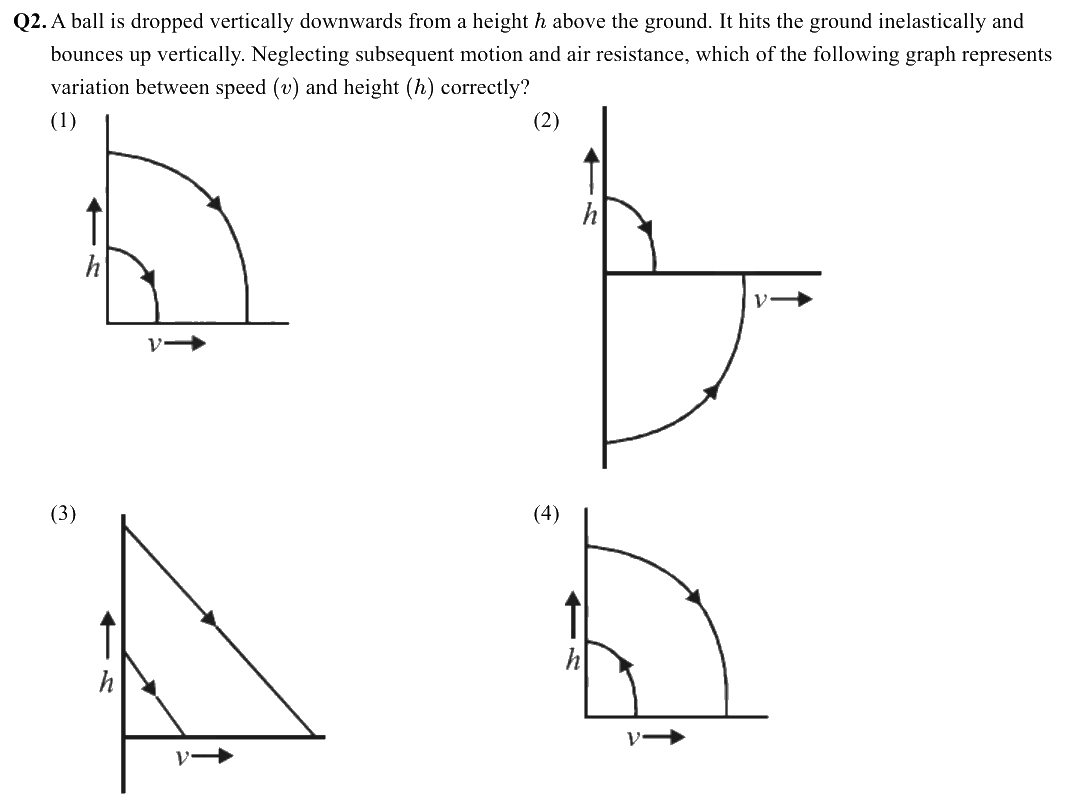
A ball is dropped vertically downwards from a height $h$ above the ground. It hits the ground inelastically and bounces up vertically. Neglecting subsequent motion and air resistance, which of the following graph represents variation between speed ($v$) and height ($h$) correctly?

The question and its figure as printed in AIEEE 2012 26 May Online. Option 1: Graph with h on the vertical axis and v on the horizontal axis, first quadrant only. Two curved arcs (quarter-ellipse like, convex away from the origin) run from a point on the h-axis down to a point on the v-axis; the outer arc starts higher and ends at larger v, the inner arc starts lower and ends at smaller v. Both arcs carry an arrowhead pointing downwards (towards the v-axis). Option 2: Graph with h on the vertical axis (pointing up) and v on the horizontal axis; the horizontal axis sits at the middle of the vertical axis, so the vertical axis extends below it. Above the horizontal axis: a small arc from a…
The question as printed in the paper.
  • A

    see figure Graph with $h$ on the vertical axis and $v$ on the horizontal axis, first quadrant only. Two curved arcs (quarter-ellipse like, convex away from the origin) run from a point on the $h$-axis down to a point on the $v$-axis; the outer arc starts higher and ends at larger $v$, the inner arc starts lower and ends at smaller $v$. Both arcs carry an arrowhead pointing downwards (towards the $v$-axis).

  • B

    see figure Graph with $h$ on the vertical axis (pointing up) and $v$ on the horizontal axis; the horizontal axis sits at the middle of the vertical axis, so the vertical axis extends below it. Above the horizontal axis: a small arc from a point on the $h$-axis curving down to a small positive $v$ on the horizontal axis, arrowhead pointing downwards. Below the horizontal axis: a larger arc from a large positive $v$ on the horizontal axis curving down and to the left to a point far down on the $h$-axis, arrowhead pointing up and to the right (towards the horizontal axis).

  • C

    see figure Graph with $h$ on the vertical axis and $v$ on the horizontal axis, first quadrant only. Two straight lines sloping down to the right, from points on the $h$-axis to points on the $v$-axis; the outer line starts higher and ends at larger $v$, the inner line starts lower and ends at smaller $v$. Both lines carry an arrowhead pointing down-right (towards the $v$-axis).

  • D

    see figure Graph with $h$ on the vertical axis and $v$ on the horizontal axis, first quadrant only. Two curved arcs (quarter-ellipse like, convex away from the origin): the outer arc runs from a high point on the $h$-axis down to a large $v$ on the $v$-axis with an arrowhead pointing downwards; the inner arc is smaller, joining a lower point on the $h$-axis and a smaller $v$ on the $v$-axis, with its arrowhead pointing upwards (up and to the left, away from the $v$-axis).

A satellite moving with velocity $v$ in a force free space collects stationary interplanetary dust at a rate of $\frac{dM}{dt} = \alpha v$ where $M$ is the mass (of satellite + dust) at that instant. The instantaneous acceleration of the satellite is

  • A

    $-\frac{\alpha v^{2}}{2M}$

  • B

    $-\frac{\alpha v^{2}}{M}$

  • C

    $-\alpha v^{2}$

  • D

    $-\frac{2\alpha v^{2}}{M}$

This question has Statement 1 and Statement 2 . Of the four choices given after the Statements, choose the one that best describes the two Statements. Statement 1: If you push on a cart being pulled by a horse so that it does not move, the cart pushes you back with an equal and opposite force. Statement 2: The cart does not move because the force described in statement 1 cancel each other.

  • A

    Statement 1 is true, Statement 2 is true, Statement 2 is the correct explanation of Statement 1.

  • B

    Statement 1 is false, Statement 2 is true.

  • C

    Statement 1 is true, Statement 2 is false.

  • D

    Statement 1 is true, Statement 2 is true, Statement 2 is not the correct explanation of Statement 1.

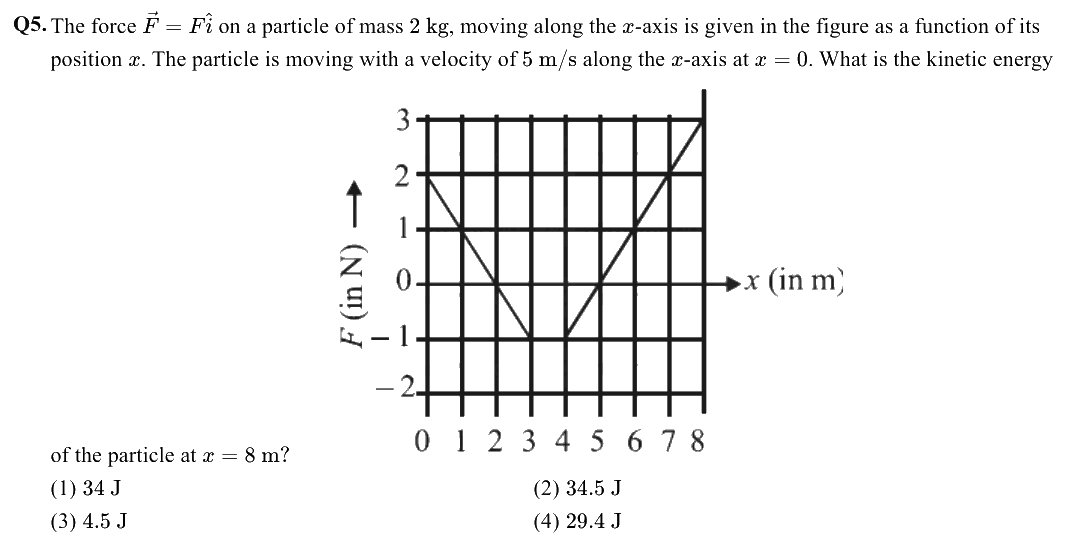
The force $\vec{F} = F\hat{i}$ on a particle of mass 2 kg, moving along the $x$-axis is given in the figure as a function of its position $x$. The particle is moving with a velocity of 5 m/s along the $x$-axis at $x = 0$. What is the kinetic energy
(see the figure above)
of the particle at $x = 8$ m?

The question and its figure as printed in AIEEE 2012 26 May Online.
The question as printed in the paper.
  • A

    34 J

  • B

    34.5 J

  • C

    4.5 J

  • D

    29.4 J

Sit the whole paper timed in EdLoop

You have seen the first 5 questions with answers. Questions 6–85 are listed below; their answers and step-by-step solutions are in the EdLoop app, free.

  1. 6Rotational MotionTension in the string of a whirled stone as a power of the radius (L conserved)
  2. 7Rotational MotionRadius of gyration of a hollow sphere from its rolling and sliding speeds on…
  3. 8GravitationSpeed at the centre of a ring of a particle released from rest on its axis
  4. 9Fluid MechanicsDependence of the terminal velocity of a small sphere in a viscous liquid on…
  5. 10ThermodynamicsRoom temperature when a working refrigerator door is left open in an insulated…
  6. 11ThermodynamicsRatio of adiabatic to isothermal final pressure on doubling the volume of a…
  7. 12WavesLength of a closed air column in resonance with a tuning fork of given frequency
  8. 13WavesSpeed of a pulse that keeps its shape, given its profile at two instants
  9. 14ElectrostaticsField lines of three equal positive charges at the corners of an equilateral…
  10. 15CapacitorsCan a conducting sphere have a capacity of one farad? Earth as the example
  11. 16CapacitorsDielectric constant of a gas from the change in the resonance frequency of an…
  12. 17Current ElectricityResistance of a wire bent in half and twisted together to make a shorter…
  13. 18Current ElectricityPotentiometer balance when a cell is loaded by a resistor equal to its…
  14. 19Magnetic Effects of CurrentForce on a 2 m wire carrying current opposite to an infinite wire 10 cm away
  15. 20Electromagnetic WavesE amplitude and wavelength of a radio wave from its frequency and B amplitude
  16. 21Electromagnetic WavesOrder of frequencies of X-rays, gamma rays and ultraviolet rays
  17. 22Ray OpticsWhich colours of a red, green and blue beam leave the hypotenuse of a…
  18. 23Wave OpticsCan a telescope of given aperture resolve a wire mesh on a window at a given…
  19. 24Wave OpticsRatio of maximum to minimum intensity in Young's experiment for slits with…
  20. 25Dual Nature of Matter &…Pick the wrong statement about photoelectrons emitted by light of frequency v
  21. 26AtomsGraph of the speed of the electron in a hydrogen atom against the principal…
  22. 27NucleiCounting rate of a radioactive source at an intermediate time from two readings
  23. 28Semiconductor ElectronicsSingle gate equivalent to two NOT gates feeding a NOR gate

Chemistry

29 questions · Questions 29–57
  1. 29Mole Concept & StoichiometryFormula of a volatile metal chloride from vapour density and % chlorine
  2. 30Atomic StructureIncreasing energy order of four electrons from their n and l values
  3. 31Periodic Table & PeriodicityOrder of second ionisation enthalpies of C, N, O and F
  4. 32Chemical Bonding &…Which two of NI3, I3-, SO3 2- and NO3- are trigonal pyramidal
  5. 33Chemical Bonding &…Which disubstituted compound has a net dipole moment
  6. 34States of MatterRatio of most probable, average and rms molecular speeds
  7. 35Chemical ThermodynamicsEntropy change of one mole of ideal gas expanding to half its pressure
  8. 36Chemical EquilibriumKc for the formation of SO3 from SO2 and O2 in a one-litre vessel
  9. 37Ionic EquilibriumSolubility product of PbI2 from its solubility in g per litre
  10. 38Amines & Nitrogen CompoundsBasicity order of piperidine, pyridine, morpholine and pyrrole
  11. 39General Organic ChemistryType of isomerism between maleic acid and fumaric acid
  12. 40General Organic ChemistryPick the antiaromatic species among six rings and ions
  13. 41HydrocarbonsProduct after allylic chlorination, hydrolysis, HOCl addition and alkali on…
  14. 42Environmental ChemistryPollutants responsible for depletion of the ozone layer
  15. 43States of MatterFind the incorrect statement about crystal defects, packing and conductivity
  16. 44SolutionsPercentage dissociation of HF from the freezing point of its solution
  17. 45ElectrochemistryStandard potential of the Cu+/Cu couple from two other copper couples
  18. 46Chemical KineticsActivation energy when the rate doubles on heating from 298 K to 308 K
  19. 47Surface ChemistryMethod used to purify a colloidal solution
  20. 48General Principles of…Froth stabiliser used in the froth flotation process
  21. 49p-Block ElementsCount S-S bonds in SO3, thiosulphate, dithionate and peroxodisulphate
  22. 50d- and f-Block ElementsLanthanoid that forms a stable +4 oxidation state
  23. 51Atomic StructureUnpaired electrons in a gadolinium atom
  24. 52Coordination CompoundsGeometrical isomers of a square planar platinum complex with four different…
  25. 53HydrocarbonsProduct of hydration of propyne
  26. 54Aldehydes, Ketones &…What Tollens' reagent and Fehling's solution are used to distinguish
  27. 55PolymersReactant that makes Bakelite from phenol
  28. 56Chemistry in Everyday LifeClass of drug to which sulphonamides belong
  29. 57BiomoleculesIdentify the correct statement about DNA and RNA

Maths

28 questions · Questions 58–85
  1. 58Quadratic Equationsx-axis crossings of 4ax^2 + 3bx + 2c when 1 is a root of ax^2 + bx + c
  2. 59Complex NumbersSum of the squared moduli of the sum and difference of two complex numbers
  3. 60Permutations & CombinationsSeven women and seven men at a round table with a man beside every woman
  4. 61Sequences & SeriesEqual arithmetic means of two pairs of terms of an AP: relation between the…
  5. 62Sequences & SeriesSum of an alternating-pattern squares series for odd n, given the sum for even n
  6. 63Binomial TheoremMiddle term of a product of two binomials in 1 - 1/x and 1 - x
  7. 64TrigonometryExact value of cos 255 degrees plus sin 195 degrees
  8. 65Straight LinesHorizontal line through the intersection of two lines with parameters a and b
  9. 66Straight LinesParallel and perpendicular pairs among four given straight lines
  10. 67CirclesNumber of common tangents to two circles given by general equations
  11. 68ParabolaSlope of the normal at the other end of a chord perpendicular to the axis
  12. 69EllipseParabola touched by the normal to an ellipse at a given point
  13. 70Limits, Continuity &…Limit of sin(pi cos^2 x) divided by x^2 as x approaches zero
  14. 71Mathematical ReasoningNegation of an if-then statement about the sun and playing tennis
  15. 72StatisticsVariance of the first n odd natural numbers and a claimed sum of their squares
  16. 73MatricesProduct of two lower triangular 3 by 3 matrices
  17. 74DeterminantsNon-trivial solution of a homogeneous 3 by 3 system: check a claimed value of k
  18. 75Limits, Continuity &…Differentiability at zero of a|sin x| + b e^|x| + c|x|^3
  19. 76Applications of DerivativesDoes f(x) = x^3 + 1 have a local extremum where its derivative vanishes?
  20. 77Applications of DerivativesRate of increase of the area of a heated circular plate with growing radius
  21. 78Indefinite IntegrationIntegral of 1 over sin^6 x as a polynomial in cot x or tan x
  22. 79Definite IntegrationIntegral over a symmetric interval of [x^2] plus a logarithm of (2 - x)/(2 + x)
  23. 80Area Under CurvesArea enclosed by the parabola y^2 = 4x and the line 2x - 3y + 4 = 0
  24. 81Differential EquationsIntegrating factor of a linear differential equation with coefficient (x^2 - 1)
  25. 82Three Dimensional GeometryDistance of a point from a line given by a point and a direction vector
  26. 83Three Dimensional GeometryParallel or perpendicular among three given planes
  27. 84Three Dimensional GeometryPlane containing a given line and a given point
  28. 85ProbabilityUrn with two balls of unknown colours: a white ball is added and one is drawn

Chapters in this paper

Get EdLoop – freeOpen on the web