EdLoop PYQs · free, no ads · questions and answers here, step-by-step solutions in the EdLoop app
PYQs · free, no adsOpen on the web (app.edloop.in)Get EdLoop – free on Google Play
MathsDifferential Equations

Differential Equations: JEE Main PYQs 2002–2026

Every Differential Equations question from past JEE Main and AIEEE papers, with options and answers. Newest first.

255questions
191papers covered
4.6%of Mathematics questions, 2019–2026
2002–2026years

Guide at a glance

Differential equations is a prominent calculus chapter under Unit 9: Differential Equations in the Class 12 curriculum, securing rank 8 among the 29 chapters in the subject.

Most asked sub-topics

First Order Equations226
Basics & Formation18
Applications11

Practise these in EdLoop

Attempt every Differential Equations question timed, see the step-by-step solution and track what you get wrong. Free.

Start practice

MCQ, single correct

205 questions
1JEE Main 2026 · 8 Apr · Shift 2MCQOpen question page ↗

Let $y = y(x)$ be the solution of the differential equation

$x\sqrt{1 - x^2}\,dy + \left(y\sqrt{1 - x^2} - x\cos^{-1}x\right)dx = 0$, $x \in (0, 1)$, $\lim_{x\to1^-}y(x) = 1$. Then $y\left(\dfrac{1}{2}\right)$ equals :

  • A

    $3 - \dfrac{\pi}{\sqrt{3}}$

  • B

    $4 - \sqrt{3}\,\pi$

  • C

    $4 - \dfrac{2\pi}{\sqrt{3}}$

  • D

    $3 - \dfrac{\pi}{2\sqrt{3}}$

2JEE Main 2026 · 4 Apr · Shift 1MCQOpen question page ↗

Let $y = y(x)$ be the solution of the differential equation $\frac{dy}{dx} = \left(1 + x + x^2\right)\left(1 - y + y^2\right)$, $y(0) = \frac{1}{2}$. Then $(2y(1) - 1)$ is equal to

  • A

    $\sqrt{3}\tan\left(\frac{11\sqrt{3}}{6}\right)$

  • B

    $\frac{\sqrt{3}}{2}\tan\left(\frac{11\sqrt{3}}{12}\right)$

  • C

    $\sqrt{3}\tan\left(\frac{11\sqrt{3}}{12}\right)$

  • D

    $\frac{\sqrt{3}}{2}\tan\left(\frac{11\sqrt{3}}{6}\right)$

3JEE Main 2026 · 4 Apr · Shift 2MCQOpen question page ↗

Let $y = y(x)$ be the solution of the differential equation:

$\frac{dy}{dx} + \left(\frac{6x^2 + \left(3x^2 + 2x^3 + 4\right)e^{-2x}}{\left(x^3 + 2\right)\left(2 + e^{-2x}\right)}\right)y = 2 + e^{-2x}$,

$x \in (-1, 2)$, satisfying $y(0) = \frac{3}{2}$. If $y(1) = \alpha\left(2 + e^{-2}\right)$, then $\alpha$ is equal to:

  • A

    $\frac{13}{8}$

  • B

    $\frac{6}{13}$

  • C

    $\frac{12}{13}$

  • D

    $\frac{13}{12}$

4JEE Main 2026 · 2 Apr · Shift 1MCQOpen question page ↗

If the curve $y = f(x)$ passes through the point $(1, \mathrm{e})$ and satisfies the differential equation $dy = y\,(2 + \log_e x)\,dx$, $x > 0$, then $f(\mathrm{e})$ is equal to :

  • A

    $\mathrm{e}^{\mathrm{e}}$

  • B

    $\mathrm{e}^{\mathrm{e}^2}$

  • C

    $\mathrm{e}^{2\mathrm{e}}$

  • D

    $\mathrm{e}^{2^{\mathrm{e}}}$

5JEE Main 2026 · 2 Apr · Shift 1MCQOpen question page ↗

Let $y = y(x)$ be the solution curve of the differential equation
$(1 + \sin x)\frac{dy}{dx} + (y+1)\cos x = 0$, $y(0) = 0$. If the curve $y = y(x)$ passes through the point $\left(\alpha, \frac{-1}{2}\right)$, then a value of $\alpha$ is :

  • A

    $\frac{\pi}{6}$

  • B

    $\frac{\pi}{4}$

  • C

    $\frac{\pi}{3}$

  • D

    $\frac{\pi}{2}$

6JEE Main 2026 · 2 Apr · Shift 2MCQOpen question page ↗

Let $x = x(y)$ be the solution of the differential equation $2y^2\frac{dx}{dy} - 2xy + x^2 = 0$, $y > 1$, $x(\mathrm{e}) = \mathrm{e}$. Then $x(\mathrm{e}^2)$ is equal to :

  • A

    $\frac{3}{2}\mathrm{e}^2$

  • B

    $\frac{2}{3}\mathrm{e}^2$

  • C

    $\mathrm{e}^2$

  • D

    $2\mathrm{e}^2$

7JEE Main 2026 · 28 Jan · Shift 1MCQOpen question page ↗

Let $y = y(x)$ be the solution of the differential equation

$x\dfrac{dy}{dx} - \sin 2y = x^3\left(2 - x^3\right)\cos^2 y$, $x \neq 0$.

If $y(2) = 0$, then $\tan(y(1))$ is equal to

  • A

    $\frac{3}{4}$

  • B

    $-\frac{3}{4}$

  • C

    $\frac{7}{4}$

  • D

    $-\frac{7}{4}$

8JEE Main 2026 · 28 Jan · Shift 2MCQOpen question page ↗

Let $y = y(x)$ be the solution of the differential equation $x\dfrac{dy}{dx} - y = x^2\cot x$, $x \in (0, \pi)$. If $y\left(\dfrac{\pi}{2}\right) = \dfrac{\pi}{2}$, then $6y\left(\dfrac{\pi}{6}\right) - 8y\left(\dfrac{\pi}{4}\right)$ is equal to :

  • A

    $3\pi$

  • B

    $-3\pi$

  • C

    $\pi$

  • D

    $-\pi$

9JEE Main 2026 · 24 Jan · Shift 2MCQOpen question page ↗

Let $y = y(x)$ be a differentiable function in the interval $(0, \infty)$ such that $y(1) = 2$, and $\displaystyle\lim_{t \to x}\left(\dfrac{t^2y(x) - x^2y(t)}{x - t}\right) = 3$ for each $x > 0$. Then $2y(2)$ is equal to

  • A

    23

  • B

    12

  • C

    18

  • D

    27

10JEE Main 2026 · 23 Jan · Shift 1MCQOpen question page ↗

Let $y = y(x)$ be the solution of the differential equation $x^4dy + (4x^3y + 2\sin x)dx = 0$, $x > 0$, $y\left(\dfrac{\pi}{2}\right) = 0$. Then $\pi^4 y\left(\dfrac{\pi}{3}\right)$ is equal to :

  • A

    92

  • B

    81

  • C

    72

  • D

    64

11JEE Main 2026 · 22 Jan · Shift 1MCQOpen question page ↗

Let the solution curve of the differential equation $x\,dy - y\,dx = \sqrt{x^2 + y^2}\,dx$, $x > 0$, $y(1) = 0$, be $y = y(x)$. Then $y(3)$ is equal to

  • A

    4

  • B

    2

  • C

    1

  • D

    6

12JEE Main 2026 · 22 Jan · Shift 2MCQOpen question page ↗

If $y = y(x)$ satisfies the differential equation

$16\left(\sqrt{x + 9\sqrt{x}}\right)\left(4 + \sqrt{9 + \sqrt{x}}\right)\cos y\,dy = (1 + 2\sin y)dx$, $x > 0$ and $y(256) = \dfrac{\pi}{2}$, $y(49) = \alpha$, then $2\sin\alpha$ is equal to :

  • A

    $2(\sqrt{2} - 1)$

  • B

    $\sqrt{2} - 1$

  • C

    $2\sqrt{2} - 1$

  • D

    $3(\sqrt{2} - 1)$

13JEE Main 2026 · 21 Jan · Shift 1MCQOpen question page ↗

Let $y = y(x)$ be the solution curve of the differential equation $(1 + x^2)\,dy + (y - \tan^{-1}x)\,dx = 0$, $y(0) = 1$. Then the value of $y(1)$ is :

  • A

    $\frac{4}{e^{\pi/4}} - \frac{\pi}{2} - 1$

  • B

    $\frac{2}{e^{\pi/4}} + \frac{\pi}{4} - 1$

  • C

    $\frac{2}{e^{\pi/4}} - \frac{\pi}{4} - 1$

  • D

    $\frac{4}{e^{\pi/4}} + \frac{\pi}{2} - 1$

14JEE Main 2026 · 21 Jan · Shift 2MCQOpen question page ↗

Let $y = y(x)$ be the solution of the differential equation $\sec x\dfrac{dy}{dx} - 2y = 2 + 3\sin x$, $x \in \left(-\dfrac{\pi}{2}, \dfrac{\pi}{2}\right)$, $y(0) = -\dfrac{7}{4}$. Then $y\left(\dfrac{\pi}{6}\right)$ is equal to :

  • A

    $-\frac{5}{2}$

  • B

    $-\frac{5}{4}$

  • C

    $-3\sqrt{2} - 7$

  • D

    $-3\sqrt{3} - 7$

15JEE Main 2025 · 8 Apr · Shift 2MCQOpen question page ↗

Let $f(x) = x - 1$ and $g(x) = e^x$ for $x \in \mathbb{R}$. If $\frac{dy}{dx} = \left(e^{-2\sqrt{x}}g(f(f(x))) - \frac{y}{\sqrt{x}}\right), y(0) = 0$, then $y(1)$ is

  • A

    $\frac{2e - 1}{e^3}$

  • B

    $\frac{e - 1}{e^4}$

  • C

    $\frac{1 - e^3}{e^4}$

  • D

    $\frac{1 - e^2}{e^4}$

16JEE Main 2025 · 7 Apr · Shift 1MCQOpen question page ↗

Let $y = y(x)$ be the solution curve of the differential equation $x\left(x^2 + e^x\right)dy + \left(e^x(x - 2)y - x^3\right)dx = 0, x > 0$, passing through the point $(1, 0)$. Then $y(2)$ is equal to

  • A

    $\frac{4}{4 + e^2}$

  • B

    $\frac{2}{2 + e^2}$

  • C

    $\frac{2}{2 - e^2}$

  • D

    $\frac{4}{4 - e^2}$

17JEE Main 2025 · 7 Apr · Shift 2MCQOpen question page ↗

Let $y = y(x)$ be the solution of the differential equation $\left(x^2 + 1\right)y' - 2xy = \left(x^4 + 2x^2 + 1\right)\cos x$, $y(0) = 1$. Then $\int_{-3}^3 y(x)dx$ is :

  • A

    24

  • B

    30

  • C

    18

  • D

    36

18JEE Main 2025 · 4 Apr · Shift 2MCQOpen question page ↗

If a curve $y = y(x)$ passes through the point $\left(1, \frac{\pi}{2}\right)$ and satisfies the differential equation $\left(7x^4\cot y - e^x\operatorname{cosec}y\right)\frac{dx}{dy} = x^5, x \geq 1$, then at $x = 2$, the value of $\cos y$ is :

  • A

    $\frac{2e^2 - e}{128}$

  • B

    $\frac{2e^2 - e}{64}$

  • C

    $\frac{2e^2 + e}{128}$

  • D

    $\frac{2e^2 + e}{64}$

19JEE Main 2025 · 3 Apr · Shift 1MCQOpen question page ↗

Let $g$ be a differentiable function such that $\int_0^x g(t)dt = x - \int_0^x tg(t)dt, x \geq 0$ and let $y = y(x)$ satisfy the differential equation $\frac{dy}{dx} - y\tan x = 2(x + 1)\sec x\,g(x), x \in \left[0, \frac{\pi}{2}\right)$. If $y(0) = 0$, then $y\left(\frac{\pi}{3}\right)$ is equal to

  • A

    $\frac{2\pi}{3}$

  • B

    $\frac{4\pi}{3}$

  • C

    $\frac{2\pi}{3\sqrt{3}}$

  • D

    $\frac{4\pi}{3\sqrt{3}}$

20JEE Main 2025 · 3 Apr · Shift 2MCQOpen question page ↗

Let $y = y(x)$ be the solution of the differential equation

$\frac{dy}{dx} + 3\left(\tan^2 x\right)y + 3y = \sec^2 x, y(0) = \frac{1}{3} + e^3$. Then $y\left(\frac{\pi}{4}\right)$ is equal to

  • A

    $\frac{2}{3}$

  • B

    $\frac{4}{3} + e^3$

  • C

    $\frac{4}{3}$

  • D

    $\frac{2}{3} + e^3$

21JEE Main 2025 · 29 Jan · Shift 1MCQOpen question page ↗

Let $y = y(x)$ be the solution of the differential equation $\cos x(\log_e(\cos x))^2\mathrm{d}y + (\sin x - 3y\sin x\log_e(\cos x))\mathrm{d}x = 0, x \in \left(0, \frac{\pi}{2}\right)$. If $y\left(\frac{\pi}{4}\right) = \frac{-1}{\log_e 2}$, then $y\left(\frac{\pi}{6}\right)$ is equal to :

  • A

    $\frac{1}{\log_e(3) - \log_e(4)}$

  • B

    $\frac{2}{\log_e(3) - \log_e(4)}$

  • C

    $\frac{1}{\log_e(4) - \log_e(3)}$

  • D

    $-\frac{1}{\log_e(4)}$

22JEE Main 2025 · 29 Jan · Shift 2MCQOpen question page ↗

If for the solution curve $y = f(x)$ of the differential equation $\frac{dy}{dx} + (\tan x)y = \frac{2 + \sec x}{(1 + 2\sec x)^2}$, $x \in \left(\frac{-\pi}{2}, \frac{\pi}{2}\right), f\left(\frac{\pi}{3}\right) = \frac{\sqrt{3}}{10}$, then $f\left(\frac{\pi}{4}\right)$ is equal to :

  • A

    $\frac{\sqrt{3} + 1}{10(4 + \sqrt{3})}$

  • B

    $\frac{5 - \sqrt{3}}{2\sqrt{2}}$

  • C

    $\frac{9\sqrt{3} + 3}{10(4 + \sqrt{3})}$

  • D

    $\frac{4 - \sqrt{2}}{14}$

23JEE Main 2025 · 24 Jan · Shift 1MCQOpen question page ↗

Let y = y(x) be the solution of the differential equation $\left(xy - 5x^2\sqrt{1 + x^2}\right)dx + (1 + x^2)dy = 0$, $y(0) = 0$. Then $y(\sqrt{3})$ is equal to

  • A

    $\sqrt{\frac{15}{2}}$

  • B

    $\frac{5\sqrt{3}}{2}$

  • C

    $2\sqrt{2}$

  • D

    $\sqrt{\frac{14}{3}}$

24JEE Main 2025 · 24 Jan · Shift 2MCQOpen question page ↗

Let $f : (0, \infty) \rightarrow \mathbf{R}$ be a function which is differentiable at all points of its domain and satisfies the condition $x^2f'(x) = 2xf(x) + 3$, with $f(1) = 4$. Then $2f(2)$ is equal to :

  • A

    39

  • B

    19

  • C

    29

  • D

    23

25JEE Main 2025 · 23 Jan · Shift 1MCQOpen question page ↗

Let a curve $y = f(x)$ pass through the points $(0, 5)$ and $\left(\log_e 2, k\right)$. If the curve satisfies the differential equation $2(3 + y)e^{2x}dx - \left(7 + e^{2x}\right)dy = 0$, then $k$ is equal to

  • A

    4

  • B

    32

  • C

    8

  • D

    16

26JEE Main 2025 · 23 Jan · Shift 2MCQOpen question page ↗

Let $x = x(y)$ be the solution of the differential equation $y = \left(x - y\frac{\mathrm{d}x}{\mathrm{d}y}\right)\sin\left(\frac{x}{y}\right)$, $y > 0$ and $x(1) = \frac{\pi}{2}$. Then $\cos(x(2))$ is equal to :

  • A

    $1 - 2\left(\log_e 2\right)^2$

  • B

    $1 - 2\left(\log_e 2\right)$

  • C

    $2\left(\log_e 2\right) - 1$

  • D

    $2\left(\log_e 2\right)^2 - 1$

27JEE Main 2025 · 22 Jan · Shift 1MCQOpen question page ↗

Let $x = x(y)$ be the solution of the differential equation $y^2\,\mathrm{d}x + \left(x - \frac{1}{y}\right)\mathrm{d}y = 0$. If $x(1) = 1$, then $x\left(\frac{1}{2}\right)$ is :

  • A

    $\frac{1}{2} + \mathrm{e}$

  • B

    $3 + \mathrm{e}$

  • C

    $3 - e$

  • D

    $\frac{3}{2} + e$

28JEE Main 2025 · 22 Jan · Shift 2MCQOpen question page ↗

If $x = f(y)$ is the solution of the differential equation $(1 + y^2) + \left(x - 2\mathrm{e}^{\tan^{-1} y}\right)\frac{\mathrm{dy}}{\mathrm{d}x} = 0$, $y \in \left(-\frac{\pi}{2}, \frac{\pi}{2}\right)$ with $f(0) = 1$, then $f\left(\frac{1}{\sqrt{3}}\right)$ is equal to :

  • A

    $e^{\pi/12}$

  • B

    $e^{\pi/4}$

  • C

    $e^{\pi/3}$

  • D

    $e^{\pi/6}$

29JEE Main 2024 · 9 Apr · Shift 1MCQOpen question page ↗

The solution curve, of the differential equation $2y\frac{\mathrm{dy}}{\mathrm{dx}} + 3 = 5\frac{\mathrm{dy}}{\mathrm{dx}}$, passing through the point $(0, 1)$ is a conic, whose vertex lies on the line:

  • A

    $2x + 3y = 9$

  • B

    $2x + 3y = -9$

  • C

    $2x + 3y = -6$

  • D

    $2x + 3y = 6$

30JEE Main 2024 · 9 Apr · Shift 1MCQOpen question page ↗

The solution of the differential equation $(x^2 + y^2)\mathrm{dx} - 5xy\,\mathrm{dy} = 0$, $y(1) = 0$, is :

  • A

    $|x^2 - 2y^2|^6 = x$

  • B

    $|x^2 - 4y^2|^6 = x$

  • C

    $|x^2 - 4y^2|^5 = x^2$

  • D

    $|x^2 - 2y^2|^5 = x^2$

31JEE Main 2024 · 8 Apr · Shift 1MCQOpen question page ↗

Let $f(x)$ be a positive function such that the area bounded by $y = f(x), y = 0$ from $x = 0$ to $x = a > 0$ is $e^{-a} + 4a^2 + a - 1$. Then the differential equation, whose general solution is $y = c_1 f(x) + c_2$, where $c_1$ and $c_2$ are arbitrary constants, is

  • A

    $(8e^x - 1)\frac{d^2y}{dx^2} + \frac{dy}{dx} = 0$

  • B

    $(8e^x - 1)\frac{d^2y}{dx^2} - \frac{dy}{dx} = 0$

  • C

    $(8e^x + 1)\frac{d^2y}{dx^2} - \frac{dy}{dx} = 0$

  • D

    $(8e^x + 1)\frac{d^2y}{dx^2} + \frac{dy}{dx} = 0$

32JEE Main 2024 · 8 Apr · Shift 1MCQOpen question page ↗

Let $y = y(x)$ be the solution of the differential equation

$(1 + y^2)e^{\tan x}dx + \cos^2 x\left(1 + e^{2\tan x}\right)dy = 0, y(0) = 1$. Then $y\left(\frac{\pi}{4}\right)$ is equal to

  • A

    $\frac{2}{e}$

  • B

    $\frac{2}{e^2}$

  • C

    $\frac{1}{e}$

  • D

    $\frac{1}{e^2}$

33JEE Main 2024 · 8 Apr · Shift 2MCQOpen question page ↗

Let $y = y(x)$ be the solution curve of the differential equation $\sec y\,\frac{dy}{dx} + 2x\sin y = x^3\cos y$, $y(1) = 0$. Then $y(\sqrt{3})$ is equal to :

  • A

    $\frac{\pi}{3}$

  • B

    $\frac{\pi}{6}$

  • C

    $\frac{\pi}{12}$

  • D

    $\frac{\pi}{4}$

34JEE Main 2024 · 6 Apr · Shift 1MCQOpen question page ↗

Let $y = y(x)$ be the solution of the differential equation $(1 + x^2)\frac{dy}{dx} + y = e^{\tan^{-1}x}$, $y(1) = 0$. Then $y(0)$ is

  • A

    $\frac{1}{2}\left(e^{\pi/2} - 1\right)$

  • B

    $\frac{1}{2}\left(1 - e^{\pi/2}\right)$

  • C

    $\frac{1}{4}\left(1 - e^{\pi/2}\right)$

  • D

    $\frac{1}{4}\left(e^{\pi/2} - 1\right)$

35JEE Main 2024 · 6 Apr · Shift 1MCQOpen question page ↗

Let $y = y(x)$ be the solution of the differential equation $(2x\log_e x)\frac{dy}{dx} + 2y = \frac{3}{x}\log_e x$, $x > 0$ and $y\left(e^{-1}\right) = 0$. Then, $y(e)$ is equal to

  • A

    $-\frac{3}{e}$

  • B

    $-\frac{3}{2e}$

  • C

    $-\frac{2}{3e}$

  • D

    $-\frac{2}{e}$

36JEE Main 2024 · 6 Apr · Shift 2MCQOpen question page ↗

Suppose the solution of the differential equation $\frac{dy}{dx} = \frac{(2+\alpha)x - \beta y + 2}{\beta x - 2\alpha y - (\beta\gamma - 4\alpha)}$ represents a circle passing through origin. Then the radius of this circle is :

  • A

    2

  • B

    $\sqrt{17}$

  • C

    $\frac{1}{2}$

  • D

    $\frac{\sqrt{17}}{2}$

37JEE Main 2024 · 5 Apr · Shift 1MCQOpen question page ↗

If $y = y(x)$ is the solution of the differential equation $\frac{dy}{dx} + 2y = \sin(2x), y(0) = \frac{3}{4}$, then $y\left(\frac{\pi}{8}\right)$ is equal to:

  • A

    $\mathrm{e}^{\pi/8}$

  • B

    $\mathrm{e}^{\pi/4}$

  • C

    $\mathrm{e}^{-\pi/4}$

  • D

    $\mathrm{e}^{-\pi/8}$

38JEE Main 2024 · 5 Apr · Shift 2MCQOpen question page ↗

The differential equation of the family of circles passing through the origin and having centre at the line $y = x$ is :

  • A

    $(x^2 - y^2 + 2xy)\,dx = (x^2 - y^2 - 2xy)\,dy$

  • B

    $(x^2 + y^2 + 2xy)\,dx = (x^2 + y^2 - 2xy)\,dy$

  • C

    $(x^2 + y^2 - 2xy)\,dx = (x^2 + y^2 + 2xy)\,dy$

  • D

    $(x^2 - y^2 + 2xy)\,dx = (x^2 - y^2 + 2xy)\,dy$

39JEE Main 2024 · 4 Apr · Shift 1MCQOpen question page ↗

If the solution $y = y(x)$ of the differential equation $(x^4 + 2x^3 + 3x^2 + 2x + 2)dy - (2x^2 + 2x + 3)dx = 0$ satisfies $y(-1) = -\frac{\pi}{4}$, then $y(0)$ is equal to :

  • A

    $\frac{\pi}{2}$

  • B

    $-\frac{\pi}{2}$

  • C

    0

  • D

    $\frac{\pi}{4}$

40JEE Main 2024 · 4 Apr · Shift 2MCQOpen question page ↗

Let $y = y(x)$ be the solution of the differential equation $(x^2 + 4)^2 dy + (2x^3 y + 8xy - 2)dx = 0$. If $y(0) = 0$, then $y(2)$ is equal to

  • A

    $\frac{\pi}{32}$

  • B

    $2\pi$

  • C

    $\frac{\pi}{8}$

  • D

    $\frac{\pi}{16}$

41JEE Main 2024 · 1 Feb · Shift 1MCQOpen question page ↗

Let $y = yx$ be the solution of the differential equation $\frac{dy}{dx} = 2xx + y^3 - xx + y - 1, y0 = 1$. Then, $\frac{1}{\sqrt{2}} + y\frac{1}{\sqrt{2}}{}^{2}$ equals:

  • A

    $\frac{4}{4 + \sqrt{e}}$

  • B

    $\frac{3}{3 - \sqrt{e}}$

  • C

    $\frac{2}{1 + \sqrt{e}}$

  • D

    $\frac{1}{2 - \sqrt{e}}$

42JEE Main 2024 · 1 Feb · Shift 2MCQOpen question page ↗

Let $\alpha$ be a non-zero real number. Suppose $f: R \rightarrow R$ is a differentiable function such that $f0 = 1$ and $\lim_{x \to -\infty} fx = 1$. If $f'x = \alpha fx + 3$, for all $x \in R$, then $f -\log_e 2$ is equal to ______.

  • A

    1

  • B

    5

  • C

    9

  • D

    7

43JEE Main 2024 · 31 Jan · Shift 1MCQOpen question page ↗

The solution curve of the differential equation $y\frac{dx}{dy} = x\log_e x - \log_e y + 1$, $x > 0$, $y > 0$ passing through the point $(e, 1)$ is

  • A

    $\log_e\frac{y}{x} = x$

  • B

    $\log_e\frac{y}{x} = y^2$

  • C

    $\log_e\frac{x}{y} = y$

  • D

    $2\log_e\frac{x}{y} = y + 1$

44JEE Main 2024 · 31 Jan · Shift 1MCQOpen question page ↗

Let $y = y(x)$ be the solution of the differential equation $\frac{dy}{dx} = \frac{\tan x + y}{\sin x\sec x - \sin x\tan x}$, $x \in 0,\ \frac{\pi}{2}$ satisfying the condition $y\frac{\pi}{4} = 2$. Then, $y\frac{\pi}{3}$ is

  • A

    $\sqrt{3}\ 2 + \log_e\sqrt{3}$

  • B

    $\frac{\sqrt{3}}{2}\ 2 + \log_e 3$

  • C

    $\sqrt{3}\ 1 + 2\log_e 3$

  • D

    $\sqrt{3}\ 2 + \log_e 3$

45JEE Main 2024 · 31 Jan · Shift 2MCQOpen question page ↗

The temperature $T(t)$ of a body at time $t = 0$ is $160^\circ$ F and it decreases continuously as per the differential equation $\frac{dT}{dt} = -KT - 80$, where $K$ is positive constant. If $T(15) = 120^\circ$ F, then $T(45)$ is equal to

  • A

    $85^\circ$ F

  • B

    $95^\circ$ F

  • C

    $90^\circ$ F

  • D

    $80^\circ$ F

46JEE Main 2024 · 30 Jan · Shift 1MCQOpen question page ↗

Let $y = y(x)$ be the solution of the differential equation $\sec x\,dy + \{2(1-x)\tan x + x(2-x)\}dx = 0$ such that $y(0) = 2$. Then $y(2)$ is equal to :

  • A

    2

  • B

    $2\{1 - \sin(2)\}$

  • C

    $2\{\sin(2) + 1\}$

  • D

    1

47JEE Main 2024 · 29 Jan · Shift 1MCQOpen question page ↗

A function $y = f(x)$ satisfies $f(x)\sin 2x + \sin x - \left(1 + \cos^2 x\right)f'(x) = 0$ with condition $f(0) = 0$. Then $f\left(\frac{\pi}{2}\right)$ is equal to

  • A

    1

  • B

    0

  • C

    $-1$

  • D

    2

48JEE Main 2024 · 29 Jan · Shift 2MCQOpen question page ↗

If $\sin\left(\frac{y}{x}\right) = \log_e|x| + \frac{\alpha}{2}$ is the solution of the differential equation $x\cos\left(\frac{y}{x}\right)\frac{dy}{dx} = y\cos\left(\frac{y}{x}\right) + x$ and $y(1) = \frac{\pi}{3}$, then $\alpha^2$ is equal to

  • A

    3

  • B

    12

  • C

    4

  • D

    9

49JEE Main 2024 · 27 Jan · Shift 1MCQOpen question page ↗

Let $x = x(t)$ and $y = y(t)$ be solutions of the differential equations $\frac{dx}{dt} + ax = 0$ and $\frac{dy}{dt} + by = 0$ respectively, a, b $\in$ R. Given that $x(0) = 2$ ; $y(0) = 1$ and $3\,y(1) = 2\,x(1)$, the value of $t$, for which $x(t) = y(t)$, is :

  • A

    $\log_{\frac{2}{3}} 2$

  • B

    $\log_{4} 3$

  • C

    $\log_{3} 4$

  • D

    $\log_{\frac{4}{3}} 2$

50JEE Main 2024 · 27 Jan · Shift 2MCQOpen question page ↗

If $y = y(x)$ is the solution curve of the differential equation $x^2 - 4dy - y^2 - 3ydx = 0$, $x > 2$, $y(4) = \frac{3}{2}$ and the slope of the curve is never zero, then the value of $y(10)$ equals :

  • A

    $\frac{3}{1 + (8)^{\frac{1}{4}}}$

  • B

    $\frac{3}{1 + 2\sqrt{2}}$

  • C

    $\frac{3}{1 - 2\sqrt{2}}$

  • D

    $\frac{3}{1 - (8)^{\frac{1}{4}}}$

51JEE Main 2023 · 15 Apr · Shift 1MCQOpen question page ↗

Let $x = x(y)$ be the solution of the differential equation $2(y + 2)\log_e(y + 2)dx + (x + 4 - 2\log_e(y + 2))dy = 0$, $y > -1$ with $x(e^4 - 2) = 1$. Then $x(e^9 - 2)$ is equal to

  • A

    3

  • B

    $\frac{4}{9}$

  • C

    $\frac{32}{9}$

  • D

    $\frac{10}{3}$

52JEE Main 2023 · 13 Apr · Shift 1MCQOpen question page ↗

Let $y = y_1(x)$ and $y = y_2(x)$ be the solution curves of the differential equation $\frac{dy}{dx} = y + 7$ with initial conditions $y_1(0) = 0$ and $y_2(0) = 1$ respectively. Then the curves $y = y_1(x)$ and $y = y_2(x)$ intersect at

  • A

    no point

  • B

    two points

  • C

    one point

  • D

    infinite number of points

53JEE Main 2023 · 12 Apr · Shift 1MCQOpen question page ↗

Let $y = y(x)$, $y > 0$, be a solution curve of the differential equation $\left(1 + x^2\right)dy = y(x - y)dx$. If $y(0) = 1$ and $y\left(2\sqrt{2}\right) = \beta$, then

  • A

    $e^{3\beta - 1} = e\left(3 + 2\sqrt{2}\right)$

  • B

    $e^{3\beta - 1} = e\left(5 + \sqrt{2}\right)$

  • C

    $e^{\beta - 1} = e^{-2}\left(3 + 2\sqrt{2}\right)$

  • D

    $e^{\beta - 1} = e^{-2}\left(5 + \sqrt{2}\right)$

54JEE Main 2023 · 11 Apr · Shift 1MCQOpen question page ↗

Let $y = yx$ be a solution curve of the differential equation, $1 - x^2y^2 dx = ydx + xdy$, If the line $x = 1$ intersects the curve $y = yx$ at $y = 2$ and the line $x = 2$ intersects the curve $y = yx$ at $y = \alpha$, then a value of $\alpha$ is

  • A

    $\frac{1 - 3e^2}{23e^2 + 1}$

  • B

    $\frac{1 + 3e^2}{23e^2 - 1}$

  • C

    $\frac{3e^2}{23e^2 - 1}$

  • D

    $\frac{3e^2}{23e^2 + 1}$

55JEE Main 2023 · 11 Apr · Shift 2MCQOpen question page ↗

Let $y = y(x)$ be the solution of the differential equation $\frac{dy}{dx} + \frac{5}{x(x^5 + 1)}y = \frac{(x^5 + 1)^2}{x^7}$, $x > 0$. If $y(1) = 2$, then $y(2)$ is equal to

  • A

    $\frac{637}{128}$

  • B

    $\frac{679}{128}$

  • C

    $\frac{693}{128}$

  • D

    $\frac{697}{128}$

56JEE Main 2023 · 10 Apr · Shift 1MCQOpen question page ↗

The slope of tangent at any point $x, y$ on a curve $y = yx$ is $\frac{x^2 + y^2}{2xy}$, $x > 0$. If $y2 = 0$, then a value of $y8$ is

  • A

    $-4\sqrt{2}$

  • B

    $2\sqrt{3}$

  • C

    $-2\sqrt{3}$

  • D

    $4\sqrt{3}$

57JEE Main 2023 · 6 Apr · Shift 2MCQOpen question page ↗

If the solution curve $f(x, y) = 0$ of the differential equation $(1 + \log_e x)\frac{dx}{dy} - x\log_e x = e^y$, $x > 0$, passes through the points $(1, 0)$ and $(a, 2)$, then $a^a$ is equal to

  • A

    $e^{2e^2}$

  • B

    $e^{e^2}$

  • C

    $e^{\sqrt{2e}^{\,2}}$

  • D

    $e^{2e\sqrt{2}}$

58JEE Main 2023 · 1 Feb · Shift 1MCQOpen question page ↗

The area enclosed by the closed curve $C$ given by the differential equation $\dfrac{dy}{dx} + \dfrac{x + a}{y - 2} = 0, y1 = 0$ is $4\pi$. Let $P$ and $Q$ be the points of intersection of the curve $C$ and the $y$-axis. If normals at $P$ and $Q$ on the curve $C$ intersect $x$-axis at points $R$ and $S$ respectively, then the length of the line segment $RS$ is

  • A

    $2\sqrt{3}$

  • B

    $\dfrac{2\sqrt{3}}{3}$

  • C

    2

  • D

    $\dfrac{4\sqrt{3}}{3}$

59JEE Main 2023 · 1 Feb · Shift 1MCQOpen question page ↗

If $y = yx$ is the solution curve of the differential equation $\dfrac{dy}{dx} + y\tan x = x\sec x$, $0 \leq x \leq \dfrac{\pi}{3}$, $y0 = 1$, then $y\dfrac{\pi}{6}$ is equal to

  • A

    $\dfrac{\pi}{12} - \dfrac{\sqrt{3}}{2}\log_e\dfrac{2}{e\sqrt{3}}$

  • B

    $\dfrac{\pi}{12} + \dfrac{\sqrt{3}}{2}\log_e\dfrac{2\sqrt{3}}{e}$

  • C

    $\dfrac{\pi}{12} - \dfrac{\sqrt{3}}{2}\log_e\dfrac{2\sqrt{3}}{e}$

  • D

    $\dfrac{\pi}{12} + \dfrac{\sqrt{3}}{2}\log_e\dfrac{2}{e\sqrt{3}}$

60JEE Main 2023 · 1 Feb · Shift 2MCQOpen question page ↗

Let $\alpha x = \exp(x^\beta y^\gamma)$ be the solution of the differential equation $2x^2 y dy - (1 - xy^2)dx = 0$, $x > 0, y(2) = \sqrt{\log_e 2}$. Then $\alpha + \beta - \gamma$ equals :

  • A

    1

  • B

    $-1$

  • C

    0

  • D

    3

61JEE Main 2023 · 31 Jan · Shift 2MCQOpen question page ↗

Let $y = y(x)$ be the solution of the differential equation $\left(3y^2 - 5x^2\right)y\,dx + 2x\left(x^2 - y^2\right)dy = 0$ such that $y(1) = 1$. Then $|(y(2))^3 - 12y(2)|$ is equal to :

  • A

    64

  • B

    $32\sqrt{2}$

  • C

    32

  • D

    $16\sqrt{2}$

62JEE Main 2023 · 30 Jan · Shift 1MCQOpen question page ↗

Let the solution curve $y = y(x)$ of the differential equation $\frac{dy}{dx} - \frac{3x^5\tan^{-1}x^3}{1 + x^{6\frac{3}{2}}}y = 2x\ \exp\frac{x^3 - \tan^{-1}x^3}{\sqrt{(1 + x)^6}}$ pass through the origin. Then $y(1)$ is equal to:

  • A

    $\exp\frac{4 - \pi}{4\sqrt{2}}$

  • B

    $\exp\frac{\pi - 4}{4\sqrt{2}}$

  • C

    $\exp\frac{1 - \pi}{4\sqrt{2}}$

  • D

    $\exp\frac{4 + \pi}{4\sqrt{2}}$

63JEE Main 2023 · 30 Jan · Shift 2MCQOpen question page ↗

The solution of the differential equation $\frac{dy}{dx} = -\left(\frac{x^2 + 3y^2}{3x^2 + y^2}\right)$, $y(1) = 0$ is

  • A

    $\log_e|x + y| - \frac{xy}{(x + y)^2} = 0$

  • B

    $\log_e|x + y| + \frac{xy}{(x + y)^2} = 0$

  • C

    $\log_e|x + y| + \frac{2xy}{(x + y)^2} = 0$

  • D

    $\log_e|x + y| - \frac{2xy}{(x + y)^2} = 0$

64JEE Main 2023 · 29 Jan · Shift 1MCQOpen question page ↗

Let $\mathrm{y} = f(\mathrm{x})$ be the solution of the differential equation $y(x + 1)dx - x^2dy = 0$, $y(1) = e$. Then $\lim_{x \to 0^+} f\left(x\right)$ is equal to

  • A

    0

  • B

    $\frac{1}{e}$

  • C

    $e^2$

  • D

    $\frac{1}{e^2}$

65JEE Main 2023 · 29 Jan · Shift 2MCQOpen question page ↗

Let $y = y(x)$ be the solution of the differential equation $x\log_e x \frac{dy}{dx} + y = x^2\log_e x$, $(x > 1)$. If $y(2) = 2$, then $y(e)$ is equal to

  • A

    $\frac{4 + e^2}{4}$

  • B

    $\frac{1 + e^2}{4}$

  • C

    $\frac{2 + e^2}{2}$

  • D

    $\frac{1 + e^2}{2}$

66JEE Main 2023 · 25 Jan · Shift 1MCQOpen question page ↗

Let $\mathrm{y} = \mathrm{y(x)}$ be the solution curve of the differential equation $\frac{dy}{dx} = \frac{y}{x}\left(1 + x^2(1 + \log_e x)\right)$, $\mathrm{x} > 0$, $\mathrm{y}(1) = 3$. Then $\frac{y^2(x)}{9}$ is equal to :

  • A

    $\frac{x^2}{5 - 2x^3(2 + \log_e x^3)}$

  • B

    $\frac{x^2}{2x^3(2 + \log_e x^3) - 3}$

  • C

    $\frac{x^2}{3x^3(1 + \log_e x^2) - 2}$

  • D

    $\frac{x^2}{7 - 3x^3(2 + \log_e x^2)}$

67JEE Main 2023 · 25 Jan · Shift 2MCQOpen question page ↗

Let $y=y(t)$ be a solution of the differential equation $\frac{dy}{dt}+\alpha y=\gamma e^{-\beta t}$ Where, $\alpha>0$, $\beta>0$ and $\gamma>0$. Then $\lim_{t\to\infty}y(t)$

  • A

    is 0

  • B

    does not exist

  • C

    is 1

  • D

    is $-1$

68JEE Main 2023 · 24 Jan · Shift 1MCQOpen question page ↗

Let $y=y(x)$ be the solution of the differential equation $x^{3}dy+(xy-1)dx=0$, $x>0$, $y\left(\frac{1}{2}\right)=3-e$. Then $y(1)$ is equal to

  • A

    1

  • B

    $e$

  • C

    $2-e$

  • D

    3

69JEE Main 2023 · 24 Jan · Shift 2MCQOpen question page ↗

Let y = y(x) be the solution of the differential equation $(x^{2}-3y^{2})dx+3xy\,dy=0$, $y(1)=1$. Then $6y^{2}(e)$ is equal to

  • A

    $3e^{2}$

  • B

    $e^{2}$

  • C

    $2e^{2}$

  • D

    $\frac{3e^{2}}{2}$

70JEE Main 2022 · 29 Jul · Shift 1MCQOpen question page ↗

Let the solution curve $y = y(x)$ of the differential equation $(1 + e^{2x})\left(\frac{dy}{dx} + y\right) = 1$ pass through the point $\left(0, \frac{\pi}{2}\right)$. Then, $\lim_{x \to \infty} e^x y(x)$ is equal to

  • A

    $\frac{\pi}{4}$

  • B

    $\frac{3\pi}{4}$

  • C

    $\frac{\pi}{2}$

  • D

    $\frac{3\pi}{2}$

71JEE Main 2022 · 29 Jul · Shift 2MCQOpen question page ↗

If the solution curve of the differential equation $\frac{dy}{dx} = \frac{x + y - 2}{x - y}$ passes through the point $2, 1$ and $k + 1, 2$, $\mathrm{k} > 0$, then

  • A

    $2\tan^{-1}\frac{1}{k} = \log_e k^2 + 1$

  • B

    $\tan^{-1}\frac{1}{k} = \log_e k^2 + 1$

  • C

    $2\tan^{-1}\frac{1}{k+1} = \log_e k^2 + 2k + 2$

  • D

    $2\tan^{-1}\frac{1}{k} = \log_e\frac{k^2 + 1}{k^2}$

72JEE Main 2022 · 29 Jul · Shift 2MCQOpen question page ↗

Let $y = yx$ be the solution curve of the differential equation $\frac{dy}{dx} + \frac{2x^2 + 11x + 13}{x^3 + 6x^2 + 11x + 6} y = \frac{x + 3}{x + 1}, x > -1$, which passes through the point $0, 1$. Then $y1$ is equal to

  • A

    $\frac{1}{2}$

  • B

    $\frac{3}{2}$

  • C

    $\frac{5}{2}$

  • D

    $\frac{7}{2}$

73JEE Main 2022 · 28 Jul · Shift 1MCQOpen question page ↗

Let the solution curve of the differential equation $xdy=\sqrt{x^{2}+y^{2}}+ydx,x>0$, intersect the line $\mathrm{x}=1$ at $y=0$ and the line $\mathrm{x}=2$ at $y=\alpha$. Then the value of $\alpha$ is

  • A

    $\frac{1}{2}$

  • B

    $\frac{3}{2}$

  • C

    $-\frac{3}{2}$

  • D

    $\frac{5}{2}$

74JEE Main 2022 · 28 Jul · Shift 1MCQOpen question page ↗

If $y=yx,x\in0,\frac{\pi}{2}$ be the solution curve of the differential equation
$\sin^{2}2x\frac{dy}{dx}+8\sin^{2}2x+2\sin4xy=$
$2e^{-4x}2\sin2x+\cos2x$, with $y\frac{\pi}{4}=e^{-\pi}$, then $y\frac{\pi}{6}$ is equal to

  • A

    $\frac{2}{\sqrt{3}}e^{-\frac{2\pi}{3}}$

  • B

    $\frac{2}{\sqrt{3}}e^{\frac{2\pi}{3}}$

  • C

    $\frac{1}{\sqrt{3}}e^{-\frac{2\pi}{3}}$

  • D

    $\frac{1}{\sqrt{3}}e^{\frac{2\pi}{3}}$

75JEE Main 2022 · 28 Jul · Shift 2MCQOpen question page ↗

Let $y=y(x)$ be the solution curve of the differential equation $\frac{dy}{dx}+\frac{1}{x^{2}-1}y=\left(\frac{x-1}{x+1}\right)^{\frac{1}{2}},x>1$ passing through the point $\left(2,\sqrt{\frac{1}{3}}\right)$. Then $\sqrt{7}y(8)$ is equal to

  • A

    $11+6\log_{e}3$

  • B

    $19$

  • C

    $12-2\log_{e}3$

  • D

    $19-6\log_{e}3$

76JEE Main 2022 · 28 Jul · Shift 2MCQOpen question page ↗

The differential equation of the family of circles passing through the points $(0,2)$ and $(0,-2)$ is

  • A

    $2xy\frac{dy}{dx}+\left(x^{2}-y^{2}+4\right)=0$

  • B

    $2xy\frac{dy}{dx}+\left(x^{2}+y^{2}-4\right)=0$

  • C

    $2xy\frac{dy}{dx}+\left(y^{2}-x^{2}+4\right)=0$

  • D

    $2xy\frac{dy}{dx}-\left(x^{2}-y^{2}+4\right)=0$

77JEE Main 2022 · 27 Jul · Shift 1MCQOpen question page ↗

Let $y = y_1(x)$ and $y = y_2(x)$ be two distinct solutions of the differential equation $\frac{dy}{dx} = x + y$, with $y_1(0) = 0$ and $y_2(0) = 1$ respectively. Then, the number of points of intersection of $y = y_1(x)$ and $y = y_2(x)$ is

  • A

    0

  • B

    1

  • C

    2

  • D

    3

78JEE Main 2022 · 27 Jul · Shift 2MCQOpen question page ↗

Consider a curve $y = y(x)$ in the first quadrant as shown in the figure. Let the area $A_1$ is twice the area $A_2$. Then the normal to the curve perpendicular to the line $2x - 12y = 15$ does NOT pass through the point ______
(see the figure above)

The question and its figure as printed in JEE Main 2022 27 Jul Shift 2.
The question as printed in the paper.
  • A

    $(6, 21)$

  • B

    $(8, 9)$

  • C

    $(10, -4)$

  • D

    $(12, -15)$

79JEE Main 2022 · 26 Jul · Shift 1MCQOpen question page ↗

If $\frac{dy}{dx} + 2y\tan x = \sin x$, $0 < x < \frac{\pi}{2}$ and $y\left(\frac{\pi}{3}\right) = 0$, then the maximum value of $y(x)$ is

  • A

    $\frac{1}{8}$

  • B

    $\frac{3}{4}$

  • C

    $\frac{1}{4}$

  • D

    $\frac{3}{8}$

80JEE Main 2022 · 26 Jul · Shift 2MCQOpen question page ↗

Let the solution curve $y = fx$ of the differential equation $\frac{dy}{dx} + \frac{xy}{x^2 - 1} = \frac{x^4 + 2x}{\sqrt{1 - x^2}}$, $x \in -1, 1$ pass through the origin. Then $\int_{-\frac{\sqrt{3}}{2}}^{\frac{\sqrt{3}}{2}} fx\,dx$ is equal to

  • A

    $\frac{\pi}{3} - \frac{1}{4}$

  • B

    $\frac{\pi}{3} - \frac{\sqrt{3}}{4}$

  • C

    $\frac{\pi}{6} - \frac{\sqrt{3}}{4}$

  • D

    $\frac{\pi}{6} - \frac{\sqrt{3}}{2}$

81JEE Main 2022 · 25 Jul · Shift 1MCQOpen question page ↗

The slope of the tangent to a curve $C$: $y = yx$ at any point $[x, y)$ on it is $\frac{2e^{2x} - 6e^{-x} + 9}{2 + 9e^{-2x}}$. If $C$ passes through the points $0, \frac{1}{2} + \frac{\pi}{2\sqrt{2}}$ and $\alpha, \frac{1}{2}e^{2\alpha}$ then $e^\alpha$ is equal to

  • A

    $\frac{3 + \sqrt{2}}{3 - \sqrt{2}}$

  • B

    $\frac{3}{\sqrt{2}}\ \frac{3 + \sqrt{2}}{3 - \sqrt{2}}$

  • C

    $\frac{1}{\sqrt{2}}\ \frac{\sqrt{2} + 1}{\sqrt{2} - 1}$

  • D

    $\frac{\sqrt{2} + 1}{\sqrt{2} - 1}$

82JEE Main 2022 · 25 Jul · Shift 1MCQOpen question page ↗

The general solution of the differential equation $x - y^2dx + y5x + y^2dy = 0$ is

  • A

    $y^2 + x^4 = Cy^2 + 2x^3$

  • B

    $y^2 + 2x^4 = Cy^2 + x^3$

  • C

    $y^2 + x^3 = C2y^2 + x^4$

  • D

    $y^2 + 2x^3 = C2y^2 + x^4$

83JEE Main 2022 · 25 Jul · Shift 2MCQOpen question page ↗

Let a smooth curve $y = f(x)$ be such that the slope of the tangent at any point $(x, y)$ on it is directly proportional to $\left(\frac{-y}{x}\right)$. If the curve passes through the points $(1, 2)$ and $(8, 1)$, then $\left|y\left(\frac{1}{8}\right)\right|$ is equal to

  • A

    $2\log_e 2$

  • B

    $4$

  • C

    $1$

  • D

    $4\log_e 2$

84JEE Main 2022 · 29 Jun · Shift 1MCQOpen question page ↗

Let the solution curve of the differential equation $x\dfrac{dy}{dx} - y = \sqrt{y^2 + 16x^2}$, $y(1) = 3$ be $y = y(x)$. Then $y(2)$ is equal to

  • A

    15

  • B

    11

  • C

    14

  • D

    17

85JEE Main 2022 · 29 Jun · Shift 2MCQOpen question page ↗

If $y = y(x)$ is the solution of the differential equation $\left(1 + e^{2x}\right)\dfrac{dy}{dx} + 2\left(1 + y^2\right)e^x = 0$ and $y(0) = 0$, then $6\left(y'(0) + \left(y\left(\log_e\sqrt{3}\right)\right)^2\right)$ is equal to:

  • A

    2

  • B

    $-2$

  • C

    $-4$

  • D

    $-1$

86JEE Main 2022 · 28 Jun · Shift 1MCQOpen question page ↗

Let the solution curve $y = y(x)$ of the differential equation, $\left[\dfrac{x}{\sqrt{x^2 - y^2}} + e^{\frac{y}{x}}\right] x \dfrac{dy}{dx} = x + \left[\dfrac{x}{\sqrt{x^2 - y^2}} + e^{\frac{y}{x}}\right] y$ pass through the points $(1, 0)$ and $(2\alpha, \alpha)$, $\alpha > 0$. Then $\alpha$ is equal to

  • A

    $\dfrac{1}{2}\exp\left(\dfrac{\pi}{6} + \sqrt{e} - 1\right)$

  • B

    $\dfrac{1}{2}\exp\left(\dfrac{\pi}{3} + \sqrt{e} - 1\right)$

  • C

    $\exp\left(\dfrac{\pi}{6} + \sqrt{e} + 1\right)$

  • D

    $2\exp\left(\dfrac{\pi}{3} + \sqrt{e} - 1\right)$

87JEE Main 2022 · 28 Jun · Shift 1MCQOpen question page ↗

Let $y = y(x)$ be the solution of the differential equation $x(1 - x^2)\dfrac{dy}{dx} + \left(3x^2 y - y - 4x^3\right) = 0$, $x > 1$ with $y(2) = -2$. Then $y(3)$ is equal to

  • A

    $-18$

  • B

    $-12$

  • C

    $-6$

  • D

    $-3$

88JEE Main 2022 · 28 Jun · Shift 2MCQOpen question page ↗

Let $x = x(y)$ be the solution of the differential equation $2ye^{\frac{x}{y^{2}}}dx + \left(y^{2} - 4xe^{\frac{x}{y^{2}}}\right)dy = 0$ such that $x(1) = 0$. Then, $x(e)$ is equal to

  • A

    $e\log_e(2)$

  • B

    $-e\log_e(2)$

  • C

    $e^{2}\log_e(2)$

  • D

    $-e^{2}\log_e(2)$

89JEE Main 2022 · 28 Jun · Shift 2MCQOpen question page ↗

Let the slope of the tangent to a curve $y = f(x)$ at $(x, y)$ be given by $2\tan x(\cos x - y)$. if the curve passes through the point $\left(\frac{\pi}{4}, 0\right)$, then the value of $\int_0^{\frac{\pi}{2}} y\,dx$ is equal to

  • A

    $\left(2 - \sqrt{2}\right) + \frac{\pi}{\sqrt{2}}$

  • B

    $2 - \frac{\pi}{\sqrt{2}}$

  • C

    $\left(2 + \sqrt{2}\right) + \frac{\pi}{\sqrt{2}}$

  • D

    $2 + \frac{\pi}{\sqrt{2}}$

90JEE Main 2022 · 27 Jun · Shift 1MCQOpen question page ↗

Let $\frac{dy}{dx} = \frac{ax - by + a}{bx + cy + a}$, where $a, b, c$ are constants. represent a circle passing through the point $(2, 5)$. Then the shortest distance of the point $(11, 6)$ from this circle is

  • A

    10

  • B

    8

  • C

    7

  • D

    5

91JEE Main 2022 · 27 Jun · Shift 1MCQOpen question page ↗

If $\frac{dy}{dx} + \frac{2^{x-y}(2^{y}-1)}{2^{x}-1} = 0,\ x, y > 0,\ y(1) = 1$, then $y(2)$ is equal to

  • A

    $2 + \log_2 3$

  • B

    $2 + \log_2 2$

  • C

    $2 - \log_{-2} 3$

  • D

    $2 - \log_2 3$

92JEE Main 2022 · 27 Jun · Shift 2MCQOpen question page ↗

If the solution curve of the differential equation $\left(\left(\tan^{-1} y\right) - x\right)dy = \left(1 + y^{2}\right)dx$ passes through the point $(1, 0)$ then the abscissa of the point on the curve whose ordinate is $\tan(1)$ is

  • A

    2

  • B

    $\frac{2}{e}$

  • C

    $\frac{3}{e}$

  • D

    $2e$

93JEE Main 2022 · 26 Jun · Shift 2MCQOpen question page ↗

If $y = y(x)$ is the solution of the differential equation $x\frac{dy}{dx} + 2y = xe^x, y(1) = 0$ then the local maximum value of the function $z(x) = x^2 y(x) - e^x, x \in R$ is

  • A

    $1 - e$

  • B

    0

  • C

    $\frac{1}{2}$

  • D

    $\frac{4}{e} - e$

94JEE Main 2022 · 26 Jun · Shift 2MCQOpen question page ↗

If $\frac{dy}{dx} + e^x (x^2 - 2) y = (x^2 - 2x)(x^2 - 2)e^{2x}$ and $y(0) = 0$, then the value of $y(2)$ is

  • A

    $-1$

  • B

    1

  • C

    0

  • D

    $e$

95JEE Main 2022 · 25 Jun · Shift 1MCQOpen question page ↗

Let $y = y x$ be the solution of the differential equation $x + 1 y' - y = e^{3x} x + 1^2$, with $y 0 = \frac{1}{3}$. Then, the point $x = -\frac{4}{3}$ for the curve $y = y x$ is

  • A

    not a critical point

  • B

    a point of local minima

  • C

    a point of local maxima

  • D

    a point of inflection

96JEE Main 2022 · 25 Jun · Shift 1MCQOpen question page ↗

If the solution curve $y = y x$ of the differential equation $y^2 dx + x^2 - xy + y^2 dy = 0$, which passes through the point $1, 1$ and intersects the line $y = \sqrt{3}x$ at the point $\alpha, \sqrt{3}\alpha$, then value of $\log_e \sqrt{3}\alpha$ is equal to

  • A

    $\frac{\pi}{2}$

  • B

    $\frac{\pi}{4}$

  • C

    $\frac{\pi}{6}$

  • D

    $\frac{\pi}{12}$

97JEE Main 2022 · 25 Jun · Shift 2MCQOpen question page ↗

If $y = yx$ is the solution of the differential equation $2x^2\frac{dy}{dx} - 2xy + 3y^2 = 0$ such that $ye = \frac{e}{3}$, then $y1$ is equal to

  • A

    $\frac{1}{3}$

  • B

    $\frac{2}{3}$

  • C

    $\frac{3}{2}$

  • D

    $3$

98JEE Main 2022 · 24 Jun · Shift 1MCQOpen question page ↗

If $x = x(y)$ is the solution of the differential equation $y\frac{dx}{dy} = 2x + y^3(y+1)e^y$, $x(1) = 0$; then $x(e)$ is equal to

  • A

    $e^e\left(e^3 - 1\right)$

  • B

    $e^3\left(e^e - 1\right)$

  • C

    $e^e - 1$

  • D

    $e^e\left(e^2 - 1\right)$

99JEE Main 2022 · 24 Jun · Shift 2MCQOpen question page ↗

A particle is moving in the $xy$-plane along a curve $C$ passing through the point $(3, 3)$. The tangent to the curve $C$ at the point $P$ meets the $x$-axis at $Q$. If the $y$-axis bisects the segment $PQ$, then $C$ is a parabola with

  • A

    length of latus rectum $3$

  • B

    length of latus rectum $6$

  • C

    focus $\left(\frac{4}{3}, 0\right)$

  • D

    focus $\left(0, \frac{3}{3}\right)$

100JEE Main 2022 · 24 Jun · Shift 2MCQOpen question page ↗

The slope of normal at any point $(x, y)$, $x > 0, y > 0$ on the curve $y = y(x)$ is given by $\frac{x^2}{xy - x^2y^2 - 1}$. If the curve passes through the point $(1, 1)$, then $e \cdot y(e)$ is equal to

  • A

    $\frac{1 - \tan(1)}{1 + \tan(1)}$

  • B

    $\tan(1)$

  • C

    $1$

  • D

    $\frac{1 + \tan(1)}{1 - \tan(1)}$

101JEE Main 2021 · 1 Sep · Shift 2MCQOpen question page ↗

If $y = y\left(x\right)$ is the solution curve of the differential equation $x^2\ dy + y - \frac{1}{x}dx = 0$; $x > 0$ and $y\left(1\right) = 1$, then $y\frac{1}{2}$ is equal to :

  • A

    $3 + \mathrm{e}$

  • B

    $3 - \mathrm{e}$

  • C

    $\frac{3}{2} - \frac{1}{\sqrt{\mathrm{e}}}$

  • D

    $3 + \frac{1}{\sqrt{\mathrm{e}}}$

102JEE Main 2021 · 31 Aug · Shift 1MCQOpen question page ↗

If $\frac{dy}{dx} = \frac{2^{x+y} - 2^x}{2^y}$, $y(0) = 1$, then $y(1)$ is equal to :

  • A

    $\log_2\left(1 + \mathrm{e}^2\right)$

  • B

    $\log_2(2\mathrm{e})$

  • C

    $\log_2(2 + \mathrm{e})$

  • D

    $\log_2(1 + e)$

103JEE Main 2021 · 31 Aug · Shift 2MCQOpen question page ↗

If $y\frac{dy}{dx} = x\left[\frac{y^2}{x^2} + \frac{\phi\left(\frac{y^2}{x^2}\right)}{\phi'\left(\frac{y^2}{x^2}\right)}\right]$, $x > 0$, $\phi > 0$, and $y\left(1\right) = -1$, then $\phi\left(\frac{y^2}{4}\right)$ is equal to:

  • A

    $2\phi(1)$

  • B

    $\phi(1)$

  • C

    $4\phi(2)$

  • D

    $4\phi(1)$

104JEE Main 2021 · 31 Aug · Shift 2MCQOpen question page ↗

If $\frac{dy}{dx} = \frac{2^x y + 2^y \cdot 2^x}{2^x + 2^{x+y}\log_e 2}$, $y0 = 0$, then for $y = 1$, the value of $x$ lies in the interval :

  • A

    $1$, $2$

  • B

    $\frac{1}{2}$, $1$

  • C

    $2$, $3$

  • D

    $0$, $\frac{1}{2}$

105JEE Main 2021 · 27 Aug · Shift 1MCQOpen question page ↗

Let us consider a curve, $y = f(x)$ passing through the point $(-2, 2)$ and the slope of the tangent to the curve at any point $(x, f(x))$ is given by $f(x) + xf'(x) = x^2$. Then

  • A

    $x^3 - 3xf(x) - 4 = 0$

  • B

    $x^2 + 2xf(x) - 12 = 0$

  • C

    $x^3 + xf(x) + 12 = 0$

  • D

    $x^2 + 2xf(x) + 4 = 0$

106JEE Main 2021 · 27 Aug · Shift 1MCQOpen question page ↗

Let $y = y(x)$ be the solution of the differential equation $\frac{dy}{dx} = 2(y + 2\sin x - 5)x - 2\cos x$ such that $y(0) = 7$. Then $y(\pi)$ is equal to

  • A

    $7e^{\pi^2} + 5$

  • B

    $e^{\pi^2} + 5$

  • C

    $2e^{\pi^2} + 5$

  • D

    $3e^{\pi^2} + 5$

107JEE Main 2021 · 27 Aug · Shift 2MCQOpen question page ↗

If the solution curve of the differential equation $\left(2x-10y^{3}\right)dy+ydx=0$, passes through the points $(0,1)$ and $(2,\beta)$, then $\beta$ is a root of the equation?

  • A

    $y^{5}-2y-2=0$

  • B

    $y^{5}-y^{2}-1=0$

  • C

    $2y^{5}-y^{2}-2=0$

  • D

    $2y^{5}-2y-1=0$

108JEE Main 2021 · 27 Aug · Shift 2MCQOpen question page ↗

A differential equation representing the family of parabolas with axis parallel to $y-$axis and whose length of latus rectum is the distance of the point $(2,-3)$ from the line $3x+4y=5$, is given by:

  • A

    $11\frac{d^{2}x}{dy^{2}}=10$

  • B

    $11\frac{d^{2}y}{dx^{2}}=10$

  • C

    $10\frac{d^{2}y}{dx^{2}}=11$

  • D

    $10\frac{d^{2}x}{dy^{2}}=11$

109JEE Main 2021 · 26 Aug · Shift 1MCQOpen question page ↗

Let $y=y(x)$ be a solution curve of the differential equation $(y+1)\tan^{2}x\,dx+\tan x\,dy+y\,dx=0$, $x\in\left(0,\frac{\pi}{2}\right)$. If $\lim_{x\to0^+}xy(x)=1$, then the value of $y\left(\frac{\pi}{4}\right)$ is:

  • A

    $\frac{\pi}{4}+1$

  • B

    $\frac{\pi}{4}-1$

  • C

    $\frac{\pi}{4}$

  • D

    $-\frac{\pi}{4}$

110JEE Main 2021 · 26 Aug · Shift 2MCQOpen question page ↗

Let $y(x)$ be the solution of the differential equation $2x^{2}\,\mathrm{d}y+\left(\mathrm{e}^{y}-2x\right)\mathrm{d}x=0$, $x>0$. If $y(\mathrm{e})=1$, then $y(1)$ is equal to:

  • A

    $\log_{e}(2\mathrm{e})$

  • B

    $\log_{e}2$

  • C

    $2$

  • D

    $0$

111JEE Main 2021 · 27 Jul · Shift 1MCQOpen question page ↗

Let $y = y(x)$ be solution of the differential equation $\log_e\left(\frac{dy}{dx}\right) = 3x + 4y$, with $y(0) = 0$. If $y\left(-\frac{2}{3}\log_e 2\right) = \alpha\log_e 2$, then the value of $\alpha$ is equal to:

  • A

    $-\frac{1}{4}$

  • B

    $\frac{1}{4}$

  • C

    2

  • D

    $-\frac{1}{2}$

112JEE Main 2021 · 27 Jul · Shift 2MCQOpen question page ↗

Let $y = y(x)$ be the solution of the differential equation $(x - x^3)dy = (y + yx^2 - 3x^4)dx$, $x > 2$ If $y(3) = 3$, then $y(4)$ is equal to:

  • A

    4

  • B

    12

  • C

    8

  • D

    16

113JEE Main 2021 · 25 Jul · Shift 1MCQOpen question page ↗

Let $y = y(x)$ be the solution of the differential equation $\frac{dy}{dx} = 1 + xe^{y - x}$, $-\sqrt{2} < x < \sqrt{2}$, $y0 = 0$ , then the minimum value of $yx$, $x \in -\sqrt{2}, \sqrt{2}$ is equal to :

  • A

    $2 - \sqrt{3} - \log_e 2$

  • B

    $2 + \sqrt{3} + \log_e 2$

  • C

    $1 + \sqrt{3} - \log_e\sqrt{3} - 1$

  • D

    $1 - \sqrt{3} - \log_e\sqrt{3} - 1$

114JEE Main 2021 · 25 Jul · Shift 2MCQOpen question page ↗

Let $y = y(x)$ be the solution of the differential equation $x\,dy = \left(y + x^3\cos x\right)dx$ with $y(\pi) = 0$, then $y\left(\frac{\pi}{2}\right)$ is equal to:

  • A

    $\frac{\pi^2}{4} + \frac{\pi}{2}$

  • B

    $\frac{\pi^2}{2} + \frac{\pi}{4}$

  • C

    $\frac{\pi^2}{2} - \frac{\pi}{4}$

  • D

    $\frac{\pi^2}{4} - \frac{\pi}{2}$

115JEE Main 2021 · 22 Jul · Shift 1MCQOpen question page ↗

Let $y = y(x)$ be the solution of the differential equation $\mathrm{cosec}^2 x\,dy + 2dx = (1 + y\cos 2x)\,\mathrm{cosec}^2 x\,dx$, with $y\left(\frac{\pi}{4}\right) = 0$. Then, the value of $(y(0) + 1)^2$ is equal to:

  • A

    $e^{1/2}$

  • B

    $e^{-1/2}$

  • C

    $e^{-1}$

  • D

    $e$

116JEE Main 2021 · 20 Jul · Shift 1MCQOpen question page ↗

Let $y = y(x)$ be the solution of the differential equation $x\tan\left(\frac{y}{x}\right)dy = \left(y\tan\left(\frac{y}{x}\right) - x\right)dx$, $-1 \le x \le 1$, $y\left(\frac{1}{2}\right) = \frac{\pi}{6}$. Then the area of the region bounded by the curves $x = 0$, $x = \frac{1}{\sqrt{2}}$ and $y = y(x)$ in the upper half plane is:

  • A

    $\frac{1}{8}(\pi - 1)$

  • B

    $\frac{1}{12}(\pi - 3)$

  • C

    $\frac{1}{4}(\pi - 2)$

  • D

    $\frac{1}{6}(\pi - 1)$

117JEE Main 2021 · 20 Jul · Shift 1MCQOpen question page ↗

Let $y = y(x)$ be the solution of the differential equation $e^x\sqrt{1 - y^2}\,dx + \left(\frac{y}{x}\right)dy = 0$, $y(1) = -1$. Then the value of $\left(y(3)\right)^2$ is equal to:

  • A

    $1 - 4e^3$

  • B

    $1 - 4e^6$

  • C

    $1 + 4e^3$

  • D

    $1 + 4e^6$

118JEE Main 2021 · 20 Jul · Shift 2MCQOpen question page ↗

Let $y = y(x)$ satisfies the equation $\frac{dy}{dx} - |A| = 0$, for all $x > 0$, where $A = \begin{bmatrix} y & \sin x & 1 \\ 0 & -1 & 1 \\ 2 & 0 & \frac{1}{x} \end{bmatrix}$. If $y(\pi) = \pi + 2$, then the value of $y\left(\frac{\pi}{2}\right)$ is:

  • A

    $\frac{\pi}{2} + \frac{4}{\pi}$

  • B

    $\frac{\pi}{2} - \frac{1}{\pi}$

  • C

    $\frac{3\pi}{2} - \frac{1}{\pi}$

  • D

    $\frac{\pi}{2} - \frac{4}{\pi}$

119JEE Main 2021 · 18 Mar · Shift 1MCQOpen question page ↗

The differential equation satisfied by the system of parabolas $y^2 = 4a(x + a)$ is

  • A

    $y\left(\frac{dy}{dx}\right)^2 - 2x\left(\frac{dy}{dx}\right) - y = 0$

  • B

    $y\left(\frac{dy}{dx}\right)^2 - 2x\left(\frac{dy}{dx}\right) + y = 0$

  • C

    $y\left(\frac{dy}{dx}\right)^2 + 2x\left(\frac{dy}{dx}\right) - y = 0$

  • D

    $y\left(\frac{dy}{dx}\right) + 2x\left(\frac{dy}{dx}\right) - y = 0$

120JEE Main 2021 · 18 Mar · Shift 2MCQOpen question page ↗

Let $y = y(x)$ be the solution of the differential equation $\frac{dy}{dx} = (y + 1)\left((y + 1)e^{x^2/2} - x\right), 0 < x < 2.1$, with $y(2) = 0$. Then the value of $\frac{dy}{dx}$ at $x = 1$ is equal to

  • A

    $\frac{-e^{3/2}}{(e^2+1)^2}$

  • B

    $-\frac{2e^2}{(1+e^2)^2}$

  • C

    $\frac{e^{5/2}}{(1+e^2)^2}$

  • D

    $\frac{5e^{1/2}}{(e^2+1)^2}$

121JEE Main 2021 · 17 Mar · Shift 1MCQOpen question page ↗

Which of the following is true for $y(x)$ that satisfies the differential equation $\frac{d y}{d x}=x y-1+x-y ; y(0)=0$

  • A

    $y(1)=\mathrm{e}^{-\frac{1}{2}}-1$

  • B

    $y(1)=e^{\frac{1}{2}}-e^{-\frac{1}{2}}$

  • C

    $y(1)=1$

  • D

    $y(1)=e^{\frac{1}{2}}-1$

122JEE Main 2021 · 17 Mar · Shift 2MCQOpen question page ↗

Let $y=y(x)$ be the solution of the differential equation
$\cos x\left(3 \sin x+\cos x+3\right) d y=(1+y \sin x(3 \sin x+\cos x+3)) d x, 0 \leq x \leq \frac{\pi}{2}, y(0)=0$. Then, $y\left(\frac{\pi}{3}\right)$ is equal to:

  • A

    $2 \log _e\left(\frac{2 \sqrt{3}+9}{6}\right)$

  • B

    $2 \log _e\left(\frac{2 \sqrt{3}+10}{11}\right)$

  • C

    $2 \log _e\left(\frac{\sqrt{3}+7}{2}\right)$

  • D

    $2 \log _e\left(\frac{3 \sqrt{3}-8}{4}\right)$

123JEE Main 2021 · 17 Mar · Shift 2MCQOpen question page ↗

If the curve $y=y(x)$ is the solution of the differential equation
$2\left(x^2+x^{5 / 4}\right) d y-y\left(x+x^{1 / 4}\right) d x=2 x^{9 / 4} d x, x>0$ which passes through the point $\left(1,1-\frac{4}{3} \log _e 2\right)$, then the value of $y(16)$ is equal to

  • A

    $4\left(\frac{31}{3}+\frac{8}{3} \log _e 3\right)$

  • B

    $\left(\frac{31}{3}+\frac{8}{3} \log _e 3\right)$

  • C

    $4\left(\frac{31}{3}-\frac{8}{3} \log _e 3\right)$

  • D

    $\left(\frac{31}{3}-\frac{8}{3} \log _e 3\right)$

124JEE Main 2021 · 16 Mar · Shift 1MCQOpen question page ↗

If $y=y(x)$ is the solution of the differential equation, $\frac{d y}{d x}+2 y \tan x=\sin x, y\left(\frac{\pi}{3}\right)=0$, then the maximum value of the function $y(x)$ over $R$ is equal to :

  • A

    8

  • B

    $\frac{1}{2}$

  • C

    $-\frac{15}{4}$

  • D

    $\frac{1}{8}$

125JEE Main 2021 · 16 Mar · Shift 2MCQOpen question page ↗

If $y = y(x)$ is the solution of the differential equation $\frac{dy}{dx} + (\tan x)y = \sin x$, $0 \leq x \leq \frac{\pi}{3}$, with $y(0) = 0$, then $y\left(\frac{\pi}{4}\right)$ is equal to

  • A

    $\frac{1}{4}\log_e 2$

  • B

    $\left(\frac{1}{2\sqrt{2}}\right)\log_e 2$

  • C

    $\log_e 2$

  • D

    $\frac{1}{2}\log_e 2$

126JEE Main 2021 · 16 Mar · Shift 2MCQOpen question page ↗

Let $C_1$ be the curve obtained by the solution of differential equation $2xy\frac{dy}{dx} = y^2 - x^2$, $x > 0$. Let the curve $C_2$ be the solution of $\frac{2xy}{x^2 - y^2} = \frac{dy}{dx}$. If both the curves pass through $(1, 1)$, then the area (in sq. units) enclosed by the curves $C_1$ and $C_2$ is equal to :

  • A

    $\pi - 1$

  • B

    $\frac{\pi}{2} - 1$

  • C

    $\pi + 1$

  • D

    $\frac{\pi}{4} + 1$

127JEE Main 2021 · 26 Feb · Shift 1MCQOpen question page ↗

The rate of growth of bacteria in a culture is proportional to the number of bacteria present and the bacteria count is 1000 at initial time $t = 0$. The number of bacteria is increased by $20\%$ in 2 hours. If the population of bacteria is 2000 after $\frac{k}{\log_e\left(\frac{6}{5}\right)}$ hours, then $\left(\frac{k}{\log_e 2}\right)^2$ is equal to:

  • A

    $8$

  • B

    $4$

  • C

    $16$

  • D

    $2$

128JEE Main 2021 · 26 Feb · Shift 2MCQOpen question page ↗

Let slope of the tangent line to a curve at any point $P(x, y)$ be given by $\frac{xy^2 + y}{x}$. If the curve intersects the line $x + 2y = 4$ at $x = -2$, then the value of $y$, for which the point $(3, y)$ lies on the curve, is :

  • A

    $-\frac{4}{3}$

  • B

    $\frac{18}{35}$

  • C

    $-\frac{18}{19}$

  • D

    $-\frac{18}{11}$

129JEE Main 2021 · 25 Feb · Shift 1MCQOpen question page ↗

If a curve passes through the origin and the slope of the tangent to it at any point $(x, y)$ is $\frac{x^2 - 4x + y + 8}{x - 2}$, then this curve also passes through the point:

  • A

    $(5, 4)$

  • B

    $(4, 4)$

  • C

    $(4, 5)$

  • D

    $(5, 5)$

130JEE Main 2021 · 24 Feb · Shift 1MCQOpen question page ↗

The population $P = Pt$ at time $t$ of a certain species follows the differential equation $\frac{dP}{dt} = 0.5P - 450$. If $P0 = 850$, then the time at which population becomes zero is:

  • A

    $\log_e 9$

  • B

    $2\log_e 18$

  • C

    $\log_e 18$

  • D

    $\frac{1}{2}\log_e 18$

131JEE Main 2021 · 24 Feb · Shift 2MCQOpen question page ↗

If a curve $y = f(x)$ passes through the point $(1,\ 2)$ and satisfies $x\frac{dy}{dx} + y = bx^4$, then for what value of $b$, $\int_1^2 f(x)dx = \frac{62}{5}$?

  • A

    $\frac{31}{5}$

  • B

    $10$

  • C

    $5$

  • D

    $\frac{62}{5}$

132JEE Main 2020 · 6 Sep · Shift 1MCQOpen question page ↗

The general solution of the differential equation $\sqrt{1 + x^2 + y^2 + x^2y^2} + xy\frac{dy}{dx} = 0$ (where C is a constant of integration)

  • A

    $\sqrt{1 + y^2} + \sqrt{1 + x^2} = \frac{1}{2}\log_e\left(\frac{\sqrt{1+x^2}-1}{\sqrt{1+x^2}+1}\right) + C$

  • B

    $\sqrt{1 + y^2} - \sqrt{1 + x^2} = \frac{1}{2}\log_e\left(\frac{\sqrt{1+x^2}-1}{\sqrt{1+x^2}+1}\right) + C$

  • C

    $\sqrt{1 + y^2} + \sqrt{1 + x^2} = \frac{1}{2}\log_e\left(\frac{\sqrt{1+x^2}+1}{\sqrt{1+x^2}-1}\right) + C$

  • D

    $\sqrt{1 + y^2} - \sqrt{1 + x^2} = \frac{1}{2}\log_e\left(\frac{\sqrt{1+x^2}+1}{\sqrt{1+x^2}-1}\right) + C$

133JEE Main 2020 · 6 Sep · Shift 2MCQOpen question page ↗

If $y = \left(\frac{2}{\pi}x - 1\right)\ \mathrm{cosec}\ x$ is the solution of the differential equation, $\frac{dy}{dx} + p(x)y = \frac{2}{\pi}\mathrm{cosec}\ x$, $0 < x < \frac{\pi}{2}$, then the function $p(x)$ is equal to :

  • A

    $\cot x$

  • B

    $\mathrm{cosec}\ x$

  • C

    $\sec x$

  • D

    $\tan x$

134JEE Main 2020 · 5 Sep · Shift 1MCQOpen question page ↗

If $y = y(x)$ is the solution of the differential equation $\frac{5 + e^x}{2 + y} \cdot \frac{dy}{dx} + e^x = 0$ satisfying $y(0) = 1$ then value of $y(\log_e 13)$ is

  • A

    1

  • B

    $-1$

  • C

    0

  • D

    2

135JEE Main 2020 · 5 Sep · Shift 2MCQOpen question page ↗

Let $y = y(x)$ be the solution of the differential equation $\cos x \frac{dy}{dx} + 2y\sin x = \sin 2x,\ x \in \left(0, \frac{\pi}{2}\right)$ If $y(\pi/3) = 0$, then $y(\pi/4)$ is equal to :

  • A

    $2 - \sqrt{2}$

  • B

    $2 + \sqrt{2}$

  • C

    $\sqrt{2} - 2$

  • D

    $\frac{1}{\sqrt{2}} - 1$

136JEE Main 2020 · 4 Sep · Shift 1MCQOpen question page ↗

Let $y = y(x)$ be the solution of the differential equation, $xy' - y = x^{2}\left(x\cos x + \sin x\right)$,$x > 0$. If $y(\pi) = \pi$, then $y''\left(\frac{\pi}{2}\right) + y\left(\frac{\pi}{2}\right)$ is equal to :

  • A

    $2 + \frac{\pi}{2}$

  • B

    $1 + \frac{\pi}{2} + \frac{\pi^{2}}{4}$

  • C

    $2 + \frac{\pi}{2} + \frac{\pi^{2}}{4}$

  • D

    $1 + \frac{\pi}{2}$

137JEE Main 2020 · 4 Sep · Shift 2MCQOpen question page ↗

The solution of the differential equation $\frac{dy}{dx} - \frac{y+3x}{\log_{e}(y+3x)} + 3 = 0$ is (where $C$ is a constant of integration)

  • A

    $x - \frac{1}{2}\left(\log_{e}(y+3x)\right)^{2} = C$

  • B

    $x - \log_{e}(y+3x) = C$

  • C

    $y + 3x - \frac{1}{2}\left(\log_{e}x\right)^{2} = C$

  • D

    $x - 2\log_{e}(y+3x) = C$

138JEE Main 2020 · 3 Sep · Shift 1MCQOpen question page ↗

The solution curve of the differential equation, $(1 + e^{-x})(1 + y^{2})\frac{dy}{dx} = y^{2}$ which passes through the point $(0,\ 1)$, is

  • A

    $y^{2} + 1 = y\left(\log_e\left(\frac{1+e^{-x}}{2}\right) + 2\right)$

  • B

    $y^{2} + 1 = y\left(\log_e\left(\frac{1+e^{x}}{2}\right) + 2\right)$

  • C

    $y^{2} = 1 + y\log_e\left(\frac{1+e^{x}}{2}\right)$

  • D

    $y^{2} = 1 + y\log_e\left(\frac{1+e^{-x}}{2}\right)$

139JEE Main 2020 · 3 Sep · Shift 2MCQOpen question page ↗

If $x^{3}dy + xy\cdot dx = x^{2}dy + 2ydx;\ y(2) = e$ and $x > 1$, then $y(4)$ is equal to :

  • A

    $\frac{\sqrt{e}}{2}$

  • B

    $\frac{1}{2} + \sqrt{e}$

  • C

    $\frac{3}{2}\sqrt{e}$

  • D

    $\frac{3}{2} + \sqrt{e}$

140JEE Main 2020 · 2 Sep · Shift 1MCQOpen question page ↗

Let $y = y(x)$ be the solution of the differential equation, $\frac{2 + \sin x}{y + 1} \cdot \frac{dy}{dx} = -\cos x$, $y > 0$, $y(0) = 1$. If $y(\pi) = a$ and $\frac{dy}{dx}$ at $x = \pi$ is $b$, then the ordered pair $(a, b)$ is equal to

  • A

    $\left(2, \frac{3}{2}\right)$

  • B

    $(1, -1)$

  • C

    $(1, 1)$

  • D

    $(2, 1)$

141JEE Main 2020 · 2 Sep · Shift 2MCQOpen question page ↗

If a curve $y = f(x)$, passing through the point $(1, 2)$, is the solution of the differential equation $2x^{2}dy = (2xy + y^{2})dx$, then $f\left(\frac{1}{2}\right)$ is equal to

  • A

    $\frac{1}{1 + \log_{e}2}$

  • B

    $\frac{1}{1 - \log_{e}2}$

  • C

    $1 + \log_{e}2$

  • D

    $\frac{-1}{1 + \log_{e}2}$

142JEE Main 2020 · 9 Jan · Shift 2MCQOpen question page ↗

If $\frac{dy}{dx} = \frac{xy}{x^2 + y^2}$; $y(1) = 1$; then a value of $x$ satisfying $y(x) = e$ is:

  • A

    $\frac{1}{2}\sqrt{3}\mathrm{e}$

  • B

    $\frac{e}{\sqrt{2}}$

  • C

    $\sqrt{2}\mathrm{e}$

  • D

    $\sqrt{3}\mathrm{e}$

143JEE Main 2020 · 8 Jan · Shift 1MCQOpen question page ↗

Let $y = y(x)$ be a solution of the differential equation, $\sqrt{1 - x^2}\frac{dy}{dx} + \sqrt{1 - y^2} = 0$, $|x| < 1$. If $y\left(\frac{1}{2}\right) = \frac{\sqrt{3}}{2}$, then $y\left(\frac{-1}{\sqrt{2}}\right)$ is equal to

  • A

    $\frac{\sqrt{3}}{2}$

  • B

    $-\frac{1}{\sqrt{2}}$

  • C

    $\frac{1}{\sqrt{2}}$

  • D

    $-\frac{\sqrt{3}}{2}$

144JEE Main 2020 · 8 Jan · Shift 2MCQOpen question page ↗

The differential equation of the family of curves, $x^2 = 4b(y + b)$, $b \in R$, is.

  • A

    $x(y')^2 = x + 2yy'$

  • B

    $x(y')^2 = 2yy' - x$

  • C

    $xy'' = y'$

  • D

    $x(y')^2 = x - 2yy'$

145JEE Main 2020 · 7 Jan · Shift 1MCQOpen question page ↗

If $y = y(x)$ is the solution of the differential equation , $e^y\left(\frac{dy}{dx} - 1\right) = e^x$ such that $y(0) = 0$, then $y(1)$ is equal to

  • A

    $1 + \log_e 2$

  • B

    $2 + \log_e 2$

  • C

    $2e$

  • D

    $\log_e 2$

146JEE Main 2020 · 7 Jan · Shift 2MCQOpen question page ↗

Let $y = y(x)$ be the solution curve of the differential equation, $(y^2 - x)\frac{dy}{dx} = 1$ , satisfying $y(0) = 1$ . This curve intersects the $X-$axis at a point whose abscissa is

  • A

    $2 - e$

  • B

    $-e$

  • C

    $2$

  • D

    $2 + e$

147JEE Main 2019 · 12 Apr · Shift 1MCQOpen question page ↗

Consider the differential equation, $y^2dx + x - \frac{1}{y}dy = 0$. If value of $y$ is 1 when $x = 1$, then the value of $x$ for which $y = 2$, is

  • A

    $\frac{3}{2} - \frac{1}{\sqrt{e}}$

  • B

    $\frac{3}{2} - \sqrt{e}$

  • C

    $\frac{1}{2} + \frac{1}{\sqrt{e}}$

  • D

    $\frac{5}{2} + \frac{1}{\sqrt{e}}$

148JEE Main 2019 · 12 Apr · Shift 2MCQOpen question page ↗

The general solution of the differential equation $(y^2 - x^3)dx - xydy = 0,\ (x \neq 0)$ is (where c is a constant of integration)

  • A

    $y^2 + 2x^2 + cx^3 = 0$

  • B

    $y^2 - 2x^2 + cx^3 = 0$

  • C

    $y^2 - 2x^3 + cx^2 = 0$

  • D

    $y^2 + 2x^3 + cx^2 = 0$

149JEE Main 2019 · 10 Apr · Shift 1MCQOpen question page ↗

If $y = y(x)$ is the solution of the differential equation $\frac{dy}{dx} = \left(\tan x - y\right)\sec^{2}x,\ x \in \left(-\frac{\pi}{2},\ \frac{\pi}{2}\right)$ , such that $y(0) = 0$, then $y\left(-\frac{\pi}{4}\right)$ is equal to:

  • A

    $\frac{1}{e} - 2$

  • B

    $2 + \frac{1}{e}$

  • C

    $e - 2$

  • D

    $\frac{1}{2} - e$

150JEE Main 2019 · 10 Apr · Shift 2MCQOpen question page ↗

Let $y = yx$ be the solution of the differential equation, $\frac{dy}{dx} + y\tan x = 2x + x^{2}\tan x,\ \ x \in \left(-\frac{\pi}{2},\ \frac{\pi}{2}\right)$, such that $y0 = 1$. Then

  • A

    $y'\frac{\pi}{4} - y'\text{-}\frac{\pi}{4} = \pi - \sqrt{2}$

  • B

    $y'\frac{\pi}{4} + y'\text{-}\frac{\pi}{4} = -\ \sqrt{2}$

  • C

    $y\frac{\pi}{4} - y\text{-}\frac{\pi}{4} = \sqrt{2}$

  • D

    $y'\frac{\pi}{4} + y'\text{-}\frac{\pi}{4} = \frac{\pi^{2}}{2} + 2$

151JEE Main 2019 · 9 Apr · Shift 1MCQOpen question page ↗

The solution of the differential equation $x\dfrac{dy}{dx} + 2y = x^2$, $(x \neq 0)$ with $y(1) = 1$, is

  • A

    $y = \dfrac{x^3}{5} + \dfrac{1}{5x^2}$

  • B

    $y = \dfrac{3}{4}x^2 + \dfrac{1}{4x^2}$

  • C

    $y = \dfrac{x^2}{4} + \dfrac{3}{4x^2}$

  • D

    $y = \dfrac{4}{5}x^3 + \dfrac{1}{5x^2}$

152JEE Main 2019 · 9 Apr · Shift 2MCQOpen question page ↗

If $\cos x\dfrac{dy}{dx} - y\sin x = 6x$, $\left(0 < x < \dfrac{\pi}{2}\right)$ and $y\left(\dfrac{\pi}{3}\right) = 0$, then $y\left(\dfrac{\pi}{6}\right)$ is equal to

  • A

    $-\dfrac{\pi^2}{4\sqrt{3}}$

  • B

    $\dfrac{\pi^2}{2\sqrt{3}}$

  • C

    $-\dfrac{\pi^2}{2}$

  • D

    $-\dfrac{\pi^2}{2\sqrt{3}}$

153JEE Main 2019 · 8 Apr · Shift 1MCQOpen question page ↗

Let $y = y(x)$ be the solution of the differential equation, $x^2 + 1^2 \dfrac{dy}{dx} + 2x\left(x^2 + 1\right)y = 1$ such that $y0 = 0$. If $\sqrt{a}\ y1 = \dfrac{\pi}{32}$, then the value of $a$ is

  • A

    $\dfrac{1}{16}$

  • B

    $\dfrac{1}{2}$

  • C

    $\dfrac{1}{4}$

  • D

    1

154JEE Main 2019 · 8 Apr · Shift 2MCQOpen question page ↗

Given that the slope of the tangent to a curve $y = y(x)$ at any point $x, y$ is $\frac{2y}{x^2}$. If the curve passes through the centre of the circle $x^2 + y^2 - 2x - 2y = 0$, then its equation is

  • A

    $x^2\log_e|y| = -2(x - 1)$

  • B

    $x\log_e|y| = 2(x - 1)$

  • C

    $x\log_e|y| = -2(x - 1)$

  • D

    $x\log_e|y| = x - 1$

155JEE Main 2019 · 12 Jan · Shift 1MCQOpen question page ↗

Let $y = y(x)$ be the solution of the differential equation, $x\frac{dy}{dx} + y = x\log_e x$, $(x > 1)$. If $2y(2) = \log_e 4 - 1$, then $y(e)$ is equal to :

  • A

    $-\frac{e}{2}$

  • B

    $\frac{e}{4}$

  • C

    $-\frac{e^2}{2}$

  • D

    $\frac{e^2}{4}$

156JEE Main 2019 · 12 Jan · Shift 2MCQOpen question page ↗

If a curve passes through the point $(1,\ -2)$ and has slope of the tangent at any point $(x,\ y)$ on it as $\frac{x^2 - 2y}{x}$, then the curve also passes through the point

  • A

    $\left(\sqrt{3},\ 0\right)$

  • B

    $(-1, 2)$

  • C

    $\left(-\sqrt{2}, 1\right)$

  • D

    $(3, 0)$

157JEE Main 2019 · 11 Jan · Shift 1MCQOpen question page ↗

If $y(x)$ is the solution of the differential equation $\frac{dy}{dx} + \left(\frac{2x+1}{x}\right)y = e^{-2x}$, $x > 0$, where $y(1) = \frac{1}{2}e^{-2}$, then:

  • A

    $y\left(\log_e 2\right) = \log_e 4$

  • B

    $y\left(\log_e 2\right) = \frac{\log_e 2}{4}$

  • C

    $y(x)$ is decreasing in $\left(\frac{1}{2}, 1\right)$

  • D

    $y(x)$ is decreasing in (0,1)

158JEE Main 2019 · 11 Jan · Shift 2MCQOpen question page ↗

The solution of the differential equation, $\frac{dy}{dx} = (x - y)^2$, when $y(1) = 1$, is:

  • A

    $\log_e\left|\frac{2-x}{2-y}\right| = x - y$

  • B

    $-\log_e\left|\frac{1-x+y}{1+x-y}\right| = 2(x - 1)$

  • C

    $-\log_e\left|\frac{1+x-y}{1-x+y}\right| = x + y - 2$

  • D

    $\log_e\left|\frac{2-y}{2-x}\right| = 2(y - 1)$

159JEE Main 2019 · 10 Jan · Shift 1MCQOpen question page ↗

If $\frac{dy}{dx} + \frac{3}{\cos^2 x}y = \frac{1}{\cos^2 x}$ , $x \in \left(-\frac{\pi}{3}, \frac{\pi}{3}\right)$, and $y\left(\frac{\pi}{4}\right) = \frac{4}{3}$, then $y\left(-\frac{\pi}{4}\right)$ equals

  • A

    $\frac{1}{3}$

  • B

    $\frac{1}{3} + e^3$

  • C

    $\frac{1}{3} + e^6$

  • D

    $-\frac{4}{3}$

160JEE Main 2019 · 10 Jan · Shift 2MCQOpen question page ↗

A curve amongst the family of curves represented by the differential equation, $(x^2 - y^2)\ dx + 2xy\ dy = 0$ which passes through $(1, 1)$, is

  • A

    A circle with centre on the $x-$ axis.

  • B

    A circle with centre on the $y-$ axis.

  • C

    A hyperbola with transverse axis along the $x-$ axis.

  • D

    An ellipse with major axis along the $y-$ axis.

161JEE Main 2019 · 10 Jan · Shift 2MCQOpen question page ↗

Let $f(x)$ be a differentiable function such that $f'(x) = 7 - \dfrac{3}{4}\dfrac{f(x)}{x}$, $(x > 0)$ and $f(1) \neq 4$. Then $\lim\limits_{x \to 0^+} x\ f\left(\dfrac{1}{x}\right)$

  • A

    does not exist.

  • B

    exists and equals $4$.

  • C

    exists and equals $\dfrac{4}{7}$.

  • D

    exists and equals $0$.

162JEE Main 2019 · 9 Jan · Shift 1MCQOpen question page ↗

If $y = y\left(x\right)$ is the solution of the differential equation, $x\dfrac{dy}{dx} + 2y = x^2$ satisfying $y1 = 1$, then $y\dfrac{1}{2}$ is equal to

  • A

    $\dfrac{7}{64}$

  • B

    $\dfrac{1}{4}$

  • C

    $\dfrac{13}{16}$

  • D

    $\dfrac{49}{16}$

163JEE Main 2018 · 16 Apr · OnlineMCQOpen question page ↗

The differential equation representing the family of ellipses having foci either on the $x$-axis or on the $y$-axis, center at the origin and passing through the point $(0, 3)$ is

  • A

    $xyy' - y^2 + 9 = 0$

  • B

    $xyy'' + x(y')^2 - yy' = 0$

  • C

    $xyy' + y^2 - 9 = 0$

  • D

    $x + yy'' = 0$

164JEE Main 2018 · 15 Apr · Shift 1MCQOpen question page ↗

Let $y = y(x)$ be the solution of the differential equation $\frac{dy}{dx} + 2y = f(x)$, where
$f(x) = \begin{cases} 1, & x \in [0, 1] \\ 0, & \text{otherwise} \end{cases}$
If $y(0) = 0$, then $y\left(\frac{3}{2}\right)$ is

  • A

    $\frac{e^2-1}{2e^3}$

  • B

    $\frac{e^2-1}{e^3}$

  • C

    $\frac{1}{2e}$

  • D

    $\frac{e^2+1}{2e^4}$

165JEE Main 2018 · 15 Apr · Shift 2MCQOpen question page ↗

The curve satisfying the differential equation, $(x^2 - y^2)dx + 2xy\,dy = 0$ and passing through the point $(1,1)$ is

  • A

    a circle of radius two

  • B

    a circle of radius one

  • C

    a hyperbola

  • D

    an ellipse

166JEE Main 2018 · 8 Apr · OfflineMCQOpen question page ↗

Let $y = y(x)$ be the solution of the differential equation $\sin x\,\dfrac{dy}{dx} + y\cos x = 4x,\ x \in (0,\ \pi)$. If $y\left(\dfrac{\pi}{2}\right) = 0$, then $y\left(\dfrac{\pi}{6}\right)$ is equal to

  • A

    $-\dfrac{4}{9}\pi^2$

  • B

    $\dfrac{4}{9\sqrt{3}}\pi^2$

  • C

    $\dfrac{-8}{9\sqrt{3}}\pi^2$

  • D

    $-\dfrac{8}{9}\pi^2$

167JEE Main 2017 · 9 Apr · OnlineMCQOpen question page ↗

A tangent to the curve, $y = f(x)$ at $P(x,\ y)$ meets $x$-axis at $A$ and $y$-axis at $B$. If $AP : BP = 1 : 3$ and $f(1) = 1$, then the curve also passes through the point

  • A

    $\left(\frac{1}{3},\ 24\right)$

  • B

    $\left(\frac{1}{2},\ 4\right)$

  • C

    $\left(2,\ \frac{1}{8}\right)$

  • D

    $\left(3,\ \frac{1}{28}\right)$

168JEE Main 2017 · 8 Apr · OnlineMCQOpen question page ↗

The curve satisfying the differential equation, $y\,dx - (x + 3y^2)\,dy = 0$ and passing through the point $(1, 1)$ also passes through the point

  • A

    $\left(\frac{1}{4}, -\frac{1}{2}\right)$

  • B

    $\left(-\frac{1}{3}, \frac{1}{3}\right)$

  • C

    $\left(\frac{1}{4}, \frac{1}{2}\right)$

  • D

    $\left(\frac{1}{3}, -\frac{1}{3}\right)$

169JEE Main 2017 · 2 Apr · OfflineMCQOpen question page ↗

If $(2 + \sin x)\frac{dy}{dx} + (y + 1)\cos x = 0$ and $y(0) = 1$, then $y\left(\frac{\pi}{2}\right)$ is equal to

  • A

    $\frac{1}{3}$

  • B

    $-\frac{2}{3}$

  • C

    $-\frac{1}{3}$

  • D

    $\frac{4}{3}$

170JEE Main 2016 · 10 Apr · OnlineMCQOpen question page ↗

The solution of the differential equation $\frac{dy}{dx} + \frac{y}{2}\sec x = \frac{\tan x}{2y}$, where $0 \le x < \frac{\pi}{2}$ and $y(0) = 1$, is given by

  • A

    $y^{2} = 1 + \frac{x}{\sec x + \tan x}$

  • B

    $y = 1 + \frac{x}{\sec x + \tan x}$

  • C

    $y = 1 - \frac{x}{\sec x + \tan x}$

  • D

    $y^{2} = 1 - \frac{x}{\sec x + \tan x}$

171JEE Main 2016 · 9 Apr · OnlineMCQOpen question page ↗

If $f(x)$ is a differentiable function in the interval $(0,\ \infty)$ such that $f(1) = 1$ and $\lim_{t \to x}\frac{t^2 f(x) - x^2 f(t)}{t - x} = 1$,for each $x > 0$, then $f\left(\frac{3}{2}\right)$ is equal to

  • A

    $\frac{23}{18}$

  • B

    $\frac{13}{6}$

  • C

    $\frac{25}{9}$

  • D

    $\frac{31}{18}$

172JEE Main 2016 · 3 Apr · OfflineMCQOpen question page ↗

If a curve $y = f(x)$ passes through the point $(1, -1)$ and satisfies the differential equation, $y\,(1 + xy)dx = x\,dy$, then $f\left(-\frac{1}{2}\right)$ is equal to

  • A

    $\frac{2}{5}$

  • B

    $\frac{4}{5}$

  • C

    $-\frac{2}{5}$

  • D

    $-\frac{4}{5}$

173JEE Main 2015 · 11 Apr · OnlineMCQOpen question page ↗

The solution of the differential equation $y\,dx - \left(x + 2y^2\right)dy = 0$ is $x = f(y)$. If $f(-1) = 1$, then $f(1)$ is equal to

  • A

    2

  • B

    3

  • C

    4

  • D

    1

174JEE Main 2015 · 10 Apr · OnlineMCQOpen question page ↗

If $y\,(x)$ is the solution of the differential equation $(x + 2)\frac{dy}{dx} = x^2 + 4x - 9$, $x \neq -2$ and $y(0) = 0$, then $y(-4)$ is equal to

  • A

    $-1$

  • B

    1

  • C

    0

  • D

    2

175JEE Main 2015 · 4 Apr · OfflineMCQOpen question page ↗

Let $y\,(x)$ be the solution of the differential equation $(x \log x)\dfrac{dy}{dx} + y = 2x\log x$, $(x \geq 1)$. Then $y\,(e)$ is equal to

  • A

    $2e$

  • B

    $e$

  • C

    $0$

  • D

    $2$

177JEE Main 2014 · 12 Apr · OnlineMCQOpen question page ↗

The general solution of the differential equation, $\sin 2x\left(\dfrac{dy}{dx} - \sqrt{\tan x}\right) - y = 0$, is :

  • A

    $y\sqrt{\tan x} = x + c$

  • B

    $y\sqrt{\cot x} = \tan x + c$

  • C

    $y\sqrt{\tan x} = \cot x + c$

  • D

    $y\sqrt{\cot x} = x + c$

178JEE Main 2014 · 11 Apr · OnlineMCQOpen question page ↗

If the general solution of the differential equation $y' = \frac{y}{x} + \Phi\left(\frac{x}{y}\right)$, for some function $\Phi$, is given by $y\ln|cx| = x$, where c is an arbitrary constant, then $\Phi(2)$ is equal to:

  • A

    4

  • B

    $\frac{1}{4}$

  • C

    $-4$

  • D

    $-\frac{1}{4}$

179JEE Main 2014 · 9 Apr · OnlineMCQOpen question page ↗

If the differential equation representing the family of all circles touching $x$-axis at the origin is $(x^2 - y^2)\frac{dy}{dx} = g(x)y$, then $g(x)$ equals

  • A

    $\frac{1}{2}x^2$

  • B

    $2x$

  • C

    $\frac{1}{2}x$

  • D

    $2x^2$

180JEE Main 2014 · 6 Apr · OfflineMCQOpen question page ↗

Let the population of rabbits surviving at a time $t$ be governed by the differential equation
$\frac{dp(t)}{dt} = \frac{1}{2}\{p(t) - 400\}$. If $p(0) = 100$, then $p(t)$ equals

  • A

    $600 - 500\,e^{\frac{t}{2}}$

  • B

    $400 - 300\,e^{\frac{-t}{2}}$

  • C

    $400 - 300\,e^{t/2}$

  • D

    $300 - 200\,e^{\frac{-t}{2}}$

181JEE Main 2013 · 25 Apr · OnlineMCQOpen question page ↗

The equation of the curve passing through the origin and satisfying the differential equation $(1 + x^2)\frac{dy}{dx} + 2xy = 4x^2$ is

  • A

    $(1 + x^2)y = x^3$

  • B

    $3\,(1 + x^2)y = 2x^3$

  • C

    $(1 + x^2)y = 3x^3$

  • D

    $3\,(1 + x^2)y = 4x^3$

182JEE Main 2013 · 23 Apr · OnlineMCQOpen question page ↗

If a curve passes through the point $\left(2, \frac{7}{2}\right)$ and has slope $\left(1 - \frac{1}{x^2}\right)$ at any point $(x, y)$ on it, then the ordinate of the point on the curve whose abscissa is $-2$ is :

  • A

    $-\frac{3}{2}$

  • B

    $\frac{3}{2}$

  • C

    $\frac{5}{2}$

  • D

    $-\frac{5}{2}$

183JEE Main 2013 · 22 Apr · OnlineMCQOpen question page ↗

Consider the differential equation :
$\frac{dy}{dx} = \frac{y^3}{2\left(xy^2 - x^2\right)}$
Statement-1: The substitution $z = y^2$ transforms the above equation into a first order homogenous differential equation. Statement-2: The solution of this differential equation is $y^2e^{-y^2/x} = C$.

  • A

    Both statements are false.

  • B

    Statement-1 is true and statement- 2 is false.

  • C

    Statement-1 is false and statement-2 is true.

  • D

    Both statements are true.

184AIEEE 2012 · 26 May · OnlineMCQOpen question page ↗

The integrating factor of the differential equation $\left(x^{2} - 1\frac{dy}{dx} + 2\right)xy = x$ is

  • A

    $\frac{1}{x^{2}-1}$

  • B

    $x^{2} - 1$

  • C

    $\frac{x^{2}-1}{x}$

  • D

    $\frac{x}{x^{2}-1}$

185AIEEE 2012 · 19 May · OnlineMCQOpen question page ↗

The general solution of the differential equation $\frac{dy}{dx} + \frac{2}{x}y = x^2$ is

  • A

    $y = cx^{-3} - \frac{x^2}{4}$

  • B

    $y = cx^3 - \frac{x^2}{4}$

  • C

    $y = cx^2 + \frac{x^3}{5}$

  • D

    $y = cx^{-2} + \frac{x^3}{5}$

186AIEEE 2012 · 12 May · OnlineMCQOpen question page ↗

Statement 1: The degrees of the differential equations $\dfrac{dy}{dx} + y^2 = x$ and $\dfrac{d^2y}{dx^2} + y = \sin x$ are equal. Statement 2: The degree of a differential equation, when it is a polynomial equation in derivatives, is the highest positive integral power of the highest order derivative involved in the differential equation, otherwise degree is not defined.

  • A

    Statement 1 is true, Statement 2 is true, Statement 2 is not a correct explanation of Statement 1.

  • B

    Statement 1 is false, Statement 2 is true.

  • C

    Statement 1 is true, Statement 2 is false.

  • D

    Statement 1 is true, Statement 2 is true; Statement 2 is a correct explanation of Statement 1.

187AIEEE 2012 · 7 May · OnlineMCQOpen question page ↗

Let $y(x)$ be a solution of $\frac{(2+\sin x)}{(1+y)}\frac{dy}{dx} = \cos x$. If $y(0) = 2$, then $y\left(\frac{\pi}{2}\right)$ equals

  • A

    $\frac{5}{2}$

  • B

    2

  • C

    $\frac{7}{2}$

  • D

    3

188AIEEE 2012 · OfflineMCQOpen question page ↗

The population $\mathrm{p}(t)$ at time $t$ of a certain mouse species satisfies the differential equation $\frac{\mathrm{dp}(t)}{\mathrm{dt}} = 0.5\ \mathrm{p}(t) - 450$. If $p(0) = 850$, then the time at which the population becomes zero is

  • A

    $2 \ln 18$

  • B

    $\ln 9$

  • C

    $\frac{1}{2} \ln 18$

  • D

    $\ln 18$

190AIEEE 2011MCQOpen question page ↗

Let I be the purchase value of an equipment and V(t) be the value after it has been used for t years. The value V(t) depreciates at a rate given by differential equation $\frac{dV(t)}{dt} = -k(T - t)$, where k > 0 is a constant and T is the total life in years of the equipment. Then the scrap value V(T) of the equipment is

  • A

    I $- \frac{kT^2}{2}$

  • B

    $1 - \frac{k(T-t)^2}{2}$

  • C

    $e^{-kT}$

  • D

    $\mathrm{T}^2 - \frac{1}{\mathrm{k}}$

191AIEEE 2010MCQOpen question page ↗

Solution of the differential equation $\cos x\,dy = y(\sin x - y)dx$, $0 < x < \frac{\pi}{2}$ is

  • A

    $y \sec x = \tan x + c$

  • B

    $y \tan x = \sec x + c$

  • C

    $\tan x = (\sec x + c)y$

  • D

    $\sec x = (\tan x + c)y$

192AIEEE 2009MCQOpen question page ↗

The differential equation which represents the family of curves $y = c_1 e^{c_2 x}$, where $c_1$ and $c_2$ are arbitrary constants is

  • A

    $y' = y^2$

  • B

    $y'' = y'y$

  • C

    $yy'' = y'$

  • D

    $yy'' = (y')^2$

193AIEEE 2008MCQOpen question page ↗

The solution of the differential equation $\frac{dy}{dx} = \frac{x+y}{x}$ satisfying the condition $y(1) = 1$ is

  • A

    $y = \ln x + x$

  • B

    $y = x\ln x + x^2$

  • C

    $y = xe^{(x-1)}$

  • D

    $y = x\ln x + x$

194AIEEE 2008MCQOpen question page ↗

The differential equation of the family of circles with fixed radius 5 units and centre on the line $y = 2$ is

  • A

    $(x-2)y'^2 = 25 - (y-2)^2$

  • B

    $(y-2)y'^2 = 25 - (y-2)^2$

  • C

    $(y-2)^2y'^2 = 25 - (y-2)^2$

  • D

    $(x-2)^2y'^2 = 25 - (y-2)^2$

195AIEEE 2007MCQOpen question page ↗

The normal to a curve at $P(x, y)$ meets the $x$-axis at $G$. If the distance of $G$ from the origin is twice the abscissa of $P$, then the curve is a

  • A

    ellipse

  • B

    parabola

  • C

    circle

  • D

    pair of straight lines

196AIEEE 2007MCQOpen question page ↗

The differential equation of all circles passing through the origin and having their centres on the $x$-axis is

  • A

    $x^2 = y^2 + xy\frac{dy}{dx}$

  • B

    $x^2 = y^2 + 3xy\frac{dy}{dx}$

  • C

    $y^2 = x^2 + 2xy\frac{dy}{dx}$

  • D

    $y^2 = x^2 - 2xy\frac{dy}{dx}$

197AIEEE 2006MCQOpen question page ↗

The differential equation whose solution is $Ax^2 + By^2 = 1$, where $A$ and $B$ are arbitrary constants is of

  • A

    second order and second degree

  • B

    first order and second degree

  • C

    first order and first degree

  • D

    second order and first degree

198AIEEE 2005MCQOpen question page ↗

The differential equation representing the family of curves $y^{2}=2c(x+\sqrt{c})$, where $c>0$, is a parameter, is of order and degree as follows:

  • A

    order 1 , degree 2

  • B

    order 1, degree 1

  • C

    order 1, degree 3

  • D

    order 2, degree 2

199AIEEE 2005MCQOpen question page ↗

If $x\frac{dy}{dx}=y(\log y-\log x+1)$, then the solution of the equation is

  • A

    $y\log\left(\frac{x}{y}\right)=cx$

  • B

    $x\log\left(\frac{y}{x}\right)=cy$

  • C

    $\log\left(\frac{y}{x}\right)=cx$

  • D

    $\log\left(\frac{x}{y}\right)=cy$

200AIEEE 2004MCQOpen question page ↗

The solution of the differential equation $ydx + (x + x^2y)dy = 0$ is

  • A

    $-\frac{1}{xy} = C$

  • B

    $-\frac{1}{xy} + \log y = C$

  • C

    $\frac{1}{xy} + \log y = C$

  • D

    $\log y = Cx$

Numerical value

50 questions
201JEE Main 2026 · 6 Apr · Shift 1NumericalOpen question page ↗

Let $y = y(x)$ be the solution of the differential equation

$\left(x^2 - x\sqrt{x^2 - 1}\right)dy + \left(y\left(x - \sqrt{x^2 - 1}\right) - x\right)dx = 0$, $x \geq 1$. If $y(1) = 1$, then the greatest integer less than $y(\sqrt{5})$ is ________.

Numerical answer type: type your answer in EdLoop to check it
202JEE Main 2026 · 5 Apr · Shift 1NumericalOpen question page ↗

Let $y = y(x)$ be the solution of the differential equation

$x\sin\left(\dfrac{y}{x}\right)dy = \left(y\sin\left(\dfrac{y}{x}\right) - x\right)dx$, $y(1) = \dfrac{\pi}{2}$ and let $\alpha = \cos\left(\dfrac{y(e^{12})}{e^{12}}\right)$. Then the number of integral value of $p$, for which the equation $x^2 + y^2 - 2px + 2py + \alpha + 2 = 0$ represents a circle of radius $r \leq 6$, is ________.

Numerical answer type: type your answer in EdLoop to check it
203JEE Main 2026 · 5 Apr · Shift 2NumericalOpen question page ↗

Let $y = y(x)$ be the solution of the differential equation

$(\tan x)^{1/2}\,dy = \left(\sec^3 x - (\tan x)^{3/2}\,y\right)dx$, $0 < x < \dfrac{\pi}{2}$, $y\left(\dfrac{\pi}{4}\right) = \dfrac{6\sqrt{2}}{5}$. If $y\left(\dfrac{\pi}{3}\right) = \dfrac{4}{5}\alpha$, then $\alpha^4$ equals ________.

Numerical answer type: type your answer in EdLoop to check it
204JEE Main 2026 · 23 Jan · Shift 2NumericalOpen question page ↗

If the solution curve $y = f(x)$ of the differential equation $(x^2 - 4)y' - 2xy + 2x(4 - x^2)^2 = 0$, $x > 2$, passes through the point $(3, 15)$, then the local maximum value of $f$ is ________.

Numerical answer type: type your answer in EdLoop to check it
205JEE Main 2025 · 2 Apr · Shift 2NumericalOpen question page ↗

Let $y = y(x)$ be the solution of the differential equation $\frac{dy}{dx} + 2y\sec^2 x = 2\sec^2 x + 3\tan x \cdot \sec^2 x$ such that $y(0) = \frac{5}{4}$. Then $12\left(y\left(\frac{\pi}{4}\right) - e^{-2}\right)$ is equal to ______.

Numerical answer type: type your answer in EdLoop to check it
206JEE Main 2025 · 28 Jan · Shift 2NumericalOpen question page ↗

If $y = y(x)$ is the solution of the differential equation, $\sqrt{4 - x^2}\frac{dy}{dx} = \left(\left(\sin^{-1}\left(\frac{x}{2}\right)\right)^2 - y\right)\sin^{-1}\left(\frac{x}{2}\right)$, $-2 \leq x \leq 2$, $y(2) = \frac{\pi^2 - 8}{4}$, then $y^2(0)$ is equal to ______ .

Numerical answer type: type your answer in EdLoop to check it
207JEE Main 2025 · 24 Jan · Shift 2NumericalOpen question page ↗

Let $y = y(x)$ be the solution of the differential equation $2\cos x\,\frac{dy}{dx} = \sin 2x - 4y\sin x$, $x \in \left(0, \frac{\pi}{2}\right)$. If $y\left(\frac{\pi}{3}\right) = 0$, then $y'\left(\frac{\pi}{4}\right) + y\left(\frac{\pi}{4}\right)$ is equal to ______ .

Numerical answer type: type your answer in EdLoop to check it
208JEE Main 2025 · 22 Jan · Shift 2NumericalOpen question page ↗

Let $y = f(x)$ be the solution of the differential equation $\frac{dy}{dx} + \frac{xy}{x^2 - 1} = \frac{x^6 + 4x}{\sqrt{1 - x^2}}$, $-1 < x < 1$ such that $f(0) = 0$. If $6\int_{-1/2}^{1/2} f(x)\mathrm{d}x = 2\pi - \alpha$ then $\alpha^2$ is equal to ______ .

Numerical answer type: type your answer in EdLoop to check it
209JEE Main 2024 · 9 Apr · Shift 2NumericalOpen question page ↗

For a differentiable function $f : \mathbb{R} \to \mathbb{R}$, suppose $f'(x) = 3f(x) + \alpha$, where $\alpha \in \mathbb{R}$, $f(0) = 1$ and $\lim_{x \to -\infty} f(x) = 7$. Then $9f(-\log_e 3)$ is equal to ______

Numerical answer type: type your answer in EdLoop to check it
210JEE Main 2024 · 8 Apr · Shift 2NumericalOpen question page ↗

Let $\alpha|x| = |y|e^{xy - \beta}$, $\alpha, \beta \in \mathbf{N}$ be the solution of the differential equation $x\,dy - y\,dx + xy(x\,dy + y\,dx) = 0$, $y(1) = 2$. Then $\alpha + \beta$ is equal to ______

Numerical answer type: type your answer in EdLoop to check it
211JEE Main 2024 · 6 Apr · Shift 1NumericalOpen question page ↗

Let a conic $C$ pass through the point $(4, -2)$ and $P(x, y)$, $x \ge 3$, be any point on $C$. Let the slope of the line touching the conic $C$ only at a single point $P$ be half the slope of the line joining the points $P$ and $(3, -5)$. If the focal distance of the point $(7, 1)$ on $C$ is $d$, then $12d$ equals ______

Numerical answer type: type your answer in EdLoop to check it
212JEE Main 2024 · 6 Apr · Shift 2NumericalOpen question page ↗

If the solution $y(x)$ of the given differential equation $(e^y + 1)\cos x\,dx + e^y \sin x\,dy = 0$ passes through the point $(\frac{\pi}{2}, 0)$, then the value of $e^{y(\frac{\pi}{6})}$ is equal to ______

Numerical answer type: type your answer in EdLoop to check it
213JEE Main 2024 · 5 Apr · Shift 1NumericalOpen question page ↗

Let $f$ be a differentiable function in the interval $(0, \infty)$ such that $f(1) = 1$ and $\lim_{t \to x} \frac{t^2 f(x) - x^2 f(t)}{t - x} = 1$ for each $x > 0$. Then $2f(2) + 3f(3)$ is equal to ______

Numerical answer type: type your answer in EdLoop to check it
214JEE Main 2024 · 5 Apr · Shift 2NumericalOpen question page ↗

Let $y = y(x)$ be the solution of the differential equation $\frac{dy}{dx} + \frac{2x}{(1+x^2)^2}y = xe^{\frac{1}{(1+x^2)}}$ ; $y(0) = 0$. Then the area enclosed by the curve $f(x) = y(x)e^{-\frac{1}{(1+x^2)}}$ and the line $y - x = 4$ is ______

Numerical answer type: type your answer in EdLoop to check it
215JEE Main 2024 · 4 Apr · Shift 1NumericalOpen question page ↗

Let the solution $y = y(x)$ of the differential equation $\frac{dy}{dx} - y = 1 + 4\sin x$ satisfy $y(\pi) = 1$. Then $y\left(\frac{\pi}{2}\right) + 10$ is equal to ______

Numerical answer type: type your answer in EdLoop to check it
216JEE Main 2024 · 4 Apr · Shift 2NumericalOpen question page ↗

Let $y = y(x)$ be the solution of the differential equation $(x + y + 2)^2 dx = dy$, $y(0) = -2$. Let the maximum and minimum values of the function $y = y(x)$ in $\left[0, \frac{\pi}{3}\right]$ be $\alpha$ and $\beta$, respectively. If $(3\alpha + \pi)^2 + \beta^2 = \gamma + \delta\sqrt{3}, \gamma, \delta \in \mathbb{Z}$, then $\gamma + \delta$ equals ______

Numerical answer type: type your answer in EdLoop to check it
217JEE Main 2024 · 1 Feb · Shift 1NumericalOpen question page ↗

If $x = xt$ is the solution of the differential equation $t + 1dx = 2x + t + 1^4dt, x0 = 2$, then $x1$ equals ______

Numerical answer type: type your answer in EdLoop to check it
218JEE Main 2024 · 1 Feb · Shift 2NumericalOpen question page ↗

If $\frac{dx}{dy} = \frac{1 + x - y^2}{y}$, $x1 = 1$, then $5x2$ is equal to:

Numerical answer type: type your answer in EdLoop to check it
219JEE Main 2024 · 31 Jan · Shift 2NumericalOpen question page ↗

Let $y = y(x)$ be the solution of the differential equation $\sec^2 x\,dx + (e^{2y}\tan^2 x + \tan x)\,dy = 0$, $0 < x < \frac{\pi}{2}$, $y\left(\frac{\pi}{4}\right) = 0$. If $y\left(\frac{\pi}{6}\right) = \alpha$, then $e^{8\alpha}$ is equal to ______.

Numerical answer type: type your answer in EdLoop to check it
220JEE Main 2024 · 30 Jan · Shift 1NumericalOpen question page ↗

Let $y = y(x)$ be the solution of the differential equation $(1 - x^2)dy = \left[xy + (x^3 + 2)\sqrt{3(1 - x^2)}\right]dx$, $-1 < x < 1$, $y(0) = 0$. If $y\left(\frac{1}{2}\right) = \frac{\mathrm{m}}{\mathrm{n}}$, m and n are coprime numbers, then m + n is equal to ______.

Numerical answer type: type your answer in EdLoop to check it
221JEE Main 2024 · 30 Jan · Shift 2NumericalOpen question page ↗

Let $Y = Y(X)$ be a curve lying in the first quadrant such that the area enclosed by the line $Y - y = Y'(x)(X - x)$ and the co-ordinate axes, where $(x, y)$ is any point on the curve, is always $\frac{-y^2}{2Y'(x)} + 1,\ Y'x \neq 0$. If $Y(1) = 1$, then $12\,Y(2)$ equals ______.

Numerical answer type: type your answer in EdLoop to check it
222JEE Main 2024 · 29 Jan · Shift 1NumericalOpen question page ↗

If the solution curve $y = y(x)$ of the differential equation $\left(1 + y^2\right)\left(1 + \log_e x\right)dx + x\,dy = 0$, $x > 0$ passes through the point $(1, 1)$ and $y(e) = \frac{\alpha - \tan\left(\frac{3}{2}\right)}{\beta + \tan\left(\frac{3}{2}\right)}$, then $\alpha + 2\beta$ is

Numerical answer type: type your answer in EdLoop to check it
223JEE Main 2024 · 29 Jan · Shift 2NumericalOpen question page ↗

Let $f(x) = \sqrt{\lim_{r \to x}\left\{\frac{2r^2\left[(f(r))^2 - f(x)f(r)\right]}{r^2 - x^2} - r^3 e^{\frac{f(r)}{r}}\right\}}$ be differentiable in $(-\infty, 0) \cup (0, \infty)$ and $f(1) = 1$. Then the value of $ae$, such that $f(a) = 0$, is equal to ______.

Numerical answer type: type your answer in EdLoop to check it
224JEE Main 2024 · 27 Jan · Shift 1NumericalOpen question page ↗

If the solution of the differential equation $(2x + 3y - 2)dx + (4x + 6y - 7)dy = 0$, $y(0) = 3$, is $\alpha x + \beta y + 3\log_e|2x + 3y - \gamma| = 6$, then $\alpha + 2\beta + 3\gamma$ is equal to ______.

Numerical answer type: type your answer in EdLoop to check it
225JEE Main 2024 · 27 Jan · Shift 2NumericalOpen question page ↗

If the solution curve, of the differential equation $\frac{dy}{dx} = \frac{x + y - 2}{x - y}$ passing through the point $(2, 1)$ is $\tan^{-1}\frac{y - 1}{x - 1} - \frac{1}{\beta}\log_e \alpha + \frac{y - 1}{x - 1}^{2} = \log_e x - 1$, then $5\beta + \alpha$ is equal to

Numerical answer type: type your answer in EdLoop to check it
226JEE Main 2023 · 13 Apr · Shift 2NumericalOpen question page ↗

If $y = y(x)$ is the solution of the differential equation $\frac{dy}{dx} + \frac{4x}{x^{2}-1}y = \frac{x+2}{\left(x^{2}-1\right)^{\frac{5}{2}}}$, $x > 1$ such that $y(2) = \frac{2}{9}\log_e 2 + \sqrt{3}$ and $y\sqrt{2} = \alpha\log_e\sqrt{\alpha} + \beta + \beta - \sqrt{\gamma}$, $\alpha, \beta, \gamma \in \mathbb{N}$, then $\alpha\beta\gamma$ is equal to

Numerical answer type: type your answer in EdLoop to check it
227JEE Main 2023 · 10 Apr · Shift 2NumericalOpen question page ↗

Let the tangent at any point P on a curve passing through the points $1, 1$ and $\frac{1}{10}, 100$, intersect positive x-axis and y-axis at the points A and B respectively. If $PA : PB = 1 : k$ and $y = yx$ is the solution of the differential equation $e^{\frac{dy}{dx}} = kx + \frac{k}{2}$, $y0 = k$, then $4y1 - 5\log_e 3$ is equal to ______

Numerical answer type: type your answer in EdLoop to check it
228JEE Main 2023 · 8 Apr · Shift 1NumericalOpen question page ↗

If the solution curve of the differential equation $(y - 2\log_e x)dx + (x\log_e x^2)dy = 0$, $x > 1$ passes through the points $\left(e, \frac{4}{3}\right)$ and $(e^4, \alpha)$, then $\alpha$ is equal to ______

Numerical answer type: type your answer in EdLoop to check it
229JEE Main 2023 · 8 Apr · Shift 2NumericalOpen question page ↗

Let the solution curve $x = x(y)$, $0 < y < \frac{\pi}{2}$, of the differential equation $(\log_e(\cos y))^2 \cos y\, dx - (1 + 3x\log_e(\cos y))\sin y\, dy = 0$ satisfy $x\left(\frac{\pi}{3}\right) = \frac{1}{2\log_e 2}$. If $x\left(\frac{\pi}{6}\right) = \frac{1}{\log_e m - \log_e n}$, where $m$ and $n$ are coprime, then $mn$ is equal to

Numerical answer type: type your answer in EdLoop to check it
230JEE Main 2023 · 6 Apr · Shift 1NumericalOpen question page ↗

Let $y = y(x)$ be a solution of the differential equation $(x\cos x)\,dy + (xy\sin x + y\cos x - 1)\,dx = 0$, $0 < x < \frac{\pi}{2}$. If $\frac{\pi}{3}\,y\left(\frac{\pi}{3}\right) = \sqrt{3}$, then $\frac{\pi}{6}\,y''\left(\frac{\pi}{6}\right) + 2y'\left(\frac{\pi}{6}\right)$ is equal to ______ .

Numerical answer type: type your answer in EdLoop to check it
231JEE Main 2023 · 6 Apr · Shift 2NumericalOpen question page ↗

Let a curve $y = f(x)$, $x \in (0, \infty)$ pass through the points $P\left(1, \frac{3}{2}\right)$ and $Q\left(a, \frac{1}{2}\right)$. If the tangent at any point $R(b, f(b))$ to the given curve cuts the $y$-axis at the point $S(0, c)$ such that $bc = 3$, then $(PQ)^2$ is equal to ______ .

Numerical answer type: type your answer in EdLoop to check it
232JEE Main 2022 · 27 Jul · Shift 1NumericalOpen question page ↗

Let $y = y(x)$ be the solution curve of the differential equation $\sin(2x^2)\log_e(\tan x^2)dy + \left(4xy - 4\sqrt{2}x\sin\left(x^2 - \frac{\pi}{4}\right)\right)dx = 0$, $0 < x < \sqrt{\frac{\pi}{2}}$, which passes through the point $\left(\sqrt{\frac{\pi}{6}}, 1\right)$. Then $\left|y\left(\sqrt{\frac{\pi}{3}}\right)\right|$ is equal to ______ .

Numerical answer type: type your answer in EdLoop to check it
233JEE Main 2022 · 26 Jul · Shift 1NumericalOpen question page ↗

Let a curve $y = y(x)$ pass through the point $(3, 3)$ and the area of the region under this curve, above the $x$-axis and between the abscissae 3 and $x(> 3)$ be $\left(\frac{y}{x}\right)^3$. If this curve also passes through the point $\left(\alpha, 6\sqrt{10}\right)$ in the first quadrant, then $\alpha$ is equal to ______ .

Numerical answer type: type your answer in EdLoop to check it
234JEE Main 2022 · 26 Jul · Shift 2NumericalOpen question page ↗

Suppose $y = yx$ be the solution curve to the differential equation $\frac{dy}{dx} - y = 2 - e^{-x}$ such that $\lim_{x \to \infty} yx$ is finite. If $a$ and $b$ are respectively the $x$ - and $y$ - intercept of the tangent to the curve at $x = 0$, then the value of $a - 4b$ is equal to ______ .

Numerical answer type: type your answer in EdLoop to check it
235JEE Main 2022 · 25 Jul · Shift 2NumericalOpen question page ↗

Let $y = y(x)$ be the solution of the differential equation $\frac{dy}{dx} = \frac{4y^3 + 2yx^2}{3xy^2 + x^3}$, $y(1) = 1$. If for some $n \in N$, $y(2) \in [n - 1, n)$, then $n$ is equal to ______.

Numerical answer type: type your answer in EdLoop to check it
236JEE Main 2022 · 29 Jun · Shift 1NumericalOpen question page ↗

Let $y = y(x)$ be the solution of the differential equation $\dfrac{dy}{dx} + \dfrac{\sqrt{2}y}{2\cos^4 x - \cos 2x} = xe^{\tan^{-1}\left(\sqrt{2}\cot 2x\right)}$, $0 < x < \dfrac{\pi}{2}$ with $y\left(\dfrac{\pi}{4}\right) = \dfrac{\pi^2}{32}$. If $y\left(\dfrac{\pi}{3}\right) = \dfrac{\pi^2}{18}e^{-\tan^{-1}(\alpha)}$, then the value of $3\alpha^2$ is equal to ______.

Numerical answer type: type your answer in EdLoop to check it
237JEE Main 2022 · 29 Jun · Shift 2NumericalOpen question page ↗

Let $y = y(x),\ x > 1$, be the solution of the differential equation $(x - 1)\dfrac{dy}{dx} + 2xy = \dfrac{1}{x - 1}$, with $y(2) = \dfrac{1 + e^4}{2e^4}$. If $y(3) = \dfrac{e^\alpha + 1}{\beta e^\alpha}$. then the value of $\alpha + \beta$ is equal to ______.

Numerical answer type: type your answer in EdLoop to check it
238JEE Main 2022 · 27 Jun · Shift 2NumericalOpen question page ↗

Let $y = y(x)$ be the solution of the differential equation
$(1 - x^{2})dy = \left(xy + (x^{3}+2)\sqrt{1-x^{2}}\right)dx,\ -1 < x < 1$
and $y(0) = 0$. If $\int_{-\frac{1}{2}}^{\frac{1}{2}} \sqrt{1-x^{2}}\,y(x)dx = k$ then $k^{-1}$ is equal to

Numerical answer type: type your answer in EdLoop to check it
239JEE Main 2022 · 26 Jun · Shift 1NumericalOpen question page ↗

Let the solution curve $y = y(x)$ of the differential equation $(4 + x^2)dy - 2x(x^2 + 3y + 4)dx = 0$ pass through the origin. Then $y(2)$ is equal to ______ .

Numerical answer type: type your answer in EdLoop to check it
240JEE Main 2022 · 26 Jun · Shift 1NumericalOpen question page ↗

Let $S = (0, 2\pi) - \left\{\frac{\pi}{2}, \frac{3\pi}{4}, \frac{3\pi}{2}, \frac{7\pi}{4}\right\}$. Let $y = y(x)$, $x \in S$, be the solution curve of the differential equation $\frac{dy}{dx} = \frac{1}{1 + \sin 2x}$, $y\left(\frac{\pi}{4}\right) = \frac{1}{2}$. If the sum of abscissas of all the points of intersection of the curve $y = y(x)$ with the curve $y = \sqrt{2}\sin x$ is $\frac{k\pi}{12}$, then $k$ is equal to ______ .

Numerical answer type: type your answer in EdLoop to check it
241JEE Main 2021 · 27 Jul · Shift 1NumericalOpen question page ↗

If $y = y(x)$, $y \in \left[0, \frac{\pi}{2}\right)$ is the solution of the differential equation $\sec y\frac{dy}{dx} - \sin(x + y) - \sin(x - y) = 0$, with $y(0) = 0$, then $5y'\left(\frac{\pi}{2}\right)$ is equal to ______.

Numerical answer type: type your answer in EdLoop to check it
242JEE Main 2021 · 27 Jul · Shift 2NumericalOpen question page ↗

Let $y = y(x)$ be the solution of the differential equation $dy = e^{\alpha x + y}dx$; $\alpha \in N$. If $y(\log_e 2) = \log_e 2$ and $y(0) = \log_e\left(\frac{1}{2}\right)$, then the value of $\alpha$ is equal to ______.

Numerical answer type: type your answer in EdLoop to check it
243JEE Main 2021 · 25 Jul · Shift 1NumericalOpen question page ↗

Let $y = y(x)$ be solution of the following differential equation $e^y\frac{dy}{dx} - 2e^y\sin x + \sin x\cos^2 x = 0$, $y\frac{\pi}{2} = 0$.
If $y0 = \log_e\alpha + \beta e^{-2}$, then $4(\alpha + \beta)$ is equal to ______.

Numerical answer type: type your answer in EdLoop to check it
244JEE Main 2021 · 25 Jul · Shift 2NumericalOpen question page ↗

Let a curve $y = f(x)$ pass through the point $\left(2, (\log_e 2)^2\right)$ and have slope $\frac{2y}{x\log_e x}$ for all positive real values of $x$. Then the value of $f(e)$ is equal to ______.

Numerical answer type: type your answer in EdLoop to check it
245JEE Main 2021 · 20 Jul · Shift 2NumericalOpen question page ↗

Let a curve $y = y(x)$ be given by the solution of the differential equation $\cos\left(\frac{1}{2}\cos^{-1}\left(e^{-x}\right)\right)dx = \left(\sqrt{e^{2x} - 1}\right)dy$. If it intersects $y$-axis at $y = -1$, and the intersection point of the curve with $x$-axis is $(\alpha, 0)$, then $e^{\alpha}$ is equal to ______ .

Numerical answer type: type your answer in EdLoop to check it
246JEE Main 2021 · 18 Mar · Shift 2NumericalOpen question page ↗

Let $y = y(x)$ be the solution of the differential equation $xdy - ydx = \sqrt{(x^2 - y^2)}dx$, $x \ge 1$, with $y(1) = 0$. If the area bounded by the line $x = 1$, $x = e^{\pi}$, $y = 0$ and $y = y(x)$ is $\alpha e^{2\pi} + \beta$, then the value of $10(\alpha + \beta)$ is equal to ______ .

Numerical answer type: type your answer in EdLoop to check it
247JEE Main 2021 · 26 Feb · Shift 1NumericalOpen question page ↗

The difference between degree and order of a differential equation that represents the family of curves given by $y^2 = a\left(x + \frac{\sqrt{a}}{2}\right), a > 0$ is ______.

Numerical answer type: type your answer in EdLoop to check it
248JEE Main 2021 · 26 Feb · Shift 1NumericalOpen question page ↗

If $y = y(x)$ is the solution of the equation $e^{\sin y}\cos y\,\frac{dy}{dx} + e^{\sin y}\cos x = \cos x,\ y(0) = 0$; then $1 + y\left(\frac{\pi}{6}\right) + \frac{\sqrt{3}}{2}y\left(\frac{\pi}{3}\right) + \frac{1}{\sqrt{2}}y\left(\frac{\pi}{4}\right)$ is equal to ______.

Numerical answer type: type your answer in EdLoop to check it
249JEE Main 2021 · 25 Feb · Shift 2NumericalOpen question page ↗

If the curve, $y = y(x)$ represented by the solution of the differential equation $(2xy^2 - y)dx + x\,dy = 0$, passes through the intersection of the lines, $2x - 3y = 1$ and $3x + 2y = 8$, then $|y(1)|$ is equal to ______.

Numerical answer type: type your answer in EdLoop to check it
250JEE Main 2020 · 9 Jan · Shift 1NumericalOpen question page ↗

If for $x \ge 0, y = y(x)$ is the solution of the differential equation,
$(x + 1)dy = \left((x+1)^2 + y - 3\right)dx, y(2) = 0$ then $y(3)$ is equal to ______.

Numerical answer type: type your answer in EdLoop to check it

Older questions

5 more, each opens its own page

How to prepare Differential Equations for JEE Main

How often it comes up

Differential equations is a prominent calculus chapter under Unit 9: Differential Equations in the Class 12 curriculum, securing rank 8 among the 29 chapters in the subject. Between 2019 and 2026, the examination presented 212 questions from this chapter across 162 papers, representing 4.6 percent of all mathematics questions. It appeared in 155 of those 162 papers and has been tested every single year since 2019. Over the recent 2024 to 2026 test cycles, it accounted for 75 questions across 58 papers, averaging 1.3 questions per paper with a 4.8 percent subject share. Comparing its earlier 2002 to 2018 share of 3.3 percent against 2024 to 2026 reveals that its long-term share is up, while comparing 2019 to 2026 with 2024 to 2026 shows it is about the same. Across the complete archive from 2002 to 2026 spanning 200 papers, 255 questions were asked in 191 papers, including 50 numerical answer questions between 2019 and 2026.

In the 2024, 2025, and 2026 testing periods, the counts stood at 39, 18, and 18 questions respectively, highlighting its sustained prominence.

The overwhelming majority of problems require solving a first-order differential equation subject to an initial value condition, followed by evaluating the resulting particular solution at a specified coordinate. Because these questions end in a concrete numerical value, they frequently appear in the numerical response section.

Most-asked topics

Questions in this chapter are concentrated heavily within a single primary subtopic:

1. First Order Equations (197 questions, 2019-2026; 226 total, last asked 2026) The vast majority of questions fall here. The dominant mathematical forms are linear differential equations solved via integrating factors, homogeneous equations resolved by substituting y equals vx, separable equations, and exact differential forms where groups of terms collapse into total differentials.

2. Applications (8 questions, 2019-2026; 11 total, last asked 2024) Focuses on geometric curves whose tangents or normals possess specified coordinate intercept properties, or physical rates of growth, decay, and cooling. Formation of differential equations from geometric descriptions was recently curtailed.

3. Basics & Formation (7 questions, 2019-2026; 18 total, last asked 2024) Deals with finding the order and degree of given equations, eliminating arbitrary constants to formulate family equations, and verifying given solutions. Note that the formation of differential equations was explicitly excised in recent syllabus updates.

What the questions look like

Examiners repeatedly use well-defined structures when composing problems:

  • First-Order Linear Form in y or x: An equation presented in standard or disguised linear format where finding the integrating factor e to the power of the integral of P resolves the general solution. In several problems, swapping the roles of dependent and independent variables to form dx over dy linear in x provides the only viable path.
  • Total Differential Recognition: Expressions containing combinations like x dy plus y dx, or x dy minus y dx divided by x squared or x squared plus y squared, which can be integrated immediately by inspection as exact differentials.
  • Homogeneous Substitution: Differential equations where terms share uniform polynomial degree, solvable by setting y equal to vx and separating variables in v and x.
  • Initial Value Followed by Functional Evaluation: Given dy over dx with an initial condition like y of one equals zero, solve for the particular solution and evaluate the functional value or local extrema of the resulting curve.

Questions to try first

Build your command of first-order differential equations with these recent questions:

How to practise it

Solving differential equations efficiently requires swift identification of the underlying type:

  • Check for linear form first: Look for single occurrences of y and dy over dx. If both appear linearly, divide by the coefficient of the derivative to put the equation in standard form and compute the integrating factor. If y appears in higher powers while x appears linearly, test whether dx over dy is linear in x.
  • Spot exact differentials: Train your eye to recognize groupings such as d of xy, d of y over x, or d of the square root of x squared plus y squared. Grouping these terms on one side allows immediate integration without formal substitution.
  • Substitute boundary conditions immediately: Determine the constant of integration as soon as the general solution is obtained, prior to attempting any algebraic rearrangement of the curve equation.
  • Watch out for integrating factor traps: When computing the integrating factor, ensure that minus signs or numerical constants multiplying the integral are brought into the exponent as logarithms before cancelling the exponential base.

Frequently asked questions

Is the formation of differential equations still in the JEE Main syllabus?

The formation of differential equations by eliminating arbitrary constants was removed from the updated NTA syllabus starting in 2024. Consequently, recent exam papers focus almost exclusively on finding solutions to provided first-order differential equations.

What should I do if a differential equation is not linear in y?

If y appears in non-linear forms (such as in an exponent or under a trigonometric function) while x appears linearly, rewrite the equation by inverting the derivative to dx over dy. Many problems that look non-linear when solved for y turn out to be standard linear equations when treated with x as the dependent variable.

How are Bernoulli's equations handled?

A Bernoulli equation contains y to an arbitrary power multiplied onto the right-hand side of a linear form. Dividing the entire equation by that power of y and substituting a new variable z equal to y to the power of one minus n transforms the expression into a standard first-order linear differential equation in z. Step-by-step solutions for each one are in the EdLoop app.

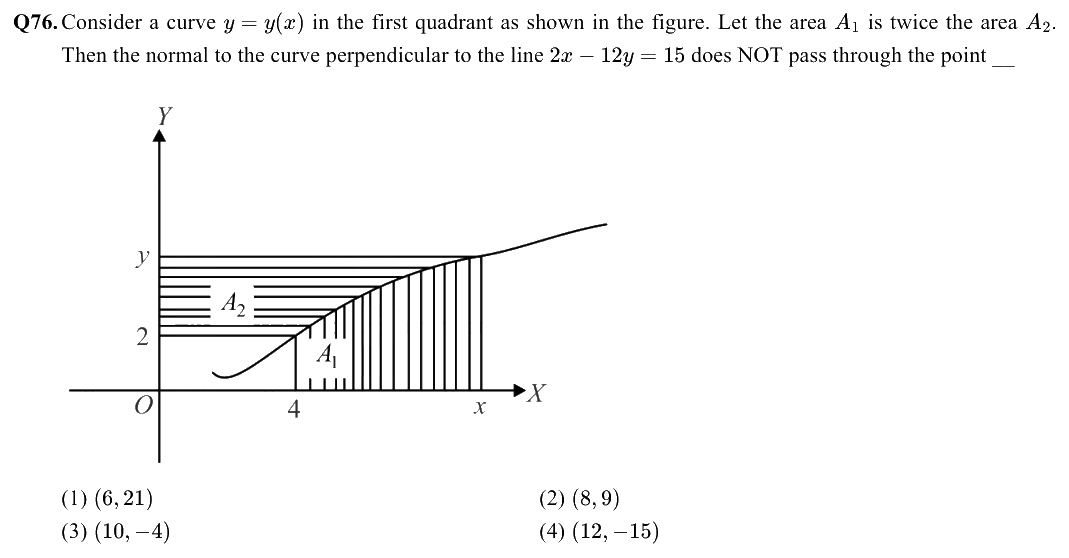
Get EdLoop – freeOpen on the web