Sets, Relations & Functions: JEE Main PYQs 2002–2026
Every Sets, Relations & Functions question from past JEE Main and AIEEE papers, with options and answers. Newest first.
321questions
187papers covered
5.8%of Mathematics questions, 2019–2026
2002–2026years
Guide at a glance
Sets, relations and functions provides the foundation for calculus and algebra under Unit 1: Sets, Relations and Functions in the Class 11 curriculum, capturing rank 2 of 29 chapters with a 5.8% share of the mathematics section.
A person has three different bags and four different books. The number of ways, in which he can put these books in the bags so that no bag is empty, is :
Let $[\cdot]$ denote the greatest integer function. If the domain of the function $f(x) = \sin^{-1}\left(\dfrac{x + [x]}{3}\right)$ is $[\alpha, \beta)$, then $\alpha^2 + \beta^2$ is equal to:
Let $e$ be the base of natural logarithm and let $f: \{1, 2, 3, 4\} \rightarrow \{1, e, e^2, e^3\}$ and $g: \{1, e, e^2, e^3\} \rightarrow \left\{1, \dfrac{1}{2}, \dfrac{1}{3}, \dfrac{1}{4}\right\}$ be two bijective functions such that $f$ is strictly decreasing and $g$ is strictly increasing. If $\phi(x) = \left[f^{-1}\left\{g^{-1}\left(\dfrac{1}{2}\right)\right\}\right]^x$, then the area of the region $\mathrm{R} = \{(x, y) : x^2 \leq y \leq \phi(x),\ 0 \leq x \leq 1\}$ is:
Let $f: \mathbb{R} \rightarrow \mathbb{R}$ be a differentiable function such that $f\left(\dfrac{x+y}{3}\right) = \dfrac{f(x) + f(y)}{3}$ for all $x, y \in \mathbb{R}$, and $f'(0) = 3$. Then the minimum value of the function $g(x) = 3 + e^x f(x)$, is:
Let $[\cdot]$ denote the greatest integer function. If the domain of the function $f(x) = \cos^{-1}\left(\frac{4x + 2[x]}{3}\right)$ is $[\alpha, \beta]$, then $12(\alpha + \beta)$ is equal to:
Let for some $\alpha\in\mathbb{R}$, $f: \mathbb{R}\rightarrow\mathbb{R}$ be a function satisfying $f(x+y) = f(x) + 2y^2 + y + \alpha xy$ for all $x, y \in \mathbb{R}$. If $f(0) = -1$ and $f(1) = 2$, then the value of $\sum_{n=1}^{5}\left(\alpha + f(n)\right)$ is:
The sum of all the elements in the range of $f(x) = \mathrm{Sgn}(\sin x) + \mathrm{Sgn}(\cos x) + \mathrm{Sgn}(\tan x) + \mathrm{Sgn}(\cot x)$, $x \neq \dfrac{n\pi}{2}$, $n \in \mathbf{Z}$, where $\mathrm{Sgn}(t) = \begin{cases} 1, & \text{if } t > 0 \\ -1, & \text{if } t < 0 \end{cases}$, is :
Let $f$ be a function such that $3f(x) + 2f\left(\dfrac{m}{19x}\right) = 5x$, $x \neq 0$, where $m = \displaystyle\sum_{i=1}^{9}(i)^2$. Then $f(5) - f(2)$ is equal to
Let $\mathrm{A} = \{-2, -1, 0, 1, 2, 3, 4\}$. Let R be a relation on A defined by $x\mathrm{R}y$ if and only if $2x + y \leq 2$. Let $l$ be the number of elements in R. Let m and n be the minimum number of elements required to be added in R to make it reflexive and symmetric relations respectively. Then $l + m + n$ is equal to :
If the domain of the function $f(x) = \sin^{-1}\left(\dfrac{5 - x}{3 + 2x}\right) + \dfrac{1}{\log_e(10 - x)}$ is $(-\infty, \alpha] \cup [\beta, \gamma) - \{\delta\}$, then $6(\alpha + \beta + \gamma + \delta)$ is equal to
Let the domain of the function $f(x) = \log_3 \log_5 \left(7 - \log_2 (x^2 - 10x + 85)\right) + \sin^{-1}\left(\left|\dfrac{3x - 7}{17 - x}\right|\right)$ be $(\alpha, \beta]$. Then $\alpha + \beta$ is equal to :
Let $f$ and $g$ be functions satisfying $f(x + y) = f(x)f(y)$, $f(1) = 7$ and $g(x + y) = g(xy)$, $g(1) = 1$, for all $x, y \in \mathbf{N}$. If $\displaystyle\sum_{x=1}^{n}\left(\dfrac{f(x)}{g(x)}\right) = 19607$, then n is equal to :
The number of strictly increasing functions $f$ from the set $\{1, 2, 3, 4, 5, 6\}$ to the set $\{1, 2, 3, \ldots, 9\}$ such that $f(i) \neq i$ for $1 \leq i \leq 6$, is equal to :
Let A = $\{2, 3, 5, 7, 9\}$. Let R be the relation on A defined by $x\mathrm{R}y$ if and only if $2x \leq 3y$. Let $l$ be the number of elements in R, and m be the minimum number of elements required to be added in R to make it a symmetric relation. Then $l + \mathrm{m}$ is equal to :
Let $A = \{0, 1, 2, 3, 4, 5\}$. Let $R$ be a relation on $A$ defined by $(x, y) \in R$ if and only if $\max\{x, y\} \in \{3, 4\}$. Then among the statements
$(S_1)$ : The number of elements in $R$ is 18, and
$(S_2)$ : The relation $R$ is symmetric but neither reflexive nor transitive
If the range of the function $f(x) = \frac{5 - x}{x^2 - 3x + 2}, x \neq 1, 2$, is $(-\infty, \alpha] \cup [\beta, \infty)$, then $\alpha^2 + \beta^2$ is equal to:
Let $f, g : (1, \infty) \rightarrow \mathbb{R}$ be defined as $f(x) = \frac{2x + 3}{5x + 2}$ and $g(x) = \frac{2 - 3x}{1 - x}$. If the range of the function fog : $[2, 4] \rightarrow \mathbb{R}$ is $[\alpha, \beta]$, then $\frac{1}{\beta - \alpha}$ is equal to
Consider the sets $A = \{(x, y) \in \mathbb{R} \times \mathbb{R} : x^2 + y^2 = 25\}$, $B = \{(x, y) \in \mathbb{R} \times \mathbb{R} : x^2 + 9y^2 = 144\}$, $C = \{(x, y) \in \mathbb{Z} \times \mathbb{Z} : x^2 + y^2 \leq 4\}$ and $D = A \cap B$. The total number of one-one functions from the set $D$ to the set $C$ is:
Let $f : \mathbb{R} \rightarrow \mathbb{R}$ be a continuous function satisfying $f(0) = 1$ and $f(2x) - f(x) = x$ for all $x \in \mathbb{R}$. If $\lim_{n \to \infty}\left\{f(x) - f\left(\frac{x}{2^n}\right)\right\} = G(x)$, then $\sum_{r=1}^{10}G\left(r^2\right)$ is equal to
Let $A = \{-3, -2, -1, 0, 1, 2, 3\}$ and R be a relation on A defined by $x\mathrm{R}y$ if and only if $2x - y \in \{0, 1\}$. Let $l$ be the number of elements in $R$. Let $m$ and $n$ be the minimum number of elements required to be added in R to make it reflexive and symmetric relations, respectively. Then $l + \mathrm{m} + \mathrm{n}$ is equal to :
Let $f(x) + 2f\left(\frac{1}{x}\right) = x^2 + 5$ and $2g(x) - 3g\left(\frac{1}{2}\right) = x, x > 0$. If $\alpha = \int_1^2 f(x)\mathrm{d}x$, and $\beta = \int_1^2 g(x)\mathrm{d}x$, then the value of $9\alpha + \beta$ is :
Let the domains of the functions $f(x) = \log_4\log_3\log_7\left(8 - \log_2\left(x^2 + 4x + 5\right)\right)$ and $g(x) = \sin^{-1}\left(\frac{7x + 10}{x - 2}\right)$ be $(\alpha, \beta)$ and $[\gamma, \delta]$, respectively. Then $\alpha^2 + \beta^2 + \gamma^2 + \delta^2$ is equal to :
Let $A = \{-3, -2, -1, 0, 1, 2, 3\}$. Let R be a relation on A defined by $x\mathrm{R}y$ if and only if $0 \leq x^2 + 2y \leq 4$. Let $l$ be the number of elements in R and $m$ be the minimum number of elements required to be added in R to make it a reflexive relation. Then $l + m$ is equal to
If the domain of the function $f(x) = \log_e\left(\frac{2x - 3}{5 + 4x}\right) + \sin^{-1}\left(\frac{4 + 3x}{2 - x}\right)$ is $[\alpha, \beta)$, then $\alpha^2 + 4\beta$ is equal to
If the domain of the function $f(x) = \log_7\left(1 - \log_4\left(x^2 - 9x + 18\right)\right)$ is $(\alpha, \beta) \cup (\gamma, \delta)$, then $\alpha + \beta + \gamma + \delta$ is equal to
Let $A = \{-2, -1, 0, 1, 2, 3\}$. Let R be a relation on $A$ defined by $x\mathrm{R}y$ if and only if $y = \max\{x, 1\}$. Let $l$ be the number of elements in R. Let $m$ and $n$ be the minimum number of elements required to be added in $\mathbf{R}$ to make it reflexive and symmetric relations, respectively. Then $l + m + n$ is equal to
Let A be the set of all functions $f : Z \rightarrow Z$ and R be a relation on A such that $R = \{(f, g) : f(0) = g(1)$ and $f(1) = g(0)\}$. Then R is :
Let $A = \{1, 2, 3, \ldots, 100\}$ and $R$ be a relation on $A$ such that $R = \{(a, b) : a = 2b + 1\}$. Let $(a_1, a_2), (a_2, a_3), (a_3, a_4), \ldots, (a_k, a_{k+1})$ be a sequence of $k$ elements of $R$ such that the second entry of an ordered pair is equal to the first entry of the next ordered pair. Then the largest integer $k$, for which such a sequence exists, is equal to :
If the domain of the function $\log_5\left(18x - x^2 - 77\right)$ is $(\alpha, \beta)$ and the domain of the function $\log_{(x-1)}\left(\frac{2x^2 + 3x - 2}{x^2 - 3x - 4}\right)$ is $(\gamma, \delta)$, then $\alpha^2 + \beta^2 + \gamma^2$ is equal to :
Let $S = \mathbf{N} \cup \{0\}$. Define a relation $R$ from $S$ to $\mathbf{R}$ by : $\mathrm{R} = \left\{(x, y) : \log_e y = x\log_e\left(\frac{2}{5}\right), x \in\ S, y \in \mathbf{R}\right\}$ Then, the sum of all the elements in the range of $R$ is equal to :
Let $f : \mathbb{R} \rightarrow \mathbb{R}$ be a function defined by $f(x) = (2 + 3a)x^2 + \left(\frac{a+2}{a-1}\right)x + b, a \neq 1$. If $f(x + y) = f(x) + f(y) + 1 - \frac{2}{7}xy$, then the value of $28\sum_{i=1}^{5}|f(i)|$ is
Let $f : [0, 3] \rightarrow \mathrm{A}$ be defined by $f(x) = 2x^3 - 15x^2 + 36x + 7$ and $g : [0, \infty) \rightarrow B$ be defined by $\mathrm{g}(x) = \frac{x^{2025}}{x^{2025} + 1}$. If both the functions are onto and $\mathrm{S} = \{x \in \mathbf{Z} : x \in \mathrm{A} \text{ or } x \in \mathrm{B}\}$, then n(S) is equal to :
Let $f : \mathbf{R} - \{0\} \rightarrow (-\infty, 1)$ be a polynomial of degree 2, satisfying $f(x)f\left(\frac{1}{x}\right) = f(x) + f\left(\frac{1}{x}\right)$. If $f(K) = -2K$, then the sum of squares of all possible values of $K$ is :
Let $f : R - \{0\} \rightarrow R$ be a function such that $f(x) - 6f\left(\frac{1}{x}\right) = \frac{35}{3x} - \frac{5}{2}$. If the $\lim_{x \to 0}\left(\frac{1}{\alpha x} + f(x)\right) = \beta$; $\alpha, \beta \in R$, then $\alpha + 2\beta$ is equal to
Let $f(x) = \frac{2^{x+2} + 16}{2^{2x+1} + 2^{x+4} + 32}$. Then the value of $8\left(f\left(\frac{1}{15}\right) + f\left(\frac{2}{15}\right) + \ldots + f\left(\frac{59}{15}\right)\right)$ is equal to
Let $\mathrm{R} = \{(1, 2), (2, 3), (3, 3)\}$ be a relation defined on the set $\{1, 2, 3, 4\}$. Then the minimum number of elements, needed to be added in R so that R becomes an equivalence relation, is:
Let $X = \mathbf{R} \times \mathbf{R}$. Define a relation $R$ on $X$ as : $(a_1, b_1)R(a_2, b_2) \Leftrightarrow b_1 = b_2$ Statement I : $\mathrm{R}$ is an equivalence relation. Statement II : For some $(a, b) \in X$, the set $S = \{(x, y) \in X : (x, y)R(a, b)\}$ represents a line parallel to $y = x$. In the light of the above statements, choose the correct answer from the options given below :
Let $f(x)$ be a real differentiable function such that $f(0) = 1$ and $f(x + y) = f(x)f'(y) + f'(x)f(y)$ for all $x, y \in \mathbf{R}$. Then $\sum_{n=1}^{100} \log_e f(\mathrm{n})$ is equal to :
Let $\mathrm{A} = \{1, 2, 3, 4\}$ and $\mathrm{B} = \{1, 4, 9, 16\}$. Then the number of many-one functions $f : \mathrm{A} \to \mathrm{B}$ such that $1 \in f(\mathrm{A})$ is equal to :
Let $[t]$ be the greatest integer less than or equal to $t$. Let $A$ be the set of all prime factors of 2310 and $f : A \to \mathbb{Z}$ be the function $f(x) = \left[\log_2\left(x^2 + \left[\frac{x^3}{5}\right]\right)\right]$. The number of one-to-one functions from $A$ to the range of $f$ is
Let $A = \{2, 3, 6, 8, 9, 11\}$ and $B = \{1, 4, 5, 10, 15\}$. Let $R$ be a relation on $A \times B$ defined by $(a, b)R(c, d)$ if and only if $3ad - 7bc$ is an even integer. Then the relation $R$ is
Let $f(x) = \begin{cases} -\mathrm{a} & \text{if } -\mathrm{a} \le x \le 0 \\ x + \mathrm{a} & \text{if } 0 < x \le \mathrm{a} \end{cases}$ where $\mathrm{a} > 0$ and $g(x) = (f(|x|) - |f(x)|)/2$. Then the function $g : [-a, a] \to [-a, a]$ is
Let the relations $R_1$ and $R_2$ on the set $X = \{1, 2, 3, \ldots, 20\}$ be given by $R_1 = \{(x, y) : 2x - 3y = 2\}$ and $R_2 = \{(x, y) : -5x + 4y = 0\}$. If $M$ and $N$ be the minimum number of elements required to be added in $R_1$ and $R_2$, respectively, in order to make the relations symmetric, then $M + N$ equals
Let $A = \{1, 2, 3, 4, 5\}$. Let R be a relation on A defined by $xRy$ if and only if $4x \le 5y$. Let m be the number of elements in R and n be the minimum number of elements from $A \times A$ that are required to be added to R to make it a symmetric relation. Then m + n is equal to :
Let $A = \{1, 3, 7, 9, 11\}$ and $B = \{2, 4, 5, 7, 8, 10, 12\}$. Then the total number of one-one maps $f : A \to B$, such that $f(1) + f(3) = 14$, is :
Let $f, g : \mathbf{R} \to \mathbf{R}$ be defined as : $f(x) = |x - 1|$ and $g(x) = \begin{cases} \mathrm{e}^x,\ \mathrm{MARA} & x \geq 0 \\ x + 1, & x \leq 0 \end{cases}$ Then the function $f(g(x))$ is
If the domain of the function $\sin^{-1}\left(\frac{3x-22}{2x-19}\right) + \log_e\left(\frac{3x^2-8x+5}{x^2-3x-10}\right)$ is $(\alpha, \beta]$, then $3\alpha + 10\beta$ is equal to:
Let the sum of the maximum and the minimum values of the function $f(x) = \frac{2x^2-3x+8}{2x^2+3x+8}$ be $\frac{m}{n}$, where $\gcd(\mathrm{m}, \mathrm{n}) = 1$. Then $\mathrm{m} + \mathrm{n}$ is equal to :
Let a relation R on $\mathbb{N} \times N$ be defined as: $(x_1, y_1)\mathrm{R}\,(x_2, y_2)$ if and only if $x_1 \le x_2$ or $y_1 \le y_2$. Consider the two statements: (I) $R$ is reflexive but not symmetric. (II) $R$ is transitive Then which one of the following is true?
Let $f(x) = 3\sqrt{x - 2} + \sqrt{4 - x}$ be a real valued function. If $\alpha$ and $\beta$ are respectively the minimum and the maximum values of $f$, then $\alpha^2 + 2\beta^2$ is equal to
Let $f: R \rightarrow R$ and $g: R \rightarrow R$ be defined as $fx = \begin{cases} \log_e x, & x > 0 \\ e^{-x}, & x \leq 0 \end{cases}$ and $gx = \begin{cases} x, & x \geq 0 \\ e^x, & x < 0 \end{cases}$. Then, $g o f: R \rightarrow R$ is:
Consider the relations $R_1$ and $R_2$ defined as $aR_1b \Leftrightarrow a^2 + b^2 = 1$ for all $a, b, \in R$ and $a, bR_2c, d \Leftrightarrow a + d = b + c$ for all $a, b, c, d \in N \times N$. Then
A
Only $R_1$ is an equivalence relation
B
Only $R_2$ is an equivalence relation
C
$R_1$ and $R_2$ both are equivalence relation
D
Neither $R_1$ nor $R_2$ is an equivalence relation
If the domain of the function $fx = \frac{\sqrt{x^2 - 25}}{4 - x^2} + \log_{10} x^2 + 2x - 15$ is $-\infty, \alpha \cup \beta, \infty$, then $\alpha^2 + \beta^3$ is equal to:
If $f(x) = \frac{4x + 3}{6x - 4}$, $x \neq \frac{2}{3}$ and $(f \circ f)(x) = g(x)$, where $g: R - \frac{2}{3} \rightarrow R - \frac{2}{3}$, then $(g \circ g \circ g)(4)$ is equal to
If the function $f: -\infty, -1 \to a, b$ defined by $f(x) = e^{x^3 - 3x + 1}$ is one-one and onto, then the distance of the point $P(2b + 4, a + 2)$ from the line $x + e^{-3}y = 4$ is:
If the domain of the function $f(x) = \cos^{-1}\left(\frac{2-|x|}{4}\right) + \left(\log_e(3-x)\right)^{-1}$ is $[-\alpha, \beta) - \{\gamma\}$, then $\alpha + \beta + \gamma$ is equal to :
If the domain of the function $f(x) = \log_e \frac{2x+3}{4x^2+x-3} + \cos^{-1}\frac{2x-1}{x+2}$ is $(\alpha, \beta]$, then the value of $5\beta - 4\alpha$ is equal to
Let $f: R - \{0\} \rightarrow R$ be a function satisfying $f\!\left(\frac{x}{y}\right) = \frac{f(x)}{f(y)}$ for all $x, y, f(y) \neq 0$. If $f'(1) = 2024$, then
If $R$ is the smallest equivalence relation on the set $\{1, 2, 3, 4\}$ such that $\{(1, 2), (1, 3)\} \subset R$, then the number of elements in $R$ is ______.
Let $S = \{1, 2, 3, \dots, 10\}$. Suppose $M$ is the set of all the subsets of $S$, then the relation $R = \{(A, B) : A \cap B \neq \phi;\ A, B \in M\}$ is :
Let $A$ and $B$ be two finite sets with $m$ and $n$ elements respectively. The total number of subsets of the set $A$ is 56 more than the total number of subsets of $B$. Then the distance of the point $P(m, n)$ from the point $Q(-2, -3)$ is
Let f: $R - \frac{-1}{2} \to R$ and g: $R - \frac{-5}{2} \to R$ be defined as $fx = \frac{2x + 3}{2x + 1}$ and $gx = \frac{|x| + 1}{2x + 5}$. Then the domain of the function fog is :
If the domain of the function $f(x) = \log_e\left(4x^2 + 11x + 6\right) + \sin^{-1}(4x + 3) + \cos^{-1}\left(\frac{10x + 6}{3}\right)$ is $(\alpha, \beta]$, then $36|\alpha + \beta|$ is equal to
For $x \in \mathbb{R}$, two real valued functions $f(x)$ and $g(x)$ are such that, $g(x) = \sqrt{x} + 1$ and $fog(x) = x + 3 - \sqrt{x}$. Then $f(0)$ is equal to
For the differentiable function $f: \mathbb{R} - \{0\} \rightarrow \mathbb{R}$, let $3f(x) + 2f\left(\frac{1}{x}\right) = \frac{1}{x} - 10$, then $\left|f(3) + f'\left(\frac{1}{4}\right)\right|$ is equal to
An organization awarded 48 medals in event '$A$', 25 in event '$B$' and 18 in event '$C$'. If these medals went to total 60 men and only five men got medals in all the three events, then, how many received medals in exactly two of three events?
Let $A = \{1, 3, 4, 6, 9\}$ and $B = \{2, 4, 5, 8, 10\}$. Let $R$ be a relation defined on $A \times B$ such that $R = \{(a_1, b_1), (a_2, b_2) : a_1 \leq b_2 \text{ and } b_1 \leq a_2\}$. Then the number of elements in the set $R$ is
Let $A = 2, 3, 4$ and $B = 8, 9, 12$. Then the number of elements in the relation $R = a_1, b_1, a_2, b_2 \in A \times B, A \times B : a_1$ divides $b_2$ and $a_2$ divides $b_1$ is
Let the number of elements in sets $A$ and $B$ be five and two respectively. Then the number of subsets of $A \times B$ each having at least 3 and at most 6 elements is
Let the sets $A$ and $B$ denote the domain and range respectively of the function $f(x) = \frac{1}{\sqrt{[x] - x}}$, where $[x]$ denotes the smallest integer greater than or equal to $x$. Then among the statements
$(S1)$ : $A \cap B = (1, \infty) - \mathbb{N}$ and
Let $P(\mathrm{S})$ denote the power set of $S = \{1, 2, 3, ..., 10\}$. Define the relations $R_1$ and $R_2$ on $P(\mathrm{S})$ as $AR_1B$ if $(A \cap B^c) \cup (B \cap A^c) = \phi$ and $AR_2B$ if $A \cup B^c = B \cup A^c, \forall A, B \in P(\mathrm{S})$ . Then :
A
both $R_1$ and $R_2$ are equivalence relations
B
only $R_1$ is an equivalence relation
C
only $R_2$ is an equivalence relation
D
both $R_1$ and $R_2$ are not equivalence relations
The absolute minimum value, of the function $f(x) = |x^2 - x + 1| + [x^2 - x + 1]$, where $[t]$ denotes the greatest integer function, in the interval $[-1, 2]$, is
The minimum number of elements that must be added to the relation $R = (a, b), (b, c)$ on the set $\{a, b, c\}$ so that it becomes symmetric and transitive is:
Suppose $f: R \rightarrow 0, \infty$ be a differentiable function such that $5f x + y = f x \cdot f y$, $\forall$ $x, y \in R$, If $f 3 = 320$, then $\sum_{n=0}^{5} f n$ is equal to:
Let $f(x)=2x^{n}+\lambda$, $\lambda\in\mathbb{R}$, $\mathrm{n}\in\mathbb{N}$, and $f(4)=133$, $f(5)=255$. Then the sum of all the positive integer divisors of $(f(3)-f(2))$ is
Let $f:\mathbb{R}\to\mathbb{R}$ be a function defined by $f(x)=\log_{\sqrt{m}}\left\{\sqrt{2}(\sin x-\cos x)+m-2\right\}$, for some $m$, such that the range of $f$ is $[0,2]$. Then the value of $m$ is ______ .
The number of functions $f:\{1,2,3,4\}\to\{a\in\mathbb{Z}:|a|\le8\}$ satisfying $f(\mathrm{n})+\frac{1}{\mathrm{n}}f(\mathrm{n}+1)=1,\forall\ \mathrm{n}\in\{1,2,3\}$ is
If $f(x)=\frac{2^{2x}}{2^{2x}+2}$, $x\in\mathbb{R}$, then $f\left(\frac{1}{2023}\right)+f\left(\frac{2}{2023}\right)+f\left(\frac{3}{2023}\right)+\cdots\cdots\cdots f\left(\frac{2022}{2023}\right)$ is equal to
Let $f(x)$ be a function such that $f(x+y)=f(x)\cdot f(y)$ for all $x,y\in\mathrm{N}$. If $f(1)=3$ and $\sum_{k=1}^{n}f(k)=3279$, then the value of $n$ is
Let $R$ be a relation from the set $\{1, 2, 3 \ldots\ldots\ldots, 60\}$ to itself such that $R = \{(a, b) : b = pq$, where $p, q \geq 3$ are prime numbers$\}$. Then, the number of elements in $R$ is
For $\alpha\in N$, consider a relation $R$ on $N$ given by $R=\{x,y:3x+\alpha y$ is a multiple of $7\}$. The relation $R$ is an equivalence relation if and only if
Let $\alpha,\beta$ and $\gamma$ be three positive real numbers. Let $fx=\alpha\mathrm{x}^{5}+\beta\mathrm{x}^{3}+\gamma\mathrm{x},\mathrm{x}\in\mathrm{R}$ and $g:R\rightarrow R$ be such that $gfx=x$ for all $x\in R$. If $a_1,a_2,a_3,\ \ldots\ ,a_n$ be in arithmetic progression with mean zero, then the value of $fg\frac{1}{n}\sum_{i=1}^{n}fa_{i}$ is equal to
Let $R_1$ and $R_2$ be two relations defined on $\mathbb{R}$ by $a\mathrm{R}_1b \Leftrightarrow ab \geq 0$ and $a\ R_2 b \Leftrightarrow a \geq b$, then
A
$R_1$ is an equivalence relation but not $R_2$
B
$R_2$ is an equivalence relation but not $R_1$
C
both $R_1$ and $R_2$ are equivalence relations
D
neither $R_1$ nor $R_2$ is an equivalence relation
Let $f, g : \mathbb{N} - \{1\} \rightarrow \mathbb{N}$ be functions defined by $f(a) = \alpha$, where $\alpha$ is the maximum of the powers of those primes $p$ such that $p^\alpha$ divides $a$, and $g(a) = a + 1$, for all $a \in \mathbb{N} - \{1\}$. Then, the function $f + g$ is
The domain of the function $f(x) = \sin^{-1}[2x^2 - 3] + \log_2\left(\log_{\frac{1}{2}}(x^2 - 5x + 5)\right)$, where $[t]$ is the greatest integer function, is
Let a set $A = A_1 \cup A_2 \cup ... \cup A_k$, where $A_i \cap A_j = \phi$ for $i \ne j$; $1 \le i, j \le k$. Define the relation $R$ from $A$ to $A$ by $R = \{(x, y) : y \in A_i$ if and only if $x \in A_i,\ 1 \le i \le k\}$. Then, $R$ is:
Let a function $f : \mathbb{N} \rightarrow \mathbb{N}$ be defined by $f(n) = \begin{cases} 2n, & n = 2, 4, 6, 8, \ldots\ldots \\ n - 1, & n = 3, 7, 11, 15, \ldots\ldots \\ \dfrac{n+1}{2}, & n = 1, 5, 9, 13, \ldots\ldots \end{cases}$ then, $f$ is
Let $f: \mathbb{R} \rightarrow \mathbb{R}$ be defined as $f(x) = x - 1$ and $g: R \rightarrow \{1, -1\} \rightarrow \mathbb{R}$ be defined as $g(x) = \frac{x^2}{x^2 - 1}$. Then the function $f \circ g$ is:
Let $f: N \rightarrow R$ be a function such that $f x + y = 2 f x f y$ for natural numbers $x$ and $y$. If $f 1 = 2$, then the value of $\alpha$ for which $\sum_{k=1}^{10} f \alpha + k = \frac{512}{3} 2^{20} - 1$ holds, is
The range of the function $f\left(x\right) = \log_{\sqrt{5}}3 + \cos\frac{3\pi}{4} + x + \cos\frac{\pi}{4} + x + \cos\frac{\pi}{4} - x - \cos\frac{3\pi}{4} - x$ is :
Let $Z$ be the set of all integers, $A=\left\{(x,y)\in Z\times Z:(x-2)^{2}+y^{2}\leq4\right\}$ $B=\left\{(x,y)\in Z\times Z:x^{2}+y^{2}\leq4\right\}$ and $C=\left\{(x,y)\in Z\times Z:(x-2)^{2}+(y-2)^{2}\leq4\right\}$ If the total number of relations from $A\cap B$ to $A\cap C$ is $2^{p}$, then the value of $p$ is:
Out of all the patients in a hospital $89\%$ are found to be suffering from heart ailment and $98\%$ are suffering from lungs infection. If $K\%$ of them are suffering from both ailments, then $K$ can not belong to the set:
Let $N$ be the set of natural numbers and a relation $R$ on $N$ be defined by $R = \{(x, y) \in N \times N : x^3 - 3x^2y - xy^2 + 3y^3 = 0\}$. Then the relation $R$ is
Let $g: N \to N$ be defined as $g(3n + 1) = 3n + 2$ $g(3n + 2) = 3n + 3$ $g(3n + 3) = 3n + 1$, for all $n \geq 0$ Then which of the following statements is true ?
A
There exists an onto function $f: N \to N$ such that $fog = f$
B
There exists a one-one function $f: N \to N$ such that $fog = f$
C
$gogog = g$
D
There exists a function $f: N \to N$ such that $gof = f$
Let $[x]$ denote the greatest integer less than or equal to $x$. Then, the values of $x \in R$ satisfying the equation $[e^x]^2 + [e^x + 1] - 3 = 0$ lie in the interval:
Let $[x]$ denote the greatest integer $\le x$, where $x \in R$. If the domain of the real valued function $f(x) = \sqrt{\frac{|[x]| - 2}{|[x]| - 3}}$ is $(-\infty, a) \cup [b, c) \cup [4, \infty)$, $a < b < c$, then the value of $a + b + c$ is:
Let $f : R - \left\{\frac{\alpha}{6}\right\} \rightarrow R$ be defined by $f(x) = \left(\frac{5x+3}{6x-\alpha}\right)$. Then the value of $\alpha$ for which $(fof)(x) = x$, for all $x \in R - \left\{\frac{\alpha}{6}\right\}$, is
The real valued function $f(x) = \frac{\mathrm{cosec}^{-1}x}{\sqrt{x - [x]}}$, where $[x]$ denotes the greatest integer less than or equal to $x$, is defined for all $x$ belonging to:
If the functions are defined as $f(x) = \sqrt{x}$ and $g(x) = \sqrt{1 - x}$, then what is the common domain of the following functions: $f + g,\ f - g,\ f/g,\ g/f,\ g - f$, where $(f \pm g)(x) = f(x) \pm g(x), (f/g)(x) = \frac{f(x)}{g(x)}$
Define a relation $R$ over a class of $n \times n$ real matrices $A$ and $B$ as "$ARB$ iff there exists a non-singular matrix $P$ such that $PAP^{-1} = B$". Then which of the following is true ?
Let $f : R - \{3\} \rightarrow R - \{1\}$ be defined by $f(x) = \frac{x-2}{x-3}$. Let $g : R \rightarrow R$ be given as $g(x) = 2x - 3$. Then, the sum of all the values of $x$ for which $f^{-1}(x) + g^{-1}(x) = \frac{13}{2}$ is equal to
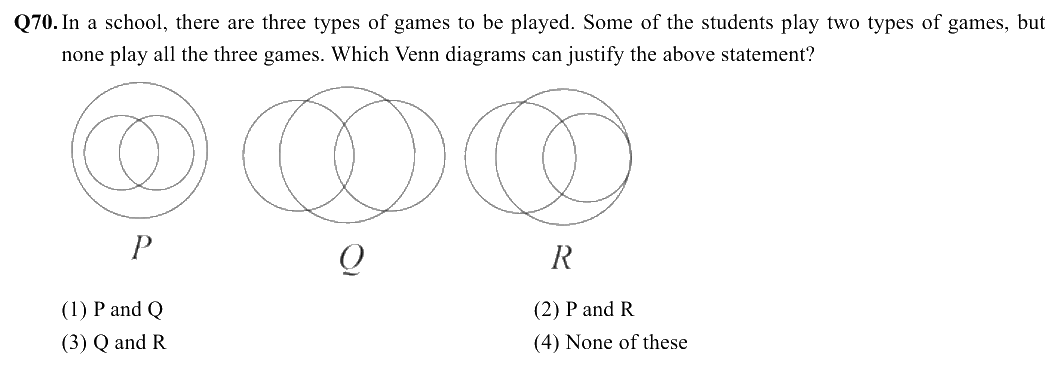
In a school, there are three types of games to be played. Some of the students play two types of games, but none play all the three games. Which Venn diagrams can justify the above statement? (see the figure above)
Let $A = \{2, 3, 4, 5, \ldots, 30\}$ and $\simeq$ be an equivalence relation on $A \times A$, defined by $(a, b) \simeq (c, d)$, if and only if $ad = bc$. Then the number of ordered pairs which satisfy this equivalence relation with ordered pair $(4, 3)$ is equal to :
Let $A = \{1, 2, 3, \ldots, 10\}$ and $f : A \to A$ be defined as $f(k) = \begin{cases} k + 1 & \text{if } k \text{ is odd} \\ k & \text{if } k \text{ is even} \end{cases}$ Then the number of possible functions $g : A \to A$ such that $g \circ f = f$ is:
Let $f, g : N \to N$ such that $f(n + 1) = f(n) + f(1)\ \forall\ n \in N$ and $g$ be any arbitrary function. Which of the following statements is NOT true?
A function $f(x)$ is given by $f(x) = \frac{5^x}{5^x + 5}$, then the sum of the series $f\left(\frac{1}{20}\right) + f\left(\frac{2}{20}\right) + f\left(\frac{3}{20}\right) + \ldots + f\left(\frac{39}{20}\right)$ is equal to:
Let $x$ denote the total number of one-one functions from a set $A$ with 3 elements to a set $B$ with 5 elements and $y$ denote the total number of one-one functions from the set $A$ to the set $A \times B$. Then :
Let $f: R \to R$ be defined as $fx = 2\ x - 1$ and $g: R - 1 \to R$. be defined as $gx = \frac{x - \frac{1}{2}}{x - 1}$. Then the composition function $fgx$ is:
If $f(x + y) = f(x)\ f(y)$ and $\sum_{x=1}^{\infty} f(x) = 2$, $x, y \in N$, where $N$ is the set of all natural numbers, then the value of $\frac{f(4)}{f(2)}$ is
For a suitably chosen real constant a, let a function, $f : \mathbf{R} - \{-a\} \rightarrow \mathbf{R}$ be defined by $f(x) = \frac{a-x}{a+x}$. Further supposed that for any real number $x \neq -a$,and $f(x) \neq -a$, $(f \circ f)(x) = x$. Then $f\left(-\frac{1}{2}\right)$ is equal to :
A survey shows that 73% of the persons working in an office like coffee, whereas 65% like tea. If $x$ denotes the percentage of them, who like both coffee and tea, then $x$ cannot be:
A survey shows that $63\%$ of the people in a city read newspaper $A$ whereas $76\%$ read news paper $B$. If $x\%$ of the people read both the newspapers, then a possible value of $x$ can be:
Let $\bigcup_{i=1}^{50} X_{i} = \bigcup_{i=1}^{n} Y_{i} = T$, where each $X_{i}$ contains 10 elements and each $Y_{i}$ contains 5 elements. If each element of the set $T$ is an element of exactly 20 sets $X_{i}$'s and exactly 6 sets $Y_{i}$'s then $n$ is equal to :
Consider the two sets: $A = \{m \in R :$ both the roots of $x^{2} - (m+1)x + m + 4 = 0$ are real $\}$ and $B = [-3, 5)$. Which of the following is not true?
Let $R_1$ and $R_2$ be two relations defined as follows : $R_1 = \{(a,\ b) \in R^{2} : a^{2}+b^{2} \in Q\}$ and $R_2 = \{(a,\ b) \in R^{2} : a^{2}+b^{2} \notin Q\}$, where Q is the set of all rational numbers, then
Let $f : R \rightarrow R$ be a function which satisfies $f(x + y) = f(x) + f(y),\ \forall x, y \in R$. If $f(1) = 2$ and $g(n) = \sum_{k=1}^{(n-1)} f(k),\ n \in N$ then the value of $n$, for which $g(n) = 20$, is
Let $f : (1, 3) \to R$, be a function defined by $f(x) = \frac{x[x]}{1 + x^2}$, where $[x]$, denotes the greatest integer $\le x$. Then the range of $f$, is
For $x \in R$, Let $[x]$ denotes the greatest integer $\leq x$, then the sum of the series $-\frac{1}{3} + -\frac{1}{3} - \frac{1}{100} + -\frac{1}{3} - \frac{2}{100} + \ldots\ldots + -\frac{1}{3} - \frac{99}{100}$ is
For $x \in \left(0, \frac{3}{2}\right)$, let $fx = \sqrt{x}, gx = \tan x$ and $hx = \frac{1 - x^2}{1 + x^2}$ . If $\phi x = (\mathrm{hof})\mathrm{og}\ (x)$ , then $\phi\ \frac{\pi}{3}$ is equal to:
Let $\mathrm{R} = \{(x, y) \in \mathbf{N}\times\mathbf{N}: \log_e(x + y) \leq 2\}$. Then the minimum number of elements, required to be added in R to make it a transitive relation, is ________.
Numerical answer type: type your answer in EdLoop to check it
Let $A = \{1, 2, 3, 4, 5, 6\}$. The number of one-one functions $f: A \rightarrow A$ such that $f(1) \geq 3$, $f(3) \leq 4$ and $f(2) + f(3) = 5$, is ________.
Numerical answer type: type your answer in EdLoop to check it
Let $A = \{1, 4, 7\}$ and $B = \{2, 3, 8\}$. Then the number of elements, in the relation $R = \{((a_1, b_1), (a_2, b_2)) \in ((A \times B) \times (A \times B)) : a_1 + b_2 \text{ divides } a_2 + b_1\}$ is ________.
Numerical answer type: type your answer in EdLoop to check it
If the domain of the function $f(x) = \sqrt{\log_{(0.6)}\left(\left|\dfrac{2x-5}{x^2-4}\right|\right)}$ is $(-\infty, \mathrm{a}] \cup \{\mathrm{b}\} \cup [\mathrm{c}, \mathrm{d}) \cup (\mathrm{e}, \infty)$, then the value of $\mathrm{a}+\mathrm{b}+\mathrm{c}+\mathrm{d}+\mathrm{e}$ is ________.
Numerical answer type: type your answer in EdLoop to check it
Let $\mathrm{A} = \{2, 3, 4, 5, 6\}$. Let R be a relation on the set $\mathrm{A}\times\mathrm{A}$ given by $(x, y)\mathrm{R}(z, w)$ if and only if $x$ divides $z$ and $y \leq w$. Then the number of elements in R is ________.
Numerical answer type: type your answer in EdLoop to check it
Let the domain of the function $f(x) = \cos^{-1}\left(\frac{4x + 5}{3x - 7}\right)$ be $[\alpha, \beta]$ and the domain of $g(x) = \log_2\left(2 - 6\log_{27}(2x + 5)\right)$ be $(\gamma, \delta)$. Then $|7(\alpha + \beta) + 4(\gamma + \delta)|$ is equal to ______.
Numerical answer type: type your answer in EdLoop to check it
The number of relations on the set A = {1, 2, 3}, containing at most 6 elements including (1, 2), which are reflexive and transitive but not symmetric, is ______ .
Numerical answer type: type your answer in EdLoop to check it
Number of functions $f : \{1, 2, \ldots, 100\} \rightarrow \{0, 1\}$, that assign 1 to exactly one of the positive integers less than or equal to 98 , is equal to ______ .
Numerical answer type: type your answer in EdLoop to check it
Let $A = \{1, 2, 3\}$. The number of relations on $A$, containing $(1, 2)$ and $(2, 3)$, which are reflexive and transitive but not symmetric, is ______ .
Numerical answer type: type your answer in EdLoop to check it
Let $A = \{2, 3, 6, 7\}$ and $B = \{4, 5, 6, 8\}$. Let $R$ be a relation defined on $A \times B$ by $(a_1, b_1)R(a_2, b_2)$ if and only if $a_1 + a_2 = b_1 + b_2$. Then the number of elements in $R$ is ______
Numerical answer type: type your answer in EdLoop to check it
If a function $f$ satisfies $f(\,\mathrm{m} + \mathrm{n}) = f(\,\mathrm{m}) + f(\mathrm{n})$ for all $\mathrm{m}, \mathrm{n} \in \mathbf{N}$ and $f(1) = 1$, then the largest natural number $\lambda$ such that $\sum_{k=1}^{2022} f(\lambda + k) \le (2022)^2$ is equal to ______
Numerical answer type: type your answer in EdLoop to check it
Let $A = \{(x, y) : 2x + 3y = 23, x, y \in \mathbb{N}\}$ and $B = \{x : (x, y) \in A\}$. Then the number of one-one functions from $A$ to $B$ is equal to ______
Numerical answer type: type your answer in EdLoop to check it
If $S = \{a \in \mathbf{R} : |2a - 1| = 3[a] + 2\{a\}\}$, where $[t]$ denotes the greatest integer less than or equal to $t$ and $\{t\}$ represents the fractional part of $t$, then $72\sum_{a \in S} a$ is equal to ______
Numerical answer type: type your answer in EdLoop to check it
In a survey of 220 students of a higher secondary school, it was found that at least 125 and at most 130 students studied Mathematics; at least 85 and at most 95 studied Physics; at least 75 and at most 90 studied Chemistry; 30 studied both Physics and Chemistry; 50 studied both Chemistry and Mathematics; 40 studied both Mathematics and Physics and 10 studied none of these subjects. Let m and n respectively be the least and the most number of students who studied all the three subjects. Then m + n is equal to ______
Numerical answer type: type your answer in EdLoop to check it
Consider the function $f : \mathbb{R} \to \mathbb{R}$ defined by $f(x) = \frac{2x}{\sqrt{1 + 9x^2}}$. If the composition of $f, \underbrace{(f \circ f \circ f \circ \cdots \circ f)}_{\text{10 times}}(x) = \frac{2^{10}x}{\sqrt{1 + 9\alpha x^2}}$, then the value of $\sqrt{3\alpha + 1}$ is equal to ______
Numerical answer type: type your answer in EdLoop to check it
Let $A = \{1,\ 2,\ 3,\ 4\}$ and $R = \{(1,\ 2),\ (2,\ 3),\ (1,\ 4)\}$ be a relation on $A$. Let $S$ be the equivalence relation on $A$ such that $R \subset S$ and the number of elements in $S$ is $n$. Then, the minimum value of $n$ is ______.
Numerical answer type: type your answer in EdLoop to check it
Let $A = \{1, 2, 3, \ldots, 100\}$. Let $R$ be a relation on $A$ defined by $(x, y) \in R$ if and only if $2x = 3y$. Let $R_1$ be a symmetric relation on $A$ such that $R \subset R_1$ and the number of elements in $R_1$ is $n$. Then the minimum value of $n$ is ______.
Numerical answer type: type your answer in EdLoop to check it
A group of 40 students appeared in an examination of 3 subjects - Mathematics, Physics & Chemistry. It was found that all students passed in at least one of the subjects, 20 students passed in Mathematics, 25 students passed in Physics, 16 students passed in Chemistry, at most 11 students passed in both Mathematics and Physics, at most 15 students passed in both Physics and Chemistry, at most 15 students passed in both Mathematics and Chemistry. The maximum number of students passed in all the three subjects is ______.
Numerical answer type: type your answer in EdLoop to check it
Let $A = \{1, 2, 3, \ldots\ldots 7\}$ and let $P(A)$ denote the power set of $A$. If the number of functions $f: A \rightarrow P(A)$ such that $a \in f(a), \forall a \in A$ is $m^n$, $m$ and $n \in N$ and $m$ is least, then $m + n$ is equal to ______.
Numerical answer type: type your answer in EdLoop to check it
Let for a differentiable function $f : (0, \infty) \to R$, $f(x) - f(y) \ge \log_e\left(\frac{x}{y}\right) + x - y$, $\forall x, y \in (0, \infty)$. Then $\sum_{n=1}^{20} f'\left(\frac{1}{n^2}\right)$ is equal to
Numerical answer type: type your answer in EdLoop to check it
Let $A = \{1, 2, 3, 4\}$ and $R$ be a relation on the set $A \times A$ defined by $R = \{((a, b), (c, d)): 2a + 3b = 4c + 5d\}$. Then the number of elements in $R$ is ______.
Numerical answer type: type your answer in EdLoop to check it
Let $A = \{-4, -3, -2, 0, 1, 3, 4\}$ and $R = \{(a, b) \in A \times A: b = |a|$ or $b^{2} = a + 1\}$ be a relation on $A$. Then the minimum number of elements, that must be added to the relation $R$ so that it becomes reflexive and symmetric, is
Numerical answer type: type your answer in EdLoop to check it
The number of relations, on the set $\{1,\ 2,\ 3\}$ containing $(1,\ 2)$ and $(2,\ 3)$ which are reflexive and transitive but not symmetric, is ______.
Numerical answer type: type your answer in EdLoop to check it
Let $A = \{1, 2, 3, 4, 5\}$ and $B = \{1, 2, 3, 4, 5, 6\}$. Then the number of functions $f : A \rightarrow B$ satisfying $f(1) + f(2) = f(4) - 1$ is equal to ______
Numerical answer type: type your answer in EdLoop to check it
If the domain of the function $fx = \sec^{-1}\frac{2x}{5x + 3}$ is $[\alpha, \beta) \cup (\gamma, \delta]$, then $3\alpha + 10\beta + \gamma + 21\delta$ is equal to ______
Numerical answer type: type your answer in EdLoop to check it
Let $A = \{0, 3, 4, 6, 7, 8, 9, 10\}$ and $R$ be the relation defined on $A$ such that $R\{(x, y) \in A \times A : x - y$ is odd positive integer or $x - y = 2\}$. The minimum number of elements that must be added to the relation $R$, so that it is a symmetric relation, is equal to ______
Numerical answer type: type your answer in EdLoop to check it
If domain of the function $\log_e\left(\frac{6x^2 + 5x + 1}{2x - 1}\right) + \cos^{-1}\left(\frac{2x^2 - 3x + 4}{3x - 5}\right)$ is $(\alpha, \beta) \cup (\gamma, \delta)$, then $18(\alpha^2 + \beta^2 + \gamma^2 + \delta^2)$ is equal to
Numerical answer type: type your answer in EdLoop to check it
Let $R = \{a, b, c, d, e\}$ and $S = \{1, 2, 3, 4\}$. Total number of onto functions $f : R \rightarrow S$ such that $f(a) \neq 1$, is equal to ______ .
Numerical answer type: type your answer in EdLoop to check it
Let $A = \{1, 2, 3, 4, \ldots\ldots\ldots\ldots, 10\}$ and $B = \{0, 1, 2, 3, 4\}$. The number of elements in the relation $R = \{(a, b) \in A \times A : 2a - b^2 + 3a - b \in B\}$ is ______ .
Numerical answer type: type your answer in EdLoop to check it
Let $S = \{1, 2, 3, 4, 5, 6\}$. Then the number of oneone functions $f: S \rightarrow P(S)$, where $P(S)$ denote the power set of $S$, such that $f(n) \subset f(m)$ where $n < m$ is
Numerical answer type: type your answer in EdLoop to check it
Let $f^1 x = \frac{3x + 2}{2x + 3}$, $x \in R - -\frac{3}{2}$. For $n \geq 2$, define $f^n x = f^1 o f^{n-1} x$. If $f^5 x = \frac{ax + b}{bx + a}$, gcd$a, b = 1$, then $a + b$ is equal to ______ .
Numerical answer type: type your answer in EdLoop to check it
Let $A = \{1, 2, 3, 5, 8, 9\}$. Then the number of possible functions $f : A \rightarrow A$ such that $f(m \cdot n) = f(m) \cdot f(n)$ for every $m, n \in A$ with $m \cdot n \in A$ is equal to
Numerical answer type: type your answer in EdLoop to check it
Let $f : \mathbb{R} \rightarrow \mathbb{R}$ be a differentiable function that satisfies the relation $f(x + y) = f(x) + f(y) - 1, \forall\ x, y \in \mathbb{R}$. If $f'(0) = 2$, then $|f(-2)|$ is equal to
Numerical answer type: type your answer in EdLoop to check it
For some $a, b, c \in \mathbb{N}$, let $f(x) = ax - 3$ and $g(x) = x^b + c$, $x \in \mathbb{R}$. If $(f \circ g)^{-1}(x) = \left(\frac{x - 7}{2}\right)^{\frac{1}{3}}$, then $(f \circ g)(ac) + (g \circ f)(b)$ is equal to ______ .
Numerical answer type: type your answer in EdLoop to check it
The minimum number of elements that must be added to relation $R=\{(a,b),(b,c),(b,d)\}$ on the set $\{a,b,c,d\}$, so that it is an equivalence relation is
Numerical answer type: type your answer in EdLoop to check it
The number of functions $f$, from the set $A = \{x \in N : x^2 - 10x + 9 \leq 0\}$ to the set $B = \{n^2 : n \in N\}$ such that $f(x) \leq (x - 3)^2 + 1$, for every $x \in A$, is ______ .
Numerical answer type: type your answer in EdLoop to check it
Let $f(x)$ be a quadratic polynomial with leading coefficient 1 such that $f(0) = p, p \neq 0$, and $f(1) = \frac{1}{3}$. If the equations $f(x) = 0$ and $f\circ f\circ f\circ f(x) = 0$ have a common real root, then $f(-3)$ is equal to ______.
Numerical answer type: type your answer in EdLoop to check it
Let $A = \{1, 2, 3, 4, 5, 6, 7\}$. Define $B = \{T \subseteq A$: either $1 \notin T$ or $2 \in T\}$ and $C = \{T \subseteq A: T$ the sum of all the elements of $T$ is a prime number.$\}$ Then the number of elements in the set $B \cup C$ is ______.
Numerical answer type: type your answer in EdLoop to check it
Let $c, k \in R$. If $f(x) = (c + 1)x^2 + (1 - c^2)x + 2k$ and $f(x + y) = f(x) + f(y) - xy$, for all $x, y \in R$, then the value of $|2(f(1) + f(2) + f(3) + ...... + f(20))|$ is equal to ______.
Numerical answer type: type your answer in EdLoop to check it
Let $f(x)$ and $g(x)$ be two real polynomials of degree 2 and 1 respectively. If $f(g(x)) = 8x^2 - 2x$, and $g(f(x)) = 4x^2 + 6x + 1$, then the value of $f(2) + g(2)$ is ______.
Numerical answer type: type your answer in EdLoop to check it
Let $R_1$ and $R_2$ be relations on the set $\{1, 2, \ldots, 50\}$ such that $R_1 = \{(p, p^n) : p$ is a prime and $n \ge 0$ is an integer$\}$ and $R_2 = \{(p, p^n) : p$ is a prime and $n = 0$ or $1\}$. Then, the number of elements in $R_1 - R_2$ is ______.
Numerical answer type: type your answer in EdLoop to check it
Let $S = \{1, 2, 3, 4\}$. Then the number of elements in the set $\{f : S \times S \to S : f \text{ is onto and } f(a, b) = f(b, a) \geq a\forall(a, b) \in S \times S\}$ is
Numerical answer type: type your answer in EdLoop to check it
Let $f : R \to R$ be a function defined by $f(x) = \frac{2e^{2x}}{e^{2x} + e}$. Then $f\left(\frac{1}{100}\right) + f\left(\frac{2}{100}\right) + f\left(\frac{3}{100}\right) + \ldots + f\left(\frac{99}{100}\right)$ is equal to ______ .
Numerical answer type: type your answer in EdLoop to check it
Let $S = \{1, 2, 3, 4, 5, 6, 7, 8, 9, 10\}$. Define $f : S \to S$ as $f(n) = \begin{cases} 2n, & \text{if } n = 1, 2, 3, 4, 5 \\ 2n - 11 & \text{if } n = 6, 7, 8, 9, 10 \end{cases}$ Let $g : S \geq S$ be a function such that $\mathrm{fog}(n) = \begin{cases} n+1, & \text{if } n \text{ is odd} \\ n-1, & \text{if } n \text{ is even} \end{cases}$, then $g(10)(g(1) + g(2) + g(3) + g(4) + g(5))$ is equal to
Numerical answer type: type your answer in EdLoop to check it
Let $f: R \rightarrow R$ be a function defined by $f x = 21 - \frac{x^{25}}{2} 2 + x^{25 \frac{1}{50}}$. If the function $g x = f f f x + f f x$, then the greatest integer less than or equal to $g 1$ is ______ .
Numerical answer type: type your answer in EdLoop to check it
If $A = \{x \in R : |x - 2| > 1\}$, $B = \{x \in R : \sqrt{x^2 - 3} > 1\}$, $C = \{x \in R : |x - 4| \geqslant 2\}$ and $Z$ is the set of all integers, then the number of subsets of the set $(A \cap B \cap C)^c \cap Z$ is ______.
Numerical answer type: type your answer in EdLoop to check it
Let $S = \{1, 2, 3, 4, 5, 6, 7\}$. Then the number of possible functions $f : S \to S$ such that $f(m \cdot n) = f(m) \cdot f(n)$ for every $m, n \in S$ and $m \cdot n \in S$, is equal to ______.
Numerical answer type: type your answer in EdLoop to check it
Let $A = \{n \in N \mid n^2 \leq n + 10,000\}$, $B = \{3k + 1 \mid k \in N\}$ and $C = \{2k \mid k \in N\}$, then the sum of all the elements of the set $A \cap (B - C)$ is equal to ______.
Numerical answer type: type your answer in EdLoop to check it
If $a + \alpha = 1, b + \beta = 2$ and $af(x) + \alpha f\left(\frac{1}{x}\right) = bx + \frac{\beta}{x}, x \neq 0$, then the value of the expression $\frac{f(x) + f\left(\frac{1}{x}\right)}{x + \frac{1}{x}}$ is ______.
Numerical answer type: type your answer in EdLoop to check it
Set $A$ has $m$ elements and set $B$ has $n$ elements. If the total number of subsets of $A$ is 112 more than the total number of subsets of $B$, then the value of $m \cdot n$ is ______.
Numerical answer type: type your answer in EdLoop to check it
Suppose that a function $f : \mathbf{R} \rightarrow \mathbf{R}$ satisfies $f(x + y) = f(x)\ f(y)$ for all x, y $\varepsilon$ R and $f(1) = 3$. If $\sum_{i=1}^{n} f(i) = 363$, then n is equal to ______.
Numerical answer type: type your answer in EdLoop to check it
Let $A = \{a, b, c\}$ and $B = \{1, 2, 3, 4\}$. Then the number of elements in the set$C = \{f : A \to B \mid 2 \in f(A)$ and $f$ is not one-one$\}$ is ______
Numerical answer type: type your answer in EdLoop to check it
Let $X = \{n \in N : 1 \leq n \leq 50\}$. If $A = \{n \in X :$ n is a multiple of $2\}$ and $B = \{n \in X :$ n is a multiple of $7\}$, then the number of elements in the smallest subset of $X$, containing both A and B, is.
Numerical answer type: type your answer in EdLoop to check it
How to prepare Sets, Relations & Functions for JEE Main
How often it comes up
Sets, relations and functions provides the foundation for calculus and algebra under Unit 1: Sets, Relations and Functions in the Class 11 curriculum, capturing rank 2 of 29 chapters with a 5.8% share of the mathematics section. In the 2019 to 2026 testing window, Sets, Relations & Functions produced 266 questions across 162 exam papers, making up 5.8% of the mathematics section and capturing rank 2 of 29 chapters. During the 2002 to 2018 period, it contributed 55 questions across 38 papers with a 4.2% share. Across recent 2024 to 2026 sessions, it expanded dramatically to 118 questions across 58 papers, accounting for a 7.6% share. The chapter's appearance weight has trended up strongly across recent exam sessions.
The topic has appeared every year from 2019 to 2026. Across 2019 to 2026, students met an average of 1.6 questions per paper, rising to 2.0 questions per paper between 2024 and 2026. It yielded 62 numerical answer questions between 2019 and 2026, frequently requiring integer counting of relation pairs or mapping combinations.
Most-asked topics
The syllabus organizes across three fundamental areas:
Functions: The largest topic with 205 total questions (170 in 2019 to 2026), evaluated continuously through 2026. Key themes include determining domain and range involving nested square roots, logarithms, and inverse trigonometric terms, checking injectivity and surjectivity, counting strictly monotonic mappings, greatest integer and fractional part evaluations, and solving Cauchy functional equations.
Relations: Generated 83 total questions (70 in 2019 to 2026), tested through 2026. Focuses on testing reflexivity, symmetry, and transitivity on finite discrete sets or real intervals, counting minimum ordered pairs needed to transform a given relation into an equivalence relation, and total counts of equivalence relations.
Sets: Produced 33 total questions (26 in 2019 to 2026), active through 2026. Examines algebraic set identities, subsets, power set cardinality, and three-set Venn diagram word problems involving inclusion-exclusion principles.
What the questions look like
Examiners test both discrete relation counting and continuous algebraic analysis. A classic relation question defines an algebraic rule on a finite set of integers and asks how many ordered pairs must be added or removed to achieve symmetry, reflexivity, or transitivity.
In functions, problems regularly require finding the intersection of validity domains for square roots, fractional denominators, and logarithmic arguments. Other common problems present functional equations (such as f(x+y) = f(x)f(y) yielding an exponential function) and ask for the sum of a finite series over the integers.
Questions to try first
Work through these selected recent questions to test your skills:
Relation symmetry and pair counting: Finding relation size and calculating additional ordered pairs necessary to enforce symmetry on a finite set.
Because this unit ranks second in mathematics weight, master discrete logic alongside continuous function manipulation:
1. Master relation properties: Check reflexivity (does (a,a) belong for all elements?), symmetry (does (a,b) imply (b,a)?), and transitivity (do (a,b) and (b,c) imply (a,c)?). Pay extra attention to vacuous transitivity when no chaining pair exists. 2. Calculate domains methodically: Break composite expressions into simultaneous inequalities: radicands of even roots must be non-negative; denominators cannot equal zero; logarithmic arguments must be strictly positive with positive bases not equal to one. 3. Test injectivity and surjectivity: For injectivity, verify whether f'(x) maintains a single sign on the domain; for surjectivity, verify whether the calculated range equals the stated codomain. 4. Recognize standard functional equations: f(x+y) = f(x)f(y) implies f(x) = a^x; f(xy) = f(x) + f(y) implies f(x) = k ln(x); f(x+y) = f(x) + f(y) implies f(x) = kx. 5. Practise counting mappings: Review combinations and binomial coefficients used to count total functions, one-one functions, and onto functions between finite sets.
Frequently asked questions
Why has Sets, Relations & Functions grown to over seven percent of recent mathematics papers?
The unit serves as the essential gateway to both calculus and abstract algebra, allowing examiners to test logical rigor, inequality solving, and combinatorics within a single question.
When is a relation transitive if an element has no chain partner?
A relation is transitive unless there exists a specific counterexample where (a,b) and (b,c) belong to the relation but (a,c) is absent. If no such pair (a,b) and (b,c) exists to begin with, the condition holds vacuously.
How do I find the range of functions containing greatest integer functions?
Analyze the behavior of the inner function over unit intervals of x where the floor function remains constant, then evaluate the resulting discrete or piecewise values. Step-by-step solutions for each one are in the EdLoop app.