Every Straight Lines question from past JEE Main and AIEEE papers, with options and answers. Newest first.
230questions
161papers covered
3.5%of Mathematics questions, 2019–2026
2002–2026years
Guide at a glance
Straight lines provides the primary algebraic language for two-dimensional coordinate geometry under Unit 10: Coordinate Geometry in the Class 11 curriculum, standing at rank 16 among the 29 chapters in the subject.
If a straight line drawn through the point of intersection of the lines $4x + 3y - 1 = 0$ and $3x + 4y - 1 = 0$, meets the co-ordinate axes at the points P and Q, then the locus of the mid point of PQ is :
In an equilateral triangle PQR, let the vertex P be at $(3, 5)$ and the side QR be along the line $x + y = 4$. If the orthocentre of the triangle PQR is $(\alpha, \beta)$, then $9(\alpha + \beta)$ is equal to:
Let the line $\mathrm{L_1}: x + 3 = 0$ intersect the lines $\mathrm{L_2}: x - y = 0$ and $\mathrm{L_3}: 3x + y = 0$ at the points A and B, respectively. Let the bisector of the obtuse angle between the lines $\mathrm{L_2}$ and $\mathrm{L_3}$ intersect the line $\mathrm{L_1}$ at the point C. Then $\mathrm{BC}^2 : \mathrm{AC}^2$ is equal to:
Let the vertex A of a triangle ABC be $(1, 2)$, and the mid-point of the side AB be $(5, -1)$. If the centroid of this triangle is $(3, 4)$ and its circumcenter is $(\alpha, \beta)$, then $21(\alpha + \beta)$ is equal to:
Let P $(3\cos\alpha, 2\sin\alpha)$, $\alpha \neq 0$, be a point on the ellipse $\frac{x^2}{9} + \frac{y^2}{4} = 1$, Q be a point on the circle $x^2 + y^2 - 14x - 14y + 82 = 0$ and R be a point on the line $x + y = 5$ such that the centroid of the triangle PQR is $\left(2 + \cos\alpha,\ 3 + \frac{2}{3}\sin\alpha\right)$. Then the sum of the ordinates of all possible points R is:
Let the mid points of the sides of a triangle ABC be $\left(\frac{5}{2}, 7\right)$, $\left(\frac{5}{2}, 3\right)$ and $(4, 5)$. If its incentre is $(h, k)$, then $3h + k$ is equal to :
Let ABC be an equilateral triangle with orthocenter at the origin and the side BC on the line $x + 2\sqrt{2}y = 4$. If the co-ordinates of the vertex A are $(\alpha, \beta)$, then the greatest integer less than or equal to $\left|\alpha + \sqrt{2}\beta\right|$ is
Let A(1, 0), B(2, $-1$) and C$\left(\dfrac{7}{3}, \dfrac{4}{3}\right)$ be three points. If the equation of the bisector of the angle ABC is $\alpha x + \beta y = 5$, then the value of $\alpha^2 + \beta^2$ is
Let the angles made with the positive $x$-axis by two straight lines drawn from the point P$(2, 3)$ and meeting the line $x + y = 6$ at a distance $\sqrt{\dfrac{2}{3}}$ from the point P be $\theta_1$ and $\theta_2$. Then the value of $(\theta_1 + \theta_2)$ is:
A rectangle is formed by the lines $x = 0$, $y = 0$, $x = 3$ and $y = 4$. Let the line L be perpendicular to $3x + y + 6 = 0$ and divide the area of the rectangle into two equal parts. Then the distance of the point $\left(\dfrac{1}{2}, -5\right)$ from the line L is equal to :
Let A$(1, 2)$ and C$(-3, -6)$ be two diagonally opposite vertices of a rhombus, whose sides AD and BC are parallel to the line $7x - y = 14$. If B$(\alpha, \beta)$ and D$(\gamma, \delta)$ are the other two vertices, then $|\alpha + \beta + \gamma + \delta|$ is equal to
Let a point A lie between the parallel lines $\mathrm{L_1}$ and $\mathrm{L_2}$ such that its distances from $\mathrm{L_1}$ and $\mathrm{L_2}$ are 6 and 3 units, respectively. Then the area (in sq. units) of the equilateral triangle ABC, where the points B and C lie on the lines $\mathrm{L_1}$ and $\mathrm{L_2}$ respectively, is :
Let $a$ be the length of a side of a square OABC with O being the origin. Its side OA makes an acute angle $\alpha$ with the positive $x$-axis and the equations of its diagonals are $(\sqrt{3}+1)x + (\sqrt{3}-1)y = 0$ and $(\sqrt{3}-1)x - (\sqrt{3}+1)y + 8\sqrt{3} = 0$. Then $a^2$ is equal to
A line passing through the point $P(a, 0)$ makes an acute angle $\alpha$ with the positive $x$-axis. Let this line be rotated about the point P through an angle $\frac{\alpha}{2}$ in the clock-wise direction. If in the new position, the slope of the line is $2 - \sqrt{3}$ and its distance from the origin is $\frac{1}{\sqrt{2}}$, then the value of $3a^2\tan^2\alpha - 2\sqrt{3}$ is
Let ABC be the triangle such that the equations of lines AB and AC be 3y – x = 2 and x + y = 2, respectively, and the points B and C lie on $x$ -axis. If P is the orthocentre of the triangle ABC, then the area of the triangle PBC is equal to
Let the three sides of a triangle are on the lines $4x - 7y + 10 = 0, x + y = 5$ and $7x + 4y = 15$. Then the distance of its orthocentre from the orthocentre of the tringle formed by the lines $x = 0, y = 0$ and $x + y = 1$ is
A line passes through the origin and makes equal angles with the positive coordinate axes. It intersects the lines $L_1 : 2x + y + 6 = 0$ and $L_2 : 4x + 2y - p = 0, p > 0$, at the points A and B , respectively. If $AB = \frac{9}{\sqrt{2}}$ and the foot of the perpendicular from the point $A$ on the line $L_2$ is $M$, then $\frac{AM}{BM}$ is equal to
Consider the lines $x(3\lambda + 1) + y(7\lambda + 2) = 17\lambda + 5, \lambda$ being a parameter, all passing through a point P . One of these lines (say $L$ ) is farthest from the origin. If the distance of $L$ from the point $(3, 6)$ is $d$, then the value of $d^2$ is
Let the area of the triangle formed by a straight line $L : x + by + c = 0$ with co-ordinate axes be 48 square units. If the perpendicular drawn from the origin to the line L makes an angle of $45^\circ$ with the positive $x$-axis, then the value of $b^2 + c^2$ is :
Let $ABC$ be a triangle formed by the lines $7x - 6y + 3 = 0$, $x + 2y - 31 = 0$ and $9x - 2y - 19 = 0$. Let the point $(h, k)$ be the image of the centroid of $\triangle ABC$ in the line $3x + 6y - 53 = 0$. Then $h^2 + k^2 + hk$ is equal to:
Let the line $x + y = 1$ meet the axes of $x$ and $y$ at A and B, respectively. A right angled triangle AMN is inscribed in the triangle OAB , where O is the origin and the points M and N lie on the lines $OB$ and $AB$, respectively. If the area of the triangle $AMN$ is $\frac{4}{9}$ of the area of the triangle $OAB$ and AN : NB = $\lambda$ : 1, then the sum of all possible value(s) of $\lambda$ is :
Let ${}^n\mathrm{C}_{r-1} = 28$, ${}^n\mathrm{C}_r = 56$ and ${}^n\mathrm{C}_{r+1} = 70$. Let $\mathrm{A}(4\cos t, 4\sin t)$, $\mathrm{B}(2\sin t, -2\cos t)$ and $C\left(3r - n, r^2 - n - 1\right)$ be the vertices of a triangle $ABC$, where $t$ is a parameter. If $(3x - 1)^2 + (3y)^2 = \alpha$, is the locus of the centroid of triangle ABC , then $\alpha$ equals
Let A, B, C be three points in $xy$-plane, whose position vector are given by $\sqrt{3}\hat{i} + \hat{j}$, $\hat{i} + \sqrt{3}\hat{j}$ and $\mathrm{a}\hat{i} + (1 - \mathrm{a})\hat{j}$ respectively with respect to the origin O . If the distance of the point C from the line bisecting the angle between the vectors $\overrightarrow{OA}$ and $\overrightarrow{OB}$ is $\frac{9}{\sqrt{2}}$, then the sum of all the possible values of $a$ is :
Two equal sides of an isosceles triangle are along $-x + 2y = 4$ and $x + y = 4$. If m is the slope of its third side, then the sum, of all possible distinct values of $m$, is :
Let the lines $3x - 4y - \alpha = 0$, $8x - 11y - 33 = 0$, and $2x - 3y + \lambda = 0$ be concurrent. If the image of the point $(1, 2)$ in the line $2x - 3y + \lambda = 0$ is $\left(\frac{57}{13}, \frac{-40}{13}\right)$, then $|\alpha\lambda|$ is equal to
Let the points $\left(\frac{11}{2}, \alpha\right)$ lie on or inside the triangle with sides $x + y = 11$, $x + 2y = 16$ and $2x + 3y = 29$. Then the product of the smallest and the largest values of $\alpha$ is equal to :
If the line $3x - 2y + 12 = 0$ intersects the parabola $4y = 3x^2$ at the points $A$ and $B$, then at the vertex of the parabola, the line segment $AB$ subtends an angle equal to
Let the area of a $\triangle PQR$ with vertices $P(5, 4), Q(-2, 4)$ and $R(a, b)$ be 35 square units. If its orthocenter and centroid are $O\left(2, \frac{14}{5}\right)$ and $C(c, d)$ respectively, then $c + 2d$ is equal to
A rod of length eight units moves such that its ends $A$ and $B$ always lie on the lines $x - y + 2 = 0$ and $y + 2 = 0$, respectively. If the locus of the point $P$, that divides the rod $AB$ internally in the ratio $2 : 1$ is $9\left(x^2 + \alpha y^2 + \beta xy + \gamma x + 28y\right) - 76 = 0$, then $\alpha - \beta - \gamma$ is equal to :
Let the triangle PQR be the image of the triangle with vertices $(1, 3), (3, 1)$ and $(2, 4)$ in the line $x + 2y = 2$. If the centroid of $\triangle PQR$ is the point $(\alpha, \beta)$, then $15(\alpha - \beta)$ is equal to :
A ray of light coming from the point $P(1, 2)$ gets reflected from the point $Q$ on the $x$-axis and then passes through the point $R(4, 3)$. If the point $S(h, k)$ is such that PQRS is a parallelogram, then $hk^2$ is equal to :
A variable line $L$ passes through the point $(3, 5)$ and intersects the positive coordinate axes at the points A and B. The minimum area of the triangle OAB, where O is the origin, is :
Two vertices of a triangle ABC are A(3, $-1$) and B($-2$, 3), and its orthocentre is P(1, 1). If the coordinates of the point C are $(\alpha, \beta)$ and the centre of the circle circumscribing the triangle PAB is (h, k), then the value of $(\alpha + \beta) + 2($ h + k$)$ equals
The equations of two sides AB and AC of a triangle ABC are $4x + y = 14$ and $3x - 2y = 5$, respectively. The point $\left(2, -\frac{4}{3}\right)$ divides the third side BC internally in the ratio 2 : 1. the equation of the side BC is
If the line segment joining the points $(5, 2)$ and $(2, a)$ subtends an angle $\frac{\pi}{4}$ at the origin, then the absolute value of the product of all possible values of $a$ is :
Let a variable line of slope $m > 0$ passing through the point $(4, -9)$ intersect the coordinate axes at the points $A$ and $B$. The minimum value of the sum of the distances of $A$ and $B$ from the origin is
If the locus of the point, whose distances from the point (2, 1) and (1, 3) are in the ratio 5 : 4, is $ax^2 + by^2 + cxy + dx + ey + 170 = 0$, then the value of $a^2 + 2b + 3c + 4d + e$ is equal to :
Let two straight lines drawn from the origin O intersect the line $3x + 4y = 12$ at the points P and Q such that $\triangle OPQ$ is an isosceles triangle and $\angle POQ = 90^\circ$. If $l = OP^2 + PQ^2 + QO^2$, then the greatest integer less than or equal to $l$ is :
Let $A(-1, 1)$ and $B(2, 3)$ be two points and $P$ be a variable point above the line $AB$ such that the area of $\triangle PAB$ is 10 . If the locus of P is $ax + by = 15$, then $5a + 2$ b is :
The vertices of a triangle are $\mathrm{A}(-1, 3), \mathrm{B}(-2, 2)$ and $\mathrm{C}(3, -1)$. A new triangle is formed by shifting the sides of the triangle by one unit inwards. Then the equation of the side of the new triangle nearest to origin is :
Let $\alpha,\ \beta,\ \gamma,\ \delta \in Z$ and let $A(\alpha, \beta)$, $B(1, 0)$, $C(\gamma, \delta)$ and $D(1, 2)$ be the vertices of a parallelogram $ABCD$. If $AB = \sqrt{10}$ and the points $A$ and $C$ lie on the line $3y = 2x + 1$, then $2(\alpha + \beta + \gamma + \delta)$ is equal to
Let $A(a, b)$, $B(3, 4)$ and $(-6, -8)$ respectively denote the centroid, circumcentre and orthocentre of a triangle. Then, the distance of the point $P(2a + 3, 7b + 5)$ from the line $2x + 3y - 4 = 0$ measured parallel to the line $x - 2y - 1 = 0$ is
Let a variable line passing through the centre of the circle $x^2 + y^2 - 16x - 4y = 0$, meet the positive co-ordinate axes at the point $A$ and $B$. Then the minimum value of $OA + OB$, where $O$ is the origin, is equal to
A line passing through the point $A(9, 0)$ makes an angle of $30^\circ$ with the positive direction of $x$-axis. If this line is rotated about $A$ through an angle of $15^\circ$ in the clockwise direction, then its equation in the new position is
If $x^2 - y^2 + 2hxy + 2gx + 2fy + c = 0$ is the locus of a point, which moves such that it is always equidistant from the lines $x + 2y + 7 = 0$ and $2x - y + 8 = 0$, then the value of $g + c + h - f$ equals
Let $\left(5, \frac{a}{4}\right)$, be the circumcenter of a triangle with vertices $A(a, -2)$, $B(a, 6)$ and $C\left(\frac{a}{4}, -2\right)$. Let $\alpha$ denote the circumradius, $\beta$ denote the area and $\gamma$ denote the perimeter of the triangle. Then $\alpha + \beta + \gamma$ is
In a $\Delta$ ABC, suppose y = x is the equation of the bisector of the angle $B$ and the equation of the side $AC$ is $2x - y = 2$. If $2\,AB = BC$ and the point $A$ and $B$ are respectively $(4, 6)$ and $(\alpha, \beta)$, then $\alpha + 2\beta$ is equal to
Let $A$ be the point of intersection of the lines $3x + 2y = 14, 5x - y = 6$ and $B$ be the point of intersection of the lines $4x + 3y = 8, 6x + y = 5$. The distance of the point $P(5, -2)$ from the line $AB$ is
The portion of the line $4x + 5y = 20$ in the first quadrant is trisected by the lines $L_1$ and $L_2$ passing through the origin. The tangent of an angle between the lines $L_1$ and $L_2$ is :
Let R be the interior region between the lines $3x - y + 1 = 0$ and $x + 2y - 5 = 0$ containing the origin. The set of all values of $a$, for which the points $a^2, a + 1$ lie in R, is :
If $(\alpha, \beta)$ is the orthocenter of the triangle $ABC$ with vertices $A(3, -7)$, $B(-1, 2)$ and $C(4, 5)$, then $9\alpha - 6\beta + 60$ is equal to
Let $(\alpha, \beta)$ be the centroid of the triangle formed by the lines $15x - y = 82$, $6x - 5y = -4$ and $9x + 4y = 17$. Then $\alpha + 2\beta$ and $2\alpha - \beta$ are the roots of the equation
If the point $\left(\alpha, \frac{7\sqrt{3}}{3}\right)$ lies on the curve traced by the mid-points of the line segments of the lines $x\cos\theta + y\sin\theta = 7$, $\theta \in \left(0, \frac{\pi}{2}\right)$ between the co-ordinates axes, then $\alpha$ is equal to
Let R be a rectangle given by the lines $x = 0$, $x = 2$, $y = 0$ and $y = 5$. Let $A\alpha, 0$ and $B0, \beta$, $\alpha \in 0, 2$ and $\beta \in 0, 5$, be such that the line segment $AB$ divides the area of the rectangle $R$ in the ratio $4 : 1$. Then, the mid-point of $AB$ lies on a
Let $A$ be the point $1, 2$ and $B$ be any point on the curve $x^2 + y^2 = 16$. If the centre of the locus of the point $P$, which divides the line segment $AB$ in the ratio $3 : 2$ is the point $C\alpha, \beta$, then the length of the line segment $AC$ is
Let $C(\alpha, \beta)$ be the circumcentre of the triangle formed by the lines $4x + 3y = 69$, $4y - 3x = 17$, and $x + 7y = 61$. Then $(\alpha - \beta)^2 + \alpha + \beta$ is equal to
Let $A(0, 1)$, $B(1, 1)$ and $C(1, 0)$ be the mid-points of the sides of a triangle with incentre at the point $D$. If the focus of the parabola $y^2 = 4ax$ passing through $D$ is $\left(\alpha + \beta\sqrt{2}, 0\right)$, where $\alpha$ and $\beta$ are rational numbers, then $\frac{\alpha}{\beta^2}$ is equal to
The straight lines $l_1$ and $l_2$ pass through the origin and trisect the line segment of the line $L: 9x + 5y = 45$ between the axes. If $m_1$ and $m_2$ are the slopes of the lines $l_1$ and $l_2$, then the point of intersection of the line $y = (m_1 + m_2)x$ with $L$ lies on
The combined equation of the two lines $ax + by + c = 0$ and $a'x + b'y + c' = 0$ can be written as $ax + by + ca'x + b'y + c' = 0$. The equation of the angle bisectors of the lines represented by the equation $2x^2 + xy - 3y^2 = 0$ is
If the orthocentre of the triangle, whose vertices are 1, 2, 2, 3 and 3, 1 is $\alpha, \beta$, then the quadratic equation whose roots are $\alpha + 4\beta$ and $4\alpha + \beta$, is
A straight line cuts off the intercepts $\mathrm{OA} = \mathrm{a}$ and $\mathrm{OB} = \mathrm{b}$ on the positive directions of $\mathrm{x}$-axis and $\mathrm{y}$-axis respectively. If the perpendicular from origin $\mathrm{O}$ to this line makes an angle of $\frac{\pi}{6}$ with positive direction of $\mathrm{y}$-axis and the area of $\triangle \mathrm{OAB}$ is $\frac{98}{3}\sqrt{3}$, then $\mathrm{a}^2 - \mathrm{b}^2$ is equal to:
A light ray emits from the origin making an angle $30^\circ$ with the positive $x$-axis. After getting reflected by the line $\mathrm{x} + \mathrm{y} = 1$, if this ray intersects x-axis at Q, then the abscissa of Q is
Let $B$ and $C$ be the two points on the line $y + x = 0$ such that $B$ and $C$ are symmetric with respect to the origin. Suppose $A$ is a point on $\mathrm{y} - 2\mathrm{x} = 2$ such that $\triangle ABC$ is an equilateral triangle. Then, the area of the $\triangle ABC$ is
Let $PQR$ be a triangle. The points $A$, $B$ and $C$ are on the sides $QR$, $RP$ and $PQ$ respectively such that $\frac{QA}{AR}=\frac{RB}{BP}=\frac{PC}{CQ}=\frac{1}{2}$. Then $\frac{\text{Area}\,\Delta PQR}{\text{Area}\,\Delta ABC}$ is equal to
The equations of sides $AB$ and $AC$ of a triangle $ABC$ are $(\lambda+1)x+\lambda y=4$ and $\lambda x+(1-\lambda)y+\lambda=0$ respectively. Its vertex $A$ is on the $y$-axis and its orthocentre is $(1,2)$. The length of the tangent from the point $C$ to the part of the parabola $y^{2}=6x$ in the first quadrant is
Let the circumcentre of a triangle with vertices $A(a, 3)$, $B(b, 5)$ and $C(a, b)$, $ab > 0$ be $P(1, 1)$. If the line $AP$ intersects the line $BC$ at the point $Q(k_1, k_2)$, then $k_1 + k_2$ is equal to
Let a line $L$ pass through the point of intersection of the lines $bx + 10y - 8 = 0$ and $2x - 3y = 0$, $b \in R - \left\{\frac{4}{3}\right\}$. If the line $L$ also passes through the point $(1, 1)$ and touches the circle $17(x^2 + y^2) = 16$, then the eccentricity of the ellipse $\frac{x^2}{5} + \frac{y^2}{b^2} = 1$ is
Let $m_1, m_2$ be the slopes of two adjacent sides of a square of side $a$ such that $a^2 + 11a + 3(m_1^2 + m_2^2) = 220$. If one vertex of the square is $(10(\cos\alpha - \sin\alpha), 10(\sin\alpha + \cos\alpha))$, where $\alpha \in \left(0, \frac{\pi}{2}\right)$ and the equation of one diagonal is $(\cos\alpha - \sin\alpha)x + (\sin\alpha + \cos\alpha)y = 10$, then $72(\sin^4\alpha + \cos^4\alpha) + a^2 - 3a + 13$ is equal to
Let $A\alpha, -2, B\alpha, 6$ and $C\frac{\alpha}{4}, -2$ be vertices of a $\Delta ABC$. If $5, \frac{\alpha}{4}$ is the circumcentre of $\Delta ABC$, then which of the following is NOT correct about $\Delta ABC$
For $t\in0,2\pi$, if $ABC$ is an equilateral triangle with vertices $A(\sin t,-\cos t)$, $B(\cos t,\sin t)$ and $C(a,b)$ such that its orthocentre lies on a circle with centre $\left(1,\frac{1}{3}\right)$, then $a^{2}-b^{2}$ is equal to
Let $A(1, 1)$, $B(-4, 3)$, $C(-2, -5)$ be vertices of a triangle $ABC$, $P$ be a point on side $BC$, and $\Delta_1$ and $\Delta_2$ be the areas of triangle $APB$ and $ABC$. Respectively. If $\Delta_1 : \Delta_2 = 4 : 7$, then the area enclosed by the lines $AP$, $AC$ and the $x$-axis is
The equations of the sides $AB$, $BC$ and $CA$ of a triangle $ABC$ are $2x + y = 0$, $x + py = 39$ and $x - y = 3$ respectively and $P(2, 3)$ is its circumcentre. Then which of the following is NOT true
A line, with the slope greater than one, passes through the point $A4, 3$ and intersects the line $x - y - 2 = 0$ at the point $B$. If the length of the line segment $AB$ is $\frac{\sqrt{29}}{3}$, then $B$ also lies on the line
Let the point $P(\alpha, \beta)$ be at a unit distance from each of the two lines $L_1 : 3x - 4y + 12 = 0$, and $L_2 : 8x + 6y + 11 = 0$. If $P$ lies below $L_1$ and above $L_2$, then $100(\alpha + \beta)$ is equal to
The distance between the two points $A$ and $A'$ which lie on $y = 2$ such that both the line segments $AB$ and $A'B$ (where $B$ is the point $(2, 3)$) subtend angle $\dfrac{\pi}{4}$ at the origin, is equal to
The distance of the origin from the centroid of the triangle whose two sides have the equations $x - 2y + 1 = 0$ and $2x - y - 1 = 0$ and whose orthocenter is $\left(\dfrac{7}{3}, \dfrac{7}{3}\right)$ is:
Let a triangle be bounded by the lines $L_1 : 2x + 5y = 10;\ L_2 : -4x + 3y = 12$ and the line $L_3$, which passes through the point $P(2, 3)$, intersect $L_2$ at $A$ and $L_1$ at $B$. If the point $P$ divides the line-segment $AB$, internally in the ratio $1 : 3$, then the area of the triangle is equal to
In an isosceles triangle $ABC$, the vertex $A$ is $(6, 1)$ and the equation of the base $BC$ is $2x + y = 4$. Let point $B$ lie on the line $x + 3y = 7$. If $(\alpha, \beta)$ is the centroid $\triangle ABC$, then $15(\alpha + \beta)$ is equal to
Let $R$ be the point $(3, 7)$ and let $P$ and $Q$ be two points on the line $x + y = 5$ such that $PQR$ is an equilateral triangle. Then the area of $\Delta PQR$ is
Let the area of the triangle with vertices $A(1, \alpha)$, $B(\alpha, 0)$ and $C(0, \alpha)$ be $4$ sq. units. If the points $(\alpha, -\alpha)$, $(-\alpha, \alpha)$ and $(\alpha^2, \beta)$ are collinear, then $\beta$ is equal to
If $p$ and $q$ are the lengths of the perpendiculars from the origin on the lines, $x\ \mathrm{cosec}\ \alpha - y\sec\alpha = k\cot 2\alpha$ and $x\sin\alpha + y\cos\alpha = k\sin 2\alpha$ respectively, then $k^2$ is equal to :
Let $A$ be the set of all points $\alpha$, $\beta$ such that the area of triangle formed by the points $5$, $6$, $3$, $2$ and $\alpha$, $\beta$ is $12$ square units. Then the least possible length of a line segment joining the origin to a point in $A$, is :
Let $A$ be a fixed point $(0, 6)$ and $B$ be a moving point $(2t, 0)$. Let $M$ be the mid-point of $AB$ and the perpendicular bisector of $AB$ meets the $y$-axis at $C$. The locus of the mid-point $P$ of $MC$ is
Let $A(a,\ 0)$, $B(b,\ 2b+1)$ and $C(0,b)$, $b\neq0$, $|b|\neq1$, be points such that the area of triangle $ABC$ is 1 sq. unit, then the sum of all possible values of $a$ is:
Let $ABC$ be a triangle with $A(-3,1)$ and $\angle ACB=\theta,0<\theta<\frac{\pi}{2}$. If the equation of the median through B is $2x+y-3=0$ and the equation of angle bisector of C is $7x-4y-1=0$, then $\tan\theta$ is equal to:
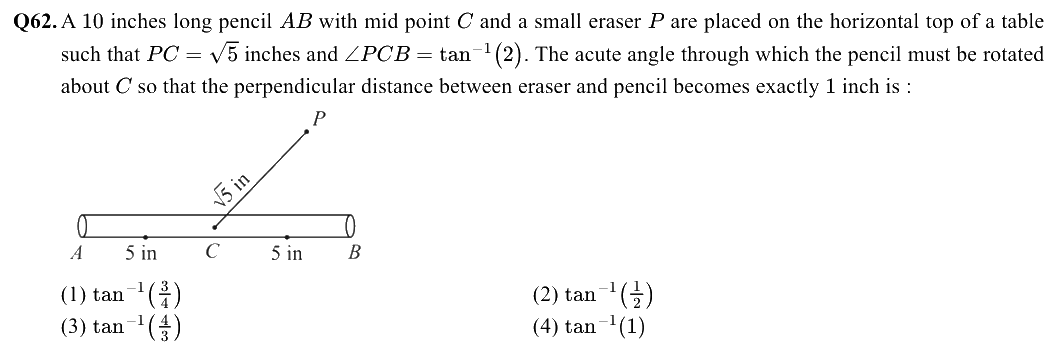
A 10 inches long pencil $AB$ with mid point $C$ and a small eraser $P$ are placed on the horizontal top of a table such that $PC=\sqrt{5}$ inches and $\angle PCB=\tan^{-1}(2)$. The acute angle through which the pencil must be rotated about $C$ so that the perpendicular distance between eraser and pencil becomes exactly 1 inch is : (see the figure above)
The point $P(a, b)$ undergoes the following three transformations successively: (a) reflection about the line $y = x$. (b) translation through 2 units along the positive direction of $x-$ axis. (c) rotation through angle $\frac{\pi}{4}$ about the origin in the anti-clockwise direction. If the co-ordinates of the final position of the point $P$ are $\left(-\frac{1}{\sqrt{2}}, \frac{7}{\sqrt{2}}\right)$, then the value of $2a + b$ is equal to:
Two sides of a parallelogram are along the lines $4x + 5y = 0$ and $7x + 2y = 0$. If the equation of one of the diagonals of the parallelogram is $11x + 7y = 9$, then other diagonal passes through the point:
Let the equation of the pair of lines, $y = px$ and $y = qx$, can be written as $(y - px)(y - qx) = 0$. Then the equation of the pair of the angle bisectors of the lines $x^2 - 4xy - 5y^2 = 0$ is:
Let $P$ be a variable point on the parabola $y = 4x^2 + 1$. Then, the locus of the mid-point of the point $P$ and the foot of the perpendicular drawn from the point $P$ to the line $y = x$ is:
The equation of one of the straight lines which passes through the point $(1, 3)$ and makes an angles $\tan^{-1}\left(\sqrt{2}\right)$ with the straight line, $y + 1 = 3\sqrt{2}x$ is
A vector $\overrightarrow{a}$ has components $3p$ and 1 with respect to a rectangular cartesian system. This system is rotated through a certain angle about the origin in the counter clockwise sense. If, with respect to new system, $\overrightarrow{a}$ has components $p + 1$ and $\sqrt{10}$, then a value of $p$ is equal to:
Let the centroid of an equilateral triangle $ABC$ be at the origin. Let one of the sides of the equilateral triangle be along the straight line $x + y = 3$. If $R$ and $r$ be the radius of circumcircle and incircle respectively of $\Delta ABC$, then $(R + r)$ is equal to :
In a triangle $P Q R$, the co-ordinates of the points $P$ and $Q$ are $(-2,4)$ and $(4,-2)$ respectively. If the equation of the perpendicular bisector of $P R$ is $2 x-y+2=0$, then the centre of the circumcircle of the $\Delta P Q R$ is:
Let $A(-1, 1)$, $B(3, 4)$ and $C(2, 0)$ be given three points. A line $y = mx$, $m > 0$, intersects lines $AC$ and $BC$ at point $P$ and $Q$ respectively. Let $A_1$ and $A_2$ be the areas of $\Delta ABC$ and $\Delta PQC$ respectively, such that $A_1 = 3A_2$, then the value of $m$ is equal to :
If the curve $x^2 + 2y^2 = 2$ intersects the line $x + y = 1$ at two points $P$ and $Q$, then the angle subtended by the line segment $PQ$ at the origin is
A man is walking on a straight line. The arithmetic mean of the reciprocals of the intercepts of this line on the coordinate axes is $\frac{1}{4}$. Three stones $A, B$ and $C$ are placed at the points $1, 1, 2, 2$ and $4, 4$ respectively. Then which of these stones is / are on the path of the man?
A ray of light coming from the point $\left(2, 2\sqrt{3}\right)$ is incident at an angle $30^\circ$ on the line $x = 1$ at the point $A$. The ray gets reflected on the line $x = 1$ and meets $x$ -axis at the point $B$. Then, the line $AB$ passes through the point
A triangle $ABC$ lying in the first quadrant has two vertices as $A(1, 2)$ and $B(3, 1)$. If$\angle BAC = 90^{\circ}$,and ar $(\Delta\ \mathrm{ABC}) = 5\sqrt{5}$ sq. units, then the abscissa of the vertex C is :
The set of all possible values of $\theta$ in the interval $(0, \pi)$ for which the points$(1, 2)$ and $(\sin\theta, \cos\theta)$ lie on the same side of the line $x + y = 1$ is?
Let $D$ be the centroid of the triangle with vertices $(3, -1)$ , $(1, 3)$ and $(2, 4)$ . Let P be the point of intersection of the lines $x + 3y - 1 = 10$ and $3x - y + 1 = 0$ . Then, the line passing through the points $D$ and P also passes through the point:
Let two points be $A(1, -1)$ and $B(0, 2)$. If a point $P(x', y')$ be such that the area of $\Delta PAB = 5$ sq. units and it lies on the line $3x + y - 4\lambda = 0$, then a value of $\lambda$ is
A triangle has a vertex at $(1,\ 2)$ and the mid points of the two sides through it are $(-1,\ 1)$ and $(2,\ 3)$ . Then the centroid of this triangle is:
A straight line $L$ at a distance of 4 units from the origin makes positive intercepts on the coordinate axes and the perpendicular from the origin to this line makes an angle of $60^{\circ}$ with the line $x + y = 0$. Then an equation of the line $L$ is: Note: In actual JEE Main paper, two options were correct for this question. Hence, we have changed one option.
Lines are drawn parallel to the line $4x - 3y + 2 = 0$, at a distance $\frac{3}{5}$ units from the origin. Then which one of the following points lies on any of these lines?
If the two lines $x + (a - 1)y = 1$ and $2x + a^2 y = 1$, $(a \in R - \{0, 1\})$ are perpendicular, then the distance of their point of intersection from the origin is
Suppose that the points $h$, $k$, 1, 2 and -3, 4 lie on the line $L_1$. If a line $L_2$ passing through the points $h$, $k$ and 4, 3 is perpendicular to $L_1$, then $\frac{k}{h}$ equals:
If a straight line passing through the point $P(-3,\ 4)$ is such that its intercepted portion between the coordinate axes is bisected at $P$, then its equation is :
Let $\sqrt{3}\hat{i} + \hat{j}$, $\hat{i} + \sqrt{3}\hat{j}$ and $\beta\hat{i} + (1-\beta)\hat{j}$ respectively be the position vectors of the points A, B and C with respect to the origin O. If the distance of C from the bisector of the acute angle between OA and OB is $\frac{3}{\sqrt{2}}$, then the sum of all possible values of $\beta$ is:
If the line $3x + 4y - 24 = 0$ intersects the $x$-axis is at the point $A$ and the $y$-axis at the point $B$, then the incentre of the triangle $OAB$, where $O$ is the origin, is:
A point $P$ moves on the line $2x - 3y + 4 = 0$. If $Q(1,\ 4)$ and $R(3,\ -2)$ are fixed points, then the locus of the centroid of $\triangle PQR$ is a line:
Let the equations of two sides of a triangle be $3x - 2y + 6 = 0$ and $4x + 5y - 20 = 0$. If the orthocenter of this triangle is at $(1,\ 1)$ then the equation of it's third side is:
In a triangle $ABC$, coordianates (sic) of $A$ are $(1, 2)$ and the equations of the medians through $B$ and $C$ are $x + y = 5$ and $x = 4$ respectively. Then area of $\triangle ABC$ (in sq. units) is
The foot of the perpendicular drawn from the origin, on the line, $3x + y = \lambda(\lambda \neq 0)$ is $P$. If the line meets $x$-axis at $A$ and $y$-axis at $B$, then the ratio $BP : PA$ is
The sides of a rhombus $ABCD$ are parallel to the lines, $x - y + 2 = 0$ and $7x - y + 3 = 0$. If the diagonals of the rhombus intersect at $P(1,2)$ and the vertex $A$ (different from the origin) is on the $y$ axis, then the ordinate of $A$ is
A straight line through a fixed point $(2, 3)$ intersects the coordinate axes at distinct points $P$ and $Q$. If $O$ is the origin and the rectangle $OPRQ$ is completed, then the locus of $R$ is:
Let the orthocentre and centroid of a triangle be $A(-3,\ 5)$ and $B(3,\ 3)$ respectively. If $C$ is the circumcentre of this triangle, then the radius of the circle having line segment $AC$ as diameter, is:
A square, of each side 2, lies above the $x$-axis and has one vertex at the origin. If one of the sides passing through the origin makes an angle $30^\circ$ with the positive direction of the $x$-axis , then the sum of the $x$-coordinates of the vertices of the square is:
Let $k$ be an integer such that the triangle with vertices $(k,\ -3k)$, $(5,\ k)$ and $(-k,\ 2)$ has area $28$ sq. units. Then the orthocenter of this triangle is at the point:
A straight line through origin $O$ meets the lines $3y = 10 - 4x$ and $8x + 6y + 5 = 0$ at points $A$ and $B$ respectively. Then, $O$ divides the segment $AB$ in the ratio
A ray of light is incident along a line which meets another line $7x - y + 1 = 0$ at the point $(0, 1)$. The ray is then reflected from this point along the line $y + 2x = 1$. Then the equation of the line of incidence of the ray of light is :
If a variable line drawn through the intersection of the lines $\frac{x}{3} + \frac{y}{4} = 1$ and $\frac{x}{4} + \frac{y}{3} = 1$ , meets the coordinate axes at A and B, $(A \neq B)$,then the locus of the midpoint of AB is:
The point $(2,1)$ is translated parallel to the line $L : x - y = 4$ by $2\sqrt{3}$ units. If the new point $Q$ lies in the third quadrant, then the equation of the line passing through $Q$ and perpendicular to $L$ is
Two sides of a rhombus are along the lines, $x - y + 1 = 0$ and $7x - y - 5 = 0$ . If its diagonals intersect at $(-1,\ -2)$ , then which one of the following is a vertex of this rhombus ?
A straight line $L$ through the point $(3, -2)$ is inclined at an angle of $60^\circ$ to the line $\sqrt{3}x + y = 1$. If $L$ also intersects the $X$-axis, then the equation of $L$ is:
If the incentre of an equilateral triangle is $(1, 1)$ and the equation of its one side is $3x + 4y + 3 = 0$, then the equation of the circumcircle of this triangle is:
Let $L$ be the line passing through the point $P(1, 2)$ such that its intercepted segment between the co-ordinate axes is bisected at $P$. If $L_1$ is the line perpendicular to $L$ and passing through the point $(-2, 1)$, then the point of intersection of $L$ and $L_1$ is
If a line $L$ is perpendicular to the line $5x - y = 1$, and the area of the triangle formed by the line $L$ and the coordinate axes is 5 sq units, then the distance of the line $L$ from the line $x + 5y = 0$ is
The circumcentre of a triangle lies at the origin and its centroid is the midpoint of the line segment joining the points $(a^2 + 1,\ a^2 + 1)$ and $(2a\ ,\ -\ 2\ a)$, $a \neq 0$. Then for any $a$, the orthocentre of this triangle lies on the line
The base of an equilateral triangle is along the line given by $3x + 4y = 9$. If a vertex of the triangle is $(1, 2)$, then the length of a side of the triangle is:
A stair-case of length $l$ rests against a vertical wall and a floor of a room. Let P be a point on the stair-case, nearer to its end on the wall, that divides its length in the ratio $1 : 2$. If the staircase begins to slide on the floor, then the locus of P is:
Given three points $P, Q, R$ with $P(5, 3)$ and $R$ lies on the $x$-axis. If the equation of $RQ$ is $x - 2y = 2$ and $PQ$ is parallel to the $x$-axis, then the centroid of $\Delta PQR$ lies on the line
Let $a$ and $b$ be any two numbers satisfying $\frac{1}{a^2} + \frac{1}{b^2} = \frac{1}{4}$. Then, the foot of perpendicular from the origin on the variable line $\frac{x}{a} + \frac{y}{b} = 1$ lies on :
Let $PS$ be the median of the triangle with vertices $P(2, 2)$, $Q(6, -1)$ and $R(7, 3)$. The equation of the line passing through $(1, -1)$ and parallel to $PS$ is
Let $a$, $b$, $c$ and $d$ be non-zero numbers. If the point of intersection of the lines $4ax + 2ay + c = 0$ & $5bx + 2by + d = 0$ lies in the fourth quadrant and is equidistant from the two axes then
Let $A(-3, 2)$ and $B(-2, 1)$ be the vertices of a triangle ABC. If the centroid of this triangle lies on the line $3x + 4y + 2 = 0$, then the vertex $C$ lies on the line :
Let $\theta_1$ be the angle between two lines $2x + 3y + c_1 = 0$ and $-x + 5y + c_2 = 0$ and $\theta_2$ be the angle between two lines $2x + 3y + c_1 = 0$ and $-x + 5y + c_3 = 0$, where $c_1, c_2, c_3$ are any real numbers : Statement-1: If $c_2$ and $c_3$ are proportional, then $\theta_1 = \theta_2$. Statement-2: $\theta_1 = \theta_2$ for all $c_2$ and $c_3$.
A
Statement-1 is true, Statement-2 is true; Statement-2 is a correct explanation of Statement-1.
B
Statement-1 is true, Statement-2 is true; Statement-2 is not a correct explanation of Statement-1.
If the extremities of the base of an isosceles triangle are the points $(2a, 0)$ and $(0, a)$ and the equation of one of the sides is $x = 2a$, then the area of the triangle, in square units, is :
If the $x$-intercept of some line $L$ is double as that of the line, $3x + 4y = 12$ and the $y$-intercept of $L$ is half as that of the same line, then the slope of $L$ is :
A light ray emerging from the point source placed at $\mathrm{P}(1,3)$ is reflected at a point Q in the axis of $x$. If the reflected ray passes through the point $R\ (6,7)$, then the abscissa of $Q$ is:
The line parallel to $x$-axis and passing through the point of intersection of lines $ax + 2by + 3b = 0$ and $bx - 2ay - 3a = 0$, where $(a, b) \neq (0, 0)$ is
If three distinct points $A, B, C$ are given in the 2dimensional coordinate plane such that the ratio of the distance of each one of them from the point $(1, 0)$ to the distance from $(-1, 0)$ is equal to $\frac{1}{2}$, then the circumcentre of the triangle $ABC$ is at the point
If the line $2x + y = k$ passes through the point which divides the line segment joining the points $(1, 1)$ and $(2, 4)$ in the ratio $3 : 2$, then $k$ equals
The lines $L_1 : y - x = 0$ and $L_2 : 2x + y = 0$ intersect the line $L_3 : y + 2 = 0$ at $P$ and $Q$ respectively. The bisector of the acute angle between $L_1$ and $L_2$ intersect $L_3$ at $R$. This question has Statement $-1$ and Statement $-2$. Of the four choices given after the statements, choose the one that best describes the two statements. Statement-1 : The ratio $PR : RQ$ equals $2\sqrt{2} : \sqrt{5}$. Statement-2 : In any triangle, bisector of an angle divides the triangle into two similar triangles.
A
Statement $-1$ is true, Statement $-2$ is true; Statement $-2$ is not a correct explanation for Statement $-1$
B
Statement $-1$ is true, Statement- 2 is false.
C
Statement $-1$ is false, Statement- 2 is true.
D
Statement $-1$ is true, Statement $-2$ is true; Statement $-2$ is a correct explanation for Statement $-1$
The line $L$ given by $\frac{x}{5} + \frac{y}{b} = 1$ passes through the point $(13, 32)$. The line $K$ is parallel to $L$ and has the equation $\frac{x}{c} + \frac{y}{3} = 1$. Then the distance between $L$ and $K$ is
Three distinct points A, B and C are given in the 2 - dimensional coordinate plane such that the ratio of the distance of any one of them from the point $(1, 0)$ to the distance from the point $(-1, 0)$ is equal to $\frac{1}{3}$. Then the circumcentre of the triangle $ABC$ is at the point
Let $A(h, k)$, $B(1, 1)$ and $C(2, 1)$ be the vertices of a right angled triangle with $AC$ as its hypotenuse. If the area of the triangle is 1, then the set of values which ' k ' can take is given by
If non-zero numbers $a,b,c$ are in H.P., then the straight line $\frac{x}{a}+\frac{y}{b}+\frac{1}{c}=0$ always passes through a fixed point. That point is
If a vertex of a triangle is $(1,1)$ and the mid-points of two sides through this vertex are $(-1,2)$ and $(3,2)$, then the centroid of the triangle is
If the pair of lines $ax^{2}+2(a+b)xy+by^{2}=0$ lie along diameters of a circle and divide the circle into four sectors such that the area of one of the sectors is thrice the area of another sector then
Let $A(2, -3)$ and $B(-2, 1)$ be vertices of a triangle $ABC$. If the centroid of this triangle moves on the line $2x + 3y = 1$, then the locus of the vertex $C$ is the line
A square of side $a$ lies above the $x$-axis and has one vertex at the origin. The side passing through the origin makes an angle $\alpha\ \left(0 < \alpha < \frac{\pi}{4}\right)$ with the positive direction of x-axis. The equation of its diagonal not passing through the origin is
If the equation of the locus of a point equidistant from the points $(a_1, b_1)$ and $(a_2, b_2)$ is $(a_1 - a_2)x + (b_1 - b_2)y + c = 0$, then the value of 'c' is
From the point $(-1, -1)$, two rays are sent making angles of 45° with the line $x + y = 0$. These rays get reflected from the mirror $x + 2y = 1$. If the equations of the reflected rays are $ax + by = 9$ and $cx + dy = 7$, $a, b, c, d \in \mathbf{Z}$, then the value of $ad + bc$ is ________.
Numerical answer type: type your answer in EdLoop to check it
Let A, B be points on the two half-lines $x - \sqrt{3}|y| = \alpha$, $\alpha > 0$ at a distance of $\alpha$ from their point of intersection P. The line segment AB meets the angle bisector of the given half-lines at the point Q. If $\mathrm{PQ} = \frac{9}{2}$ and R is the radius of the circumcircle of $\Delta$PAB, then $\frac{\alpha^2}{\mathrm{R}}$ is equal to ________.
Numerical answer type: type your answer in EdLoop to check it
If $P$ is a point on the circle $x^2 + y^2 = 4$, $Q$ is a point on the straight line $5x + y + 2 = 0$ and $x - y + 1 = 0$ is the perpendicular bisector of $PQ$, then 13 times the sum of abscissa of all such points $P$ is ________.
Numerical answer type: type your answer in EdLoop to check it
Let $A(4, -2), B(1, 1)$ and $C(9, -3)$ be the vertices of a triangle ABC. Then the maximum area of the parallelogram AFDE, formed with vertices D, E and F on the sides BC, CA and AB of the triangle ABC respectively, is ______
Numerical answer type: type your answer in EdLoop to check it
Let $A(6, 8)$, $B(10\cos\alpha, -10\sin\alpha)$ and $C(-10\sin\alpha, 10\cos\alpha)$, be the vertices of a triangle. If $L(a, 9)$ and $G(h, k)$ be its orthocenter and centroid respectively, then $(5a - 3h + 6k + 100\sin 2\alpha)$ is equal to ______ .
Numerical answer type: type your answer in EdLoop to check it
Let the distance between two parallel lines be 5 units and a point $P$ lie between the lines at a unit distance from one of them. An equilateral triangle $PQR$ is formed such that $Q$ lies on one of the parallel lines, while $R$ lies on the other. Then $(QR)^2$ is equal to ______ .
Numerical answer type: type your answer in EdLoop to check it
If the orthocentre of the triangle formed by the lines $2x + 3y - 1 = 0, x + 2y - 1 = 0$ and $ax + by - 1 = 0$, is the centroid of another triangle, whose circumcentre and orthocentre respectively are $(3, 4)$ and $(-6, -8)$, then the value of $|a - b|$ is ______
Numerical answer type: type your answer in EdLoop to check it
Let a ray of light passing through the point $(3, 10)$ reflects on the line $2x + y = 6$ and the reflected ray passes through the point $(7, 2)$. If the equation of the incident ray is $ax + by + 1 = 0$, then $a^2 + b^2 + 3ab$ is equal to ______
Numerical answer type: type your answer in EdLoop to check it
Let $L_1, L_2$ be the lines passing through the point $P(0, 1)$ and touching the parabola $9x^2 + 12x + 18y - 14 = 0$. Let $Q$ and $R$ be the points on the lines $L_1$ and $L_2$ such that $\triangle PQR$ is an isosceles triangle with base $QR$. If the slopes of the lines $QR$ are $m_1$ and $m_2$, then $16\,(m_1^2 + m_2^2)$ is equal to ______
Numerical answer type: type your answer in EdLoop to check it
Consider a triangle ABC having the vertices $\mathrm{A}(1, 2), \mathrm{B}(\alpha, \beta)$ and $\mathrm{C}(\gamma, \delta)$ and angles $\angle ABC = \frac{\pi}{6}$ and $\angle BAC = \frac{2\pi}{3}$. If the points B and C lie on the line $y = x + 4$, then $\alpha^2 + \gamma^2$ is equal to ______
Numerical answer type: type your answer in EdLoop to check it
Let $ABC$ be an isosceles triangle in which $A$ is at $-1, 0$, $\angle A = \frac{2\pi}{3}$, $AB = AC$ and $B$ is on the positive $x$ - axis. If $BC = 4\sqrt{3}$ and the line $BC$ intersects the line $y = x + 3$ at $\alpha, \beta$, then $\frac{\beta^4}{\alpha^2}$ is:
Numerical answer type: type your answer in EdLoop to check it
Let $A(-2, -1)$, $B(1, 0)$, $C(\alpha, \beta)$ and $D(\gamma, \delta)$ be the vertices of a parallelogram $ABCD$. If the point $C$ lies on $2x - y = 5$ and the point $D$ lies on $3x - 2y = 6$, then the value of $\alpha + \beta + \gamma + \delta$ is equal to ______.
Numerical answer type: type your answer in EdLoop to check it
If the sum of squares of all real values of $\alpha$, for which the lines $2x - y + 3 = 0$, $6x + 3y + 1 = 0$ and $\alpha x + 2y - 2 = 0$ do not form a triangle is p, then the greatest integer less than or equal to p is ______.
Numerical answer type: type your answer in EdLoop to check it
If the line $l_1 : 3y - 2x = 3$ is the angular bisector of the lines $l_2 : x - y + 1 = 0$ and $l_3 : \alpha x + \beta y + 17 = 0$, then $\alpha^2 + \beta^2 - \alpha - \beta$ is equal to ______
Numerical answer type: type your answer in EdLoop to check it
Let the equations of two adjacent sides of a parallelogram $ABCD$ be $2x - 3y = -23$ and $5x + 4y = 23$. If equation of its one diagonal $AC$ is $3x + 7y = 23$ and the distance of $A$ from the other diagonal is $d$, then $50d^2$ is equal to ______
Numerical answer type: type your answer in EdLoop to check it
A triangle is formed by the tangents at the point $(2, 2)$ on the curves $y^2 = 2x$ and $x^2 + y^2 = 4x$, and the line $x + y + 2 = 0$. If $r$ is the radius of its circumcircle, then $r^2$ is equal to
Numerical answer type: type your answer in EdLoop to check it
A triangle is formed by $X$-axis, $Y$-axis and the line $3x+4y=60$. Then the number of points $P(a,b)$ which lie strictly inside the triangle, where $a$ is an integer and $b$ is a multiple of $a$, is ______ .
Numerical answer type: type your answer in EdLoop to check it
The equations of the sides $AB$, $BC$ & $CA$ of a triangle $ABC$ are $2x+y=0$, $x+py=21a$ ($a\neq0$) and $x-y=3$ respectively. Let $P(2,a)$ be the centroid of the triangle $ABC$, then $(BC)^{2}$ is equal to
Numerical answer type: type your answer in EdLoop to check it
The equations of the sides $AB$, $BC$ and $CA$ of a triangle $ABC$ are $2x + y = 0$, $x + py = 15a$ and $x - y = 3$ respectively. If its orthocentre is $(2, a)$, $-\frac{1}{2} < a < 2$, then $p$ is equal to
Numerical answer type: type your answer in EdLoop to check it
A ray of light passing through the point $P(2, 3)$ reflects on the $X$-axis at point $A$ and the reflected ray passes through the point $Q(5, 4)$. Let $R$ be the point that divides the line segment $AQ$ internally into the ratio $2 : 1$. Let the co-ordinates of the foot of the perpendicular $M$ from $R$ on the bisector of the angle $PAQ$ be $(\alpha, \beta)$. Then, the value of $7\alpha + 3\beta$ is equal to ______.
Numerical answer type: type your answer in EdLoop to check it
Let $A\left(\frac{3}{\sqrt{a}}, \sqrt{a}\right)$, $a > 0$, be a fixed point in the $xy$-plane. The image of $A$ in $y$-axis be $B$ and the image of $B$ in $x$-axis be $C$. If $D(3\cos\theta, a\sin\theta)$, is a point in the fourth quadrant such that the maximum area of $\Delta ACD$ is $12$ square units, then $a$ is equal to ______
Numerical answer type: type your answer in EdLoop to check it
Let the points of intersections of the lines $x - y + 1 = 0$, $x - 2y + 3 = 0$ and $2x - 5y + 11 = 0$ are the mid points of the sides of a triangle ABC. Then the area of the triangle ABC is
Numerical answer type: type your answer in EdLoop to check it
A man starts walking from the point $P\left(-3, 4\right)$, touches the $x$-axis at $R$, and then turns to reach at the point $Q\left(0, 2\right)$. The man is walking at a constant speed. If the man reaches the point $Q$ in the minimum time, then $50\left[\left(PR\right)^2 + \left(RQ\right)^2\right]$ is equal to ______.
Numerical answer type: type your answer in EdLoop to check it
Consider a triangle having vertices $A(-2, 3)$, $B(1, 9)$ and $C(3, 8)$. If a line $L$ passing through the circumcentre of triangle $ABC$, bisects line $BC$, and intersects $y$-axis at point $\left(0, \frac{\alpha}{2}\right)$, then the value of real number $\alpha$ is ______ .
Numerical answer type: type your answer in EdLoop to check it
Let $\tan \alpha, \tan \beta$ and $\tan \gamma ; \alpha, \beta, \gamma \neq \frac{(2 n-1) \pi}{2}, n \in N$ be the slopes of the three line segments $O A, O B$ and $O C$, respectively, where $O$ is origin. If circumcentre of $\triangle A B C$ coincides with origin and its orthocentre lies on $y$-axis, then the value of $\left(\frac{\cos 3 \alpha+\cos 3 \beta+\cos 3 \gamma}{\cos \alpha \cdot \cos \beta \cdot \cos \gamma}\right)^2$ is equal to :
Numerical answer type: type your answer in EdLoop to check it
If the line, $2\ x - y + 3 = 0$ is at a distance $\frac{1}{\sqrt{5}}$ and $\frac{2}{\sqrt{5}}$ from the lines $4x - 2y + \alpha = 0$ and $6x - 3y + \beta = 0$ respectively, then the sum of all possible values of $\alpha$ and $\beta$ is ______.
Numerical answer type: type your answer in EdLoop to check it
Let $A(1, 0), B(6, 2)$ and $C\left(\frac{3}{2}, 6\right)$ be the vertices of a triangle $ABC$. If $P$ is a point inside the triangle $ABC$ such that the triangles $APC$, $APB$ and $BPC$ have equal areas, then the length of the line segment $PQ$, where $Q$ is the point $\left(-\frac{7}{6}, -\frac{1}{3}\right)$, is
Numerical answer type: type your answer in EdLoop to check it
Straight lines provides the primary algebraic language for two-dimensional coordinate geometry under Unit 10: Coordinate Geometry in the Class 11 curriculum, standing at rank 16 among the 29 chapters in the subject. Across the 162 papers conducted between 2019 and 2026, this chapter contributed 159 questions, capturing 3.5 percent of all mathematics questions. It appeared in 125 of those 162 papers and has been asked every year since 2019. In the recent 2024 to 2026 examination cycle, it supplied 68 questions across 58 papers, averaging 1.2 questions per paper with an increased subject share of 4.4 percent. Comparing the 2002 to 2018 share of 5.4 percent to the 2024 to 2026 share shows that its long-term share is down, whereas comparing 2019 to 2026 against 2024 to 2026 shows it is up. Over the full 2002 to 2026 archive spanning 200 papers, 230 questions appeared in 161 papers, with 27 questions appearing in the numerical answer format from 2019 to 2026.
In the 2024, 2025, and 2026 cycles, the question counts were 30, 22, and 16 questions respectively.
Because lines define the sides of triangles, chords of circles, and axes of symmetry, straight line mechanics permeate all of coordinate geometry. Even when an exam problem is categorized under circles or parabolas, the core algebraic workload frequently reduces to line perpendicularity, distance formulas, or angle bisectors.
Most-asked topics
Questions in this chapter divide between two large primary topics and one historical subtopic:
1. Equations of Lines (83 questions, 2019-2026; 119 total, last asked 2026) The largest concentration of questions involves slope forms, intercept forms, parametric or symmetric line equations, distance between parallel lines, perpendicular distance from a point to a line, and equations of angle bisectors.
2. Points & Basics (73 questions, 2019-2026; 101 total, last asked 2026) Deals with triangle geometry in coordinates, including the centroid, incentre, circumcentre, and orthocentre. Many questions ask students to find the image of a point or the foot of a perpendicular across a given line, or determine collinearity and concurrency conditions.
3. Pair of Straight Lines (3 questions, 2019-2026; 10 total, last asked 2023) Covers homogeneous and general second-degree equations representing pairs of intersecting or parallel lines, angle bisectors of line pairs, and lines joining the origin to intersection points. This topic was officially removed in recent syllabus revisions.
What the questions look like
Examiners repeatedly deploy several classical coordinate configurations:
Triangle Centres and Orthocentre Relations: Given two vertices of a triangle and its orthocentre or circumcentre, compute the coordinates of the third vertex using perpendicular slope relations and section formulas.
Parametric Distance Along a Line: A line drawn in a specific angular direction from a known point intersects another line or circle. Using the parametric form x equals x1 plus r cos theta allows distances along the ray to be found cleanly.
Angle Bisectors and Reflections: Determining the bisector of the acute or obtuse angle between two intersecting lines, or identifying the image of a given point in a reflecting line mirror.
Perpendicular Distance and Parallel Strips: Finding locus points or triangle areas bounded between parallel lines separated by specified perpendicular offsets.
Questions to try first
Test your coordinate mechanics with these recent examination problems:
Fluency in straight lines depends on using coordinate shortcuts rather than raw algebra:
Use the parametric symmetric form: Whenever a problem mentions distance measured along a line inclined at an angle, express coordinates as x1 plus r cos theta and y1 plus r sin theta. Substituting these directly into the target curve or line yields a simple quadratic or linear equation in r.
Master the foot of the perpendicular formula: Memorise the standard coordinate formulas for the foot of the perpendicular and the reflection image of a point across the line ax plus by plus c equals zero. Deriving them from scratch during the exam wastes critical minutes.
Exploit Euler's line relationship: In any non-equilateral triangle, remember that the orthocentre, centroid, and circumcentre are collinear, with the centroid dividing the distance between orthocentre and circumcentre in the ratio two to one. This property frequently shortcuts vertex computations.
Differentiate acute and obtuse bisectors: Write both line equations with positive constant terms. Evaluate the sign of a1 a2 plus b1 b2. If it is positive, the positive sign yields the obtuse angle bisector; if negative, the positive sign corresponds to the acute angle bisector.
Frequently asked questions
Is the pair of straight lines topic still part of the syllabus?
General and homogeneous pairs of straight lines passing through the origin were dropped from the official JEE Main syllabus starting in 2024. Questions specifically asking for angles between pairs of lines or joint equations have stopped appearing, though understanding individual straight lines remains paramount.
How do I identify whether an angle bisector contains the origin?
Write the equations of both intersecting lines such that their constant terms are both strictly positive. The bisector formed with the positive sign between the normalized equations is the bisector of the angle containing the origin.
Why is the parametric form of a line so widely tested?
The parametric line formulation converts geometric questions involving lengths and distances into purely algebraic roots of one scalar variable r. This avoids cumbersome square roots from distance formulas and connects smoothly with polynomial equations. Step-by-step solutions for each one are in the EdLoop app.