Every Laws of Motion question from past JEE Main and AIEEE papers, with options and answers. Newest first.
253questions
153papers covered
4.3%of Physics questions, 2019–2026
2002–2026years
Guide at a glance
Laws of Motion sits at the theoretical core of classical mechanics in JEE Main Physics. Across the papers we hold from 2019 to 2026, the chapter contributed 195 questions in 162 papers, which translates to 1.2 questions per paper, turning up in 126 of those 162 papers.
A car moving with a speed of 54 km/h takes a turn of radius 20 m. A simple pendulum is suspended from the ceiling of the car. Determine the angle made by the string of the pendulum with the vertical during the turning. (Take $g = 10$ m/s$^2$)
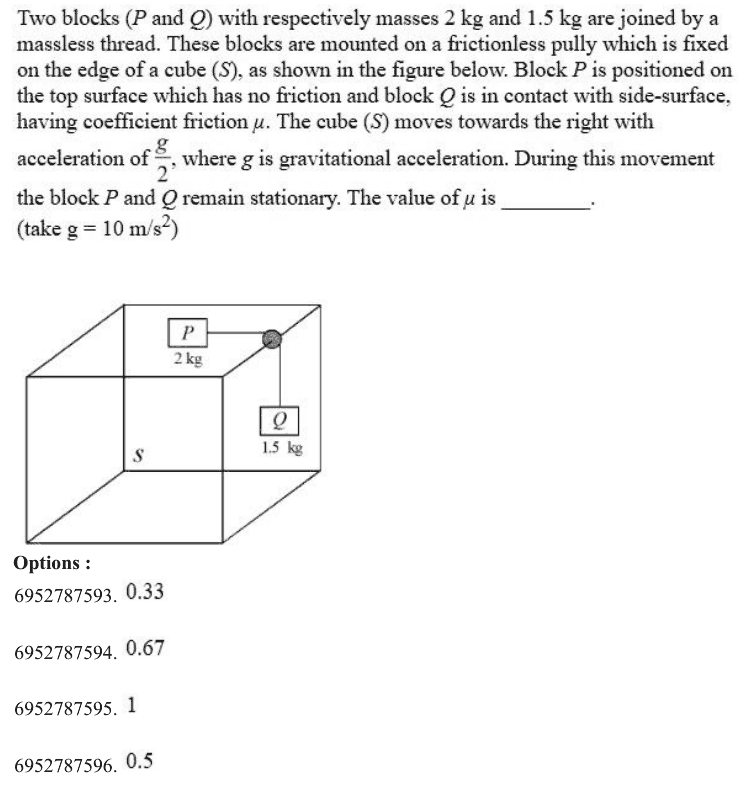
Two blocks ($P$ and $Q$) with respectively masses 2 kg and 1.5 kg are joined by a massless thread. These blocks are mounted on a frictionless pully which is fixed on the edge of a cube ($S$), as shown in the figure below. Block $P$ is positioned on the top surface which has no friction and block $Q$ is in contact with side-surface, having coefficient friction $\mu$. The cube ($S$) moves towards the right with acceleration of $\dfrac{g}{2}$, where $g$ is gravitational acceleration. During this movement the block $P$ and $Q$ remain stationary. The value of $\mu$ is ________. (take g = 10 m/s$^2$)
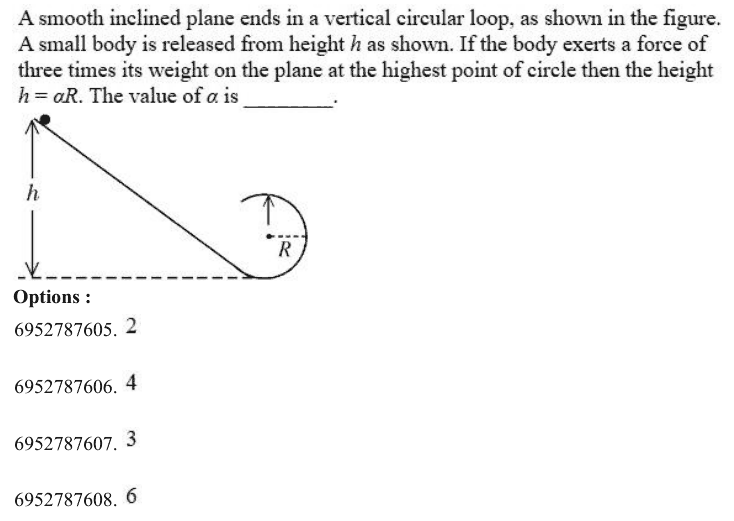
A smooth inclined plane ends in a vertical circular loop, as shown in the figure. A small body is released from height $h$ as shown. If the body exerts a force of three times its weight on the plane at the highest point of circle then the height $h = \alpha R$. The value of $\alpha$ is ________.
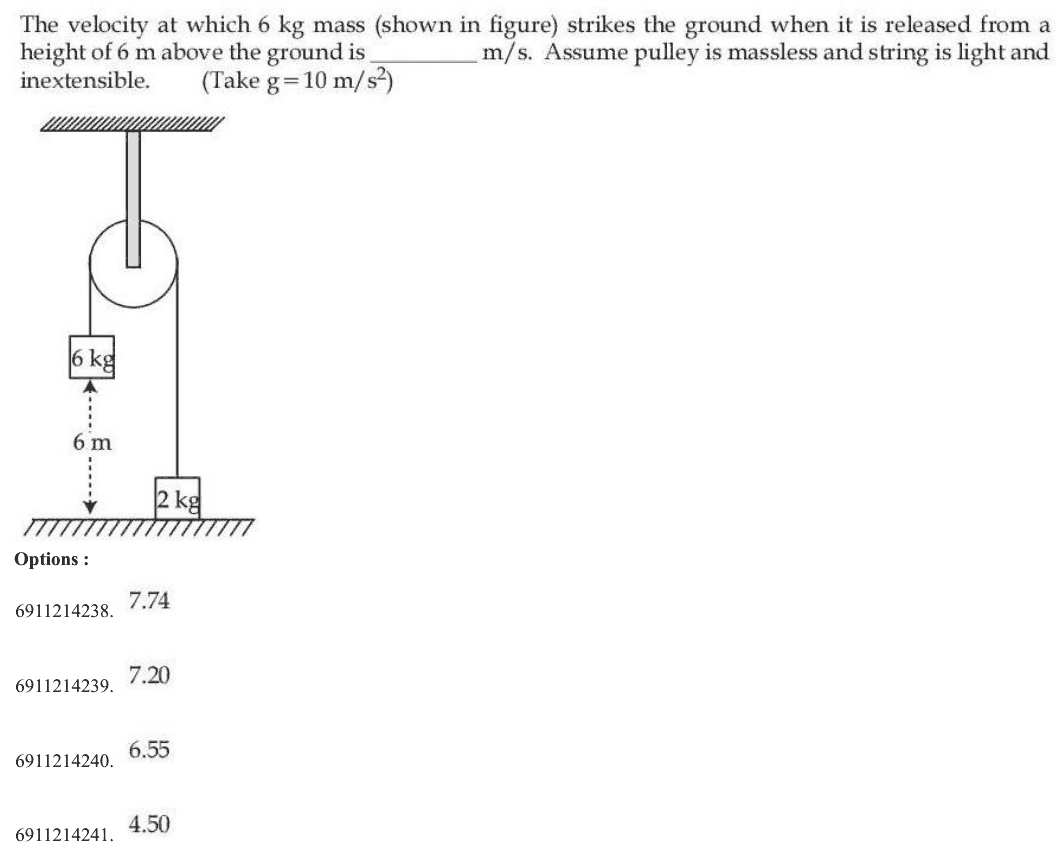
The velocity at which 6 kg mass (shown in figure) strikes the ground when it is released from a height of 6 m above the ground is ________ m/s. Assume pulley is massless and string is light and inextensible. (Take g = 10 m/s$^2$)
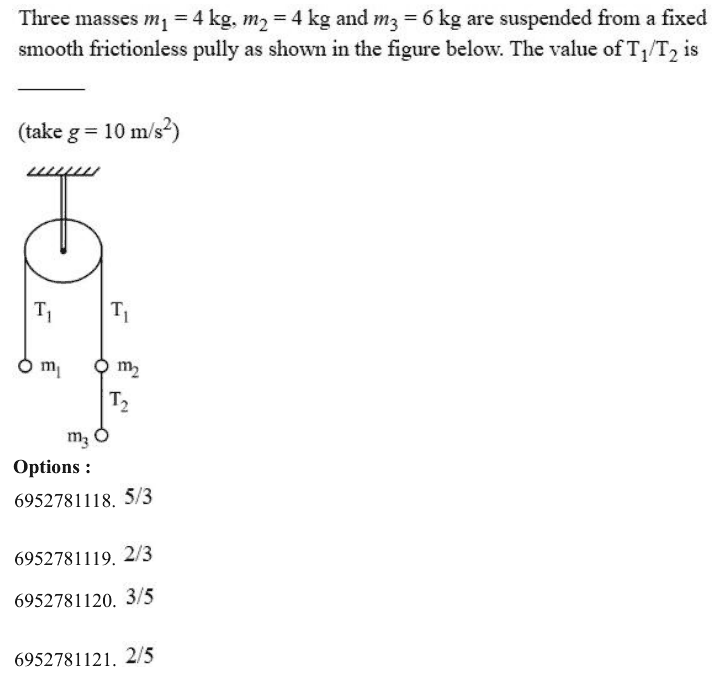
Three masses $m_1 = 4$ kg, $m_2 = 4$ kg and $m_3 = 6$ kg are suspended from a fixed smooth frictionless pully as shown in the figure below. The value of $T_1/T_2$ is ________.
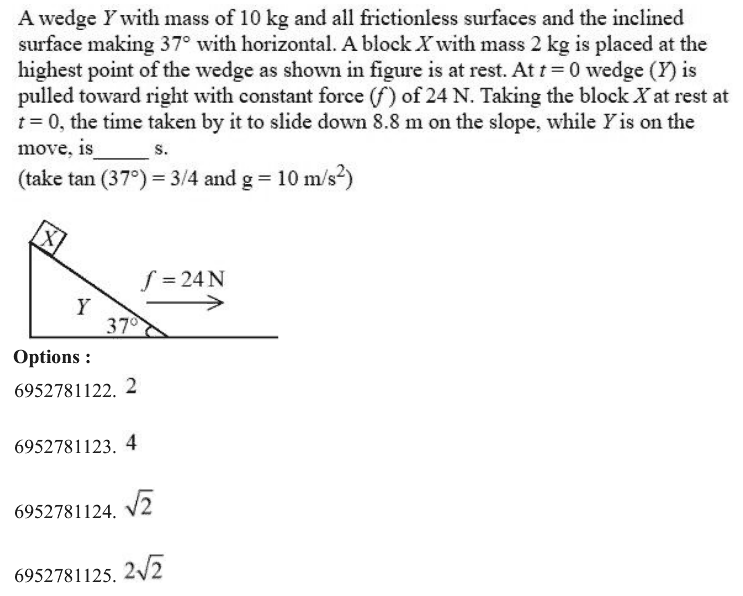
A wedge $Y$ with mass of 10 kg and all frictionless surfaces and the inclined surface making 37° with horizontal. A block $X$ with mass 2 kg is placed at the highest point of the wedge as shown in figure is at rest. At $t = 0$ wedge ($Y$) is pulled toward right with constant force ($f$) of 24 N. Taking the block $X$ at rest at $t = 0$, the time taken by it to slide down 8.8 m on the slope, while $Y$ is on the move, is ________ s.
The time taken by a block of mass $m$ to slide down from the highest point to the lowest point on a rough inclined plane is 50 % more compared to the time taken by the same block on identical inclined smooth plane. Both inclined planes are at 45° with the horizontal. The coefficient of kinetic friction between the rough inclined surface and block is ________.
At $t = 0$, a body of mass 100 g starts moving under the influence of a force $\left(5\hat{i} + 10\hat{j}\right)$N. After 2 s its position is $\left(2x\hat{i} + 5y\hat{j}\right)$ m. The ratio $x : y$ is ________.
A 0.5 kg mass is in contact against the inner wall of a cylindrical drum of radius 4 m rotating about its vertical axis. The minimum rotational speed of the drum to enable the mass to remain stuck to the wall (without falling) is 5 rad/s. The coefficient of friction between the drum's inner wall surface and mass is ________. (Take g = 10 m/s$^2$)
A block of mass 5 kg is moving on an inclined plane which makes an angle of $30°$ with the horizontal. Friction coefficient between the block and inclined plane surface is $\dfrac{\sqrt{3}}{2}$. The force to be applied on the block so that the block will move down without acceleration is ________ N.
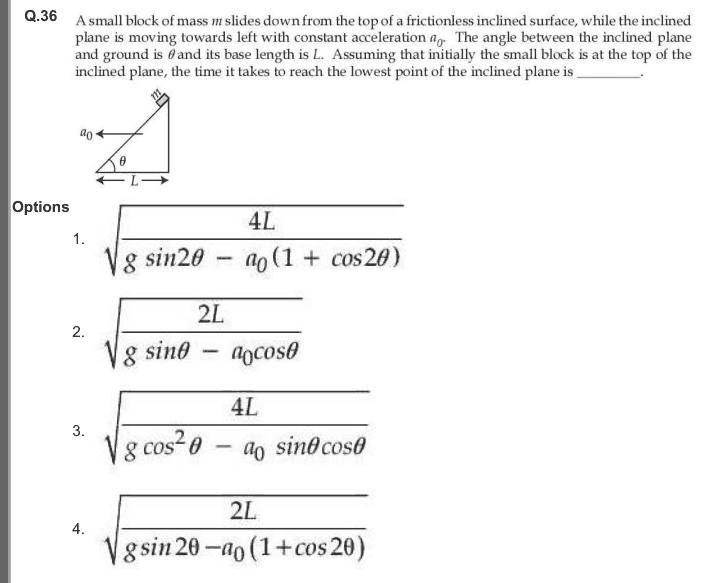
A small block of mass $m$ slides down from the top of a frictionless inclined surface, while the inclined plane is moving towards left with constant acceleration $a_0$. The angle between the inclined plane and ground is $\theta$ and its base length is $L$. Assuming that initially the small block is at the top of the inclined plane, the time it takes to reach the lowest point of the inclined plane is ________.
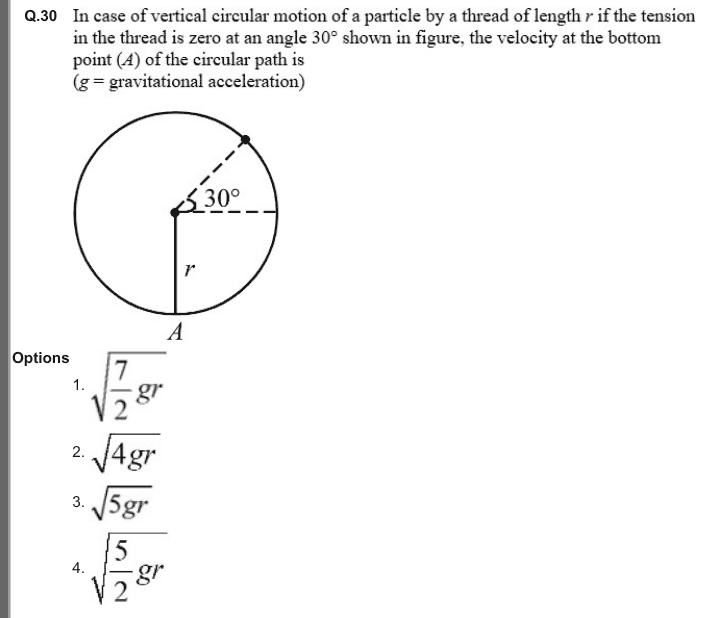
In case of vertical circular motion of a particle by a thread of length $r$ if the tension in the thread is zero at an angle $30°$ shown in figure, the velocity at the bottom point ($A$) of the circular path is
A flexible chain of mass $m$ hangs between two fixed points at the same level. The inclination of the chain with the horizontal at the two points of support is $30°$. Considering the equilibrium of each half of the chain, the tension of the chain at the lowest point is ________.
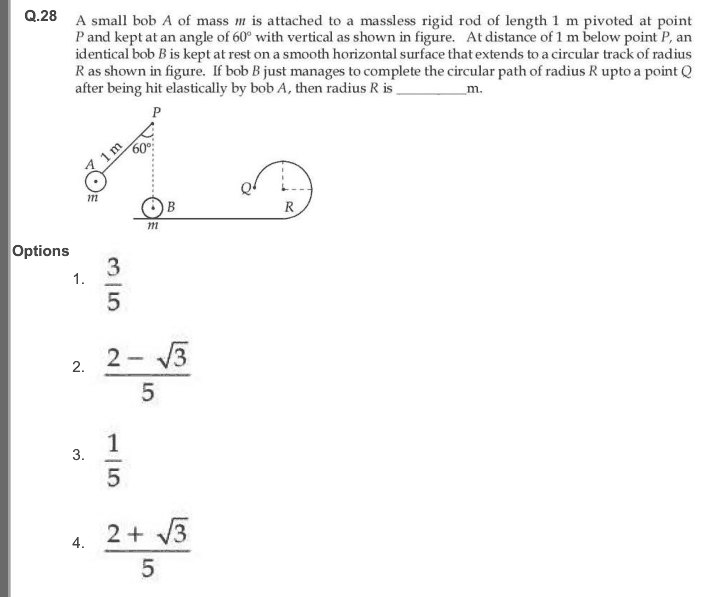
A small bob $A$ of mass $m$ is attached to a massless rigid rod of length 1 m pivoted at point $P$ and kept at an angle of $60°$ with vertical as shown in figure. At distance of 1 m below point $P$, an identical bob $B$ is kept at rest on a smooth horizontal surface that extends to a circular track of radius $R$ as shown in figure. If bob $B$ just manages to complete the circular path of radius $R$ upto a point $Q$ after being hit elastically by bob $A$, then radius $R$ is ________ m.
A body of mass 14 kg initially at rest explodes and breaks into three fragments of masses in the ratio 2 : 2 : 3. The two pieces of equal masses fly off perpendicular to each other with a speed of 18 m/s each. The velocity of the heavier fragment is ________ m/s.
A block is sliding down on an inclined plane of slope $\theta$ and at an instant $t = 0$ this block is given an upward momentum so that it starts moving up on the inclined surface with velocity $u$. The distance ($S$) travelled by the block before its velocity become zero, is ________.
A simple pendulum has a bob with mass $m$ and charge $q$. The pendulum string has negligible mass. When a uniform and horizontal electric field $\vec{E}$ is applied, the tension in the string changes. The final tension in the string, when pendulum attains an equilibrium position is ________.
A 4 kg mass moves under the influence of a force $\vec{F} = \left(4t^3\hat{i} - 3t\hat{j}\right)$ N where $t$ is the time in second. If mass starts from origin at $t = 0$, the velocity and position after $t = 2$ s will be :
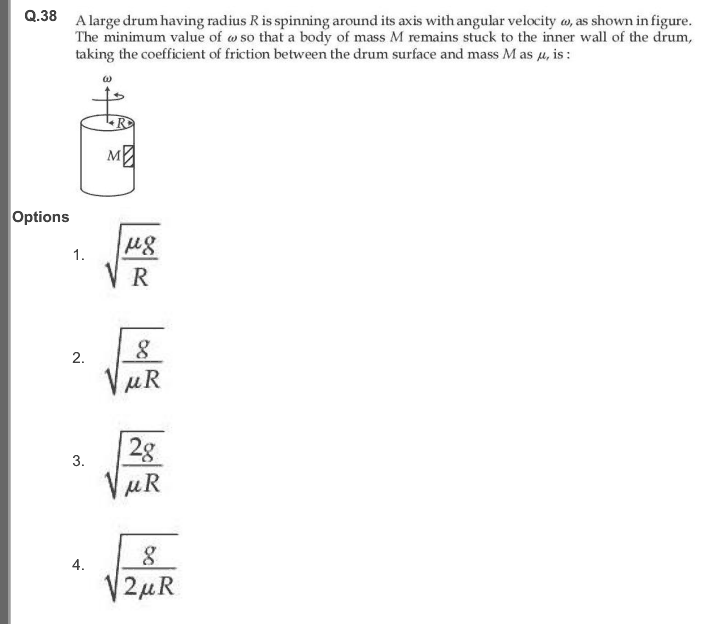
A large drum having radius $R$ is spinning around its axis with angular velocity $\omega$, as shown in figure. The minimum value of $\omega$ so that a body of mass $M$ remains stuck to the inner wall of the drum, taking the coefficient of friction between the drum surface and mass $M$ as $\mu$, is :
A body of mass 2 kg moving with velocity of $\vec{v}_{in} = 3\hat{i} + 4\hat{j}\,ms^{-1}$ enters into a constant force field of 6 N directed along positive z-axis. If the body remains in the field for a period of $\frac{5}{3}$ seconds, then velocity of the body when it emerges from force field is.
A cubic block of mass m is sliding down on an inclined plane at $60^\circ$ with an acceleration of $\frac{g}{2}$, the value of coefficient of kinetic friction is
A body of mass $m$ is suspended by two strings making angles $\theta_1$ and $\theta_2$ with the horizontal ceiling with tensions $T_1$ and $T_2$ simultaneously. $T_1$ and $T_2$ are related by $T_1 = \sqrt{3}T_2$, the angles $\theta_1$ and $\theta_2$ are
A
$\theta_1 = 30^\circ\theta_2 = 60^\circ$ with $T_2 = \frac{3mg}{4}$
B
$\theta_1 = 45^\circ\theta_2 = 45^\circ$ with $T_2 = \frac{3mg}{4}$
C
$\theta_1 = 60^\circ\theta_2 = 30^\circ$ with $T_2 = \frac{mg}{2}$
D
$\theta_1 = 30^\circ\theta_2 = 60^\circ$ with $T_2 = \frac{4mg}{5}$
A block of mass 25 kg is pulled along a horizontal surface by a force at an angle $45^\circ$ with the horizontal. The friction coefficient between the block and the surface is 0.25. The block travels at a uniform velocity. The workdone by the applied force during a displacement of 5 m of the block is :
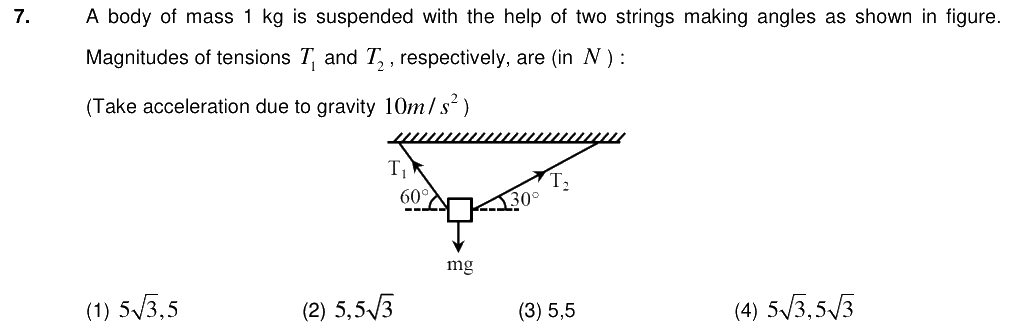
A body of mass 1 kg is suspended with the help of two strings making angles as shown in figure. Magnitudes of tensions $T_1$ and $T_2$, respectively, are (in $N$ ) :
A sand dropper drops sand of mass $m(t)$ on a conveyer belt at a rate proportional to the square root of speed ($v$) of the belt, i.e. $\frac{dm}{dt} \propto \sqrt{v}$. If P is the power delivered to run the belt at constant speed then which of the following relationship is true?
A balloon and its content having mass $M$ is moving up with an acceleration ' $a$ '. The mass that must be released from the content so that the balloon starts moving up with an acceleration ' $3a$' will be (Take ' g ' as acceleration due to gravity)
A car of mass ' $m$ ' moves on a banked road having radius ' $r$ ' and banking angle $\theta$. To avoid slipping from banked road, the maximum permissible speed of the car is $\mathrm{v_0}$. The coefficient of friction $\mu$ between the wheels of the car and the banked road is
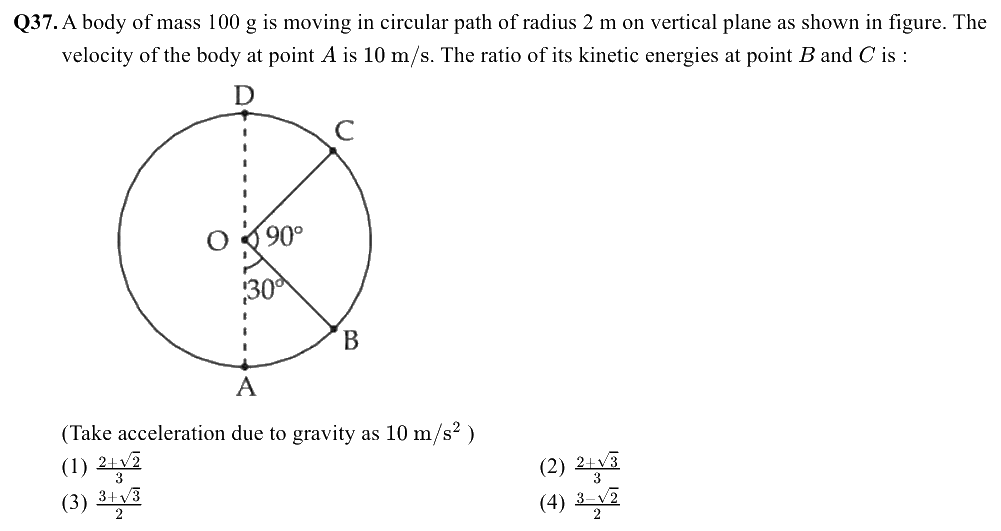
A body of mass 100 g is moving in circular path of radius 2 m on vertical plane as shown in figure. The velocity of the body at point $A$ is 10 m/s. The ratio of its kinetic energies at point $B$ and $C$ is :
A light unstretchable string passing over a smooth light pulley connects two blocks of masses $m_1$ and $m_2$. If the acceleration of the system is $\frac{g}{8}$, then the ratio of the masses $\frac{m_2}{m_1}$ is :
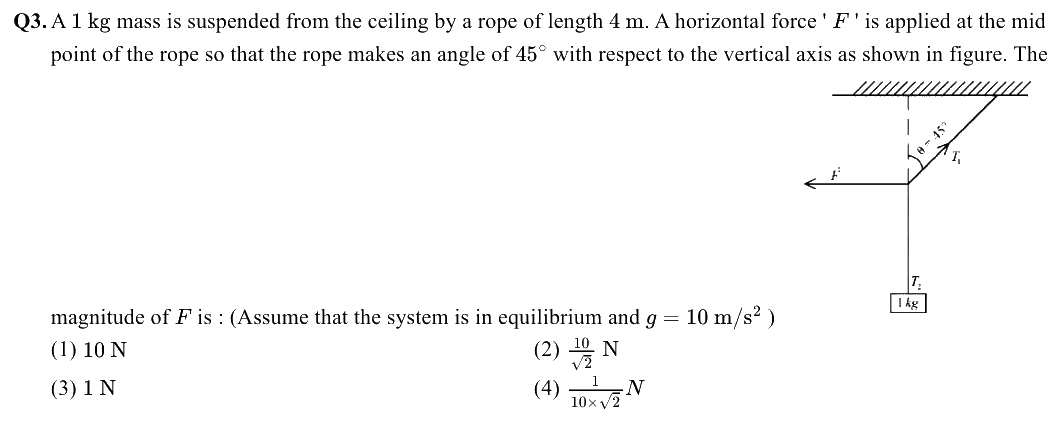
A 1 kg mass is suspended from the ceiling by a rope of length 4 m. A horizontal force '$\vec{F}$' is applied at the mid point of the rope so that the rope makes an angle of $45^\circ$ with respect to the vertical axis as shown in figure. The magnitude of $F$ is : (Assume that the system is in equilibrium and $g = 10$ m/s$^2$ )
A stationary particle breaks into two parts of masses $m_A$ and $m_B$ which move with velocities $v_A$ and $v_B$ respectively. The ratio of their kinetic energies $(K_B : K_A)$ is :
A player caught a cricket ball of mass 150 g moving at a speed of 20 m/s. If the catching process is completed in 0.1 s, the magnitude of force exerted by the ball on the hand of the player is:
A given object takes n times the time to slide down $45^{\circ}$ rough inclined plane as it takes the time to slide down an identical perfectly smooth $45^{\circ}$ inclined plane. The coefficient of kinetic friction between the object and the surface of inclined plane is :
A light string passing over a smooth light pulley connects two blocks of masses $m_1$ and $m_2$ (where $m_2 > m_1$ ). If the acceleration of the system is $\frac{g}{\sqrt{2}}$, then the ratio of the masses $\frac{m_1}{m_2}$ is:
A body of weight 200 N is suspended from a tree branch through a chain of mass 10 kg. The branch pulls the chain by a force equal to (if $g = 10$ m/s$^2$ ) :
A car of 800 kg is taking turn on a banked road of radius 300 m and angle of banking $30^\circ$. If coefficient of static friction is 0.2 then the maximum speed with which car can negotiate the turn safely:
A wooden block of mass 5 kg rests on a soft horizontal floor. When an iron cylinder of mass 25 kg is placed on the top of the block, the floor yields and the block and the cylinder together go down with an acceleration of 0.1 $\mathrm{ms^{-2}}$. The action force of the system on the floor is equal to:
A particle moves in $x - y$ plane under the influence of a force $\vec{F}$ such that its linear momentum is $\vec{p}(t) = \hat{i}\cos(kt) - \hat{j}\sin(kt)$. If k is constant, the angle between $\vec{F}$ and $\vec{p}$ will be :
A heavy box of mass 50 kg is moving on a horizontal surface. If co-efficient of kinetic friction between the box and horizontal surface is 0.3 then force of kinetic friction is :
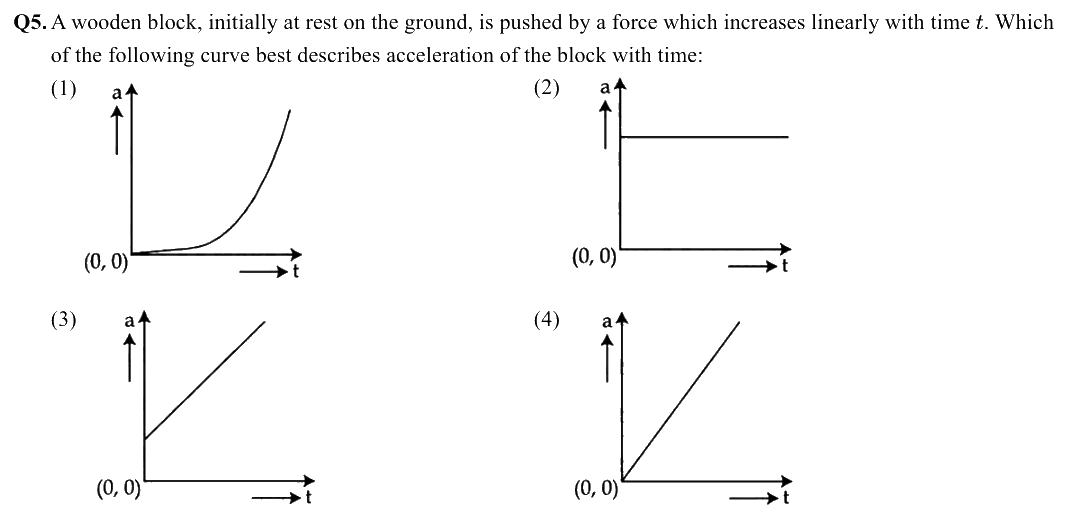
A wooden block, initially at rest on the ground, is pushed by a force which increases linearly with time $t$. Which of the following curve best describes acceleration of the block with time:
The question as printed in the paper.
A
see figure Graph of a against t, origin labelled (0, 0): a curve that starts at the origin almost flat and then bends upward, rising more and more steeply to the right.
B
see figure Graph of a against t, origin labelled (0, 0): a horizontal straight line at some height above the t-axis, running parallel to the t-axis.
C
see figure Graph of a against t, origin labelled (0, 0): a straight line sloping upward to the right, starting from a point on the a-axis above the origin (non-zero intercept).
D
see figure Graph of a against t, origin labelled (0, 0): a straight line sloping upward to the right, starting from the origin.
A 2 kg brick begins to slide over a surface which is inclined at an angle of $45^\circ$ with respect to horizontal axis. The co-efficient of static friction between their surfaces is:
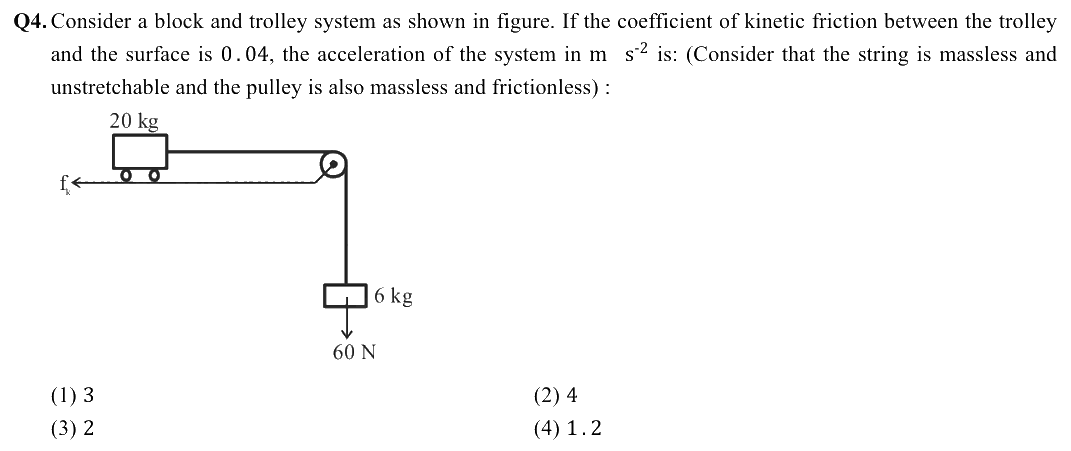
Consider a block and trolley system as shown in figure. If the coefficient of kinetic friction between the trolley and the surface is 0.04, the acceleration of the system in $\text{m s}^{-2}$ is: (Consider that the string is massless and unstretchable and the pulley is also massless and frictionless) :
A ball of mass 0.5 kg is attached to a string of length 50 cm. The ball is rotated on a horizontal circular path about its vertical axis. The maximum tension that the string can bear is 400 N. The maximum possible value of angular velocity of the ball in rad $\text{s}^{-1}$ is,:
A cricket player catches a ball of mass 120 g moving with 25 $\text{m s}^{-1}$ speed. If the catching process is completed in 0.1 s then the magnitude of force exerted by the ball on the hand of player will be(in SI unit):
A body of mass 4 kg experiences two forces $\vec{F}_1 = 5\hat{i} + 8\hat{j} + 7\hat{k}$ and $\vec{F}_2 = 3\hat{i} - 4\hat{j} - 3\hat{k}$. The acceleration acting on the body is:
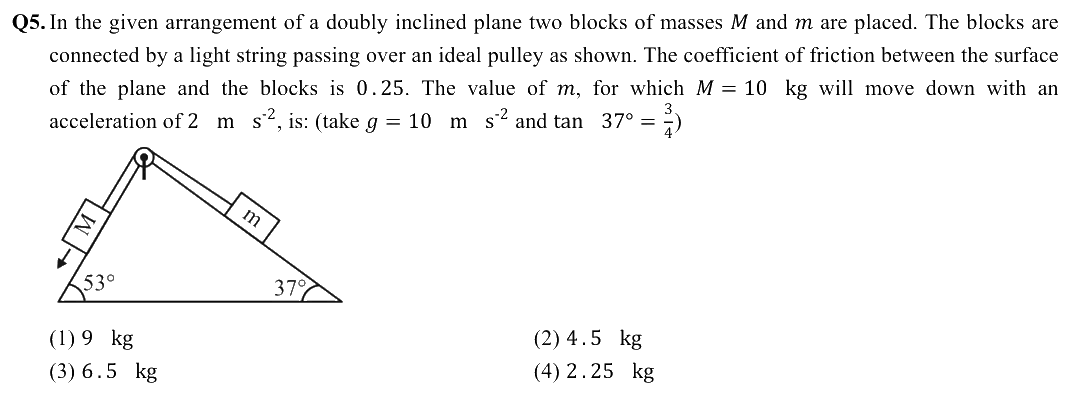
In the given arrangement of a doubly inclined plane two blocks of masses $M$ and $m$ are placed. The blocks are connected by a light string passing over an ideal pulley as shown. The coefficient of friction between the surface of the plane and the blocks is 0.25. The value of $m$, for which $M = 10$ kg will move down with an acceleration of 2 m s$^{-2}$, is: (take $g = 10$ m s$^{-2}$ and $\tan 37^\circ = \frac{3}{4}$)
A coin is placed on a disc. The coefficient of friction between the coin and the disc is $\mu$. If the distance of the coin from the center of the disc is $r$, the maximum angular velocity which can be given to the disc, so that the coin does not slip away, is :
An artillery piece of mass $M_1$ fires a shell of mass $M_2$ horizontally. Instantaneously after the firing, the ratio of kinetic energy of the artillery and that of the shell is :
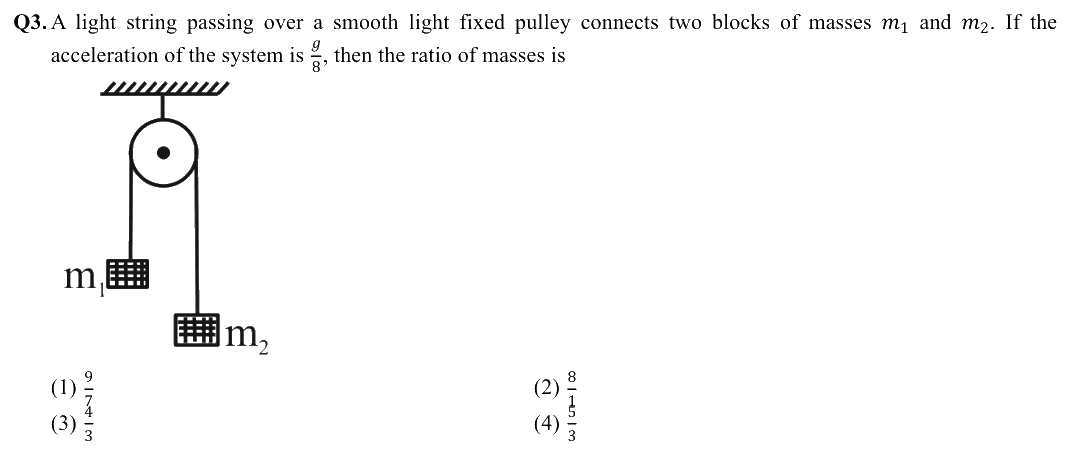
A light string passing over a smooth light fixed pulley connects two blocks of masses $m_1$ and $m_2$. If the acceleration of the system is $\frac{g}{8}$, then the ratio of masses is
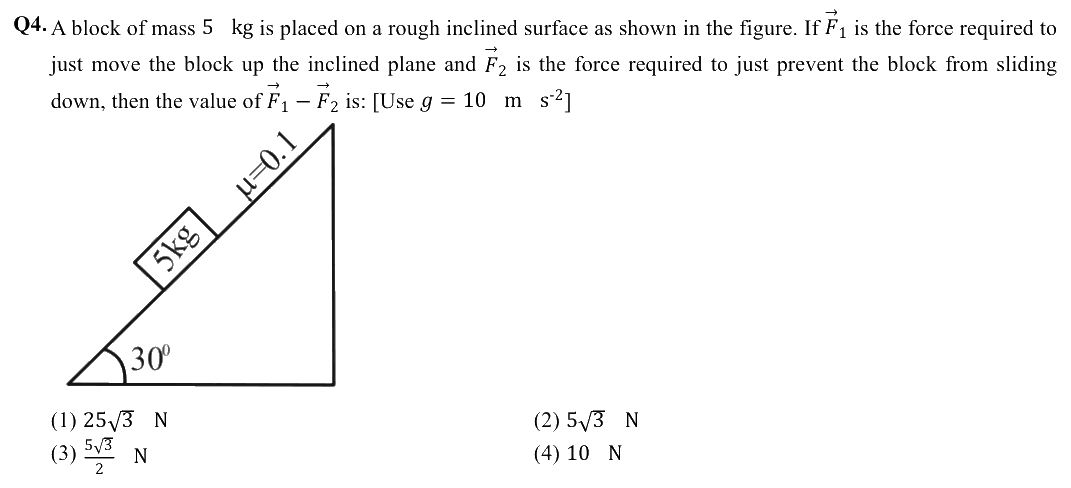
A block of mass 5 kg is placed on a rough inclined surface as shown in the figure. If $\vec{F}_1$ is the force required to just move the block up the inclined plane and $\vec{F}_2$ is the force required to just prevent the block from sliding down, then the value of $\vec{F}_1 - \vec{F}_2$ is: [Use $g = 10\ \text{m s}^{-2}$]
A spherical body of mass 100 g is dropped from a height of 10 m from the ground. After hitting the ground, the body rebounds to a height of 5 m. The impulse of force imparted by the ground to the body is given by: (given $g = 9.8\ \mathrm{m\,s^{-2}}$)
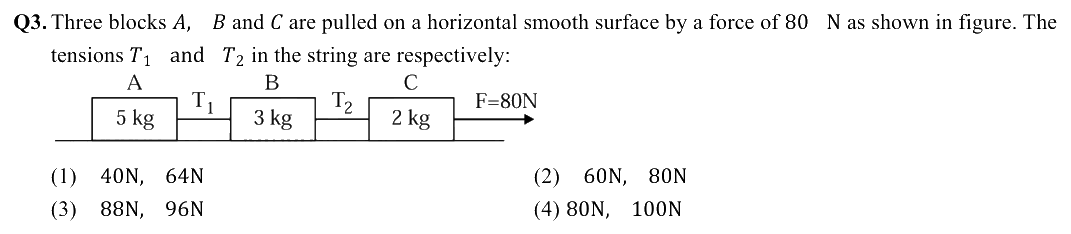
Three blocks $A$, $B$ and $C$ are pulled on a horizontal smooth surface by a force of 80 N as shown in figure. The tensions $T_1$ and $T_2$ in the string are respectively:
A block of mass $m$ is placed on a surface having vertical cross section given by $y = \frac{x^2}{4}$. If coefficient of friction is 0.5, the maximum height above the ground at which block can be placed without slipping is:
If the radius of curvature of the path of two particles of same mass are in the ratio 3 : 4, then in order to have constant centripetal force, their velocities will be in the ratio of:
A stone of mass 900 g is tied to a string and moved in a vertical circle of radius 1 m making 10 rpm. The tension in the string, when the stone is at the lowest point is (if $\pi^2 = 9.8$ and $g = 9.8$ m s$^{-2}$)
A train is moving with a speed of 12 m s$^{-1}$ on rails which are 1.5 m apart. To negotiate a curve radius 400 m, the height by which the outer rail should be raised with respect to the inner rail is (Given, $g$ = 10 m s$^{-2}$):
A ball suspended by a thread swings in a vertical plane so that its magnitude of acceleration in the extreme position and lowest position are equal. The angle ($\theta$) of thread deflection in the extreme position will be :
A bullet of 10 g leaves the barrel of gun with a velocity of 600 m s$^{-1}$. If the barrel of gun is 50 cm long and mass of gun is 3 kg, then value of impulse supplied to the gun will be:
A vehicle of mass 200 kg is moving along a levelled curved road of radius 70 m with angular velocity of 0.2 rad s$^{-1}$. The centripetal force acting on the vehicle is:
Three forces $F_1 = 10$ N, $F_2 = 8$ N, $F_3 = 6$ N are acting on a particle of mass 5 kg. The forces $F_2$ and $F_3$ are applied perpendicularly so that particle remains at rest. If the force $F_1$ is removed, then the acceleration of the particle is
A coin placed on a rotating table just slips when it is placed at a distance of 1 cm from the centre. If the angular velocity of the table is halved, it will just slip when placed at a distance of ______ from the centre:
An average force of 125 N is applied on a machine gun firing bullets each of mass 10 g at the speed of $250\ \mathrm{m\ s^{-1}}$ to keep it in position. The number of bullets fired per second by the machine gun is :
Given below are two statements: one is labelled as Assertion A and the other is labelled as Reason R Assertion A : An electric fan continues to rotate for some time after the current is switched off. Reason R: Fan continues to rotate due to inertia of motion. In the light of above statements, choose the most appropriate answer from the options given below.
A
A is correct but R is not correct
B
A is not correct but R is correct
C
Both A and R are correct and R is the correct explanation of A
D
Both A and R are correct but R is NOT the correct explanation of A
At any instant the velocity of a particle of mass 500 g is $(2t\,\hat{i} + 3t^{2}\,\hat{j})\ \mathrm{m\,s^{-1}}$. If the force acting on the particle at $t = 1$ s is $(\hat{i} + x\,\hat{j})$ N. Then the value of $x$ will be:
A bullet of mass $0.1\ \mathrm{kg}$ moving horizontally with speed $400\ \mathrm{m\,s^{-1}}$ hits a wooden block of mass $3.9\ \mathrm{kg}$ kept on a horizontal rough surface. The bullet gets embedded into the block and moves $20\ \mathrm{m}$ before coming to rest. The coefficient of friction between the block and the surface is ______ .
A small block of mass $100\ \mathrm{g}$ is tied to a spring of spring constant $7.5\ \mathrm{N\ m^{-1}}$ and length $20\ \mathrm{cm}$. The other end of spring is fixed at a particular point $A$. If the block moves in a circular path on a smooth horizontal surface with constant angular velocity $5\ \mathrm{rad\ s^{-1}}$ about point $A$, then tension in the spring is
A child of mass $5\ \mathrm{kg}$ is going round a merry-go-round that makes 1 rotation in $3.14\ \mathrm{s}$. The radius of the merry-go-round is $2\ \mathrm{m}$. The centrifugal force on the child will be
A block of mass 5 $\mathrm{kg}$ is placed at rest on a table of rough surface. Now, if a force of 30 $\mathrm{N}$ is applied in the direction parallel to surface of the table, the block slides through a distance of 50 $\mathrm{m}$ in an interval of time 10 $\mathrm{s}$. Coefficient of kinetic friction is (given, $g$ = 10 $\mathrm{m\ s^{-2}}$ ):
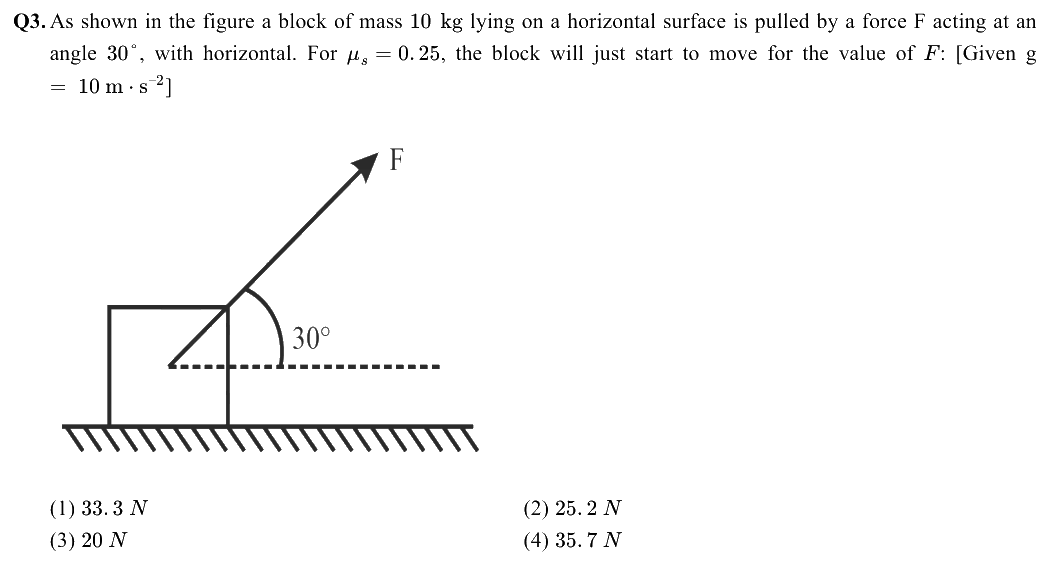
As shown in the figure a block of mass 10 $\mathrm{kg}$ lying on a horizontal surface is pulled by a force F acting at an angle $30^\circ$, with horizontal. For $\mu_s$ = 0.25, the block will just start to move for the value of $F$: [Given g = 10 $\mathrm{m \cdot s^{-2}}$]
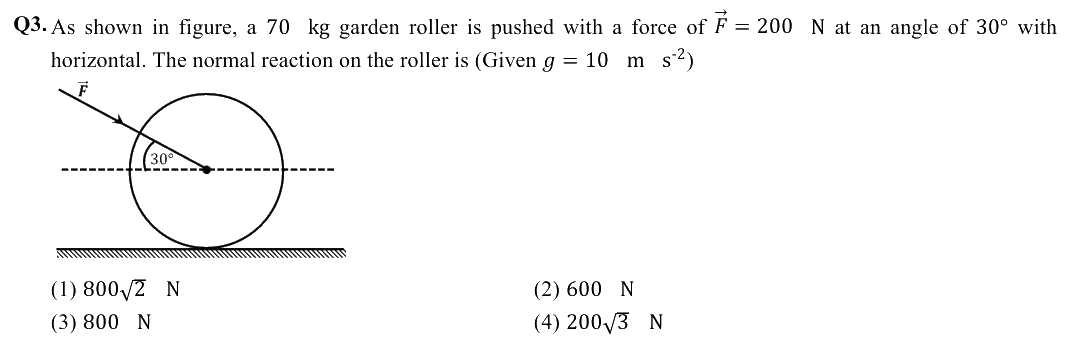
As shown in figure, a 70 $\mathrm{kg}$ garden roller is pushed with a force of $\vec{F}$ = 200 $\mathrm{N}$ at an angle of $30^\circ$ with horizontal. The normal reaction on the roller is (Given $g$ = 10 $\mathrm{m\ s^{-2}}$)
100 balls each of mass $m$ moving with speed $v$ simultaneously strike a wall normally and reflected back with same speed, in time $t$ s. The total force exerted by the balls on the wall is
A stone of mass 1 kg is tied to end of a massless string of length 1 m. If the breaking tension of the string is 400 N, then maximum linear velocity, the stone can have without breaking the string, while rotating in horizontal plane, is:
A body of mass 10 kg is moving with an initial speed of 20 m s$^{-1}$. The body stops after 5 s due to friction between body and the floor. The value of the coefficient of friction is: (Take acceleration due to gravity $g$ = 10 m s$^{-2}$)
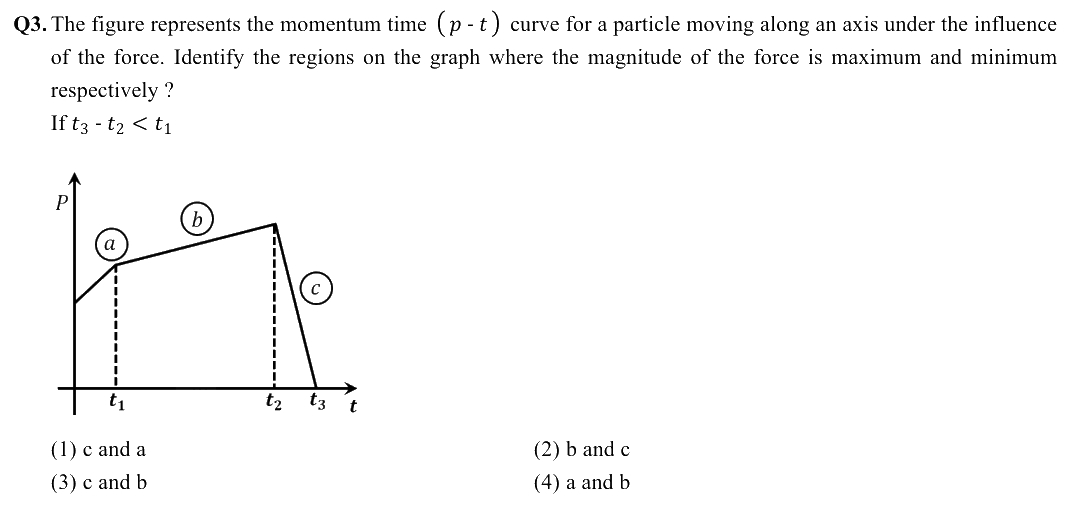
The figure represents the momentum time $(p - t)$ curve for a particle moving along an axis under the influence of the force. Identify the regions on the graph where the magnitude of the force is maximum and minimum respectively ? If $t_3 - t_2 < t_1$
A ball of mass 200 g rests on a vertical post of height 20 m. A bullet of mass 10 g, travelling in horizontal direction, hits the centre of the ball. After collision both travels independently. The ball hits the ground at a distance 30 m and the bullet at a distance of 120 m from the foot of the post. The value of initial velocity of the bullet will be (if $g = 10$ m s$^{-2}$) :
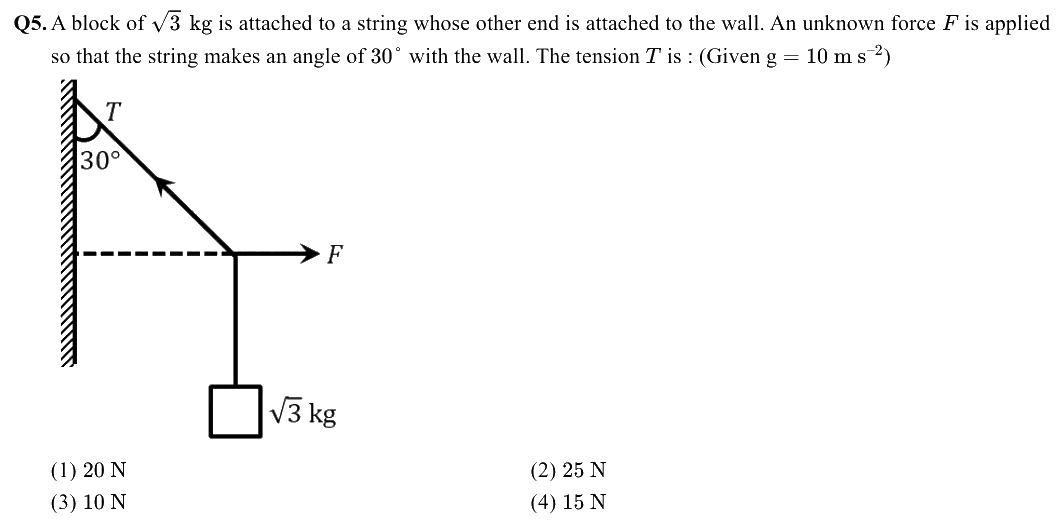
A block of $\sqrt{3}$ kg is attached to a string whose other end is attached to the wall. An unknown force $F$ is applied so that the string makes an angle of 30$^\circ$ with the wall. The tension $T$ is : (Given g = 10 m s$^{-2}$)
A machine gun of mass 10 kg fires 20 g bullets at the rate of 180 bullets per minute with a speed of 100 m s$^{-1}$ each. The recoil velocity of the gun is :
A car is moving on a horizontal curved road with radius $50\ \mathrm{m}$. The approximate maximum speed of car will be, if friction between tyres and road is $0.34$. [Take $g = 10\ \mathrm{m\,s^{-2}}$]
A block of mass $m$ slides down the plane inclined at angle $30^\circ$ with an acceleration $\frac{g}{4}$. The value of coefficient of kinetic friction will be :
The time taken by an object to slide down $45^\circ$ rough inclined plane is $n$ times as it takes to slide down a perfectly smooth $45^\circ$ incline plane. The coefficient of kinetic friction between the object and the incline plane is:
Force acts for 20 s on a body of mass 20 kg, starting from rest, after which the force ceases and then body describes 50 m in the next 10 s. The value of force will be :
A car is moving with a constant speed of $20\ \mathrm{m\,s^{-1}}$ in a circular horizontal track of radius $40\ \mathrm{m}$. A bob is suspended from the roof of the car by a massless string. The angle made by the string with the vertical will be : (Take $g = 10\ \mathrm{m\,s^{-2}}$)
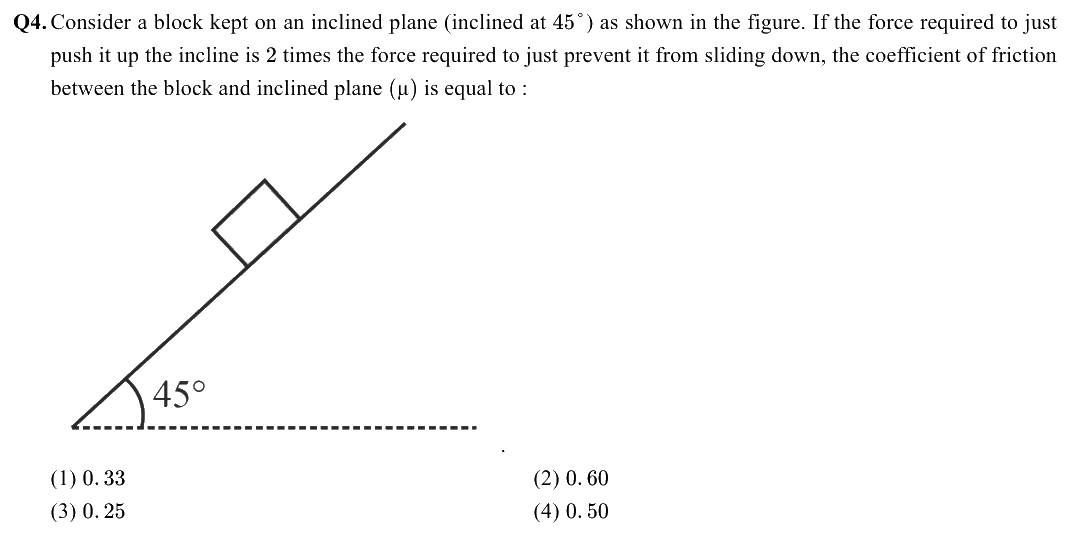
Consider a block kept on an inclined plane (inclined at $45^\circ$) as shown in the figure. If the force required to just push it up the incline is 2 times the force required to just prevent it from sliding down, the coefficient of friction between the block and inclined plane ($\mu$) is equal to :
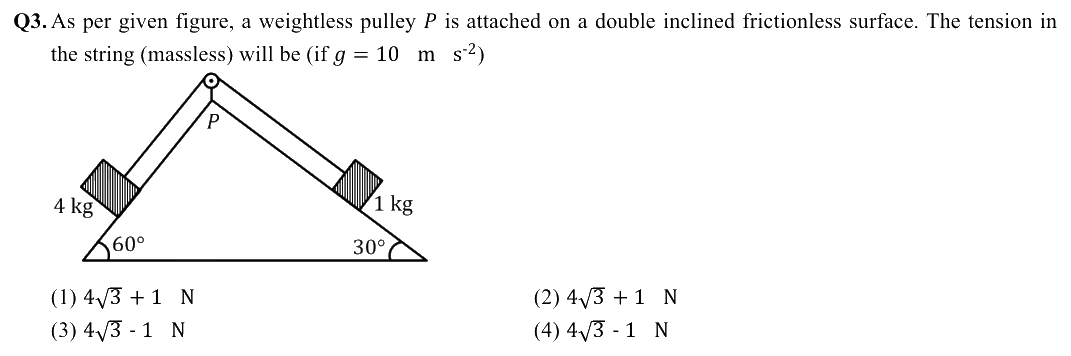
As per given figure, a weightless pulley $P$ is attached on a double inclined frictionless surface. The tension in the string (massless) will be (if $g=10\ \mathrm{m\,s^{-2}}$)
Statement-I: An elevator can go up or down with uniform speed when its weight is balanced with the tension of its cable.
Statement-II: Force exerted by the floor of an elevator on the foot of a person standing on it is more than his/her weight when the elevator goes down with increasing speed.
In the light of the above statements, choose the correct answer from the options given below:
A body of mass 200 g is tied to a spring of spring constant $12.5\ \mathrm{N\,m^{-1}}$, while the other end of spring is fixed at point $O$. If the body moves about $O$ in a circular path on a smooth horizontal surface with constant angular speed $5\ \mathrm{rad\,s^{-1}}$, then the ratio of extension in the spring to its natural length will be :
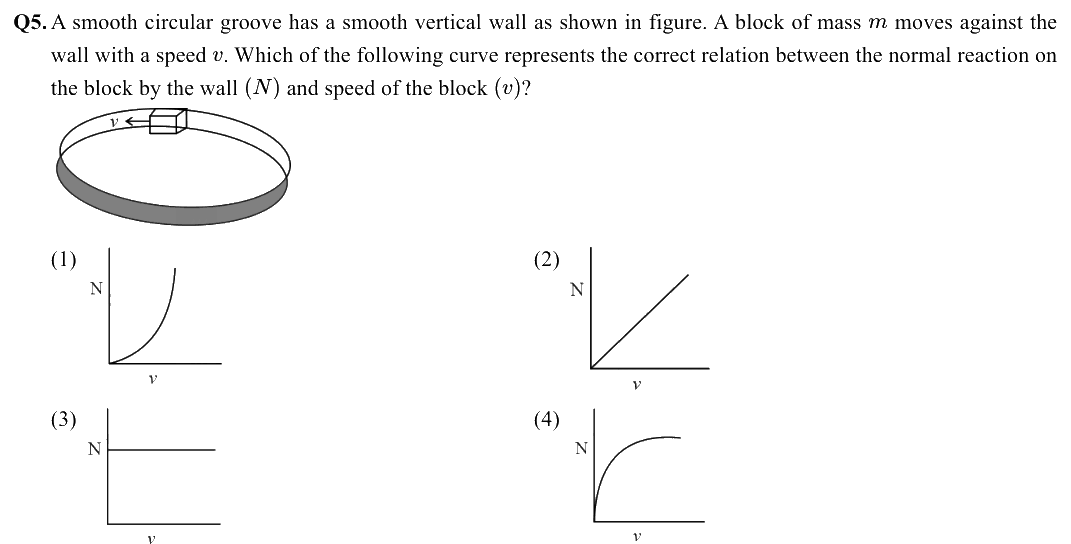
A smooth circular groove has a smooth vertical wall as shown in figure. A block of mass $m$ moves against the wall with a speed $v$. Which of the following curve represents the correct relation between the normal reaction on the block by the wall ($N$) and speed of the block ($v$)? (see the figure above)
The question as printed in the paper.
A
see figure graph of $N$ against $v$: a curve starting at the origin and rising ever more steeply (concave upwards)
B
see figure graph of $N$ against $v$: a straight line rising from the origin
C
see figure graph of $N$ against $v$: a horizontal line (constant $N$) well above the $v$ axis
D
see figure graph of $N$ against $v$: a curve starting at the origin, rising steeply at first and then flattening (concave downwards)
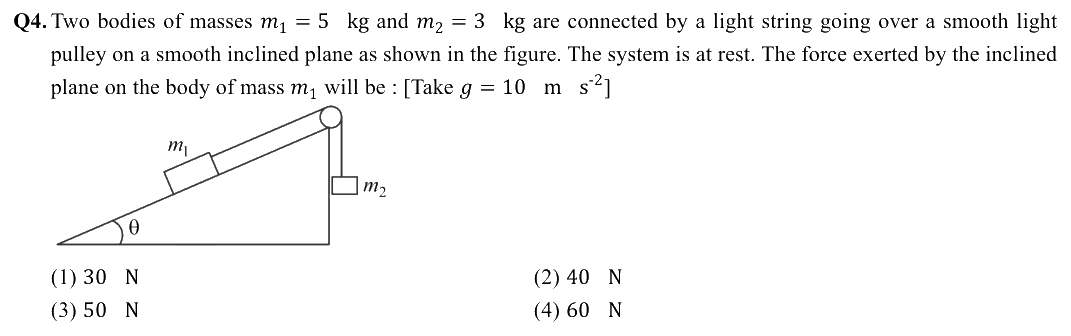
Two bodies of masses $m_1 = 5$ kg and $m_2 = 3$ kg are connected by a light string going over a smooth light pulley on a smooth inclined plane as shown in the figure. The system is at rest. The force exerted by the inclined plane on the body of mass $m_1$ will be : [Take $g = 10\ \mathrm{m\ s^{-2}}$] (see the figure above)
A balloon has mass of $10\ \mathrm{g}$ in air. The air escapes from the balloon at a uniform rate with velocity $4.5\ \mathrm{cm\ s^{-1}}$. If the balloon shrinks in $5\ \mathrm{s}$ completely. Then, the average force acting on that balloon will be (in dyne).
In two different experiments, an object of mass $5\ \mathrm{kg}$ moving with a speed of $25\ \mathrm{ms^{-1}}$ hits two different walls and comes to rest within (i) 3 second, (ii) 5 seconds, respectively. Choose the correct option out of the following :
A
Impulse and average force acting on the object will be same for both the cases.
B
Impulse will be same for both the cases but the average force will be different.
C
Average force will be same for both the cases but the impulse will be different.
D
Average force and impulse will be different for both the cases.
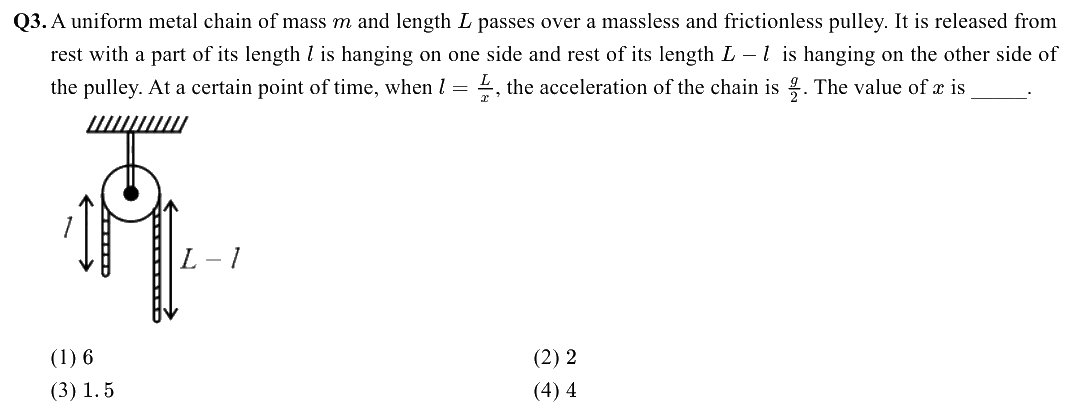
A uniform metal chain of mass $m$ and length $L$ passes over a massless and frictionless pulley. It is released from rest with a part of its length $l$ is hanging on one side and rest of its length $L-l$ is hanging on the other side of the pulley. At a certain point of time, when $l=\frac{L}{x}$, the acceleration of the chain is $\frac{g}{2}$. The value of $x$ is ______.
A pressure-pump has a horizontal tube of cross-sectional area $10\ \mathrm{cm^{2}}$ for the outflow of water at a speed of $20\ \mathrm{m\,s^{-1}}$. The force exerted on the vertical wall just in front of the tube which stops water horizontally flowing out of the tube, is: [given : density of water $=1000\ \mathrm{kg\,m^{-3}}$]
A bag is gently dropped on a conveyor belt moving at a speed of 2 $\mathrm{m~s^{-1}}$. The coefficient of friction between the conveyor belt and bag is 0.4 Initially, the bag slips on the belt before it stops due to friction. The distance travelled by the bag on the belt during slipping motion is : [Take $g$ = 10 $\mathrm{m~s^{-2}}$]
Sand is being dropped from a stationary dropper at a rate of 0.5 $\mathrm{kg~s^{-1}}$ on a conveyor belt moving with a velocity of 5 $\mathrm{m~s^{-1}}$. The power needed to keep belt moving with the same velocity will be
A block of mass $M$ slides down on a rough inclined plane with constant velocity. The angle made by the incline plane with horizontal is $\theta$. The magnitude of the contact force will be :
A block $A$ takes 2 s to slide down a frictionless incline of $30^\circ$ and length $l$, kept inside a lift going up with uniform velocity $v$. If the incline is changed to $45^\circ$, the time taken by the block, to slide down the incline, will be approximately:
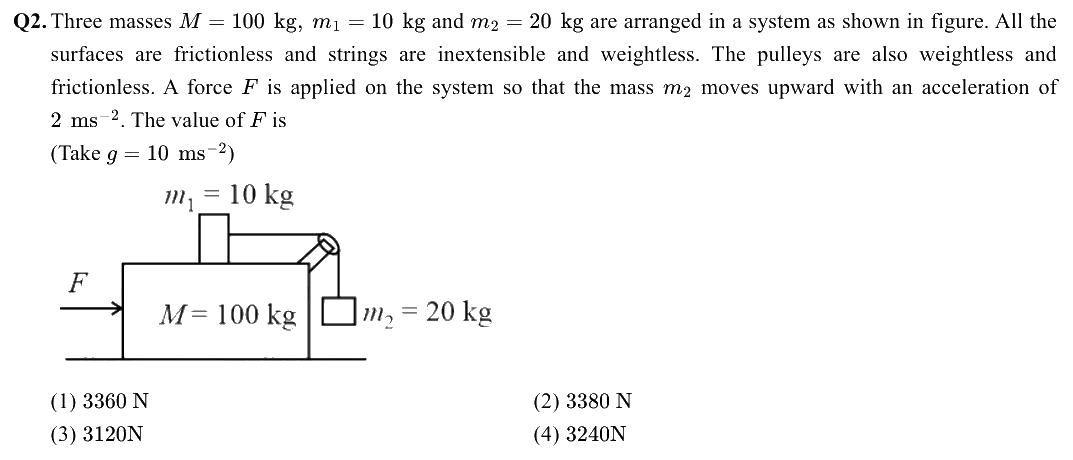
Three masses $M = 100$ kg, $m_1 = 10$ kg and $m_2 = 20$ kg are arranged in a system as shown in figure. All the surfaces are frictionless and strings are inextensible and weightless. The pulleys are also weightless and frictionless. A force $F$ is applied on the system so that the mass $m_2$ moves upward with an acceleration of $2 \mathrm{~ms^{-2}}$. The value of $F$ is (Take $g = 10 \mathrm{~ms^{-2}}$) (see the figure above)
A monkey of mass 50 kg climbs on a rope which can withstand the tension ($T$) of 350 N. If monkey initially climbs down with an acceleration of $4 \mathrm{~m~s^{-2}}$ and then climbs up with an acceleration of $5 \mathrm{~m~s^{-2}}$. Choose the correct option ($\mathrm{g = 10~m~s^{-2}}$)
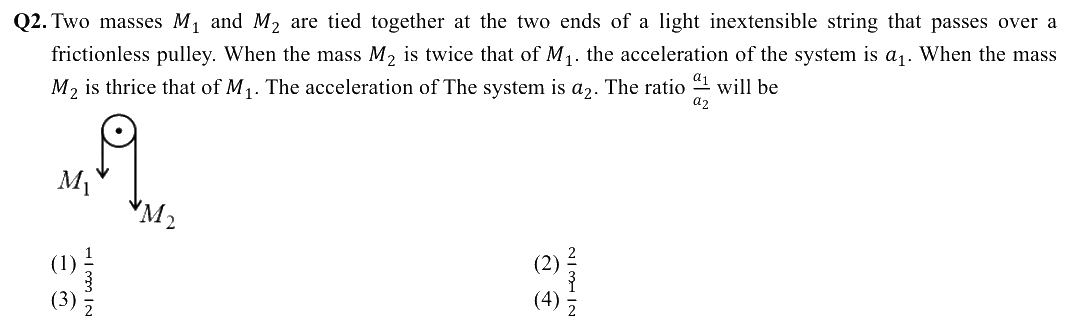
Two masses $M_1$ and $M_2$ are tied together at the two ends of a light inextensible string that passes over a frictionless pulley. When the mass $M_2$ is twice that of $M_1$. the acceleration of the system is $a_1$. When the mass $M_2$ is thrice that of $M_1$. The acceleration of The system is $a_2$. The ratio $\frac{a_1}{a_2}$ will be
A ball of mass $0.15\ \mathrm{kg}$ hits the wall with its initial speed of $12\ \mathrm{m\ s^{-1}}$ and bounces back without changing its initial speed. If the force applied by the wall on the ball during the contact is $100\ \mathrm{N}$. calculate the time duration of the contact of ball with the wall.
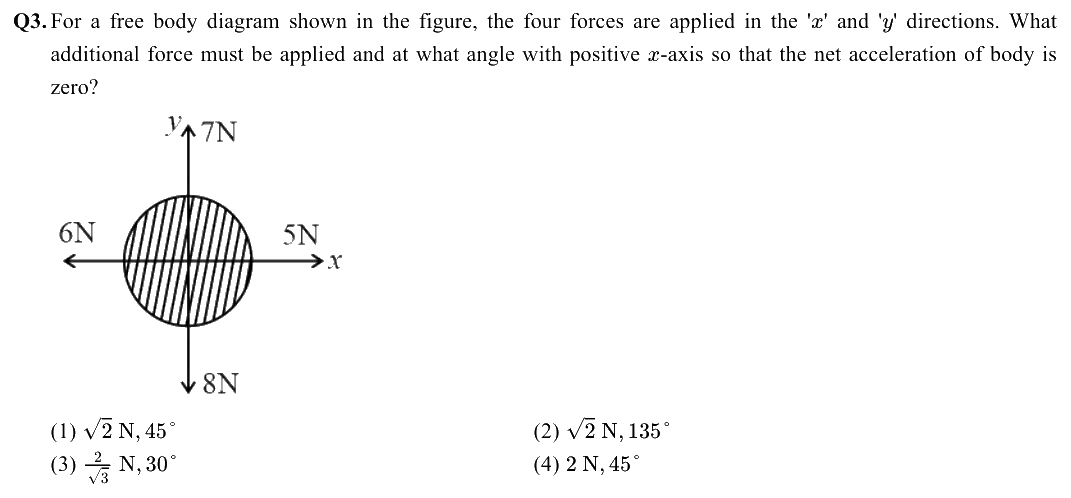
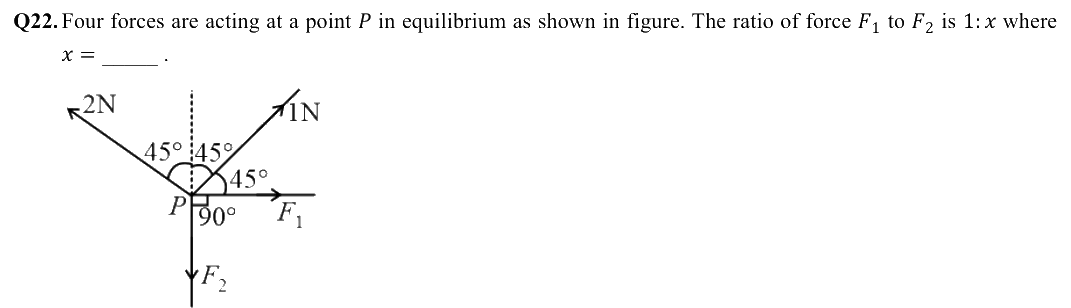
For a free body diagram shown in the figure, the four forces are applied in the '$x$' and '$y$' directions. What additional force must be applied and at what angle with positive $x$-axis so that the net acceleration of body is zero?
Two billiard balls of mass $0.05\ \mathrm{kg}$ each moving in opposite directions with $10\ \mathrm{ms^{-1}}$ collide and rebound with the same speed. If the time duration of contact is $t = 0.005$ s, then what is the force exerted on the ball due to each other?
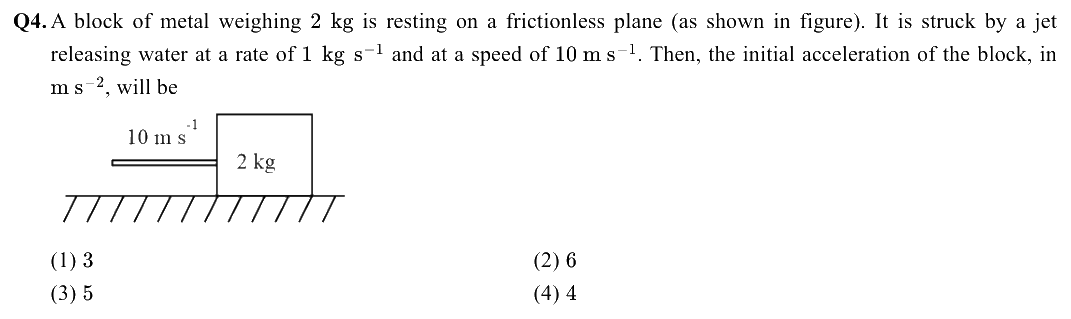
A block of metal weighing $2\ \mathrm{kg}$ is resting on a frictionless plane (as shown in figure). It is struck by a jet releasing water at a rate of $1\ \mathrm{kg\,s^{-1}}$ and at a speed of $10\ \mathrm{m\,s^{-1}}$. Then, the initial acceleration of the block, in $\mathrm{m\,s^{-2}}$, will be
A body of mass $M$ at rest explodes into three pieces, in the ratio of masses $1 : 1 : 2$. Two smaller pieces fly off perpendicular to each other with velocities of $30\ \mathrm{m\,s^{-1}}$ and $40\ \mathrm{m\,s^{-1}}$ respectively. The velocity of the third piece will be
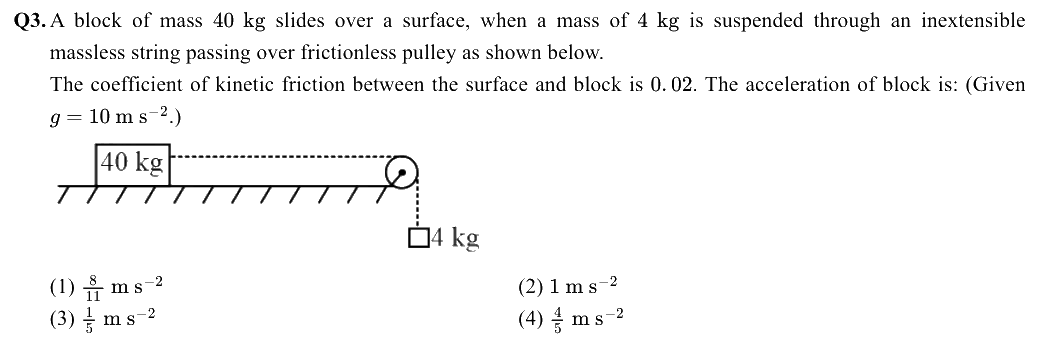
A block of mass $40\ \mathrm{kg}$ slides over a surface, when a mass of $4\ \mathrm{kg}$ is suspended through an inextensible massless string passing over frictionless pulley as shown below. The coefficient of kinetic friction between the surface and block is $0.02$. The acceleration of block is: (Given $g = 10\ \mathrm{m\,s^{-2}}$.)
A block of mass $M$ placed inside a box descends vertically with acceleration $a$. The block exerts a force equal to one-fourth of its weight on the floor of the box. The value of 'a' will be
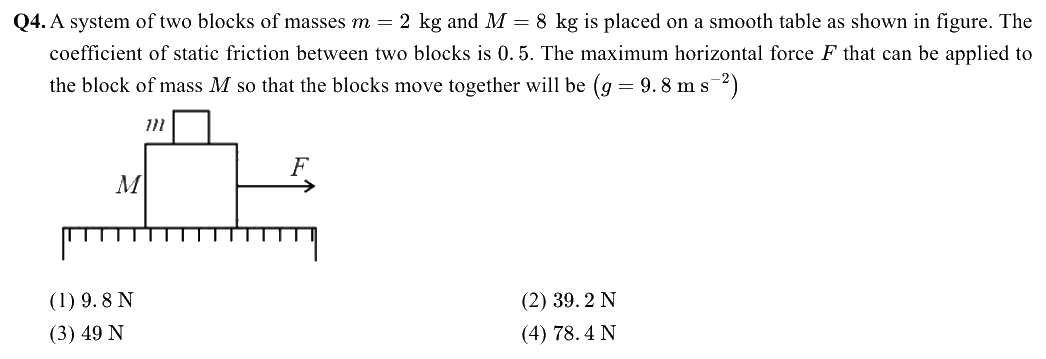
A system of two blocks of masses $m = 2\ \mathrm{kg}$ and $M = 8\ \mathrm{kg}$ is placed on a smooth table as shown in figure. The coefficient of static friction between two blocks is 0.5. The maximum horizontal force $F$ that can be applied to the block of mass $M$ so that the blocks move together will be ($g = 9.8\ \mathrm{m\ s^{-2}}$) (see the figure above)
One end of a massless spring of spring constant $k$ and natural length $l_0$ is fixed while the other end is connected to a small object of mass $m$ lying on a frictionless table. The spring remains horizontal on the table. If the object is made to rotate at an angular velocity $\omega$ about an axis passing trough fixed end, then the elongation of the spring will be
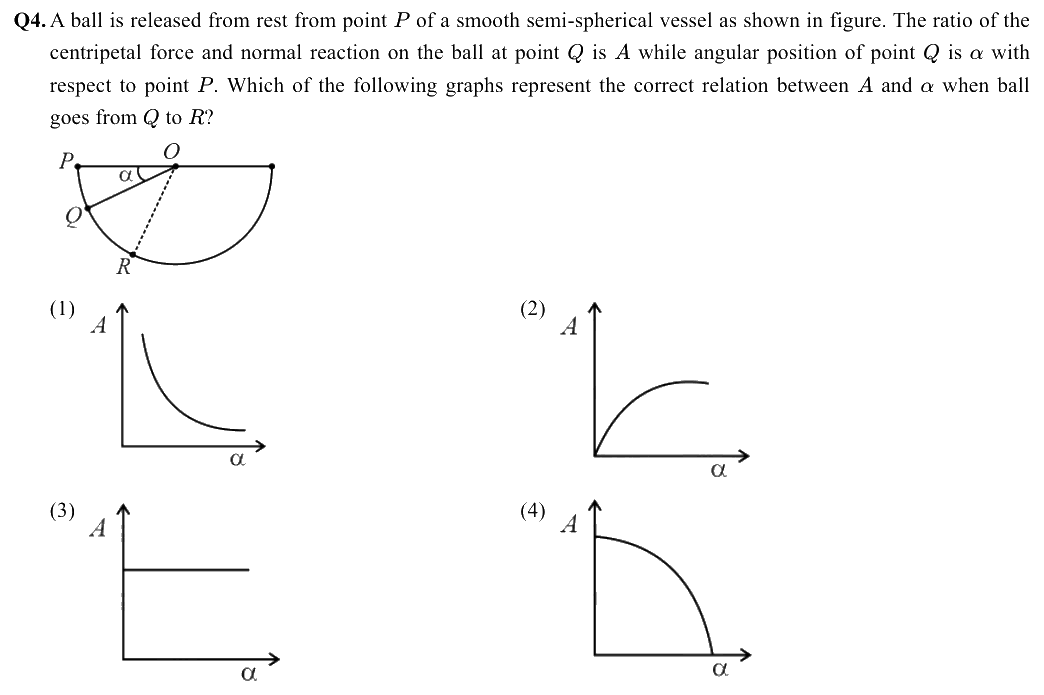
A ball is released from rest from point $P$ of a smooth semi-spherical vessel as shown in figure. The ratio of the centripetal force and normal reaction on the ball at point $Q$ is $A$ while angular position of point $Q$ is $\alpha$ with respect to point $P$. Which of the following graphs represent the correct relation between $A$ and $\alpha$ when ball goes from $Q$ to $R$? (see the figure above)
The question as printed in the paper.
A
see figure graph of A against alpha: a decreasing convex curve starting high on the A axis and flattening toward the alpha axis
B
see figure graph of A against alpha: a rising concave curve starting at the origin and levelling off
C
see figure graph of A against alpha: a horizontal line at constant A
D
see figure graph of A against alpha: a curve starting at a maximum on the A axis and falling in a concave-down arc to zero at a finite alpha
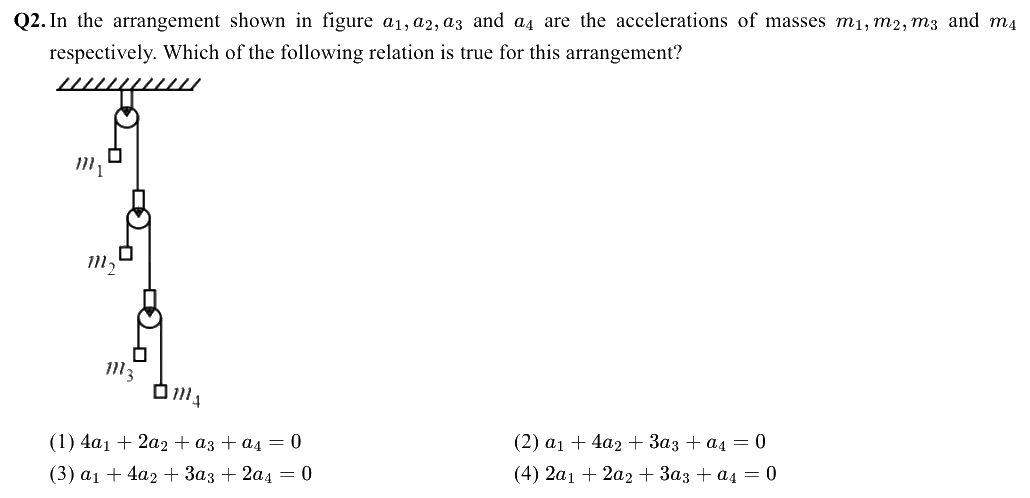
In the arrangement shown in figure $a_1, a_2, a_3$ and $a_4$ are the accelerations of masses $m_1, m_2, m_3$ and $m_4$ respectively. Which of the following relation is true for this arrangement? (see the figure above)
A disc with a flat small bottom beaker placed on it at a distance $R$ from its center is revolving about an axis passing through the center and perpendicular to its plane with an angular velocity $\omega$. The coefficient of static friction between the bottom of the beaker and the surface of the disc is $\mu$. The beaker will revolve with the disc if :
A boy ties a stone of mass $100 \mathrm{~g}$ to the end of a $2 \mathrm{~m}$ long string and whirls it around in a horizontal plane. The string can withstand the maximum tension of $80 \mathrm{~N}$. If the maximum speed with which the stone can revolve is $\frac{K}{\pi} \mathrm{~rev~min^{-1}}$. The value of $K$ is : (Assume the string is massless and un-stretchable)
A block of mass $10 \mathrm{~kg}$ starts sliding on a surface with an initial velocity of $9.8 \mathrm{~ms^{-1}}$. The coefficient of friction between the surface and block is $0.5$. The distance covered by the block before coming to rest is :[use $\mathrm{g} = 9.8 \mathrm{~ms^{-2}}$]
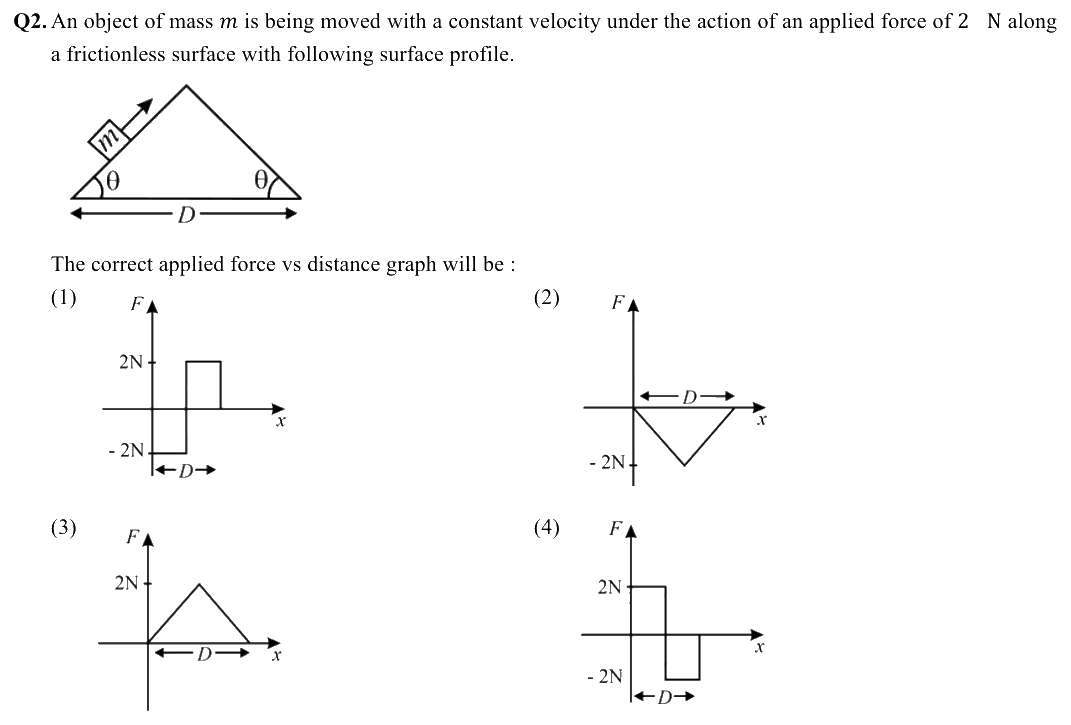
An object of mass $m$ is being moved with a constant velocity under the action of an applied force of $2$ N along a frictionless surface with following surface profile. (see the figure above) The correct applied force vs distance graph will be :
The question as printed in the paper.
A
see figure F against x; a rectangular step: F = -2N from the F axis over a stretch marked D, then F = +2N over the next stretch, zero elsewhere.
B
see figure F against x; a V-shaped dip below the x axis, going down from the axis to -2N at the middle and back to the axis, the span marked D.
C
see figure F against x; an inverted-V above the x axis, rising from the origin to a peak (below the 2N mark) at the middle and back to the axis, the span marked D.
D
see figure F against x; F = +2N over the first stretch, then F = -2N over the next stretch (a rectangle below the axis), the second stretch marked D.
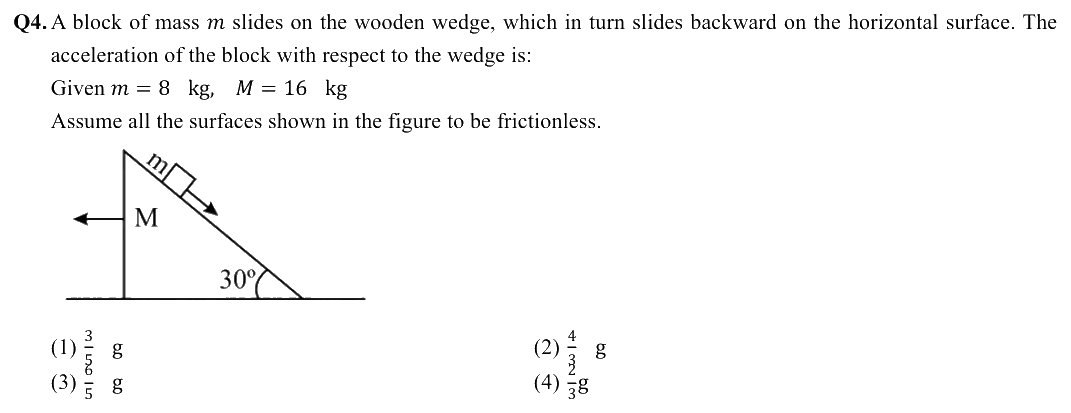
A block of mass $m$ slides on the wooden wedge, which in turn slides backward on the horizontal surface. The acceleration of the block with respect to the wedge is: Given $m = 8$ kg, $M = 16$ kg Assume all the surfaces shown in the figure to be frictionless. (see the figure above)
A block moving horizontally on a smooth surface with a speed of $40$ m s$^{-1}$ splits into two parts with masses in the ratio of $1 : 2$. If the smaller part moves at $60$ m s$^{-1}$ in the same direction, then the fractional change in kinetic energy is :
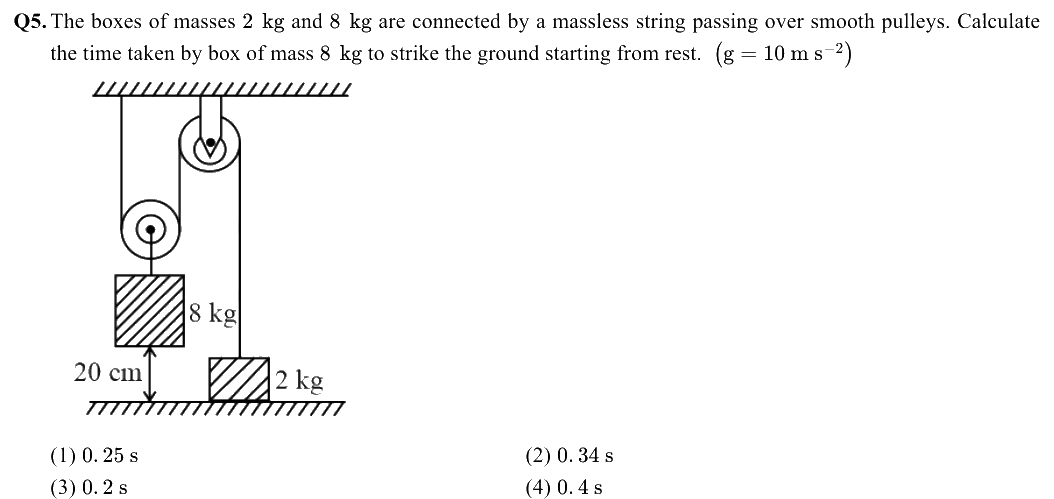
The boxes of masses $2\ \mathrm{kg}$ and $8\ \mathrm{kg}$ are connected by a massless string passing over smooth pulleys. Calculate the time taken by box of mass $8\ \mathrm{kg}$ to strike the ground starting from rest. ($\mathrm{g}=10\ \mathrm{m\ s^{-2}}$) (see the figure above)
The initial mass of a rocket is $1000\ \mathrm{kg}$. Calculate at what rate the fuel should be burnt so that the rocket is given an acceleration of, $20\ \mathrm{m\ s^{-2}}$. The gases come out at a relative speed of $500\ \mathrm{m\ s^{-1}}$, with respect to the rocket: [Use $g=10\ \mathrm{m\ s^{-2}}$]
A particle of mass $m$ is suspended from a ceiling through a string of length $L$. The particle moves in a horizontal circle of radius $r$ such that $r=\frac{L}{\sqrt{2}}$. The speed of particle will be :
A particle of mass $M$ originally at rest is subjected to a force whose direction is constant but magnitude varies with time according to the relation $F = F_0\left[1 - \left(\frac{t - T}{T}\right)^2\right]$ where $F_0$ and $T$ are constants. The force acts only for the time interval $2T$. The velocity $v$ of the particle after time $2T$ is:
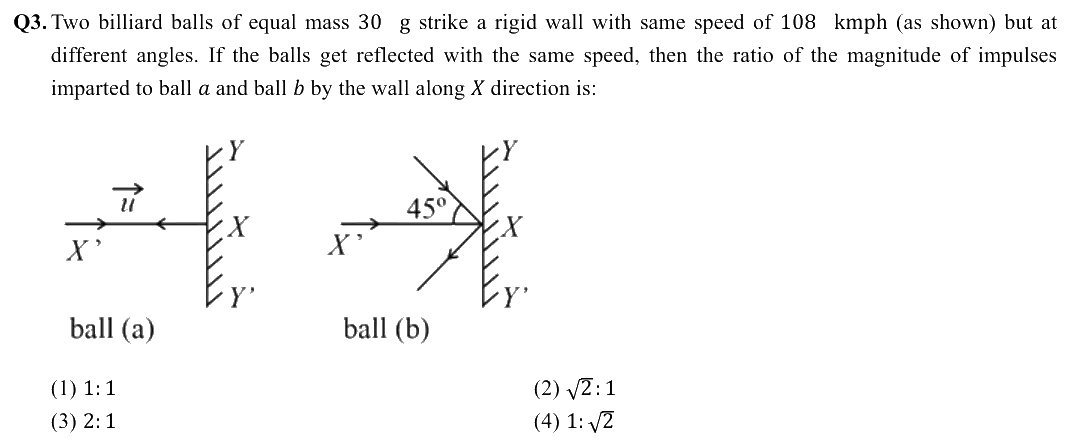
Two billiard balls of equal mass $30\ \mathrm{g}$ strike a rigid wall with same speed of $108\ \mathrm{kmph}$ (as shown) but at different angles. If the balls get reflected with the same speed, then the ratio of the magnitude of impulses imparted to ball $a$ and ball $b$ by the wall along $X$ direction is: (see the figure above)
A force $\vec{F} = \left(40\hat{i} + 10\hat{j}\right)\ \mathrm{N}$ acts on a body of mass $5\ \mathrm{kg}$. If the body starts from rest, its position vector $\vec{r}$ at time $t = 10\ \mathrm{s}$ will be
A bullet of $4\ \mathrm{g}$ mass is fired from a gun of mass $4\ \mathrm{kg}$. If the bullet moves with the muzzle speed of $50\ \mathrm{m\ s^{-1}}$, the impulse imparted to the gun and velocity of recoil of gun are
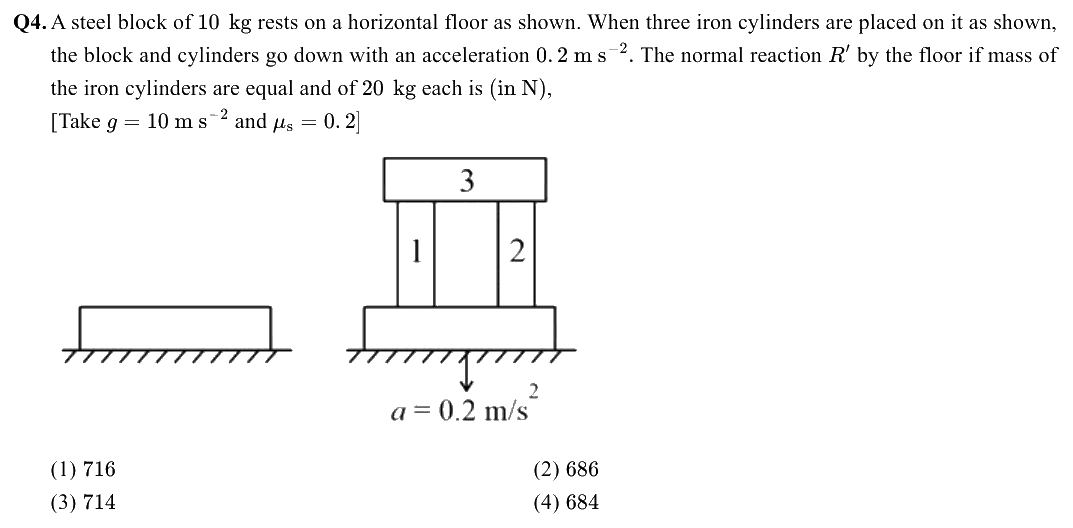
A steel block of $10\ \mathrm{kg}$ rests on a horizontal floor as shown. When three iron cylinders are placed on it as shown, the block and cylinders go down with an acceleration $0.2\ \mathrm{m\ s^{-2}}$. The normal reaction $R'$ by the floor if mass of the iron cylinders are equal and of $20\ \mathrm{kg}$ each is (in N), [Take $g = 10\ \mathrm{m\ s^{-2}}$ and $\mu_s = 0.2$] (see the figure above)
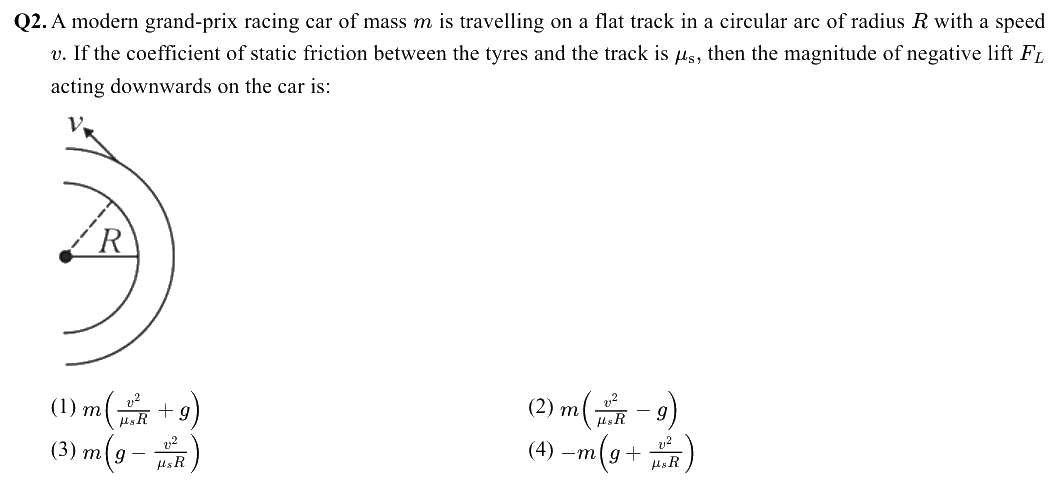
A modern grand-prix racing car of mass $m$ is travelling on a flat track in a circular arc of radius $R$ with a speed $v$. If the coefficient of static friction between the tyres and the track is $\mu_{\mathrm{s}}$, then the magnitude of negative lift $F_L$ acting downwards on the car is: (see the figure above)
A block of 200 g mass moves with a uniform speed in a horizontal circular groove, with vertical side walls of radius $20 \mathrm{~cm}$. If the block takes $40 \mathrm{~s}$ to complete one round, the normal force by the side walls of the groove is:
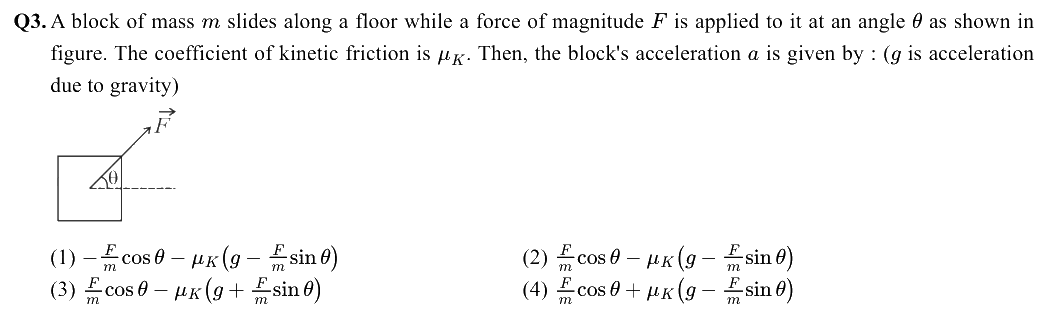
A block of mass $m$ slides along a floor while a force of magnitude $F$ is applied to it at an angle $\theta$ as shown in figure. The coefficient of kinetic friction is $\mu_K$. Then, the block's acceleration $a$ is given by : ($g$ is acceleration due to gravity) (see the figure above)
Statement I: A cyclist is moving on an unbanked road with a speed of $7\ \mathrm{km\ h^{-1}}$ and takes a sharp circular turn along a path of the radius of $2\ \mathrm{m}$ without reducing the speed. The static friction coefficient is $0.2$. The cyclist will not slip and pass the curve $(g = 9.8\ \mathrm{m\,s^{-2}})$ Statement II : If the road is banked at an angle of $45^\circ$, cyclist can cross the curve of $2\ \mathrm{m}$ radius with the speed of $18.5\ \mathrm{km\ h^{-1}}$ without slipping. In the light of the above statements, choose the correct answer from the options given below.
A
Statement I is incorrect and statement II is correct
B
Statement I is correct and statement II is incorrect
A particle is moving with uniform speed along the circumference of a circle of radius $R$ under the action of a central fictitious force $F$ which is inversely proportional to $R^3$. Its time period of revolution will be given by :
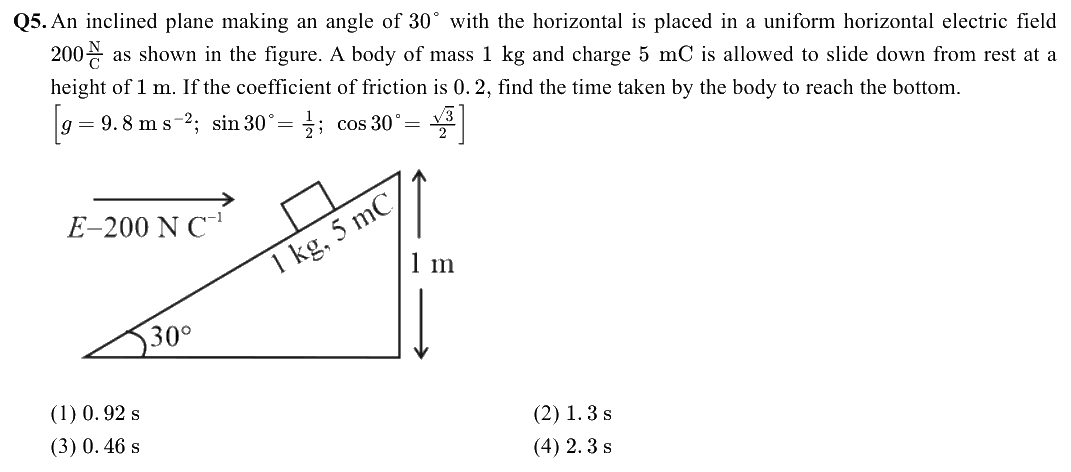
An inclined plane making an angle of $30^\circ$ with the horizontal is placed in a uniform horizontal electric field $200\,\frac{\mathrm{N}}{\mathrm{C}}$ as shown in the figure. A body of mass $1\ \mathrm{kg}$ and charge $5\ \mathrm{mC}$ is allowed to slide down from rest at a height of $1\ \mathrm{m}$. If the coefficient of friction is $0.2$, find the time taken by the body to reach the bottom. $\left[g = 9.8\ \mathrm{m\,s^{-2}};\ \sin 30^\circ = \frac{1}{2};\ \cos 30^\circ = \frac{\sqrt{3}}{2}\right]$ (see the figure above)
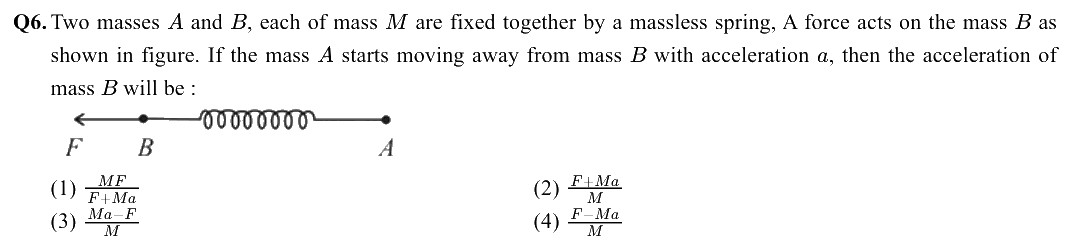
Two masses $A$ and $B$, each of mass $M$ are fixed together by a massless spring, A force acts on the mass $B$ as shown in figure. If the mass $A$ starts moving away from mass $B$ with acceleration $a$, then the acceleration of mass $B$ will be : (see the figure above)
An insect is at the bottom of a hemispherical ditch of radius $1\mathrm{m}$. It crawls up the ditch but starts slipping after it is at height h from the bottom. If the coefficient of friction between the ground and the insect is $0.75$, then $h$ is : ($g = 10\ \mathrm{m\ s^{-2}}$)
A particle moving in the xy-plane experiences a velocity dependent force $\vec{F} = k\left(v_y\hat{i} + v_x\hat{j}\right)$, where $v_x$ and $v_y$ are the x and y components of its velocity $\vec{v}$. If $\vec{a}$ is the acceleration of the particle, then which of the following statements is true for the particle ?
A
quantity $\vec{v} \times \vec{a}$ is constant in time
B
$\vec{F}$ arises from a magnetic field
C
kinetic energy of particle is constant in time
D
quantity $\vec{v} \cdot \vec{a}$ is constant in time
A spaceship in space sweeps stationary interplanetary dust. As a result, its mass increases at a rate $\frac{dM(t)}{dt} = bv^2(t)$, where $v(t)$ is its instantaneous velocity. The instantaneous acceleration of the satellite is:
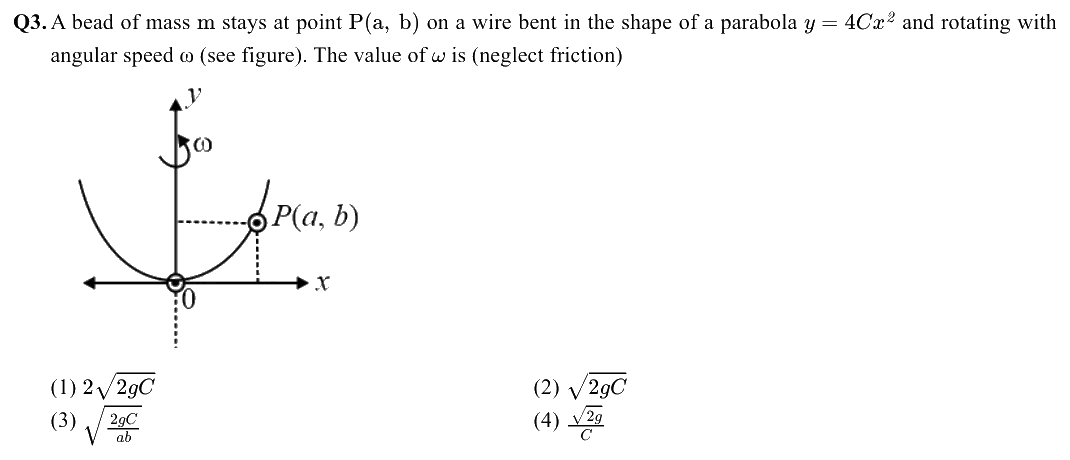
A bead of mass m stays at point P(a, b) on a wire bent in the shape of a parabola $y = 4Cx^{2}$ and rotating with angular speed $\omega$ (see figure). The value of $\omega$ is (neglect friction) (see the figure above)
A spring mass system (mass $m$, spring constant $k$ and natural length $l$ ) rests in equilibrium on a horizontal disc. The free end of the spring is fixed at the centre of the disc. If the disc together with spring mass system rotates about it's axis with an angular velocity $\omega$, $(k \gg m\omega^2)$ the relative change in the length of the spring is best given by the option:
A particle of mass $m$ is fixed to one end of a light spring having force constant $k$ and unstretched length $l$. The other end is fixed. The system is given an angular speed $\omega$ about the fixed end of the spring such that it rotates in a circle in gravity free space. Then the stretch in the spring is:
A mass of $10\ \mathrm{kg}$ is suspended by a rope of length $4\ \mathrm{m}$, from the ceiling. A force $\mathrm{F}$ is applied horizontally at the mid-point of the rope such that the top half of the rope makes an angle of $45^\circ$ with the vertical. Then $\mathrm{F}$ equals: (Take $\mathrm{g} = 10\ \mathrm{m\,s^{-2}}$ and the rope to be massless)
A man (mass $= 50\ \mathrm{kg}$) and his son (mass $= 20\ \mathrm{kg}$ ) are standing on a frictionless surface facing each other. The man pushes his son so that he starts moving at a speed of $0.70\ \mathrm{m\ s^{-1}}$ with respect to the man. The speed of the man with respect to the surface is:
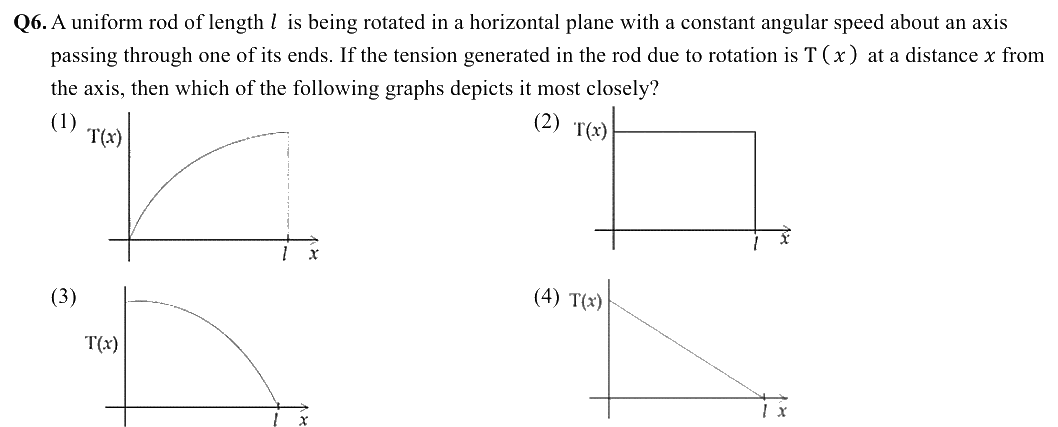
A uniform rod of length $l$ is being rotated in a horizontal plane with a constant angular speed about an axis passing through one of its ends. If the tension generated in the rod due to rotation is $\mathrm{T}\ (x)$ at a distance $x$ from the axis, then which of the following graphs depicts it most closely?
The question as printed in the paper.
A
see figure graph of T(x) against x: a curve starting at the origin, rising with decreasing slope (concave down) up to x = l, where a vertical dashed line is drawn
B
see figure graph of T(x) against x: a horizontal straight line at constant T(x) from x = 0 up to x = l, then dropping vertically (a rectangle-like step) to the x-axis at l
C
see figure graph of T(x) against x: a curve starting at the top of the T axis (maximum at x = 0) falling with increasing steepness (concave down) to zero at x = l
D
see figure graph of T(x) against x: a straight line falling from a maximum at x = 0 to zero at x = l
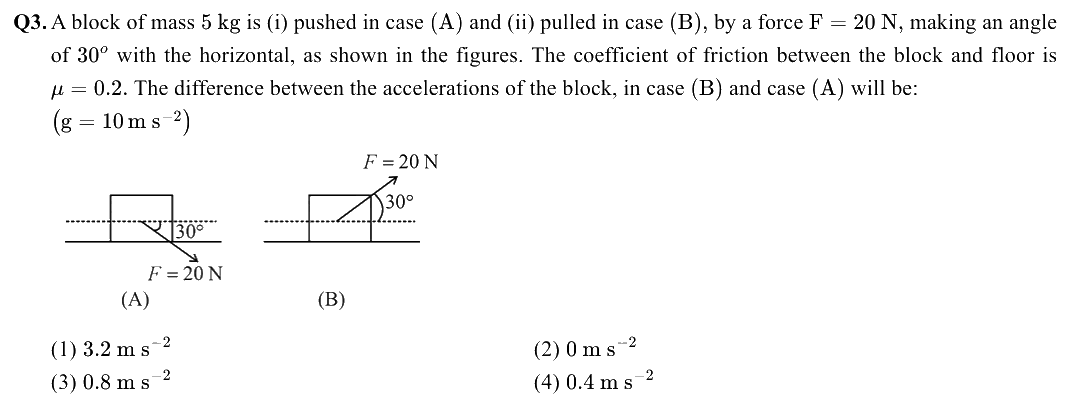
A block of mass 5 kg is (i) pushed in case (A) and (ii) pulled in case (B), by a force $\mathrm{F = 20\ N}$, making an angle of $30^o$ with the horizontal, as shown in the figures. The coefficient of friction between the block and floor is $\mu = 0.2$. The difference between the accelerations of the block, in case (B) and case (A) will be: ($\mathrm{g = 10\ m\,s^{-2}}$) (see the figure above)
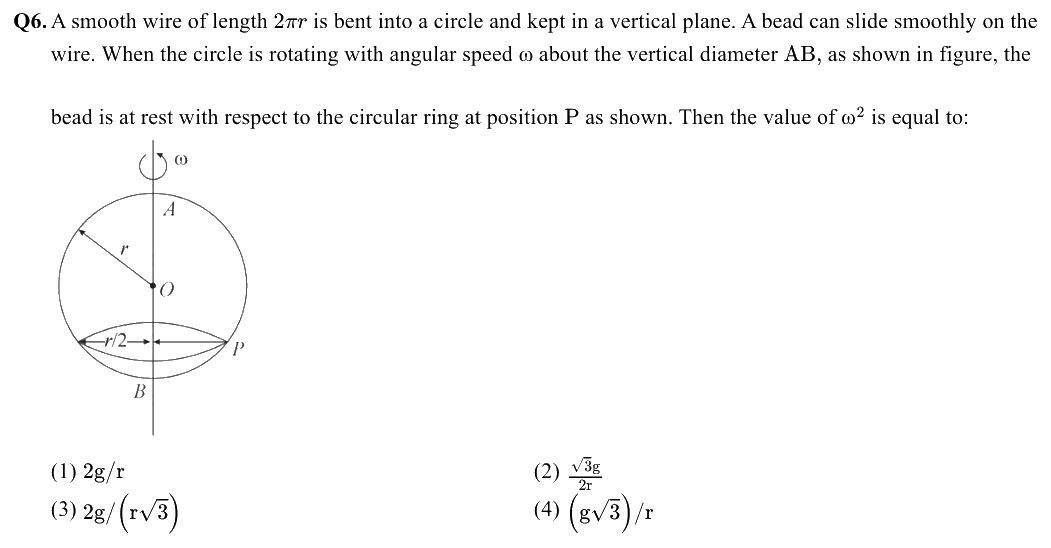
A smooth wire of length $2\pi r$ is bent into a circle and kept in a vertical plane. A bead can slide smoothly on the wire. When the circle is rotating with angular speed $\omega$ about the vertical diameter AB, as shown in figure, the bead is at rest with respect to the circular ring at position P as shown. Then the value of $\omega^2$ is equal to: (see the figure above)
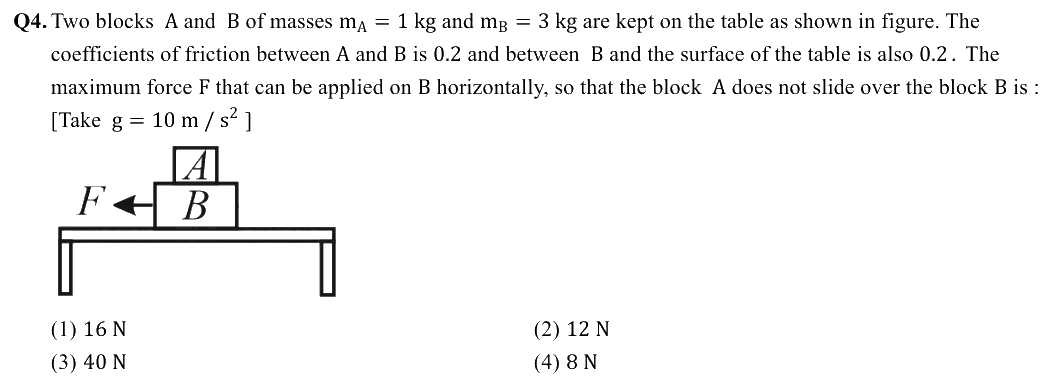
Two blocks A and B of masses $m_A = 1\ \mathrm{kg}$ and $m_B = 3\ \mathrm{kg}$ are kept on the table as shown in figure. The coefficients of friction between A and B is 0.2 and between B and the surface of the table is also 0.2. The maximum force F that can be applied on B horizontally, so that the block A does not slide over the block B is : [Take $g = 10\ \mathrm{m/s^{2}}$]
A body of mass $m_1$ moving with an unknown velocity of $v_1\,\hat{i}$, undergoes a collinear collision with a body of mass $m_2$ moving with a velocity $v_2\,\hat{i}$. After the collision, $m_1$ and $m_2$ move with velocities of $v_3\,\hat{i}$ and $v_4\,\hat{i}$, respectively. If $m_2 = 0.5\ m_1$ and $v_3 = 0.5\ v_1$, then $v_1$ is:
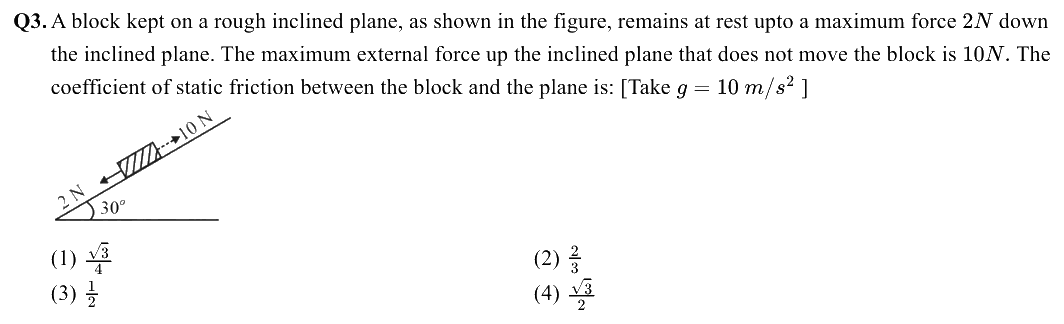
A block kept on a rough inclined plane, as shown in the figure, remains at rest upto a maximum force $2N$ down the inclined plane. The maximum external force up the inclined plane that does not move the block is $10N$. The coefficient of static friction between the block and the plane is: [Take $g = 10\ m/s^2$ ]
A liquid of density $\rho$ is coming out of a hose pipe of radius a with horizontal speed $v$ and hits a mesh. 50% of the liquid passes through the mesh unaffected. 25% looses all of its momentum and 25% comes back with the same speed. The resultant pressure on the mesh will be:
A particle of mass m is moving in a straight line with momentum p. Starting at time $t = 0$, a force $F = k$ t acts in the same direction on the moving particle during time interval T so that its momentum changes from p to 3p. Here $k$ is a constant. The value of T is
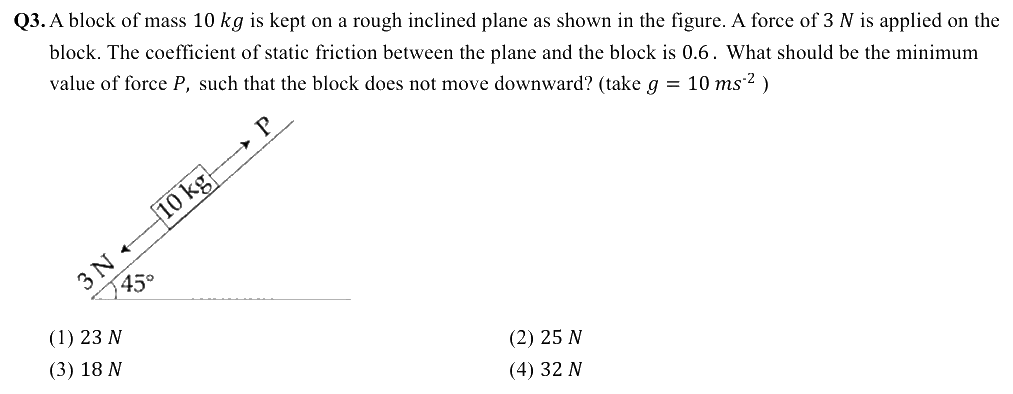
A block of mass $10\ kg$ is kept on a rough inclined plane as shown in the figure. A force of $3\ N$ is applied on the block. The coefficient of static friction between the plane and the block is $0.6$. What should be the minimum value of force $P$, such that the block does not move downward? (take $g = 10\ ms^{-2}$ ) (see the figure above)
A mass of $10\ \mathrm{kg}$ is suspended vertically by a rope from the roof. When a horizontal force is applied on the rope at some point, the rope deviated at an angle of $45^\circ$ at the roof point. If the suspended mass is at equilibrium, the magnitude of the force applied is $(g = 10\ \mathrm{m\,s^{-2}})$
Two particles of the same mass $m$ are moving in circular orbits because of force, given by $F(r) = -\frac{16}{r} - r^3$. The first particle is at a distance $r = 1$, and the second, at $r = 4$. The best estimate for the ratio of kinetic energies of the first and the second particle is closest to
A given object takes $n$ times more time to slide down a $45^\circ$ rough inclined plane as it takes to slide down a perfectly smooth $45^\circ$ incline. The coefficient of kinetic friction between the object and the incline is :
A body of mass $2\ \mathrm{kg}$ slides down with an acceleration of $3\ \mathrm{m/s^2}$ on a rough inclined plane having a slope of $30^\circ$ . The external force required to take the same body up the plane with the same acceleration will be: ($\mathrm{g = 10\ m/s^2}$)
A disc rotates about its axis of symmetry in a hoizontal plane at a steady rate of $3.5$ revolutions per second. A coin placed at a distance of $1.25\ \mathrm{cm}$ from the axis of rotation remains at rest on the disc. The coefficient of friction between the coin and the disc is ($\mathrm{g} = 10\ \mathrm{m/s^2}$)
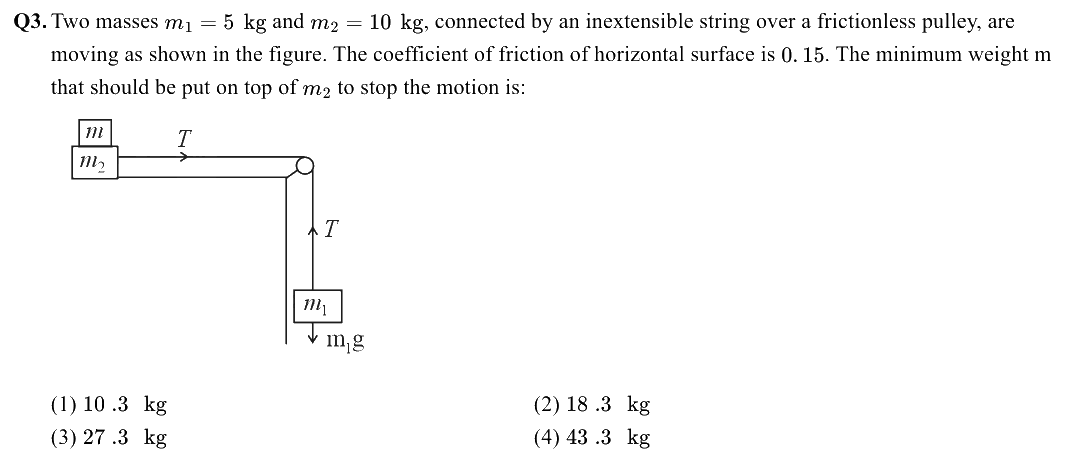
Two masses $m_1 = 5\ \mathrm{kg}$ and $m_2 = 10\ \mathrm{kg}$, connected by an inextensible string over a frictionless pulley, are moving as shown in the figure. The coefficient of friction of horizontal surface is $0.15$. The minimum weight m that should be put on top of $m_2$ to stop the motion is: (see the figure above)
A particle is moving with a uniform speed in a circular orbit of radius R in a central force inversely proportional to the $n^{th}$ power of R. If the period of rotation of the particle is T, then:
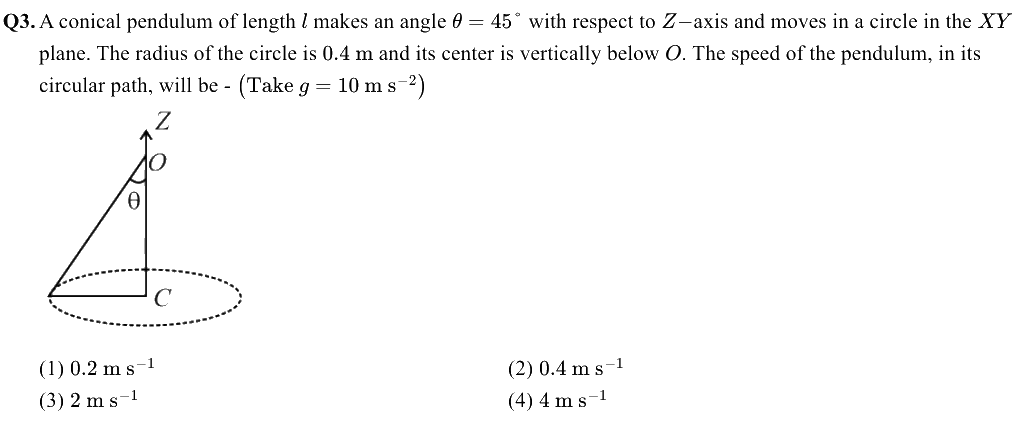
A conical pendulum of length $l$ makes an angle $\theta = 45^\circ$ with respect to $Z$-axis and moves in a circle in the $XY$ plane. The radius of the circle is 0.4 m and its center is vertically below $O$. The speed of the pendulum, in its circular path, will be - (Take $g = 10\ \mathrm{m\,s^{-2}}$) (see the figure above)
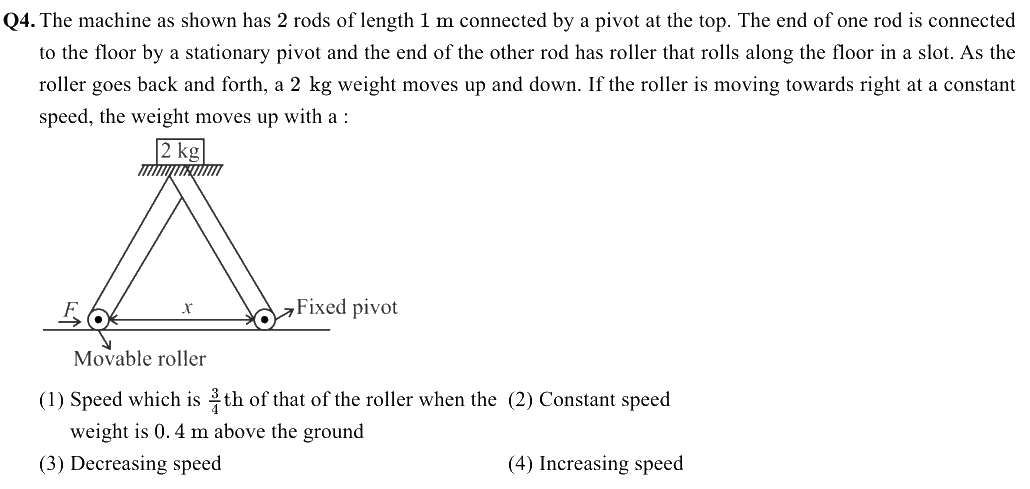
The machine as shown has 2 rods of length 1 m connected by a pivot at the top. The end of one rod is connected to the floor by a stationary pivot and the end of the other rod has roller that rolls along the floor in a slot. As the roller goes back and forth, a 2 kg weight moves up and down. If the roller is moving towards right at a constant speed, the weight moves up with a : (see the figure above)
The question as printed in the paper.
A
Speed which is $\frac{3}{4}$th of that of the roller when the weight is 0.4 m above the ground
Concrete mixture is made by mixing cement, stone and sand in a rotating cylindrical drum. If the drum rotates too fast, the ingredients remain stuck to the wall of the drum and proper mixing of ingredients does not take place. The maximum rotational speed of the drum in revolutions per minute (rpm) to ensure proper mixing is close to : (Take the radius of the drum to be $1.25\ \mathrm{m}$ and its axle to be horizontal) :
A rocket is fired vertically from the earth with an acceleration of $2g$, where g is the gravitational acceleration. On an inclined plane inside the rocket, making an angle $\theta$ with the horizontal, a point object of mass m is kept. The minimum coefficient of friction $\mu_{\min}$ between the mass and the inclined surface such that the mass does not move is:
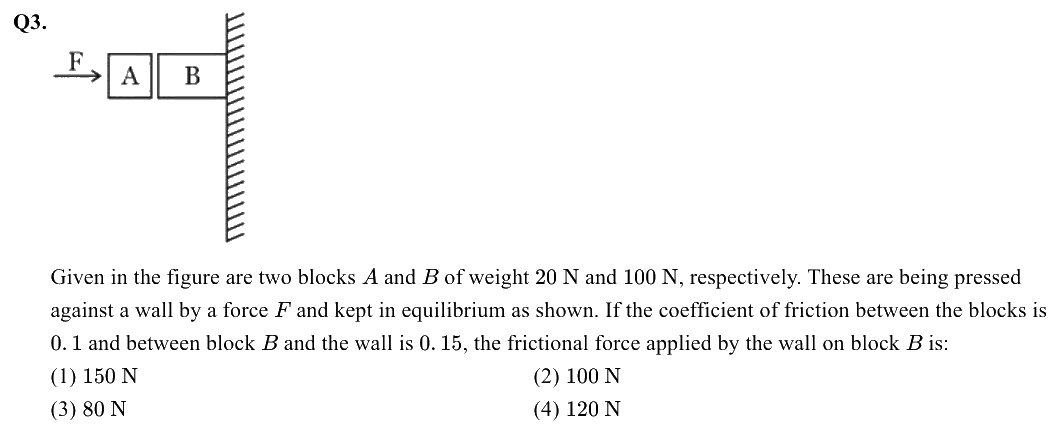
see figure Given in the figure are two blocks $A$ and $B$ of weight $20\ \mathrm{N}$ and $100\ \mathrm{N}$, respectively. These are being pressed against a wall by a force $F$ and kept in equilibrium as shown. If the coefficient of friction between the blocks is $0.1$ and between block $B$ and the wall is $0.15$, the frictional force applied by the wall on block $B$ is:
A heavy box is to be dragged along a rough horizontal floor. To do so, the person $A$ pushes it at an angle $30^\circ$ from the horizontal and requires a minimum force $F_{\mathrm{A}}$, while the person $B$ pulls the box at an angle $60^\circ$ from the horizontal and needs minimum force $F_{\mathrm{B}}$. If the coefficient of friction between the box and the floor is $\frac{\sqrt{3}}{5}$, the ratio $\frac{F_A}{F_B}$ is
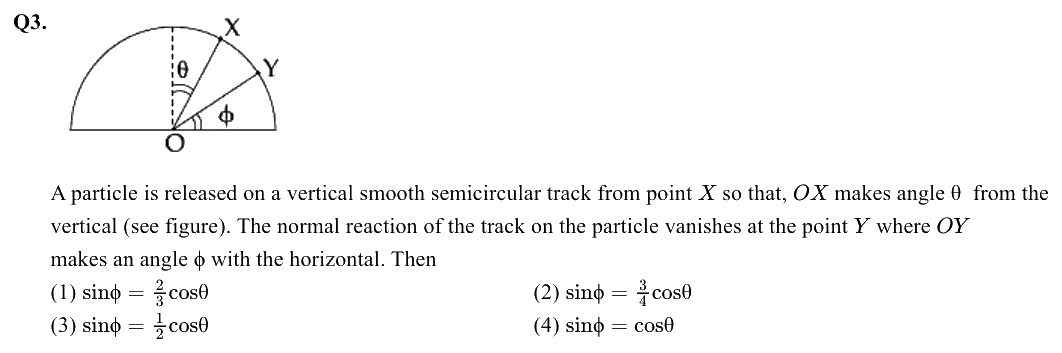
see figure A particle is released on a vertical smooth semicircular track from point $X$ so that $OX$ makes angle $\theta$ from the vertical (see figure). The normal reaction of the track on the particle vanishes at the point $Y$ where $OY$ makes an angle $\phi$ with the horizontal. Then
A body of mass $5\ \mathrm{kg}$ under the action of constant force $\vec{F} = F_x \hat{i} + F_y \hat{j}$ has velocity at $\mathrm{t} = 0\ \mathrm{s}$ as $\vec{\mathrm{v}} = (6\hat{\mathrm{i}} - 2\hat{\mathrm{j}}\mathrm{m/s})$ and at $\mathrm{t} = 10\ \mathrm{s}$ as $\vec{\mathrm{v}} = +6\hat{\mathrm{j}}\mathrm{m/s}$. The force $\vec{\mathrm{F}}$ is:
Water is flowing at a speed of 1.5 $\mathrm{m\,s^{-1}}$ through a horizontal tube of cross-sectional area $10^{-2}\ \mathrm{m^2}$ and you are trying to stop the flow by your palm. Assuming that the water stops immediately after hitting the palm, the minimum force that you must exert should be (density of water = $10^3\ \mathrm{kg\,m^{-3}}$)
A block of mass $m$ is placed on a surface with a vertical cross section given by $y = \frac{x^3}{6}$. If the coefficient of friction is 0.5, the maximum height above the ground at which the block can be placed without slipping is
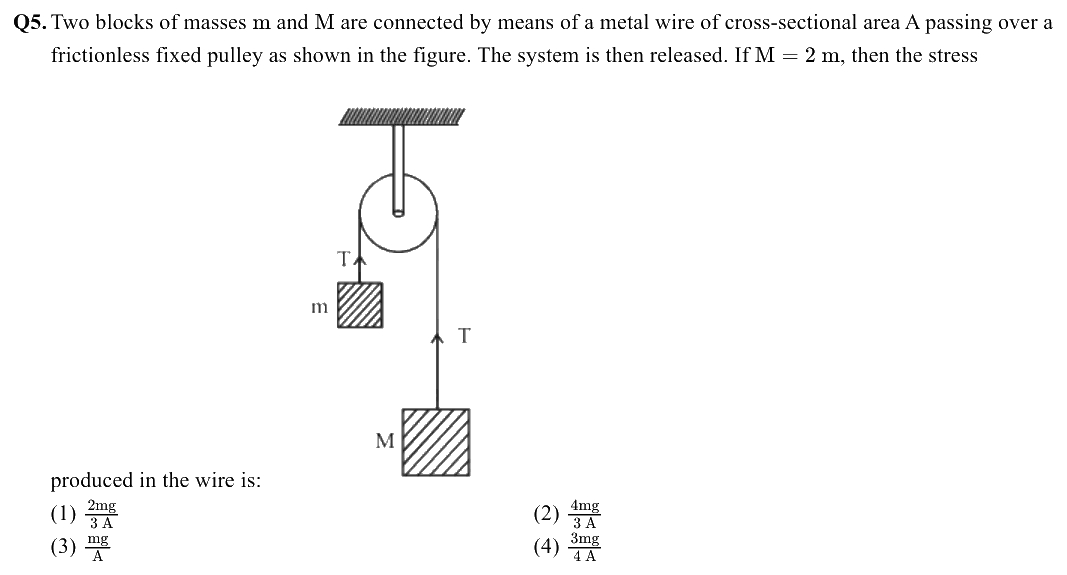
Two blocks of masses m and M are connected by means of a metal wire of cross-sectional area A passing over a frictionless fixed pulley as shown in the figure. The system is then released. If $M = 2$ m, then the stress produced in the wire is: (see the figure above)
A body of mass ' $m$ ' is tied to one end of a spring and whirled round in a horizontal plane with a constant angular velocity. The elongation in the spring is 1 cm. If the angular velocity is doubled, the elongation in the spring is 5 cm. The original length of the spring is :
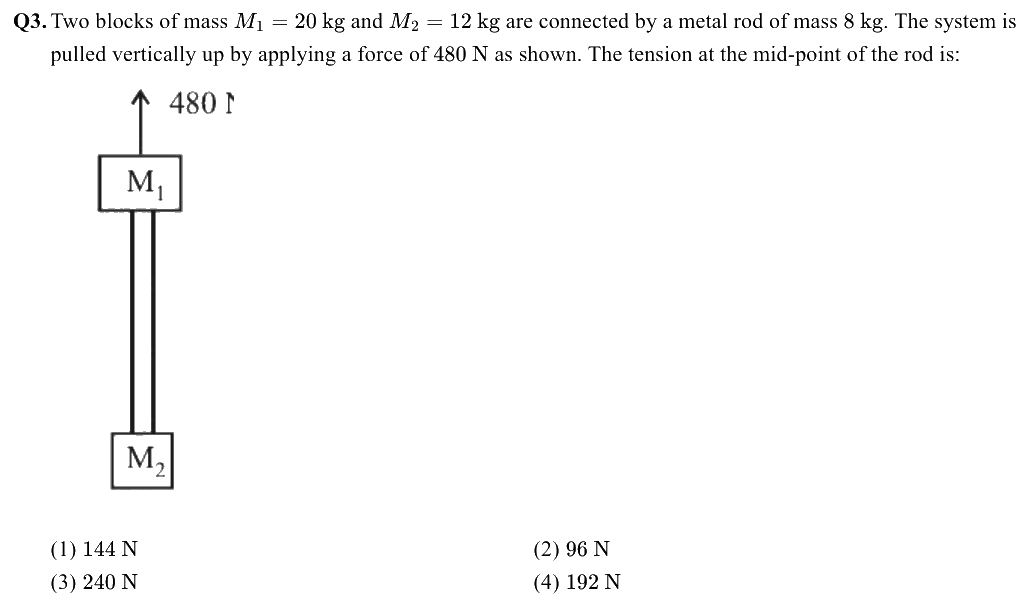
Two blocks of mass $M_1 = 20\ \mathrm{kg}$ and $M_2 = 12\ \mathrm{kg}$ are connected by a metal rod of mass $8\ \mathrm{kg}$. The system is pulled vertically up by applying a force of $480\ \mathrm{N}$ as shown. The tension at the mid-point of the rod is: (see the figure above)
A body starts from rest on a long inclined plane of slope $45^\circ$. The coefficient of friction between the body and the plane varies as $\mu = 0.3x$, where $x$ is distance travelled down the plane. The body will have maximum speed (for $g = 10\ \mathrm{m/s^2}$ ) when $x =$
A satellite moving with velocity $v$ in a force free space collects stationary interplanetary dust at a rate of $\frac{dM}{dt} = \alpha v$ where $M$ is the mass (of satellite + dust) at that instant. The instantaneous acceleration of the satellite is
This question has Statement 1 and Statement 2 . Of the four choices given after the Statements, choose the one that best describes the two Statements. Statement 1: If you push on a cart being pulled by a horse so that it does not move, the cart pushes you back with an equal and opposite force. Statement 2: The cart does not move because the force described in statement 1 cancel each other.
A
Statement 1 is true, Statement 2 is true, Statement 2 is the correct explanation of Statement 1.
B
Statement 1 is false, Statement 2 is true.
C
Statement 1 is true, Statement 2 is false.
D
Statement 1 is true, Statement 2 is true, Statement 2 is not the correct explanation of Statement 1.
Sand is being dropped on a conveyer belt at the rate of $2\ \mathrm{kg}$ per second. The force necessary to keep the belt moving with a constant speed of $3\ \mathrm{ms^{-1}}$ will be
A block of weight $W$ rests on a horizontal floor with coefficient of static friction $\mu$. It is desired to make the block move by applying minimum amount of force. The angle $\theta$ from the horizontal at which the force should be applied and magnitude of the force $F$ are respectively.
A
$\theta = \tan^{-1}(\mu), F = \frac{\mu W}{\sqrt{1+\mu^2}}$
B
$\theta = \tan^{-1}\left(\frac{1}{\mu}\right), F = \frac{\mu W}{\sqrt{1+\mu^2}}$
C
$\theta = 0, F = \mu W$
D
$\theta = \tan^{-1}\left(\frac{\mu}{1+\mu}\right), F = \frac{\mu W}{1+\mu}$
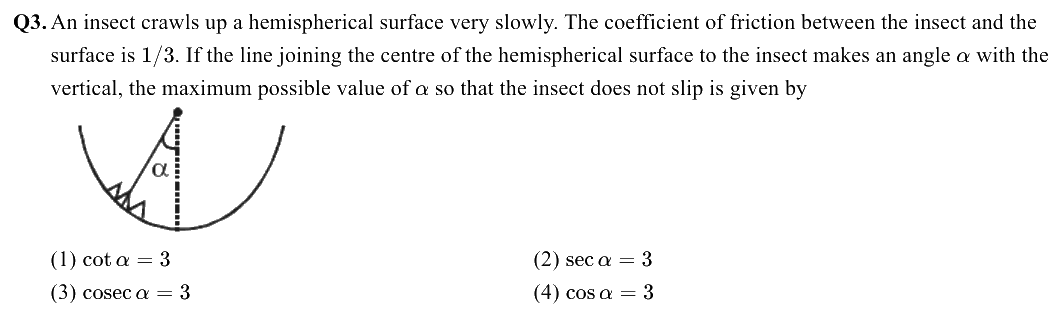
An insect crawls up a hemispherical surface very slowly. The coefficient of friction between the insect and the surface is $1/3$. If the line joining the centre of the hemispherical surface to the insect makes an angle $\alpha$ with the vertical, the maximum possible value of $\alpha$ so that the insect does not slip is given by (see the figure above)
A projectile moving vertically upwards with a velocity of $200\ \mathrm{ms^{-1}}$ breaks into two equal parts at a height of $490$ m. One part starts moving vertically upwards with a velocity of $400\ \mathrm{ms^{-1}}$. How much time it will take, after the break up with the other part to hit the ground?
An engine pumps water continuously through a hose. Water leaves the hose with velocity $v$ and $m$ is mass per unit length of the water jet. If this jet hits a surface and came to rest instantaneously, the force on the surface is
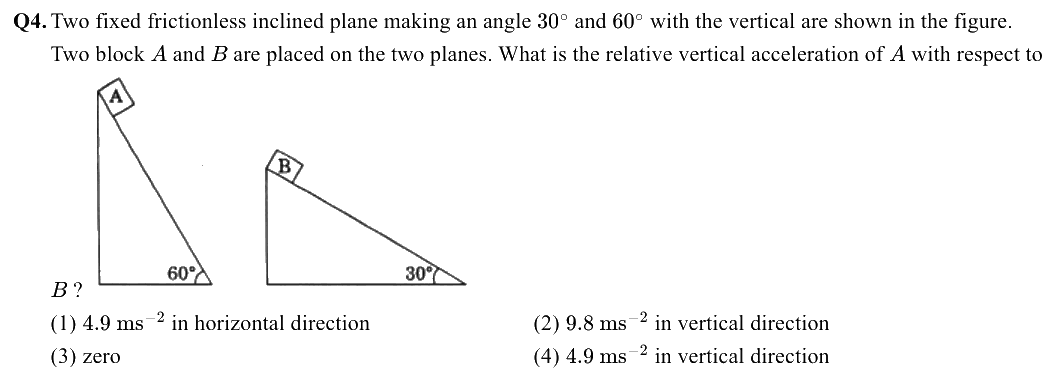
Two fixed frictionless inclined plane making an angle $30°$ and $60°$ with the vertical are shown in the figure. Two block $A$ and $B$ are placed on the two planes. What is the relative vertical acceleration of $A$ with respect to $B$ ? (see the figure above)
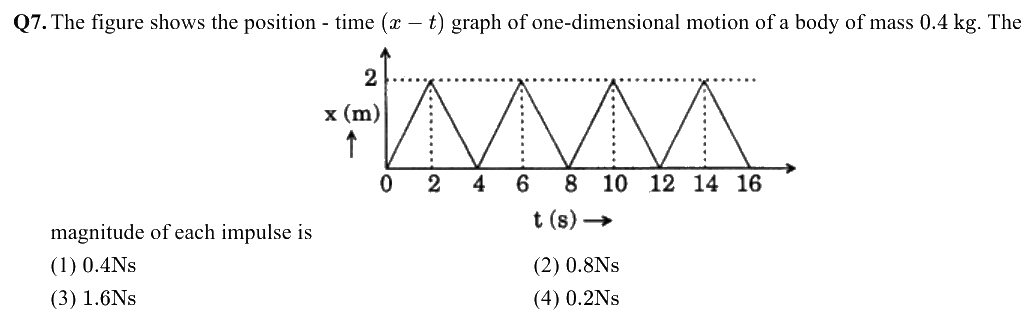
The figure shows the position - time $(x - t)$ graph of one-dimensional motion of a body of mass 0.4 kg. The magnitude of each impulse is (see the figure above)
A block of mass 'm' is connected to another block of mass 'M' by a spring (massless) of spring constant 'k'. The blocks are kept on a smooth horizontal plane. Initially the blocks are at rest and the spring is unstretched. Then a constant force 'F' starts acting on the block of mass 'M' to pull it. Find the force on the block of mass 'm'
A body weighing 13 kg is suspended by two strings 5 m and 12 m long, their other ends being fastened to the extremities of a rod 13 m long. If the rod be so held that the body hangs immediately below the middle point. The tensions in the strings are
A player caught a cricket ball of mass 150 g moving at a rate of 20 m/s. If the catching process is completed in 0.1 s, the force of the blow exerted by the ball on the hand of the player is equal to
A bomb of mass 16 kg at rest explodes into two pieces of masses of 4 kg and 12 kg. The velocity of the 12 kg mass is $4\ \mathrm{ms^{-1}}$. The kinetic energy of the other mass is
A smooth block is released at rest on a $45^\circ$ incline and then slides a distance d. The time taken to slide is n times as much to slide on rough incline than on a smooth incline. The coefficient of friction is
The upper half of an inclined plane with inclination $\phi$ is perfectly smooth while the lower half is rough. A body starting from rest at the top will again come to rest at the bottom if the coefficient of friction for the lower half is given by
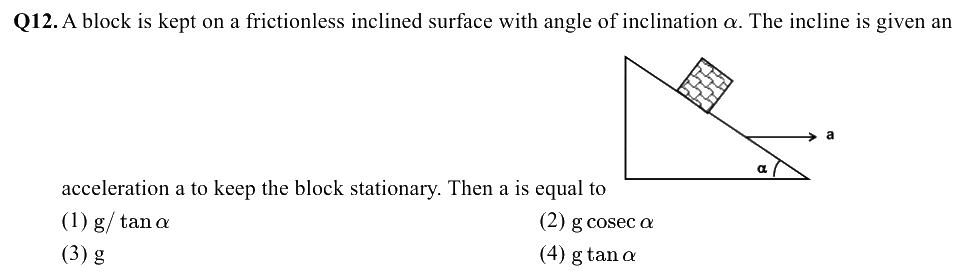
A block is kept on a frictionless inclined surface with angle of inclination $\alpha$. The incline is given an acceleration a to keep the block stationary. Then a is equal to (see the figure above)
A particle of mass 0.3 kg is subjected to a force $F = -kx$ with $k = 15\ \mathrm{N/m}$. What will be its initial acceleration if it is released from a point 20 cm away from the origin?
A machine gun fires a bullet of mass 40 g with a velocity 1200 $\mathrm{ms^{-1}}$. The man holding it can exert a maximum force of 144 N on the gun. How many bullets can he fire per second at the most?
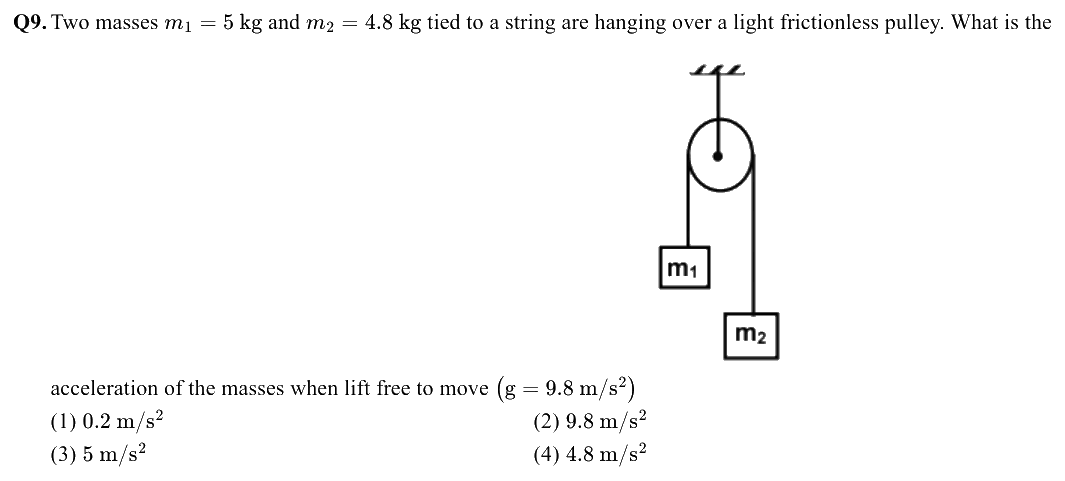
Two masses $m_1$ = 5 kg and $m_2$ = 4.8 kg tied to a string are hanging over a light frictionless pulley. What is the acceleration of the masses when lift free to move (g = 9.8 $\mathrm{m/s^2}$) (see the figure above)
A block rests on a rough inclined plane making an angle of $30^\circ$ with the horizontal. The coefficient of static friction between the block and the plane is 0.8. If the frictional force on the block is 10 N, the mass of the block (in kg ) is (take g = 10 $\mathrm{m/s^2}$ )
A spring balance is attached to the ceiling of a lift. A man hangs his bag on the spring and the spring reads 49 N, when the lift is stationary. If the lift moves downward with an acceleration of 5 m/s$^2$, the reading of the spring balance will be
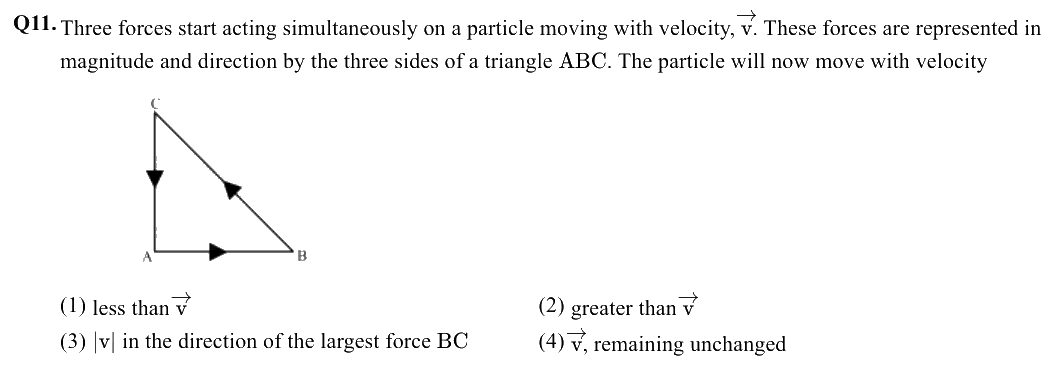
Three forces start acting simultaneously on a particle moving with velocity, $\vec{v}$. These forces are represented in magnitude and direction by the three sides of a triangle ABC. The particle will now move with velocity (see the figure above)
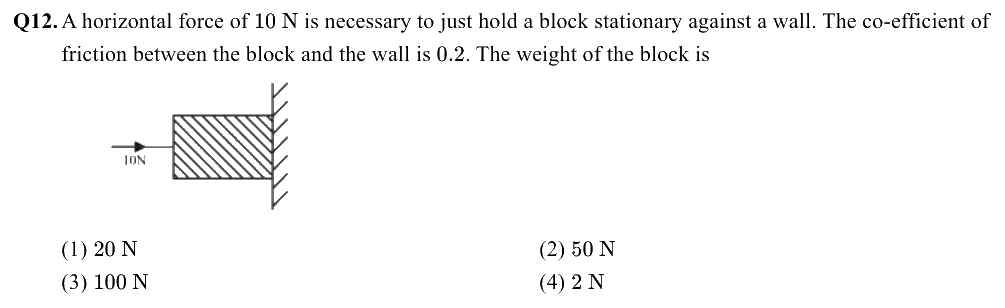
A horizontal force of 10 N is necessary to just hold a block stationary against a wall. The co-efficient of friction between the block and the wall is 0.2. The weight of the block is (see the figure above)
A block of mass $M$ is pulled along a horizontal frictionless surface by a rope of mass m. If a force P is applied at the free end of the rope, the force exerted by the rope on the block is
A light spring balance hangs from the hook of the other light spring balance and a block of mass M kg hangs from the former one. Then the true statement about the scale reading is
A
Both the scales read Mkg each
B
The scale of the lower one reads Mkg and of the upper one zero
C
The reading of the two scales can be anything but the sum of the reading will be Mkg
A rocket with a lift-off mass $3.5 \times 10^4$ kg is blasted upwards with an initial acceleration of 10 m/s$^2$. Then the initial thrust of the blast is
A light string passing over a smooth light pulley connects two blocks of masses $m_1$ and $m_2$ (vertically). If the acceleration of the system is g/8, then the ratio of the masses is
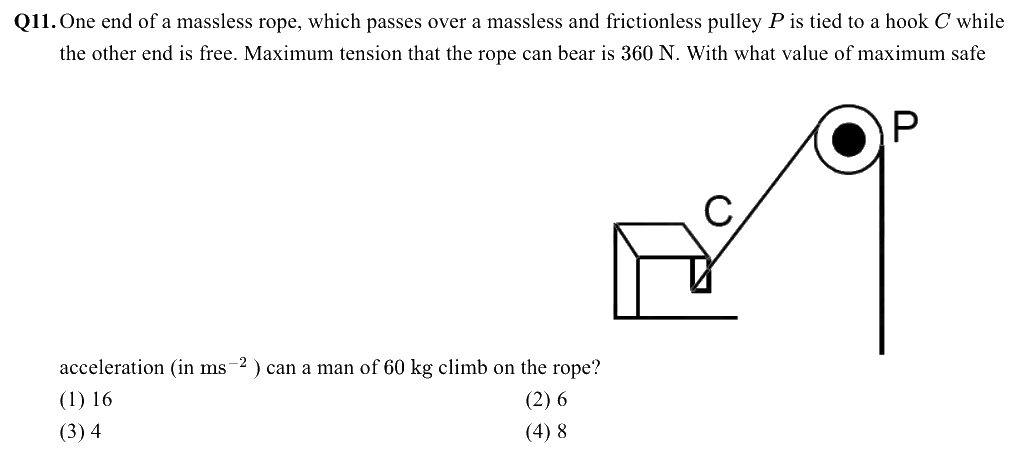
One end of a massless rope, which passes over a massless and frictionless pulley $P$ is tied to a hook $C$ while the other end is free. Maximum tension that the rope can bear is 360 N. With what value of maximum safe acceleration (in $\mathrm{ms^{-2}}$ ) can a man of 60 kg climb down the rope? (see the figure above)
A bead of weight $w$ can slide on smooth circular wire in a vertical plane. The bead is attached by a light thread to the highest point of the wire and in equilibrium, the thread is taut and make an angle $\theta$ with the vertical then tension of the thread and reaction of the wire on the bead are
A solid sphere, a hallow sphere and a ring are released from top of an inclined plane (frictionless) so that they slide down the plane. Then maximum acceleration down the plane is for (no rolling)
A block takes $t$ time to slide down a plane inclined at 45° to the horizontal. If the surface is made smooth (frictionless), the block takes time $\dfrac{t}{2}$ to slide down the plane. The coefficient of friction between the block and the inclined plane is $\left(\dfrac{\alpha}{100}\right)$. The value of $\alpha$ is ________.
Numerical answer type: type your answer in EdLoop to check it
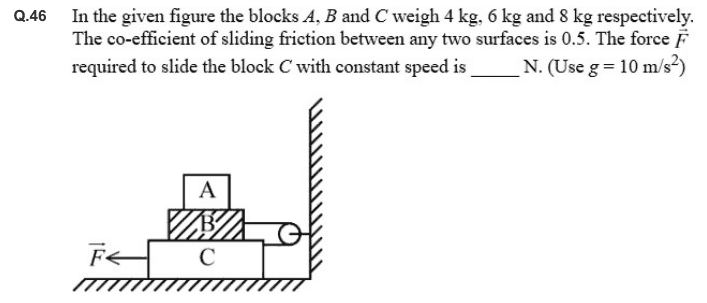
In the given figure the blocks $A$, $B$ and $C$ weigh 4 kg, 6 kg and 8 kg respectively. The co-efficient of sliding friction between any two surfaces is 0.5. The force $\vec{F}$ required to slide the block $C$ with constant speed is ________ N. (Use $g = 10$ m/s$^2$)
(see the figure above)
The question as printed in the paper.
Numerical answer type: type your answer in EdLoop to check it
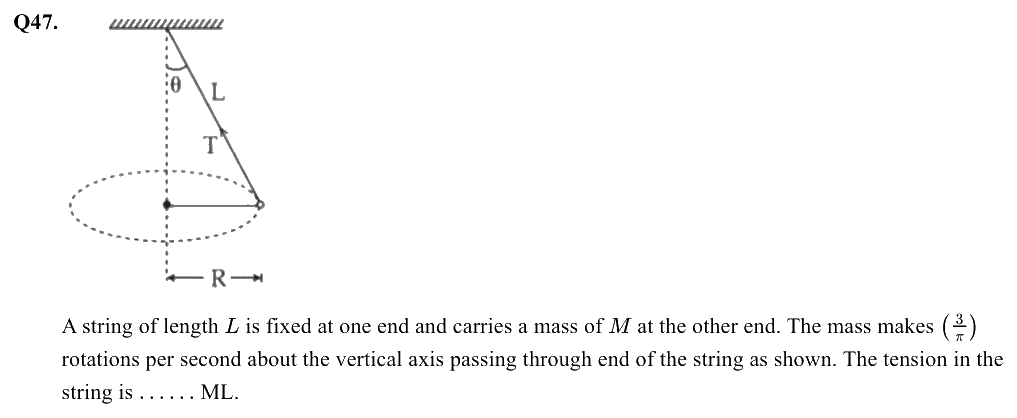
see figure A string of length $L$ is fixed at one end and carries a mass of $M$ at the other end. The mass makes $\left(\frac{3}{\pi}\right)$ rotations per second about the vertical axis passing through end of the string as shown. The tension in the string is ______ ML.
The question as printed in the paper.
Numerical answer type: type your answer in EdLoop to check it
A tube of length 1 m is filled completely with an ideal liquid of mass 2 M , and closed at both ends. The tube is rotated uniformly in horizontal plane about one of its ends. If the force exerted by the liquid at the other end is F then angular velocity of the tube is $\sqrt{\frac{\mathrm{F}}{\alpha \mathrm{M}}}$ in SI unit. The value of $\alpha$ is ______ .
Numerical answer type: type your answer in EdLoop to check it
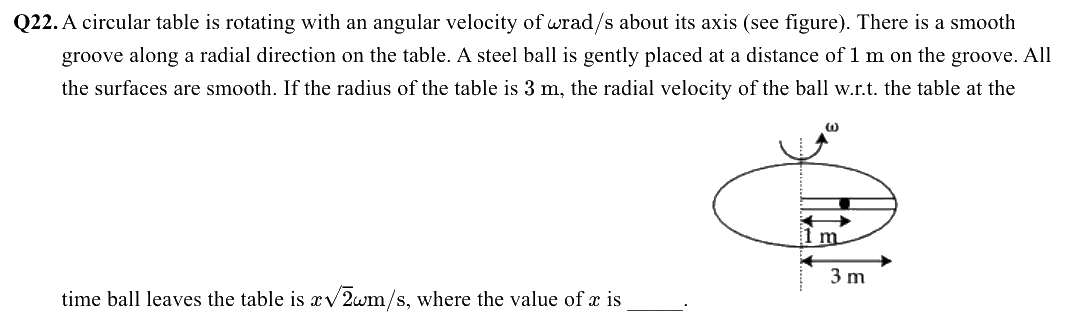
A circular table is rotating with an angular velocity of $\omega$ rad/s about its axis (see figure). There is a smooth groove along a radial direction on the table. A steel ball is gently placed at a distance of 1 m on the groove. All the surfaces are smooth. If the radius of the table is 3 m, the radial velocity of the ball w.r.t. the table at the time ball leaves the table is $x\sqrt{2}\omega$ m/s, where the value of $x$ is ______.
(see the figure above)
The question as printed in the paper.
Numerical answer type: type your answer in EdLoop to check it
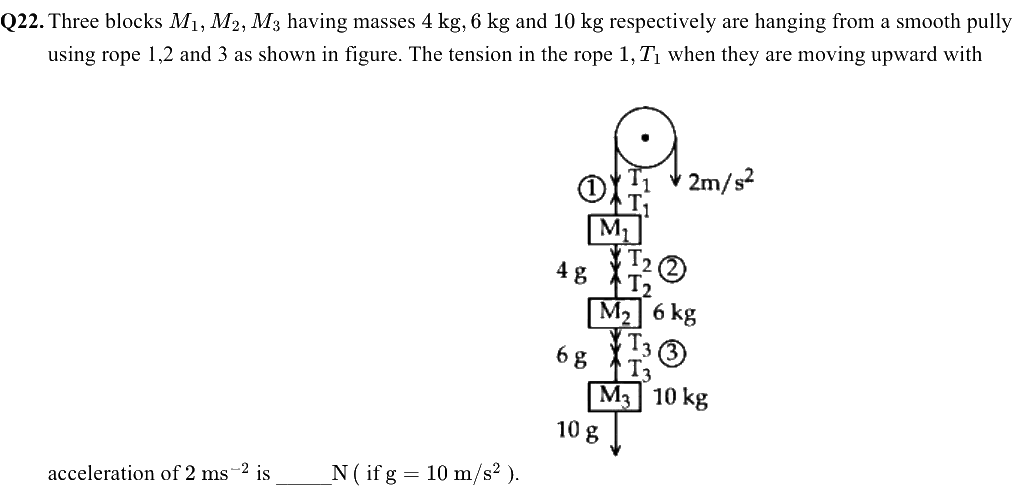
Three blocks $M_1, M_2, M_3$ having masses 4 kg, 6 kg and 10 kg respectively are hanging from a smooth pully using rope 1,2 and 3 as shown in figure. The tension in the rope 1, $T_1$ when they are moving upward with acceleration of 2 $\mathrm{ms^{-2}}$ is ______ N ( if g = 10 m/s$^2$ ).
(see the figure above)
The question as printed in the paper.
Numerical answer type: type your answer in EdLoop to check it
A body of mass $5\ \mathrm{kg}$ is moving with a momentum of $10\ \mathrm{kg\,m\,s^{-1}}$. Now a force of $2\ \mathrm{N}$ acts on the body in the direction of its motion for $5\ \mathrm{s}$. The increase in the Kinetic energy of the body is ______ J.
Numerical answer type: type your answer in EdLoop to check it
A tennis ball is dropped on to the floor from a height of $9.8\ \mathrm{m}$. It rebounds to a height $5.0\ \mathrm{m}$. Ball comes in contact with the floor for $0.2\ \mathrm{s}$. The average acceleration during contact is ______ $\mathrm{m\,s^{-2}}$. [Given $g = 10\ \mathrm{m\,s^{-2}}$]
Numerical answer type: type your answer in EdLoop to check it
A tube of length 50 cm is filled completely with an incompressible liquid of mass 250 g and closed at both ends. The tube is then rotated in horizontal plane about one of its ends with a uniform angular velocity $x\sqrt{F}\ \mathrm{rad\ s^{-1}}$. If $F$ be the force exerted by the liquid at the other end then the value of $x$ will be ______.
Numerical answer type: type your answer in EdLoop to check it
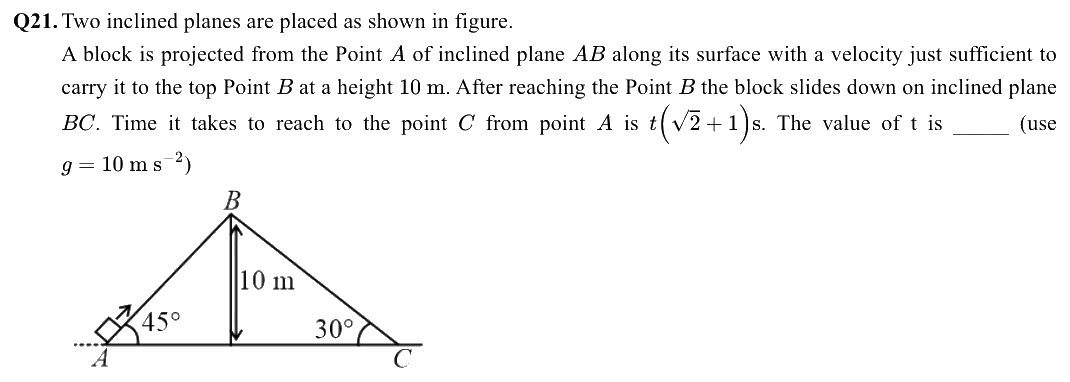
Two inclined planes are placed as shown in figure. A block is projected from the Point $A$ of inclined plane $AB$ along its surface with a velocity just sufficient to carry it to the top Point $B$ at a height 10 m. After reaching the Point $B$ the block slides down on inclined plane $BC$. Time it takes to reach to the point $C$ from point $A$ is $t\left(\sqrt{2} + 1\right)$s. The value of t is ______ (use $g = 10 \mathrm{~m~s^{-2}}$) (see the figure above)
The question as printed in the paper.
Numerical answer type: type your answer in EdLoop to check it
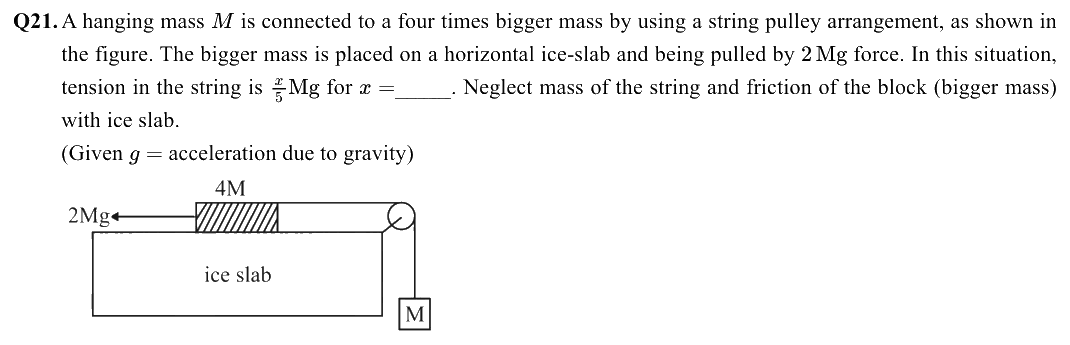
A hanging mass $M$ is connected to a four times bigger mass by using a string pulley arrangement, as shown in the figure. The bigger mass is placed on a horizontal ice-slab and being pulled by $2\,Mg$ force. In this situation, tension in the string is $\dfrac{x}{5}Mg$ for $x =$ ______. Neglect mass of the string and friction of the block (bigger mass) with ice slab. (Given $g =$ acceleration due to gravity)
(see the figure above)
The question as printed in the paper.
Numerical answer type: type your answer in EdLoop to check it
A man of $60\ \mathrm{kg}$ is running on the road and suddenly jumps into a stationary trolly car of mass $120\ \mathrm{kg}$. Then the trolly car starts moving with velocity $2\ \mathrm{m\,s^{-1}}$. The velocity of the running man was ______ $\mathrm{m\,s^{-1}}$, when he jumps into the car.
Numerical answer type: type your answer in EdLoop to check it
A pendulum of length $2\ \mathrm{m}$ consists of a wooden bob of mass $50\ \mathrm{g}$. A bullet of mass $75\ \mathrm{g}$ is fired towards the stationary bob with a speed $v$. The bullet emerges out of the bob with a speed $\frac{v}{3}$ and the bob just completes the vertical circle. The value of $v$ is ______ $\mathrm{m\ s^{-1}}$ (if $g = 10\ \mathrm{m\ s^{-2}}$).
Numerical answer type: type your answer in EdLoop to check it
A mass of $10\ \mathrm{kg}$ is suspended vertically by a rope of length $5\ \mathrm{m}$ from the roof. A force of $30\ \mathrm{N}$ is applied at the middle point of rope in horizontal direction. The angle made by upper half of the rope with vertical is $\alpha = \tan^{-1}\left(x \times 10^{-1}\right)$. The value of $x$ is ______ . (Given, $g = 10\ \mathrm{m\ s^{-2}}$)
Numerical answer type: type your answer in EdLoop to check it
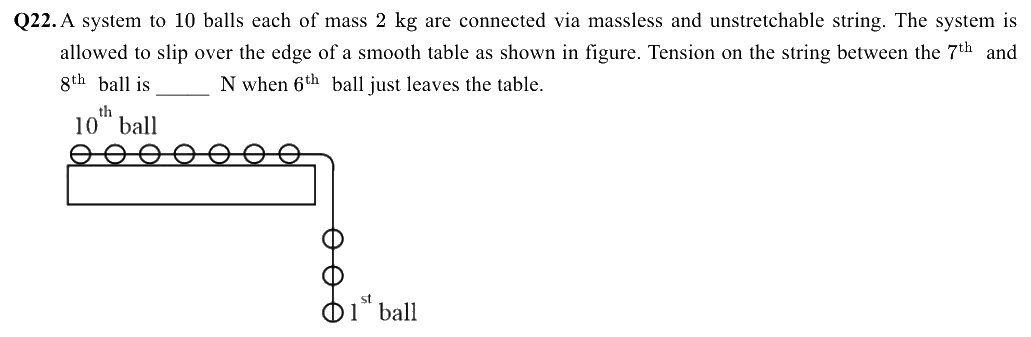
A system to 10 balls each of mass $2 \mathrm{~kg}$ are connected via massless and unstretchable string. The system is allowed to slip over the edge of a smooth table as shown in figure. Tension on the string between the $7^{\mathrm{th}}$ and $8^{\mathrm{th}}$ ball is ______ N when $6^{\mathrm{th}}$ ball just leaves the table. (see the figure above)
The question as printed in the paper.
Numerical answer type: type your answer in EdLoop to check it
A batsman hits back a ball of mass $0.4 \mathrm{~kg}$ straight in the direction of the bowler without changing its initial speed of $15 \mathrm{~m} \mathrm{~s}^{-1}$. The impulse imparted to the ball is ______ N s.
Numerical answer type: type your answer in EdLoop to check it
A uniform chain of $6 \mathrm{~m}$ length is placed on a table such that a part of its length is hanging over the edge of the table. The system is at rest. The co-efficient of static friction between the chain and the surface of the table is $0.5$, the maximum length of the chain hanging from the table is ______ m.
Numerical answer type: type your answer in EdLoop to check it
A force on an object of mass $100 \mathrm{~g}$ is $10\hat{i} + 5\hat{j} \mathrm{~N}$. The position of that object at $t = 2 \mathrm{~s}$ is $a\hat{i} + b\hat{j} \mathrm{~m}$ after starting from rest. The value of $\frac{a}{b}$ will be ______ .
Numerical answer type: type your answer in EdLoop to check it
A curved in a level road has a radius $75 \mathrm{~m}$. The maximum speed of a car turning this curved road can be $30 \mathrm{~m~s^{-1}}$ without skidding. If radius of curved road is changed to $48 \mathrm{~m}$ and the coefficient of friction between the tyres and the road remains same, then maximum allowed speed would be ______ $\mathrm{m~s^{-1}}$.
Numerical answer type: type your answer in EdLoop to check it
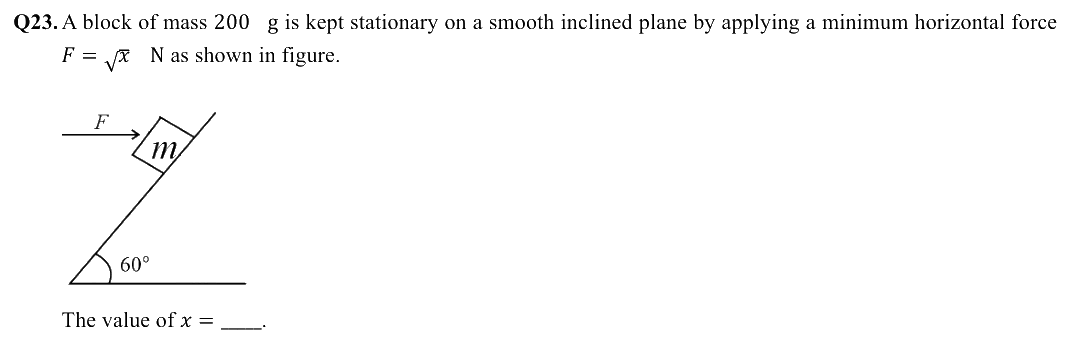
A block of mass $200 \mathrm{~g}$ is kept stationary on a smooth inclined plane by applying a minimum horizontal force $F = \sqrt{x} \mathrm{~N}$ as shown in figure. (see the figure above) The value of $x =$ ______.
The question as printed in the paper.
Numerical answer type: type your answer in EdLoop to check it
When a body slides down from rest along a smooth inclined plane making an angle of $30^\circ$ with the horizontal, it takes time $T$. When the same body slides down from the rest along a rough inclined plane making the same angle and through the same distance, it takes time $\alpha T$, where $\alpha$ is a constant greater than $1$. The co-efficient of friction between the body and the rough plane is $\frac{1}{\sqrt{x}}\frac{\alpha^2 - 1}{\alpha^2}$ where $x =$ ______.
Numerical answer type: type your answer in EdLoop to check it
A car is moving on a plane inclined at $30^\circ$ to the horizontal with an acceleration of $10$ m s$^{-2}$ parallel to the plane upward. A bob is suspended by a string from the roof of the car. The angle in degrees which the string makes with the vertical is (Take $g = 10$ m s$^{-2}$)
Numerical answer type: type your answer in EdLoop to check it
A block moving horizontally on a smooth surface with a speed of $40$ m s$^{-1}$ splits into two equal parts. If one of the parts moves at $60$ m s$^{-1}$ in the same direction, then the fractional change in the kinetic energy will be $x : 4$ where $x =$ ______.
Numerical answer type: type your answer in EdLoop to check it
The coefficient of static friction between two blocks is $0.5$ and the table is smooth. The maximum horizontal force that can be applied to move the blocks together is ______$\mathrm{N}$ (take $g=10\ \mathrm{m\ s^{-2}}$) (see the figure above)
The question as printed in the paper.
Numerical answer type: type your answer in EdLoop to check it
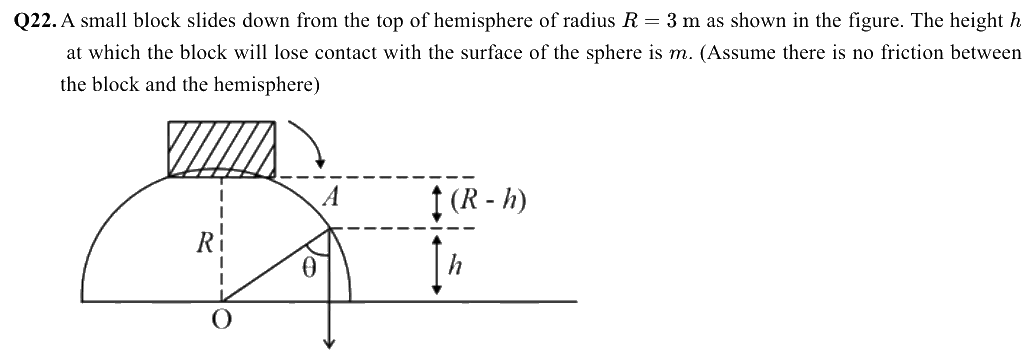
A small block slides down from the top of hemisphere of radius $R = 3\ \mathrm{m}$ as shown in the figure. The height $h$ at which the block will lose contact with the surface of the sphere is $\mathrm{m}$. (Assume there is no friction between the block and the hemisphere) (see the figure above)
The question as printed in the paper.
Numerical answer type: type your answer in EdLoop to check it
A body of mass $m$ is launched up on a rough inclined plane making an angle of $30^\circ$ with the horizontal. The coefficient of friction between the body and plane is $\frac{\sqrt{x}}{5}$ if the time of ascent is half of the time of descent. The value of $x$ is ______ .
Numerical answer type: type your answer in EdLoop to check it
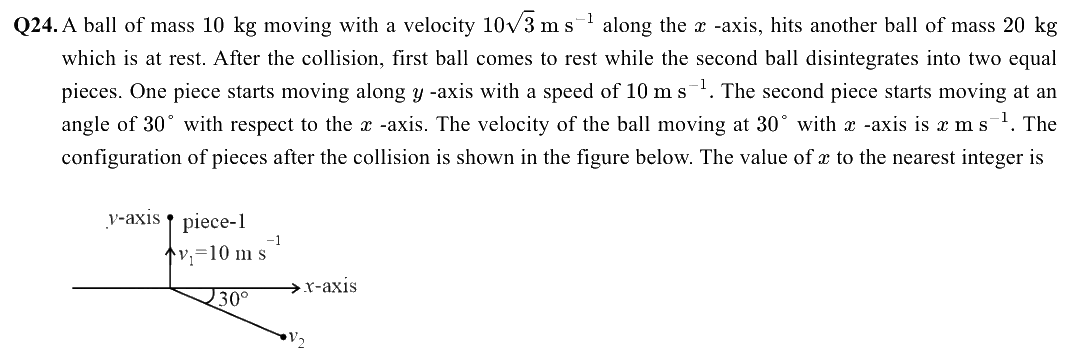
A ball of mass $10~\mathrm{kg}$ moving with a velocity $10\sqrt{3}~\mathrm{m~s^{-1}}$ along the $x$ -axis, hits another ball of mass $20~\mathrm{kg}$ which is at rest. After the collision, first ball comes to rest while the second ball disintegrates into two equal pieces. One piece starts moving along $y$ -axis with a speed of $10~\mathrm{m~s^{-1}}$. The second piece starts moving at an angle of $30^\circ$ with respect to the $x$ -axis. The velocity of the ball moving at $30^\circ$ with $x$ -axis is $x~\mathrm{m~s^{-1}}$. The configuration of pieces after the collision is shown in the figure below. The value of $x$ to the nearest integer is (see the figure above)
The question as printed in the paper.
Numerical answer type: type your answer in EdLoop to check it
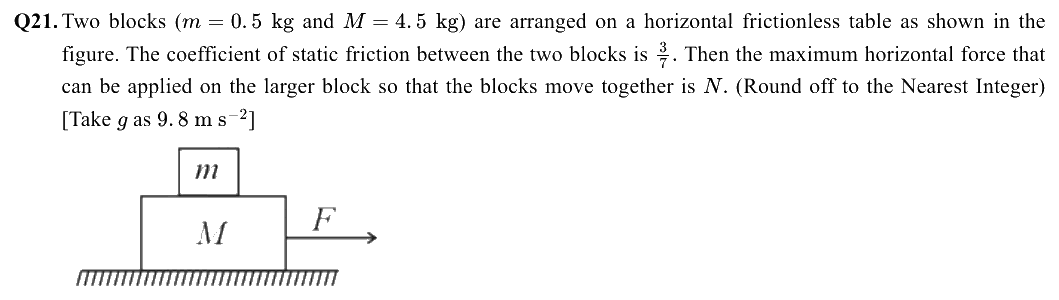
Two blocks ($m=0.5 \mathrm{~kg}$ and $M=4.5 \mathrm{~kg}$) are arranged on a horizontal frictionless table as shown in figure. The coefficient of static friction between the two blocks is $\frac{3}{7}$. Then the maximum horizontal force that can be applied on the larger block so that the blocks move together is $N$. (Round off to the Nearest Integer) [Take $g$ as $9.8 \mathrm{~m} \mathrm{~s}^{-2}$] (see the figure above)
The question as printed in the paper.
Numerical answer type: type your answer in EdLoop to check it
A body of mass $1 \mathrm{~kg}$ rests on a horizontal floor with which it has a coefficient of static friction $\frac{1}{\sqrt{3}}$. It is desired to make the body move by applying the minimum possible force $F \mathrm{~N}$. The value of $F$ will be ______. (Round off to the Nearest Integer) [Take $g=10 \mathrm{~m} \mathrm{~s}^{-2}$ ]
Numerical answer type: type your answer in EdLoop to check it
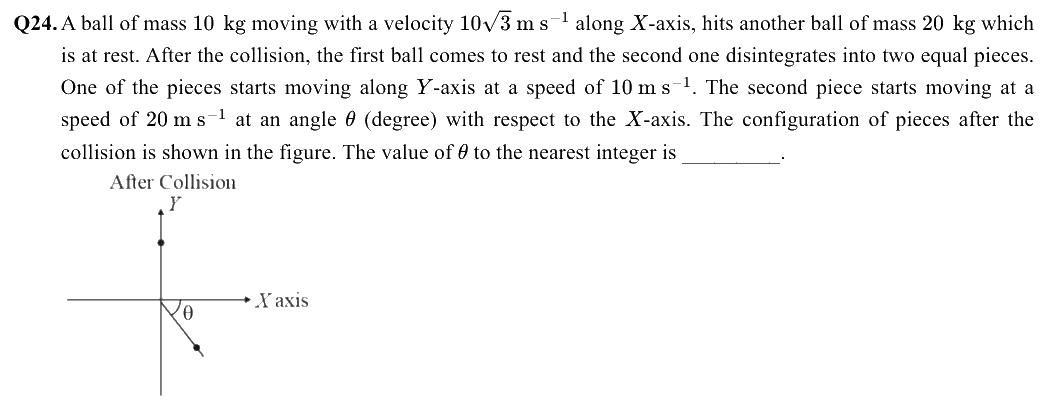
A ball of mass $10 \mathrm{~kg}$ moving with a velocity $10 \sqrt{3} \mathrm{~m} \mathrm{~s}^{-1}$ along $X$-axis, hits another ball of mass $20 \mathrm{~kg}$ which is at rest. After the collision, the first ball comes to rest and the second one disintegrates into two equal pieces. One of the pieces starts moving along $Y$-axis at a speed of $10 \mathrm{~m} \mathrm{~s}^{-1}$. The second piece starts moving at a speed of $20 \mathrm{~m} \mathrm{~s}^{-1}$ at an angle $\theta$ (degree) with respect to the $X$-axis. The configuration of pieces after the collision is shown in the figure. The value of $\theta$ to the nearest integer is ______. (see the figure above)
The question as printed in the paper.
Numerical answer type: type your answer in EdLoop to check it
A body of mass $2\ \mathrm{kg}$ moves under a force of $\left(2\hat{i} + 3\hat{j} + 5\hat{k}\right)\mathrm{N}$ It starts from rest and was at the origin initially. After $4\ \mathrm{s}$, its new coordinates are $(8, b, 20)$. The value of $b$ is ______. (Round off to the Nearest Integer)
Numerical answer type: type your answer in EdLoop to check it
A boy pushes a box of mass $2\ \mathrm{kg}$ with a force $\vec{F} = \left(20\hat{i} + 10\hat{j}\right)\mathrm{N}$ on a frictionless surface. If the box was initially at rest, then ______ m is displacement along the $x$-axis after $10\ \mathrm{s}$
Numerical answer type: type your answer in EdLoop to check it
A person standing on a spring balance inside a stationary lift measures $60\ \mathrm{kg}$. The weight of that person if the lift descends with uniform downward acceleration of $1.8\ \mathrm{m\,s^{-2}}$ will be ______ N. $\left[g = 10\ \mathrm{m\,s^{-2}}\right]$
Numerical answer type: type your answer in EdLoop to check it
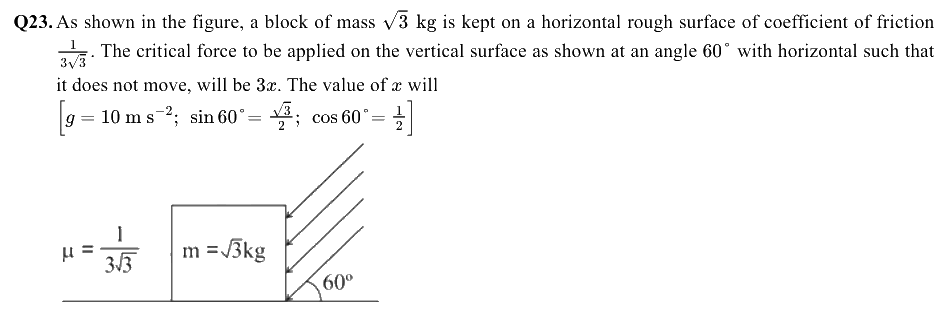
As shown in the figure, a block of mass $\sqrt{3}\ \mathrm{kg}$ is kept on a horizontal rough surface of coefficient of friction $\mu = \frac{1}{3\sqrt{3}}$. The critical force to be applied on the vertical surface as shown at an angle $60^\circ$ with horizontal such that it does not move, will be $3x$. The value of $x$ will $\left[g = 10\ \mathrm{m\,s^{-2}};\ \sin 60^\circ = \frac{\sqrt{3}}{2};\ \cos 60^\circ = \frac{1}{2}\right]$ (see the figure above)
The question as printed in the paper.
Numerical answer type: type your answer in EdLoop to check it
A small bob tied at one end of a thin string of length $1\ \mathrm{m}$ is describing a vertical circle so that the maximum and minimum tension in the string is in the ratio $5 : 1$. The velocity of the bob at the highest position is ______ $\mathrm{m\ s^{-1}}$. (Take $g = 10\ \mathrm{m\ s^{-2}}$)
Numerical answer type: type your answer in EdLoop to check it
The coefficient of static friction between a wooden block of mass $0.5\ \mathrm{kg}$ and a vertical rough wall is $0.2$. The magnitude of the horizontal force that should be applied on the block to keep it adhere to the wall will be ______ N. $g = 10\ \mathrm{m\ s^{-2}}$
Numerical answer type: type your answer in EdLoop to check it
An inclined plane is bent in such a way that the vertical cross-section is given by $y = \frac{x^2}{4}$ where $y$ is in vertical and $x$ in horizontal direction. If the upper surface of this curved plane is rough with coefficient of friction $\mu = 0.5$, the maximum height in cm at which a stationary block will not slip downward is ______ cm.
Numerical answer type: type your answer in EdLoop to check it
A block starts moving up an inclined plane of inclination $30^\circ$ with an initial velocity of $v_0$. It comes back to its initial position with velocity $\frac{v_0}{2}$. The value of the coefficient of kinetic friction between the block and the inclined plane is close to $\frac{1}{1000}$, The nearest integer to I is :
Numerical answer type: type your answer in EdLoop to check it
Laws of Motion sits at the theoretical core of classical mechanics in JEE Main Physics. Across the papers we hold from 2019 to 2026, the chapter contributed 195 questions in 162 papers, which translates to 1.2 questions per paper, turning up in 126 of those 162 papers. Over this eight-year period, it holds the 8th position among 29 Physics chapters, claiming 4.3% of all Physics questions.
Its overall presence has stayed about the same across multiple testing eras. From 2002 to 2018, it commanded 4.3% of the Physics section; during the 2024 to 2026 exam cycle, it held precisely that same 4.3% mark, delivering 67 questions in 58 papers. The most concentrated testing occurred in 2024, when our papers recorded 35 questions across 20 papers. Since 2019 there has been no year without it, appearing in 126 of the 162 papers we hold.
Designated as Unit 3: Laws of Motion in NTA's Class 11 syllabus, the chapter provides the free-body methodology and force balance equations used continuously in gravitation, fluids, and rotational dynamics.
Most-asked topics
Between 2019 and 2026, the questions sorted into four balanced topics:
Newton's Laws & Free Body Diagrams: 65 questions. Coupled blocks, pulley-string assemblies, variable force integration, and equilibrium under concurrent forces.
Friction: 48 questions. Static limits, kinetic resistance on inclined planes, two-block slip conditions, and minimum holding forces.
Dynamics of Circular Motion: 42 questions. Vertical circular loops, tension extremes, conical pendulums, and centrifugal death-well cylinders.
Momentum & Impulse: 40 questions. Internal explosions, vector momentum conservation in two dimensions, and force-time impulse areas.
All four topic divisions featured actively in 2026 shifts, requiring students to treat each with equal seriousness.
What the questions look like
Pulley and block questions evaluate your ability to set up coupled equations of motion. A standard setup links two masses on rough or smooth inclines connected via massless cords over light pulleys. Students must write separate second-law equations for each component, identify geometric acceleration constraints, and solve for string tension or system acceleration. When forces vary with time, as when a polynomial force vector acts on an inertial mass, direct integration yields velocity and displacement vectors.
Friction problems test the boundary between static rest and kinetic sliding. Common scenarios place a block on an inclined ramp where the angle exceeds the repose angle, asking for the stopping distance when the block is kicked uphill against both gravity and friction. Another recurring pattern places one block atop another on a smooth floor, asking for the maximum external force applied to the bottom block before upper slip occurs.
Circular dynamics problems split between horizontal and vertical planes. In horizontal setups, a cylindrical rotor spins until static friction along the inner vertical wall balances gravity on a rider. In vertical circular motion, questions probe non-uniform speed variations, asking for bottom launch speed when the string goes slack at an intermediate angular elevation.
A solid fraction of problems requires direct numeric values: 39 of the 195 questions between 2019 and 2026 were numerical answer items with no multiple-choice alternatives.
Questions to try first
These selections from NTA's 2026 examinations highlight the primary question patterns:
Master free-body diagrams by isolating each body onto clean scrap paper before writing down equations. Clearly indicate contact normals, friction forces opposing relative motion, gravitational pull, and cord tensions. Choose an acceleration direction for each body that honors string inextensibility, ensuring your coordinate axes align with intended accelerations.
For friction, check static limiting friction before assuming motion occurs. Calculate the maximum static friction value first; if the driving force is smaller, friction equals the applied force and acceleration is zero. Only when driving force exceeds static friction should you employ kinetic friction coefficients in Newton's second law.
In circular motion, identify the physical agent supplying the centripetal force, whether string tension, normal contact, or friction, instead of writing centrifugal force into an inertial frame. For vertical loops, combine mechanical energy conservation between points with the radial force balance equation at the point where tension or normal contact vanishes.
Frequently asked questions
Is Laws of Motion vital for overall mechanics in JEE Main 2027?
Yes. Laws of Motion yielded 195 questions across 162 papers in our set from 2019 to 2026, giving 1.2 questions per paper. It ranks 8th among 29 Physics chapters and appeared in 126 of the 162 papers we hold.
What is the most common mistake students make in this chapter?
Assuming friction always equals the coefficient of friction times normal force without verifying whether the block is actually sliding, and misidentifying string constraint relationships in movable pulley systems.
Does vertical circular motion belong to this chapter or Work, Energy & Power?
Both chapters cover it. Laws of Motion handles the radial force balance and string slack conditions, while Work, Energy and Power provides the velocity relation between different elevations.
Where can I see the solutions?
Every question on this page opens with its options and answer. Step-by-step solutions for each one are in the EdLoop app.