Every Atoms question from past JEE Main and AIEEE papers, with options and answers. Newest first.
153questions
128papers covered
2.5%of Physics questions, 2019–2026
2002–2026years
Guide at a glance
Atoms explores atomic architecture and Bohr's quantized orbital model under Unit 18: Atoms and Nuclei in the Class 12 curriculum, holding rank 24 among the 29 physics chapters with a 2.5 percent share of total physics questions.
The ratio of momentum of the photons of the 1$^{\text{st}}$ and 2$^{\text{nd}}$ line of Balmer series of Hydrogen atoms is $\alpha/\beta$. The possible values of $\alpha$ and $\beta$ are:-
In the hydrogen atom, the electron makes a transition from the higher orbit ($i$) to a lower orbit ($f$). The ratio of the radius of the orbits in given by $r_i : r_f = 16 : 4$. The wavelength of photon emitted due to this transition is ________ nm. (Given Rydberg constant = $1.0973\times10^7$ /m)
Two electrons are moving in orbits of two hydrogen like atoms with speeds $3 \times 10^5$ m/s and $2.5 \times 10^5$ m/s respectively. If the radii of these orbits are nearly same then the possible order of energy states are ________ respectively.
7.9 MeV $\alpha$-particle scatters from a target material of atomic number 79. From the given data the estimated diameter of nuclei of the target material is (approximately) ________ m.
$\left[\dfrac{1}{4\pi\epsilon_0} = 9 \times 10^9\ \mathrm{Nm^2/C^2}\right.$ and electron charge $= 1.6 \times 10^{-19}$ C$\left.\right]$
If an alpha particle with energy 7.7 MeV is bombarded on a thin gold foil, the closest distance from nucleus it can reach is ________ m. (Atomic number of gold = 79 and $\dfrac{1}{4\pi\epsilon_o} = 9\times10^9$ in SI units)
The energy of an electron in an orbit of the Bohr's atom is $-0.04E_0$ eV where $E_0$ is the ground state energy. If $L$ is the angular momentum of the electron in this orbit and $h$ is the Planck's constant, then $\dfrac{2\pi L}{h}$ is ________ :
Statement (I): The dimensions of Planck's constant and angular momentum are same.
Statement (II) : In Bohr's model electron revolve around the nucleus only in those orbits for which angular momentum is integral multiple of Planck's constant.
In the light of the above statements, choose the most appropriate answer from the options given below :
A
Both Statement I and Statement II are incorrect
B
Statement I is incorrect but Statement II is correct
C
Both Statement I and Statement II are correct
D
Statement I is correct but Statement II is incorrect
Assuming the validity of Bohr's atomic model for hydrogen like ions the radius of $Li^{++}$ ion in its ground state is given by $\frac{1}{X}a_0$, where $X$ = ______ (Where $a_0$ is the first Bohr's radius.)
During the transition of electron from state A to state C of a Bohr atom, the wavelength of emitted radiation is 2000$\mathring{A}$ and it becomes 6000$\mathring{A}$ when the electron jumps from state B to state C. Then the wavelength of the radiation emitted during the transition of electrons from state A to state B is
An electron projected perpendicular to a uniform magnetic field B moves in a circle. If Bohr's quantization is applicable, then the radius of the electronic orbit in the first excited state is :
An electron rotates in a circle around a nucleus having positive charge Ze. Correct relation between total energy (E) of electron to its potential energy (U) is :
Statement I: Most of the mass of the atom and all its positive charge are concentrated in a tiny nucleus and the electrons revolve around it, is Rutherford's model.
Statement II: An atom is a spherical cloud of positive charges with electrons embedded in it, is a special case of Rutherford's model.
In the light of the above statements, choose the most appropriate from the options given below.
The angular momentum for the electron in Bohr's orbit is $L$. If the electron is assumed to revolve in second orbit of hydrogen atom, then the change in angular momentum will be
A small particle of mass $m$ moves in such a way that its potential energy $U = \frac{1}{2}m\omega^2 r^2$ where $\omega$ is constant and $r$ is the distance of the particle from origin. Assuming Bohr's quantization of momentum and circular orbit, the radius of $\mathrm{n^{th}}$ orbit will be proportional to
An electron of a hydrogen like atom, having $Z$ = 4, jumps from $4^{th}$ energy state to $2^{nd}$ energy state, The energy released in this process, will be: (Given $Rch$ = 13.6 $eV$) Where $R$ = Rydberg constant $c$ = Speed of light in vacuum $h$ = Planck's constant
Speed of an electron in Bohr's 7$^{th}$ orbit for Hydrogen atom is 3.6 $\times$ $10^6$ m s$^{-1}$. The corresponding speed of the electron in 3$^{rd}$ orbit, in m s$^{-1}$ is :
A photon is emitted in transition from $n=4$ to $n=1$ level in hydrogen atom. The corresponding wavelength for this transition is (given, $h=4\times10^{-15}$ eV s)
Find the ratio of energies of photons produced due to transition of an election of hydrogen atom from its(i) second permitted energy level to the first level, and (ii) the highest permitted energy level to the first permitted level.
Hydrogen atom from excited state comes to the ground by emitting a photon of wavelength $\lambda$. The value of principal quantum number $n$ of the excited state will be : ( $R$ : Rydberg constant)
A hydrogen atom in its ground state absorbs $10.2\ \mathrm{eV}$ of energy. The angular momentum of electron of the hydrogen atom will increase by the value of (Given, Planck's constant $= 6.6 \times 10^{-34}\ \mathrm{Js}$).
Given below are two statements Statement I: In hydrogen atom, the frequency of radiation emitted when electron jumps from lower energy orbit ($E_1$) to higher energy orbit ($E_2$), is given as $hf = \mathrm{E}_1 - \mathrm{E}_2$ Statement II: The jumping of electron from higher energy orbit ($E_2$) to lower energy orbit ($E_1$) is associated with frequency of radiation given as $f = \frac{(\mathrm{E}_2 - \mathrm{E}_1)}{h}$. This condition is Bohr's frequency condition. In the light of the above statements, choose the correct answer from the options given below:
A
Both statement I and statement II are true.
B
Both statement I and statement II are false.
C
Statement I is correct but statement II is false.
D
Statement I is incorrect but statement II is true.
The ratio for the speed of the electron in the $3^{\mathrm{rd}}$ orbit of $\mathrm{He}^+$ to the speed of the electron in the $3^{\mathrm{rd}}$ orbit of hydrogen atom will be :
In Bohr's atomic model of hydrogen, let $K, P$ and $E$ are the kinetic energy, potential energy and total energy of the electron respectively. Choose the correct option when the electron undergoes transitions to a higher level :
A free electron of $2.6$ eV energy collides with a $\mathrm{H^+}$ ion. This results in the formation of a hydrogen atom in the first excited state and a photon is released. Find the frequency of the emitted photon. $h = 6.6 \times 10^{-34}$ J s
A particular hydrogen like ion emits radiation of frequency $2.92\times10^{15}\ \mathrm{Hz}$ when it makes transition from $\mathrm{n}=3$ to $\mathrm{n}=1$. The frequency in Hz of radiation emitted in transition from $\mathrm{n}=2$ to $\mathrm{n}=1$ will be:
An electron and proton are separated by a large distance. The electron starts approaching the proton with energy $3\ \mathrm{eV}$. The proton captures the electrons and forms a hydrogen atom in second excited state. The resulting photon is incident on a photosensitive metal of threshold wavelength $4000\ \mathrm{\AA}$ What is the maximum kinetic energy of the emitted photoelectron?
A nucleus of mass $M$ emits $\gamma$-ray photon of frequency $\nu$. The loss of internal energy by the nucleus is: [Take $c$ as the speed of electromagnetic wave]
Imagine that the electron in a hydrogen atom is replaced by a muon $(\mu)$. The mass of muon particle is 207 times that of an electron and charge is equal to the charge of an electron. The ionization potential of this hydrogen atom will be:-
If an electron is moving in the $n^{\text {th }}$ orbit of the hydrogen atom, then its velocity $\left(v_n\right)$ for the $n^{\text {th }}$ orbit is given as:
If $\lambda_1$ and $\lambda_2$ are the wavelengths of the third member of Lyman and first member of the Paschen series respectively, then the value of $\lambda_1 : \lambda_2$ is :
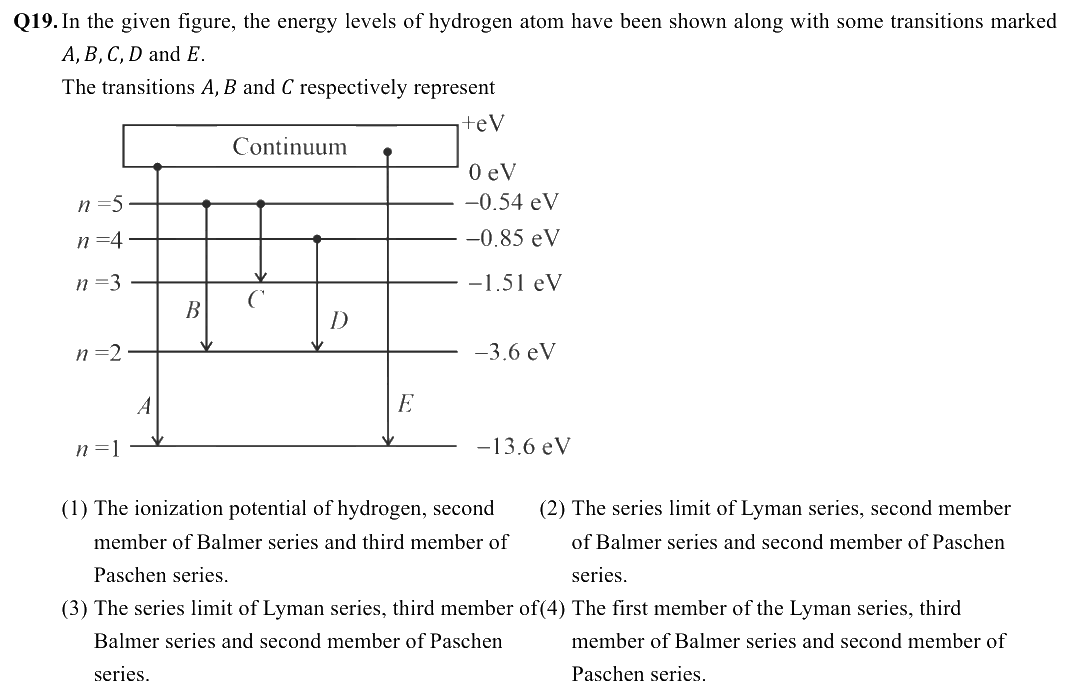
In the given figure, the energy levels of hydrogen atom have been shown along with some transitions marked $A, B, C, D$ and $E$. The transitions $A$, $B$ and $C$ respectively represent (see the figure above)
The question as printed in the paper.
A
The ionization potential of hydrogen, second member of Balmer series and third member of Paschen series.
B
The series limit of Lyman series, second member of Balmer series and second member of Paschen series.
C
The series limit of Lyman series, third member of Balmer series and second member of Paschen series.
D
The first member of the Lyman series, third member of Balmer series and second member of Paschen series.
In a hydrogen atom the electron makes a transition from $(n + 1)^{\mathrm{th}}$ level to the $n^{\mathrm{th}}$ level. If $n >> 1$, the frequency of radiation emitted is proportional to :
The energy required to ionise a hydrogen like ion in its ground state is 9 Rydbergs. What is the wavelength of the radiation emitted when the electron in this ion jumps from the second excited stale (sic) to the ground state?
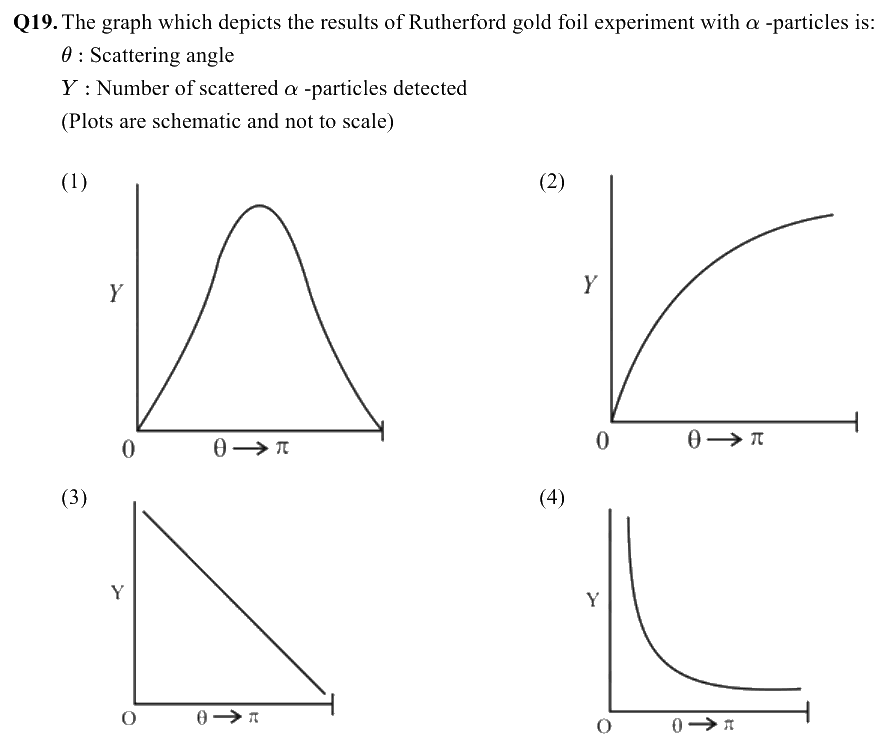
The graph which depicts the results of Rutherford gold foil experiment with $\alpha$ -particles is: $\theta$ : Scattering angle $Y$ : Number of scattered $\alpha$ -particles detected (Plots are schematic and not to scale)
The time period of revolution of electron in its ground state orbit in a hydrogen atom is $1.6 \times 10^{-16}\mathrm{s}$. The frequency of revolution of the electron in its first excited state (in $s^{-1}$ ) is:
An excited $\mathrm{He^+}$ ion emits two photons in succession, with wavelengths 108.5 nm and 30.4 nm in making a transition to the ground state. The quantum number n, corresponding to its initial excited state is (for a photon of wavelength $\lambda$, energy $\mathrm{E} = \frac{1240\ \mathrm{eV}}{\lambda(\mathrm{in\ nm})}$)
The electron in a hydrogen atom first jumps from the third excited state to the second excited state and subsequently to the first excited state. The ratio of the respective wavelengths $\frac{\lambda_1}{\lambda_2}$ of the photons emitted in this process is:
In $\mathrm{Li^{++}}$ ,electron in first Bohr orbit is excited to a level by a radiation of wavelength $\lambda$.When the ion gets de excited to the ground state in all possible ways (including intermediate emissions), a total of six spectral lines are observed. What is the value of $\lambda$ ? (Given: $h = 6.63\times10^{-34}\ \mathrm{J\,s}$ ; $c = 3\times10^{8}\ \mathrm{m\ s^{-1}}$ )
Taking the wavelength of first Balmer line in hydrogen spectrum (n = 3 to n = 2) as 660 nm , the wavelength of the $2^{\mathrm{nd}}$ Balmer line (n = 4 to n = 2) will be :
Radiation coming from transitions $n = 2$ to $n = 1$ of hydrogen atoms fall on $\mathrm{He^+}$ ions in $n = 1$ and $n = 2$ states. The possible transition of helium ions as they absorb energy from the radiation is:
A particle of mass $m$ moves in a circular orbit in a central potential field $U(r) = \frac{1}{2}kr^2$. If Bohr's quantization conditions are applied, radii of possible orbitals and energy levels vary with quantum number $n$ as:
In a Frank - Hertz experiment, an electron of energy $5.6\ eV$ passes through mercury vapour and emerges with an energy $0.7\ eV$. The minimum wavelength of photons emitted by mercury atoms is close to:
A hydrogen atom, initially in the ground state is excited by absorbing a photon of wavelength $980A$ .... The radius of the atom in the excited state, in terms of Bohr radius $a_0$, will be:
In a hydrogen like atom, when an electron jumps from the M-shell to the L-shell, the wavelength of emitted radiation is $L$. If an electron jumps from N -shell to the L -shell, the wavelength of emitted radiation will be:
The de-Broglie wavelength ($\lambda_B$) associated with the electron orbiting in the second excited state of hydrogen atom is related to that in the ground state ($\lambda_G$) by:
The energy required to remove the electron from a singly ionized Helium atom is 2.2 times the energy required to remove an electron from Helium atom. The total energy required to ionize the Helium atom completely is:
Muon ($\mu^{-1}$) is negatively charged ($|\mathrm{q}| = |\mathrm{e}|$) with a mass $\mathrm{m_\mu} = 200\ \mathrm{m_e}$, where $\mathrm{m_e}$ is the mass of the electron and e is the electronic charge. If $\mu^{-1}$ is bound to a proton to form a hydrogen like atom, identify the correct statements (A) Radius of the muonic orbit is 200 times smaller than that of the electron (B) the speed of the $\mu^{-1}$ in the $n$th orbit is $\frac{1}{200}$ times that of the election in the nth orbit (C) The Ionization energy of muonic atom is 200 times more than that of an hydrogen atom (D) The momentum of the muon in the nth orbit is 200 times more than that of the electron
An electron from various excited states of hydrogen atom emit radiation to come to the ground state. Let $\lambda_n$, $\lambda_g$ be the de Broglie wavelength of the electron in the $n^{th}$ state and the ground state respectively. Let $\Lambda_n$ be the wavelength of the emitted photon in the transition from the $n^{th}$ state to the ground state. For large n, (A, B are constants)
According to Bohr's theory, the time averaged magnetic field at the centre (i.e., nucleus) of a hydrogen atom due to the motion of electrons in the $n^{th}$ orbit is proportional to: ($n$ = principal quantum number)
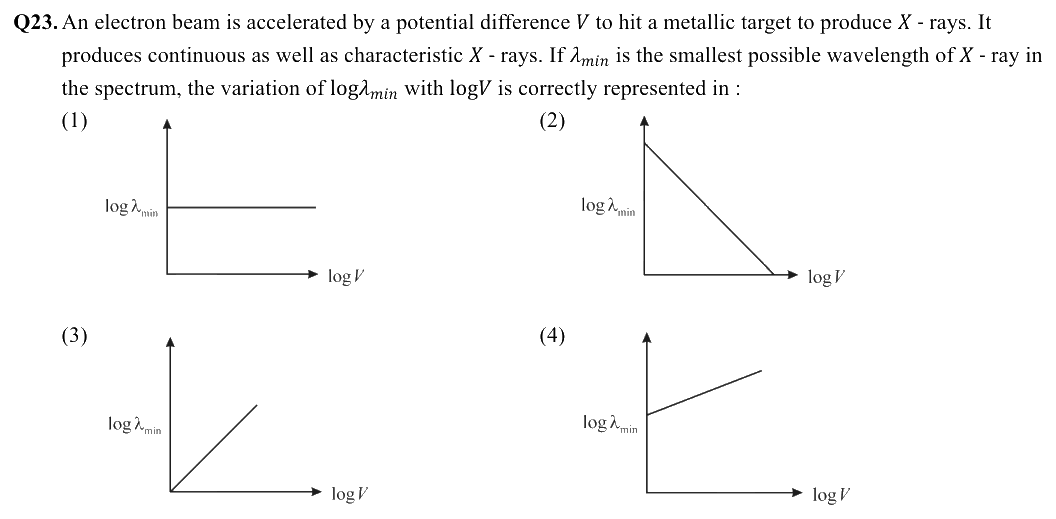
An electron beam is accelerated by a potential difference $V$ to hit a metallic target to produce $X$ - rays. It produces continuous as well as characteristic $X$ - rays. If $\lambda_{min}$ is the smallest possible wavelength of $X$ - ray in the spectrum, the variation of $\log\lambda_{min}$ with $\log V$ is correctly represented in :
The question as printed in the paper.
A
see figure graph of $\log\lambda_{min}$ against $\log V$
B
see figure graph of $\log\lambda_{min}$ against $\log V$
C
see figure graph of $\log\lambda_{min}$ against $\log V$
D
see figure graph of $\log\lambda_{min}$ against $\log V$
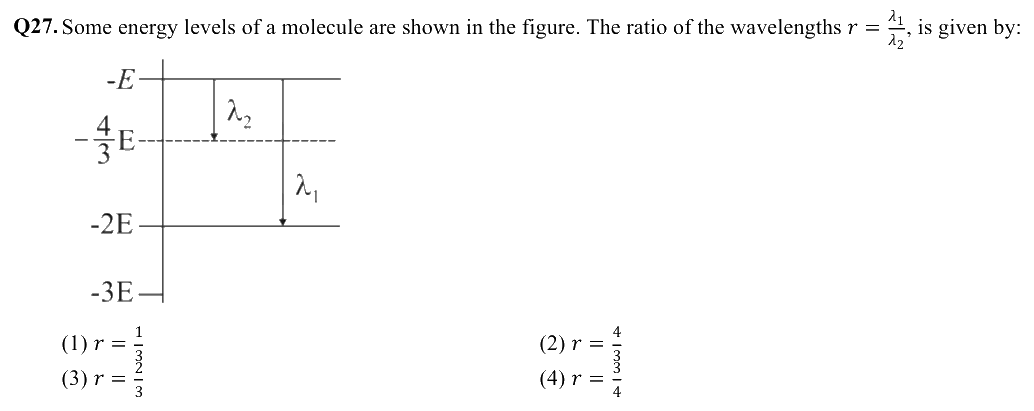
Some energy levels of a molecule are shown in the figure. The ratio of the wavelengths $r = \frac{\lambda_1}{\lambda_2}$, is given by: (see the figure above)
A neutron moving with a speed 'v' makes a head on collision with a stationary hydrogen atom in ground state. The minimum kinetic energy of the neutron for which perfectly inelastic collision will take place is :
An electron in a hydrogen atom makes a transition from $n = 2$ to $n = 1$ and emits a photon. This photon strikes a doubly ionized lithium atom which was already in an excited state and completely removes the orbiting electron. The least quantum number for the excited state of the lithium-ion for the process is
If one were to apply the Bohr model to a particle of mass 'm' and charge 'q' moving in a plane under the influence of a magnetic field 'B', the energy of the charged particle in the $n^{th}$ level will be:
If the binding energy of the electron in a hydrogen atom is 13.6 eV, the energy required to remove the electron from the first excited state of $\mathrm{Li}^{++}$ is :
Hydrogen $(_1\mathrm{H}^1)$, Deuterium $(_1\mathrm{H}^2)$, singly ionised Helium $(_2\mathrm{He}^4)^+$ and doubly ionised lithium $(_3\mathrm{Li}^6)^{++}$ all have one electron around the nucleus. Consider an electron transition from $n = 2$ to $n = 1$. If the wave lengths of emitted radiation are $\lambda_1$, $\lambda_2$, $\lambda_3$ and $\lambda_4$ respectively then approximately which one of the following is correct ?
In the Bohr's model of hydrogen-like atom the force between the nucleus and the electron is modified as $F = \frac{e^2}{4\pi\varepsilon_0}\left(\frac{1}{r^2} + \frac{\beta}{r^3}\right)$, where $\beta$ is a constant. For this atom, the radius of the $n^{\mathrm{th}}$ orbit in terms of the Bohr radius $\left(a_0 = \frac{\varepsilon_0 h^2}{m\pi e^2}\right)$ is :
In a hydrogen like atom electron makes transition from an energy level with quantum number n to another with quantum number (n $-$ 1). If n >> 1, the frequency of radiation emitted is proportional to :
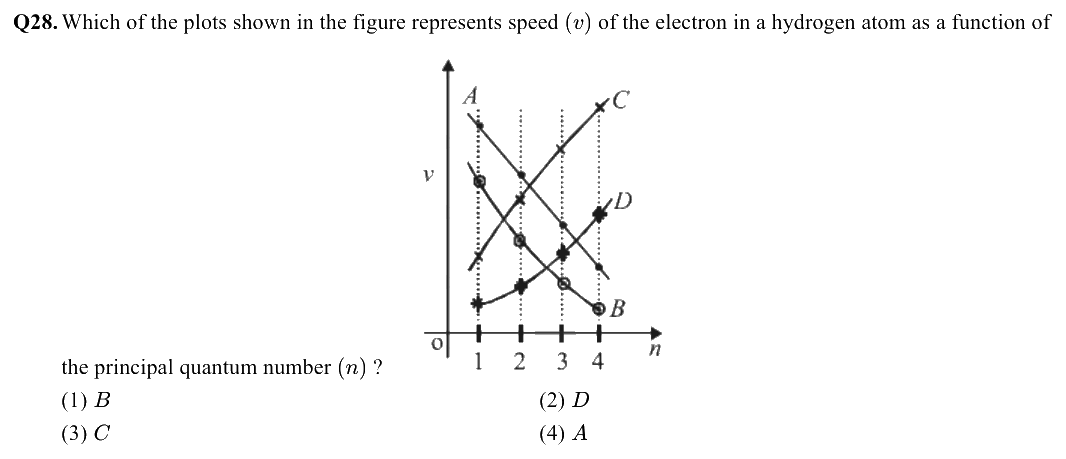
Which of the plots shown in the figure represents speed ($v$) of the electron in a hydrogen atom as a function of the principal quantum number ($n$) ? (see the figure above)
Ionisation energy of Li (Lithium) atom in ground state is $5.4\mathrm{eV}$. Binding energy of an electron in $\mathrm{Li^+}$ ion in ground state is $75.6\mathrm{eV}$. Energy required to remove all three electrons of Lithium (Li) atom is
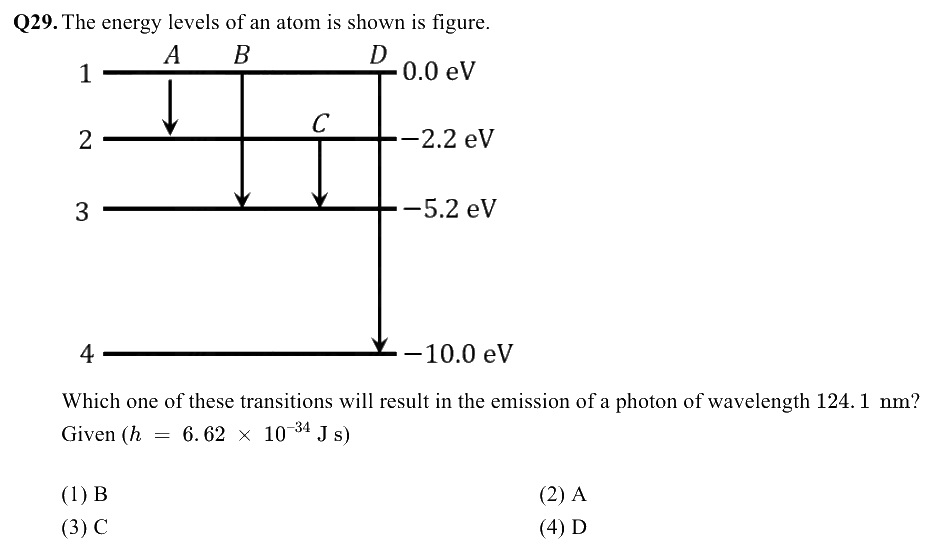
A hypothetical atom has only three energy levels. The ground level has energy, $E_1 = -8\,\mathrm{eV}$. The two excited states have energies, $E_2 = -6\,\mathrm{eV}$ and $E_3 = -2\,\mathrm{eV}$. Then which of the following wavelengths will not be present in the emission spectrum of this atom?
A doubly ionised Li atom is excited from its ground state($n = 1$) to $n = 3$ state. The wavelengths of the spectral lines are given by $\lambda_{32}$, $\lambda_{31}$ and $\lambda_{21}$. The ratio $\lambda_{32}/\lambda_{31}$ and $\lambda_{21}/\lambda_{31}$ are, respectively
The electron of a hydrogen atom makes a transition from the $(n+1)^{\mathrm{th}}$ orbit to the $n^{\mathrm{th}}$ orbit. For large n the wavelength of the emitted radiation is proportional to
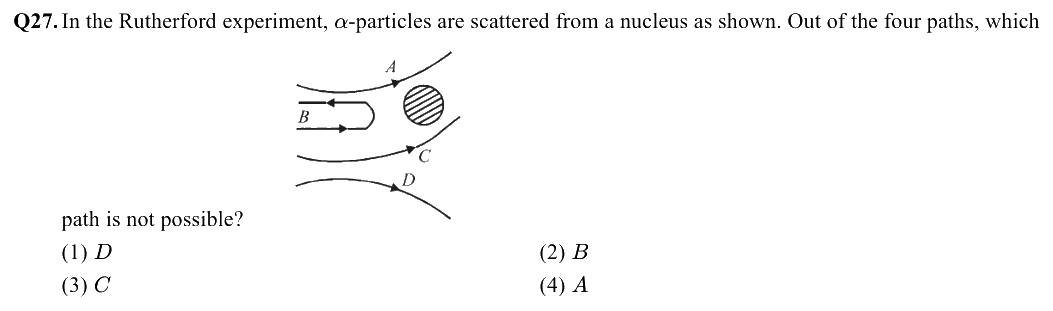
In the Rutherford experiment, $\alpha$-particles are scattered from a nucleus as shown. Out of the four paths, which path is not possible? (see the figure above)
Hydrogen atom is excited from ground state to another state with principal quantum number equal to $4$. Then the number of spectral lines in the emission spectra will be
A diatomic molecule is made of two masses $m_1$ and $m_2$ which are separated by a distance $r$. If we calculate its rotational energy by applying Bohr's rule of angular momentum quantization, its energy will be given by ( $n$ is an integer)
The transition from the state $n = 4$ to $n = 3$ in a hydrogen like atom results in ultraviolet radiation. Infrared radiation will be obtained in the transition from
Suppose an electron is attracted towards the origin by a force $k/r$ where ' $k$ ' is a constant and ' $r$ ' is the distance of the electron from the origin. By applying Bohr model to this system, the radius of the $n^{\mathrm{th}}$ orbital of the electron is found to be ' $r_n$ ' and the kinetic energy of the electron to be $T_n$. Then which of the following is true?
An alpha nucleus of energy $\frac{1}{2}mv^2$ bombards a heavy nuclear target of charge Ze. Then the distance of closest approach for the alpha nucleus will be proportional to
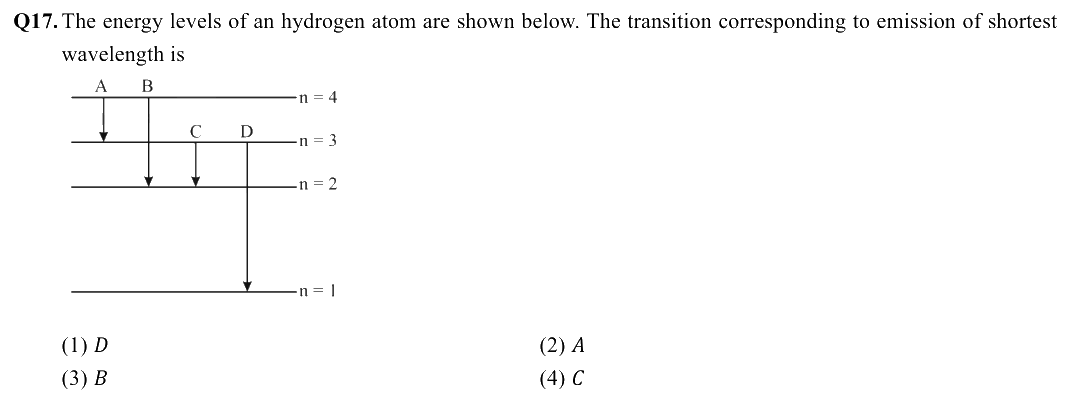
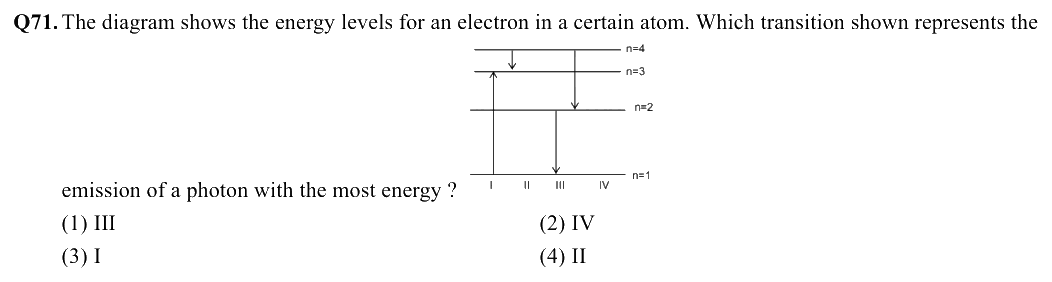
The diagram shows the energy levels for an electron in a certain atom. Which transition shown represents the emission of a photon with the most energy ? (see the figure above)
An $\alpha$-particle of energy 5MeV is scattered through $180^\circ$ by a fixed uranium nucleus. The distance of the closest approach is of the order of
The wavelengths involved in the spectrum of deuterium $\left({}^{2}_{1}\mathrm{D}\right)$ are slightly different from that of hydrogen spectrum, because
A
the size of the two nuclei are different
B
the nuclear forces are different in the two cases
C
the masses of the two nuclei are different
D
the attraction between the electron and the nucleus is different in the two cases
If the binding energy of the electron in a hydrogen atom is 13.6eV, the energy required to remove the electron from the first excited state of $\mathrm{Li^{++}}$ is
Using Bohr's model, calculate the ratio of the magnetic fields generated due to the motion of the electrons in the 2$^{\text{nd}}$ and 4$^{\text{th}}$ orbits of hydrogen atom ________.
Numerical answer type: type your answer in EdLoop to check it
An electron in the hydrogen atom initially in the fourth excited state makes a transition to $n^{th}$ energy state by emitting a photon of energy 2.86 eV . The integer value of n will be ______ .
Numerical answer type: type your answer in EdLoop to check it
In an alpha particle scattering experiment distance of closest approach for the $\alpha$ particle is $4.5 \times 10^{-14}$ m. If target nucleus has atomic number 80 , then maximum velocity of $\alpha$ - particle is ______ $\times 10^{5}$ m/s approximately. $\left(\frac{1}{4\pi\epsilon_0} = 9 \times 10^9\right.$ SI unit, mass of $\alpha$ particle = $6.72 \times 10^{-27}$ kg)
Numerical answer type: type your answer in EdLoop to check it
Radius of a certain orbit of hydrogen atom is 8.48$\tilde{A}$ . . . . If energy of electron in this orbit is $E/x$. then $x$ = ______ (Given $a_0$ = 0.529$\tilde{A}$ . . . , $E$ = energy of electron in ground state).
Numerical answer type: type your answer in EdLoop to check it
In Franck-Hertz experiment, the first dip in the current-voltage graph for hydrogen is observed at 10.2 V. The wavelength of light emitted by hydrogen atom when excited to the first excitation level is ______ nm. (Given hc = 1245eVnm, e = $1.6 \times 10^{-19}$C ).
Numerical answer type: type your answer in EdLoop to check it
The shortest wavelength of the spectral lines in the Lyman series of hydrogen spectrum is 915 Å .... The longest wavelength of spectral lines in the Balmer series will be ______ Å ....
Numerical answer type: type your answer in EdLoop to check it
A hydrogen atom changes its state from $n = 3$ to $n = 2$. Due to recoil, the percentage change in the wave length of emitted light is approximately $1 \times 10^{-n}$. The value of $n$ is ______. [Given Rhc = 13.6eV, hc = 1242eVnm, h = $6.6 \times 10^{-34}$ J s mass of the hydrogenatom = $1.6 \times 10^{-27}$ kg ]
Numerical answer type: type your answer in EdLoop to check it
A particular hydrogen - like ion emits the radiation of frequency $3 \times 10^{15}$ Hz when it makes transition from $n = 2$ to $n = 1$. The frequency of radiation emitted in transition from $n = 3$ to $n = 1$ is $\frac{x}{9} \times 10^{15}$ Hz, when $x$ = ______.
Numerical answer type: type your answer in EdLoop to check it
An electron of hydrogen atom on an excited state is having energy $E_n = -0.85$ eV. The maximum number of allowed transitions to lower energy level is ______.
Numerical answer type: type your answer in EdLoop to check it
When a hydrogen atom going from $n = 2$ to $n = 1$ emits a photon, its recoil speed is $\frac{x}{5}$ m s$^{-1}$. Where $x =$ ______. (Use: mass of hydrogen atom = $1.6 \times 10^{-27}$ kg, charge of electron $e = 1.6 \times 10^{-19}$ C)
Numerical answer type: type your answer in EdLoop to check it
Hydrogen atom is bombarded with electrons accelerated through a potential difference of $V$, which causes excitation of hydrogen atoms. If the experiment is being formed at $T = 0$ K. The minimum potential difference needed to observe any Balmer series lines in the emission spectra will be $\frac{\alpha}{10}$ V, where $\alpha =$ ______. (Write the value to the nearest integer)
Numerical answer type: type your answer in EdLoop to check it
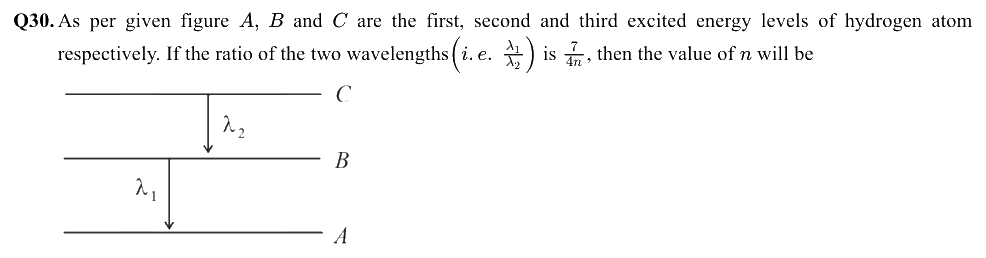
As per given figure $A$, $B$ and $C$ are the first, second and third excited energy levels of hydrogen atom respectively. If the ratio of the two wavelengths ($i.e.$ $\frac{\lambda_1}{\lambda_2}$) is $\frac{7}{4n}$, then the value of $n$ will be
(see the figure above)
The question as printed in the paper.
Numerical answer type: type your answer in EdLoop to check it
The radius of $2^{nd}$ orbit of $\mathrm{He^{+}}$ of Bohr's model is $r_1$ and that of fourth orbit of $\mathrm{Be^{3+}}$ is represented as $r_2$. Now the ratio $\frac{r_2}{r_1}$ is $x : 1$. The value of $x$ is ______.
Numerical answer type: type your answer in EdLoop to check it
A monochromatic light is incident on a hydrogen sample in ground state. Hydrogen atoms absorb a fraction of light and subsequently emit radiation of six different wavelengths. The frequency of incident light is $x \times 10^{15}$ Hz. The value of x is ______. (Given $h = 4.25 \times 10^{-15}$ eVs)
Numerical answer type: type your answer in EdLoop to check it
The ratio of wavelength of spectral lines $\mathrm{H_\alpha}$ and $\mathrm{H_\beta}$ in the Balmer series is $\frac{x}{20}$. The value of $x$ is ______ .
Numerical answer type: type your answer in EdLoop to check it
Experimentally it is found that $12.8\ \mathrm{eV}$ energy is required to separate a hydrogen atom into a proton and an electron. So the orbital radius of the electron in a hydrogen atom is $\frac{9}{x} \times 10^{-10}\ \mathrm{m}$. The value of the $x$ is: ______ . (1 eV $= 1.6 \times 10^{-19}$ J, $\frac{1}{4\pi\varepsilon_0} = 9 \times 10^{9}\ \frac{\mathrm{Nm^2}}{\mathrm{C^2}}$ and electronic charge $= 1.6 \times 10^{-19}$ C)
Numerical answer type: type your answer in EdLoop to check it
A light of energy 12.75 eV is incident on a hydrogen atom in its ground state. The atom absorbs the radiation and reaches to one of its excited states. The angular momentum of the atom in the excited state is $\dfrac{x}{\pi} \times 10^{-17}$ eVs. The value of $x$ is ______ (use $h$ = 4.14 $\times$ $10^{-15}$ eVs, $c$ = 3 $\times$ $10^8$ $\mathrm{m\ s^{-1}}$)
Numerical answer type: type your answer in EdLoop to check it
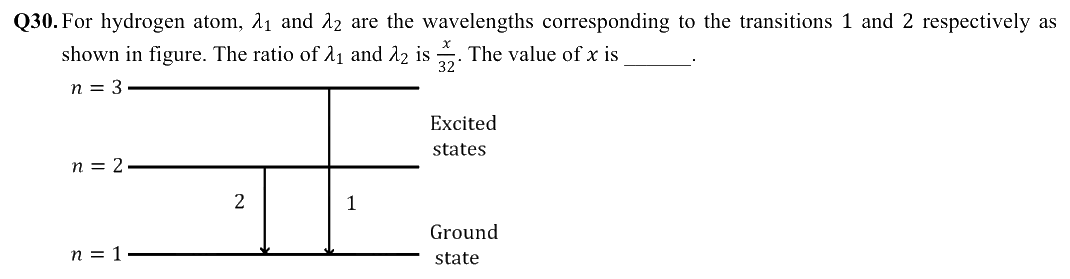
For hydrogen atom, $\lambda_1$ and $\lambda_2$ are the wavelengths corresponding to the transitions 1 and 2 respectively as shown in figure. The ratio of $\lambda_1$ and $\lambda_2$ is $\dfrac{x}{32}$. The value of $x$ is ______.
(see the figure above)
The question as printed in the paper.
Numerical answer type: type your answer in EdLoop to check it
If the binding energy of ground state electron in a hydrogen atom is 13.6 eV, then, the energy required to remove the electron from the second excited state of $\mathrm{Li^{2+}}$ will be: $x \times 10^{-1}$ eV. The value of $x$ is ______.
Numerical answer type: type your answer in EdLoop to check it
The wavelength of the radiation emitted is $\lambda_0$ when an electron jumps from the second excited state to the first excited state of hydrogen atom. If the electron jumps from the third excited state to the second orbit of the hydrogen atom, the wavelength of the radiation emitted will be $\frac{20}{x}\lambda_0$. The value of $x$ is ______.
Numerical answer type: type your answer in EdLoop to check it
In a hydrogen spectrum $\lambda$ be the wavelength of first transition line of Lyman series. The wavelength difference will be "a$\lambda$" between the wavelength of $3^{rd}$ transition line of Paschen series and that of $2^{nd}$ transition line of Balmer Series where a = ______ .
Numerical answer type: type your answer in EdLoop to check it
$\frac{x}{x+4}$ is the ratio of energies of photons produced due to transition of an electron of hydrogen atom from its (i) third permitted energy level to the second level and (ii) the highest permitted energy level to the second level. The value of $x$ will be
Numerical answer type: type your answer in EdLoop to check it
$\sqrt{d_1}$ and $\sqrt{d_2}$ are the impact parameters corresponding to scattering angles $60^\circ$ and $90^\circ$ respectively, when an $\alpha$ particle is approaching a gold nucleus. For $d_1 = xd_2$, the value of $x$ will be ______.
Numerical answer type: type your answer in EdLoop to check it
A beam of monochromatic light is used to excite the electron in $\mathrm{Li^{++}}$ from the first orbit to the third orbit. The wavelength of monochromatic light is found to be $x \times 10^{-10}\ \mathrm{m}$. The value of $x$ is ______ . [Given $hc = 1242\ \mathrm{eV\ nm}$]
Numerical answer type: type your answer in EdLoop to check it
$X$ different wavelength may be observed in the spectrum from a hydrogen sample if the atoms are excited to states with principal quantum number $n=6$? The value of $X$ is
Numerical answer type: type your answer in EdLoop to check it
In Bohr's atomic model, the electron is assumed to revolve in a circular orbit of radius $0.5\ \mathrm{\AA}$. If the speed of electron is $2.2 \times 10^6\ \mathrm{m\ s^{-1}}$. Then the current associated with the electron will be ______ $\times 10^{-2}\ \mathrm{mA}$. [Take $\pi$ as $\frac{22}{7}$]
Numerical answer type: type your answer in EdLoop to check it
The $K_\alpha$ X-ray of molybdenum has wavelength $0.071\ \mathrm{nm}$. If the energy of a molybdenum atom with a $K$ electron knocked out is $27.5\ \mathrm{keV}$, the energy of this atom when an $L$ electron is knocked out will be ______ keV. (Round off to the nearest integer ) $[h = 4.14 \times 10^{-15}\ \mathrm{eV\ s},\ c = 3 \times 10^{8}\ \mathrm{m\ s^{-1}}]$
Numerical answer type: type your answer in EdLoop to check it
A particle of mass $m$ moves in a circular orbit in a central potential field $U(r)=U_0 r^4$. If Bohr's quantization conditions are applied, radii of possible orbitals $r_n$ vary with $n^{\frac{1}{\alpha}}$, where $\alpha$ is ______.
Numerical answer type: type your answer in EdLoop to check it
The first three spectral lines of H-atom in the Balmer series are given $\lambda_1, \lambda_2, \lambda_3$ considering the Bohr atomic model, the wave lengths of first and third spectral lines $\left(\frac{\lambda_1}{\lambda_3}\right)$ are related by a factor of approximately $x$ $\times 10^{-1}$. The value of $x$, to the nearest integer, is ______.
Numerical answer type: type your answer in EdLoop to check it
In the line spectra of hydrogen atom, difference between the largest and the shortest wavelengths of the Lyman series is 305 $\mathrm{\AA}$. The corresponding difference for the Paschan series in $\mathrm{\AA}$ is: ______
Numerical answer type: type your answer in EdLoop to check it
The first member of the Balmer series of hydrogen atom has a wavelength of $6561\ \mathring{\mathrm{A}}$. The wavelength of the second member of the Balmer series (in nm) is______
Numerical answer type: type your answer in EdLoop to check it
Atoms explores atomic architecture and Bohr's quantized orbital model under Unit 18: Atoms and Nuclei in the Class 12 curriculum, holding rank 24 among the 29 physics chapters with a 2.5 percent share of total physics questions. Between 2019 and 2026, candidates answered 115 questions across 162 papers, representing an average rate of 0.7 questions per sitting. The chapter featured in 97 of those 162 papers, and questions appeared every single year throughout the testing era. In the recent three-year block from 2024 to 2026, examiners set 44 questions across 58 papers, maintaining an average of 0.8 questions per shift and a 2.8 percent subject share. The chapter's share has stayed about the same when compared to the 2002 to 2018 window, which recorded 38 questions across 38 papers for a 2.8 percent share. During the 2026 examination sessions, 11 questions were presented across 19 papers, showing up in 11 separate shifts. Over the 2019 to 2026 timeline, 34 questions required numerical answers, with candidates evaluating quantum numbers, wavelength differences, and closest approach distances.
Most-asked topics
Questions from this chapter concentrate almost entirely on Bohr's quantization framework:
Bohr Model: 137 questions historically, with 103 delivered between 2019 and 2026, tested up to 2026. This dominant topic explores orbital radii scaling with n squared over Z, electron orbital speeds scaling with Z over n, kinetic and potential energy relationships, angular momentum quantization, Rydberg formula calculations, and spectral series lines from Lyman to Pfund.
Rutherford Model: 11 total problems, including 8 from 2019 to 2026, asked in 2026. Concepts test alpha particle scattering, distance of closest approach, impact parameter relations, and nuclear dimension estimations.
X-rays: 5 lifetime questions, with 4 appearing between 2019 and 2026, last asked in 2023. Questions assess continuous and characteristic X-ray generation mechanisms and Duane-Hunt minimum cutoff wavelengths.
What the questions look like
JEE Main tests atoms through structured algebraic substitutions and orbital proportionality rules:
Orbital quantum number from energy fractions: An electron occupies a stationary Bohr orbit with total energy equal to a specified decimal fraction of the ground state energy. Students determine the principal quantum number n and evaluate orbital angular momentum.
Distance of closest approach in alpha scattering: High-energy alpha particles fired head-on toward heavy gold nuclei convert initial kinetic energy entirely into electrostatic potential energy at the turning point.
Spectral wavelength differences: Given the shortest wavelength of the Lyman series, students apply the Rydberg formula to calculate the difference between the longest wavelengths of the Balmer and Paschen series.
Orbital magnetic field scaling: Comparing the magnetic field generated at the nucleus by circulating orbital electrons across different principal quantum states.
Memorize the power dependencies of all Bohr quantities with respect to principal quantum number n and nuclear charge Z. Radius scales as n squared over Z, velocity scales as Z over n, orbital time period scales as n cubed over Z squared, and total energy scales as minus Z squared over n squared.
Be proficient with energy relations: potential energy is always negative and twice the total energy, while kinetic energy is positive and equals the absolute value of total energy. When an electron transitions to a lower energy state, kinetic energy increases while potential energy decreases by twice that amount.
For hydrogen spectral series, know the transition limits cold. The shortest wavelength of any series corresponds to an electron falling from infinity, while the longest wavelength corresponds to an transition from the immediately adjacent upper level.
Frequently asked questions
Which topic in atoms carries the highest weight?
Bohr model questions represent nearly ninety percent of all modern questions from this chapter. Mastering orbital scaling laws and Rydberg transition formulas provides comprehensive exam coverage.
What is the connection between atoms in physics and atomic structure in chemistry?
Both chapters share identical theoretical foundations for Bohr orbits and hydrogen spectral transitions. Preparing these concepts thoroughly provides dual benefits across both physics and chemistry sections.
Are X-ray spectra questions still common?
X-ray questions were last asked in 2023 and have been de-emphasized in recent syllabus revisions, leaving Rutherford scattering and Bohr transitions as the primary focus areas. Step-by-step solutions for each one are in the EdLoop app.