Every Current Electricity question from past JEE Main and AIEEE papers, with options and answers. Newest first.
383questions
186papers covered
6.5%of Physics questions, 2019–2026
2002–2026years
Guide at a glance
Current electricity stands at the top of JEE Main physics in question volume, codified under Unit 12: Current Electricity in the Class 12 NTA syllabus, holding rank 1 among all 29 physics chapters.
A voltmeter with internal resistance of $x\ \Omega$ can be used to measure upto 20 V. In order to increase its measuring range to 30 V, the required modification is to ________.
A
connect resistor of $\frac{x}{2}\Omega$, in series with voltmeter.
B
connect resistor of $\frac{x}{2}\Omega$, in parallel to voltmeter.
C
connect a resistor of $x\ \Omega$ in series with voltmeter.
D
connect resistor of $2x\ \Omega$ in parallel to voltmeter.
Two resistors of 200 $\Omega$ and 400 $\Omega$ are connected in series with a battery of 100 V. A bulb rated at 200 V, 100 W is connected across the 400 $\Omega$ resistance. The potential drop across the bulb is ________ V.
In the potentiometer, when the cell in the secondary circuit is shunted with 4 $\Omega$ resistance, the balance is obtained at the length 120 cm of wire. Now when the same cell is shunted with 12 $\Omega$ resistance, the balance is shifted to a length of 180 cm. The internal resistance of cell is ________ $\Omega$
For the two cells having same EMF $E$ and internal resistance $r$, the current passing through the external resistor 6 $\Omega$ is same when both the cells are connected either in parallel or in series. The value of internal resistance $r$ is ________ $\Omega$.
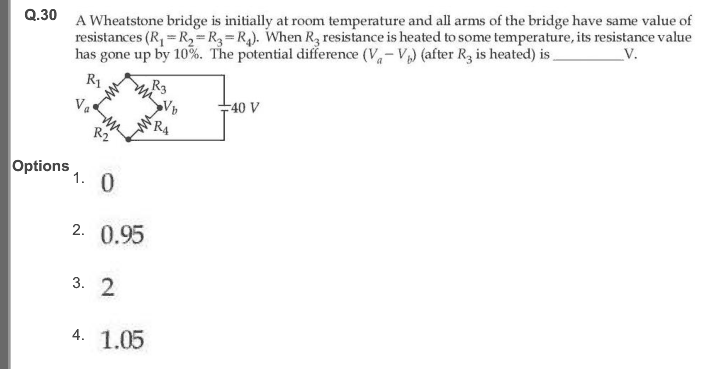
A Wheatstone bridge is initially at room temperature and all arms of the bridge have same value of resistances ($R_1 = R_2 = R_3 = R_4$). When $R_3$ resistance is heated to some temperature, its resistance value has gone up by 10%. The potential difference ($V_a - V_b$) after $R_3$ is heated is ________ V.
Two resistors of 100 $\Omega$ each are connected in series with a 9 V battery. A voltmeter of 400 $\Omega$ resistance is connected to measure the voltage drop across one of the resistors. The voltmeter reading is ________ V.
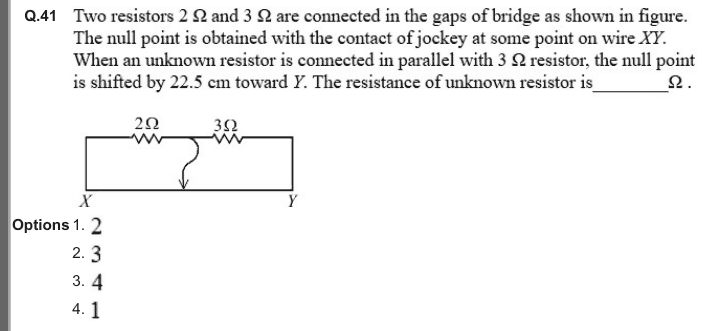
Two resistors 2 $\Omega$ and 3 $\Omega$ are connected in the gaps of bridge as shown in figure. The null point is obtained with the contact of jockey at some point on wire $XY$. When an unknown resistor is connected in parallel with 3 $\Omega$ resistor, the null point is shifted by 22.5 cm toward $Y$. The resistance of unknown resistor is ________ $\Omega$.
A regular hexagon is formed by six wires each of resistance $r\ \Omega$ and the corners are joined to the centre by wires of same resistance. If the current enters at one corner and leaves at the opposite corner, the equivalent resistance of the hexagon between the two opposite corners will be
A moving coil galvanometer of resistance 100 $\Omega$ shows a full scale deflection for a current of 1 mA. The value of resistance required to convert this galvanometer into an ammeter, showing full scale deflection for a current of 5 mA, is ________ $\Omega$.
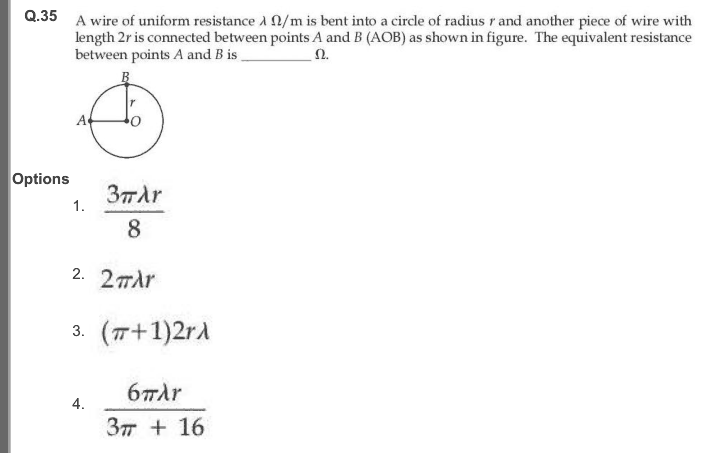
A wire of uniform resistance $\lambda\ \Omega$/m is bent into a circle of radius $r$ and another piece of wire with length $2r$ is connected between points $A$ and $B$ (AOB) as shown in figure. The equivalent resistance between points $A$ and $B$ is ________ $\Omega$.
To compare EMF of two cells using potentiometer the balancing lengths obtained are 200 cm and 150 cm. The least count of scale is 1 cm. The percentage error in the ratio of EMFs is ________.
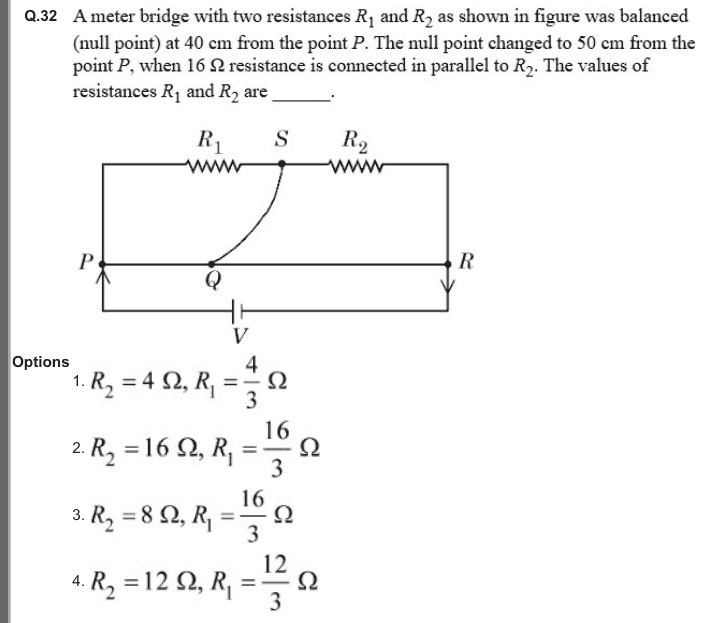
A meter bridge with two resistances $R_1$ and $R_2$ as shown in figure was balanced (null point) at 40 cm from the point $P$. The null point changed to 50 cm from the point $P$, when $16\,\Omega$ resistance is connected in parallel to $R_2$. The values of resistances $R_1$ and $R_2$ are ________.
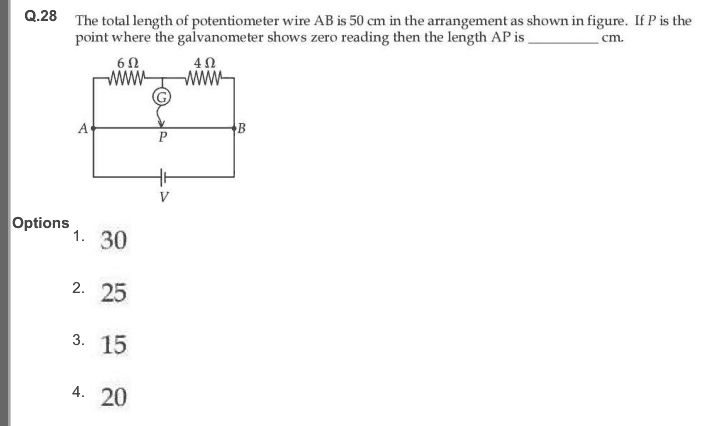
The total length of potentiometer wire $AB$ is 50 cm in the arrangement as shown in figure. If $P$ is the point where the galvanometer shows zero reading then the length AP is ________ cm.
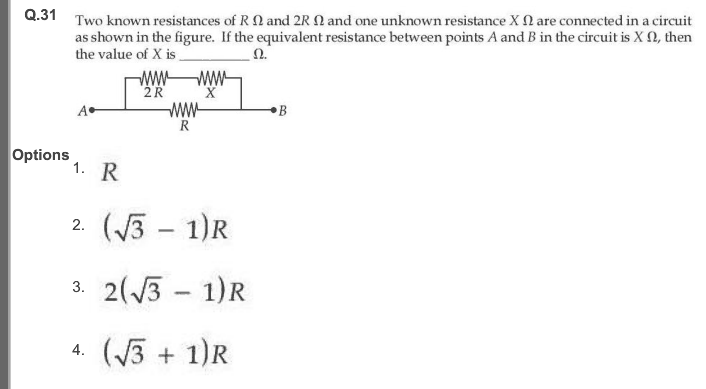
Two known resistances of $R\,\Omega$ and $2R\,\Omega$ and one unknown resistance $X\,\Omega$ are connected in a circuit as shown in figure. If the equivalent resistance between points $A$ and $B$ in the circuit is $X\,\Omega$, then the value of $X$ is ________ $\Omega$.
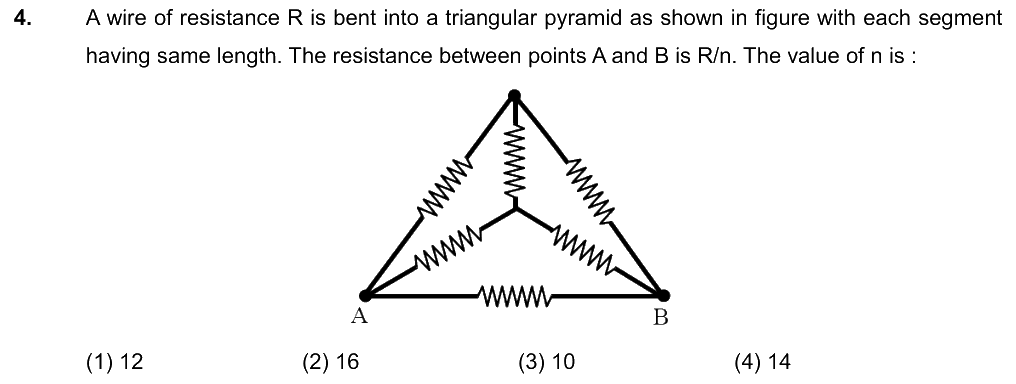
A wire of resistance R is bent into a triangular pyramid as shown in figure with each segment having same length. The resistance between points A and B is R/n. The value of n is :
Current passing through a wire as function of time is given as $I(t) = 0.02t + 0.01A$. The charge that will flow through the wire from $t = 1s$ to $t = 2s$ is
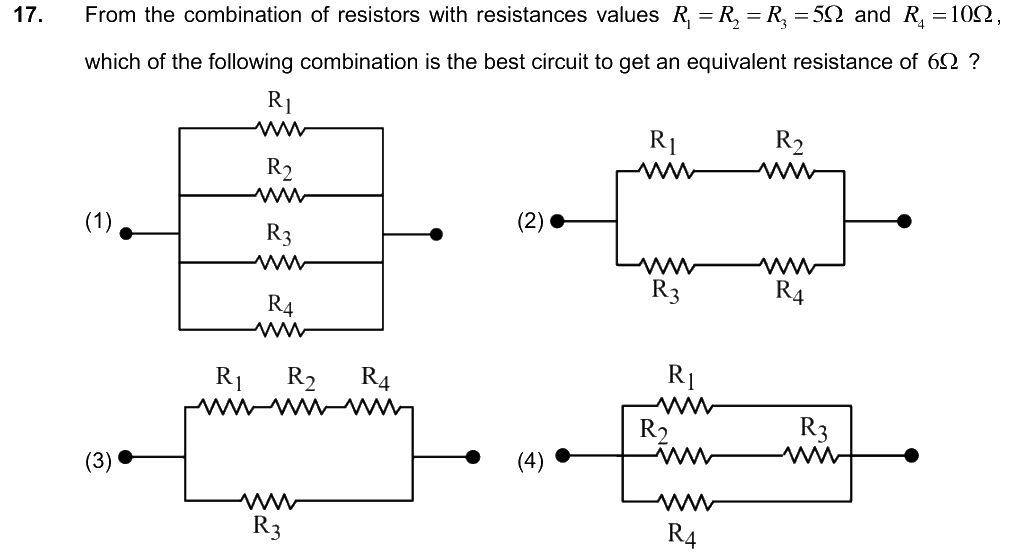
From the combination of resistors with resistances values $R_1 = R_2 = R_3 = 5\Omega$ and $R_4 = 10\Omega$, which of the following combination is the best circuit to get an equivalent resistance of $6\Omega$ ?
The question as printed in the paper.
A
see figure four resistors R1, R2, R3, R4 in four parallel branches, one above the other, between the left and right terminals.
B
see figure two parallel branches between the terminals: the upper branch has R1 then R2 in series; the lower branch has R3 then R4 in series.
C
see figure two parallel branches: the upper branch has R1, R2 and R4 in series (in that order, left to right); the lower branch has R3 alone.
D
see figure a left terminal wire leading to a junction from which three branches run side by side (R1 on the top branch, R2 on the middle branch, R4 on the bottom branch); the three branches join again at a junction, and then R3 lies on the wire to the right terminal, in series with that group.
There are 'n' number of identical electric bulbs, each is designed to draw a power p independently from the mains supply. They are now joined in series across the mains supply. The total power drawn by the combination is :
A wire of length 25 m and cross-sectional area $5mm^2$ having resistivity of $2 \times 10^{-6}\Omega m$ is bent into a complete circle. The resistance between diametrically opposite points will be
A wire of resistance R is bent into an equilateral triangle and an identical wire is bent into $a$ square. The ratio of resistance between the two end points of an edge of the triangle to that of the square is Options
A galvanometer having a coil of resistance $30\Omega$ need 20 mA of current for full-scale deflection. If a maximum current of 3 A is to be measured using this galvanometer, the resistance of the shunt to be added to the galvanometer should be $\frac{30}{X}\ \Omega$, where $X$ is Options
Given below are two statements : Statement-I : The equivalent emf of two nonideal batteries connected in parallel is smaller than either of the two emfs. Statement-II : The equivalent internal resistance of two nonideal batteries connected in parallel is smaller than the internal resistance of either of the two batteries. In the light of the above statements, choose the correct answer from the options given below.
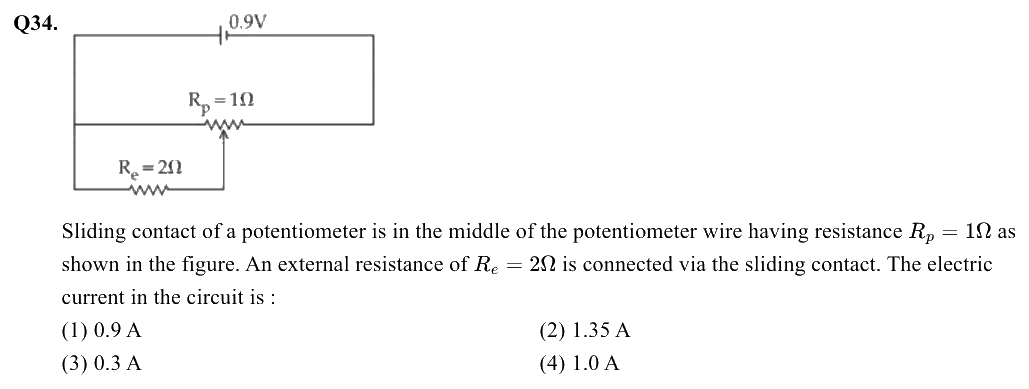
see figure Sliding contact of a potentiometer is in the middle of the potentiometer wire having resistance $R_p = 1\Omega$ as shown in the figure. An external resistance of $R_e = 2\Omega$ is connected via the sliding contact. The electric current in the circuit is :
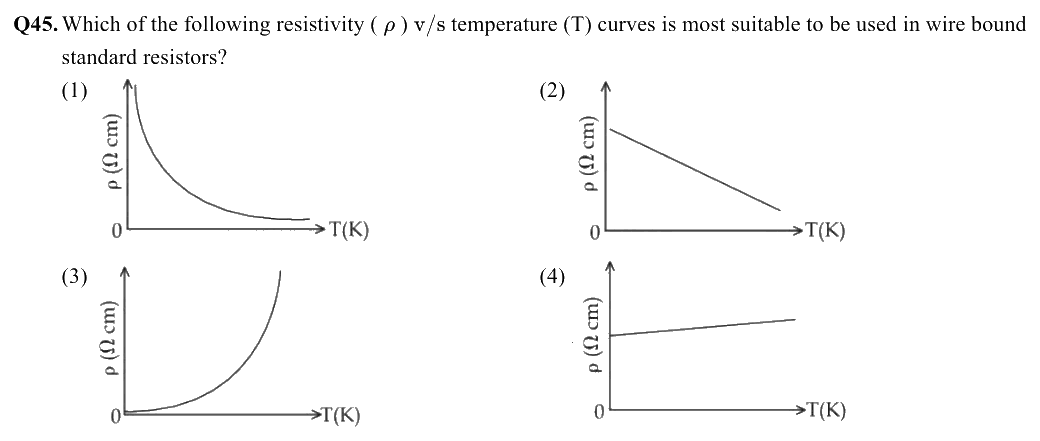
Which of the following resistivity ( $\rho$ ) v/s temperature (T) curves is most suitable to be used in wire bound standard resistors?
The question as printed in the paper.
A
see figure axes 'ρ (Ω cm)' (vertical) and 'T(K)' (horizontal), origin '0'; a curve starting very high on the vertical axis and falling steeply, then flattening toward the T axis, ending close to it and above it.
B
see figure same axes; a straight line starting part-way up the vertical axis and falling steadily to the right, ending above the T axis.
C
see figure same axes; a curve starting near zero at the origin, rising slowly at first and then more and more steeply to the upper right.
D
see figure same axes; a nearly flat straight line starting part-way up the vertical axis and rising very slightly to the right.
A galvanometer has a coil of resistance 200$\Omega$ with a full scale deflection at 20$\mu$A. The value of resistance to be added to use it as an ammeter of range (0 $-$ 20)mA is ;
Water boils in an electric kettle in 20 minutes after being switched on. Using the same main supply, the length of the heating element should be ______ to ______ times of its initial length if the water is to be boiled in 15 minutes.
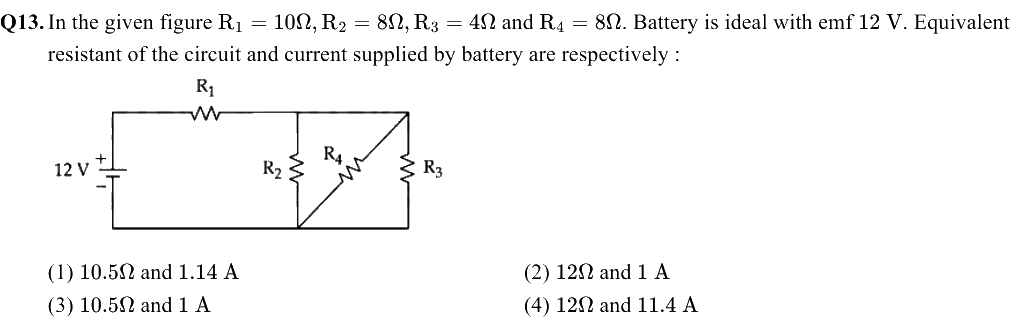
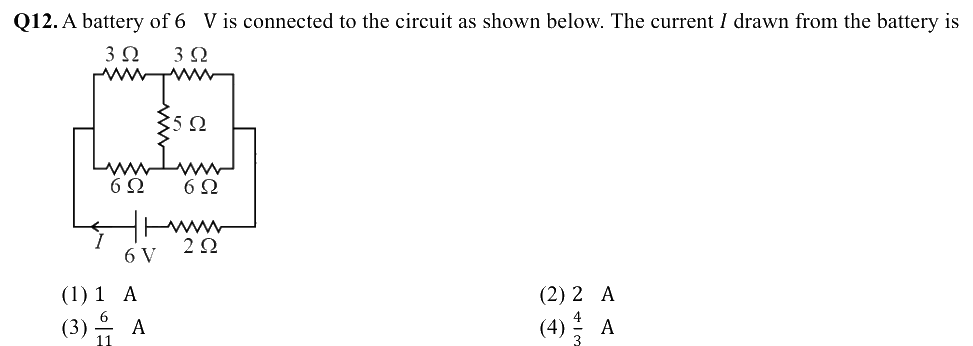
In the given figure $\mathrm{R_1}$ = $10\Omega$, $\mathrm{R_2}$ = $8\Omega$, $\mathrm{R_3}$ = $4\Omega$ and $\mathrm{R_4}$ = $8\Omega$. Battery is ideal with emf 12 V. Equivalent resistant of the circuit and current supplied by battery are respectively :
A galvanometer of resistance $100\,\Omega$ when connected in series with $400\,\Omega$ measures a voltage of upto 10 V. The value of resistance required to convert the galvanometer into ammeter to read upto 10 A is $x \times 10^{-2}\,\Omega$. The value of $x$ is :
The resistances of the platinum wire of a platinum resistance thermometer at the ice point and steam point are 8$\Omega$ and 10$\Omega$ respectively. After inserting in a hot bath of temperature 400$^\circ$C, the resistance of platinum wire is :
To measure the internal resistance of a battery, potentiometer is used. For R = 10$\Omega$, the balance point is observed at $l$ = 500 cm and for R = 1$\Omega$ the balance point is observed at $l$ = 400 cm. The internal resistance of the battery is approximately :
A galvanometer has a resistance of 50 $\Omega$ and it allows maximum current of 5 mA. It can be converted into voltmeter to measure upto 100 V by connecting in series a resistor of resistance.
In a metre-bridge when a resistance in the left gap is 2 $\Omega$ and unknown resistance in the right gap, the balance length is found to be 40 cm. On shunting the unknown resistance with 2 $\Omega$, the balance length changes by:
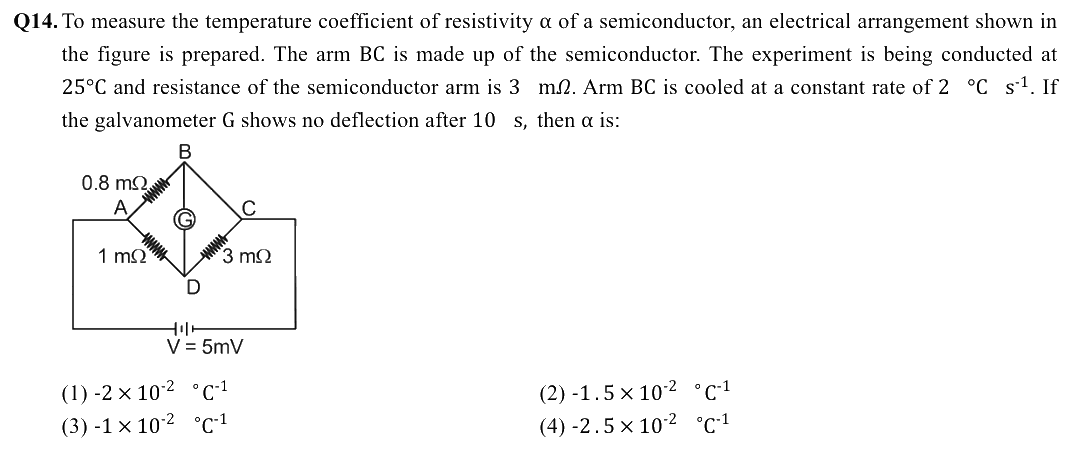
To measure the temperature coefficient of resistivity $\alpha$ of a semiconductor, an electrical arrangement shown in the figure is prepared. The arm BC is made up of the semiconductor. The experiment is being conducted at 25°C and resistance of the semiconductor arm is 3 m$\Omega$. Arm BC is cooled at a constant rate of 2 $\text{°C s}^{-1}$. If the galvanometer G shows no deflection after 10 s, then $\alpha$ is:
Two conductors have the same resistances at $0\ ^\circ$C but their temperature coefficients of resistance are $\alpha_1$ and $\alpha_2$. The respective temperature coefficients for their series and parallel combinations are :
The resistance per centimeter of a meter bridge wire is $r$, with $X\ \Omega$ resistance in left gap. Balancing length from left end is at 40 cm with $25\ \Omega$ resistance in right gap. Now the wire is replaced by another wire of $2r$ resistance per centimeter. The new balancing length for same settings will be at
An electric toaster has resistance of 60 $\Omega$ at room temperature ($27^\circ$C). The toaster is connected to a 220 V supply. If the current flowing through it reaches 2. 75 A, the temperature attained by toaster is around: (if $\alpha = 2 \times 10^{-4}\ {}^\circ\mathrm{C}^{-1}$)
When a potential difference $V$ is applied across a wire of resistance $R$, it dissipates energy at a rate $W$. If the wire is cut into two halves and these halves are connected mutually parallel across the same supply, the energy dissipation rate will become:
The electric current through a wire varies with time as $I = I_0 + \beta t$, where $I_0 = 20$ A and $\beta = 3$ A s$^{-1}$. The amount of electric charge crossed through a section of the wire in 20 s is:
A galvanometer having coil resistance 10 $\Omega$ shows a full scale deflection for a current of 3 mA. For it to measure a current of 8 A, the value of the shunt should be:
The deflection in moving coil galvanometer falls from 25 divisions to 5 division when a shunt of 24 $\Omega$ is applied. The resistance of galvanometer coil will be:
A wire of length 10 cm and radius $\sqrt{7} \times 10^{-4}$ m connected across the right gap of a meter bridge. When a resistance of 4.5 $\Omega$ is connected on the left gap by using a resistance box, the balance length is found to be at 60 cm from the left end. If the resistivity of the wire is R $\times$ $10^{-7}$ $\Omega$ m, then value of R is :
Wheatstone bridge principle is used to measure the specific resistance $S_1$ of given wire, having length $L$, radius $r$. If X is the resistance of wire, then specific resistance is : $S_1 = X\frac{\pi r^2}{L}$. If the length of the wire gets doubled then the value of specific resistance will be :
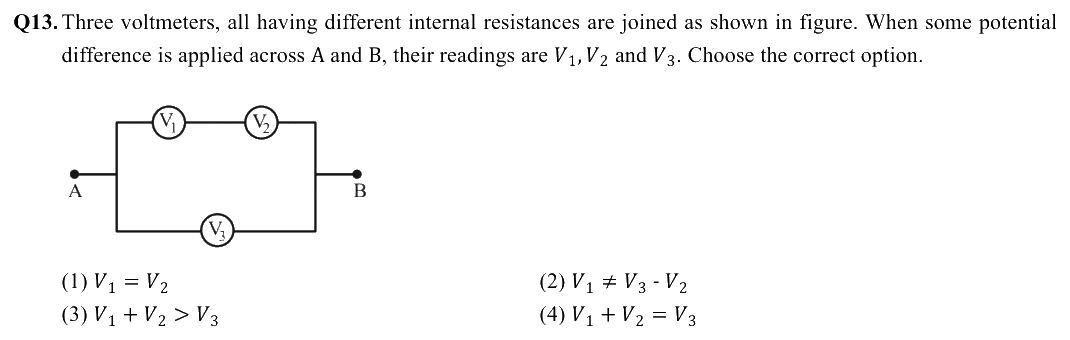
Three voltmeters, all having different internal resistances are joined as shown in figure. When some potential difference is applied across A and B, their readings are $V_1, V_2$ and $V_3$. Choose the correct option.
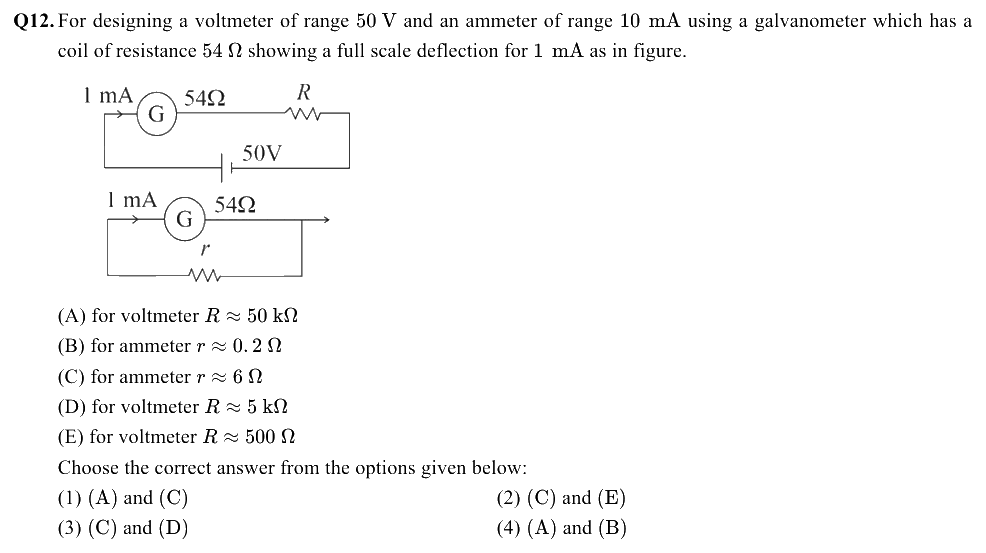
For designing a voltmeter of range 50 V and an ammeter of range 10 mA using a galvanometer which has a coil of resistance 54 $\Omega$ showing a full scale deflection for 1 mA as in figure.
(see the figure above) (A) for voltmeter $R \approx 50$ k$\Omega$ (B) for ammeter $r \approx 0.2\ \Omega$ (C) for ammeter $r \approx 6\ \Omega$ (D) for voltmeter $R \approx 5$ k$\Omega$ (E) for voltmeter $R \approx 500\ \Omega$ Choose the correct answer from the options given below:
Given below are two statements: Statement I : The equivalent resistance of resistors in a series combination is smaller than least resistance used in the combination. Statement II : The resistivity of the material is independent of temperature. In the light of the above statements, choose the correct answer from the options given below:
Two identical heater filaments are connected first in parallel and then in series. At the same applied voltage, the ratio of heat produced in same time for parallel to series will be:
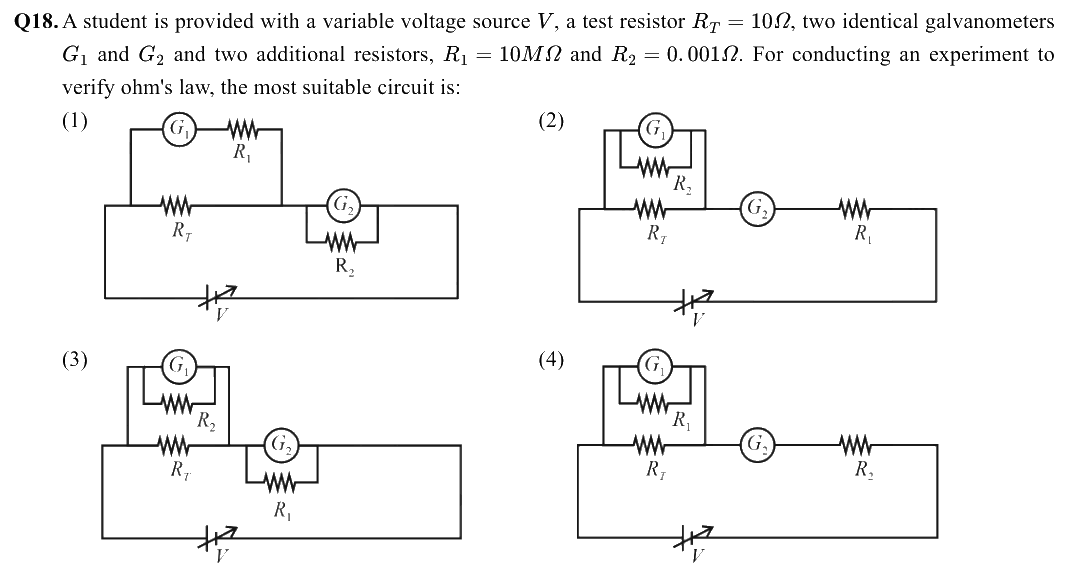
A student is provided with a variable voltage source $V$, a test resistor $R_T = 10\,\Omega$, two identical galvanometers $G_1$ and $G_2$ and two additional resistors, $R_1 = 10\,\mathrm{M}\Omega$ and $R_2 = 0.001\,\Omega$. For conducting an experiment to verify ohm's law, the most suitable circuit is:
The question as printed in the paper.
A
see figure Circuit 1: top loop of G1 in series with R1 connected across R_T (a branch from the left end of R_T to its right end); further along the same main wire, G2 with R2 connected in parallel across it; variable source V in the bottom wire.
B
see figure Circuit 2: G1 with R2 in parallel with each other, this pair connected as a branch across R_T; further along the main loop G2 and R1 are in series; variable source V in the bottom wire.
C
see figure Circuit 3: G1 with R2 in parallel with each other, this pair connected as a branch across R_T; further along the main loop G2 with R1 connected in parallel across it; variable source V in the bottom wire.
D
see figure Circuit 4: G1 with R1 in parallel with each other, this pair connected as a branch across R_T; further along the main loop G2 and R2 are in series; variable source V in the bottom wire.
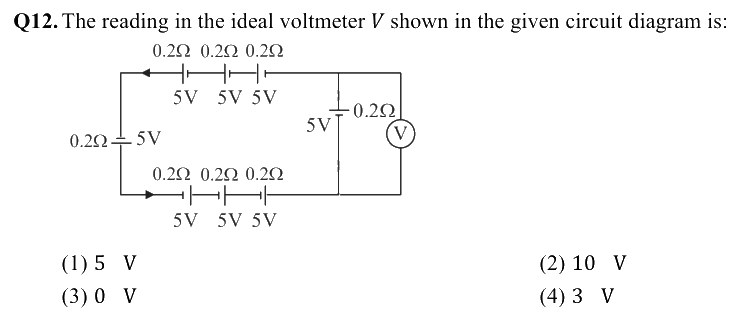
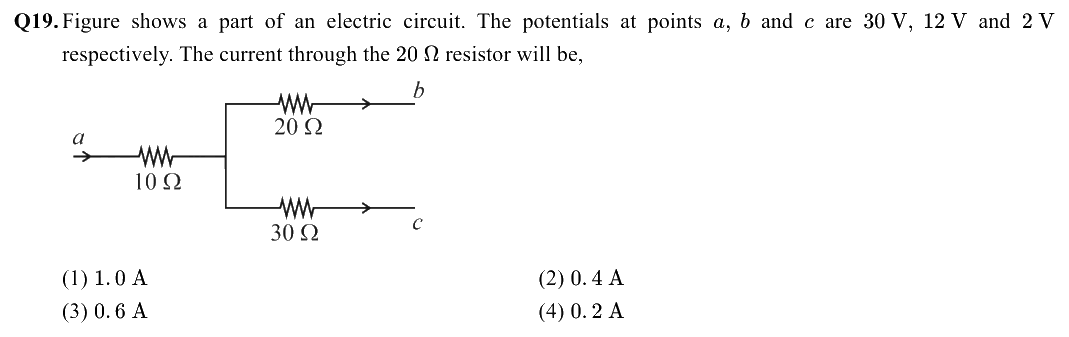
Figure shows a part of an electric circuit. The potentials at points $a$, $b$ and $c$ are $30\ \mathrm{V}$, $12\ \mathrm{V}$ and $2\ \mathrm{V}$ respectively. The current through the $20\ \Omega$ resistor will be,
Given below are two statements : One is labelled as Assertion A and the other is labelled as Reason R. Assertion A : For measuring the potential difference across a resistance of 600 $\Omega$, the voltmeter with resistance 1000 $\Omega$ will be preferred over voltmeter with resistance 4000 $\Omega$. Reason R : Voltmeter with higher resistance will draw smaller current than voltmeter with lower resistance. In the light of the above statements, choose the most appropriate answer from the options given below
A
A is not correct but R is correct
B
Both A and R are correct and R is the correct explanation of A
C
Both A and R are correct but R is not the correct explanation of A
The drift velocity of electrons for a conductor connected in an electrical circuit is $V_d$. The conductor is now replaced by another conductor with same material and same length but double the area of cross-section. The applied voltage remains same. The new drift velocity of electrons will be
The $H$ amount of thermal energy is developed by a resistor in 10 s when a current of 4 A is passed through it. If the current is increased to 16 A, the thermal energy developed by the resistor in 10 s will be
The charge flowing in a conductor changes with time as $Q_t = \alpha t - \beta t^2 + \gamma t^3$, where $\alpha$, $\beta$ and $\gamma$ are constants. Minimum value of current is:
With the help of potentiometer, we can determine the value of emf of a given cell. The sensitivity of the potentiometer is (A) directly proportional to the length of the potentiometer wire (B) directly proportional to the potential gradient of the wire (C) inversely proportional to the potential gradient of the wire (D) inversely proportional to the length of the potentiometer wire Choose the correct option for the above statements:
A uniform metallic wire carries a current 2 A, when 3.4 V battery is connected across it. The mass of uniform metallic wire is $8.92 \times 10^{-3}\ \mathrm{kg}$, density is $8.92 \times 10^{3}\ \mathrm{kg\,m^{-3}}$ and resistivity is $1.7 \times 10^{-8}\ \Omega - \mathrm{m}$. The length of wire is :
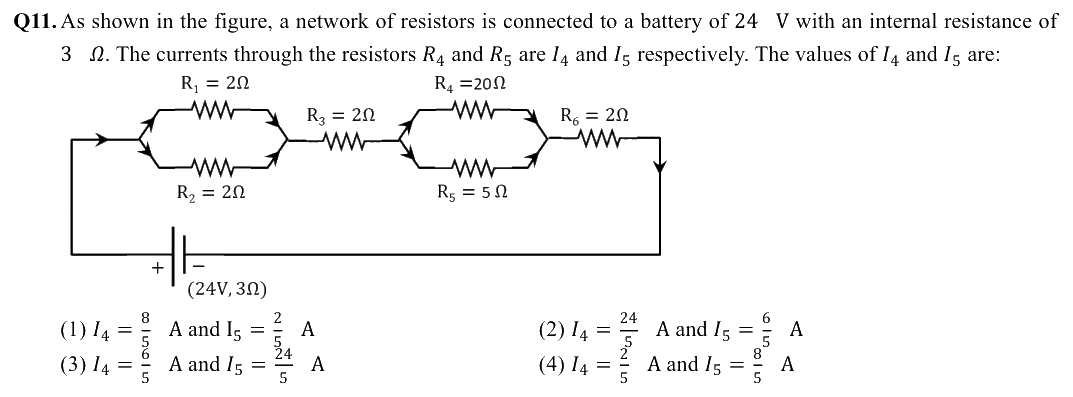
As shown in the figure, a network of resistors is connected to a battery of 24 V with an internal resistance of 3 $\Omega$. The currents through the resistors $R_4$ and $R_5$ are $I_4$ and $I_5$ respectively. The values of $I_4$ and $I_5$ are:
A cell of emf 90 V is connected across series combination of two resistors each of 100 $\Omega$ resistance. A voltmeter of resistance 400 $\Omega$ is used to measure the potential difference across each resistor. The reading of the voltmeter will be:
Two metallic wires of identical dimensions are connected is series. If $\sigma_1$ and $\sigma_2$ are the conductivities of the these wires respectively, the effective conductivity of the combination is :
Given below are two statements: one is labelled as Assertion A and the other is labelled as Reason R. Assertion A: Alloys such as constantan and manganin are used in making standard resistance coils. Reason R: Constantan and manganin have very small value of temperature coefficient of resistance. In the light of the above statements, choose the correct answer from the options given below.
A
Both A and R are true and R is the correct explanation of A
B
Both A and R are true but R is NOT the correct explanation of A.
A 1 m long wire is broken into two unequal parts $X$ and $Y$. The $X$ part of the wire is stretched into another wire $W$. Length of $W$ is twice the length of $X$ and the resistance of $W$ is twice that of $Y$. Find the ratio of length of $X$ and $Y$.
A wire of resistance $R_{1}$ is drawn out so that its length is increased by twice of its original length. The ratio of new resistance to original resistance is:
Given below are two statements : Statement I : A uniform wire of resistance $80\ \Omega$ is cut into four equal parts. These parts are now connected in parallel. The equivalent resistance of the combination will be $5\ \Omega$. Statement II : Two resistance $2R$ and $3R$ are connected in parallel in an electric circuit. The value of thermal energy developed in $3R$ and $2R$ will be in the ratio $3:2$. In the light of the above statements, choose the most appropriate answer from the options given below
A
Both statement I and statement II are correct
B
Both statement I and statement II are incorrect
C
Statement I is correct but statement II is incorrect
D
Statement I is incorrect but statement II is correct.
Two sources of equal emfs are connected in series. This combination is connected to an external resistance $R$. The internal resistances of the two sources are $r_1$ and $r_2$ ($r_1 > r_2$). If the potential difference across the source of internal resistance $r_1$ is zero then the value of $R$ will be
A. The drift velocity of electrons decreases with the increase in the temperature of conductor. B. The drift velocity is inversely proportional to the area of cross-section of given conductor. C. The drift velocity does not depend on the applied potential difference to the conductor. D. The drift velocity of electron is inversely proportional to the length of the conductor. E. The drift velocity increases with the increase in temperature of conductor. Choose the correct answer from the options given below:
The combination of two identical cells, whether connected in series or parallel combination provides the same current through an external resistance of $2\ \Omega$. The value of internal resistance of each cell is
Resistance of the wire is measured as $2\ \Omega$ and $3\ \Omega$ at $10^{\circ}\mathrm{C}$ and $30^{\circ}\mathrm{C}$ respectively. Temperature coefficient of resistance of the material of the wire is
A teacher in his physics laboratory allotted an experiment to determine the resistance $G$ a galvanometer. Students took the observations for $\frac{1}{3}$ deflection in the galvanometer. Which of the below is true for measuring value of $G$?
A
$\frac{1}{3}$ deflection method cannot be used for determining the resistance of the galvanometer.
B
$\frac{1}{3}$ deflection method can be used and in this case the $G$ equals to twice the value of shunt resistance(s).
C
$\frac{1}{3}$ deflection method can be used and in this case, the $G$ equals to three times the value of shunt resistance(s).
D
$\frac{1}{3}$ deflection method can be used and in this case the $G$ value equals to the shunt resistance(s)
Answer: (B) $\frac{1}{3}$ deflection method can be used and in this case the $G$ equals to twice the value of shunt resistance(s).· Key from source paper
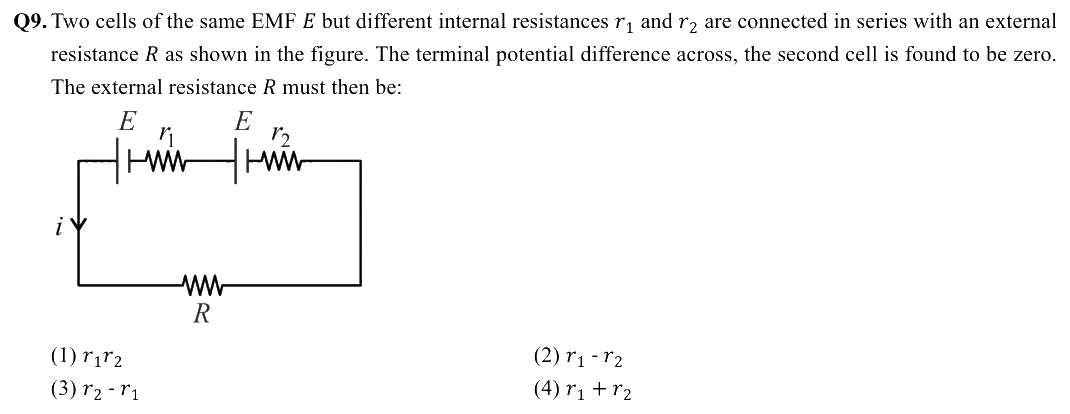
Two cells of the same EMF $E$ but different internal resistances $r_1$ and $r_2$ are connected in series with an external resistance $R$ as shown in the figure. The terminal potential difference across, the second cell is found to be zero. The external resistance $R$ must then be: (see the figure above)
If $n$ represents the actual number of deflections in a converted galvanometer of resistance $G$ and shunt resistance $S$. Then the total current $I$ when its figure of merit is $K$ will be
Two identical cells each of emf $1.5 \mathrm{~V}$ are connected in parallel across a parallel combination of two resistors each of resistance $20\,\Omega$. A voltmeter connected in the circuit measures $1.2 \mathrm{~V}$. The internal resistance of each cell is :
What will be the most suitable combination of three resistors $A = 2\,\Omega$, $B = 4\,\Omega$, $C = 6\,\Omega$ so that $\left(\frac{22}{3}\right)\Omega$ is equivalent resistance of combination?
A
Parallel combination of $A$ and $C$ connected in series with $B$
B
Parallel combination of $A$ and $B$ connected in series with $C$
C
Series combination of $A$ and $C$ connected in parallel with $B$.
D
Series combination of $B$ and $C$ connected in parallel with $A$.
Five identical cells each of internal resistance $1$ $\Omega$ and emf $5$ V are connected in series and in parallel with an external resistance $R$. For what value of $R$, current in series and parallel combination will remain the same?
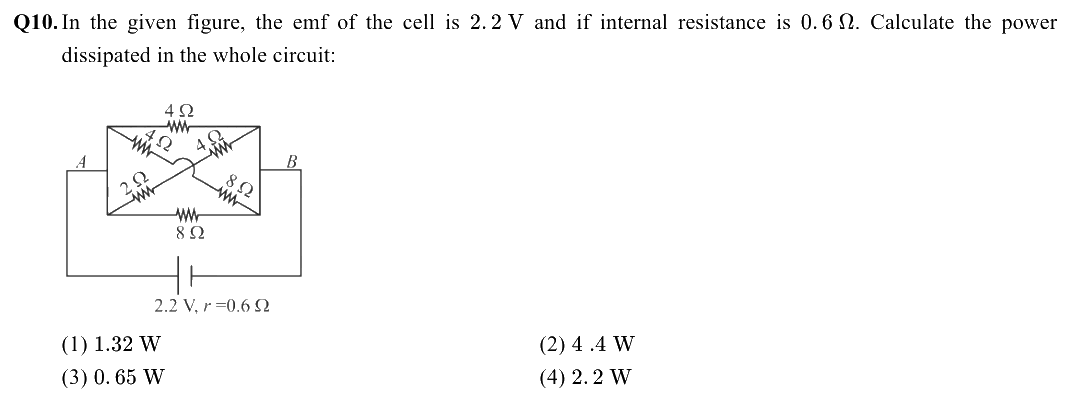
In the given figure, the emf of the cell is $2.2\ \mathrm{V}$ and if internal resistance is $0.6\ \Omega$. Calculate the power dissipated in the whole circuit: (see the figure above)
What equal length of an iron wire and a copper-nickel alloy wire, each of $2\ \mathrm{mm}$ diameter connected parallel to give an equivalent resistance of $3\ \Omega$? (Given resistivities of iron and copper-nickel alloy wire are $12\ \mu\Omega\ \mathrm{cm}$ and $51\ \mu\Omega\ \mathrm{cm}$ respectively)
An electric bulb of $500\ \mathrm{W}$ at $100\ \mathrm{V}$ is used in a circuit having a $200\ \mathrm{V}$ supply. Calculate the resistance $R$ to be connected in series with the bulb so that the power delivered by the bulb is $500\ \mathrm{W}$.
If you are provided a set of resistances, $2\ \Omega$, $4\ \Omega$, $6\ \Omega$ and $8\ \Omega$. Connect these resistances to obtain an equivalent resistance of $\frac{46}{3}\ \Omega$.
A
$2\ \Omega$ and $6\ \Omega$ are in parallel with $4\ \Omega$ and $8\ \Omega$ in series
B
$4\ \Omega$ and $6\ \Omega$ are in parallel with $2\ \Omega$ and $8\ \Omega$ in series
C
$2\ \Omega$ and $4\ \Omega$ are in parallel with $6\ \Omega$ and $8\ \Omega$ in series
D
$6\ \Omega$ and $8\ \Omega$ are in parallel with $2\ \Omega$ and $4\ \Omega$ in series
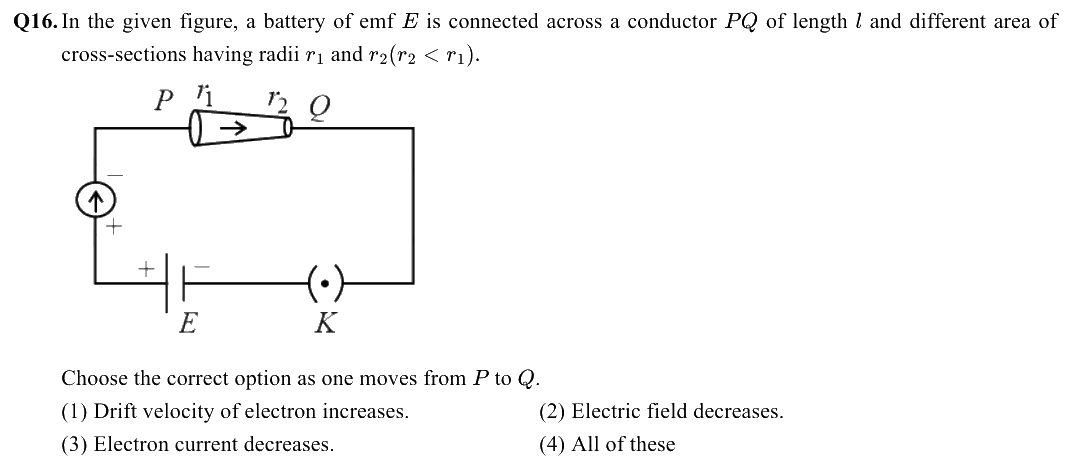
In the given figure, a battery of emf $E$ is connected across a conductor $PQ$ of length $l$ and different area of cross-sections having radii $r_1$ and $r_2(r_2 < r_1)$. (see the figure above) Choose the correct option as one moves from $P$ to $Q$.
The resistance of a conductor at $15^\circ\mathrm{C}$ is $16\ \Omega$ and at $100^\circ\mathrm{C}$ is $20\ \Omega$. What will be the temperature coefficient of resistance of the conductor?
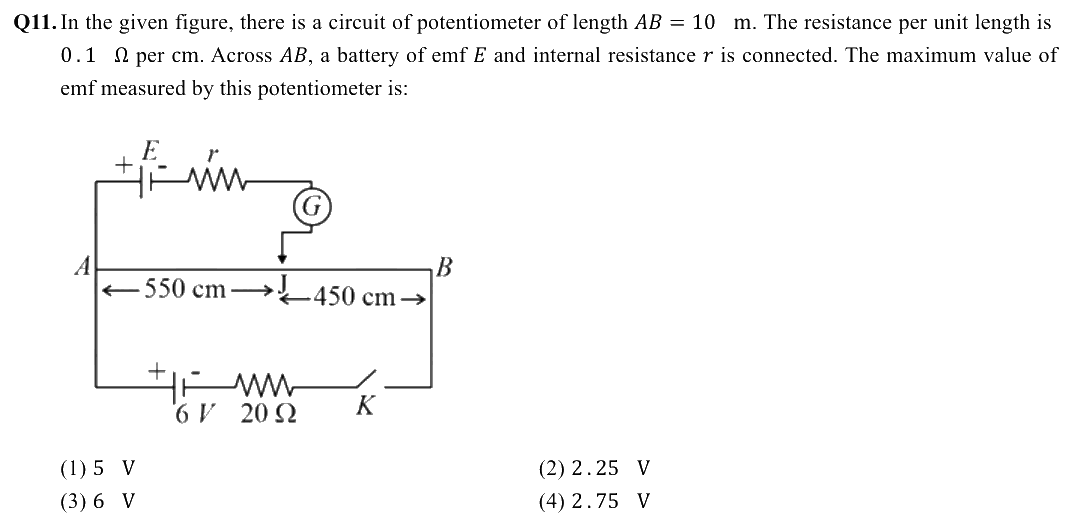
In the given figure, there is a circuit of potentiometer of length $AB = 10\ \mathrm{m}$. The resistance per unit length is $0.1\ \Omega$ per cm. Across $AB$, a battery of emf $E$ and internal resistance $r$ is connected. The maximum value of emf measured by this potentiometer is: (see the figure above)
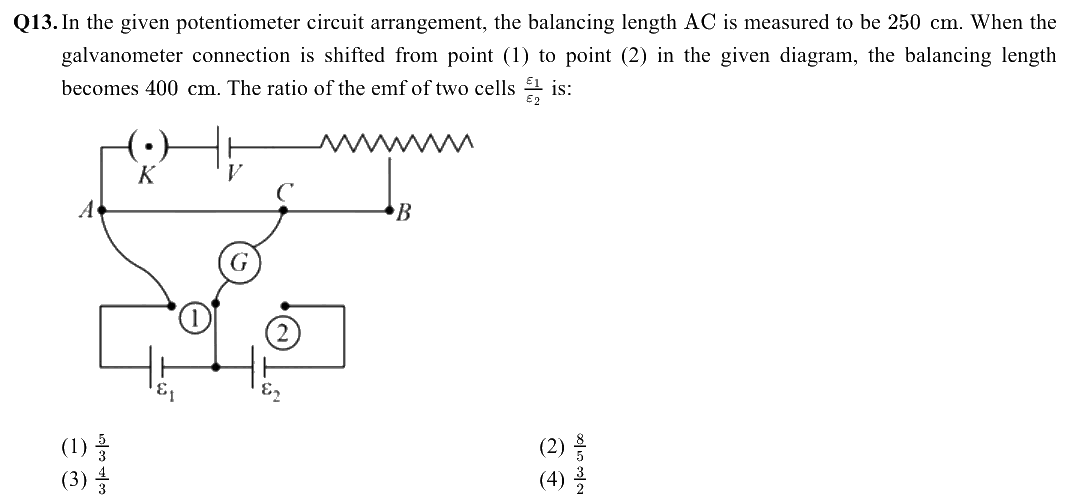
In the given potentiometer circuit arrangement, the balancing length $AC$ is measured to be $250\ \mathrm{cm}$. When the galvanometer connection is shifted from point (1) to point (2) in the given diagram, the balancing length becomes $400\ \mathrm{cm}$. The ratio of the emf of two cells $\frac{\varepsilon_1}{\varepsilon_2}$ is: (see the figure above)
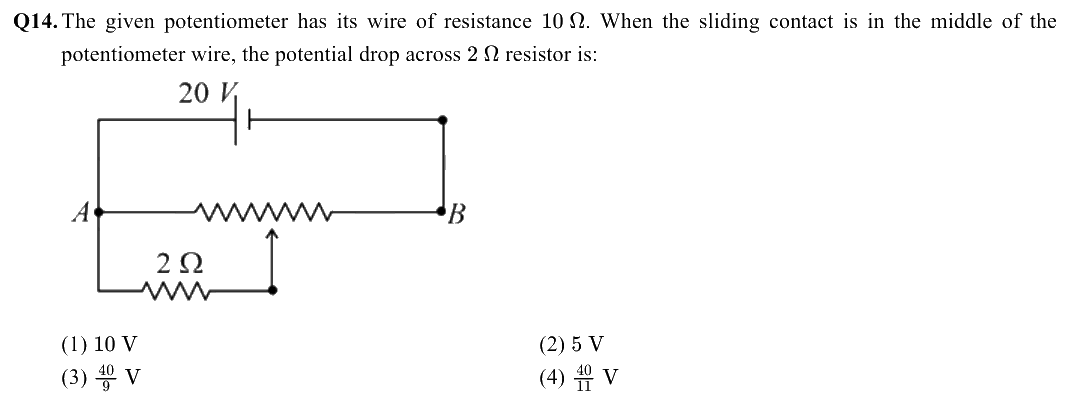
The given potentiometer has its wire of resistance $10\ \Omega$. When the sliding contact is in the middle of the potentiometer wire, the potential drop across $2\ \Omega$ resistor is: (see the figure above)
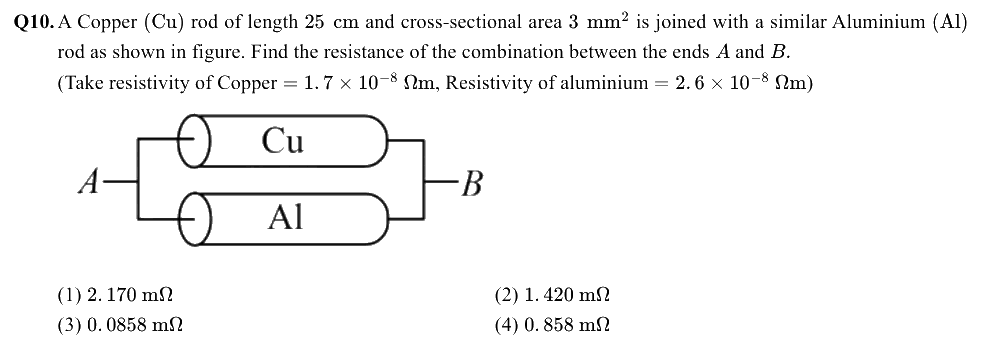
A Copper (Cu) rod of length $25\ \mathrm{cm}$ and cross-sectional area $3\ \mathrm{mm}^2$ is joined with a similar Aluminium (Al) rod as shown in figure. Find the resistance of the combination between the ends $A$ and $B$. (Take resistivity of Copper $= 1.7 \times 10^{-8}\ \Omega\mathrm{m}$, Resistivity of aluminium $= 2.6 \times 10^{-8}\ \Omega\mathrm{m}$) (see the figure above)
A current of $5\ \mathrm{A}$ is passing through a non-linear magnesium wire of cross-section $0.04\ \mathrm{m}^2$. At every point the direction of current density is at an angle of $60^\circ$ with the unit vector of area of cross-section. The magnitude of electric field at every point of the conductor is: (resistivity of magnesium $\rho = 44 \times 10^{-8}\ \Omega\mathrm{m}$)
A current of $10 \mathrm{~A}$ exists in a wire of cross-sectional area of $5 \mathrm{~mm}^2$ with a drift velocity of $2 \times 10^{-3} \mathrm{~m} \mathrm{~s}^{-1}$. The number of free electrons in each cubic meter of the wire is
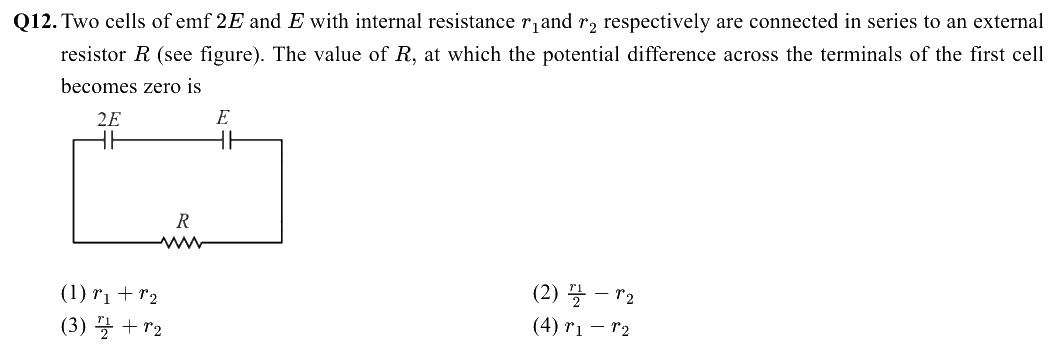
Two cells of emf $2 E$ and $E$ with internal resistance $r_1$ and $r_2$ respectively are connected in series to an external resistor $R$ (see figure). The value of $R$, at which the potential difference across the terminals of the first cell becomes zero is (see the figure above)
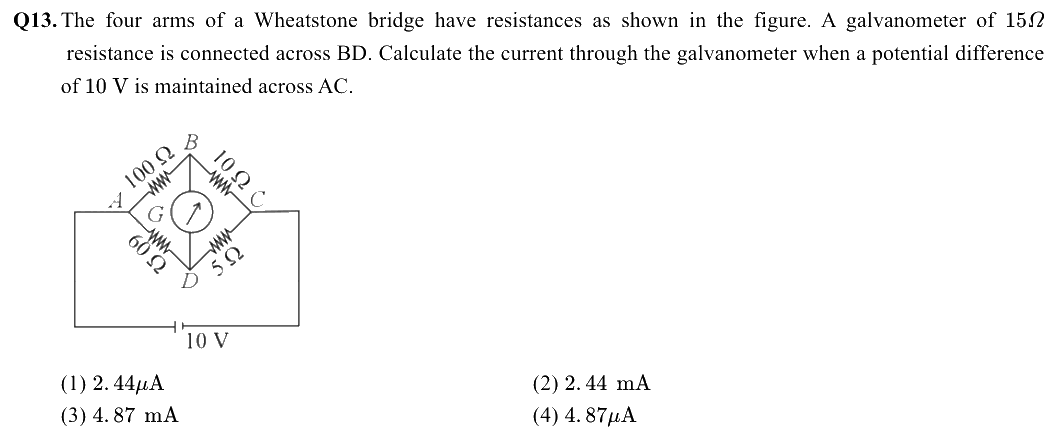
The four arms of a Wheatstone bridge have resistances as shown in the figure. A galvanometer of $15 \Omega$ resistance is connected across BD. Calculate the current through the galvanometer when a potential difference of 10 V is maintained across AC. (see the figure above)
A conducting wire of length $l$, area of crosssection $A$ and electric resistivity $\rho$ is connected between the terminals of a battery. A potential difference $V$ is developed between its ends, causing an electric current. If the length of the wire of the same material is doubled and the area of cross-section is halved, the resultant current would be ______
A resistor develops $500\ \mathrm{J}$ of thermal energy in $20\ \mathrm{s}$ when a current of $1.5\ \mathrm{A}$ is passed through it. If the current is increased from $1.5\ \mathrm{A}$ to $3\ \mathrm{A}$, what will be the energy developed in $20\ \mathrm{s}$.
A wire of $1\ \Omega$ has a length of $1\ \mathrm{m}$. It is stretched till its length increases by $25\%$. The percentage change in resistance to the nearest integer is :
A current through a wire depends on time as $i = \alpha_0 t + \beta t^2$, where $\alpha_0 = 20\ \mathrm{A\ s^{-1}}$ and $\beta = 8\ \mathrm{A\ s^{-2}}$. Find the charge crossed through a section of the wire in $15\ \mathrm{s}$.
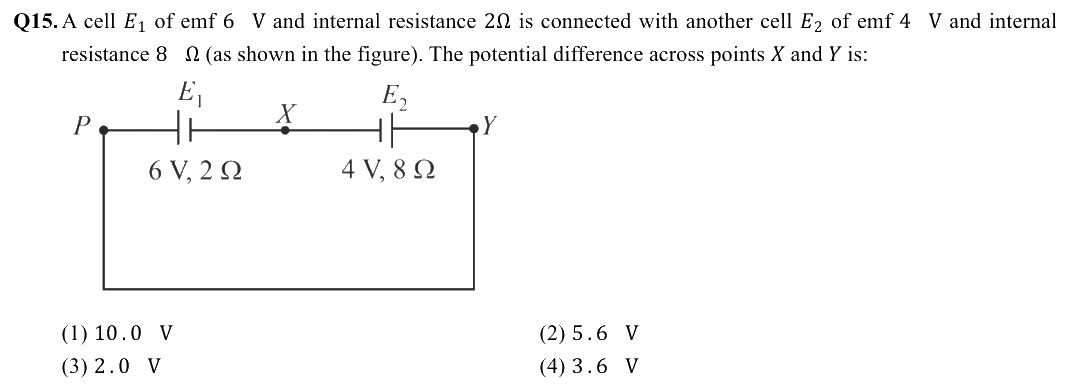
A cell $E_1$ of emf $6\ \mathrm{V}$ and internal resistance $2\Omega$ is connected with another cell $E_2$ of emf $4\ \mathrm{V}$ and internal resistance $8\ \Omega$ (as shown in the figure). The potential difference across points $X$ and $Y$ is: (see the figure above)
A galvanometer of resistance $G$ is converted into a voltameter of range $0 - 1$ V by connecting a resistance $R$ in series with it. The additional resistance that should be connected in series with $R_1$ to increase the range of the voltmeter to $0 - 2$V will be :
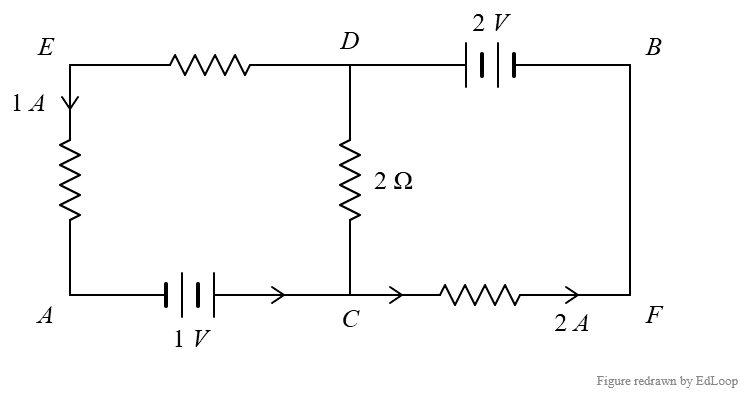
In the circuit, given in the figure currents in different branches and value of one resistor are shown. Then potential at point $B$ with respect to the point $A$ is: (see the figure above)
A battery of 3.0 V is connected to a resistor dissipating 0.5 W of power. If the terminal voltage of the battery is 2.5 V, the power dissipated within the internal resistance is:
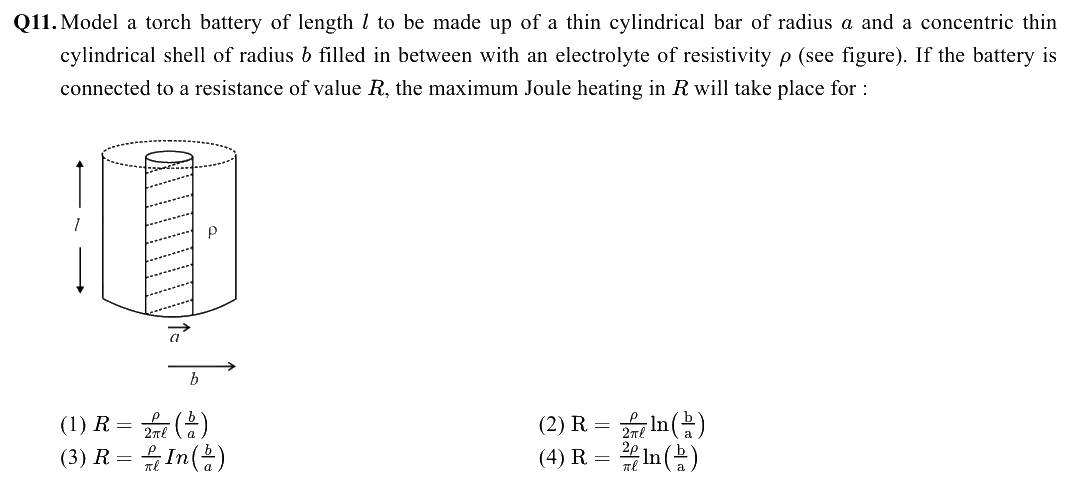
Model a torch battery of length $l$ to be made up of a thin cylindrical bar of radius $a$ and a concentric thin cylindrical shell of radius $b$ filled in between with an electrolyte of resistivity $\rho$ (see figure). If the battery is connected to a resistance of value $R$, the maximum Joule heating in $R$ will take place for : (see the figure above)
Two resistors $400\ \Omega$ and $800\ \Omega$ are connected in series across a $6\mathrm{V}$ battery. The potential difference measured by a voltmeter of $10\ \mathrm{k\Omega}$ across $400\ \Omega$ resistor is close to:
Consider four conducing materials copper, tungsten, mercury and aluminum with resistivity $\rho_{\mathrm{C}}$, $\rho_{\mathrm{T}}$, $\rho_{\mathrm{M}}$ and $\rho_{\mathrm{A}}$ respectively. Then :
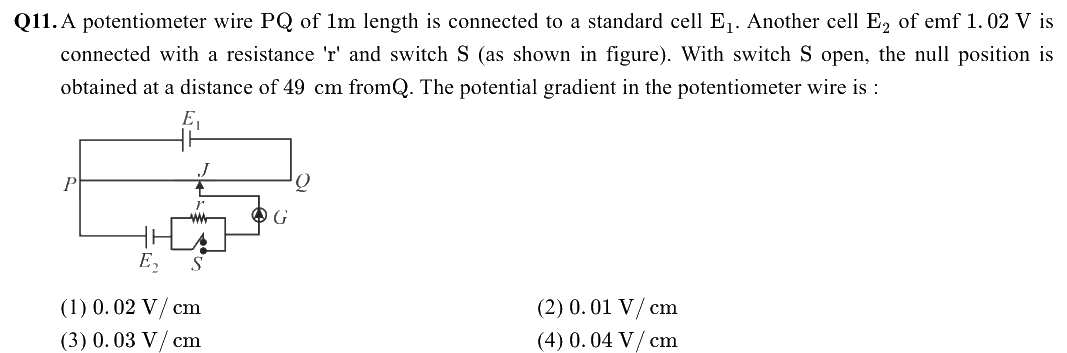
A potentiometer wire PQ of $1\mathrm{m}$ length is connected to a standard cell $\mathrm{E}_{1}$. Another cell $\mathrm{E}_{2}$ of emf $1.02\ \mathrm{V}$ is connected with a resistance 'r' and switch S (as shown in figure). With switch S open, the null position is obtained at a distance of $49\ \mathrm{cm}$ fromQ. The potential gradient in the potentiometer wire is : (see the figure above)
The length of a potentiometer wire is $1200\ \mathrm{cm}$ and it carries a current of $60\ \mathrm{mA}$ For a cell of emf $5\ \mathrm{V}$ and internal resistance of $20\ \Omega$ the null point on it is found to be at $1000\ \mathrm{cm}$ The resistance of whole wire is:
A galvanometer having a coil resistance $100\ \Omega$ gives a full scale deflection when a current of $1\mathrm{mA}$ is passed through it. What is the value of the resistance which can convert this galvanometer into a voltmeter given full scale deflection for a potential difference of $10\mathrm{V}$?
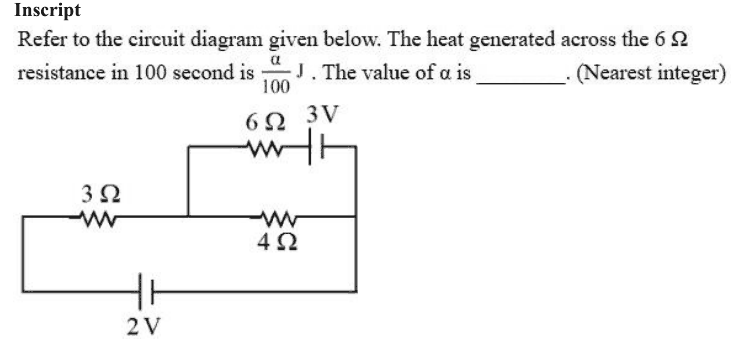
Refer to the circuit diagram given below. The heat generated across the 6 $\Omega$ resistance in 100 second is $\dfrac{\alpha}{100}$ J. The value of $\alpha$ is ________. (Nearest integer)
(see the figure above)
The question as printed in the paper.
Numerical answer type: type your answer in EdLoop to check it
A moving coil of galvanometer when shunted with 2 $\Omega$ resistance gives a full scale deflection for a current of 500 mA. When a resistance of 470 $\Omega$ is connected in series it gives a full scale deflection for 10 V potential applied on it. The value of resistance of galvanometer coil is ________ $\Omega$.
Numerical answer type: type your answer in EdLoop to check it
Two cells of emfs 1 V and 2 V and internal resistance 2 $\Omega$ and 1 $\Omega$, respectively connected in parallel, gave a current of 1 A through an external resistance. If the polarity of one cell is reversed, then value of current through the external resistance will be $\dfrac{\alpha}{5}$ A. The value of $\alpha$ is ________.
Numerical answer type: type your answer in EdLoop to check it
When an external resistance of 5 $\Omega$ is connected across terminals of a cell, a current of 0.25 A flows through it. When the 5 $\Omega$ resistor is replaced by a 2 $\Omega$ resistor, a current of 0.5 A flows through it. The internal resistance of the cell is ________ $\Omega$.
Numerical answer type: type your answer in EdLoop to check it
In a meter bridge experiment to determine the value of unknown resistance, first the resistances 2 $\Omega$ and 3 $\Omega$ are connected in the left and right gaps of the bridge and the null point is obtained at a distance $l$ cm from the left. Now when an unknown resistance $x\ \Omega$ is connected in parallel to 3 $\Omega$ resistance, the null point is shifted by 10 cm to the right of wire. The value of unknown resistance $x$ is ________ $\Omega$.
Numerical answer type: type your answer in EdLoop to check it
A cylindrical conductor of length 2 m and area of cross-section 0.2 mm$^2$ carries an electric current of 1.6 A when its ends are connected to a 2 V battery. Mobility of electrons in the conductor is $\alpha \times 10^{-3}$ m$^2$/V.s. The value of $\alpha$ is :
(electron concentration $= 5 \times 10^{28}$/m$^3$ and electron charge $= 1.6 \times 10^{-19}$ C)
Numerical answer type: type your answer in EdLoop to check it
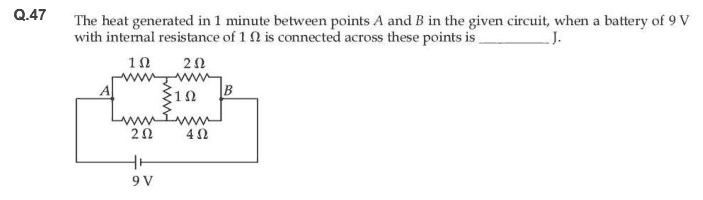
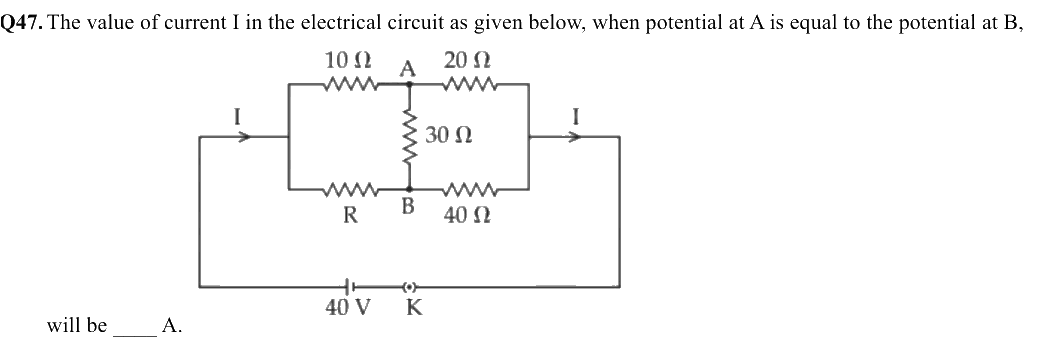
The heat generated in 1 minute between points $A$ and $B$ in the given circuit, when a battery of 9 V with internal resistance of 1 $\Omega$ is connected across these points is ________ J.
(see the figure above)
The question as printed in the paper.
Numerical answer type: type your answer in EdLoop to check it
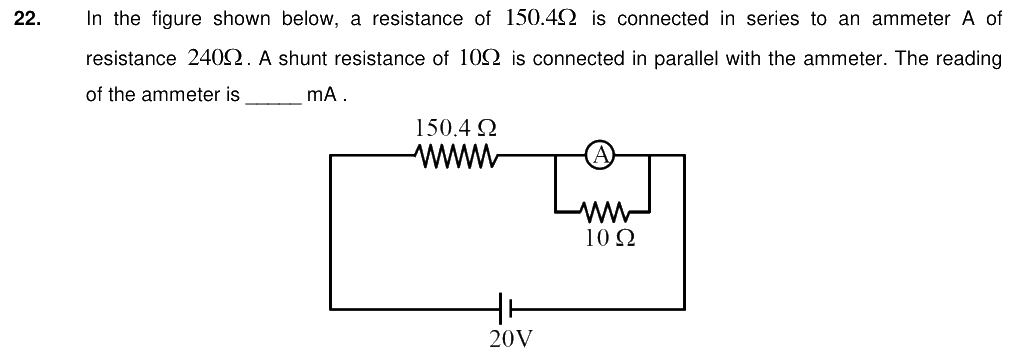
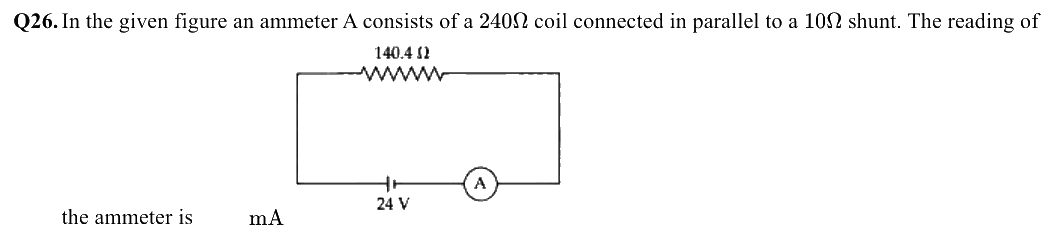
In the figure shown below, a resistance of $150.4\Omega$ is connected in series to an ammeter A of resistance $240\Omega$. A shunt resistance of $10\Omega$ is connected in parallel with the ammeter. The reading of the ammeter is ______ mA .
(see the figure above)
The question as printed in the paper.
Numerical answer type: type your answer in EdLoop to check it
Two cells of emfs 1V and 2V and internal resistances $2\Omega$ and $1\Omega$, respectively, are connected in series with an external resistance of $6\Omega$. The total current in the circuit is $I_1$. Now the same two cells in parallel configuration are connected to same external resistance. In this case, the total current drawn is $I_2$. The value of $\left(\frac{I_1}{I_2}\right)$ is $\frac{x}{3}$. The value of x is ______ .
Numerical answer type: type your answer in EdLoop to check it
At room temperature ($27^\circ$C), the resistance of a heating element is 50$\Omega$. The temperature coefficient of the material is $2.4 \times 10^{-4}\,^\circ\mathrm{C}^{-1}$. The temperature of the element, when its resistance is 62$\Omega$, is ______ $^\circ$C.
Numerical answer type: type your answer in EdLoop to check it
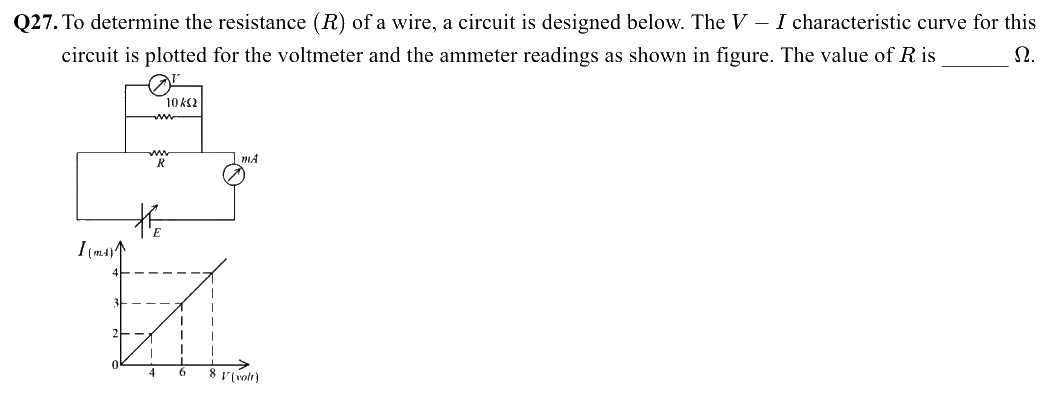
To determine the resistance ($R$) of a wire, a circuit is designed below. The $V - I$ characteristic curve for this circuit is plotted for the voltmeter and the ammeter readings as shown in figure. The value of $R$ is ______ $\Omega$.
(see the figure above)
The question as printed in the paper.
Numerical answer type: type your answer in EdLoop to check it
Resistance of a wire at $0^{\circ}$C, $100^{\circ}$C and $t^{\circ}$C is found to be $10\Omega$, $10.2\Omega$ and $10.95\Omega$ respectively. The temperature $t$ in Kelvin scale is ______
Numerical answer type: type your answer in EdLoop to check it
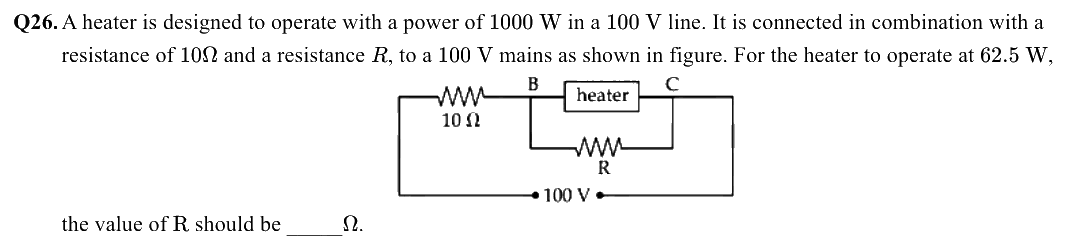
A heater is designed to operate with a power of 1000 W in a 100 V line. It is connected in combination with a resistance of $10\Omega$ and a resistance $R$, to a 100 V mains as shown in figure. For the heater to operate at 62.5 W, the value of R should be ______ $\Omega$.
(see the figure above)
The question as printed in the paper.
Numerical answer type: type your answer in EdLoop to check it
A wire of resistance $R$ and radius $r$ is stretched till its radius became $r/2$. If new resistance of the stretched wire is $xR$, then value of $x$ is ______
Numerical answer type: type your answer in EdLoop to check it
A wire of resistance $20\,\Omega$ is divided into 10 equal parts, resulting pairs. A combination of two parts are connected in parallel and so on. Now resulting pairs of parallel combination are connected in series. The equivalent resistance of final combination is ______ $\Omega$.
Numerical answer type: type your answer in EdLoop to check it
Two wires $A$ and $B$ are made up of the same material and have the same mass. Wire $A$ has radius of 2.0 mm and wire $B$ has radius of 4.0 mm. The resistance of wire $B$ is 2$\Omega$. The resistance of wire $A$ is ______ $\Omega$.
Numerical answer type: type your answer in EdLoop to check it
The current in a conductor is expressed as $I = 3t^2 + 4t^3$, where $I$ is in Ampere and $t$ is in second. The amount of electric charge that flows through a section of the conductor during $t = 1$ s to $t = 2$ s is ______ C.
Numerical answer type: type your answer in EdLoop to check it
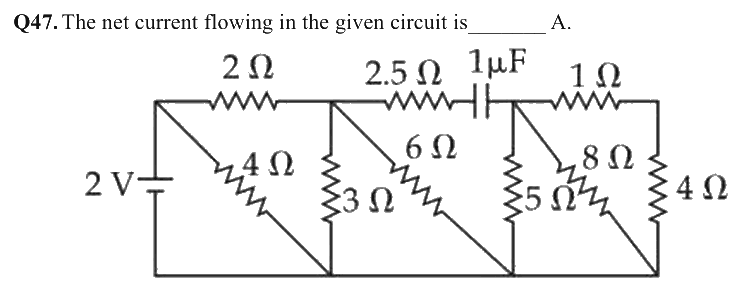
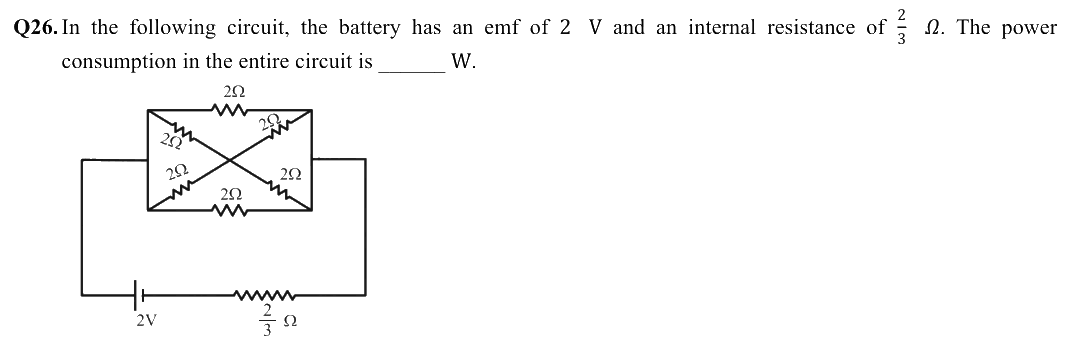
In the following circuit, the battery has an emf of 2 V and an internal resistance of $\frac{2}{3}\ \Omega$. The power consumption in the entire circuit is ______ W.
(see the figure above)
The question as printed in the paper.
Numerical answer type: type your answer in EdLoop to check it
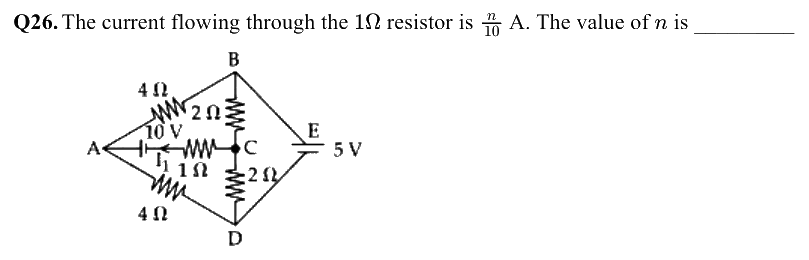
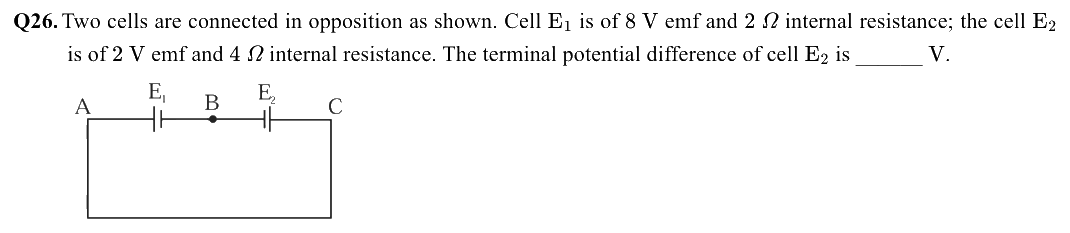
Two cells are connected in opposition as shown. Cell $\mathrm{E_1}$ is of 8 V emf and 2 $\Omega$ internal resistance; the cell $\mathrm{E_2}$ is of 2 V emf and 4 $\Omega$ internal resistance. The terminal potential difference of cell $\mathrm{E_2}$ is ______ V.
(see the figure above)
The question as printed in the paper.
Numerical answer type: type your answer in EdLoop to check it
Two resistance of $100\,\Omega$ and $200\,\Omega$ are connected in series with a battery of 4 V and negligible internal resistance. A voltmeter is used to measure voltage across $100\,\Omega$ resistance, which gives reading as 1 V. The resistance of voltmeter must be ______ $\Omega$.
Numerical answer type: type your answer in EdLoop to check it
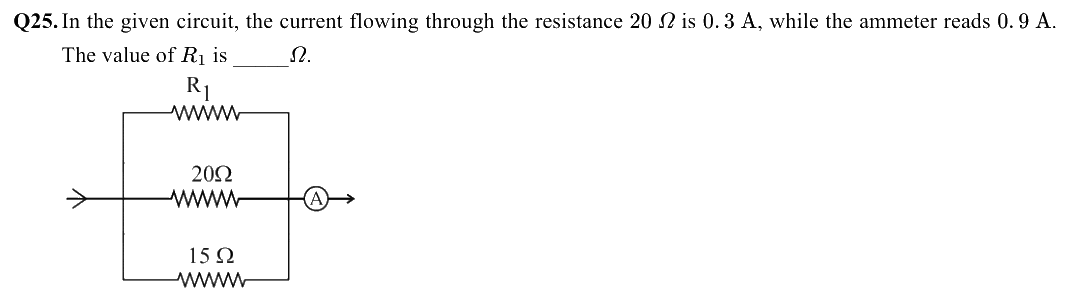
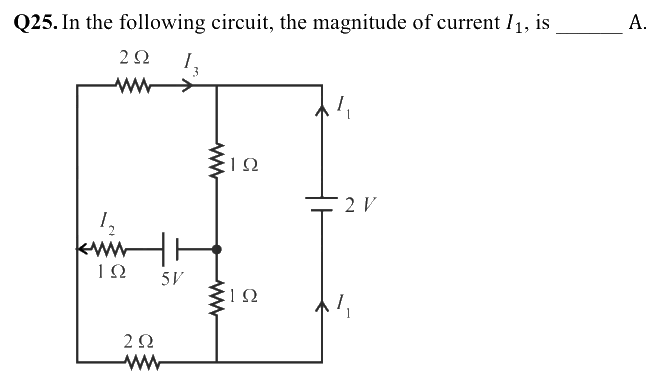
In the given circuit, the current flowing through the resistance 20 $\Omega$ is 0.3 A, while the ammeter reads 0.9 A. The value of $R_1$ is ______ $\Omega$.
(see the figure above)
The question as printed in the paper.
Numerical answer type: type your answer in EdLoop to check it
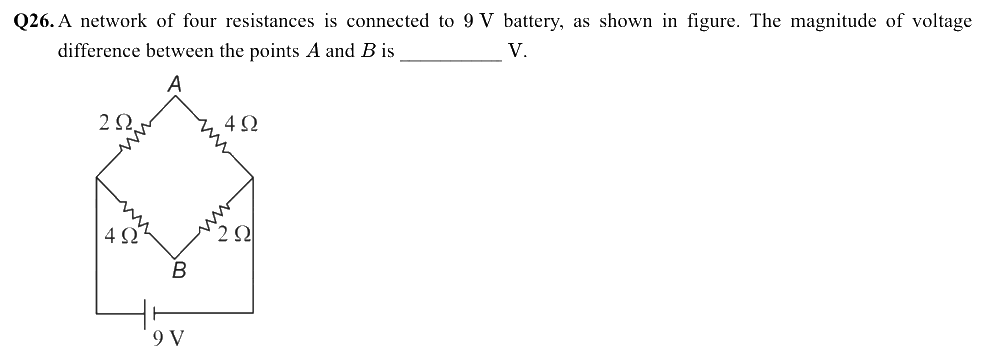
A network of four resistances is connected to 9 V battery, as shown in figure. The magnitude of voltage difference between the points $A$ and $B$ is ______ V.
(see the figure above)
The question as printed in the paper.
Numerical answer type: type your answer in EdLoop to check it
A potential $V_0$ is applied across a uniform wire of resistance $R$. The power dissipation is $P_1$. The wire is then cut into two equal halves and a potential of $V_0$ is applied across the length of each half. The total power dissipation across two wires is $P_2$. The ratio of $P_2 : P_1$ is $\sqrt{x} : 1$. The value of $x$ is ______.
Numerical answer type: type your answer in EdLoop to check it
When a resistance of 5 $\Omega$ is shunted with a moving coil galvanometer, it shows a full scale deflection for current of 250 mA, however when 1050 $\Omega$ resistance is connected with it in series, it gives full scale deflection for 25 volt. The resistance of galvanometer is ______ $\Omega$.
Numerical answer type: type your answer in EdLoop to check it
The current flowing through a conductor connected across a source is 2 A and 1.2 A at $0^\circ$C and $100^\circ$C respectively. The current flowing through the conductor at $50^\circ$C will be ______ $\times\ 10^{2}$ mA.
Numerical answer type: type your answer in EdLoop to check it
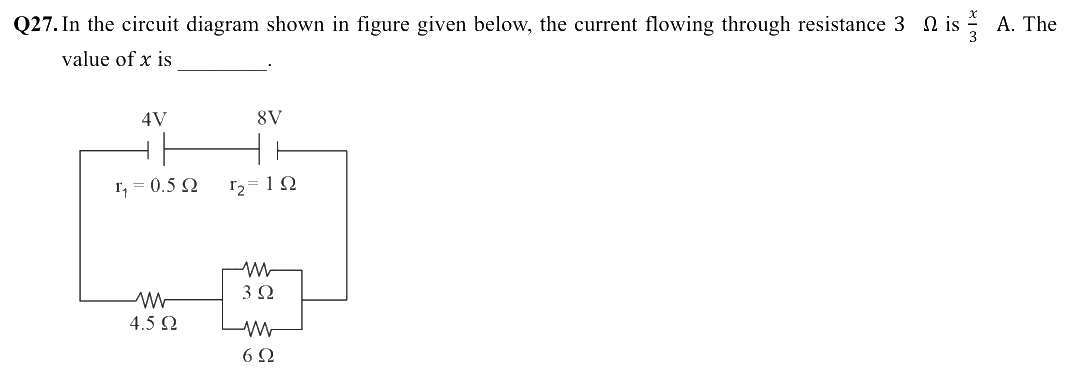
In the circuit diagram shown in figure given below, the current flowing through resistance 3 $\Omega$ is $\frac{x}{3}$ A. The value of $x$ is ______. (see the figure above)
The question as printed in the paper.
Numerical answer type: type your answer in EdLoop to check it
Two identical cells each of emf 1.5 V are connected in series across a 10 $\Omega$ resistance. An ideal voltmeter connected across 10 $\Omega$ resistance reads 1.5 V. The internal resistance of each cell is ______ $\Omega$.
Numerical answer type: type your answer in EdLoop to check it
10 resistors each of resistance $10\ \Omega$ can be connected in such as to get maximum and minimum equivalent resistance. The ratio of maximum and minimum equivalent resistance will be ______.
Numerical answer type: type your answer in EdLoop to check it
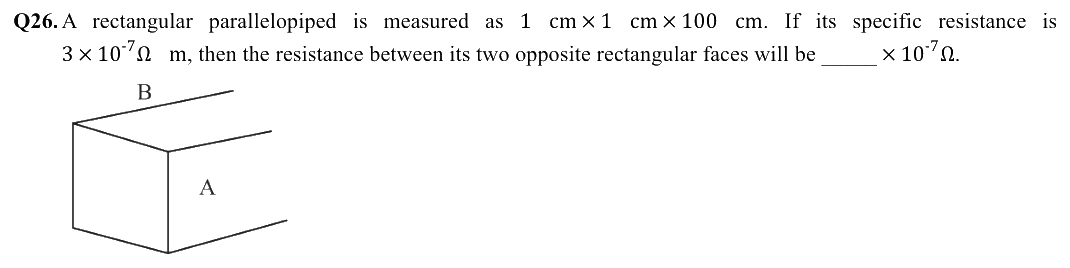
A rectangular parallelopiped is measured as 1 cm $\times$ 1 cm $\times$ 100 cm. If its specific resistance is $3 \times 10^{-7}\ \Omega\,\mathrm{m}$, then the resistance between its two opposite rectangular faces will be ______ $\times 10^{-7}\ \Omega$. (see the figure above)
The question as printed in the paper.
Numerical answer type: type your answer in EdLoop to check it
A current of 2 A flows through a wire of cross-sectional area $25.0\ \mathrm{mm^{2}}$. The number of free electrons in a cubic meter are $2.0 \times 10^{28}$. The drift velocity of the electrons is ______ $\times 10^{-6}\ \mathrm{ms^{-1}}$ (given, charge on electron $= 1.6 \times 10^{-19}\,\mathrm{C}$).
Numerical answer type: type your answer in EdLoop to check it
The number density of free electrons in copper is nearly $8 \times 10^{28}\ \mathrm{m^{-3}}$. A copper wire has its area of cross-section $= 2 \times 10^{-6}\ \mathrm{m^2}$ and is carrying a current of $3.2\ \mathrm{A}$. The drift speed of the electrons is ______ $\times 10^{-6}\ \mathrm{m\,s^{-1}}$.
Numerical answer type: type your answer in EdLoop to check it
The length of a metallic wire is increased by $20\%$ and its area of cross-section is reduced by $4\%$. The percentage change in resistance of the metallic wire is ______ .
Numerical answer type: type your answer in EdLoop to check it
In an experiment to find emf of a cell using potentiometer, the length of null point for a cell of emf 1.5 V is found to be 60 cm. If this cell is replaced by another cell of emf $E$. the length-of null point increases by 40 cm. The value of $E$ is $\dfrac{x}{10}$ V. The value of $x$ is ______.
Numerical answer type: type your answer in EdLoop to check it
Two identical cells, when connected either in parallel or in series gives same current in an external resistance 5 $\Omega$. The internal resistance of each cell will be ______ $\Omega$.
Numerical answer type: type your answer in EdLoop to check it
In a metre bridge experiment the balance point is obtained if the gaps are closed by $2\ \Omega$ and $3\ \Omega$. A shunt of $X\ \Omega$ is added to $3\ \Omega$ resistor to shift the balancing point by $22.5\ \mathrm{cm}$. The value of $X$ is ______.
Numerical answer type: type your answer in EdLoop to check it
A null point is found at 200 cm in potentiometer when cell in secondary circuit is shunted by $5\ \Omega$. When a resistance of $15\ \Omega$ is used for shunting null point moves to 300 cm. The internal resistance of the cell is ______ $\Omega$.
Numerical answer type: type your answer in EdLoop to check it
When two resistance $R_1$ and $R_2$ connected in series and introduced into the left gap of a meter bridge and a resistance of $10\ \Omega$ is introduced into the right gap, a null point is found at 60 cm from left side. When $R_1$ and $R_2$ are connected in parallel and introduced into the left gap, a resistance of $3\ \Omega$ is introduced into the right-gap to get null point at 40 cm from left end. The product of $R_1 R_2$ is ______ $\Omega^2$.
Numerical answer type: type your answer in EdLoop to check it
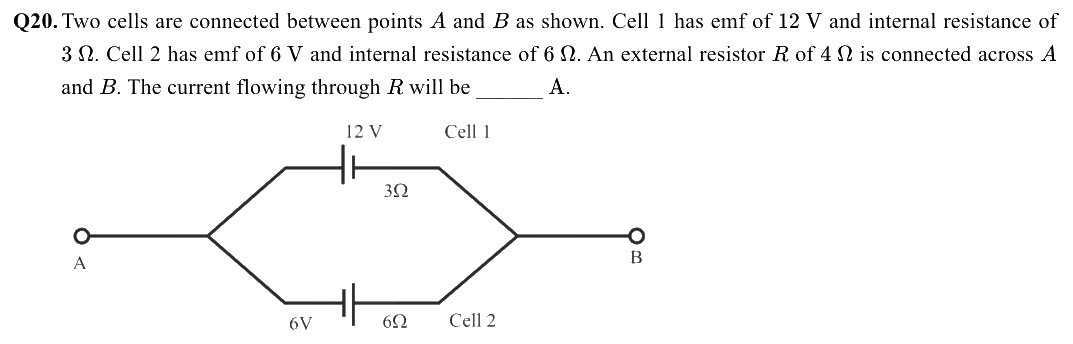
Two cells are connected between points $A$ and $B$ as shown. Cell 1 has emf of 12 V and internal resistance of 3 $\Omega$. Cell 2 has emf of 6 V and internal resistance of 6 $\Omega$. An external resistor $R$ of 4 $\Omega$ is connected across $A$ and $B$. The current flowing through $R$ will be ______ A.
(see the figure above)
The question as printed in the paper.
Numerical answer type: type your answer in EdLoop to check it
A hollow cylindrical conductor has length of 3.14 m, while its inner and outer diameters are 4 mm and 8 mm respectively. The resistance of the conductor is $n\times10^{-3}\ \Omega$. If the resistivity of the material is $2.4\times10^{-8}\ \Omega$ m. The value of n is ______.
Numerical answer type: type your answer in EdLoop to check it
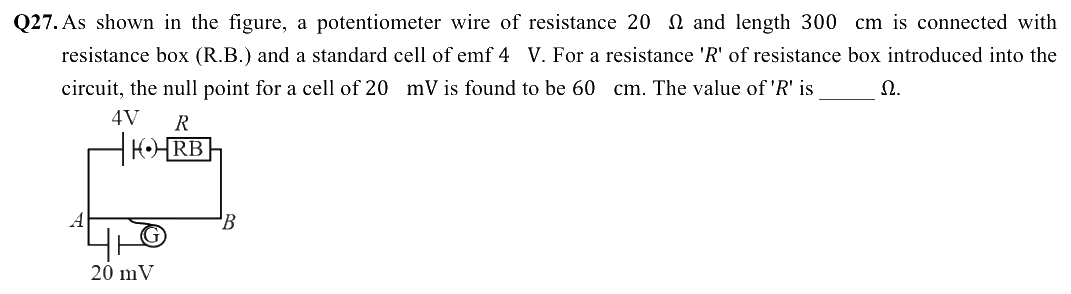
As shown in the figure, a potentiometer wire of resistance $20\ \Omega$ and length $300\ \mathrm{cm}$ is connected with resistance box (R.B.) and a standard cell of emf $4\ \mathrm{V}$. For a resistance '$R$' of resistance box introduced into the circuit, the null point for a cell of $20\ \mathrm{mV}$ is found to be $60\ \mathrm{cm}$. The value of '$R$' is ______ $\Omega$.
(see the figure above)
The question as printed in the paper.
Numerical answer type: type your answer in EdLoop to check it
An electrical bulb rated $220\ \mathrm{V}$, $100\ \mathrm{W}$, is connected in series with another bulb rated $220\ \mathrm{V}$, $60\ \mathrm{W}$. If the voltage across combination is $220\ \mathrm{V}$, the power consumed by the $100\ \mathrm{W}$ bulb will be about ______ W.
Numerical answer type: type your answer in EdLoop to check it
A 1 m long copper wire carries a current of 1 A. If the cross section of the wire is 2.0 $\mathrm{mm^2}$ and the resistivity of copper is $1.7 \times 10^{-8}$ $\Omega$ m. The force experienced by moving electron in the wire is ______ $\times 10^{-23}$ N (Charge of electron= $1.6 \times 10^{-19}$C )
Numerical answer type: type your answer in EdLoop to check it
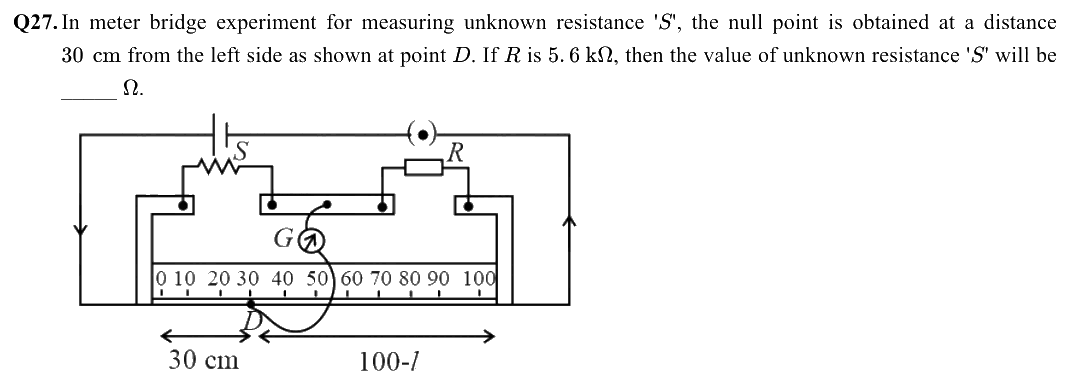
In meter bridge experiment for measuring unknown resistance 'S', the null point is obtained at a distance 30 cm from the left side as shown at point D. If R is 5.6 k$\Omega$, then the value of unknown resistance 'S' will be ______ $\Omega$. (see the figure above)
The question as printed in the paper.
Numerical answer type: type your answer in EdLoop to check it
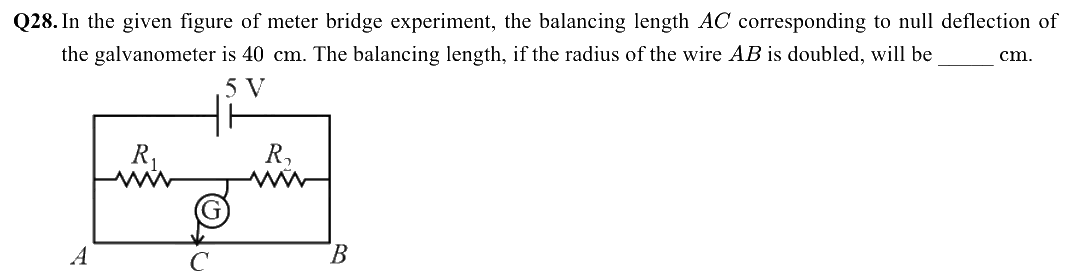
In the given figure of meter bridge experiment, the balancing length $AC$ corresponding to null deflection of the galvanometer is 40 cm. The balancing length, if the radius of the wire $AB$ is doubled, will be ______ cm. (see the figure above)
The question as printed in the paper.
Numerical answer type: type your answer in EdLoop to check it
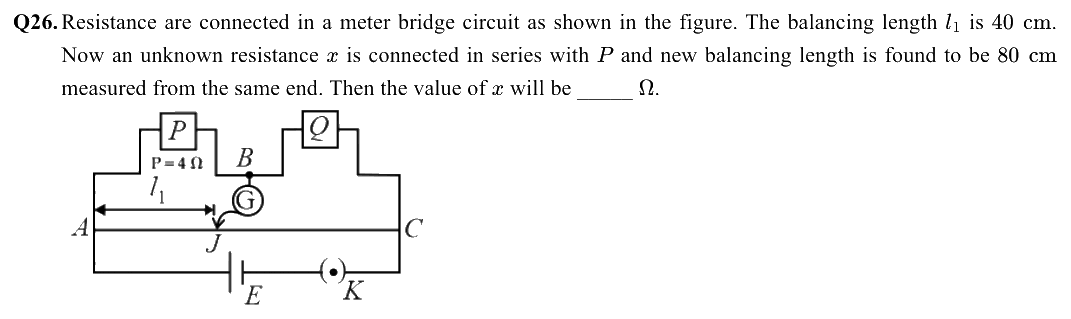
Resistance are connected in a meter bridge circuit as shown in the figure. The balancing length $l_1$ is 40 cm. Now an unknown resistance $x$ is connected in series with $P$ and new balancing length is found to be 80 cm measured from the same end. Then the value of $x$ will be ______ $\Omega$. (see the figure above)
The question as printed in the paper.
Numerical answer type: type your answer in EdLoop to check it
A potentiometer wire of length $300\ \mathrm{cm}$ is connected in series with a resistance $780\ \Omega$ and a standard cell of emf $4\ \mathrm{V}$. A constant current flows through potentiometer wire. The length of the null point for cell of emf 20mV is found to be $60\ \mathrm{cm}$. The resistance of the potentiometer wire is ______ $\Omega$.
Numerical answer type: type your answer in EdLoop to check it
Eight copper wire of length $l$ and diameter d are joined in parallel to form a single composite conductor of resistance $R$. If a single copper wire of length $2l$ have the same resistance $R$ then its diameter will be ______ $d$.
Numerical answer type: type your answer in EdLoop to check it
In a potentiometer arrangement, a cell of emf $1.20$ V gives a balance point at $36\ \mathrm{cm}$ length of wire. This cell is now replaced by another cell of emf $1.80$ V. The difference in balancing length of potentiometer wire in above conditions will be ______ cm.
Numerical answer type: type your answer in EdLoop to check it
Two coils require 20 minutes and 60 minutes respectively to produce same amount of heat energy when connected separately to the same source. If they are connected in parallel arrangement to the same source; the time required to produce same amount of heat by the combination of coils, will be ______ min.
Numerical answer type: type your answer in EdLoop to check it
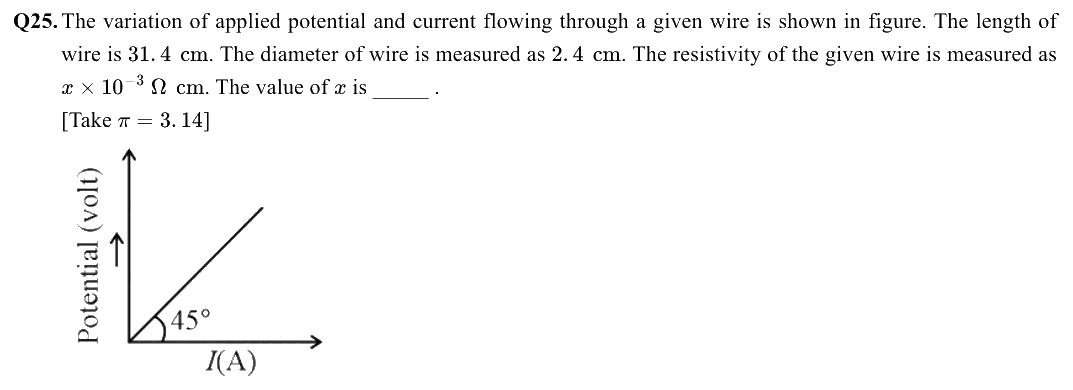
The variation of applied potential and current flowing through a given wire is shown in figure. The length of wire is $31.4\ \mathrm{cm}$. The diameter of wire is measured as $2.4\ \mathrm{cm}$. The resistivity of the given wire is measured as $x \times 10^{-3}\ \Omega\ \mathrm{cm}$. The value of $x$ is ______ . [Take $\pi = 3.14$]
(see the figure above)
The question as printed in the paper.
Numerical answer type: type your answer in EdLoop to check it
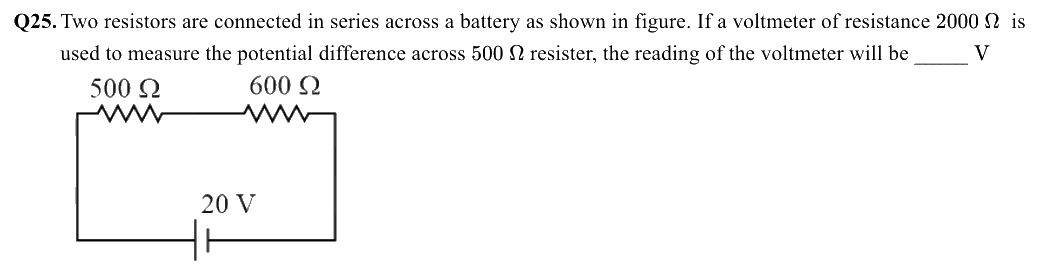
Two resistors are connected in series across a battery as shown in figure. If a voltmeter of resistance $2000\ \Omega$ is used to measure the potential difference across $500\ \Omega$ resister, the reading of the voltmeter will be ______ V.
(see the figure above)
The question as printed in the paper.
Numerical answer type: type your answer in EdLoop to check it
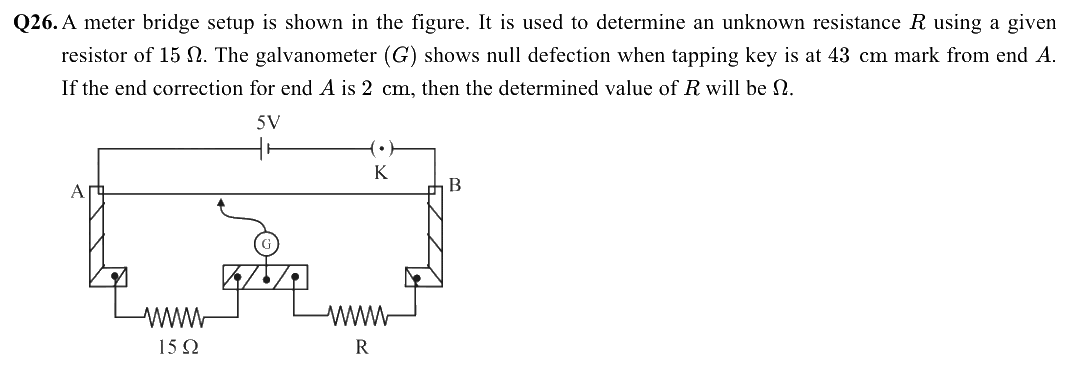
A meter bridge setup is shown in the figure. It is used to determine an unknown resistance $R$ using a given resistor of $15\ \Omega$. The galvanometer $(G)$ shows null defection when tapping key is at $43\ \mathrm{cm}$ mark from end $A$. If the end correction for end $A$ is $2\ \mathrm{cm}$, then the determined value of $R$ will be $\Omega$.
(see the figure above)
The question as printed in the paper.
Numerical answer type: type your answer in EdLoop to check it
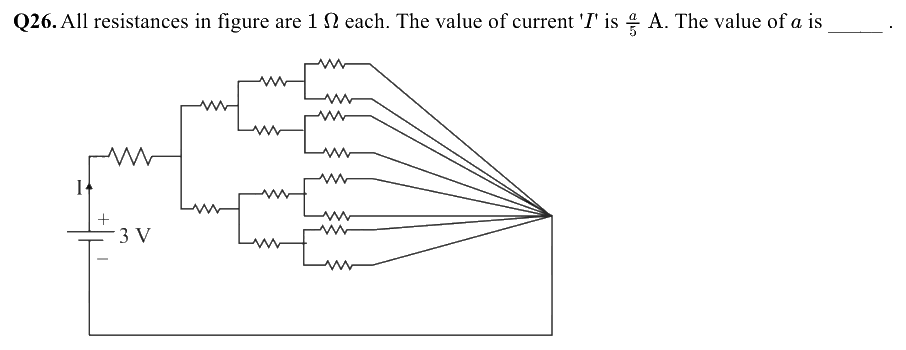
All resistances in figure are $1\ \Omega$ each. The value of current 'I' is $\frac{a}{5}\ \mathrm{A}$. The value of $a$ is ______ . (see the figure above)
The question as printed in the paper.
Numerical answer type: type your answer in EdLoop to check it
A cell, shunted by a $8\ \Omega$ resistance, is balanced across a potentiometer wire of length $3\ \mathrm{m}$. The balancing length is $2\ \mathrm{m}$ when the cell is shunted by a $4\ \Omega$ resistance. The value of internal resistance of the cell will be ______ $\Omega$.
Numerical answer type: type your answer in EdLoop to check it
The current density in a cylindrical wire of radius $4\ \mathrm{mm}$ is $4 \times 10^{6}\ \mathrm{A\ m^{-2}}$. The current through the outer portion of the wire between radial distances $\frac{R}{2}$ and $R$ is ______ $\pi$ A.
Numerical answer type: type your answer in EdLoop to check it
The current density in a cylindrical wire of radius $r = 4.0\ \mathrm{mm}$ is $1.0 \times 10^{6}\ \mathrm{A^{2}\ m^{2}}$. The current through the outer portion of the wire between radial distances $\frac{r}{2}$ and $r$ is $x\pi$ A; where $x$ is
Numerical answer type: type your answer in EdLoop to check it
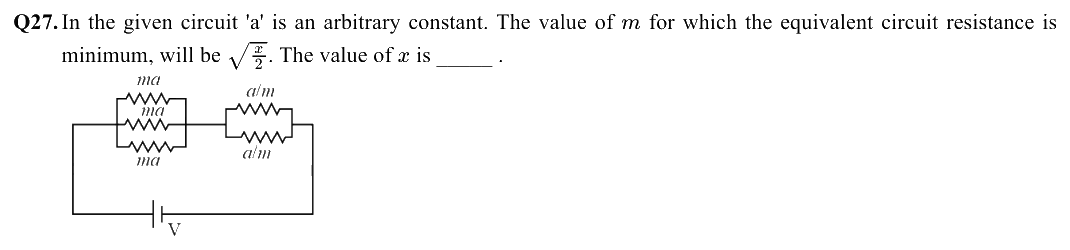
In the given circuit 'a' is an arbitrary constant. The value of $m$ for which the equivalent circuit resistance is minimum, will be $\sqrt{\frac{x}{2}}$. The value of $x$ is ______ . (see the figure above)
The question as printed in the paper.
Numerical answer type: type your answer in EdLoop to check it
A resistor develops $300 \mathrm{~J}$ of thermal energy in $15 \mathrm{~s}$, when a current of $2 \mathrm{~A}$ is passed through it. If the current increases to $3 \mathrm{~A}$, the energy developed in $10 \mathrm{~s}$ is ______ J.
Numerical answer type: type your answer in EdLoop to check it
The length of a given cylindrical wire is increased to double of its original length. The percentage increase in the resistance of the wire will be ______ $\%$
Numerical answer type: type your answer in EdLoop to check it
In a potentiometer arrangement, a cell gives a balancing point at $75 \mathrm{~cm}$ length of wire. This cell is now replaced by another cell of unknown emf. If the ratio of the emf's of two cells respectively is $3 : 2$, the difference in the balancing length of the potentiometer wire in above two cases will be ______ cm.
Numerical answer type: type your answer in EdLoop to check it
A potentiometer wire of length $10 \mathrm{~m}$ and resistance $20\,\Omega$ is connected in series with a $25 \mathrm{~V}$ battery and an external resistance $30\,\Omega$. A cell of emf $E$ in secondary circuit is balanced by $250 \mathrm{~cm}$ long potentiometer wire. The value of $E$ (in volt) is $\frac{x}{10}$. The value of $x$ is ______ .
Numerical answer type: type your answer in EdLoop to check it
A uniform heating wire of resistance $36$ $\Omega$ is connected across a potential difference of $240$ V. The wire is then cut into half and a potential difference of $240$ V is applied across each half separately. The ratio of power dissipation in first case to the total power dissipation in the second case would be $1 : x$, where $x$ is
Numerical answer type: type your answer in EdLoop to check it
A square-shaped wire with a resistance of each side $3$ $\Omega$ is bent to form a complete circle. The resistance between two diametrically opposite points of the circle in a unit of $\Omega$ will be, ______.
Numerical answer type: type your answer in EdLoop to check it
A resistor dissipates $192$ J of energy in $1$ s when a current of $4$ A is passed through it. Now, when the current is doubled, the amount of thermal energy dissipated in $5$ s is ______ J.
Numerical answer type: type your answer in EdLoop to check it
First, a set of $n$ equal resistors of $10$ $\Omega$ each are connected in series to a battery of E.M.F. $20$ V and internal resistance $10$ $\Omega$. A current $I$ is observed to flow. Then, the $n$ resistors are connected in parallel to the same battery. It is observed that the current is increased $20$ times, then the value of $n$ is ______.
Numerical answer type: type your answer in EdLoop to check it
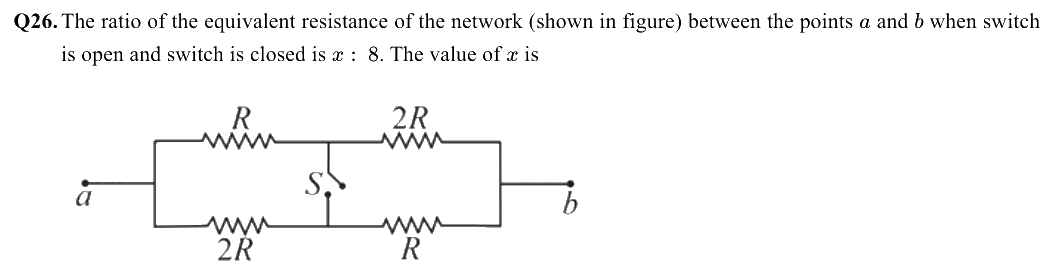
The ratio of the equivalent resistance of the network (shown in figure) between the points $a$ and $b$ when switch is open and switch is closed is $x:8$. The value of $x$ is (see the figure above)
The question as printed in the paper.
Numerical answer type: type your answer in EdLoop to check it
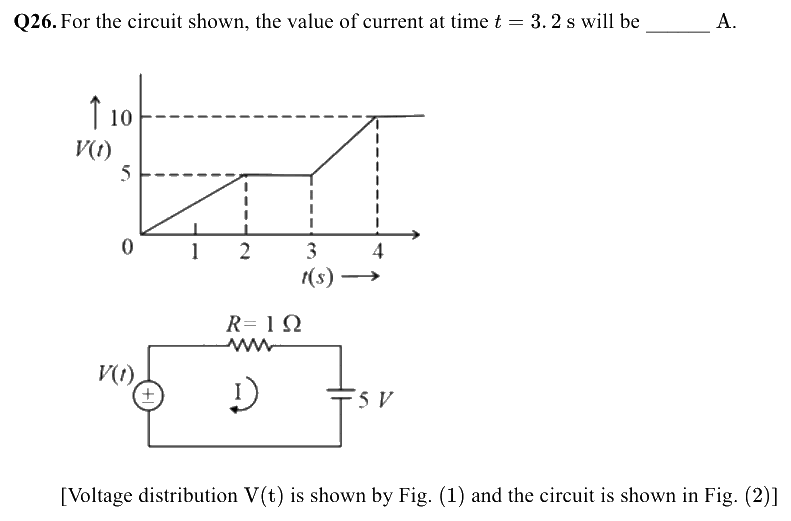
For the circuit shown, the value of current at time $t = 3.2\ \mathrm{s}$ will be ______ A. (see the figure above) [Voltage distribution V(t) is shown by Fig. (1) and the circuit is shown in Fig. (2)]
The question as printed in the paper.
Numerical answer type: type your answer in EdLoop to check it
An electric bulb rated as $200\ \mathrm{W}$ at $100\ \mathrm{V}$ is used in a circuit having $200\ \mathrm{V}$ supply. The resistance $R$ that must be put in series with the bulb so that the bulb delivers the same power is ______ $\Omega$.
Numerical answer type: type your answer in EdLoop to check it
A $16\ \Omega$ wire is bent to form a square loop. A $9\ \mathrm{V}$ supply having an internal resistance of $1\ \Omega$ is connected across one of its sides. The potential drop across the diagonals of the square loop is ______ $\times 10^{-1}\ \mathrm{V}$.
Numerical answer type: type your answer in EdLoop to check it
In an electric circuit, a call of certain emf provides a potential difference of $1.25\ \mathrm{V}$ across a load resistance of $5\ \Omega$. However, it provides a potential difference of $1\ \mathrm{V}$ across a load resistance of $2\ \Omega$.The emf of the cell is given by $\frac{x}{10}\ \mathrm{V}$. Then the value of $x$ is ______ .
Numerical answer type: type your answer in EdLoop to check it
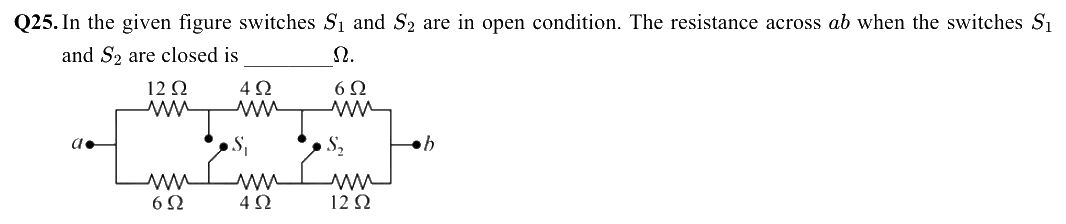
In the given figure switches $S_1$ and $S_2$ are in open condition. The resistance across $ab$ when the switches $S_1$ and $S_2$ are closed is ______ $\Omega$. (see the figure above)
The question as printed in the paper.
Numerical answer type: type your answer in EdLoop to check it
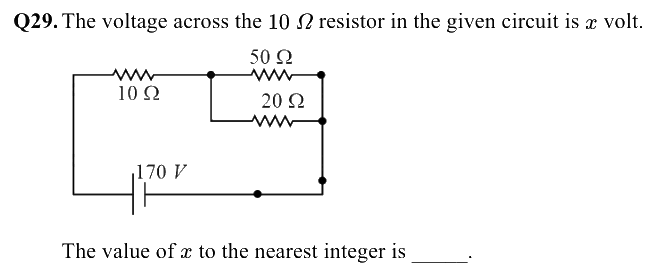
The voltage across the $10~\Omega$ resistor in the given circuit is $x$ volt. (see the figure above) The value of $x$ to the nearest integer is ______ .
The question as printed in the paper.
Numerical answer type: type your answer in EdLoop to check it
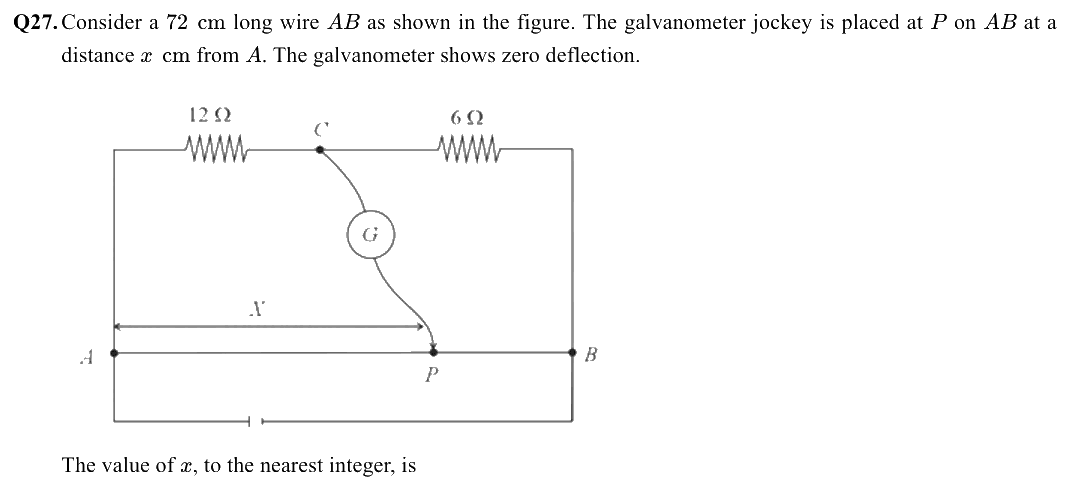
Consider a $72~\mathrm{cm}$ long wire $AB$ as shown in the figure. The galvanometer jockey is placed at $P$ on $AB$ at a distance $x$ cm from $A$. The galvanometer shows zero deflection. (see the figure above) The value of $x$, to the nearest integer, is ______
The question as printed in the paper.
Numerical answer type: type your answer in EdLoop to check it
Two wires of same length and thickness having specific resistances $6~\Omega$ cm and $3~\Omega$ cm respectively are connected in parallel. The effective resistivity is $\rho~\Omega\mathrm{cm}$. The value of $\rho$ to the nearest integer, is ______ .
Numerical answer type: type your answer in EdLoop to check it
The equivalent resistance of series combination of two resistors is $s$. When they are connected in parallel, the equivalent resistance is $p$. If $s=n p$, then the minimum value for $n$ is ______. (Round off to the Nearest Integer)
Numerical answer type: type your answer in EdLoop to check it
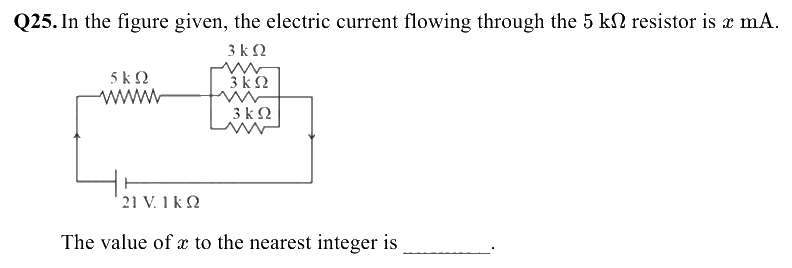
In the figure given, the electric current flowing through the $5 \mathrm{k} \Omega$ resistor is $x \mathrm{~mA}$. (see the figure above) The value of $x$ to the nearest integer is ______.
The question as printed in the paper.
Numerical answer type: type your answer in EdLoop to check it
The energy dissipated by a resistor is $10\ \mathrm{mJ}$ in $1\ \mathrm{s}$, when an electric current of $2\ \mathrm{mA}$ flows through it. The resistance is ______ $\Omega$. (Round off to the Nearest Integer)
Numerical answer type: type your answer in EdLoop to check it
In an electrical circuit, a battery is connected to pass $20\ \mathrm{C}$ of charge through it in a certain given time. The potential difference between two plates of the battery is maintained at $15\ \mathrm{V}$. The workdone by the battery is ______ J
Numerical answer type: type your answer in EdLoop to check it
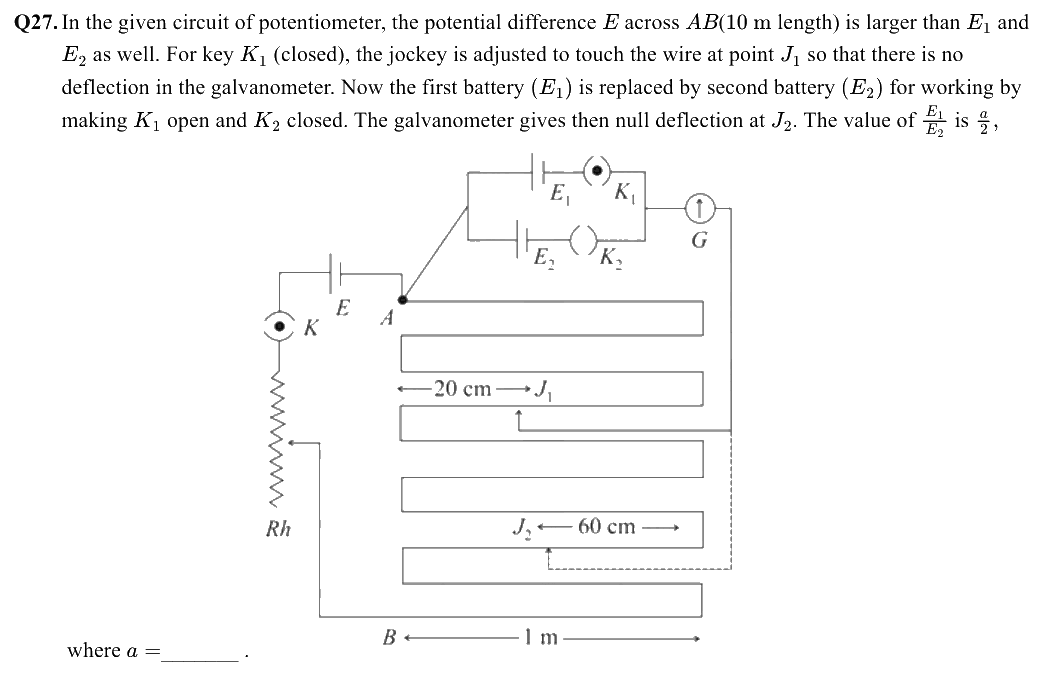
In the given circuit of potentiometer, the potential difference $E$ across $AB$(10 m length) is larger than $E_1$ and $E_2$ as well. For key $K_1$ (closed), the jockey is adjusted to touch the wire at point $J_1$ so that there is no deflection in the galvanometer. Now the first battery $(E_1)$ is replaced by second battery $(E_2)$ for working by making $K_1$ open and $K_2$ closed. The galvanometer gives then null deflection at $J_2$. The value of $\frac{E_1}{E_2}$ is $\frac{a}{2}$, where $a =$ ______. (see the figure above)
The question as printed in the paper.
Numerical answer type: type your answer in EdLoop to check it
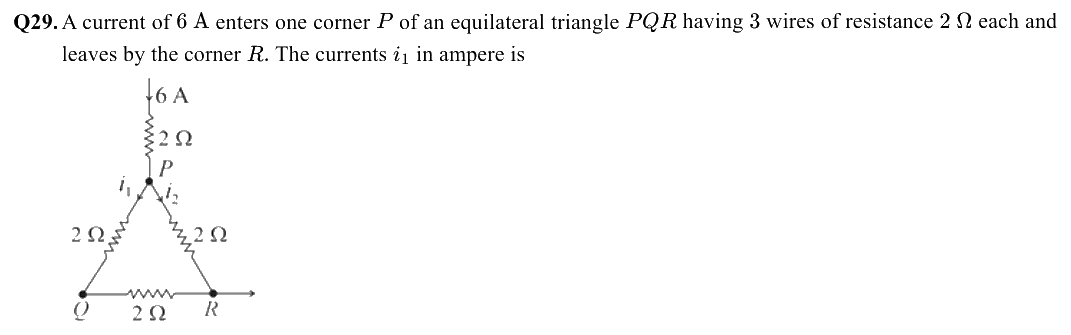
A current of $6\ \mathrm{A}$ enters one corner $P$ of an equilateral triangle $PQR$ having 3 wires of resistance $2\ \Omega$ each and leaves by the corner $R$. The currents $i_1$ in ampere is (see the figure above)
The question as printed in the paper.
Numerical answer type: type your answer in EdLoop to check it
A cylindrical wire of radius $0.5\ \mathrm{mm}$ and conductivity $5 \times 10^{7}\ \mathrm{S\ m^{-1}}$ is subjected to an electric field of $10\ \mathrm{mV\ m^{-1}}$. The expected value of current in the wire will be $x^3\pi$ mA. The value of $x$ is ______.
Numerical answer type: type your answer in EdLoop to check it
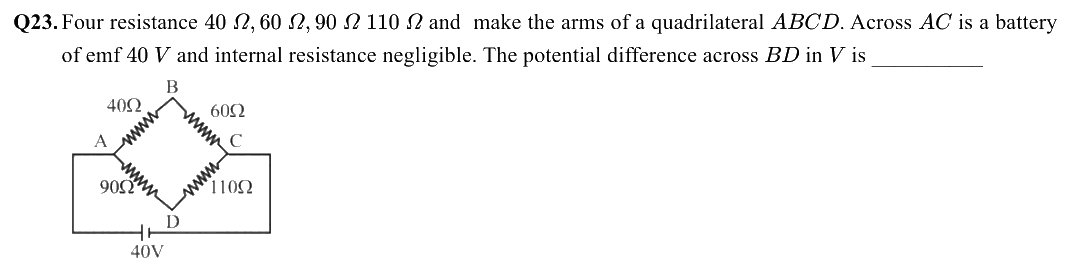
Four resistance $40\ \Omega, 60\ \Omega, 90\ \Omega\ 110\ \Omega$ and make the arms of a quadrilateral $ABCD$. Across $AC$ is a battery of emf $40\ V$ and internal resistance negligible. The potential difference across $BD$ in $V$ is ______ (see the figure above)
The question as printed in the paper.
Numerical answer type: type your answer in EdLoop to check it
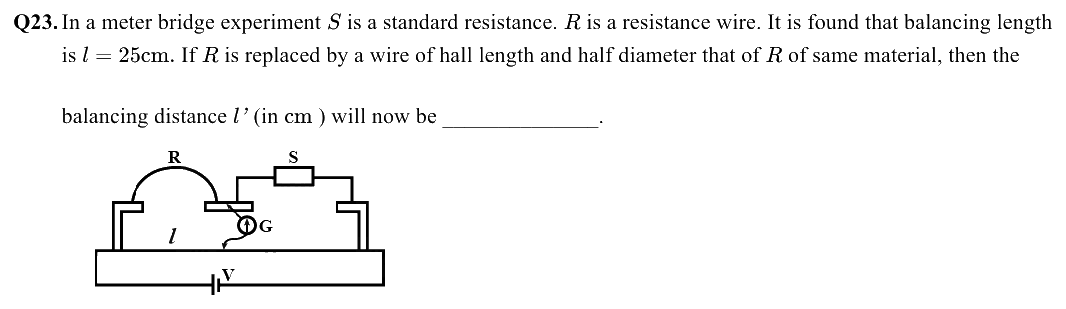
In a meter bridge experiment $S$ is a standard resistance. $R$ is a resistance wire. It is found that balancing length is $l = 25\mathrm{cm}$. If $R$ is replaced by a wire of hall (sic) length and half diameter that of $R$ of same material, then the balancing distance $l'$ (in cm ) will now be ______. (see the figure above)
The question as printed in the paper.
Numerical answer type: type your answer in EdLoop to check it
Four resistances of $15\ \Omega$, $12\ \Omega$, $4\ \Omega$ and $10\ \Omega$ respectively in cyclic order to form Wheatstone's network. The resistance that is to be connected in parallel with the resistance of $10\ \Omega$ to balance the network is __________ $\Omega$.
Numerical answer type: type your answer in EdLoop to check it
The series combination of two batteries, both of the same emf $10\mathrm{V}$, but different internal resistance of $20\ \Omega$ and $5\ \Omega$, is connected to the parallel combination of two resistors $30\ \Omega$ and $\mathrm{x}\ \Omega$. The voltage difference across the battery of internal resistance $20\ \Omega$ is zero, the value of x (in $\Omega$) is____
Numerical answer type: type your answer in EdLoop to check it
Current electricity stands at the top of JEE Main physics in question volume, codified under Unit 12: Current Electricity in the Class 12 NTA syllabus, holding rank 1 among all 29 physics chapters. In the testing window spanning 2019 to 2026, the exam produced 297 current electricity questions across 162 test shifts, giving an average frequency of 1.8 questions per paper. The chapter featured in 150 of those 162 papers, and questions have been set every single year without exception. Over the recent 2024 to 2026 stretch, testing registered 92 problems across 58 shifts, which amounts to 1.6 questions per paper and represents a 5.9 percent share of the subject. This share shows a trend that is down compared to the 6.4 percent share from 86 questions in the 2002 to 2018 era. During the 2026 exam cycle, 26 questions were distributed across 19 papers, with problems appearing in 16 separate sessions. Notably, 106 questions between 2019 and 2026 appeared as numerical answer questions, making current electricity the single largest source of numerical response problems in the physics exam.
Most-asked topics
The exam distributes questions across four distinct areas of study:
Circuits & Kirchhoff's Laws: 162 questions historically, with 135 asked between 2019 and 2026, continuing in 2026. This area examines multi-loop mesh networks, nodal voltage analysis, symmetric resistor cubes and polygons, delta-star transformations, and bridge circuits.
Measuring Instruments: 86 questions in total, including 66 from 2019 to 2026 and appearing in 2026. Core concepts evaluate meter bridge balancing, potentiometer comparative EMF measurements, galvanometer conversion to ammeters and voltmeters, and percentage error analysis.
Current & Resistance: 88 problems overall, with 64 during the 2019 to 2026 period, tested through 2026. Questions explore microscopic drift velocity, electron mobility, temperature coefficients of resistance, color coding, and non-uniform cross-section conductors.
Heating Effect & Power: 47 lifetime questions, with 32 between 2019 and 2026, tested up to 2026. Problems test Joule heating, maximum power transfer theorem, rated power of connected light bulbs, and electrical efficiency in DC networks.
What the questions look like
Current electricity questions in JEE Main blend conceptual rules with quantitative network reductions:
Meter bridge balance adjustments: Determining an unknown resistance using a meter wire, or calculating how the null position shifts along the wire when an additional resistance is connected in parallel with one arm.
Galvanometer conversions: Finding the required shunt resistance to convert a sensitive galvanometer into an ammeter of a specified range, or adding a series multiplier resistor to construct a voltmeter.
Microscopic transport calculations: Connecting macroscopic current and applied voltage to microscopic parameters like carrier concentration, relaxation time, and electron mobility.
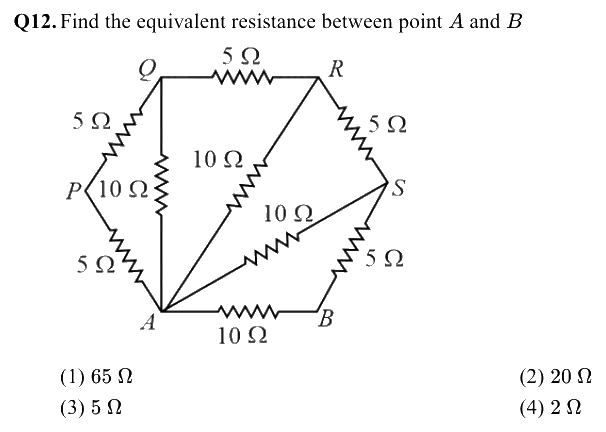
Complex symmetric resistor frameworks: Calculating the equivalent resistance across opposite vertices of regular geometric grids, such as hexagonal webs with radial spokes.
Questions to try first
Solve these illustrative recent problems to gauge your exam preparation:
Prioritize nodal analysis over long Kirchhoff loop equations. Assigning potential values to distinct junctions and writing current conservation equations at each node is faster and significantly less error-prone when dealing with multi-cell circuits.
Focus on laboratory measuring instruments. Understand the working principles of the meter bridge and Wheatstone bridge. For galvanometer modifications, practice deriving the shunt resistance formula from first principles by equating the potential differences across the parallel branches.
Because 106 questions in the modern era were numerical answer questions, practice working through complete calculations without rounding prematurely. Pay close attention to unit conversions between millimeters, centimeters, and standard SI units when dealing with wire resistance formulas.
Frequently asked questions
Why does current electricity have such high question weight?
Current electricity ranks 1 in total questions because its concepts directly bridge basic physics with practical circuits, and it provides ample material for both theoretical reasoning and multi-step numerical calculation.
Are potentiometer questions still relevant after syllabus updates?
While certain specialized laboratory experiments have been adjusted in recent syllabus revisions, general measuring instruments, meter bridge systems, and galvanometer conversions continue to appear regularly in JEE Main papers.
How should I handle symmetric resistor network problems?
Look for equipotential lines or planes of symmetry perpendicular to the flow of current. Nodes lying on the axis of symmetry can be separated or folded, reducing complex three-dimensional or planar grids into simple series and parallel branches. Step-by-step solutions for each one are in the EdLoop app.