
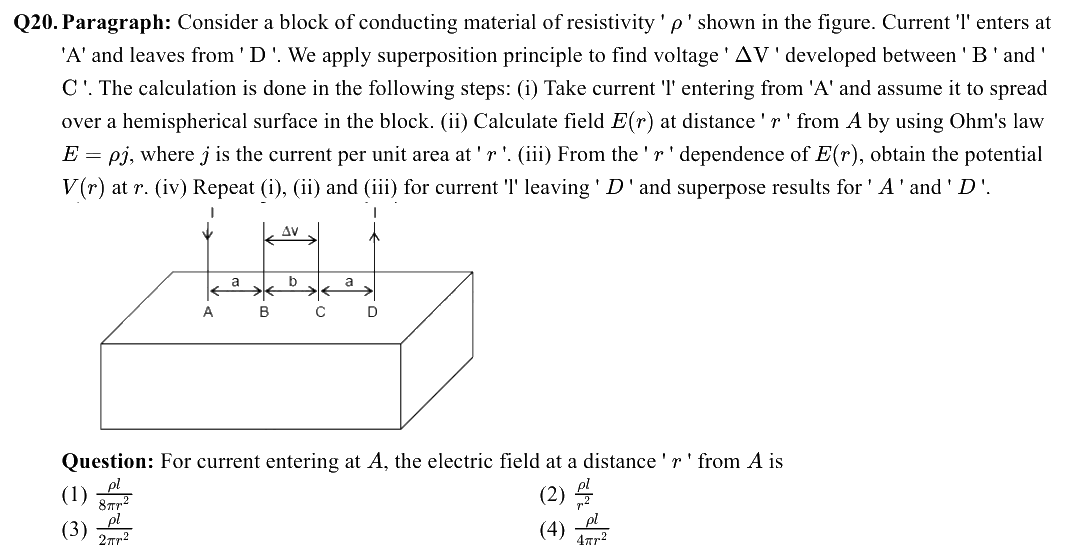
Paragraph: Consider a block of conducting material of resistivity ' $\rho$ ' shown in the figure. Current 'I' enters at 'A' and leaves from ' D '. We apply superposition principle to find voltage ' $\Delta$V ' developed between ' B ' and ' C '. The calculation is done in the following steps: (i) Take current 'I' entering from 'A' and assume it to spread over a hemispherical surface in the block. (ii) Calculate field $E(r)$ at distance ' $r$ ' from $A$ by using Ohm's law $E = \rho j$, where $j$ is the current per unit area at ' $r$ '. (iii) From the ' $r$ ' dependence of $E(r)$, obtain the potential $V(r)$ at $r$. (iv) Repeat (i), (ii) and (iii) for current 'I' leaving ' $D$ ' and superpose results for ' $A$ ' and ' $D$ '.
(see the figure above)
Question: For current entering at $A$, the electric field at a distance ' $r$ ' from $A$ is
- (1)
$\frac{\rho l}{8\pi r^{2}}$
- (2)
$\frac{\rho l}{r^{2}}$
- (3)
$\frac{\rho l}{2\pi r^{2}}$
- (4)
$\frac{\rho l}{4\pi r^{2}}$
Show answer
Option (3) is correct.
Key from source paper