Every Electromagnetic Waves question from past JEE Main and AIEEE papers, with options and answers. Newest first.
189questions
171papers covered
3.3%of Physics questions, 2019–2026
2002–2026years
Guide at a glance
Electromagnetic waves unifies electricity, magnetism, and optics under Unit 15: Electromagnetic Waves in the Class 12 syllabus, holding rank 13 among the 29 physics chapters.
A point light source emits E.M. waves in free space. A detector, placed at a distance of $L$ m, measures the intensity as $I_o$. The detector is now shifted to another location on the same spherical surface ensuring the angle between original location and new location as 45°. The measured intensity at new location will be ________.
For an electromagnetic wave propagating through vacuum, $\vec{k}$, $\vec{E}$ and $\omega$ represent propagation vector, electric field and angular frequency, respectively. The magnetic field associated with this wave is represented by :
A displacement current of 4.0 A can be set up in the space between two parallel plates of 6 $\mu$F capacitor. The rate of change of potential difference across the plates of the capacitor is nearly $\alpha\times10^6$ V/s. The value of $\alpha$ is ________.
A magnetic field vector in an electromagnetic wave is represented by $\vec{B} = B_0\sin\left(2\pi\nu t - \frac{2\pi x}{\lambda}\right)\hat{j}$. Its associated electric field vector is ________.
A
$\vec{E} = -\nu\lambda B_0\sin\left(2\pi\nu t - \frac{2\pi x}{\lambda}\right)\hat{k}$
B
$\vec{E} = -\nu\lambda B_0\sin\left(2\pi\nu t - \frac{2\pi x}{\lambda}\right)\hat{i}$
C
$\vec{E} = \nu\lambda B_0\sin\left(2\pi\nu t - \frac{2\pi x}{\lambda}\right)\hat{k}$
D
$\vec{E} = \nu\lambda B_0\sin\left(2\pi\nu t - \frac{2\pi x}{\lambda}\right)\hat{i}$
An electromagnetic wave travelling in $x$-direction is described by field equation $\mathrm{E}_y = 300\,\sin\omega\left(t - \frac{x}{c}\right)$. If the electron is restricted to move in $y$-direction only with speed of $1.5\times10^6$ m/s then ratio of maximum electric and magnetic forces acting on the electron is ________.
An electromagnetic wave travels in free space along the $x$-direction. At a particular point in space and time, $\vec{B} = 2\times10^{-7}\,\hat{j}$ T is associated with this wave. The value of corresponding electric field $\vec{E}$ at this point is ________ V/m.
A plane electromagnetic wave is moving in free space with velocity $c = 3 \times 10^8$ m/s and its electric field is given as $\vec{E} = 54\sin(kz - \omega t)\hat{j}$ V/m, where $\hat{j}$ is the unit vector along y-axis. The magnetic field vector $\vec{B}$ of the wave is :
A laser beam has intensity of $4.0 \times 10^{14}$ W/m$^2$. The amplitude of magnetic field associated with beam is ________ T. (Take $\epsilon_0 = 8.85 \times 10^{-12}$ C$^2$/Nm$^2$ and c $= 3 \times 10^{8}$ m/s)
The electric field in a plane electromagnetic wave is given by : $E_y = 69\sin[0.6\times10^3 x - 1.8\times10^{11}t]$ V/m. The expression for magnetic field associated with this electromagnetic wave is ________ T.
A
$B_z = 2.3\times10^{-7}\sin[0.6\times10^3 x - 1.8\times10^{11}t]$
B
$B_y = 69\sin[0.6\times10^3 x + 1.8\times10^{11}t]$
C
$B_z = 2.3\times10^{-7}\sin[0.6\times10^3 x + 1.8\times10^{11}t]$
D
$B_y = 2.3\times10^{-7}\sin[0.6\times10^3 x - 1.8\times10^{11}t]$
If $\epsilon_0$ denotes the permittivity of free space and $\Phi_E$ is the flux of the electric field through the area bounded by the closed surface, then dimensions of $\left(\epsilon_0\frac{d\phi_E}{dt}\right)$ are that of :
A small mirror of mass $m$ is suspended by a massless thread of length $l$. Then the small angle through which the thread will be deflected when a short pulse of laser of energy E falls normal on the mirror (c = speed of light in vacuum and g = acceleration due to gravity)
Given below are two statements : one is labelled as Assertion (A) and the other is labelled as Reason (R). Assertion (A) : Electromagnetic waves carry energy but not momentum. Reason (R): Mass of a photon is zero. In the light of the above statements, choose the most appropriate answer from the options given below :
A
Both (A) and (R) are true and (R) is the correct explanation of (A)
B
Both (A) and (R) are true but (R) is not the correct explanation of (A)
A plane electromagnetic wave propagates along the $+x$ direction in free space. The components of the electric field, $\vec{E}$ and magnetic field, $\vec{B}$ vectors associated with the wave in Cartesian frame are
Due to presence of an em-wave whose electric component is given by E = 100 sin($\omega$t $-$ kx)$\mathrm{NC^{-1}}$, a cylinder of length 200 cm holds certain amount of em-energy inside it. If another cylinder of same length but half diameter than previous one holds same amount of em-energy, the magnitude of the electric field of the corresponding em-wave should be modified as
The magnetic field of an E.M. wave is given by $\vec{\mathrm{B}} = \left(\frac{\sqrt{3}}{2}\hat{i} + \frac{1}{2}\hat{j}\right)30\sin\left[\omega\left(\mathrm{t} - \frac{z}{c}\right)\right]$ (S.I. Units). The corresponding electric field in S.I. units is :
Arrange the following in the ascending order of wavelength ($\lambda$) : (A) Microwaves ($\lambda_1$) (B) Ultraviolet rays ($\lambda_2$) (C) Infrared rays ($\lambda_3$) (D) X-rays ($\lambda_4$) Choose the most appropriate answer from the options given below :
The electric field of an electromagnetic wave in free space is $\vec{\mathrm{E}} = 57\cos\left[7.5 \times 10^6\mathrm{t} - 5 \times 10^{-3}(3x + 4y)\right](4\hat{i} - 3\hat{j})N/C$. The associated magnetic field in Tesla is
A plane electromagnetic wave of frequency 20 MHz travels in free space along the $+x$ direction. At a particular point in space and time, the electric field vector of the wave is $\mathrm{E}_y = 9.3\mathrm{Vm}^{-1}$. Then, the magnetic field vector of the wave at that point is
A plane EM wave is propagating along $x$ direction. It has a wavelength of 4 mm. If electric field is in $y$ direction with the maximum magnitude of 60Vm$^{-1}$, the equation for magnetic field is :
The magnetic field in a plane electromagnetic wave is $B_y = (3.5 \times 10^{-7})\sin(1.5 \times 10^{3}x + 0.5 \times 10^{11}t)$T. The corresponding electric field will be :
Average force exerted on a non-reflecting surface at normal incidence is $2.4 \times 10^{-4}$ N. If 360 W/cm$^2$ is the light energy flux during span of 1 hour 30 minutes, Then the area of the surface is:
Electromagnetic waves travel in a medium with speed of $1.5 \times 10^8$ m s$^{-1}$. The relative permeability of the medium is 2.0 . The relative permittivity will be:
In the given electromagnetic wave $E_y = 600 \sin(\omega t - kx)$ $Vm^{-1}$, intensity of the associated light beam is (in W/m$^2$ : (Given $\epsilon_0 = 9 \times 10^{-12}$ C$^2$ N$^{-1}$ m$^{-2}$ )
An alternating voltage of amplitude 40 V and frequency 4kHz is applied directly across the capacitor of $12\mu$F. The maximum displacement current between the plates of the capacitor is nearly :
The electric field in an electromagnetic wave is given by $\vec{\mathrm{E}} = \hat{i}\,40\cos\omega(\mathrm{t} - z/c)\mathrm{NC^{-1}}$. The magnetic field induction of this wave is (in SI unit) :
Arrange the following in the ascending order of wavelength: A. Gamma rays ($\lambda_1$) B. $x$ - rays ($\lambda_2$) C. Infrared waves ($\lambda_3$) D. Microwaves ($\lambda_4$) Choose the most appropriate answer from the options given below
A parallel plate capacitor has a capacitance $C = 200$ pF. It is connected to 230 V ac supply with an angular frequency 300 $\text{rad s}^{-1}$. The rms value of conduction current in the circuit and displacement current in the capacitor respectively are :
If frequency of electromagnetic wave is 60 MHz and it travels in air along z direction then the corresponding electric and magnetic field vectors will be mutually perpendicular to each other and the wavelength of the wave in m is :
In a plane EM wave, the electric field oscillates sinusoidally at a frequency of $5 \times 10^{10}$ Hz and an amplitude of 50 V m$^{-1}$. The total average energy density of the electromagnetic field of the wave is : [Use $\varepsilon_0 = 8.85 \times 10^{-12}$ C$^2$ N$^{-1}$ m$^{-2}$]
The electric field of an electromagnetic wave in free space is represented as $\vec{E} = E_0\cos\left(\omega t - kz\right)\hat{i}$. The corresponding magnetic induction vector will be :
A
$\vec{B} = E_0 C\cos\left(\omega t - kz\right)\hat{j}$
B
$\vec{B} = \frac{E_0}{C}\cos\left(\omega t - kz\right)\hat{j}$
C
$\vec{B} = E_0 C\cos\left(\omega t + kz\right)\hat{j}$
D
$\vec{B} = \frac{E_0}{C}\cos\left(\omega t + kz\right)\hat{j}$
If the total energy transferred to a surface in time $t$ is $6.48 \times 10^{5}$ J, then the magnitude of the total momentum delivered to this surface for complete absorption will be :
A plane electromagnetic wave of frequency 35 MHz travels in free space along the $X$-direction. At a particular point (in space and time) $\overrightarrow{E} = 9.6\hat{j}$ V m$^{-1}$. The value of magnetic field at this point is:
An object is placed in a medium of refractive index 3. An electromagnetic wave of intensity $6 \times 10^8$ W m$^{-2}$ falls normally on the object and it is absorbed completely. The radiation pressure on the object would be (speed of light in free space $= 3 \times 10^8$ m s$^{-1}$):
Match List-I with List II of Electromagnetic waves with corresponding wavelength range: List I | List II (A) Microwave | (I) 400 nm to 1 nm (B) Ultraviolet | (II) 1 nm to $10^{-3}$ nm (C) $X$-Ray | (III) 1 mm to 700 nm (D) Infra-red | (IV) 0.1 m to 1 mm Choose the correct answer from the options given below:
The source of time varying magnetic field may be (A) a permanent magnet (B) an electric field changing linearly with time (C) direct current (D) a decelerating charge particle (E) an antenna fed with a digital signal Choose the correct answer from the options given below.
In an electromagnetic wave, at an instant and at a particular position, the electric field is along the negative z-axis and magnetic field is along the positive x-axis. Then the direction of propagation of electromagnetic wave is:
Given below are two statements: one is labelled as Assertion A and the other is labelled as Reason R Assertion A : EM waves used for optical communication have longer wavelengths than that of microwave, employed in Radar technology. Reason R : Infrared EM waves are more energetic than microwaves, (used in Radar) In the light of given statements, choose the correct answer from the options given below.
A
Both A and R are true but R is NOT the correct explanation of A
B
A is false but R is true
C
A is true but R is false
D
Both A and R are true and R is the correct explanation of A
The electric field in an electromagnetic wave is given by $\vec{E} = 20\sin\omega t - \frac{x}{c}\hat{j}\ \mathrm{N\ C^{-1}}$, where $\omega$ and $c$ are angular frequency and velocity of electromagnetic wave respectively. The energy contained in a volume of $5 \times 10^{-4}\ \mathrm{m^3}$ will be (Given $\varepsilon_0 = 8.85 \times 10^{-12}\ \mathrm{C^2\ N^{-1}\ m^{-2}}$)
A plane electromagnetic wave of frequency 20 MHz propagates in free space along $x$-direction. At a particular space and time $\vec{E} = 6.6\hat{j}\ \mathrm{V\ m^{-1}}$. What is $\vec{B}$ at this point?
The amplitude of magnetic field in an electromagnetic wave propagating along $y$-axis is $6.0 \times 10^{-7}$ T. The maximum value of electric field in the electromagnetic wave is
For the plane electromagnetic wave given by $E = E_0\sin(\omega t - kx)$ and $B = B_0\sin(\omega t - kx)$, the ratio of average electric energy density to average magnetic energy density is
The energy density associated with electric field $\vec{E}$ and magnetic field $\vec{B}$ of an electromagnetic wave in free space is given by ($\varepsilon_0-$ permittivity of free space, $\mu_0-$ permeability of free space)
A small object at rest, absorbs a light pulse of power 20 mW and duration 300 ns. Assuming speed of light as 3 $\times$ $10^8$ m s$^{-1}$. The momentum of the object becomes equal to :
A point source of 100 W emits light with 5% efficiency. At a distance of 5 m from the source, the intensity produced by the electric field component is:
A. Speed of light in vacuum is dependent on the direction of propagation. B. Speed of light in a medium is independent of the wavelength of light. C. The speed of light is independent of the motion of the source. D. The speed of light in a medium is independent of intensity.
Choose the correct answer from the question given below :
Given below are two statements : Statement I : Electromagnetic waves are not deflected by electric and magnetic field. Statement II : The amplitude of electric field and the magnetic field in electromagnetic waves are related to each other as $E_0 = \sqrt{\frac{\mu_0}{\varepsilon_0}}\, B_0$. In the light of the above statements, choose the correct answer from the options given below:
All electromagnetic wave is transporting energy in the negative $z$ direction. At a certain point and certain time the direction of electric field of the wave is along positive $y$ direction. What will be the direction of the magnetic field of the wave at that point and instant?
Match List - I with List - II List-I: (a) UV rays, (b) $X$-rays, (c) Microwave, (d) Infrared wave List-II: (i) Diagnostic tool in medicine, (ii) Water purification, (iii) Communication, Radar, (iv) Improving visibility in foggy days Choose the correct answer from the options given below :
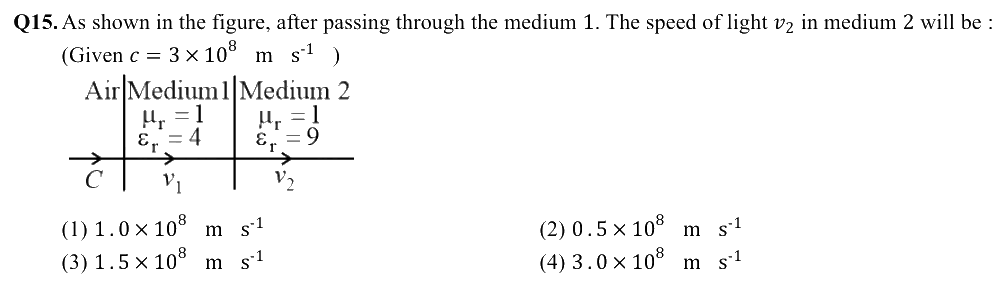
As shown in the figure, after passing through the medium 1. The speed of light $v_{2}$ in medium 2 will be : (Given $c=3\times10^{8}\ \mathrm{m\ s^{-1}}$ )
Sun light falls normally on a surface of area $36\ \mathrm{cm^{2}}$ and exerts an average force of $7.2\times10^{-9}\ \mathrm{N}$ within a time period of $20$ minutes. Considering a case of complete absorption, the energy flux of incident light is
A beam of light travelling along $X$-axis is described by the electric field $E_y$ = 900 $\sin\omega\left(t - \frac{x}{c}\right)$. The ratio of electric force to magnetic force on a charge $q$ moving along $Y$-axis with a speed of $3 \times 10^7$ $\mathrm{m~s^{-1}}$ will be : [Given speed of light = $3 \times 10^8$ $\mathrm{m~s^{-1}}$ ]
Identify the correct statements from the following descriptions of various properties of electromagnetic waves. A. In a plane electromagnetic wave electric field and magnetic field must be perpendicular to each other and direction of propagation of wave should be along electric field or magnetic field. B. The energy in electromagnetic wave is divided equally between electric and magnetic fields. C. Both electric field and magnetic field are parallel to each other and perpendicular to the direction of propagation of wave. D. The electric field, magnetic field and direction of propagation of wave must be perpendicular to each other. E. The ratio of amplitude of magnetic field to the amplitude of electric field is equal to speed of light. Choose the most appropriate answer from the options given below:
The magnetic field of a plane electromagnetic wave is given by $\overrightarrow{B} = 2 \times 10^{-8} \sin(0.5 \times 10^3 x + 1.5 \times 10^{11} t)\hat{j}$ T. The amplitude of the electric field would be
A
$6 \mathrm{~Vm^{-1}}$ along $x$-axis
B
$3 \mathrm{~Vm^{-1}}$ along $z$-axis
C
$6 \mathrm{~Vm^{-1}}$ along $z$-axis
D
$2 \times 10^{-8} \mathrm{~Vm^{-1}}$ along $z$-axis
The oscillating magnetic field in a plane electromagnetic wave is given by $B_y = 5\times10^{-6}\sin1000\pi5x - 4\times10^{8}t$ T. The amplitude of electric field will be
Light wave travelling in air along $x$-direction is given by $E_y = 540\sin\pi\times10^{4}(x - ct)\ \mathrm{V\,m^{-1}}$. Then, the peak value of magnetic field of wave will be (Given $c = 3\times10^{8}\ \mathrm{m\,s^{-1}}$)
A radar sends an electromagnetic signal of electric field $(E_0) = 2.25\ \mathrm{V\,m^{-1}}$ and magnetic field $(B_0) = 1.5 \times 10^{-8}\ \mathrm{T}$ which strikes a target on line of sight at a distance of $3\ \mathrm{km}$ in a medium. After that, a part of signal (echo) reflects back towards the radar with same velocity and by same path. If the signal was transmitted at time $t = 0$ from radar, then after how much time echo will reach to the radar?
An EM wave propagating in $x$-direction has a wavelength of $8\ \mathrm{mm}$. The electric field vibrating $y$-direction has maximum magnitude of $60\ \mathrm{Vm^{-1}}$. Choose the correct equations for electric and magnetic fields if the EM wave is propagating in vacuum :
Match List - I with List - II List-I (a) Ultraviolet rays (b) Microwaves (c) Infrared waves (d) $X$-rays List-II (i) Study crystal structure (ii) Greenhouse effect (iii) Sterilizing surgical instrument (iv) Radar system
Given below are two statements : Statement I: A time varying electric field is a source of changing magnetic field and vice-versa. Thus a disturbance in electric or magnetic field creates EM waves. Statement II: In a material medium, the EM wave travels with speed $v = \frac{1}{\sqrt{\mu_0 \epsilon_0}}$. In the light of the above statements, choose the correct answer from the options given below.
If Electric field intensity of a uniform plane electro magnetic wave is given as $E = -301.6 \sin(kz - \omega t)\hat{a}_x + 452.4 \sin(kz - \omega t)\hat{a}_y \mathrm{~V} \mathrm{~m}^{-1}$. Then, magnetic intensity $H$ of this wave in $\mathrm{A} \mathrm{~m}^{-1}$ will be [Given : Speed of light in vacuum $c = 3 \times 10^8 \mathrm{~m} \mathrm{~s}^{-1}$, Permeability of vacuum $\mu_0 = 4\pi \times 10^{-7} \mathrm{~N} \mathrm{~A}^{-2}$]
The electric field in an electromagnetic wave is given by $E = 56.5 \sin\omega\frac{t - x}{c} \mathrm{NC}^{-1}$. Find the intensity of the wave if it is propagating along $x$-axis in the free space. (Given $\epsilon_0 = 8.85 \times 10^{-12} \mathrm{C}^2 \mathrm{~N}^{-1} \mathrm{~m}^{-2}$)
The electromagnetic waves travel in a medium at a speed of $2.0 \times 10^{8} \mathrm{~m~s^{-1}}$. The relative permeability of the medium is $1.0$. The relative permittivity of the medium will be
A plane electromagnetic wave travels in a medium of relative permeability $1.61$ and relative permittivity $6.44$. If magnitude of magnetic intensity is $4.5 \times 10^{-2} \mathrm{~A~m^{-1}}$ at a point, what will be the approximate magnitude of electric field intensity at that point ? (Given : Permeability of free space $\mu_0 = 4\pi \times 10^{-7} \mathrm{~N~A^{-2}}$, speed of light in vacuum $c = 3 \times 10^{8} \mathrm{~m~s^{-1}}$)
An electric bulb is rated as $200 \mathrm{~W}$. What will be the peak magnetic field at $4 \mathrm{~m}$ distance produced by the radiations coming from this bulb? Consider this bulb as a point source with $3.5\%$ efficiency.
Electric field of a plane electromagnetic wave propagating through a non-magnetic medium is given by $E = 20\cos 2 \times 10^{10}t - 200x$ V m$^{-1}$. The dielectric constant of the medium is equal to: (Take $\mu_r = 1$ )
The magnetic field vector of an electromagnetic wave is given by $B = B_0\frac{i + j}{\sqrt{2}}\cos kz - \omega t$ where $\hat{i}$, $\hat{j}$ represents unit vector along $x$ and $y$-axis respectively. At $t = 0$ s, two electric charges $q_1$ of $4\pi$ coulomb and $q_2$ of $2\pi$ coulomb located at $0, 0, \frac{\pi}{k}$ and $0, 0, \frac{3\pi}{k}$, respectively, have the same velocity of $0.5c\hat{i}$, (where $c$ is the velocity of light ). The ratio of the force acting on charge $q_1$ to $q_2$ is :
The electric field in a plane electromagnetic wave is given by, $E = 50\sin(500x - 10 \times 10^{10}t)$ V m$^{-1}$. The velocity of an electromagnetic wave in this medium is: (Given $c$ = the speed of light in vacuum.)
A light beam is described by $E=800\sin\omega\left(t-\frac{x}{c}\right)$. An electron is allowed to move normal to the propagation of light beam with a speed of $3\times10^{7}\ \mathrm{m\ s^{-1}}$. What is the maximum magnetic force exerted on the electron?
A linearly polarised electromagnetic wave in vacuum is $E = 3.1\cos(1.8z - 5.4 \times 10^{6}t)\hat{i}\ \mathrm{N\ C^{-1}}$ is incident normally on a perfectly reflecting wall at $z = a$. Choose the correct option.
A
The wavelength is $5.4\ \mathrm{m}$.
B
The frequency of electromagnetic wave is $54 \times 10^{4}\ \mathrm{Hz}$.
C
The transmitted wave will be $3.1\cos(1.8z - 5.4 \times 10^{6}t)\hat{i}\ \mathrm{N/C}$.
D
The reflected wave will be $3.1\cos(1.8z + 5.4 \times 10^{6}t)\hat{i}\ \mathrm{N\ C^{-1}}$.
Intensity of sunlight is observed as $0.092\ \mathrm{Wm^{-2}}$ at a point in free space. What will be the peak value of magnetic field at that point ? ($\varepsilon_0 = 8.85 \times 10^{-12}\ \mathrm{C^2\ N^{-1}\ m^{-2}}$)
$AC$ voltage $V(t) = 20\ \sin \omega t$ of frequency $50\ \mathrm{Hz}$ is applied to a parallel plate capacitor. The separation between the plates is $2\ \mathrm{mm}$ and the area is $1\ \mathrm{m}^2$. The amplitude of the oscillating displacement current for the applied $AC$ voltage is $\left[\text{Take } \varepsilon_0 = 8.85 \times 10^{-12}\ \mathrm{F\ m^{-1}}\right]$
In an electromagnetic wave, the electric field vector and magnetic field vector are given as $\overrightarrow{E} = E_0\hat{\mathrm{i}}$ and $\overrightarrow{B} = B_0\hat{\mathrm{k}}$, respectively. The direction of propagation of electromagnetic wave is along:
A plane electromagnetic wave of frequency $100~\mathrm{MHz}$ is traveling in a vacuum along the $x-$direction. At a particular point in space and time, $\vec{B} = 2.0 \times 10^{-8}~\hat{k}\mathrm{T}$. (where, $\hat{k}$ is unit vector along $z-$direction) What is $\vec{E}$ at this point?
A plane electromagnetic wave propagating along y-direction can have the following pair of electric field $\left(\vec{E}\right)$ and magnetic field $\left(\vec{B}\right)$ components.
A plane electromagnetic wave of frequency 500 MHz is traveling in a vacuum along the $y$-direction. At a particular point in space and time, $\vec{B}=8.0 \times 10^{-8} \hat{z} \mathrm{~T}$. The value of the electric field at this point is:(speed of light $=3 \times 10^8 \mathrm{~ms}^{-1}$) $\hat{x}, \hat{y}, \hat{z}$ are unit vectors along $x, y$ and $z$ direction.
For an electromagnetic wave travelling in free space, the relation between average energy densities due to electric $\left(U_e\right)$ and magnetic $\left(U_m\right)$ fields is :
Match List - I with List - II. List-I (a) Source of microwave frequency (b) Source of infrared frequency (c) Source of Gamma Rays (d) Source of X-rays List-II (i) Radioactive decay of nucleus (ii) Magnetron (iii) Inner shell electrons (iv) Vibration of atoms and molecules (v) LASER (vi) RC circuit Choose the correct answer from the options given below:
For a plane electromagnetic wave, the magnetic field at a point x and time t is : $\vec{B}(x, t) = \left[1.2 \times 10^{-7}\sin\left(0.5 \times 10^3 x + 1.5 \times 10^{11}t\right)\hat{k}\right]$ T. The instantaneous electric field $\vec{E}$ corresponding to $\vec{B}$ is :
An electron is constrained to move along the $y$-axis with a speed of 0. 1 $c$ (c is the speed of light) in the presence of electromagnetic wave, whose electric field is $\vec{\mathrm{E}} = 30\hat{j}\sin\left(1.5 \times 10^7 \mathrm{t} - 5 \times 10^{-2}\mathrm{x}\right)$ V m$^{-1}$. where $t$ in seconds and $x$ is im (sic) meters.The maximum magnetic force experienced by the electron will be: (given c = 3 $\times 10^8$ m s$^{-1}$ and electron charge = 1. 6 $\times 10^{-19}$ Coloumbs
The correct match between the entries in column I and column II are : Column I (Radiation): a Microwave, b Gamma rays, c A.M. radio, d X-rays Column II (Wavelength): i $100\ m$, ii $10^{-15}\mathrm{m}$, iii $10^{-10}\mathrm{m}$, iv $10^{-3}\mathrm{m}$
The electric field of a plane electromagnetic wave is given by $\vec{E} = E_{0}\left(\hat{x}+\hat{y}\right)\sin(kz-\omega t)$. Its magnetic field will be given by
The magnetic field of a plane electromagnetic wave is $\vec{B} = 3\times 10^{-8}\sin[200\pi(y + ct)]\hat{i}\ \mathrm{T}$ . Where, $c = 3\times 10^{8}\ \mathrm{m\,s^{-1}}$ is the speed of light the corresponding electric filed is :
The electric field of a plane electromagnetic wave propagating along the x direction in vacuum is $\vec{E} = E_0\hat{j}\cos(\omega t - kx)$. The magnetic field $\vec{B}$, at the moment $t = 0$ is:
A plane electromagnetic wave, has frequency of $2.0 \times 10^{10}\ \mathrm{Hz}$ and its energy density is $1.02 \times 10^{-8}\ \mathrm{J\ m}^{-3}$ in vacuum. The amplitude of the magnetic field of the wave is close to $\left(\frac{1}{4\pi\epsilon_{0}} = 9 \times 10^{9}\ \frac{\mathrm{Nm}^{2}}{\mathrm{C}^{2}}\right)$ and speed of light $= 3 \times 10^{8}\ \mathrm{m\ s}^{-1}$.
In a plane electromagnetic wave, the directions of electric field and magnetic field are represented by $\hat{k}$ and $2\hat{i} - 2\hat{j}$, respectively. What is the unit vector along direction of propagation of the wave.
The electric fields of two plane electromagnetic plane waves in vacuum are given by $\overrightarrow{E_1} = E_0\hat{j}\cos(\omega t - kx)$ and $\overrightarrow{E_2} = E_0\hat{k}\cos(\omega t - ky)$ At $t = 0$, a particle of charge $q$ is at origin with a velocity $\overrightarrow{v} = 08c\hat{j}$ ( $c$ is the speed of light in vaccum). The instantaneous force experienced by the particle is:
A plane electromagnetic wave is propagating along the direction $\frac{\hat{i}+\hat{j}}{\sqrt{2}}$, with its polarization along the direction $\hat{k}$. The correct form of the magnetic field of the wave would be (here $B_0$ is an appropriate constant):
A
$B_0 \frac{\hat{i}-\hat{j}}{\sqrt{2}} \cos\left(\omega t - k\frac{\hat{i}+\hat{j}}{\sqrt{2}}\right)$
B
$B_0 \frac{\hat{j}-\hat{i}}{\sqrt{2}} \cos\left(\omega t + k\frac{\hat{i}+\hat{j}}{\sqrt{2}}\right)$
C
$B_0 \hat{k} \cos\left(\omega t - k\frac{\hat{i}+\hat{j}}{\sqrt{2}}\right)$
D
$B_0 \frac{\hat{i}+\hat{j}}{\sqrt{2}} \cos\left(\omega t - k\frac{\hat{i}+\hat{j}}{\sqrt{2}}\right)$
A plane electromagnetic wave of frequency $25\mathrm{GHz}$ is propagating in vacuum along the z-direction. At a particular point in space and time, the magnetic filed is given by $\vec{B} = 5 \times 10^{-8}\,\hat{j}\,T$. The corresponding electric field $\vec{E}$ is (speed of light $= 3 \times 10^{8}\ \mathrm{m\ s^{-1}}$)
If the magnetic field in a plane electromagnetic wave is given by $\vec{B} = 3 \times 10^{-8}\sin(1.6 \times 10^3 x + 48 \times 10^{10}t)\hat{j}T$, then what will be expression for electric field ?
A
$\vec{E} = \left(60\sin(1.6 \times 10^3 x + 48 \times 10^{10}t)\hat{k}\frac{\mathrm{V}}{\mathrm{m}}\right)$
B
$\vec{E} = \left(9\sin(1.6 \times 10^3 x + 48 \times 10^{10}t)\hat{k}\frac{\mathrm{V}}{\mathrm{m}}\right)$
The electric field of a plane electromagnetic wave is given by $\vec{E} = E_0\frac{\hat{i}+\hat{j}}{\sqrt{2}}\cos(kz + \omega t)$. At $t = 0$, a positively charged particle is at the point $(x, y, z) = \left(0, 0, \frac{\pi}{k}\right)$. If its instantaneous velocity at $(t = 0)$ is $v_0\hat{k}$, the force acting on it due to the wave is:
A
parallel to $\frac{\hat{i}+\hat{j}}{\sqrt{2}}$
B
zero
C
antiparallel to $\frac{\hat{i}+\hat{j}}{\sqrt{2}}$
A plane electromagnetic wave having a frequency $f = 23.9\ \mathrm{GHz}$ propagates along the positive $z-$ direction in free space. The peak value of the Electric Field is 60 V/m. Which among the following is the acceptable magnetic field component in the electromagnetic wave?
The electric field of a plane electromagnetic wave is given by $\vec{E} = E_0\hat{i}\ \cos(kz)\cos\left(\omega t\right)$ The corresponding magnetic field $\vec{B}$ is then given by:
Light is incident normally on a completely absorbing surface with an energy flux of $25\ \mathrm{W\,cm^{-2}}$. If the surface has an area of $25\ \mathrm{cm^{2}}$, the momentum transferred to the surface in 40 min time duration will be:
The magnetic field of a plane electromagnetic wave is given by $\vec{B} = B_0\hat{i}[\cos(kz - \omega t)] + B_1\hat{j}\cos(kz + \omega t)$, where $B_0 = 3 \times 10^{-5}$ T and $B_1 = 2 \times 10^{-6}$ T. The RMS value of the force experienced by a stationary charge Q = $10^{-4}$ C at z = 0 is closest to
Sunlight of intensity 50 $\mathrm{W\ m^{-2}}$ is incident normally on the surface of a solar panel. Some part of incident energy (25%) is reflected from the surface and the rest is absorbed. The force exerted on 1 $\mathrm{m^2}$ surface area will be close to ($c = 3 \times 10^8\ \mathrm{m\ s^{-1}}$)
A plane electromagnetic wave travels in free space along the x-direction. The electric field component of the wave at a particular point of space and time is $E = 6\ \mathrm{V\,m^{-1}}$ along y-direction. Its corresponding magnetic field component, B would be:
The magnetic field of an electromagnetic wave is given by: $\vec{B}$ = $1.6 \times 10^{-6}\cos 2 \times 10^7 z + 6 \times 10^{15}t\ 2\hat{i} + \hat{j}\ \frac{\mathrm{Wb}}{\mathrm{m^2}}$ The associated electric field will be:
A light wave is incident normally on a glass slab of refractive index 1.5. If $4\%$ of light gets reflected and the amplitude of the electric field of the incident light is $30\ \frac{V}{m}$, then the amplitude of the electric field for the wave propagating in the glass medium will be:
An electromagnetic wave of intensity 50Wm$^{-2}$ enters in a medium of refractive index 'n' without any loss. The ratio of the magnitudes of electric fields, and the ratio of the magnitudes of magnetic fields of the wave before and after entering into the medium are respectively, given by :
A 27 mW laser beam has a cross-sectional area of 10 mm$^2$. The magnitude of the maximum electric field in this electromagnetic wave is given by: [Given permittivity of space $\epsilon_0 = 9 \times 10^{-12}$SI units, Speed of light c = $3 \times 10^8$ m/s]
If the magnetic field of a plane electromagnetic wave is given by (The speed of light $= 3 \times 10^8\ m/s$) $B = 100 \times 10^{-6}\ \sin\left[2\pi \times 2 \times 10^{15}\left(t - \frac{x}{c}\right)\right]$ then the maximum electric field associated with it is:
The electric field of a plane polarized electromagnetic wave in free space at time $t = 0$ is given by the expression $\overrightarrow{E}(x,\ y) = 10\hat{j}\cos(6x + 8z)$. The magnetic field $\overrightarrow{B}(x,\ z,\ t)$ is given by ($c$ is the velocity of light.)
A plane electromagnetic wave of frequency $50\ MHz$ travels in free space along the positive $x$ - direction. At a particular point in space and time, $\overrightarrow{E} = 6.3\ \hat{j}\ V\ /\ m$, The corresponding magnetic field $\overrightarrow{B}$, at that point will be:
A plane electromagnetic wave of wavelength $\lambda$ has an intensity $I$. It is propagating along the positive $Y-$direction. The allowed expressions for the electric and magnetic fields are given by:
A monochromatic beam of light has a frequency $v = \frac{3}{2\pi}\times 10^{12}\ \mathrm{Hz}$ and is propagating along the direction $\frac{\hat{i}+\hat{j}}{\sqrt{2}}$. It is polarized along the $\hat{k}$ direction. The acceptable form for the magnetic field is:
Answer: (B) $\frac{E_0}{C}\left(\frac{\hat{i}-\hat{j}}{\sqrt{2}}\right)\cos\left[10^4\left(\frac{\hat{i}+\hat{j}}{\sqrt{2}}\right)\cdot\vec{r}-(3\times10^{12})t\right]$· Checked by our team
A plane polarized monochromatic EM wave is travelling a vacuum along $z$ direction such that at $\mathrm{t} = \mathrm{t_1}$ it is found that the electric field is zero at a spatial point $\mathrm{z_1}$. The next zero that occurs in its neighbourhood is at $\mathrm{z_2}$. The frequency of the electromagnetic wave is:
An EM wave from air enters a medium. The electric fields are $\vec{E_1} = E_{01}\hat{x}\cos\left[2\pi v\left(\dfrac{z}{c} - t\right)\right]$ in air and $\vec{E_2} = E_{02}\hat{x}\cos[k(2z - ct)]$in medium, where the wave number k and frequency $v$ refer to their values in the air. The medium is non-magnetic. If $\epsilon_{r_1}$ and $\epsilon_{r_2}$ refer to relative permittivities of air and medium respectively, which of the following options, is correct?
The electric field component of a monochromatic radiation is given by $\overrightarrow{E} = 2E_0 \cos kz \cos\omega t\ \hat{i}$, Its magnetic field $\overrightarrow{B}$ is then given by:
Magnetic field in a plane electromagnetic wave is given by, $\vec{B} = B_0\sin(kx + \omega t)\hat{j}$ T. Expression for corresponding electric field will be: (Where $c$ is speed of light)
Consider an electromagnetic wave propagating in vacuum. Choose the correct statement:
A
For an electromagnetic wave propagating in $+y$ direction the electric field is $\vec{E} = \frac{1}{\sqrt{2}}E_{yz}(x,t)\hat{z}$ and the magnetic field is $\vec{B} = \frac{1}{\sqrt{2}}B_{z}(x,t)\hat{y}$
B
For an electromagnetic wave propagating in + y direction the electric field is $\vec{E} = \frac{1}{\sqrt{2}}E_{yz}(x,t)\hat{y}$ and the magnetic field is $\vec{B} = \frac{1}{\sqrt{2}}B_{\mathrm{yz}}(x,t)\hat{z}$
C
For an electromagnetic wave propagating in + x direction the electric field is $\vec{E} = \frac{1}{\sqrt{2}}E_{yz}(y,\ z,\ t)\ (\hat{y} + \hat{z})$ and the magnetic field is $\vec{B} = \frac{1}{\sqrt{2}}E_{yz}(y,\ z,\ t)\ (\hat{y} + \hat{z})$
D
For an electromagnetic wave propagating in + x direction the electric field is $\vec{E} = \frac{1}{\sqrt{2}}E_{yz}(x,t)\ (\hat{y} - \hat{z})$ and the magnetic field is $\vec{B} = \frac{1}{\sqrt{2}}\ B_{yz}(x,\ t)(\hat{y} + \hat{z})$
Answer: (D) For an electromagnetic wave propagating in + x direction the electric field is $\vec{E} = \frac{1}{\sqrt{2}}E_{yz}(x,t)\ (\hat{y} - \hat{z})$ and the magnetic field is $\vec{B} = \frac{1}{\sqrt{2}}\ B_{yz}(x,\ t)(\hat{y} + \hat{z})$· Key from source paper
Arrange the following electromagnetic radiations per quantum in the order of increasing energy: A : Blue light B : Yellow light C : X-ray D : Radiowave
For plane electromagnetic waves propagating in the $+z$-direction, which one of the following combinations gives the correct possible direction for $\vec{E}$ and $\vec{B}$ field respectively?
A
$\left(\hat{i} + 2\hat{j}\right)$ and $\left(2\hat{i} - \hat{j}\right)$
B
$\left(-2\hat{i} - 3\hat{j}\right)$ and $\left(3\hat{i} - 2\hat{j}\right)$
C
$\left(2\hat{i} + 3\hat{j}\right)$ and $\left(\hat{i} + 2\hat{j}\right)$
D
$\left(3\hat{i} + 4\hat{j}\right)$ and $\left(4\hat{i} - 3\hat{j}\right)$
An electromagnetic wave travelling in the $x-$ direction has frequency of $2 \times 10^{14}$ H z and electric field amplitude of $27\ \mathrm{V\,m^{-1}}$ oscillates in $Y-$direction. From the options given below, which one describes the magnetic field for this wave?
A red $LED$ emits light at $0.1$ watt uniformly around it. The amplitude of the electric field of the light at a distance of $1\ \mathrm{m}$ from the diode is:
If microwaves, $X$-rays, infrared, gamma rays, ultraviolet, radio waves and visible parts of the electromagnetic spectrum are denoted respectively by $M$, $X$, $I$, $G$, $U$, $R$ and $V$ the following is the arrangement in ascending order of the wavelength
A lamp emits monochromatic green light uniformly in all directions. The lamp is $3\%$ efficient in converting electrical power to electromagnetic waves and consumes $100\ \mathrm{W}$ of power. The amplitude of the electric field associated with the electromagnetic radiation at a distance of $5\ \mathrm{m}$ from the lamp will be nearly:
An electromagnetic wave of frequency $1 \times 10^{14}$ hertz is propagating along z-axis. The amplitude of electric field is $4\ \mathrm{V/m}$. If $\varepsilon_0 = 8.8 \times 10^{-12}\mathrm{C}^2/\mathrm{N{-}\ m}^2$, then average energy density of electric field will be:
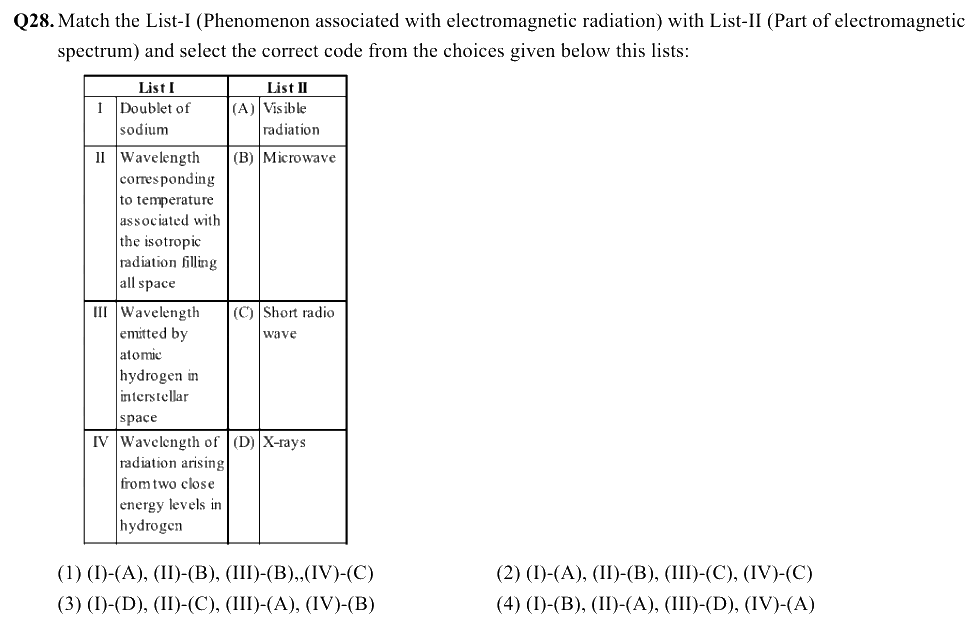
Match the List-I (Phenomenon associated with electromagnetic radiation) with List-II (Part of electromagnetic spectrum) and select the correct code from the choices given below this lists: (see the figure above)
Match List I (Wavelength range of electromagnetic spectrum) with List II (Method of production of these waves) and select the correct option from the options given below the lists. List I | List II (a) 700 nm to 1 mm | (i) Vibration of atoms and molecules. (b) 1 nm to 400 nm | (ii) Inner shell electrons in atoms moving from one energy level to a lower level. (c) $< 10^{-3}$ nm | (iii) Radioactive decay of the nucleus. (d) 1 mm to 0.1 m | (iv) Magnetron valve.
Match List - I (Electromagnetic wave type) with List - II (Its association/application) and select the correct option from the choices given below the lists :
List - I (a) Infrared waves (b) Radio waves (c) X - rays (d) Ultraviolet rays
List - II (i) To treat muscular strain (ii) For broadcasting (iii) To detect fracture of bones (iv) Absorbed by the ozone layer of the atmosphere
This question has Statement-1 and Statements2. Of the four choices given after the Statements, choose the one that best describes the two Statements. Statement-1 : Out of radio waves and microwaves, the radio waves undergo more diffraction. Statement-2 : Radio waves have greater frequency compared to microwaves.
A
Statement-1 is true, Statement-2 is true and Statement-2 is the correct explanation of Statement-1
B
Statement-1 is false, Statement-2 is true.
C
Statement-1 is true, Statement-2 is false.
D
Statement-1 is true, Statement-2 is true but Statement-2 is not the correct explanation of Statement-1
A parallel plate capacitor of area $60\ \mathrm{cm^2}$ and separation 3 mm is charged initially to $90\mu\mathrm{C}$. If the medium between the plate gets slightly conducting and the plate loses the charge initially at the rate of $2.5 \times 10^{-8}\mathrm{C/s}$, then what is the magnetic field between the plates ?
To establish an instantaneous current of $2\ \mathrm{A}$ through a $1\mu\mathrm{F}$ capacitor ; the potential difference across the capacitor plates should be changed at the rate of:
A plane electromagnetic wave in a non-magnetic dielectric medium is given by $\vec{E} = \vec{E}_0\left(4 \times 10^{-7}x - 50t\right)$ with distance being in meter and time in seconds. The dielectric constant of the medium is :
A radio transmitter transmits at 830kHz. At a certain distance from the transmitter magnetic field has amplitude $4.82 \times 10^{-11}$ T. The electric field and the wavelength are respectively
An electromagnetic wave with frequency $\omega$ and wavelength $\lambda$ travels in the $+y$ direction. Its magnetic field is along $+x$-axis. The vector equation for the associated electric field (of amplitude $E_0$ ) is
A
$\vec{E} = -E_0\cos\left(\omega t + \frac{2\pi}{\lambda}y\right)\hat{x}$
B
$\vec{E} = E_0\cos\left(\omega t - \frac{2\pi}{\lambda}y\right)\hat{x}$
C
$\vec{E} = E_0\cos\left(\omega t - \frac{2\pi}{\lambda}y\right)\hat{z}$
D
$\vec{E} = -E_0\cos\left(\omega t + \frac{2\pi}{\lambda}y\right)\hat{z}$
An electromagnetic wave in vacuum has the electric and magnetic fields $\vec{E}$ and $\vec{B}$, which are always perpendicular to each other. The direction of polarization is given by $\vec{X}$ and that of wave propagation by $\vec{k}$. Then :
A
$\vec{X} \parallel \vec{B}$ and $\vec{k} \parallel \vec{B} \times \vec{E}$
B
$\vec{X} \parallel \vec{E}$ and $\vec{k} \parallel \vec{E} \times \vec{B}$
C
$\vec{X} \parallel \vec{B}$ and $\vec{k} \parallel \vec{E} \times \vec{B}$
D
$\vec{X} \parallel \vec{E}$ and $\vec{k} \parallel \vec{B} \times \vec{E}$
The equation of the electric field of an electromagnetic wave propagating through free space is given by : $E = \sqrt{377}\,\sin(6.27 \times 10^3\,t - 2.09 \times 10^{-5}\,x)$ N/C
The average power of the electromagnetic wave is $\left(\dfrac{1}{\alpha}\right)$ W/m$^2$. The value of $\alpha$ is ________
$\left(\text{Take } \sqrt{\dfrac{\mu_0}{\epsilon_0}} = 377 \text{ in SI units}\right)$
Numerical answer type: type your answer in EdLoop to check it
An electromagnetic wave of frequency 100 MHz propagates through a medium of conductivity, $\sigma = 10$ mho/m. The ratio of maximum conduction current density to maximum displacement current density is ________.
If an optical medium possesses a relative permeability of $\frac{10}{\pi}$ and relative permittivity of $\frac{1}{0.0885}$, then the velocity of light is greater in vacuum than that in this medium by ______ times. $\left(\mu_0 = 4\pi \times 10^{-7}H/m, \epsilon_0 = 8.85 \times 10^{-12}F/m, c = 3 \times 10^8m/s\right)$
Numerical answer type: type your answer in EdLoop to check it
A parallel plate capacitor consisting of two circular plates of radius 10 cm is being charged by a constant current of 0.15 A . If the rate of change of potential difference between the plates is $7 \times 10^8$ V/s then the integer value of the distance between the parallel plates is ( Take, $\epsilon_0 = 9 \times 10^{-12}\ \frac{\mathrm{F}}{\mathrm{m}}$, $\pi = \frac{22}{7}$) ______ $\mu$m.
Numerical answer type: type your answer in EdLoop to check it
A time varying potential difference is applied between the plates of a parallel plate capacitor of capacitance $2.5\mu$ F. The dielectric constant of the medium between the capacitor plates is 1 . It produces an instantaneous displacement current of 0.25 mA in the intervening space between the capacitor plates, the magnitude of the rate of change of the potential difference will be ______ $\mathrm{Vs}^{-1}$.
Numerical answer type: type your answer in EdLoop to check it
A parallel plate capacitor of area $A = 16\ \mathrm{cm}^2$ and separation between the plates 10 cm , is charged by a DC current. Consider a hypothetical plane surface of area $\mathrm{A}_0 = 3.2\ \mathrm{cm}^2$ inside the capacitor and parallel to the plates. At an instant, the current through the circuit is 6A. At the same instant the displacement current through $\mathrm{A}_0$ is ______ mA .
Numerical answer type: type your answer in EdLoop to check it
In a medium the speed of light wave decreases to 0.2 times to its speed in free space. The ratio of relative permittivity to the refractive index of the medium is $x$: 1. The value of $x$ is ______. (Given speed of light in free space = $3 \times 10^8$ $\mathrm{m\ s^{-1}}$ and for the given medium $\mu_r$ = 1)
Numerical answer type: type your answer in EdLoop to check it
A point source of light is placed at the centre of curvature of a hemispherical surface. The source emits a power of 24 W. The radius of curvature of hemisphere is 10 cm and the inner surface is completely reflecting. The force on the hemisphere due to the light falling on it is ______ $\times$ $10^{-8}$ N.
Numerical answer type: type your answer in EdLoop to check it
Nearly 10% of the power of a 110 W light bulb is converted to visible radiation. The change in average intensities of visible radiation, at a distance of 1 m from the bulb to a distance of 5 m is $a \times 10^{-2}\ \mathrm{W\ m^{-2}}$. The value of '$a$' will be
Numerical answer type: type your answer in EdLoop to check it
The intensity of the light from a bulb incident on a surface is $0.22\ \mathrm{W\,m^{-2}}$. The amplitude of the magnetic field in this light-wave is ______ $\times 10^{-9}\ \mathrm{T}$ (Given : Permittivity of vacuum $\epsilon_0 = 8.85 \times 10^{-12}\ \mathrm{C^2\,N^{-1}\,m^{-2}}$, speed of light in vacuum $c = 3 \times 10^8\ \mathrm{m\,s^{-1}}$ )
Numerical answer type: type your answer in EdLoop to check it
The displacement current of $4.425\ \mu\mathrm{A}$ is developed in the space between the plates of parallel plate capacitor when voltage is changing at a rate of $10^6\ \mathrm{V\,s^{-1}}$. The area of each plate of the capacitor is $40\ \mathrm{cm^2}$. The distance between each plate of the capacitor is $x \times 10^{-3}\ \mathrm{m}$. The value of $x$ is , (Permittivity of free space, $\varepsilon_0 = 8.85 \times 10^{-12}\ \mathrm{C^2\,N^{-1}\,m^{-2}}$) ______
Numerical answer type: type your answer in EdLoop to check it
The electric field in an electromagnetic wave is given by $E = \left(50\ \mathrm{N\ C^{-1}}\right)\sin\omega\left(t - \frac{x}{c}\right)$ The energy contained in a cylinder of volume $V$ is $5.5 \times 10^{-12}$ J. The value of $V$ is ______ cm$^3$. (given $\epsilon_0 = 8.8 \times 10^{-12}$C$^2$ N$^{-1}$ m$^{-2}$)
Numerical answer type: type your answer in EdLoop to check it
A plane electromagnetic wave with a frequency of $30\ \mathrm{MHz}$ travels in free space. At a particular point in space and time, the electric field is $6\ \mathrm{V\ m^{-1}}$. The magnetic field at this point will be $x\times10^{-8}\ \mathrm{T}$. The value of $x$ is,
Numerical answer type: type your answer in EdLoop to check it
The electric field in a plane electromagnetic wave is given by $\vec{E}=200\cos\left[\left(0.5\times10^{3}\ \mathrm{m^{-1}}\right)x-\left(1.5\times10^{11}\ \mathrm{rad\ s^{-1}}\right)t\right]\ \mathrm{V\ m^{-1}}\ \hat{j}$. If this wave falls normally on a perfectly reflecting surface having an area of $100\ \mathrm{cm^{2}}$. If the radiation pressure exerted by the E.M. wave on the surface during a 10 min exposure is $\frac{k}{10^{9}}\ \mathrm{N\ m^{-2}}$. Find the value of $k$
Numerical answer type: type your answer in EdLoop to check it
If $2.5 \times 10^{-6} \mathrm{~N}$ average force is exerted by a light wave on a non-reflecting surface of $30 \mathrm{~cm}^2$ area during 40 min of time span, the energy flux of light just before it falls on the surface is ______ $\mathrm{W} \mathrm{cm}^{-2}$.(Round off to the Nearest Integer), (Assume complete absorption and normal incidence conditions are there)
Numerical answer type: type your answer in EdLoop to check it
The electric field intensity is produced by the radiation coming from a 100 W bulb at a distance of 3 m is $E$. The electric field intensity produced by the radiation coming from 60 W at the same distance is $\sqrt{\frac{x}{5}} E$. Where the value of $x=$ ______.
Numerical answer type: type your answer in EdLoop to check it
Seawater at a frequency $f=9 \times 10^2 \mathrm{~Hz}$, has permittivity $\varepsilon=80 \varepsilon_0$ and resistivity $\rho=0.25 \Omega \mathrm{m}$. Imagine a parallel plate capacitor is immersed in seawater and is driven by an alternating voltage source $V(t)=V_0 \sin (2 \pi f t)$. Then the conduction current density becomes $10^x$ times the displacement current density after time $t=\frac{1}{800} \mathrm{~s}$. The value of $x$ is ______ (Given : $\frac{1}{4 \pi \varepsilon_0}=9 \times 10^9 \mathrm{~N} \mathrm{~m}^2 \mathrm{C}^{-2}$ )
Numerical answer type: type your answer in EdLoop to check it
A radiation is emitted by $1000\ \mathrm{W}$ bulb and it generates an electric field and magnetic field at $P$, placed at a distance of $2\ \mathrm{m}$. The efficiency of the bulb is $1.25\%$. The value of peak electric field at $P$ is $x \times 10^{-1}\ \mathrm{V\,m^{-1}}$. Value of $x$ is ______ (Rounded-off to the nearest integer) [Take $\varepsilon_0 = 8.85 \times 10^{-12}\ \mathrm{C^2\,N^{-1}\,m^{-2}}$, $c = 3 \times 10^8\ \mathrm{m\,s^{-1}}$]
Numerical answer type: type your answer in EdLoop to check it
An electromagnetic wave of frequency $5\mathrm{GHz}$, is travelling in a medium whose relative electric permittivity and relative magnetic permeability both are $2$. Its velocity in this medium is ______ $\times 10^{7}\ \mathrm{m\ s^{-1}}$.
Numerical answer type: type your answer in EdLoop to check it
An electromagnetic wave of frequency $3\ \mathrm{GHz}$ enters a dielectric medium of relative electric permittivity $2.25$ from vacuum. The wavelength of this wave in that medium will be ______ $\times 10^{-2}$ cm.
Numerical answer type: type your answer in EdLoop to check it
Suppose that intensity of a laser is $\left(\frac{315}{\pi}\right)\ \mathrm{W\ m^{-2}}$. The rms electric field, in units of $\mathrm{V\ m^{-1}}$ associated with this source is close to the nearest integer is $-$ ($\varepsilon_0 = 8.86 \times 10^{-12}\ \mathrm{C^2\ N\ m^{-2}}$; $\mathrm{c} = 3 \times 10^8\ \mathrm{m\ s^{-1}}$)
Numerical answer type: type your answer in EdLoop to check it
Electromagnetic waves unifies electricity, magnetism, and optics under Unit 15: Electromagnetic Waves in the Class 12 syllabus, holding rank 13 among the 29 physics chapters. Throughout the 2019 to 2026 computerized period, 152 questions were drawn from electromagnetic waves across 162 papers, an average of 0.9 questions per exam session. The topic appeared in 142 of those 162 papers, and questions have been included in every single testing year. Looking at the three years from 2024 to 2026, candidates answered 52 questions across 58 papers, maintaining an average of 0.9 questions per test and a 3.4 percent subject share. The chapter's share is up compared to the 2002 to 2018 window, which recorded 37 questions across 38 papers for a 2.7 percent share. Relative to the complete 2019 to 2026 baseline, the recent share has stayed about the same. In 2026 alone, 17 questions were set across 19 papers, showing up in 16 individual sessions. Across 2019 to 2026, 22 questions appeared in numerical answer format, while the rest were multiple choice items testing field orientations, phase equations, and spectrum properties.
Most-asked topics
The exam splits questions between wave propagation fundamentals and qualitative spectrum classifications:
EM Waves: 162 questions historically, with 137 asked between 2019 and 2026, tested up to 2026. This dominant topic covers sinusoidal wave equations, the cross product relation linking electric field, magnetic field, and propagation direction, wave speed in vacuum and matter, energy density, intensity, radiation pressure, Poynting vector, and displacement current.
Electromagnetic Spectrum: 27 total questions, with 15 appearing from 2019 to 2026, continuing in 2026. Problems assess frequency and wavelength ordering, generation mechanisms, and practical applications of radio waves, microwaves, infrared radiation, visible light, ultraviolet rays, X-rays, and gamma rays.
What the questions look like
Electromagnetic waves questions in JEE Main follow clear mathematical and classification templates:
Matching field vectors and directions: Given a mathematical expression for an electric field oscillating along one Cartesian axis and propagating along another, students determine the amplitude, frequency, and directional unit vector of the corresponding magnetic field.
Phase speed and medium characteristics: Wave phase functions containing spatial frequency k and angular frequency omega allow extracting wave speed, which students relate to dielectric constant, magnetic permeability, or refractive index.
Intensity and field amplitudes: Evaluating the peak electric or magnetic field amplitude from the average intensity of a directional laser beam.
Matching spectrum bands to production sources: Associating specific electromagnetic bands such as X-rays or microwaves with physical processes like decelerating electrons or magnetron oscillations.
Questions to try first
Begin your practice with these representative recent problems:
Master the orthogonal vector geometry of transverse electromagnetic waves. The propagation direction always aligns with the vector cross product of the electric field vector with the magnetic field vector. Remembering this cross product rule prevents sign errors when writing out vector equations.
Keep the amplitude ratio E zero divided by B zero equal to the wave speed c at your fingertips. In any non-magnetic dielectric medium, wave speed equals c divided by the refractive index, where the refractive index equals the square root of the relative dielectric constant.
Review the NCERT table for the electromagnetic spectrum thoroughly. Memorize the wavelength ranges, detection methods, and production mechanisms for each band from radio waves to gamma rays, as direct matching questions appear routinely.
Frequently asked questions
Which topic within electromagnetic waves is asked most frequently?
Wave equations and vector relationships account for 137 of the 142 modern questions. Questions testing the cross product relationship between electric field, magnetic field, and wave velocity form the bedrock of the chapter.
What is the most common mistake students make in this chapter?
Students frequently assign the wrong direction to the magnetic field vector by forgetting that the cross product of electric field with magnetic field must point in the direction of wave travel. Writing out unit vector cross products explicitly avoids this error.
How are displacement current questions framed in JEE Main?
Questions usually ask for displacement current inside parallel plate capacitors during charging, or test Maxwell-Ampere law matching relationships connecting total current to surface flux derivatives. Step-by-step solutions for each one are in the EdLoop app.