A liquid of density 600 kg/m$^3$ flowing steadily in a tube of varying cross-section. The cross-section at a point $A$ is 1.0 cm$^2$ and that at $B$ is 20 mm$^2$. Both the points $A$ and $B$ are in same horizontal plane, the speed of the liquid at $A$ is 10 cm/s. The difference in pressures at $A$ and $B$ points is ________ Pa.
A spherical liquid drop of radius $R$ acquires the terminal velocity $v_1$ when falls through a gas of viscosity $\eta$. Now the drop is broken into 64 identical droplets and each droplet acquires terminal velocity $v_2$ falling through the same gas. The ratio of terminal velocities $v_1/v_2$ is ________.
A cylindrical vessel of 40 cm radius is completely filled with water and its capacity is 528 dm$^3$ (dm : decimeter) The vessel is placed on a solid block of exactly same height as vessel. If a small hole is made at 70 cm below the top of water level, then horizontal range of water falling on the ground in the beginning is ________ cm.
Eight mercury drops, each of radius $r$, coalesce to form a bigger drop. The surface energy released in this process is ________. (S is the surface tension of mercury).
A water spray gun is attached to a hose of cross sectional area 30 cm$^2$. The gun comprises of 10 perforations each of cross sectional area of 15 mm$^2$. If the water flows in the hose with the speed of 50 cm/s, calculate the speed at which the water flows out from each perforation. (Neglect any edge effects)
A liquid drop of diameter 2 mm breaks into 512 droplets. The change in surface energy is $\alpha\times10^{-6}$ J. The value of $\alpha$ is ________. (Take surface tension of liquid $= 0.08$ N/m)
The surface tension of a soap bubble is 0.03 N/m. The work done in increasing the diameter of bubble from 2 cm to 6 cm is $\alpha\pi\times10^{-4}$ J. The value of $\alpha$ is ________. (Take $\pi = 3.14$)
If an air bubble of diameter 2 mm rises steadily through a liquid of density 2000 kg/m$^3$ at a rate of 0.5 cm/s, then the coefficient of viscosity of liquid is ________ Poise. (Take g = 10 m/s$^2$)
A cubical block of density $\rho_b = 600$ kg/m$^3$ floats in a liquid of density $\rho_e = 900$ kg/m$^3$. If the height of block is $H = 8.0$ cm then height of the submerged part is ________ cm.
A small metallic sphere of diameter 2 mm and density 10.5 g/cm$^3$ is dropped in glycerine having viscosity 10 Poise and density 1.5 g/cm$^3$ respectively. The terminal velocity attained by the sphere is ________ cm/s.
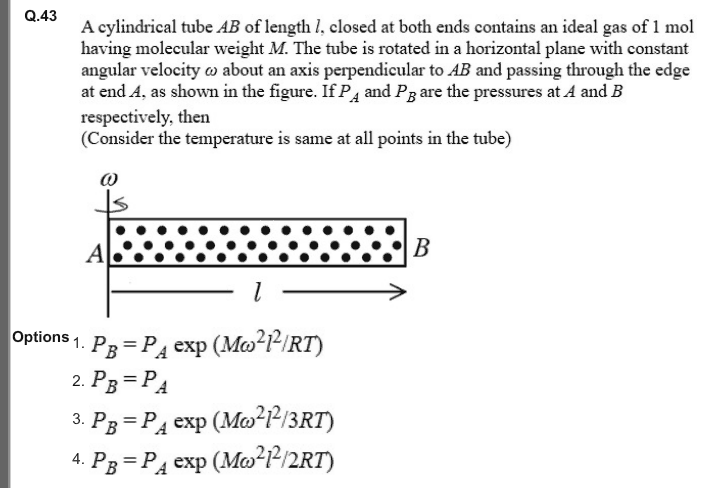
A cylindrical tube $AB$ of length $l$, closed at both ends contains an ideal gas of 1 mol having molecular weight $M$. The tube is rotated in a horizontal plane with constant angular velocity $\omega$ about an axis perpendicular to $AB$ and passing through the edge at end $A$, as shown in the figure. If $P_A$ and $P_B$ are the pressures at $A$ and $B$ respectively, then
(Consider the temperature is same at all points in the tube)
When a part of a straight capillary tube is placed vertically in a liquid, the liquid raises upto certain height $h$. If the inner radius of the capillary tube, density of the liquid and surface tension of the liquid decrease by 1% each, then the height of the liquid in the tube will change by ________ %.
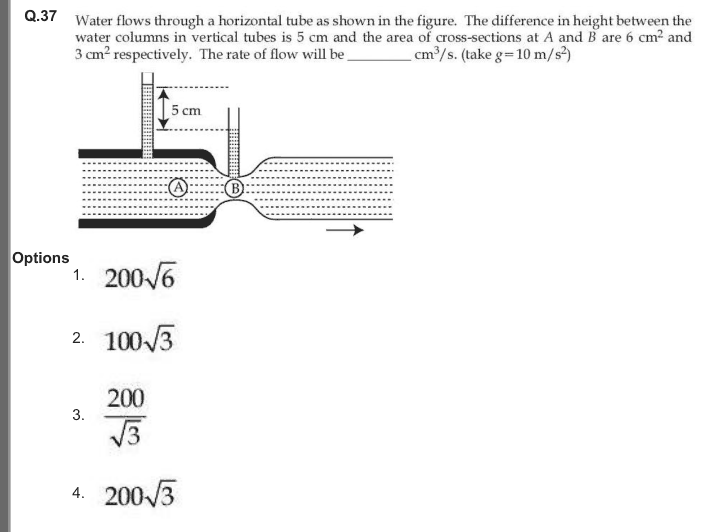
Water flows through a horizontal tube as shown in the figure. The difference in height between the water columns in vertical tubes is 5 cm and the area of cross-sections at $A$ and $B$ are 6 cm$^2$ and 3 cm$^2$ respectively. The rate of flow will be ________ cm$^3$/s. (take $g = 10$ m/s$^2$)
Surface tension of two liquids (having same densities), $T_1$ and $T_2$, are measured using capillary rise method utilizing two tubes with inner radii of $r_1$ and $r_2$ where $r_1 > r_2$. The measured liquid heights in these tubes are $h_1$ and $h_2$ respectively. [Ignore the weight of the liquid about the lowest point of meniscus]. The heights $h_1$ and $h_2$ and surfaces tensions $T_1$ and $T_2$ satisfy the relation :
A capillary tube of radius 0.1 mm is partly dipped in water (surface tension 70dyn/cm and glass water contact angle $\approx 0^\circ$ ) with 30º inclined with the vertical. The length of water risen in the capillary is ______ cm . (Take $g = 9.8m/s^2$ )
Two liquids A and B have $\theta_A$ and $\theta_B$ as contact angles in a capillary tube. If $K = \cos\theta_A / \cos\theta_B$, then identify the correct statement:
A
K is negative, then liquid A and liquid B have concave meniscus.
B
K is zero, then liquid A has convex meniscus and liquid B has concave meniscus.
C
K is negative, then liquid A and liquid B have convex meniscus.
D
K is negative, then liquid A has concave meniscus and liquid B has convex meniscus.
Consider a completely full cylindrical water tank of height 1.6 m and of cross-sectional area $0.5m^2$. It has a small hole in its side at a height 90 cm from the bottom. Assume, the cross-sectional area of the hole to be negligibly small as compared to that of the water tank. If a load 50 kg is applied at the top surface of the water in the tank then the velocity of the water coming out at the instant when the hole is opened is: $\left(g = 10m/s^2\right)$
A solid steel ball of diameter 3.6 mm acquired terminal velocity $2.45 \times 10^{-2}m / s$ while falling under gravity through an oil of density $925kgm^{-3}$. Take density of steel as $7825kgm^{-3}$ and g as 9.8 $m/s^2$. The viscosity of the oil in SI unit is
Two cylindrical vessels of equal cross sectional area of $2m^2$ contain water upto heights 10 m and 6 m, respectively. If the vessels are connected at their bottom then the work done by the force of gravity is
(Density of water is $10^3kg / m^3$ and $g = 10m/s^2$ )
Two water drops each of radius ' $r$ ' coalesce to form a bigger drop. If ' $T$ ' is the surface tension, the surface energy released in this process is :
In the experiment for measurement of viscosity ' $\eta$ ' of given liquid with a ball having radius $R$, consider following statements. A. Graph between terminal velocity V and R will be a parabola. B. The terminal velocities of different diameter balls are constant for a given liquid. C. Measurement of terminal velocity is dependent on the temperature. D. This experiment can be utilized to assess the density of a given liquid. E. If balls are dropped with some initial speed, the value of $\eta$ will change. Choose the correct answer from the options given below:
Consider following statements: A. Surface tension arises due to extra energy of the molecules at the interior as compared to the molecules at the surface, of a liquid. B. As the temperature of liquid rises, the coefficient of viscosity increases. C. As the temperature of gas increases, the coefficient of viscosity increases D. The onset of turbulence is determined by Reynold's number. E. In a steady flow two stream lines never intersect. Choose the correct answer from the options given below:
A 400 g solid cube having an edge of length 10 cm floats in water. How much volume of the cube is outside the water ? (Given : density of water = $1000\ \mathrm{kg\,m^{-3}}$ )
The amount of work done to break a big water drop of radius ' $R$ ' into 27 small drops of equal radius is 10 J . The work done required to break the same big drop into 64 small drops of equal radius will be
An air bubble of radius 0.1 cm lies at a depth of 20 cm below the free surface of a liquid of density 1000 $\mathrm{kg/m^3}$. If the pressure inside the bubble is 2100 $\mathrm{N/m^2}$ greater than the atmospheric pressure, then the surface tension of the liquid in SI unit is (use g = 10 $\mathrm{m/s^2}$ )
Given below are two statements: Statement I: The hot water flows faster than cold water Statement II: Soap water has higher surface tension as compared to fresh water. In the light above statements, choose the correct answer from the options given below
Water flows in a horizontal pipe whose one end is closed with a valve. The reading of the pressure gauge attached to the pipe is $P_1$. The reading of the pressure gauge falls to $P_2$ when the valve is opened. The speed of water flowing in the pipe is proportional to
A small rigid spherical ball of mass M is dropped in a long vertical tube containing glycerine. The velocity of the ball becomes constant after some time. If the density of glycerine is half of the density of the ball, then the viscous force acting on the ball will be (consider g as acceleration due to gravity)
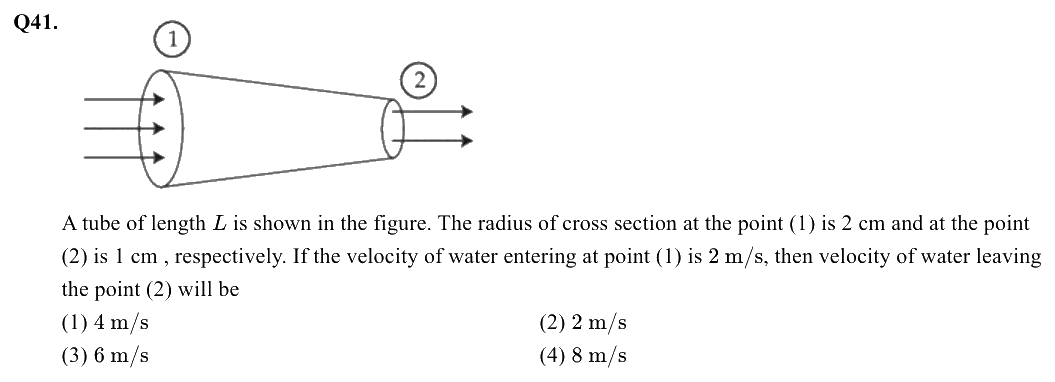
see figure A tube of length $L$ is shown in the figure. The radius of cross section at the point (1) is 2 cm and at the point (2) is 1 cm , respectively. If the velocity of water entering at point (1) is 2 m/s, then velocity of water leaving the point (2) will be
A sphere of relative density $\sigma$ and diameter $D$ has concentric cavity of diameter $d$. The ratio of $\frac{D}{d}$, if it just floats on water in a tank is :
The excess pressure inside a soap bubble is thrice the excess pressure inside a second soap bubble. The ratio between the volume of the first and the second bubble is:
A spherical ball of radius $1 \times 10^{-4}$ m and density $10^5$ kg/m$^3$ falls freely under gravity through a distance $h$ before entering a tank of water, If after entering in water the velocity of the ball does not change, then the value of $h$ is approximately: (The coefficient of viscosity of water is $9.8 \times 10^{-6}$ N s/m$^2$ )
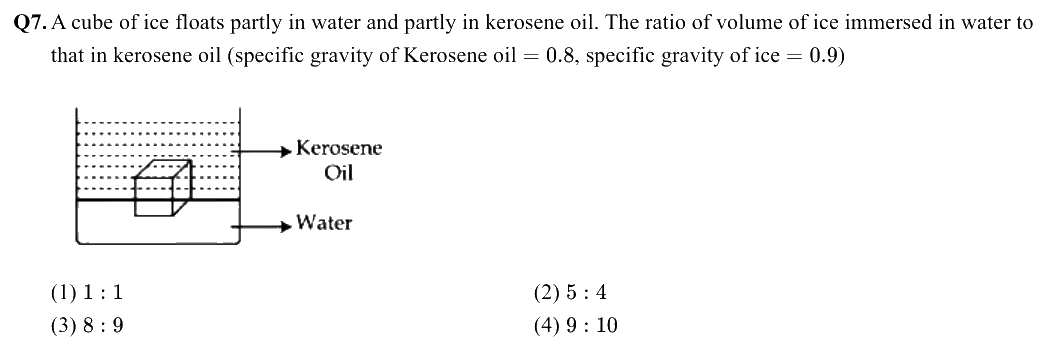
A cube of ice floats partly in water and partly in kerosene oil. The ratio of volume of ice immersed in water to that in kerosene oil (specific gravity of Kerosene oil = 0.8, specific gravity of ice = 0.9)
A small ball of mass $m$ and density $\rho$ is dropped in a viscous liquid of density $\rho_0$. After sometime, the ball falls with constant velocity. The viscous force on the ball is :
Given below are two statements : Statement I : When a capillary tube is dipped into a liquid, the liquid neither rises nor falls in the capillary. The contact angle may be $0^\circ$. Statement II : The contact angle between a solid and a liquid is a property of the material of the solid and liquid as well. In the light of the above statement, choose the correct answer from the options given below.
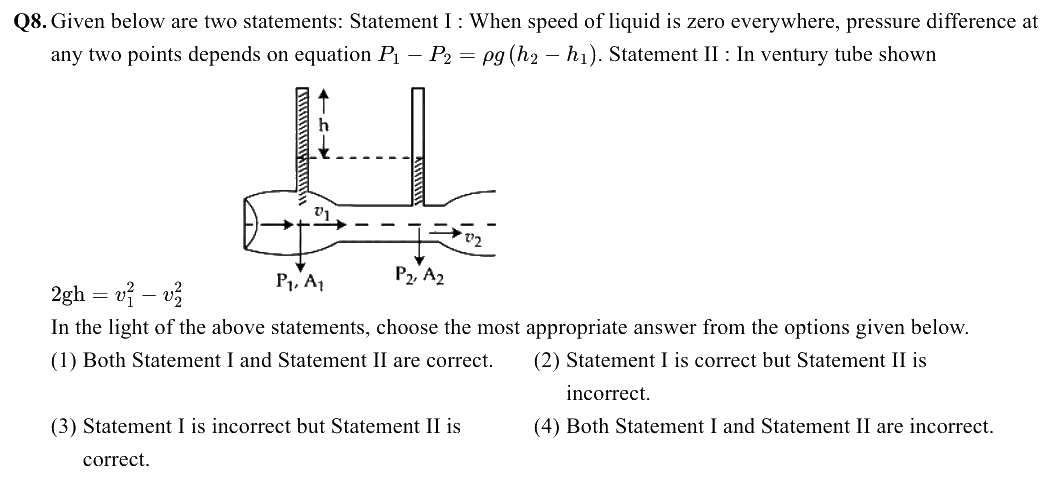
Given below are two statements: Statement I : When speed of liquid is zero everywhere, pressure difference at any two points depends on equation $P_1 - P_2 = \rho g\,(h_2 - h_1)$. Statement II : In ventury tube shown
(see the figure above)
$2gh = v_1^2 - v_2^2$
In the light of the above statements, choose the most appropriate answer from the options given below.
The question as printed in the paper.
A
Both Statement I and Statement II are correct.
B
Statement I is correct but Statement II is incorrect.
C
Statement I is incorrect but Statement II is correct.
Given below are two statements : Statement I : The contact angle between a solid and a liquid is a property of the material of the solid and liquid as well. Statement II : The rise of a liquid in a capillary tube does not depend on the inner radius of the tube. In the light of the above statements, choose the correct answer from the options given below:
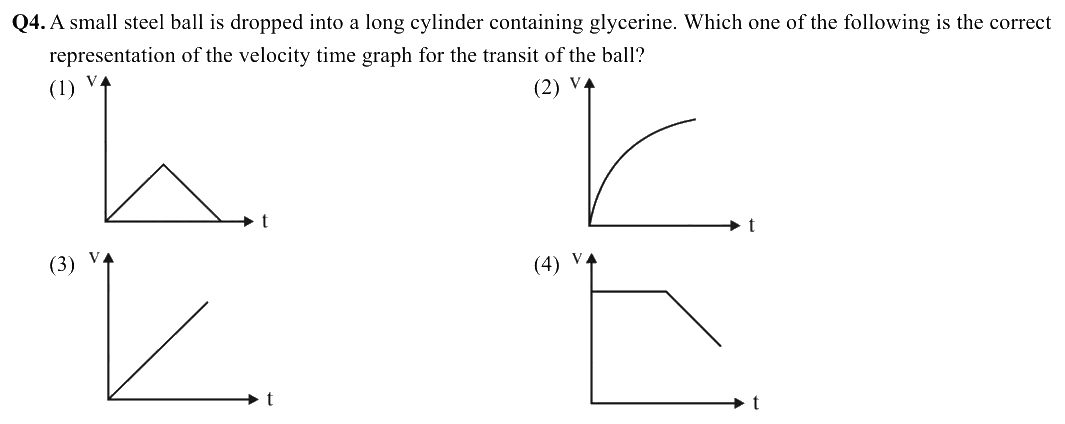
A small steel ball is dropped into a long cylinder containing glycerine. Which one of the following is the correct representation of the velocity time graph for the transit of the ball?
(see the figure above)
The question as printed in the paper.
A
see figure v-t graph: a straight line rising from the origin to a peak, then a straight line falling back to the t axis (a triangle shape)
B
see figure v-t graph: a curve rising steeply from the origin and flattening out (concave down, still slightly rising at the right end)
C
see figure v-t graph: a straight line rising from the origin at a constant slope
D
see figure v-t graph: a horizontal line starting at a non-zero value on the v axis, then, after a flat part, a straight line sloping downward, ending above the t axis
A small spherical ball of radius $r$, falling through a viscous medium of negligible density has terminal velocity $v$. Another ball of the same mass but of radius $2r$, falling through the same viscous medium will have terminal velocity:
A small liquid drop of radius $R$ is divided into 27 identical liquid drops. If the surface tension is $T$, then the work done in the process will be :
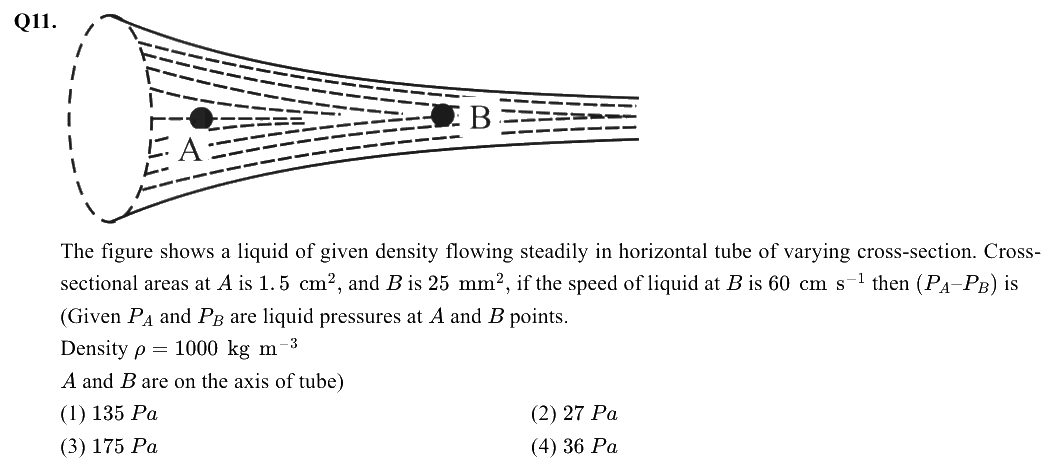
see figure The figure shows a liquid of given density flowing steadily in horizontal tube of varying cross-section. Cross-sectional areas at $A$ is 1.5 cm$^{2}$, and $B$ is 25 mm$^{2}$, if the speed of liquid at $B$ is 60 cm s$^{-1}$ then $(P_A - P_B)$ is (Given $P_A$ and $P_B$ are liquid pressures at $A$ and $B$ points. Density $\rho$ = 1000 kg m$^{-3}$ $A$ and $B$ are on the axis of tube)
Given below are two statements: one is labelled as Assertion A and the other is labelled as Reason R Assertion A : A spherical body of radius $(5 \pm 0.1)$ mm having a particular density is falling through a liquid of constant density. The percentage error in the calculation of its terminal velocity is 4%. Reason R : The terminal velocity of the spherical body falling through the liquid is inversely proportional to its radius. In the light of the above statements, choose the correct answer from the options given below
A
Both A and R are true and R is the correct explanation of A
B
Both A and R are true but R is NOT the correct explanation of A
Given below are two statements: Statement I: Pressure in a reservoir of water is same at all points at the same level of water. Statement II: The pressure applied to enclosed water is transmitted in all directions equally. In the light of the above statements, choose the correct answer from the options given below:
A hydraulic automobile lift is designed to lift vehicles of mass $5000\ \mathrm{kg}$. The area of cross section of the cylinder carrying load is $250\ \mathrm{cm^2}$. The maximum pressure the smaller piston would have to bear is [Assume $g = 10\ \mathrm{m\,s^{-2}}$]
A small ball of mass $M$ and density $\rho$ is dropped in a viscous liquid of density $\rho_0$. After some time, the ball falls with a constant velocity. What is the viscous force on the ball?
Given below are two statements: one is labelled as Assertion A and the other is labelled as Reason R
Assertion A: When you squeeze one end of a tube to get toothpaste out from the other end, Pascal's principle is observed.
Reason R: A change in the pressure applied to an enclosed incompressible fluid is transmitted undiminished to every portion of the fluid and to the walls of its container.
In the light of the above statements, choose the most appropriate answer from the options given below.
A
Both A and R are correct but R is NOT the correct explanation of A
B
A is not correct but R is correct
C
A is correct but R is not correct
D
Both A and R is correct and R is the correct explanation of A
A mercury drop of radius $10^{-3}$ m is broken into 125 equal size droplets. Surface tension of mercury is 0.45 $\mathrm{N\ m^{-1}}$. The gain in surface energy is:
If 1000 droplets of water of surface tension 0.07 $\mathrm{N\ m^{-1}}$. having same radius 1 $\mathrm{mm}$ each, combine to from a single drop. In the process the released surface energy is- Take $\pi = \dfrac{22}{7}$
The height of liquid column raised in a capillary tube of certain radius when dipped in liquid $A$ vertically is, 5 cm. If the tube is dipped in a similar manner in another liquid $B$ of surface tension and density double the values of liquid $A$, the height of liquid column raised in liquid B would be ______ m.
Surface tension of a soap bubble is $2.0 \times 10^{-2}\ \mathrm{N\,m^{-1}}$. Work done to increase the radius of soap bubble from $3.5\ \mathrm{cm}$ to $7\ \mathrm{cm}$ will be : [Take $\pi = \frac{22}{7}$ ]
A fully loaded boeing aircraft has a mass of $5.4 \times 10^5$ kg. Its total wing area is $500\ \mathrm{m^2}$. It is in level flight with a speed of $1080\ \mathrm{km\,h^{-1}}$. If the density of air $\rho$ is $1.2\ \mathrm{kg\,m^{-3}}$, the fractional increase in the speed of the air on the upper surface of the wing relative to the lower surface in percentage will be ($g = 10\ \mathrm{m\,s^{-2}}$)
Given below are two statements: One is labelled as Assertion (A) and the other is labelled as Reason (R). Assertion (A): Clothes containing oil or grease stains cannot be cleaned by water wash. Reason (R) : Because the angle of contact between the oil/ grease and water is obtuse. In the light of the above statements, choose the correct answer from the option given below.
A
Both (A) and (R) are true and (R) is the correct explanation of (A)
B
Both (A) and (R) are true but (R) is not the correct explanation of (A)
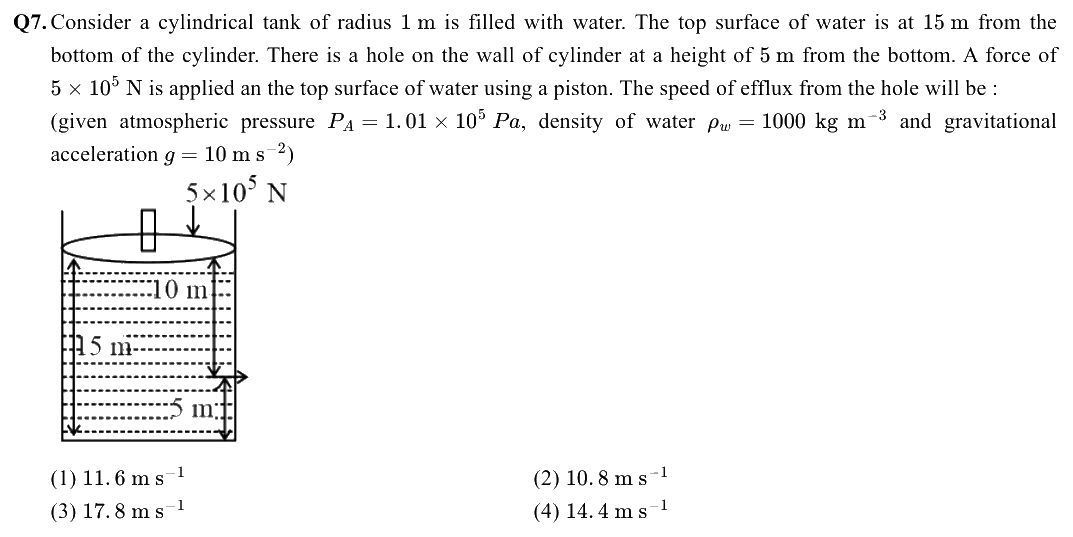
Consider a cylindrical tank of radius $1\ \mathrm{m}$ is filled with water. The top surface of water is at $15\ \mathrm{m}$ from the bottom of the cylinder. There is a hole on the wall of cylinder at a height of $5\ \mathrm{m}$ from the bottom. A force of $5\times10^{5}\ \mathrm{N}$ is applied on the top surface of water using a piston. The speed of efflux from the hole will be : (given atmospheric pressure $P_A=1.01\times10^{5}\ Pa$, density of water $\rho_w=1000\ \mathrm{kg\,m^{-3}}$ and gravitational acceleration $g=10\ \mathrm{m\,s^{-2}}$)
Two cylindrical vessels of equal cross-sectional area 16 $\mathrm{cm^2}$ contain water upto heights 100 cm and 150 cm respectively. The vessels are interconnected so that the water levels in them become equal. The work done by the force of gravity during the process, is [Take density of water = $10^3$ $\mathrm{kg~m^{-3}}$ and $g$ = 10 $\mathrm{ms^{-2}}$]
A water drop of radius 1 cm is broken into 729 equal droplets. If surface tension of water is 75 dyne $\mathrm{cm^{-1}}$, then the gain in surface energy upto first decimal place will be [Given $\pi$ = 3.14]
A drop of liquid of density $\rho$ is floating half immersed in a liquid of density $\sigma$ and surface tension $7.5\times10^{-4}\ \mathrm{N\,cm^{-1}}$. The radius of drop in cm will be : (Take : $g = 10\ \mathrm{ms^{-2}}$)
A water drop of diameter $2\ \mathrm{cm}$ is broken into 64 equal droplets. The surface tension of water is $0.075\ \mathrm{N\,m^{-1}}$. In this process the gain in surface energy will be
A water drop of radius $1\mu\mathrm{m}$ falls in a situation where the effect of buoyant force is negligible. Co-efficient of viscosity of air is $1.8 \times 10^{-5}\ \mathrm{N\ s\ m^{-2}}$ and its density is negligible as compared to that of water $10^{6}\ \mathrm{g\ m^{-3}}$. Terminal velocity of the water drop is (Take acceleration due to gravity $= 10\ \mathrm{m\ s^{-2}}$)
The velocity of a small ball of mass $m$ and density $d_1$, when dropped in a container filled with glycerine, becomes constant after some time. If the density of glycerine is $d_2$, then the viscous force acting on the ball, will be
If $p$ is the density and $\eta$ is coefficient of viscosity of fluid which flows with a speed $v$ in the pipe of diameter $d$, the correct formula for Reynolds number $R_e$ is
In Millikan's oil drop experiment, what is viscous force acting on an uncharged drop of radius $2.0 \times 10^{-5}$ m and density $1.2 \times 10^3$ kg m$^{-3}$? Take viscosity of liquid $= 1.8 \times 10^{-5}$ N s m$^{-2}$. (Neglect buoyancy due to air).
Two narrow bores of diameter $5.0\ \mathrm{mm}$ and $8.0\ \mathrm{mm}$ are joined together to form a $U-$shaped tube open at both ends. If this $U-$tube contains water, what is the difference in the level of two limbs of the tube. [Take surface tension of water $T=7.3\times10^{-2}\ \mathrm{N\ m^{-1}}$, angle of contact $=0$, $g=10\ \mathrm{m\ s^{-2}}$ and density of water$=1.0\times10^{3}\ \mathrm{kg\ m^{-3}}$]
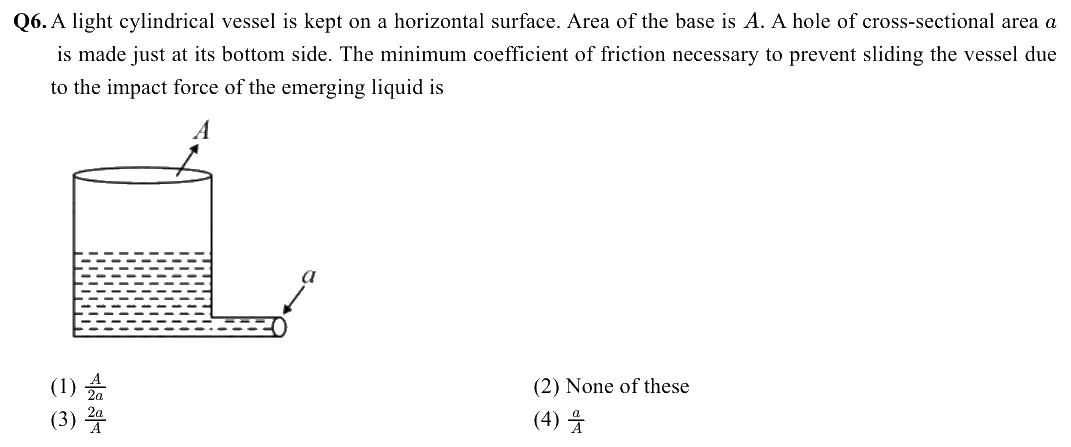
A light cylindrical vessel is kept on a horizontal surface. Area of the base is $A$. A hole of cross-sectional area $a$ is made just at its bottom side. The minimum coefficient of friction necessary to prevent sliding the vessel due to the impact force of the emerging liquid is (see the figure above)
A raindrop with radius $\mathrm{R} = 0.2\ \mathrm{mm}$ falls from a cloud at a height $\mathrm{h} = 2000\ \mathrm{m}$ above the ground. Assume that the drop is spherical throughout its fall and the force of buoyance may be neglected, then the terminal speed attained by the raindrop is : [Density of water $\rho_{\mathrm{w}} = 1000\ \mathrm{kg\ m^{-3}}$ and Density of air $\rho_{\mathrm{a}} = 1.2\ \mathrm{kg\ m^{-3}}$, $\mathrm{g} = 10\ \mathrm{m/s^2}$ Coefficient of viscosity of air $= 1.8 \times 10^{-5}\ \mathrm{N\ s\ m^{-2}}$]
The pressure acting on a submarine is $3 \times 10^5 \mathrm{~Pa}$ at a certain depth. If the depth is doubled, the percentage increase in the pressure acting on the submarine would be: (Assume that atmospheric pressure is $1 \times 10^5 \mathrm{~Pa}$ density of water is $10^3 \mathrm{~kg} \mathrm{~m}^{-3}$, $g=10 \mathrm{~ms}^{-2}$)
What will be the nature of flow of water from a circular tap, when its flow rate increased from $0.18\ \mathrm{L\ (min)^{-1}}$ to $0.48\ \mathrm{L\ (min)^{-1}}$? The radius of the tap and viscosity of water are $0.5\ \mathrm{cm}$ and $10^{-3}\ \mathrm{Pa\ s}$, respectively. (Density of water : $10^3\ \mathrm{kg\ m^{-3}}$)
A large number of water drops, each of radius $r$, combine to have a drop of radius $R$. If the surface tension is $T$ and mechanical equivalent of heat is $J$, the rise in heat energy per unit volume will be:
A fluid is flowing through a horizontal pipe of varying cross-section, with v $\mathrm{ms^{-1}}$ at a point where the pressure is P Pascal. At another point where pressure $\frac{P}{2}$ Pascal its speed is V $\mathrm{ms^{-1}}$. If the density of the fluid is $\rho\ \mathrm{kg - m^{-3}}$ and the flow is streamline, then V is equal to
A hollow spherical shell at outer radius $R$ floats just submerged under the water surface. The inner radius of the shell is $r$ . If the specific gravity of the shell material is $\frac{27}{8}$ with respect to water, the value of $r$ is:
In an experiment to verify Stokes law, a small spherical ball of radius $r$ and density $\rho$ falls under gravity through a distance $h$ in air before entering a tank of water. If the terminal velocity of the ball inside water is same as its velocity just before entering the water surface, then the value of $h$ is proportional to: (ignore viscosity of air)
A air bubble of radius 1 cm in water has an upward acceleration of $9.8\ \mathrm{cms^{-2}}$. The density of water is $1\ \mathrm{gm\ cm^{-3}}$ and water offers negligible drag force on the bubble. The mass of the bubble is $\left(g\ =\ 980\ \mathrm{cm/s^{2}}\right)$.
Two identical cylindrical vessels are kept on the ground and each contain the same liquid of density $d$. The area of the base of both vessels is $S$ but the height of liquid in one vessel is $x_{1}$ and in the other $x_{2}$. When both cylinders are connected through a pipe of negligible volume very close to the bottom, the liquid flows from one vessel to the other until it comes to equilibrium at a new height. The change in energy of the system in the process is :
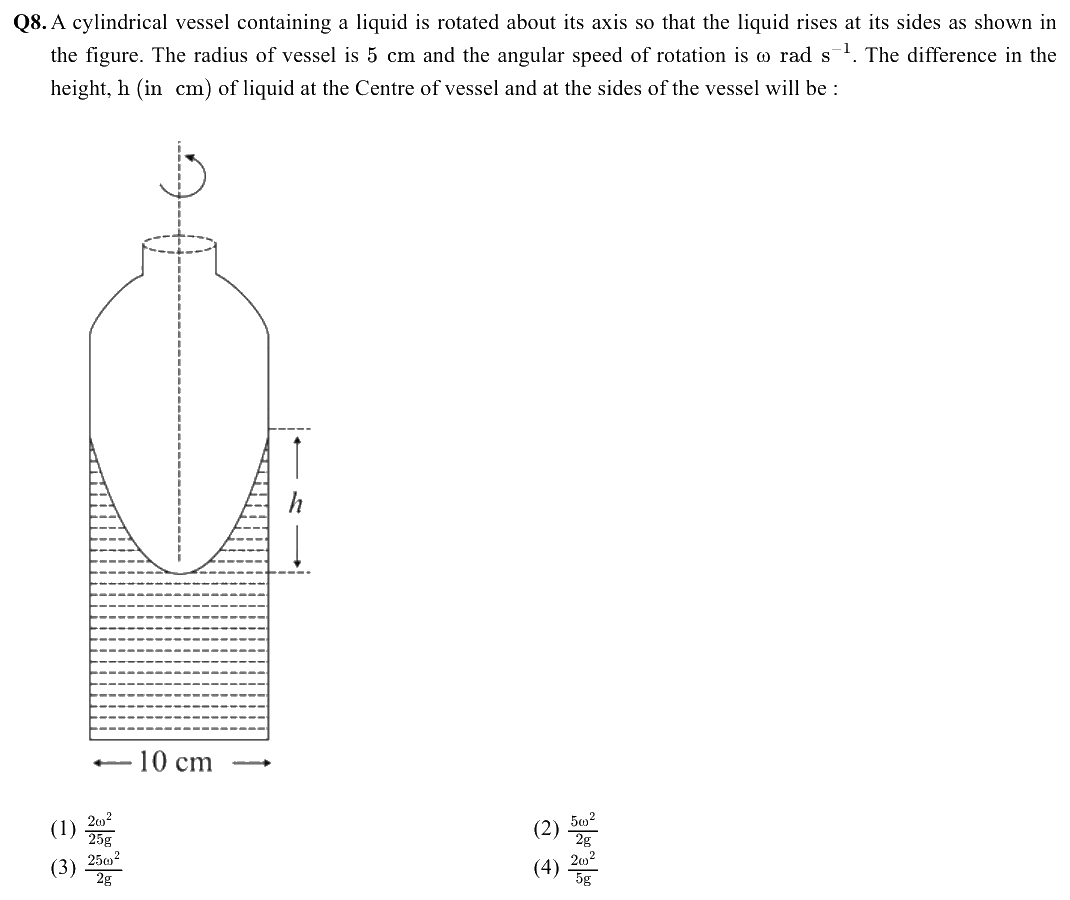
A cylindrical vessel containing a liquid is rotated about its axis so that the liquid rises at its sides as shown in the figure. The radius of vessel is $5\ \mathrm{cm}$ and the angular speed of rotation is $\omega\ \mathrm{rad\ s}^{-1}$. The difference in the height, h (in cm) of liquid at the Centre of vessel and at the sides of the vessel will be : (see the figure above)
A capillary tube made of glass of radius $0.15\ \mathrm{mm}$ is dipped vertically in a beaker filled with methylene iodide (surface tension $= 0.05\ \mathrm{N\ m}^{-1}$, density $= 667\ \mathrm{kg\ m}^{-3}$) which rises to height h in the tube. It is observed that the two tangents drawn from observed that the two tangents drawn from liquid-glass interfaces (from opp. sides of the capillary) make an angle of $60^{\circ}$ with one another. Then h is close to ($\mathrm{g} = 10\ \mathrm{m\ s}^{-2}$)
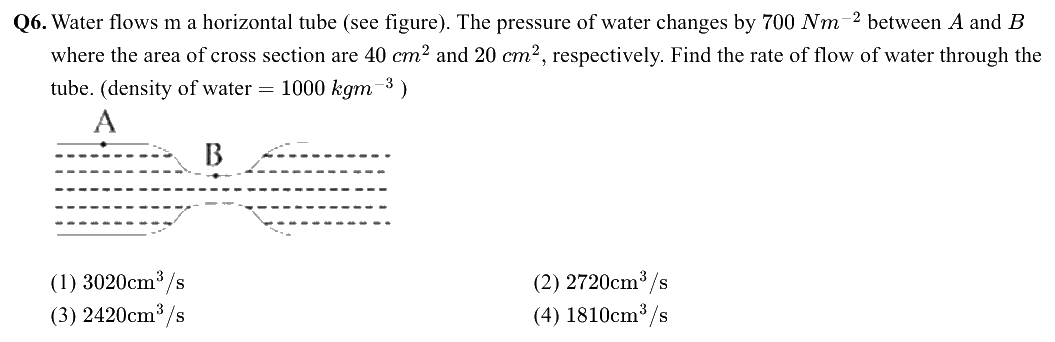
Water flows in a horizontal tube (see figure). The pressure of water changes by $700\ Nm^{-2}$ between $A$ and $B$ where the area of cross section are $40\ cm^2$ and $20\ cm^2$, respectively. Find the rate of flow of water through the tube. (density of water $= 1000\ kgm^{-3}$ ) (see the figure above)
A small spherical droplet of density $d$ is floating exactly half immersed in a liquid of density $\rho$ and surface tension $T$. The radius of the droplet is (take note that the surface tension applies an upward force on the droplet):
A leak proof cylinder of length $1\ \mathrm{m}$, made of a metal which has very low coefficient of expansion is floating vertically in water at $0^\circ\mathrm{C}$ such that its height above the water surface is $20\ \mathrm{cm}$. When the temperature of water is increased to $4^\circ\mathrm{C}$, the height of the cylinder above the water surface becomes $21\ \mathrm{cm}$. The density of water at $T = 4^\circ\mathrm{C}$, relative to the density at $T = 0^\circ\mathrm{C}$ is close to:
Consider a solid sphere of radius $R$ and mass density $\rho(r) = \rho_0\left(1 - \frac{r^2}{R^2}\right), 0 < r \le R$. The minimum density of a liquid in which it will float is:
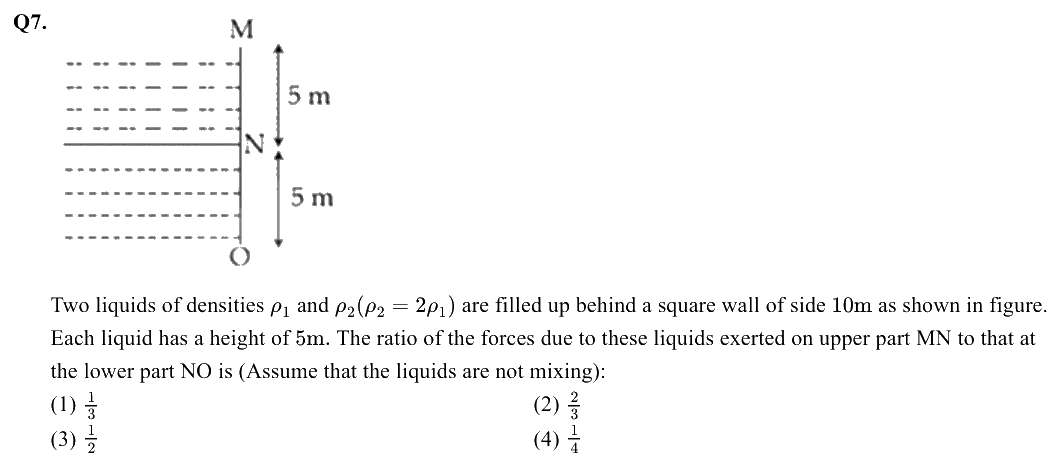
see figure Two liquids of densities $\rho_1$ and $\rho_2 (\rho_2 = 2\rho_1)$ are filled up behind a square wall of side $10\mathrm{m}$ as shown in figure. Each liquid has a height of $5\mathrm{m}$. The ratio of the forces due to these liquids exerted on upper part MN to that at the lower part NO is (Assume that the liquids are not mixing):
An ideal fluid flows (laminar flow) through a pipe of non-uniform diameter. The maximum and minimum diameters of the pipes are $6.4\mathrm{cm}$ and $4.8\mathrm{cm}$, respectively. The ratio of the minimum and the maximum velocities of fluid in this pipe is:
A solid sphere, of radius R acquires a terminal velocity $v_1$ when falling (due to gravity) through a viscous fluid having a coefficient of viscosity $\eta$. The sphere is broken into 27 identical solid spheres. If each of these spheres acquires a terminal velocity, $v_2$, when falling through the same fluid, the ratio $\left(\frac{v_1}{v_2}\right)$ equals:
The ratio of surface tensions of mercury and water is given to be 7.5, while the ratio of their densities is 13.6 . Their contact angles, with glass, are close to $135^\circ$ and $0^\circ$, respectively. If it is observed that mercury gets depressed by an amount $h$ in a capillary tube of radius $r_1$, while water rises by the same amount $h$ in a capillary tube of radius $r_2$, then the ratio $\frac{r_1}{r_2}$ is close to
A cubical block of side $0.5\ \mathrm{m}$ floats on water with 30% of its volume under water. What is the maximum weight that can be put on the block without fully submerging it under water? [Take, density of water $= 10^{3}\ \mathrm{kg\,/\,m^{3}}$ ]
Water from a tap emerges vertically downwards with an initial speed of $1.0\ \mathrm{ms^{-1}}$. The cross - sectional area of the tap is $10^{-4}\ \mathrm{m^{2}}$. Assume that the pressure is constant throughout the stream of water and that the flow is streamlined. The cross - sectional area of the stream, $0.15\ \mathrm{m}$ below the tap would be: (Take $g = 10\ \mathrm{ms^{-2}}$ )
A submarine experiences a pressure of $5.05\times10^{6}\ \mathrm{Pa}$ at a depth of $d_1$ in a sea. When it goes further to a depth of $d_2$, it experiences a pressure of $8.08\times10^{6}\ \mathrm{Pa}$. Then $d_2 - d_1$ is approximately (density of water $= 10^{3}\ \mathrm{kg\,/\,m^{3}}$ and acceleration due to gravity $= 10\ \mathrm{ms^{-2}}$ ):
A wooden block floating in a bucket of water has $\dfrac{4}{5}$ of its volume submerged. When certain amount of an oil is poured into the bucket, it is found that the block is just under the oil surface with half of its volume under water and half in oil. The density of oil relative to that of water is:
Water from a pipe is coming at a rate of 100 liters per minute. If the radius of the pipe is 5 cm, the Reynolds number for the flow is of the order of: (density of water = 100 $\mathrm{kg/m^3}$, coefficient of viscosity of water = 1 mPa s)
A long cylindrical vessel is half filled with a liquid. When the vessel is rotated about its own vertical axis, the liquid rises up near the wall. If the radius of vessel is 5 $cm$ and its rotational speed is 2 rotations per second, then the difference in the heights between the center and the sides, in $cm$, will be:
Water flows into a large tank with flat bottom at the rate of $10^{-4}\ m^3s^{-1}$. Water is also leaking out of a hole of area $1\ cm^2$ at its bottom. If the height of the water in the tank remains steady then this height is:
The top of a water tank is open to air and its water level is maintained. It is giving out $0.74\ \mathrm{m^3}$ water per minute through a circular opening of $2\ \mathrm{cm}$ radius in its wall. The depth of the centre of the opening from the level of water in the tank is close to:
A small soap bubble of radius 4cm is trapped inside another bubble of radius 6cm without any contact. Let $P_2$ be the pressure inside the inner bubble and $P_0$, the pressure outside the outer bubble. Radius of another bubble with pressure difference $P_2 - P_0$ between its inside and outside would be:
A thin uniform tube is bent into a circle of radius $r$ in the virtical plane. Equal volumes of two immiscible liquids, whose densities are $\rho_1$ and $\rho_2$ ($\rho_1 > \rho_2$) fill half the circle. The angle $\theta$ between the radius vector passing through the common interface and the vertical is
When an air bubble of radius $r$ rises from the bottom to the surface of a lake, its radius becomes $\frac{5r}{4}$. Taking the atmospheric pressure to be equal to $10\ \mathrm{m}$ height of water column, the depth of the lake would approximately be (ignore the surface tension and the effect of temperature):
Two tubes of radii $r_1$ and $r_2$ and lengths $l_1$ and $l_2$, respectively, are connected in series and a liquid flows through each of them in stream line conditions. $P_1$ and $P_2$ are pressure differences across the two tubes. If $P_2$ is $4P_1$ and $l_2$ is $\frac{l_1}{4}$ then the radius $r_2$ will be equal to :
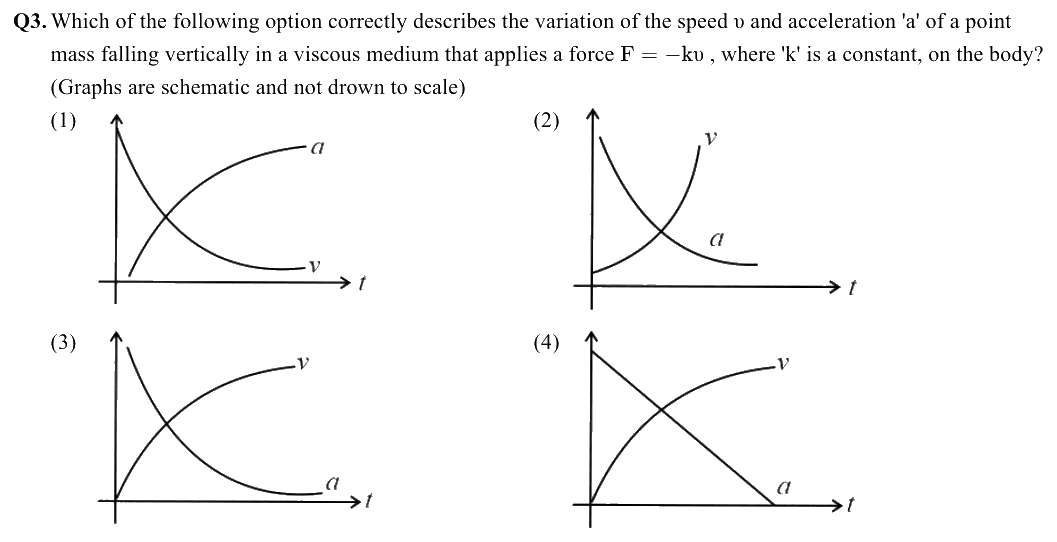
Which of the following option correctly describes the variation of the speed $v$ and acceleration 'a' of a point mass falling vertically in a viscous medium that applies a force $F = -kv$ , where 'k' is a constant, on the body? (Graphs are schematic and not drown to scale)
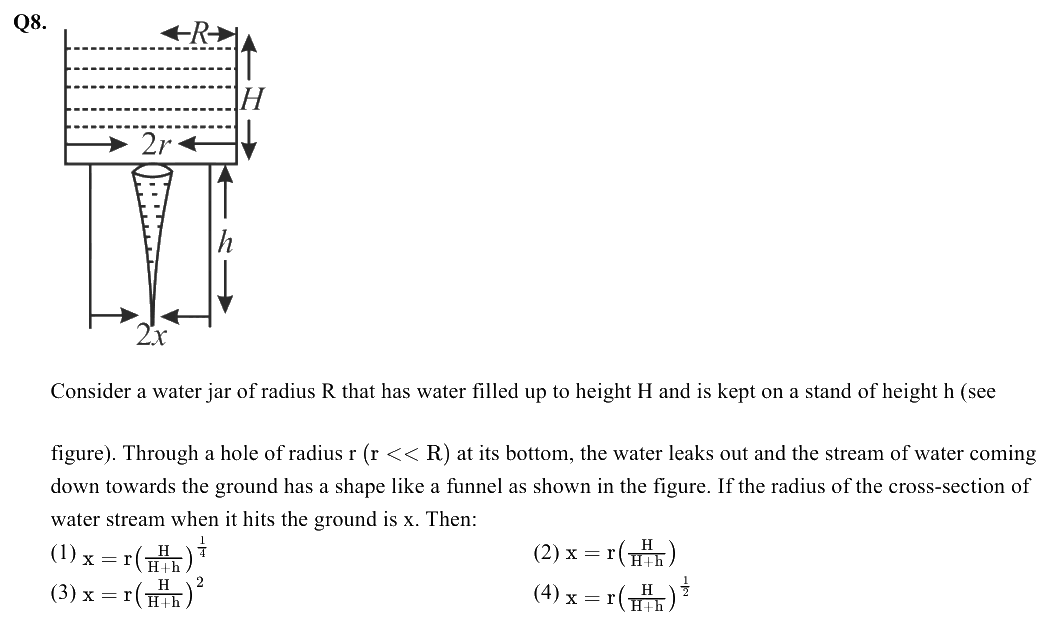
see figure Consider a water jar of radius R that has water filled up to height H and is kept on a stand of height h (see figure). Through a hole of radius r ($r \ll R$) at its bottom, the water leaks out and the stream of water coming down towards the ground has a shape like a funnel as shown in the figure. If the radius of the cross-section of water stream when it hits the ground is x. Then:
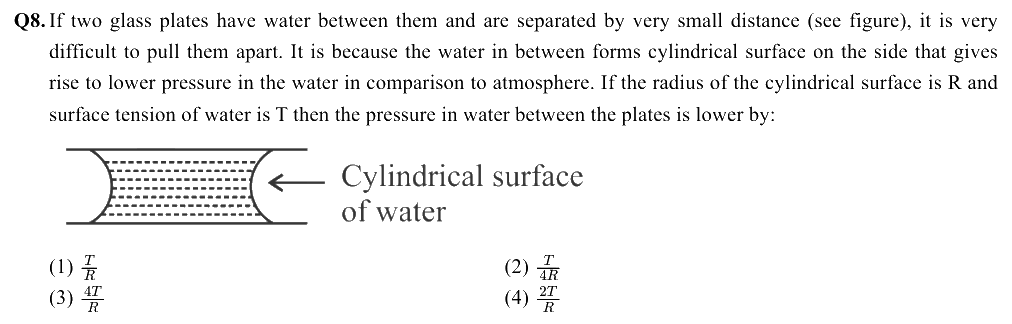
If two glass plates have water between them and are separated by very small distance (see figure), it is very difficult to pull them apart. It is because the water in between forms cylindrical surface on the side that gives rise to lower pressure in the water in comparison to atmosphere. If the radius of the cylindrical surface is R and surface tension of water is T then the pressure in water between the plates is lower by: (see the figure above)
If it takes 5 minutes to fill a 15 litre bucket from a water tap of diameter $\frac{2}{\sqrt{\pi}}$ cm then the Reynolds number for the flow is (density of water = $10^3$ $kg/m^3$ and viscosity of water = $10^{-3}$ $Pa.s$ ) close to:
The velocity of water in a river is $18\ \mathrm{km\,h^{-1}}$ near the surface. If the river is $5\ \mathrm{m}$ deep, find the shearing stress between the horizontal layers of water. The coefficient of viscosity of water$= 10^{-2}$ poise.
A large number of liquid drops each of radius $r$ coalesce to form a single drop of the radius $R$. The energy released in the process is converted into kinetic energy of the big drop so formed. The speed of the big drop is (given surface tension of the liquid $T$, density $\rho$)
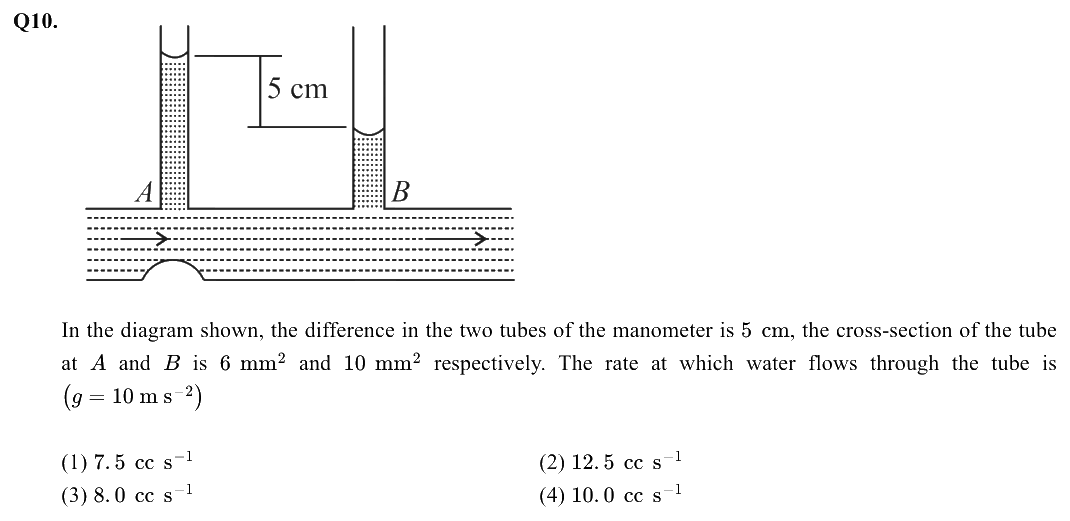
see figure In the diagram shown, the difference in the two tubes of the manometer is $5\ \mathrm{cm}$, the cross-section of the tube at $A$ and $B$ is $6\ \mathrm{mm^2}$ and $10\ \mathrm{mm^2}$ respectively. The rate at which water flows through the tube is $(g = 10\ \mathrm{m\,s^{-2}})$
A cylindrical vessel of cross-section A contains water to a height h. There is a hole in the bottom of radius ' $a$ '. The time in which it will be emptied is:
Two soap bubbles coalesce to form a single bubble. If V is the subsequent change in volume of contained air and S change in total surface area, T is the surface tension and P atmospheric pressure, then which of the following relation is correct?
A tank with a small hole at the bottom has been filled with water and kerosene (specific gravity $0.8$ ). The height of water is $3\ \mathrm{m}$ and that of kerosene $2\ \mathrm{m}$. When the hole is opened the velocity of fluid coming out from it is nearly: (take $\mathrm{g} = 10\ \mathrm{ms}^{-2}$ and density of water $= 10^3\ \mathrm{kg\ m}^{-3}$)
An air bubble of radius $0.1\ \mathrm{cm}$ is in a liquid having surface tension $0.06\ \mathrm{N/m}$ and density $10^3\ \mathrm{kg/m^3}$. The pressure inside the bubble is $1100\mathrm{Nm}^{-2}$ greater than the atmospheric pressure. At what depth is the bubble below the surface of the liquid? ($\mathrm{g} = 9.8\ \mathrm{ms}^{-2}$)
A capillary tube is immersed vertically in water and the height of the water column is $x$. When this arrangement is taken into a mine of depth d, the height of the water column is $y$. If R is the radius of earth, the ratio $\frac{x}{y}$ is :
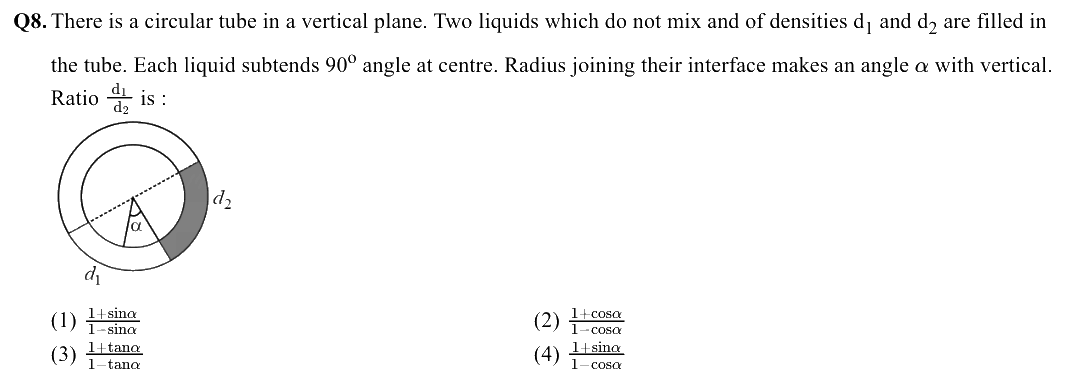
There is a circular tube in a vertical plane. Two liquids which do not mix and of densities $\mathrm{d}_1$ and $\mathrm{d}_2$ are filled in the tube. Each liquid subtends $90^\circ$ angle at centre. Radius joining their interface makes an angle $\alpha$ with vertical. Ratio $\frac{\mathrm{d}_1}{\mathrm{d}_2}$ is :
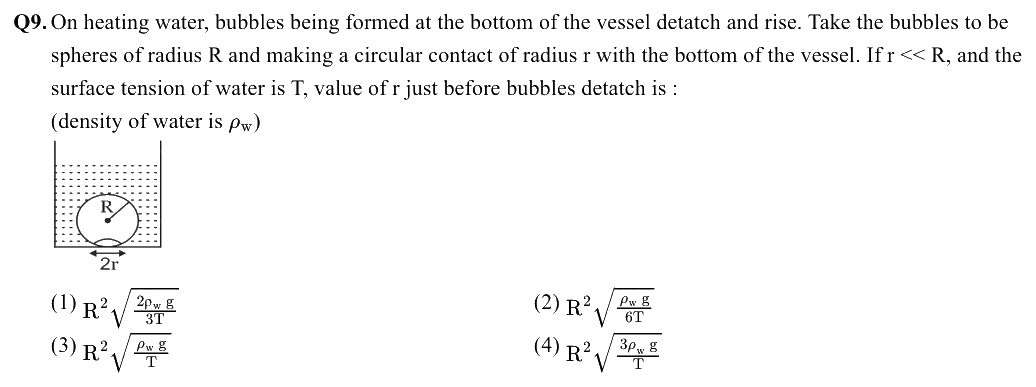
On heating water, bubbles being formed at the bottom of the vessel detatch and rise. Take the bubbles to be spheres of radius R and making a circular contact of radius r with the bottom of the vessel. If $r \ll R$, and the surface tension of water is T, value of r just before bubbles detatch is : (density of water is $\rho_\mathrm{w}$)
In an experiment, a small steel ball falls through a liquid at a constant speed of 10 cm/s. If the steel ball is pulled upward with a force equal to twice its effective weight, how fast will it move upward ?
Wax is coated on the inner wall of a capillary tube and the tube is then dipped in water. Then, compared to the unwaxed capillary, the angle of contact $\theta$ and the height $h$ upto which water rises change. These changes are :
Air of density $1.2\ \mathrm{kg\ m^{-3}}$ is blowing across the horizontal wings of an aeroplane in such a way that its speeds above and below the wings are $150\ \mathrm{ms^{-1}}$ and $100\ \mathrm{ms^{-1}}$, respectively. The pressure difference between the upper and lower sides of the wings, is :
This question has Statement-1 and Statement- 2 . Of the four choices given after the Statements, choose the one that best describes the two Statetnents. Statement-1: A capillary is dipped in a liquid and liquid rises to a height $h$ in it. As the temperature of the liquid is raised, the height $h$ increases (if the density of the liquid and the angle of contact remain the same). Statement-2: Surface tension of a liquid decreases with the rise in its temperature.
A
Statement-1 is true, Statement-2 is true; Statement-2 is not the correct explanation for Statement-1.
B
Statement-1 is false, Statement- 2 is true.
C
Statement-1 is true, Statement- 2 is false.
D
Statement-1 is true, Statement-2 is true; Statement-2 is the correct explanation for Statement-1.
A uniform cylinder of length L and mass M having cross-sectional area A is suspended, with its length vertical, from a fixed point by a massless spring, such that it is half submerged in a liquid of density $\sigma$ at equilibrium position. The extension $\mathrm{x_0}$ of the spring when it is in equilibrium is :
Assume that a drop of a liquid evaporates by a decrease in its surface energy so that its temperature remains unchanged. The minimum radius of the drop for this to be possible is. (The surface tension is $T$, the density of the liquid is $\rho$ and $L$ is its latent heat of vaporisation.)
A large number of droplets, each of radius, $r$ coalesce to form a bigger drop of radius, $R$. An engineer designs a machine so that the energy released in this process is converted into the kinetic energy of the drop. Velocity of the drop is ($T$ = surface tension, $\rho$ = density)
Water is flowing through a horizontal tube having cross-sectional areas of its two ends being $A$ and $A'$ such that the ratio $A/A'$ is $5$ . If the pressure difference of water between the two ends is $3 \times 10^5\ \mathrm{N\,m^{-2}}$, the velocity of water with which it enters the tube will be (neglect gravity effects)
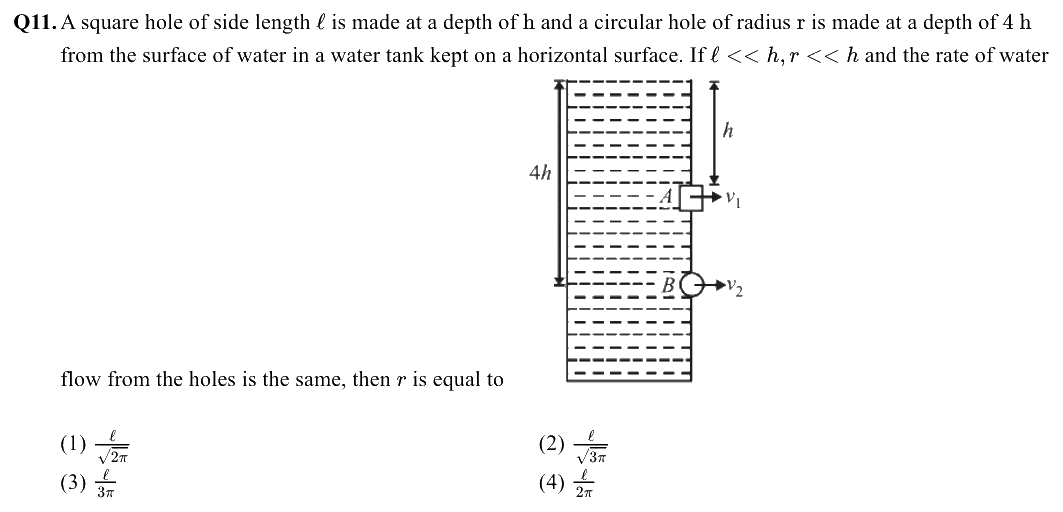
A square hole of side length $\ell$ is made at a depth of h and a circular hole of radius r is made at a depth of 4 h from the surface of water in a water tank kept on a horizontal surface. If $\ell << h, r << h$ and the rate of water flow from the holes is the same, then r is equal to (see the figure above)
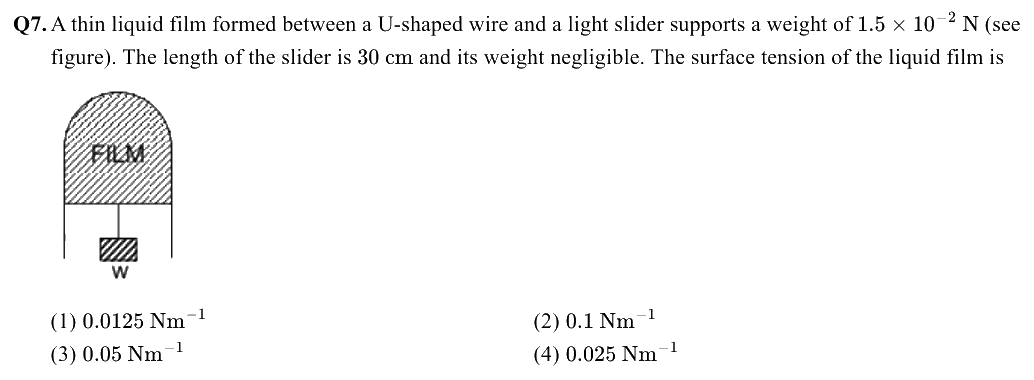
A thin liquid film formed between a U-shaped wire and a light slider supports a weight of $1.5 \times 10^{-2}\ \mathrm{N}$ (see figure). The length of the slider is $30\ \mathrm{cm}$ and its weight negligible. The surface tension of the liquid film is (see the figure above)
Work done in increasing the size of a soap bubble from a radius of $3\ \mathrm{cm}$ to $5\ \mathrm{cm}$ is nearly (Surface tension of soap solution $= 0.03\ \mathrm{Nm^{-1}}$ ):
Water is flowing continuously from a tap having an internal diameter $8 \times 10^{-3}\ \mathrm{m}$. The water velocity as it leaves the tap is $0.4\ \mathrm{ms^{-1}}$. The diameter of the water stream at a distance $2 \times 10^{-1}\ \mathrm{m}$ below the lap (sic) is close to :
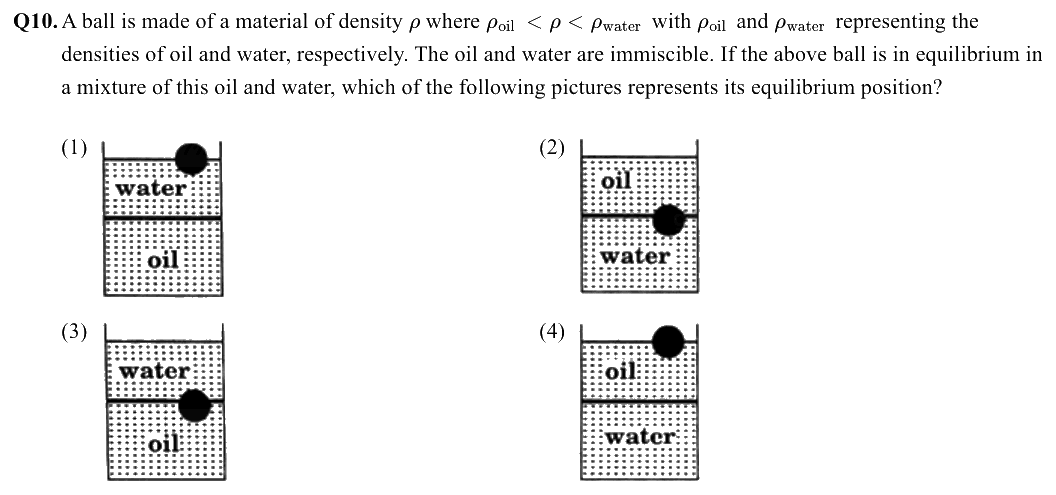
A ball is made of a material of density $\rho$ where $\rho_{\text{oil}} < \rho < \rho_{\text{water}}$ with $\rho_{\text{oil}}$ and $\rho_{\text{water}}$ representing the densities of oil and water, respectively. The oil and water are immiscible. If the above ball is in equilibrium in a mixture of this oil and water, which of the following pictures represents its equilibrium position?
The question as printed in the paper.
A
see figure Container with water on top and oil below; the ball is at the top, resting at the water surface.
B
see figure Container with oil on top and water below; the ball is at the oil-water interface.
C
see figure Container with water on top and oil below; the ball is at the water-oil interface.
D
see figure Container with oil on top and water below; the ball is at the top, at the oil surface.
A spherical solid ball of volume $V$ is made of a material of density $\rho_1$. It is falling through a liquid of density $\rho_2$ ($\rho_2 < \rho_1$). Assume that the liquid applies a viscous force on the ball that is proportional to the square of its speed v, i.e., $F_{\mathrm{viscous}} = -kv^{2}$ ($k > 0$). The terminal speed of the ball is
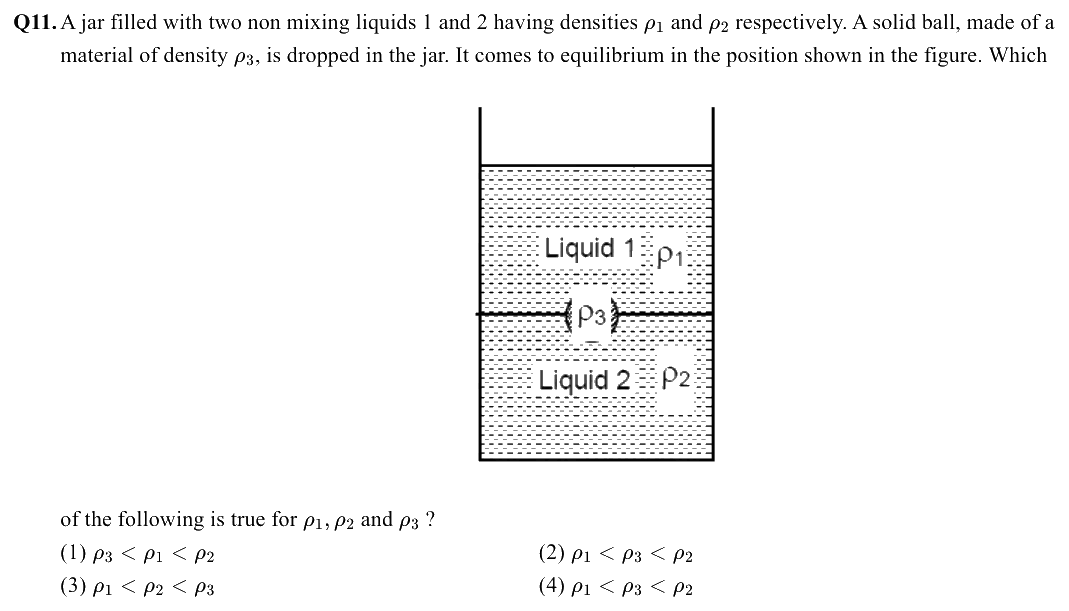
A jar filled with two non mixing liquids 1 and 2 having densities $\rho_1$ and $\rho_2$ respectively. A solid ball, made of a material of density $\rho_3$, is dropped in the jar. It comes to equilibrium in the position shown in the figure. Which of the following is true for $\rho_1$, $\rho_2$ and $\rho_3$ ? (see the figure above)
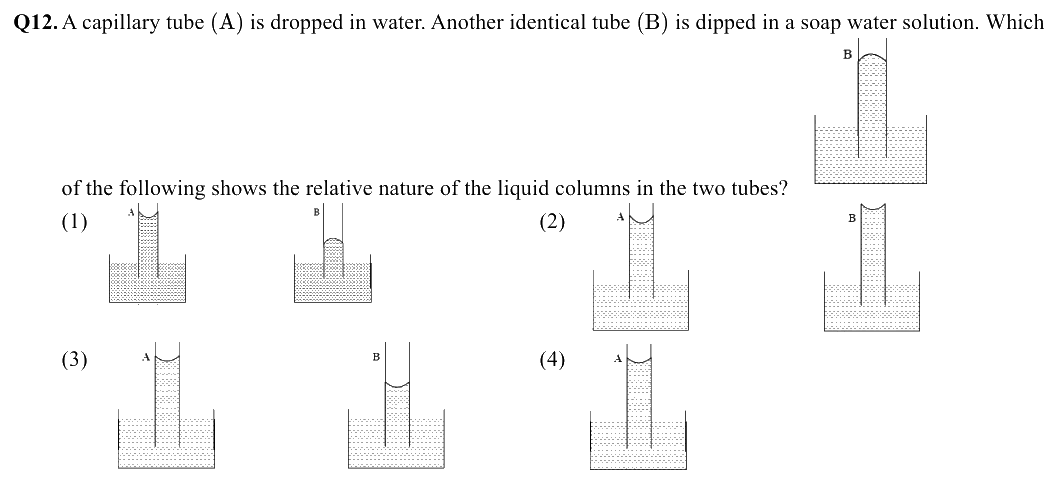
A capillary tube (A) is dropped in water. Another identical tube (B) is dipped in a soap water solution. Which of the following shows the relative nature of the liquid columns in the two tubes? (see the figure above) tube B in a beaker (displaced drawing of option 4)
If the terminal speed of a sphere of gold (density = $19.5\ \mathrm{kg/m^3}$ ) is 0.2 m/s in a viscous liquid (density = $1.5\ \mathrm{kg/m^3}$ ), find the terminal speed of a sphere of silver (density = $10.5\ \mathrm{kg/m^3}$ ) of the same size in the same liquid.
A 20 cm long capillary tube is dipped in water. The water rises up to 8 cm. If the entire arrangement is put in a freely falling elevator the length of water column in the capillary tube will be
Spherical balls of radius $R$ are falling in a viscous fluid of viscosity $\eta$ with a velocity $v$. The retarding viscous force acting on the spherical ball is
A
directly proportional to R but inversely proportional to v.
B
directly proportional to both radius $R$ and velocity $v$.
C
inversely proportional to both radius R and velocity v.
D
inversely proportional to R but directly proportional to velocity v.
A cylinder of height 20 m is completely filled with water. The velocity of efflux of water (in $\mathrm{ms^{-1}}$ ) through a small hole on the side wall of the cylinder near its bottom is
The surface tension of a soap solution is $3.5\times10^{-2}$ N/m. The work required to increase the radius of a soap bubble from 1 cm to 2 cm is $\alpha\times10^{-6}$ J. The value of $\alpha$ is ________. ($\pi = 22/7$)
Numerical answer type: type your answer in EdLoop to check it
A tub is filled with water and a wooden cube 10 cm $\times$ 10 cm $\times$ 10 cm is placed in the water. The wooden cube is found to float on the water with a part of it submerged in water. When a metal coin is placed on the wooden cube, the submerged part is increased by 3.87 cm. The mass of the metal coin is ________ gram. (Take water density as 1 g/cm$^3$ and density of wood as 0.4 g/cm$^3$)
Numerical answer type: type your answer in EdLoop to check it
Sixty four rain drops of radius 1 mm each falling down with a terminal velocity of 10 cm/s coalesce to form a bigger drop. The terminal velocity of bigger drop is ________ cm/s.
Numerical answer type: type your answer in EdLoop to check it
A soap bubble of surface tension 0.04 N/m is blown to a diameter of 7 cm. If $(15000 - x)$ $\mu$J of work is done in blowing it further to make its diameter 14 cm, then the value of $x$ is ________.
($\pi = 22/7$)
Numerical answer type: type your answer in EdLoop to check it
The terminal velocity of a metallic ball of radius 6 mm in a viscous fluid is 20 cm/s. The terminal velocity of another ball of same material and having radius 3 mm in the same fluid will be ________ cm/s.
Numerical answer type: type your answer in EdLoop to check it
A cube having a side of 10 cm with unknown mass and 200 gm mass were hung at two ends of an uniform rigid rod of 27 cm long. The rod along with masses was placed on a wedge keeping the distance between wedge point and 200 gm weight as 25 cm. Initially the masses were not at balance. A beaker is placed beneath the unknown mass and water is added slowly to it. At given point the masses were in balance and half volume of the unknown mass was inside the water. (Take the density of unknown mass is more than that of the water, the mass did not absorb water and water density is 1gm/cm$^3$). The unknown mass is ______ kg.
Numerical answer type: type your answer in EdLoop to check it
The excess pressure inside a soap bubble A in air is half the excess pressure inside another soap bubble B in air. If the volume of the bubble A is n times the volume of the bubble B, then, the value of $n$ is ______ .
Numerical answer type: type your answer in EdLoop to check it
A vessel with square cross-section and height of 6 m is vertically partitioned. A small window of $100cm^2$ with hinged door is fitted at a depth of 3 m in the partition wall. One part of the vessel is filled completely with water and the other side is filled with the liquid having density $1.5 \times 10^3kg / m^3$. What force one needs to apply on the hinged door so that it does not get opened ?
(Acceleration due to gravity $= 10m / s^2$ )
Numerical answer type: type your answer in EdLoop to check it
In a hydraulic lift, the surface area of the input piston is 6 $\mathrm{cm^2}$ and that of the output piston is 1500 $\mathrm{cm^2}$. If 100 N force is applied to the input piston to raise the output piston by 20 cm, then the work done is ______ kJ.
Numerical answer type: type your answer in EdLoop to check it
An air bubble of radius 1.0 mm is observed at a depth of 20 cm below the free surface of a liquid having surface tension $0.095\ \mathrm{J/m^2}$ and density $10^3\ \mathrm{kg/m^3}$. The difference between pressure inside the bubble and atmospheric pressure is ______ $\mathrm{N/m^2}$. (Take g = 10 $\mathrm{m/s^2}$ )
Numerical answer type: type your answer in EdLoop to check it
Two soap bubbles of radius 2 cm and 4 cm , respectively, are in contact with each other. The radius of curvature of the common surface, in cm , is ______ .
Numerical answer type: type your answer in EdLoop to check it
A liquid column of height 0.04 cm balances excess pressure of a soap bubble of certain radius. If density of liquid is $8 \times 10^3\ \mathrm{kg\,m^{-3}}$ and surface tension of soap solution is $0.28\mathrm{Nm}^{-1}$, then diameter of the soap bubble is ______ cm. (if $g = 10\ \mathrm{m\,s^{-2}}$ )
Numerical answer type: type your answer in EdLoop to check it
Small water droplets of radius 0.01 mm are formed in the upper atmosphere and falling with a terminal velocity of 10 cm/s. Due to condensation, if 8 such droplets are coalesced and formed a larger drop, the new terminal velocity will be ______ cm/s.
Numerical answer type: type your answer in EdLoop to check it
A big drop is formed by coalescing 1000 small droplets of water. The ratio of surface energy of 1000 droplets to that of energy of big drop is $\frac{10}{x}$. The value of $x$ is ______
Numerical answer type: type your answer in EdLoop to check it
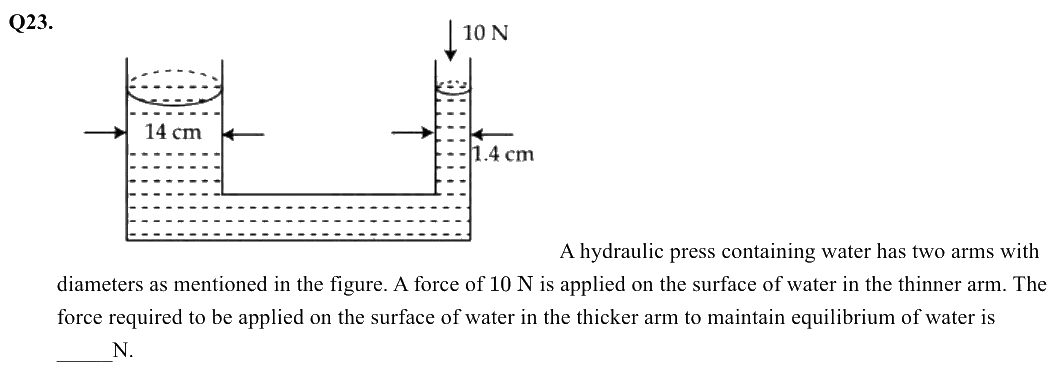
see figure A hydraulic press containing water has two arms with diameters as mentioned in the figure. A force of 10 N is applied on the surface of water in the thinner arm. The force required to be applied on the surface of water in the thicker arm to maintain equilibrium of water is ______ N.
The question as printed in the paper.
Numerical answer type: type your answer in EdLoop to check it
A soap bubble is blown to a diameter of 7 cm.36960erg of work is done in blowing it further. If surface tension of soap solution is 40dyne/cm then the new radius is ______ cm Take ($\pi = \frac{22}{7}$)
Numerical answer type: type your answer in EdLoop to check it
Mercury is filled in a tube of radius 2 cm up to a height of 30 cm. The force exerted by mercury on the bottom of the tube is ______ N. (Given, atmospheric pressure = $10^5\,\mathrm{Nm}^{-2}$, density of mercury = $1.36 \times 10^4$ kg m$^{-3}$, g = 10 m s$^{-2}$, $\pi = \frac{22}{7}$)
Numerical answer type: type your answer in EdLoop to check it
A plane is in level flight at constant speed and each of its two wings has an area of 40 $\text{m}^2$. If the speed of the air is 180 $\text{km h}^{-1}$ over the lower wing surface and 252 $\text{km h}^{-1}$ over the upper wing surface, the mass of the plane is ______ kg. (Take air density to be 1 $\text{kg m}^{-3}$ and $g = 10\ \text{m s}^{-2}$)
Numerical answer type: type your answer in EdLoop to check it
A big drop is formed by coalescing 1000 small identical drops of water. If $E_1$ be the total surface energy of 1000 small drops of water and $E_2$ be the surface energy of single big drop of water, the $E_1 : E_2$ is $x : 1$, where $x$ = ______.
Numerical answer type: type your answer in EdLoop to check it
In a test experiment on a model aeroplane in wind tunnel, the flow speeds on the upper and lower surfaces of the wings are 70 m s$^{-1}$ and 65 m s$^{-1}$ respectively. If the wing area is 2 m$^2$, the lift of the wing is ______ N. (Given density of air = 1.2 kg m$^{-3}$)
Numerical answer type: type your answer in EdLoop to check it
The reading of pressure metre attached with a closed pipe is $4.5 \times 10^4$ N m$^{-2}$. On opening the valve, water starts flowing and the reading of pressure metre falls to $2.0 \times 10^4$ N m$^{-2}$. The velocity of water is found to be $\sqrt{V}$ m s$^{-1}$. The value of $V$ is ______.
Numerical answer type: type your answer in EdLoop to check it
There is an air bubble of radius 1.0 mm in a liquid of surface tension 0.075 N m$^{-1}$ and density 1000 kg m$^{-3}$ at a depth of 10 cm below the free surface. The amount by which the pressure inside the bubble is greater than the atmospheric pressure is ______ $Pa$($g$ = 10 m s$^{-2}$).
Numerical answer type: type your answer in EdLoop to check it
Glycerin of density $1.25 \times 10^{3}\ \mathrm{kg\ m^{-3}}$ is flowing through the conical section of pipe. The area of cross-section of the pipe at its ends are $10\ \mathrm{cm^2}$ and $5\ \mathrm{cm^2}$ and pressure drop across its length is $3\ \mathrm{N\ m^{-2}}$. The rate of flow of glycerin through the pipe is $x \times 10^{-5}\ \mathrm{m^3\ s^{-1}}$. The value of $x$ is ______.
Numerical answer type: type your answer in EdLoop to check it
The surface tension of soap solution is $3.5 \times 10^{-2}\ \mathrm{N\ m^{-1}}$. The amount of work done required to increase the radius of soap bubble from 10 cm to 20 cm is ______ $\times 10^{-4}$ J. (take $\pi = \frac{22}{7}$)
Numerical answer type: type your answer in EdLoop to check it
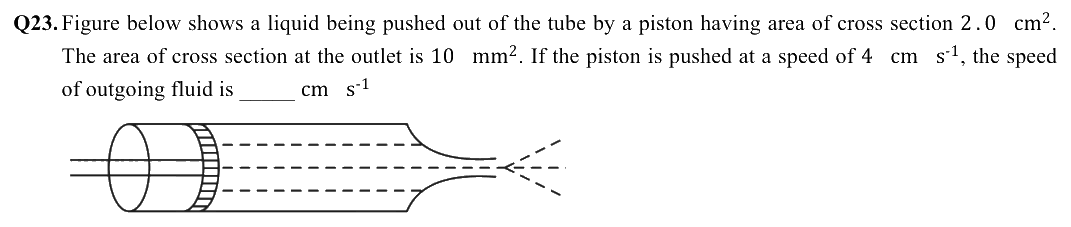
Figure below shows a liquid being pushed out of the tube by a piston having area of cross section $2.0\ \mathrm{cm^2}$. The area of cross section at the outlet is $10\ \mathrm{mm^2}$. If the piston is pushed at a speed of $4\ \mathrm{cm\,s^{-1}}$, the speed of outgoing fluid is ______ $\mathrm{cm\,s^{-1}}$ (see the figure above)
The question as printed in the paper.
Numerical answer type: type your answer in EdLoop to check it
An air bubble of diameter 6 mm rises steadily through a solution of density $1750\ \mathrm{kg\,m^{-3}}$ at the rate of $0.35\ \mathrm{cm\,s^{-1}}$. The co-efficient of viscosity of the solution (neglect density of air) is ______ Pas (given, $\mathrm{g} = 10\ \mathrm{m\,s^{-2}}$).
Numerical answer type: type your answer in EdLoop to check it
The surface of water in a water tank of cross section area 750 $\mathrm{cm^2}$ on the top of a house is $h$ m. above the tap level. The speed of water coming out through the tap of cross section area 500 $\mathrm{mm^2}$ is 30 $\mathrm{cm\ s^{-1}}$. At that instant, $\dfrac{dh}{dt}$ is $x \times 10^{-3}$ $\mathrm{m\ s^{-1}}$. The value of $x$ will be ______.
Numerical answer type: type your answer in EdLoop to check it
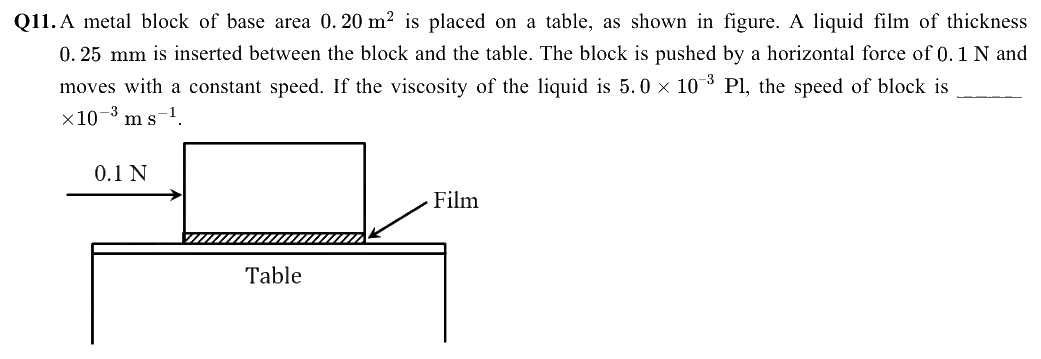
A metal block of base area $0.20\ \mathrm{m^2}$ is placed on a table, as shown in figure. A liquid film of thickness $0.25\ \mathrm{mm}$ is inserted between the block and the table. The block is pushed by a horizontal force of $0.1\ \mathrm{N}$ and moves with a constant speed. If the viscosity of the liquid is $5.0 \times 10^{-3}$ Pl, the speed of block is ______ $\times 10^{-3}\ \mathrm{m\,s^{-1}}$. (see the figure above)
The question as printed in the paper.
Numerical answer type: type your answer in EdLoop to check it
A spherical drop of liquid splits into 1000 identical spherical drops. If $u_i$ is the surface energy of the original drop and $u_f$ is the total surface energy of the resulting drops, the (ignoring evaporation), $\frac{u_f}{u_i}=\left(\frac{10}{x}\right)$. Then value of $x$ is ______:
Numerical answer type: type your answer in EdLoop to check it
A spherical ball of radius 1 mm and density $10.5\ \mathrm{g\,cc^{-1}}$ is dropped in glycerine of coefficient of viscosity 9.8 poise and density $1.5\ \mathrm{g\,cc^{-1}}$. Viscous force on the ball when it attains constant velocity is $3696\times10^{-x}$ N. The value of $x$ is
(Given, $g=9.8\ \mathrm{m\,s^{-2}}$ and $\pi=\frac{22}{7}$)
Numerical answer type: type your answer in EdLoop to check it
The velocity of a small ball of mass 0.3 g and density 8 $\mathrm{g\ cc^{-1}}$ when dropped in a container filled with glycerine becomes constant after some time. If the density of glycerine is 1.3 $\mathrm{g\ cc^{-1}}$, then the value of viscous force acting on the ball will be $x \times 10^{-4}$ N, the value of $x$ is ______. [use $g = 10\ \mathrm{m\ s^{-2}}$]
Numerical answer type: type your answer in EdLoop to check it
The diameter of an air bubble which was initially $2\ \mathrm{mm}$, rises steadily through a solution of density $1750\ \mathrm{kg/m^{3}}$ at the rate of $0.35\ \mathrm{cm/s}$. Coefficient of viscosity of the solution is ______ (Assume mass of the bubble to be negligible) (Answer in Poise to the nearest integer)
Numerical answer type: type your answer in EdLoop to check it
A spherical soap bubble of radius 3 cm is formed inside another spherical soap bubble of radius 6 cm. If internal pressure of the smaller bubble of radius 3 cm in the above system is equal to the internal pressure of the another single soap bubble of radius $r$ cm. The value of $r$ is ______
Numerical answer type: type your answer in EdLoop to check it
A small spherical ball of radius $0.1\ \mathrm{mm}$ and density $10^4\ \mathrm{kg\,m^{-3}}$ falls freely under gravity through a distance $h$ before entering a tank of water. If, after entering the water the velocity of ball does not change and it continue to fall with same constant velocity inside water, then the value of $h$ will be ______ m. (Given $g = 10\ \mathrm{m\,s^{-2}}$, viscosity of water $= 1.0 \times 10^{-5}\ \mathrm{N\text{-}s\,m^{-2}}$ ).
Numerical answer type: type your answer in EdLoop to check it
A liquid of density $750\ \mathrm{kg\ m^{-3}}$ flows smoothly through a horizontal pipe that tapers in cross-sectional area from $A_1 = 1.2 \times 10^{-2}\ \mathrm{m^2}$ to $A_2 = \frac{A_1}{2}$. The pressure difference between the wide and narrow sections of the pipe is $4500\ \mathrm{Pa}$. The rate of flow of liquid is ______ $\times 10^{-3}\ \mathrm{m^{3}\ s^{-1}}$.
Numerical answer type: type your answer in EdLoop to check it
The area of cross-section of a large tank is $0.5\ \mathrm{m^2}$. It has a narrow opening near the bottom having area of cross-section $1\ \mathrm{cm^2}$. A load of $25\ \mathrm{kg}$ is applied on the water at the top in the tank. Neglecting the speed of water in the tank, the velocity of the water, coming out of the opening at the time when the height of water level in the tank is $40\ \mathrm{cm}$ above the bottom, will be ______ $\mathrm{cm\ s^{-1}}$. [Take $g = 10\ \mathrm{m\ s^{-2}}$]
Numerical answer type: type your answer in EdLoop to check it
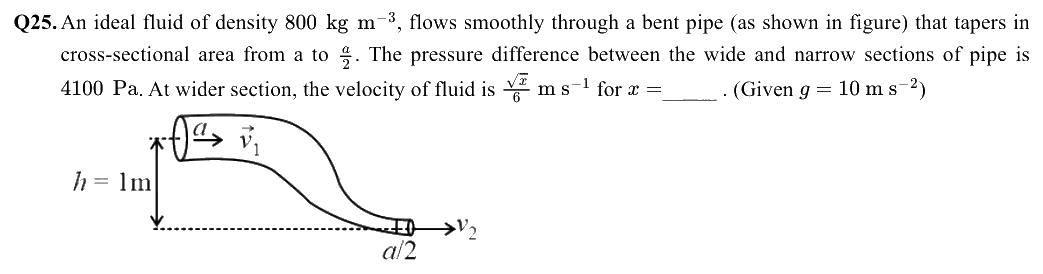
An ideal fluid of density $800 \mathrm{~kg} \mathrm{~m}^{-3}$, flows smoothly through a bent pipe (as shown in figure) that tapers in cross-sectional area from $a$ to $\frac{a}{2}$. The pressure difference between the wide and narrow sections of pipe is $4100 \mathrm{~Pa}$. At wider section, the velocity of fluid is $\frac{\sqrt{x}}{6} \mathrm{~m} \mathrm{~s}^{-1}$ for $x =$ ______ . (Given $g = 10 \mathrm{~m} \mathrm{~s}^{-2}$) (see the figure above)
The question as printed in the paper.
Numerical answer type: type your answer in EdLoop to check it
The velocity of upper layer of water in a river is $36 \mathrm{~km} \mathrm{~h}^{-1}$. Shearing stress between horizontal layers of water is $10^{-3} \mathrm{~N} \mathrm{~m}^{-2}$. Depth of the river is ______ m. (Co-efficient of viscosity of water is $10^{-2} \mathrm{~Pa} \mathrm{~s}$)
Numerical answer type: type your answer in EdLoop to check it
A soap bubble of the radius $3\ \mathrm{cm}$ is formed inside another soap bubble of radius, $6\ \mathrm{cm}$. The radius of an equivalent soap bubble that has the same excess pressure as inside the smaller bubble with respect to the atmospheric pressure is ____$\mathrm{cm}$.
Numerical answer type: type your answer in EdLoop to check it
The water is filled up to a height of $12\ \mathrm{m}$ in a tank having vertical sidewalls. A hole is made in one of the walls at a depth $h$ below the water level. The value of $h$ for which the emerging stream of water strikes the ground at the maximum range is ______ m.
Numerical answer type: type your answer in EdLoop to check it
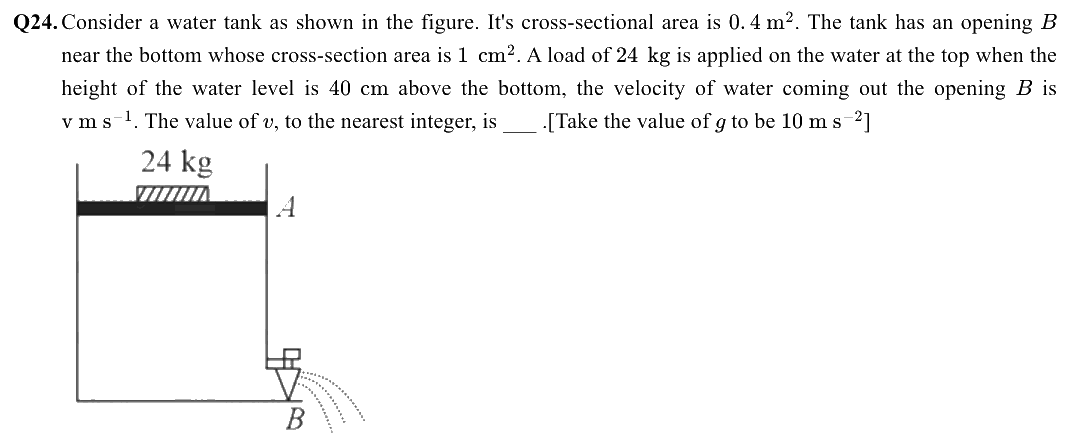
Consider a water tank as shown in the figure. It's cross-sectional area is $0.4~\mathrm{m^2}$. The tank has an opening $B$ near the bottom whose cross-section area is $1~\mathrm{cm^2}$. A load of $24~\mathrm{kg}$ is applied on the water at the top when the height of the water level is $40~\mathrm{cm}$ above the bottom, the velocity of water coming out the opening $B$ is $v~\mathrm{m~s^{-1}}$. The value of $v$, to the nearest integer, is ______ .[Take the value of $g$ to be $10~\mathrm{m~s^{-2}}$] (see the figure above)
The question as printed in the paper.
Numerical answer type: type your answer in EdLoop to check it
A hydraulic press can lift $100\ \mathrm{kg}$ when a mass $m$ is placed on the smaller piston. It can lift kg when the diameter of the larger piston is increased by $4$ times and that of the smaller piston is decreased by $4$ times keeping the same mass $m$ on the smaller piston.
Numerical answer type: type your answer in EdLoop to check it
When a long glass capillary tube of radius $0.015\ \mathrm{cm}$ is dipped in a liquid, the liquid rises to a height of $15\ \mathrm{cm}$ within it. If the contact angle between the liquid and glass to close to $0^\circ$, the surface tension of the liquid, in milliNewton $\mathrm{m^{-1}}$, is $[\rho_{\mathrm{(liqued)}} = 900\ \mathrm{kg\ m^{-3}}, g = 10\ \mathrm{m\,s^{-2}}]$ (Given answer in closed integer)
Numerical answer type: type your answer in EdLoop to check it
Fluid Mechanics is a fundamental branch of continuum physics that tests both hydrostatic balances and moving flow dynamics in JEE Main. In the papers we hold from 2019 to 2026, the chapter accounted for 146 questions in 162 papers, working out to 0.9 questions per paper, and appeared in 116 of those 162 papers. That puts it at 15th of 29 Physics chapters over that eight-year period, representing 3.2% of all Physics questions.
The chapter has grown in weighting in recent exam years. Between 2002 and 2018, it claimed 3.0% of Physics; across the last three exam years (2024 to 2026), its share rose to 4.3%, yielding 67 questions in 58 papers. The most active single year in our collection was 2024, with 26 questions across 20 papers. Every exam year since 2019 included questions on fluids, with questions appearing in 116 of the 162 papers in our set.
The topics form part of Unit 7: Properties of Solids and Liquids in NTA's Class 11 Physics syllabus. The concepts bridge mechanical equilibrium with energy conservation along streamlines and molecular surface forces.
Most-asked topics
From 2019 to 2026, the questions distributed across four distinct topics:
Surface Tension: 51 questions. Capillary rise, excess pressure across spherical interfaces, bubble coalescence work, and contact angles.
Viscosity: 36 questions. Terminal velocity in viscous media, Stokes' law, Poiseuille flow, and velocity gradients.
Fluid Statics: 29 questions. Archimedes' principle, hydrostatic pressure variation with depth, buoyant equilibrium, and accelerated fluid tanks.
All four topic divisions were tested in the 2026 exam cycle, so preparing across the entire chapter is necessary.
What the questions look like
Surface tension questions frequently feature capillary tubes and spherical bubbles. A common question gives two capillary tubes of different bore radii dipped into the same liquid and asks for the ratio of liquid column heights, or evaluates the percentage change in capillary rise when radius, liquid density, and surface tension shift by small percentages. Other questions calculate the mechanical work done in blowing a soap bubble or merging many tiny mist droplets into a larger drop.
Viscosity problems center on steady terminal motion. A typical problem presents a small metallic sphere falling through glycerine or oil under gravity. Students balance downward gravitational force against the combined upward forces of buoyancy and Stokes viscous drag, showing that terminal velocity is proportional to the square of the sphere radius and the density difference. Questions often ask for the new terminal speed when the sphere radius is halved.
Fluid dynamics questions apply Bernoulli's theorem along streamlines. You will encounter venturi meter problems where a manometer level difference between wide and constricted pipe sections allows you to calculate volume discharge rate. In fluid statics, problems typically ask for the submerged depth or tilt angle of a solid block floating at an interface between two immiscible liquids.
Direct numeric computation is common in this chapter: 43 of the 146 questions since 2019 were numerical-response questions without options.
Questions to try first
Here are five questions from NTA's 2026 papers covering the major themes:
Begin with fluid statics and buoyancy. Practice writing equilibrium equations for floating bodies by equating weight to buoyant force, taking care to use the density of the displaced liquid rather than the solid body. For accelerated fluid containers, remember that the free surface tilts such that the effective gravity vector is perpendicular to the liquid surface.
Next, master the combination of the continuity equation and Bernoulli's equation. Whenever you analyze horizontal pipe flow, remember that higher fluid speed in a narrow constriction corresponds to lower static pressure, not higher. Always verify whether a point on a streamline is exposed to the atmosphere so atmospheric pressure terms cancel cleanly.
For surface tension, distinguish carefully between drops and bubbles: a liquid drop has one interface with excess pressure 2T/R, whereas a soap bubble surrounded by air has two interfaces with excess pressure 4T/R. In viscosity problems, never omit the buoyant force when deriving terminal velocity unless the surrounding fluid density is explicitly stated to be negligible.
Frequently asked questions
Is Fluid Mechanics heavily tested in JEE Main 2027?
Yes. Fluid Mechanics generated 146 questions across 162 papers in our set from 2019 to 2026, averaging 0.9 questions per paper. It ranks 15th among 29 Physics chapters and appeared in 116 of those 162 papers.
Which topic in Fluid Mechanics is tested most often?
Surface tension is the most-asked topic, providing 51 questions between 2019 and 2026, followed by viscosity with 36 questions and fluid dynamics with 30 questions.
Why do raindrops reach a constant speed rather than accelerating indefinitely?
As a raindrop falls through the atmosphere, upward viscous drag increases linearly with speed until the sum of viscous drag and buoyant force exactly balances the downward gravitational pull. At that equilibrium point, acceleration ceases and the drop maintains a constant terminal velocity.
Where can I see the solutions?
Every question on this page opens with its options and answer. Step-by-step solutions for each one are in the EdLoop app.