Every Wave Optics question from past JEE Main and AIEEE papers, with options and answers. Newest first.
189questions
153papers covered
3.1%of Physics questions, 2019–2026
2003–2026years
Guide at a glance
Wave optics examines the wave nature of light under Unit 16: Optics in the Class 12 curriculum, holding rank 19 among 29 physics chapters with a 3.1 percent share of total physics questions.
In interference experiment the path difference between two interfering waves at a point $A$ on the screen is $\lambda/3$, where $\lambda$ is the wavelength of these waves, and at another point $B$ the path difference is $\lambda/6$. The ratio of intensities at points $A$ and $B$ is ________.
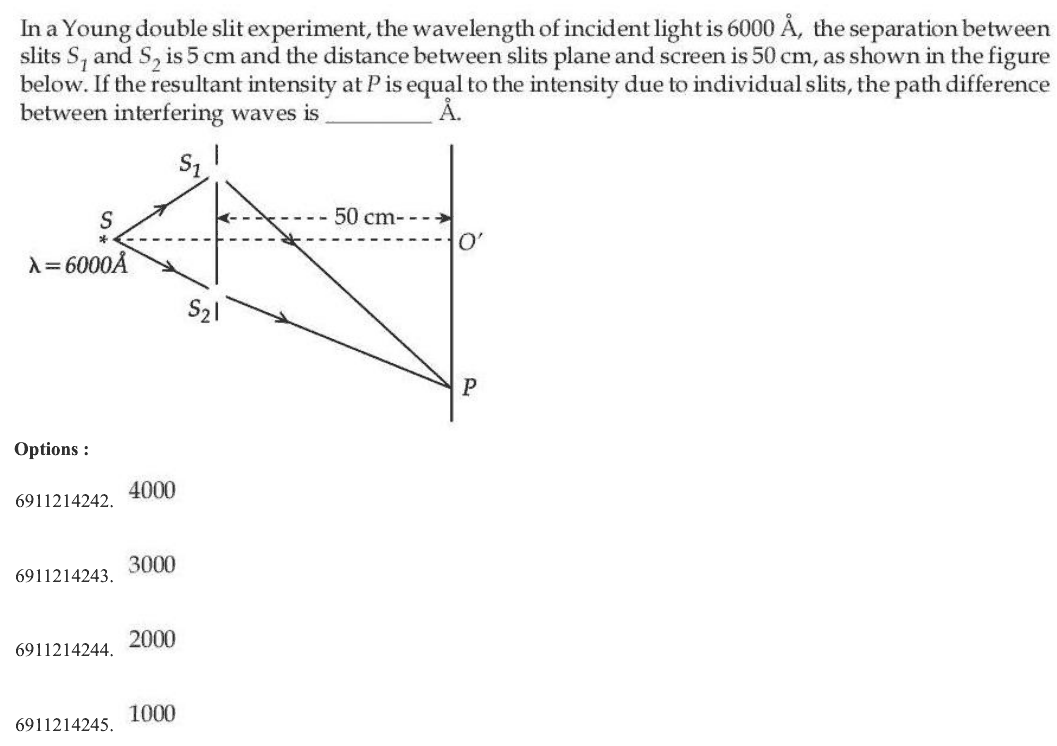
In a Young double slit experiment, the wavelength of incident light is 6000 Å, the separation between slits $S_1$ and $S_2$ is 5 cm and the distance between slits plane and screen is 50 cm, as shown in the figure below. If the resultant intensity at $P$ is equal to the intensity due to individual slits, the path difference between interfering waves is ________ Å.
In Young's double slit experiment, the fringe width of the interference pattern produced on the screen is 2.4 $\mu$m. If the experiment is carried out in another medium having refractive index 1.2, the fringe width will be ________ $\mu$m.
The maximum intensity in a Young's double slit experiment is $I_o$. Distance between the slits ($d$) is $5\lambda$, where $\lambda$ is the wavelength of light used. The intensity of the fringe, exactly opposite to one of the slits on the screen, placed at $D = 10d$ is ________.
A slit of width $a$ is illuminated by light of wavelength $\lambda$. The linear separation between 1$^{\text{st}}$ and 3$^{\text{rd}}$ minima in the diffraction pattern produced on a screen placed at a distance $D$ from the slit system is ________.
A telescope with objective diameter $R$ is used to observe a distant star emitting light of wavelength 500 nm, at a resolution of $5\times10^{-7}$ radian. The value of $R$ is ________ cm.
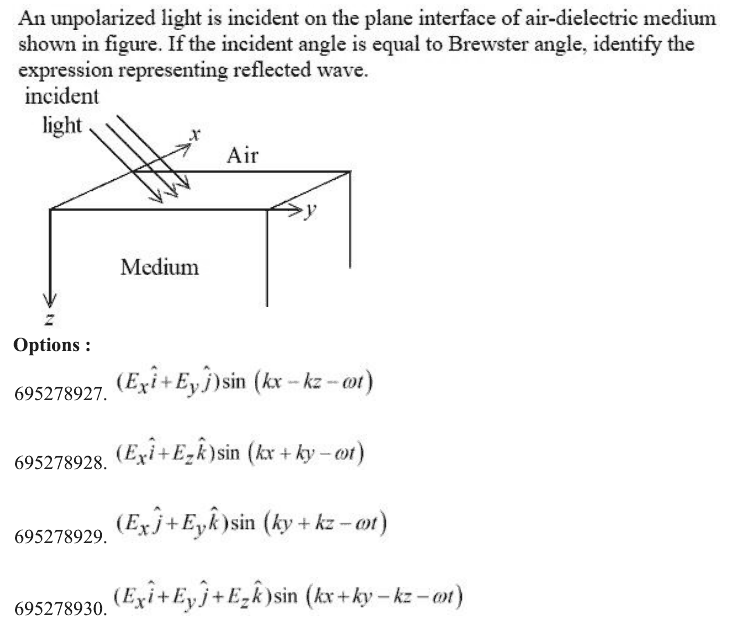
An unpolarized light is incident on the plane interface of air-dielectric medium shown in figure. If the incident angle is equal to Brewster angle, identify the expression representing reflected wave.
An unpolarized light of certain intensity passes through a combination of two polarizers whose transmission axes are at 30° and 90°, respectively, with respect to the horizontal axis. A third polarizer with its transmission axis at 60° with the horizontal axis is placed between the two existing polarizers. The ratio of the output intensities with and without the third polarizer is ________.
An unpolarised light is incident at an interface of two dielectric media having refractive indices of 2 (incident medium) and $2\sqrt{3}$ (medium) respectively. To satisfy the condition that reflected and refracted rays are perpendicular to each other, the angle of incidence is ________.
In the Young's double slit experiment the intensity produced by each one of the individual slits is $I_o$. The distance between two slits is 2 mm. The distance of screen from slits is 10 m. The wavelength of light is 6000 $\mathrm{\AA}$. The intensity of light on the screen in front of one of the slits is ________.
When an unpolarized light falls at a particular angle on a glass plate (placed in air), it is observed that the reflected beam is linearly polarized. The angle of refracted beam with respect to the normal is ________.
($\tan^{-1}(1.52) = 57.7°$, refractive indices of air and glass are 1.00 and 1.52, respectively.)
In a double slit experiment the distance between the slits is 0.1 cm and the screen is placed at 50 cm from the slits plane. When one slit is covered with a transparent sheet having thickness $t$ and refractive index $n (= 1.5)$, the central fringe shifts by 0.2 cm. The value of $t$ is ________ cm.
Statement I : In a Young's double slit experiment, the angular separation of fringes will increase as the screen is moved away from the plane of the slits
Statement II : In a Young's double slit experiment, the angular separation of fringes will increase when monochromatic source is replaced by another monochromatic source of higher wavelength
In the light of the above statements, choose the correct answer from the options given below :
In a Young's double slit experiment, the slits are separated by 0.2 mm. If the slits separation is increased to 0.4 mm, the percentage change of the fringe width is :
Two polarisers $P_1$ and $P_2$ are placed in such a way that the intensity of the transmitted light will be zero. A third polariser $P_3$ is inserted in between $P_1$ and $P_2$, at particular angle between $P_2$ and $P_3$. The transmitted intensity of the light passing the through all three polarisers is maximum. The angle between the polarisers $P_2$ and $P_3$ is :
Two monochromatic light beams have intensities in the ratio 1:9. An interference pattern is obtained by these beams. The ratio of the intensities of maximum to minimum is
Width of one of the two slits in a Young's double slit interference experiment is half of the other slit. The ratio of the maximum to the minimum intensity in the interference pattern is :
A light wave is propagating with plane wave fronts of the type $x + y + z =$ constant. The angle made by the direction of wave propagation with the $x$ -axis is :
The Young's double slit interference experiment is performed using light consisting of 480 nm and 600 nm wavelengths to form interference patterns. The least number of the bright fringes of 480 nm light that are required for the first coincidence with the bright fringes formed by 600 nm light is
Young's double slit inteference apparatus is immersed in a liquid of refractive index 1.44. It has slit separation of 1.5 mm . The slits are illuminated by a parallel beam of light whose wavelength in air is 690 nm . The fringe-width on a screen placed behind the plane of slits at a distance of 0.72 m , will be :
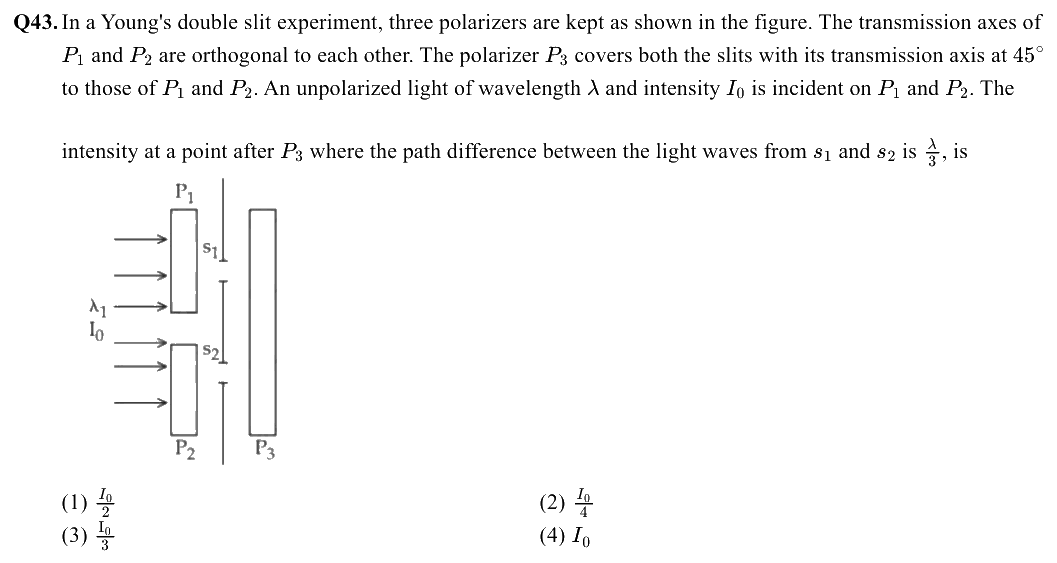
In a Young's double slit experiment, three polarizers are kept as shown in the figure. The transmission axes of $P_1$ and $P_2$ are orthogonal to each other. The polarizer $P_3$ covers both the slits with its transmission axis at $45^\circ$ to those of $P_1$ and $P_2$. An unpolarized light of wavelength $\lambda$ and intensity $I_0$ is incident on $P_1$ and $P_2$. The intensity at a point after $P_3$ where the path difference between the light waves from $s_1$ and $s_2$ is $\frac{\lambda}{3}$, is
The width of one of the two slits in Young's double slit experiment is d while that of the other slit is $x$ d. If the ratio of the maximum to the minimum intensity in the interference pattern on the screen is 9 : 4 then what is the value of $x$ ? (Assume that the field strength varies according to the slit width.)
Given below are two statements : one is labelled as Assertion (A) and the other is labelled as Reason (R). Assertion-(A) : If Young's double slit experiment is performed in an optically denser medium than air, then the consecutive fringes come closer. Reason-(R) : The speed of light reduces in an optically denser medium than air while its frequency does not change. In the light of the above statements, choose the most appropriate answer from the options given below :
A
Both (A) and (R) are true but (R) is not the correct explanation of (A)
B
Both (A) and (R) are true and (R) is the correct explanation of (A)
A transparent film of refractive index, 2.0 is coated on a glass slab of refractive index, 1.45. What is the minimum thickness of transparent film to be coated for the maximum transmission of Green light of wavelength 550 nm . [Assume that the light is incident nearly perpendicular to the glass surface.]
Given below are two statements. One is labelled as Assertion (A) and the other is labelled as Reason (R).
Assertion (A) : In Young's double slit experiment, the fringes produced by red light are closer as compared to those produced by blue light. Reason (R): The fringe width is directly proportional to the wavelength of light.
In the light of the above statements, choose the correct answer from the options given below :
A
Both (A) and (R) are true but (R) is NOT the correct explanation of (A)
B
(A) is true but (R) is false
C
Both (A) and (R) are true and (R) is the correct explanation of (A)
The width of one of the two slits in a Young's double slit experiment is 4 times that of the other slit. The ratio of the maximum of the minimum intensity in the interference pattern is:
A monochromatic light of wavelength 6000 $\mathring{A}$ is incident on the single slit of width 0.01 mm. If the diffraction pattern is formed at the focus of the convex lens of focal length 20 cm, the linear width of the central maximum is :
A microwave of wavelength 2.0 cm falls normally on a slit of width 4.0 cm. The angular spread of the central maxima of the diffraction pattern obtained on a screen 1.5 m away from the slit, will be:
When unpolarized light is incident at an angle of $60^\circ$ on a transparent medium from air. The reflected ray is completely polarized. The angle of refraction in the medium is
The diffraction pattern of a light of wavelength 400 nm diffracting from a slit of width 0. 2 mm is focused on the focal plane of a convex lens of focal length 100 cm. The width of the $1^{\mathrm{st}}$ secondary maxima will be :
A beam of unpolarised light of intensity $I_0$ is passed through a polaroid $A$ and then through another polaroid $B$ which is oriented so that its principal plane makes an angle of $45^\circ$ relative to that of $A$. The intensity of emergent light is :
In Young's double slit experiment, light from two identical sources are superimposing on a screen. The path difference between the two lights reaching at a point on the screen is $\frac{7\lambda}{4}$. The ratio of intensity of fringe at this point with respect to the maximum intensity of the fringe is:
A single slit of width $a$ is illuminated by a monochromatic light of wavelength 600 nm. The value of $a$ for which first minimum appears at $\theta$ = 30° on the screen will be :
In a Young's double slit experiment, the ratio of amplitude of light coming from slits is 2 : 1. The ratio of the maximum to minimum intensity in the interference pattern is
The ratio of intensities at two points P and Q on the screen in a Young's double slit experiment where phase difference between two waves of same amplitude are $\frac{\pi}{3}$ and $\frac{\pi}{2}$, respectively are
The width of fringe is $2\ \mathrm{mm}$ on the screen in a double slit experiment for the light of wavelength of $400\ \mathrm{nm}$. The width of the fringe for the light of wavelength $600\ \mathrm{nm}$ will be:
Given below are two statements: one is labelled as Assertion A and the other is labelled as Reason R
Assertion A: The phase difference of two light waves change if they travel through different media having same thickness, but different indices of refraction.
Reason R: The wavelengths of waves are different in different media.
In the light of the above statements, choose the most appropriate answer from the options given below
A
Both A and R are correct but R is NOT the correct explanation of A
B
A is not correct but R is correct
C
A is correct but R is not correct
D
Both A and R are correct and R is the correct explanation of A
'$n$' polarizing sheets are arranged such that each makes an angle $45^\circ$ with the proceeding sheet. An unpolarized light of intensity $I$ is incident into this arrangement. The output intensity is found to be $\dfrac{I}{64}$. The value of $n$ will be:
Two polaroids $A$ and $B$ are placed in such a way that the pass-axis of polaroids are perpendicular to each other. Now, another polaroid $C$ is placed between $A$ and $B$ bisecting angle between them. If intensity of unpolarised light is $I_0$ then intensity of transmitted light after passing through polaroid $B$ will be :
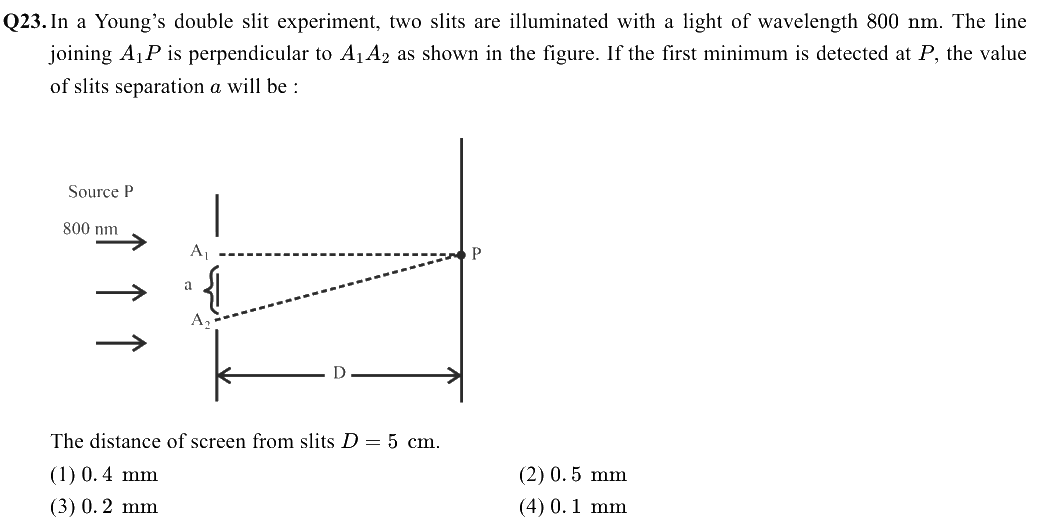
In a Young's double slit experiment, two slits are illuminated with a light of wavelength $800\ \mathrm{nm}$. The line joining $A_1P$ is perpendicular to $A_1A_2$ as shown in the figure. If the first minimum is detected at $P$, the value of slits separation $a$ will be :
(see the figure above)
The distance of screen from slits $D = 5\ \mathrm{cm}$.
In Young's double slits experiment, the position of $5^{\mathrm{th}}$ bright fringe from the central maximum is 5 cm. The distance between slits and screen is 1 m and wavelength of used monochromatic light is 600 nm. The separation between the slits is:
Statement I : If the Brewster's angle for the light propagating from air to glass is $\theta_B$, then Brewster's angle for the light propagating from glass to air is $\frac{\pi}{2}-\theta_B$.
Statement II : The Brewster's angle for the light propagating from glass to air is $\tan^{-1}\mu_g$, where $\mu_g$ is the refractive index of glass.
In the light of the above statements, choose the correct answer from the options given below :
An unpolarised light beam of intensity $2I_0$ is passed through a polaroid $P$ and then through another polaroid $Q$ which is oriented in such a way that its passing axis makes an angle of $30^\circ$ relative to that of $P$. The intensity of the emergent light is
Two coherent sources of light interfere. The intensity ratio of two sources is 1 : 4. For this interference pattern if the value of $\frac{I_{\max} + I_{\min}}{I_{\max} - I_{\min}}$ is equal to $\frac{2\alpha + 1}{\beta + 3}$, then $\frac{\alpha}{\beta}$ will be
In young's double slit experiment, the fringe width is 12 mm. If the entire arrangement is placed in water of refractive index $\frac{4}{3}$, then the fringe width becomes (in mm)
Using Young's double slit experiment, a monochromatic light of wavelength $5000\mathrm{\AA}$ produces fringes of fringe width $0.5\ \mathrm{mm}$. If another monochromatic light of wavelength $6000\mathrm{\AA}$ is used and the separation between the slits is doubled, then the new fringe width will be
In young's double slit experiment performed using a monochromatic light of wavelength $\lambda$, when a glass plate ($\mu = 1.5$) of thickness $x\lambda$ is introduced in the path of the one of the interfering beams, the intensity at the position where the central maximum occurred previously remains unchanged. The value of $x$ will be
The two light beams having intensities $I$ and $9I$ interfere to produce a fringe pattern on a screen. The phase difference between the beams is $\frac{\pi}{2}$ at point $P$ and $\pi$ at point $Q$. Then the difference between the resultant intensities at $P$ and $Q$ will be :
The interference pattern is obtained with two coherent light sources of intensity ratio $4 : 1$. And the ratio $\frac{I_{\max} + I_{\min}}{I_{\max} - I_{\min}}$ is $\frac{5}{x}$. Then, the value of $x$ will be equal to :
A light whose electric field vectors are completely removed by using a good polaroid, allowed to incident on the surface of the prism at Brewster's angle. Choose the most suitable option for the phenomenon related to the prism.
A
Reflected and refracted rays will be perpendicular to each other.
B
Wave will propagate along the surface of prism.
C
No refraction, and there will be total reflection of light.
D
No reflection. and there will be total transmission of light.
The light waves from two coherent sources have same intensity $I_1=I_2=I_0$. In interference pattern the intensity of light at minima is zero. What will be the intensity of light at maxima?
In the Young's double slit experiment, the distance between the slits varies in time as $dt = d_0 + a_0\ \sin\omega t$; where $d_0$, $\omega$ and $a_0$ are constants. The difference between the largest fringe width and the smallest fringe width obtained over time is given as:
In Young's double slit arrangement, slits are separated by a gap of $0.5~\mathrm{mm}$, and the screen is placed at a distance of $0.5~\mathrm{m}$ from them. The distance between the first and the third bright fringe formed when the slits are illuminated by a monochromatic light of $5890~\mathrm{\AA}$ is :-
In a Young's double slit experiment two slits are separated by $2\ \mathrm{mm}$ and the screen is placed one meter away. When a light of wavelength $500\ \mathrm{nm}$ is used, the fringe separation will be :
Two coherent light sources having intensity in the ratio $2x$ produce an interference pattern. The ratio $\frac{I_{max} - I_{min}}{I_{max} + I_{min}}$ will be
Consider the diffraction pattern obtained from the sunlight incident on a pinhole of diameter $0.1\ \mu\mathrm{m}$. If the diameter of the pinhole is slightly increased, it will affect the diffraction pattern such that
In a Young's double slit experiment, the width of the one of the slit is three times the other slit. The amplitude of the light coming from a slit is proportional to the slit-width. Find the ratio of the maximum to the minimum intensity in the interference pattern.
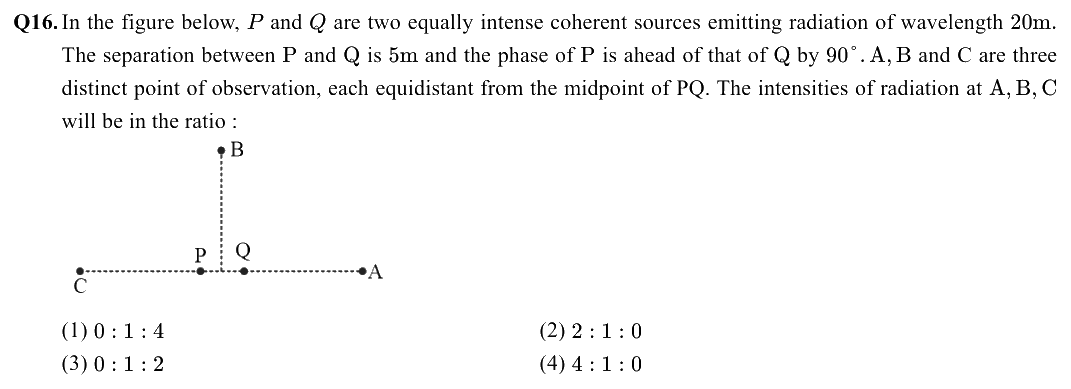
In the figure below, $P$ and $Q$ are two equally intense coherent sources emitting radiation of wavelength 20m. The separation between P and Q is 5m and the phase of P is ahead of that of Q by $90^\circ$. A, B and C are three distinct point of observation, each equidistant from the midpoint of PQ. The intensities of radiation at A, B, C will be in the ratio : (see the figure above)
A beam of plane polarized light of large cross-sectional area and uniform intensity of $3.3\ \mathrm{W\ m^{-2}}$ falls normally on a polarizer (cross-sectional area $3 \times 10^{-4}\ \mathrm{m^{2}}$), which rotates about its axis with an angular speed of $31.4\ \mathrm{rad\ s^{-1}}$. The energy of light passing through the polarizer per revolution, is close to:
In a Young's double slit experiment, light of $500\ \mathrm{nm}$ is used to produce and interference pattern. When the distance between the slits is $0.05\ \mathrm{mm}$, the angular width (in degree) of the fringes formed on the distance screen is close to :
Two light waves having the same wavelength $\lambda$ in vacuum are in phase initially. Then the first wave travels a path $L_1$ through a medium of refractive index $n_1$ while the second wave travels a path of length $L_2$ through a medium of refractive index $n_2$. After this the phase difference between the two waves is:
Interference fringes are observed on a screen by illuminating two thin slits $1\ \mathrm{mm}$ apart with a light source ($\lambda = 632.8\ \mathrm{nm}$). The distance between the screen and the slits is $100\ \mathrm{cm}$. If a bright fringe is observed on a screen at distance of $1.27\ \mathrm{mm}$ from the central bright fringe, then the path difference between the waves, which are reaching this point from the slits is close to :
In a Young's double slit experiment,16 fringes are observed in a certain segment of the screen when light of wavelength $700\ \mathrm{nm}$ is used. If the wavelength of light is changed to $400\ \mathrm{nm}$, the number of fringes observed in the same segment of the screen would be :
The aperture diameter of a telescope is 5m . The separation between the moon and the earth is $4 \times 10^5\mathrm{km}$ . With light of wavelength of $5500\mathrm{\AA}$ , the minimum separation between objects on the surface of moon, so that they are just resolved, is close to:
In a double $-$ slit experiment, at a certain point on the screen the path difference between the two interfering waves is $\frac{1}{8}$th of a wavelength. The ratio of the intensity of light at that point to that at the center of a bright fringe is:
A polarizer - analyser set is adjusted such that the intensity of light coming out of the analyser is just $36\%$ of the original intensity. Assuming that the polarizer - analyser set does not absorb any light, the angle by which the analyser needs to be rotated further, to reduce the output intensity to zero, is $\left(\sin^{-1}\left(\frac{3}{5}\right) = 37^\circ\right)$
Visible light of wavelength $6000 \times 10^{-8}\mathrm{cm}$ falls normally on a single slit and produces a diffraction pattern. It is found that the second diffraction minimum is at $60^\circ$ from the central maximum. If the first minimum is produced at $\theta_1$, then $\theta_1$ is close to
In a Young's double slit experiment, the separation between the slits is $0.15\mathrm{mm}$. In the experiment, a source of light of wavelength $589\mathrm{nm}$ is used and the interference pattern is observed on a screen kept $1.5\mathrm{m}$ away. The separation between the successive bright fringes on the screen is:
In a double slit experiment, when a thin film of thickness t having refractive index $\mu$ is introuduced in front of one of the slits, the maximum at the centre of the fringe pattern shifts by one fringe width. The value of t is ( $\lambda$ is the wavelength of the light used):
A system of three polarizers $\mathrm{P_1, P_2, P_3}$ is set up such that the pass axis of $\mathrm{P_3}$ is crossed with respect to that of $\mathrm{P_1}$. The pass axis of $\mathrm{P_2}$ is inclined at $60^o$ to the pass axis of $\mathrm{P_3}$. When a beam of unpolarized light of intensity $\mathrm{I_o}$ is incident on $\mathrm{P_1}$, the intensity of light transmitted by the three polarizers is $\mathrm{I}$ . The ratio $(\mathrm{I_o/I})$ equals (nearly):
In a Young's double-slit experiment, the ratio of the slit's width is $4:1$. The ratio of the intensity of maxima to minima, close to the central fringe on the screen, will be
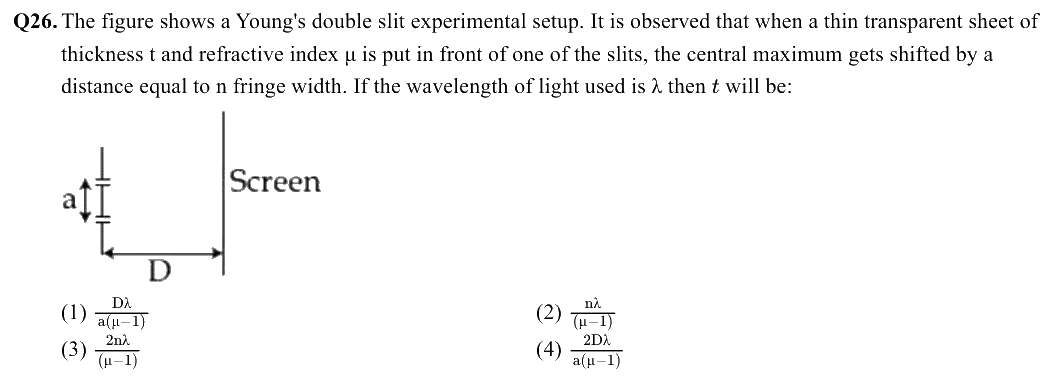
The figure shows a Young's double slit experimental setup. It is observed that when a thin transparent sheet of thickness t and refractive index $\mu$ is put in front of one of the slits, the central maximum gets shifted by a distance equal to n fringe width. If the wavelength of light used is $\lambda$ then $t$ will be: (see the figure above)
In an interference experiment the ratio of amplitudes of coherent waves is $\dfrac{a_1}{a_2} = \dfrac{1}{3}$. The ratio of maximum and minimum intensities of fringes will be:
Calculate the limit of resolution of a telescope objective having a diameter of 200 cm , if it has to detect light of wavelength 500 nm coming from a star.
In a Young's double slit experiment, the path difference, at a certain point on the screen, betwen two interfering waves is $\frac{1}{8}$ th of wavelength. The ratio of the intensity at this point to that at the centre of a bright fringe is close to:
In a double-slit experiment, green light (5303 A) falls on a double slit having a separation of 19.44$\mu$m and a width of 4.05$\mu$m. The number of bright fringes between the first and the second diffraction minima is
In Young's double slit experiment slit separation $0.1\ mm$, one observes a bright fringe at angle $\frac{1}{40}\ rad$ by using light of wavelength $\lambda_1$. When the light of wavelength $\lambda_2$ is used a bright fringe is seen at the same angle in the same set up. Given that $\lambda_1$ and $\lambda_2$ are in visible range $(380\ nm$ to $740\ nm)$, their values are:
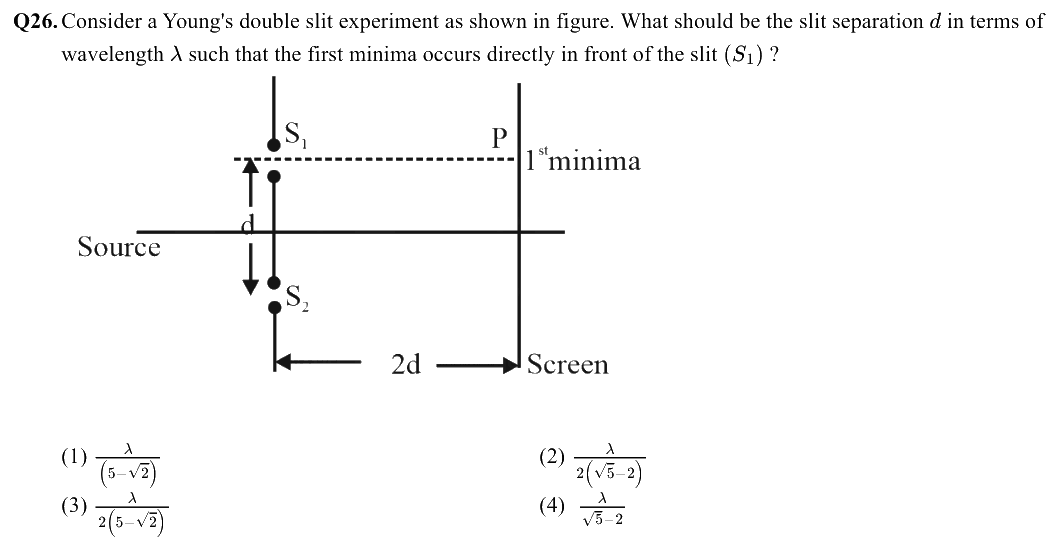
Consider a Young's double slit experiment as shown in figure. What should be the slit separation $d$ in terms of wavelength $\lambda$ such that the first minima occurs directly in front of the slit $(S_1)$ ? (see the figure above)
Two coherent sources produce waves of different intensities which interfere. After interference, the ratio of the maximum intensity to the minimum intensity is $16$ . The intensity of the waves are in the ratio:
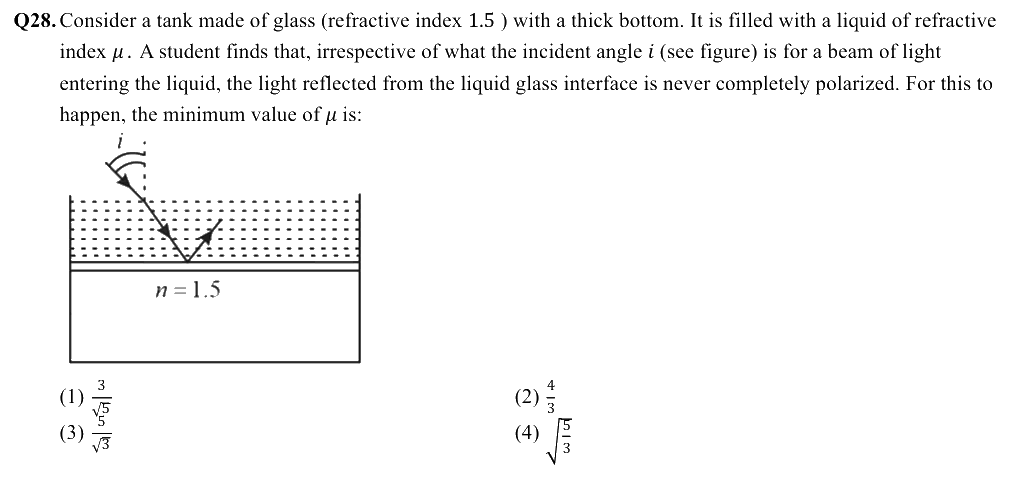
Consider a tank made of glass (refractive index $1.5$ ) with a thick bottom. It is filled with a liquid of refractive index $\mu$. A student finds that, irrespective of what the incident angle $i$ (see figure) is for a beam of light entering the liquid, the light reflected from the liquid glass interface is never completely polarized. For this to happen, the minimum value of $\mu$ is: (see the figure above)
In a young's double slit experiment, the slits are placed $0.320\ mm$ apart. Light of wavelength $\lambda = 500\ nm$ is incident on the slits. The total number of bright fringes that are observed in the angular range $-30^o \leq \theta \leq 30^o$ is:
Unpolarized light of intensity $I$ is incident on a system of two polarizers, $A$ followed by $B$. The intensity of emergent light is $\frac{I}{2}$. If a third polarizer $C$ is placed between $A$ and $B$ the intensity of emergent light is reduced to $\frac{I}{3}$. The angle between the polarizers $A$ and $C$ is $\theta$, then
Light of wavelength $550\ \mathrm{nm}$ falls normally on a slit of width $22.0 \times 10^{-5}\ \mathrm{cm}$. The angular position of the second minima from the central maximum will be (in radians)
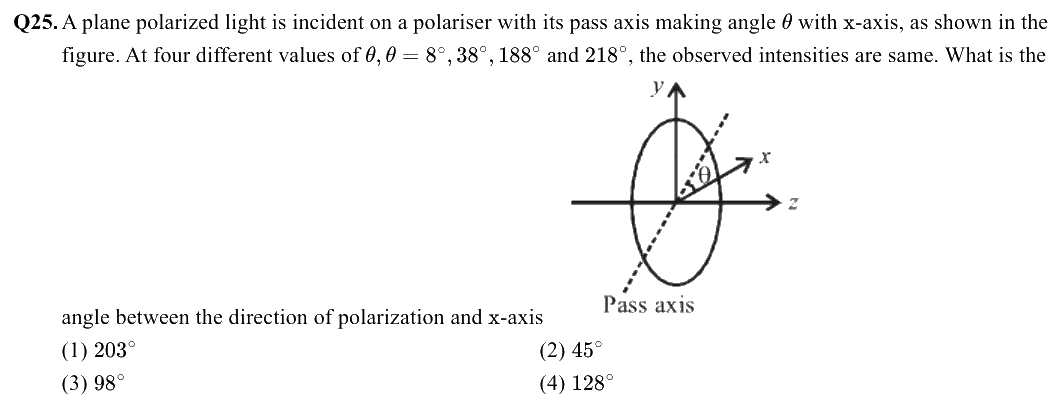
A plane polarized light is incident on a polariser with its pass axis making angle $\theta$ with x-axis, as shown in the figure. At four different values of $\theta$, $\theta = 8^\circ, 38^\circ, 188^\circ$ and $218^\circ$, the observed intensities are same. What is the angle between the direction of polarization and x-axis (see the figure above)
Unpolarized light of intensity $I$ passes through an ideal polariser $A$. Another identical polariser $B$ is placed behind $A$. The intensity of light beyond B is found to be $\dfrac{I}{2}$. Now another identical polariser $C$ is placed between $A$ and $B$. The intensity beyond B is now found to be $\dfrac{I}{8}$. The angle between polariser $A$ and $C$ is
The angular width of the central maximum in a single slit diffraction pattern is $60^\circ$ . The width of the slit is $1\ \mu\mathrm{m}$. The slit is illuminated by monochromatic plane waves. If another slit of the same width is made near it, Young's fringes can be observed on a screen placed at a distance $50\ \mathrm{cm}$ from the slits. If the observed fringe width is $1\ \mathrm{cm}$, what is slit separation distance? (i.e., the distance between the centres of each slit.)
A single slit of width 0.1 mm is illuminated by a parallel beam of light of wavelength 6000 Å and diffraction bands are observed on a screen 0.5 m from the slit. The distance of the third dark band from the central bright band is:
A single slit of width $b$ is illuminated by a coherent monochromatic light of wavelength $\lambda$. If the second and fourth minima in the diffraction pattern at a distance 1 cm from the slit are at 3 cm and 6 cm respectively from the central maximum, what is the width of the central maximum? (i.e. distance between first minimum on either side of the central maximum)
In Young's double slit experiment, slits are separated by $0.5\ \mathrm{mm}$, and the screen is placed $150\ \mathrm{cm}$ away. A beam of light consisting of two wavelengths, $650\ \mathrm{nm}$ and $520\ \mathrm{nm}$, is used to obtain interference fringes on the screen. The least distance from the common central maximum to the point where the bright fringes due to both the wavelengths coincide is:
Two stars are 10 light years away from the earth. They are seen through a telescope of objective diameter 30 cm. The wavelength of light is $600\mathrm{nm}$. To see the stars just resolved by the telescope, the minimum distance between them should be $(1\ light\ year = 9.46\times10^{15}m)$ of the order of :
In Young's double-slit experiment, the distance between slits and the screen is 1 m and monochromatic light of wavelength 600 nm is being used. A person standing near the slits is looking at the fringe pattern. When the separation between the slits is varied, the interference pattern disappears for a particular distance $\mathrm{d_0}$ between the slits. If the angular resolution of the eye is $\frac{1}{60}^{\circ}$, then the value of $\mathrm{d_0}$ is close to
The box of a pin hole camera, of length L, has a hole of radius a. It is assumed that when the hole is illuminated by a parallel beam of light of wavelength $\lambda$ the spread of the spot (obtained on the opposite wall of the camera) is the sum of its geometrical spread and the spread due to diffraction. The spot would then have its minimum size (say $b_{min}$ ) when:
A
$a = \sqrt{\lambda L}$ and $b_{min} = \sqrt{4\lambda L}$
B
$a = \frac{\lambda^2}{L}$ and $b_{min} = \sqrt{4\lambda L}$
C
$a = \frac{\lambda^2}{L}$ and $b_{min} = \left(\frac{2\lambda^2}{L}\right)$
D
$a = \sqrt{\lambda L}$ and $b_{min} = \left(\frac{2\lambda^2}{L}\right)$
In a Young's double slit experiment with light of wavelength $\lambda$, the separation of slits is $d$ and distance of screen is $D$ such that $D \gg d \gg \lambda$. If the Fringe width is $\beta$, the distance from point of maximum intensity to the point where intensity falls to half of the maximum intensity on either side is:
Unpolarized light of intensity $I_0$ is incident on surface of a block of glass at Brewster's angle. In that case, which one of the following statements is true?
A
transmitted light is partially polarized with intensity $\frac{I_0}{2}$
B
transmitted light is completely polarized with intensity less than $\frac{I_0}{2}$
C
reflected light is partially polarized with intensity $\frac{I_0}{2}$
D
reflected light is completely polarized with intensity less than $\frac{I_0}{2}$
On a hot summer night, the refractive index of air is the smallest near the ground and increases with a height from the ground. When a light beam is directed horizontally, the Huygens' principle leads us to conclude that as it travels, the light beam,
Assuming that the human pupil has a radius of $0.25\ \mathrm{cm}$ and a comfortable viewing distance of $25\ \mathrm{cm}$. The minimum separation between two point objects that the human eye can resolve for the light of wavelength $500\ \mathrm{nm}$ is
A ray of light is incident from a denser to a rarer medium. The critical angle for total internal reflection is $\theta_{\mathrm{iC}}$ and Brewster's angle of incidence is $\theta_{\mathrm{iB}}$, such that $\frac{\sin\theta_{\mathrm{iC}}}{\sin\theta_{\mathrm{iB}}} = \eta = 1.28$. The relative refractive index of the two media is
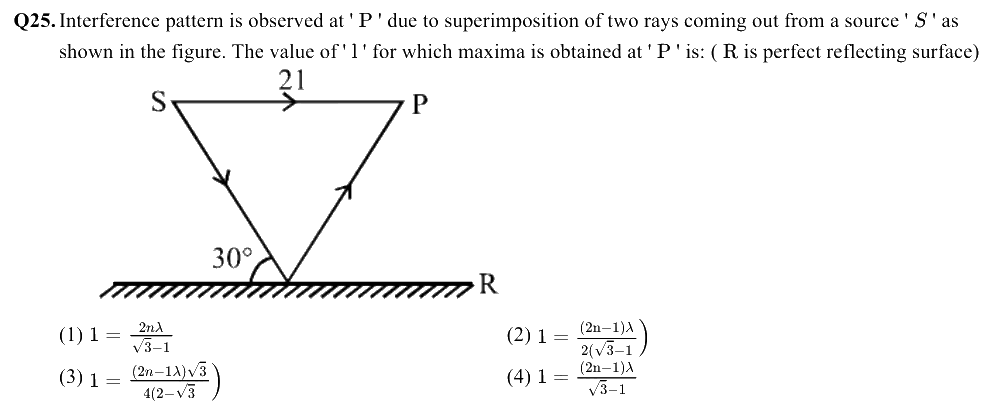
Interference pattern is observed at ' P ' due to superimposition of two rays coming out from a source ' $S$ ' as shown in the figure. The value of ' $l$ ' for which maxima is obtained at ' P ' is: ( R is perfect reflecting surface) (see the figure above)
In an experiment of single slit diffraction pattern, first minimum for red light coincides with first maximum of some other wavelength. If wavelength of red light is $6600\mathring{A}$, then wavelength of first maximum will be:
Two monochromatic light beams of intensity 16 and 9 units are interfering. The ratio of intensities of bright and dark parts of the resultant pattern is:
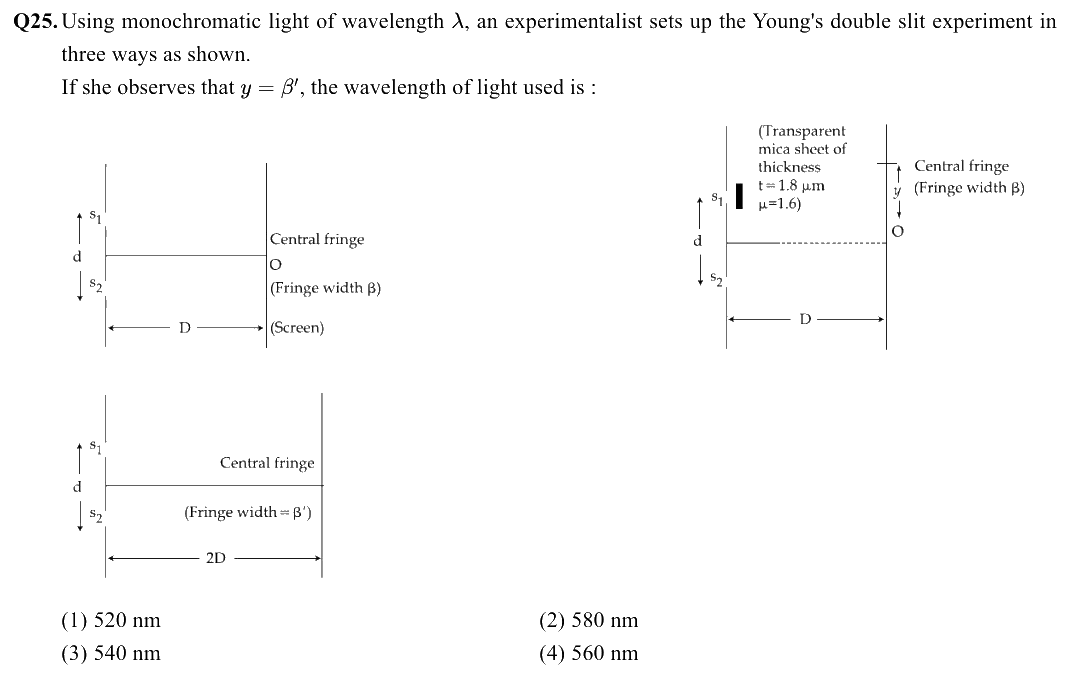
Using monochromatic light of wavelength $\lambda$, an experimentalist sets up the Young's double slit experiment in three ways as shown. If she observes that $y = \beta'$, the wavelength of light used is : (see the figure above)
Two beams, A and B of plane polarized light with mutually perpendicular planes of polarization are seen through a polaroid. From the position when the beam A has maximum intensity (and beam B has zero intensity), a rotation of polaroid through $30^\circ$ makes the two beams appear equally bright. If the initial intensities of the two beams are $\mathrm{I_A}$ and $\mathrm{I_B}$ respectively, then $\frac{\mathrm{I_A}}{\mathrm{I_B}}$ equals :
A thin glass plate of thickness is $\frac{2500}{3}\lambda$ ( $\lambda$ is wavelength of light used) and refractive index $\mu = 1.5$ is inserted between one of the slits and the screen in Young's double slit experiment. At a point on the screen equidistant from the slits, the ratio of the intensities before and after the introduction of the glass plate is :
The source that illuminates the double $-$ slit in 'double - slit interference experiment' emits two distinct monochromatic waves of wavelength 500 nm and 600 nm, each of them producing its own pattern on the screen. At the central point of the pattern when path difference is zero, maxima of both the patterns coincide and the resulting interference pattern is most distinct at the region of zero path difference. But as one moves out of this central region, the two fringe systems are gradually out of step such that maximum due to on wavelength coincides with the minimum due to the other and the combined fringe system becomes completely indistinct. This may happen when path difference in nm is:
$n$ identical waves each of intensity $I_0$ interfere with each other. The ratio of maximum intensities if the interference is (i) coherent and (ii) incoherent is :
This question has Statement-1 and Statement-2. Of the four choices given after the Statements, choose the one that best describes the two Statements. Statement-1: In Young's double slit experiment, the number of fringes observed in the field of view is small with longer wavelength of light and is large with shorter wavelength of light. Statement-2: In the double slit experiment the fringe width depends directly on the wavelength of light.
A
Statement-1 is true, Statement-2 is true and the Statement-2 is correct explanation of the Statement-1.
B
Statement-1 is false and the Statement-2 is true.
C
Statement-1 is true Statement-2 is true and the Statement-2 is not correct explanation of the Statement-1.
A ray of light of intensity I is incident on a parallel glass slab at point A as shown in diagram. It undergoes partial reflection and refraction. At each reflection, 25% of incident energy is reflected. The rays AB and A'B' undergo interference. The ratio of $\mathrm{I}_{\max}$ and $\mathrm{I}_{\min}$ is :
A person lives in a high-rise building on the bank of a river 50 m wide. Across the river is a well lit tower of height 40 m. When the person, who is at a height of 10 m, looks through a polarizer at an appropriate angle at light of the tower reflecting from the river surface, he notes that intensity of light coming from distance X from his building is the least and this corresponds to the light coming from light bulbs at height ' Y ' on the tower. The values of X and Y are respectively close to (refractive index of water $\simeq \dfrac{4}{3}$ )
A beam of unpolarised light of intensity $I_0$ is passed through a polaroid $A$ and then through another polaroid $B$ which is oriented so that its principle plane makes an angle of $45^{\circ}$ relative to that of $A$. The intensity of the emergent light is:
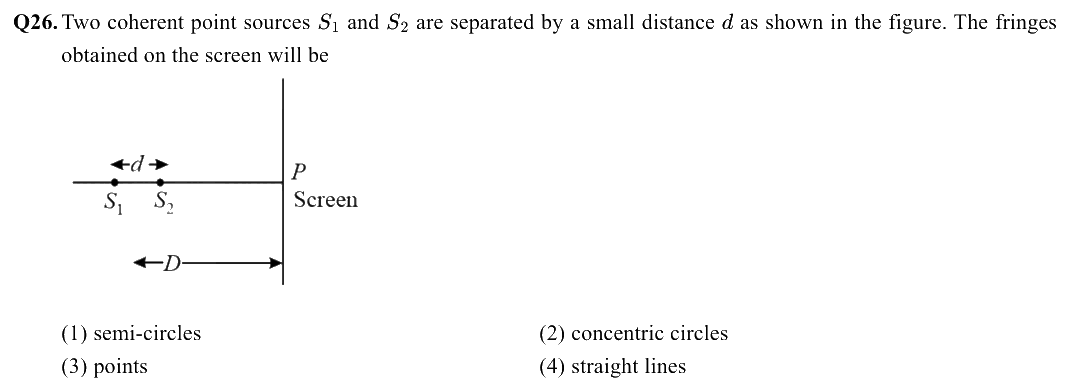
Two coherent point sources $S_1$ and $S_2$ are separated by a small distance $d$ as shown in the figure. The fringes obtained on the screen will be (see the figure above)
A telescope of aperture $3 \times 10^{-2}$ m diameter is focused on a window at 80 m distance fitted with a wire mesh of spacing $2 \times 10^{-3}$ m. Given: $\lambda = 5.5 \times 10^{-7}$ m, which of the following is true for observing the mesh through the telescope?
A
Yes, it is possible with the same aperture size.
B
Possible also with an aperture half the present diameter.
In Young's double slit interference experiment, the slit widths are in the ratio $1 : 25$. Then the ratio of intensity at the maxima and minima in the interference pattern is
Two coherent plane light waves of equal amplitude makes a small angle $\alpha(<< 1)$ with each other. They fall almost normally on a screen. If $\lambda$ is the wavelength of light waves, the fringe width $\Delta x$ of interference patterns of the two sets of waves on the screen is
The first diffraction minimum due to the single slit diffraction is seen at $\theta = 30^\circ$ for a light of wavelength $5000\,\mathrm{\AA}$ falling perpendicularly on the slit. The width of the slit is
The maximum number of possible interference maxima for slit separation equal to $1.8\lambda$, where $\lambda$ is the wavelength of light used, in a Young's double slit experiment is
In a Young's double slit experiment with light of wavelength $\lambda$, fringe pattern on the screen has fringe width $\beta$. When two thin transparent glass (refractive index $\mu$ ) plates of thickness $t_1$ and $t_2$ $(t_1 > t_2)$ are placed in the path of the two beams respectively, the fringe pattern will shift by a distance
Two polaroids have their polarizing directions parallel so that the intensity of a transmitted light is maximum. The angle through which either polaroid must be turned if the intensity is to drop by one-half is
In Young's double slit experiment, one of the slit is wider than other, so that the amplitude of the light from one slit is double of that from other slit. If $I_m$ be the maximum intensity, the resultant intensity $I$ when they interfere at phase difference $\phi$ is given by
Direction: The question has a paragraph followed by two statements, Statement -1 and statement -2. Of the given four alternatives after the statements, choose the one that describes the statements. A thin air film is formed by putting the convex surface of a plane - convex lens over a plane glass plate. With monochromatic light, this film gives an interference pattern due to light reflected from the top (convex) surface and the bottom (glass plate) surface of the film. Statement-1 : When light reflects from the air-glass plate interface, the reflected wave suffers a phase change of $\pi$. Statement-2 : The centre of the interference pattern is dark.
A
Statement-1 is true, Statement-2 is true; Statement-2 is the correct explanation of Statement-1.
B
Statement-1 is true, Statement-2 is true; Statement-2 is not the correct explanation of Statement-1.
An initially parallel cylindrical beam travels in a medium of refractive index $\mu(I) = \mu_0 + \mu_2 I$, where $\mu_0$ and $\mu_2$ are positive constants and I is the intensity of the light beam. The intensity of the beam is decreasing with increasing radius. As the beam enters the medium, it will
A
diverge
B
converge
C
diverge near the axis and converge near the periphery
An initially parallel cylindrical beam travels in a medium of refractive index $\mu(I) = \mu_0 + \mu_2 I$, where $\mu_0$ and $\mu_2$ are positive constants and I is the intensity of the light beam. The intensity of the beam is decreasing with increasing radius. The initial shape of the wave front of the beam is
A
convex
B
concave
C
convex near the axis and concave near the periphery
A mixture of light, consisting of wavelength 590 nm and an unknown wavelength, illuminates Young's double slit and gives rise to two overlapping interference patterns on the screen. The central maximum of both lights coincide. Further, it is observed that the third bright fringe of known light coincides with the $4^{\text{th}}$ bright fringe of the unknown light. From this data, the wavelength of the unknown light is
In a Young's double slit experiment the intensity at a point where the path difference is $\frac{\lambda}{6}$ ($\lambda$ being the wavelength of the light used) is I. If $\mathrm{I_0}$ denotes the maximum intensity, $\frac{\mathrm{I}}{\mathrm{I_0}}$ is equal to
Two point white dots are 1 mm apart on a black paper. They are viewed by eye of pupil diameter 3 mm. Approximately, what is the maximum distance at which these dots can be resolved by the eye? [ Take wavelength of light $= 500\ \mathrm{nm}$ ]
If $\mathrm{I_0}$ is the intensity of the principal maximum in the single slit diffraction pattern, then what will be its intensity when the slit width is doubled?
An unpolarized light of intensity $I_o$ passes through polarizer and then through a certain optically active solution and finally it goes to analyser. If the angle between analyser and polariser is 0° and intensity of light emerged from analyser is $\dfrac{3}{8}I_o$, the angle of rotation of the light by the solution with respect to analyser is ________ degrees.
Numerical answer type: type your answer in EdLoop to check it
In a double slit experiment, when one of the slits is covered by a transparent mica sheet of refractive index 1.56, the central fringe shifts to the position of 7$^{\text{th}}$ bright fringe, obtained with both slits uncovered. If the light source wavelength is 450 nm, the thickness of mica sheet is $\alpha\times10^{-9}$ m. The value of $\alpha$ is ________.
Numerical answer type: type your answer in EdLoop to check it
In single slit diffraction pattern, the wavelength of light used is 628 nm and slit width is 0.2 mm, the angular width of central maximum is $\alpha\times10^{-2}$ degrees. The value of $\alpha$ is ________.
Numerical answer type: type your answer in EdLoop to check it
In a Young's double slit experiment, the intensity at some point on the screen is found to be $\frac{3}{4}$ times of the maximum of the interference pattern. The path difference between the interfering waves at this point is $\frac{\lambda}{x}$ where $\lambda$ is wavelength of the incident light. The value of $x$ is ________.
Numerical answer type: type your answer in EdLoop to check it
A beam of light consisting of wavelengths 650 nm and 550 nm illuminates the Young's double slits with separation of 2 mm such that the interference fringes are formed on a screen, placed at a distance of 1.2 m from the slits. The least distance of a point from the central maximum, where the bright fringes due to both the wavelengths coincide, is ________ $\times 10^{-5}$ m.
Numerical answer type: type your answer in EdLoop to check it
In two separate Young's double-slit experimental set-ups and two monochromatic light sources of different wavelengths are used to get fringes of equal width. The ratios of the slits separations and that of the wavelengths of light used are $2 : 1$ and $1 : 2$ respectively. The corresponding ratio of the distances between the slits and the respective screens ($D_1/D_2$) is ________.
Numerical answer type: type your answer in EdLoop to check it
In a Young's double slit experiment set up, the two slits are kept 0.4 mm apart and screen is placed at 1 m from slits. If a thin transparent sheet of thickness 20 $\mu$m is introduced in front of one of the slits then center bright fringe shifts by 20 mm on the screen. The refractive index of transparent sheet is given by $\frac{\alpha}{10}$, where $\alpha$ is ________.
Numerical answer type: type your answer in EdLoop to check it
In a Young's double slit experiment, two slits are located 1.5 mm apart. The distance of screen from slits is 2 m and the wavelength of the source is 400 nm . If the 20 maxima of the double slit pattern are contained within the central maximum of the single slit diffraction pattern, then the width of each slit is $x \times 10^{-3}$ cm , where $x$ -value is ______ .
Numerical answer type: type your answer in EdLoop to check it
Two coherent monochromatic light beams of intensities 4 I and 9 I are superimposed. The difference between the maximum and minimum intensities in the resulting interference pattern is $xI$. The value of $x$ is ______ .
Numerical answer type: type your answer in EdLoop to check it
If the measured angular separation between the second minimum to the left of the central maximum and the third minimum to the right of the central maximum is $30^\text{o}$ in a single slit diffraction pattern recorded using 628 nm light, then the width of the slit is ______ $\mu m$ .
Numerical answer type: type your answer in EdLoop to check it
A double slit interference experiment performed with a light of wavelength 600 nm forms an interference fringe pattern on a screen with 10 th bright fringe having its centre at a distance of 10 mm from the central maximum. Distance of the centre of the same 10th bright fringe from the central maximum when the source of light is replaced by another source of wavelength 660 nm would be ______ mm .
Numerical answer type: type your answer in EdLoop to check it
A thin transparent film with refractive index 1.4 , is held on circular ring of radius 1.8 cm . The fluid in the film evaporates such that transmission through the film at wavelength 560 nm goes to a minimum every 12 seconds. Assuming that the film is flat on its two sides, the rate of evaporation is ______ $\pi \times 10^{-13}\ \mathrm{m^3/s}$.
Numerical answer type: type your answer in EdLoop to check it
In a Young's double slit experiment, the intensity at a point is $\left(\frac{1}{4}\right)^{\text{th}}$ of the maximum intensity, the minimum distance of the point from the central maximum is ______ $\mu$m. (Given : $\lambda$ = 600 nm, d = 1.0 mm, D = 1.0 m )
Numerical answer type: type your answer in EdLoop to check it
Monochromatic light of wavelength 500 nm is used in Young's double slit experiment. An interference pattern is obtained on a screen. When one of the slits is covered with a very thin glass plate (refractive index = 1.5 ), the central maximum is shifted to a position previously occupied by the 4$^{th}$ bright fringe. The thickness of the glass-plate is ______ $\mu$m.
Numerical answer type: type your answer in EdLoop to check it
A parallel beam of monochromatic light of wavelength 600 nm passes through single slit of 0.4 mm width. Angular divergence corresponding to second order minima would be ______ $\times 10^{-3}$rad.
Numerical answer type: type your answer in EdLoop to check it
Two slits are 1 mm apart and the screen is located 1 m away from the slits. A light of wavelength 500 nm is used. The width of each slit to obtain 10 maxima of the double slit pattern within the central maximum of the single slit pattern is ______ $\times 10^{-4}$ m.
Numerical answer type: type your answer in EdLoop to check it
Two coherent monochromatic light beams of intensities I and 4I are superimposed. The difference between maximum and minimum possible intensities in the resulting beam is $x$I. The value of $x$ is $ ______.
Numerical answer type: type your answer in EdLoop to check it
In Young's double slit experiment, carried out with light of wavelength $5000\,\mathrm{\AA}$, the distance between the slits is 0.3 mm and the screen is at 200 cm from the slits. The central maximum is at $x$ = 0 cm. The value of $x$ for third maxima is ______ mm.
Numerical answer type: type your answer in EdLoop to check it
In a single slit experiment, a parallel beam of green light of wavelength 550 nm passes through a slit of width 0.20 mm. The transmitted light is collected on a screen 100 cm away. The distance of first order minima from the central maximum will be $x \times 10^{-5}$ m. The value of $x$ is :
Numerical answer type: type your answer in EdLoop to check it
Two wavelengths $\lambda_1$ and $\lambda_2$ are used in Young's double slit experiment. $\lambda_1$ = 450 nm and $\lambda_2$ = 650 nm. The minimum order of fringe produced by $\lambda_2$ which overlaps with the fringe produced by $\lambda_1$ is $n$. The value of $n$ is ______.
Numerical answer type: type your answer in EdLoop to check it
In Young's double slit experiment, monochromatic light of wavelength 5000 $\mathring{A}$ is used. The slits are 1.0 mm apart and screen is placed at 1.0 m away from slits. The distance from the centre of the screen where intensity becomes half of the maximum intensity for the first time is ______ $\times 10^{-6}$ m.
Numerical answer type: type your answer in EdLoop to check it
Two waves of intensity ratio 1 : 9 cross each other at a point. The resultant intensities at the point, when (a) Waves are incoherent is $I_1$ b Waves are coherent is $I_2$ and differ in phase by $60^\circ$. If $\frac{I_1}{I_2} = \frac{10}{x}$, then $x =$ ______.
Numerical answer type: type your answer in EdLoop to check it
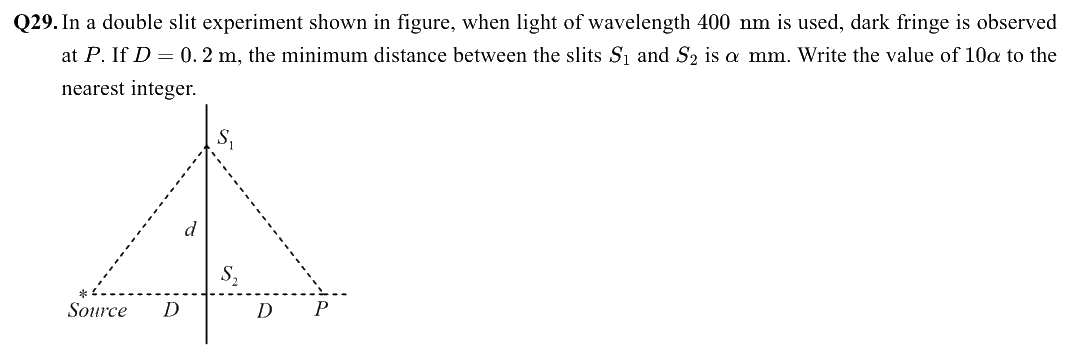
In a double slit experiment shown in figure, when light of wavelength 400 nm is used, dark fringe is observed at $P$. If $D = 0.2$ m, the minimum distance between the slits $S_1$ and $S_2$ is $\alpha$ mm. Write the value of $10\alpha$ to the nearest integer.
(see the figure above)
The question as printed in the paper.
Numerical answer type: type your answer in EdLoop to check it
In a single slit diffraction pattern, a light of wavelength 6000 $\mathrm{\mathring{A}}$ is used. The distance between the first and third minima in the diffraction pattern is found to be 3 mm when the screen is placed 50 cm away from slits. The width of the slit is ______ $\times 10^{-4}$ m.
Numerical answer type: type your answer in EdLoop to check it
A parallel beam of monochromatic light of wavelength 5000 Å is incident normally on a single narrow slit of width 0.001 mm. The light is focused by convex lens on screen, placed on its focal plane. The first minima will be formed for the angle of diffraction of ______ (degree).
Numerical answer type: type your answer in EdLoop to check it
Unpolarised light of intensity $32\ \mathrm{W\,m^{-2}}$ passes through the combination of three polaroids such that the pass axis of the last polaroids is perpendicular to that of the pass axis of first polaroids. If intensity of emerging light is $3\ \mathrm{W\,m^{-2}}$, then the angle between pass axis of first two polaroids is ______ $^\circ$.
Numerical answer type: type your answer in EdLoop to check it
A beam of light consisting of two wavelengths $7000\ \mathrm{\AA}$ and $5500\ \mathrm{\AA}$ is used to obtain interference pattern in Young's double slit experiment. The distance between the slits is $2.5\ \mathrm{mm}$ and the distance between the plane of slits and the screen is $150\ \mathrm{cm}$. The least distance from the central fringe, where the bright fringes due to both the wavelengths coincide, is $n \times 10^{-5}\ \mathrm{m}$. The value of $n$ is ______ .
Numerical answer type: type your answer in EdLoop to check it
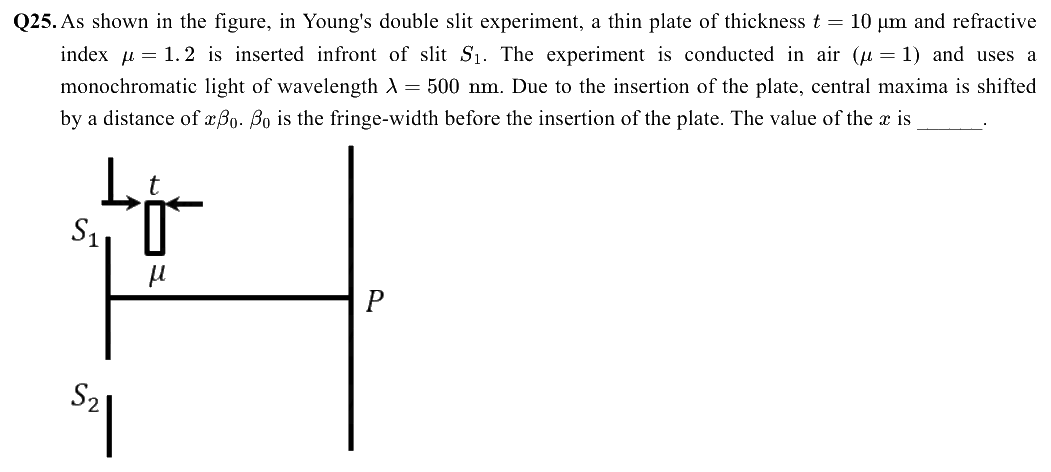
As shown in the figure, in Young's double slit experiment, a thin plate of thickness $t$ = 10 $\mu$m and refractive index $\mu$ = 1.2 is inserted infront of slit $S_1$. The experiment is conducted in air ($\mu$ = 1) and uses a monochromatic light of wavelength $\lambda$ = 500 nm. Due to the insertion of the plate, central maxima is shifted by a distance of $x\beta_0$. $\beta_0$ is the fringe-width before the insertion of the plate. The value of the $x$ is ______.
(see the figure above)
The question as printed in the paper.
Numerical answer type: type your answer in EdLoop to check it
Two light waves of wavelengths 800 and 600 nm are used in Young's double slit experiment to obtain interference fringes on a screen placed 7 m away from plane of slits. If the two slits are separated by 0.35 mm, then shortest distance from the central bright maximum to the point where the bright fringes of the two wavelength coincide will be ______ mm.
Numerical answer type: type your answer in EdLoop to check it
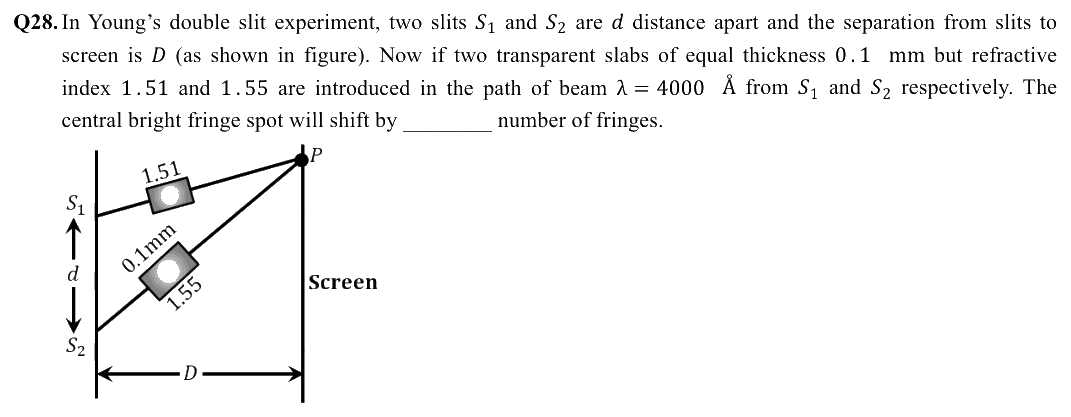
In Young's double slit experiment, two slits $S_1$ and $S_2$ are $d$ distance apart and the separation from slits to screen is $D$ (as shown in figure). Now if two transparent slabs of equal thickness 0.1 mm but refractive index 1.51 and 1.55 are introduced in the path of beam $\lambda$ = 4000 $\mathrm{\AA}$ from $S_1$ and $S_2$ respectively. The central bright fringe spot will shift by ______ number of fringes.
(see the figure above)
The question as printed in the paper.
Numerical answer type: type your answer in EdLoop to check it
In a Young's double slit experiment, the intensities at two points, for the path difference $\frac{\lambda}{4}$ and $\frac{\lambda}{3}$ ($\lambda$ being the wavelength of light used) are $I_1$ and $I_2$ respectively. If $I_0$ denotes the intensity produced by each one of the individual slits, then $\frac{I_1 + I_2}{I_0}$ = ______.
Numerical answer type: type your answer in EdLoop to check it
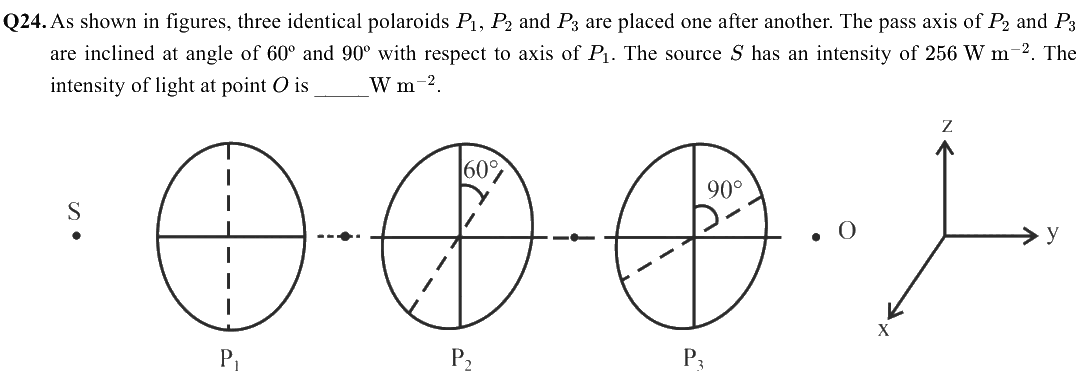
As shown in figures, three identical polaroids $P_1$, $P_2$ and $P_3$ are placed one after another. The pass axis of $P_2$ and $P_3$ are inclined at angle of $60^\circ$ and $90^\circ$ with respect to axis of $P_1$. The source $S$ has an intensity of $256\ \mathrm{W\,m^{-2}}$. The intensity of light at point $O$ is ______ $\mathrm{W\,m^{-2}}$.
(see the figure above)
The question as printed in the paper.
Numerical answer type: type your answer in EdLoop to check it
Unpolarised light is incident on the boundary between two dielectric media, whose dielectric constants are 2.8 (medium -1) and 6.8 (medium - 2), respectively. To satisfy the condition, so that the reflected and refracted rays are perpendicular to each other, the angle of incidence should be $\tan^{-1}\left(1 + \frac{10}{\theta}\right)^{\frac{1}{2}}$, the value of $\theta$ is ______. (Given for dielectric media, $\mu_r = 1$)
Numerical answer type: type your answer in EdLoop to check it
Two light beams of intensities $4I$ and $9I$ interfere on a screen. The phase difference between these beams on the screen at point $A$ is zero and at point $B$ is $\pi$. The difference of resultant intensities, at the point $A$ and $B$, will be ______ $I$.
Numerical answer type: type your answer in EdLoop to check it
In a Young's double slit experiment, a laser light of $560\ \mathrm{nm}$ produces an interference pattern with consecutive bright fringes' separation of $7.2\ \mathrm{mm}$. Now another light is used to produce an interference pattern with consecutive bright fringes' separation of $8.1\ \mathrm{mm}$. The wavelength of second light is ______ nm.
Numerical answer type: type your answer in EdLoop to check it
Two beams of light having intensities $I$ and $4I$ interfere to produce a fringe pattern on a screen. The phase difference between the two beams are $\frac{\pi}{2}$ and $\frac{\pi}{3}$ at points $A$ and $B$ respectively. The difference between the resultant intensities at the two points is $xI$. The value of $x$ will be ______ .
Numerical answer type: type your answer in EdLoop to check it
In a double slit experiment with monochromatic light, fringes are obtained on a screen placed at some distance from the plane of slits. If the screen is moved by $5 \times 10^{-2}\ \mathrm{m}$ towards the slits, the change in fringe width is $3 \times 10^{-3}\ \mathrm{cm}$. If the distance between the slits is $1\ \mathrm{mm}$, then the wavelength of the light will be ______ nm.
Numerical answer type: type your answer in EdLoop to check it
In a Young's double slit experiment, an angular width of the fringe is $0.35^{\circ}$ on a screen placed at $2\ \mathrm{m}$ away for particular wavelength of $450\ \mathrm{nm}$. The angular width of the fringe, when whole system is immersed in a medium of refractive index $\frac{7}{5}$, is $\frac{1}{\alpha}$. The value of $\alpha$ is ______ .
Numerical answer type: type your answer in EdLoop to check it
In Young's double slit experiment the two slits are $0.6\ \mathrm{mm}$ distance apart. Interference pattern is observed on a screen at a distance $80\ \mathrm{cm}$ from the slits. The first dark fringe is observed on the screen directly opposite to one of the slits. The wavelength of light will be ______ nm.
Numerical answer type: type your answer in EdLoop to check it
Sodium light of wavelengths $650 \mathrm{~nm}$ and $655 \mathrm{~nm}$ is used to study diffraction at a single slit of aperture $0.5 \mathrm{~mm}$. The distance between the slit and the screen is $2.0 \mathrm{~m}$. The separation between the positions of the first maxima of diffraction pattern obtained in the two cases is ______ $\times 10^{-5} \mathrm{~m}$
Numerical answer type: type your answer in EdLoop to check it
The width of one of the two slits in a Young's double slit experiment is three times the other slit. If the amplitude of the light coming from a slit is proportional to the slit-width, the ratio of minimum to maximum intensity in the interference pattern is $x : 4$ where $x$ is ______.
Numerical answer type: type your answer in EdLoop to check it
In a Young's double slit experiment, the slits are separated by $0.3$ mm and the screen is $1.5$ m away from the plane of slits. Distance between fourth bright fringes on both sides of central bright fringe is $2.4$ cm. The frequency of light used is $x \times 10^{14}$ Hz.
Numerical answer type: type your answer in EdLoop to check it
White light is passed through a double slit and interference is observed on a screen $1.5\ \mathrm{m}$ away. The separation between the slits is $0.3\ \mathrm{mm}$. The first violet and red fringes are formed $2.0\ \mathrm{mm}$ and $3.5\ \mathrm{mm}$ away from the central white fringes. The difference in wavelengths of red and violet light is (in nm).
Numerical answer type: type your answer in EdLoop to check it
A source of light is placed in front of a screen. The intensity of light on the screen is $I$. Two Polaroids $P_1$ and $P_2$ are so placed in between the source of light and screen that the intensity of light on the screen is $\frac{I}{2}$. Then the $P_2$, should be rotated by an angle of (degrees) so that the intensity of light on the screen becomes $\frac{3I}{8}$.
Numerical answer type: type your answer in EdLoop to check it
The difference in the number of waves when yellow light propagates through air and vacuum columns of the same thickness is one. The thickness of the air column is ______ mm. [Refractive index of air $= 1.0003$, the wavelength of yellow light in vacuum $= 6000\ \mathrm{\AA}$]
Numerical answer type: type your answer in EdLoop to check it
A fringe width of $6 \mathrm{~mm}$ was produced for two slits separated by $1 \mathrm{~mm}$ apart. The screen is placed $10 \mathrm{~m}$ away. The wavelength of light used is $x \mathrm{~nm}$. The value of $x$ to the nearest integer is ______.
Numerical answer type: type your answer in EdLoop to check it
An unpolarized light beam is incident on the polarizer of a polarization experiment and the intensity of light beam emerging from the analyzer is measured as $100$ Lumens. Now, if the analyzer is rotated around the horizontal axis (direction of light) by $30^\circ$ in clockwise direction, the intensity of emerging light will be ______ Lumens.
Numerical answer type: type your answer in EdLoop to check it
A Young's double-slit experiment is performed using monochromatic light of wavelength $\lambda$. The intensity of light at a point on the screen, where the path difference is $\lambda$, is K units. The intensity of light at a point where the path difference is $\frac{\lambda}{6}$ is given by $\frac{nK}{12}$, where n is an integer. The value of n is
Numerical answer type: type your answer in EdLoop to check it
Orange light of wavelength $6000 \times 10^{-10}\ m$ illuminates a single slit of width $0.6 \times 10^{-4}\ m$. The maximum possible number of diffraction minima produced on both sides of the central maximum is ______
Numerical answer type: type your answer in EdLoop to check it
In Young's double slit experiment 15 fringes are observed on a small portion of the screen when light of wavelength 500 nm is used. Ten fringes are observed on the same section of the screen when another light source of wavelength $\lambda$ is used. Then the value of $\lambda$ is (in nm ) ______.
Numerical answer type: type your answer in EdLoop to check it
Wave optics examines the wave nature of light under Unit 16: Optics in the Class 12 curriculum, holding rank 19 among 29 physics chapters with a 3.1 percent share of total physics questions. In the computer-based testing window spanning 2019 to 2026, candidates answered 140 questions across 162 test papers, delivering an average of 0.9 problems in each sitting. The topic was included in 119 of those 162 papers, appearing consistently in every single exam year. During the recent 2024 to 2026 period, testing recorded 63 questions across 58 papers, lifting the average to 1.1 questions per shift and achieving a 4.1 percent subject share. This marks a trend that is up compared to the 3.1 percent share from the full 2019 to 2026 baseline. When measured against the 2002 to 2018 window, which logged 49 questions across 38 papers for a 3.6 percent share, the chapter's share has stayed about the same. In 2026 alone, examiners presented 22 questions across 19 papers, featured in 17 separate sessions. Across the 2019 to 2026 span, 50 questions appeared in numerical answer format, requiring students to calculate fringe shifts, slit widths, and intensity ratios without choices.
Most-asked topics
Questions from wave optics fall into three primary subject areas:
Interference: 113 questions since 2003, with 90 appearing between 2019 and 2026, tested up to 2026. This dominant area tests Young's double slit experiment, fringe width variations, introduction of thin transparent glass sheets causing fringe shifts, overlapping bright fringes of multiple wavelengths, and intensity expressions as a function of phase difference.
Diffraction & Polarisation: 68 total questions, including 45 between 2019 and 2026, continuing into 2026. Core concepts evaluate single-slit Fraunhofer diffraction, angular width of the central diffraction peak, secondary maxima positions, Brewster's law, polarization by reflection, and Malus's law.
Huygens' Principle: 8 lifetime questions, with 5 asked between 2019 and 2026, tested in 2026. Themes assess wavefront shapes from point, line, and distant sources, reflection and refraction laws proved by secondary wavelets, and wavefront distortion after passing through prisms, lenses, or pinholes.
What the questions look like
JEE Main problems in wave optics combine wave geometry with precise algebraic formulas:
Fringe displacement by transparent slabs: Inserting a thin transparent film of known thickness and refractive index over one slit introduces an extra optical path, displacing the central interference fringe by a measurable distance on the screen.
Angular separation and parameters in double slit setups: Questions test how angular fringe width depends purely on wavelength and slit spacing while remaining independent of screen distance.
Central diffraction maximum width: Determining the linear or angular spread of the central maximum in single-slit diffraction as a function of slit aperture and incident light color.
Brewster's angle and polarization by reflection: Finding the required angle of incidence on a dielectric surface where reflected and refracted rays travel at ninety degrees to each other, rendering the reflected beam completely plane-polarized.
Questions to try first
Test your preparation with these representative recent problems:
Focus on the mathematical formulas of Young's double slit experiment. Remember the distinction between linear fringe width beta equal to lambda capital D over small d, and angular fringe width theta equal to lambda over small d. Screen distance changes affect only linear fringe width, leaving angular separation unchanged.
Pay close attention to optical path length. When a light ray traverses a medium of thickness t and refractive index n, the extra optical path introduced is n minus one multiplied by t. Equating this optical path difference to fringe shift formulas solves almost all slab insertion problems.
For single slit diffraction, do not confuse minima conditions with double slit maxima. In single slit diffraction, minima occur where slit width multiplied by sin theta equals non-zero integer multiples of wavelength, while the central maximum spans twice this angular value.
Frequently asked questions
Which topic in wave optics is most important for JEE Main?
Young's double slit interference is the most frequently asked topic by a wide margin, accounting for 90 of the 140 modern questions. Mastering fringe width, path difference, and slab shifts covers the core of the chapter.
How do I remember the difference between double slit and single slit formulas?
In double slit interference, path difference d sin theta equals integer multiples of wavelength for bright fringes. In single slit diffraction, slit aperture a sin theta equals integer multiples of wavelength for dark minima. Keeping this reversal clear prevents errors.
Are polarization questions still asked after recent syllabus modifications?
Basic Brewster's law applications and polarization by reflection continue to appear in recent JEE Main papers, though resolving power formulas have been excluded. Step-by-step solutions for each one are in the EdLoop app.