Magnetic Effects of Current: JEE Main PYQs 2002–2026
Every Magnetic Effects of Current question from past JEE Main and AIEEE papers, with options and answers. Newest first.
261questions
165papers covered
4.4%of Physics questions, 2019–2026
2002–2026years
Guide at a glance
Magnetic effects of current bridges electrostatics and electrodynamics under Unit 13: Magnetic Effects of Current and Magnetism in the Class 12 NTA syllabus, holding rank 7 among the 29 physics chapters.
A current carrying circular loop of radius 2 cm with unit normal $\hat{n} = \dfrac{\hat{k} + \hat{i}}{\sqrt{2}}$ is placed in a magnetic field, $\vec{B} = B_o\left(3\hat{i} + 2\hat{k}\right)$. If $B_o = 4\times10^{-3}$ T and current $I = 100\sqrt{2}$ A, the torque experienced by the loop is ________ Wb.A. ($\pi = 3.14$)
A small cube of side 1 mm is placed at the centre of a circular loop of radius 10 cm carrying a current of 2 A. The magnetic energy stored inside the cube is $\alpha\times10^{-14}$ J. The value of $\alpha$ is ________. ($\mu_o = 4\pi\times10^{-7}$ Tm/A, $\pi = 3.14$)
A current of 30 A each flows in opposite directions in two conducting wires, placed parallel to each other at a distance of 8 cm. The magnetic field at the mid point between the two wires is ________ $\mu$T.
A particle of charge $q$ and mass $m$ is projected from origin with an initial velocity $\vec{v} = \left(\frac{v_o}{\sqrt{2}}\hat{x} + \frac{v_o}{\sqrt{2}}\hat{y}\right)$. There exists a uniform magnetic field $\vec{B} = B_0\,\hat{z}$ and a space varying electric field $\vec{E} = E_o\,e^{-\lambda x}\hat{x}$ within the region $0 \leq x \leq L$. After travelling a distance such that $x$-coordinate has changed from $x = 0$ to $x = L$, the change in the kinetic energy is ________.
An insulated wire is wound so that it forms a flat coil with $N = 200$ turns. The radius of the innermost turn is $r_1 = 3$ cm, and of the outermost turn $r_2 = 6$ cm. If 20 mA current flows in it then the magnetic moment will be $\alpha\times10^{-2}$ A.m$^2$. The value of $\alpha$ is ________.
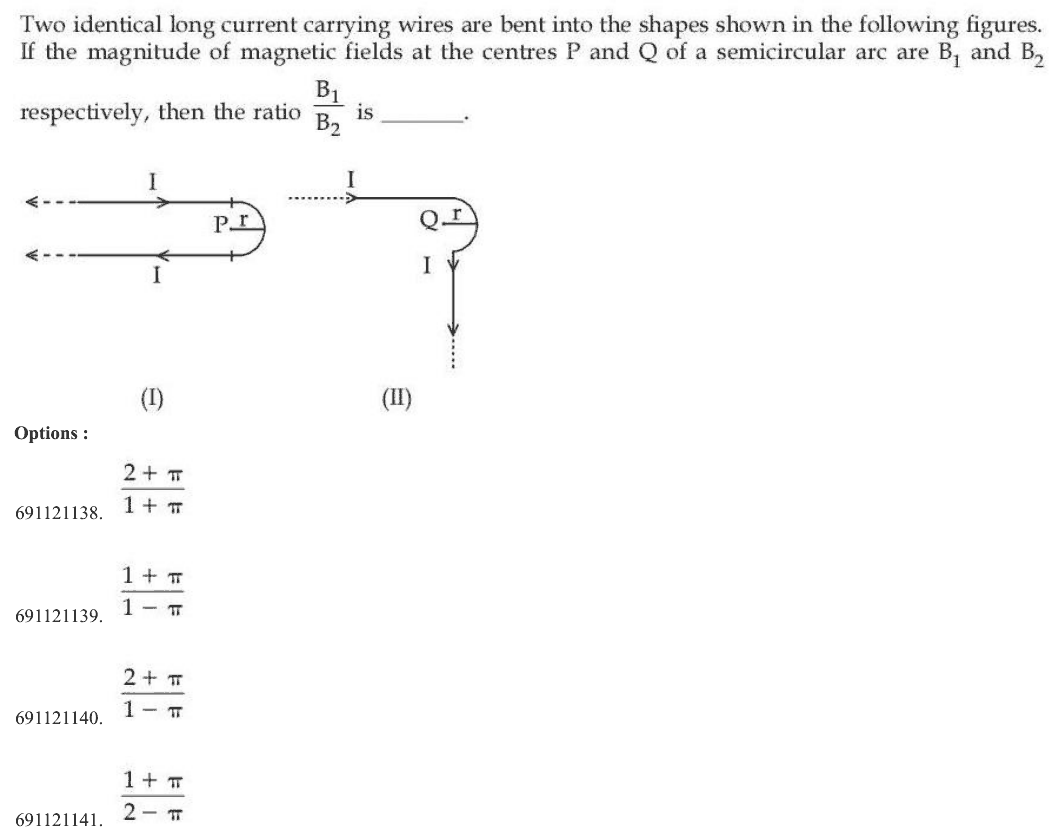
Two identical long current carrying wires are bent into the shapes shown in the following figures. If the magnitude of magnetic fields at the centres P and Q of a semicircular arc are $\mathrm{B_1}$ and $\mathrm{B_2}$ respectively, then the ratio $\frac{\mathrm{B_1}}{\mathrm{B_2}}$ is ________.
A particle having charge $10^{-9}$ C moving in $x$-$y$ plane in fields of $0.4\,\hat{j}$ N/C and $4\times10^{-3}\,\hat{k}$ T experiences a force of $\left(4\hat{i} + 2\hat{j}\right)\times10^{-10}$ N. The velocity of the particle at that instant is ________ m/s.
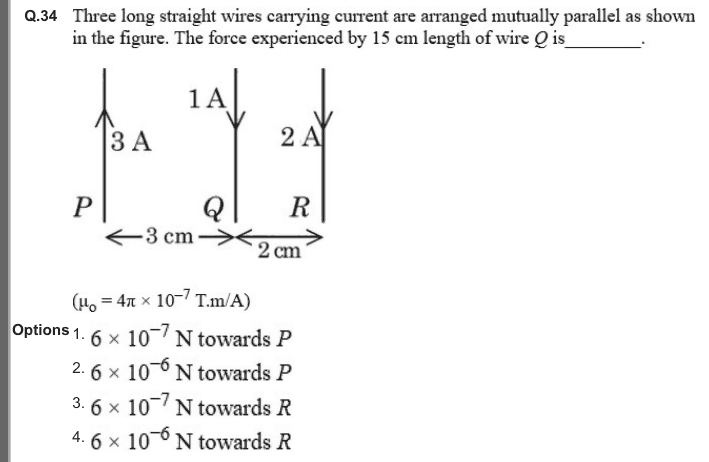
Three long straight wires carrying current are arranged mutually parallel as shown in the figure. The force experienced by 15 cm length of wire $Q$ is ________.
The magnetic field at the centre of a current carrying circular loop of radius $R$ is 16 $\mu$T. The magnetic field at a distance $x = \sqrt{3}R$ on its axis from the centre is ________ $\mu$T.
A long cylindrical conductor with large cross section carries an electric current distributed uniformly over its cross-section. Magnetic field due to this current is :
A. maximum at either ends of the conductor and minimum at the midpoint
B. maximum at the axis of the conductor
C. minimum at the surface of the conductor
D. minimum at the axis of the conductor
E. same at all points in the cross-section of the conductor
Choose the correct answer from the options given below :
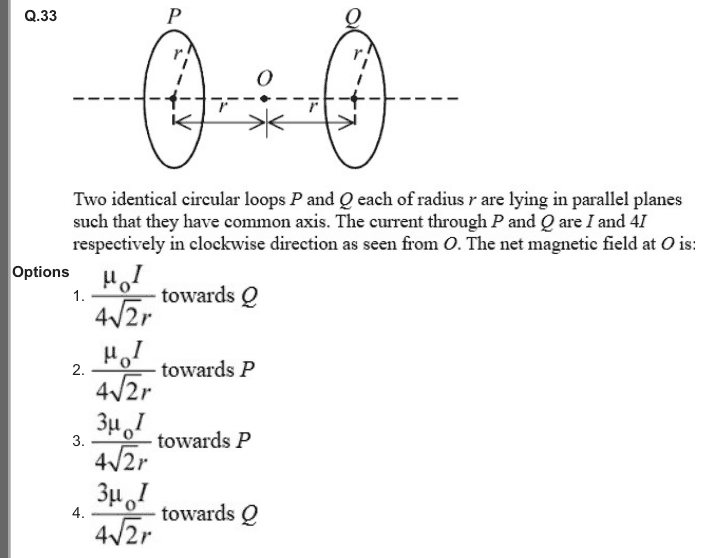
Two identical circular loops $P$ and $Q$ each of radius $r$ are lying in parallel planes such that they have common axis. The current through $P$ and $Q$ are $I$ and $4I$ respectively in clockwise direction as seen from $O$. The net magnetic field at $O$ is:
The current passing through a conducting loop in the form of equilateral triangle of side $4\sqrt{3}$ cm is 2 A. The magnetic field at its centroid is $\alpha \times 10^{-5}$ T. The value of $\alpha$ is ________.
A current carrying solenoid is placed vertically and a particle of mass $m$ with charge $Q$ is released from rest. The particle moves along the axis of solenoid. If $g$ is acceleration due to gravity then the acceleration ($a$) of the charged particle will satisfy :
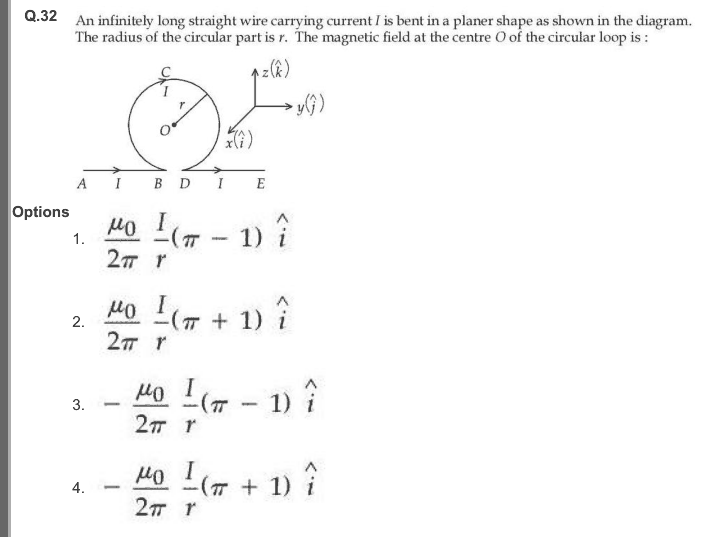
An infinitely long straight wire carrying current $I$ is bent in a planer shape as shown in the diagram. The radius of the circular part is $r$. The magnetic field at the centre $O$ of the circular loop is :
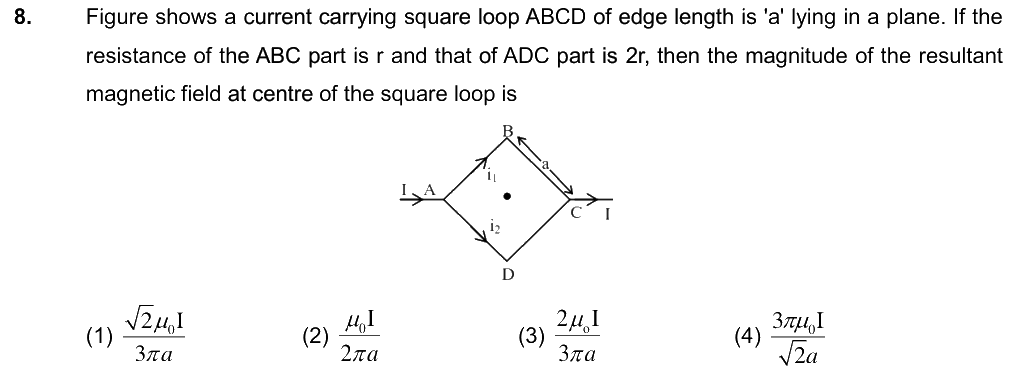
Figure shows a current carrying square loop ABCD of edge length is 'a' lying in a plane. If the resistance of the ABC part is r and that of ADC part is 2r, then the magnitude of the resultant magnetic field at centre of the square loop is
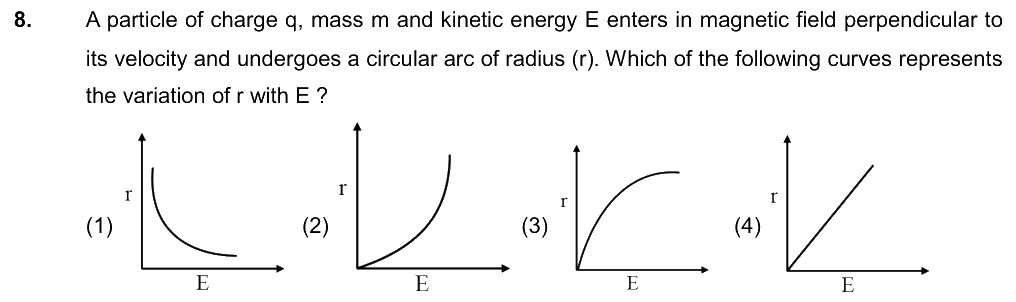
A particle of charge q, mass m and kinetic energy E enters in magnetic field perpendicular to its velocity and undergoes a circular arc of radius (r). Which of the following curves represents the variation of r with E ?
The question as printed in the paper.
A
see figure axes 'r' (vertical) and 'E' (horizontal); a curve starting high on the vertical axis, falling steeply at first and flattening out towards the horizontal axis (concave up, not touching the axis).
B
see figure same axes; a curve starting at the origin, nearly flat at first and then rising ever more steeply to the upper right.
C
see figure same axes; a curve starting at the origin, rising steeply at first and then flattening out at the upper right.
D
see figure same axes; a straight line from the origin rising to the upper right.
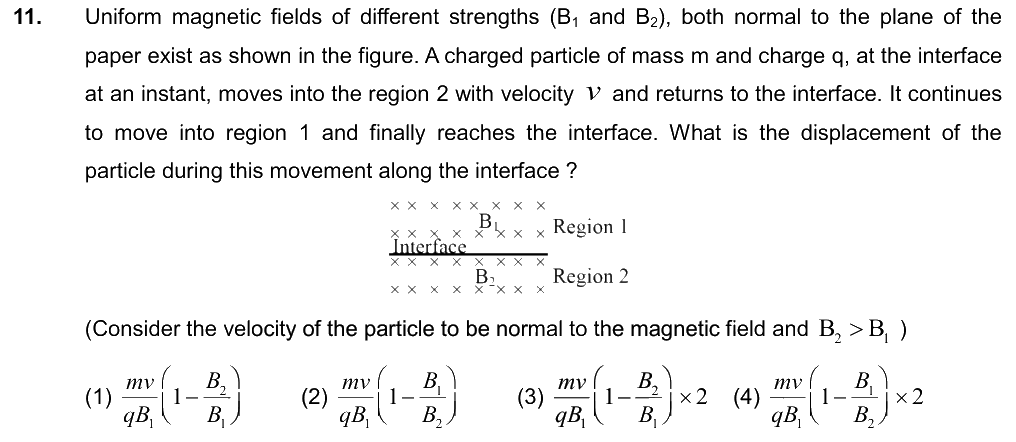
Uniform magnetic fields of different strengths ($B_1$ and $B_2$), both normal to the plane of the paper exist as shown in the figure. A charged particle of mass m and charge q, at the interface at an instant, moves into the region 2 with velocity $v$ and returns to the interface. It continues to move into region 1 and finally reaches the interface. What is the displacement of the particle during this movement along the interface ?
(see the figure above)
(Consider the velocity of the particle to be normal to the magnetic field and $B_2 > B_1$ )
A magnetic dipole experiences a torque of $80\sqrt{3}Nm$ when placed in uniform magnetic field in such a way that dipole moment makes angle of $60^\circ$ with magnetic field. The potential energy of the dipole is :
Given below are two statements: one is labelled as Assertion A and the other is labelled as Reason R
Assertion A : If Oxygen ion $\left(O^{-2}\right)$ and Hydrogen ion $\left(H^+\right)$ enter normal to the magnetic field with equal momentum, then the path of $O^{-2}$ ion has a smaller curvature than that of $H^+$.
Reason R : A proton with same linear momentum as an electron will form a path of smaller radius of curvature on entering a uniform magnetic field perpendicularly.
In the light of the above statements, choose the correct answer from the options given below
A
Both A and R are true and R is the correct explanation of A
B
Both A and R are true but R is NOT the correct explanation of A
Let $B_1$ be the magnitude of magnetic field at center of a circular coil of radius $R$ carrying current $I$. Let $B_2$ be the magnitude of magnetic field at an axial distance ' $x$ ' from the center. For $x : R = 3 : 4, \frac{B_2}{B_1}$ is :
A monochromatic light is incident on a metallic plate having work function $\phi$. An electron, emitted normally to the plate from a point A with maximum kinetic energy, enters a constant magnetic field, perpendicular to the initial velocity of electron. The electron passes through a curve and hits back the plate at a point B. The distance between A and B is :
(Given : The magnitude of charge of an electron is e and mass is m, h is Planck's constant and $c$ is velocity of light. Take the magnetic field exists throughout the path of electron)
An electron with mass 'm' with an initial velocity $(t = 0)\vec{v} = v_0\hat{i}\ (v_0 > 0)$ enters a magnetic field $\vec{B} = B_0\hat{j}$. If the initial de-Broglie wavelength at t = 0 is $\lambda_0$ then its value after time ' t ' would be :
Consider a long straight wire of a circular cross-section (radius a) carrying a steady current I. The current is uniformly distributed across this cross-section. The distances from the centre of the wire's cross-section at which the magnetic field [inside the wire, outside the wire] is half of the maximum possible magnetic field, any where due to the wire, will be
Consider a long thin conducting wire carrying a uniform current I. A particle having mass " M " and charge " $q$ " is released at a distance " $a$ " from the wire with a speed $v_0$ along the direction of current in the wire. The particle gets attracted to the wire due to magnetic force. The particle turns round when it is at distance $x$ from the wire. The value of $x$ is [ $\mu_0$ is vacuum permeability]
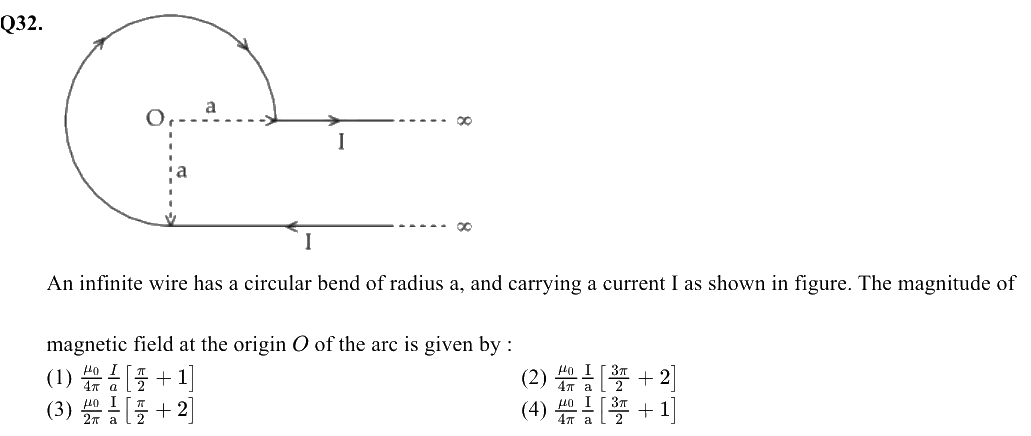
see figure An infinite wire has a circular bend of radius a, and carrying a current I as shown in figure. The magnitude of magnetic field at the origin $O$ of the arc is given by :
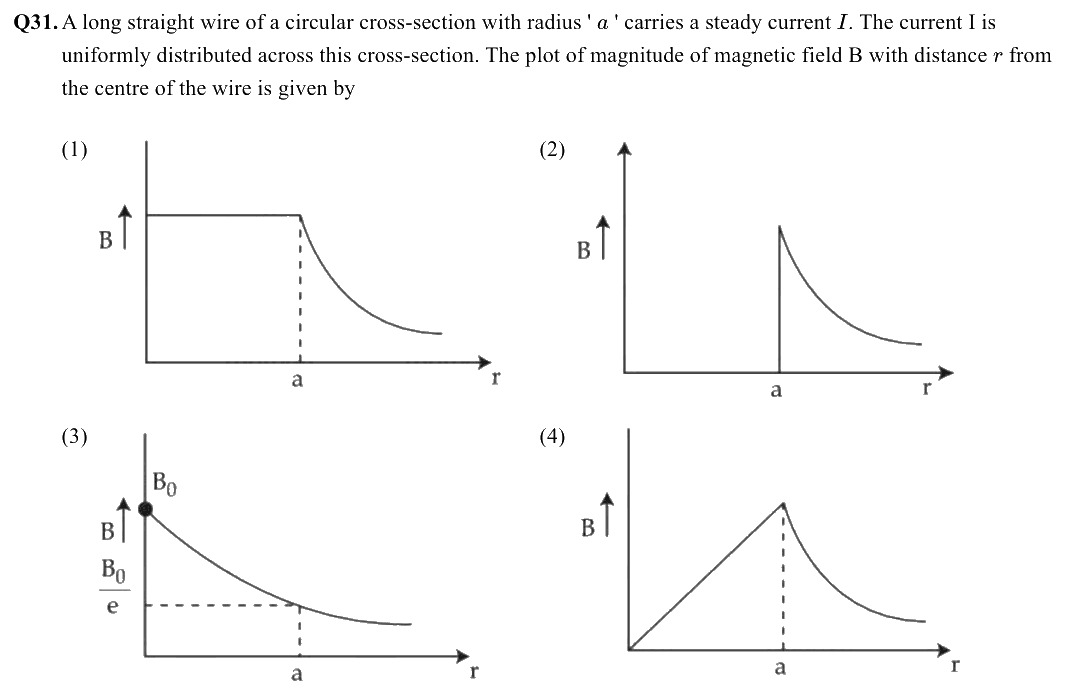
A long straight wire of a circular cross-section with radius ' $a$ ' carries a steady current $I$. The current I is uniformly distributed across this cross-section. The plot of magnitude of magnetic field B with distance $r$ from the centre of the wire is given by
The question as printed in the paper.
A
see figure axes 'B' (vertical) and 'r' (horizontal), 'a' marked on the r axis with a dashed vertical line up to the curve; a horizontal line at constant height from the vertical axis to r = a, then a curve falling and flattening toward the r axis for r > a.
B
see figure same axes; no line for r < a; at r = a a vertical line rises from the r axis to a high point, then a curve falls and flattens toward the r axis for r > a.
C
see figure same axes with a dot labelled 'B0' on the vertical axis at its top; a curve falling from B0 through a dashed level labelled 'B0/e' (a dashed horizontal line from B0/e to the point on the curve above r = a, with a dashed vertical line from that point to 'a') and flattening toward the r axis.
D
see figure same axes; a straight line rising from the origin to a peak at r = a (dashed vertical line from the peak to 'a'), then a curve falling and flattening toward the r axis for r > a.
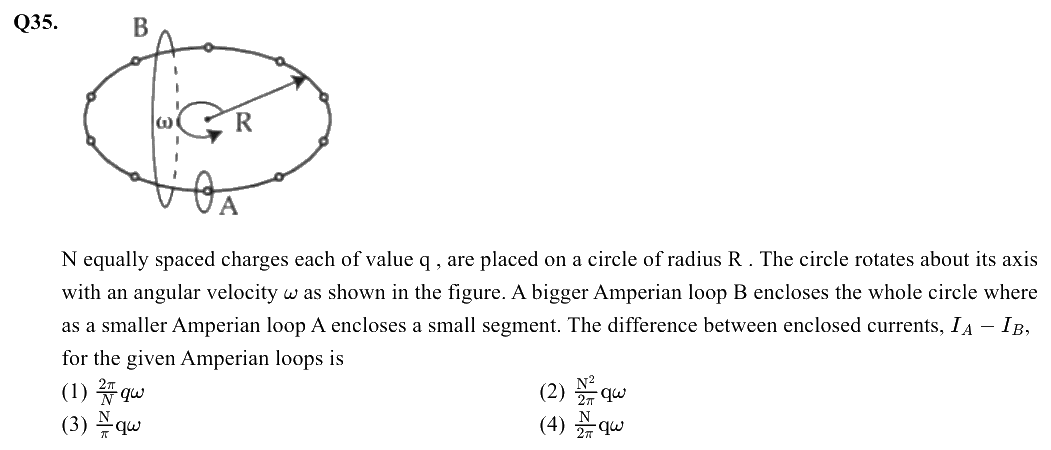
see figure N equally spaced charges each of value q , are placed on a circle of radius R . The circle rotates about its axis with an angular velocity $\omega$ as shown in the figure. A bigger Amperian loop B encloses the whole circle where as a smaller Amperian loop A encloses a small segment. The difference between enclosed currents, $I_A - I_B$, for the given Amperian loops is
Given below are two statements. One is labelled as Assertion (A) and the other is labelled as Reason (R). Assertion (A) : A electron in a certain region of uniform magnetic field is moving with constant velocity in a straight line path. Reason (R): The magnetic field in that region is along the direction of velocity of the electron. In the light of the above statements, choose the correct answer from the options given below :
A
(A) is true but (R) is false
B
Both (A) and (R) are true but (R) is NOT the correct explanation of (A)
C
Both (A) and (R) are true and (R) is the correct explanation of (A)
Consider a moving coil galvanomenter (MCG): A. The torsional constant in moving coil galvanometer has dimentions $\left[\mathrm{ML}^2\ \mathrm{T}^{-2}\right]$ B. Increasing the current sensitivity may not necessarily increase the voltage sensitivity. C. If we increase number of turns (N) to its double (2 N), then the voltage sensitivity doubles. D. MCG can be converted into an ammeter by introducing a shunt resistance of large value in parallel with galvanometer. E. Current sensitivity of MCG depends inversely on number of turns of coil. Choose the correct answer from the options given below:
Given below are two statements : Statement (I) : When currents vary with time, Newton's third law is valid only if momentum carried by the electromagnetic field is taken into account. Statement (II) : Ampere's circuital law does not depend on Biot-Savart's law. In the light of the above statements, choose the correct answer from the options given below :
A proton and a deutron ( $q = +e$, $m = 2.0$u) having same kinetic energies enter a region of uniform magnetic field $\vec{B}$, moving perpendicular to $\vec{B}$. The ratio of the radius $r_d$ of deutron path to the radius $r_p$ of the proton path is:
A long straight wire of radius $a$ carries a steady current I. The current is uniformly distributed across its cross section. The ratio of the magnetic field at $\frac{a}{2}$ and $2a$ from axis of the wire is :
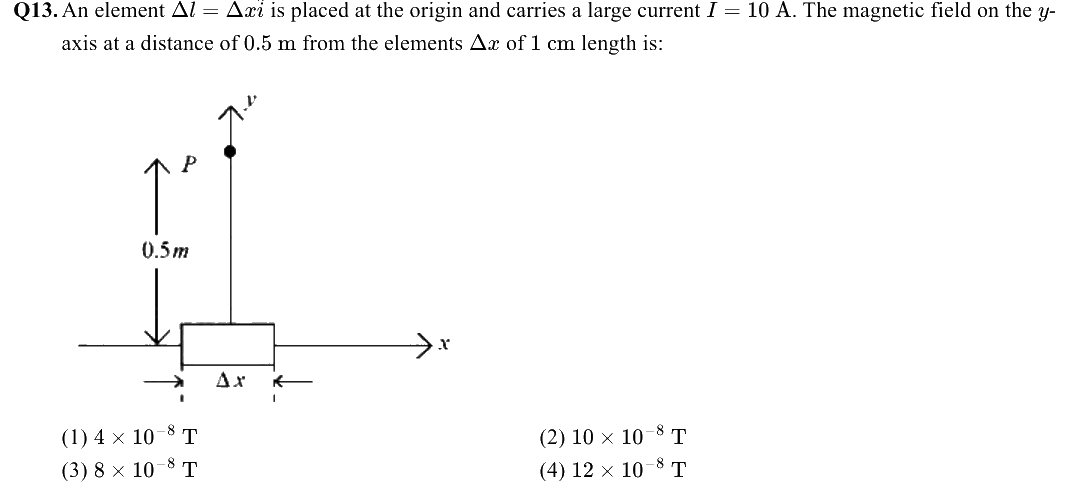
An element $\Delta l = \Delta x\hat{i}$ is placed at the origin and carries a large current $I = 10$ A. The magnetic field on the $y$-axis at a distance of 0.5 m from the elements $\Delta x$ of 1 cm length is:
The electrostatic force $\left(\vec{F}_1\right)$ and magnetic force $\left(\vec{F}_2\right)$ acting on a charge $q$ moving with velocity $v$ can be written :
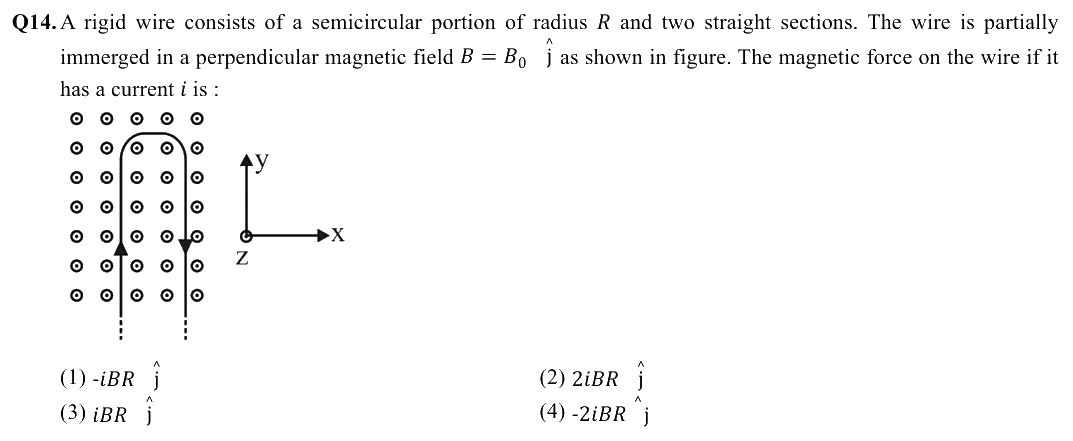
A rigid wire consists of a semicircular portion of radius $R$ and two straight sections. The wire is partially immerged in a perpendicular magnetic field $B = B_0\ \hat{j}$ as shown in figure. The magnetic force on the wire if it has a current $i$ is :
A uniform magnetic field of $2 \times 10^{-3}$ T acts along positive Y-direction. A rectangular loop of sides 20 cm and 10 cm with current of 5 A is in Y-Z plane. The current is in anticlockwise sense with reference to negative X axis. Magnitude and direction of the torque is :
A
$2 \times 10^{-4}$ N m along positive Z –direction
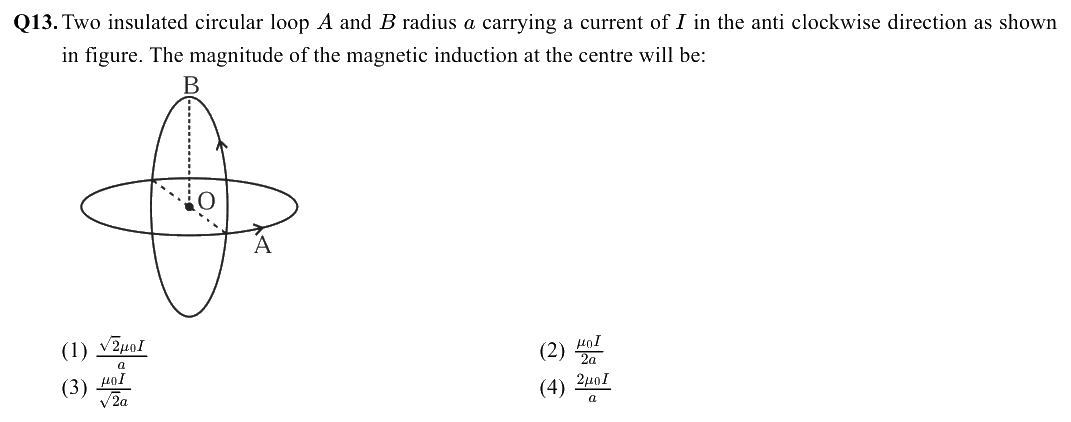
Two insulated circular loop $A$ and $B$ radius $a$ carrying a current of $I$ in the anti clockwise direction as shown in figure. The magnitude of the magnetic induction at the centre will be:
Two particles $X$ and $Y$ having equal charges are being accelerated through the same potential difference. Thereafter, they enter normally in a region of uniform magnetic field and describes circular paths of radii $R_1$ and $R_2$ respectively. The mass ratio of $X$ and $Y$ is :
A proton moving with a constant velocity passes through a region of space without any change in its velocity. If $\vec{E}$ and $\vec{B}$ represent the electric and magnetic fields respectively, then the region of space may have :
A current of 200 $\mu$A deflects the coil of a moving coil galvanometer through $60°$. The current to cause deflection through $\frac{\pi}{10}$ radian is
An electron is moving along the positive x-axis. If uniform magnetic field is applied parallel to the negative z-axis, then A. The electron will experience magnetic force along positive y-axis B. The electron will experience magnetic force along negative y-axis C. The electron will not experience any force in magnetic field D. The electron will continue to move along the positive x-axis E. The electron will move along circular path in magnetic field Choose the correct answer from the option given below:
The current sensitivity of moving coil galvanometer is increased by 25%. This increase is achieved only changing in the number of turns of coils and area of cross section of the wire while keeping the resistance of galvanometer coil constant. The percentage change in the voltage sensitivity will be:
An electron is allowed to move with constant velocity along the axis of current carrying straight solenoid. (A) The electron will experience magnetic force along the axis of the solenoid. (B) The electron will not experience magnetic force. (C) The electron will continue to move along the axis of the solenoid. (D) The electron will be accelerated along the axis of the solenoid. (E) The electron will follow parabolic path-inside the solenoid. Choose the correct answer from the option given below:
Given below are two statements: Statement I: If the number of turns in the coil of a moving coil galvanometer is doubled then the current sensitivity becomes double. Statement II: Increasing current sensitivity of a moving coil galvanometer by only increasing the number of turns in the coil will also increase its voltage sensitivity in the same ratio In the light of the above statements, choose the correct answer from the options given below:
A charge particle moving in magnetic field B, has the components of velocity along B as well as perpendicular to B. The path of the charge particle will be
A
helical path with the axis perpendicular to the direction of magnetic field B
A long straight wire of circular cross-section (radius $a$) is carrying steady current I. The current I is uniformly distributed across this cross-section. The magnetic field is
A
inversely proportional to $r$ in the region $r < a$ and uniform throughout in the region $r > a$
B
directly proportional to $r$ in the region $r < a$ and inversely proportional to $r$ in the region $r > a$
C
Zero in the region $r < a$ and inversely proportional to $r$ in the region $r > a$
D
uniform in the region $r < a$ and inversely proportional to distance $r$ from the axis, in the region $r > a$
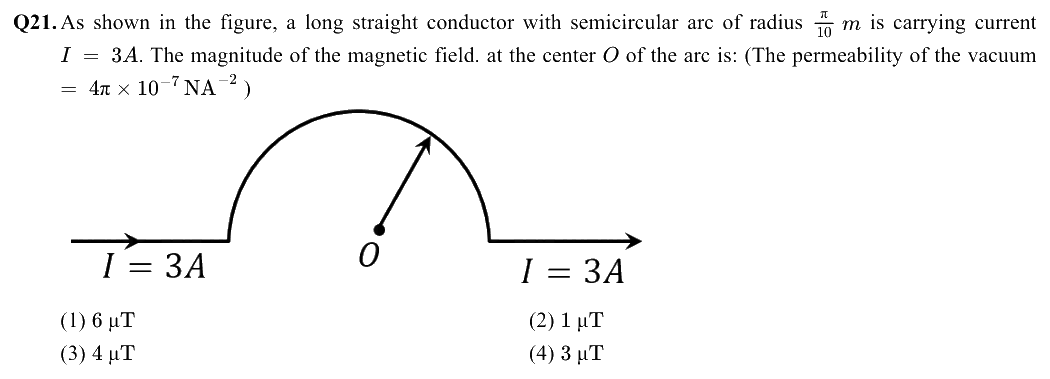
As shown in the figure, a long straight conductor with semicircular arc of radius $\dfrac{\pi}{10}$ m is carrying current $I$ = 3A. The magnitude of the magnetic field. at the center $O$ of the arc is: (The permeability of the vacuum = $4\pi \times 10^{-7}$ $\mathrm{NA^{-2}}$)
The number of turns of the coil of a moving coil galvanometer is increased in order to increase current sensitivity by 50%. The percentage change in voltage sensitivity of the galvanometer will be :
A long conducting wire having a current $I$ flowing through it, is bent into a circular coil of $N$ turns. Then it is bent into a circular coil of $n$ turns. The magnetic field is calculated at the centre of coils in both the cases. The ratio of the magnetic field in first case to that of second case is:
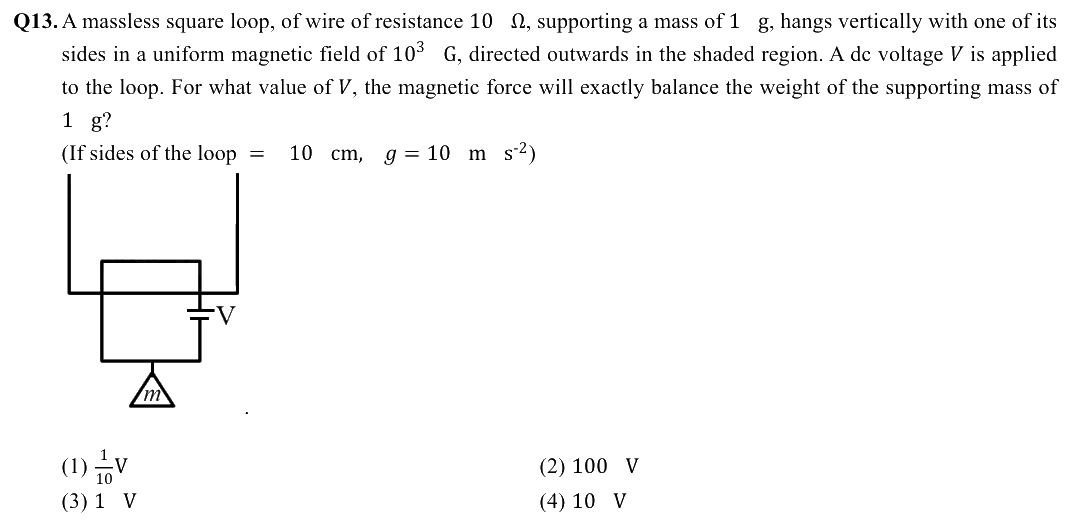
A massless square loop, of wire of resistance 10 $\Omega$, supporting a mass of 1 g, hangs vertically with one of its sides in a uniform magnetic field of $10^3$ G, directed outwards in the shaded region. A dc voltage $V$ is applied to the loop. For what value of $V$, the magnetic force will exactly balance the weight of the supporting mass of 1 g? (If sides of the loop = 10 cm, $g$ = 10 m s$^{-2}$)
The magnetic moments associated with two closely wound circular coils $A$ and $B$ of radius $r_A$ = 10 cm and $r_B$ = 20 cm respectively are equal if: (Where $N_A$, $I_A$ and $N_B$, $I_B$ are number of turn and current of $A$ and $B$ respectively)
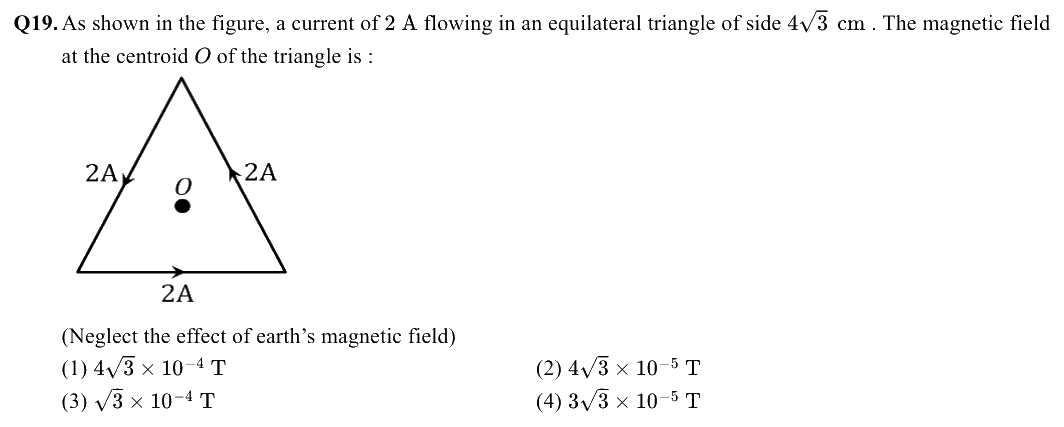
As shown in the figure, a current of 2 A flowing in an equilateral triangle of side $4\sqrt{3}$ cm. The magnetic field at the centroid $O$ of the triangle is : (Neglect the effect of earth's magnetic field)
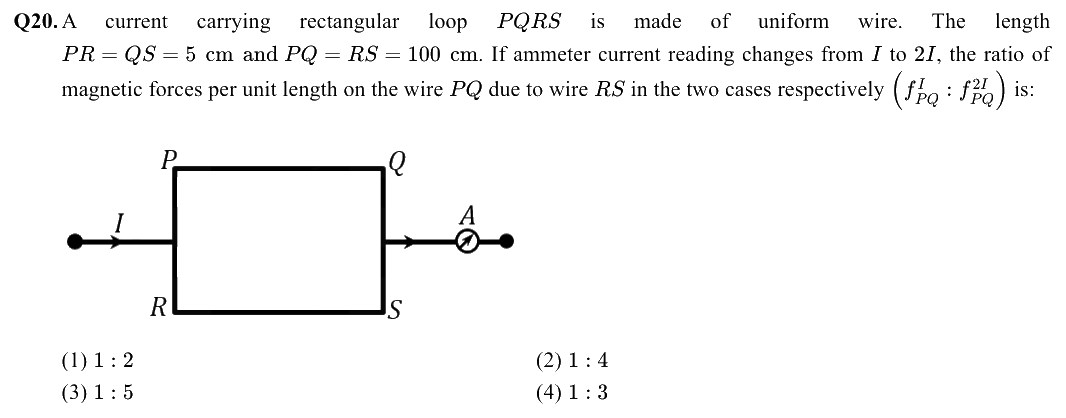
A current carrying rectangular loop $PQRS$ is made of uniform wire. The length $PR$ = $QS$ = 5 cm and $PQ$ = $RS$ = 100 cm. If ammeter current reading changes from $I$ to $2I$, the ratio of magnetic forces per unit length on the wire $PQ$ due to wire $RS$ in the two cases respectively $\left(f^{I}_{PQ} : f^{2I}_{PQ}\right)$ is:
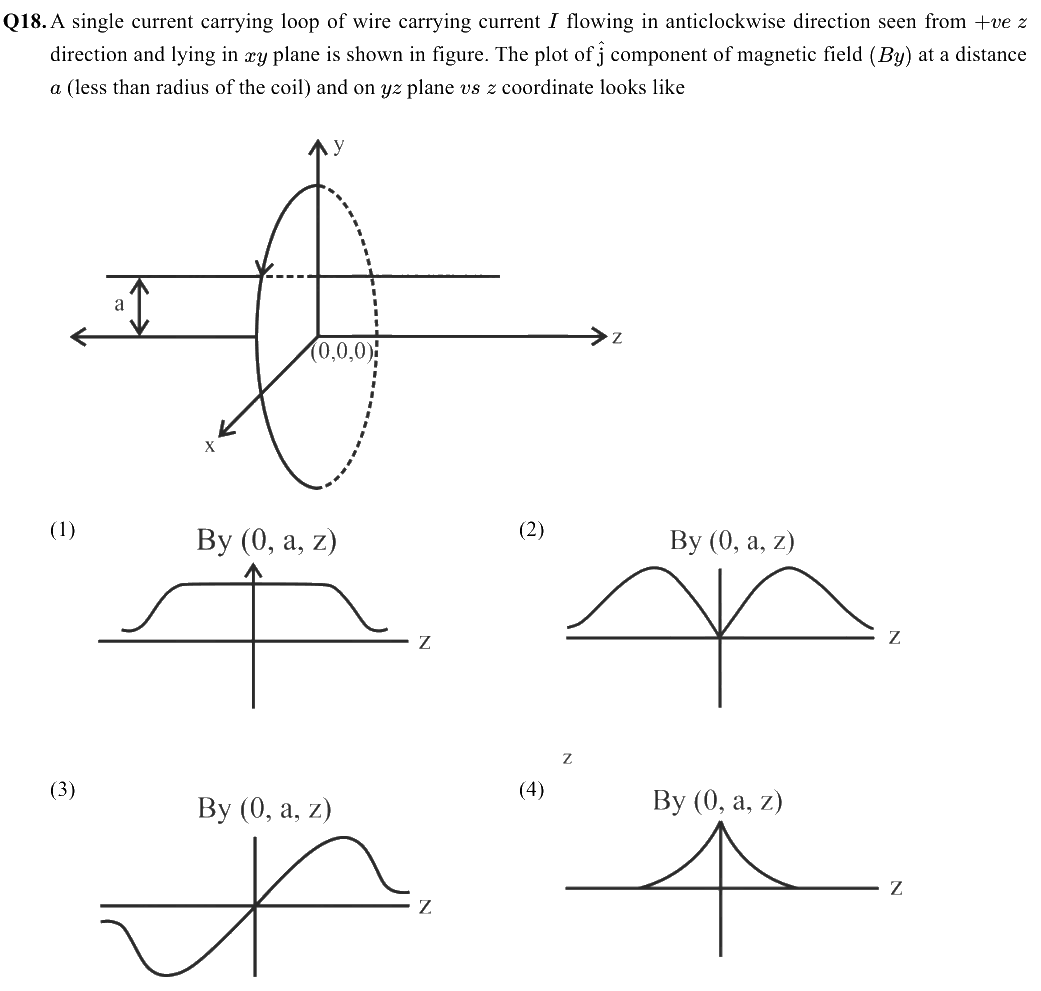
A single current carrying loop of wire carrying current $I$ flowing in anticlockwise direction seen from $+ve\ z$ direction and lying in $xy$ plane is shown in figure. The plot of $\hat{\mathrm{j}}$ component of magnetic field ($By$) at a distance $a$ (less than radius of the coil) and on $yz$ plane $vs$ $z$ coordinate looks like
The electric current in a circular coil of four turns produces a magnetic induction 32 T at its centre. The coil is unwound and is rewound into a circular coil of single turn, the magnetic induction at the centre of the coil by the same current will be :
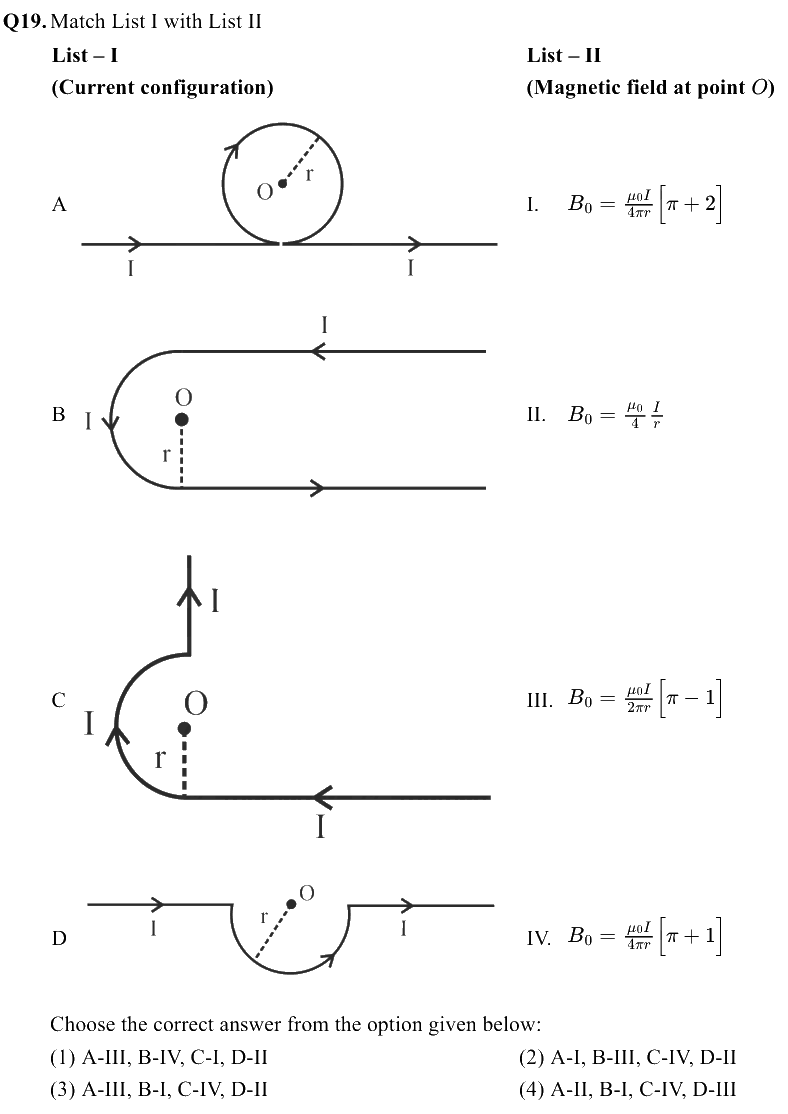
List - I (Current configuration) A (see the figure above) B (see the figure above) C (see the figure above) D (see the figure above)
List - II (Magnetic field at point $O$) I. $B_0 = \frac{\mu_0 I}{4\pi r}\left[\pi + 2\right]$ II. $B_0 = \frac{\mu_0}{4}\frac{I}{r}$ III. $B_0 = \frac{\mu_0 I}{2\pi r}\left[\pi - 1\right]$ IV. $B_0 = \frac{\mu_0 I}{4\pi r}\left[\pi + 1\right]$
Choose the correct answer from the option given below:
A solenoid of 1200 turns is wound uniformly in a single layer on a glass tube 2 m long and 0.2 m in diameter. The magnetic intensity at the center of the solenoid when a current of 2 A flows through it is:
For a moving coil galvanometer, the deflection in the coil is 0.05 rad when a current of 10 mA is passed through it. If the torsional constant of suspension wire is $4.0\times10^{-5}\ \mathrm{N\,m\,rad^{-1}}$, the magnetic field is 0.01 T and the number of turns in the coil is 200, the area of each turn (in $\mathrm{cm^{2}}$ ) is :
Two long straight wires $P$ and $Q$ carrying equal current 10 A each were kept parallel to each other at 5 cm distance. Magnitude of magnetic force experienced by 10 cm length of wire $P$ is $F_1$. If distance between wires is halved and currents on them are doubled, force $F_2$ on 10 cm length of wire $P$ will be:
A circular loop of radius $R$ is carrying current $i$ A. The ratio of magnetic field at the centre of circular loop and at a distance $R$ from the center of the loop on its axis is :
A long solenoid is formed by winding 70 turns $\mathrm{cm^{-1}}$. If 2.0 A current flows, then the magnetic field produced inside the solenoid is ______.
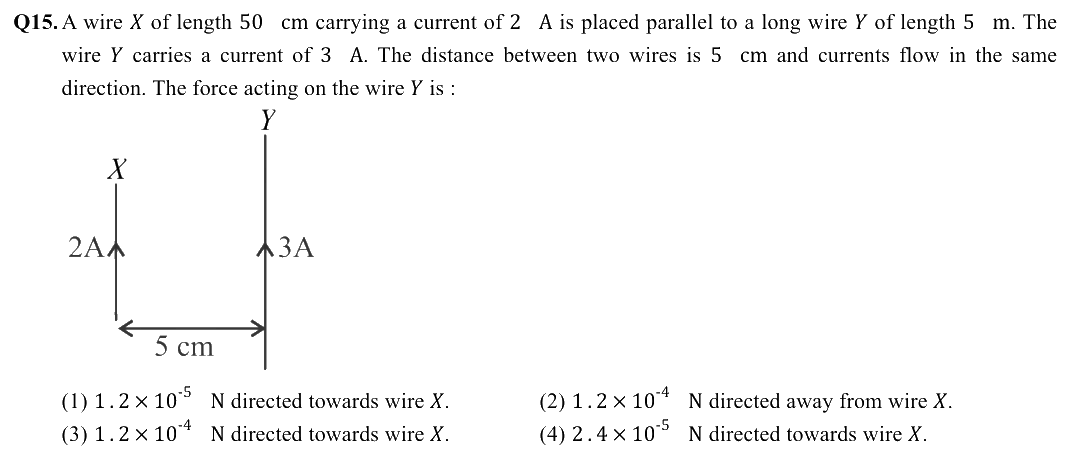
A wire $X$ of length 50 cm carrying a current of 2 A is placed parallel to a long wire $Y$ of length 5 m. The wire $Y$ carries a current of 3 A. The distance between two wires is 5 cm and currents flow in the same direction. The force acting on the wire $Y$ is : (see the figure above)
The question as printed in the paper.
A
$1.2 \times 10^{-5}$ N directed towards wire $X$.
B
$1.2 \times 10^{-4}$ N directed away from wire $X$.
The current sensitivity of a galvanometer can be increased by : (A) decreasing the number of turns (B) increasing the magnetic field (C) decreasing the area of the coil (D) decreasing the torsional constant of the spring Choose the most appropriate answer from the options given below :
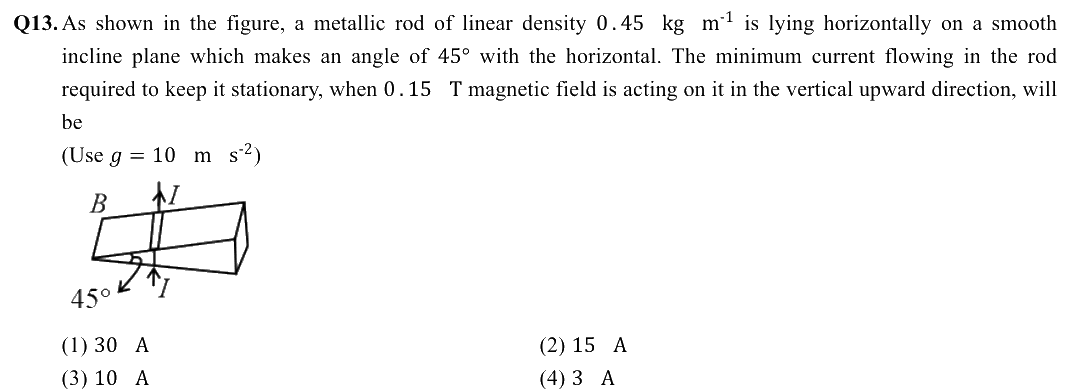
As shown in the figure, a metallic rod of linear density $0.45\ \mathrm{kg\ m^{-1}}$ is lying horizontally on a smooth incline plane which makes an angle of $45^{\circ}$ with the horizontal. The minimum current flowing in the rod required to keep it stationary, when $0.15\ \mathrm{T}$ magnetic field is acting on it in the vertical upward direction, will be (Use $g=10\ \mathrm{m\ s^{-2}}$)
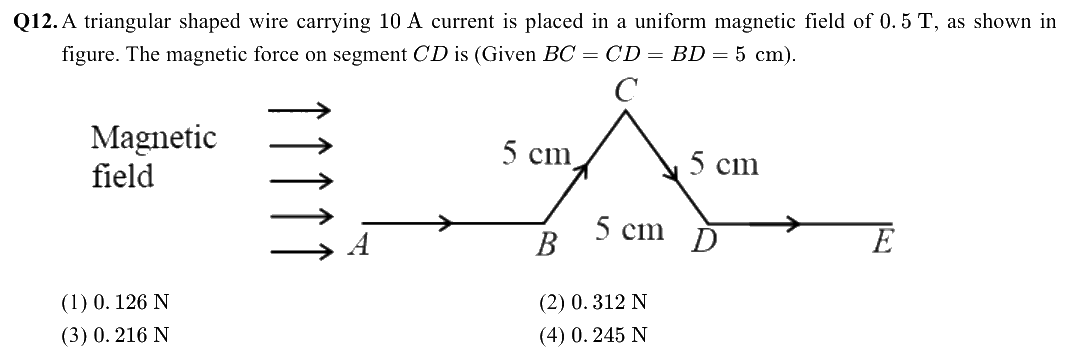
A triangular shaped wire carrying $10\ \mathrm{A}$ current is placed in a uniform magnetic field of $0.5\ \mathrm{T}$, as shown in figure. The magnetic force on segment $CD$ is (Given $BC=CD=BD=5\ \mathrm{cm}$).
The magnetic field at the center of current carrying circular loop is $B_1$. The magnetic field at a distance of $\sqrt{3}$ times radius of the given circular loop from the center on its axis is $B_2$. The value of $\frac{B_1}{B_2}$ will be
A cyclotron is used to accelerate protons. If the operating magnetic field is 1.0 T and the radius of the cyclotron 'dees' is 60 cm, the kinetic energy of the accelerated protons in MeV will be : [use $m_\mathrm{p}$ = $1.6 \times 10^{-27}$ kg, $e$ = $1.6 \times 10^{-19}$ C]
A charge particle is moving in a uniform magnetic field $(2\hat{i} + 3\hat{j})$ T. If it has an acceleration of $(\alpha\hat{i} - 4\hat{j})$ $\mathrm{m~s^{-2}}$, then the value of $\alpha$ will be
$B_X$ and $B_Y$ are the magnetic field at the centre of two coils two coils $X$ and $Y$ respectively, each carrying equal current. If coil $X$ has 200 turns and 20 cm radius and coil $Y$ has 400 turns and 20 cm radius, the ratio of $B_X$ and $B_Y$ is
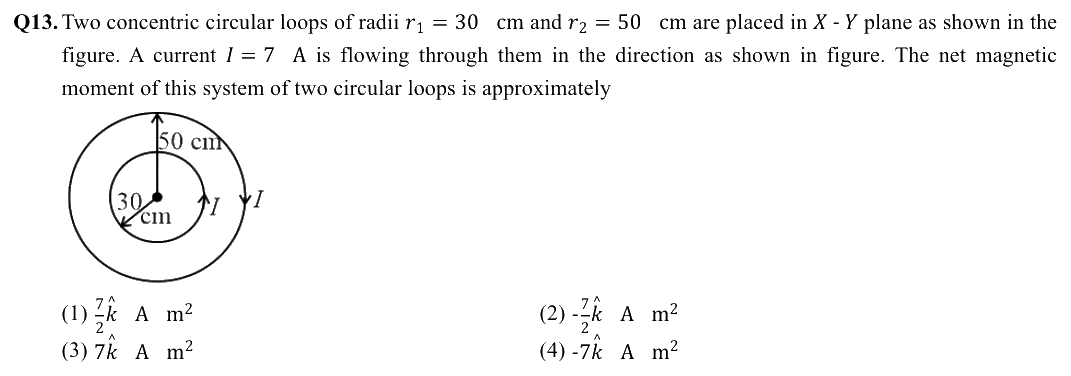
Two concentric circular loops of radii $r_1 = 30\ \mathrm{cm}$ and $r_2 = 50\ \mathrm{cm}$ are placed in $X - Y$ plane as shown in the figure. A current $I = 7\ \mathrm{A}$ is flowing through them in the direction as shown in figure. The net magnetic moment of this system of two circular loops is approximately
A velocity selector consists of electric field $\vec{E} = E\ \hat{k}$ and magnetic field $\vec{B} = B\ \hat{j}$ with $B = 12\ \mathrm{mT}$. The value $E$ required for an electron of energy 728eV moving along the positive x-axis to pass undeflected is (Given, mass of electron $= 9.1\times10^{-31}\ \mathrm{kg}$)
Two charged particles, having same kinetic energy, are allowed to pass through a uniform magnetic field perpendicular to the direction of motion. If the ratio of radii of their circular paths is $6:5$ and their respective masses ratio is $9:4$. Then, the ratio of their charges will be
An electron with energy $0.1$ keV moves at right angle to the earth's magnetic field of $1\times10^{-4}\ \mathrm{Wbm^{-2}}$. The frequency of revolution of the electron will be (Take mass of electron $= 9.0\times10^{-31}\ \mathrm{kg}$)
The electric current in a circular coil of 2 turns produces a magnetic induction $B_1$ at its centre. The coil is unwound and is rewound into a circular coil of 5 turns and the same current produces a magnetic induction $B_2$ at its centre. The ratio of $\frac{B_2}{B_1}$ is:
A charge particle moves along circular path in a uniform magnetic field in a cyclotron. The kinetic energy of the charge particle increases to 4 times its initial value. What will be the ratio of new radius to the original radius of circular path of the charge particle?
Two long current carrying conductors are placed parallel to each other at a distance of $8\ \mathrm{cm}$ between them. The magnitude of magnetic field produced at mid-point between the two conductors due to current flowing in them is $300\ \mu\mathrm{T}$. The equal current flowing in the two conductors is :
Given below are two statements : Statement I: The electric force changes the speed of the charged particle and hence changes its kinetic energy; whereas the magnetic force does not change the kinetic energy of the charged particle. Statement II: The electric force accelerates the positively charged particle perpendicular to the direction of electric field. The magnetic force accelerates the moving charged particle along the direction of magnetic field. In the light of the above statements, choose the most appropriate answer from the options given below :
A
Both Statement I and Statement II are correct.
B
Both Statement I and Statement II are incorrect.
C
Statement I is correct but Statement II is incorrect.
D
Statement I is incorrect but Statement II is correct.
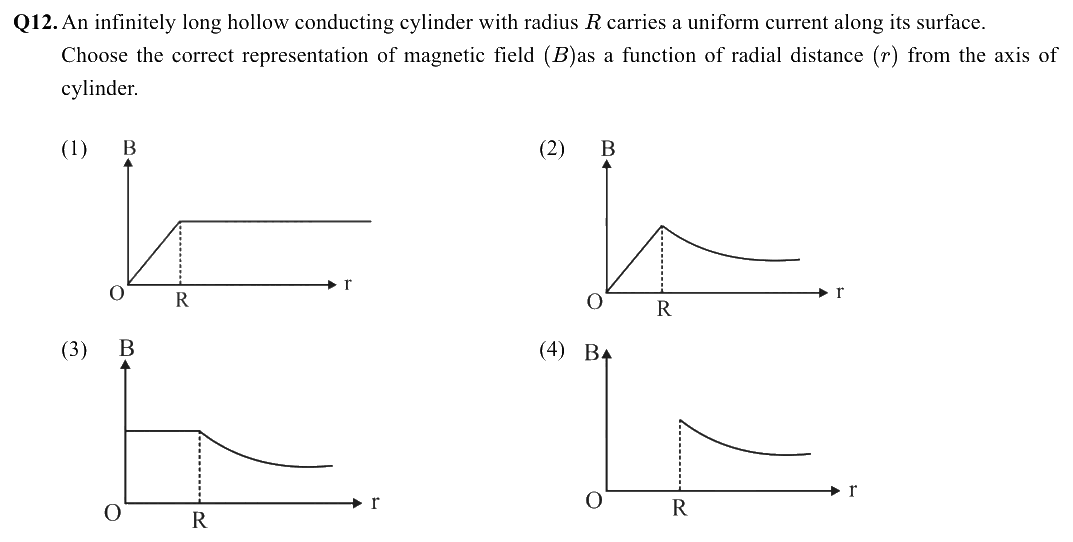
An infinitely long hollow conducting cylinder with radius $R$ carries a uniform current along its surface. Choose the correct representation of magnetic field $(B)$ as a function of radial distance $(r)$ from the axis of cylinder.
The question as printed in the paper.
A
see figure Graph of $B$ against $r$: a straight line rising from the origin O up to $r = R$ (dotted vertical line at R), then a horizontal constant line continuing to the right.
B
see figure Graph of $B$ against $r$: a straight line rising from the origin O up to a peak at $r = R$ (dotted vertical line at R), then a decaying curve falling gradually for $r > R$.
C
see figure Graph of $B$ against $r$: a constant horizontal line at a non-zero value from $r = 0$ to $r = R$ (dotted vertical line at R), then a decaying curve for $r > R$.
D
see figure Graph of $B$ against $r$: nothing is drawn for $r < R$ (B stays on the axis, zero); at $r = R$ (dotted vertical line at R) the curve starts at a non-zero value and decays gradually for $r > R$.
Two parallel, long wires are kept $0.20\ \mathrm{m}$ apart in vacuum, each carrying current of $x\ \mathrm{A}$ in the same direction. If the force of attraction per meter of each wire is $2 \times 10^{-6}\ \mathrm{N}$, then the value of $x$ is approximately
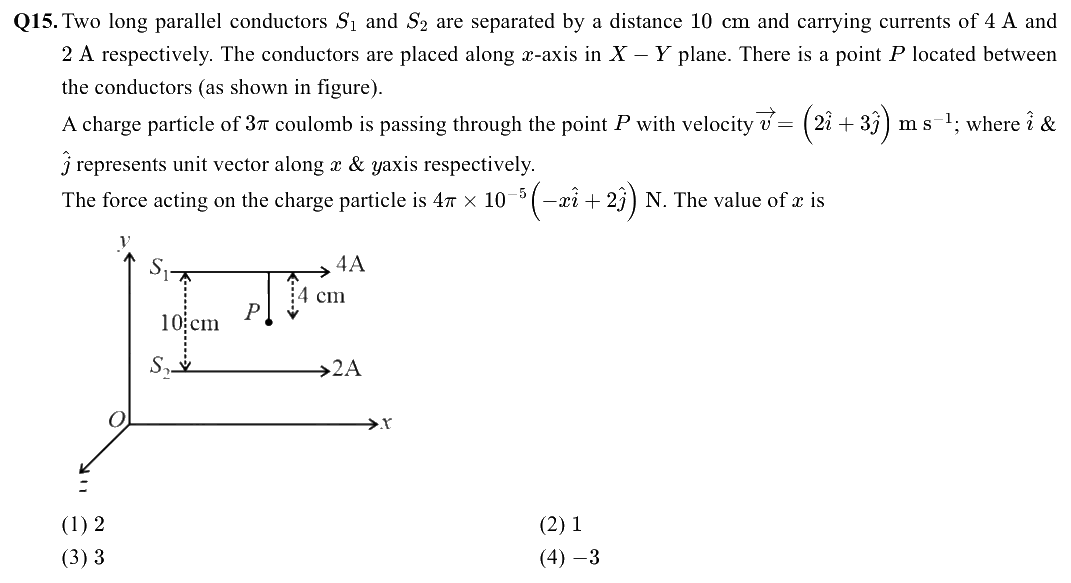
Two long parallel conductors $S_1$ and $S_2$ are separated by a distance $10\ \mathrm{cm}$ and carrying currents of $4\ \mathrm{A}$ and $2\ \mathrm{A}$ respectively. The conductors are placed along $x$-axis in $X - Y$ plane. There is a point $P$ located between the conductors (as shown in figure). A charge particle of $3\pi$ coulomb is passing through the point $P$ with velocity $\vec{v} = \left(2\hat{i} + 3\hat{j}\right)\ \mathrm{m\ s^{-1}}$; where $\hat{i}$ & $\hat{j}$ represents unit vector along $x$ & $y$ axis respectively. The force acting on the charge particle is $4\pi \times 10^{-5}\left(-x\hat{i} + 2\hat{j}\right)$ N. The value of $x$ is (see the figure above)
A proton and an alpha particle of the same velocity enter in a uniform magnetic field which is acting perpendicular to their direction of motion. The ratio of the radii of the circular paths described by the alpha particle and proton is
A long straight wire with a circular cross-section having radius $R$, is carrying a steady current $I$. The current $I$ is uniformly distributed across this cross-section. Then the variation of magnetic field due to current $I$ with distance $r < R$ from its centre will be
A long solenoid carrying a current produces a magnetic field $B$ along its axis. If the current is doubled and the number of turns per cm is halved, the new value of magnetic field will be equal to
Given below are two statements : One is labelled as Assertion (A) and the other is labelled as Reason (R). Assertion (A) : In an uniform magnetic field, speed and energy remains the same for a moving charged particle. Reason (R): Moving charged particle experiences magnetic force perpendicular to its direction of motion.
A
Both Assertion and Reason are true and Reason is the correct explanation of Assertion.
B
Both Assertion and Reason are true but Reason is NOT the correct explanation of Assertion.
The magnetic field at the centre of a circular coil of radius $r$, due to current I flowing through it, is $B$. The magnetic field at a point along the axis at a distance $\frac{r}{2}$ from the centre is :
A proton, a deuteron and an $\alpha$-particle with same kinetic energy enter into a uniform magnetic field at right angle to magnetic field. The ratio of the radii of their respective circular paths is :
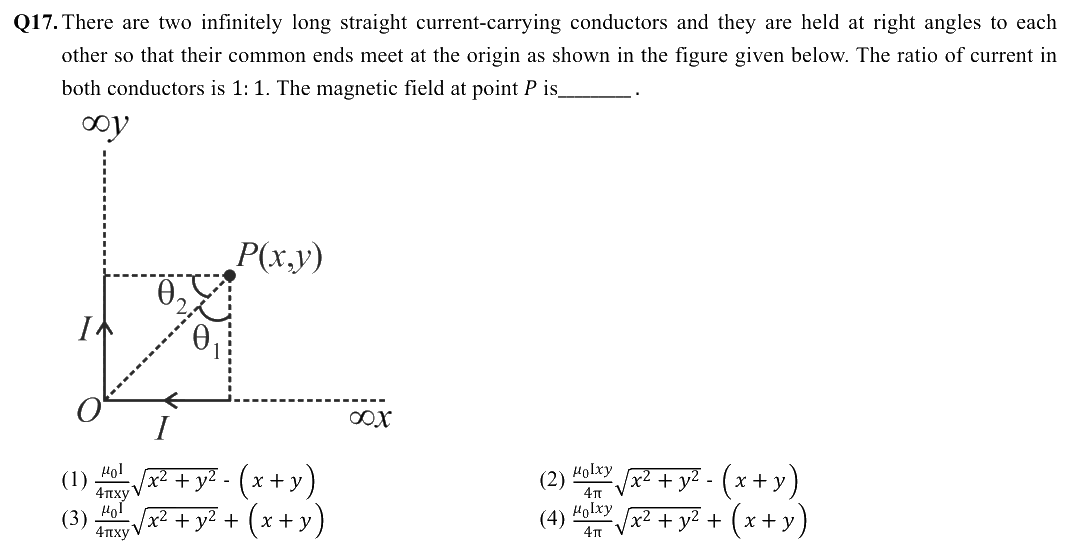
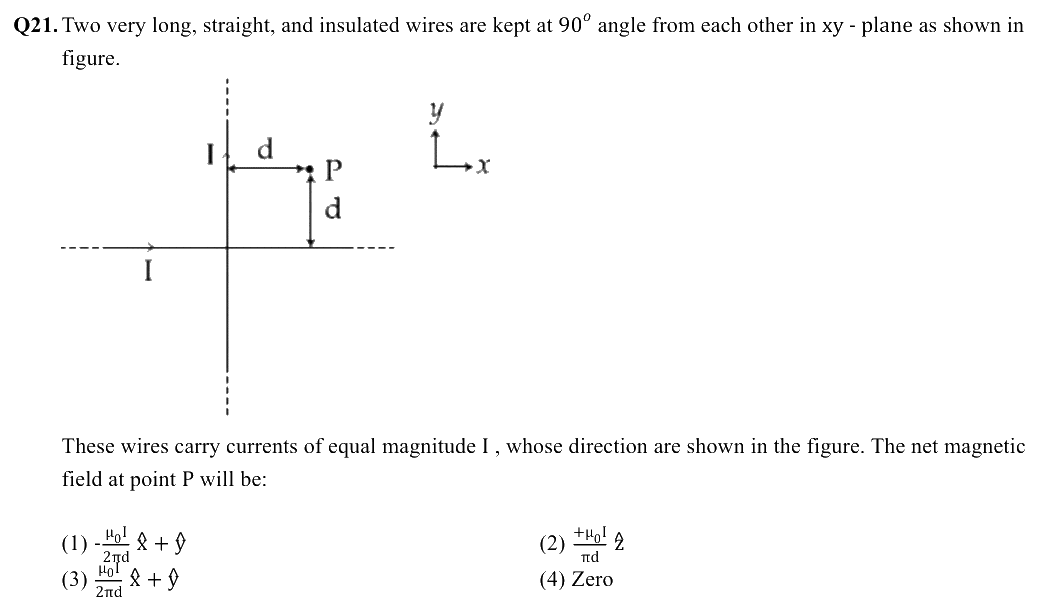
There are two infinitely long straight current-carrying conductors and they are held at right angles to each other so that their common ends meet at the origin as shown in the figure given below. The ratio of current in both conductors is $1 : 1$. The magnetic field at point $P$ is ______. (see the figure above)
A coil having $N$ turns is wound tightly in the form of a spiral with inner and outer radii $a$ and $b$ respectively. Find the magnetic field at centre, when a current $I$ passes through coil :
A current of $1.5$ A is flowing through a triangle, of side $9$ cm each. The magnetic field at the centroid of the triangle is : (Assume that the current is flowing in the clockwise direction.)
A
$2\sqrt{3} \times 10^{-5}$ T, inside the plane of triangle
B
$2\sqrt{3} \times 10^{-7}$ T, outside the plane of triangle
C
$3 \times 10^{-7}$ T, outside the plane of triangle
D
$3 \times 10^{-5}$ T, inside the plane of triangle
Two ions of masses $4$ amu and $16$ amu have charges $+2$ e and $+3$ e respectively. These ions pass through the region of the constant perpendicular magnetic field. The kinetic energy of both ions is the same. Then:
A
lighter ion will be deflected less than heavier ion
B
lighter ion will be deflected more than heavier ion
For full scale deflection of total 50 divisions, $50\ \mathrm{mV}$ voltage is required in galvanometer. The resistance of galvanometer if its current sensitivity is $2\ \mathrm{div}\ /\,\mathrm{mA}$ will be:
A coaxial cable consists of an inner wire of radius $a$ surrounded by an outer shell of inner and outer radii $b$ and $c$ respectively. The inner wire carries an electric current $i_0$ which is distributed uniformly across cross-sectional area. The outer shell carries an equal current in opposite direction and distributed uniformly. What will be the ratio of the magnetic field at a distance x from the axis when $(i)$ $\mathrm{x}<\mathrm{a}$ and $(ii)$ $\mathrm{a}<\mathrm{x}<\mathrm{b}$ ?
The fractional change in the magnetic field intensity at a distance $r$ from centre on the axis of current carrying coil of radius $a$ to the magnetic field intensity at the centre of the same coil is: (Take $\mathrm{r}<\mathrm{a}$)
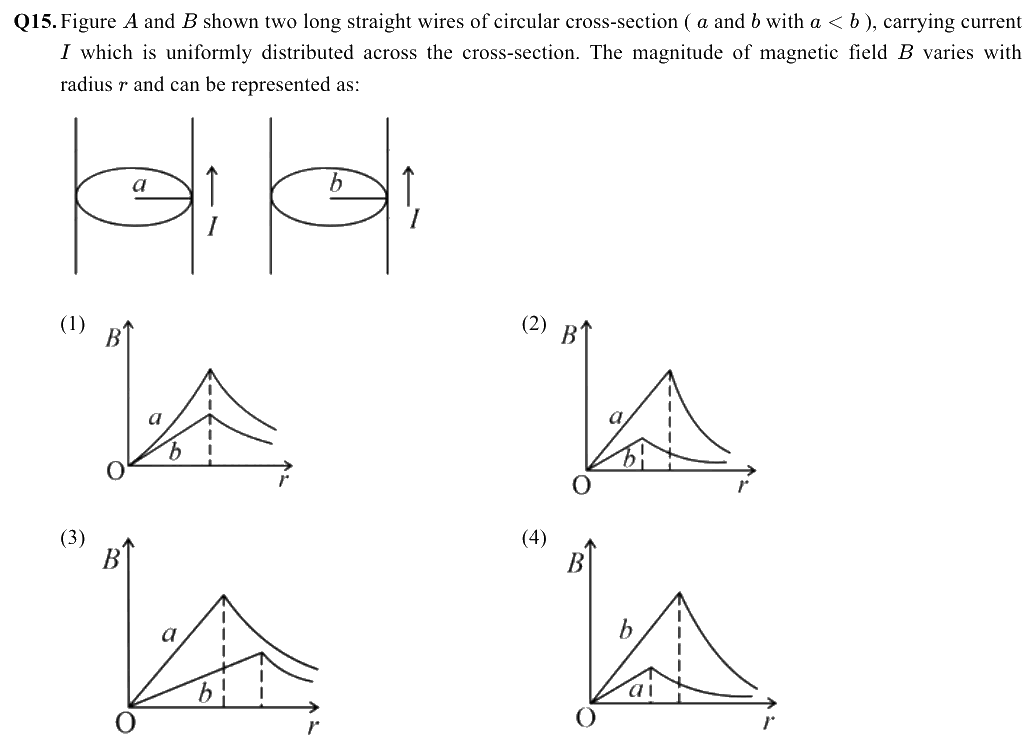
Figure $A$ and $B$ shown two long straight wires of circular cross-section ( $a$ and $b$ with $a < b$ ), carrying current $I$ which is uniformly distributed across the cross-section. The magnitude of magnetic field $B$ varies with radius $r$ and can be represented as: (see the figure above)
Two ions having same mass have charges in the ratio $1 : 2$. They are projected normally in a uniform magnetic field with their speeds in the ratio $2 : 3$. The ratio of the radii of their circular trajectories is,
A deuteron and an alpha particle having equal kinetic energy enter perpendicular into a magnetic field. Let $r_d$ and $r_\alpha$ be their respective radii of circular path. The value of $\frac{r_d}{r_\alpha}$ is equal to:
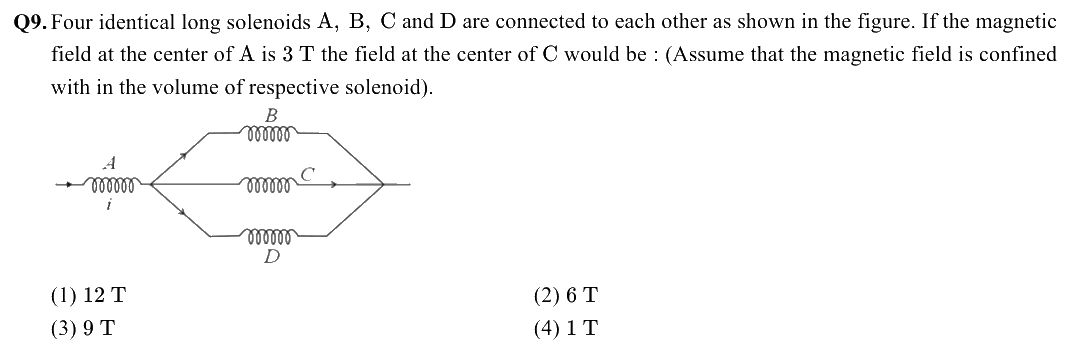
Four identical long solenoids A, B, C and D are connected to each other as shown in the figure. If the magnetic field at the center of A is 3 T the field at the center of C would be : (Assume that the magnetic field is confined with in the volume of respective solenoid). (see the figure above)
A proton and an $\alpha$-particle, having kinetic energies $\mathrm{K_p}$ and $\mathrm{K_\alpha}$, respectively, enter into a magnetic field at right angles. The ratio of the radii of the trajectory of proton to that of $\alpha$ -particle is $2 : 1$. The ratio of $\mathrm{K_p : K_\alpha}$ is:
A solenoid of 1000 turns per metre has a core with relative permeability 500. Insulated windings of the solenoid carry an electric current of 5 A. The magnetic flux density produced by the solenoid is: (Permeability of free space$=4 \pi \times 10^{-7} \mathrm{H} \mathrm{m}^{-1}$)
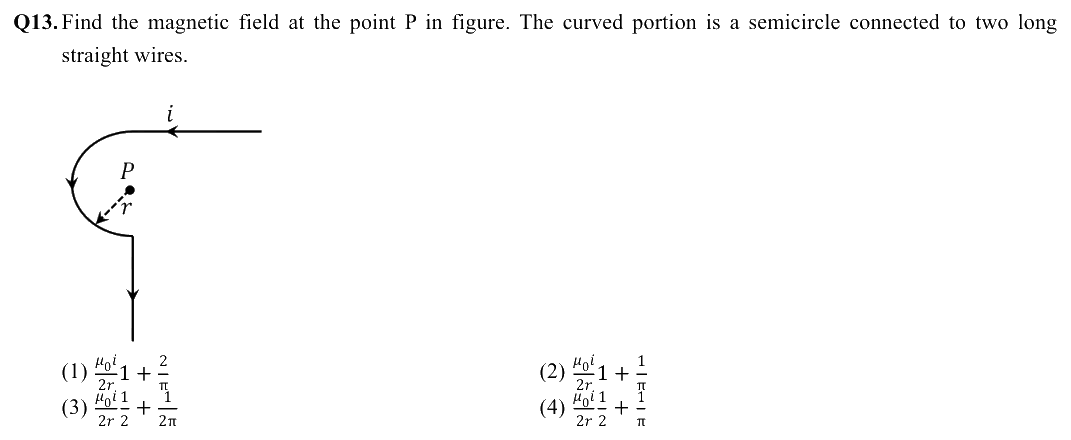
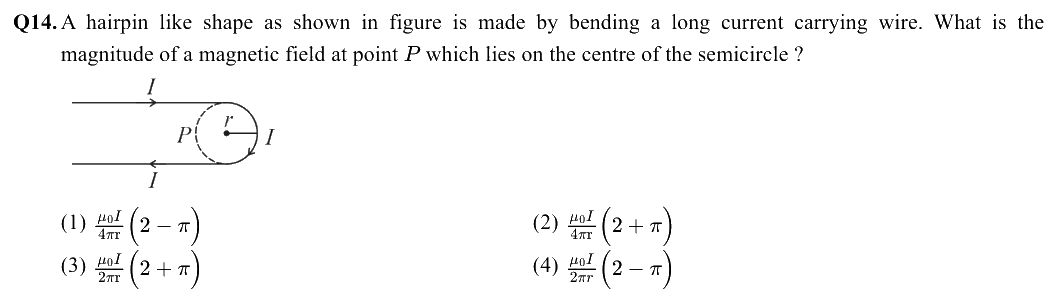
A hairpin like shape as shown in figure is made by bending a long current carrying wire. What is the magnitude of a magnetic field at point $P$ which lies on the centre of the semicircle ? (see the figure above)
A proton, a deuteron and an $\alpha$ particle are moving with same momentum in a uniform magnetic field. The ratio of magnetic forces acting on them ______ and their speed is ______ in the ratio.
Magnetic fields at two points on the axis of a circular coil at a distance of $0.05\ \mathrm{m}$ and $0.2\ \mathrm{m}$ from the centre are in the ratio $8 : 1$. The radius of coil is ______ .
A particle of charge $q$ and mass $m$ is moving with a velocity $-v\hat{i}\left(v \neq 0\right)$ towards a large screen placed in the $Y - Z$ plane at distance d. If there is magnetic field $\vec{B} = B_0\hat{k}$, the minimum value of $v$ for which the particle will not hit the screen is :
An electron is moving along $+x$ direction with a velocity of $6 \times 10^6\ \mathrm{ms^{-1}}$. It enters a region of uniform electric field of $300\ V/cm$ pointing along $+y$ direction. The magnitude and direction of the magnetic field set up in this region such that the electron keeps moving along the x direction will be:
A
$3 \times 10^{-4}\mathrm{T}$, along $+z$ direction
B
$5 \times 10^{-3}\mathrm{T}$, along $-z$ direction
C
$5 \times 10^{-3}\mathrm{T}$, along $+z$ direction
A charged particle going around in a circle can be considered to be a current loop. A particle of a mass m carrying charge q is moving in a plane with speed $v$ under the influence of magnetic field $\vec{B}$. The magnetic moment of this moving particle is :
A square loop of side 2a and carrying current I is kept in xz plane with its centre at origin. A long wire carrying the same current I is placed parallel to z-axis and passing through point (0, b, 0), (b >> a). The magnitude of torque on the loop about z-axis will be :
A square loop of side $2a$, and carrying current $I$ is kept in $XZ$ plane with its centre at origin. A long wire carrying the same current $I$ is placed parallel to the $z$-axis and passing through the point $(0, b, 0), (b >> a)$. The magnitude of the torque on the loop about $z$-axis is given by.
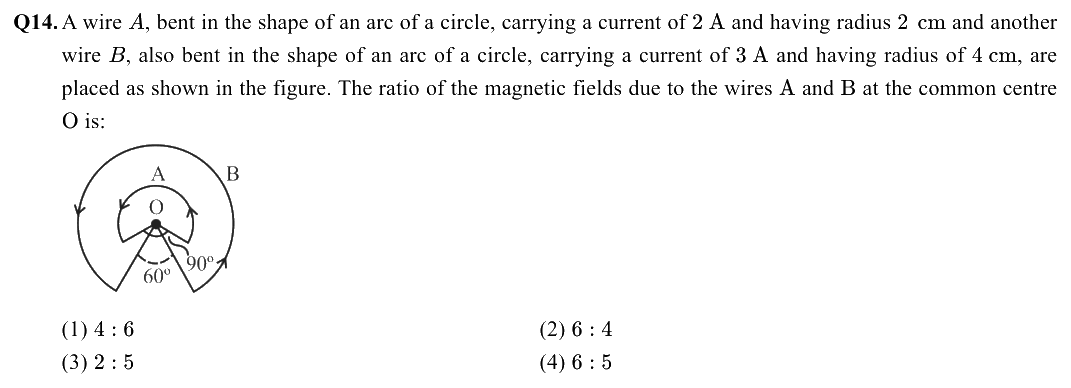
A wire $A$, bent in the shape of an arc of a circle, carrying a current of 2 A and having radius 2 cm and another wire $B$, also bent in the shape of an arc of a circle, carrying a current of 3 A and having radius of 4 cm, are placed as shown in the figure. The ratio of the magnetic fields due to the wires A and B at the common centre O is: (see the figure above)
A circular coil has moment of inertia $0.8\ \mathrm{kg\ m^{2}}$ around any diameter and is carrying current to produce a magnetic moment of $20\ \mathrm{Am^{2}}$. The coil is kept initially in a vertical position and it can rotate freely around a horizontal diameter. When a uniform magnetic field of $4\ \mathrm{T}$ is applied along the vertical, it starts rotating around its horizontal diameter. The angular speed the coil acquires after rotating by $60^{\circ}$ will be :
Magnitude of magnetic field (in SI units) at the centre of a hexagonal shape coil of side $10\ \mathrm{cm}$, 50 turns and carrying current$I$ (Ampere) in units of $\frac{\mu_0 I}{\pi}$ is :
A charged particle carrying charge $1\ \mu C$ is moving with velocity $(2\hat{i} + 3\hat{j} + 4\hat{k})\ \mathrm{m\,s^{-1}}$. If an external magnetic field of $(5\hat{i} + 3\hat{j} - 6\hat{k})\times 10^{-3}T$ exists in the region where the particle is moving then the force on the particle is $\vec{F}\times 10^{-9}\ \mathrm{N}$ . the vector $\vec{F}$ is :
A beam of protons with speed $4 \times 10^{5}\ \mathrm{m\ s}^{-1}$ enters a uniform magnetic field of $0.3\ \mathrm{T}$ at an angle $60^{\circ}$ to the magnetic field, the pitch of the resulting helical path of protons is close to : (Mass of the proton $= 1.67 \times 10^{-27}\ \mathrm{kg}$, charge of the proton$= 1.69 \times 10^{-19}\mathrm{C}$)
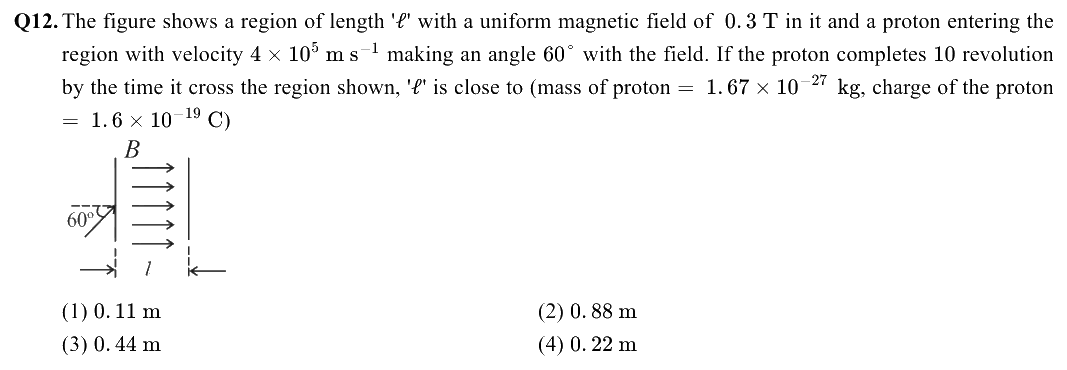
The figure shows a region of length '$\ell$' with a uniform magnetic field of $0.3\ \mathrm{T}$ in it and a proton entering the region with velocity $4 \times 10^{5}\ \mathrm{m\ s}^{-1}$ making an angle $60^{\circ}$ with the field. If the proton completes 10 revolution by the time it cross the region shown, '$\ell$' is close to (mass of proton $= 1.67 \times 10^{-27}\ \mathrm{kg}$, charge of the proton $= 1.6 \times 10^{-19}\ \mathrm{C}$) (see the figure above)
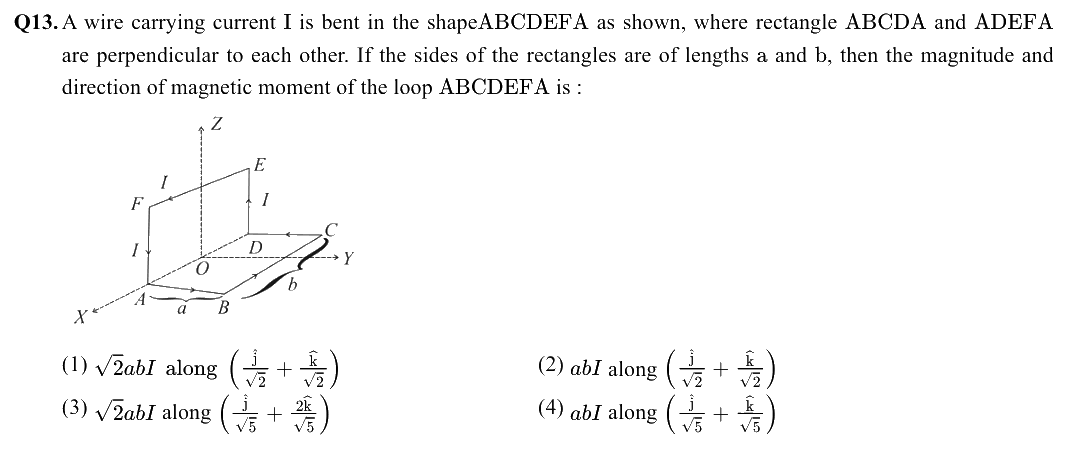
A wire carrying current I is bent in the shapeABCDEFA as shown, where rectangle ABCDA and ADEFA are perpendicular to each other. If the sides of the rectangles are of lengths a and b, then the magnitude and direction of magnetic moment of the loop ABCDEFA is : (see the figure above)
The question as printed in the paper.
A
$\sqrt{2}abI$ along $\left(\frac{\hat{j}}{\sqrt{2}}+\frac{\hat{k}}{\sqrt{2}}\right)$
B
$abI$ along $\left(\frac{\hat{j}}{\sqrt{2}}+\frac{\hat{k}}{\sqrt{2}}\right)$
C
$\sqrt{2}abI$ along $\left(\frac{\hat{j}}{\sqrt{5}}+\frac{2\hat{k}}{\sqrt{5}}\right)$
D
$abI$ along $\left(\frac{\hat{j}}{\sqrt{5}}+\frac{\hat{k}}{\sqrt{5}}\right)$
A long, straight Wire of radius a carries a current distributed uniformly over its cross-section. The ratio of the magnetic fields due to the wire at distance $\frac{a}{3}$ and $2a$ , respectively from the axis of the wire is:
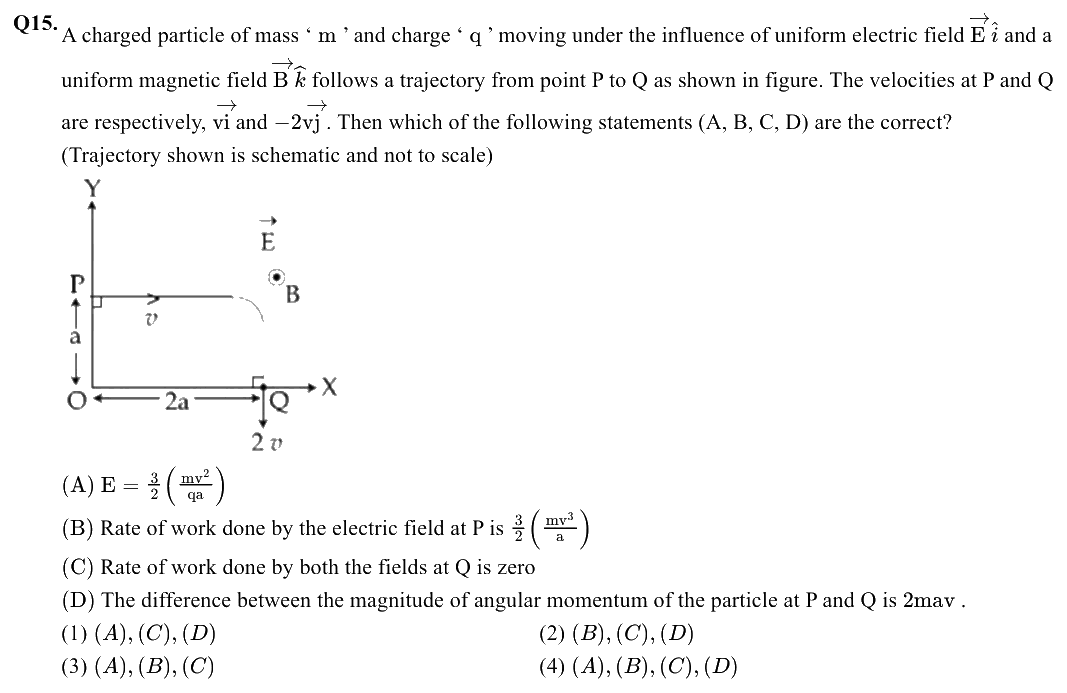
A charged particle of mass ' m ' and charge ' q ' moving under the influence of uniform electric field $\overrightarrow{\mathrm{E}}\hat{i}$ and a uniform magnetic field $\overrightarrow{\mathrm{B}}\hat{k}$ follows a trajectory from point P to Q as shown in figure. The velocities at P and Q are respectively, $\overrightarrow{v}\hat{i}$ and $-2\overrightarrow{v}\hat{j}$ . Then which of the following statements (A, B, C, D) are the correct? (Trajectory shown is schematic and not to scale) (see the figure above) (A) $\mathrm{E} = \frac{3}{2}\left(\frac{mv^2}{qa}\right)$ (B) Rate of work done by the electric field at P is $\frac{3}{2}\left(\frac{mv^3}{a}\right)$ (C) Rate of work done by both the fields at Q is zero (D) The difference between the magnitude of angular momentum of the particle at P and Q is $2mav$ .
A small circular loop of conducting wire has radius a and carries current $I$. It is placed in a uniform magnetic field $B$ perpendicular to its plane such that when rotated slightly about its diameter and released, it starts performing simple harmonic motion of time period $T$. The mass of the loop is $m$ then:
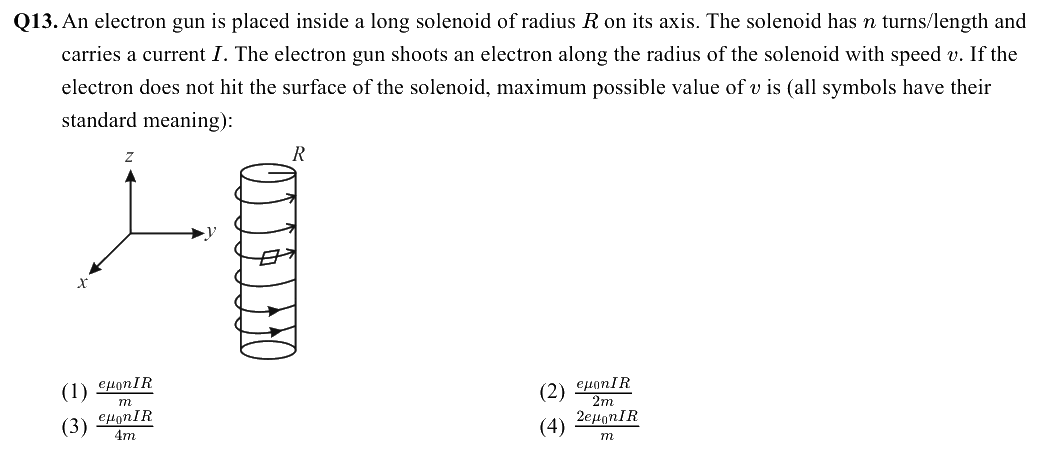
An electron gun is placed inside a long solenoid of radius $R$ on its axis. The solenoid has $n$ turns/length and carries a current $I$. The electron gun shoots an electron along the radius of the solenoid with speed $v$. If the electron does not hit the surface of the solenoid, maximum possible value of $v$ is (all symbols have their standard meaning): (see the figure above)
Proton with kinetic energy of $1\ \mathrm{MeV}$ moves from south to north. It gets an acceleration of $10^{12}\ \mathrm{m/s^2}$ by an applied magnetic field (west to east). The value of magnetic field: (Rest mass of proton is $1.6 \times 10^{-27}\mathrm{kg}$ )
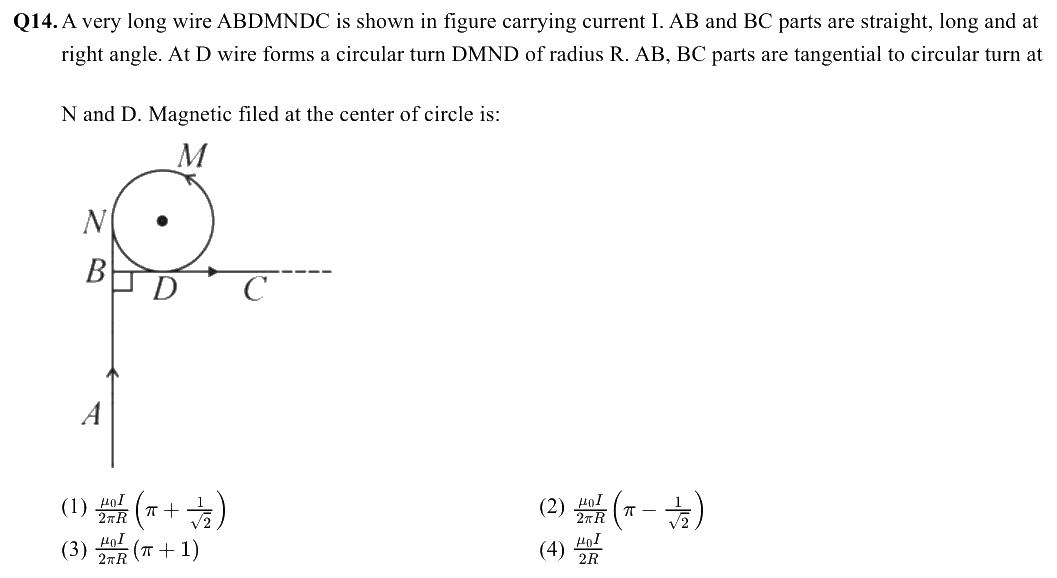
A very long wire ABDMNDC is shown in figure carrying current I. AB and BC parts are straight, long and at right angle. At D wire forms a circular turn DMND of radius R. AB, BC parts are tangential to circular turn at N and D. Magnetic filed at the center of circle is: (see the figure above)
A particle of mass $m$ and charge $q$ has an initial velocity $\vec{v} = v_0\hat{j}$. If an electric field $\vec{E} = E_0\hat{i}$ and magnetic field $\vec{B} = B_0\hat{i}$ act on the particle, its speed will double after a time
A thin ring of 10 cm radius carries a uniformly distributed charge. The ring rotates at a constant angular speed of $40\pi\ \mathrm{rads^{-1}}$ about its axis, perpendicular to its plane. Is the magnetic field its centre is $3.8 \times 10^{-9}\mathrm{T}$ , then the charge carried by the ring is close to $\mu_0 = 4\pi \times 10^{-7}\ \mathrm{N\ /\ A^2}$.
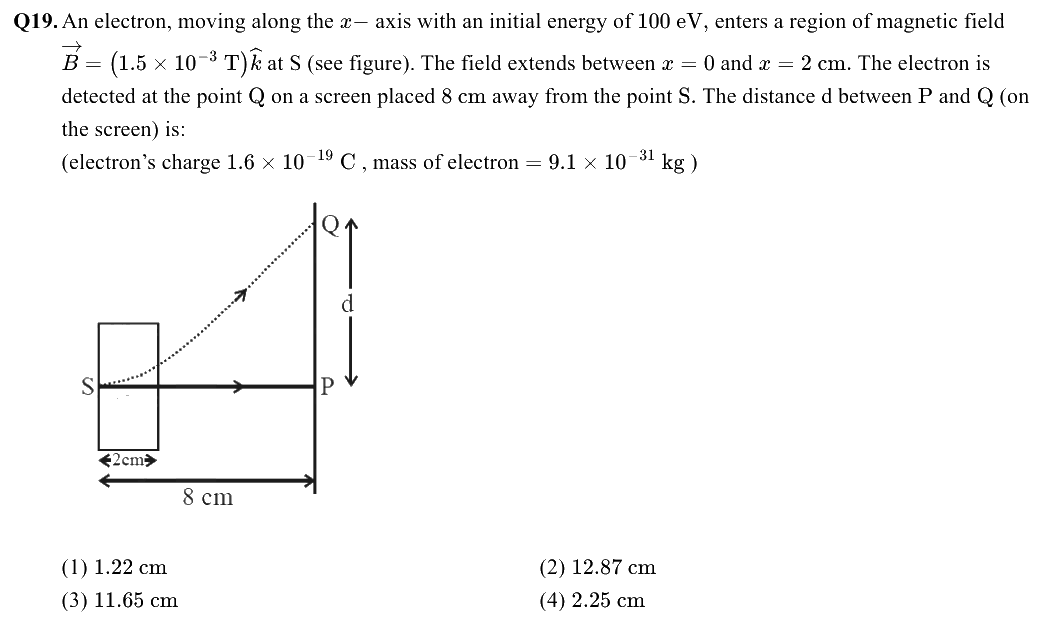
An electron, moving along the $x-$ axis with an initial energy of 100 eV, enters a region of magnetic field $\vec{B} = \left(1.5 \times 10^{-3}\ \mathrm{T}\right)\hat{k}$ at S (see figure). The field extends between $x = 0$ and $x = 2$ cm. The electron is detected at the point Q on a screen placed 8 cm away from the point S. The distance d between P and Q (on the screen) is: (electron's charge $1.6 \times 10^{-19}\ \mathrm{C}$ , mass of electron $= 9.1 \times 10^{-31}\ \mathrm{kg}$ ) (see the figure above)
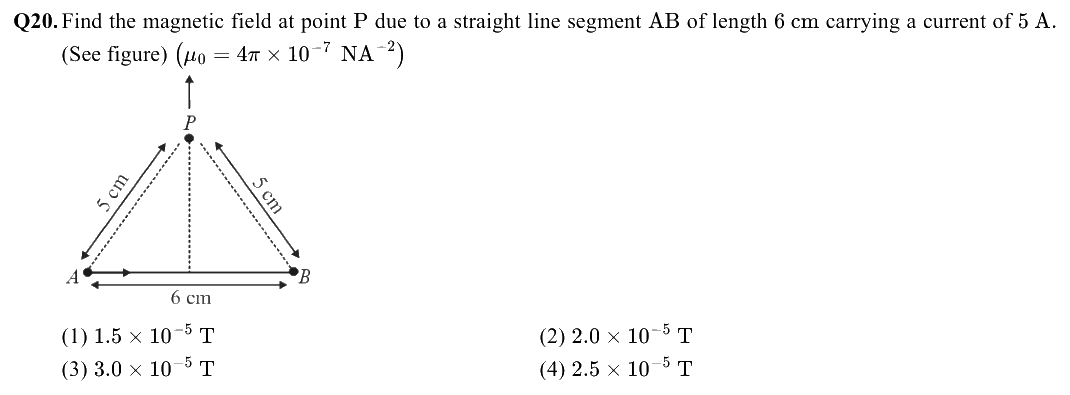
Find the magnetic field at point P due to a straight line segment AB of length 6 cm carrying a current of 5 A. (See figure) $\left(\mu_0 = 4\pi \times 10^{-7}\ \mathrm{NA^{-2}}\right)$ (see the figure above)
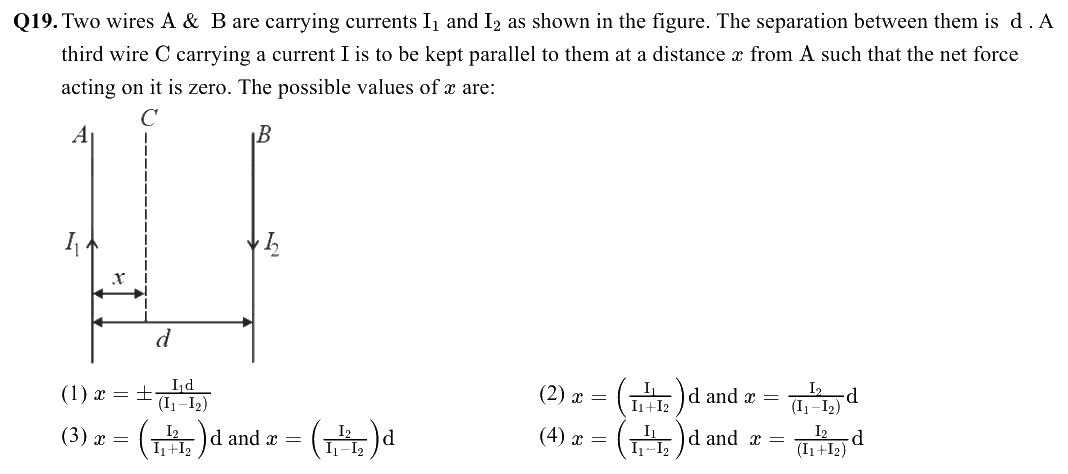
Two wires A & B are carrying currents $I_1$ and $I_2$ as shown in the figure. The separation between them is $d$ . A third wire C carrying a current I is to be kept parallel to them at a distance $x$ from A such that the net force acting on it is zero. The possible values of $x$ are:
A proton, an electron, and a Helium nucleus, have the same energy. They are in circular orbits in a plane due to magnetic field perpendicular to the plane. Let $r_p, r_e$ and $r_{He}$ be their respective radii, then,
A square loop is carrying a steady current I and the magnitude of its magnetic dipole moment is m . If this square loop is changed to a circular loop and it carries the same current, the magnitude of the magnetic dipole moment of circular loop will be:
The magnitude of the magnetic field at the centre of an equilateral triangular loop of side $1\ \mathrm{m}$ which is carrying a current of $10\ \mathrm{A}$ is: [Take $\mu_0 = 4\pi\times10^{-7}\ \mathrm{N\,A^{-2}}$ ]
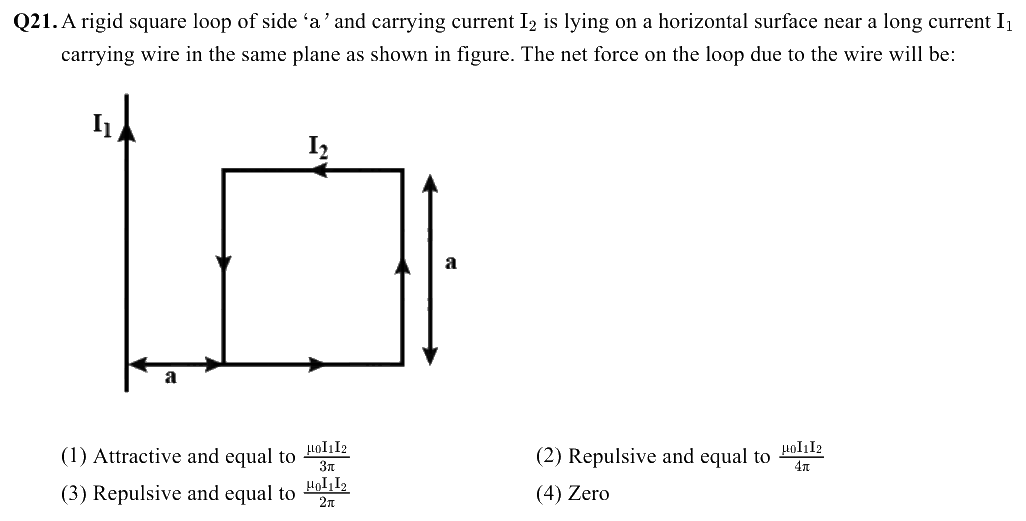
A rigid square loop of side 'a' and carrying current $\mathrm{I_2}$ is lying on a horizontal surface near a long current $\mathrm{I_1}$ carrying wire in the same plane as shown in figure. The net force on the loop due to the wire will be: (see the figure above)
The question as printed in the paper.
A
Attractive and equal to $\dfrac{\mu_0 I_1 I_2}{3\pi}$
B
Repulsive and equal to $\dfrac{\mu_0 I_1 I_2}{4\pi}$
C
Repulsive and equal to $\dfrac{\mu_0 I_1 I_2}{2\pi}$
A rectangular coil (Dimension 5 cm $\times$ 2.5 cm ) with 100 turns, carrying a current of 3 A in the clock-wise direction, is kept centered at the origin and in the X $-$ Z plane. A magnetic field of 1 T is applied along X $-$ axis . If the coil is tilted through $45^\circ$ about Z $-$ axis , then the torque on the coil is:
A moving coil galvanometer has a coil with 175 turns and area 1 $\mathrm{cm^2}$. It uses a torsion band of torsion constant $10^{-6}$ N m/rad The coil is placed in a magnetic field B parallel to its plane. The coil deflects by $1^\circ$ for a current of 1 mA The value of B (in tesla) is approximately:
A circular coil having N turns and radius r carries a current I. It is held in the XZ plane in a magnetic field $B\hat{i}$. The torque on the coil due to the magnetic field is:
A proton and an $\alpha$- particle (with their masses in the ratio of 1 : 4 and charges in the ratio of 1 : 2 ) are accelerated from rest through a potential difference $V$. If a uniform magnetic field ($B$) is set up perpendicular to their velocities, the ratio of the radii $r_p : r_\alpha$ of the circular paths described by them will be:
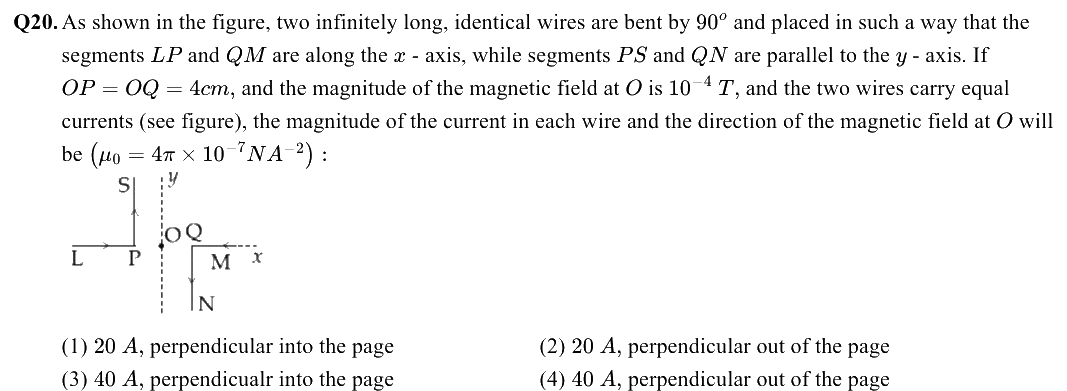
As shown in the figure, two infinitely long, identical wires are bent by $90^o$ and placed in such a way that the segments $LP$ and $QM$ are along the $x$ - axis, while segments $PS$ and $QN$ are parallel to the $y$ - axis. If $OP = OQ = 4cm$, and the magnitude of the magnetic field at $O$ is $10^{-4}$ $T$, and the two wires carry equal currents (see figure), the magnitude of the current in each wire and the direction of the magnetic field at $O$ will be ($\mu_0 = 4\pi \times 10^{-7} NA^{-2}$) :
In an experiment, electrons are accelerated, from rest, by applying a voltage of 500 V. Calculate the radius of the path if a magnetic field 100mT is then applied. [Charge of the electron = $1.6 \times 10^{-19}$C Mass of the electron = $9.1 \times 10^{-31}$ kg]
The region between $y = 0$ and $y = $ d contains a magnetic field $\vec{B} = B\hat{z}$. A particle of mass m and charge q enters the region with a velocity $\vec{v} = v\hat{i}$. if d = $\frac{mv}{2qB}$ , the acceleration of the charged particle at the point of its emergence at the other side is :
An insulating thin rod of length $l$ has a linear charge density $\rho(x) = \rho_0\frac{x}{l}$ on it. The rod is rotated about an axis passing through the origin $(x = 0)$ and perpendicular to the rod. If the rod makes $n$ rotations per second, then the time averaged magnetic moment of the rod is:
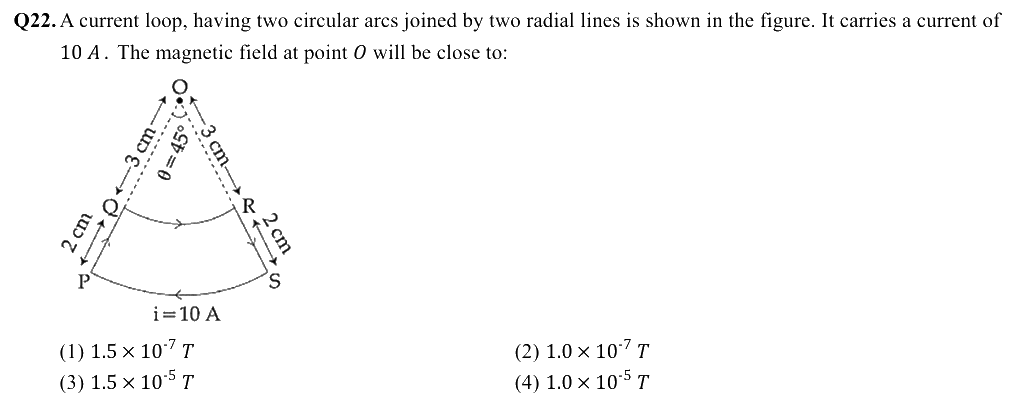
A current loop, having two circular arcs joined by two radial lines is shown in the figure. It carries a current of $10\ A$ . The magnetic field at point $O$ will be close to: (see the figure above)
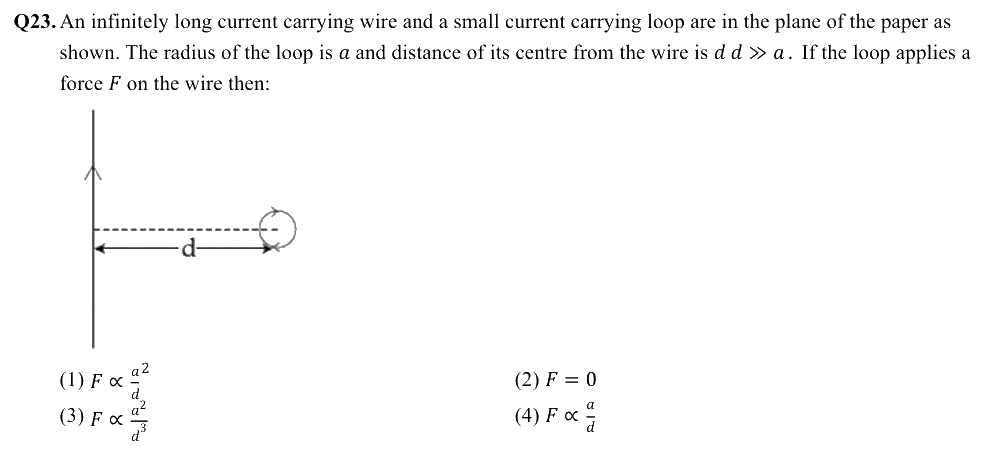
An infinitely long current carrying wire and a small current carrying loop are in the plane of the paper as shown. The radius of the loop is $a$ and distance of its centre from the wire is $d$ $d \gg a$. If the loop applies a force $F$ on the wire then: (see the figure above)
A particle having the same charge as of electron moves in a circular path of radius $0.5\ \mathrm{cm}$ under the influence of a magnetic field of $0.5\ T$. If an electric field of $100\ V/m$ makes it to move in a straight path, then the mass of the particle is (Given charge of electron $= 1.6\times10^{-19}C$ )
One of the two identical conducting wires of length $L$ is bent in the form of a circular loop and the other one into a circular coil of $N$ identical turns. If the same current is passed in both, the ratio of the magnetic field at the centre of the loop $(B_L)$ to that at the centre of the coil $(B_C)$, i.e. $\dfrac{B_L}{B_C}$ will be
A charge $q$ is spread uniformly over an insulated loop of radius $r$. If it is rotated with an angular velocity $\omega$ with respect to normal axis then magnetic moment of the loop is:
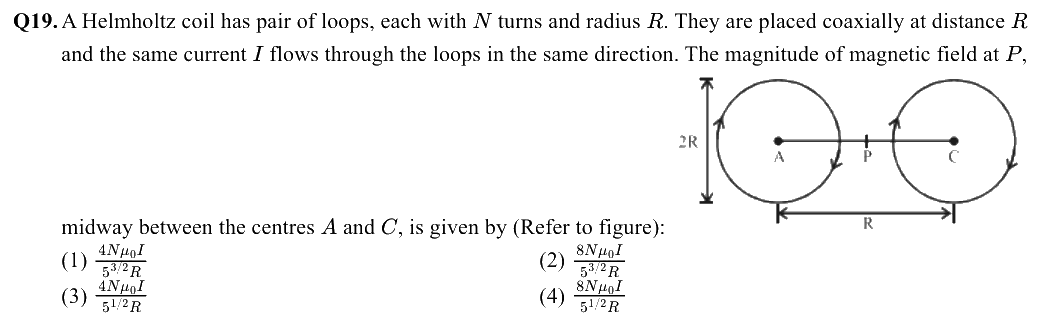
A Helmholtz coil has pair of loops, each with $N$ turns and radius $R$. They are placed coaxially at distance $R$ and the same current $I$ flows through the loops in the same direction. The magnitude of magnetic field at P, midway between the centres $A$ and $C$, is given by (Refer to figure): (see the figure above)
A current of $1\ \mathrm{A}$ is flowing on the sides of an equilateral triangle of side $4.5\times10^{-2}\ \mathrm{m}$. The magnetic field at the centre of the triangle will be:
The dipole moment of a circular loop carrying a current I, is m and the magnetic field at the centre of the loop is $B_1$ . When the dipole moment is doubled by keeping the current constant, the magnetic field at the centre of the loop is $B_2$ . The ratio $\dfrac{B_1}{B_2}$ is:
An electron, a proton and an alpha particle having the same kinetic energy are moving in circular orbits of radii $r_e$, $r_p$, $r_\alpha$ respectively in a uniform magnetic field B. The relation between $r_e$, $r_p$, $r_\alpha$ is:
A negative test charge is moving near a long straight wire carrying a current. The force acting on the test charge is parallel to the direction of the current. The motion of the charge is:
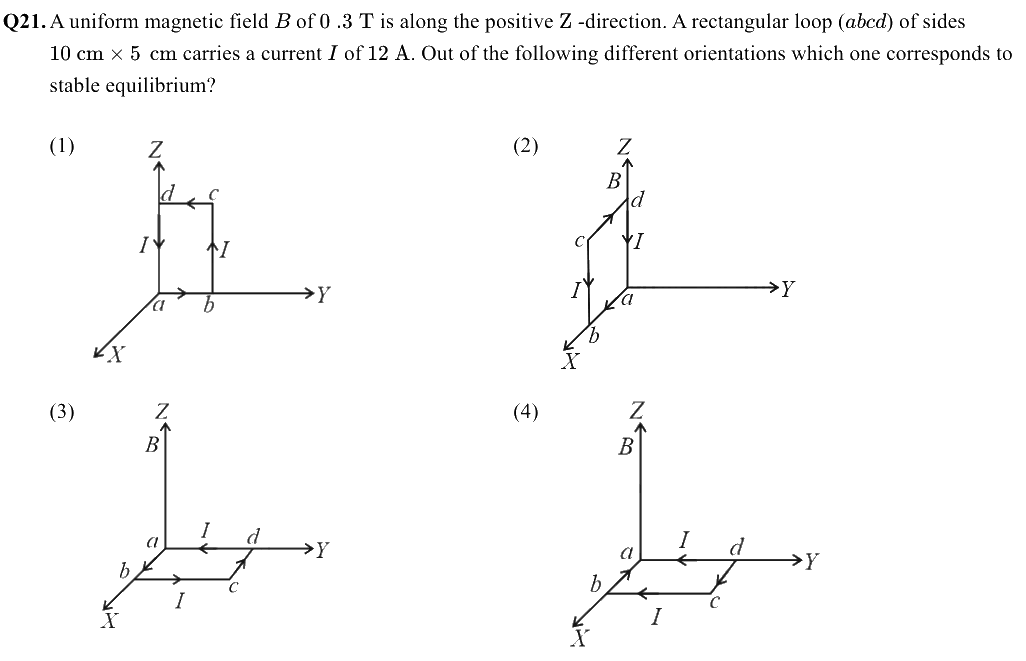
A uniform magnetic field $B$ of 0.3 T is along the positive $Z$-direction. A rectangular loop ($abcd$) of sides $10\ \mathrm{cm} \times 5\ \mathrm{cm}$ carries a current $I$ of 12 A. Out of the following different orientations which one corresponds to stable equilibrium?
In a certain region static electric and magnetic fields exist. The magnetic field is given by $\vec{B} = B_0\left(\hat{i} + 2\hat{j} - 4\hat{k}\right)$. If a test charge moving with a velocity $\vec{v} = v_0\left(3\hat{i} - \hat{j} + 2\hat{k}\right)$ experiences no force in that region, then the electric field in the region, in SI units, is:
Two identical wires $A$ and $B$, each of length $l$, carry the same current $I$ . Wire $A$ is bent into a circle of radius $R$ and wire $B$ is bent to form a square of side $a$. If $B_A$ and $B_B$ are the values of magnetic field at the centres of the circle and square respectively, then the ratio $\frac{B_A}{B_B}$ is
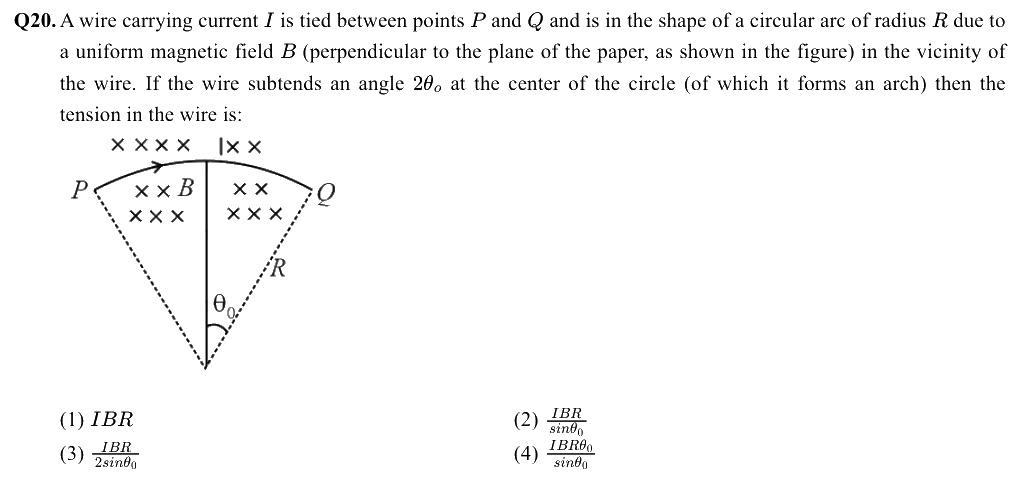
A wire carrying current $I$ is tied between points $P$ and $Q$ and is in the shape of a circular arc of radius $R$ due to a uniform magnetic field $B$ (perpendicular to the plane of the paper, as shown in the figure) in the vicinity of the wire. If the wire subtends an angle $2\theta_0$ at the center of the circle (of which it forms an arch) then the tension in the wire is: (see the figure above)
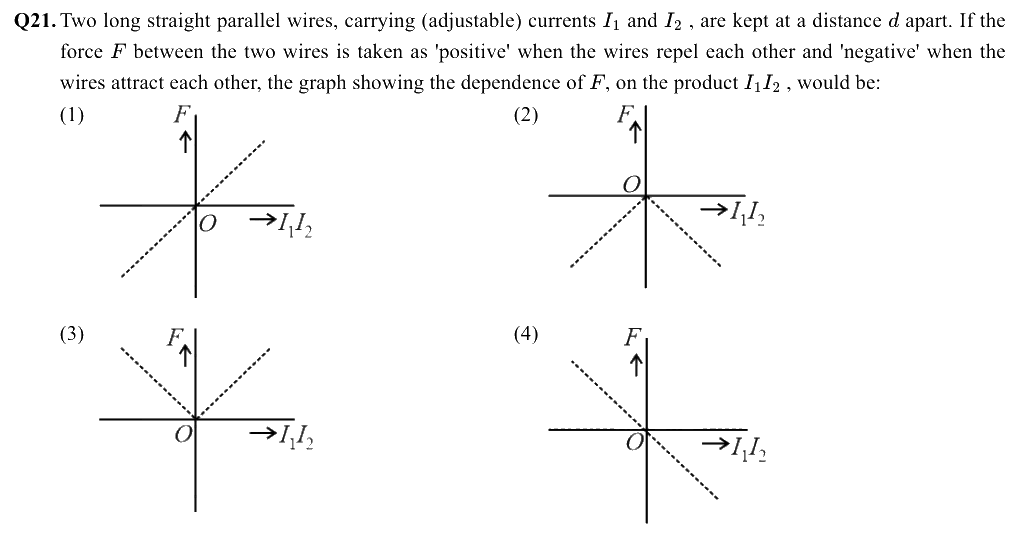
Two long straight parallel wires, carrying (adjustable) currents $I_1$ and $I_2$, are kept at a distance $d$ apart. If the force $F$ between the two wires is taken as 'positive' when the wires repel each other and 'negative' when the wires attract each other, the graph showing the dependence of $F$, on the product $I_1I_2$, would be:
A 25 cm long solenoid has the radius 2 cm and 500 turns. It carries a current of 15 A. If it is equivalent to a magnet of the same size and magnetization $\vec{M}$ $\left(\frac{\text{Magnetic moment}}{\text{volume}}\right)$ ,then $\left|\vec{M}\right|$ is:
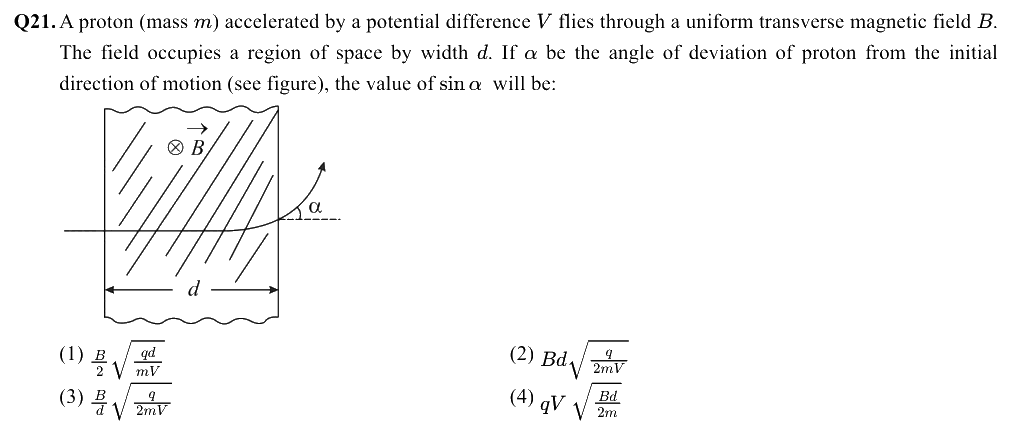
A proton (mass $m$) accelerated by a potential difference $V$ flies through a uniform transverse magnetic field $B$. The field occupies a region of space by width $d$. If $\alpha$ be the angle of deviation of proton from the initial direction of motion (see figure), the value of $\sin\alpha$ will be: (see the figure above)
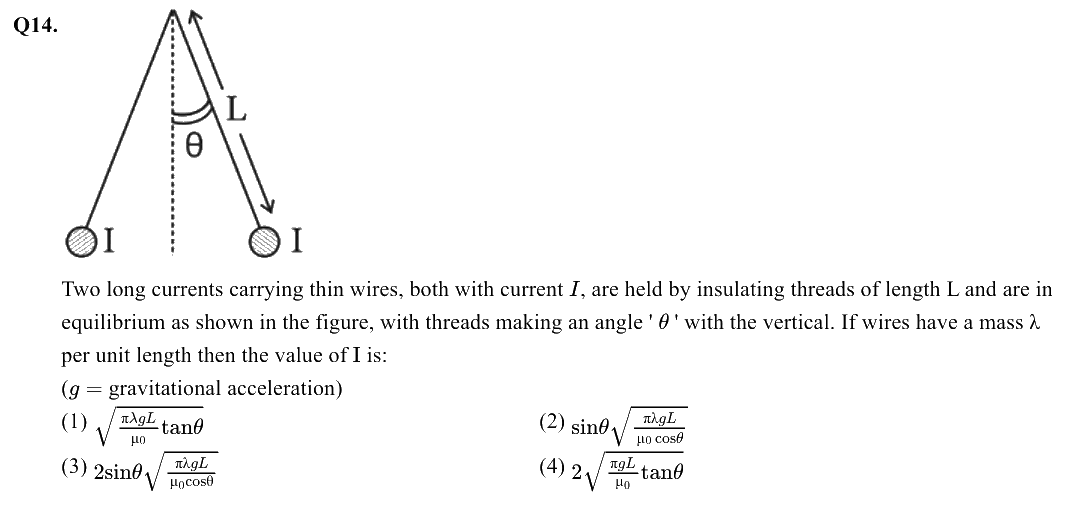
see figure Two long currents carrying thin wires, both with current $I$, are held by insulating threads of length L and are in equilibrium as shown in the figure, with threads making an angle '$\theta$' with the vertical. If wires have a mass $\lambda$ per unit length then the value of I is: ($g$ =gravitational acceleration)
The question as printed in the paper.
A
$\sqrt{\dfrac{\pi\lambda g L}{\mu_0}\tan\theta}$
B
$\sin\theta\sqrt{\dfrac{\pi\lambda g L}{\mu_0\cos\theta}}$
C
$2\sin\theta\sqrt{\dfrac{\pi\lambda g L}{\mu_0\cos\theta}}$
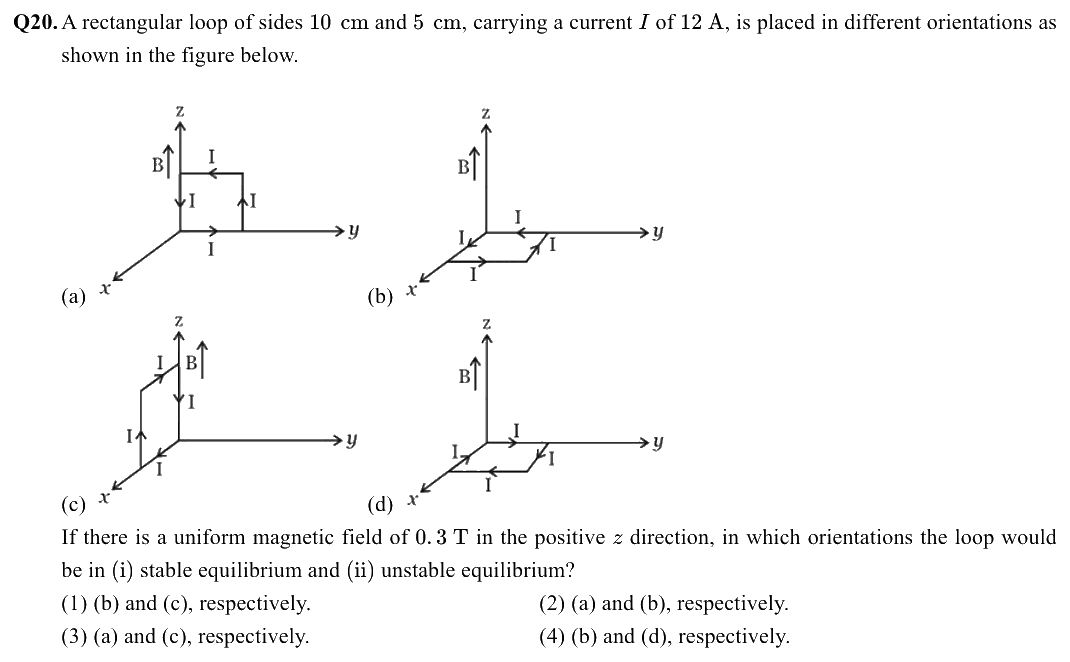
A rectangular loop of sides $10\ \mathrm{cm}$ and $5\ \mathrm{cm}$, carrying a current $I$ of $12\ \mathrm{A}$, is placed in different orientations as shown in the figure below. (see the figure above) If there is a uniform magnetic field of $0.3\ \mathrm{T}$ in the positive $z$ direction, in which orientations the loop would be in (i) stable equilibrium and (ii) unstable equilibrium?
Two coaxial solenoids of different radii carry current $I$ in the same direction. Let $\vec{F_1}$ be the magnetic force on the inner solenoid due to the outer one and $\vec{F_2}$ be the magnetic force on the outer solenoid due to the inner one. Then:
A
$\vec{F_1}$ is radially outwards and $\vec{F_2} = 0$
B
$\vec{F_1} = \vec{F_2} = 0$
C
$\vec{F_1}$ is radially inwards and $\vec{F_2}$ is radially outwards
D
$\vec{F_1}$ is radially inwards and $\vec{F_2} = 0$
A positive charge ' q ' of mass ' m ' is moving along the $+x$ axis. We wish to apply a uniform magnetic field B for time $\Delta t$ so that the charge reverses its direction crossing the y axis at a distance d. Then:
A
$\mathrm{B} = \dfrac{\mathrm{mv}}{\mathrm{qd}}$ and $\Delta \mathrm{t} = \dfrac{\pi \mathrm{d}}{\mathrm{v}}$
B
$\mathrm{B} = \dfrac{\mathrm{mv}}{2\mathrm{qd}}$ and $\Delta \mathrm{t} = \dfrac{\pi \mathrm{d}}{2\mathrm{v}}$
C
$\mathrm{B} = \dfrac{2\mathrm{mv}}{\mathrm{qd}}$ and $\Delta \mathrm{t} = \dfrac{\pi \mathrm{d}}{2\mathrm{v}}$
D
$B = \dfrac{2\mathrm{mv}}{\mathrm{qd}}$ and $\Delta \mathrm{t} = \dfrac{\pi \mathrm{d}}{\mathrm{v}}$
Consider two thin identical conducting wires covered with very thin insulating material. One of the wires is bent into a loop and produces magnetic field $\mathrm{B_1}$, at its centre when a current I passes through it. The second wire is bent into a coil with three identical loops adjacent to each other and produces magnetic field $\mathrm{B_2}$ at the centre of the loops when current I/3 passes through it. The ratio $\mathrm{B_1} : \mathrm{B_2}$ is:
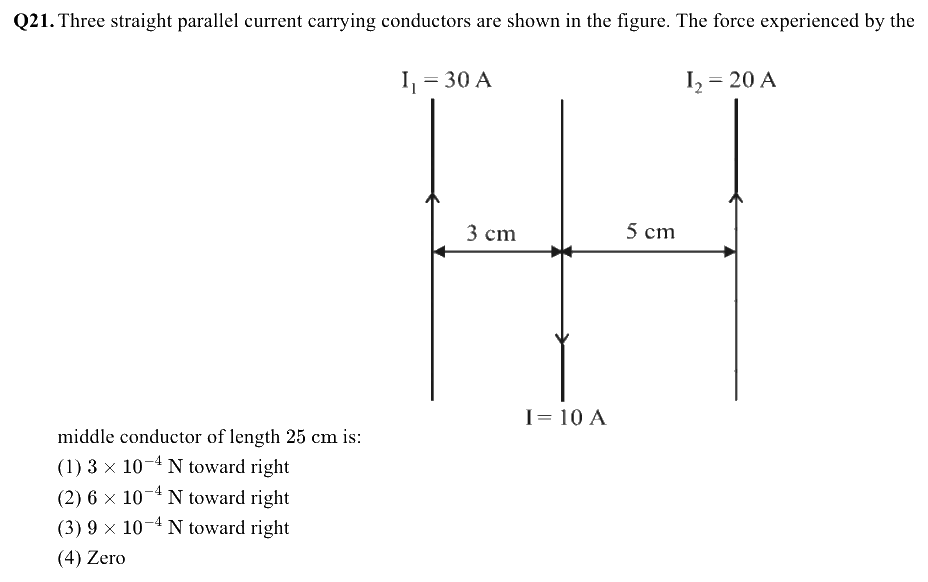
Three straight parallel current carrying conductors are shown in the figure. The force experienced by the middle conductor of length $25\ \mathrm{cm}$ is: (see the figure above)
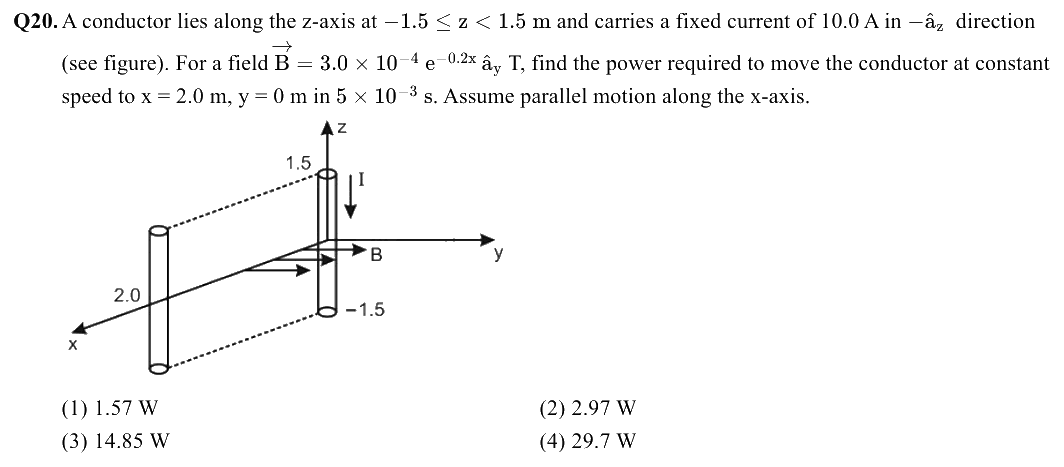
A conductor lies along the z-axis at $-1.5 \le z < 1.5$ m and carries a fixed current of 10.0 A in $-\hat{a}_z$ direction (see figure). For a field $\vec{B} = 3.0 \times 10^{-4}\,e^{-0.2x}\,\hat{a}_y$ T, find the power required to move the conductor at constant speed to x = 2.0 m, y = 0 m in $5 \times 10^{-3}$ s. Assume parallel motion along the x-axis.
One of the two small circular coils, (none of them having any self - inductance) is suspended with a V-shaped copper wire, with plane horizontal. The other coil is placed just below the first one with plane horizontal. Both the coils are connected in series with a dc supply. The coils are found to attract each other with a force. Which one of the following statements is incorrect?
A
Both the coils carry currents in the same direction.
B
Coils will attract each other, even if the supply is an ac source.
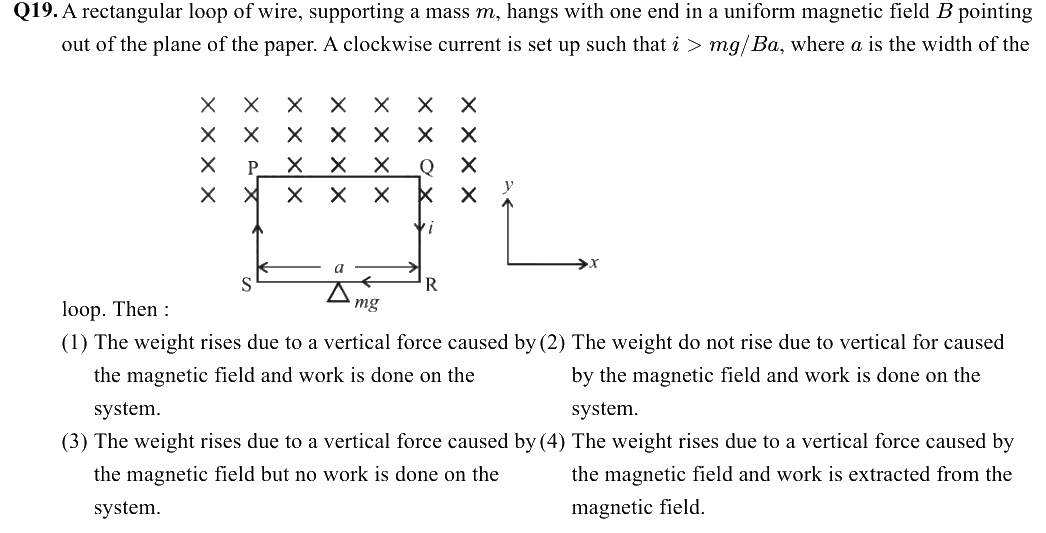
A rectangular loop of wire, supporting a mass $m$, hangs with one end in a uniform magnetic field $B$ pointing out of the plane of the paper. A clockwise current is set up such that $i > mg/Ba$, where $a$ is the width of the loop. Then : (see the figure above)
The question as printed in the paper.
A
The weight rises due to a vertical force caused by the magnetic field and work is done on the system.
B
The weight do not rise due to vertical for caused by the magnetic field and work is done on the system.
C
The weight rises due to a vertical force caused by the magnetic field but no work is done on the system.
D
The weight rises due to a vertical force caused by the magnetic field and work is extracted from the magnetic field.
A particle of charge $16 \times 10^{-16}$C moving with velocity $10\ \mathrm{ms^{-1}}$ along $x$-axis enters a region where magnetic field of induction $\vec{B}$ is along the $y$-axis and an electric field of magnitude $10^{4}\mathrm{Vm^{-1}}$ is along the negative $z$-axis. If the charged particle continues moving along $x$-axis, the magnitude of $\vec{B}$ is :
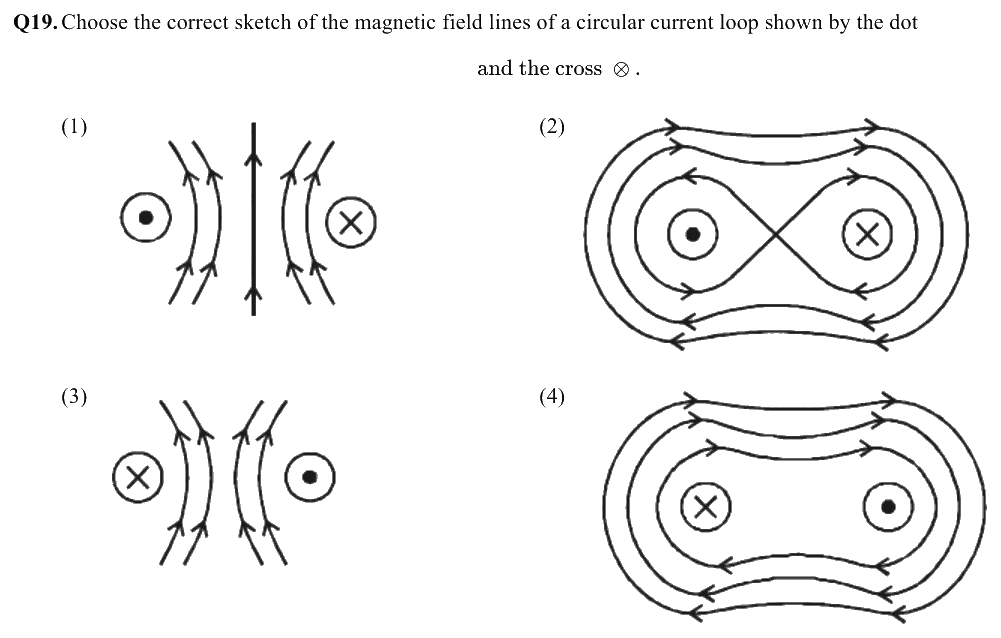
Choose the correct sketch of the magnetic field lines of a circular current loop shown by the dot and the cross $\otimes$. (see the figure above)
The question as printed in the paper.
A
see figure A dot in a circle on the left and a cross in a circle on the right. Between them four curved field lines: two arcs bulging to the right (like a closing bracket) on the left side, and two arcs bulging to the left (like an opening bracket) on the right side, plus a straight vertical line with arrowheads in the middle. All arrows (on the arcs and on the straight line) point upward.
B
see figure A dot in a circle on the left and a cross in a circle on the right. Two outer closed loops enclose both symbols, with arrows pointing right along the top and left along the bottom (clockwise). Inside, a figure-eight curve crosses at the centre: the loop around the dot has its arrow pointing left along the top and right along the bottom (counter-clockwise), the loop around the cross has its arrow pointing right along the top and left along the bottom (clockwise).
C
see figure A cross in a circle on the left and a dot in a circle on the right. Four curved field lines between them: two arcs bulging to the right on the left side and two arcs bulging to the left on the right side, with no straight line in the middle. All arrows point upward.
D
see figure A cross in a circle on the left and a dot in a circle on the right. Three nested closed loops all enclose both symbols; arrows point right along the top and left along the bottom (clockwise) on every loop. No figure-eight crossing.
A current $i$ is flowing in a straight conductor of length $L$. The magnetic induction at a point on its axis at a distance $\frac{L}{4}$ from its centre will be :
An electric current is flowing through a circular coil of radius R. The ratio of the magnetic field at the centre of the coil and that at a distance $2\sqrt{2}R$ from the centre of the coil and on its axis is :
In the Bohr model an electron moves in a circular orbit around the proton. Considering the orbiting electron to be a circular current loop, the magnetic moment of the hydrogen atom, when the electron is in $n^{\text{th}}$ excited state, is :
Currents of a 10 ampere and 2 ampere are passed through two parallel thin wires $A$ and $B$ respectively in opposite directions. Wire $A$ is infinitely long and the length of the wire $B$ is 2 m. The force acting on the conductor $B$, which is situated at 10 cm distance from $A$ will be
A proton and a deuteron are both accelerated through the same potential difference and enter in a magnetic field perpendicular to the direction of the field. If the deuteron follows a path of radius $R$, assuming the neutron and proton masses are nearly equal, the radius of the proton's path will be
The magnetic force acting on charged particle of charge $2\,\mu\mathrm{C}$ in magnetic field of $2T$ acting in $y-$ direction, when the particle velocity is $(2\hat{i} + 3\hat{j}) \times 10^6\ \mathrm{ms^{-1}}$ is
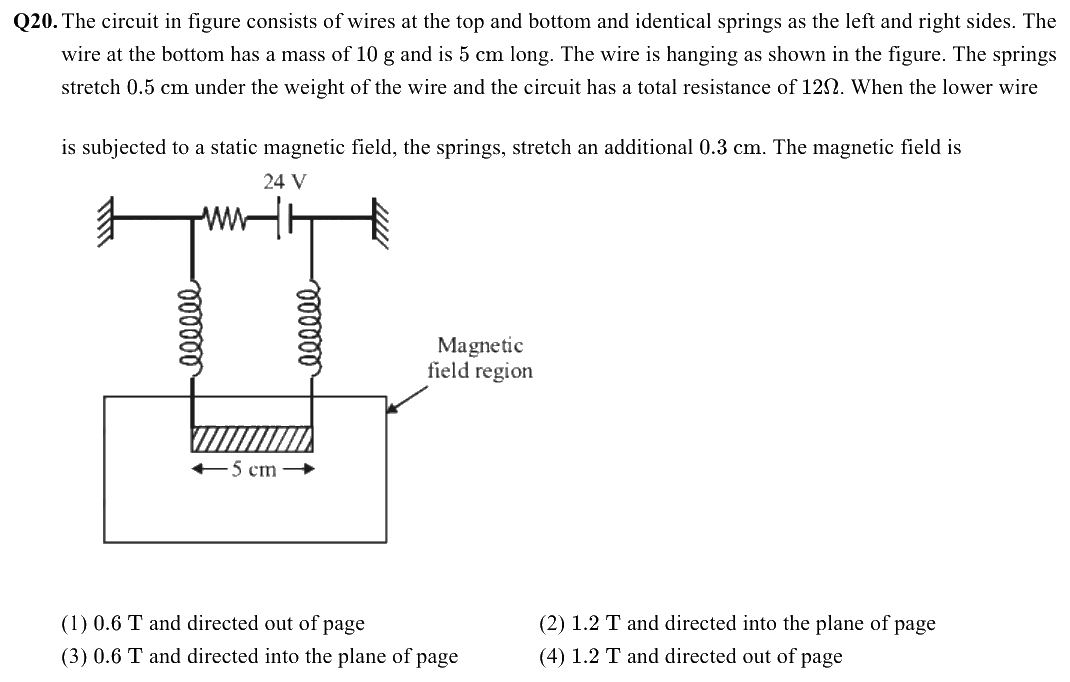
The circuit in figure consists of wires at the top and bottom and identical springs as the left and right sides. The wire at the bottom has a mass of $10$ g and is $5$ cm long. The wire is hanging as shown in the figure. The springs stretch $0.5$ cm under the weight of the wire and the circuit has a total resistance of $12\,\Omega$. When the lower wire is subjected to a static magnetic field, the springs, stretch an additional $0.3$ cm. The magnetic field is (see the figure above)
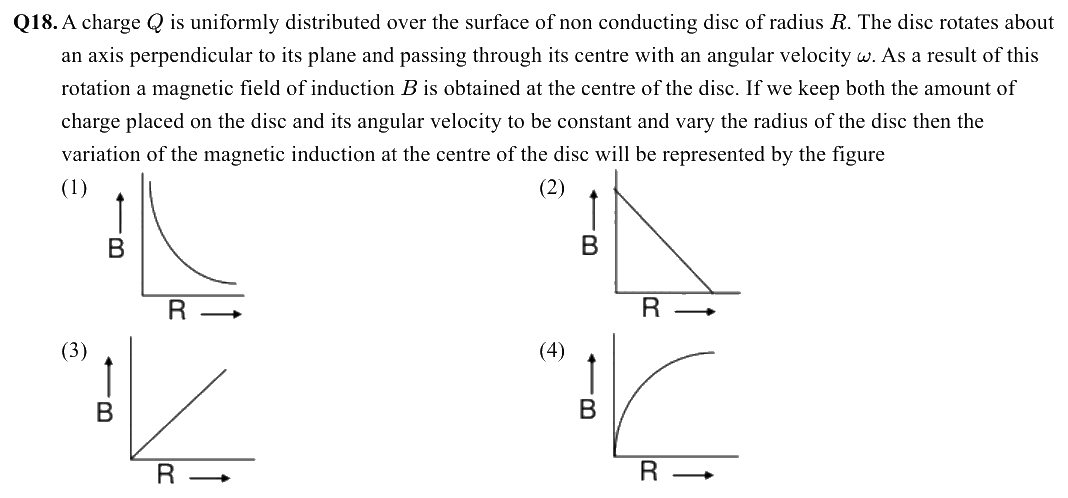
A charge $Q$ is uniformly distributed over the surface of non conducting disc of radius $R$. The disc rotates about an axis perpendicular to its plane and passing through its centre with an angular velocity $\omega$. As a result of this rotation a magnetic field of induction $B$ is obtained at the centre of the disc. If we keep both the amount of charge placed on the disc and its angular velocity to be constant and vary the radius of the disc then the variation of the magnetic induction at the centre of the disc will be represented by the figure
Proton, Deuteron and alpha particle of the same kinetic energy are moving in circular trajectories in a constant magnetic field. The radii of proton, deuteron and alpha particle are respectively $r_p, r_d$ and $r_\alpha$. Which one of the following relations is correct?
A current I flows in an infinitely long wire with cross section in the form of a semicircular ring of radius R. The magnitude of the magnetic induction along its axis is
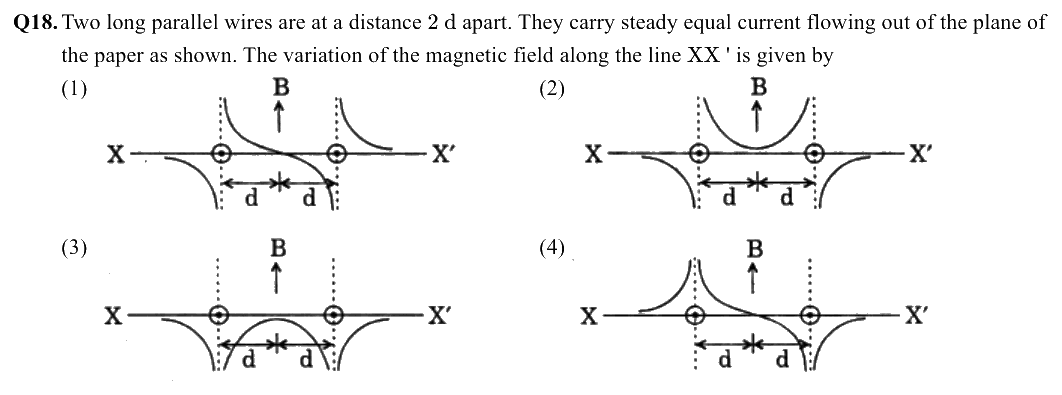
Two long parallel wires are at a distance 2 d apart. They carry steady equal current flowing out of the plane of the paper as shown. The variation of the magnetic field along the line XX ' is given by
The question as printed in the paper.
A
see figure Graph (1): B against position along XX'. Left of the left wire the curve is below the axis, going to large negative values at the wire; between the wires it falls from large positive at the left wire, through zero at the midpoint, to large negative at the right wire; right of the right wire it is above the axis, from large positive at the wire decaying towards zero.
B
see figure Graph (2): outside both wires the curve is below the axis (large negative at each wire, decaying away from it); between the wires a U-shaped curve entirely above the axis, lowest at the midpoint and rising steeply towards each wire.
C
see figure Graph (3): outside both wires the curve is below the axis (large negative at each wire, decaying away from it); between the wires an inverted-U arch, highest at the midpoint (at about axis level) and falling below the axis towards each wire.
D
see figure Graph (4): left of the left wire the curve is above the axis, rising to large positive at the wire; between the wires it falls from large positive at the left wire, through zero at the midpoint, to large negative at the right wire; right of the right wire it is below the axis, from large negative at the wire rising towards the axis.
A current loop $ABCD$ is held fixed on the plane of the paper. The arcs $BC$ (radius $= b$) and $DA$ (radius $= a$) of the loop are joined by two straight wires $AB$ and $CD$. A steady current $I$ is flowing in the loop. Angle made by $AB$ and $CD$ at the origin $O$ is $30^\circ$. Another straight thin wire with steady current $I_1$ flowing out of the plane of the paper is kept at the origin. The magnitude of the magnetic field ($B$) due to loop $ABCD$ at the origin ($O$) is
A current loop $ABCD$ is held fixed on the plane of the paper. The arcs $BC$ (radius $= b$) and $DA$ (radius $= a$) of the loop are joined by two straight wires $AB$ and $CD$. A steady current $I$ is flowing in the loop. Angle made by $AB$ and $CD$ at the origin $O$ is $30^\circ$. Another straight thin wire with steady current $I_1$ flowing out of the plane of the paper is kept at the origin. Due to the presence of the current $I_1$ at the origin
A
The forces on $AB$ and $DC$ are zero
B
The forces on $AD$ and $BC$ are zero
C
The magnitude of the net force on the loop is given by $\frac{\mu_0 I I_1}{4\pi}\left[2(b-a) + \frac{\pi}{3}(a+b)\right]$
D
The magnitude of the net force on the loop is given by $\frac{\mu_0 I I_1}{24ab}(b-a)$
A horizontal overhead power line is at a height of 4 m from the ground and carries a current of 100 A from east to west. The magnetic field directly below it on the ground is ($\mu_0 = 4\pi \times 10^{-7}\ \mathrm{T\ m\ A^{-1}}$)
A long straight wire of radius ' $a$ ' caries a steady current i. The current is uniformly distributed across its cross section. The ratio of the magnetic field at $\frac{a}{2}$ and $2a$ is
A charged particle with charge q enters a region of constant, uniform and mutually orthogonal fields $\vec{\mathrm{E}}$ and $\vec{\mathrm{B}}$ with a velocity $\vec{\mathrm{v}}$ perpendicular to both $\vec{\mathrm{E}}$ and $\vec{\mathrm{B}}$, and comes out without any change in magnitude or direction of $\vec{\mathrm{v}}$. Then
Two identical conducting wires AOB and COD are placed at right angles to each other. The wire AOB carries an electric current $\mathrm{I_1}$ and COD carries a current $\mathrm{I_2}$. The magnetic field on a point lying at a distance ' d ' from O, in a direction perpendicular to the plane of the wires AOB and COD, will be given by
In a region, steady and uniform electric and magnetic fields are present. These two fields are parallel to each other. A charged particle is released from rest in this region. The path of the particle will be a
A long solenoid has 200 turns per cm and carries a current i. The magnetic field at its centre is $6.28 \times 10^{-2}$ Weber $/\mathrm{m^2}$. Another long solenoid has 100 turns per cm and it carries a current i/3. The value of the magnetic field at its centre is
Two concentric coils each of radius equal to $2\pi\,\mathrm{cm}$ are placed at right angles to each other. 3 Ampere and 4 ampere are the currents flowing in each coil respectively. The magnetic induction in Weber $/\mathrm{m^2}$ at the centre of the coils will be ($\mu_0 = 4\pi \times 10^{-7}\ \mathrm{Wb/A\text{-}m}$)
A uniform electric field and a uniform magnetic field are acting along the same direction in a certain region. If an electron is projected along the direction of the fields with a certain velocity then
A
its velocity will decrease.
B
its velocity will increase.
C
it will turn towards right of direction of motion.
A charged particle of mass m and charge $q$ travels on a circular path of radius $r$ that is perpendicular to a magnetic field B. The time taken by the particle to complete one revolution is
A 5 mg particle carrying a charge of $5\pi\times10^{-6}$ C is moving with velocity of $\left(3\hat{i} + 2\hat{k}\right)\times10^{-2}$ m/s in a region having magnetic field $\vec{B} = 0.1\,\hat{k}$ Wb/m$^2$. It moves a distance of $\alpha$ meter along $\hat{k}$ when it completes 5 revolutions. The value of $\alpha$ is ________.
Numerical answer type: type your answer in EdLoop to check it
The charged particle moving in a uniform magnetic field of $\left(3\hat{i} + 2\hat{j}\right)$T has an acceleration $\left(4\hat{i} - \dfrac{x}{2}\hat{j}\right)$ m/s$^2$. The value of $x$ is
Numerical answer type: type your answer in EdLoop to check it
A circular coil of radius 2 cm and 125 turns carries a current of 1 A. The coil is placed in a uniform magnetic field of magnitude 0.4 T. The axis of the coil makes an angle of 30° with the direction of the magnetic field. The torque acting on the coil is $\alpha\times10^{-4}$ N.m. The value of $\alpha$ is ________. ($\pi = 3.14$)
Numerical answer type: type your answer in EdLoop to check it
1 $\mu$C charge moving with velocity $\vec{v} = \left(\hat{i} - 2\hat{j} + 3\hat{k}\right)$ m/s in the region of magnetic field $\vec{B} = \left(2\hat{i} + 3\hat{j} - 5\hat{k}\right)$ T. The magnitude of force acting on it is $\sqrt{\alpha}\times10^{-6}$ N. The value of $\alpha$ is ________.
Numerical answer type: type your answer in EdLoop to check it
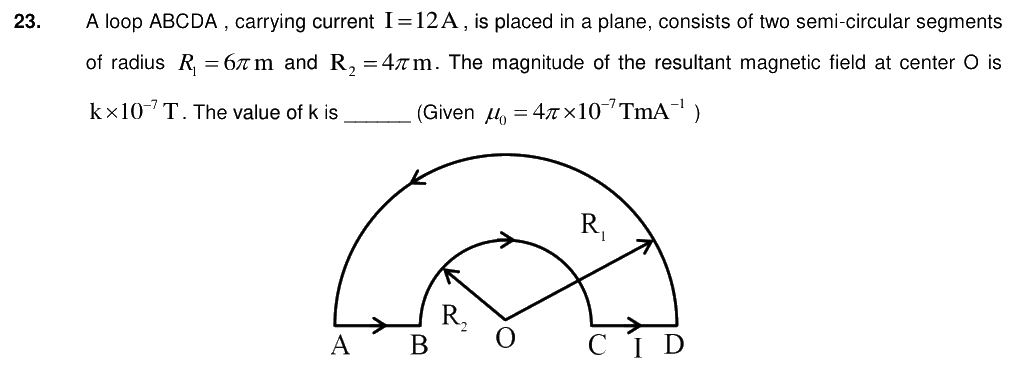
A loop ABCDA , carrying current $I = 12A$, is placed in a plane, consists of two semi-circular segments of radius $R_1 = 6\pi m$ and $R_2 = 4\pi m$. The magnitude of the resultant magnetic field at center O is $k \times 10^{-7}T$. The value of k is ______ (Given $\mu_0 = 4\pi \times 10^{-7}TmA^{-1}$ )
(see the figure above)
The question as printed in the paper.
Numerical answer type: type your answer in EdLoop to check it
A 4.0 cm long straight wire carrying a current of 8 A is placed perpendicular to a uniform magnetic field of strength 0.15 T . The magnetic force on the wire is ______ mN .
Numerical answer type: type your answer in EdLoop to check it
The magnetic field inside a 200 turns solenoid of radius 10 cm is $2.9 \times 10^{-4}$Tesla. If the solenoid carries a current of 0.29 A , then the length of the solenoid is ______ $\pi$cm.
Numerical answer type: type your answer in EdLoop to check it
A current of 5A exists in a square loop of side $\frac{1}{\sqrt{2}}$ m. Then the magnitude of the magnetic field $B$ at the centre of the square loop will be $p \times 10^{-6}$ T. where, value of p is ______ . [Take $\mu_0 = 4\pi \times 10^{-7}\mathrm{TmA^{-1}}$].
Numerical answer type: type your answer in EdLoop to check it
A tightly wound long solenoid carries a current of 1.5 A . An electron is executing uniform circular motion inside the solenoid with a time period of 75 ns . The number of turns per metre in the solenoid is ______ -. [Take mass of electron $\mathrm{m_e = 9 \times 10^{-31}}$ kg, charge of electron $|\mathrm{q_e}| = 1.6 \times 10^{-19}$C, $\mu_0 = 4\pi \times 10^{-7} \frac{\mathrm{N}}{\mathrm{A^2}}$, 1 ns = $10^{-9}$ s]
Numerical answer type: type your answer in EdLoop to check it
A proton is moving undeflected in a region of crossed electric and magnetic fields at a constant speed of $2 \times 10^5\ \mathrm{ms}^{-1}$. When the electric field is switched off, the proton moves along a circular path of radius 2 cm . The magnitude of electric field is $x \times 10^4$ N/C. The value of $x$ is ______ Take the mass of the proton $= 1.6 \times 10^{-27}$ kg.
Numerical answer type: type your answer in EdLoop to check it
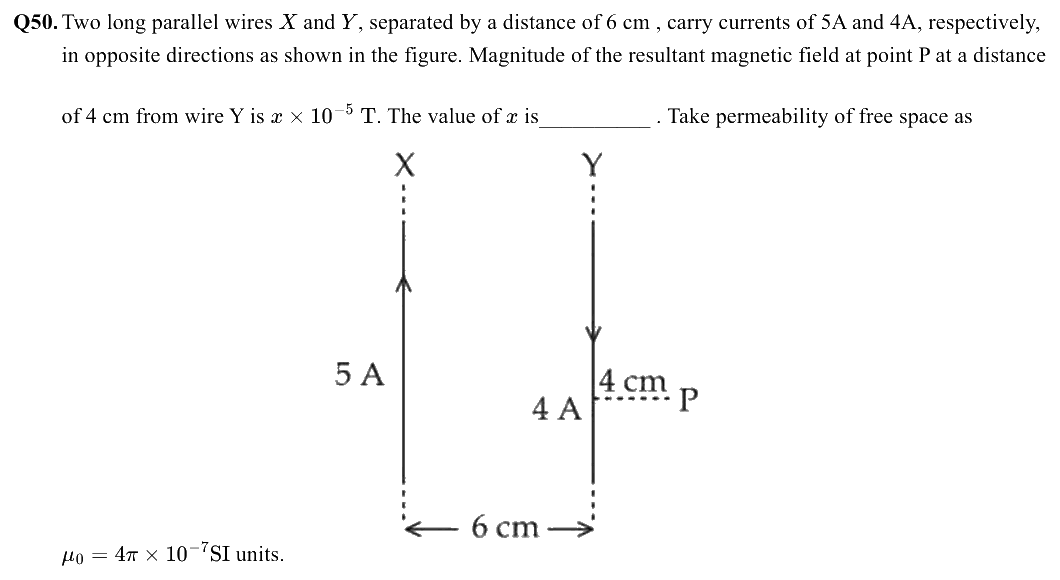
Two long parallel wires $X$ and $Y$, separated by a distance of 6 cm , carry currents of 5A and 4A, respectively, in opposite directions as shown in the figure. Magnitude of the resultant magnetic field at point P at a distance of 4 cm from wire Y is $x \times 10^{-5}$ T. The value of $x$ is ______ . Take permeability of free space as
(see the figure above)
$\mu_0 = 4\pi \times 10^{-7}$ SI units.
The question as printed in the paper.
Numerical answer type: type your answer in EdLoop to check it
A square loop of edge length 2 m carrying current of 2 A is placed with its edges parallel to the $x$ $y$ axis. A magnetic field is passing through the $x - y$ plane and expressed as $\vec{B} = \mathrm{B_0}(1 + 4x)\hat{k}$, where $\mathrm{B_0}$ = 5 T. The net magnetic force experienced by the loop is ______ N.
Numerical answer type: type your answer in EdLoop to check it
An electron with kinetic energy 5eV enters a region of uniform magnetic field of 3 $\mu$T perpendicular to its direction. An electric field E is applied perpendicular to the direction of velocity and magnetic field. The value of $E$, so that electron moves along the same path, is ______ $\mathrm{NC^{-1}}$. ( Given, mass of electron = $9 \times 10^{-31}$ kg , electric charge = $1.6 \times 10^{-19}$C)
Numerical answer type: type your answer in EdLoop to check it
A circular coil having 200 turns, $2.5 \times 10^{-4}$ m$^2$ area and carrying $100\mu$A current is placed in a uniform magnetic field of 1T. Initially the magnetic dipole moment ($\vec{M}$) was directed along $\vec{B}$. Amount of work, required to rotate the coil through $90^\circ$ from its initial orientation such that $\vec{M}$ becomes perpendicular to $\vec{B}$, is ______ $\mu$J.
Numerical answer type: type your answer in EdLoop to check it
A coil having 100 turns, area of $5 \times 10^{-3}$ m$^2$, carrying current of 1 mA is placed in uniform magnetic field of 0.20 T such a way that plane of coil is perpendicular to the magnetic field. The work done in turning the coil through $90^\circ$ is ______ $\mu$J.
Numerical answer type: type your answer in EdLoop to check it
A 2 A current carrying straight metal wire of resistance $1\Omega$, resistivity $2 \times 10^{-6}\Omega$m, area of cross-section 10 mm$^2$ and mass 500 g is suspended horizontally in mid air by applying a uniform magnetic field $\vec{B}$. The magnitude of $B$ is ______ $\times 10^{-1}$ T (given, g = 10 m/s$^2$ ).
Numerical answer type: type your answer in EdLoop to check it
A solenoid of length 0.5 m has a radius of 1 cm and is made up of ' m ' number of turns. It carries a current of 5 A. If the magnitude of the magnetic field inside the solenoid is $6.28 \times 10^{-3}$ T then the value of $m$ is ______ .
Numerical answer type: type your answer in EdLoop to check it
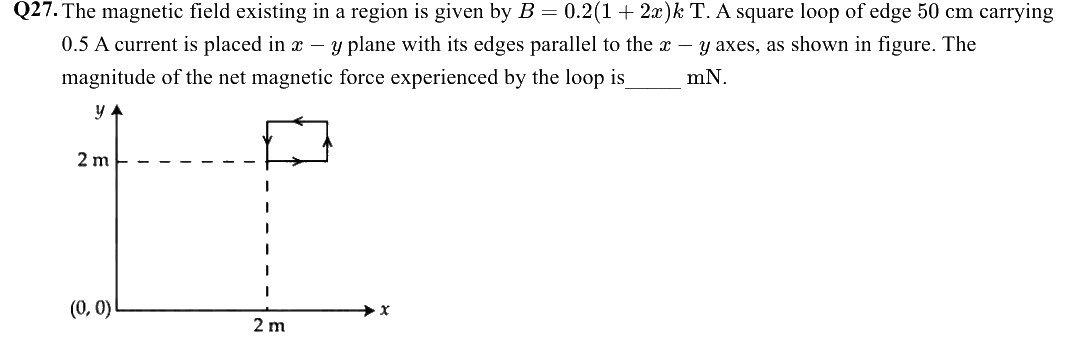
The magnetic field existing in a region is given by $B = 0.2(1 + 2x)k$ T. A square loop of edge 50 cm carrying 0.5 A current is placed in $x - y$ plane with its edges parallel to the $x - y$ axes, as shown in figure. The magnitude of the net magnetic force experienced by the loop is ______ mN.
(see the figure above)
The question as printed in the paper.
Numerical answer type: type your answer in EdLoop to check it
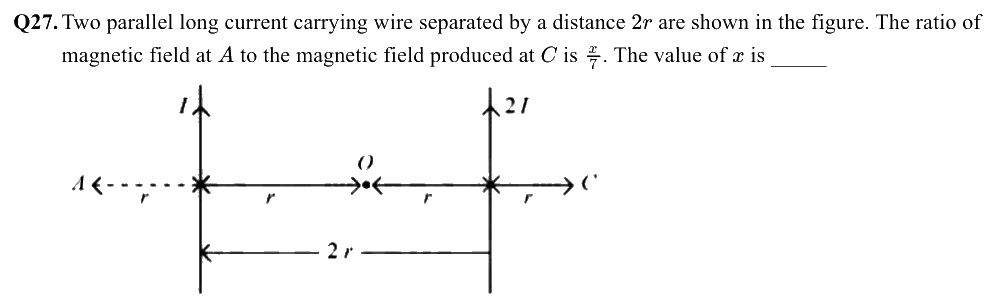
Two parallel long current carrying wire separated by a distance $2r$ are shown in the figure. The ratio of magnetic field at $A$ to the magnetic field produced at $C$ is $\frac{x}{7}$. The value of $x$ is ______
(see the figure above)
The question as printed in the paper.
Numerical answer type: type your answer in EdLoop to check it
A regular polygon of 6 sides is formed by bending a wire of length $4\pi$ meter. If an electric current of $4\pi\sqrt{3}$ A is flowing through the sides of the polygon, the magnetic field at the centre of the polygon would be $x \times 10^{-7}$ T. The value of $x$ is ______.
Numerical answer type: type your answer in EdLoop to check it
A moving coil galvanometer has 100 turns and each turn has an area of 2.0 $\text{cm}^2$. The magnetic field produced by the magnet is 0.01 T and the deflection in the coil is 0.05 radian when a current of 10 mA is passed through it. The torsional constant of the suspension wire is $x \times 10^{-5}$ N-m / rad. The value of $x$ is ______.
Numerical answer type: type your answer in EdLoop to check it
An electron moves through a uniform magnetic field $\vec{B} = B_0\hat{i} + 2B_0\hat{j}$ T. At a particular instant of time, the velocity of electron is $\vec{u} = 3\hat{i} + 5\hat{j}$ m s$^{-1}$. If the magnetic force acting on electron is $\vec{F} = 5e\hat{k}$ N, where $e$ is the charge of electron, then the value of $B_0$ is ______ T.
Numerical answer type: type your answer in EdLoop to check it
Two circular coils $P$ and $Q$ of 100 turns each have same radius of $\pi$ cm. The currents in $P$ and $Q$ are 1 A and 2 A respectively. $P$ and $Q$ are placed with their planes mutually perpendicular with their centers coincide. The resultant magnetic field induction at the center of the coils is $\sqrt{x}$ mT, where $x =$ ______. [Use $\mu_0 = 4\pi \times 10^{-7}$ T m A$^{-1}$]
Numerical answer type: type your answer in EdLoop to check it
The horizontal component of earth's magnetic field at a place is $3.5 \times 10^{-5}$ T. A very long straight conductor carrying current of $\sqrt{2}$ A in the direction from South east to North West is placed. The force per unit length experienced by the conductor is ______ $\times 10^{-6}\ \mathrm{N\,m^{-1}}$.
Numerical answer type: type your answer in EdLoop to check it
The current of 5 A flows in a square loop of sides 1 m is placed in air. The magnetic field at the centre of the loop is $X\sqrt{2} \times 10^{-7}$ T. The value of X is ______.
Numerical answer type: type your answer in EdLoop to check it
A charge of 4.0 $\mu$C is moving with a velocity of $4.0 \times 10^6$ m s$^{-1}$ along the positive $y$-axis under a magnetic field $B$ of strength $\left(2\hat{k}\right)$ T. The force acting on the charge is $x\hat{i}$ N. The value of $x$ is ______.
Numerical answer type: type your answer in EdLoop to check it
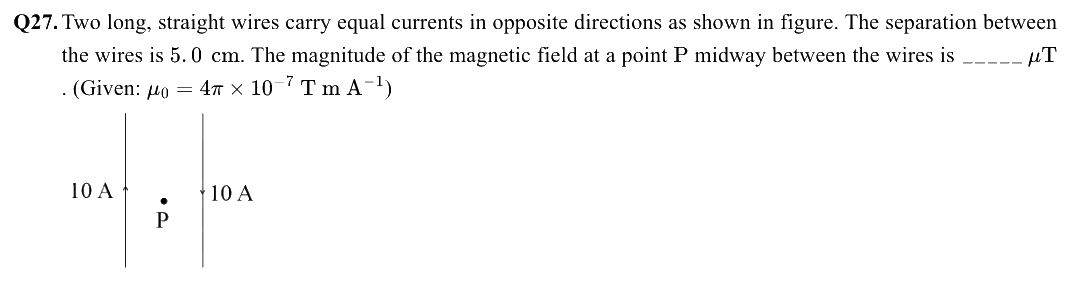
Two long, straight wires carry equal currents in opposite directions as shown in figure. The separation between the wires is 5.0 cm. The magnitude of the magnetic field at a point P midway between the wires is ______ $\mu$T. (Given: $\mu_0 = 4\pi \times 10^{-7}$ T m A$^{-1}$)
(see the figure above)
The question as printed in the paper.
Numerical answer type: type your answer in EdLoop to check it
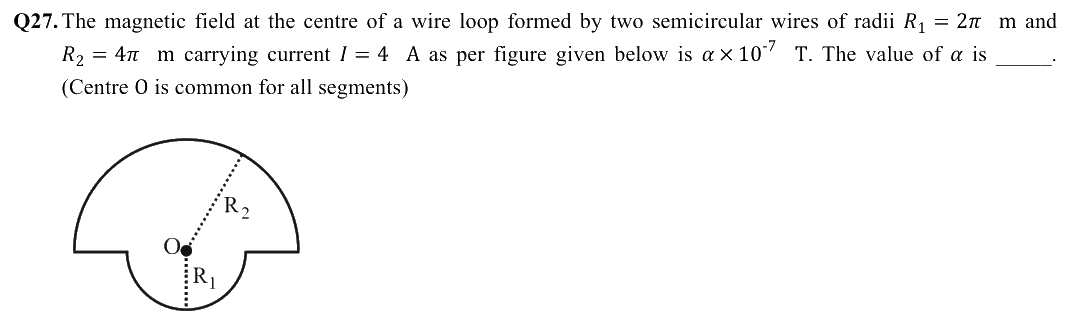
The magnetic field at the centre of a wire loop formed by two semicircular wires of radii $R_1 = 2\pi$ m and $R_2 = 4\pi$ m carrying current $I = 4$ A as per figure given below is $\alpha \times 10^{-7}$ T. The value of $\alpha$ is ______. (Centre O is common for all segments)
(see the figure above)
The question as printed in the paper.
Numerical answer type: type your answer in EdLoop to check it
An electron in a hydrogen atom revolves around its nucleus with a speed of $6.76 \times 10^{6}$ m s$^{-1}$ in an orbit of radius 0.52 Å. The magnetic field produced at the nucleus of the hydrogen atom is ______ T.
Numerical answer type: type your answer in EdLoop to check it
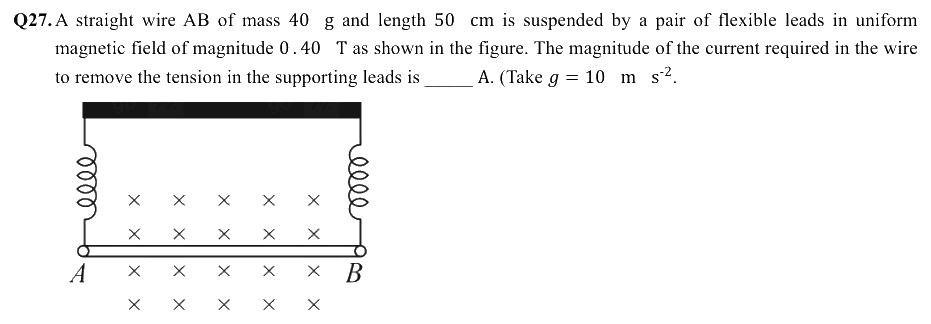
A straight wire AB of mass 40 g and length 50 cm is suspended by a pair of flexible leads in uniform magnetic field of magnitude 0.40 T as shown in the figure. The magnitude of the current required to remove the tension in the supporting leads is ______ A. (Take $g$ = 10 m s$^{-2}$).
(see the figure above)
The question as printed in the paper.
Numerical answer type: type your answer in EdLoop to check it
The current required to be passed through a solenoid of 15 cm length and 60 turns in order to demagnetise a bar magnet of magnetic intensity $2.4 \times 10^{3}\ \mathrm{A\,m^{-1}}$ is ______ A.
Numerical answer type: type your answer in EdLoop to check it
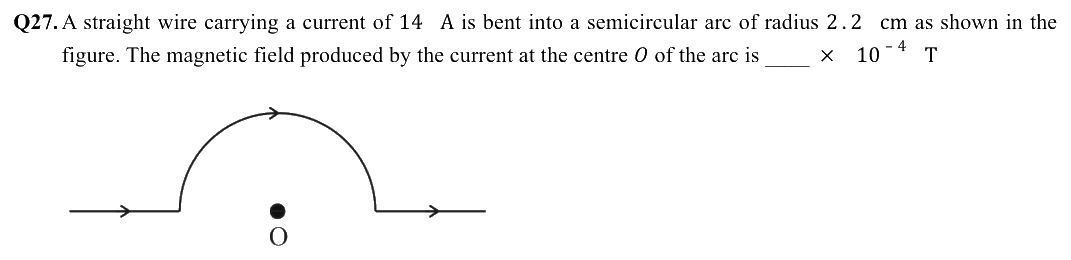
A straight wire carrying a current of 14 A is bent into a semicircular arc of radius $2.2$ cm as shown in the figure. The magnetic field produced by the current at the centre $O$ of the arc is ______ $\times 10^{-4}$ T (see the figure above)
The question as printed in the paper.
Numerical answer type: type your answer in EdLoop to check it
The magnetic intensity at the centre of a long current carrying solenoid is found to be $1.6 \times 10^{3}\ \mathrm{A\,m^{-1}}$. If the number of turns is 8 per cm, then the current flowing through the solenoid is ______ A.
Numerical answer type: type your answer in EdLoop to check it
The ratio of magnetic field at the centre of a current carrying coil of radius $r$ to the magnetic field at distance $r$ from the centre of coil on its axis is $\sqrt{x} : 1$. The value of $x$ is ______ .
Numerical answer type: type your answer in EdLoop to check it
Two identical circular wires of radius $20\ \mathrm{cm}$ and carrying current $\sqrt{2}\ \mathrm{A}$ are placed in perpendicular planes as shown in figure. The net magnetic field at the centre of the circular wires is ______ $\times 10^{-8}\ \mathrm{T}$. (Take $\pi = 3.14$)
(see the figure above)
The question as printed in the paper.
Numerical answer type: type your answer in EdLoop to check it
A proton with a kinetic energy of $2.0\ \mathrm{eV}$ moves into a region of uniform magnetic field of magnitude $\frac{\pi}{2} \times 10^{-3}\ \mathrm{T}$. The angle between the direction of magnetic field and velocity of proton is $60^\circ$. The pitch of the helical path taken by the proton is ______ cm. (Take, mass of proton $= 1.6 \times 10^{-27}\ \mathrm{kg}$ and charge on proton $= 1.6 \times 10^{-19}\ \mathrm{C}$).
Numerical answer type: type your answer in EdLoop to check it
A charge particle of 2 $\mu$C accelerated by a potential difference of 100 V enters a region of uniform magnetic field of magnitude 4 mT at right angle to the direction of field. The charge particle completes semicircle of radius 3 cm inside magnetic field. The mass of the charge particle is ______ $\times$ $10^{-18}$ kg.
Numerical answer type: type your answer in EdLoop to check it
Two long parallel wires carrying currents 8 A and 15 A in opposite directions are placed at a distance of 7 cm from each other. A point $P$ is at equidistant from both the wires such that the lines joining the point $P$ to the wires are perpendicular to each other. The magnitude of magnetic field at $P$ is ______ $\times10^{-6}$ T. (Given: $\sqrt{2}=1.4$)
Numerical answer type: type your answer in EdLoop to check it
A single turn current loop in the shape of a right angle triangle with sides 5 cm, 12 cm, 13 cm is carrying a current of 2 A. The loop is in a uniform magnetic field of magnitude 0.75 T whose direction is parallel to the current in the 13 cm side of the loop. The magnitude of the magnetic force on the 5 cm side will be $\frac{x}{130}$ N. The value of $x$ is ______.
Numerical answer type: type your answer in EdLoop to check it
A closely wounded circular coil of radius 5 cm produces a magnetic field of $37.68 \times 10^{-4}$ T at its center. The current through the coil is ______ A. [Given, number of turns in the coil is 100 and $\pi = 3.14$]
Numerical answer type: type your answer in EdLoop to check it
A wire of length 314 cm carrying current of 14 A is bent to form a circle. The magnetic moment of the coil is ______ $\mathrm{A - m^2}$. [Given $\pi = 3.14$]
Numerical answer type: type your answer in EdLoop to check it
A singly ionized magnesium atom $(A = 24)$ ion is accelerated to kinetic energy $5\ \mathrm{keV}$, and is projected perpendicularly into a magnetic field $B$ of the magnitude $0.5\ \mathrm{T}$. The radius of path formed will be ______ cm.
Numerical answer type: type your answer in EdLoop to check it
A deuteron and a proton moving with equal kinetic energy enter into to a uniform magnetic field at right angle to the field. If $r_d$ and $r_p$ are the radii of their circular paths respectively, then the ratio $\frac{r_d}{r_p}$ will be $\sqrt{x} : 1$ where $x$ is ______ .
Numerical answer type: type your answer in EdLoop to check it
Two $10 \mathrm{~cm}$ long, straight wires, each carrying a current of $5 \mathrm{~A}$ are kept parallel to each other. If each wire experienced a force of $10^{-5} \mathrm{~N}$, then separation between the wires is ______ cm.
Numerical answer type: type your answer in EdLoop to check it
A uniform conducting wire of length $24a$, and resistance $R$ is wound up as a current carrying coil in the shape of an equilateral triangle of side $a$ and then in the form of a square of side $a$. The coil is connected to a voltage source $V_0$. The ratio of magnetic moment of the coils in case of equilateral triangle to that for square is $1 : \sqrt{y}$ where $y$ is ______.
Numerical answer type: type your answer in EdLoop to check it
If the maximum value of accelerating potential provided by a radio frequency oscillator is $12\,\mathrm{kV}$. The number of revolution made by a proton in a cyclotron to achieve one sixth of the speed of light is: [$\mathrm{m_p}=1.67\times10^{-27}\ \mathrm{kg}$, $\mathrm{e}=1.6\times10^{-19}\ \mathrm{C}$, Speed of light$=3\times10^{8}\ \mathrm{m\ s^{-1}}$]
Numerical answer type: type your answer in EdLoop to check it
A coil in the shape of an equilateral triangle of side $10\ \mathrm{cm}$ lies in a vertical plane between the pole pieces of permanent magnet producing a horizontal magnetic field $20\,\mathrm{mT}$. The torque acting on the coil when a current of $0.2\ \mathrm{A}$ is passed through it and its plane becomes parallel to the magnetic field will be $\sqrt{x}\times10^{-5}\ \mathrm{Nm}$. The value of $x$ is
Numerical answer type: type your answer in EdLoop to check it
A galvanometer coil has 500 turns and each turn has an average area of $3\times 10^{-4}\mathrm{m}^{2}$. If a torque of $1.5\ \mathrm{Nm}$ is required to keep this coil parallel to a magnetic field when a current of $0.5\mathrm{A}$ is flowing through it, the strength of the field (in T) is ______ .
Numerical answer type: type your answer in EdLoop to check it
How to prepare Magnetic Effects of Current for JEE Main
How often it comes up
Magnetic effects of current bridges electrostatics and electrodynamics under Unit 13: Magnetic Effects of Current and Magnetism in the Class 12 NTA syllabus, holding rank 7 among the 29 physics chapters. Throughout the computer-based testing era from 2019 to 2026, 201 questions were drawn from this chapter across 162 papers, translating to an average of 1.2 questions per sitting. The topic appeared in 133 of those 162 exam sessions, and questions have been featured every year without omission. Looking at the three-year block from 2024 to 2026, candidates faced 73 questions across 58 papers, maintaining a rate of 1.3 questions per test and a 4.7 percent share. The chapter's subject share has stayed about the same when compared to the 2002 to 2018 window, which logged a 4.5 percent share from 60 questions across 38 papers. During the 2026 exams, 18 questions were presented across 19 papers, featured in 15 individual shifts. A total of 48 problems between 2019 and 2026 were formatted as numerical answer questions, requiring exact vector computations and numerical evaluations.
Most-asked topics
The syllabus organizes questions into three prominent areas:
Force on Charges & Currents: 116 questions since 2002, with 83 delivered between 2019 and 2026, asked up to 2026. This topic tests the Lorentz magnetic force on free charges, helical and circular trajectories, magnetic forces on straight and curved current-carrying wires, and mutual forces between parallel conductors.
Magnetic Field due to Current: 101 lifetime questions, including 80 from 2019 to 2026, tested in 2026. Problems center on the Biot-Savart law, circular loops, circular arcs, coaxial ring fields, Ampere's circuital law, solenoids, toroids, and field distributions inside thick cylindrical wires.
Current Loops & Galvanometer: 44 total questions, with 38 concentrated between 2019 and 2026, tested through 2026. Concepts examine the magnetic dipole moment of planar loops and spiral coils, torque on loops in uniform fields, potential energy of orientations, and moving coil galvanometer mechanics.
What the questions look like
JEE Main problems in this chapter emphasize vector cross products, spatial geometry, and right-hand rules:
Superposition of loop and straight wire fields: A planar circuit formed by a straight wire running tangential to a full circular loop. Students apply the right-hand grip rule to find whether individual field vectors reinforce or oppose each other at the center.
Force on multi-conductor parallel arrays: Three or four parallel long wires carry specified currents in coplanar arrangements. Questions ask for the net magnetic force per unit length exerted on one specific wire.
Centroid and axial fields of regular polygons: Evaluating magnetic field intensity at the centroid of an equilateral triangle, square, or regular polygon carrying a steady current.
Helical and circular particle motion: Charged particles injected with specified velocity vectors into uniform magnetic fields or crossed electric and magnetic fields, calculating cyclotron radius, pitch, or net velocity.
Questions to try first
Work through these representative recent problems:
Master right-hand rules for both magnetic field direction and magnetic force direction. Biot-Savart calculations require cross products of current elements with displacement vectors, while Lorentz forces require the cross product of velocity with magnetic field. A simple sign error in vector direction immediately leads to wrong choices.
Memorize standard magnetic field results: straight finite wire segments, circular arcs subtending an angle at the center, axial fields of circular loops, and interior solenoid fields. When finding field values for polygonal loops, calculate the field of a single side segment and multiply by symmetry.
For moving charges, become comfortable relating kinetic energy, momentum, and magnetic field through the cyclotron radius formula. When charged particles enter at an angle to the field, separate motion into parallel drift along the field lines and circular orbit in the transverse plane.
Frequently asked questions
Which formula in magnetic effects of current appears most often?
The magnetic field at the center of circular arcs and along the axis of circular loops appears repeatedly. Equally important is the Lorentz force formula on moving charges and parallel current-carrying wires.
How do I calculate the field of complex planar wire shapes?
Break the circuit into simple segments: straight lines and circular arcs. Calculate the magnitude and direction of the magnetic field from each individual segment at the point of interest, then add them algebraically along the coordinate axis perpendicular to the plane.
Are questions on toroids and cyclotrons still asked in JEE Main?
Cyclotron theory has been removed from the current syllabus, while basic Ampere circuital law applications on solenoids and wires remain central to the exam. Step-by-step solutions for each one are in the EdLoop app.