Every Electrostatics question from past JEE Main and AIEEE papers, with options and answers. Newest first.
297questions
186papers covered
5%of Physics questions, 2019–2026
2002–2026years
Guide at a glance
Electrostatics forms the starting point for electromagnetic theory in the Class 12 syllabus under NTA Unit 11 (Electrostatics). It ranks 5 among the 29 physics chapters by total weight.
Two point charges $q_1 = 3\ \mu$C and $q_2 = -4\ \mu$C are placed at points $\left(2\hat{i} + 3\hat{j} + 3\hat{k}\right)$ and $\left(\hat{i} + \hat{j} + \hat{k}\right)$ respectively. Force on charge $q_2$ is ________ N. $\left(\text{Take } \dfrac{1}{4\pi\epsilon_0} = 9\times10^9 \text{ SI Units}\right)$
A thin half ring of radius 35 cm is uniformly charged with a total charge of $Q$ coulomb. If the magnitude of the electric field at centre of the half ring is 100 V/m, then the value of $Q$ is ________ nC. ($\epsilon_o = 8.85\times10^{-12}$ C$^2$/Nm$^2$ and $\pi = 3.14$)
A rigid dipole undergoes a simple harmonic motion about its centre in the presence of an electric field $\vec{\mathrm{E}}_1 = \mathrm{E}_0\,\hat{x}$. If another electric field $\vec{\mathrm{E}}_2 = 2\mathrm{E}_0\left(\hat{y} + \hat{z}\right)$ is introduced to the system, what will be the percentage change in the frequency of the oscillation (approximate)?
Given below are two statements: one is labelled as Assertion A and the other is labelled as Reason R
Assertion A: In electrostatics, a conductor does not store any net charge inside.
Reason R: Inside the capacitor (with no dielectric medium), the free charge carriers, if placed between the plates of capacitor, experience force and drift.
Choose the *correct* answer from the options given below
A
Both A and R are true and R is the correct explanation of A
B
Both A and R are true but R is NOT the correct explanation of A
Two charged conducting spheres $\mathrm{S_1}$ and $\mathrm{S_2}$ of radii 8 cm and 18 cm are connected to each other by a wire. After equilibrium is established, the ratio of electric fields on $\mathrm{S_1}$ and $\mathrm{S_2}$ spheres are $\mathrm{E_{S1}}$ and $\mathrm{E_{S2}}$ respectively. The value of $\frac{\mathrm{E_{S1}}}{\mathrm{E_{S2}}}$ is ________.
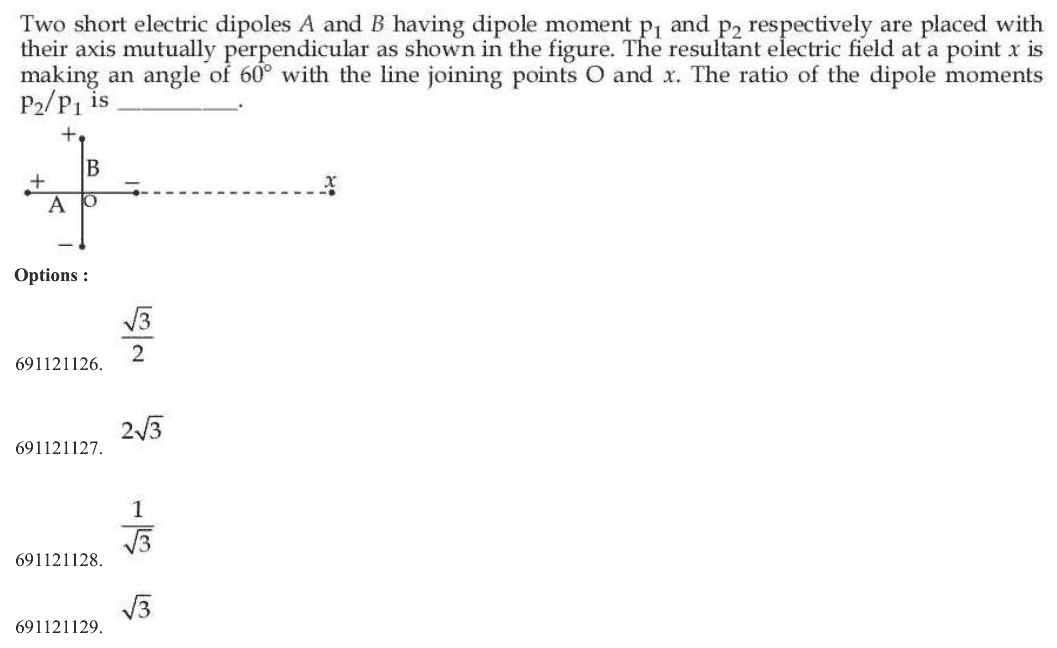
Two short electric dipoles $A$ and $B$ having dipole moment $\mathrm{p_1}$ and $\mathrm{p_2}$ respectively are placed with their axis mutually perpendicular as shown in the figure. The resultant electric field at a point $x$ is making an angle of $60°$ with the line joining points O and $x$. The ratio of the dipole moments $\mathrm{p_2/p_1}$ is ________.
Two metal plates ($A$, $B$) are kept horizontally with separation of $\left(\frac{12}{\pi}\right)$ cm, with plate A on the top. An atomizer jet sprays oil (density 1.5 g/cm$^3$) droplets of radius 1 mm horizontally. All oil droplets carry a charge 5 nC. The potentials $V_A$ and $V_B$ are required on plates A and B respectively in order to ensure the droplets do not descend. The values of $V_A$ and $V_B$ are ________. (Neglect the air resistance to the droplets and take g = 10 m/s$^2$)
Two point charges 8 $\mu C$ and $-2$ $\mu C$ are located at $x = 2$ cm and $x = 4$ cm, respectively on the $x$-axis. The ratio of electric flux due to these charges through two spheres of radii 3 cm and 5 cm with their centers at the origin is ________.
Two point charges of 1 nC and 2 nC are placed at the two corners of equilateral triangle of side 3 cm. The work done in bringing a charge of 3 nC from infinity to the third corner of the triangle is ________ $\mu$J.
There are three co-centric conducting spherical shells $A$, $B$ and $C$ of radii $a$, $b$ and $c$ respectively ($c > b > a$) and they are charged with charge $q_1$, $q_2$ and $q_3$ respectively. The potentials of the spheres $A$, $B$ and $C$ respectively, are :
Answer: (C) $\frac{1}{4\pi\epsilon_0}\left(\frac{q_1}{a}+\frac{q_2}{b}+\frac{q_3}{c}\right)$, $\frac{1}{4\pi\epsilon_0}\left(\frac{q_1+q_2}{b}+\frac{q_3}{c}\right)$, $\frac{1}{4\pi\epsilon_0}\left(\frac{q_1+q_2+q_3}{c}\right)$· Official NTA final key
The electrostatic potential in a charged spherical region of radius $r$ varies as $V = ar^3 + b$, where $a$ and $b$ are constants. The total charge in the sphere of unit radius is $\alpha \times \pi a\epsilon_0$. The value of $\alpha$ is ________.
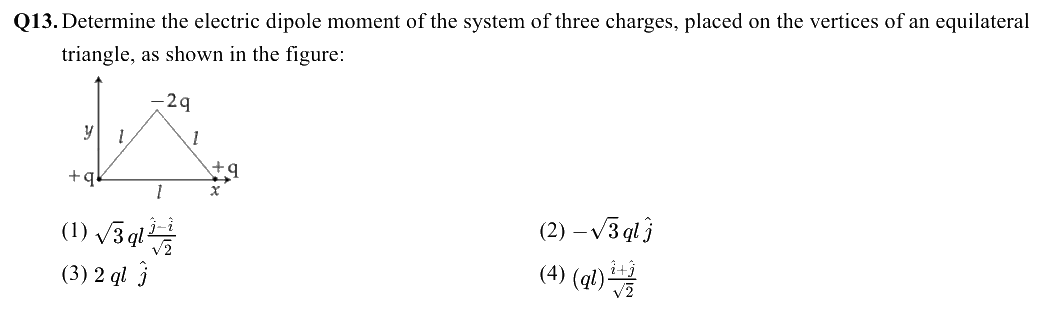
Three charges $+2q$, $+3q$ and $-4q$ are situated at $(0, -3a)$, $(2a, 0)$ and $(-2a, 0)$ respectively in the $xy$ plane. The resultant dipole moment about origin is ________.
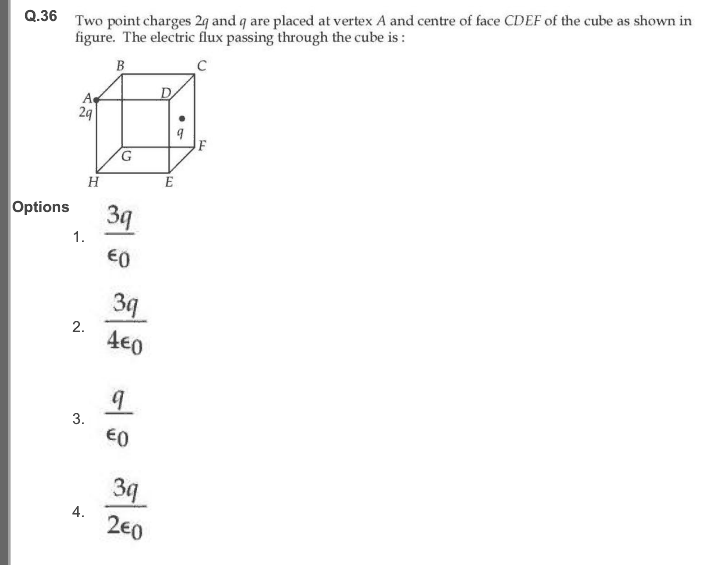
Two point charges $2q$ and $q$ are placed at vertex $A$ and centre of face $CDEF$ of the cube as shown in figure. The electric flux passing through the cube is :
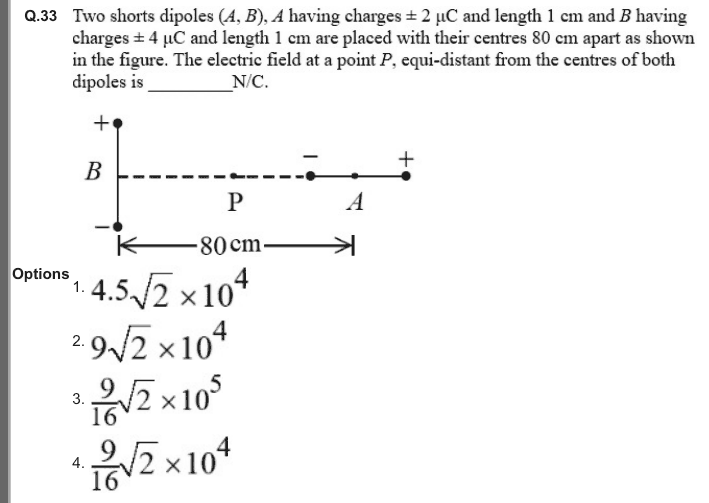
Two shorts dipoles ($A$, $B$), $A$ having charges $\pm 2\,\mu$C and length 1 cm and $B$ having charges $\pm 4\,\mu$C and length 1 cm are placed with their centres 80 cm apart as shown in the figure. The electric field at a point $P$, equi-distant from the centres of both dipoles is ________ N/C.
Two charges $7\,\mu$C and $-2\,\mu$C are placed at $(-9, 0, 0)$ cm and $(9, 0, 0)$ cm respectively in an external field $E = \dfrac{A}{r^2}\hat{r}$, where $A = 9 \times 10^5$ N/C.m$^2$. Considering the potential at infinity is 0, the electrostatic energy of the configuration is ________ J.
Electric field in a region is given by $\vec{E} = Ax\hat{i} + By\hat{j}$, where $A = 10$ V/m$^2$ and $B = 5$ V/m$^2$. If the electric potential at a point $(10, 20)$ is 500 V, then the electric potential at origin is ________ V.
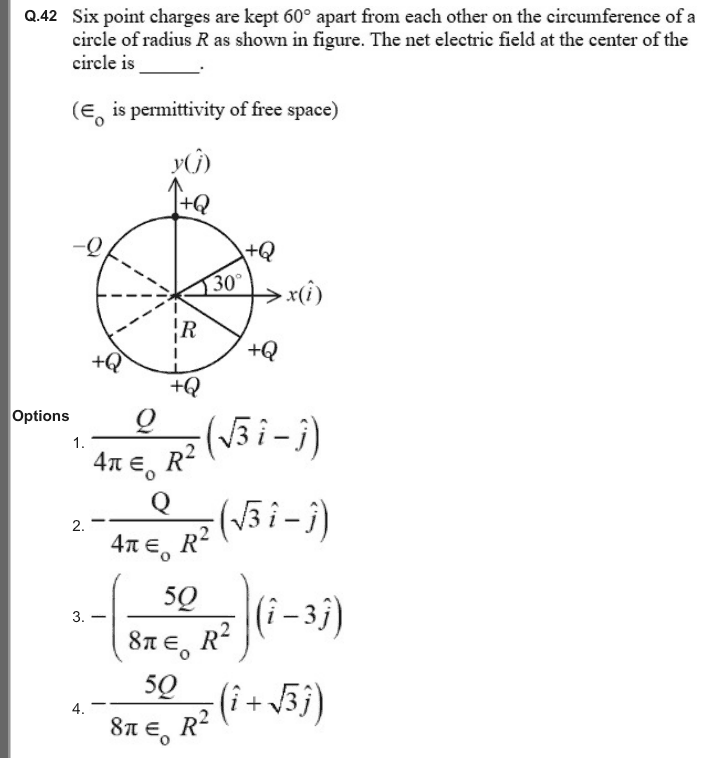
Six point charges are kept $60°$ apart from each other on the circumference of a circle of radius $R$ as shown in figure. The net electric field at the center of the circle is ________.
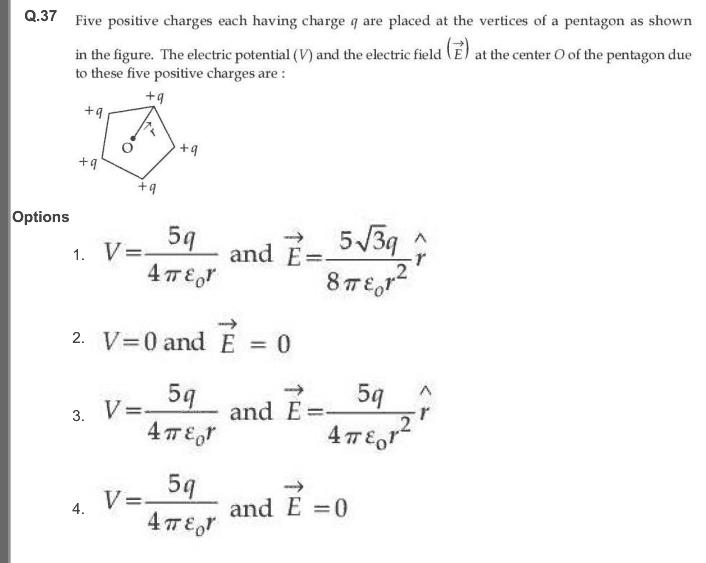
Five positive charges each having charge $q$ are placed at the vertices of a pentagon as shown in the figure. The electric potential ($V$) and the electric field ($\vec{E}$) at the center $O$ of the pentagon due to these five positive charges are :
(see the figure above)
The question as printed in the paper.
A
$V = \frac{5q}{4\pi\varepsilon_0 r}$ and $\vec{E} = \frac{5\sqrt{3}q}{8\pi\varepsilon_0 r^2}\hat{r}$
B
$V = 0$ and $\vec{E} = 0$
C
$V = \frac{5q}{4\pi\varepsilon_0 r}$ and $\vec{E} = \frac{5q}{4\pi\varepsilon_0 r^2}\hat{r}$
D
$V = \frac{5q}{4\pi\varepsilon_0 r}$ and $\vec{E} = 0$
Three small identical bubbles of water having same charge on each coalesce to form a bigger bubble. Then the ratio of the potentials on one initial bubble and that on the resultant bigger bubble is :
A point charge of $10^{-8}$ C is placed at origin. The work done in moving a point charge 2 $\mu$C from point $A(4, 4, 2)$ m to $B(2, 2, 1)$ m is ________ J. $\left(\dfrac{1}{4\pi\epsilon_o} = 9\times10^9\text{ in SI units}\right)$
Consider two identical metallic spheres of radius $R$ each having charge $Q$ and mass $m$. Their centers have an initial separation of $4R$. Both the spheres are given an initial speed of $u$ towards each other. The minimum value of $u$, so that they can just touch each other is : (Take $k = \dfrac{1}{4\pi\epsilon_0}$ and assume $kQ^2 > Gm^2$ where $G$ is the Gravitational constant)
An infinitely long wire has uniform linear charge density $\lambda = 2\,nC/m$. The net flux through a Gaussian cube of side length $\sqrt{3}\,cm$, if the wire passes through any two corners of the cube, that are maximally displaced from each other, would be $x\,Nm^2C^{-1}$, where $x$ is :
[Neglect any edge effects and use $\frac{1}{4\pi\varepsilon_0} = 9 \times 10^9$ SI units]
Two metal spheres of radius R and 3 R have same surface charge density $\sigma$. If they are brought in contact and then separated, the surface charge density on smaller and bigger sphere becomes $\sigma_1$ and $\sigma_2$, respectively. The ratio $\frac{\sigma_1}{\sigma_2}$ is ______.
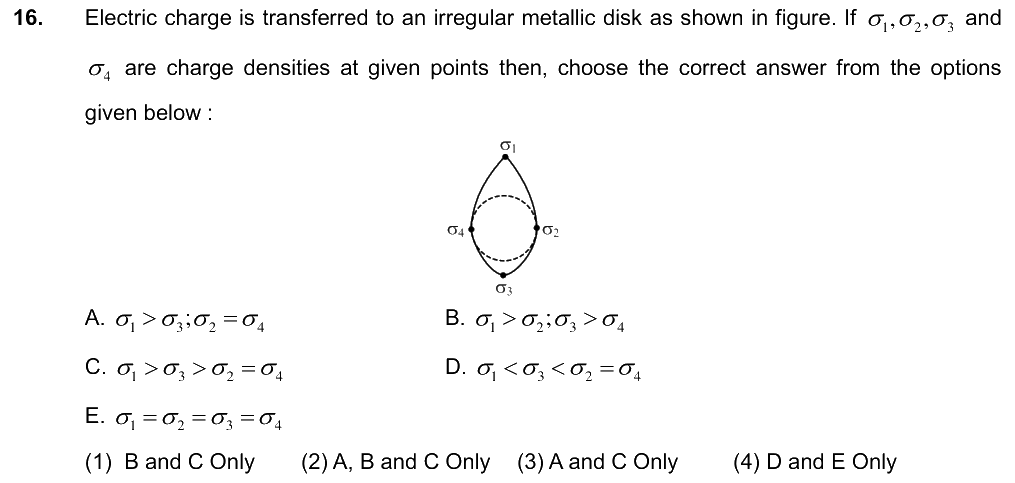
Electric charge is transferred to an irregular metallic disk as shown in figure. If $\sigma_1, \sigma_2, \sigma_3$ and $\sigma_4$ are charge densities at given points then, choose the correct answer from the options given below :
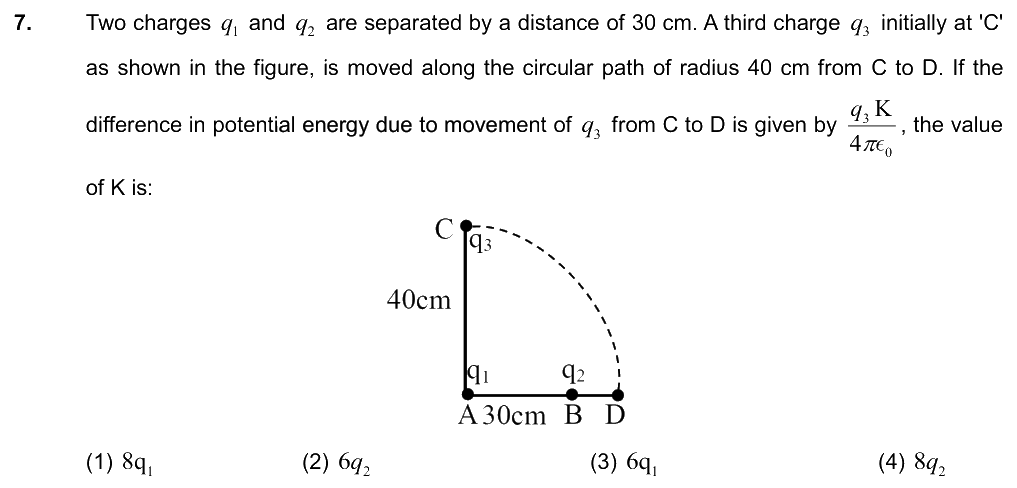
Two charges $q_1$ and $q_2$ are separated by a distance of 30 cm. A third charge $q_3$ initially at 'C' as shown in the figure, is moved along the circular path of radius 40 cm from C to D. If the difference in potential energy due to movement of $q_3$ from C to D is given by $\frac{q_3K}{4\pi\epsilon_0}$, the value of K is:
A dipole with two electric charges of $2\mu C$ magnitude each, with separation distance $0.5\mu m$, is placed between the plates of a capacitor such that its axis is parallel to an electric field established between the plates when a potential difference of 5 V is applied. Separation between the plates is 0.5 mm. If the dipole is rotated by 30º from the axis, it tends to realign in the direction due to a torque. The value of torque is :
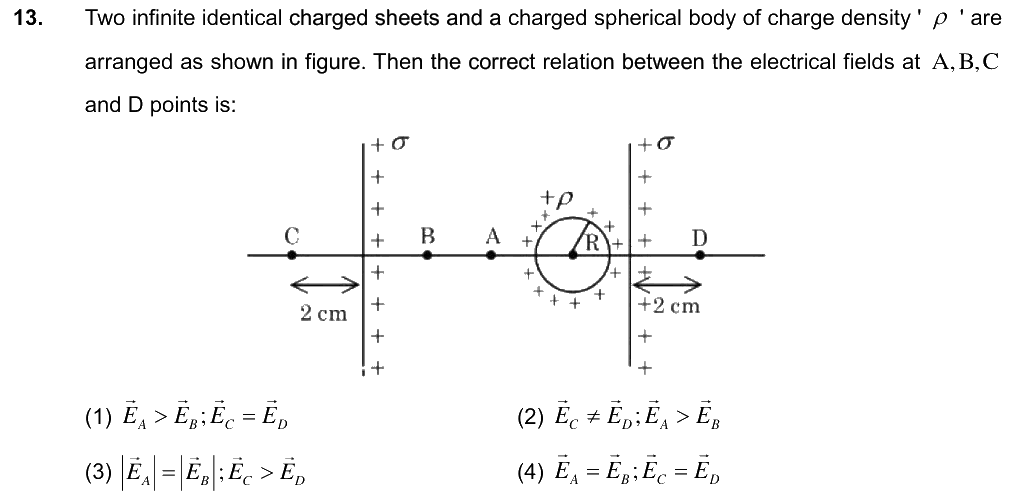
Two infinite identical charged sheets and a charged spherical body of charge density ' $\rho$ ' are arranged as shown in figure. Then the correct relation between the electrical fields at A, B, C and D points is:
Two small spherical balls of mass 10 g each with charges $-2\mu C$ and $2\mu C$, are attached to two ends of very light rigid rod of length 20 cm. The arrangement is now placed near an infinite nonconducting charge sheet with uniform charge density of $100\mu C/m^2$ such that length of rod makes an angle of $30^\circ$ with electric field generated by charge sheet. Net torque acting on the rod is: (Take $\epsilon_o : 8.85 \times 10^{-12}C^2Nm^2$ )
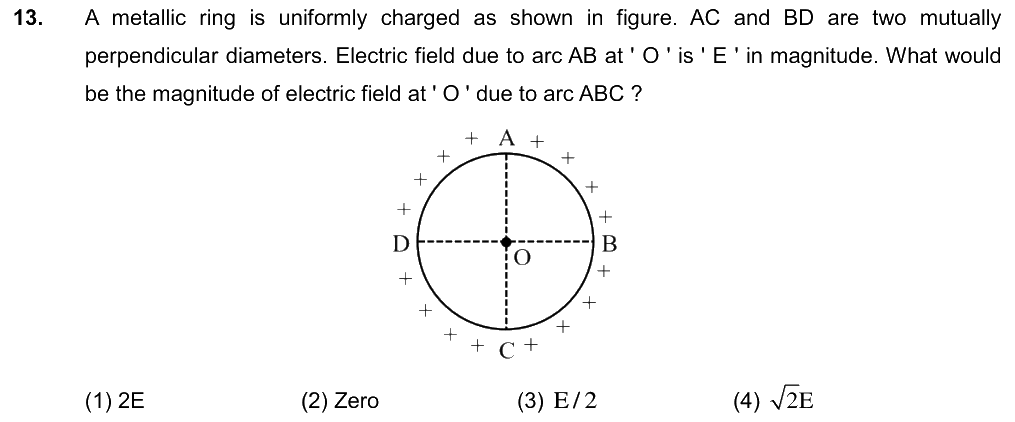
A metallic ring is uniformly charged as shown in figure. AC and BD are two mutually perpendicular diameters. Electric field due to arc AB at ' O ' is ' E ' in magnitude. What would be the magnitude of electric field at ' O ' due to arc ABC ?
The electrostatic potential on the surface of uniformly charged spherical shell of radius R = 10 cm is 120 V . The potential at the centre of shell, at a distance r = 5 cm from centre, and at a distance $r = 15$ cm from the centre of the shell respectively, are:
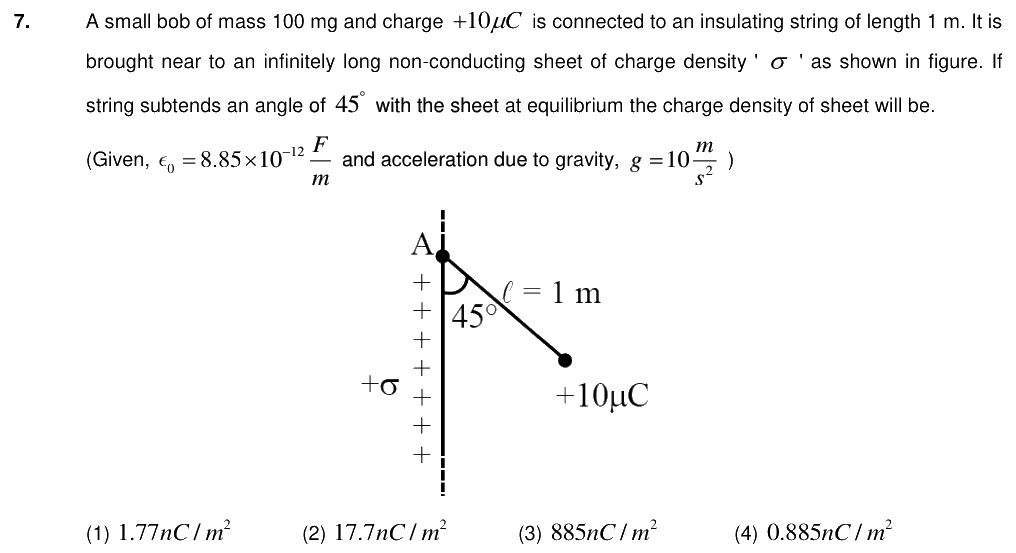
A small bob of mass 100 mg and charge $+10\mu C$ is connected to an insulating string of length 1 m. It is brought near to an infinitely long non-conducting sheet of charge density ' $\sigma$ ' as shown in figure. If string subtends an angle of $45^\circ$ with the sheet at equilibrium the charge density of sheet will be.
(Given, $\epsilon_0 = 8.85 \times 10^{-12}\frac{F}{m}$ and acceleration due to gravity, $g = 10\frac{m}{s^2}$ )
A point charge + q is placed at the origin. A second point charge +9 q is placed at $(d, 0, 0)$ in Cartesian coordinate system. The point in between them where the electric field vanishes is :
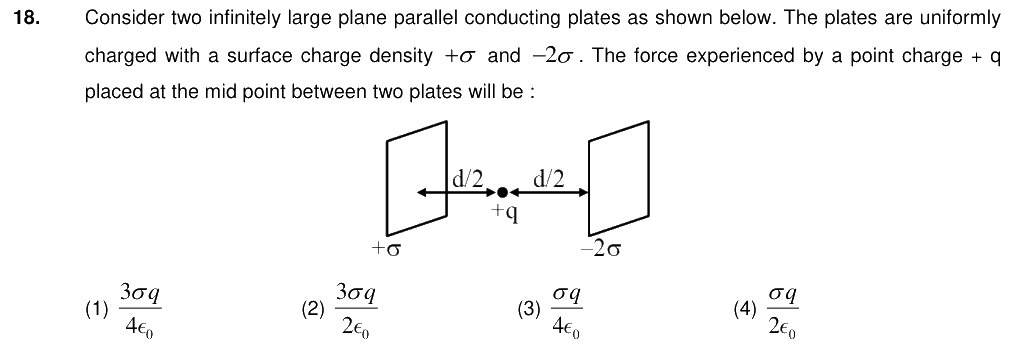
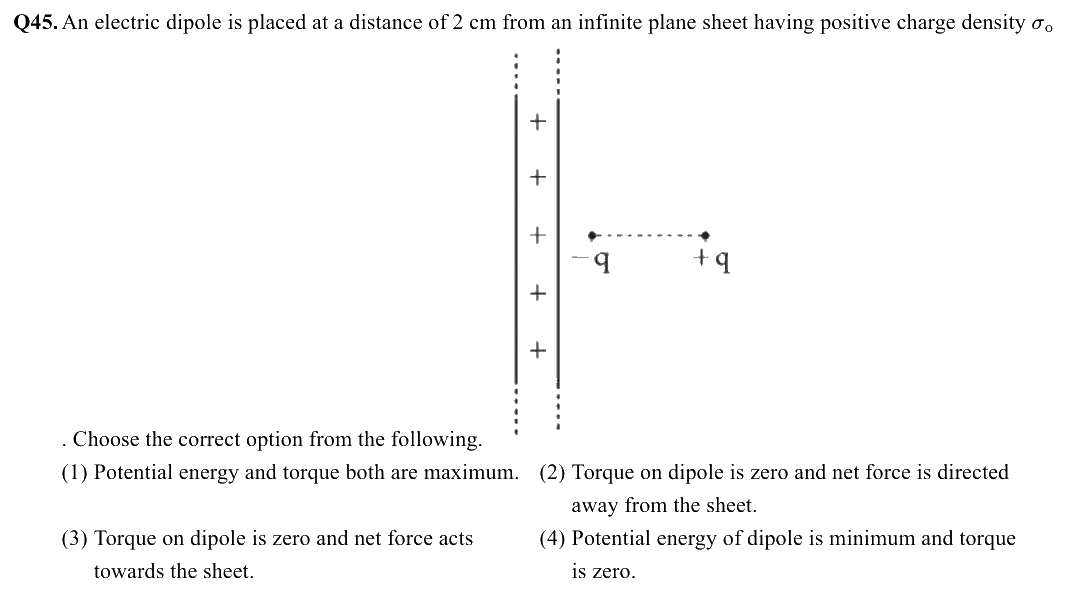
Consider two infinitely large plane parallel conducting plates as shown below. The plates are uniformly charged with a surface charge density $+\sigma$ and $-2\sigma$. The force experienced by a point charge + q placed at the mid point between two plates will be :
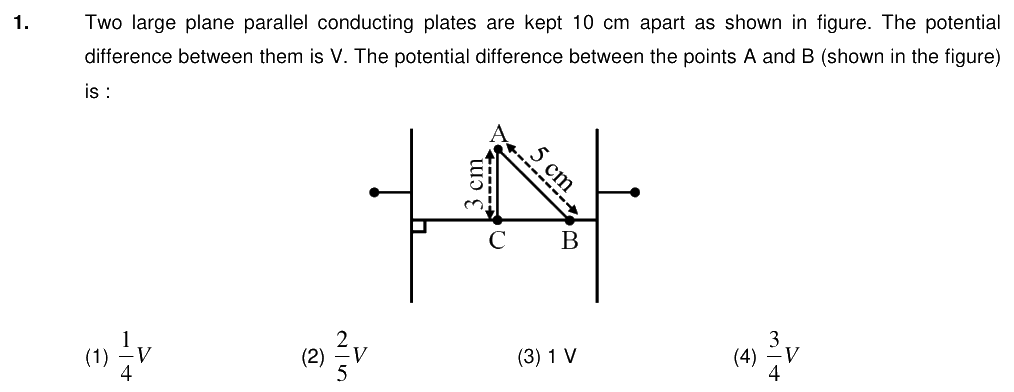
Two large plane parallel conducting plates are kept 10 cm apart as shown in figure. The potential difference between them is V. The potential difference between the points A and B (shown in the figure) is :
Consider a circular loop that is uniformly charged and has a radius $a\sqrt{2}$. Find the position along the positive $z$ -axis of the cartesian coordinate system where the electric field is maximum if the ring was assumed to be placed in xy plane at the origin :
An electric dipole of mass m, charge q, and length $l$ is placed in a uniform electric field $\vec{\mathrm{E}} = \mathrm{E_0}\hat{i}$. When the dipole is rotated slightly from its equilibrium position and released, the time period of its oscillations will be:
A point charge causes an electric flux of $-2 \times 10^4\ \mathrm{Nm^2C^{-1}}$ to pass through a spherical Gaussian surface of 8.0 cm radius, centred on the charge. The value of the point charge is : (Given $\epsilon_0$ = $8.85 \times 10^{-12}\ \mathrm{C^2\,N^{-1}\,m^{-2}}$ )
Three infinitely long wires with linear charge density $\lambda$ are placed along the $x - axis$, y-axis and $z-$ axis respectively. Which of the following denotes an equipotential surface?
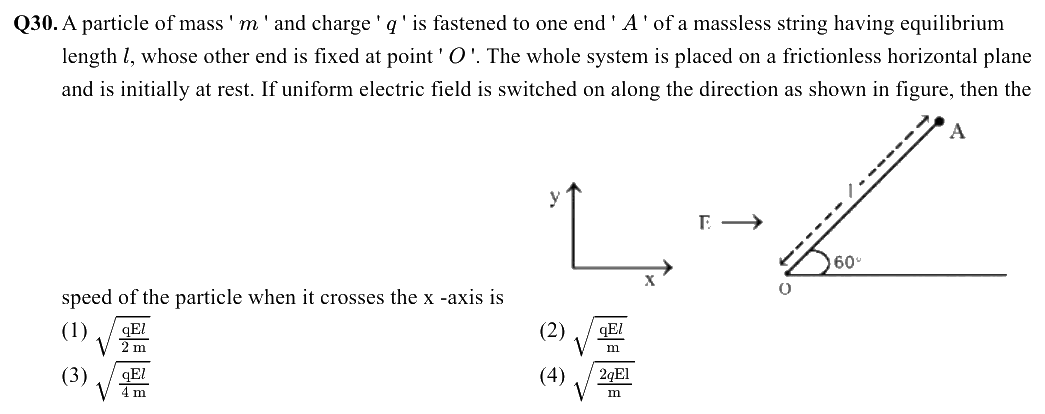
A particle of mass ' $m$ ' and charge ' $q$ ' is fastened to one end ' $A$ ' of a massless string having equilibrium length $l$, whose other end is fixed at point ' $O$ '. The whole system is placed on a frictionless horizontal plane and is initially at rest. If uniform electric field is switched on along the direction as shown in figure, then the speed of the particle when it crosses the x -axis is
A small uncharged conducting sphere is placed in contact with an identical sphere but having $4 \times 10^{-8}$C charge and then removed to a distance such that the force of repulsion between them is $9 \times 10^{-3}$ N. The distance between them is (Take $\frac{1}{4\pi\epsilon_o}$ as $9 \times 10^9$inSI units)
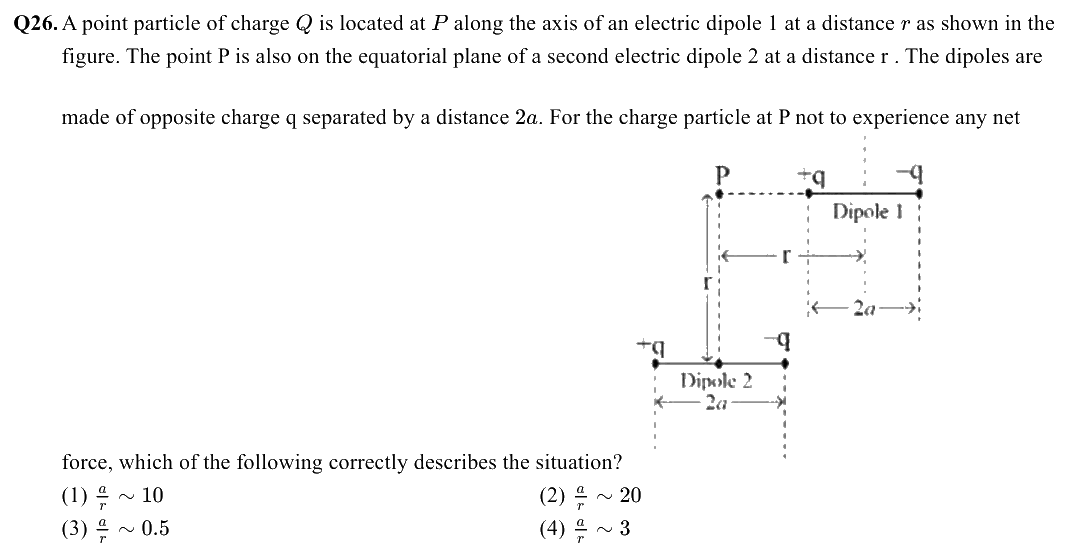
A point particle of charge $Q$ is located at $P$ along the axis of an electric dipole 1 at a distance $r$ as shown in the figure. The point P is also on the equatorial plane of a second electric dipole 2 at a distance r . The dipoles are made of opposite charge q separated by a distance $2a$. For the charge particle at P not to experience any net force, which of the following correctly describes the situation ?
Two charges $7\mu c$ and $-4\mu c$ are placed at $(-7\ \mathrm{cm}, 0, 0)$ and $(7\ \mathrm{cm}, 0, 0)$ respectively. Given, $\epsilon_0 = 8.85 \times 10^{-12}\mathrm{C}^2\ \mathrm{N}^{-1}\ \mathrm{m}^{-2}$, the electrostatic potential energy of the charge configuration is :
Two point charges $-4\mu c$ and $4\mu c$, constituting an electric dipole, are placed at $(-9, 0, 0)$cm and $(9, 0, 0)$cm in a uniform electric field of strength $10^4\mathrm{NC}^{-1}$. The work done on the dipole in rotating it from the equilibrium through $180^\circ$ is :
An electron is made to enter symmetrically between two parallel and equally but oppositely charged metal plates, each of 10 cm length. The electron emerges out of the electric field region with a horizontal component of velocity $10^6$ m/s. If the magnitude of the electric field between the plates is 9.1 V/cm, then the vertical component of velocity of electron is (mass of electron $= 9.1 \times 10^{-31}$ kg and charge of electron $= 1.6 \times 10^{-19}$C )
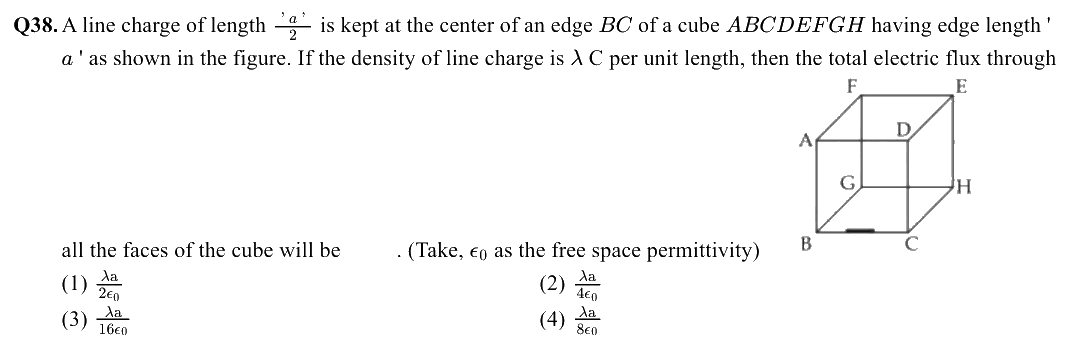
A line charge of length $\frac{a}{2}$ is kept at the center of an edge $BC$ of a cube $ABCDEFGH$ having edge length ' $a$ ' as shown in the figure. If the density of line charge is $\lambda$ C per unit length, then the total electric flux through all the faces of the cube will be ______ . (Take, $\epsilon_0$ as the free space permittivity)
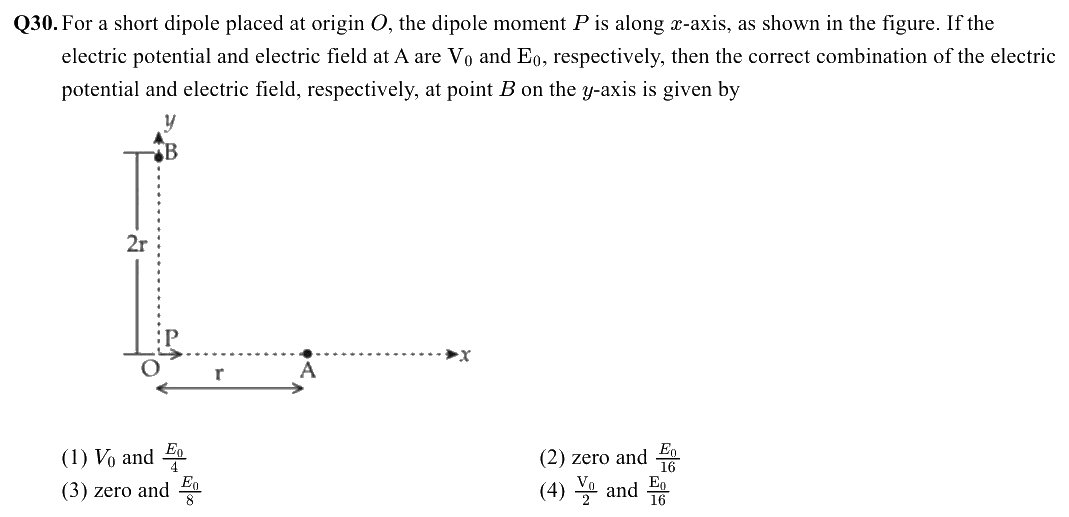
For a short dipole placed at origin $O$, the dipole moment $P$ is along $x$-axis, as shown in the figure. If the electric potential and electric field at A are $\mathrm{V_0}$ and $\mathrm{E_0}$, respectively, then the correct combination of the electric potential and electric field, respectively, at point $B$ on the $y$-axis is given by
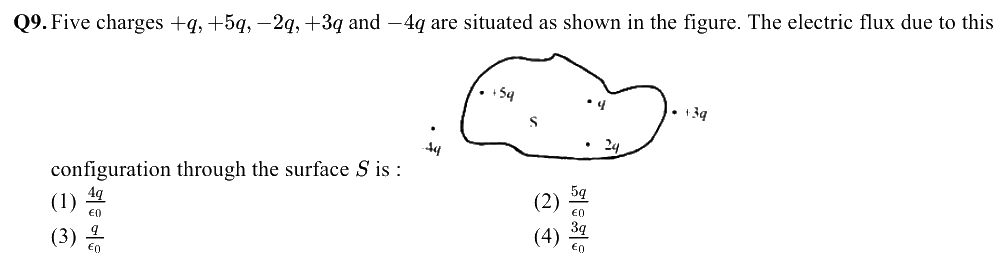
Five charges $+q$, $+5q$, $-2q$, $+3q$ and $-4q$ are situated as shown in the figure. The electric flux due to this configuration through the surface $S$ is :
Two charged conducting spheres of radii $a$ and $b$ are connected to each other by a conducting wire. The ratio of charges of the two spheres respectively is:
Ques: $\sigma$ is the uniform surface charge density of a thin spherical shell of radius $R$. The electric field at any point on the surface of the spherical shell is :
Two identical conducting spheres $P$ and $S$ with charge $Q$ on each, repel each other with a force 16 N. A third identical uncharged conducting sphere $R$ is successively brought in contact with the two spheres. The new force of repulsion between P and S is :
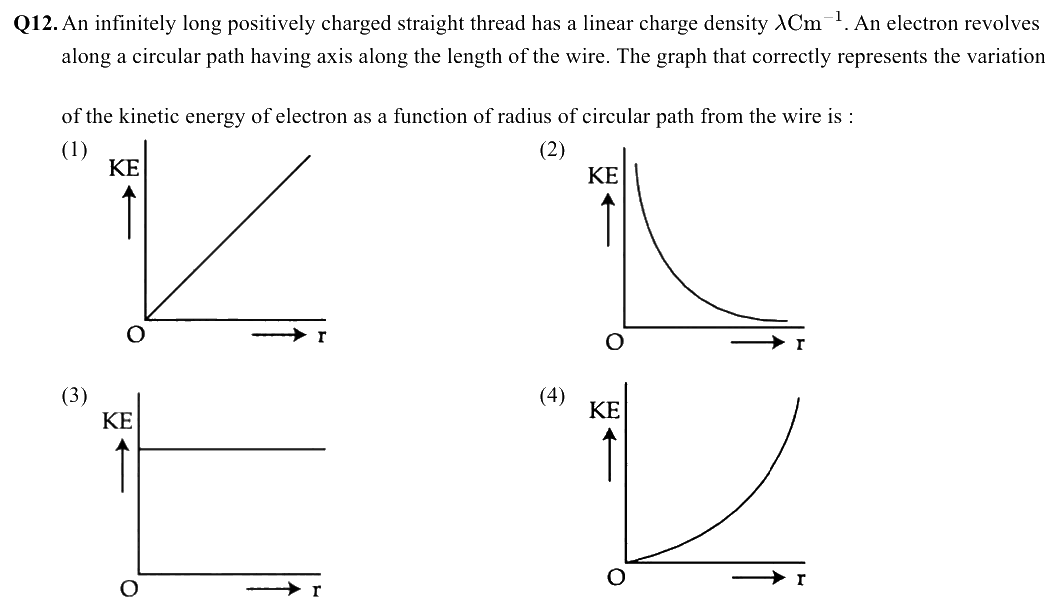
An infinitely long positively charged straight thread has a linear charge density $\lambda\,\mathrm{Cm^{-1}}$. An electron revolves along a circular path having axis along the length of the wire. The graph that correctly represents the variation of the kinetic energy of electron as a function of radius of circular path from the wire is :
The question as printed in the paper.
A
see figure Graph of KE against r with origin O: a straight line rising from the origin to the upper right.
B
see figure Graph of KE against r with origin O: a decreasing convex curve, starting high near the KE-axis and falling towards the r-axis, flattening out without touching it.
C
see figure Graph of KE against r with origin O: a horizontal straight line at a constant height above the r-axis.
D
see figure Graph of KE against r with origin O: a convex curve starting at the origin, rising slowly at first and then more steeply to the upper right.
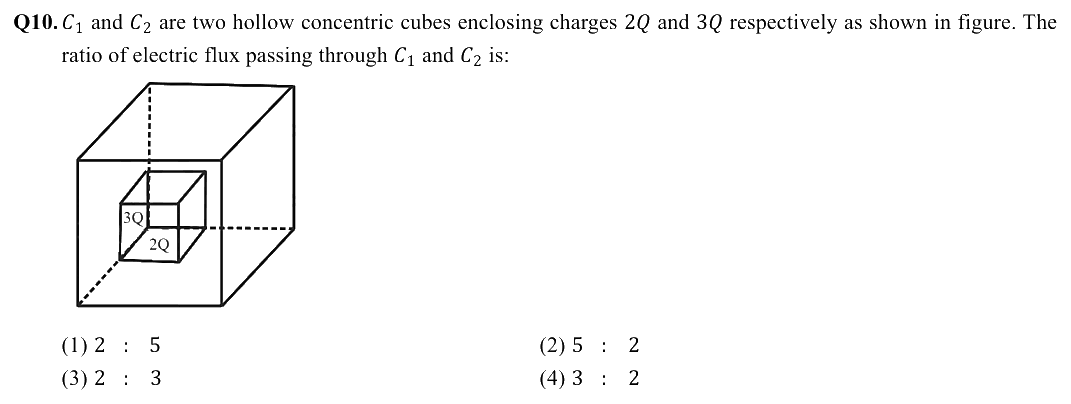
$C_1$ and $C_2$ are two hollow concentric cubes enclosing charges $2Q$ and $3Q$ respectively as shown in figure. The ratio of electric flux passing through $C_1$ and $C_2$ is:
Two charges $q$ and $3q$ are separated by a distance 'r' in air. At a distance $x$ from charge $q$, the resultant electric field is zero. The value of $x$ is :
Force between two point charges $q_1$ and $q_2$ placed in vacuum at $r$ cm apart is $F$. Force between them when placed in a medium having dielectric $K = 5$ at $\frac{r}{5}$ cm apart will be:
A particle of charge $-q$ and mass $m$ moves in a circle of radius $r$ around an infinitely long line charge of linear density $+\lambda$. Then time period will be given as: (Consider $k$ as Coulomb's constant)
Two charges of $5Q$ and $-2Q$ are situated at the points $(3a,\ 0)$ and $(-5a,\ 0)$ respectively. The electric flux through a sphere of radius $4a$ having centre at origin is:
An electric field is given by $\left(6\hat{i} + 5\hat{j} + 3\hat{k}\right)$ N C$^{-1}$. The electric flux through a surface area $30\hat{i}$ m$^2$ lying in YZ-plane (in SI unit) is:
An electric charge $10^{-6}$ $\mu$C is placed at origin (0, 0) m of X $-$ Y co-ordinate system. Two points $P$ and $Q$ are situated at $\left(\sqrt{3}, \sqrt{3}\right)$ m and $\left(\sqrt{6}, 0\right)$ m respectively. The potential difference between the points $P$ and $Q$ will be :
Two charges of each magnitude 0.01 C and separated by a distance of 0.4 mm constitute an electric dipole. If the dipole is placed in an uniform electric field $\vec{E}$ of 10 dyne $\cdot$ C$^{-1}$ making 30° angle with $\vec{E}$, the magnitude of torque acting on dipole is:
A 10 $\mu$C charge is divided into two parts and placed at 1 cm distance so that the repulsive force between them is maximum. The charges of the two parts are:
Given below are two statements: one is labelled as Assertion A and the other is labelled as Reason R. Assertion A : If an electric dipole of dipole moment $30 \times 10^{-5}$ C m is enclosed by a closed surface, the net flux coming out of the surface will be zero. Reason R : Electric dipole consists of two equal and opposite charges. In the light of above, statements, choose the correct answer from the options given below.
A
Both A and R are true and R is the correct explanation of A
B
A is false but R is true
C
A is true but R is false
D
Both A and R are true and R is NOT the correct explanation of A
A capacitor of capacitance $C$ is charged to a potential $V$. The flux of the electric field through a closed surface enclosing the positive plate of the capacitor is:
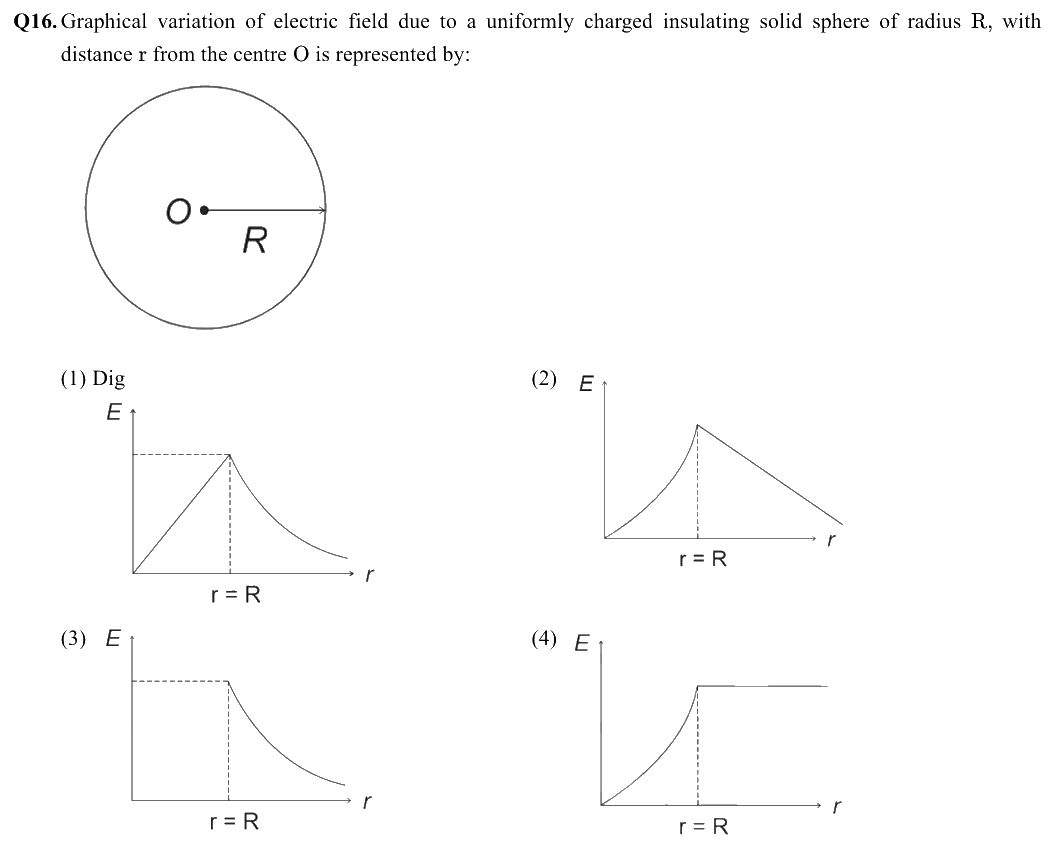
Graphical variation of electric field due to a uniformly charged insulating solid sphere of radius R, with distance r from the centre O is represented by: (see the figure above)
Electric potential at a point $P$ due to a point charge of $5 \times 10^{-9}\ \mathrm{C}$ is $50\ \mathrm{V}$. The distance of $P$ from the point charge is: (Assume, $\frac{1}{4\pi\varepsilon_0} = 9 \times 10^{9}\ \mathrm{N\,m^2\,C^{-2}}$)
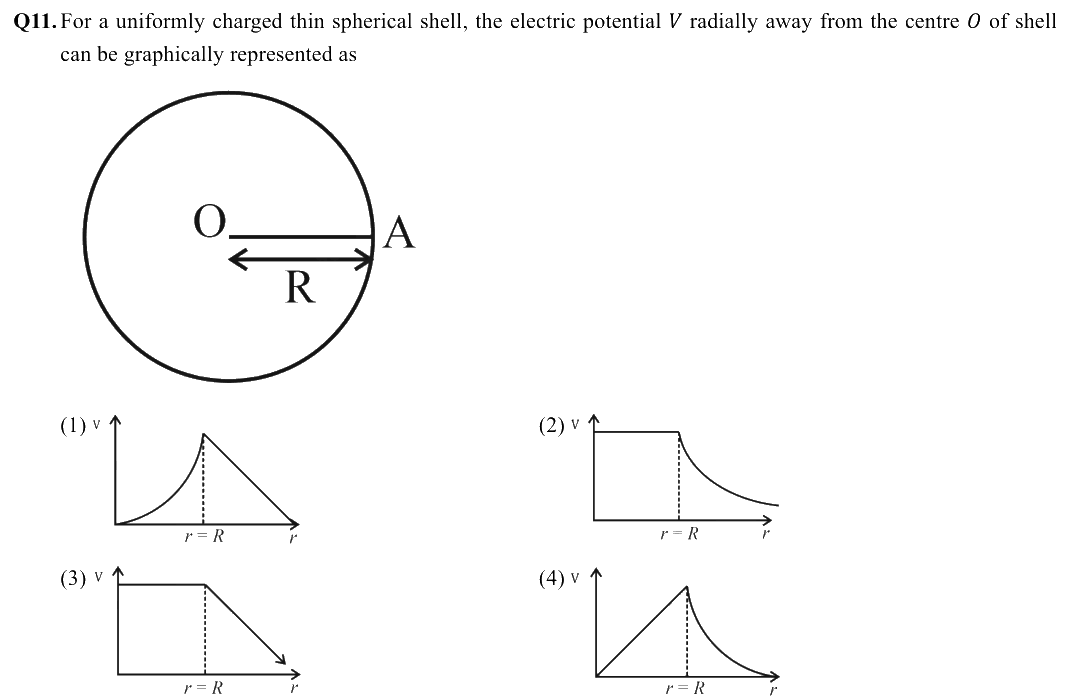
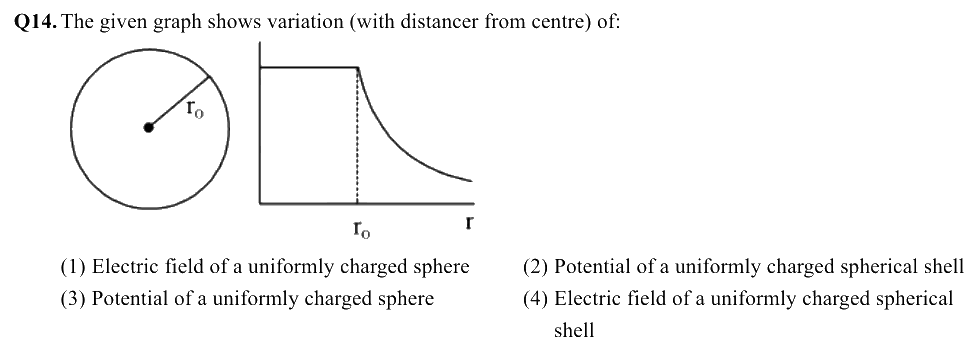
For a uniformly charged thin spherical shell, the electric potential $V$ radially away from the centre $O$ of shell can be graphically represented as
(see the figure above)
The question as printed in the paper.
A
see figure V versus r graph: V rises from the origin along a curve that bends upward (increasing slope) to a peak at r = R (dashed vertical line), then falls along a straight line down to the r axis.
B
see figure V versus r graph: V is constant (horizontal line) up to r = R (dashed vertical line), then falls along a curve that flattens out towards the r axis (decaying curve).
C
see figure V versus r graph: V is constant (horizontal line) up to r = R (dashed vertical line), then falls along a straight slanting line (arrowhead at the end) that goes down towards the r axis.
D
see figure V versus r graph: V rises along a straight line from the origin to r = R (dashed vertical line), then falls along a curve that flattens out towards the r axis (decaying curve).
A dipole comprises of two charged particles of identical magnitude $q$ and opposite in nature. The mass $m$ of the positive charged particle is half of the mass of the negative charged particle. The two charges are separated by a distance $l$ . If the dipole is placed in a uniform electric field $\vec{E}$; in such a way that dipole axis makes a very small angle with the electric field, $\vec{E}$. The angular frequency of the oscillations of the dipole when released is given by:
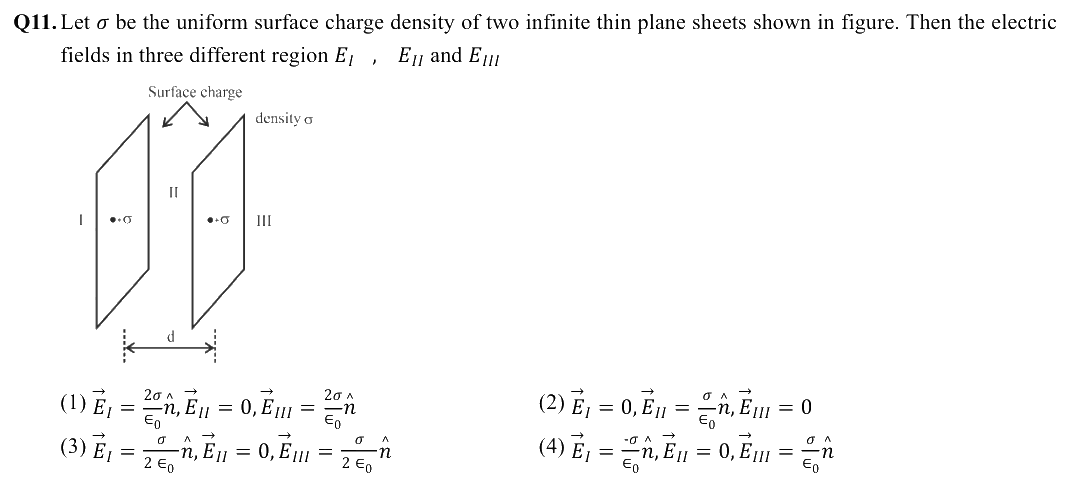
Let $\sigma$ be the uniform surface charge density of two infinite thin plane sheets shown in figure. Then the electric fields in three different region $E_I$ , $E_{II}$ and $E_{III}$
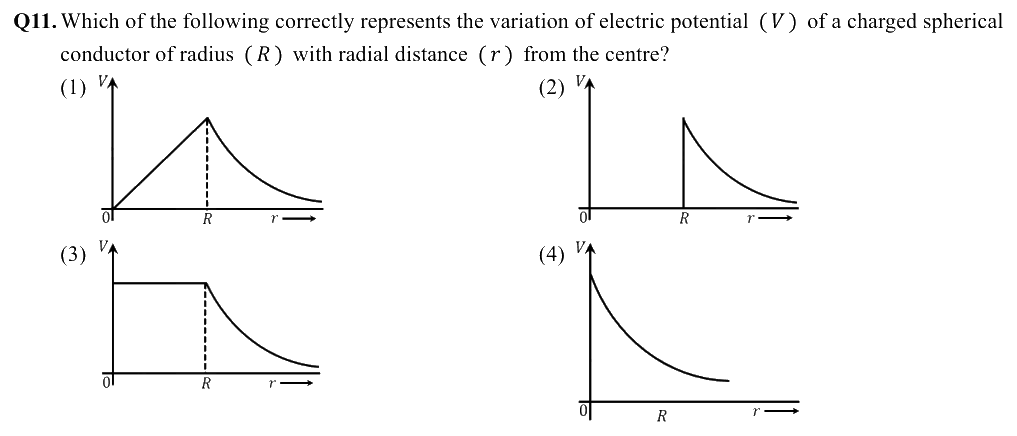
Which of the following correctly represents the variation of electric potential ($V$) of a charged spherical conductor of radius ($R$) with radial distance ($r$) from the centre?
Two isolated metallic solid spheres of radii $R$ and $2R$ are charged such that both have same charge density $\sigma$. The spheres are then connected by a thin conducting wire. If the new charge density of the bigger sphere is $\sigma'$. The ratio $\frac{\sigma'}{\sigma}$ is :
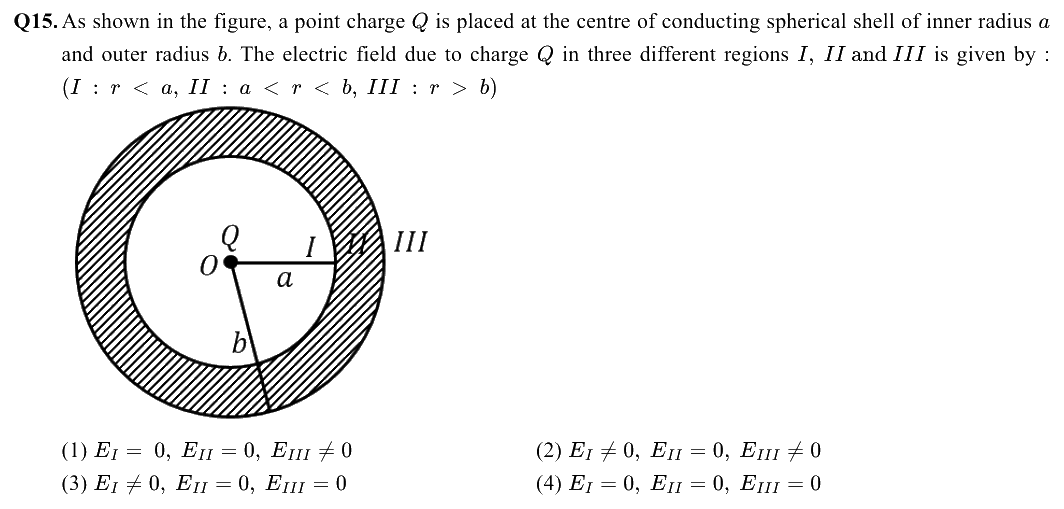
As shown in the figure, a point charge $Q$ is placed at the centre of conducting spherical shell of inner radius $a$ and outer radius $b$. The electric field due to charge $Q$ in three different regions $I$, $II$ and $III$ is given by : ($I$ : $r < a$, $II$ : $a < r < b$, $III$ : $r > b$)
In a cuboid of dimension $2L \times 2L \times L$, a charge $q$ is placed at the centre of the surface $S$ having area of $4L^2$. The flux through the opposite surface to $S$ is given by
A point charge $2 \times 10^{-2}$ C is moved from $P$ to $S$ in a uniform electric field of $30\ \mathrm{N\,C^{-1}}$ directed along positive $x$-axis. If coordinates of $P$ and $S$ are $(1, 2, 0)$ m and $(0, 0, 0)$ m respectively, the work done by electric field will be
A point charge of 10 $\mu$C is placed at the origin. At what location on the $X$-axis should a point charge of 40 $\mu$C be placed so that the net electric field is zero at $x=2$ cm on the $X$-axis ?
If two charges $q_1$ and $q_2$ are separated with distance $d$ and placed in a medium of dielectric constant $k$. What will be the equivalent distance between charges in air for the same electrostatic force?
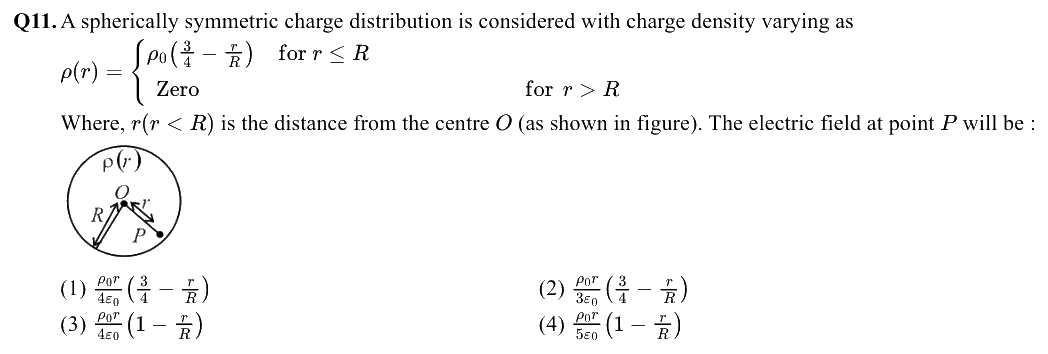
A spherically symmetric charge distribution is considered with charge density varying as $\rho(r) = \begin{cases} \rho_0\left(\frac{3}{4} - \frac{r}{R}\right) & \text{for } r \leq R \\ \text{Zero} & \text{for } r > R \end{cases}$ Where, $r(r < R)$ is the distance from the centre $O$ (as shown in figure). The electric field at point $P$ will be : (see the figure above)
Given below are two statements. Statement I : Electric potential is constant within and at the surface of each conductor. Statement II : Electric field just outside a charged conductor is perpendicular to the surface of the conductor at every point. In the light of the above statements, choose the most appropriate answer from the options give below.
A
Both statement I and statement II are correct
B
Both statement I and statement II are incorrect
C
Statement I is correct but statement II is incorrect
D
Statement I is incorrect but and statement II is correct
Two identical metallic spheres $A$ and $B$ when placed at certain distance in air repel each other with a force of $F$. Another identical uncharged sphere $C$ is first placed in contact with $A$ and then in contact with $B$ and finally placed at midpoint between spheres $A$ and $B$. The force experienced by sphere $C$ will be :
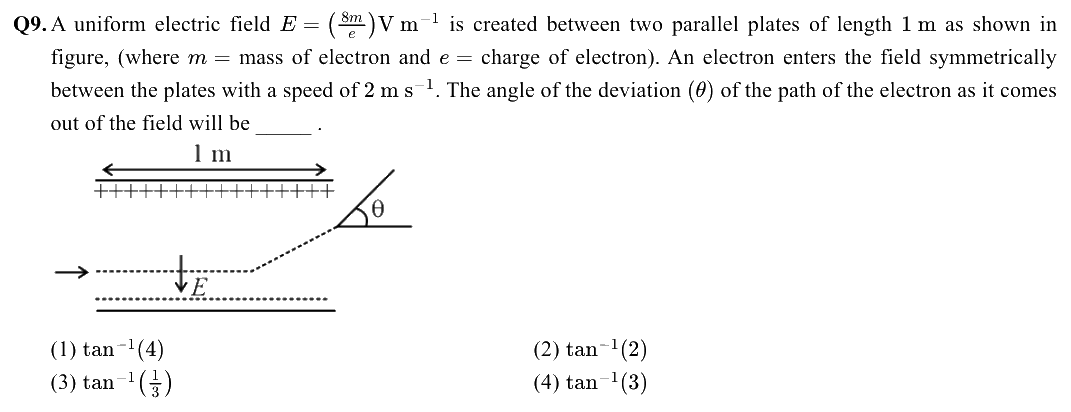
A uniform electric field $E=\left(\frac{8m}{e}\right)\mathrm{V\,m^{-1}}$ is created between two parallel plates of length $1\ \mathrm{m}$ as shown in figure, (where $m=$ mass of electron and $e=$ charge of electron). An electron enters the field symmetrically between the plates with a speed of $2\ \mathrm{m\,s^{-1}}$. The angle of the deviation ($\theta$) of the path of the electron as it comes out of the field will be ______.
Two identical positive charges $Q$ each are fixed at a distance of $2a$ apart from each other. Another point charge $q_0$ with mass $m$ is placed at midpoint between two fixed charges. For a small displacement along the line joining the fixed charges, the charge $q_0$ executes SHM. The time period of oscillation of charge $q_0$ will be
A charge of $4\mu\mathrm{C}$ is to be divided into two. The distance between the two divided charges is constant. The magnitude of the divided charges so that the force between them is maximum, will be:
Two uniformly charged spherical conductors $A$ and $B$ of radii $5\ \mathrm{mm}$ and $10\ \mathrm{mm}$ are separated by a distance of $2\ \mathrm{cm}$. If the spheres are connected by a conducting wire, then in equilibrium condition, the ratio of the magnitudes of the electric fields at the surface of the sphere $A$ and $B$ will be
A positive charge particle of $100\ \mathrm{mg}$ is thrown in opposite direction to a uniform electric field of strength $1 \times 10^5\ \mathrm{N\,C^{-1}}$. If the charge on the particle is $40\ \mu\mathrm{C}$ and the initial velocity is $200\ \mathrm{m\,s^{-1}}$, how much distance it will travel before coming to the rest momentarily
Two point charges $Q$ each are placed at a distance $d$ apart. A third point charge $q$ is placed at a distance $x$ from mid-point on the perpendicular bisector. The value of $x$ at which charge $q$ will experience the maximum Coulomb's force is:
Statement-I : A point charge is brought in an electric field. The value of electric field at a point near to the charge may increase if the charge is positive. Statement-II : An electric dipole is placed in a uniform electric field. The net electric force on the dipole will not be zero.
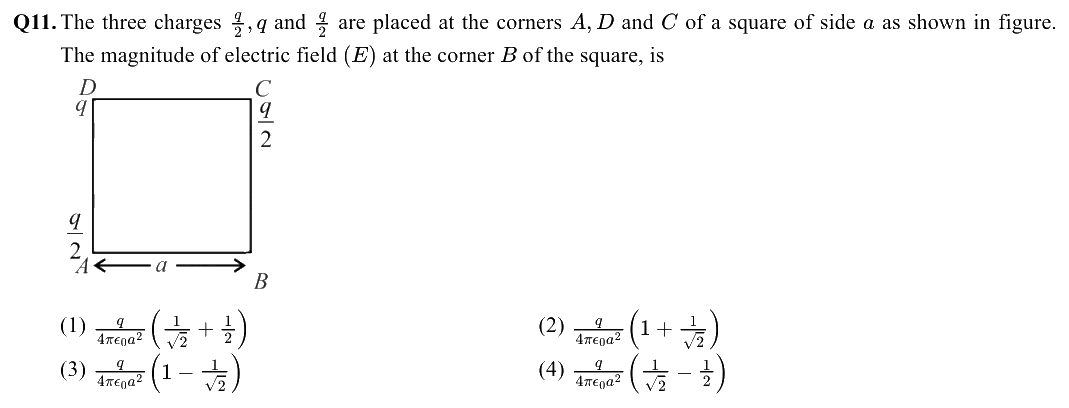
The three charges $\dfrac{q}{2}, q$ and $\dfrac{q}{2}$ are placed at the corners $A, D$ and $C$ of a square of side $a$ as shown in figure. The magnitude of electric field $(E)$ at the corner $B$ of the square, is
Two point charges $A$ and $B$ of magnitude $+8 \times 10^{-6}\mathrm{C}$ and $-8 \times 10^{-6}\mathrm{C}$ respectively are placed at a distance $d$ apart. The electric field at the middle point $O$ between the charges is $6.4 \times 10^{4}\ \mathrm{N\ C^{-1}}$. The distance 'd' between the point charges $A$ and $B$ is
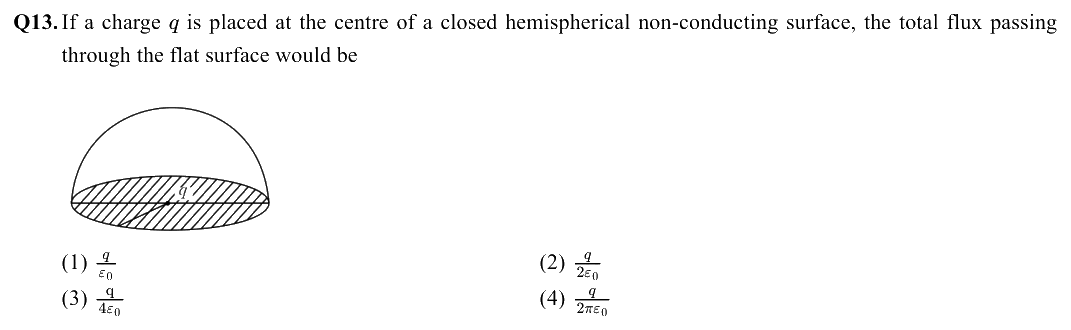
If a charge $q$ is placed at the centre of a closed hemispherical non-conducting surface, the total flux passing through the flat surface would be (see the figure above)
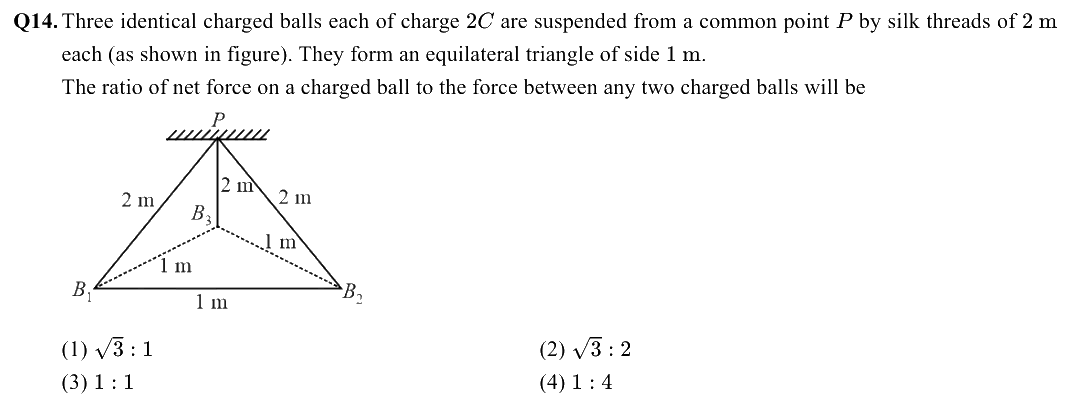
Three identical charged balls each of charge $2C$ are suspended from a common point $P$ by silk threads of $2\ \mathrm{m}$ each (as shown in figure). They form an equilateral triangle of side $1\ \mathrm{m}$. The ratio of net force on a charged ball to the force between any two charged balls will be (see the figure above)
Sixty four conducting drops each of radius $0.02 \mathrm{~m}$ and each carrying a charge of $5 \mu\mathrm{C}$ are combined to form a bigger drop. The ratio of surface density of bigger drop to the smaller drop will be
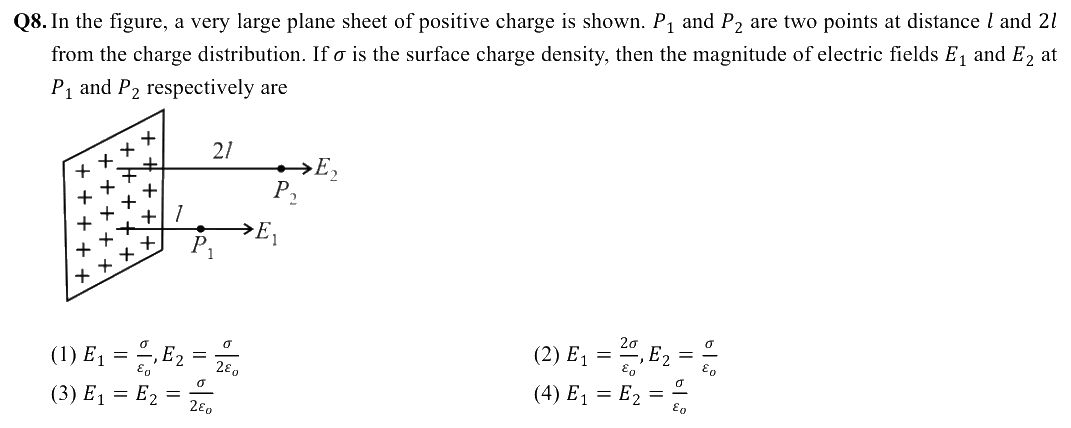
In the figure, a very large plane sheet of positive charge is shown. $P_1$ and $P_2$ are two points at distance $l$ and $2l$ from the charge distribution. If $\sigma$ is the surface charge density, then the magnitude of electric fields $E_1$ and $E_2$ at $P_1$ and $P_2$ respectively are (see the figure above)
A vertical electric field of magnitude $4.9 \times 10^{5} \mathrm{~N~C^{-1}}$ just prevents a water droplet of a mass $0.1 \mathrm{~g}$ from falling. The value of charge on the droplet will be : (Given $g = 9.8 \mathrm{~m~s^{-2}}$)
Two identical charged particles each having a mass $10 \mathrm{~g}$ and charge $2.0 \times 10^{-7} \mathrm{C}$ are placed on a horizontal table with a separation of $L$ between them such that they stay in limited equilibrium. If the coefficient of friction between each particle and the table is $0.25$, find the value of $L$. [Use $\mathrm{g} = 10 \mathrm{~ms^{-2}}$ ]
A long cylindrical volume contains a uniformly distributed charge of density $\rho$. The radius of cylindrical volume is $R$. A charge particle $(q)$ revolves around the cylinder in a circular path. The kinetic energy of the particle is :
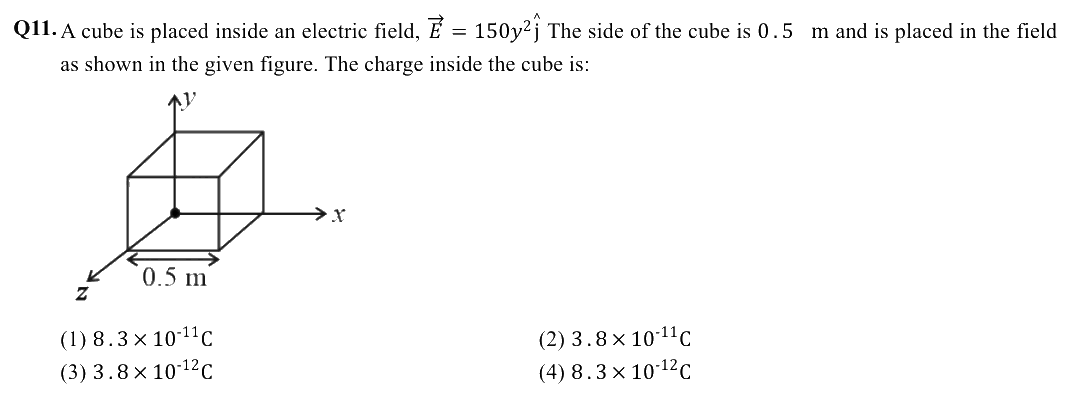
A cube is placed inside an electric field, $\vec{E} = 150y^2\hat{j}$ The side of the cube is $0.5$ m and is placed in the field as shown in the given figure. The charge inside the cube is: (see the figure above)
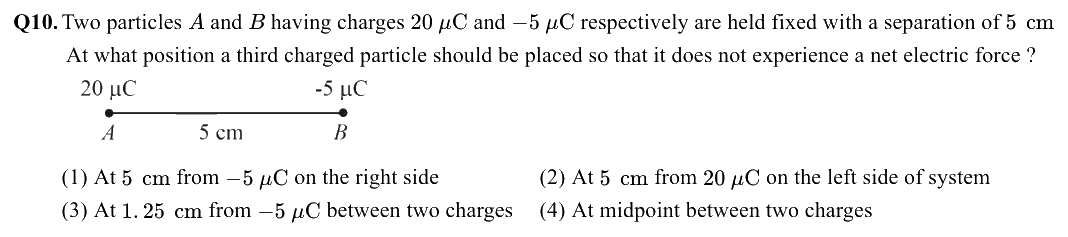
Two particles $A$ and $B$ having charges $20$ $\mu$C and $-5$ $\mu$C respectively are held fixed with a separation of $5$ cm. At what position a third charged particle should be placed so that it does not experience a net electric force ? (see the figure above)
The question as printed in the paper.
A
At $5$ cm from $-5$ $\mu$C on the right side
B
At $5$ cm from $20$ $\mu$C on the left side of system
Choose the incorrect statement: (a) The electric lines of force entering into a Gaussian surface provide negative flux. (b) A charge $q$ is placed at the centre of a cube. The flux through all the faces will be the same. (c) In a uniform electric field net flux through a closed Gaussian surface containing no net charge, is zero. (d) When an electric field is parallel to a Gaussian surface, it provides a finite non-zero flux. Choose the most appropriate answer from the options given below:
A uniformly charged disc of radius $R$ having surface charge density $\sigma$ is placed in the $xy$ plane with its center at the origin. Find the electric field intensity along the $z$-axis at a distance $Z$ from origin:
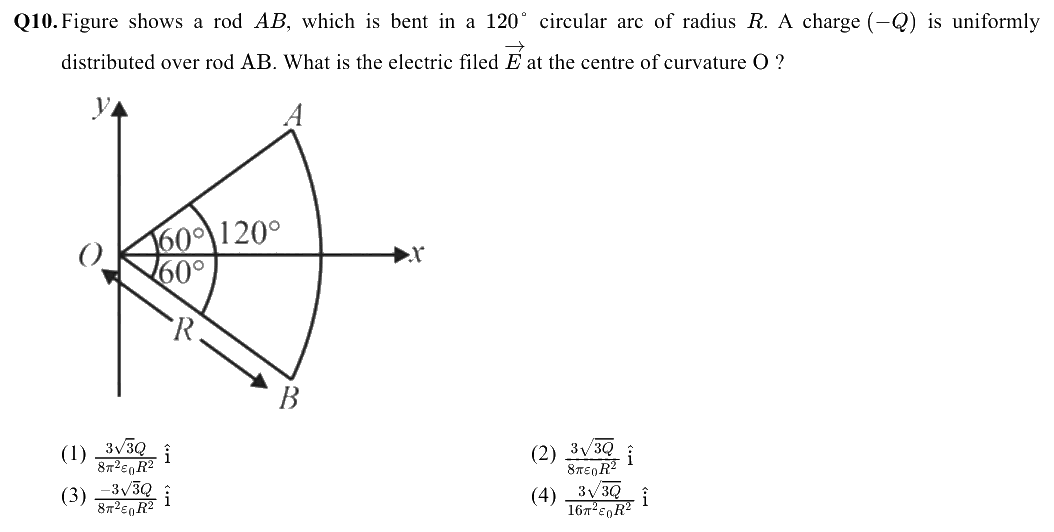
Figure shows a rod $AB$, which is bent in a $120^\circ$ circular arc of radius $R$. A charge $(-Q)$ is uniformly distributed over rod AB. What is the electric filed $\vec{E}$ at the centre of curvature O ? (see the figure above)
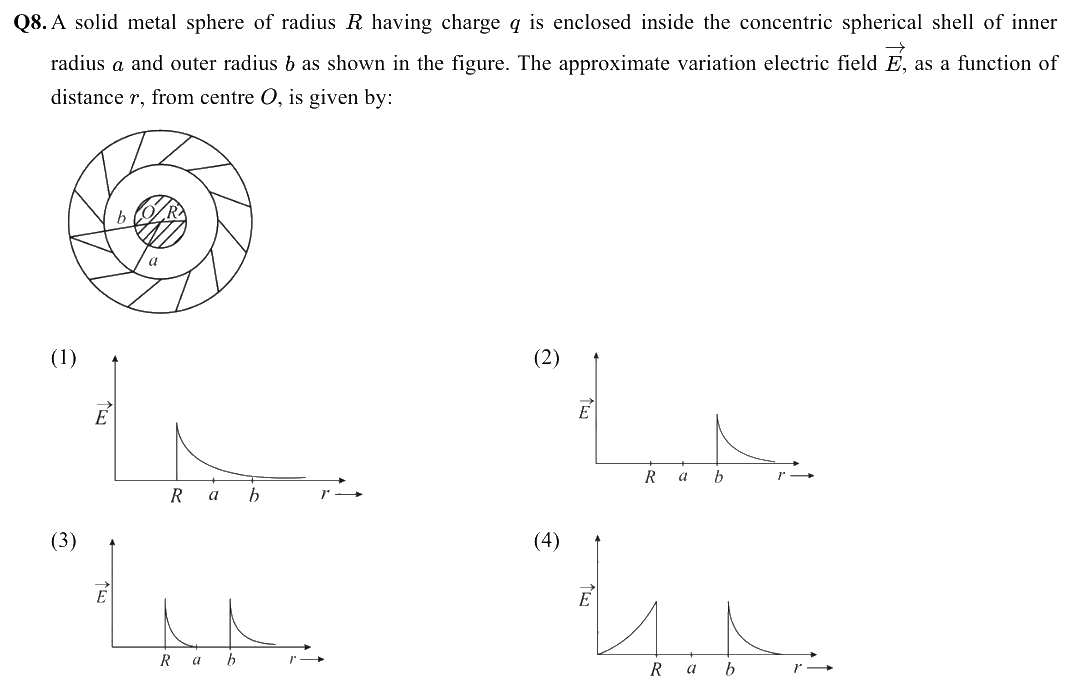
A solid metal sphere of radius $R$ having charge $q$ is enclosed inside the concentric spherical shell of inner radius $a$ and outer radius $b$ as shown in the figure. The approximate variation electric field $\vec{E}$, as a function of distance $r$, from centre $O$, is given by: (see the figure above)
The question as printed in the paper.
A
see figure Graph of E against r with R, a, b marked on the r axis: E jumps to a high value at r = R and then decreases smoothly (like 1/r^2) towards zero, continuing past a and b as a single decaying curve; no break at a or b.
B
see figure Graph of E against r with R, a, b marked on the r axis: E is zero from the origin up to r = b, then jumps to a high value at r = b and decreases towards zero.
C
see figure Graph of E against r with R, a, b marked on the r axis: E is zero up to r = R, jumps to a high value at R and decays towards zero by a, is zero between a and b, then jumps again at b and decays.
D
see figure Graph of E against r with R, a, b marked on the r axis: E rises from zero at the origin as a curve up to a maximum at r = R, then drops to zero (is zero between R and b, including a), then jumps at b and decays towards zero.
The two thin coaxial rings, each of radius $a$ and having charges $+Q$ and $-Q$ respectively are separated by a distance of $s$. The potential difference between the centres of the two rings is :
Two identical tennis balls each having mass $m$ and charge $q$ are suspended from a fixed point by threads of length $l$. What is the equilibrium separation when each thread makes a small angle $\theta$ with the vertical?
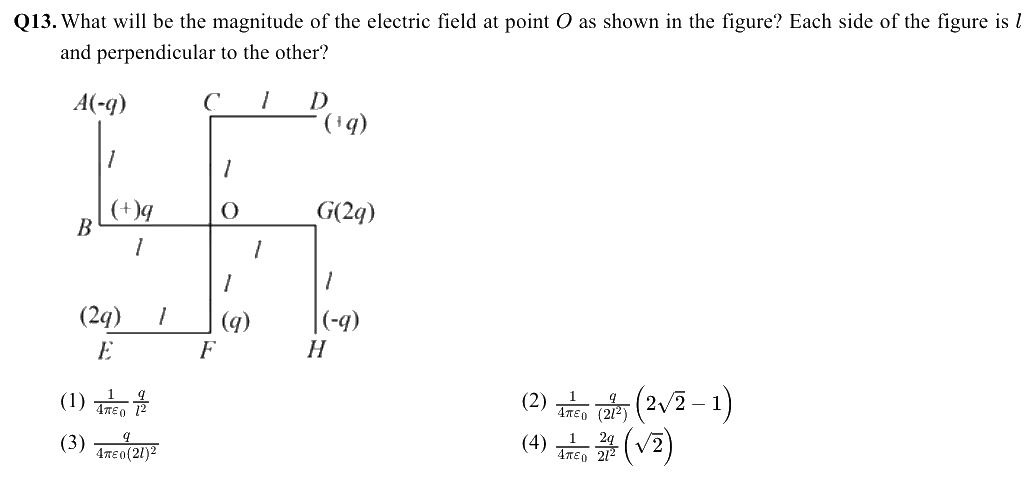
What will be the magnitude of the electric field at point $O$ as shown in the figure? Each side of the figure is $l$ and perpendicular to the other? (see the figure above)
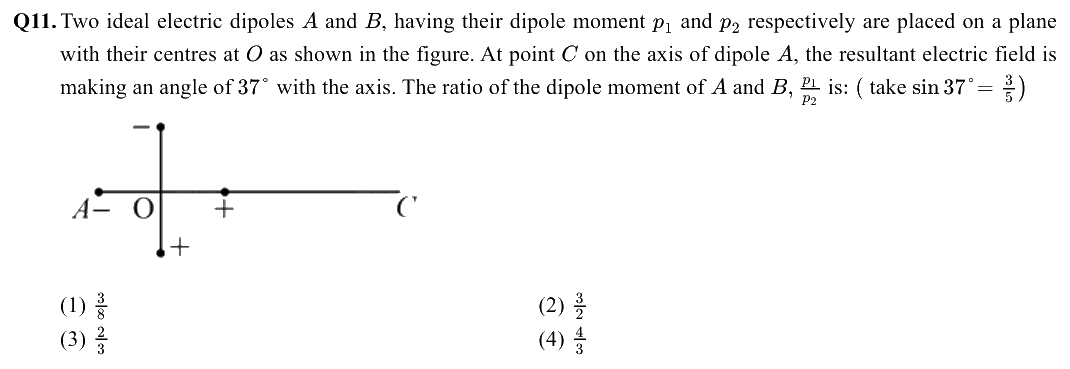
Two ideal electric dipoles $A$ and $B$, having their dipole moment $p_1$ and $p_2$ respectively are placed on a plane with their centres at $O$ as shown in the figure. At point $C$ on the axis of dipole $A$, the resultant electric field is making an angle of $37^\circ$ with the axis. The ratio of the dipole moment of $A$ and $B$, $\frac{p_1}{p_2}$ is: ( take $\sin 37^\circ = \frac{3}{5}$) (see the figure above)
An electric dipole is placed on $x$-axis in proximity to a line charge of linear charge density $3.0 \times 10^{-6}\ \mathrm{C\ m^{-1}}$. Line charge is placed on z-axis and positive and negative charge of dipole is at a distance of $10\ \mathrm{mm}$ and $12\ \mathrm{mm}$ from the origin respectively. If total force of $4\ \mathrm{N}$ is exerted on the dipole, find out the amount of positive or negative charge of the dipole.
A certain charge $Q$ is divided into two parts $q$ and $(Q - q)$. How should the charges $Q$ and $q$ be divided so that $q$ and $(Q - q)$ placed at a certain distance apart experience maximum electrostatic repulsion?
An oil drop of the radius $2~\mathrm{mm}$ with a density $3~\mathrm{g~cm^{-3}}$ is held stationary under a constant electric field $3.55 \times 10^5~\mathrm{V~m^{-1}}$ in the Millikan's oil drop experiment. What is the number of excess electrons that the oil drop will possess? (consider $g = 9.81~\mathrm{m\,s^{-2}}$).
Find out the surface charge density at the intersection of point $x = 3\ \mathrm{m}$ plane and $x$-axis, in the region of uniform line charge of $8\ \mathrm{nC\ m^{-1}}$ lying along the $z$-axis in free space.
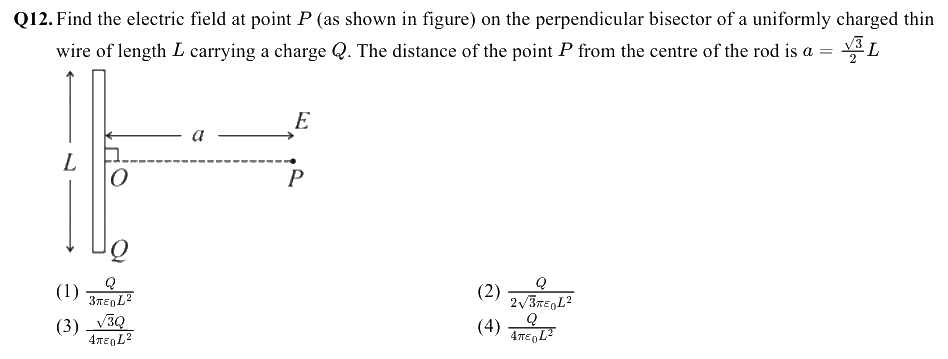
Find the electric field at point $P$ (as shown in figure) on the perpendicular bisector of a uniformly charged thin wire of length $L$ carrying a charge $Q$. The distance of the point $P$ from the centre of the rod is $a = \frac{\sqrt{3}}{2}L$ (see the figure above)
Given below are two statements Statement I : An electric dipole is placed at the centre of a hollow sphere. The flux of electric field through the sphere is zero, but the electric field is not zero anywhere in the sphere. Statement II : If $R$ is the radius of a solid metallic sphere and $Q$ be the total charge on it. The electric field at any point on the spherical surface of radius $r(< R)$ is zero but the electric flux passing through this closed spherical surface of radius $r$ is not In the light of the above statements, choose the correct answer from the options given below:
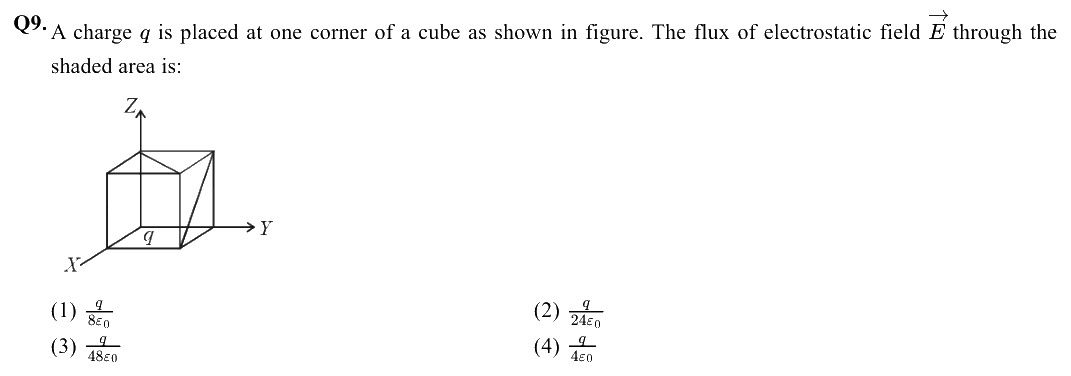
A charge $q$ is placed at one corner of a cube as shown in figure. The flux of electrostatic field $\vec{E}$ through the shaded area is: (see the figure above)
An electron with kinetic energy $K_1$ enters between parallel plates of a capacitor at an angle $\alpha$ with the plates. It leaves the plates at angle $\beta$ with kinetic energy $K_2$. Then the ratio of kinetic energies $K_1 : K_2$ will be :
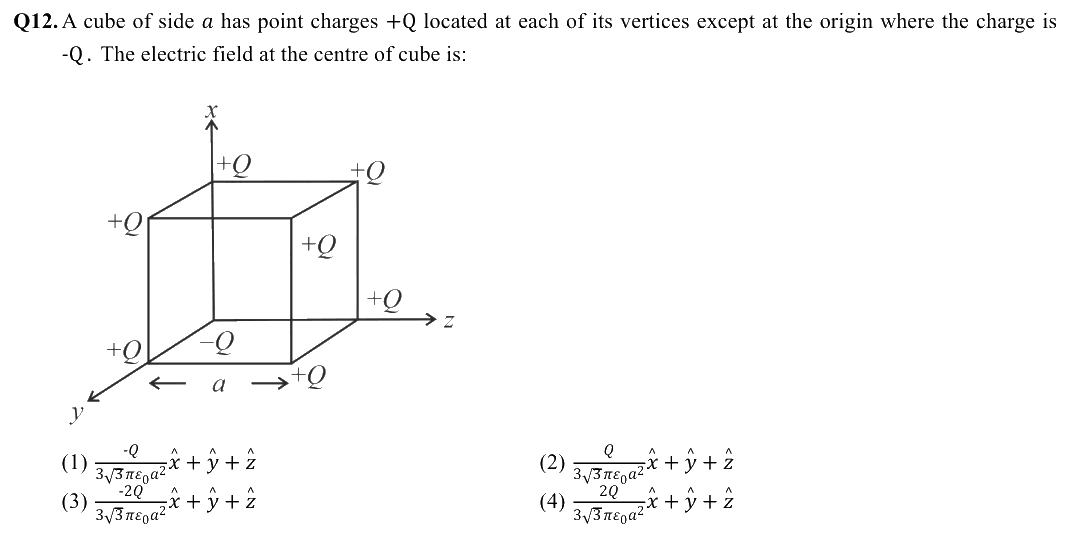
A cube of side $a$ has point charges $+Q$ located at each of its vertices except at the origin where the charge is $-Q$. The electric field at the centre of cube is: (see the figure above)
Two electrons each are fixed at a distance $2d$. A third charge proton placed at the midpoint is displaced slightly by a distance $x(x \ll d)$ perpendicular to the line joining the two fixed charges. Proton will execute simple harmonic motion having angular frequency: ($m$ = mass of charged particle)
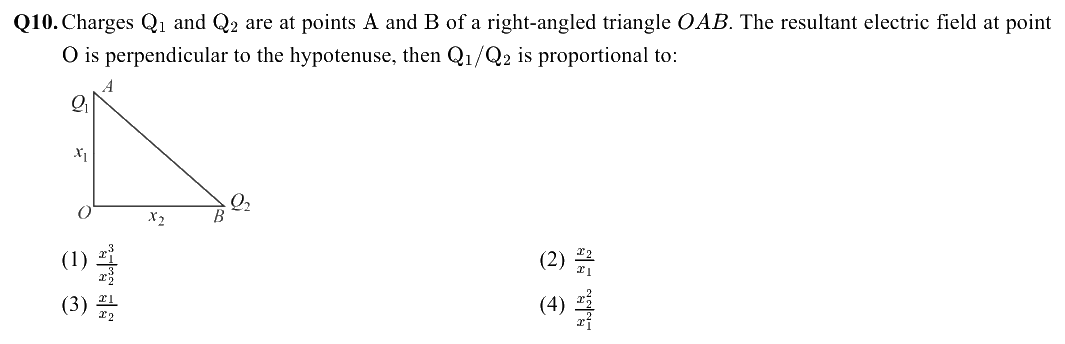
Charges $\mathrm{Q_1}$ and $\mathrm{Q_2}$ are at points A and B of a right-angled triangle $OAB$. The resultant electric field at point O is perpendicular to the hypotenuse, then $\mathrm{Q_1/Q_2}$ is proportional to: (see the figure above)
Two identical electric point dipoles have dipole have dipole moments $\vec{p_1} = p\hat{i}$ and $\vec{p_2} = -p\hat{i}$ and are held on the x-axis at distance 'a' from each other. When released, they move along the x-axis with the direction of their dipole moments remaining unchanged. If the mass of each dipole is 'm', their speed when they are infinitely far apart is :
Consider the force F on a charge 'q' due to a uniformly charged spherical shell of radius R carrying charge Q distributed uniformly over it. Which one of the following statements is true for F, if 'q' is placed at distance r from the centre of the shell?
A
$F = \frac{1}{4\pi\epsilon_0}\frac{Qq}{R^2}$ for $r < R$
B
$\frac{1}{4\pi\epsilon_0}\frac{qQ}{R^2} > F > 0$ for $r < R$
C
$F = \frac{1}{4\pi\epsilon_0}\frac{Qq}{r^2}$ for $r > R$
D
$F = \frac{1}{4\pi\epsilon_0}\frac{Qq}{r^2}$ for all r
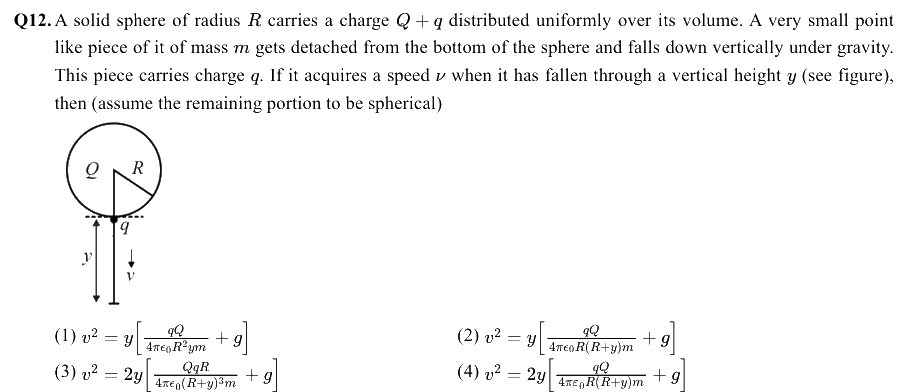
A solid sphere of radius $R$ carries a charge $Q + q$ distributed uniformly over its volume. A very small point like piece of it of mass $m$ gets detached from the bottom of the sphere and falls down vertically under gravity. This piece carries charge $q$. If it acquires a speed $v$ when it has fallen through a vertical height $y$ (see figure), then (assume the remaining portion to be spherical) (see the figure above)
Ten charges are placed on the circumference of a circle of radius R with constant angular separation between successive charges. Alternate charges1, 3, 5, 7, 9 have charge $(+q)$ each, while 2, 4, 6, 8, 10 have charge $(-q)$ each. The potential V and the electric field E at the centre of the circle are respectively : (Take$V = 0$ at infinity)
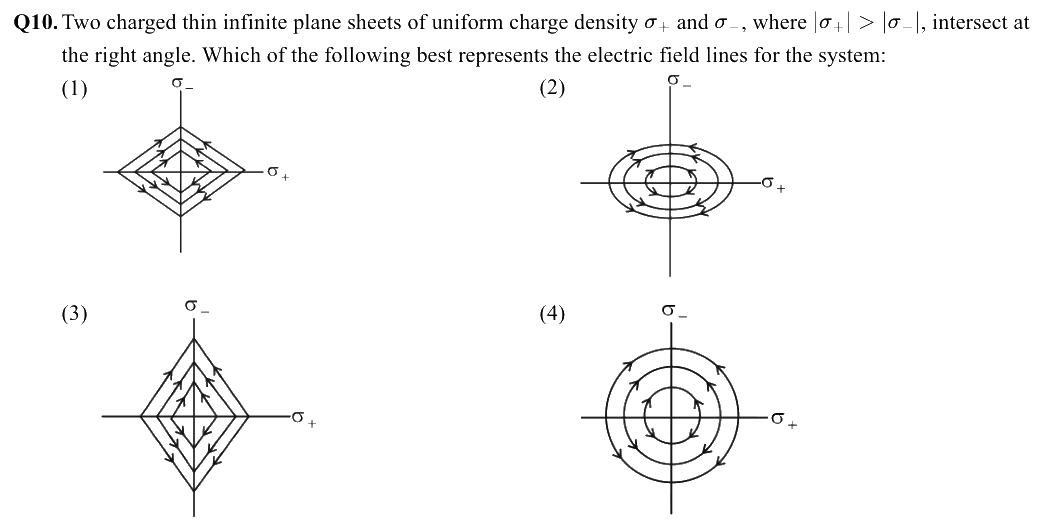
Two charged thin infinite plane sheets of uniform charge density $\sigma_{+}$ and $\sigma_{-}$, where $|\sigma_{+}| > |\sigma_{-}|$, intersect at the right angle. Which of the following best represents the electric field lines for the system:
The question as printed in the paper.
A
see figure nested diamond-shaped closed loops, wider than tall
B
see figure nested ellipse-shaped closed loops, wider than tall
C
see figure nested diamond-shaped closed loops, taller than wide
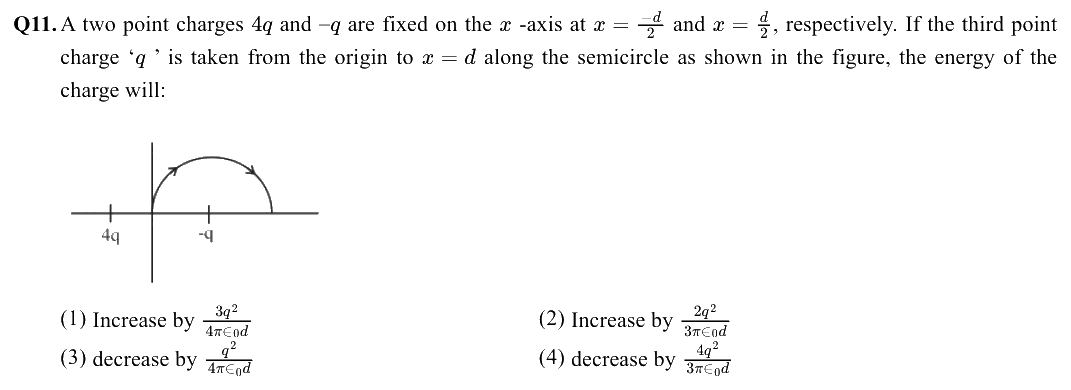
A two point charges $4q$ and $-q$ are fixed on the $x$ -axis at $x = \frac{-d}{2}$ and $x = \frac{d}{2}$, respectively. If the third point charge 'q ' is taken from the origin to $x = d$ along the semicircle as shown in the figure, the energy of the charge will: (see the figure above)
A particle of charge $q$ and mass $m$ is subjected to an electric field $E = E_{0}\left(1-ax^{2}\right)$ in the $x-$direction, where $a$ and $E_{0}$ are constants. Initially the particle was at rest at $x = 0$. Other than the initial position the kinetic energy of the particle becomes zero when the distance of the particle from the origin is :
Two isolated conducting spheres $S_1$ and $S_2$ of radius $\frac{2}{3}R$ and $\frac{1}{3}R$ have $12\ \mu C$ and $-3\ \mu C$ charges, respectively, and are at a large distance from each other, They are now connected by a conducting wire. A long time after this is done the charges on $S_1$ and $S_2$ are respectively :
Hydrogen ion and singly ionized helium atom are accelerated, from rest, through the same potential difference. The ratio of final speeds of hydrogen and helium ions is close to:
Concentric metallic hollow spheres of radii R and 4R hold charges $Q_1$ and $Q_2$ respectively. Given that surface charge densities of the concentric spheres are equal, the potential difference $V(R) - V(4R)$ is:
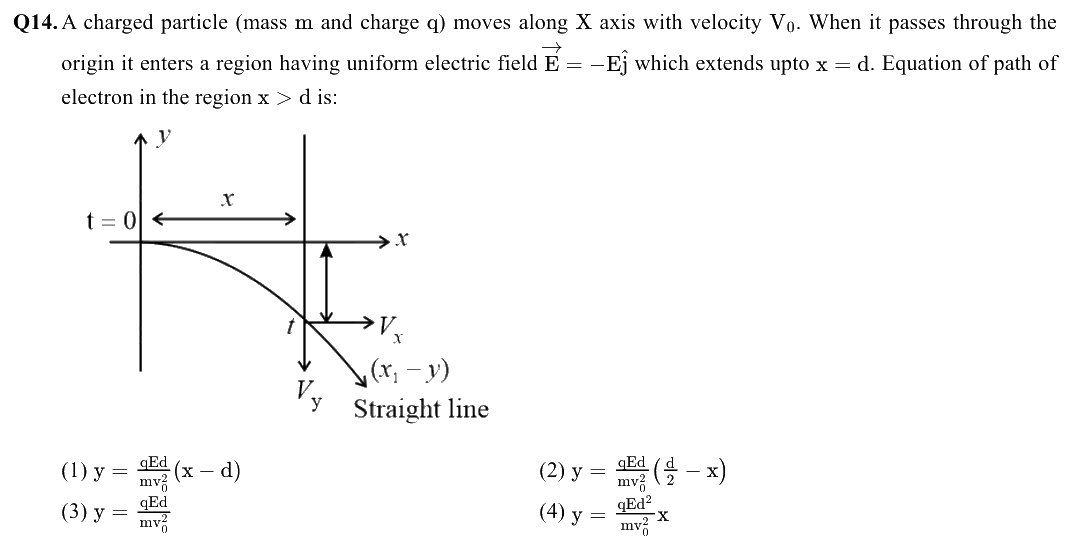
A charged particle (mass m and charge q) moves along X axis with velocity $\mathrm{V}_{0}$. When it passes through the origin it enters a region having uniform electric field $\overrightarrow{\mathrm{E}} = -\mathrm{E}\hat{\mathrm{j}}$ which extends upto $\mathrm{x} = \mathrm{d}$. Equation of path of electron in the region $\mathrm{x} > \mathrm{d}$ is: (see the figure above)
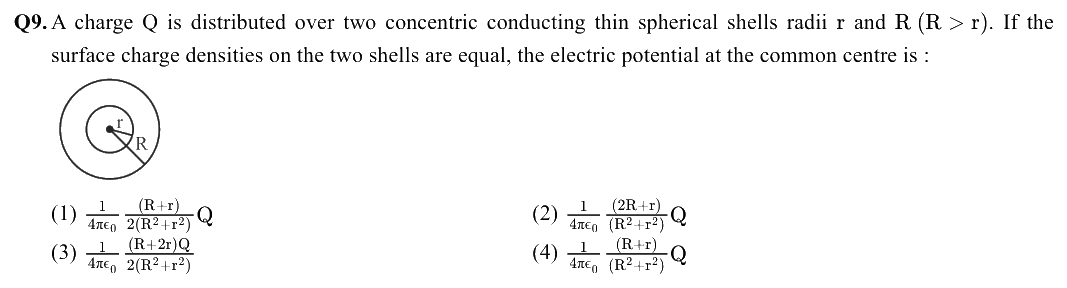
A charge Q is distributed over two concentric conducting thin spherical shells radii r and R (R > r). If the surface charge densities on the two shells are equal, the electric potential at the common centre is : (see the figure above)
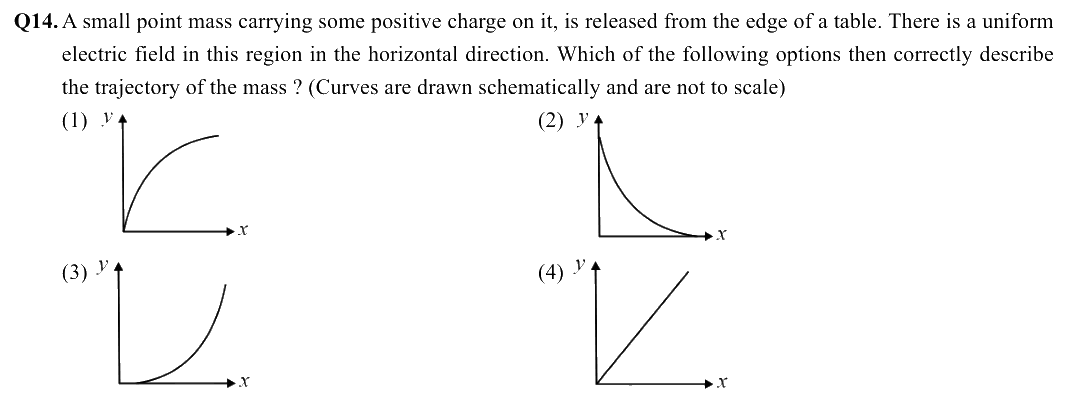
A small point mass carrying some positive charge on it, is released from the edge of a table. There is a uniform electric field in this region in the horizontal direction. Which of the following options then correctly describe the trajectory of the mass ? (Curves are drawn schematically and are not to scale)
The question as printed in the paper.
A
see figure y-versus-x graph: curve rising from the origin, steep at first and flattening (concave down).
B
see figure y-versus-x graph: curve starting high on the y axis and falling, flattening towards the x axis (decreasing, concave up).
C
see figure y-versus-x graph: curve rising from the origin, flat at first and getting steeper (concave up).
D
see figure y-versus-x graph: straight line rising from the origin.
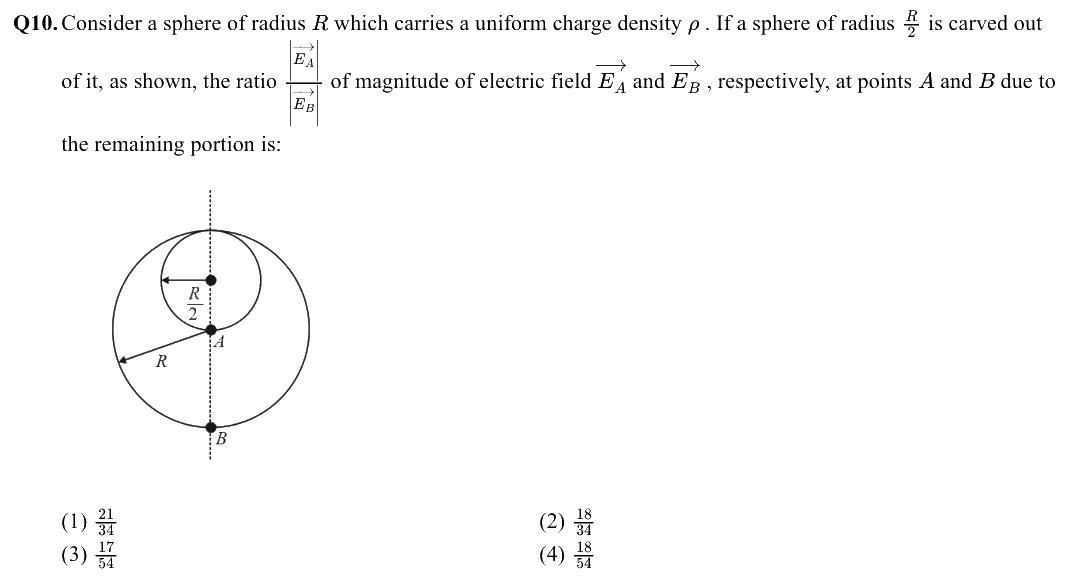
Consider a sphere of radius $R$ which carries a uniform charge density $\rho$ . If a sphere of radius $\frac{R}{2}$ is carved out of it, as shown, the ratio $\frac{\left|\overrightarrow{E_A}\right|}{\left|\overrightarrow{E_B}\right|}$ of magnitude of electric field $\overrightarrow{E_A}$ and $\overrightarrow{E_B}$ , respectively, at points $A$ and $B$ due to the remaining portion is: (see the figure above)
An electric dipole of moment $\overrightarrow{\mathrm{p}} = \left(-\hat{i} - 3\hat{j} + 2\hat{k}\right) \times 10^{-29}\ \mathrm{C\ m}$ at the origin $(0,0,0)$ . The electric field due to this dipole at $\overrightarrow{\mathrm{r}} = +\hat{i} + 3\hat{j} + 5\hat{k}$ (note that $\overrightarrow{r} \bullet \overrightarrow{p} = 0$ ) is parallel to:
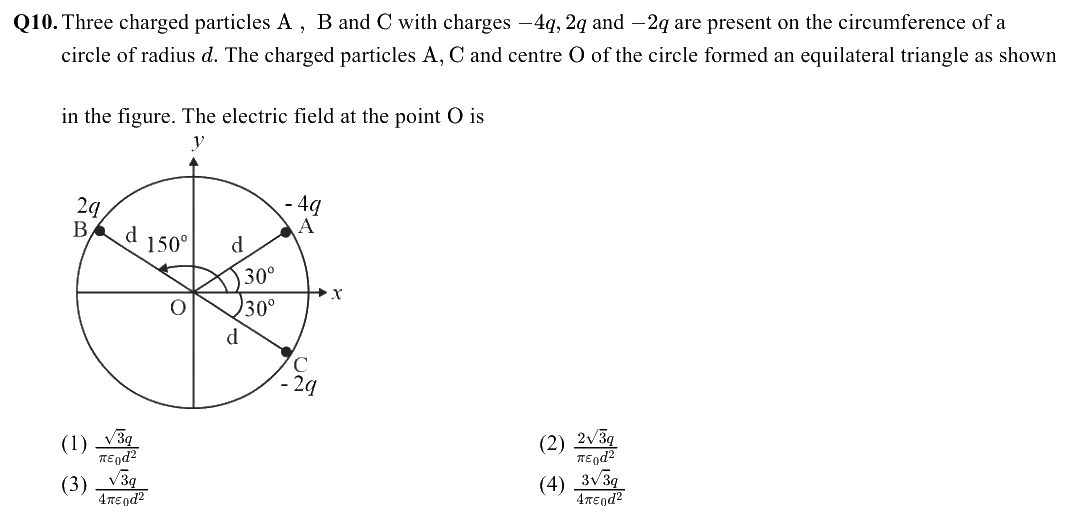
Three charged particles A , B and C with charges $-4q$, $2q$ and $-2q$ are present on the circumference of a circle of radius $d$. The charged particles A, C and centre O of the circle formed an equilateral triangle as shown in the figure. The electric field at the point O is (see the figure above)
In finding the electric field using Gauss law the formula $\left|\vec{E}\right| = \frac{q_{\mathrm{enc}}}{\varepsilon_0|A|}$ is applicable. In the formula $\varepsilon_0$ is permittivity of free space, $A$ is the area of Gaussian surface and $q_{\mathrm{enc}}$ is charge enclosed by the Gaussian surface. This equation can be used in which of the following situation?
A
Only when the Gaussian surface is an equipotential surface
B
Only when the Gaussian surface is an equipotential surface and $\left|\vec{E}\right|$ is constant on the surface.
C
Only when $\left|\vec{E}\right|$ = constant on the surface.
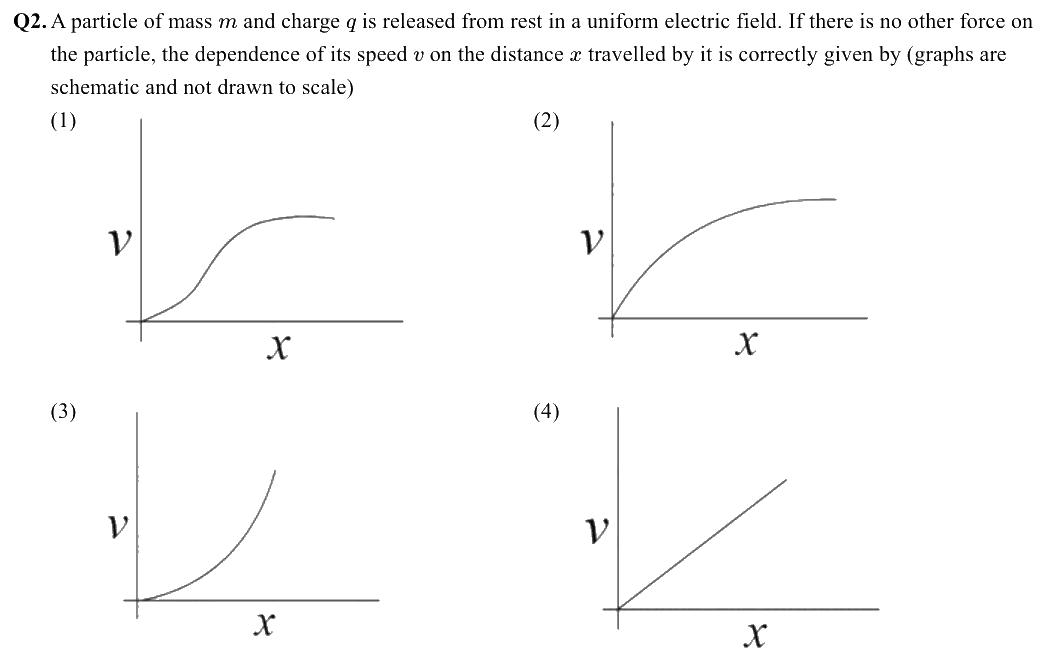
A particle of mass $m$ and charge $q$ is released from rest in a uniform electric field. If there is no other force on the particle, the dependence of its speed $v$ on the distance $x$ travelled by it is correctly given by (graphs are schematic and not drawn to scale)
Consider two charged metallic spheres $S_1$ and $S_2$ of radii $R_1$ and $R_2$, respectively. The electric fields $E_1$ (on $S_1$) and $E_2$ (on $S_2$) on their surfaces are such that $\frac{E_1}{E_2} = \frac{R_1}{R_2}$. Then the ratio $V_1$ (on $S_1$)$/V_2$ (on $S_2$) of the electrostatic potentials on each sphere is:
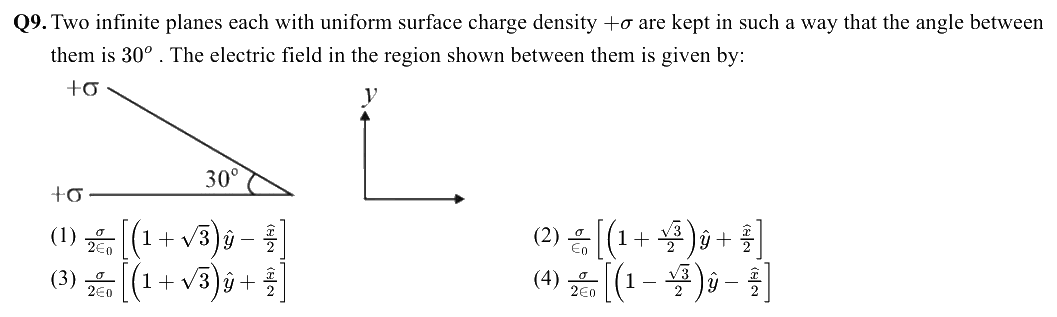
Two infinite planes each with uniform surface charge density $+\sigma$ are kept in such a way that the angle between them is $30^\circ$. The electric field in the region shown between them is given by: (see the figure above)
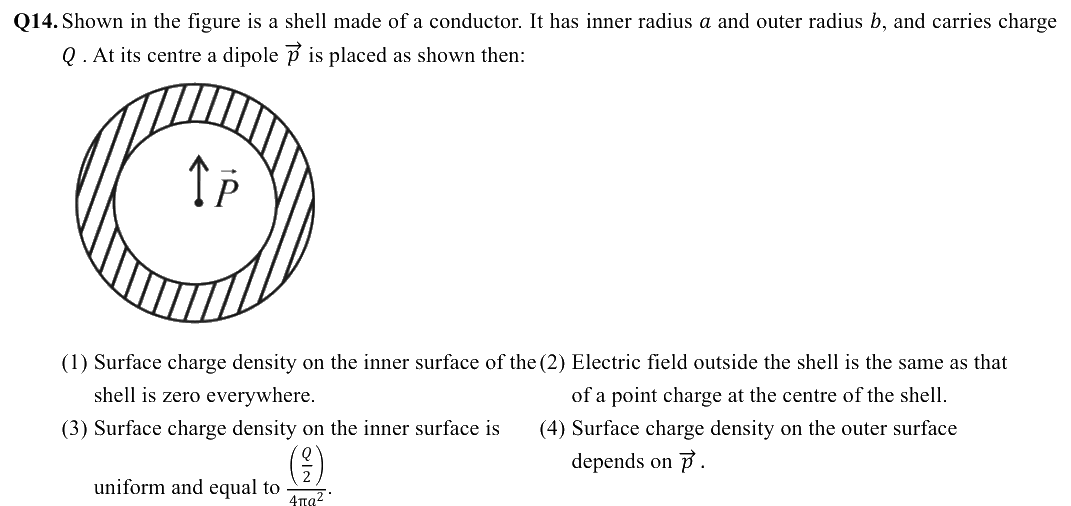
Shown in the figure is a shell made of a conductor. It has inner radius $a$ and outer radius $b$, and carries charge $Q$ . At its centre a dipole $\vec{p}$ is placed as shown then: (see the figure above)
The question as printed in the paper.
A
Surface charge density on the inner surface of the shell is zero everywhere.
B
Electric field outside the shell is the same as that of a point charge at the centre of the shell.
C
Surface charge density on the inner surface is uniform and equal to $\frac{\left(\frac{Q}{2}\right)}{4\pi a^2}$.
D
Surface charge density on the outer surface depends on $\vec{p}$ .
A Point dipole $\vec{\mathrm{p}} = -\mathrm{p_0}\hat{x}$ is kept at the origin. The potential and electric field due to this dipole on the $y -$ axis at a distance d are, respectively: (Taken V = 0 at infinity)
Let a total charge 2Q be distributed in a sphere of radius R, with the charge density given by $\rho(\mathrm{r}) = \mathrm{kr}$, where r is the distance from the centre. Two charges A and B , of $-\mathrm{Q}$ each, are placed on diametrically opposite points, at equal distance, a, from the centre. If A and B do not experience any force, then:
A uniformly charged ring of radius $3a$ and total charge $q$ is placed in $x$-$y$ plane centred at origin. A point charge $q$ is moving towards the ring along the $z-$ axis and has speed $v$ at $z = 4a$ . The minimum value of $v$ such that it crosses the origin is:
In free space, a particle $A$ of charge $1\ \mu\mathrm{C}$ is held fixed at point $P$. Another particle $B$ of the same charge and mass $4\ \mathrm{mg}$ is kept at a distance of $1\ \mathrm{mm}$ from $P$. If $B$ is released, then its velocity at a distance of $9\ \mathrm{mm}$ from $P$ is: [Take $\frac{1}{4\pi\epsilon_0} = 9\times10^{9}\ \mathrm{N\,m^{2}\,C^{-2}}$ ]
Four point charges $-q$, $+q$, $+q$ and $-q$ are placed on y-axis at y = $-2d$, y = $-d$, y = $+d$ and y = $+2d$, respectively. The magnitude of the electric field E at a point on the x-axis at x = D, with D $\gg$ d, will behave as:
The bob of a simple pendulum has mass 2 g and a charge of 5.0 $\mu$C. It is at rest in a uniform horizontal electric field of intensity 2000 V / m At equilibrium, the angle that the pendulum makes with the vertical is: take $g = 10\ \mathrm{m/s^2}$
A solid conducting sphere, having a charge Q, is surrounded by an uncharged conducting hollow spherical shell. Let the potential difference between the surface of the solid sphere and that of the outer surface of the hollow shell be $V$. If the shell is now given a charge of $-4Q$, the new potential difference between the same two surfaces is:
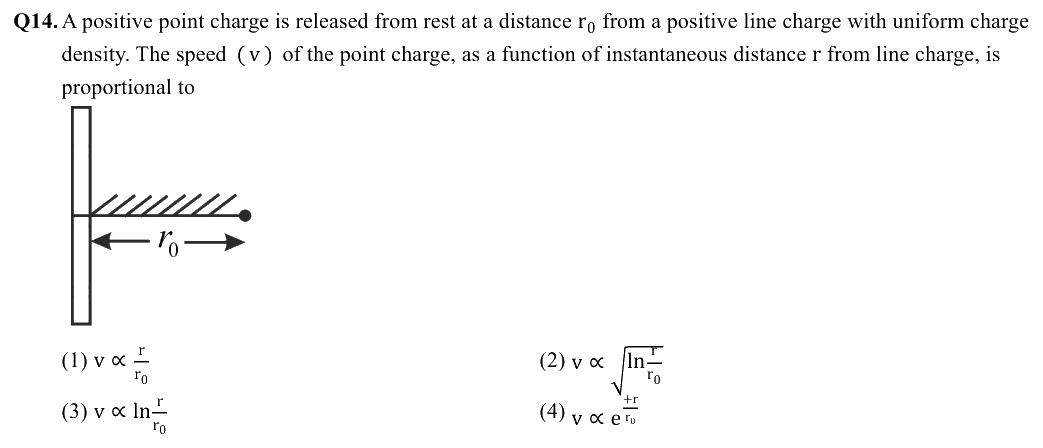
A positive point charge is released from rest at a distance $\mathrm{r_0}$ from a positive line charge with uniform charge density. The speed ($\mathrm{v}$) of the point charge, as a function of instantaneous distance r from line charge, is proportional to
An electric dipole is formed by two equal and opposite charges q with separation d . The charges have same mass m. It is kept in a uniform electric field E. If it is slightly rotated from its equilibrium orientation, then its angular frequency $\omega$ is:
The electric field in a region is given by $\vec{E}$ = Ax + B $\hat{i}$ , where E is in $\mathrm{NC^{-1}}$ and x is in metres. The values of constants are A = 20 SI unit and B = 10 SI unit. If the potential at x = 1 is $\mathrm{V_1}$ and that at x = - 5 is $\mathrm{V_2}$, then $\mathrm{V_1}$ - $\mathrm{V_2}$ is
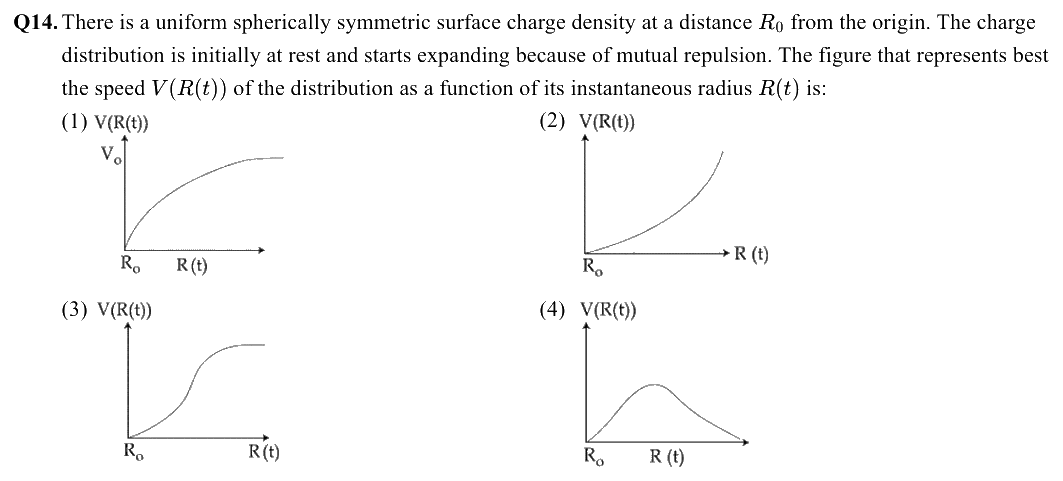
There is a uniform spherically symmetric surface charge density at a distance $R_0$ from the origin. The charge distribution is initially at rest and starts expanding because of mutual repulsion. The figure that represents best the speed $V(R(t))$ of the distribution as a function of its instantaneous radius $R(t)$ is:
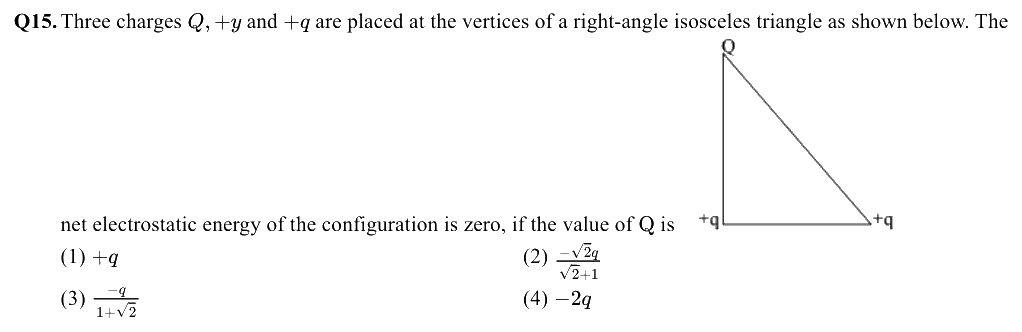
Three charges Q, $+y$ and $+q$ are placed at the vertices of a right-angle isosceles triangle as shown below. The net electrostatic energy of the configuration is zero, if the value of Q is (see the figure above)
An electric field of 1000 V/m is applied to an electric dipole at angle of 45$^{\circ}$. The value of electric dipole moment is $10^{-29}$C $\cdot$ m. What is the potential energy of the electric dipole?
A particle of mass $m$ and charge $q$ is in an electric and magnetic field given by $\vec{E} = 2\hat{i} + 3\hat{j};\ \vec{B} = 4\hat{j} + 6\hat{k}$ The charged particle is shifted from the origin to the point P($x = 1; y = 1$) along a straight path. The magnitude of the total work done is :
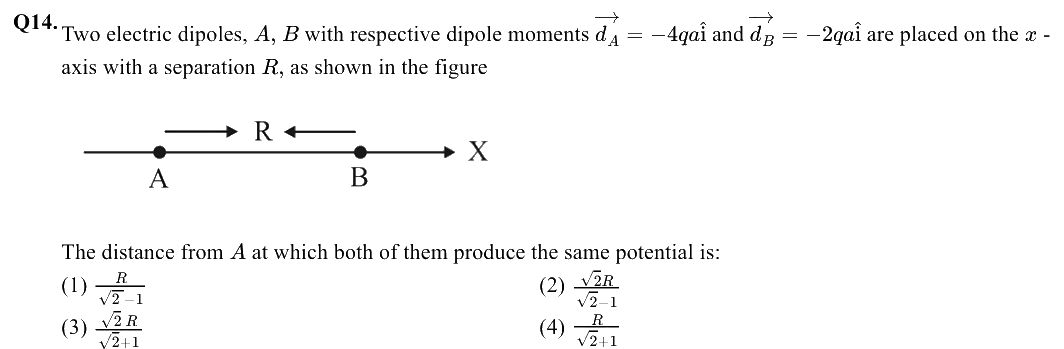
Two electric dipoles, $A$, $B$ with respective dipole moments $\vec{d_A} = -4qa\hat{i}$ and $\vec{d_B} = -2qa\hat{i}$ are placed on the $x$ - axis with a separation $R$, as shown in the figure (see the figure above) The distance from $A$ from which both of them produce the same potential is:
A charge $Q$ is distributed over three concentric spherical shells of radii $a$, $b$, $c$ $(a < b < c)$ such that their surface charge densities are equal to one another. The total potential at a point at distance $r$ from their common centre, where $r < a$, would be:
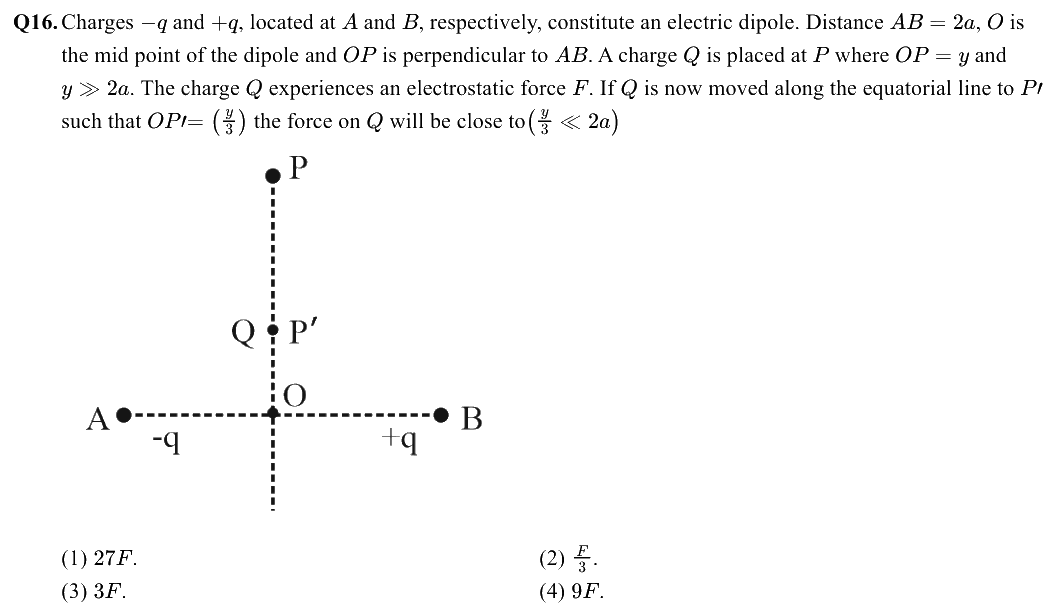
Charges $-q$ and $+q$, located at $A$ and $B$, respectively, constitute an electric dipole. Distance $AB = 2a$, $O$ is the mid point of the dipole and $OP$ is perpendicular to $AB$. A charge $Q$ is placed at $P$ where $OP = y$ and $y \gg 2a$. The charge $Q$ experiences an electrostatic force $F$. If $Q$ is now moved along the equatorial line to $P'$ such that $OP' = \left(\dfrac{y}{3}\right)$ the force on $Q$ will be close to $\left(\dfrac{y}{3} \gg 2a\right)$ (see the figure above)
Four equal point charges $Q$ each are placed in the $xy$ plane at $(0,\ 2), (4,\ 2), (4,\ -2)$ and $(0,\ -2)$ . The work required to put a fifth charge $Q$ at the origin of the coordinate system will be:
Three charges $+Q$, $q$, $+\ Q$ are placed respectively, at distance, $0, d\ /\ 2$ and $d$ from the origin, on the $x$ -axis. If the net force experienced by $+Q$, placed at $x = 0$, is zero, then value of $q$ is:
For a uniformly charged ring of radius $R$, the electric field on its axis has the largest magnitude at a distance $h$ from its centre. Then value of $h$ is:
Charge is distributed within a sphere of radius $R$ with a volume charge density $\rho(r) = \dfrac{A}{r^2}e^{-\frac{2r}{a}}$, where $A$ and $a$ are constants. If $Q$ is the total charge of this charge distribution, the radius $R$ is:
Two point charges $q_1\left(\sqrt{10}\ \mu\mathrm{C}\right)$ and $q_2(-25\ \mu\mathrm{C})$ are placed on the $x$ -axis at $x = 1\ \mathrm{m}$ and $x = 4\ \mathrm{m}$ respectively. The electric field (in $\mathrm{V/m}$) at a point $y = 3\ \mathrm{m}$ on $y$-axis is, $\left[\text{Take } \dfrac{1}{4\pi\epsilon_0} = 9\times10^9\ \mathrm{N\,m^2C^{-2}}\right]$
Two identical conducting spheres $A$ and $B$ carry an equal charges. They are separated by a distance much larger than their diameters, and the force between them is $F$. A third identical conducting sphere, $C$, is uncharged. Sphere $C$ is first touched to $A$, then to $B$, and then removed. As a result, the force between $A$ and $B$ would be equal to:
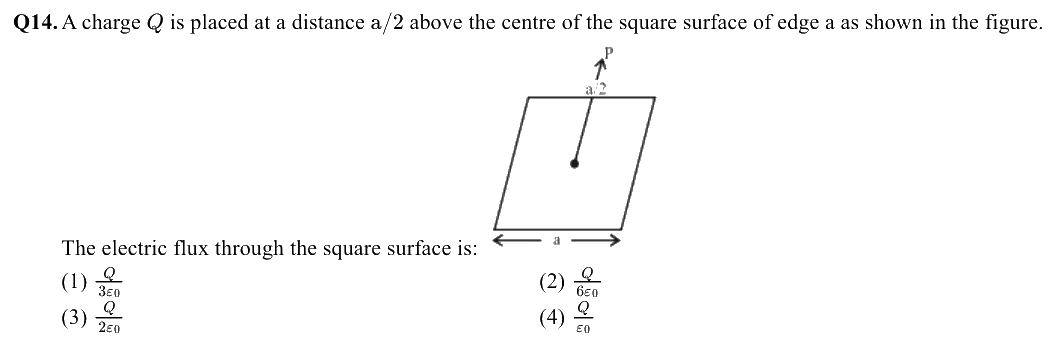
A charge $Q$ is placed at a distance $a/2$ above the centre of the square surface of edge $a$ as shown in the figure. (see the figure above) The electric flux through the square surface is:
[12] A solid ball of radius R has a charge density $\rho$ given by $\rho = \rho_0\left(1-\frac{r}{R}\right)$ for $0 \leq r \leq R$. The electric field outside the ball is:
Three concentric metal shells $A$, $B$ and $C$ of respective radii $a$, $b$ and $c$ $(a < b < c)$ have surface charge densities $+\sigma$, $-\sigma$ and $+\sigma$ respectively. The potential of shell $B$ is:
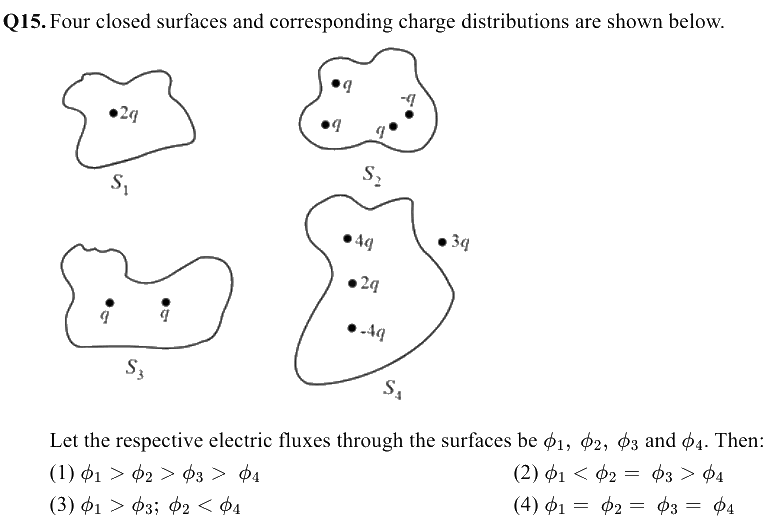
Four closed surfaces and corresponding charge distributions are shown below. (see the figure above) Let the respective electric fluxes through the surfaces be $\phi_1$, $\phi_2$, $\phi_3$ and $\phi_4$. Then:
There is a uniform electrostatic field in a region. The potential at various points on a small sphere centred at $P$, in the region, is found to vary between the limits 589.0 V to 589.8 V. What is the potential at a point on the sphere whose radius vector makes an angle of $60^\circ$ with the direction of the field?
The energy stored in the electric field produced by a metal sphere is 4.5 J. If the sphere contains 4 $\mu$C charge, its radius will be: $\left[\text{Take}: \frac{1}{4\pi\epsilon_0} = 9 \times 10^{9}\ \mathrm{N\ m^2\ C^{-2}}\right]$
An electric dipole has fixed dipole moment $\vec{p}$, which makes angle $\theta$ with respect to $x$ - axis. When subjected to an electric field $\vec{E}_1 = E\hat{i}$, it experiences a torque $\vec{T}_1 = \tau\hat{k}$. When subjected to another electric field $\vec{E}_2 = \sqrt{3}\,E_1\hat{j}$ it experiences a torque $\vec{T}_2 = -\vec{T}_1$. The angle $\theta$ is:
Within a spherical charge distribution of charge density $\rho(r)$, $N$ equipotential surfaces of potential $V_0,\ V_0 + \Delta V,\ V_0 + 2\Delta V,\ldots V_0 + N\Delta V$ $(\Delta V > 0)$, are drawn and have increasing radii $r_0,\ r_1,\ r_2,\ldots r_N$, respectively. If the difference in the radii of the surfaces is constant for all values of $V_0$ and $\Delta V$ then :
The potential (in volts) of a charge distribution is given by $V(z) = 30 - 5z^{2}$ for $|z| \leq 1$ m $V(z) = 35 - 10\ |z|$ for $|z| \geq 1$ m . $V(z)$ does not depend on x and y. If this potential is generated by a constant charge per unit volume $\rho_0$ (in units of $\epsilon_0$ ) which is spread over a certain region, then choose the correct statement.
A
$\rho_0 = 20\ \epsilon_0$ in the entire region
B
$\rho_0 = 10\ \epsilon_0$ for $|z| \leq 1$ m and $\rho_0 = 0$ else where
C
$\rho_0 = 20\ \epsilon_0$ for $|z| \leq 1$ m and $\rho_0 = 0$ else where
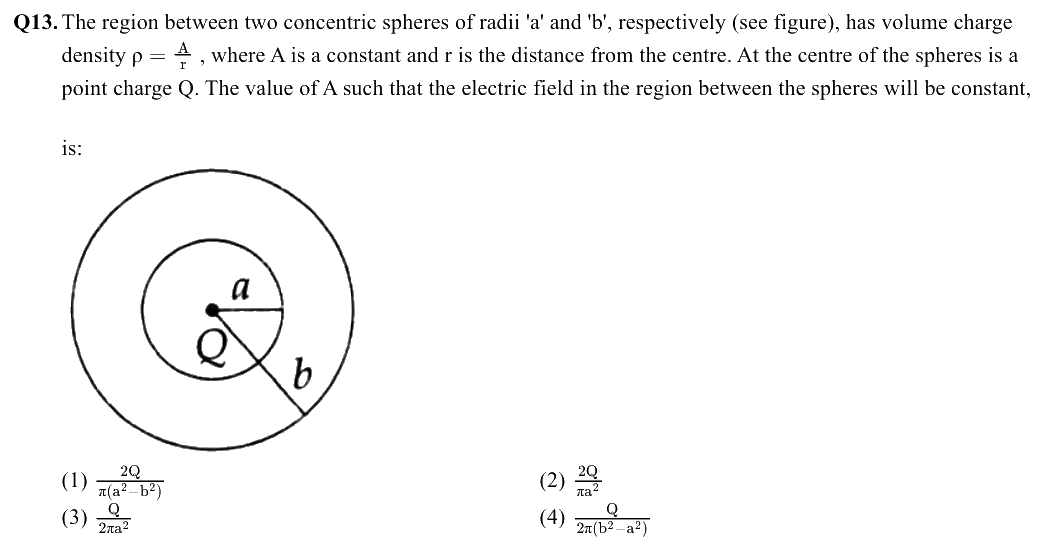
The region between two concentric spheres of radii 'a' and 'b', respectively (see figure), has volume charge density $\rho = \frac{A}{r}$ , where A is a constant and r is the distance from the centre. At the centre of the spheres is a point charge Q. The value of A such that the electric field in the region between the spheres will be constant, is: (see the figure above)
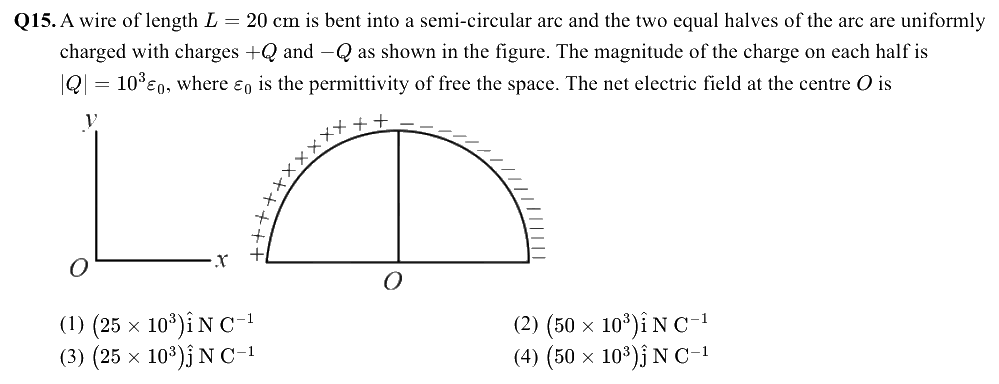
A wire of length $L = 20$ cm is bent into a semi-circular arc and the two equal halves of the arc are uniformly charged with charges $+Q$ and $-Q$ as shown in the figure. The magnitude of the charge on each half is $|Q| = 10^3 \varepsilon_0$, where $\varepsilon_0$ is the permittivity of free the space. The net electric field at the centre $O$ is (see the figure above)
An electric field $\vec{E} = \left(25\,\hat{i} + 30\,\hat{j}\right)$ N C$^{-1}$ exists in a region of space. If the potential at the origin is taken to be zero then the potential at $x = 2$ m, $y = 2$ m is:
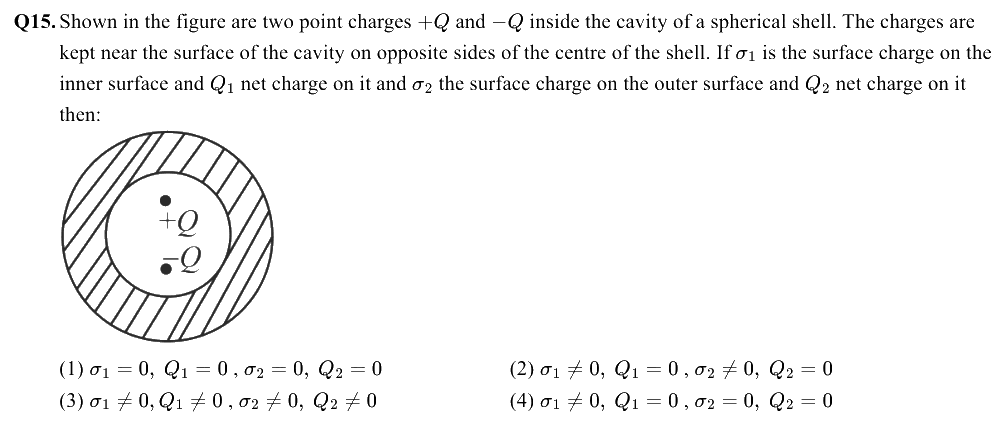
Shown in the figure are two point charges $+Q$ and $-Q$ inside the cavity of a spherical shell. The charges are kept near the surface of the cavity on opposite sides of the centre of the shell. If $\sigma_1$ is the surface charge on the inner surface and $Q_1$ net charge on it and $\sigma_2$ the surface charge on the outer surface and $Q_2$ net charge on it then: (see the figure above)
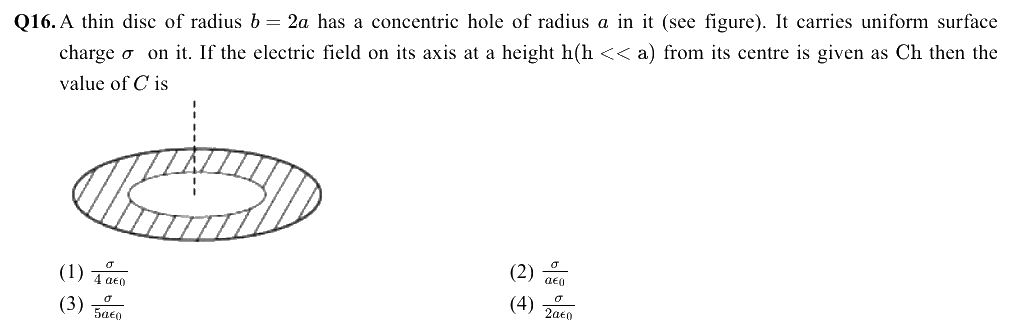
A thin disc of radius $b = 2a$ has a concentric hole of radius $a$ in it (see figure). It carries uniform surface charge $\sigma$ on it. If the electric field on its axis at a height h($h << a$) from its centre is given as Ch then the value of $C$ is (see the figure above)
A uniformly charged solid sphere of radius R has potential $V_0$ (measured with respect to $\infty$) on its surface. For this sphere the equipotential surfaces with potential $\dfrac{3V_0}{2}$, $\dfrac{5V_0}{4}$, $\dfrac{3V_0}{4}$ and $\dfrac{V_0}{4}$ have radius $R_1$, $R_2$, $R_3$ and $R_4$ respectively. Then
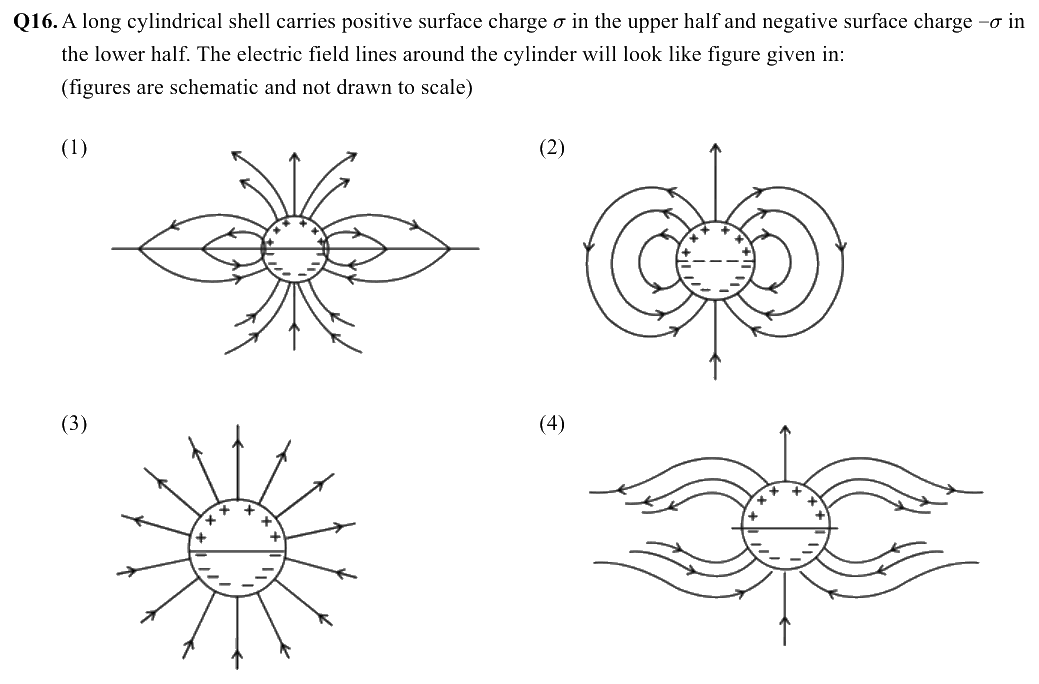
A long cylindrical shell carries positive surface charge $\sigma$ in the upper half and negative surface charge $-\sigma$ in the lower half. The electric field lines around the cylinder will look like figure given in: (figures are schematic and not drawn to scale)
The question as printed in the paper.
A
see figure cylinder cross-section with field lines
B
see figure cylinder cross-section with field lines
C
see figure cylinder cross-section with field lines
D
see figure cylinder cross-section with field lines
The electric field in a region of space is given by, $\overrightarrow{E} = E_0\hat{i} + 2E_0\hat{j}$ where $E_0 = 100\ \mathrm{N\,C^{-1}}$. The flux of this field through a circular surface of radius $0.02\ \mathrm{m}$ parallel to the $Y$-$Z$ plane is nearly
A spherically symmetric charge distribution is characterised by a charge density having the following variations: $\rho(r) = \rho_o\left(1-\dfrac{r}{R}\right)$ for $r < R$ $\rho(\mathrm{r}) = 0$ for $r \geq \mathrm{R}$ Where $r$ is the distance from the centre of the charge distribution $\rho_o$ is a constant. The electric field at an internal point $(r < R)$ is:
A cone of base radius $R$ and height $h$ is located in a uniform electric field $\vec{\mathrm{E}}$ parallel to its base. The electric flux entering the cone is:
A three coulomb charge moves from the point $(0, -2, -5)$ to the point $(5, 1, 2)$ in an electric field expressed as $\vec{E} = 2x\hat{i} + 3y^2\hat{j} + 4\hat{k}$ N/C. The work done in moving the charge is ________ J.
Numerical answer type: type your answer in EdLoop to check it
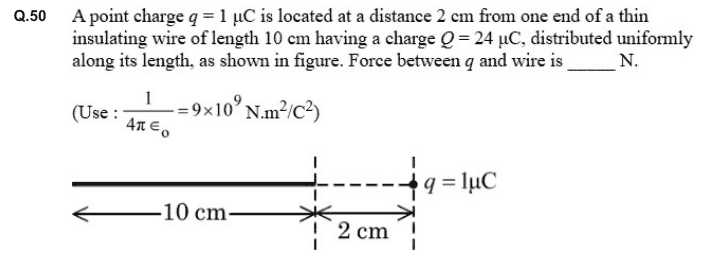
A point charge $q = 1\ \mu$C is located at a distance 2 cm from one end of a thin insulating wire of length 10 cm having a charge $Q = 24\ \mu$C, distributed uniformly along its length, as shown in figure. Force between $q$ and wire is ________ N.
The electric field in a region is given by $\vec{E} = \left(2\hat{i} + 4\hat{j} + 6\hat{k}\right) \times 10^3N/C$. The flux of the field through a rectangular surface parallel to x-z plane is $6.0Nm^2C^{-1}$. The area of the surface is ______ $cm^2$.
Numerical answer type: type your answer in EdLoop to check it
An electric dipole of dipole moment $6 \times 10^{-6}$Cm is placed in uniform electric field of magnitude $10^6$ V/m. Initially, the dipole moment is parallel to electric field. The work that needs to be done on the dipole to make its dipole moment opposite to the field, will be ______ J.
Numerical answer type: type your answer in EdLoop to check it
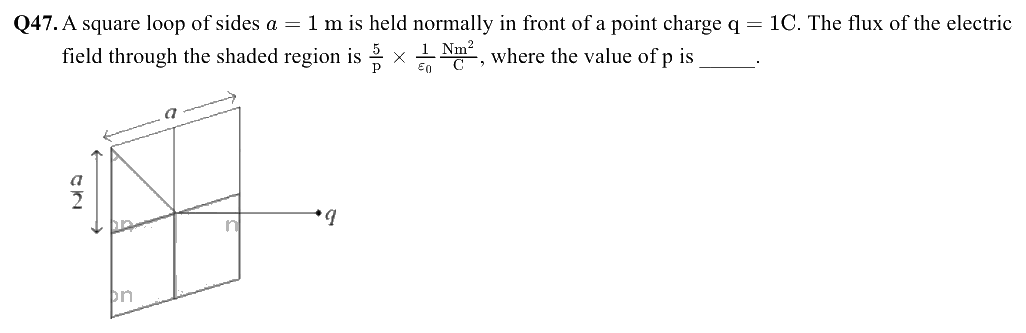
A square loop of sides $a = 1$ m is held normally in front of a point charge q = 1C. The flux of the electric field through the shaded region is $\frac{5}{\mathrm{p}} \times \frac{1}{\varepsilon_0}\frac{\mathrm{Nm^2}}{\mathrm{C}}$, where the value of p is ______ .
(see the figure above)
The question as printed in the paper.
Numerical answer type: type your answer in EdLoop to check it
A positive ion $A$ and a negative ion $B$ has charges $6.67 \times 10^{-19}$C and $9.6 \times 10^{-10}$C, and masses $19.2 \times 10^{-27}$ kg and $9 \times 10^{-27}$ kg respectively. At an instant, the ions are separated by a certain distance r. At that instant the ratio of the magnitudes of electrostatic force to gravitational force is $P \times 10^{45}$, where the value of $10P$ is ______ (Take $\frac{1}{4\pi\varepsilon_0} = 9 \times 10^9\mathrm{Nm}^2\mathrm{C}^{-1}$ and universal gravitational constant as $6.67 \times 10^{-11}\ \mathrm{Nm}^2\ \mathrm{kg}^{-2}$ ) Assume that charge may not be an integral multiple of electrons.
Numerical answer type: type your answer in EdLoop to check it
An electric field $\vec{E} = (2x\hat{i})\,\mathrm{NC^{-1}}$ exists in space. A cube of side 2 m is placed in the space as per figure given below. The electric flux through the cube is ______ $\mathrm{Nm^2/C}$.
(see the figure above)
The question as printed in the paper.
Numerical answer type: type your answer in EdLoop to check it
An electric field, $\vec{E} = \frac{2\hat{i} + 6\hat{j} + 8\hat{k}}{\sqrt{6}}$ passes through the surface of 4 $\mathrm{m}^2$ area having unit vector $\hat{n} = \left(\frac{2\hat{i} + \hat{j} + \hat{k}}{\sqrt{6}}\right)$. The electric flux for that surface is ______ Vm.
Numerical answer type: type your answer in EdLoop to check it
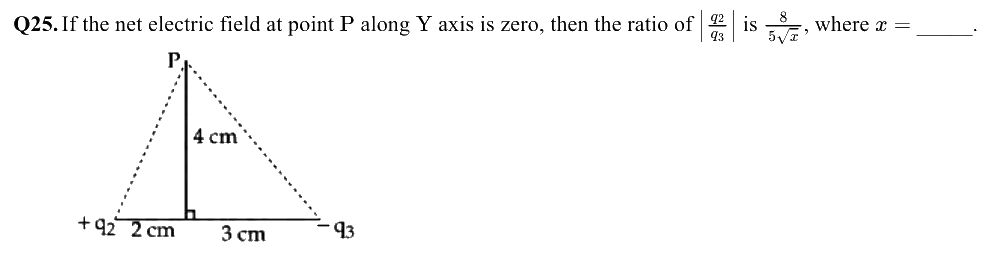
If the net electric field at point P along Y axis is zero, then the ratio of $\left|\frac{q_2}{q_3}\right|$ is $\frac{8}{5\sqrt{x}}$, where $x$ = ______.
(see the figure above)
The question as printed in the paper.
Numerical answer type: type your answer in EdLoop to check it
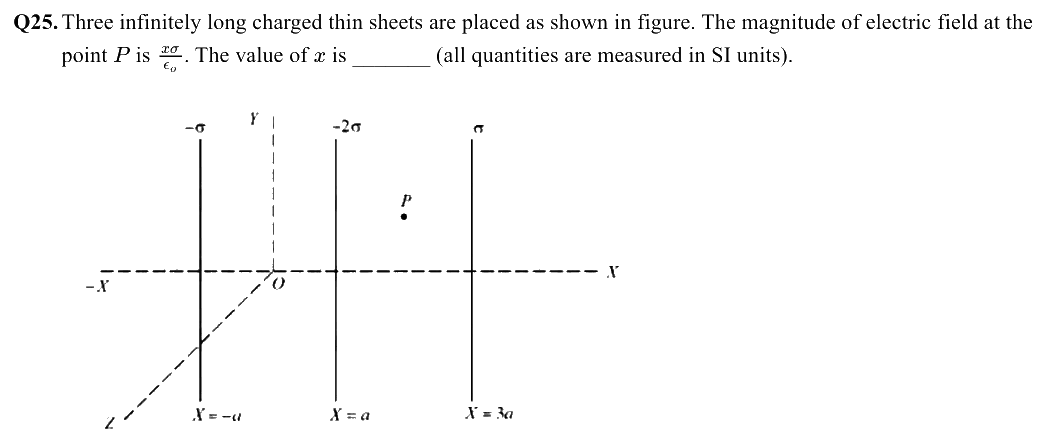
Three infinitely long charged thin sheets are placed as shown in figure. The magnitude of electric field at the point $P$ is $\frac{x\sigma}{\epsilon_o}$. The value of $x$ is ______ (all quantities are measured in SI units).
(see the figure above)
The question as printed in the paper.
Numerical answer type: type your answer in EdLoop to check it
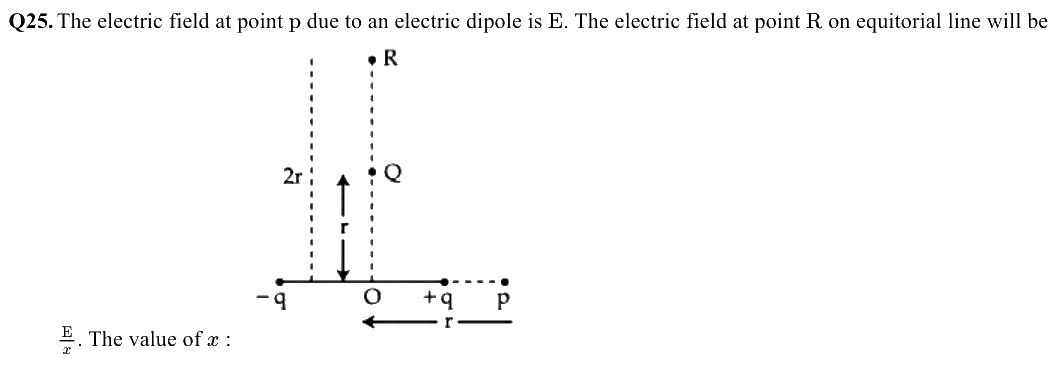
The electric field at point p due to an electric dipole is E. The electric field at point R on equitorial line will be $\frac{E}{x}$. The value of $x$ :
(see the figure above)
The question as printed in the paper.
Numerical answer type: type your answer in EdLoop to check it
An infinite plane sheet of charge having uniform surface charge density $+\sigma_s$C/m$^2$ is placed on $x - y$ plane. Another infinitely long line charge having uniform linear charge density $+\lambda_e$C/m is placed at $z = 4$ m plane and parallel to $y$-axis. If the magnitude values $|\sigma_s| = 2\,|\lambda_e|$ then at point $(0, 0, 2)$, the ratio of magnitudes of electric field values due to sheet charge to that of line charge is $\pi\sqrt{n} : 1$. The value of $n$ is ______.
Numerical answer type: type your answer in EdLoop to check it
Two identical charged spheres are suspended by strings of equal lengths. The strings make an angle $\theta$ with each other. When suspended in water the angle remains the same. If density of the material of the sphere is 1.5 g / cc, the dielectric constant of water will be ______. (Take density of water = 1 g / cc)
Numerical answer type: type your answer in EdLoop to check it
Suppose a uniformly charged wall provides a uniform electric field of $2 \times 10^{4}\ \text{N C}^{-1}$ normally. A charged particle of mass 2 g being suspended through a silk thread of length 20 cm and remain stayed at a distance of 10 cm from the wall. Then the charge on the particle will be $\frac{1}{\sqrt{x}}\mu$C where $x$ = ______ [use $g = 10\ \text{m s}^{-2}$]
Numerical answer type: type your answer in EdLoop to check it
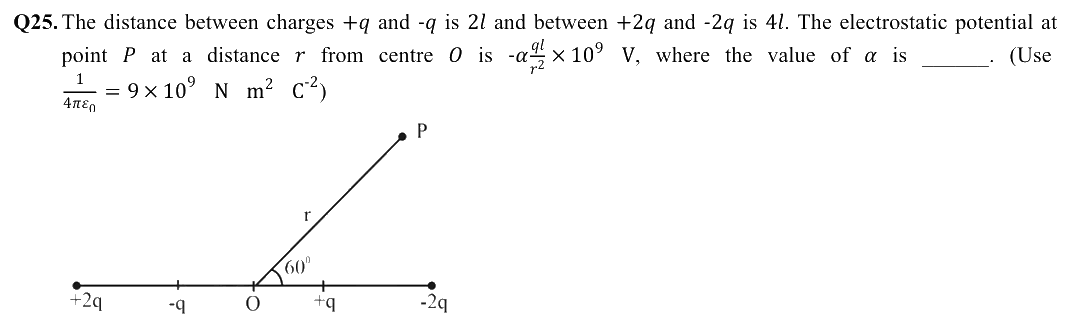
The distance between charges $+q$ and $-q$ is $2l$ and between $+2q$ and $-2q$ is $4l$. The electrostatic potential at point $P$ at a distance $r$ from centre $O$ is $-\alpha\frac{ql}{r^2} \times 10^9$ V, where the value of $\alpha$ is ______. (Use $\frac{1}{4\pi\varepsilon_0} = 9 \times 10^9$ N m$^2$ C$^{-2}$)
(see the figure above)
The question as printed in the paper.
Numerical answer type: type your answer in EdLoop to check it
Two identical charged spheres are suspended by strings of equal lengths. The string make an angle of $37^\circ$ with each other. When suspended in a liquid of density 0.7 g cm$^{-3}$, the angle remains same. If density of material of the sphere is 1.4 g cm$^{-3}$, the dielectric constant of the liquid is ______ $\tan 37^\circ = \frac{3}{4}$
Numerical answer type: type your answer in EdLoop to check it
An electron is moving under the influence of the electric field of a uniformly charged infinite plane sheet $S$ having surface charge density $+\sigma$. The electron at $t = 0$ is at a distance of 1 m from $S$ and has a speed of 1 m s$^{-1}$. The maximum value of $\sigma$, if the electron strikes $S$ at $t = 1$ s is $\alpha\left[\frac{m\epsilon_0}{e}\right]\frac{\mathrm{C}}{\mathrm{m}^2}$. The value of $\alpha$ is ______.
Numerical answer type: type your answer in EdLoop to check it
A thin metallic wire having cross sectional area of $10^{-4}$ m$^2$ is used to make a ring of radius 30 cm. A positive charge of $2\pi$ C is uniformly distributed over the ring, while another positive charge of 30 pC is kept at the centre of the ring. The tension in the ring is ______ N; provided that the ring does not get deformed (neglect the influence of gravity).
(Given, $\frac{1}{4\pi\epsilon_0} = 9 \times 10^9$ SI units)
Numerical answer type: type your answer in EdLoop to check it
The electric potential at the surface of an atomic nucleus ($Z = 50$) of radius $9 \times 10^{-13}$ cm is $\alpha \times 10^6$ V. What is the value of $\alpha$?
(Charge of proton $1.6 \times 10^{-19}$ C)
Numerical answer type: type your answer in EdLoop to check it
Two charges of -4 $\mu$C and +4 $\mu$C are placed at the points $A(1,\ 0,\ 4)$ m and $B(2,\ -1,\ 5)$ m located in an electric field $\vec{E} = 0.20\hat{i}$ V cm$^{-1}$. The magnitude of the torque acting on the dipole is $8\sqrt{\alpha} \times 10^{-5}$ N m, where $\alpha =$ ______.
Numerical answer type: type your answer in EdLoop to check it
A thin infinite sheet charge and an infinite line charge of respective charge densities $+\sigma$ and $+\lambda$ are placed parallel at 5 m distance from each other. Points $P$ and $Q$ are at $\frac{3}{\pi}$ m and $\frac{4}{\pi}$ m perpendicular distances from line charge towards sheet charge, respectively. $E_p$ and $E_q$ are the magnitudes of resultant electric field intensities at point $P$ and $Q$ respectively. If $\frac{E_P}{E_Q} = \frac{4}{a}$ for $2|\sigma| = |\lambda|$, then the value of $a$ is ______.
Numerical answer type: type your answer in EdLoop to check it
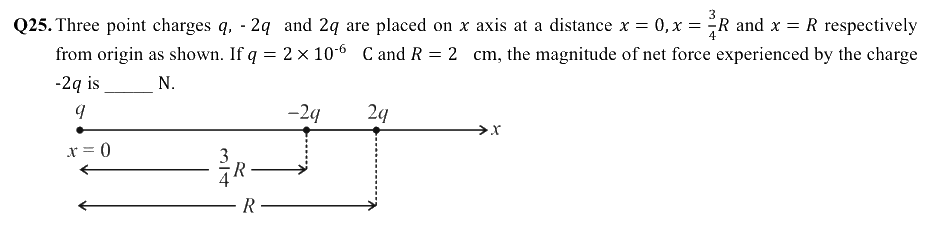
Three point charges $q$, $-2q$ and $2q$ are placed on $x$ axis at a distance $x = 0$, $x = \frac{3}{4}R$ and $x = R$ respectively from origin as shown. If $q = 2 \times 10^{-6}$ C and $R = 2$ cm, the magnitude of net force experienced by the charge $-2q$ is ______ N.
(see the figure above)
The question as printed in the paper.
Numerical answer type: type your answer in EdLoop to check it
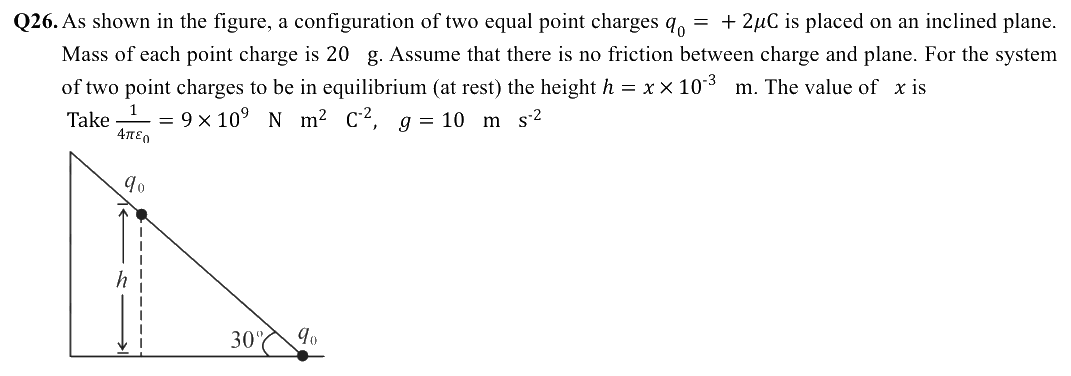
As shown in the figure, a configuration of two equal point charges $q_0 = +2\mu\mathrm{C}$ is placed on an inclined plane. Mass of each point charge is 20 g. Assume that there is no friction between charge and plane. For the system of two point charges to be in equilibrium (at rest) the height $h = x \times 10^{-3}$ m. The value of $x$ is Take $\frac{1}{4\pi\varepsilon_0} = 9 \times 10^{9}\ \mathrm{N\ m^2\ C^{-2}}$, $g = 10\ \mathrm{m\ s^{-2}}$ (see the figure above)
The question as printed in the paper.
Numerical answer type: type your answer in EdLoop to check it
Three concentric spherical metallic shells $X$, $Y$ and $Z$ of radius $a$, $b$ and $c$ respectively $a < b < c$ have surface charge densities $\sigma$, $-\sigma$ and $\sigma$, respectively. The shells $X$ and $Z$ are at same potential. If the radii of $X$ & $Y$ are 2 cm and 3 cm, respectively. The radius of shell $Z$ is ______ cm.
Numerical answer type: type your answer in EdLoop to check it
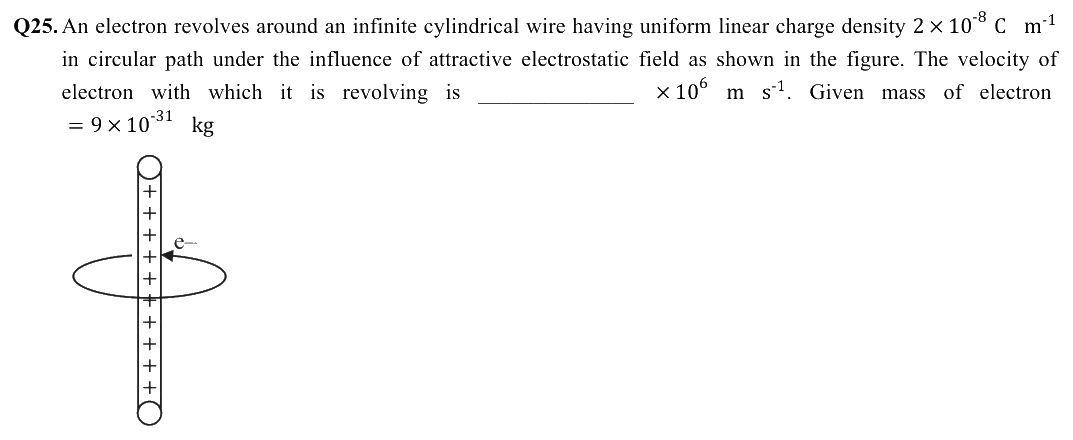
An electron revolves around an infinite cylindrical wire having uniform linear charge density $2 \times 10^{-8}\ \mathrm{C\,m^{-1}}$ in circular path under the influence of attractive electrostatic field as shown in the figure. The velocity of electron with which it is revolving is ______ $\times 10^6\ \mathrm{m\,s^{-1}}$. Given mass of electron $= 9 \times 10^{-31}$ kg (see the figure above)
The question as printed in the paper.
Numerical answer type: type your answer in EdLoop to check it
An electric dipole of dipole moment is $6.0 \times 10^{-6}\ \mathrm{C\,m}$ placed in a uniform electric field of $1.5 \times 10^{3}\ \mathrm{N\,C^{-1}}$ in such a way that dipole moment is along electric field. The work done in rotating dipole by $180^\circ$ in this field will be ______ mJ.
Numerical answer type: type your answer in EdLoop to check it
Two equal positive point charges are separated by a distance 2$a$. The distance of a point from the centre of the line joining two charges on the equatorial line (perpendicular bisector) at which force experienced by a test charge $q_0$ becomes maximum is $\dfrac{a}{\sqrt{x}}$. The value of $x$ is ______.
Numerical answer type: type your answer in EdLoop to check it
A cubical volume is bounded by the surfaces $x$ = 0, $x$ = $a$, $y$ = 0, $y$ = $a$, $z$ = 0, $z$ = $a$. The electric field in the region is given by $\vec{E}$ = $E_0 x\hat{i}$. Where $E_0$ = 4 $\times$ $10^4$ $\mathrm{NC^{-1}\ m^{-1}}$. If $a$ = 2 cm, the charge contained in the cubical volume is $Q \times 10^{-14}$ C. The value of $Q$ is ______. (Take $\epsilon_0$ = 9 $\times$ $10^{-12}$ $\mathrm{C^2\ N^{-1}m^{-2}}$)
Numerical answer type: type your answer in EdLoop to check it
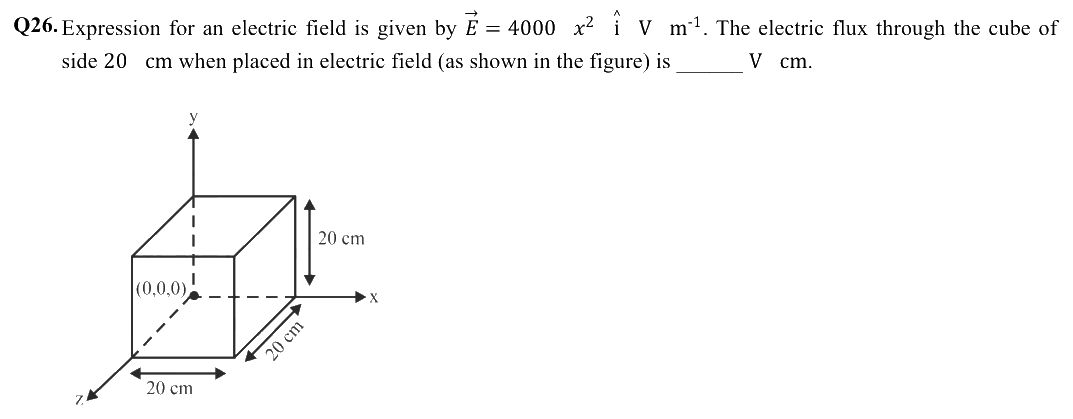
Expression for an electric field is given by $\vec{E}$ = 4000 $x^2$ $\hat{i}$ $\mathrm{V\ m^{-1}}$. The electric flux through the cube of side 20 $\mathrm{cm}$ when placed in electric field (as shown in the figure) is ______ $\mathrm{V\ cm}$.
(see the figure above)
The question as printed in the paper.
Numerical answer type: type your answer in EdLoop to check it
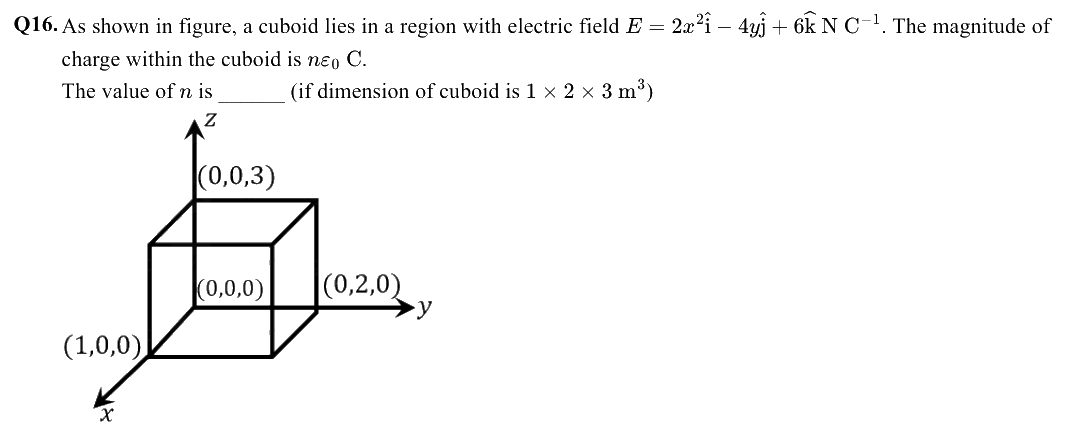
As shown in figure, a cuboid lies in a region with electric field $E = 2x^2\hat{i} - 4y\hat{j} + 6\hat{k}$ N C$^{-1}$. The magnitude of charge within the cuboid is $n\varepsilon_0$ C. The value of $n$ is ______ (if dimension of cuboid is 1 $\times$ 2 $\times$ 3 m$^3$)
(see the figure above)
The question as printed in the paper.
Numerical answer type: type your answer in EdLoop to check it
A point charge $q_1 = 4q_0$ is placed at origin. Another point charge $q_2 = -q_0$ is placed at $x = 12\ \mathrm{cm}$. Charge of proton is $q_0$. The proton is placed on $x$-axis so that the electrostatic force on it is zero. In this situation, the position of the proton from the origin is ______ cm.
Numerical answer type: type your answer in EdLoop to check it
For a charged spherical ball, electrostatic potential inside the ball varies with $r$ as $V = 2ar^2 + b$. Here, $a$ and $b$ are constant and $r$ is the distance from the center. The volume charge density inside the ball is $-\lambda a \varepsilon$. The value of $\lambda$ is ______. $\varepsilon$ = permittivity of medium.
Numerical answer type: type your answer in EdLoop to check it
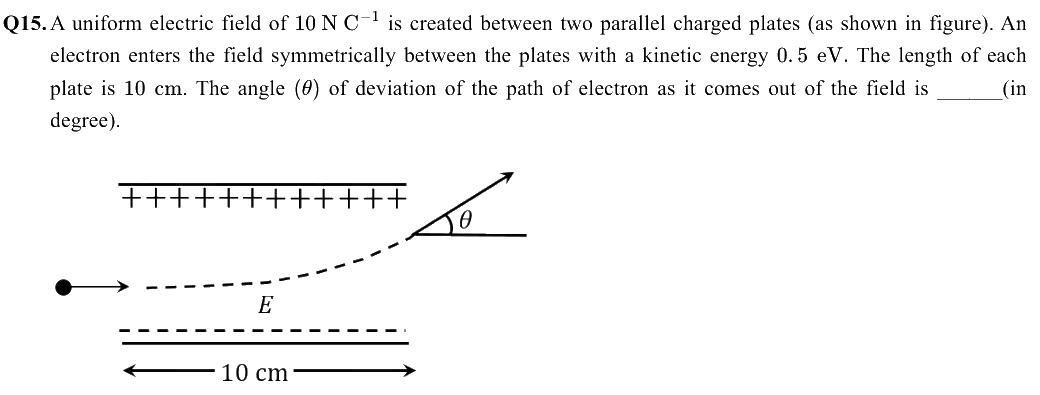
A uniform electric field of $10\ \mathrm{N\,C^{-1}}$ is created between two parallel charged plates (as shown in figure). An electron enters the field symmetrically between the plates with a kinetic energy $0.5\ \mathrm{eV}$. The length of each plate is $10\ \mathrm{cm}$. The angle ($\theta$) of deviation of the path of electron as it comes out of the field is ______ (in degree). (see the figure above)
The question as printed in the paper.
Numerical answer type: type your answer in EdLoop to check it
A stream of a positively charged particles having $\frac{q}{m}=2\times10^{11}\ \mathrm{C\,kg^{-1}}$ and velocity $\vec{v}_0=3\times10^{7}\hat{i}\ \mathrm{m\,s^{-1}}$ is deflected by an electric field $1.8\hat{j}\ \mathrm{kV\,m^{-1}}$. The electric field exists in a region of 10 cm along $x$ direction. Due to the electric field, the deflection of the charge particles in the $y$ direction is ______ mm.
Numerical answer type: type your answer in EdLoop to check it
Two electric dipoles of dipole moments $1.2\times10^{-30}\ \mathrm{cm}$ and $2.4\times10^{-30}\ \mathrm{cm}$ are placed in two difference uniform electric fields of strengths $5\times10^{4}\ \mathrm{N\ C^{-1}}$ and $15\times10^{4}\ \mathrm{N\ C^{-1}}$ respectively. The ratio of maximum torque experienced by the electric dipoles will be $\frac{1}{x}$. The value of $x$ is ______.
Numerical answer type: type your answer in EdLoop to check it
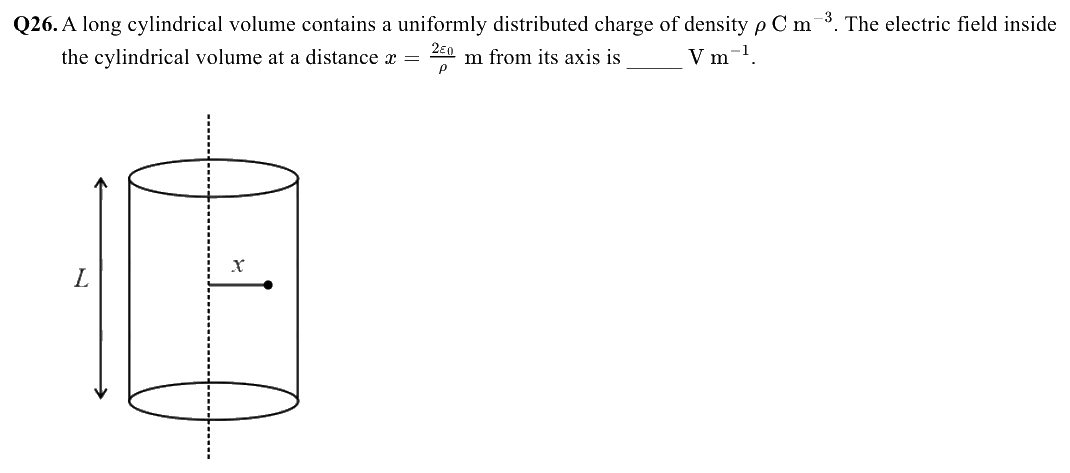
A long cylindrical volume contains a uniformly distributed charge of density $\rho$ C $\mathrm{m^{-3}}$. The electric field inside the cylindrical volume at a distance $x = \frac{2\varepsilon_0}{\rho}$ m from its axis is ______ V $\mathrm{m^{-1}}$. (see the figure above)
The question as printed in the paper.
Numerical answer type: type your answer in EdLoop to check it
Three point charges of magnitude $5\ \mu$C, $0.16\ \mu$C and $0.3\ \mu$C are located at the vertices $A, B, C$ of a right angled triangle whose sides are $AB = 3\ \mathrm{cm}$, $BC = 3\sqrt{2}\ \mathrm{cm}$ and $CA = 3\ \mathrm{cm}$ and point $A$ is the right angle corner. Charge at point $A$ experiences ______ N of electrostatic force due to the other two charges.
Numerical answer type: type your answer in EdLoop to check it
The volume charge density of a sphere of radius 6 m is 2 $\mu\mathrm{C\ cm^{-3}}$. The number of lines of force per unit surface area coming out from the surface of the sphere is ______ $\times\,10^{10}\ \mathrm{N\ C^{-1}}$. [Given : Permittivity of vacuum $\epsilon_0 = 8.85\times10^{-12}\ \mathrm{C^2\ N^{-1}\text{-}m^{-2}}$]
Numerical answer type: type your answer in EdLoop to check it
$27$ identical drops are charged at $22 \mathrm{~V}$ each. They combine to form a bigger drop. The potential of the bigger drop will be ______ $\mathrm{V}$.
Numerical answer type: type your answer in EdLoop to check it
A particle of mass $1\ \mathrm{mg}$ and charge $q$ is lying at the mid-point of two stationary particles kept at a distance $2\ \mathrm{m}$ when each is carrying same charge $q$. If the free charged particle is displaced from its equilibrium position through distance $x$ $x < < 1\ \mathrm{m}$. The particle executes SHM. Its angular frequency of oscillation will be ______ $\times 10^{5}\ \mathrm{rad\ s^{-1}}$ (if $q^2 = 10C^2$)
Numerical answer type: type your answer in EdLoop to check it
The total charge enclosed in an incremental volume of $2 \times 10^{-9}\ \mathrm{m}^3$ located at the origin is ______ nC, if electric flux density of its field is found as$D = e^{-x}\sin y\,\hat{i} - e^{-x}\cos y\,\hat{j} + 2z\hat{k}\ \mathrm{C\ m^{-2}}$
Numerical answer type: type your answer in EdLoop to check it
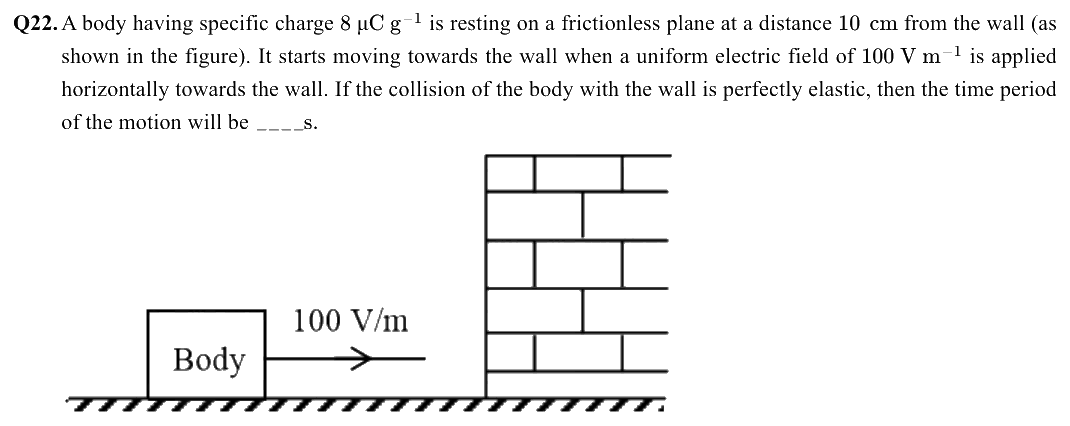
A body having specific charge $8\ \mu\mathrm{C\ g^{-1}}$ is resting on a frictionless plane at a distance $10\ \mathrm{cm}$ from the wall (as shown in the figure). It starts moving towards the wall when a uniform electric field of $100\ \mathrm{V\ m^{-1}}$ is applied horizontally towards the wall. If the collision of the body with the wall is perfectly elastic, then the time period of the motion will be ______ s. (see the figure above)
The question as printed in the paper.
Numerical answer type: type your answer in EdLoop to check it
An infinite number of point charges, each carrying $1~\mu\mathrm{C}$ charge, are placed along the y-axis at $y = 1~\mathrm{m}, 2~\mathrm{m}, 4~\mathrm{m}, 8~\mathrm{m}\ldots$ . The total force on a $1~\mathrm{C}$ point charge, placed at the origin, is $x \times 10^3~\mathrm{N}$. The value of $x$, to the nearest integer, is ______ . [Take $\frac{1}{4\pi\epsilon_0} = 9 \times 10^9~\mathrm{N~m^2~C^{-2}}$]
Numerical answer type: type your answer in EdLoop to check it
The electric field in a region is given by $\vec{E}=\frac{2}{5} E_0 \hat{i}+\frac{3}{5} E_0 \hat{j}$ with $E_0=4.0 \times 10^3 \mathrm{~N} \mathrm{C}^{-1}$. The flux of this field through a rectangular surface, area $0.4 \mathrm{~m}^2$ parallel to the $Y-Z$ plane is ______ $\mathrm{N} \mathrm{m}^2 \mathrm{C}^{-1}$.
Numerical answer type: type your answer in EdLoop to check it
$27$ similar drops of mercury are maintained at $10\ \mathrm{V}$ each. All these spherical drops combine into a single big drop. The potential energy of the bigger drop is ______ times that of a smaller drop.
Numerical answer type: type your answer in EdLoop to check it
The electric field in a region is given by $\vec{E} = \left(\frac{3}{5}E_0\hat{i} + \frac{4}{5}E_0\hat{j}\right)\ \mathrm{N\ C^{-1}}$. The ratio of flux of reported field through the rectangular surface of area $0.2\ \mathrm{m^2}$ (parallel to $y - z$ plane) to that of the surface of area $0.3\ \mathrm{m^2}$ (parallel to $x - z$ plane) is $a : b = a : 2$, where $a =$? [Here $\hat{i}$, $\hat{j}$ and $\hat{k}$ are unit vectors along $x$, $y$ and $z$ -axes respectively]
Numerical answer type: type your answer in EdLoop to check it
$512$ identical drops of mercury are charged to a potential of $2\ \mathrm{V}$ each. The drops are joined to form a single drop. The potential of this drop is $V$ in Volt.
Numerical answer type: type your answer in EdLoop to check it
Two small spheres each of mass $10\ \mathrm{mg}$ are suspended from a point by threads $0.5\ \mathrm{m}$ long. They are equally charged and repel each other to a distance of $0.20\ \mathrm{m}$. The charge on each of the sphere is $\frac{a}{21} \times 10^{-8}\ \mathrm{C}$. The value of $a$ will be ______. [Given $g = 10\ \mathrm{m\ s^{-2}}$]
Numerical answer type: type your answer in EdLoop to check it
Two identical conducting spheres with negligible volume have $2.1\ \mathrm{nC}$ and $-0.1\ \mathrm{nC}$ charges, respectively. They are brought into contact and then separated by a distance of $0.5\ \mathrm{m}$. The electrostatic force acting between the spheres is ______ $\times 10^{-9}\ \mathrm{N}$. [Given : $4\pi\varepsilon_0 = \frac{1}{9 \times 10^9}$ SI unit]
Numerical answer type: type your answer in EdLoop to check it
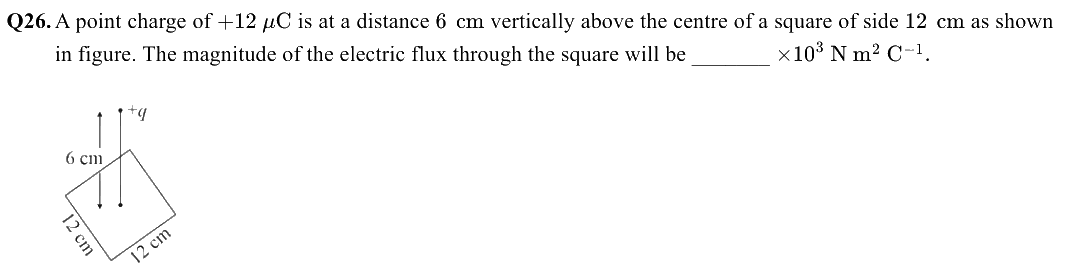
A point charge of $+12\ \mu\mathrm{C}$ is at a distance $6\ \mathrm{cm}$ vertically above the centre of a square of side $12\ \mathrm{cm}$ as shown in figure. The magnitude of the electric flux through the square will be ______ $\times 10^{3}\ \mathrm{N\ m^2\ C^{-1}}$. (see the figure above)
The question as printed in the paper.
Numerical answer type: type your answer in EdLoop to check it
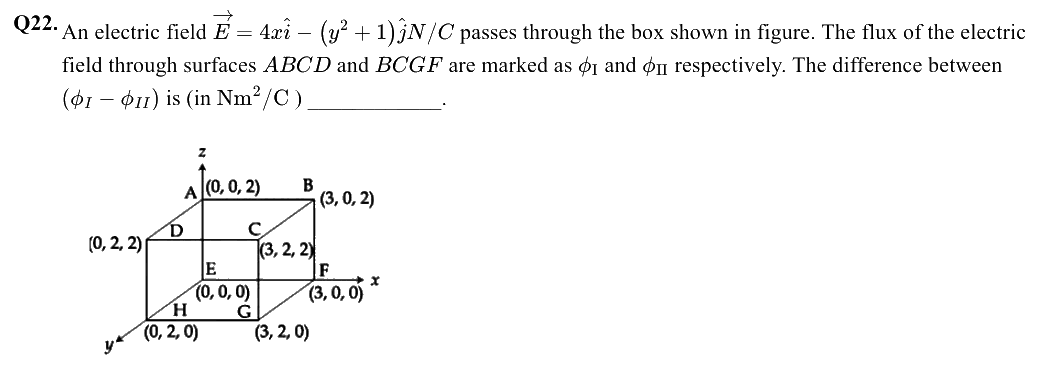
An electric field $\overrightarrow{E} = 4x\hat{i} - (y^2 + 1)\hat{j}\,N/C$ passes through the box shown in figure. The flux of the electric field through surfaces $ABCD$ and $BCGF$ are marked as $\phi_I$ and $\phi_{II}$ respectively. The difference between $(\phi_I - \phi_{II})$ is (in $\mathrm{Nm^2/C}$ ) ______. (see the figure above)
The question as printed in the paper.
Numerical answer type: type your answer in EdLoop to check it
Electrostatics forms the starting point for electromagnetic theory in the Class 12 syllabus under NTA Unit 11 (Electrostatics). It ranks 5 among the 29 physics chapters by total weight. In the modern computerized testing window from 2019 to 2026, electrostatics delivered 230 questions across 162 papers, an average of 1.4 problems in every sitting. A student encounters questions from this chapter in most tests, as 149 of those 162 test shifts included at least one problem. Testing has taken place every single year without interruption. Looking at recent testing cycles, the chapter's presence has shifted up: across the 58 papers set between 2024 and 2026, candidates tackled 92 questions, lifting its subject share to 5.9 percent with an average rate of 1.6 questions per shift. In the earlier paper-based window from 2002 to 2018, the chapter contributed 67 questions across 38 papers, yielding a 5.0 percent share. In the 2026 exam cycle alone, 19 papers featured 26 questions, appearing in 16 separate shifts. Across the 2019 to 2026 timeline, 53 questions required numerical answers without multiple options, meaning students regularly calculate exact numerical values for electrostatic field, flux, and energy.
Most-asked topics
Six distinct concepts structure the questions from this chapter:
Gauss's Law: 75 total questions since 2002, with 57 asked between 2019 and 2026, tested up to 2026. Problems demand flux calculations through geometric surfaces like cubes, cylinders, and spheres, as well as field determinations for infinite sheets, wire distributions, and non-uniform volume charge densities.
Electric Potential: 73 problems overall, including 54 in the 2019 to 2026 period and appearing in 2026. This area tests work done moving charges through electric fields, potential profiles of concentric conducting shells, and the calculation of potential from field gradients.
Electric Field: 54 total questions, with 41 coming between 2019 and 2026, continuing into 2026. Typical questions evaluate vector superpositions from discrete charge arrangements, circular arcs, and ring axes.
Charge & Coulomb's Law: 44 lifetime questions, with 33 asked from 2019 to 2026, tested in 2026. Questions explore pairwise forces, null points, equilibrium of suspended hanging pith balls, and integration over continuous linear rods.
Electric Dipole: 33 problems across all years, with 31 concentrated between 2019 and 2026, tested through 2026. Core themes involve axial and equatorial field strengths, torque in uniform fields, and potential energy of rotating dipoles.
Conductors: 18 problems overall, including 14 between 2019 and 2026, tested in 2026. Questions probe charge redistribution between connected metal spheres, surface charge densities, and cavity shielding.
What the questions look like
JEE Main tests electrostatics through both algebraic deductions and direct multi-step arithmetic:
Flux through closed geometric shells: A charge placed at an apex, edge, or face center of a prism or cube requires symmetry arguments or solid angle apportioning to determine the net escaping flux.
Concentric conducting spherical systems: Multiple concentric spherical shells carry specified charges or potentials. Questions ask for potential values on each shell surface or the charge shifted after earthing or interconnecting them.
Vector superposition of fields: Point charges arranged symmetrically around circles, pentagons, or squares create composite field vectors at the geometric center or along a perpendicular axis.
Continuous charge distributions: Calculating the electrostatic force on a point charge positioned along the extension of a uniformly charged thin rod requires setting up an integral over infinitesimal elements.
Begin by establishing strong vector fluency. Coulomb's law and electric field evaluations are vector operations, so writing unit vectors and resolving components along coordinate axes prevents sign mistakes.
Next, master the fundamental integral relationships connecting field and potential. When given a position-dependent electric field vector, integrate along the path to calculate work and potential difference. For continuous objects like charged rings, discs, and rods, practice setting up differential charge elements dq and evaluating the definite integrals.
Dedicate focused time to Gauss's law and conductor electrostatics. Learn how to enclose charges using symmetric Gaussian surfaces and apply the principle that all static excess charge sits on the outer conductor boundary. Solve past numerical questions to build precision in converting prefixes like microcoulombs and centimeters without arithmetic slips.
Frequently asked questions
Which topic in electrostatics carries the most weight?
Gauss's law and electric potential together account for more than half of all electrostatics questions in JEE Main. Focusing on flux calculations, potential differences, and energy conservation yields the highest return.
Are questions from electrostatics mostly theoretical or calculation-heavy?
The majority of questions require algebraic manipulation or numerical calculation. With 53 numerical response questions appearing between 2019 and 2026, students must be ready to work through calculations accurately to an integer answer.
How should I study conductors and spherical shells?
Focus on the properties of electrostatic equilibrium: electric fields vanish inside conducting material, excess charges reside on surfaces, and interconnected conductors equalize their electric potentials. Step-by-step solutions for each one are in the EdLoop app.