
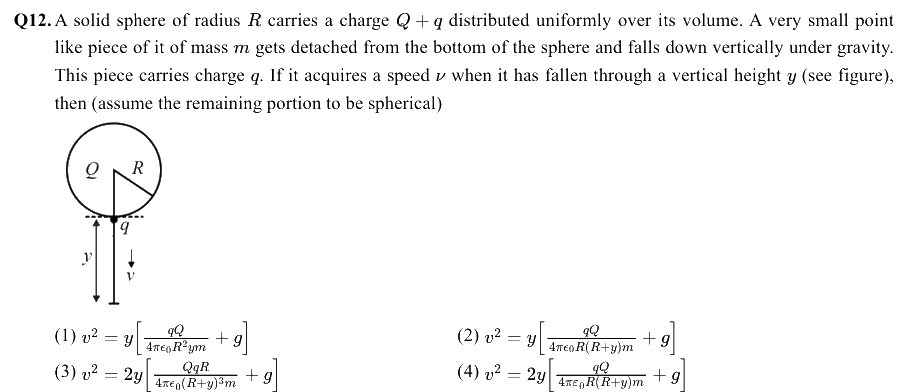
A solid sphere of radius $R$ carries a charge $Q + q$ distributed uniformly over its volume. A very small point like piece of it of mass $m$ gets detached from the bottom of the sphere and falls down vertically under gravity. This piece carries charge $q$. If it acquires a speed $v$ when it has fallen through a vertical height $y$ (see figure), then (assume the remaining portion to be spherical)
(see the figure above)
- (1)
$v^2 = y\left[\frac{qQ}{4\pi\epsilon_0 R^2 ym} + g\right]$
- (2)
$v^2 = y\left[\frac{qQ}{4\pi\epsilon_0 R(R+y)m} + g\right]$
- (3)
$v^2 = 2y\left[\frac{QqR}{4\pi\epsilon_0 (R+y)^3 m} + g\right]$
- (4)
$v^2 = 2y\left[\frac{qQ}{4\pi\epsilon_0 R(R+y)m} + g\right]$
Show answer
Option (4) is correct.
Key from source paper