When one moves from a point 16 km below the earth's surface to a point 16 km above the earth's surface. The change in g is approximately $\alpha$ %. The value of $\alpha$ is ________.
A body of mass $m$ is taken from the surface of earth to a height equal to twice the radius of earth ($R_e$). The increase in potential energy will be ________. (g is acceleration due to gravity at the surface of earth)
The height in terms of radius of the earth ($R$), at which the acceleration due to gravity becomes $\frac{g}{9}$, where $g$ is acceleration due to gravity on earth's surface, is ________.
A planet ($\mathrm{P_1}$) is moving around the star of mass $2M$ in the orbit of radius $R$. Another planet ($\mathrm{P_2}$) is moving around another star of mass $4M$ in a orbit of radius $2R$. Ratio of time periods of revolution of $\mathrm{P_2}$ and $\mathrm{P_1}$ is ________.
If a body of mass 1 kg falls on the earth from infinity, it attains velocity ($v$) and kinetic energy ($k$) on reaching the surface of earth. The values of $v$ and $k$ respectively are ________. (Take radius of earth to be 6400 km and $g = 9.8$ m/s$^2$)
Three masses 200 kg, 300 kg and 400 kg are placed at the vertices of an equilateral triangle with sides 20 m. They are rearranged on the vertices of a bigger triangle of side 25 m and with the same centre. The work done in this process ________ J.
(Gravitational constant G $= 6.7 \times 10^{-11}$ N m$^2$/ kg$^2$)
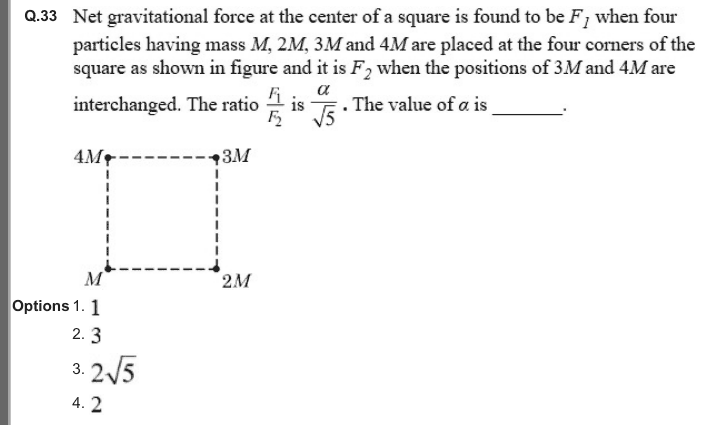
Net gravitational force at the center of a square is found to be $F_1$ when four particles having mass $M$, $2M$, $3M$ and $4M$ are placed at the four corners of the square as shown in figure and it is $F_2$ when the positions of $3M$ and $4M$ are interchanged. The ratio $\dfrac{F_1}{F_2}$ is $\dfrac{\alpha}{\sqrt{5}}$. The value of $\alpha$ is ________.
The escape velocity from a spherical planet $A$ is 10 km/s. The escape velocity from another planet $B$ whose density and radius are 10% of those of planet $A$, is ________ m/s.
Statement I : A satellite is moving around earth in the orbit very close to the earth surface. The time period of revolution of satellite depends upon the density of earth.
Statement II : The time period of revolution of the satellite is $T = 2\pi\sqrt{\frac{R_e}{g}}$ (for satellite very close to the earth surface), where $R_e$ radius of earth and $g$ acceleration due to gravity.
In the light of the above statements, choose the correct answer from the options given below :
Initially a satellite of 100 kg is in a circular orbit of radius $1.5R_E$. This satellite can be moved to a circular orbit of radius $3R_E$ by supplying $\alpha\times10^6$ J of energy. The value of $\alpha$ is ________. (Take Radius of Earth $R_E = 6\times10^6$ m and $g = 10$ m/s$^2$)
Given below are two statements : one is labelled as Assertion (A) and the other is labelled as Reason (R).
Assertion (A) : The radius vector from the Sun to a planet sweeps out equal areas in equal intervals of time and thus areal velocity of planet is constant.
Reason (R): For a central force field the angular momentum is a constant.
In the light of the above statements, choose the most appropriate answer from the options given below :
A
(A) is not correct but (R) is correct
B
(A) is correct but (R) is not correct
C
Both (A) and (R) are correct and (R) is the correct explanation of (A)
D
Both (A) and (R) are correct but (R) is not the correct explanation of (A)
Given below are two statements: one is labelled as Assertion A and the other is labelled as Reason R
Assertion A: The kinetic energy needed to project a body of mass $m$ from earth surface to infinity is $\frac{1}{2}mgR$, where R is the radius of earth.
Reason R: The maximum potential energy of a body is zero when it is projected to infinity from earth surface.
In the light of the above statements, choose the correct answer from the options given below
A
A is false but R is true
B
Both A and R are true but R is NOT the correct explanation of A
C
A is true but R is false
D
Both A and R are true and R is the correct explanation of A
An object is kept at rest at a distance of 3R above the earth's surface where $R$ is earth's radius. The minimum speed with which it must be projected so that it does not return to earth is: (Assume $M$ = mass of earth, G= Universal gravitational constant)
Earth has mass 8 times and radius 2 times that of a planet. If the escape velocity from the earth is 11.2 km/s, the escape velocity in km/s from the planet will be :
A satellite is launched into a circular orbit of radius ' R ' around the earth. A second satellite is launched into an orbit of radius 1.03 R . The time period of revolution of the second satellite is larger than the first one approximately by
If a satellite orbiting the Earth is 9 times closer to the Earth than the Moon, what is the time period of rotation of the satellite? Given rotational time period of Moon = 27 days and gravitational attraction between the satellite and the moon is neglected.
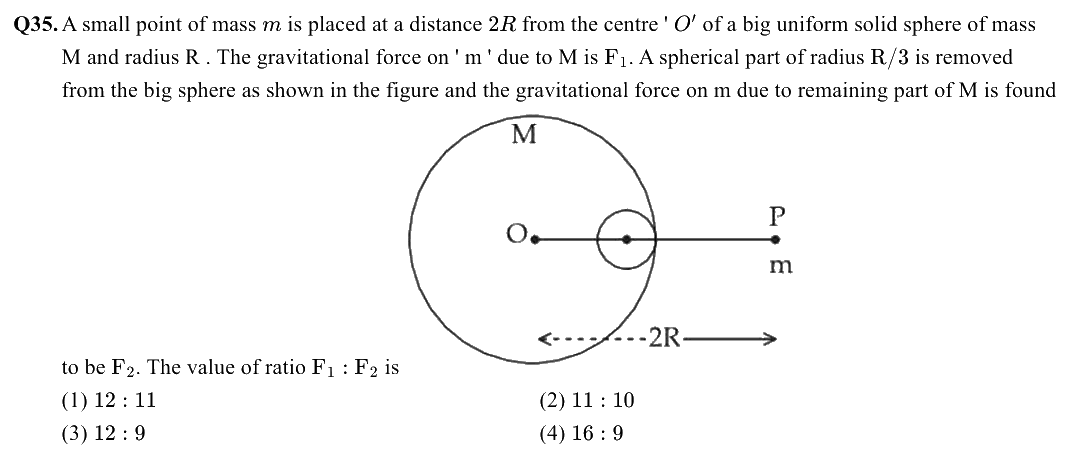
A small point of mass $m$ is placed at a distance $2R$ from the centre ' $O'$ of a big uniform solid sphere of mass M and radius R . The gravitational force on ' m ' due to M is $\mathrm{F}_1$. A spherical part of radius R/3 is removed from the big sphere as shown in the figure and the gravitational force on m due to remaining part of M is found to be $\mathrm{F}_2$. The value of ratio $\mathrm{F}_1 : \mathrm{F}_2$ is
Given below are two statements. One is labelled as Assertion (A) and the other is labelled as Reason (R).
Assertion (A) : A simple pendulum is taken to a planet of mass and radius, 4 times and 2 times, respectively, than the Earth. The time period of the pendulum remains same on earth and the planet. Reason (R): The mass of the pendulum remains unchanged at Earth and the other planet. In the light of the above statements, choose the correct answer from the options given below :
A
(A) is false but (R) is true
B
(A) is true but (R) is false
C
Both (A) and (R) are true and (R) is the correct explanation of (A)
D
Both (A) and (R) are true but (R) is NOT the correct explanation of (A)
An astronaut takes a ball of mass $m$ from earth to space. He throws the ball into a circular orbit about earth at an altitude of 318.5 km. From earth's surface to the orbit, the change in total mechanical energy of the ball is $x\,\frac{\mathrm{GM_e m}}{21\mathrm{R_e}}$. The value of $x$ is (take $\mathrm{R_e}$ = 6370 km) :
A satellite of $10^3$ kg mass is revolving in circular orbit of radius $2R$. If $\frac{10^4 R}{6}$ J energy is supplied to the satellite, it would revolve in a new circular orbit of radius (use $g = 10$ m/s$^2$, $R$ = radius of earth)
Two planets $A$ and $B$ having masses $m_1$ and $m_2$ move around the sun in circular orbits of $r_1$ and $r_2$ radii respectively. If angular momentum of $A$ is $L$ and that of $B$ is $3\,\mathrm{L}$, the ratio of time period $\left(\frac{T_A}{T_B}\right)$ is:
Two satellite $A$ and $B$ go round a planet in circular orbits having radii $4R$ and $R$ respectively. If the speed of A is $3v$, the speed of B will be :
To project a body of mass $m$ from earth's surface to infinity, the required kinetic energy is (assume, the radius of earth is $R_E$, $g$ = acceleration due to gravity on the surface of earth):
Assuming the earth to be a sphere of uniform mass density, a body weighed 300 N on the surface of earth. How much it would weigh at R/4 depth under surface of earth ?
A satellite revolving around a planet in stationary orbit has time period 6 hours. The mass of planet is one-fourth the mass of earth. The radius orbit of planet is : ( Given = Radius of geo-stationary orbit for earth is $4.2 \times 10^4$ km )
A metal wire of uniform mass density having length $L$ and mass $M$ is bent to form a semicircular arc and a particle of mass m is placed at the centre of the arc. The gravitational force on the particle by the wire is :
If $R$ is the radius of the earth and the acceleration due to gravity on the surface of earth is $g = \pi^2\ \text{m s}^{-2}$, then the length of the second's pendulum at a height $h = 2R$ from the surface of earth will be:
A light planet is revolving around a massive star in a circular orbit of radius $R$ with a period of revolution $T$. If the force of attraction between planet and star is proportional to $R^{-3/2}$ then choose the correct option :
Four identical particles of mass $m$ are kept at the four corners of a square. If the gravitational force exerted on one of the masses by the other masses is $\frac{2\sqrt{2} + 1}{32}\frac{Gm^2}{L^2}$, the length of the sides of the square is
The mass of the moon is $\frac{1}{144}$ times the mass of a planet and its diameter $\frac{1}{16}$ times the diameter of a planet. If the escape velocity on the planet is v, the escape velocity on the moon will be:
The gravitational potential at a point above the surface of earth is $-5.12 \times 10^{7}\ \mathrm{J\,kg^{-1}}$ and the acceleration due to gravity at that point is 6. 4 m s$^{-2}$. Assume that the mean radius of earth to be 6400 km. The height of this point above the earth's surface is:
Escape velocity of a body from earth is 11.2 km s$^{-1}$. If the radius of a planet be one-third the radius of earth and mass be one-sixth that of earth, the escape velocity from the plate is:
A planet takes 200 days to complete one revolution around the Sun. If the distance of the planet from Sun is reduced to one fourth of the original distance, how many days will it take to complete one revolution?
The acceleration due to gravity on the surface of earth is $g$. If the diameter of earth reduces to half of its original value and mass remains constant, then acceleration due to gravity on the surface of earth would be :
A body is released from a height equal to the radius ($R$) of the earth. The velocity of the body when it strikes the surface of the earth will be: (Given $g$ = acceleration due to gravity on the earth.)
Two identical particles each of mass $m$ go round a circle of radius $a$ under the action of their mutual gravitational attraction. The angular speed of each particle will be :
A planet having mass $9\,\mathrm{M_e}$ and radius $4\mathrm{R_e}$, where $\mathrm{M_e}$ and $\mathrm{R_e}$ are mass and radius of earth respectively, has escape velocity in km s$^{-1}$ given by: (Given escape velocity on earth $V_e = 11.2 \times 10^{3}$ m s$^{-1}$)
Two planets A and B of radii $R$ and $1.5\,R$ have densities $\rho$ and $\frac{\rho}{2}$ respectively. The ratio of acceleration due to gravity at the surface of B to A is:
Given below are two statements: Statement I : For a planet, if the ratio of mass of the planet to its radius increase, the escape velocity from the planet also increase. Statement II : Escape velocity is independent of the radius of the planet. In the light of above statements, choose the most appropriate answer from the options given below
A
Statement I is incorrect but Statement II is correct
B
Statement I is correct but statement II is incorrect
Two satellites $A$ and $B$ move round the earth in the same orbit. The mass of $A$ is twice the mass of $B$. The quantity which is same for the two satellites will be
The ratio of escape velocity of a planet to the escape velocity of earth will be:- Given: Mass of the planet is 16 times mass of earth and radius of the planet is 4 times the radius of earth.
The radii of two planets $A$ and $B$ are $R$ and $4R$ and their densities are $\rho$ and $\frac{\rho}{3}$ respectively. The ratio of acceleration due to gravity at their surfaces $g_A : g_B$ will be
A space ship of mass $2 \times 10^{4}$ kg is launched into a circular orbit close to the earth surface. The additional velocity to be imparted to the space ship in the orbit to overcome the gravitational pull will be (if $g = 10\ \mathrm{m\ s^{-2}}$ and radius of earth $= 6400$ km ):
Two satellites of masses m and 3 m revolve around the earth in circular orbits of radii r & 3r respectively. The ratio of orbital speeds of the satellites respectively is
Assuming the earth to be a sphere of uniform mass density, the weight of a body at a depth $d = \frac{R}{2}$ from the surface of earth, if its weight on the surface of earth is 200 N, will be : (Given $R$ = radius of earth)
Given below are two statements: Statement I : Rotation of the earth shows effect on the value of acceleration due to gravity $(g)$. Statement II : The effect of rotation of the earth on the value of $g$ at the equator is minimum and that at the pole is maximum. In the light of the above statements, choose the correct answer from the options given below
The time period of a satellite, revolving above earth's surface at a height equal to R will be (Given $g = \pi^2\ \mathrm{m\,s^{-2}}$, $R$ = radius of earth)
Given below are two statements: Statement I: If $E$ be the total energy of a satellite moving around the earth, then its potential energy will be $\frac{E}{2}$. Statement II: The kinetic energy of a satellite revolving in an orbit is equal to the half the magnitude of total energy $E$. In the light of the above statements, choose the most appropriate answer from the options given below.
A
Statement I is correct but Statement II is incorrect
B
Statement I is incorrect but Statement II is correct
The orbital angular momentum of a satellite is L, when it is revolving in a circular orbit at height h from earth surface. If the distance of satellite from the earth centre is increased by eight times to its initial value, then the new angular momentum will be
A planet has double the mass of the earth. Its average density is equal to that of the earth. An object weighing $W$ on earth will weigh on that planet:
The weight of a body on the surface of the earth is $100\ \mathrm{N}$. The gravitational force on it when taken at a height, from the surface of earth, equal to one-fourth the radius of the earth is:
If earth has a mass nine times and radius twice to the of a planet $P$. Then $\dfrac{v_e}{3}\sqrt{x}\ ms^{-1}$ will be the minimum velocity required by a rocket to pull out of gravitational force of $P$, where $v_e$ is escape velocity on earth. The value of $x$ is
Given below are two statements : Statement-I: Acceleration due to gravity is different at different places on the surface of earth. Statement-II: Acceleration due to gravity increases as we go down below the earth's surface. In the light of the above statements, choose the correct answer from the options given below
The escape velocities of two planets $A$ and $B$ are in the ratio 1 : 2. If the ratio of their radii respectively is 1 : 3, then the ratio of acceleration due to gravity of planet $A$ to the acceleration of gravity of planet $B$ will be:
At a certain depth $d$ below surface of earth, value of acceleration due to gravity becomes four times that of its value at a height $3R$ above earth surface. Where $R$ is Radius of earth (Take $R$ = 6400 $\mathrm{km}$). The depth $d$ is equal to
A body weight $W$, is projected vertically upwards from earth's surface to reach a height above the earth which is equal to nine times the radius of earth. The weight of the body at that height will be:
If the gravitational field in the space is given as $-\frac{K}{r^2}$. Taking the reference point to be at $r = 2$ cm with gravitational potential $V = 10$ J kg$^{-1}$. Find the gravitational potentials at $r = 3$ cm in SI unit (Given, that $K = 6$ J cm kg$^{-1}$)
An object is allowed to fall from a height $R$ above the earth, where $R$ is the radius of the earth. Its velocity when it strikes the earth's surface, ignoring air resistance, will be :
Two particles of equal mass $m$ move in a circle of radius $r$ under the action of their mutual gravitational attraction. The speed of each particle will be :
The time period of a satellite of earth is 24 hours. If the separation between the earth and the satellite is decreased to one fourth of the previous value, then its new time period will become.
Assume that the earth is a solid sphere of uniform density and a tunnel is dug along its diameter throughout the earth. It is found that when a particle is released in this tunnel, it executes a simple harmonic motion. The mass of the particle is 100 g. The time period of the motion of the particle will be (approximately) (take $g = 10\ \mathrm{ms^{-2}}$, radius of earth = 6400 km)
A body of mass is taken from earth surface to the height $h$ equal to twice the radius of earth ($R_e$), the increase in potential energy will be : ($g$ = acceleration due to gravity on the surface of earth)
The weight of a body at the surface of earth is 18 N. The weight of the body at an altitude of 3200 km above the earth's surface is (given, radius of earth $R_e=6400$ km)
If the distance of the earth from Sun is $1.5\times10^{6}$ km, then the distance of an imaginary planet from Sun, if its period of revolution is 2.83 years is:
An object of mass 1 kg is taken to a height from the surface of earth which is equal to three times the radius of earth. The gain in potential energy of the object will be [If, $g = 10\ \mathrm{m\ s^{-2}}$ and radius of earth $= 6400$ km]
Assume there are two identical simple pendulum Clocks-1 is placed on the earth and Clock-2 is placed on a space station located at a height $h$ above the earth surface. Clock-1 and Clock-2 operate at time periods $4\ \mathrm{s}$ and $6\ \mathrm{s}$ respectively. Then the value of $h$ is - (consider radius of earth $R_E=6400\ \mathrm{km}$ and $g$ on earth $10\ \mathrm{m\,s^{-2}}$)
Two satellites $A$ and $B$ having masses in the ratio 4 : 3 are revolving in circular orbits of radii $3r$ and $4r$ respectively around the earth. The ratio of total mechanical energy of $A$ to $B$ is
A body of mass $m$ is projected with velocity $\lambda v_e$ in vertically upward direction from the surface of the earth into space. It is given that $v_e$ is escape velocity and $\lambda < 1$. If air resistance is considered to the negligible, then the maximum height from the centre of earth, to which the body can go, will be ($R$ : radius of earth)
A body is projected vertically upwards from the surface of earth with a velocity equal to one third of escape velocity. The maximum height attained by the body will be (Take radius of earth $= 6400\ \mathrm{km}$ and $g = 10\ \mathrm{ms^{-2}}$)
Three identical particle $A, B$ and $C$ of mass 100 kg each are placed in a straight line with $AB = BC = 13$ m. The gravitational force on a fourth particle $P$ of the same mass is $F$, when placed at a distance 13 m from the particle $B$ on the perpendicular bisector of the line $AC$. The value of $F$ will be approximately
The length of a seconds pendulum at a height $h = 2R$ from earth surface will be: (Given: $R$ = Radius of earth and acceleration due to gravity at the surface of earth $g = \pi^2\ \mathrm{m\,s^{-2}}$)
An object is taken to a height above the surface of earth at a distance $\frac{5}{4}R$ from the centre of the earth. Where radius of earth, $R = 6400$ km. The percentage decrease in the weight of the object will be
The escape velocity of a body on a planet $A$ is $12\ \mathrm{km\,s^{-1}}$. The escape velocity of the body on another planet $B$, whose density is four times and radius is half of the planet $A$, is
The time period of a satellite revolving around earth in a given orbit is 7 hours. If the radius of orbit is increased to three times its previous value, then approximate new time period of the satellite will be
Two planets $A$ and $B$ of equal mass are having their period of revolutions $T_A$ and $T_B$ such that $T_A = 2T_B$. These planets are revolving in the circular orbits of radii $r_A$ and $r_B$ respectively. Which out of the following would be the correct relationship of their orbits?
Two objects of equal masses placed at certain distance from each other attracts each other with a force of $F$. If one-third mass of one object is transferred to the other object, then the new force will be
Statement I : The law of gravitation holds good for any pair of bodies in the universe. Statement II : The weight of any person becomes zero when the person is at the centre of the earth. In the light of the above statements, choose the correct answer from the options given below.
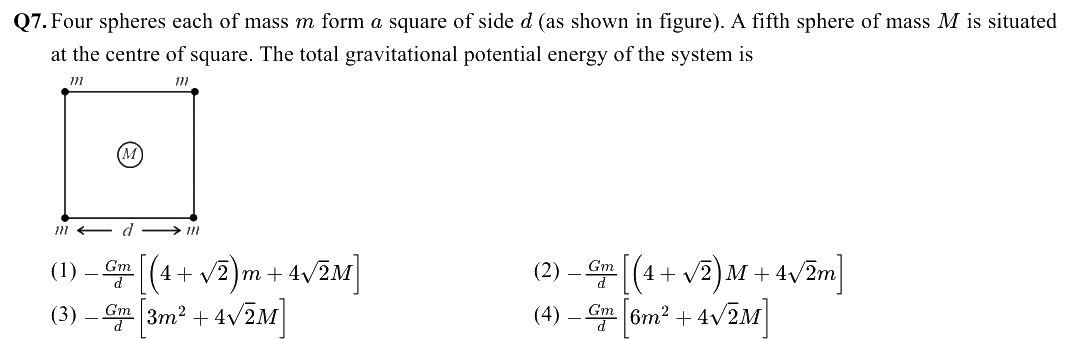
Four spheres each of mass $m$ form a square of side $d$ (as shown in figure). A fifth sphere of mass $M$ is situated at the centre of square. The total gravitational potential energy of the system is (see the figure above)
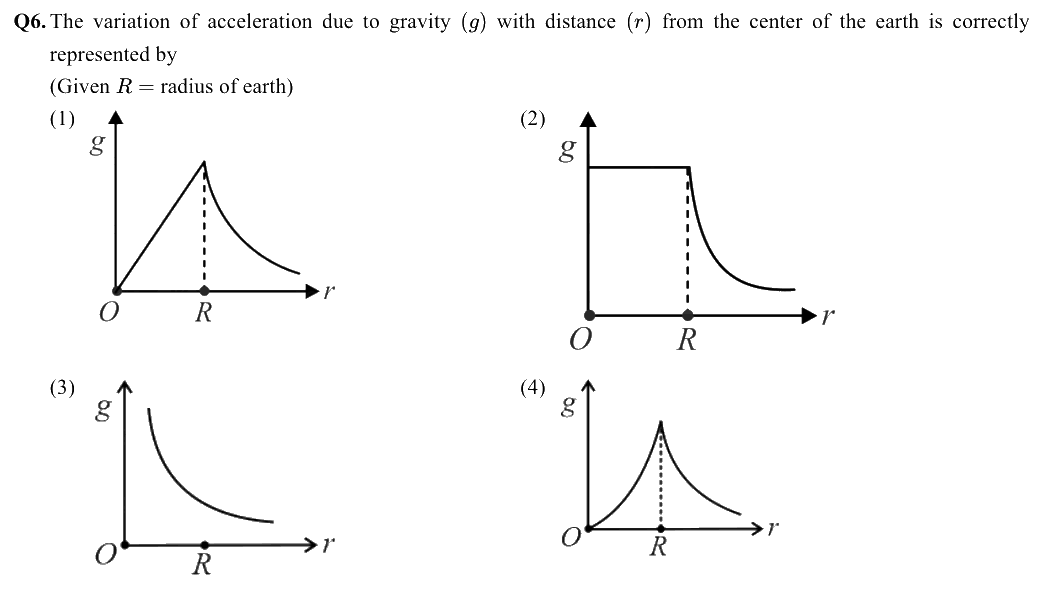
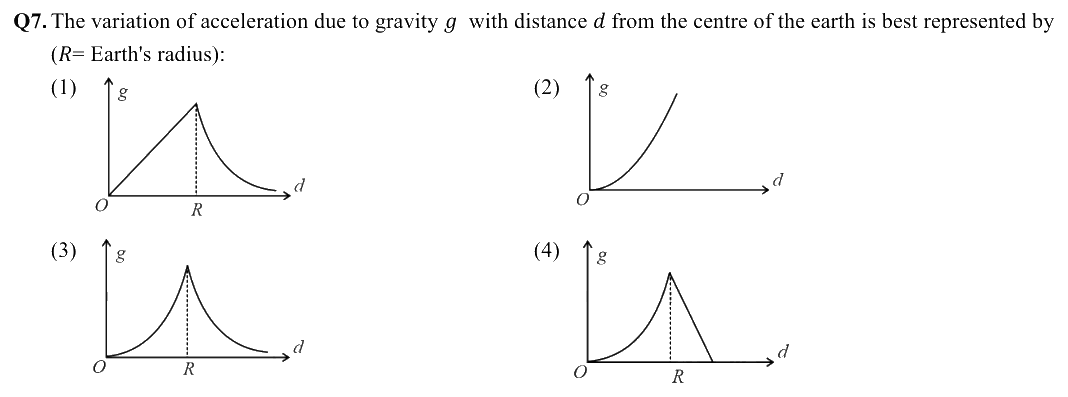
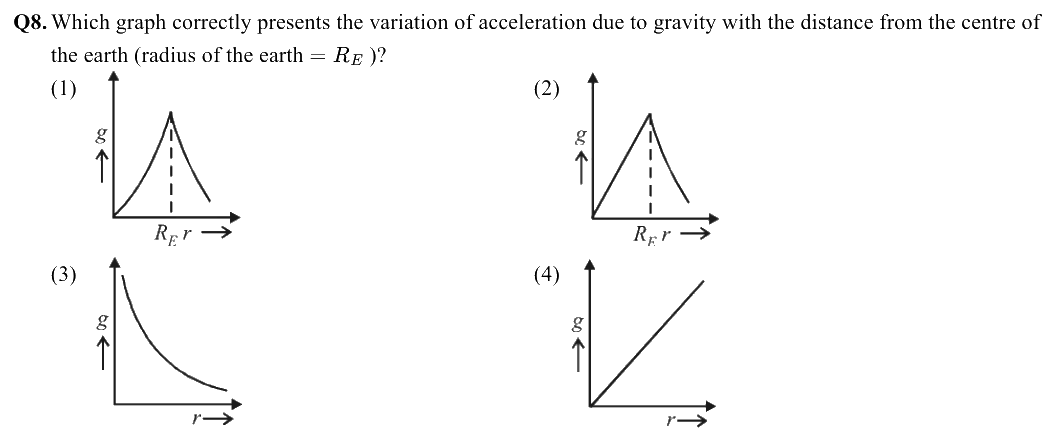
The variation of acceleration due to gravity $(g)$ with distance $(r)$ from the center of the earth is correctly represented by (Given $R$ = radius of earth)
The question as printed in the paper.
A
see figure g against r: a straight line rising from the origin O to a peak at r = R (marked by a dotted vertical line), then a decreasing convex curve beyond R
B
see figure g against r: a horizontal line at constant g from the vertical axis up to r = R (dotted vertical line), then a decreasing curve beyond R
C
see figure g against r: a decreasing convex curve over the whole range, starting high near the g axis, with R marked on the r axis
D
see figure g against r: a curve rising concavely (like a parabola opening upward) from the origin to a sharp peak at r = R (dotted vertical line), then decreasing beyond R
Given below are two statements: One is labelled as Assertion A and the other is labelled as Reason R. Assertion A: If we move from poles to equator, the direction of acceleration due to gravity always points towards the center of earth without any variation in its magnitude. Reason R: At equator, the direction of acceleration due to the gravity is towards the center of earth. In the light of above statements, choose the correct answer from the options given below
A
Assertion and reason both are correct and reason is correct explanation of assertion.
B
Assertion and reason both are correct but reason is not correct explanation of assertion.
The height of any point $P$ above the surface of earth is equal to diameter of earth. The value of acceleration due to gravity at point $P$ will be : (Given $g$ = acceleration due to gravity at the surface of earth).
The approximate height from the surface of earth at which the weight of the body becomes $\frac{1}{3}$ of its weight on the surface of earth is : [Radius of earth $\mathrm{R} = 6400 \mathrm{~km}$ and $\sqrt{3} = 1.732$]
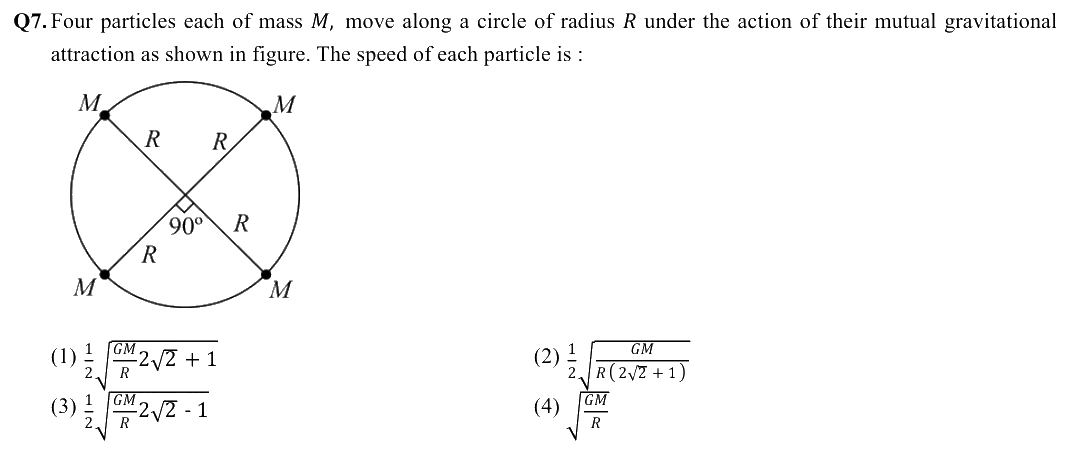
Four particles each of mass $M$, move along a circle of radius $R$ under the action of their mutual gravitational attraction as shown in figure. The speed of each particle is : (see the figure above)
The masses and radii of the earth and moon are $(M_1,\ R_1)$ and $(M_2,\ R_2)$ respectively. Their centres are at a distance $r$ apart. Find the minimum escape velocity for a particle of mass $m$ to be projected from the middle of these two masses :
If $R_E$ be the radius of Earth, then the ratio between the acceleration due to gravity at a depth $r$ below and a height $r$ above the earth surface is: (Given : $r < R_E$)
A mass of $50\ \mathrm{kg}$ is placed at the center of a uniform spherical shell of mass $100\ \mathrm{kg}$ and radius $50\ \mathrm{m}$. If the gravitational potential at a point, $25\ \mathrm{m}$ from the center is $V\ \mathrm{kg\ m^{-1}}$. The value of $V$ is:
Inside a uniform spherical shell : (a) The gravitational field is zero. (b) The gravitational potential is zero. (c) The gravitational field is the same everywhere. (d) The gravitation potential is the same everywhere. (e) All the above. Choose the most appropriate answer from the options given below:
Two identical particles of mass $1\ \mathrm{kg}$ each go round a circle of radius $R$, under the action of their mutual gravitational attraction. The angular speed of each particle is:
The planet Mars has two moons, if one of them has a period 7 hours, 30 minutes and an orbital radius of $9.0 \times 10^3\ \mathrm{km}$. Find the mass of Mars. $\left\{\text{Given }\frac{4\pi^2}{G} = 6 \times 10^{11}\ \mathrm{N^{-1}\ m^{-2}\ kg^2}\right\}$
The minimum and maximum distances of a planet revolving around the Sun are $x_1$ and $x_2$. If the minimum speed of the planet on its trajectory is $v_0$, then its maximum speed will be:
Consider a planet in some solar system that has a mass double the mass of earth and density equal to the average density of the earth. If the weight of an object on earth is $W$, the weight of the same object on that planet will be:
A body is projected vertically upwards from the surface of earth with a velocity sufficient enough to carry it to infinity. The time taken by it to reach height $h$ is ______ S.
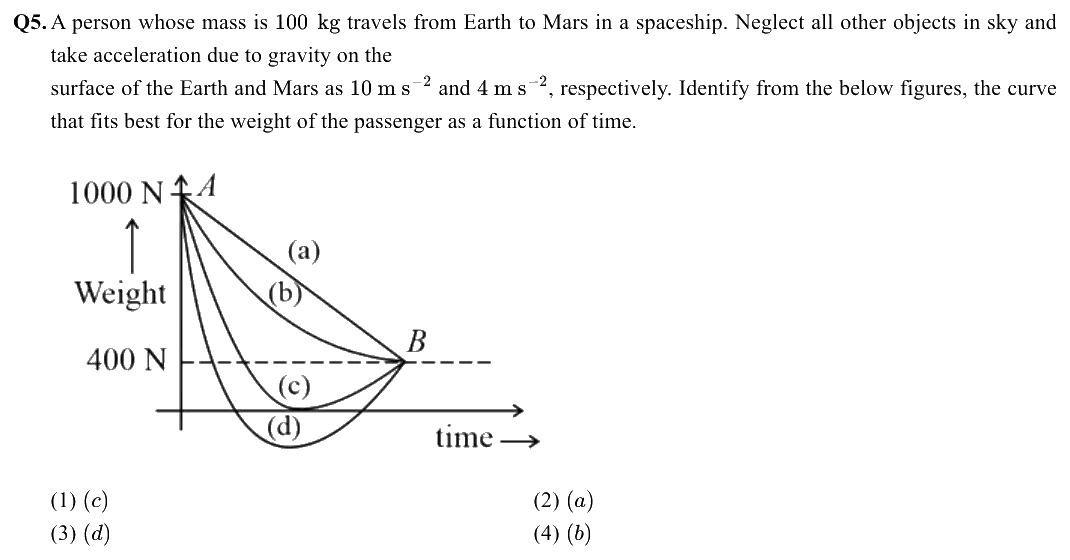
A person whose mass is $100\ \mathrm{kg}$ travels from Earth to Mars in a spaceship. Neglect all other objects in sky and take acceleration due to gravity on the surface of the Earth and Mars as $10\ \mathrm{m\ s^{-2}}$ and $4\ \mathrm{m\ s^{-2}}$, respectively. Identify from the below figures, the curve that fits best for the weight of the passenger as a function of time. (see the figure above)
A satellite is launched into a circular orbit of radius $R$ around earth, while a second satellite is launched into a circular orbit of radius $1.02\ R$. The percentage difference in the time periods of the two satellites is:
Consider a binary star system of star $A$ and star $B$ with masses $m_\mathrm{A}$ and $m_\mathrm{B}$ revolving in a circular orbit of radii $r_\mathrm{A}$ and $r_\mathrm{B}$, respectively. If $T_\mathrm{A}$ and $T_\mathrm{B}$ are the time period of star $A$ and star $B$, respectively, then:
The time period of a satellite in a circular orbit of the radius $R$ is $T$. The period of another satellite in a circular orbit of the radius $9R$ is:
If the angular velocity of earth's spin is increased such that the bodies at the equator start floating, the duration of the day would be approximately : (Take : $g = 10~\mathrm{ms^{-2}}$, the radius of earth, $R = 6400 \times 10^3~\mathrm{m}$, Take $\pi = 3.14$)
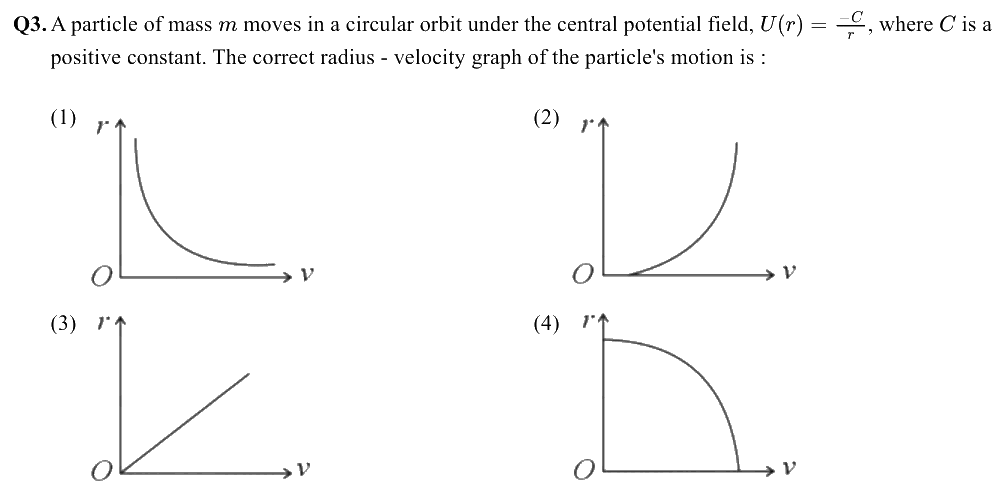
A particle of mass $m$ moves in a circular orbit under the central potential field, $U(r) = \frac{-C}{r}$, where $C$ is a positive constant. The correct radius - velocity graph of the particle's motion is :
The question as printed in the paper.
A
see figure r-v graph (r vertical, v horizontal, origin O): a curve falling steeply from high r near the r-axis and flattening towards the v-axis (decreasing, convex, hyperbola-like).
B
see figure r-v graph (r vertical, v horizontal, origin O): a curve starting near the v-axis at low r and rising ever more steeply as v increases (increasing, concave up).
C
see figure r-v graph (r vertical, v horizontal, origin O): a straight line through the origin rising to the right.
D
see figure r-v graph (r vertical, v horizontal, origin O): a curve starting at a high r on the r-axis, falling slowly at first then more steeply to meet the v-axis at a point on the right (decreasing, concave down, quarter-ellipse-like).
The angular momentum of a planet of mass $M$ moving around the sun in an elliptical orbit is $\vec{L}$. The magnitude of the areal velocity of the planet is :
A geostationary satellite is orbiting around an arbitrary planet $P$ at a height of $11 R$ above the surface of $P, R$ being the radius of $P$. The time period of another satellite in hours at a height of $2 R$ from the surface of $P$ is ______ has the time period of 24 hours.
The maximum and minimum distances of a comet from the Sun are $1.6 \times 10^{12} \mathrm{~m}$ and $8.0 \times 10^{10} \mathrm{~m}$ respectively. If the speed of the comet at the nearest point is $6 \times 10^4 \mathrm{~m} \mathrm{~s}^{-1}$, the speed at the farthest point is
A planet revolving in elliptical orbit has : A. a constant velocity of revolution. B. has the least velocity when it is nearest to the sun. C. its areal velocity is directly proportional to its velocity. D. areal velocity is inversely proportional to its velocity. E. to follow a trajectory such that the areal velocity is constant. Choose the correct answer from the options given below:
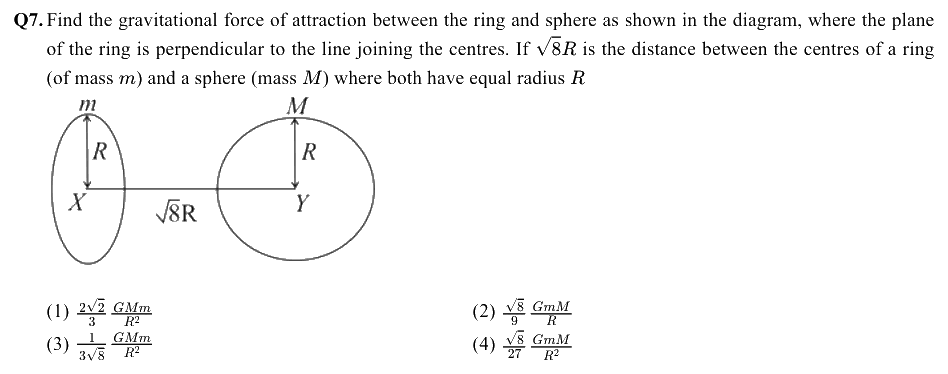
Find the gravitational force of attraction between the ring and sphere as shown in the diagram, where the plane of the ring is perpendicular to the line joining the centres. If $\sqrt{8}R$ is the distance between the centres of a ring (of mass $m$) and a sphere (mass $M$) where both have equal radius $R$ (see the figure above)
Assume that a tunnel is dug along a chord of the earth, at a perpendicular distance $\frac{R}{2}$ from the earth's centre, where $R$ is the radius of the earth. The wall of the tunnel is frictionless. If a particle is released in this tunnel, it will execute a simple harmonic motion with a time period:
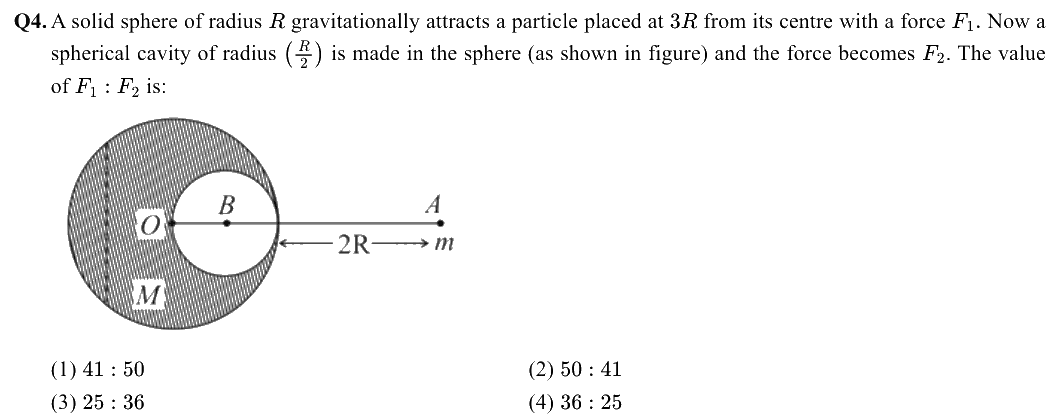
A solid sphere of radius $R$ gravitationally attracts a particle placed at $3R$ from its centre with a force $F_1$. Now a spherical cavity of radius $\left(\frac{R}{2}\right)$ is made in the sphere (as shown in figure) and the force becomes $F_2$. The value of $F_1 : F_2$ is: (see the figure above)
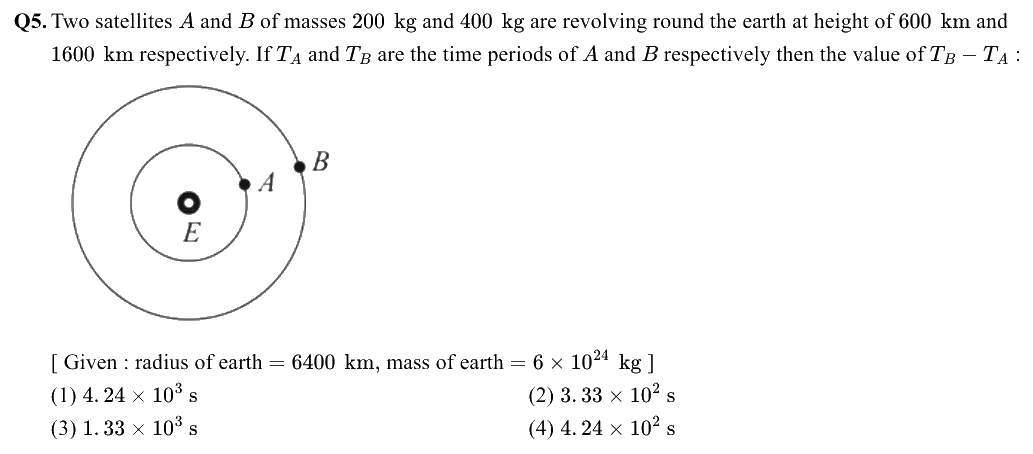
Two satellites $A$ and $B$ of masses $200\ \mathrm{kg}$ and $400\ \mathrm{kg}$ are revolving round the earth at height of $600\ \mathrm{km}$ and $1600\ \mathrm{km}$ respectively. If $T_A$ and $T_B$ are the time periods of $A$ and $B$ respectively then the value of $T_B - T_A$ : (see the figure above) [ Given : radius of earth $= 6400\ \mathrm{km}$, mass of earth $= 6 \times 10^{24}\ \mathrm{kg}$ ]
Given below are two statements : one is labelled as Assertion $A$ and the other is labelled as Reason $R$. Assertion $A$ : The escape velocities of planet $A$ and $B$ are same. But $A$ and $B$ are of unequal mass. Reason $R$: The product of their mass and radius must be same. $M_1R_1 = M_2R_2$ In the light of the above statements, choose the most appropriate answer from the options given below :
A
Both $A$ and $R$ are correct and $R$ is the correct explanation of $A$
B
Both $A$ and $R$ are correct but $R$ is NOT the correct explanation of $A$
Consider two satellites $S_1$ and $S_2$ with periods of revolution $1\,\mathrm{hr}$ and $8\,\mathrm{hr}$ respectively revolving around a planet in circular orbits. The ratio of angular velocity of satellite $S_1$ to the angular velocity of satellite $S_2$ is:
Four identical particles of equal masses $1\ \mathrm{kg}$ made to move along the circumference of a circle of radius $1\ \mathrm{m}$ under the action of their own mutual gravitational attraction. The speed of each particle will be:
A body weighs $49\ \mathrm{N}$ on a spring balance at the north pole. What will be its weight recorded on the same weighing machine, if it is shifted to the equator? [Use $g = \frac{GM}{R^2} = 9.8\ \mathrm{m\,s^{-2}}$ and radius of earth, $R = 6400\ \mathrm{km}$.]
A satellite is in an elliptical orbit around a planet $P$. It is observed that the velocity of the satellite when it is farthest from the planet is 6 times less than that when it is closest to the planet. The ratio of distances between the satellite and the planet at closest and farthest points is :
Two planets have masses M and 16 M and their radii are a and 2a, respectively. The separation between the centres of the planets is 10a. A body of mass m is fired from the surface of the larger planet towards the smaller planet along the line joining their centres. For the body to be able to reach at the surface of smaller planet, the minimum firing speed needed is :
The value of the acceleration due to gravity is $g_1$ at a height $h = \frac{R}{2}$ ($R$ = radius of the earth) from the surface of the earth. It is again equal to $g_1$ at a depth $d$ below the surface the earth. The ratio $\left(\frac{d}{R}\right)$ equals:
The acceleration due to gravity on the earth's surface at the poles is $g$ and angular velocity of the earth about the axis passing through the pole is $\omega$. An object is weighed at the equator and at a height $h$ above the poles by using a spring balance. If the weights are found to be same, then $h$ is: ($h \ll R$, where $R$ is the radius of the earth)
On the $x$-axis and at a distance $x$ from the origin, the gravitational field due to a mass distribution is given by $\frac{Ax}{(x^{2}+a^{2})^{3/2}}$ in the $x$-direction. The magnitude of the gravitational potential on the $x$-axis at a distance $x$, taking its value to be zero at infinity is:
A body is moving in a low circular orbit about a planet of mass $M$ and radius $R$. The radius of the orbit can be taken to be $R$ itself. Then the ratio of the speed of this body in the orbit to the escape velocity from the planet is:
A satellite is moving in a low nearly circular orbit around the earth. Its radius is roughly equal to that of the earth's radius $\mathrm{R_e}$. By firing rockets attached to it, its speed is instantaneously increased in the direction of its motion so that it become $\sqrt{\frac{3}{2}}$ times larger. Due to this the farthest distance from the centre of the earth that the satellite reaches is R. Value of R is :
The mass density of a planet of radius R varies with the distance r from its centre as $\rho(r) = \rho_0\left(1 - \frac{r^{2}}{R^{2}}\right)$ Then the gravitational field is maximum at:
The mass density of a spherical galaxy varies as $\frac{K}{r}$ over a large distance $r$ from its center. In that region, a small star is in a circular orbit of radius $R$. Then the period of revolution,$T$ depends on $R$ as:
The height 'h' at which the weight of a body will be the same as that at the same depth 'h' from the surface of the earth is (Radius of the earth is R and effect of the rotation of the earth is neglected)
A body A of mass $m$ is moving in a circular orbit of radius $R$ about a planet. Another body B of mass $\frac{m}{2}$ collides with A with a velocity which is half $\left(\frac{\overrightarrow{v}}{2}\right)$ the instantaneous velocity $\overrightarrow{v}$ of A. The collision is completely inelastic. Then, the combined body:
A
continues to move in a circular orbit
B
Escapes from the Planet's Gravitational field
C
Falls vertically downwards towards the planet
D
starts moving in an elliptical orbit around the planet
Planet $A$ has mass $M$ and radius $R$. Planet $B$ has half the mass and half the radius of Planet $A$. If the escape velocities from the Planets $A$ and $B$ are $v_A$ and $v_B$, respectively, then $\frac{v_A}{v_B} = \frac{n}{4}$. The value of $n$ is:
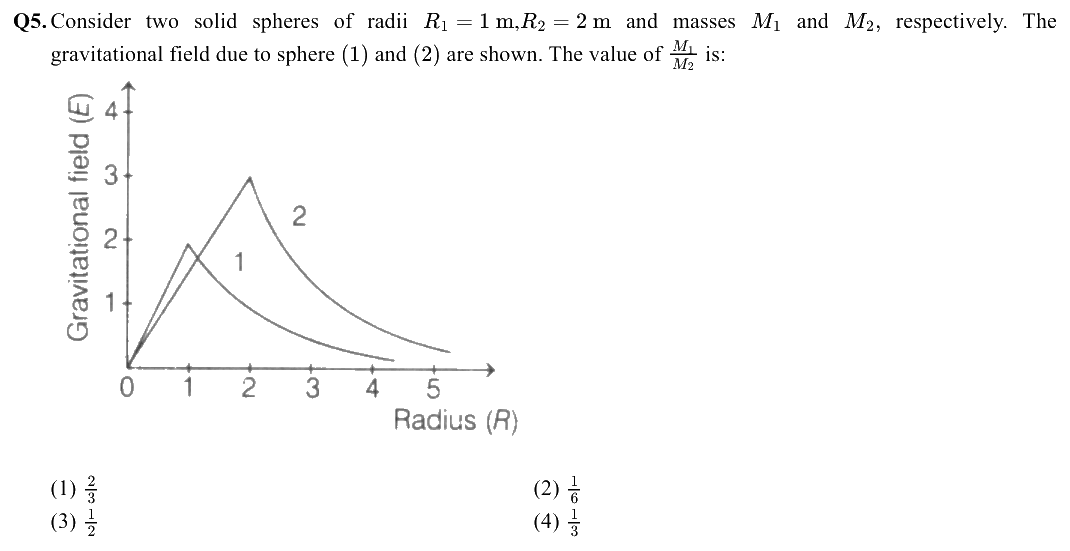
Consider two solid spheres of radii $R_1 = 1\ \mathrm{m}, R_2 = 2\ \mathrm{m}$ and masses $M_1$ and $M_2$, respectively. The gravitational field due to sphere (1) and (2) are shown. The value of $\frac{M_1}{M_2}$ is: (see the figure above)
A satellite of mass$M$ is launched vertically upwards with an initial speed $u$ from the surface of the earth. After it reaches height $R$ ( $R =$ radius of the earth), it ejects a rocket of mass $\frac{M}{10}$ so that subsequently the satellite moves in a circular orbit. The kinetic energy of the rocket is ( $G$ is the gravitational constant; $M_e$ is the mass of the earth):
A box weighs $196\mathrm{N}$ on a spring balance at the north pole. Its weight recorded on the same balance if it is shifted to the equator is close to (Take $\mathrm{g} = 10\mathrm{ms}^{-2}$ at the north pole and the radius of the earth $= 6400\mathrm{km}$ ):
The ratio of the weights of a body on Earth's surface to that on the surface of a planet is 9 : 4 The mass of the planet is $\frac{1}{9}th$ of that of the Earth. If $R$ is the radius of the Earth, what is the radius of the planet? (Take the planets to have the same mass density)
The value of acceleration due to gravity at Earth's surface is $9.8\ \mathrm{m\ s^{-2}}$. The altitude above its surface at which the acceleration due to gravity decreases to $4.9\ \mathrm{m\ s^{-2}}$, is close to: (Radius of earth $= 6.4\times10^{6}\ \mathrm{m}$ )
A spaceship orbits around a planet at a height of $20\ \mathrm{km}$ from its surface. Assuming that only gravitational field of the planet acts on the spaceship, what will be the number of complete revolutions made by the spaceship in 24 hours around the planet? [Given: Mass of planet $= 8\times10^{22}\ \mathrm{kg}$, Radius of planet $= 2\times10^{6}\ \mathrm{m}$, Gravitational constant $G = 6.67\times10^{-11}\ \mathrm{Nm^{2}\,/\,kg^{2}}$ ]
A solid sphere of mass M and radius $a$ is surrounded by a uniform concentric spherical shell of thickness 2a and mass 2M. The gravitational field at distance 3a from the centre will be:
A test particle is moving in a circular orbit in the gravitational field produced by a mass density $\rho(r) = \dfrac{K}{r^2}$. Identify the current relation between the radius R of the particle's orbit and its period T :
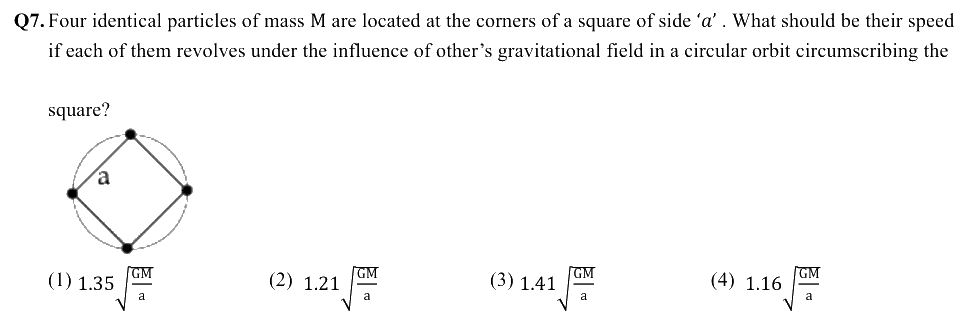
Four identical particles of mass M are located at the corners of a square of side '$a$'. What should be their speed if each of them revolves under the influence of other's gravitational field in a circular orbit circumscribing the square? (see the figure above)
A rocket has to be launched from earth in such a way that it never returns. If $E$ is the minimum energy delivered by the rocket launcher, what should be the minimum energy that the launcher should have, if the same rocket is to be launched from the surface of the moon? Assume that the density of the earth and the moon are equal and that the earth's volume is 64 times the volume of the moon.
A satellite of mass M is in a circular orbit of radius R about the center of the earth. A meteorite of the same mass, falling towards the earth, collides with the satellite completely inelastic. The speeds of the satellite and the meteorite are the same, just before the collision. The subsequent motion of the combined body will be:
A straight rod of length $L$ extends from $x = a$ to $x = L + a$. The gravitational force it exerts on a point mass 'm' at $x = 0$, if the mass per unit length of the rod is $A + Bx^2$, is given by:
Two satellites, A and B, have masses $m$ and $2m$ respectively. A is in a circular orbit of radius $R$ and B is in a circular orbit of radius $2R$ around the earth. The ratio of their kinetic energies, $\frac{K_A}{K_B}$ is:
A satellite is revolving in a circular orbit at a height h from the carth surface, such that h << R where R is the radius of the earth. Assuming that the effect of earth"s atmosphere can be neglected the minimum increase in the speed required so that the satellite could escape from the gravitational field of earth is
The mass and the diameter of a planet are three times the respective values for the Earth. The period of oscillation of a simple pendulum on the Earth is 2 s. The period of oscillation of the same pendulum on the planet would be:
A satellite is moving with a constant speed $v$ in circular orbit around the earth. An object of mass '$m$' is ejected from the satellite such that it just escapes from the gravitational pull of the earth. At the time of ejection, the kinetic energy of the object is:
Two stars of masses $3\times10^{31}\ \mathrm{kg}$ each, and at distance $2\times10^{11}\ \mathrm{m}$ rotate in a plane about their common centre of mass O. A meteorite passes through O moving perpendicular to the stars' rotation plane. In order to escape from the gravitational field of this double star, the minimum speed that meteorite should have at O is ( Take Gravitational constant $G = 6.67\times10^{-11}\ \mathrm{N\,m^2\ kg^{-2}}$ )
The energy required to take a satellite to a height $h$ above the Earth surface (radius of Earth $= 6.4\times10^3\ \mathrm{km}$ ) is $E_1$, and the kinetic energy required for the satellite to be in a circular orbit at this height is $E_2$. The value of $h$ for which $E_1$ and $E_2$ are equal, is
The relative uncertainty in the period of a satellite orbiting around the earth is $10^{-2}$. If the relative uncertainty in the radius of the orbit is negligible, the relative uncertainty in the mass of the earth is:
A body of mass $m$ is moving in a circular orbit of radius $R$ about a planet of mass $M$. At some instant, it splits into two equal masses. The first mass moves in a circular orbit of radius $\frac{R}{2}$, and the other mass, in a circular orbit of radius $\frac{3R}{2}$. The difference between the final and initial total energies is:
Take the mean distance of the moon and the sun from the earth to be $0.4 \times 10^{6}\ \mathrm{km}$ and $150 \times 10^{6}\ \mathrm{km}$ respectively. Their masses are $8 \times 10^{22}\ \mathrm{kg}$ and $2\times 10^{30}\ \mathrm{kg}$ respectively. The radius of the earth is $6400\ \mathrm{km}$. Let $\Delta F_1$ be the difference in the forces exerted by the moon at the nearest and farthest points on the earth and $\Delta F_2$ be the difference in the force exerted by the sun at the nearest and farthest points on the earth. Then, the number closest to $\frac{\Delta F_1}{\Delta F_2}$ is:
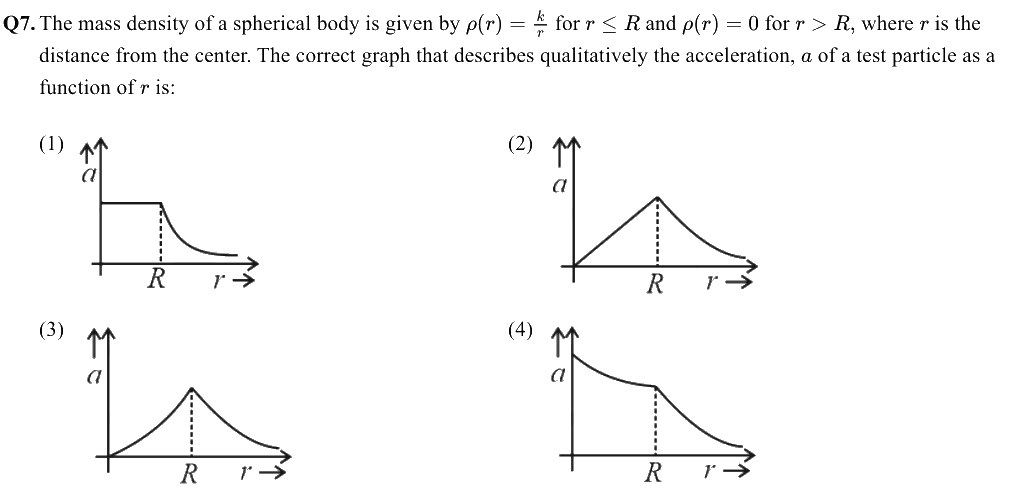
The mass density of a spherical body is given by $\rho(r) = \frac{k}{r}$ for $r \leq R$ and $\rho(r) = 0$ for $r > R$, where $r$ is the distance from the center. The correct graph that describes qualitatively the acceleration, $a$ of a test particle as a function of $r$ is:
If the Earth has no rotational motion, the weight of a person on the equator is $W$. Determine the speed with which the earth would have to rotate about its axis so that the person at the equator will weigh $\frac{3}{4}W$. The radius of the Earth is 6400 km and $g = 10\ \mathrm{m\ s^{-2}}$.
An astronaut of mass $m$ is working on a satellite orbiting the earth at a distance $h$ from the earth's surface. The radius of the earth is $R$, while its mass is $M$. The gravitational pull $F_G$ on the astronaut is
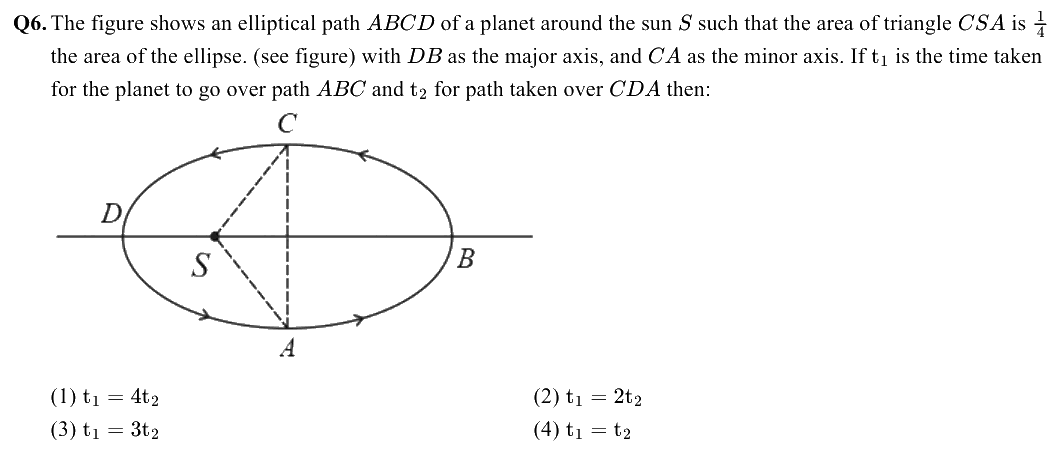
The figure shows an elliptical path $ABCD$ of a planet around the sun $S$ such that the area of triangle $CSA$ is $\frac{1}{4}$ the area of the ellipse. (see figure) with $DB$ as the major axis, and $CA$ as the minor axis. If $\mathrm{t_1}$ is the time taken for the planet to go over path $ABC$ and $\mathrm{t_2}$ for path taken over $CDA$ then: (see the figure above)
A satellite is revolving in a circular orbit at a height $h$ from the earth's surface (radius of earth $R$; $h \ll R$ ). The minimum increase in its orbital velocity required, so that the satellite could escape from the earth's gravitational field, is close to (Neglect the effect of atmosphere.)
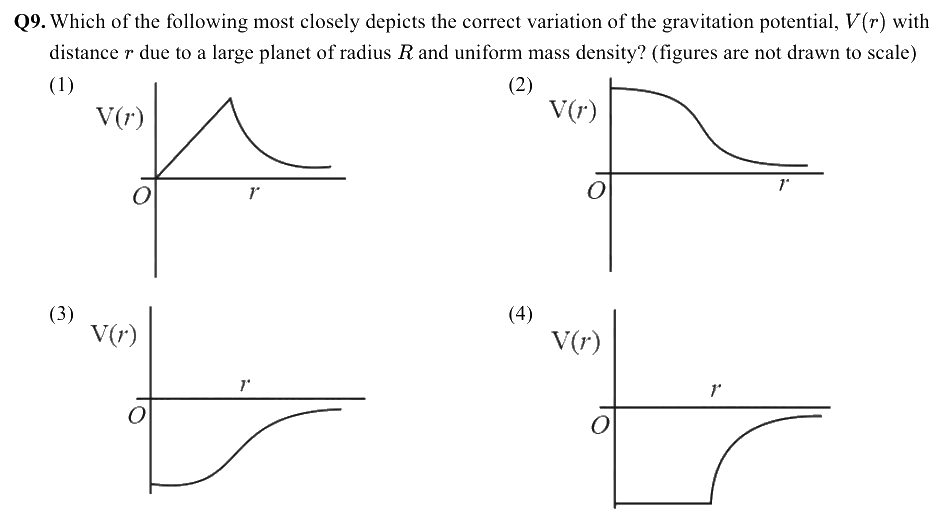
Which of the following most closely depicts the correct variation of the gravitation potential, $V(r)$ with distance $r$ due to a large planet of radius $R$ and uniform mass density? (figures are not drawn to scale)
A very long (length $L$) cylindrical galaxy is made of uniformly distributed mass and has radius $R$ ($R << L$). A star outside the galaxy is orbiting the galaxy in a plane perpendicular to the galaxy and passing through its centre. If the time period of the star is $T$ and its distance from the galaxy's axis is $r$, then
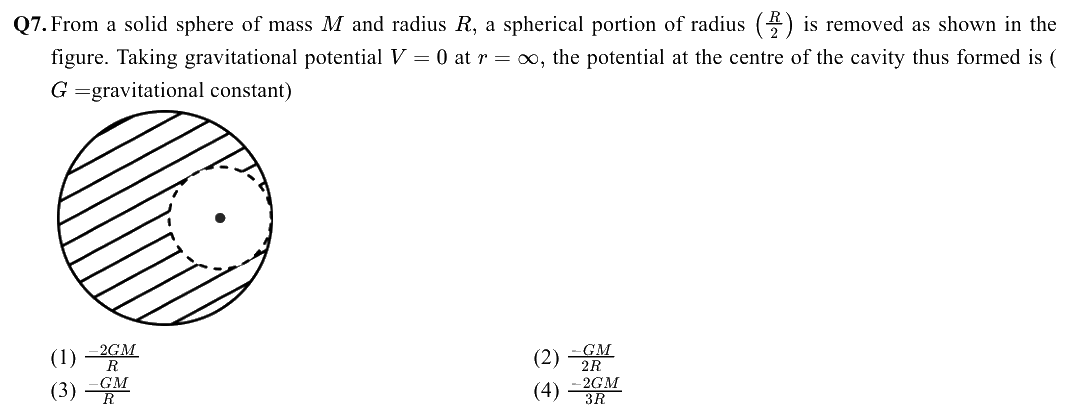
From a solid sphere of mass $M$ and radius $R$, a spherical portion of radius $\left(\dfrac{R}{2}\right)$ is removed as shown in the figure. Taking gravitational potential $V = 0$ at $r = \infty$, the potential at the centre of the cavity thus formed is ( $G$ =gravitational constant) (see the figure above)
The gravitational field in a region is given by $\overrightarrow{g} = \left(5\hat{i} + 12\hat{j}\right)\ \mathrm{N\,kg^{-1}}$. The change in the gravitational potential energy of a particle of mass $2\ \mathrm{kg}$ when it is taken from the origin to a point $(7\ \mathrm{m}, -3\ \mathrm{m})$ is
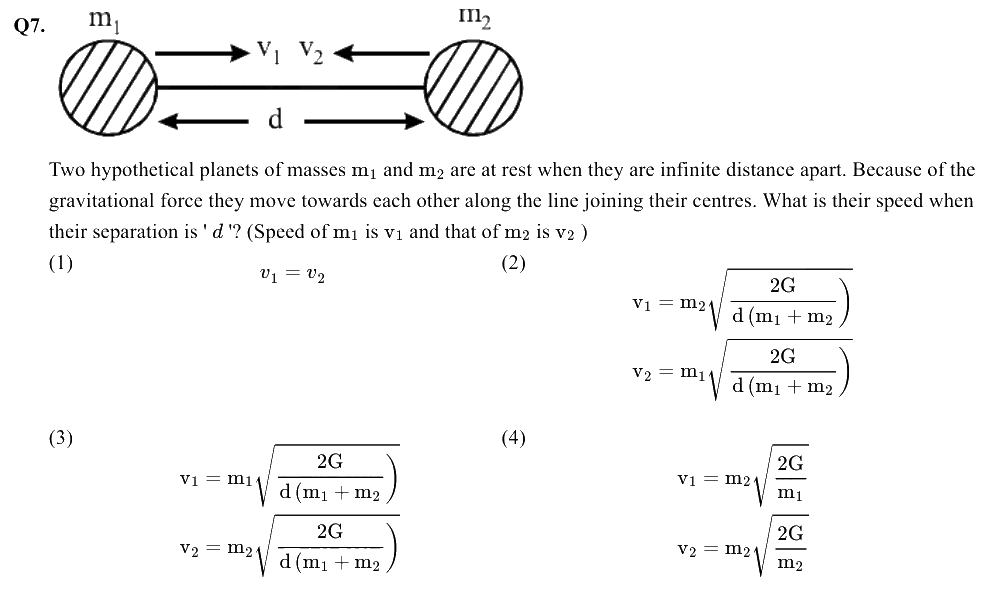
see figure Two hypothetical planets of masses $m_1$ and $m_2$ are at rest when they are infinite distance apart. Because of the gravitational force they move towards each other along the line joining their centres. What is their speed when their separation is ' $d$ '? (Speed of $m_1$ is $v_1$ and that of $m_2$ is $v_2$ )
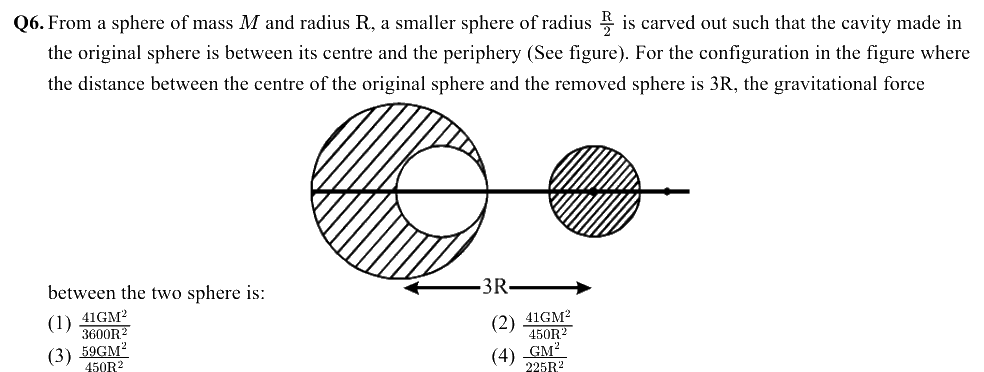
From a sphere of mass $M$ and radius R, a smaller sphere of radius $\frac{\mathrm{R}}{2}$ is carved out such that the cavity made in the original sphere is between its centre and the periphery (See figure). For the configuration in the figure where the distance between the centre of the original sphere and the removed sphere is 3R, the gravitational force between the two sphere is: (see the figure above)
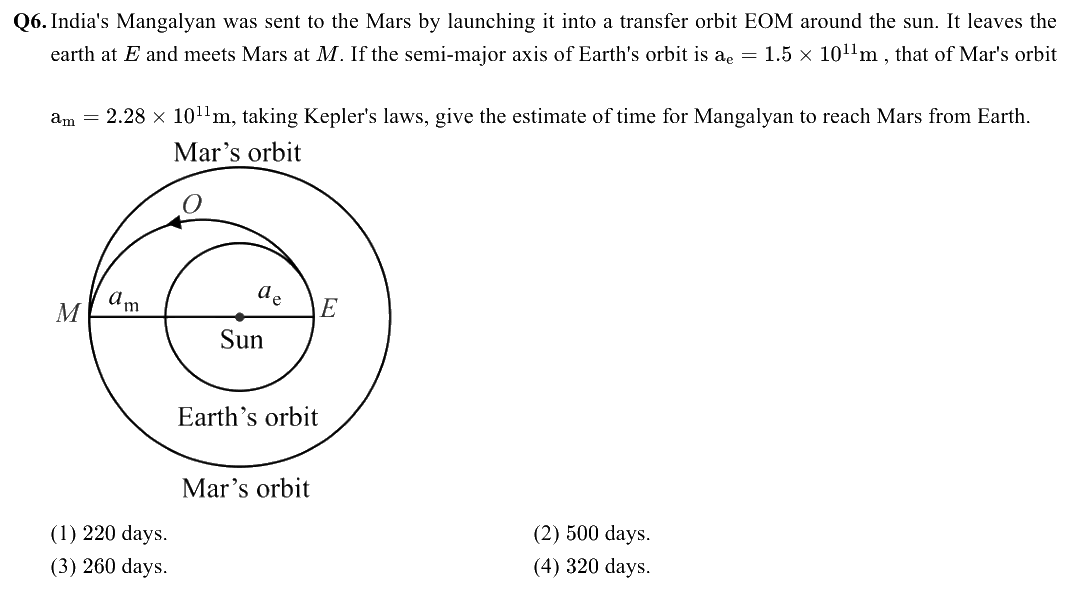
India's Mangalyan was sent to the Mars by launching it into a transfer orbit EOM around the sun. It leaves the earth at $E$ and meets Mars at $M$. If the semi-major axis of Earth's orbit is $\mathrm{a_e} = 1.5\times10^{11}\,\mathrm{m}$ , that of Mar's orbit $\mathrm{a_m} = 2.28\times10^{11}\mathrm{m}$, taking Kepler's laws, give the estimate of time for Mangalyan to reach Mars from Earth. (see the figure above)
Four particles, each of mass $M$ and equidistant from each other, move along a circle of radius $R$ under the action of their mutual gravitational attraction. The speed of each particle is
The gravitational field in a region is given by: $E = (5\,\mathrm{N/kg})\hat{i} + (12\,\mathrm{N/kg})\hat{j}$ If the potential at the origin is taken to be zero, then the ratio of the potential at the points $(12\ \mathrm{m}, 0)$ and $(0, 5\ \mathrm{m})$ is :
The change in the value of acceleration of earth towards sun, when the moon comes from the position of solar eclipse to the position on the other side of earth in line with sun is: (mass of the moon $= 7.36 \times 10^{22}\ \mathrm{kg}$, radius of the moon's orbit $= 3.8 \times 10^{8}\ \mathrm{m}$ ).
The gravitational field, due to the 'left over part' of a uniform sphere (from which a part as shown, has been 'removed out'), at a very far off point, P, located as shown, would be (nearly) :
What is the minimum energy required to launch a satellite of mass m from the surface of a planet of mass M and radius R in a circular orbit at an altitude of 2R?
A point particle is held on the axis of a ring of mass $m$ and radius $r$ at a distance $r$ from its centre $C$. When released, it reaches $C$ under the gravitational attraction of the ring. Its speed at $C$ will be
Two point masses of mass $m_1 = fM$ and $m_2 = (1-f)M (f < 1)$ are in outer space (far from gravitational influence of other objects) at a distance $R$ from each other. They move in circular orbits about their centre of mass with angular velocities $\omega_1$ for $m_1$ and $\omega_2$ for $m_2$. In that case
Assuming the earth to be a sphere of uniform density, the acceleration due to gravity inside the earth at a distance of $r$ from the centre is proportional to
Which graph correctly presents the variation of acceleration due to gravity with the distance from the centre of the earth (radius of the earth = $R_E$ )?
The mass of a spaceship is $1000\ \mathrm{kg}$. It is to be launched from the earth's surface out into free space. The value of ' g ' and ' $R$ ' (radius of earth) are $10\ \mathrm{m/s^2}$ and $6400\ \mathrm{km}$ respectively. The required energy for this work will be ;
Two bodies of masses m and $4$ m are placed at a distance r. The gravitational potential at a point on the line joining them where the gravitational field is zero is:
The height at which the acceleration due to gravity becomes $\frac{g}{9}$ (where $g$ = the acceleration due to gravity on the surface of the earth) in terms of $R$, the radius of the earth is
A planet in a distant solar system is 10 times more massive than the earth and its radius is 10 times smaller. Given that the escape velocity from the earth is $11\ \mathrm{kms^{-1}}$, the escape velocity from the surface of the planet would be
This question contains Statement $-1$ and Statement-2. Of the four choices given after the statements, choose the one that best describes the two statements. Statement - I: For a mass $M$ kept at the centre of a cube of side ' $a$ ', the flux of gravitational field passing through its sides is $4\pi$ GM. and Statement - II If the direction of a field due to a point source is radial and its dependence on the distance ' $r$ ' for the source is given as $1/r^{2}$, its flux through a closed surface depends only on the strength of the source enclosed by the surface and not on the size or shape of the surface
A
Statement $-1$ is false, Statement $-2$ is true.
B
Statement $-1$ is true, Statement $-2$ is true; Statement $-2$ is correct explanation for Statement-1.
C
Statement $-1$ is true, Statement $-2$ is true; Statement $-2$ is not a correct explanation for Statement-1.
The change in the value of $g$ at a height ' $h$ ' above the surface of the earth is the same as at a depth 'd' below the surface of earth. When both ' $d$ ' and ' $h$ ' are much smaller than the radius of earth, then which one of the following is correct?
A particle of mass 10 g is kept on the surface of a uniform sphere of mass 100 kg and radius 10 cm. Find the work to be done against the gravitational force between them to take the particle far away from the sphere (you may take $\mathrm{G} = 6.67 \times 10^{-11}\,\mathrm{Nm^2/kg^2}$ )
A satellite of mass $m$ revolves around the earth of radius $R$ at a height $x$ from its surface. If $g$ is the acceleration due to gravity on the surface of the earth, the orbital speed of the satellite is
If g is the acceleration due to gravity on the earth's surface, the gain in the potential energy of object of mass $m$ raised from the surface of the earth to a height equal to the radius $R$ of the earth is
Suppose the gravitational force varies inversely as the nth power of distance. Then the time period planet in circular orbit of radius $\mathrm{R}$ around the sun will be proportional to
The time period of a satellite of earth is 5 hours. If the separation between the earth and the satellite is increased to 4 times the previous value, the new time period will become
The escape velocity for a body projected vertically upwards from the surface of earth is 11 km/s. If the body is projected at an angle of $45^\circ$ with the vertical, the escape velocity will be
Three identical spheres of mass m, are placed at the vertices of an equilateral triangle of length $a$. When released, they interact only through gravitational force and collide after a time $T = 4$ seconds. If the sides of the triangle are increased to length 2a and also the masses of the spheres are made 2 m, then they will collide after ______ seconds.
Numerical answer type: type your answer in EdLoop to check it
A satellite of mass 1000 kg is launched to revolve around the earth in an orbit at a height of 270 km from the earth's surface. Kinetic energy of the satellite in this orbit is ______ $\times 10^{10} J$. (Mass of earth $= 6 \times 10^{24}kg$, Radius of earth $= 6.4 \times 10^6m$, Gravitational constant $= 6.67 \times 10^{-11}Nm^2kg^{-2}$ )
Numerical answer type: type your answer in EdLoop to check it
Two planets, $A$ and $B$ are orbiting a common star in circular orbits of radii $R_A$ and $R_B$, respectively, with $R_B = 2R_A$. The planet B is $4\sqrt{2}$ times more massive than planet $A$. The ratio $\left(\frac{L_B}{L_A}\right)$ of angular momentum ($L_B$) of planet $B$ to that of planet $A$ ($L_A$) is closest to integer ______ .
Numerical answer type: type your answer in EdLoop to check it
Acceleration due to gravity on the surface of earth is ' $g$ '. If the diameter of earth is reduced to one third of its original value and mass remains unchanged, then the acceleration due to gravity on the surface of the earth is ______ g.
Numerical answer type: type your answer in EdLoop to check it
A satellite of mass $\frac{M}{2}$ is revolving around earth in a circular orbit at a height of $\frac{R}{3}$ from earth surface. The angular momentum of the satellite is $M\sqrt{\frac{GMR}{x}}$. The value of $x$ is ______, where $M$ and $R$ are the mass and radius of earth, respectively. ( G is the gravitational constant)
Numerical answer type: type your answer in EdLoop to check it
A simple pendulum is placed at a place where its distance from the earth's surface is equal to the radius of the earth. If the length of the string is 4 m, then the time period of small oscillations will be ______ s. [take $g = \pi^2\ \mathrm{m\,s^{-2}}$]
Numerical answer type: type your answer in EdLoop to check it
If the acceleration due to gravity experienced by a point mass at a height $h$ above the surface of earth is same as that of the acceleration due to gravity at a depth $\alpha h (h \ll R_e)$ ) from the earth surface. The value of $\alpha$ will be ______. (use $R_e = 6400$ km)
Numerical answer type: type your answer in EdLoop to check it
Two satellites $S_1$ and $S_2$ are revolving in circular orbits around a planet with radius $R_1 = 3200 \mathrm{~km}$ and $R_2 = 800 \mathrm{~km}$ respectively. The ratio of speed of satellite $S_1$ to the speed of satellite $S_2$ in their respective orbits would be $\frac{1}{x}$ where $x =$
Numerical answer type: type your answer in EdLoop to check it
Two satellites revolve around a planet in coplanar circular orbits in anticlockwise direction. Their period of revolutions are $1$ hour and $8$ hours respectively. The radius of the orbit of nearer satellite is $2 \times 10^3$ km. The angular speed of the farther satellite as observed from the nearer satellite at the instant when both the satellites are closest is $\frac{\pi}{x}$ rad h$^{-1}$, where $x$ is ______.
Numerical answer type: type your answer in EdLoop to check it
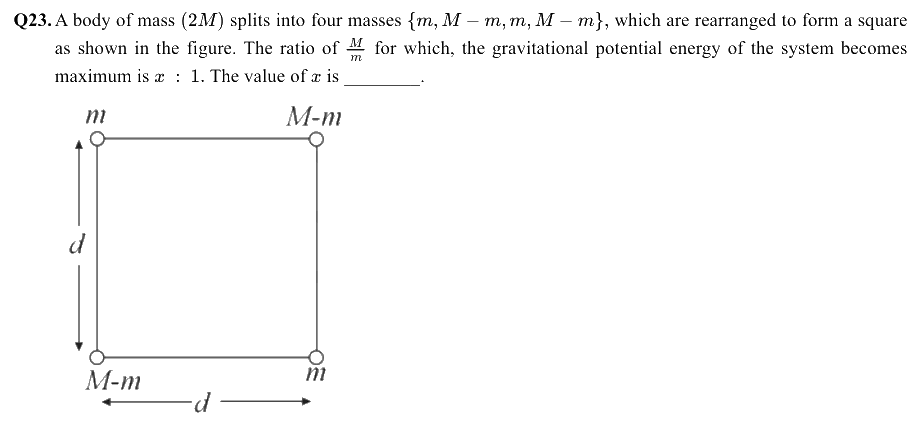
A body of mass $(2M)$ splits into four masses $\{m, M - m, m, M - m\}$, which are rearranged to form a square as shown in the figure. The ratio of $\frac{M}{m}$ for which, the gravitational potential energy of the system becomes maximum is $x$ : 1. The value of $x$ is ______. (see the figure above)
The question as printed in the paper.
Numerical answer type: type your answer in EdLoop to check it
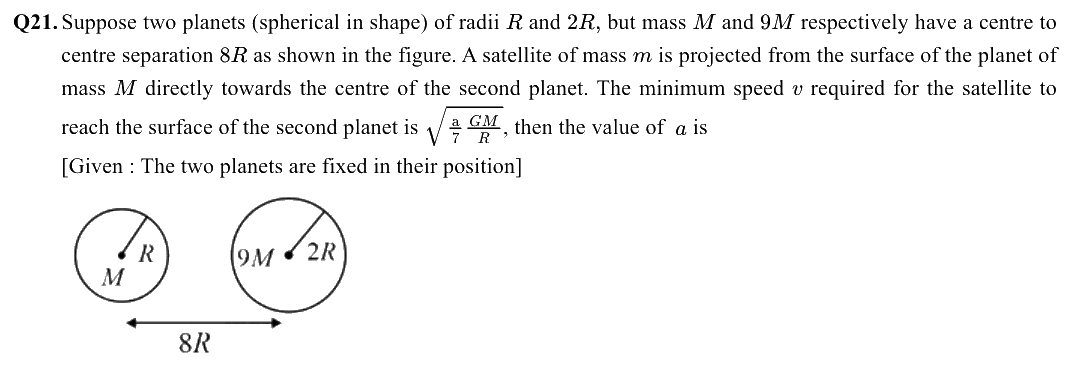
Suppose two planets (spherical in shape) of radii $R$ and $2R$, but mass $M$ and $9M$ respectively have a centre to centre separation $8R$ as shown in the figure. A satellite of mass $m$ is projected from the surface of the planet of mass $M$ directly towards the centre of the second planet. The minimum speed $v$ required for the satellite to reach the surface of the second planet is $\sqrt{\frac{a}{7}\frac{GM}{R}}$, then the value of $a$ is [Given : The two planets are fixed in their position] (see the figure above)
The question as printed in the paper.
Numerical answer type: type your answer in EdLoop to check it
The radius in kilometer to which the present radius of earth ($R=6400 \mathrm{~km}$) to be compressed so that the escape velocity is increased 10 time is ______.
Numerical answer type: type your answer in EdLoop to check it
If one wants to remove all the mass of the earth to infinity in order to break it up completely. The amount of energy that needs to be supplied will be $\frac{x}{5}\frac{GM^2}{R}$ where $x$ is ______. (Round off to the Nearest Integer) ($M$ is the mass of earth, $R$ is the radius of earth, $G$ is the gravitational constant)
Numerical answer type: type your answer in EdLoop to check it
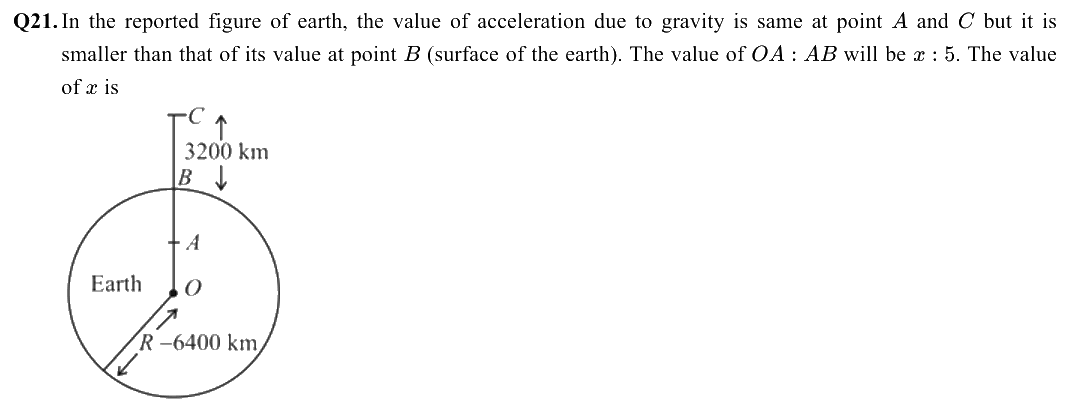
In the reported figure of earth, the value of acceleration due to gravity is same at point $A$ and $C$ but it is smaller than that of its value at point $B$ (surface of the earth). The value of $OA : AB$ will be $x : 5$. The value of $x$ is (see the figure above)
The question as printed in the paper.
Numerical answer type: type your answer in EdLoop to check it
The initial velocity $v_i$ required to project a body vertically upward from the surface of the earth to reach a height of $10R$, where $R$ is the radius of the earth, may be described in terms of escape velocity $v_e$ such that $v_i = \sqrt{\frac{x}{y}} \times v_e$. The value of $x$ will be
Numerical answer type: type your answer in EdLoop to check it
An asteroid is moving directly towards the centre of the earth. When at a distance of $10R$ ($R$ is the radius of the earth) from the centre of the earth, it has a speed of $12\ \mathrm{km\ s^{-1}}$. Neglecting the effect of earth's atmosphere, what will be the speed of the asteroid when it hits the surface of the earth (escape velocity from the earth is $11.2\ \mathrm{km\ s^{-1}}$) ? Give your answer to the nearest integer in $\mathrm{km\ s^{-1}}$______.
Numerical answer type: type your answer in EdLoop to check it
Gravitation is one of the most dependable chapters in JEE Main Physics, providing clean, mathematically tractable questions on almost every exam day. Across the papers we hold from 2019 to 2026, it accounted for 172 questions in 162 papers, which corresponds to 1.1 questions per paper, and appeared in 142 of those 162 papers. That makes it the 10th largest of 29 Physics chapters over that eight-year period, representing 3.8% of all Physics questions.
The chapter's share has stayed about the same over two decades of testing. Between 2002 and 2018, it took 3.2% of Physics; across the last three exam years (2024 to 2026), it stood at 2.8%, producing 44 questions across 58 papers. The busiest year in our set was 2021, when our records show 38 questions across 26 papers. Since 2019 there has been no year without it, appearing in 142 of the 162 papers we hold.
The chapter corresponds to Unit 6: Gravitation in NTA's Class 11 Physics syllabus. Its conceptual structure closely mirrors Electrostatics, meaning mastery of gravitational potential and field superposition directly reinforces Coulomb's law later in Class 12.
Most-asked topics
From 2019 to 2026, gravitation problems distributed across four main topics:
Newton's Law of Gravitation: 62 questions. Variation of g with altitude, depth, and planetary rotation, along with force between distributed masses.
Satellites: 61 questions. Orbital velocity, total mechanical energy, escape speed, and orbital altitude transitions.
Kepler's Laws: 25 questions. Orbital period scaling, areal velocity conservation, and elliptical trajectory geometry.
Field & Potential: 24 questions. Gravitational potential inside solid and hollow spheres, binding energy of discrete mass configurations, and field superposition.
All four topic divisions appeared in the 2026 question papers, so none can be safely set aside.
What the questions look like
Variation of acceleration due to gravity is the most frequent calculation. A typical problem asks for the height above Earth's surface where g falls to a stated fraction, such as g/9. Students must be careful not to use the linear approximation (1 - 2h/R) when h is comparable to Earth's radius, opting instead for the exact inverse-square relation R² / (R + h)². Other variations explore depth variations inside the Earth, where g decreases linearly toward zero at the center.
Satellite mechanics questions focus on energy bookkeeping. You will often calculate the energy input required to shift an orbiting satellite from an initial orbital radius to a higher circular orbit. Because total orbital energy equals negative kinetic energy, moving outward reduces kinetic energy while increasing gravitational potential energy, resulting in a net positive energy requirement. Escape velocity problems frequently ask you to scale escape speed to hypothetical planets with given ratios of density and radius.
Field and potential problems evaluate vector additions and scalar potential energies. A standard format places four masses at the vertices of a square, asking for the net gravitational pull at the center, or evaluates how the force shifts when two masses swap positions. Kepler's third law questions test period ratios when orbit radii or central star masses vary.
The numerical answer format appears moderately here: 16 of the 172 questions since 2019 had no options, requiring exact arithmetic.
Questions to try first
The following questions from NTA's 2026 papers illustrate the classic problem styles:
Start by deriving the formulas for acceleration due to gravity at height h and depth d directly from Newton's law of gravitation and shell theorems. Commit to memory that g at depth d equals g(1 - d/R) for a uniform sphere, whereas at height h it follows g R² / (R + h)². Never mix up the two regimes.
Next, master satellite energy relationships. Remember that for a circular orbit of radius r around mass M, potential energy is -GMm/r, kinetic energy is GMm/(2r), and total energy is -GMm/(2r). This simple 2 : -1 : 1 relationship between potential, kinetic, and total energies will allow you to answer energy shift questions in under a minute without algebraic confusion.
For escape velocity, relate the formula to both mass and density. Writing escape velocity as proportional to R times the square root of density makes comparative problems straightforward when given density ratios. Finish by solving multi-particle potential energy problems, counting pairwise combinations systematically using n(n - 1)/2 for n masses.
Frequently asked questions
Is Gravitation heavily featured in JEE Main 2027?
Yes. Gravitation contributed 172 questions across 162 papers in our set from 2019 to 2026, yielding 1.1 questions per paper. It ranks 10th of 29 Physics chapters and appeared in 142 of those 162 papers.
Which topic in Gravitation has the most questions?
Newton's law of gravitation and satellite dynamics dominate the chapter, with 62 questions and 61 questions respectively between 2019 and 2026.
When can I use the approximation for g at height h?
Use g' ≈ g(1 - 2h/R) only when height h is very small compared to Earth's radius, typically below a few percent of R. If h is comparable to R, always apply the exact formula g' = g / (1 + h/R)².
Where can I see the solutions?
Every question on this page opens with its options and answer. Step-by-step solutions for each one are in the EdLoop app.