How often it comes up
Elasticity is a concise and highly practical chapter that offers consistent returns in JEE Main Physics. Across the papers we hold from 2019 to 2026, it supplied 99 questions in 162 papers, which corresponds to 0.6 questions per paper, and was present in 84 of those 162 papers. Over that period, it ranks 25th of 29 Physics chapters, representing 2.2% of all Physics questions.
The chapter has grown in recent exam cycles compared to historical levels. In the AIEEE and early JEE Main years (2002 to 2018), it accounted for 1.6% of Physics; over the recent 2024 to 2026 testing window, it rose to 2.6%, contributing 41 questions across 58 papers. The highest question counts in our set occurred in 2021 (20 questions in 26 papers), followed by 2024 (15 questions in 20 papers) and 2026 (15 questions in 19 papers). Since 2019 there has been no year without it, appearing in 84 of the 162 papers we hold.
Classified under Unit 7: Properties of Solids and Liquids in NTA's Class 11 syllabus, the chapter focuses on material deformation under mechanical and thermal stresses.
Most-asked topics
Between 2019 and 2026, the questions divided into two clear topics:
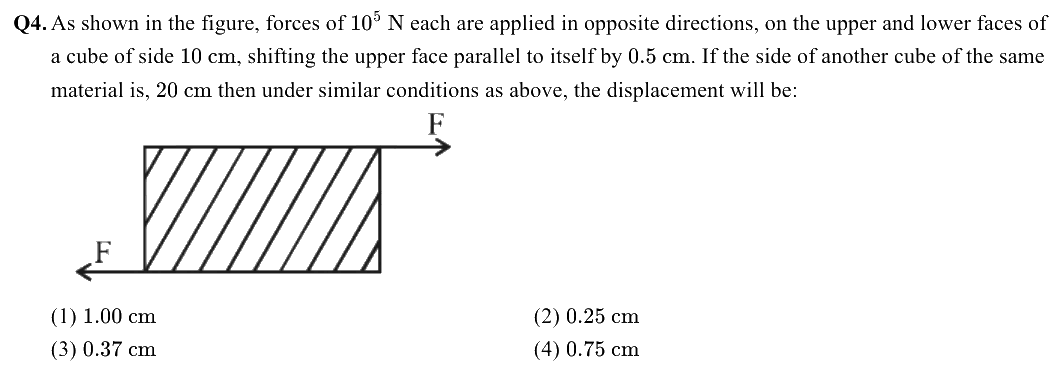
- Stress, Strain & Moduli: 77 questions. Tensile stress, longitudinal strain, Young's modulus, shear modulus, bulk modulus, and stress-strain curve interpretation.
- Elastic Energy & Applications: 22 questions. Strain energy density in stretched wires, spring systems, thermal stress in clamped rods, and stress distribution along heavy suspended ropes.
Both areas appeared in 2026 question sets, and their concise scope makes thorough coverage manageable within a short revision window.
What the questions look like
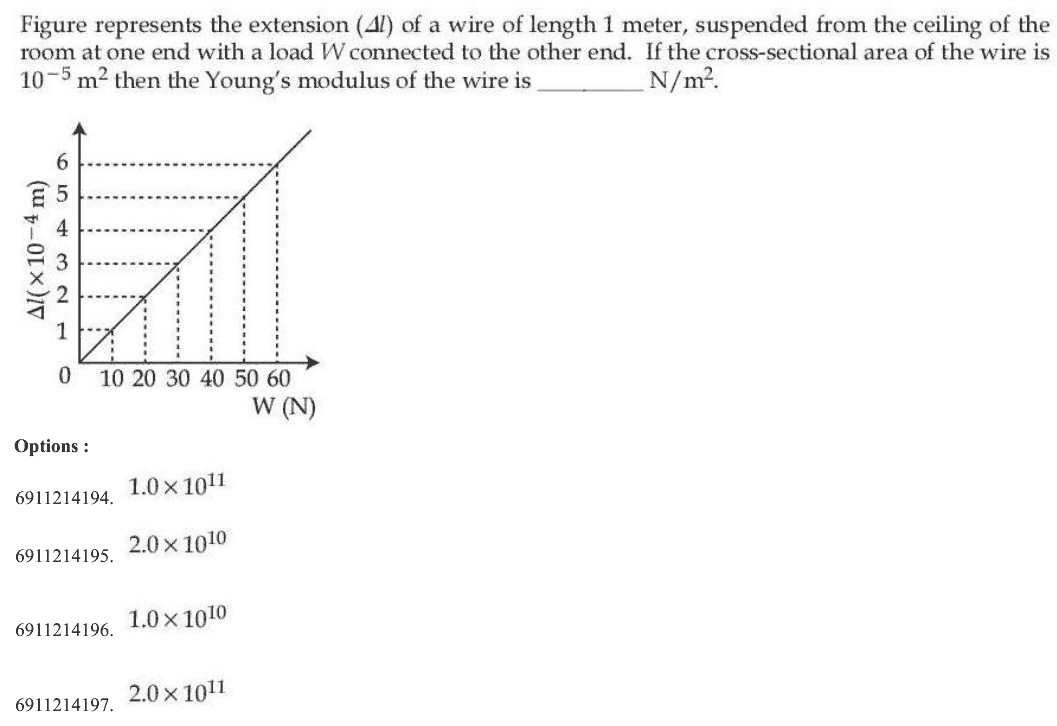
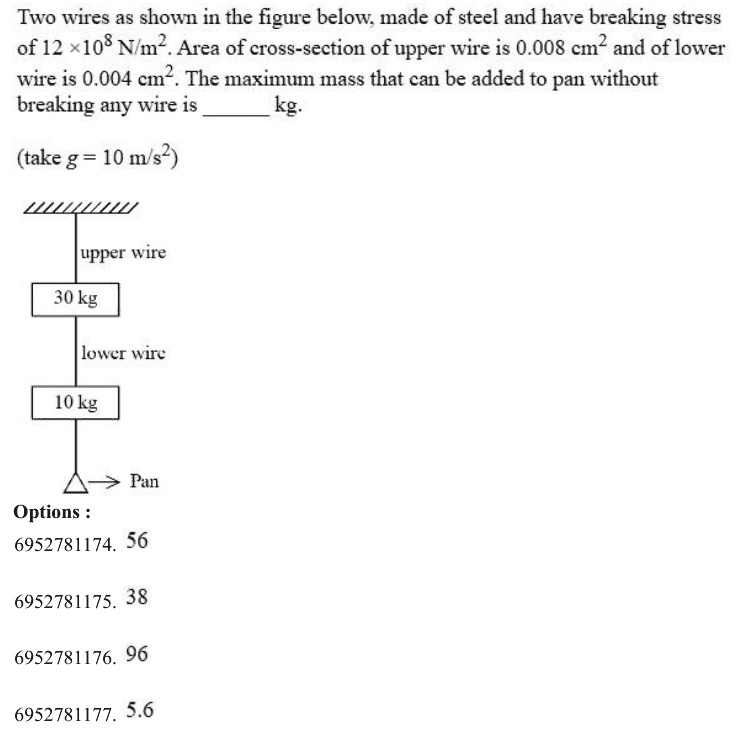
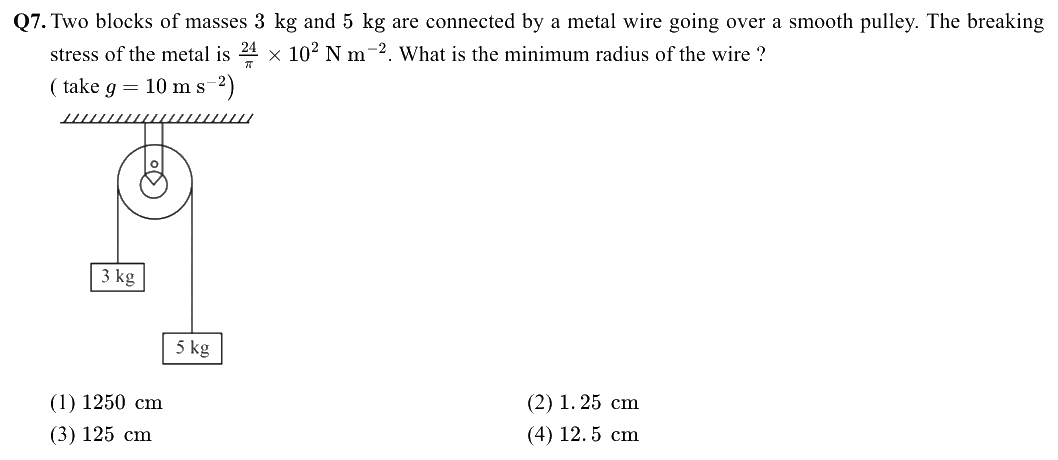
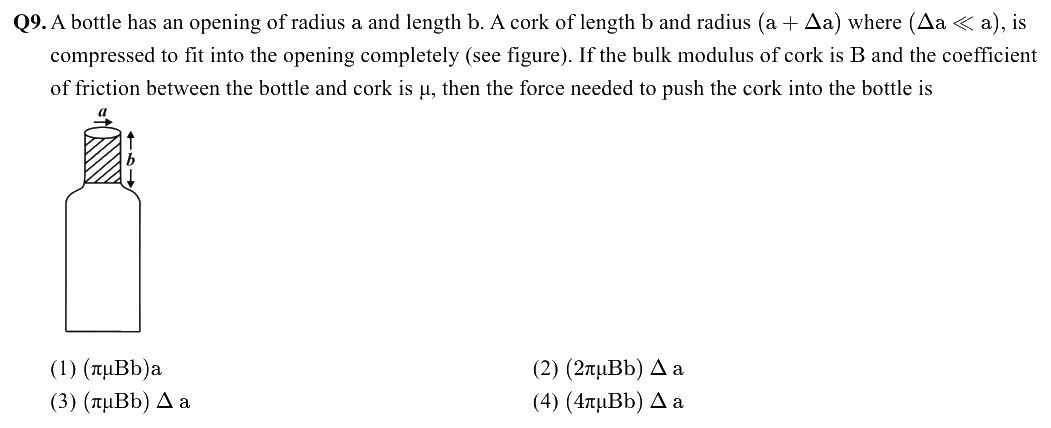
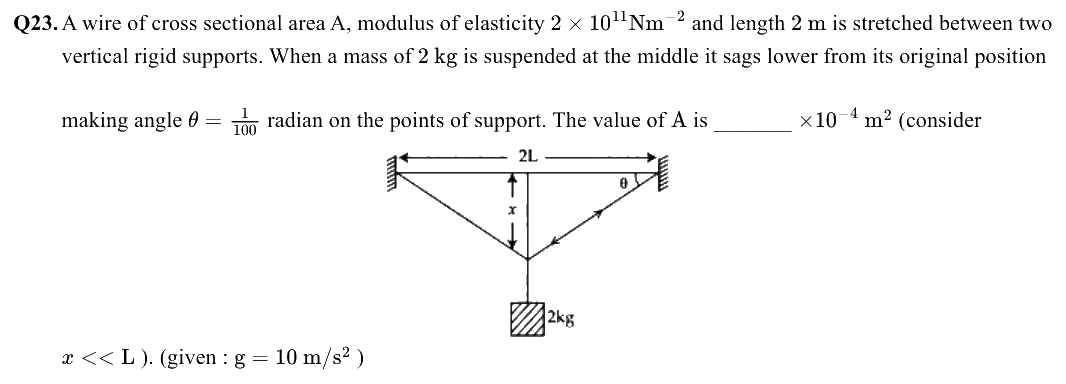
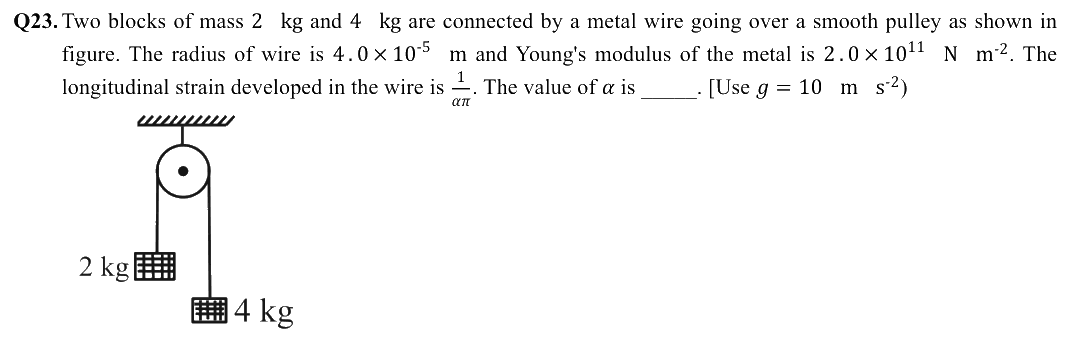
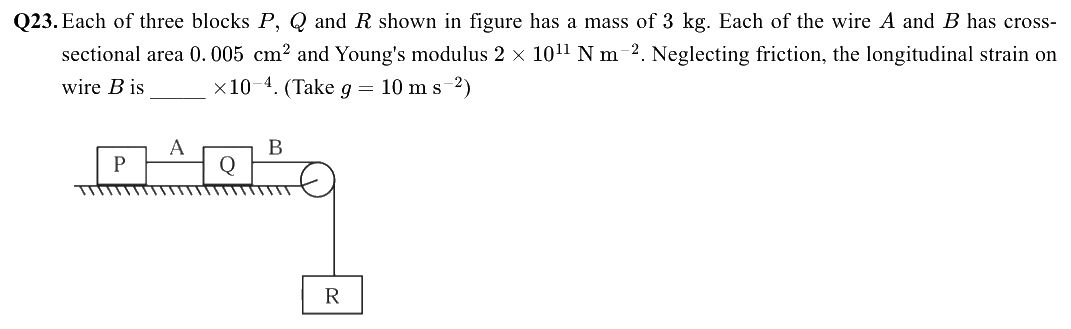
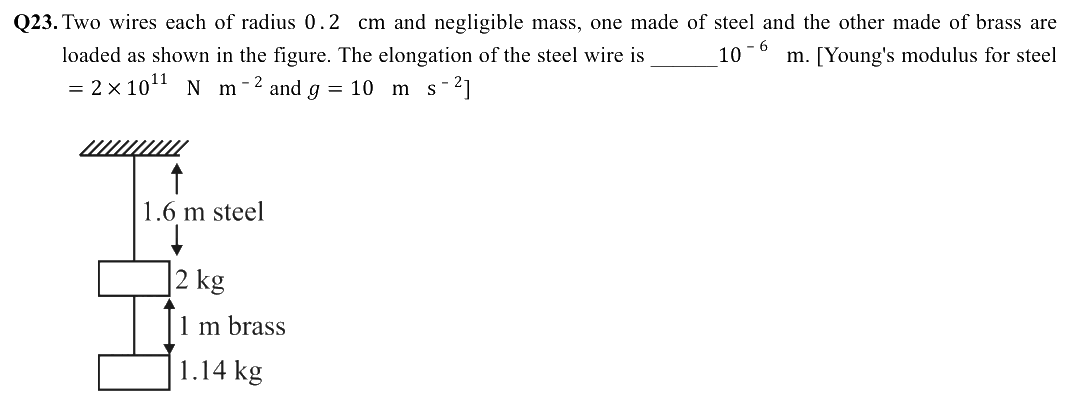
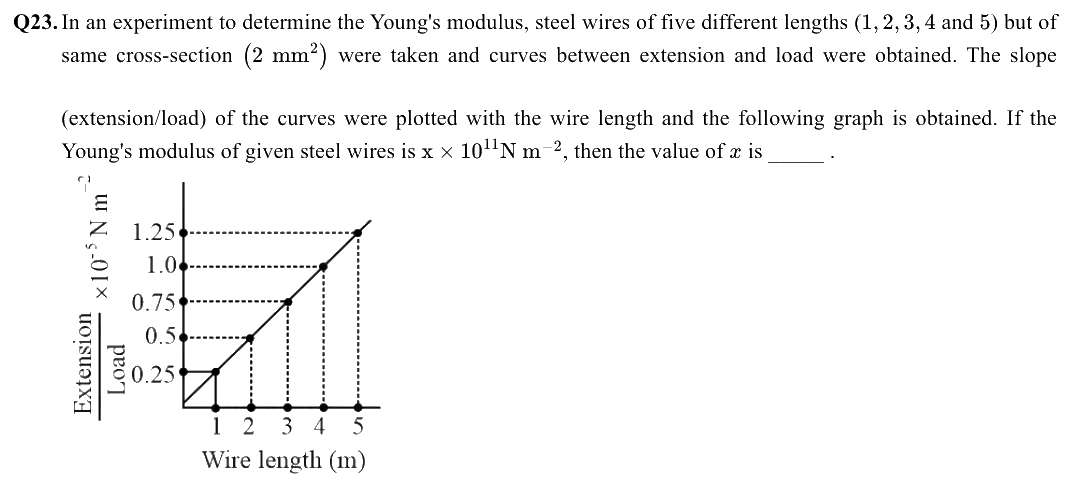
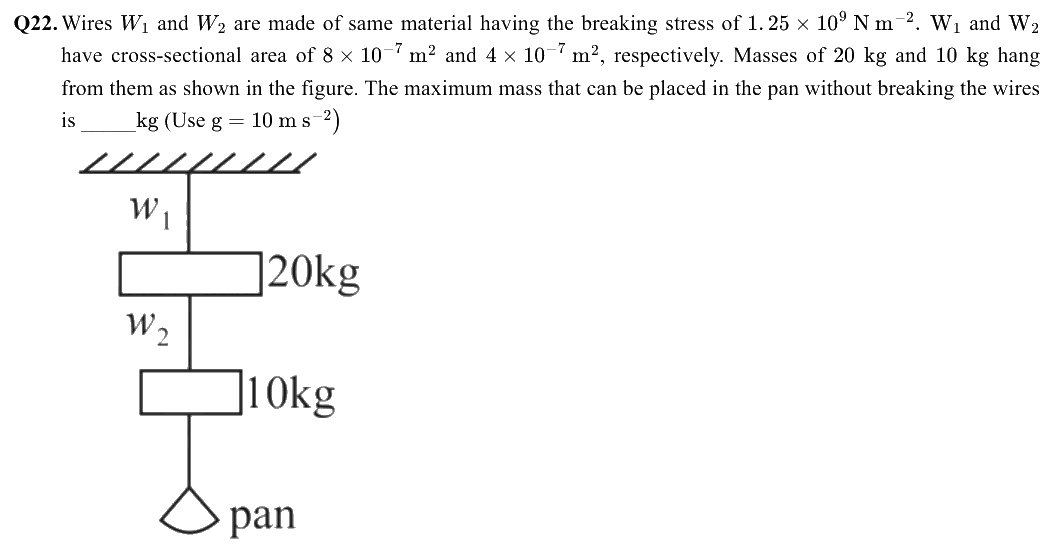
Modulus questions primarily focus on wire stretching and comparative ratios. A common problem compares two metal wires made of different materials, with given ratios of original length and cross-sectional area, subjected to identical stretching forces or experiencing identical elongations. Students equate tensile stress to Young's modulus multiplied by longitudinal strain to solve for unknown dimensional or material ratios. Other questions evaluate volumetric compression in liquids, where you calculate percentage volume decrease using bulk modulus and applied pressure.
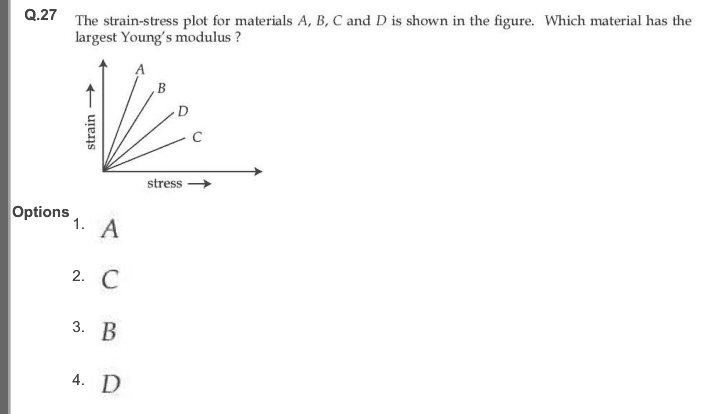
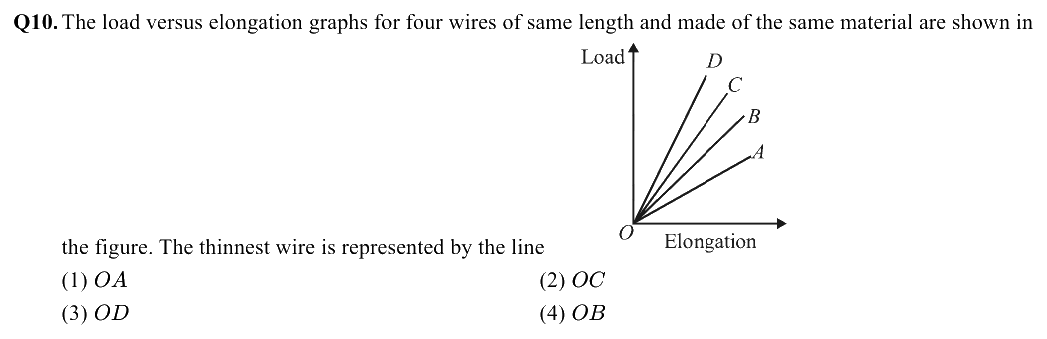
Stress-strain curve problems test qualitative and quantitative understanding of material behavior. Given graphs of strain plotted against stress for multiple substances, you must identify the material possessing the highest Young's modulus by examining reciprocal slopes, or distinguish brittle materials from ductile metals based on their plastic deformation ranges.
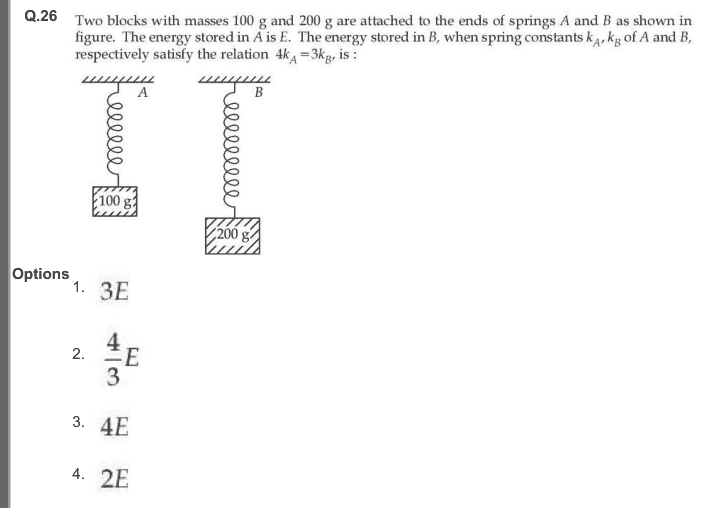
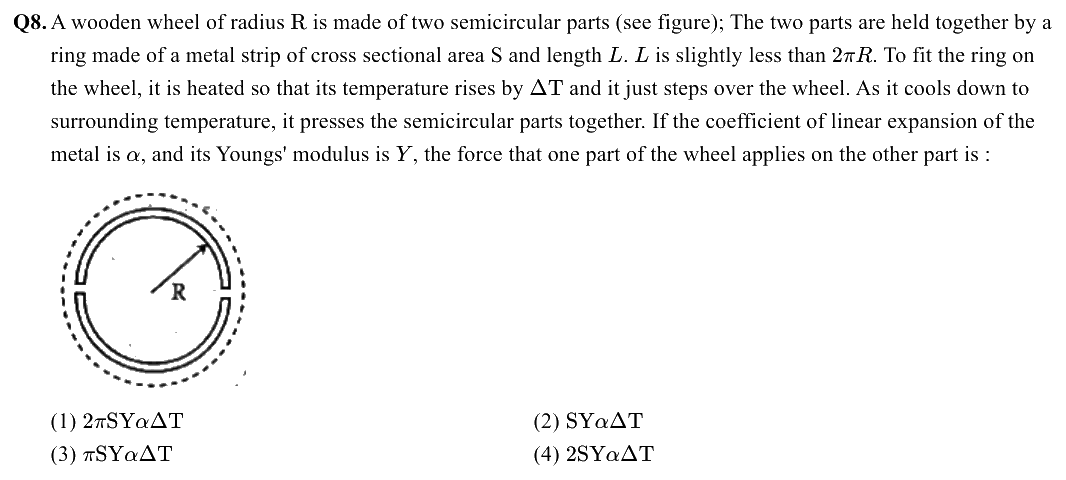
Elastic energy problems calculate the work stored inside deformed materials. Standard setups evaluate elastic potential energy stored in a wire under load, or compute the temperature drop required to induce a specified thermal tension in a clamped rod whose thermal contraction is restrained. Another regular problem type evaluates tensile stress at intermediate cross-sections along a heavy suspended rope bearing its own self-weight plus an external load.
Numerical-response problems form an unusually heavy slice of this chapter: 42 of the 99 questions from 2019 to 2026 had no answer choices, making meticulous unit tracking essential.
Questions to try first
These selections from NTA's 2026 papers illustrate the dominant question formats:
How to practise it
Start by mastering the three primary elastic moduli: Young's modulus for longitudinal stretch, shear modulus for shape distortion at constant volume, and bulk modulus for volumetric compression. Write out each definition clearly, ensuring you recognize that strain is a dimensionless ratio while stress and moduli carry units of pressure (N/m² or Pa).
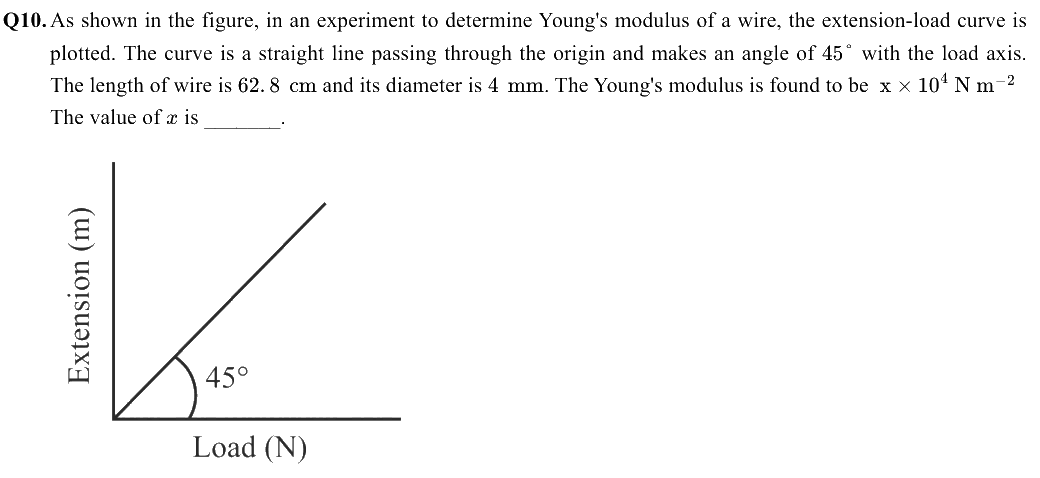
Pay special attention to axes when reading graphical data. Standard physics textbooks place stress on the vertical axis and strain on the horizontal axis, where slope directly yields Young's modulus. However, JEE Main frequently inverts the axes by plotting strain on the vertical axis and stress on the horizontal axis; in such cases, the steepest curve corresponds to the smallest Young's modulus rather than the largest.
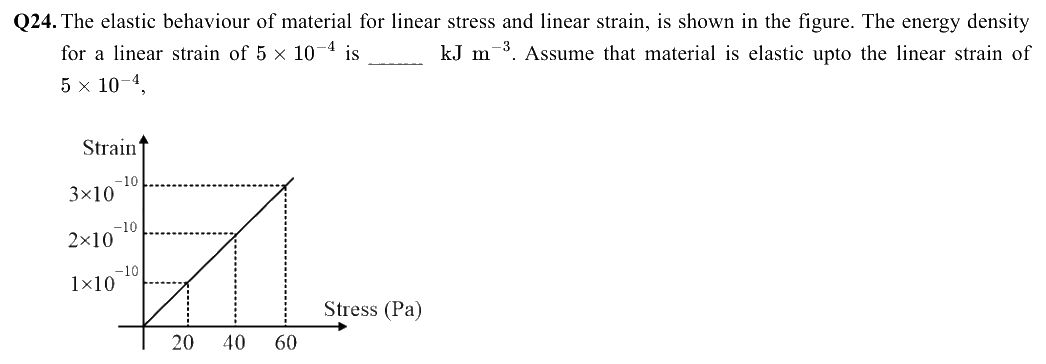
For elastic potential energy, practice deriving both total stored energy (half of force times elongation) and energy density (half of stress times strain). When solving thermal stress questions, recognize that prevented thermal contraction equals mechanical elongation, so thermal stress simply equals Young's modulus times the linear expansion coefficient times temperature change.
Frequently asked questions
Is Elasticity regularly tested in JEE Main 2027?
Yes. Elasticity delivered 99 questions across 162 papers in our collection from 2019 to 2026, appearing in 84 of those 162 papers. Because the question patterns are narrow and repetitive, it offers reliable marks for modest preparation time.
Why do so many Elasticity questions appear in numerical format?
Of the 99 questions asked since 2019, 42 were numerical-response questions. The simple formulas make it easy for examiners to test direct multi-digit calculations involving powers of ten and material constants.
How does thermal stress arise in a clamped metal rod?
When a metal rod is clamped rigidly at both ends and cooled, thermal contraction is prevented. The clamps must exert outward tensile forces to hold the length fixed, setting up an internal tensile stress equal to the product of Young's modulus, the linear expansion coefficient, and the temperature drop.
Where can I see the solutions?
Every question on this page opens with its options and answer. Step-by-step solutions for each one are in the EdLoop app.