
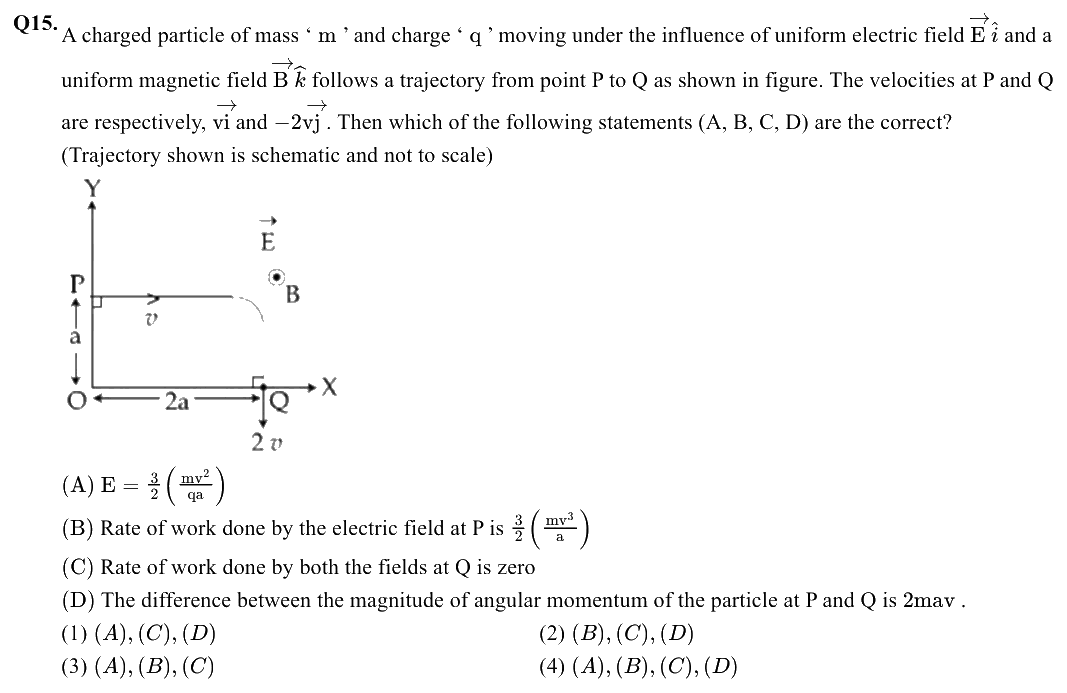
A charged particle of mass ' m ' and charge ' q ' moving under the influence of uniform electric field $\overrightarrow{\mathrm{E}}\hat{i}$ and a uniform magnetic field $\overrightarrow{\mathrm{B}}\hat{k}$ follows a trajectory from point P to Q as shown in figure. The velocities at P and Q are respectively, $\overrightarrow{v}\hat{i}$ and $-2\overrightarrow{v}\hat{j}$ . Then which of the following statements (A, B, C, D) are the correct?
(Trajectory shown is schematic and not to scale)
(see the figure above)
(A) $\mathrm{E} = \frac{3}{2}\left(\frac{mv^2}{qa}\right)$
(B) Rate of work done by the electric field at P is $\frac{3}{2}\left(\frac{mv^3}{a}\right)$
(C) Rate of work done by both the fields at Q is zero
(D) The difference between the magnitude of angular momentum of the particle at P and Q is $2mav$ .
- (1)
$(A), (C), (D)$
- (2)
$(B), (C), (D)$
- (3)
$(A), (B), (C)$
- (4)
$(A), (B), (C), (D)$
Show answer
Option (3) is correct.
Key from source paper