EdLoop PYQs · free, no ads · questions and answers here, step-by-step solutions in the EdLoop app
PYQs · free, no adsOpen on the web (app.edloop.in)Get EdLoop – free on Google Play
ChemistryBiomolecules

Biomolecules: JEE Main PYQs 2002–2026

Every Biomolecules question from past JEE Main and AIEEE papers, with options and answers. Newest first.

207questions
183papers covered
3.5%of Chemistry questions, 2019–2026
2002–2026years

Guide at a glance

Biomolecules bridges organic chemistry with biological structures under Unit 19: Biomolecules in the Class 12 curriculum, holding rank 14 of 31 chapters with a 3.5% share of the chemistry section.

Most asked sub-topics

Carbohydrates91
Amino Acids & Proteins73
Vitamins, Nucleic Acids & Hormones43

Practise these in EdLoop

Attempt every Biomolecules question timed, see the step-by-step solution and track what you get wrong. Free.

Start practice

MCQ, single correct

188 questions
1JEE Main 2026 · 8 Apr · Shift 2MCQOpen question page ↗

The incorrect statement from the following with respect to carbohydrates is :

  • A

    All monosaccharides are reducing sugars.

  • B

    The monosaccharide units obtained from hydrolysis of oligosaccharides are always the same.

  • C

    Starch and cellulose are typical examples of polysaccharides, which are very high molecular weight compounds of more than ten monosaccharide units.

  • D

    Open chain and cyclic structures co-exist at equilibrium that are responsible for certain properties as in the case of D$-$(+)$-$glucose.

2JEE Main 2026 · 6 Apr · Shift 1MCQOpen question page ↗

Match the LIST-I with LIST-II

List-I Deficiency DiseaseList-II Vitamin
A. ScurvyI. Pyridoxine
B. ConvulsionsII. Vitamin A
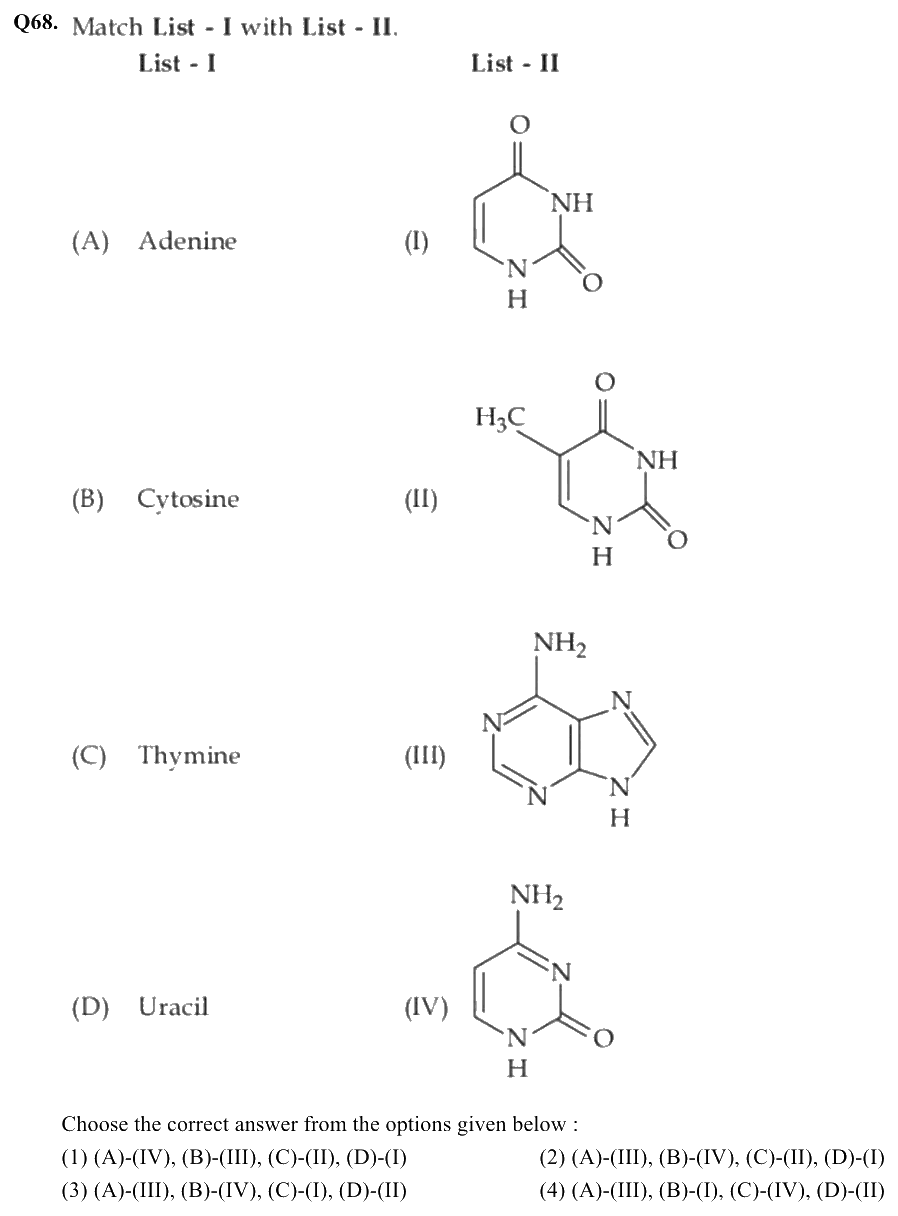
C. CheilosisIII. Ascorbic Acid
D. XerophthalmiaIV. Riboflavin

Choose the *correct* answer from the options given below:

  • A

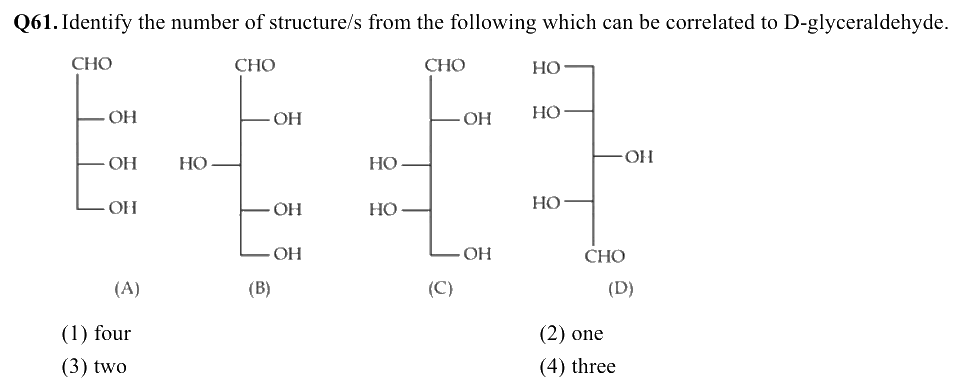
    A-I, B-III, C-II, D-IV

  • B

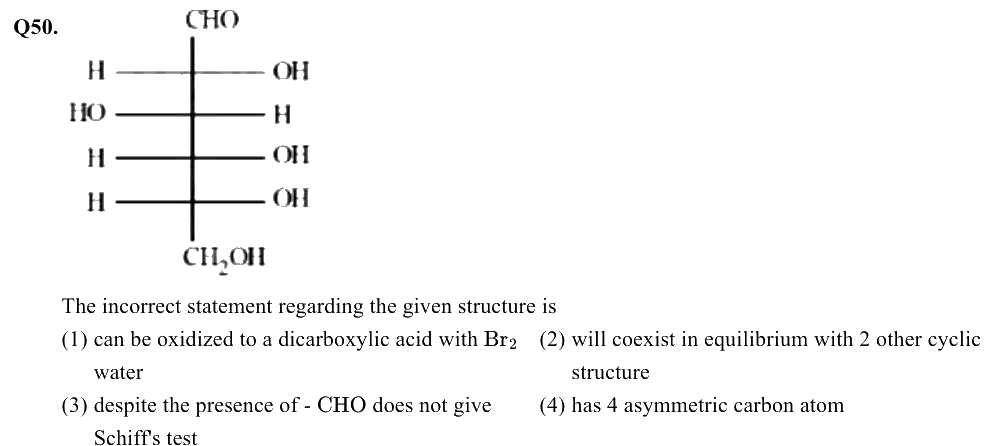
    A-I, B-III, C-IV, D-II

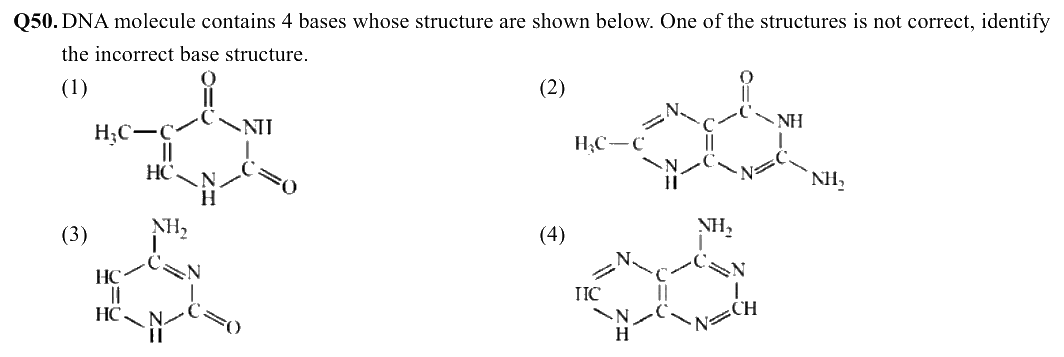
  • C

    A-III, B-I, C-IV, D-II

  • D

    A-III, B-I, C-II, D-IV

3JEE Main 2026 · 5 Apr · Shift 1MCQOpen question page ↗

Identify the correct statements.

A. Glucose exists in two anomeric forms.

B. Anomers of glucose differ in configuration at C$-$1 in cyclic hemiacetal structure.

C. Melting point of $\alpha$ - anomer of glucose is greater than $\beta$ - anomer.

D. Specific rotation of $\alpha$ - anomer is +19° while for $\beta$ - anomer is +112°

E. $\alpha$ and $\beta$ - anomers of glucose are prepared by crystallization of saturated glucose solution at 303 K and 371 K respectively.

Choose the correct answer from the options given below:

  • A

    A and B Only

  • B

    B and C Only

  • C

    A, B and D Only

  • D

    A, B and E Only

4JEE Main 2026 · 5 Apr · Shift 2MCQOpen question page ↗

Identify the incorrect statement about tertiary structure of proteins.

  • A

    They can be fibrous or globular in structure.

  • B

    The main forces that stabilize the structure are hydrogen bonding, disulphide links, van der Waals and electrostatic forces of attraction.

  • C

    The structure remains intact when exposed to pH changes.

  • D

    A linear polypeptide chain will convert to a secondary structure and then further folding of the secondary structure will convert to tertiary structure.

5JEE Main 2026 · 5 Apr · Shift 2MCQOpen question page ↗

Given below are two statements :

Statement I : (see the figure above) and (see the figure above) are two anomers of D-(+)-glucose.

Statement II : The open chain forms of D-glucose and D- fructose contain three similar chiral carbons at $\mathrm{C_3}$, $\mathrm{C_4}$ and $\mathrm{C_5}$.

In the light of the above statements, choose the correct answer from the options given below :

The question and its figure as printed in B Tech 5th Apr 2026 Shift 2.
The question as printed in the paper.
  • A

    Both Statement I and Statement II are true

  • B

    Both Statement I and Statement II are false

  • C

    Statement I is true but Statement II is false

  • D

    Statement I is false but Statement II is true

6JEE Main 2026 · 4 Apr · Shift 1MCQOpen question page ↗

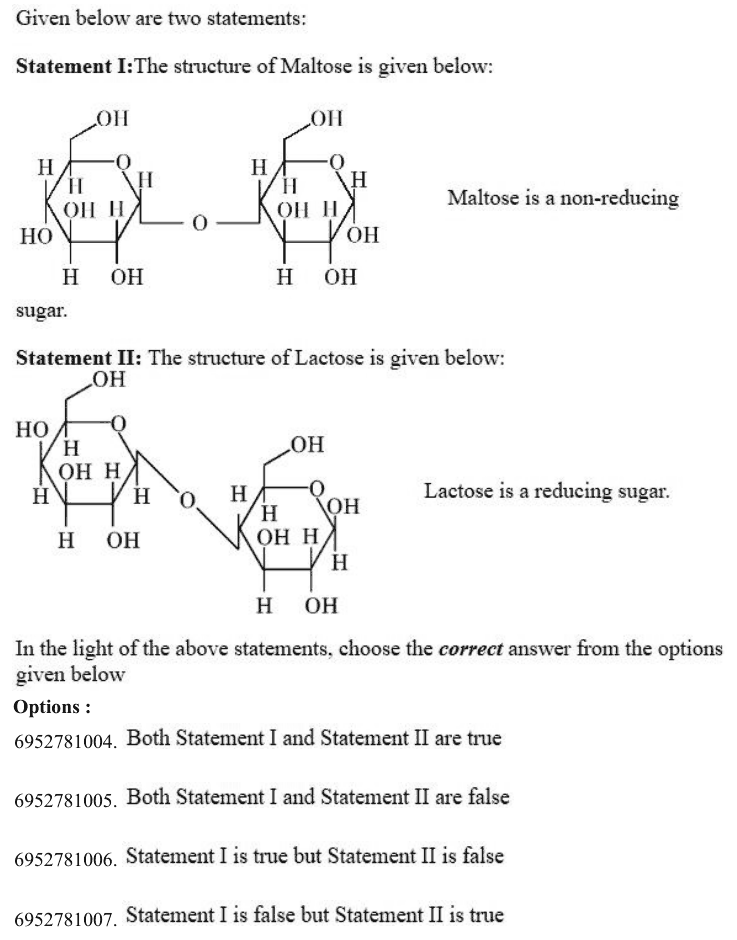
Given below are two statements:

Statement I: The structure of Maltose is given below:

(see the figure above)

Maltose is a non-reducing sugar.

Statement II: The structure of Lactose is given below:

(see the figure above)

Lactose is a reducing sugar.

In the light of the above statements, choose the *correct* answer from the options given below

The question and its figure as printed in B Tech 4th Apr 2026 Shift 1.
The question as printed in the paper.
  • A

    Both Statement I and Statement II are true

  • B

    Both Statement I and Statement II are false

  • C

    Statement I is true but Statement II is false

  • D

    Statement I is false but Statement II is true

7JEE Main 2026 · 4 Apr · Shift 1MCQOpen question page ↗

Match the LIST-I with LIST-II

List-I Name of amino acidList-II One letter symbol/type
A. ArginineI. D/Non-essential
B. Aspartic acidII. R/Essential
C. LysineIII. E/Non-essential
D. Glutamic acidIV. K/Essential

Choose the *correct* answer from the options given below:

  • A

    A-II, B-I, C-IV, D-III

  • B

    A-IV, B-III, C-II, D-I

  • C

    A-III, B-IV, C-I, D-II

  • D

    A-II, B-IV, C-I, D-III

8JEE Main 2026 · 4 Apr · Shift 2MCQOpen question page ↗

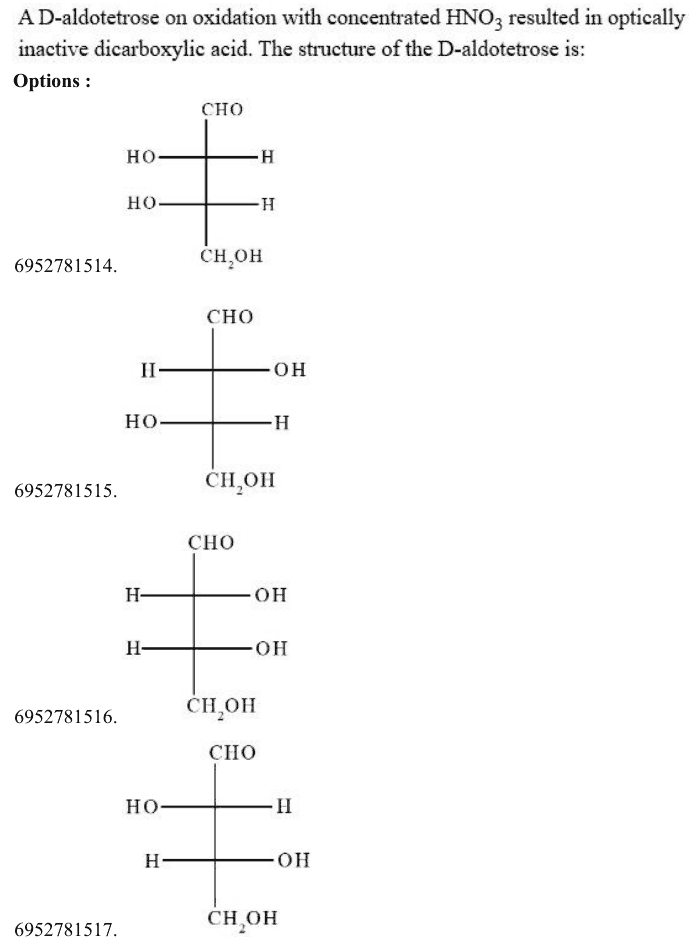
A D-aldotetrose on oxidation with concentrated $\mathrm{HNO_3}$ resulted in optically inactive dicarboxylic acid. The structure of the D-aldotetrose is:

The question and its figure as printed in B Tech 4th Apr 2026 Shift 2. Option 1: Fischer projection: CHO at top; second carbon HO on the left, H on the right; third carbon HO on the left, H on the right; CH2OH at bottom. Option 2: Fischer projection: CHO at top; second carbon H on the left, OH on the right; third carbon HO on the left, H on the right; CH2OH at bottom. Option 3: Fischer projection: CHO at top; second carbon H on the left, OH on the right; third carbon H on the left, OH on the right; CH2OH at bottom. Option 4: Fischer projection: CHO at top; second carbon HO on the left, H on the right; third carbon H on the left, OH on the right; CH2OH at bottom.
The question as printed in the paper.
  • A

    see figure Fischer projection: CHO at top; second carbon HO on the left, H on the right; third carbon HO on the left, H on the right; CH2OH at bottom.

  • B

    see figure Fischer projection: CHO at top; second carbon H on the left, OH on the right; third carbon HO on the left, H on the right; CH2OH at bottom.

  • C

    see figure Fischer projection: CHO at top; second carbon H on the left, OH on the right; third carbon H on the left, OH on the right; CH2OH at bottom.

  • D

    see figure Fischer projection: CHO at top; second carbon HO on the left, H on the right; third carbon H on the left, OH on the right; CH2OH at bottom.

9JEE Main 2026 · 2 Apr · Shift 1MCQOpen question page ↗

Match List - I with List - II.

List - I VitaminList - II Name
A. Vitamin $\mathrm{B_1}$I. Pyridoxine
B. Vitamin $\mathrm{B_2}$II. Ascorbic acid
C. Vitamin $\mathrm{B_6}$III. Thiamine
D. Vitamin CIV. Riboflavin

Choose the correct answer from the options given below :

  • A

    A-II, B-I, C-III, D-IV

  • B

    A-IV, B-III, C-II, D-I

  • C

    A-III, B-IV, C-I, D-II

  • D

    A-I, B-III, C-II, D-IV

10JEE Main 2026 · 2 Apr · Shift 2MCQOpen question page ↗

Identify the correct pair having amino acid (A) and the hormone (B) that is iodinated derivative of the amino acid (A).
(T and Y represent one letter code for amino acids)

Amino acid (A) Hormone (B)

  • A

    T; Insulin

  • B

    T; Thyroxine

  • C

    Y; Thyroxine

  • D

    Y; Insulin

11JEE Main 2026 · 28 Jan · Shift 1MCQOpen question page ↗

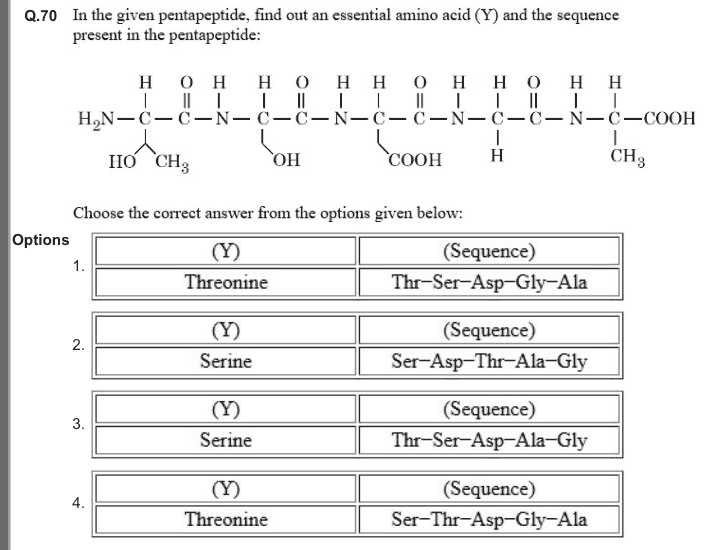
In the given pentapeptide, find out an essential amino acid (Y) and the sequence present in the pentapeptide:

(see the figure above)

Choose the correct answer from the options given below:

The question and its figure as printed in JEE Main 2026 28 Jan Shift 1.
The question as printed in the paper.
  • A

    (Y): Threonine ; (Sequence): Thr$-$Ser$-$Asp$-$Gly$-$Ala

  • B

    (Y): Serine ; (Sequence): Ser$-$Asp$-$Thr$-$Ala$-$Gly

  • C

    (Y): Serine ; (Sequence): Thr$-$Ser$-$Asp$-$Ala$-$Gly

  • D

    (Y): Threonine ; (Sequence): Ser$-$Thr$-$Asp$-$Gly$-$Ala

12JEE Main 2026 · 28 Jan · Shift 2MCQOpen question page ↗

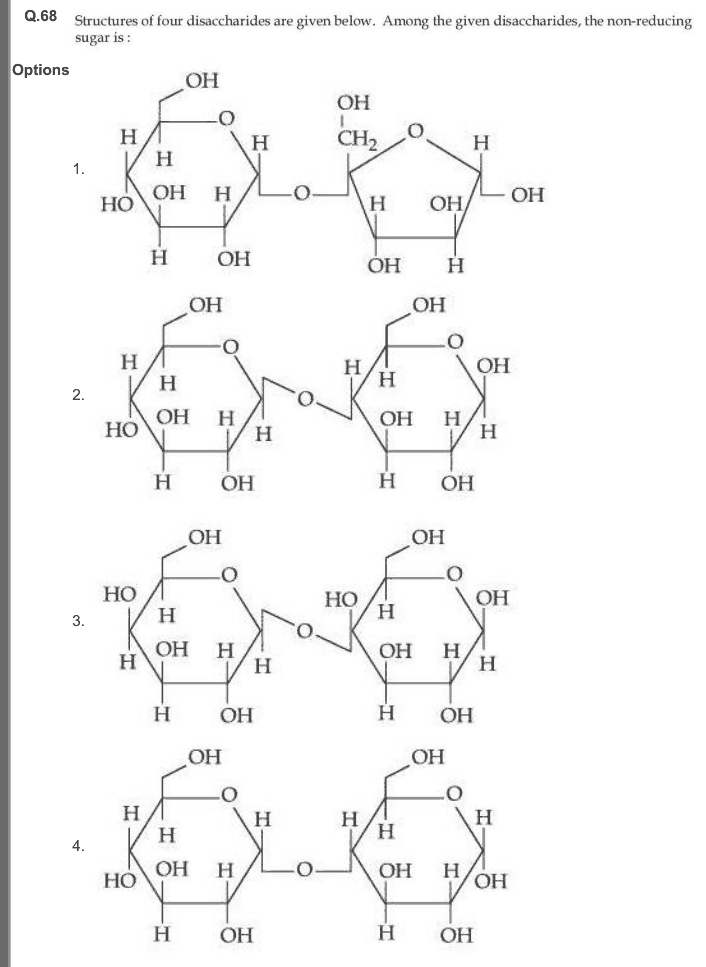
Structures of four disaccharides are given below. Among the given disaccharides, the non-reducing sugar is :

The question and its figure as printed in JEE Main 2026 28 Jan Shift 2. Option 1: a six-membered ring (left) joined through a bridging 'O' to a five-membered ring (right). Left ring, going round from its top-left carbon: that carbon has an arm going up then right ending in 'OH' (CH2OH) and an 'H' below it; the ring O is at the upper right; the carbon at the left has 'H' above and 'HO' below; the bottom-left carbon has 'OH' above and 'H' below; the bottom-right carbon has 'H' above and 'OH' below; the carbon at the right (next to the ring O) has 'H' above, and its bond to the bridging O goes DOWN and then right. Right ring: its top-left carbon carries 'CH2' with 'OH' above it, and the…
The question as printed in the paper.
  • A

    see figure a six-membered ring (left) joined through a bridging 'O' to a five-membered ring (right). Left ring, going round from its top-left carbon: that carbon has an arm going up then right ending in 'OH' (CH2OH) and an 'H' below it; the ring O is at the upper right; the carbon at the left has 'H' above and 'HO' below; the bottom-left carbon has 'OH' above and 'H' below; the bottom-right carbon has 'H' above and 'OH' below; the carbon at the right (next to the ring O) has 'H' above, and its bond to the bridging O goes DOWN and then right. Right ring: its top-left carbon carries 'CH2' with 'OH' above it, and the bridging O is bonded to the carbon that carries it (bond goes left); the ring O is at the top; the right-hand carbon next to the ring O has 'H' above and a bond going down then right to 'OH'; the lower-left carbon has 'H' above and 'OH' below; the lower-right carbon has 'OH' above and 'H' below.

  • B

    see figure two six-membered rings joined through a bridging 'O'. Left ring: top-left carbon with CH2OH arm (up then right ending in 'OH') and 'H' below; the carbon at the left has 'H' above and 'HO' below; the bottom-left carbon has 'OH' above and 'H' below; the bottom-right carbon has 'H' above and 'OH' below; the carbon at the right (next to the ring O) has 'H' BELOW it, and its bond to the bridging O goes UP and then down-right. Right ring: top-left carbon with CH2OH arm (up then right ending in 'OH') and 'H' below; the carbon at the left, which is bonded to the bridging O through a bond going down, has 'H' above; the bottom-left carbon has 'OH' above and 'H' below; the bottom-right carbon has 'H' above and 'OH' below; the carbon at the right (next to the ring O) has 'OH' above and 'H' below.

  • C

    see figure two six-membered rings joined through a bridging 'O'. Left ring: top-left carbon with CH2OH arm (up then right ending in 'OH') and 'H' below; the carbon at the left has 'HO' above and 'H' below; the bottom-left carbon has 'OH' above and 'H' below; the bottom-right carbon has 'H' above and 'OH' below; the carbon at the right (next to the ring O) has 'H' BELOW it, and its bond to the bridging O goes UP and then down-right. Right ring: top-left carbon with CH2OH arm (up then right ending in 'OH') and 'H' below; the carbon at the left, which is bonded to the bridging O through a bond going down, has 'HO' above; the bottom-left carbon has 'OH' above and 'H' below; the bottom-right carbon has 'H' above and 'OH' below; the carbon at the right (next to the ring O) has 'OH' above and 'H' below.

  • D

    see figure two six-membered rings joined through a bridging 'O'. Left ring: top-left carbon with CH2OH arm (up then right ending in 'OH') and 'H' below; the carbon at the left has 'H' above and 'HO' below; the bottom-left carbon has 'OH' above and 'H' below; the bottom-right carbon has 'H' above and 'OH' below; the carbon at the right (next to the ring O) has 'H' ABOVE it, and its bond to the bridging O goes DOWN and then right. Right ring: top-left carbon with CH2OH arm (up then right ending in 'OH') and 'H' below; the carbon at the left, bonded to the bridging O through a bond going down, has 'H' above; the bottom-left carbon has 'OH' above and 'H' below; the bottom-right carbon has 'H' above and 'OH' below; the carbon at the right (next to the ring O) has 'H' above and 'OH' below.

13JEE Main 2026 · 24 Jan · Shift 2MCQOpen question page ↗

The number of possible tripeptides formed involving alanine (ala), glycine (gly) and valine (val), where no amino acid has been used more than once is:

  • A

    3

  • B

    6

  • C

    8

  • D

    4

14JEE Main 2026 · 23 Jan · Shift 1MCQOpen question page ↗

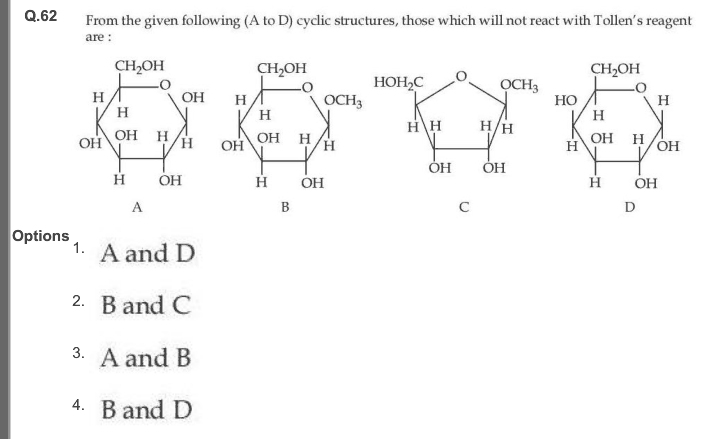
From the given following (A to D) cyclic structures, those which will not react with Tollen's reagent are :

(see the figure above)

The question and its figure as printed in JEE Main 2026 23 Jan Shift 1.
The question as printed in the paper.
  • A

    A and D

  • B

    B and C

  • C

    A and B

  • D

    B and D

15JEE Main 2026 · 23 Jan · Shift 2MCQOpen question page ↗

Both human DNA and RNA are chiral molecules. The chirality in DNA and RNA arises due to the presence of

  • A

    Base unit

  • B

    Chiral phosphate unit

  • C

    L$-$sugar component

  • D

    D$-$sugar component

16JEE Main 2026 · 22 Jan · Shift 1MCQOpen question page ↗

Given below are two statements:

Statement I: Sucrose is dextrorotatory. However, sucrose upon hydrolysis gives a solution having mixture of products. This solution shows laevorotation.

Statement II: Hydrolysis of sucrose gives glucose and fructose. Since the laevorotation of glucose is more than the dextrorotation of fructose, the resulting solution becomes laevorotatory.

In the light of the above statements, choose the correct answer from the options given below

  • A

    Statement I is false but Statement II is true

  • B

    Statement I is true but Statement II is false

  • C

    Both Statement I and Statement II are false

  • D

    Both Statement I and Statement II are true

17JEE Main 2026 · 22 Jan · Shift 2MCQOpen question page ↗

Match List - I with List - II.

List - I Reaction of Glucose withList - II Product formed
A.HydroxylamineI.Gluconic acid
B.$\mathrm{Br_2}$ waterII.Glucose pentaacetate
C.Excess acetic anhydrideIII.Saccharic acid
D.Concentrated $\mathrm{HNO_3}$IV.Glucoxime

Choose the correct answer from the options given below :

  • A

    A-IV, B-I, C-II, D-III

  • B

    A-IV, B-III, C-II, D-I

  • C

    A-I, B-III, C-IV, D-II

  • D

    A-III, B-I, C-IV, D-II

18JEE Main 2026 · 21 Jan · Shift 1MCQOpen question page ↗

Identify the correct statements.

A. Arginine and Tryptophan are essential amino acids.

B. Histidine does not contain heterocyclic ring in its structure.

C. Proline is a six membered cyclic ring amino acid.

D. Glycine does not have chiral centre.

E. Cysteine has characteristic feature of side chain as MeS$-\mathrm{CH_2}-\mathrm{CH_2}-$.

Choose the correct answer from the options given below :

  • A

    B and E Only

  • B

    A and D Only

  • C

    C and D Only

  • D

    C and E Only

19JEE Main 2026 · 21 Jan · Shift 2MCQOpen question page ↗

The correct statements are :

A. Activation energy for enzyme catalysed hydrolysis of sucrose is lower than that of acid catalysed hydrolysis.

B. During denaturation, secondary and tertiary structures of a protein are destroyed but primary structure remains intact.

C. Nucleotides are joined together by glycosidic linkage between $\mathrm{C_1}$ and $\mathrm{C_4}$ carbons of the pentose sugar.

D. Quaternary structure of proteins represents overall folding of the polypeptide chain.

Choose the correct answer from the options given below :

  • A

    A, B and D Only

  • B

    A and B Only

  • C

    B and C Only

  • D

    A, C and D Only

20JEE Main 2025 · 8 Apr · Shift 2MCQOpen question page ↗

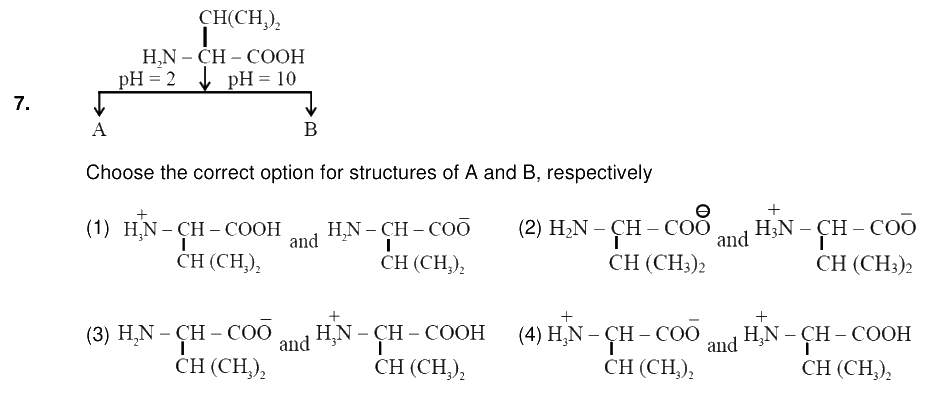
see figure Choose the correct option for structures of A and B, respectively

The question and its figure as printed in JEE Main 2025 08 Apr Shift 2. Question: Choose the correct option for structures of A and B, respectively Option 1: A = +H3N-CH(CH(CH3)2)-COOH and B = H2N-CH(CH(CH3)2)-COO^- (the CH(CH3)2 group hangs below the CH) Option 2: A = H2N-CH(CH(CH3)2)-COO^- (the minus is drawn as a circled minus) and B = +H3N-CH(CH(CH3)2)-COO^- (the CH(CH3)2 group hangs below the CH) Option 3: A = H2N-CH(CH(CH3)2)-COO^- and B = +H3N-CH(CH(CH3)2)-COOH (the CH(CH3)2 group hangs below the CH) Option 4: A = +H3N-CH(CH(CH3)2)-COO^- and B = +H3N-CH(CH(CH3)2)-COOH (the CH(CH3)2 group hangs below the CH)
The question as printed in the paper.
  • A

    see figure A = $\overset{+}{H_3N}-CH(CH(CH_3)_2)-COOH$ and B = $H_2N-CH(CH(CH_3)_2)-COO^-$ (the $CH(CH_3)_2$ group hangs below the CH)

  • B

    see figure A = $H_2N-CH(CH(CH_3)_2)-COO^-$ (the minus is drawn as a circled minus) and B = $\overset{+}{H_3N}-CH(CH(CH_3)_2)-COO^-$ (the $CH(CH_3)_2$ group hangs below the CH)

  • C

    see figure A = $H_2N-CH(CH(CH_3)_2)-COO^-$ and B = $\overset{+}{H_3N}-CH(CH(CH_3)_2)-COOH$ (the $CH(CH_3)_2$ group hangs below the CH)

  • D

    see figure A = $\overset{+}{H_3N}-CH(CH(CH_3)_2)-COO^-$ and B = $\overset{+}{H_3N}-CH(CH(CH_3)_2)-COOH$ (the $CH(CH_3)_2$ group hangs below the CH)

21JEE Main 2025 · 7 Apr · Shift 1MCQOpen question page ↗

Given below are two statements:

Statement I: D-(+)-glucose + D-(+) fructose $\xrightarrow{-H_2O}$ Sucrose

sucrose $\xrightarrow{hydrolysis}$ D- (+) glucose $+ D - (+)$ fructose

Statement II: Invert sugar is formed during sucrose hydrolysis

In the light of the above statements, choose the correct answer from the options given below

  • A

    Both Statement I and Statement II are False

  • B

    Statement I is true but Statement II is false

  • C

    Both Statement I and Statement II are true

  • D

    Statement I is false but Statement II are true

22JEE Main 2025 · 7 Apr · Shift 2MCQOpen question page ↗

Given below are two statements :

Statement (I) : On hydrolysis, oligo peptides give rise to fewer number of $\alpha$ -amino acids while proteins give rise to a large number of $\beta$ -amino acids.

Statement (II) : Natural proteins are denatured by acids which convert the water soluble form of fibrous proteins to their water insoluble form.

In the light of the above statements, choose the most appropriate answer from the options given below :

  • A

    Statement I is incorrect but Statement II is correct

  • B

    Both Statement I and Statement II are correct

  • C

    Statement I is correct but Statement II is incorrect

  • D

    Both Statement I and Statement II are incorrect

23JEE Main 2025 · 4 Apr · Shift 1MCQOpen question page ↗

Identify the pair of reactants that upon reaction, with elimination of HCl will give rise to the dipeptide Gly-Ala.

  • A

    $NH_2 - CH_2 - COOH$ and $NH_2 - CH(CH_3) - COCl$

  • B

    $NH_2 - CH_2 - COCl$ and $NH_2 - CH(CH_3) - COOH$

  • C

    $NH_2 - CH_2 - COOH$ and $NH_2 - CH(CH_3) - COOH$

  • D

    $NH_2 - CH_2 - COCl$ and $\overset{\oplus}{N}H_3 - CH(CH_3) - COCl$

24JEE Main 2025 · 4 Apr · Shift 2MCQOpen question page ↗

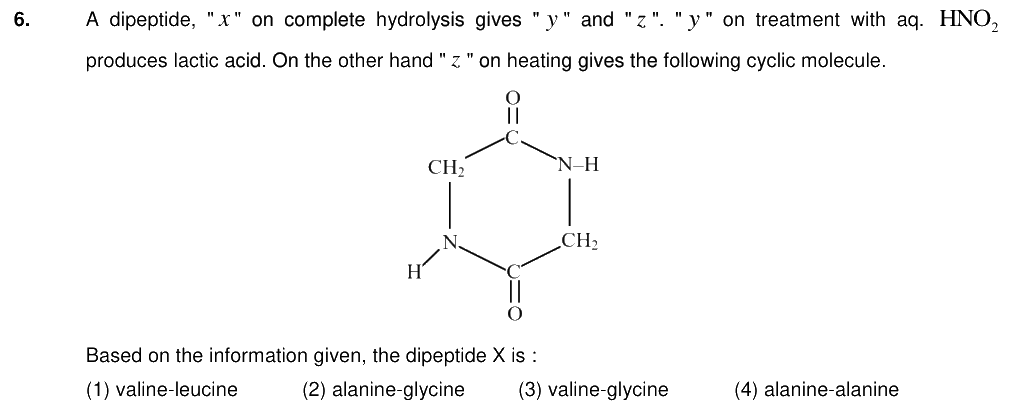
A dipeptide, " $x$ " on complete hydrolysis gives " $y$ " and " $z$ ". " $y$ " on treatment with aq. $HNO_2$ produces lactic acid. On the other hand " $z$ " on heating gives the following cyclic molecule.

(see the figure above)

Based on the information given, the dipeptide X is :

The question and its figure as printed in JEE Main 2025 04 Apr Shift 2.
The question as printed in the paper.
  • A

    valine-leucine

  • B

    alanine-glycine

  • C

    valine-glycine

  • D

    alanine-alanine

25JEE Main 2025 · 3 Apr · Shift 1MCQOpen question page ↗

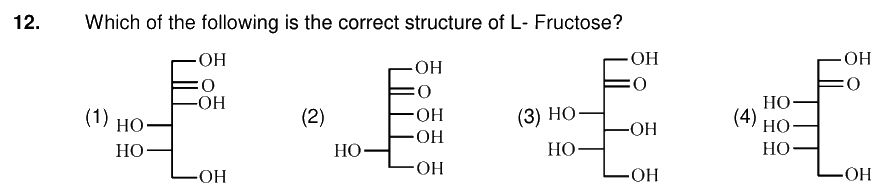
Which of the following is the correct structure of L- Fructose?

The question and its figure as printed in JEE Main 2025 03 Apr Shift 1. Option 1: Fischer projection, top to bottom: 'OH' on the right of the top carbon; a carbonyl '=O' on the right of the second carbon; 'OH' on the right of the third carbon; 'HO' on the left of the fourth carbon; 'HO' on the left of the fifth carbon; 'OH' at the bottom (right). Option 2: Fischer projection, top to bottom: 'OH' on the right of the top carbon; '=O' on the right of the second carbon; 'OH' on the right of the third carbon; 'OH' on the right of the fourth carbon; 'HO' on the left of the fifth carbon; 'OH' at the bottom (right). Option 3: Fischer projection, top to bottom: 'OH' on the right of the top carbon…
The question as printed in the paper.
  • A

    see figure Fischer projection, top to bottom: 'OH' on the right of the top carbon; a carbonyl '=O' on the right of the second carbon; 'OH' on the right of the third carbon; 'HO' on the left of the fourth carbon; 'HO' on the left of the fifth carbon; 'OH' at the bottom (right).

  • B

    see figure Fischer projection, top to bottom: 'OH' on the right of the top carbon; '=O' on the right of the second carbon; 'OH' on the right of the third carbon; 'OH' on the right of the fourth carbon; 'HO' on the left of the fifth carbon; 'OH' at the bottom (right).

  • C

    see figure Fischer projection, top to bottom: 'OH' on the right of the top carbon; '=O' on the right of the second carbon; 'HO' on the left of the third carbon; 'OH' on the right of the fourth carbon; 'HO' on the left of the fifth carbon; 'OH' at the bottom (right).

  • D

    see figure Fischer projection, top to bottom: 'OH' on the right of the top carbon; '=O' on the right of the second carbon; 'HO' on the left of the third carbon; 'HO' on the left of the fourth carbon; 'HO' on the left of the fifth carbon; 'OH' at the bottom (right).

26JEE Main 2025 · 3 Apr · Shift 2MCQOpen question page ↗

Fat soluble vitamins are:

A. Vitamin $B_1$ B. Vitamin C C. Vitamin E D. Vitamin $B_{12}$ E. Vitamin K

Choose the correct answer from the options given below:

  • A

    A & B Only

  • B

    B & C Only

  • C

    C & D Only

  • D

    C & E Only

27JEE Main 2025 · 2 Apr · Shift 1MCQOpen question page ↗

Identify the correct statement among the following :

  • A

    All naturally occurring amino acids are optically active.

  • B

    All naturally occurring amino acids except glycine contain one chiral centre.

  • C

    Amino acid, cysteine can easily undergo dimerisation due to the presence of free SH group.

  • D

    Glutamic acid is the only amino acid that contains a - COOH group at the side chain.

28JEE Main 2025 · 2 Apr · Shift 2MCQOpen question page ↗

A tetrapeptide, "x" on complete hydrolysis produced glycine (Gly), alanine (Ala), valine (Val), leucine (Leu) in equimolar proportion each. The number of tetrapeptides (sequences) possible involving each of these amino acids is :

  • A

    32

  • B

    8

  • C

    24

  • D

    16

29JEE Main 2025 · 29 Jan · Shift 1MCQOpen question page ↗

Match List - I with List - II.

List - I (Carbohydrate)List - II (Linkage Source)
(A)Amylose(I)$\beta - C_1 - C_4$, plant
(B)Cellulose(II)$\alpha - C_1 - C_4$, animal
(C)Glycogen(III)$\alpha - C_1 - C_4, \alpha - C_1 - C_6$, plant
(D)Amylopectin(IV)$\alpha - C_1 - C_4$, plant

Choose the correct answer from the options given below :

  • A

    (A)-(IV), (B)-(I), (C)-(III), (D)-(II)

  • B

    (A)-(III), (B)-(II), (C)-(I), (D)-(IV)

  • C

    (A)-(II), (B)-(III), (C)-(I), (D)-(IV)

  • D

    (A)-(IV), (B)-(I), (C)-(II), (D)-(III)

30JEE Main 2025 · 29 Jan · Shift 2MCQOpen question page ↗

Identify the essential amino acids from below : (A) Valine (B) Proline (C) Lysine (D) Threonine (E) Tyrosine Choose the correct answer from the options given below :

  • A

    (A), (C) and (E) only

  • B

    (A), (C) and (D) only

  • C

    (C), (D) and (E) only

  • D

    (B), (C) and (E) only

31JEE Main 2025 · 28 Jan · Shift 1MCQOpen question page ↗

Given below are two statements: Statement I : D-glucose pentaacetate reacts with 2, 4-dinitrophenylhydrazine Statement II : Starch, on heating with concentrated sulfuric acid at $100^\circ$C and 2-3 atmosphere pressure produces glucose. In the light of the above statements, choose the correct answer from the options given below

  • A

    Statement I is false but Statement II is true

  • B

    Both Statement I and Statement II are false

  • C

    Both Statement I and Statement II are true

  • D

    Statement I is true but Statement II is false

32JEE Main 2025 · 28 Jan · Shift 2MCQOpen question page ↗

Match List - I with List - II.

List - I (Saccharides)List - II (Glycosidic-linkages found)
(A)Sucrose(I)$\alpha$ 1 – 4
(B)Maltose(II)$\alpha$ 1 – 4 and $\alpha$ 1 – 6
(C)Lactose(III)$\alpha$ 1 – $\beta$ 2
(D)Amylopectin(IV)$\beta$ 1 – 4

Choose the correct answer from the options given below :

  • A

    (A)-(IV), (B)-(II), (C)-(I), (D)-(III)

  • B

    (A)-(I), (B)-(II), (C)-(III), (D)-(IV)

  • C

    (A)-(III), (B)-(I), (C)-(IV), (D)-(II)

  • D

    (A)-(II), (B)-(IV), (C)-(III), (D)-(I)

33JEE Main 2025 · 28 Jan · Shift 2MCQOpen question page ↗

Identify correct conversion during acidic hydrolysis from the following : (A) starch gives galactose. (B) cane sugar gives equal amount of glucose and fructose. (C) milk sugar gives glucose and galactose. (D) amylopectin gives glucose and fructose. (E) amylose gives only glucose. Choose the correct answer from the options given below :

  • A

    (A), (B) and (C) only

  • B

    (B), (C) and (E) only

  • C

    (C), (D) and (E) only

  • D

    (B), (C) and (D) only

34JEE Main 2025 · 24 Jan · Shift 1MCQOpen question page ↗

The carbohydrate "Ribose" present in DNA, is A. A pentose sugar B. present in pyranose from C. in "D" configuration D. a reducing sugar, when free E. in $\alpha$-anomeric form Choose the correct answer from the options given below:

  • A

    A, D and E Only

  • B

    A, C and D Only

  • C

    A, B and E Only

  • D

    B, D and E Only

35JEE Main 2025 · 24 Jan · Shift 2MCQOpen question page ↗

Match List - I with List - II.

(see the figure above)
Choose the correct answer from the options given below :

The question and its figure as printed in JEE Main 2025 24 Jan Shift 2.
The question as printed in the paper.
  • A

    (A)-(IV), (B)-(III), (C)-(II), (D)-(I)

  • B

    (A)-(III), (B)-(IV), (C)-(II), (D)-(I)

  • C

    (A)-(III), (B)-(IV), (C)-(I), (D)-(II)

  • D

    (A)-(III), (B)-(I), (C)-(IV), (D)-(II)

36JEE Main 2025 · 23 Jan · Shift 1MCQOpen question page ↗

Given below are two statements: Statement I: Fructose does not contain an aldehydic group but still reduces Tollen's reagent Statement II: In the presence of base, fructose undergoes rearrangement to give glucose. In the light of the above statements, choose the correct answer from the options given below

  • A

    Both Statement I and Statement II are true

  • B

    Both Statement I and Statement II are false

  • C

    Statement I is true but Statement II is false

  • D

    Statement I is true but Statement II is false

37JEE Main 2025 · 23 Jan · Shift 2MCQOpen question page ↗

The $\alpha$-Helix and $\beta$ - Pleated sheet structures of protein are associated with its :

  • A

    tertiary structure

  • B

    quaternary structure

  • C

    secondary structure

  • D

    primary structure

39JEE Main 2025 · 22 Jan · Shift 2MCQOpen question page ↗

Identify the number of structure/s from the following which can be correlated to D-glyceraldehyde.

(see the figure above)

The question and its figure as printed in JEE Main 2025 22 Jan Shift 2.
The question as printed in the paper.
  • A

    four

  • B

    one

  • C

    two

  • D

    three

40JEE Main 2024 · 9 Apr · Shift 2MCQOpen question page ↗

The incorrect statement about Glucose is :

  • A

    Glucose is soluble in water because of having aldehyde functional group

  • B

    Glucose remains in multiple isomeric form in its aqueous solution

  • C

    Glucose is one of the monomer unit in sucrose

  • D

    Glucose is an aldohexose

41JEE Main 2024 · 8 Apr · Shift 1MCQOpen question page ↗

see figure The incorrect statement regarding the given structure is

The question and its figure as printed in JEE Main 2024 08 Apr Shift 1. Question: The incorrect statement regarding the given structure is
The question as printed in the paper.
  • A

    can be oxidized to a dicarboxylic acid with $\mathrm{Br_2}$ water

  • B

    will coexist in equilibrium with 2 other cyclic structure

  • C

    despite the presence of - CHO does not give Schiff's test

  • D

    has 4 asymmetric carbon atom

42JEE Main 2024 · 6 Apr · Shift 1MCQOpen question page ↗

DNA molecule contains 4 bases whose structure are shown below. One of the structures is not correct, identify the incorrect base structure.

The question and its figure as printed in JEE Main 2024 06 Apr Shift 1. Option 1: a six-membered ring drawn with H3C-C at the upper left, a C with O double-bonded above at the top, NH at the upper right, C=O at the lower right, N-H at the bottom and HC at the lower left, with a C=C between the H3C-C and HC carbons. Option 2: a fused two-ring structure with H3C-C and N-H on the left ring, N=C and a C with O double-bonded above at the top, NH at the upper right, N= and C-NH2 at the lower right (NH2 below). Option 3: a six-membered ring drawn with NH2 on a C at the top, N=C at the upper right, C=O at the lower right, N-H at the bottom, and HC=HC on the left side. Option 4: a fused two-ring…
The question as printed in the paper.
  • A

    see figure a six-membered ring drawn with H3C-C at the upper left, a C with O double-bonded above at the top, NH at the upper right, C=O at the lower right, N-H at the bottom and HC at the lower left, with a C=C between the H3C-C and HC carbons.

  • B

    see figure a fused two-ring structure with H3C-C and N-H on the left ring, N=C and a C with O double-bonded above at the top, NH at the upper right, N= and C-NH2 at the lower right (NH2 below).

  • C

    see figure a six-membered ring drawn with NH2 on a C at the top, N=C at the upper right, C=O at the lower right, N-H at the bottom, and HC=HC on the left side.

  • D

    see figure a fused two-ring structure with NH2 on a C at the top, N atoms and an HC on the left ring, N-H at the lower left, and N=CH at the lower right.

43JEE Main 2024 · 6 Apr · Shift 2MCQOpen question page ↗

The incorrect statements regarding enzymes are : (A) Enzymes are biocatalysts. (B) Enzymes are non-specific and can catalyse different kinds of reactions. (C) Most Enzymes are globular proteins. (D) Enzyme - oxidase catalyses the hydrolysis of maltose into glucose. Choose the correct answer from the option given below :

  • A

    (B), (C) and (D)

  • B

    (B) and (D)

  • C

    (A), (B) and (C)

  • D

    (B) and (C)

45JEE Main 2024 · 5 Apr · Shift 2MCQOpen question page ↗

Coagulation of egg, on heating is because of :

  • A

    The secondary structure of protein remains unchanged

  • B

    Denaturation of protein occurs

  • C

    Biological property of protein remains unchanged

  • D

    Breaking of the peptide linkage in the primary structure of protein occurs

46JEE Main 2024 · 4 Apr · Shift 1MCQOpen question page ↗

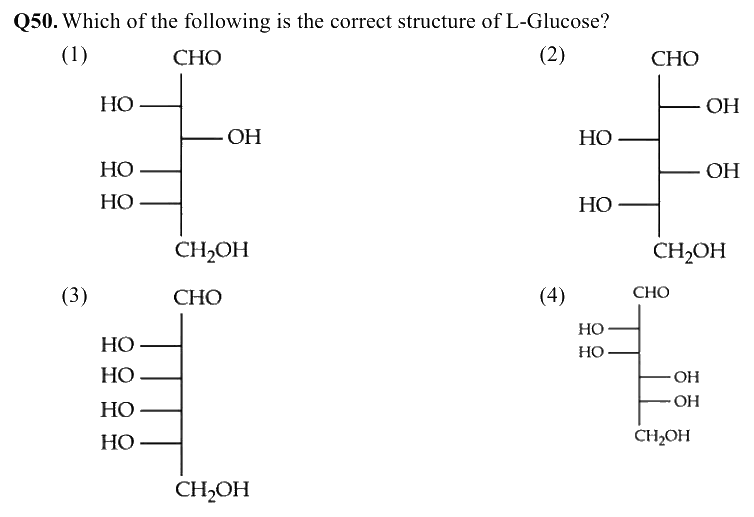
Which of the following is the correct structure of L-Glucose?

The question and its figure as printed in JEE Main 2024 04 Apr Shift 1. Option 1: Fischer projection: CHO at the top, a vertical line, then four horizontal bonds from top to bottom: HO on the left, OH on the right, HO on the left, HO on the left; CH2OH at the bottom. Option 2: Fischer projection: CHO at the top, a vertical line, then four horizontal bonds from top to bottom: OH on the right, HO on the left, OH on the right, HO on the left; CH2OH at the bottom. Option 3: Fischer projection: CHO at the top, a vertical line, then four horizontal bonds from top to bottom: HO on the left, HO on the left, HO on the left, HO on the left; CH2OH at the bottom. Option 4: Fischer projection (printed…
The question as printed in the paper.
  • A

    see figure Fischer projection: CHO at the top, a vertical line, then four horizontal bonds from top to bottom: HO on the left, OH on the right, HO on the left, HO on the left; CH2OH at the bottom.

  • B

    see figure Fischer projection: CHO at the top, a vertical line, then four horizontal bonds from top to bottom: OH on the right, HO on the left, OH on the right, HO on the left; CH2OH at the bottom.

  • C

    see figure Fischer projection: CHO at the top, a vertical line, then four horizontal bonds from top to bottom: HO on the left, HO on the left, HO on the left, HO on the left; CH2OH at the bottom.

  • D

    see figure Fischer projection (printed smaller than the others): CHO at the top, a vertical line, then four horizontal bonds from top to bottom: HO on the left, HO on the left, OH on the right, OH on the right; CH2OH at the bottom.

47JEE Main 2024 · 4 Apr · Shift 2MCQOpen question page ↗

Match List I with List II

List - IList - II
A. $\alpha$ - Glucose and $\alpha$ - GalactoseI. Functional isomers
B. $\alpha$ - Glucose and $\beta$ - GlucoseII. Homologous
C. $\alpha$ - Glucose and $\alpha$ - FructoseIII. Anomers
D. $\alpha$ - Glucose and $\alpha$ - RiboseIV. Epimers

Choose the correct answer from the options given below:

  • A

    A-IV, B-III, C-I, D-II

  • B

    A-III, B-IV, C-I, D-II

  • C

    A-IV, B-III, C-II, D-I

  • D

    A-III, B-IV, C-II, D-I

48JEE Main 2024 · 1 Feb · Shift 1MCQOpen question page ↗

If one strand of a DNA has the sequence ATGCTTCA, sequence of the bases in complementary strand is:

  • A

    CATTAGCT

  • B

    TACGAAGT

  • C

    GTACTTAC

  • D

    ATGCGACT

49JEE Main 2024 · 31 Jan · Shift 1MCQOpen question page ↗

Match List I with List II

List-IList-II
A. Glucose/NaHCO$_3$ / $\Delta$I. Gluconic acid
B. Glucose/HNO$_3$II. No reaction
C. Glucose/HI / $\Delta$III. n-hexane
D. Glucose/Bromine waterIV. Saccharic acid

Choose the correct answer from the options given below:

  • A

    A-IV, B-I, C-III, D-II

  • B

    A-II, B-IV, C-III, D-I

  • C

    A-III, B-II, C-I, D-IV

  • D

    A-I, B-IV, C-III, D-II

52JEE Main 2024 · 29 Jan · Shift 2MCQOpen question page ↗

Match List I with List II

List I (Bio Polymer)List II (Monomer)
A.StarchI.nucleotide
B.CelluloseII.$\alpha$-glucose
C.Nucleic acidIII.$\beta$-glucose
D.ProteinIV.$\alpha$-amino acid

Choose the correct answer from the options given below :-

  • A

    A-II, B-I, C-III, D-IV

  • B

    A-IV, B-II, C-I, D-III

  • C

    A-I, B-III, C-IV, D-II

  • D

    A-II, B-III, C-I, D-IV

53JEE Main 2024 · 27 Jan · Shift 1MCQOpen question page ↗

Two nucleotides are joined together by a linkage known as :

  • A

    Phosphodiester linkage

  • B

    Glycosidic linkage

  • C

    Disulphide linkage

  • D

    Peptide linkage

54JEE Main 2024 · 27 Jan · Shift 2MCQOpen question page ↗

Which structure of protein remains intact after coagulation of egg white on boiling?

  • A

    Primary

  • B

    Tertiary

  • C

    Secondary

  • D

    Quaternary

55JEE Main 2023 · 15 Apr · Shift 1MCQOpen question page ↗

Which is not true for arginine?

  • A

    It has a fairly high melting point

  • B

    It is associated with more than one $\mathrm{pK_a}$ values.

  • C

    It has high solubility in benzene.

  • D

    It is a crystalline solid.

56JEE Main 2023 · 13 Apr · Shift 2MCQOpen question page ↗

The naturally occurring amino acid that contains only one basic functional group in its chemical structure is

  • A

    asparagine

  • B

    histidine

  • C

    arginine

  • D

    lysine

57JEE Main 2023 · 11 Apr · Shift 1MCQOpen question page ↗

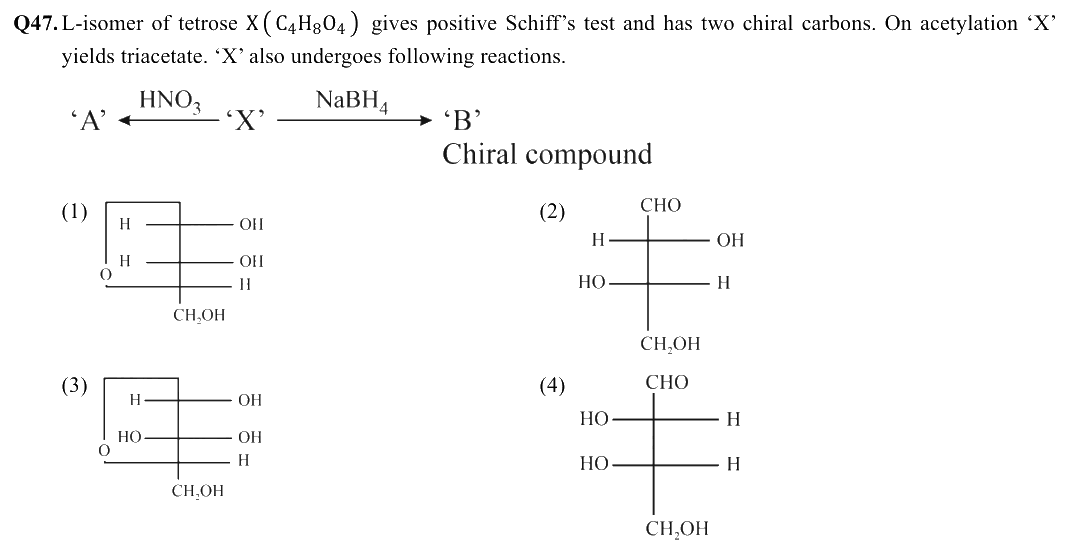
L-isomer of tetrose $\mathrm{X}\ (\mathrm{C_4H_8O_4})$ gives positive Schiff's test and has two chiral carbons. On acetylation 'X' yields triacetate. 'X' also undergoes following reactions.
(see the figure above)

The question and its figure as printed in JEE Main 2023 11 Apr Shift 1.
The question as printed in the paper.
  • A

    see figure

  • B

    see figure

  • C

    see figure

  • D

    see figure

58JEE Main 2023 · 10 Apr · Shift 1MCQOpen question page ↗

The one that does not stabilize $2^\circ$ and $3^\circ$ structures of proteins is

  • A
    • S - S - linkage
  • B

    H - bonding

  • C
    • O - O - linkage
  • D

    van der Waals forces

59JEE Main 2023 · 8 Apr · Shift 1MCQOpen question page ↗

Sulphur (S) containing amino acids from the following are:
(a) isoleucine
(b) cysteine
(c) lysine
(d) methionine
(e) glutamic acid

  • A

    b, c, e

  • B

    a, b, c

  • C

    b, d

  • D

    a, d

60JEE Main 2023 · 8 Apr · Shift 2MCQOpen question page ↗

Match List I with List II

List I Natural amino acidList II One Letter Code
(A)Glutamic acid(I)Q
(B)Glutamine(II)W
(C)Tyrosine(III)E
(D)Tryptophan(IV)Y

Choose the correct answer from the options given below:

  • A

    (A)-III, B-IV, (C)-I, (D)-II

  • B

    (A)-IV, B-III, (C)-I, (D)-II

  • C

    (A)-III, B-I, (C)-IV, (D)-II

  • D

    (A)-II, B-I, (C)-IV, (D)-III

61JEE Main 2023 · 6 Apr · Shift 1MCQOpen question page ↗

Match List I with List II

LIST I – Enzymatic reactionLIST II - Enzyme
ASucrose$\rightarrow$ Glucose and FructoseIZymase
BGlucose $\rightarrow$ ethyl alcohol and $\mathrm{CO_2}$IIPepsin
CStarch $\rightarrow$ MaltoseIIIInvertase
DProteins $\rightarrow$ Amino acidsIVDiastase

Choose the correct answer from the options given below.

  • A

    A - I, B - II, C - IV, D - III

  • B

    A - III, B - I, C - IV, D - II

  • C

    A - III, B - I, C - II, D - IV

  • D

    A - I, B - IV, C - III, D - II

62JEE Main 2023 · 6 Apr · Shift 1MCQOpen question page ↗

Match List I and List II

List I VitaminList II Deficiency disease
AVitamin AIBeri-Beri
BThiamineIICheilosis
CAscorbic acidIIIXerophthalmia
DRiboflavinIVScurvy

Choose the correct answer from the options given below

  • A

    A - III, B - I, C - IV, D - II

  • B

    A - IV, B - I, C - III, D - II

  • C

    A - IV, B - II, C - III, D - I

  • D

    A - III, B - II, C - IV, D - I

63JEE Main 2023 · 6 Apr · Shift 2MCQOpen question page ↗

Match List-I with List-II.

List-I Natural Amino acidList-II One Letter Code
(A)Arginine(I)D
(B)Aspartic acid(II)N
(C)Asparagine(III)A
(D)Alanine(IV)R

Choose the correct answer from the options given below:

  • A

    (A)-(IV), B-(I), (C)-(II), (D)-(III)

  • B

    (A)-(I), B-(III), (C)-(IV), (D)-(II)

  • C

    (A)-(III), B-(I), (C)-(II), (D)-(IV)

  • D

    (A)-(IV), B-(I), (C)-(III), (D)-(II)

64JEE Main 2023 · 1 Feb · Shift 1MCQOpen question page ↗

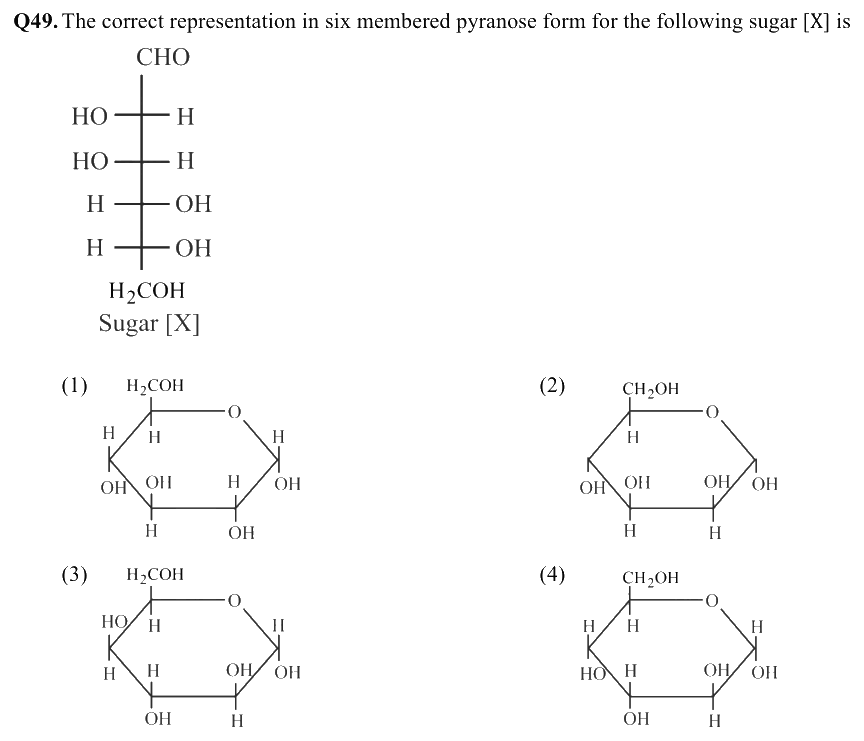
The correct representation in six membered pyranose form for the following sugar [X] is

(see the figure above)

The question and its figure as printed in JEE Main 2023 01 Feb Shift 1.
The question as printed in the paper.
  • A

    (pyranose drawing 1, see figure)

  • B

    (pyranose drawing 2, see figure)

  • C

    (pyranose drawing 3, see figure)

  • D

    (pyranose drawing 4, see figure)

65JEE Main 2023 · 1 Feb · Shift 2MCQOpen question page ↗

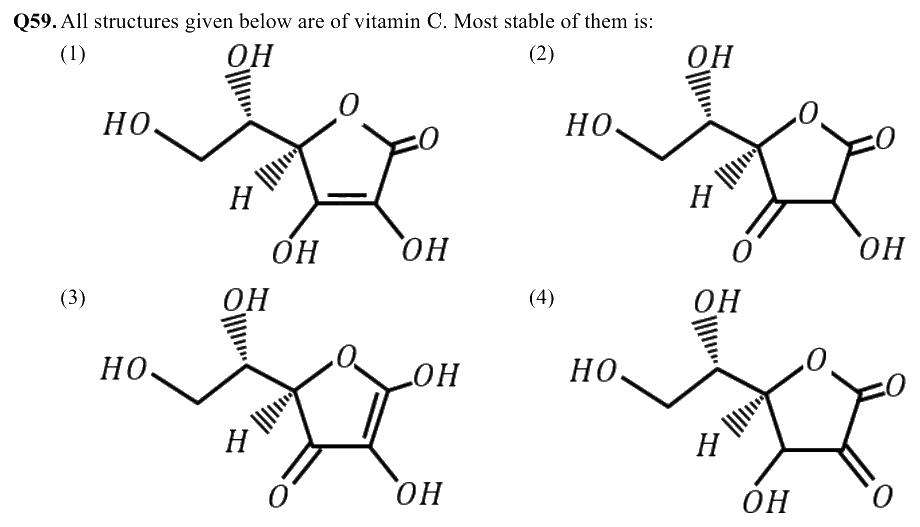
All structures given below are of vitamin C. Most stable of them is:

The question and its figure as printed in JEE Main 2023 01 Feb Shift 2. Option 1: five-membered lactone ring (ring O at the top right, C=O at the right) with a C=C bearing an OH at the bottom right and an OH at the bottom left carbon; the ring carbon at the upper left carries H (hashed) and the side chain CH(OH)-CH2-OH (HO at left, OH above on a hashed bond). Option 2: five-membered lactone ring (ring O at the top right, C=O at the right) with no ring C=C; the lower left ring carbon has a C=O (O at the bottom left) and the lower right ring carbon has OH; same H and side chain as in 1. Option 3: five-membered ring with ring O at the top right; the carbon next to the O carries OH and is…
The question as printed in the paper.
  • A

    see figure five-membered lactone ring (ring O at the top right, C=O at the right) with a C=C bearing an OH at the bottom right and an OH at the bottom left carbon; the ring carbon at the upper left carries H (hashed) and the side chain CH(OH)-$\mathrm{CH_2}$-OH (HO at left, OH above on a hashed bond).

  • B

    see figure five-membered lactone ring (ring O at the top right, C=O at the right) with no ring C=C; the lower left ring carbon has a C=O (O at the bottom left) and the lower right ring carbon has OH; same H and side chain as in 1.

  • C

    see figure five-membered ring with ring O at the top right; the carbon next to the O carries OH and is double-bonded to the next carbon, which carries OH; the lower left ring carbon has a C=O (O at the bottom); same H and side chain as in 1.

  • D

    see figure five-membered lactone ring (ring O at the top right, C=O at the right) with a C=O on the next carbon (O at the bottom right) and OH on the lower left ring carbon; same H and side chain as in 1.

66JEE Main 2023 · 31 Jan · Shift 1MCQOpen question page ↗

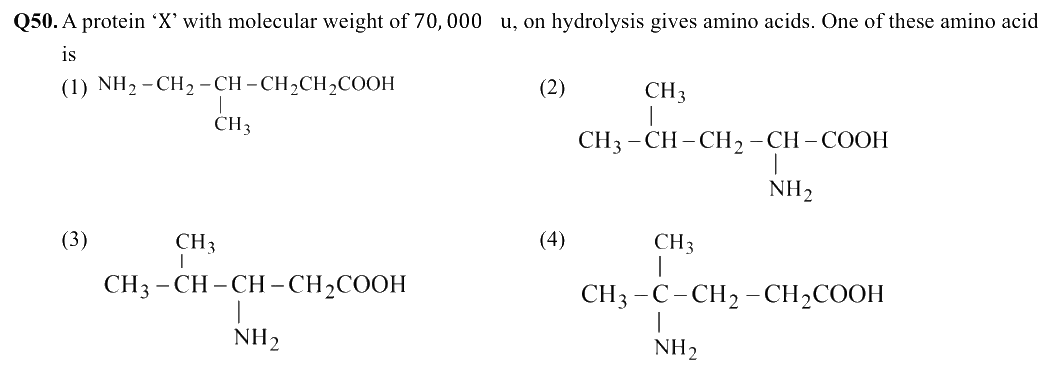
A protein 'X' with molecular weight of 70, 000 u, on hydrolysis gives amino acids. One of these amino acid is

The question and its figure as printed in JEE Main 2023 31 Jan Shift 1. Option 1: Drawn in a line: NH2-CH2-CH-CH2CH2COOH with a CH3 hanging below the CH. Option 2: Drawn in a line: CH3-CH-CH2-CH-COOH with a CH3 above the first CH and NH2 below the second CH. Option 3: Drawn in a line: CH3-CH-CH-CH2COOH with a CH3 above the first CH and NH2 below the second CH. Option 4: Drawn in a line: CH3-C-CH2-CH2COOH with a CH3 above the C and NH2 below the C.
The question as printed in the paper.
  • A

    see figure Drawn in a line: $\mathrm{NH_2-CH_2-CH-CH_2CH_2COOH}$ with a $\mathrm{CH_3}$ hanging below the CH.

  • B

    see figure Drawn in a line: $\mathrm{CH_3-CH-CH_2-CH-COOH}$ with a $\mathrm{CH_3}$ above the first CH and $\mathrm{NH_2}$ below the second CH.

  • C

    see figure Drawn in a line: $\mathrm{CH_3-CH-CH-CH_2COOH}$ with a $\mathrm{CH_3}$ above the first CH and $\mathrm{NH_2}$ below the second CH.

  • D

    see figure Drawn in a line: $\mathrm{CH_3-C-CH_2-CH_2COOH}$ with a $\mathrm{CH_3}$ above the C and $\mathrm{NH_2}$ below the C.

67JEE Main 2023 · 31 Jan · Shift 2MCQOpen question page ↗

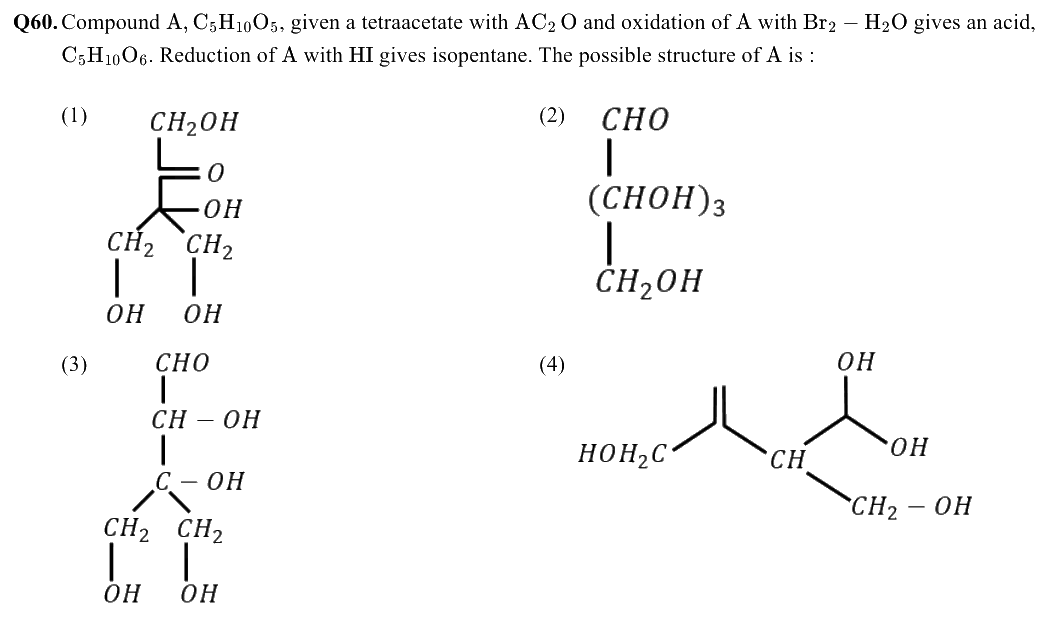
Compound A, $\mathrm{C_5H_{10}O_5}$, given a tetraacetate with $\mathrm{AC_2\,O}$ and oxidation of A with $\mathrm{Br_2 - H_2O}$ gives an acid, $\mathrm{C_5H_{10}O_6}$. Reduction of A with HI gives isopentane. The possible structure of A is :

(see the figure above)

The question and its figure as printed in JEE Main 2023 31 Jan Shift 2.
The question as printed in the paper.
  • A

    see figure

  • B

    see figure

  • C

    see figure

  • D

    see figure

68JEE Main 2023 · 30 Jan · Shift 1MCQOpen question page ↗

Given below are two statements: one is labelled as Assertion (A) and the other is labelled as Reason (R).

Assertion (A): Ketoses give Seliwanoff's test faster than Aldoses.

Reason (R): Ketoses undergo $\beta$-elimination followed by formation of furfural.

In the light of the above statements, choose the correct answer from the options given below:

  • A

    (A) is false but (R) is true

  • B

    Both (A) and (R) are true and (R) is the correct explanation of (A)

  • C

    (A) is true but (R) is false

  • D

    Both (A) and (R) are true but (R) is not the correct explanation of (A)

70JEE Main 2023 · 29 Jan · Shift 2MCQOpen question page ↗

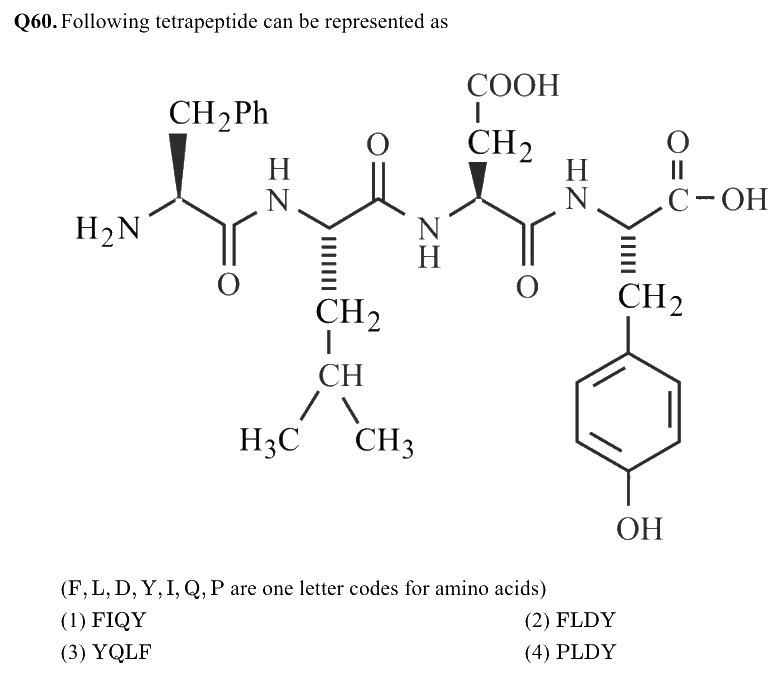
Following tetrapeptide can be represented as
(see the figure above)
(F, L, D, Y, I, Q, P are one letter codes for amino acids)

The question and its figure as printed in JEE Main 2023 29 Jan Shift 2.
The question as printed in the paper.
  • A

    FIQY

  • B

    FLDY

  • C

    YQLF

  • D

    PLDY

71JEE Main 2023 · 25 Jan · Shift 1MCQOpen question page ↗

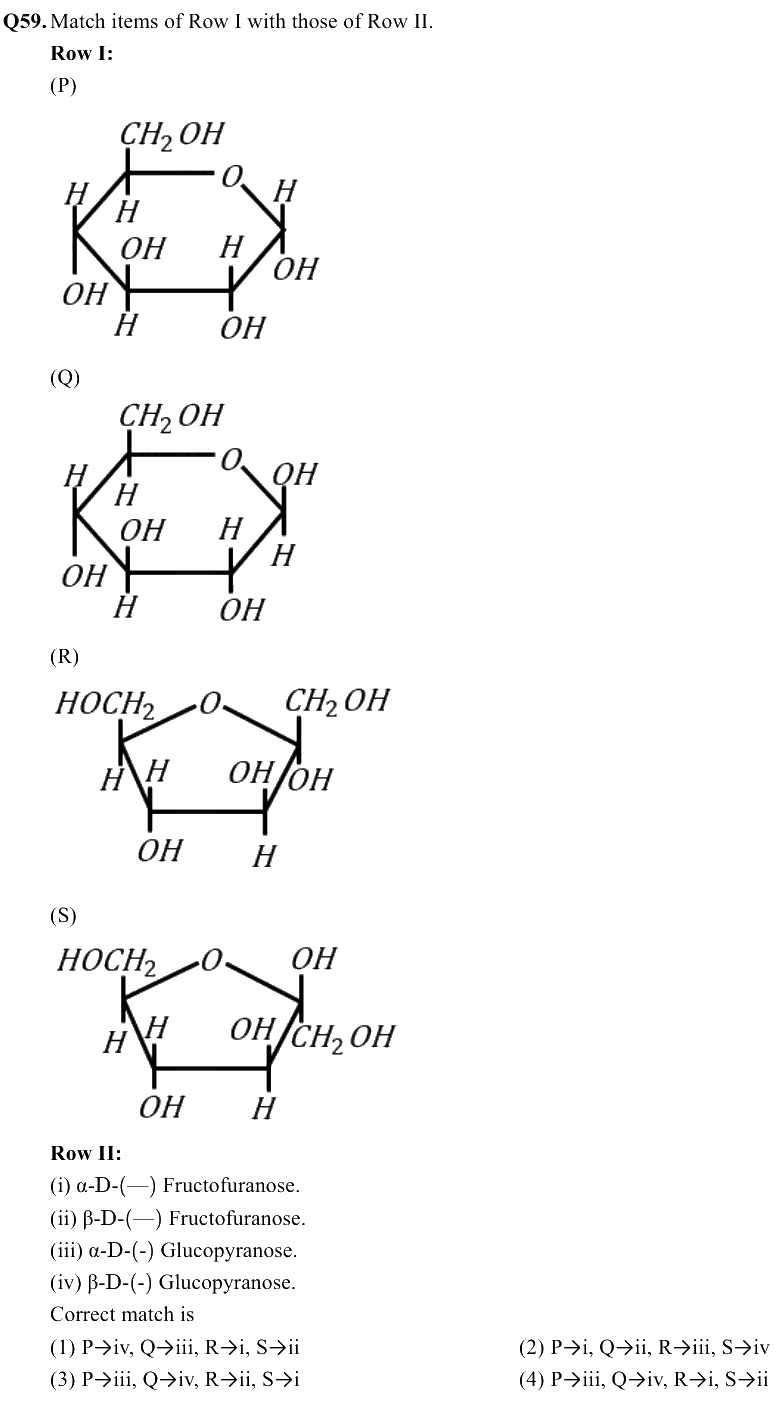
Match items of Row I with those of Row II.
Row I:
(P) (see the figure above)
(Q) (see the figure above)
(R) (see the figure above)
(S) (see the figure above)
Row II:
(i) $\alpha$-D-(—) Fructofuranose.
(ii) $\beta$-D-(—) Fructofuranose.
(iii) $\alpha$-D-(-) Glucopyranose.
(iv) $\beta$-D-(-) Glucopyranose.
Correct match is

The question and its figure as printed in JEE Main 2023 25 Jan Shift 1.
The question as printed in the paper.
  • A

    P$\to$iv, Q$\to$iii, R$\to$i, S$\to$ii

  • B

    P$\to$i, Q$\to$ii, R$\to$iii, S$\to$iv

  • C

    P$\to$iii, Q$\to$iv, R$\to$ii, S$\to$i

  • D

    P$\to$iii, Q$\to$iv, R$\to$i, S$\to$ii

72JEE Main 2022 · 29 Jul · Shift 2MCQOpen question page ↗

Given below are two statements. One is labelled as Assertion A and the other is labelled as Reason R.
Assertion A : Amylose is insoluble in water.
Reason R : Amylose is a long linear molecule with more than 200 glucose units.
In the light of the above statements, choose the correct answer from the options given below.

  • A

    Both A and R are correct and R is the correct explanation of A.

  • B

    Both A and R are correct and R is NOT the correct explanation of A.

  • C

    A is correct but R is not correct.

  • D

    A is not correct but R is correct.

73JEE Main 2022 · 28 Jul · Shift 1MCQOpen question page ↗

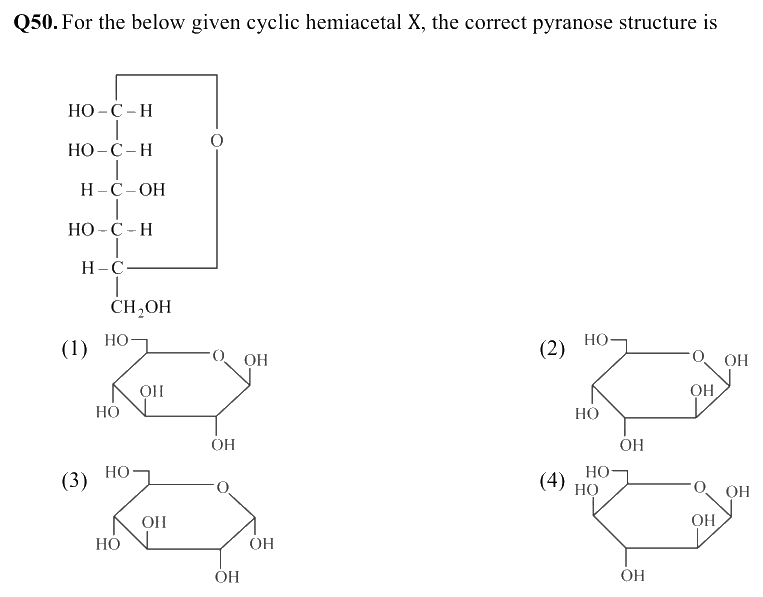
For the below given cyclic hemiacetal X, the correct pyranose structure is

(see the figure above)

The question and its figure as printed in JEE Main 2022 28 Jul Shift 1. Option 1: Flat (Haworth-type) pyranose ring drawn in perspective: ring O at the top right, C1 at the right, C2 lower right, C3 lower left, C4 at the left, C5 top left carrying HOCH2 (up). C1 OH up, C2 OH down, C3 OH up, C4 HO down. Option 2: Same flat ring and numbering as option 1, HOCH2 up on C5. C1 OH up, C2 OH up, C3 OH down, C4 HO down. Option 3: Same flat ring and numbering as option 1, HOCH2 up on C5. C1 OH down, C2 OH down, C3 OH up, C4 HO down. Option 4: Same flat ring and numbering as option 1, HOCH2 up on C5. C1 OH up, C2 OH up, C3 OH down, C4 HO up.
The question as printed in the paper.
  • A

    see figure Flat (Haworth-type) pyranose ring drawn in perspective: ring O at the top right, C1 at the right, C2 lower right, C3 lower left, C4 at the left, C5 top left carrying $\mathrm{HOCH_2}$ (up). C1 OH up, C2 OH down, C3 OH up, C4 HO down.

  • B

    see figure Same flat ring and numbering as option 1, $\mathrm{HOCH_2}$ up on C5. C1 OH up, C2 OH up, C3 OH down, C4 HO down.

  • C

    see figure Same flat ring and numbering as option 1, $\mathrm{HOCH_2}$ up on C5. C1 OH down, C2 OH down, C3 OH up, C4 HO down.

  • D

    see figure Same flat ring and numbering as option 1, $\mathrm{HOCH_2}$ up on C5. C1 OH up, C2 OH up, C3 OH down, C4 HO up.

74JEE Main 2022 · 28 Jul · Shift 2MCQOpen question page ↗

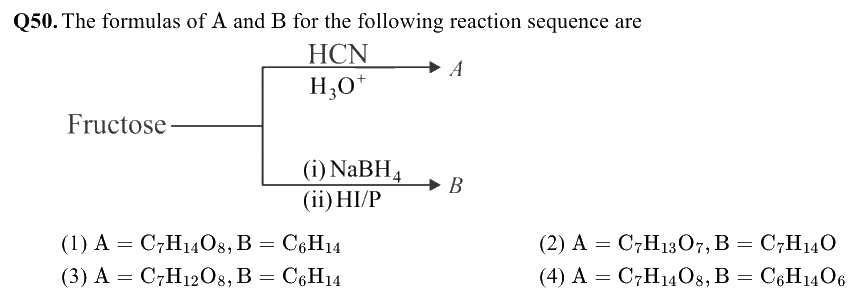
The formulas of A and B for the following reaction sequence are

(see the figure above)

The question and its figure as printed in JEE Main 2022 28 Jul Shift 2.
The question as printed in the paper.
  • A

    $\mathrm{A=C_7H_{14}O_8,\ B=C_6H_{14}}$

  • B

    $\mathrm{A=C_7H_{13}O_7,\ B=C_7H_{14}O}$

  • C

    $\mathrm{A=C_7H_{12}O_8,\ B=C_6H_{14}}$

  • D

    $\mathrm{A=C_7H_{14}O_8,\ B=C_6H_{14}O_6}$

75JEE Main 2022 · 27 Jul · Shift 1MCQOpen question page ↗

A sugar 'X' dehydrates very slowly under acidic condition to give furfural which on further reaction with resorcinol gives the coloured product after sometime. Sugar 'X' is

  • A

    Aldopentose

  • B

    Aldotetrose

  • C

    Oxalic acid

  • D

    Ketotetrose

76JEE Main 2022 · 27 Jul · Shift 2MCQOpen question page ↗

Match List-I with List-II

List-IList-II
AGlucose + HIIGluconic acid
BGlucose + $\mathrm{Br_2}$ waterIIGlucose pentacetate
CGlucose + acetic anhydrideIIISaccharic acid
DGlucose + $\mathrm{HNO_3}$IVHexane

Choose the correct answer from the options given below

  • A

    A – IV, B – I, C – II, D – III

  • B

    A – IV, B – III, C – II, D – I

  • C

    A – III, B – I, C – IV, D – II

  • D

    A – I, B – III, C – IV, D – II

77JEE Main 2022 · 26 Jul · Shift 1MCQOpen question page ↗

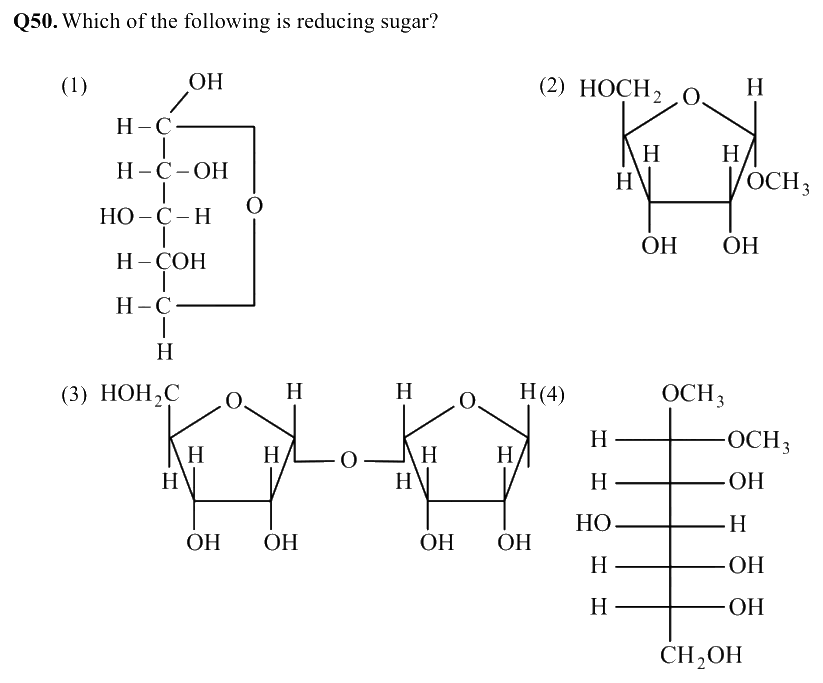
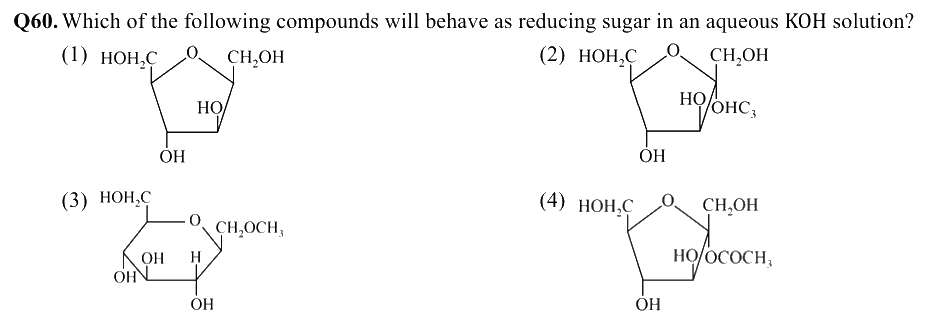
Which of the following is reducing sugar?
(see the figure above)

The question and its figure as printed in JEE Main 2022 26 Jul Shift 1. Option 1: Open-chain-like drawing of a sugar with a ring O bridge: a vertical chain from the top, with OH on the top carbon, then H-C, H-C-OH, HO-C-H, H-COH, H-C, H at the bottom, and an O drawn on the right joining the top carbon to the bottom carbon (a cyclic hemiacetal form of a hexose drawn in a chain style). Option 2: A five-membered ring (furanose) with ring O at the top; HOCH2 at the upper left carbon, H and OCH3 at the right ring carbon (the carbon next to O), H, H on the upper ring carbons and OH, OH at the bottom two carbons (a methyl glycoside). Option 3: Two five-membered rings (furanose) each with ring O…
The question as printed in the paper.
  • A

    see figure Open-chain-like drawing of a sugar with a ring O bridge: a vertical chain from the top, with OH on the top carbon, then H-C, H-C-OH, HO-C-H, H-COH, H-C, H at the bottom, and an O drawn on the right joining the top carbon to the bottom carbon (a cyclic hemiacetal form of a hexose drawn in a chain style).

  • B

    see figure A five-membered ring (furanose) with ring O at the top; $\mathrm{HOCH_2}$ at the upper left carbon, H and $\mathrm{OCH_3}$ at the right ring carbon (the carbon next to O), H, H on the upper ring carbons and OH, OH at the bottom two carbons (a methyl glycoside).

  • C

    see figure Two five-membered rings (furanose) each with ring O at the top, joined by an O bridge between the right carbon of the left ring and the left carbon of the right ring; $\mathrm{HOCH_2}$ at the left end; OH, OH below each ring (a disaccharide).

  • D

    see figure An open chain vertical (Fischer-style) structure with $\mathrm{OCH_3}$ at the top, then rows: H and $\mathrm{OCH_3}$, H and OH, HO and H, H and OH, H and OH, ending with $\mathrm{CH_2OH}$ at the bottom.

79JEE Main 2022 · 25 Jul · Shift 1MCQOpen question page ↗

During the denaturation of proteins, which of these structures will remain intact ?

  • A

    Primary

  • B

    Secondary

  • C

    Tertiary

  • D

    Quarternary

80JEE Main 2022 · 25 Jul · Shift 2MCQOpen question page ↗

Glycosidic linkage between $\mathrm{C_1}$ of $\alpha$-glucose and $\mathrm{C_2}$ of $\beta$-fructose is found in

  • A

    Maltose

  • B

    Sucrose

  • C

    Lactose

  • D

    amylose

81JEE Main 2022 · 29 Jun · Shift 1MCQOpen question page ↗

Sugar moiety in DNA and RNA molecules respectively are

  • A

    $\beta - \mathrm{D} - 2$-deoxyribose, $\beta - \mathrm{D}$-deoxyribose

  • B

    $\beta - \mathrm{D}$-ribose, $\beta - \mathrm{D} - 2$deoxyribose

  • C

    $\beta - \mathrm{D} - 2$-deoxyribose, $\beta - \mathrm{D}$-ribose

  • D

    $\beta - \mathrm{D}$deoxyribose, $\beta - \mathrm{D} - 2$deoxyribose

82JEE Main 2022 · 29 Jun · Shift 2MCQOpen question page ↗

The structure of protein that is unaffected by heating is :

  • A

    secondary structure

  • B

    tertiary structure

  • C

    primary structure

  • D

    Quaternary structure

83JEE Main 2022 · 28 Jun · Shift 1MCQOpen question page ↗

Stability of $\alpha$ - Helix structure of proteins depends upon

  • A

    H-bonding interaction

  • B

    dipolar interaction

  • C

    van der Waals forces

  • D

    $\pi$-stacking interaction

84JEE Main 2022 · 28 Jun · Shift 2MCQOpen question page ↗

When sugar 'X' is boiled with dilute $\mathrm{H_2\,SO_4}$ in alcoholic solution, two isomers 'A' and 'B' are formed. 'A' on oxidation with $\mathrm{HNO_3}$ yields saccharic acid where as 'B' is laevorotatory. The compound 'X' is

  • A

    Maltose

  • B

    Sucrose

  • C

    Lactose

  • D

    Strach

85JEE Main 2022 · 27 Jun · Shift 1MCQOpen question page ↗

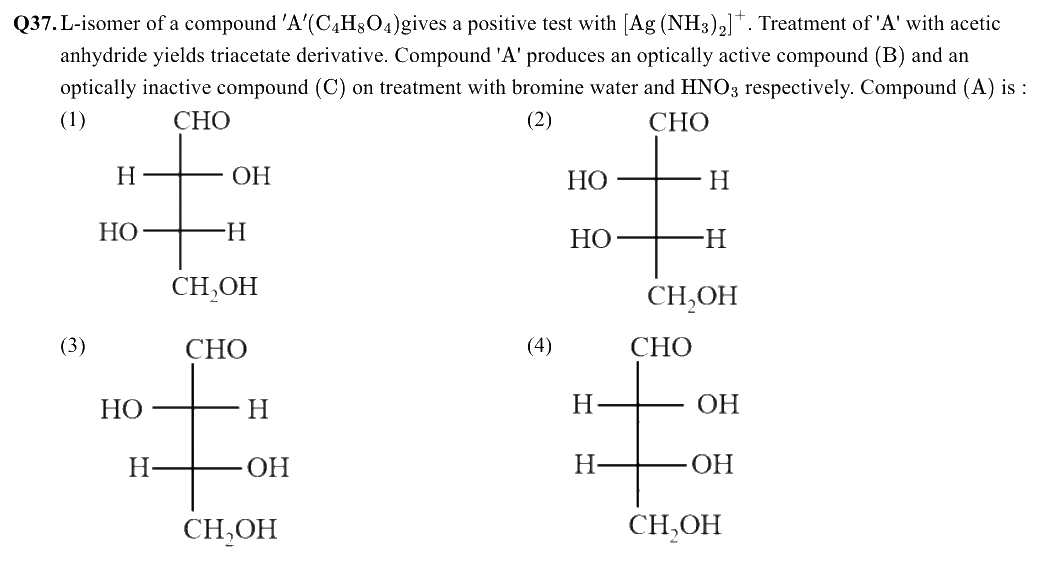
L-isomer of a compound 'A'($\mathrm{C_4H_8O_4}$)gives a positive test with $\mathrm{[Ag\,(NH_3)_2]^{+}}$. Treatment of 'A' with acetic anhydride yields triacetate derivative. Compound 'A' produces an optically active compound (B) and an optically inactive compound (C) on treatment with bromine water and $\mathrm{HNO_3}$ respectively. Compound (A) is :

The question and its figure as printed in JEE Main 2022 27 Jun Shift 1. Option 1: Fischer projection: CHO at the top; first carbon with H on the left and OH on the right; second carbon with HO on the left and H on the right; CH2OH at the bottom. Option 2: Fischer projection: CHO at the top; first carbon with HO on the left and H on the right; second carbon with HO on the left and H on the right; CH2OH at the bottom. Option 3: Fischer projection: CHO at the top; first carbon with HO on the left and H on the right; second carbon with H on the left and OH on the right; CH2OH at the bottom. Option 4: Fischer projection: CHO at the top; first carbon with H on the left and OH on the right…
The question as printed in the paper.
  • A

    see figure Fischer projection: CHO at the top; first carbon with H on the left and OH on the right; second carbon with HO on the left and H on the right; CH_2OH at the bottom.

  • B

    see figure Fischer projection: CHO at the top; first carbon with HO on the left and H on the right; second carbon with HO on the left and H on the right; CH_2OH at the bottom.

  • C

    see figure Fischer projection: CHO at the top; first carbon with HO on the left and H on the right; second carbon with H on the left and OH on the right; CH_2OH at the bottom.

  • D

    see figure Fischer projection: CHO at the top; first carbon with H on the left and OH on the right; second carbon with H on the left and OH on the right; CH_2OH at the bottom.

86JEE Main 2022 · 27 Jun · Shift 2MCQOpen question page ↗

Given below are two statements.
Statement I: Maltose has two $\alpha - D -$ glucose units linked at $\mathrm{C_1}$ and $\mathrm{C_4}$ and is a reducing sugar.
Statement II: Maltose has two monosaccharides: $\alpha$-D-glucose and $\beta$-D-glucose linked at $\mathrm{C_1}$ and $\mathrm{C_6}$ and it is a non-reducing sugar.
In the light of the above statements, choose the correct answer from the options given below.

  • A

    Both Statement I and Statement II are true.

  • B

    Both Statement I and Statement II are false.

  • C

    Statement I is true but Statement II is false.

  • D

    Statement I is false but Statement II is true.

87JEE Main 2022 · 26 Jun · Shift 2MCQOpen question page ↗

Which one of the following is a water soluble vitamin, that is not excreted easily?

  • A

    Vitamin $\mathrm{B}_2$

  • B

    Vitamin $\mathrm{B}_1$

  • C

    Vitamin $\mathrm{B}_6$

  • D

    Vitamin $\mathrm{B}_{12}$

88JEE Main 2022 · 25 Jun · Shift 2MCQOpen question page ↗

Match the following correctly

(i) Zymase(a) Stomach
(ii) Urease(b) Yeast
(iii) Diastase(c) Malt
(iv) Pepsin(d)Soyabean
  • A

    (i)-B; (ii) D(iii)-C; (iv)-A

  • B

    (i)-B; (ii)-A; (iii)-C; (iv)-D

  • C

    (i)-A; (ii)-B; (iii)-C; (iv)-D

  • D

    (i)-D; (ii)-C; (iii)-B; (iv)-A

89JEE Main 2022 · 24 Jun · Shift 1MCQOpen question page ↗

A polysaccharide 'X' on boiling with dil $\mathrm{H_2SO_4}$ at $393 \mathrm{~K}$ under $2 - 3 \mathrm{~atm}$ pressure yields 'Y' 'Y' on treatment with bromine water gives gluconic acid. 'X' contains $\beta$-glycosidic linkages only. Compound 'X' is :

  • A

    starch

  • B

    cellulose

  • C

    amylose

  • D

    amylopectin

90JEE Main 2021 · 31 Aug · Shift 1MCQOpen question page ↗

Which one of the following compounds contains $\beta - \mathrm{C_1} - \mathrm{C_4}$ glycosidic linkage ?

  • A

    Sucrose

  • B

    Amylose

  • C

    Lactose

  • D

    Maltose

92JEE Main 2021 · 27 Aug · Shift 1MCQOpen question page ↗

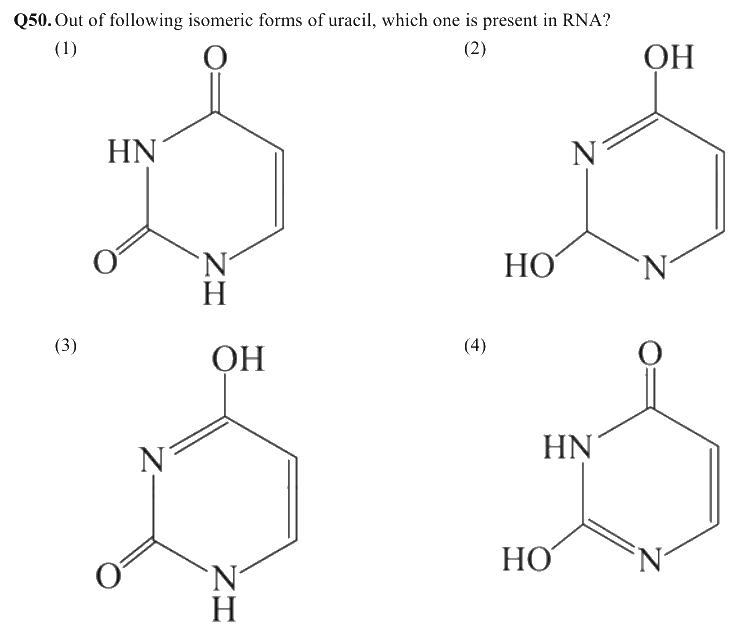
Out of following isomeric forms of uracil, which one is present in RNA?

The question and its figure as printed in JEE Main 2021 27 Aug Shift 1. Option 1: six-membered ring: O= at the top, HN at the upper left, O= at the lower left (on the carbon between the two nitrogens), N-H at the bottom, C=C on the right side (diketo form). Option 2: six-membered ring with OH at the top, ring N at the upper left, HO at the lower left, ring N at the bottom, C=C on the right (dihydroxy form, no N-H). Option 3: six-membered ring with OH at the top, ring N at the upper left, O= at the lower left, N-H at the bottom, C=C on the right. Option 4: six-membered ring with O= at the top, HN at the upper left, HO at the lower left, ring N at the bottom, C=C on the right.
The question as printed in the paper.
  • A

    see figure six-membered ring: O= at the top, HN at the upper left, O= at the lower left (on the carbon between the two nitrogens), N-H at the bottom, C=C on the right side (diketo form).

  • B

    see figure six-membered ring with OH at the top, ring N at the upper left, HO at the lower left, ring N at the bottom, C=C on the right (dihydroxy form, no N-H).

  • C

    see figure six-membered ring with OH at the top, ring N at the upper left, O= at the lower left, N-H at the bottom, C=C on the right.

  • D

    see figure six-membered ring with O= at the top, HN at the upper left, HO at the lower left, ring N at the bottom, C=C on the right.

93JEE Main 2021 · 27 Aug · Shift 2MCQOpen question page ↗

Which one of the following tests used for the identification of functional groups in organic compounds does not use copper reagent?

  • A

    Seliwanoff's test

  • B

    Biuret test for peptide bond

  • C

    Barfoed's test

  • D

    Benedict's test

94JEE Main 2021 · 27 Aug · Shift 2MCQOpen question page ↗

Hydrolysis of sucrose gives:

  • A

    $\alpha-\mathrm{D}-(+)-$ Glucose and $\alpha-\mathrm{D}-(-)-$ Fructose

  • B

    $\alpha-\mathrm{D}-(+)-$ Glucose and $\beta-\mathrm{D}-(-)-$ Fructose

  • C

    $\alpha-\mathrm{D}-(-)$-Glucose and $\beta-\mathrm{D}-(-)-$ Fructose

  • D

    $\alpha-\mathrm{D}-(-)-$ Glucose and $\alpha-\mathrm{D}-(+)-$ Fructose

95JEE Main 2021 · 26 Aug · Shift 2MCQOpen question page ↗

Given below are two statements : one is labelled as Assertion (A) and the other is labelled as Reason (R).
Assertion (A) : Sucrose is a disaccharide and a non-reducing sugar.
Reason (R): Sucrose involves glycosidic linkage between $C_1$ of $\beta$-glucose and $C_2$ of $\alpha$-fructose.
Choose the most appropriate answer from the options given below :

  • A

    Both (A) and (R) are true and (R) is the true explanation of (A).

  • B

    (A) is true but (R) is false.

  • C

    (A) is false but (R) is true.

  • D

    Both (A) and (R) are true but (R) is not the true explanation of (A).

96JEE Main 2021 · 27 Jul · Shift 1MCQOpen question page ↗

Which one among the following chemical tests is used to distinguish monosaccharide from disaccharide ?

  • A

    Seliwanoff's test

  • B

    Iodine test

  • C

    Barfoed test

  • D

    Tollen's test

97JEE Main 2021 · 27 Jul · Shift 1MCQOpen question page ↗

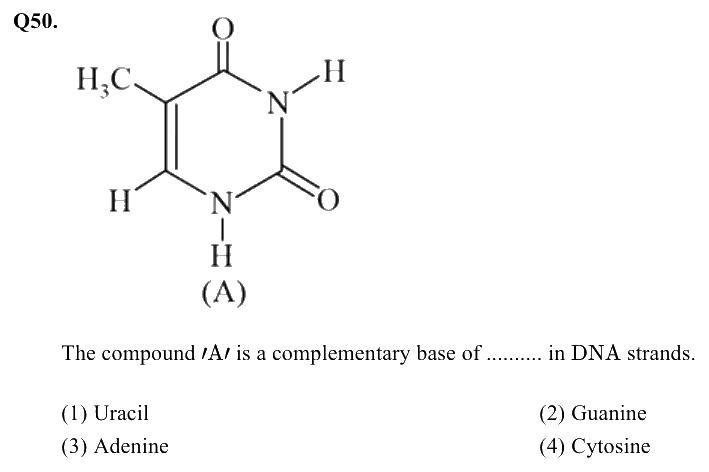
see figure The compound 'A' is a complementary base of ______ in DNA strands.

The question and its figure as printed in JEE Main 2021 27 Jul Shift 1. Question: The compound 'A' is a complementary base of in DNA strands.
The question as printed in the paper.
  • A

    Uracil

  • B

    Guanine

  • C

    Adenine

  • D

    Cytosine

100JEE Main 2021 · 25 Jul · Shift 2MCQOpen question page ↗

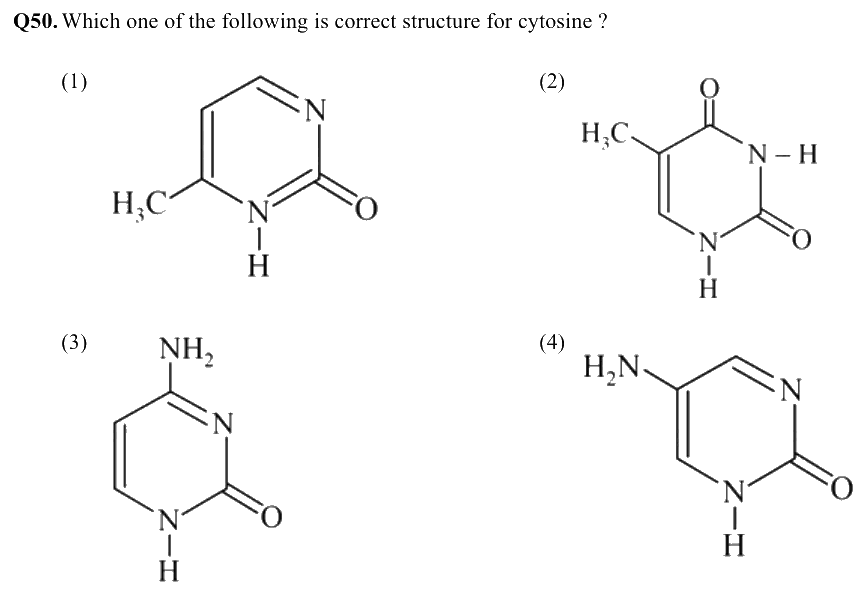
Which one of the following is correct structure for cytosine ?

The question and its figure as printed in JEE Main 2021 25 Jul Shift 2.
The question as printed in the paper.
  • A

    see figure

  • B

    see figure

  • C

    see figure

  • D

    see figure

101JEE Main 2021 · 22 Jul · Shift 1MCQOpen question page ↗

Thiamine and pyridoxine are also known respectively as:

  • A

    Vitamin $\mathrm{B_2}$ and Vitamin E

  • B

    Vitamin E and Vitamin $\mathrm{B_2}$

  • C

    Vitamin $\mathrm{B_6}$ and Vitamin $\mathrm{B_2}$

  • D

    Vitamin $\mathrm{B_1}$ and Vitamin $\mathrm{B_6}$

102JEE Main 2021 · 20 Jul · Shift 1MCQOpen question page ↗

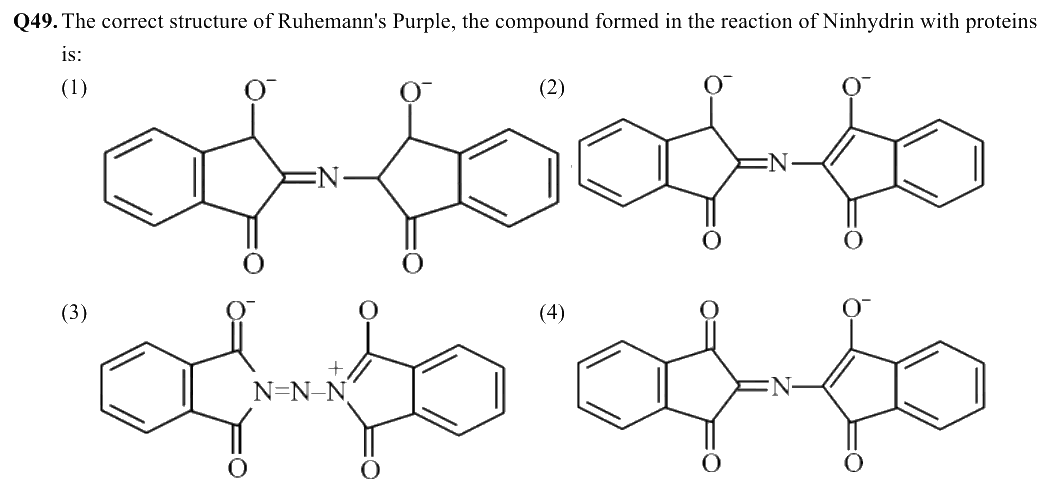
The correct structure of Ruhemann's Purple, the compound formed in the reaction of Ninhydrin with proteins is:

The question and its figure as printed in JEE Main 2021 20 Jul Shift 1.
The question as printed in the paper.
  • A

    see figure

  • B

    see figure

  • C

    see figure

  • D

    see figure

103JEE Main 2021 · 20 Jul · Shift 1MCQOpen question page ↗

Identify the incorrect statement from the following.

  • A

    Amylose is a branched chain polymer of glucose

  • B

    Starch is a polymer of $\alpha - D$ glucose

  • C

    $\beta$-Glycosidic linkage makes cellulose polymer

  • D

    Glycogen is called as animal starch

104JEE Main 2021 · 20 Jul · Shift 2MCQOpen question page ↗

Which one of the following statements is not true about enzymes?

  • A

    Enzymes are non-specific for a reaction and substrate.

  • B

    Almost all enzymes are proteins.

  • C

    Enzymes work as catalysts by lowering the activation energy of a biochemical reaction.

  • D

    The action of enzymes is temperature and pH specific

105JEE Main 2021 · 18 Mar · Shift 1MCQOpen question page ↗

A non-reducing sugar A hydrolyses to give two reducing mono saccharides. Sugar A is

  • A

    Fructose

  • B

    Galactose

  • C

    Glucose

  • D

    Sucrose

106JEE Main 2021 · 18 Mar · Shift 2MCQOpen question page ↗

Deficiency of vitamin K causes :

  • A

    Increase in blood clotting time

  • B

    Increase in fragility of RBC 's

  • C

    Cheilosis

  • D

    Decrease in blood clotting time

107JEE Main 2021 · 17 Mar · Shift 1MCQOpen question page ↗

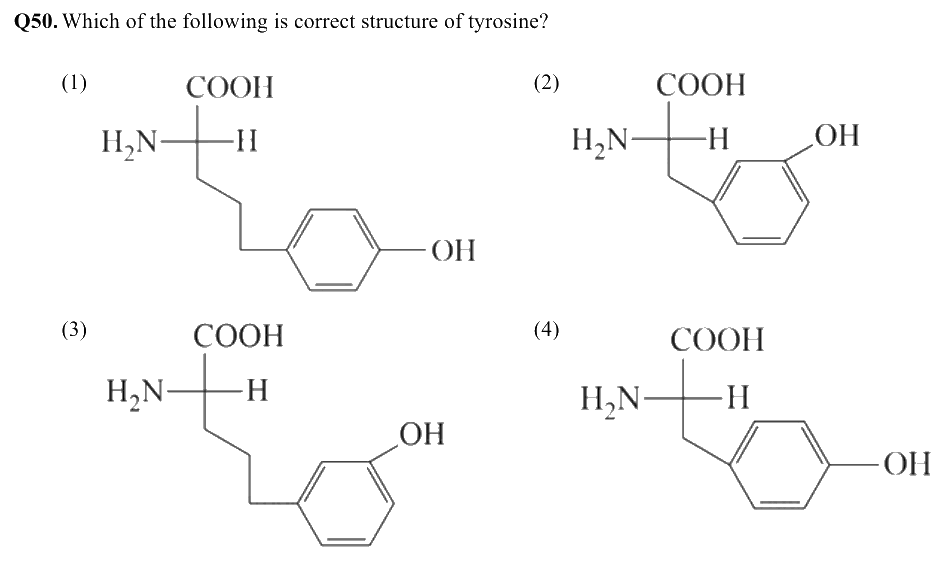
Which of the following is correct structure of tyrosine?
(see the figure above)

The question and its figure as printed in JEE Main 2021 17 Mar Shift 1. Option 1: Fischer-type drawing: COOH at the top, H2N on the left and H on the right of the central carbon, then a two-carbon zigzag chain (CH2CH2) leading to a benzene ring bearing OH para to the chain Option 2: Same Fischer-type drawing, then a single CH2 leading to a benzene ring bearing OH meta to the chain (OH on the ring carbon at the upper right, as drawn) Option 3: Same Fischer-type drawing, then a two-carbon zigzag chain (CH2CH2) leading to a benzene ring bearing OH meta to the chain (as drawn) Option 4: Same Fischer-type drawing, then a single CH2 leading to a benzene ring bearing OH para to the chain
The question as printed in the paper.
  • A

    see figure Fischer-type drawing: $\mathrm{COOH}$ at the top, $\mathrm{H_2N}$ on the left and H on the right of the central carbon, then a two-carbon zigzag chain ($\mathrm{CH_2CH_2}$) leading to a benzene ring bearing OH para to the chain

  • B

    see figure Same Fischer-type drawing, then a single $\mathrm{CH_2}$ leading to a benzene ring bearing OH meta to the chain (OH on the ring carbon at the upper right, as drawn)

  • C

    see figure Same Fischer-type drawing, then a two-carbon zigzag chain ($\mathrm{CH_2CH_2}$) leading to a benzene ring bearing OH meta to the chain (as drawn)

  • D

    see figure Same Fischer-type drawing, then a single $\mathrm{CH_2}$ leading to a benzene ring bearing OH para to the chain

109JEE Main 2021 · 17 Mar · Shift 2MCQOpen question page ↗

$\mathrm{C}_{12} \mathrm{H}_{22} \mathrm{O}_{11}$ (Sucrose) $+\mathrm{H}_2 \mathrm{O} \xrightarrow{\text { Enzyme A }} \mathrm{C}_6 \mathrm{H}_{12} \mathrm{O}_6$ (Glucose) $+\mathrm{C}_6 \mathrm{H}_{12} \mathrm{O}_6$ (Fructose)
$\mathrm{C}_6 \mathrm{H}_{12} \mathrm{O}_6$ (Glucose) $\xrightarrow{\text { Enzyme B }} 2 \mathrm{C}_2 \mathrm{H}_5 \mathrm{OH}+2 \mathrm{CO}_2$
In the above reactions, the enzyme A and enzyme B respectively are :-

  • A

    Amylase and Invertase

  • B

    Invertase and Amylase

  • C

    Invertase and Zymase

  • D

    Zymase and Invertase

110JEE Main 2021 · 16 Mar · Shift 1MCQOpen question page ↗

Which among the following pairs of Vitamins is stored in our body relatively for longer duration?

  • A

    Thiamine and Vitamin A

  • B

    Vitamin A and D

  • C

    Thiamine and Ascorbic acid

  • D

    Ascorbic acid and Vitamin D

111JEE Main 2021 · 16 Mar · Shift 2MCQOpen question page ↗

The secondary structure of protein is stabilised by:

  • A

    Peptide bond

  • B

    glycosidic bond

  • C

    Hydrogen bonding

  • D

    van der Waals forces

113JEE Main 2021 · 26 Feb · Shift 2MCQOpen question page ↗

Match List-I with List-II.

List-IList-II
(a) Sucrose(i) $\beta - \mathrm{D}-$Galactose and $\beta - \mathrm{D}-$Glucose
(b) Lactose(ii) $\alpha - \mathrm{D}-$Glucose and $\beta - \mathrm{D}-$Fructose
(c) Maltose(iii) $\alpha - \mathrm{D}-$Glucose and $\alpha - \mathrm{D}-$Glucose

Choose the correct answer from the options given below:

  • A

    (a) $\rightarrow$ (iii), (b) $\rightarrow$ (ii), (c) $\rightarrow$ (i)

  • B

    (a) $\rightarrow$ (iii), (b) $\rightarrow$ (i), (c) $\rightarrow$ (ii)

  • C

    (a) $\rightarrow$ (ii), (b) $\rightarrow$ (i), (c) $\rightarrow$ (iii)

  • D

    (a) $\rightarrow$ (i), (b) $\rightarrow$ (iii), (c) $\rightarrow$ (ii)

114JEE Main 2021 · 26 Feb · Shift 2MCQOpen question page ↗

Seliwanoff test and Xanthoproteic test are used for the identification of ______ and ______ respectively.

  • A

    aldoses, ketoses

  • B

    ketoses, proteins

  • C

    proteins, ketoses

  • D

    ketoses, aldoses

115JEE Main 2021 · 25 Feb · Shift 1MCQOpen question page ↗

Which of the glycosidic linkage between galactose and glucose is present in lactose?

  • A

    C $-$ 1 of glucose and C $-$ 4 of galactose

  • B

    C $-$ 1 of glucose and C $-$ 6 of galactose

  • C

    C $-$ 1 of galactose and C $-$ 4 of glucose

  • D

    C $-$ 1 of galactose and C $-$ 6 of glucose

116JEE Main 2021 · 25 Feb · Shift 2MCQOpen question page ↗

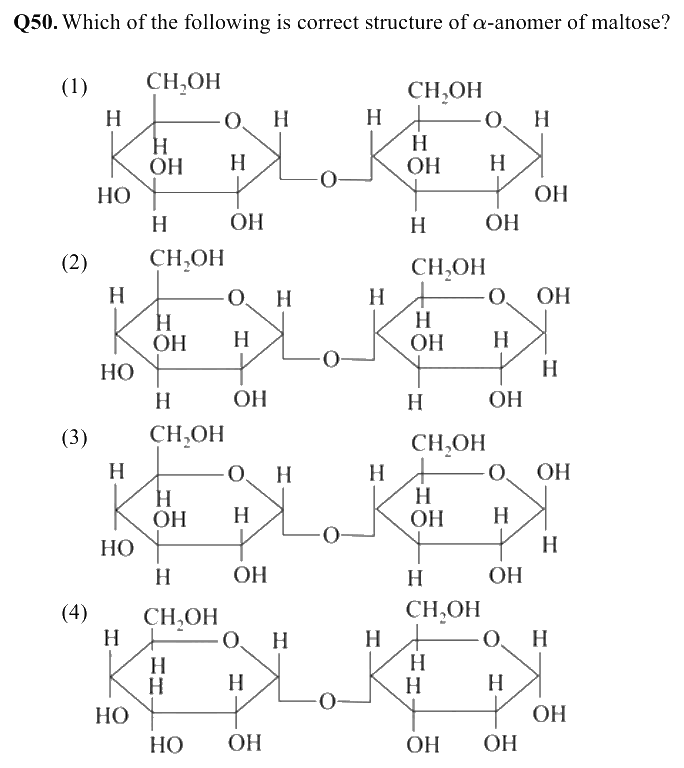
Which of the following is correct structure of $\alpha$-anomer of maltose?

The question and its figure as printed in JEE Main 2021 25 Feb Shift 2. Option 1: two six-membered pyranose rings (ring oxygen at the top of each, CH2OH at the top, H and OH groups on the ring carbons) joined by a glycosidic oxygen bridge between the lower right carbon of the left ring and the lower left carbon of the right ring Option 2: disaccharide drawing of the same kind as option 1 (two pyranose rings joined by an O bridge), with different positions of H and OH on the ring carbons Option 3: disaccharide drawing of the same kind as option 1, with different positions of H and OH on the ring carbons Option 4: disaccharide drawing of the same kind as option 1, with different positions of…
The question as printed in the paper.
  • A

    see figure two six-membered pyranose rings (ring oxygen at the top of each, CH2OH at the top, H and OH groups on the ring carbons) joined by a glycosidic oxygen bridge between the lower right carbon of the left ring and the lower left carbon of the right ring

  • B

    see figure disaccharide drawing of the same kind as option 1 (two pyranose rings joined by an O bridge), with different positions of H and OH on the ring carbons

  • C

    see figure disaccharide drawing of the same kind as option 1, with different positions of H and OH on the ring carbons

  • D

    see figure disaccharide drawing of the same kind as option 1, with different positions of H and OH on the ring carbons

117JEE Main 2021 · 24 Feb · Shift 1MCQOpen question page ↗

Out of the following, which type of interaction is responsible for the stabilisation of $\alpha$ - helix structure of proteins?

  • A

    Covalent bonding

  • B

    Ionic bonding

  • C

    Hydrogen bonding

  • D

    vander Waals forces

118JEE Main 2020 · 6 Sep · Shift 2MCQOpen question page ↗

Which one of the following statement is not true?

  • A

    Lactose contains $\alpha-$glycosidic linkage between $\mathrm{C_1}$ of galactose and $\mathrm{C_4}$ of glucose

  • B

    Lactose is a reducing sugar and it gives Fehling's test.

  • C

    Lactose ($\mathrm{C_{11}H_{22}O_{11}}$) is a disaccharide and it contains 8 hydroxyl groups.

  • D

    On acid hydrolysis, lactose gives one molecule of D(+)$-$glucose and one molecule of D(+)$-$galactose.

120JEE Main 2020 · 4 Sep · Shift 1MCQOpen question page ↗

What are the functional groups present in the structure of maltose?

  • A

    One ketal and one hemiketal

  • B

    Two acetals

  • C

    One acetal and one hemiacetal

  • D

    One acetal and one ketal

121JEE Main 2020 · 2 Sep · Shift 1MCQOpen question page ↗

Consider the following reactions :
(i) Glucose $+ \mathrm{ROH} \xrightarrow{\text{dry HCl}}$ Acetal $\xrightarrow[(\mathrm{CH}_{3}\mathrm{CO})_{2}\mathrm{O}]{\text{x eq. of}}$ acetyl derivative
(ii) Glucose $\xrightarrow{\text{Ni/H}_{2}}$ A $\xrightarrow[(\mathrm{CH}_{3}\mathrm{CO})_{2}\mathrm{O}]{\text{y eq. of}}$ acetyl derivative
(iii) Glucose $\xrightarrow[(\mathrm{CH}_{3}\mathrm{CO})_{2}\mathrm{O}]{\text{z eq. of}}$ acetyl derivative 'x', 'y' and 'z' in these reactions are respectively.

  • A

    5, 4 & 6

  • B

    4, 6 & 5

  • C

    4, 5 & 5

  • D

    5, 6 & 5

122JEE Main 2020 · 2 Sep · Shift 2MCQOpen question page ↗

The correct observation in the following reaction is:
Sucrose $\xrightarrow[\text{Cleavage (Hydrolysis)}]{\text{Glycosidic bond}} \mathrm{A} + \mathrm{B} \xrightarrow[\text{Reagent}]{\text{Seliwanoff}} ?$

  • A

    Formation of blue colour

  • B

    Gives no colour

  • C

    Formation of red colour

  • D

    Formation of violet colour

123JEE Main 2020 · 9 Jan · Shift 2MCQOpen question page ↗

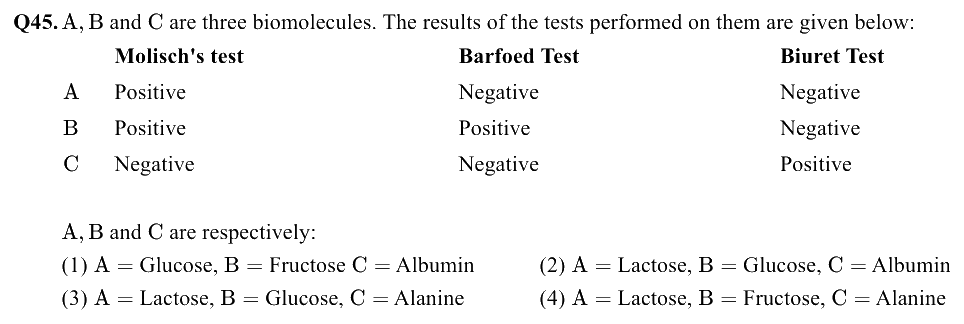
A, B and C are three biomolecules. The results of the tests performed on them are given below:
(see the figure above)
A, B and C are respectively:

The question and its figure as printed in JEE Main 2020 09 Jan Shift 2.
The question as printed in the paper.
  • A

    A = Glucose, B = Fructose C = Albumin

  • B

    A = Lactose, B = Glucose, C = Albumin

  • C

    A = Lactose, B = Glucose, C = Alanine

  • D

    A = Lactose, B = Fructose, C = Alanine

124JEE Main 2020 · 8 Jan · Shift 1MCQOpen question page ↗

Which of the following statement is not true for glucose?

  • A

    Glucose exists in two crystalline forms $\alpha$ and $\beta$

  • B

    Glucose gives Schiff's test for aldehyde

  • C

    Glucose reacts with hydroxylamine to form oxime

  • D

    The pentaacetate of glucose does not react with hydroxylamine to give oxime

125JEE Main 2020 · 8 Jan · Shift 2MCQOpen question page ↗

Two monomers in maltose are:

  • A

    $\alpha - D-$ glucose and $\beta - D-$ glucose

  • B

    $\alpha - D-$ glucose and $\alpha - D-$ galactose

  • C

    $\alpha - D -$ glucose and $\alpha - D-$ Fructose

  • D

    $\alpha - D-$ glucose and $\alpha - D-$ glucose

126JEE Main 2020 · 7 Jan · Shift 1MCQOpen question page ↗

Match the following :
(i) Riboflavin (a) Beriberi
(ii) Thiamine (b) Scurvy
(iii) Pyridoxine (c) Cheilosis
(iv) Ascorbic acid (d) Convulsions

  • A

    (i) $-$ (a), (ii) $-$ (d), (iii) $-$ (c), (iv) $-$ (b)

  • B

    (i) $-$ (c), (ii) $-$ (d), (iii) $-$ (a), (iv) $-$ (b)

  • C

    (i) $-$ (c), (ii) $-$ (a), (iii) $-$ (d), (iv) $-$ (b)

  • D

    (i) $-$ (d), (ii) $-$ (b), (iii) $-$ (a), (iv) $-$ (c)

127JEE Main 2020 · 7 Jan · Shift 2MCQOpen question page ↗

Which of the following statements is correct?

  • A

    Gluconic acid can form cyclic (acetal/hemiacetal) structure

  • B

    Gluconic acid is a dicarboxylic acid

  • C

    Gluconic acid is a partial oxidation product of glucose

  • D

    Gluconic acid is obtained by oxidation of glucose with $\mathrm{HNO_3}$

128JEE Main 2019 · 12 Apr · Shift 1MCQOpen question page ↗

Glucose and Galactose are having identical configuration in all the positions except position.

  • A

    C - 3

  • B

    C - 4

  • C

    C - 5

  • D

    C - 2

129JEE Main 2019 · 12 Apr · Shift 1MCQOpen question page ↗

Which of the following statements is not true about RNA?

  • A

    It controls the synthesis of protein

  • B

    It usually does not replicate

  • C

    It has always double standard $\alpha$ - helix structure

  • D

    It is present in the nucleus of the cell

130JEE Main 2019 · 12 Apr · Shift 2MCQOpen question page ↗

Which of the given statements is incorrect about glycogen?

  • A

    It is present in animal cells.

  • B

    It is a straight chain polymer similar to amylose.

  • C

    It is present in some yeast and fungi

  • D

    Only $\alpha-$ linkages are present in the molecule.

131JEE Main 2019 · 10 Apr · Shift 1MCQOpen question page ↗

Amylopectin is composed of:

  • A

    $\beta - D-$ glucose , $\mathrm{C_1 - C_4}$ and $\mathrm{C_1 - C_6}$ linkages

  • B

    $\alpha - D-$ glucose, $\mathrm{C_1 - C_4}$ and $\mathrm{C_2 - C_6}$ linkages

  • C

    $\alpha - D-$ glucose, $\mathrm{C_1 - C_4}$ and $\mathrm{C_1 - C_6}$ linkages

  • D

    $\beta - D-$ glucose, $\mathrm{C_1 - C_4}$ and $\mathrm{C_2 - C_6}$ linkages

132JEE Main 2019 · 10 Apr · Shift 2MCQOpen question page ↗

Number of stereo centers present in linear and cyclic structures of glucose are respectively:

  • A

    4 and 4

  • B

    5 and 5

  • C

    4 and 5

  • D

    5 and 4

133JEE Main 2019 · 9 Apr · Shift 1MCQOpen question page ↗

Which of the following statements is not true about sucrose?

  • A

    It is also named as invert sugar.

  • B

    It is a non-reducing sugar.

  • C

    The glycosidic linkage is present Between $\mathrm{C_1}$ of $\alpha$ -glucose and $\mathrm{C_1}$ of $\beta$ -fructose.

  • D

    On hydrolysis, it produces glucose and fructose.

135JEE Main 2019 · 8 Apr · Shift 2MCQOpen question page ↗

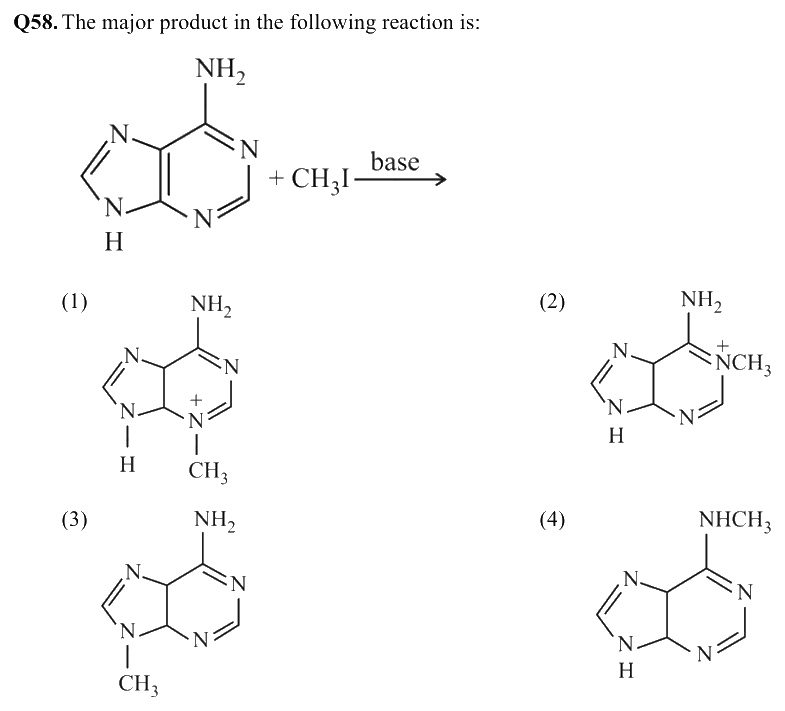
The major product in the following reaction is:

(see the figure above)

The question and its figure as printed in JEE Main 2019 08 Apr Shift 2. Option 1: adenine skeleton with a N^+-CH3 in the six-membered ring and H on the five-membered ring N Option 2: adenine skeleton with N^+CH3 at the six-membered ring N (right) and H on the five-membered ring N Option 3: adenine skeleton with NH2 unchanged and a CH3 on the five-membered ring N (lower left) Option 4: adenine skeleton with NHCH3 in place of NH2 and H on the five-membered ring N
The question as printed in the paper.
  • A

    see figure adenine skeleton with a $\mathrm{N^+{-}CH_3}$ in the six-membered ring and H on the five-membered ring N

  • B

    see figure adenine skeleton with $\mathrm{N^+CH_3}$ at the six-membered ring N (right) and H on the five-membered ring N

  • C

    see figure adenine skeleton with $\mathrm{NH_2}$ unchanged and a $\mathrm{CH_3}$ on the five-membered ring N (lower left)

  • D

    see figure adenine skeleton with $\mathrm{NHCH_3}$ in place of $\mathrm{NH_2}$ and H on the five-membered ring N

136JEE Main 2019 · 8 Apr · Shift 2MCQOpen question page ↗

Fructose and glucose can be distinguished by:

  • A

    Fehling's test

  • B

    Benedict's test

  • C

    Barfoed's test

  • D

    Seliwanoff's test

138JEE Main 2019 · 11 Jan · Shift 1MCQOpen question page ↗

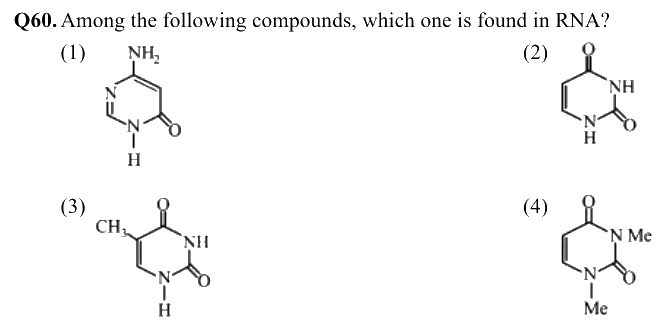
Among the following compounds, which one is found in RNA?
(see the figure above)

The question and its figure as printed in JEE Main 2019 11 Jan Shift 1. Option 1: six-membered ring with NH2 at the top, ring N at the upper left, ring N-H at the bottom and C=O at the lower right (cytosine-type structure) Option 2: six-membered ring with C=O at the top, NH at the upper right, N-H at the bottom and C=O at the lower right (uracil-type structure) Option 3: same ring as option 2 with a CH3 on the upper left carbon (thymine-type structure) Option 4: same ring as option 2 with a methyl group on each ring nitrogen (N Me at the upper right, N-Me at the bottom)
The question as printed in the paper.
  • A

    see figure six-membered ring with NH2 at the top, ring N at the upper left, ring N-H at the bottom and C=O at the lower right (cytosine-type structure)

  • B

    see figure six-membered ring with C=O at the top, NH at the upper right, N-H at the bottom and C=O at the lower right (uracil-type structure)

  • C

    see figure same ring as option 2 with a CH3 on the upper left carbon (thymine-type structure)

  • D

    see figure same ring as option 2 with a methyl group on each ring nitrogen (N Me at the upper right, N-Me at the bottom)

139JEE Main 2019 · 11 Jan · Shift 2MCQOpen question page ↗

see figure The correct match between Item I and Item II is:

The question and its figure as printed in JEE Main 2019 11 Jan Shift 2. Question: The correct match between Item I and Item II is:
The question as printed in the paper.
  • A

    (A) $\rightarrow$ (Q, R); (B) $\rightarrow$ (S); (C) $\rightarrow$ (P)

  • B

    (A) $\rightarrow$ (R); (B) $\rightarrow$ (Q); (C) $\rightarrow$ (P)

  • C

    (A) $\rightarrow$ (R); (B) $\rightarrow$ (S); (C) $\rightarrow$ (Q)

  • D

    (A) $\rightarrow$ (Q); (B) $\rightarrow$ (S); (C) $\rightarrow$ (R)

140JEE Main 2019 · 10 Jan · Shift 1MCQOpen question page ↗

The correct structure of the product 'P' in the following reaction is
$Asn - Ser + (CH_3\ CO)_2O \xrightarrow{NEt_3} P$ (excess)
(see the figure above)

The question and its figure as printed in JEE Main 2019 10 Jan Shift 1. Option 1: CH3C(=O)-NH-CH(CH2C(=O)NH2)-C(=O)-NH-CH(CH2OCOCH3)-COOH Option 2: CH3C(=O)-NH-CH(CH2C(=O)NHCOCH3)-C(=O)-NH-CH(CH2OCOCH3)-COOH Option 3: CH3C(=O)-NH-CH(CH2OCOCH3)-C(=O)-NH-CH(CH2C(=O)NH2)-COOH Option 4: CH3C(=O)-NH-CH(CH2OCOCH3)-C(=O)-NH-CH(CH2C(=O)NHCOCH3)-COOH
The question as printed in the paper.
  • A

    see figure CH3C(=O)-NH-CH(CH2C(=O)NH2)-C(=O)-NH-CH(CH2OCOCH3)-COOH

  • B

    see figure CH3C(=O)-NH-CH(CH2C(=O)NHCOCH3)-C(=O)-NH-CH(CH2OCOCH3)-COOH

  • C

    see figure CH3C(=O)-NH-CH(CH2OCOCH3)-C(=O)-NH-CH(CH2C(=O)NH2)-COOH

  • D

    see figure CH3C(=O)-NH-CH(CH2OCOCH3)-C(=O)-NH-CH(CH2C(=O)NHCOCH3)-COOH

141JEE Main 2019 · 10 Jan · Shift 2MCQOpen question page ↗

Which of the following tests cannot be used for identifying amino acids?

  • A

    Biuret test

  • B

    Xanthoproteic test

  • C

    Barfoed test

  • D

    Ninhydrin test

142JEE Main 2019 · 9 Jan · Shift 1MCQOpen question page ↗

The increasing order of pKa of the following amino acids in aqueous solution is
Glycine, Aspartate, Lysine, Arginine.

  • A

    Arginine < Lysine < Glycine < Aspartate

  • B

    Aspartate < Glycine < Arginine < Lysine

  • C

    Glycine < Aspartate < Arginine < Lysine

  • D

    Aspartate < Glycine < Lysine < Arginine

143JEE Main 2019 · 9 Jan · Shift 2MCQOpen question page ↗

The correct sequence of amino acids present in the tripeptide given below is:
(see the figure above)

The question and its figure as printed in JEE Main 2019 09 Jan Shift 2.
The question as printed in the paper.
  • A

    $Val - Ser - Thr$

  • B

    $Leu - Ser - Thr$

  • C

    $Thr - Ser - Val$

  • D

    $Thr - Ser - Leu$

144JEE Main 2018 · 16 Apr · OnlineMCQOpen question page ↗

Among the following, the incorrect statement is

  • A

    cellulose and amylose has $1,4-$glycosidic linkage.

  • B

    lactose contains $\beta - D-$galactose and $\beta - D-$glucose.

  • C

    maltose and lactose has $1,4-$glycosidic linkage.

  • D

    sucrose and amylose has $1,2-$glycosidic linkage.

145JEE Main 2018 · 15 Apr · Shift 1MCQOpen question page ↗

Which of the following will not exist in zwitter ionic form at pH $= 7$ ?

The question and its figure as printed in JEE Main 2018 15 Apr Shift 1 Online. Option 1: structure Option 2: structure Option 3: structure Option 4: structure
The question as printed in the paper.
  • A

    see figure structure

  • B

    see figure structure

  • C

    see figure structure

  • D

    see figure structure

146JEE Main 2018 · 15 Apr · Shift 1MCQOpen question page ↗

Which of the following is the correct structure of adenosine ?

The question and its figure as printed in JEE Main 2018 15 Apr Shift 1 Online. Option 1: structure Option 2: structure Option 3: structure Option 4: structure
The question as printed in the paper.
  • A

    see figure structure

  • B

    see figure structure

  • C

    see figure structure

  • D

    see figure structure

147JEE Main 2018 · 15 Apr · Shift 2MCQOpen question page ↗

The dipeptide, Gln-Gly, on treatment with $\mathrm{CH_3COCl}$ followed by aqueous work up gives.

The question and its figure as printed in JEE Main 2018 15 Apr Shift 2 Online. Option 1: CH3C(=O)-NH on the alpha carbon; CONH-CH2-COOH; side chain (CH2)2-C(=O)-NH2 Option 2: CH3C(=O)-NH on the alpha carbon; CONH-CH2-COOH; side chain (CH2)2-C(=O)-NH-COCH3 Option 3: CH3C(=O)-NH-CH2-CONH-; alpha carbon with COOH; side chain (CH2)2-C(=O)-NH-COCH3 Option 4: CH3C(=O)-NH-CH2-CONH-; alpha carbon with COOH; side chain (CH2)2-C(=O)-NH2
The question as printed in the paper.
  • A

    see figure CH3C(=O)-NH on the alpha carbon; CONH-CH2-COOH; side chain (CH2)2-C(=O)-NH2

  • B

    see figure CH3C(=O)-NH on the alpha carbon; CONH-CH2-COOH; side chain (CH2)2-C(=O)-NH-COCH3

  • C

    see figure CH3C(=O)-NH-CH2-CONH-; alpha carbon with COOH; side chain (CH2)2-C(=O)-NH-COCH3

  • D

    see figure CH3C(=O)-NH-CH2-CONH-; alpha carbon with COOH; side chain (CH2)2-C(=O)-NH2

149JEE Main 2018 · 8 Apr · OfflineMCQOpen question page ↗

The predominant form of histamine present in human blood is $(\mathrm{pK_a},\ \text{Histidine} = 60)$
(see the figure above)

The question and its figure as printed in JEE Main 2018 08 Apr. Option 1: imidazole ring (N-H at the top left, N at the bottom) with the side chain CH2CH2-NH3^+; the ring is neutral Option 2: imidazole ring (N-H at the top left, N at the bottom) with the side chain CH2CH2-NH2; the ring is neutral Option 3: imidazole ring protonated (the ring N at the bottom bears a positive charge and an H) with the side chain ending in NH3^+ Option 4: imidazole ring protonated (the ring N at the bottom bears a positive charge and an H) with the side chain ending in NH2
The question as printed in the paper.
  • A

    see figure imidazole ring (N-H at the top left, N at the bottom) with the side chain $\mathrm{CH_2CH_2{-}NH_3^{+}}$; the ring is neutral

  • B

    see figure imidazole ring (N-H at the top left, N at the bottom) with the side chain $\mathrm{CH_2CH_2{-}NH_2}$; the ring is neutral

  • C

    see figure imidazole ring protonated (the ring N at the bottom bears a positive charge and an H) with the side chain ending in $\mathrm{NH_3^{+}}$

  • D

    see figure imidazole ring protonated (the ring N at the bottom bears a positive charge and an H) with the side chain ending in $\mathrm{NH_2}$

150JEE Main 2017 · 9 Apr · OnlineMCQOpen question page ↗

The incorrect statement among the following is

  • A

    $\alpha - \mathrm{D}-$glucose and $\beta - \mathrm{D}-$ glucose are enantiomers.

  • B

    the penta acetate of glucose does not react with hydroxyl amine.

  • C

    $\alpha - \mathrm{D}-$glucose and $\beta - \mathrm{D}-$glucose are anomers.

  • D

    cellulose is a straight chain polysaccharide made up of only $\beta - \mathrm{D}-$glucose units.

152JEE Main 2017 · 2 Apr · OfflineMCQOpen question page ↗

Which of the following compounds will behave as reducing sugar in an aqueous KOH solution?

The question and its figure as printed in JEE Main 2017 02 Apr. Option 1: five-membered ring with O, HOH2C, CH2OH, HO and OH Option 2: five-membered ring with O, HOH2C, CH2OH, HO, OCH3 and OH Option 3: six-membered ring with O, HOH2C, CH2OCH3, OH, H, OH and OH Option 4: five-membered ring with O, HOH2C, CH2OH, HO, OCOCH3 and OH
The question as printed in the paper.
  • A

    see figure five-membered ring with O, HOH2C, CH2OH, HO and OH

  • B

    see figure five-membered ring with O, HOH2C, CH2OH, HO, OCH3 and OH

  • C

    see figure six-membered ring with O, HOH2C, CH2OCH3, OH, H, OH and OH

  • D

    see figure five-membered ring with O, HOH2C, CH2OH, HO, OCOCH3 and OH

153JEE Main 2016 · 10 Apr · OnlineMCQOpen question page ↗

Observation of "Rhumann's purple" is a confirmatory test for the presence of:

  • A

    Starch

  • B

    Reducing sugar

  • C

    Protein

  • D

    Cupric ion

154JEE Main 2016 · 9 Apr · OnlineMCQOpen question page ↗

Consider the following sequence for aspartic acid:
(see the figure above)
The pH (Isoelectric point) of aspartic acid is:

The question and its figure as printed in JEE Main 2016 09 Apr Online.
The question as printed in the paper.
  • A

    3.65

  • B

    2.77

  • C

    5.74

  • D

    1.88

156JEE Main 2015 · 11 Apr · OnlineMCQOpen question page ↗

Dipeptide (Asn-Ser) + Ac$_2$O (excess) $\xrightarrow{\mathrm{Et_3N}}$ Product
(see the figure above)

The question and its figure as printed in JEE Main 2015 11 Apr Online. Option 1: CH3-C(=O)-NH-CH(CH2-OH)-C(=O)-NH-CH(CO...)(CH2-C...) with the right end overprinted by option 2 and not legible Option 2: CH3-C(=O)-NH-CH(CH2-C(=O)-NH2)-C(=O)-NH-CH(COOH)-CH2-O-C(=O)-C... with the right end running off the page edge Option 3: CH3-C(=O)-NH-CH(CH2-C(=O)-NH2)-C(=O)-NH-CH(COO...)-CH2-O-... with the right end overprinted by option 4 and not legible Option 4: CH3-C(=O)-NH-CH(CH2-OAc)-C(=O)-NH-CH(COOH)-CH2-C(=O)-NH2
The question as printed in the paper.
  • A

    see figure CH3-C(=O)-NH-CH(CH2-OH)-C(=O)-NH-CH(CO...)(CH2-C...) with the right end overprinted by option 2 and not legible

  • B

    see figure CH3-C(=O)-NH-CH(CH2-C(=O)-NH2)-C(=O)-NH-CH(COOH)-CH2-O-C(=O)-C... with the right end running off the page edge

  • C

    see figure CH3-C(=O)-NH-CH(CH2-C(=O)-NH2)-C(=O)-NH-CH(COO...)-CH2-O-... with the right end overprinted by option 4 and not legible

  • D

    see figure CH3-C(=O)-NH-CH(CH2-OAc)-C(=O)-NH-CH(COOH)-CH2-C(=O)-NH2

157JEE Main 2015 · 11 Apr · OnlineMCQOpen question page ↗

Accumulation of which of the following molecules in the muscles occurs as a result of vigorous exercise?

  • A

    Glycogen

  • B

    Pyruvic acid

  • C

    Glucose

  • D

    L-lactic acid

158JEE Main 2015 · 10 Apr · OnlineMCQOpen question page ↗

Complete hydrolysis of starch gives:

  • A

    Galactose and fructose in equimolar amounts

  • B

    Glucose and galactose in equimolar amounts

  • C

    Glucose and fructose in equimolar amounts

  • D

    Glucose only

160JEE Main 2014 · 19 Apr · OnlineMCQOpen question page ↗

The reason for double helical structure of DNA is the operation of :

  • A

    Van der Waals forces

  • B

    Electrostatic attractions

  • C

    Hydrogen bonding

  • D

    Dipole - Dipole interactions

163JEE Main 2013 · 25 Apr · OnlineMCQOpen question page ↗

Which of the following statement is not correct?

  • A

    Amylopectin is a branched polymer of $\alpha$ - glucose.

  • B

    Cellulose is a linear polymer of $\beta$-glucose.

  • C

    Glycogen is the food reserve of plants.

  • D

    All proteins are polymers of $\alpha$ - amino acids.

164JEE Main 2013 · 25 Apr · OnlineMCQOpen question page ↗

Among the following vitamins the one whose deficiency causes rickets (bone deficiency) is :

  • A

    Vitamin A

  • B

    Vitamin B

  • C

    Vitamin D

  • D

    Vitamin C

166JEE Main 2013 · 23 Apr · OnlineMCQOpen question page ↗

Natural glucose is termed D-glucose because :

  • A

    $-$OH on the second carbon is on the right side in Fischer projection

  • B

    $-$OH on the sixth carbon is on the right side in Fischer projection.

  • C

    $-$OH on the fifth carbon is on the right side in Fischer projection.

  • D

    It is dextrorotatory.

167JEE Main 2013 · 22 Apr · OnlineMCQOpen question page ↗

Which of the following structures represents thymine ?
(see the figure above)

The question and its figure as printed in JEE Main 2013 22 Apr Online. Option 1: Six-membered ring: C=O at the top carbon, HN on the left, C=O (O at the lower left) between the two nitrogens, N with an H below it at the lower right, and a C=C double bond on the right side; no other substituent. Option 2: Six-membered ring: NH2 on the top carbon, N on the left (double bond to the top carbon), C=O (O at the lower left) between the two nitrogens, N with an H below it at the lower right, and a C=C double bond on the right side; no other substituent. Option 3: Six-membered ring: NH2 on the top carbon, N on the left (double bond to the top carbon), HO on the lower-left carbon between the two…
The question as printed in the paper.
  • A

    see figure Six-membered ring: C=O at the top carbon, HN on the left, C=O (O at the lower left) between the two nitrogens, N with an H below it at the lower right, and a C=C double bond on the right side; no other substituent.

  • B

    see figure Six-membered ring: NH2 on the top carbon, N on the left (double bond to the top carbon), C=O (O at the lower left) between the two nitrogens, N with an H below it at the lower right, and a C=C double bond on the right side; no other substituent.

  • C

    see figure Six-membered ring: NH2 on the top carbon, N on the left (double bond to the top carbon), HO on the lower-left carbon between the two nitrogens, N (no H) at the bottom, and a C=C double bond on the right side.

  • D

    see figure Six-membered ring: OH on the top carbon, N on the left (double bond to the top carbon), HO on the lower-left carbon between the two nitrogens, N (no H) at the bottom, a C=C double bond on the right side, and CH3 on the right-hand ring carbon next to the top carbon.

169JEE Main 2013 · 7 Apr · OfflineMCQOpen question page ↗

Synthesis of each molecule of glucose in photosynthesis involves

  • A

    8 molecules of ATP

  • B

    6 molecules of ATP

  • C

    18 molecules of ATP

  • D

    10 molecules of ATP

170AIEEE 2012 · 26 May · OnlineMCQOpen question page ↗

Which of the following statements is correct?

  • A

    RNA controls the synthesis of proteins.

  • B

    The sugar present in DNA is D-(-)-ribose.

  • C

    RNA has double stranded $\alpha$-helix structure.

  • D

    DNA mainly occurs in the cytoplasm of the cell.

173AIEEE 2012 · 7 May · OnlineMCQOpen question page ↗

All of the following statements apply to proteins except

  • A

    Proteins generally have no definite melting point

  • B

    Proteins contain the grouping - CONH–

  • C

    Proteins have high molecular weight

  • D

    Proteins can only contain the elements C, H, O and N.

175AIEEE 2012 · OfflineMCQOpen question page ↗

Which one of the following statements is correct?

  • A

    All amino acids except lysine are optically active

  • B

    All amino acids are optically active

  • C

    All amino acids except glycine are optically active

  • D

    All amino acids except glutamic acid are optically active

176AIEEE 2011MCQOpen question page ↗

The presence or absence of hydroxyl group on which carbon atom of sugar differentiates RNA and DNA ?

  • A

    $2^{\mathrm{nd}}$

  • B

    $3^{\mathrm{rd}}$

  • C

    $4^{\mathrm{th}}$

  • D

    $1^{\mathrm{st}}$

178AIEEE 2009MCQOpen question page ↗

The two functional groups present in a typical carbohydrate are :

  • A

    $\mathrm{-OH}$ and $\mathrm{-COOH}$

  • B

    $\mathrm{-CHO}$ and $\mathrm{-COOH}$

  • C

    $\mathrm{> C = O}$ and $\mathrm{-OH}$

  • D

    $\mathrm{-OH}$ and $\mathrm{-CHO}$

180AIEEE 2006MCQOpen question page ↗

The term anomers of glucose refers to

  • A

    isomers of glucose that differ in configurations at carbons one and four ($C - 1$ and $C - 4$)

  • B

    a mixture of ($D$)-glucose and (L)-glucose

  • C

    enantiomers of glucose

  • D

    isomers of glucose that differ in configuration at carbon one (C - 1)

182AIEEE 2005MCQOpen question page ↗

In both DNA and RNA, heterocyclic base and phosphate ester linkages are at-

  • A

    $\mathrm{C}_5'$ and $\mathrm{C}_2'$ respectively of the sugar molecule

  • B

    $\mathrm{C}_2'$ and $\mathrm{C}_5'$ respectively of the sugar molecule

  • C

    $\mathrm{C}_1'$ and $\mathrm{C}_5'$ respectively of the sugar molecule

  • D

    $\mathrm{C}_5'$ and $\mathrm{C}_1'$ respectively of the sugar molecule

183AIEEE 2004MCQOpen question page ↗

Insulin production and its action in human body are responsible for the level of diabetes. This compound belongs to which of the following categories?

  • A

    A co- enzyme

  • B

    An antibiotic

  • C

    An enzyme

  • D

    A hormone

186AIEEE 2003MCQOpen question page ↗

The reason for double helical structure of DNA is operation of

  • A

    dipole-dipole interaction

  • B

    hydrogen bonding

  • C

    electrostatic attractions

  • D

    van der Waals' forces

187AIEEE 2002MCQOpen question page ↗

RNA is different from DNA because RNA contains

  • A

    ribose sugar and thymine

  • B

    ribose sugar and uracil

  • C

    deoxyribose sugar and thymine

  • D

    deoxyribose sugar and uracil

188AIEEE 2002MCQOpen question page ↗

The functional group, which is found in amino acid is

  • A

    $\mathrm{COOH}$ group

  • B

    $\mathrm{NH_2}$ group

  • C

    $\mathrm{CH_3}$ group

  • D

    both (a) and (b)

Numerical value

19 questions
189JEE Main 2025 · 4 Apr · Shift 1NumericalOpen question page ↗

The total number of hydrogen bonds of a DNA-double Helix strand whose one strand has the following sequence of bases is ______ .

5' G–G–C–A–A–A–T–C–G–G–C–T–A–3'

Numerical answer type: type your answer in EdLoop to check it
190JEE Main 2024 · 9 Apr · Shift 1NumericalOpen question page ↗

Total number of essential amino acid among the given list of amino acids is ______ Arginine, Phenylalanine, Aspartic acid, Cysteine, Histidine, Valine, Proline

Numerical answer type: type your answer in EdLoop to check it
191JEE Main 2024 · 8 Apr · Shift 2NumericalOpen question page ↗

The total number of carbon atoms present in tyrosine, an amino acid, is ______

Numerical answer type: type your answer in EdLoop to check it
192JEE Main 2024 · 1 Feb · Shift 2NumericalOpen question page ↗

The number of tripeptides formed by three different amino acids using each amino acid once is ______.

Numerical answer type: type your answer in EdLoop to check it
193JEE Main 2024 · 31 Jan · Shift 2NumericalOpen question page ↗

From the vitamins $A, B_1, B_6, B_{12}, C, D, E$ and $K$, the number vitamins that can be stored in our body is ______.

Numerical answer type: type your answer in EdLoop to check it
194JEE Main 2024 · 30 Jan · Shift 2NumericalOpen question page ↗

The total number of correct statements, regarding the nucleic acids is ______.

A. RNA is regarded as the reserve of genetic information.

B. DNA molecule self-duplicates during cell division

C. DNA synthesizes proteins in the cell.

D. The message for the synthesis of particular proteins is present in DNA

E. Identical DNA strands are transferred to daughter cells.

Numerical answer type: type your answer in EdLoop to check it
195JEE Main 2023 · 12 Apr · Shift 1NumericalOpen question page ↗

In an oligopeptide named Alanylglycylphenyl alanyl isoleucine, the number of $sp^2$ hybridised carbons is ______.

Numerical answer type: type your answer in EdLoop to check it
196JEE Main 2023 · 11 Apr · Shift 2NumericalOpen question page ↗

Number of compounds from the following which will not produce orange red precipitate with Benedict solution is ______
Glucose, maltose, sucrose, ribose, 2-deoxyribose, amylose, lactose

Numerical answer type: type your answer in EdLoop to check it
197JEE Main 2023 · 30 Jan · Shift 2NumericalOpen question page ↗

A short peptide on complete hydrolysis produces 3 moles of glycine (G), two moles of leucine (L) and two moles of valine (V) per mole of peptide. The number of peptide linkages in it are ______ .

Numerical answer type: type your answer in EdLoop to check it
198JEE Main 2023 · 24 Jan · Shift 2NumericalOpen question page ↗

Total number of tripeptides possible by mixing of valine and proline is ______ .

Numerical answer type: type your answer in EdLoop to check it
199JEE Main 2022 · 29 Jul · Shift 1NumericalOpen question page ↗

In a linear tetrapeptide (Constituted with different amino acids), (number of amino acids) - (number of peptide bonds) is

Numerical answer type: type your answer in EdLoop to check it
200JEE Main 2022 · 26 Jun · Shift 1NumericalOpen question page ↗

The number of oxygen present in a nucleotide formed from a base, that is present only in RNA is

Numerical answer type: type your answer in EdLoop to check it
201JEE Main 2022 · 25 Jun · Shift 2NumericalOpen question page ↗

How many of the given compounds will give a positive Biuret test ______ ?
Glycine, Glycylalanine, Tripeptide, Biuret

Numerical answer type: type your answer in EdLoop to check it
202JEE Main 2022 · 24 Jun · Shift 2NumericalOpen question page ↗

In alanylglycylleucylalanylvaline the number of peptide linkages is:

Numerical answer type: type your answer in EdLoop to check it
203JEE Main 2021 · 1 Sep · Shift 2NumericalOpen question page ↗

A peptide synthesized by the reactions of one molecule each of Glycine, Leucine, Aspartic acid and Histidine will have ______ peptide linkages.

Numerical answer type: type your answer in EdLoop to check it
204JEE Main 2021 · 26 Aug · Shift 1NumericalOpen question page ↗

The total number of negative charge in the tetrapeptide, Gly-Glu-Asp-Tyr, at pH $12.5$ will be_______ (Integer answer)

Numerical answer type: type your answer in EdLoop to check it
205JEE Main 2020 · 5 Sep · Shift 1NumericalOpen question page ↗

The number of chiral carbon(s) present in peptide, Ile-Arg-Pro, is ................

Numerical answer type: type your answer in EdLoop to check it
206JEE Main 2020 · 5 Sep · Shift 2NumericalOpen question page ↗

The number of chiral carbons present in sucrose is ______

Numerical answer type: type your answer in EdLoop to check it
207JEE Main 2020 · 3 Sep · Shift 2NumericalOpen question page ↗

The number of (see the figure above) groups present in a tripeptide Asp – Glu – Lys is ______ .

The question and its figure as printed in JEE Main 2020 03 Sep Shift 2.
The question as printed in the paper.
Numerical answer type: type your answer in EdLoop to check it

How to prepare Biomolecules for JEE Main

How often it comes up

Biomolecules bridges organic chemistry with biological structures under Unit 19: Biomolecules in the Class 12 curriculum, holding rank 14 of 31 chapters with a 3.5% share of the chemistry section. During 2019 to 2026, Biomolecules accounted for 162 questions across 162 exam papers, delivering 3.5% of the chemistry section and holding rank 14 of 31 chapters. In the earlier 2002 to 2018 testing span, it contributed 45 questions across 38 papers with a 3.4% share. Over the recent 2024 to 2026 cycle, question numbers reached 60 questions across 58 papers, accounting for a 3.9% share. Comparing 2002 to 2018 against 2024 to 2026, the trend is up, while comparing 2019 to 2026 against 2024 to 2026, the testing share has remained about the same.

The chapter has appeared every year from 2019 to 2026. Across 2019 to 2026, students met an average of 1.0 question per paper, identical to the 1.0 question per paper recorded between 2024 and 2026. Nineteen numerical answer questions were presented from 2019 to 2026, often counting peptide bonds, chiral carbons, or stereoisomeric peptides.

Most-asked topics

The syllabus organizes across three core topics:

  • Carbohydrates: The leading topic with 91 total questions (73 in 2019 to 2026), evaluated continuously through 2026. Key areas investigate glucose chemical reactions (forming pentaacetate with acetic anhydride, saccharic acid with nitric acid, and n-hexane with HI and red phosphorus), cyclic alpha/beta anomers, mutarotation, Haworth projections, glycosidic linkages in maltose, lactose, and sucrose, and the structural basis of invert sugar.
  • Amino Acids & Proteins: Contributed 73 total questions (60 in 2019 to 2026), tested through 2026. Focuses on classification into essential and non-essential amino acids, acidic/basic/neutral side chains, zwitterionic forms, peptide bond formation, secondary protein stabilization via hydrogen bonding (alpha-helix and beta-pleated sheets), and protein denaturation disrupting secondary and tertiary conformations while preserving primary structure.
  • Vitamins, Nucleic Acids & Hormones: Produced 43 total questions (29 in 2019 to 2026), active through 2026. Examines water-soluble versus fat-soluble vitamins (deficiency diseases like scurvy, rickets, beriberi, and night blindness), chemical components of DNA versus RNA (purine and pyrimidine base pairing), chirality of the pentose sugar backbone, and thyroid/pancreatic hormones.

What the questions look like

Examiners test structural knowledge directly through diagrams and reaction matching. A recurring carbohydrate question presents four disaccharide structures and asks candidates to identify the non-reducing sugar by checking whether all anomeric carbons participate in glycosidic linkages (as in sucrose).

Protein questions often evaluate amino acid structures, asking students to identify essential amino acids, count peptide linkages in a drawn oligopeptide, or explain why glycine is the only standard proteinogenic amino acid lacking an asymmetric chiral alpha-carbon.

Questions to try first

Work through these authentic recent exam questions:

How to practise it

Prepare for biomolecules by memorizing exact chemical formulas, linkages, and test responses:

1. Memorize glucose chemical reactions: Glucose with bromine water gives gluconic acid (monocarboxylic); with concentrated nitric acid gives saccharic acid (dicarboxylic); with acetic anhydride gives pentaacetate confirming five hydroxyl groups. 2. Note why sucrose is a non-reducing sugar: In sucrose, the hemiacetal hydroxyl of alpha-D-glucose and the hemiketal hydroxyl of beta-D-fructose link together through a glycosidic bond, leaving no free anomeric carbon to reduce Tollens or Fehling solutions. 3. Classify vitamins by solubility: Vitamins B and C are water-soluble (excreted readily, requiring regular intake, except vitamin B12); vitamins A, D, E, and K are fat-soluble (stored in liver and adipose tissue). 4. Identify essential amino acids: Memorize the ten essential amino acids (valine, leucine, isoleucine, lysine, methionine, threonine, phenylalanine, tryptophan, histidine, arginine). 5. Understand nucleic acid structures: Adenine pairs with thymine via two hydrogen bonds; guanine pairs with cytosine via three hydrogen bonds. In RNA, uracil replaces thymine.

Frequently asked questions

Why is glycine optically inactive?

Glycine possesses two hydrogen atoms bonded to its alpha carbon, giving it an internal plane of symmetry and preventing it from having a chiral center, unlike all other natural amino acids.

What is invert sugar?

Sucrose is dextrorotatory, but upon acid hydrolysis it yields an equimolar mixture of dextrorotatory D-glucose and more strongly levorotatory D-fructose, resulting in an overall levorotatory mixture called invert sugar.

What remains intact when a protein undergoes denaturation?

Denaturation by heat or pH changes disrupts hydrogen bonding and hydrophobic interactions, destroying secondary, tertiary, and quaternary structures, but leaves the covalent primary peptide backbone completely intact. Step-by-step solutions for each one are in the EdLoop app.

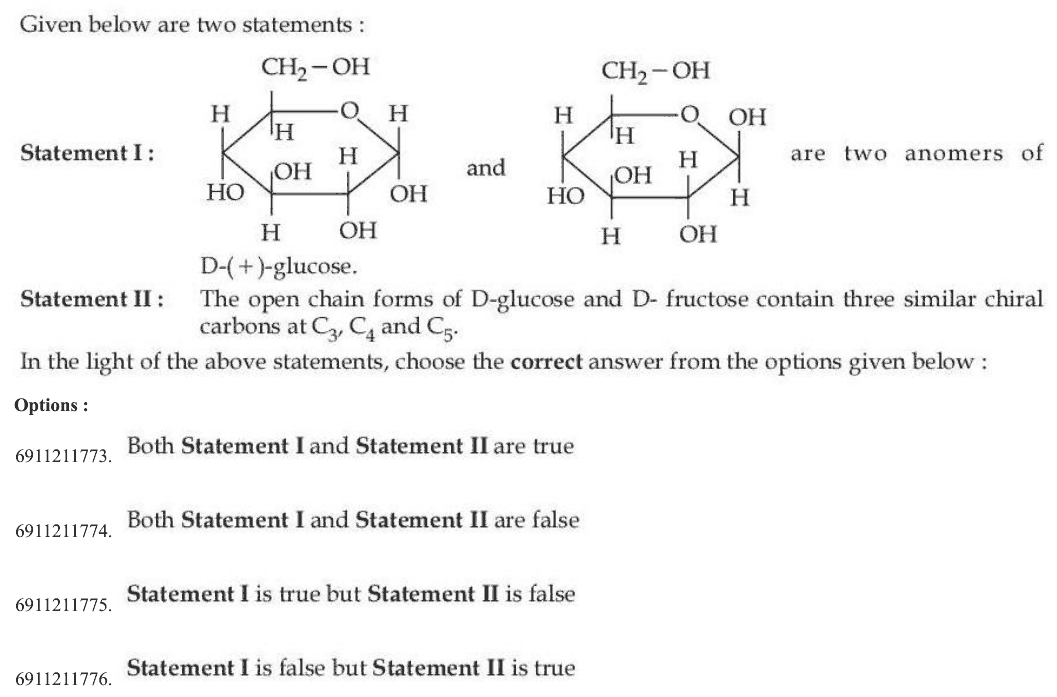
Get EdLoop – freeOpen on the web