EdLoop PYQs · free, no ads · questions and answers here, step-by-step solutions in the EdLoop app
PYQs · free, no adsOpen on the web (app.edloop.in)Get EdLoop – free on Google Play
ChemistryHydrocarbons

Hydrocarbons: JEE Main PYQs 2002–2026

Every Hydrocarbons question from past JEE Main and AIEEE papers, with options and answers. Newest first.

287questions
166papers covered
4.9%of Chemistry questions, 2019–2026
2002–2026years

Guide at a glance

Hydrocarbons forms the core reaction groundwork for organic chemistry under Unit 15: Hydrocarbons in the Class 11 curriculum, holding rank 3 of 31 chapters with a 4.9% share of the chemistry section.

Most asked sub-topics

Alkenes120
Aromatic Hydrocarbons87
Alkanes40
Alkynes40

Practise these in EdLoop

Attempt every Hydrocarbons question timed, see the step-by-step solution and track what you get wrong. Free.

Start practice

MCQ, single correct

255 questions
1JEE Main 2026 · 8 Apr · Shift 2MCQOpen question page ↗

n-Butane on monochlorination under photochemical condition gives an optically active compound "P". "P" on further chlorination gives dichloro compounds.

The number of dichloro compounds obtained (ignore stereoisomers) is :

  • A

    3

  • B

    4

  • C

    5

  • D

    6

2JEE Main 2026 · 6 Apr · Shift 1MCQOpen question page ↗

Given below are two statements:

Statement I: Methane can be prepared by decarboxylation of sodium ethanoate, Kolbe's electrolysis of sodium acetate and reaction of $\mathrm{CH_3MgBr}$ with water.

Statement II: Methane cannot be prepared from unsaturated hydrocarbons and by Wurtz reaction.

In the light of the above statements, choose the *correct* answer from the options given below

  • A

    Both Statement I and Statement II are true

  • B

    Both Statement I and Statement II are false

  • C

    Statement I is true but Statement II is false

  • D

    Statement I is false but Statement II is true

3JEE Main 2026 · 6 Apr · Shift 1MCQOpen question page ↗

Given below are two statements:

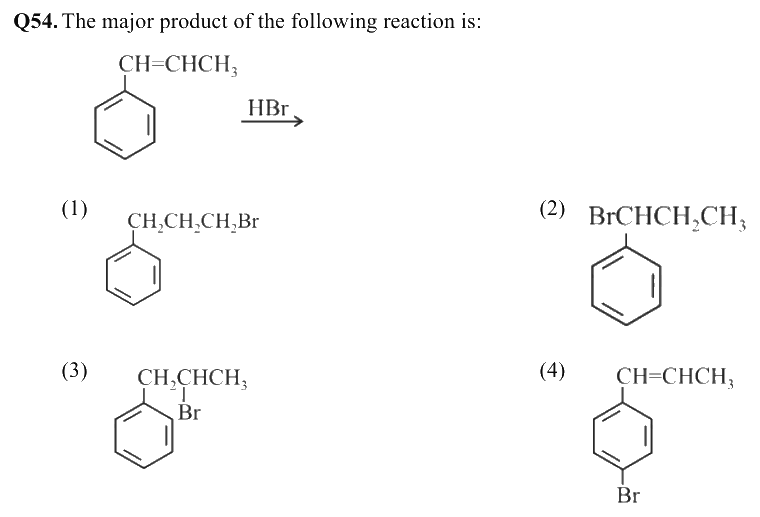
Statement I: 3-phenylpropene reacts with HBr and gives secondary alkyl bromide having a chiral carbon atom as the major product.

Statement II: Aryl chlorides and aryl cyanides can be prepared by Sandmeyer reaction as well as Gattermann reaction.

In the light of the above statements, choose the *correct* answer from the options given below

  • A

    Both Statement I and Statement II are true

  • B

    Both Statement I and Statement II are false

  • C

    Statement I is true but Statement II is false

  • D

    Statement I is false but Statement II is true

4JEE Main 2026 · 6 Apr · Shift 2MCQOpen question page ↗

An optically active alkyl bromide $\mathrm{C_4H_9Br}$, reacts with ethanolic KOH to form major compound [A] which reacts with bromine to give compound [B]. Compound [B] reacts with ethanolic KOH and sodamide to give compound [C]. One molecule of water adds to compound [C] on warming with mercuric sulphate and dilute sulphuric acid at 333 K to form compound [D]. The functional group in compound D will be confirmed by :

  • A

    Haloform test

  • B

    Lucas test

  • C

    Silver mirror test

  • D

    Benedict test

5JEE Main 2026 · 6 Apr · Shift 2MCQOpen question page ↗

Consider the following reactions. Total number of electrons in the $\pi$ bonds and lone pair of electrons in the product (X) is :

(see the figure above)

The question and its figure as printed in B Tech 6th Apr 2026 Shift 2.
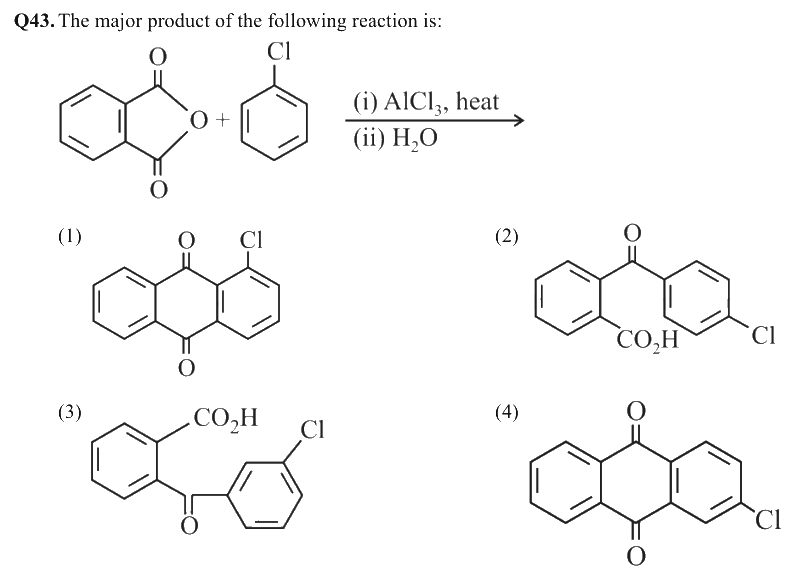
The question as printed in the paper.
  • A

    12

  • B

    16

  • C

    14

  • D

    18

6JEE Main 2026 · 5 Apr · Shift 1MCQOpen question page ↗

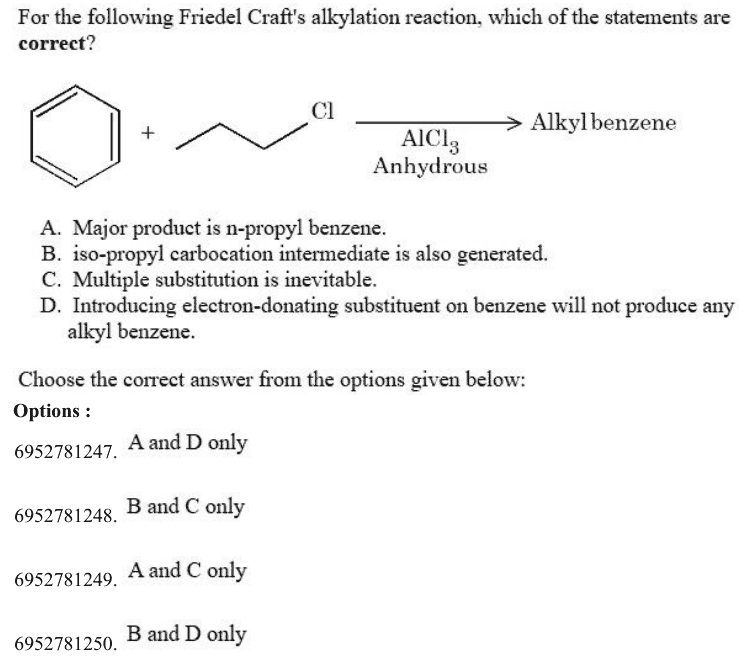
For the following Friedel Craft's alkylation reaction, which of the statements are correct?

(see the figure above)

A. Major product is n-propyl benzene.

B. iso-propyl carbocation intermediate is also generated.

C. Multiple substitution is inevitable.

D. Introducing electron-donating substituent on benzene will not produce any alkyl benzene.

Choose the correct answer from the options given below:

The question and its figure as printed in B Tech 5th Apr 2026 Shift 1.
The question as printed in the paper.
  • A

    A and D only

  • B

    B and C only

  • C

    A and C only

  • D

    B and D only

7JEE Main 2026 · 4 Apr · Shift 1MCQOpen question page ↗

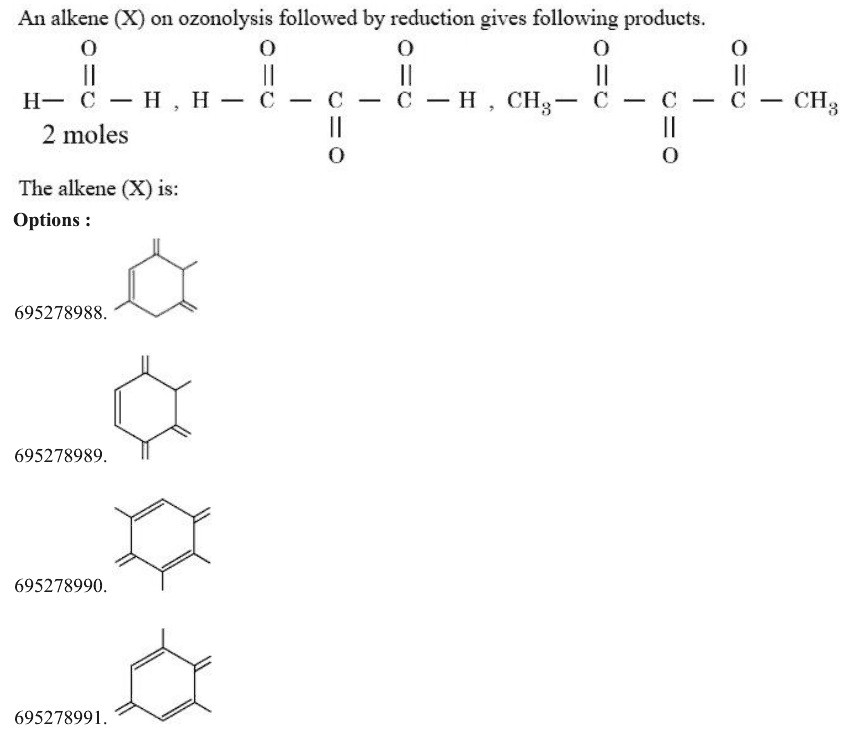
An alkene (X) on ozonolysis followed by reduction gives following products.

(see the figure above)

The alkene (X) is:

The question and its figure as printed in B Tech 4th Apr 2026 Shift 1. Option 1: six-membered ring skeleton: top vertex with an exocyclic double bond pointing up; upper-right vertex with a short single-bond stub (methyl) pointing right; lower-right vertex with an exocyclic double bond pointing lower-right; bottom vertex plain (CH2); lower-left vertex with a short stub pointing left (methyl) and a ring C=C double bond between the lower-left and upper-left vertices. Option 2: six-membered ring skeleton: top vertex with an exocyclic double bond pointing up; upper-right vertex with a short stub pointing right; lower-right vertex with an exocyclic double bond pointing lower-right; bottom vertex…
The question as printed in the paper.
  • A

    see figure six-membered ring skeleton: top vertex with an exocyclic double bond pointing up; upper-right vertex with a short single-bond stub (methyl) pointing right; lower-right vertex with an exocyclic double bond pointing lower-right; bottom vertex plain (CH2); lower-left vertex with a short stub pointing left (methyl) and a ring C=C double bond between the lower-left and upper-left vertices.

  • B

    see figure six-membered ring skeleton: top vertex with an exocyclic double bond pointing up; upper-right vertex with a short stub pointing right; lower-right vertex with an exocyclic double bond pointing lower-right; bottom vertex with an exocyclic double bond pointing down; ring C=C double bond between the upper-left and lower-left vertices.

  • C

    see figure six-membered ring skeleton: upper-left vertex with a short stub (methyl) pointing up-left and a ring C=C double bond to the top vertex; upper-right vertex with an exocyclic double bond pointing up-right; lower-right vertex with a stub pointing right and a ring C=C double bond to the bottom vertex; bottom vertex with a stub pointing down; lower-left vertex with an exocyclic double bond pointing lower-left.

  • D

    see figure six-membered ring skeleton: top vertex with a stub pointing up and a ring C=C double bond to the upper-left vertex; upper-right vertex with an exocyclic double bond pointing up-right; lower-right vertex with a stub pointing right and a ring C=C double bond to the bottom vertex; lower-left vertex with an exocyclic double bond pointing lower-left.

8JEE Main 2026 · 4 Apr · Shift 2MCQOpen question page ↗

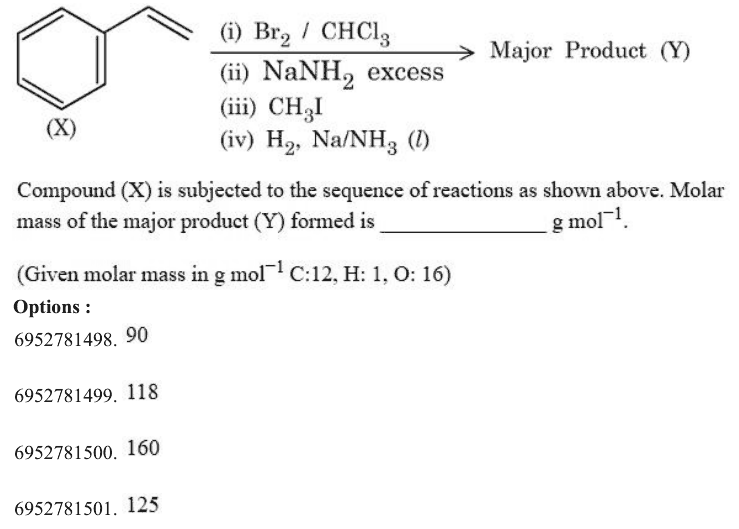
see figure Compound (X) is subjected to the sequence of reactions as shown above. Molar mass of the major product (Y) formed is ________ g mol$^{-1}$. (Given molar mass in g mol$^{-1}$ C:12, H: 1, O: 16)

The question and its figure as printed in B Tech 4th Apr 2026 Shift 2. Question: Compound (X) is subjected to the sequence of reactions as shown above. Molar mass of the major product (Y) formed is g mol^-1. (Given molar mass in g mol^-1 C:12, H: 1, O: 16)
The question as printed in the paper.
  • A

    90

  • B

    118

  • C

    160

  • D

    125

9JEE Main 2026 · 2 Apr · Shift 1MCQOpen question page ↗

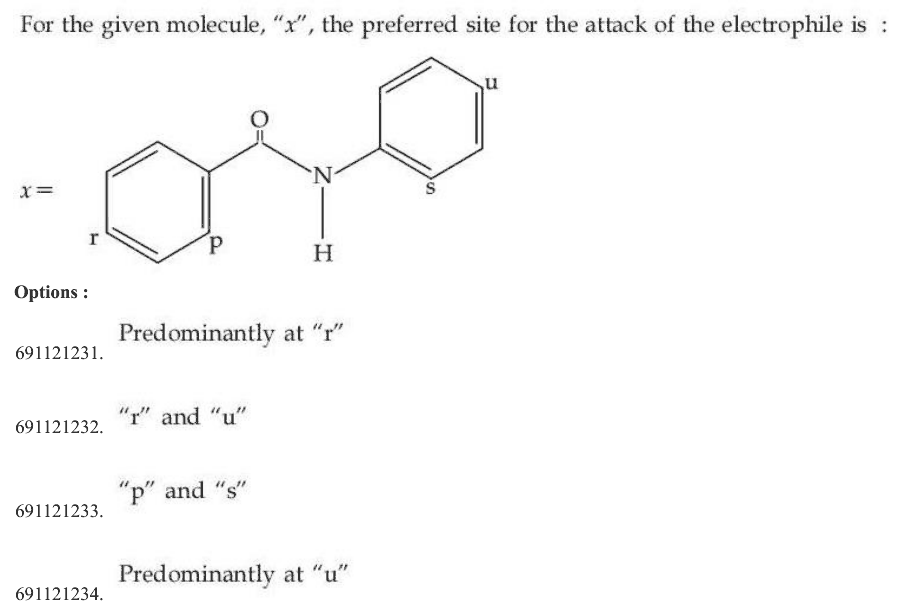
For the given molecule, "$x$", the preferred site for the attack of the electrophile is :

$x =$ (see the figure above)

The question and its figure as printed in B Tech 2nd Apr 2026 Shift 1.
The question as printed in the paper.
  • A

    Predominantly at "r"

  • B

    "r" and "u"

  • C

    "p" and "s"

  • D

    Predominantly at "u"

10JEE Main 2026 · 2 Apr · Shift 2MCQOpen question page ↗

The compound (X) on

(i) on heating in the presence of anhydrous $\mathrm{AlCl_3}$ and HCl gas gives 2,4-dimethyl pentane

(ii) aromatization gives toulene and

(iii) cyclisation gives methyl cyclohexane

The correct name of compound (X) is :

  • A

    Hept-2-ene

  • B

    Hept-1,3,5-triene

  • C

    Heptane

  • D

    Hept-2,4,6-triene

11JEE Main 2026 · 28 Jan · Shift 1MCQOpen question page ↗

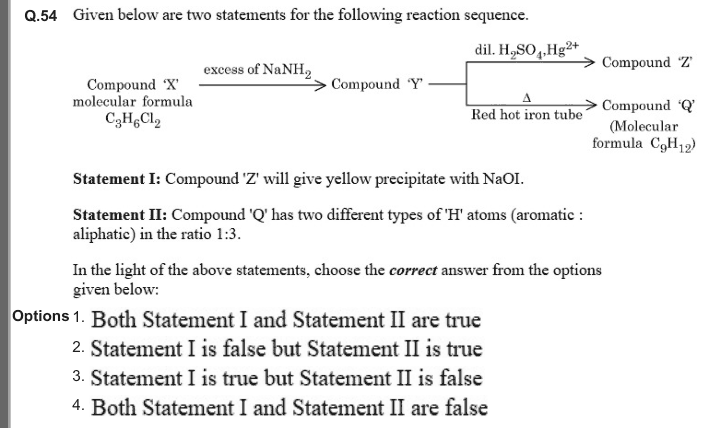
Given below are two statements for the following reaction sequence.

(see the figure above)

Statement I: Compound 'Z' will give yellow precipitate with NaOI.

Statement II: Compound 'Q' has two different types of 'H' atoms (aromatic : aliphatic) in the ratio 1:3.

In the light of the above statements, choose the *correct* answer from the options given below:

The question and its figure as printed in JEE Main 2026 28 Jan Shift 1.
The question as printed in the paper.
  • A

    Both Statement I and Statement II are true

  • B

    Statement I is false but Statement II is true

  • C

    Statement I is true but Statement II is false

  • D

    Both Statement I and Statement II are false

12JEE Main 2026 · 28 Jan · Shift 1MCQOpen question page ↗

$\mathrm{Ph-CH=CH_2} \xrightarrow[\mathrm{HBr}]{(\mathrm{PhCOO})_2}$ Product

Consider the above reaction.

A. The reaction proceeds through a more stable radical intermediate.

B. The role of peroxide is to generate H$^\bullet$ (Hydrogen radical).

C. During this reaction, benzene is formed as a byproduct.

D. 1$-$Bromo$-$2$-$phenylethane is formed as the minor product.

E. The same reaction in absence of peroxide proceeds via carbocation intermediate.

Identify the correct statements. Choose the *correct* answer from the options given below:

  • A

    A, B & D Only

  • B

    C, D & E Only

  • C

    A, C & E Only

  • D

    A & E Only

13JEE Main 2026 · 28 Jan · Shift 2MCQOpen question page ↗

The reactions which produce alcohol as the product are :

A. $\mathrm{CH_4} + \mathrm{O_2} \xrightarrow[\Delta]{\mathrm{Mo_2O_3}}$

B. $2\mathrm{CH_3CH_3} + 3\mathrm{O_2} \xrightarrow[\Delta]{(\mathrm{CH_3COO})_2\,\mathrm{Mn}}$

C. $(\mathrm{CH_3})_3\mathrm{CH} \xrightarrow{\mathrm{KMnO_4}}$

D. $2\mathrm{CH_4} + \mathrm{O_2} \xrightarrow{\mathrm{Cu/523\,K/100\,atm.}}$

E. $\mathrm{CH_3-CH=CH-CH_3} \xrightarrow{\mathrm{KMnO_4/H^+}}$

Choose the correct answer from the options given below :

  • A

    A and D Only

  • B

    C and D Only

  • C

    A, C and E Only

  • D

    B, D and E Only

14JEE Main 2026 · 28 Jan · Shift 2MCQOpen question page ↗

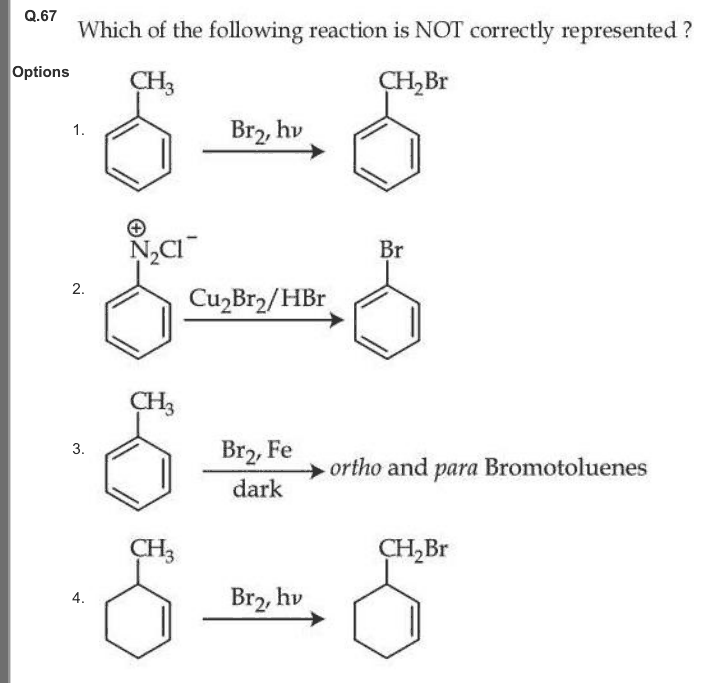
Which of the following reaction is NOT correctly represented ?

The question and its figure as printed in JEE Main 2026 28 Jan Shift 2. Option 1: a benzene ring with 'CH3' on a bond straight up from its top vertex; an arrow labelled 'Br2, hν' above; a second benzene ring with 'CH2Br' on a bond straight up from its top vertex. Option 2: a benzene ring with '+N2Cl−' on a bond straight up from its top vertex (a circled plus above the N, a minus at the upper right of Cl); an arrow labelled 'Cu2Br2/HBr' above; a second benzene ring with 'Br' on a bond straight up. Option 3: a benzene ring with 'CH3' on a bond straight up; an arrow labelled 'Br2, Fe' above and 'dark' below; the words 'ortho and para Bromotoluenes' written after the arrow. Option 4: a…
The question as printed in the paper.
  • A

    see figure a benzene ring with 'CH3' on a bond straight up from its top vertex; an arrow labelled 'Br2, hν' above; a second benzene ring with 'CH2Br' on a bond straight up from its top vertex.

  • B

    see figure a benzene ring with '+N2Cl−' on a bond straight up from its top vertex (a circled plus above the N, a minus at the upper right of Cl); an arrow labelled 'Cu2Br2/HBr' above; a second benzene ring with 'Br' on a bond straight up.

  • C

    see figure a benzene ring with 'CH3' on a bond straight up; an arrow labelled 'Br2, Fe' above and 'dark' below; the words 'ortho and para Bromotoluenes' written after the arrow.

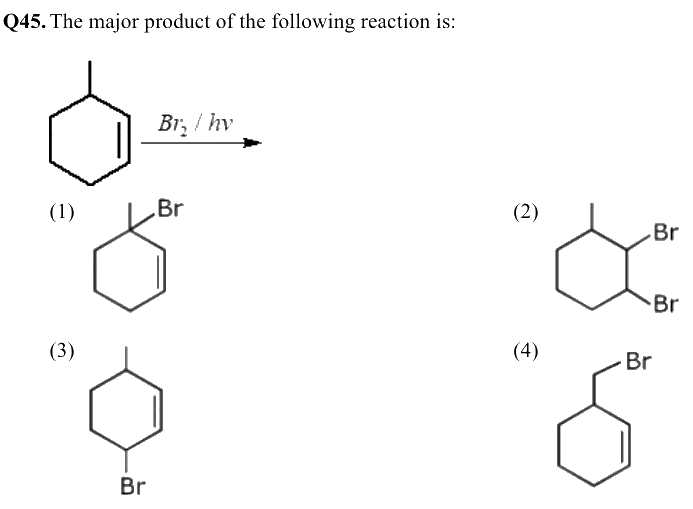
  • D

    see figure a six-membered ring with one double bond (on its right-hand side) and 'CH3' on a bond straight up from its top vertex; an arrow labelled 'Br2, hν' above; a second ring of the same kind with 'CH2Br' on a bond straight up.

15JEE Main 2026 · 28 Jan · Shift 2MCQOpen question page ↗

Identify the correct statements :

The presence of $-\mathrm{NO_2}$ group in benzene ring

A. activates the ring towards electrophilic substitutions.

B. deactivates the ring towards electrophilic substitutions.

C. activates the ring towards nucleophilic substitutions.

D. deactivates the ring towards nucleophilic substitutions.

Choose the correct answer from the options given below :

  • A

    A and D Only

  • B

    B and C Only

  • C

    C and A Only

  • D

    B and D Only

16JEE Main 2026 · 24 Jan · Shift 1MCQOpen question page ↗

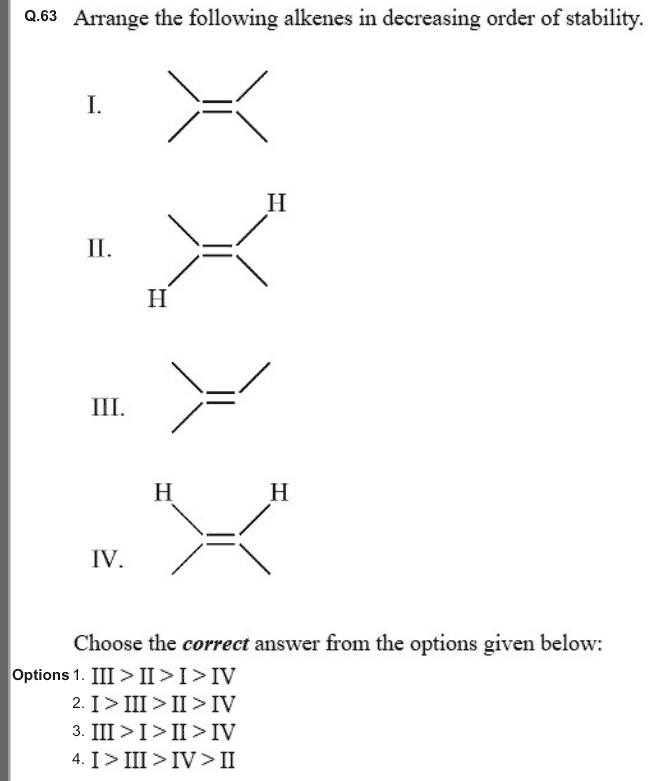
Arrange the following alkenes in decreasing order of stability.

(see the figure above)

Choose the *correct* answer from the options given below:

The question and its figure as printed in JEE Main 2026 24 Jan Shift 1.
The question as printed in the paper.
  • A

    III $>$ II $>$ I $>$ IV

  • B

    I $>$ III $>$ II $>$ IV

  • C

    III $>$ I $>$ II $>$ IV

  • D

    I $>$ III $>$ IV $>$ II

17JEE Main 2026 · 23 Jan · Shift 1MCQOpen question page ↗

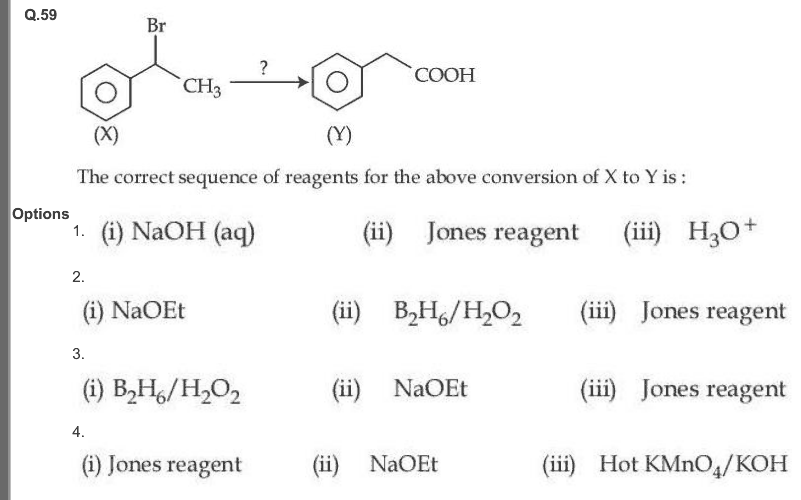
see figure The correct sequence of reagents for the above conversion of X to Y is :

The question and its figure as printed in JEE Main 2026 23 Jan Shift 1. Question: The correct sequence of reagents for the above conversion of X to Y is :
The question as printed in the paper.
  • A

    (i) NaOH (aq) (ii) Jones reagent (iii) $\mathrm{H_3O^+}$

  • B

    (i) NaOEt (ii) $\mathrm{B_2H_6/H_2O_2}$ (iii) Jones reagent

  • C

    (i) $\mathrm{B_2H_6/H_2O_2}$ (ii) NaOEt (iii) Jones reagent

  • D

    (i) Jones reagent (ii) NaOEt (iii) Hot $\mathrm{KMnO_4}$/KOH

18JEE Main 2026 · 23 Jan · Shift 1MCQOpen question page ↗

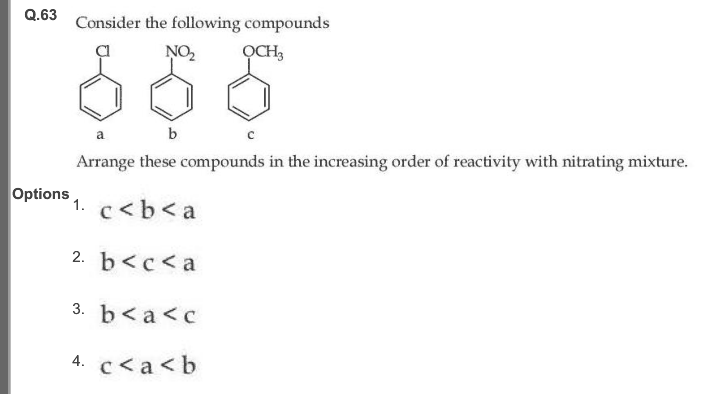
Consider the following compounds

(see the figure above)

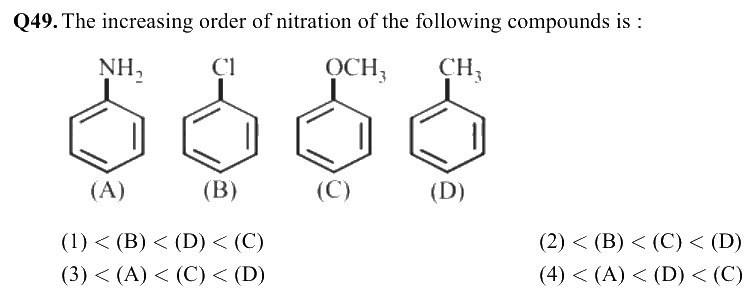
Arrange these compounds in the increasing order of reactivity with nitrating mixture.

The question and its figure as printed in JEE Main 2026 23 Jan Shift 1.
The question as printed in the paper.
  • A

    c < b < a

  • B

    b < c < a

  • C

    b < a < c

  • D

    c < a < b

19JEE Main 2026 · 23 Jan · Shift 1MCQOpen question page ↗

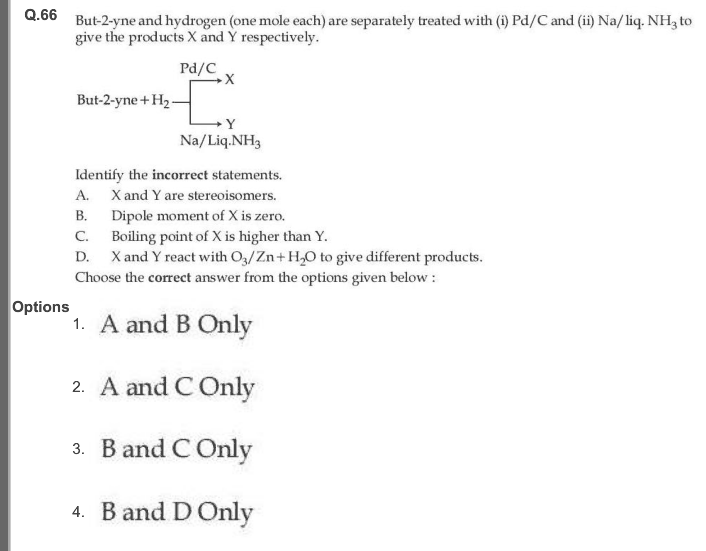
But-2-yne and hydrogen (one mole each) are separately treated with (i) Pd/C and (ii) Na/liq. $\mathrm{NH_3}$ to give the products X and Y respectively.

(see the figure above)

Identify the incorrect statements.

A. X and Y are stereoisomers.

B. Dipole moment of X is zero.

C. Boiling point of X is higher than Y.

D. X and Y react with $\mathrm{O_3}$/Zn$+\mathrm{H_2O}$ to give different products.

Choose the correct answer from the options given below :

The question and its figure as printed in JEE Main 2026 23 Jan Shift 1.
The question as printed in the paper.
  • A

    A and B Only

  • B

    A and C Only

  • C

    B and C Only

  • D

    B and D Only

20JEE Main 2026 · 23 Jan · Shift 2MCQOpen question page ↗

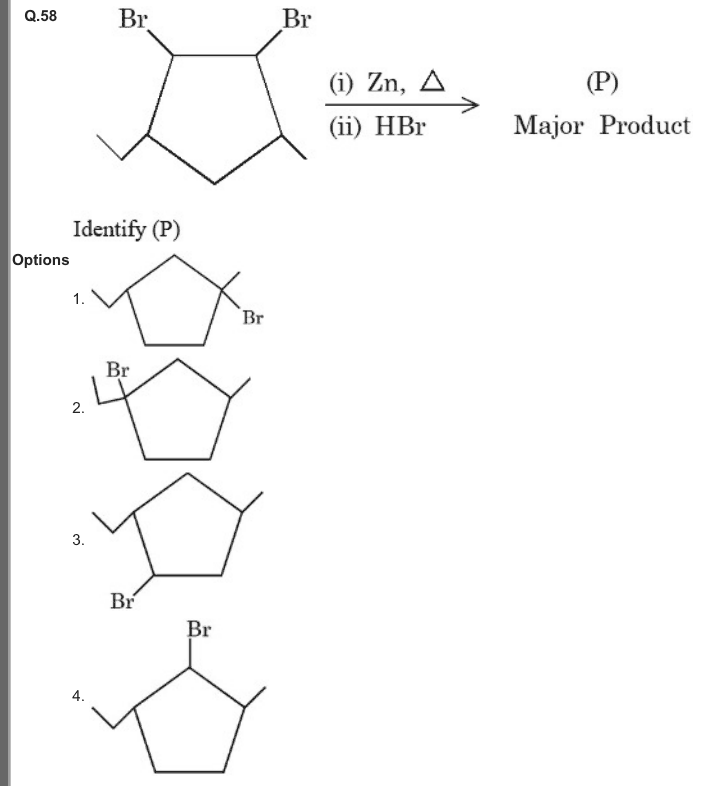
see figure Identify (P)

The question and its figure as printed in JEE Main 2026 23 Jan Shift 2. Question: Identify (P) Option 1: a five-membered ring with a flat bottom; its upper-left vertex carries a two-bond chain (a bond down-left, then a bond up-left); its right-hand upper vertex carries a short plain bond up-right and 'Br' on a bond going down-right. Option 2: a five-membered ring with a flat bottom; its upper-left vertex carries 'Br' on a short bond going up and a two-bond chain (a bond down-left, then a bond up); its right-hand vertex carries a short plain bond up-right. Option 3: a five-membered ring with a flat bottom; its upper-left vertex carries a two-bond chain (a bond down-left, then a bond…
The question as printed in the paper.
  • A

    see figure a five-membered ring with a flat bottom; its upper-left vertex carries a two-bond chain (a bond down-left, then a bond up-left); its right-hand upper vertex carries a short plain bond up-right and 'Br' on a bond going down-right.

  • B

    see figure a five-membered ring with a flat bottom; its upper-left vertex carries 'Br' on a short bond going up and a two-bond chain (a bond down-left, then a bond up); its right-hand vertex carries a short plain bond up-right.

  • C

    see figure a five-membered ring with a flat bottom; its upper-left vertex carries a two-bond chain (a bond down-left, then a bond up-left); its right-hand vertex carries a short plain bond up-right; its lower-left vertex carries 'Br' on a bond going down-left.

  • D

    see figure a five-membered ring with a flat bottom; its upper-left vertex carries a two-bond chain (a bond down-left, then a bond up-left); its right-hand vertex carries a short plain bond up-right; its top vertex carries 'Br' on a bond going straight up.

21JEE Main 2026 · 22 Jan · Shift 1MCQOpen question page ↗

Given below are two statements:

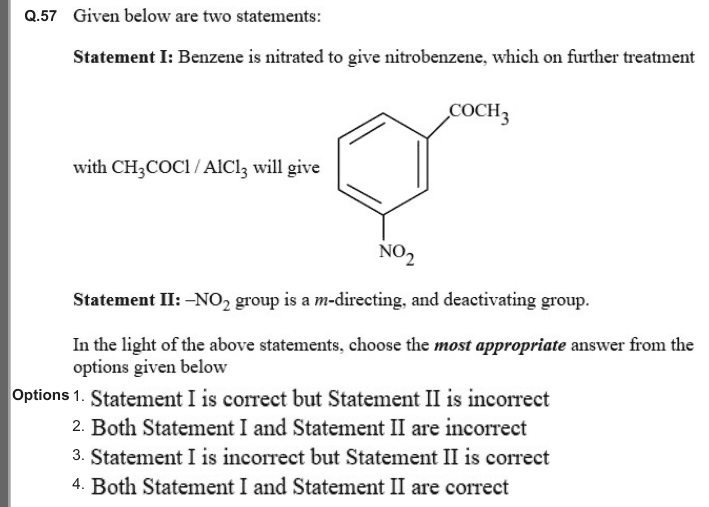
Statement I: Benzene is nitrated to give nitrobenzene, which on further treatment with $\mathrm{CH_3COCl}$ / $\mathrm{AlCl_3}$ will give

(see the figure above)

Statement II: $-\mathrm{NO_2}$ group is a $m$-directing, and deactivating group.

In the light of the above statements, choose the most appropriate answer from the options given below

The question and its figure as printed in JEE Main 2026 22 Jan Shift 1.
The question as printed in the paper.
  • A

    Statement I is correct but Statement II is incorrect

  • B

    Both Statement I and Statement II are incorrect

  • C

    Statement I is incorrect but Statement II is correct

  • D

    Both Statement I and Statement II are correct

22JEE Main 2026 · 22 Jan · Shift 2MCQOpen question page ↗

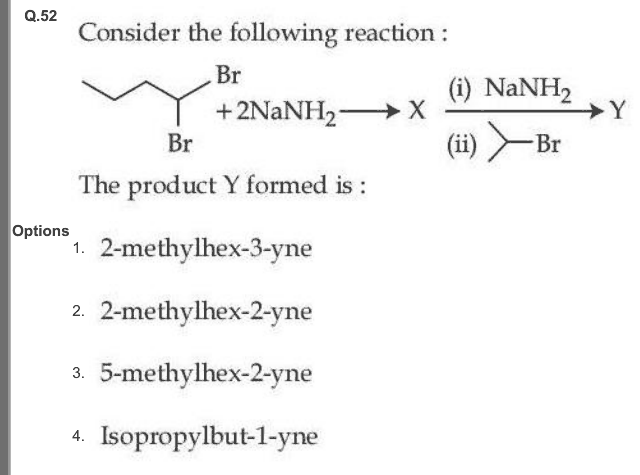
Consider the following reaction :

(see the figure above)

The product Y formed is :

The question and its figure as printed in JEE Main 2026 22 Jan Shift 2.
The question as printed in the paper.
  • A

    2-methylhex-3-yne

  • B

    2-methylhex-2-yne

  • C

    5-methylhex-2-yne

  • D

    Isopropylbut-1-yne

23JEE Main 2026 · 22 Jan · Shift 2MCQOpen question page ↗

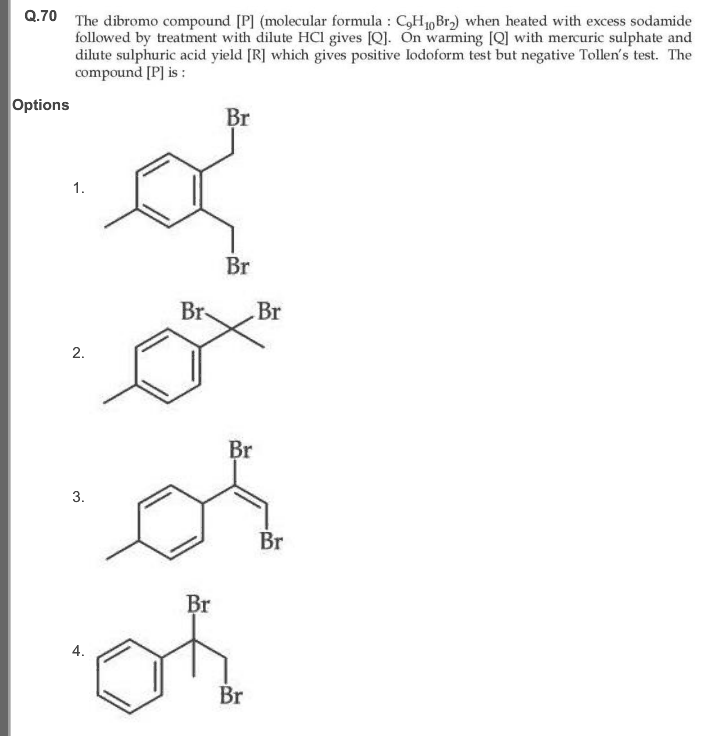
The dibromo compound [P] (molecular formula : $\mathrm{C_9H_{10}Br_2}$) when heated with excess sodamide followed by treatment with dilute HCl gives [Q]. On warming [Q] with mercuric sulphate and dilute sulphuric acid yield [R] which gives positive Iodoform test but negative Tollen's test. The compound [P] is :

The question and its figure as printed in JEE Main 2026 22 Jan Shift 2. Option 1: a six-membered ring with alternating double bonds and a plain bond at its lower-left vertex; its two right-hand adjacent vertices each carry a two-bond chain ending in 'Br': the upper one goes up-right then straight up, the lower one goes down-right then straight down. Option 2: a six-membered ring with alternating double bonds and a plain bond at its lower-left vertex; from its upper-right vertex a bond goes up-right to a carbon that has 'Br' on a short bond to the upper left, 'Br' on a short bond to the upper right, and a plain bond going down-right. Option 3: a six-membered ring drawn with only two double…
The question as printed in the paper.
  • A

    see figure a six-membered ring with alternating double bonds and a plain bond at its lower-left vertex; its two right-hand adjacent vertices each carry a two-bond chain ending in 'Br': the upper one goes up-right then straight up, the lower one goes down-right then straight down.

  • B

    see figure a six-membered ring with alternating double bonds and a plain bond at its lower-left vertex; from its upper-right vertex a bond goes up-right to a carbon that has 'Br' on a short bond to the upper left, 'Br' on a short bond to the upper right, and a plain bond going down-right.

  • C

    see figure a six-membered ring drawn with only two double bonds (on its upper-left and lower-right sides) and a plain bond at its lower-left vertex; from its right-hand vertex a bond goes up-right to a carbon that has 'Br' on a bond straight up and a double bond going down-right to a carbon with 'Br' on a bond straight down.

  • D

    see figure a six-membered ring with alternating double bonds, no substituent on its left; from its right-hand vertex a bond goes up-right to a carbon that has 'Br' on a bond straight up and a short plain bond straight down, and a bond down-right to a second carbon that has 'Br' on a bond straight down.

24JEE Main 2026 · 21 Jan · Shift 1MCQOpen question page ↗

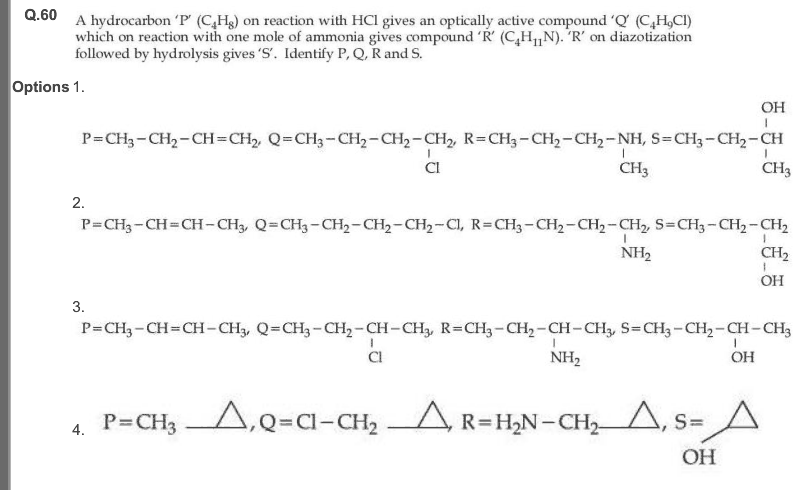
A hydrocarbon 'P' ($\mathrm{C_4H_8}$) on reaction with HCl gives an optically active compound 'Q' ($\mathrm{C_4H_9Cl}$) which on reaction with one mole of ammonia gives compound 'R' ($\mathrm{C_4H_{11}N}$). 'R' on diazotization followed by hydrolysis gives 'S'. Identify P, Q, R and S.

The question and its figure as printed in JEE Main 2026 21 Jan Shift 1. Option 1: P=CH3-CH2-CH=CH2, Q=CH3-CH2-CH2-CH2 with Cl hanging below the last carbon, R=CH3-CH2-CH2-NH with CH3 hanging below the NH, S=CH3-CH2-CH with OH above the last carbon and CH3 below it (printed as condensed formulas with groups above and below the chain). Option 2: P=CH3-CH=CH-CH3, Q=CH3-CH2-CH2-CH2-Cl, R=CH3-CH2-CH2-CH2 with NH2 hanging below the last carbon, S=CH3-CH2-CH2 with CH2 hanging below the last carbon and OH below that. Option 3: P=CH3-CH=CH-CH3, Q=CH3-CH2-CH-CH3 with Cl below the CH, R=CH3-CH2-CH-CH3 with NH2 below the CH, S=CH3-CH2-CH-CH3 with OH below the CH. Option 4: P = CH3 attached to a…
The question as printed in the paper.
  • A

    see figure P=CH3-CH2-CH=CH2, Q=CH3-CH2-CH2-CH2 with Cl hanging below the last carbon, R=CH3-CH2-CH2-NH with CH3 hanging below the NH, S=CH3-CH2-CH with OH above the last carbon and CH3 below it (printed as condensed formulas with groups above and below the chain).

  • B

    see figure P=CH3-CH=CH-CH3, Q=CH3-CH2-CH2-CH2-Cl, R=CH3-CH2-CH2-CH2 with NH2 hanging below the last carbon, S=CH3-CH2-CH2 with CH2 hanging below the last carbon and OH below that.

  • C

    see figure P=CH3-CH=CH-CH3, Q=CH3-CH2-CH-CH3 with Cl below the CH, R=CH3-CH2-CH-CH3 with NH2 below the CH, S=CH3-CH2-CH-CH3 with OH below the CH.

  • D

    see figure P = CH3 attached to a triangle (three-membered ring), Q = Cl-CH2 attached to a triangle, R = H2N-CH2 attached to a triangle, S = a triangle with OH below it.

25JEE Main 2026 · 21 Jan · Shift 1MCQOpen question page ↗

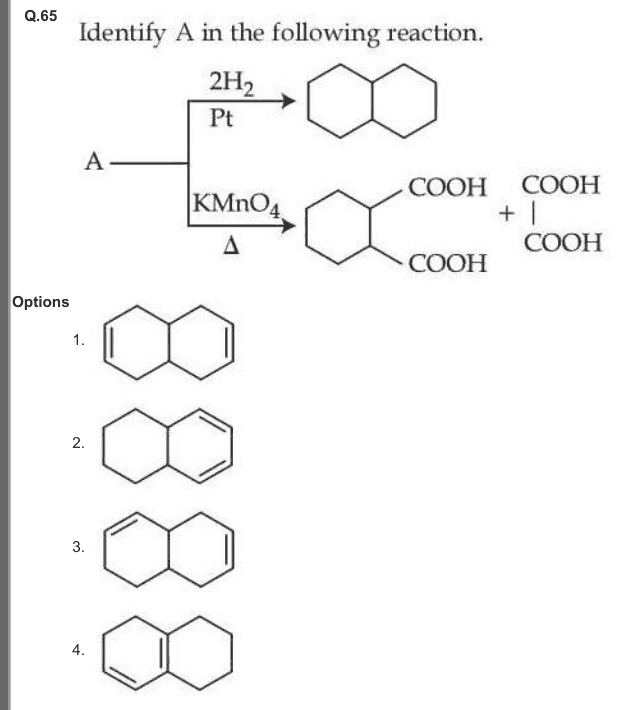
Identify A in the following reaction.

(see the figure above)

The question and its figure as printed in JEE Main 2026 21 Jan Shift 1. Option 1: two fused six-membered rings; the left ring has a double bond on its left vertical edge and the right ring has a double bond on its right vertical edge. Option 2: two fused six-membered rings; the left ring has only single bonds; the right ring has a double bond on its upper-right edge and another on its lower-right edge. Option 3: two fused six-membered rings; the left ring has a double bond on its upper-left edge and the right ring has a double bond on its right vertical edge. Option 4: two fused six-membered rings; the left ring has a double bond on its lower-left edge and the shared bond between the rings…
The question as printed in the paper.
  • A

    see figure two fused six-membered rings; the left ring has a double bond on its left vertical edge and the right ring has a double bond on its right vertical edge.

  • B

    see figure two fused six-membered rings; the left ring has only single bonds; the right ring has a double bond on its upper-right edge and another on its lower-right edge.

  • C

    see figure two fused six-membered rings; the left ring has a double bond on its upper-left edge and the right ring has a double bond on its right vertical edge.

  • D

    see figure two fused six-membered rings; the left ring has a double bond on its lower-left edge and the shared bond between the rings is drawn double; the right ring has only single bonds.

26JEE Main 2025 · 8 Apr · Shift 2MCQOpen question page ↗

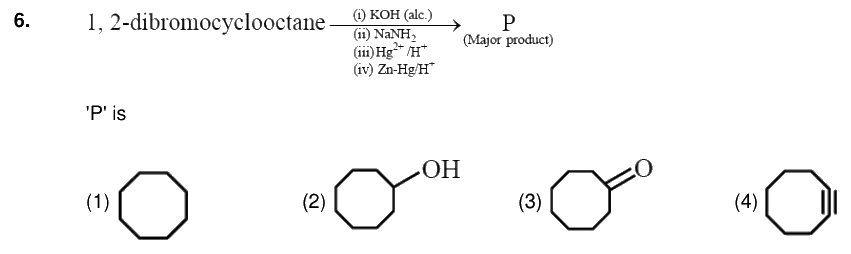
1, 2-dibromocyclooctane $\xrightarrow[\text{(ii) NaNH}_2\text{ (iii) Hg}^{2+}/\text{H}^+\text{ (iv) Zn-Hg/H}^+]{\text{(i) KOH (alc.)}}$ P (Major product)

'P' is

The question and its figure as printed in JEE Main 2025 08 Apr Shift 2. Option 1: an eight-membered ring with no substituent (cyclooctane). Option 2: an eight-membered ring with an OH group on the right (cyclooctanol). Option 3: an eight-membered ring with a C=O on the right, O at the upper right (cyclooctanone). Option 4: an eight-membered ring with a triple bond drawn along its right-hand edge (cyclooctyne).
The question as printed in the paper.
  • A

    see figure an eight-membered ring with no substituent (cyclooctane).

  • B

    see figure an eight-membered ring with an OH group on the right (cyclooctanol).

  • C

    see figure an eight-membered ring with a C=O on the right, O at the upper right (cyclooctanone).

  • D

    see figure an eight-membered ring with a triple bond drawn along its right-hand edge (cyclooctyne).

27JEE Main 2025 · 8 Apr · Shift 2MCQOpen question page ↗

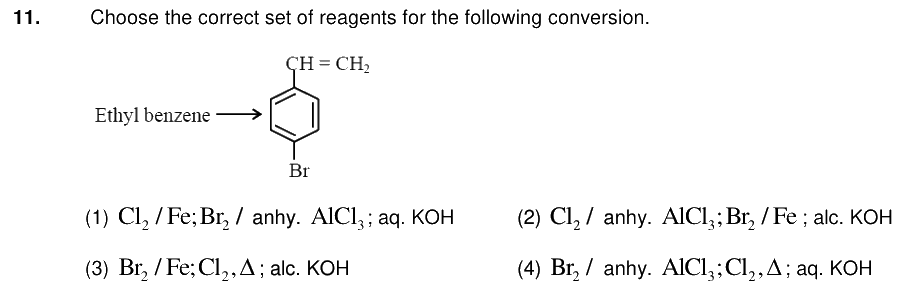
Choose the correct set of reagents for the following conversion.

Ethyl benzene $\longrightarrow$ (see the figure above)

The question and its figure as printed in JEE Main 2025 08 Apr Shift 2.
The question as printed in the paper.
  • A

    $Cl_2$ / Fe; $Br_2$ / anhy. $AlCl_3$; aq. KOH

  • B

    $Cl_2$ / anhy. $AlCl_3$; $Br_2$ / Fe ; alc. KOH

  • C

    $Br_2$ / Fe; $Cl_2, \Delta$ ; alc. KOH

  • D

    $Br_2$ / anhy. $AlCl_3$; $Cl_2, \Delta$; aq. KOH

28JEE Main 2025 · 7 Apr · Shift 1MCQOpen question page ↗

Given below are two statements:

Statement I: Ozonolysis followed by treatment with $Zn, H_2O$ of cis-2-butene gives ethanal.

Statement II: The product obtained by ozonolysis followed by treatment with $Zn, H_2O$ of 3, 6-dimethyloct-4-ene has no chiral carbon atom.

In the light of the above statements, choose the correct answer from the options given below

  • A

    Both Statement I and Statement II are False

  • B

    Statement I is false but Statement II are true

  • C

    Statement I is true but Statement II is false

  • D

    Both Statement I and Statement II are true

29JEE Main 2025 · 7 Apr · Shift 1MCQOpen question page ↗

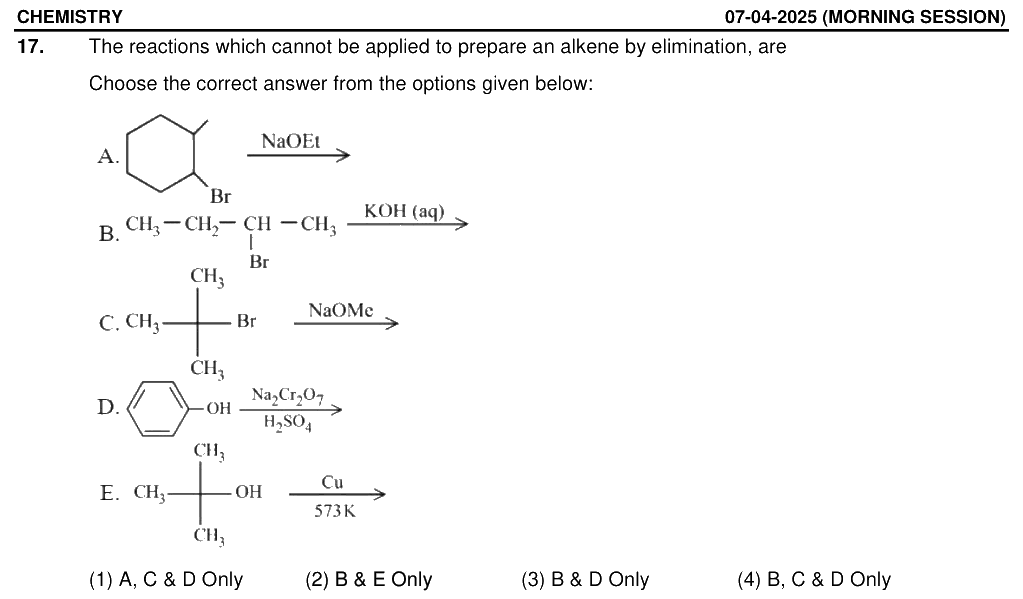
The reactions which cannot be applied to prepare an alkene by elimination, are

Choose the correct answer from the options given below:

(see the figure above)

The question and its figure as printed in JEE Main 2025 07 Apr Shift 1.
The question as printed in the paper.
  • A

    A, C & D Only

  • B

    B & E Only

  • C

    B & D Only

  • D

    B, C & D Only

30JEE Main 2025 · 7 Apr · Shift 2MCQOpen question page ↗

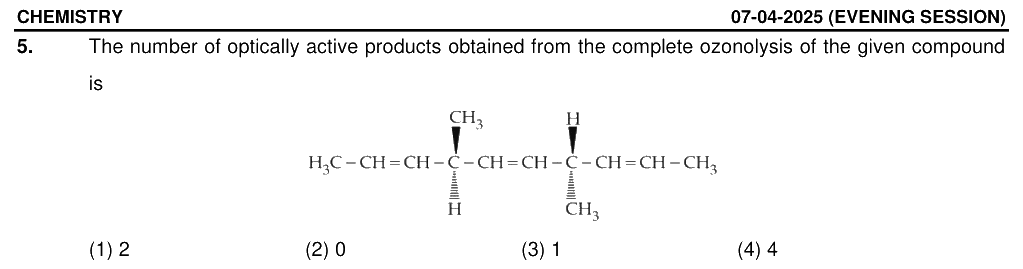
The number of optically active products obtained from the complete ozonolysis of the given compound is

(see the figure above)

The question and its figure as printed in JEE Main 2025 07 Apr Shift 2.
The question as printed in the paper.
  • A

    2

  • B

    0

  • C

    1

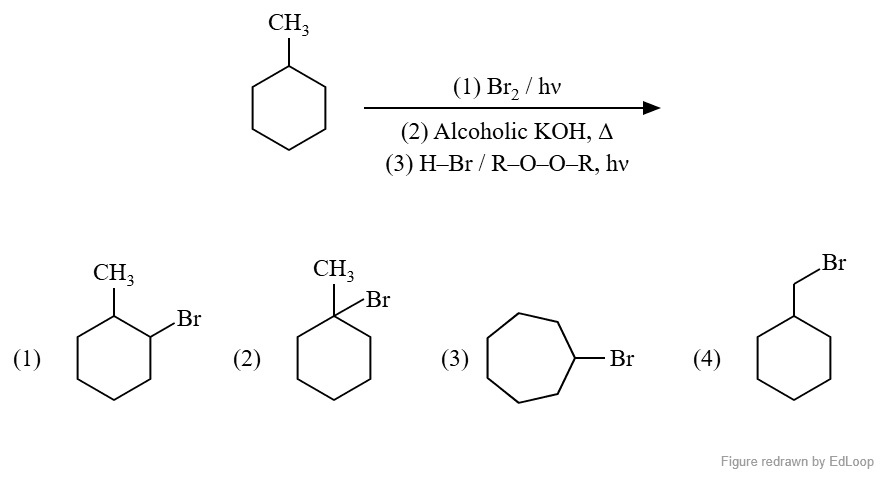
  • D

    4

31JEE Main 2025 · 4 Apr · Shift 1MCQOpen question page ↗

Predict the major product of the following reaction sequence:-

(see the figure above)

The question and its figure as printed in JEE Main 2025 04 Apr Shift 1. Option 1: a cyclohexane ring with 'CH3' on the top-left ring carbon and 'Br' on the carbon next to it (on a bond going down-right from the neighbouring ring carbon). Option 2: a cyclohexane ring with both 'CH3' (up) and 'Br' (on a bond to the right) on the same top ring carbon. Option 3: a seven-membered ring with 'Br' on a bond to the right from its rightmost carbon. Option 4: a cyclohexane ring with a CH2 carrying 'Br' attached (the ring carbon bonded to a CH2 that goes up-right to 'Br').
The question as printed in the paper.
  • A

    see figure a cyclohexane ring with 'CH3' on the top-left ring carbon and 'Br' on the carbon next to it (on a bond going down-right from the neighbouring ring carbon).

  • B

    see figure a cyclohexane ring with both 'CH3' (up) and 'Br' (on a bond to the right) on the same top ring carbon.

  • C

    see figure a seven-membered ring with 'Br' on a bond to the right from its rightmost carbon.

  • D

    see figure a cyclohexane ring with a CH2 carrying 'Br' attached (the ring carbon bonded to a CH2 that goes up-right to 'Br').

32JEE Main 2025 · 4 Apr · Shift 2MCQOpen question page ↗

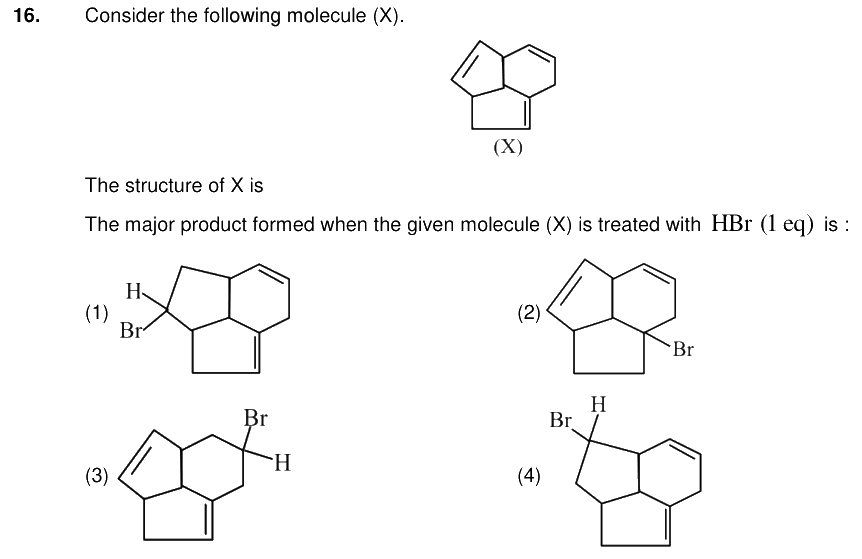
Consider the following molecule (X).

(see the figure above)

The structure of X is

The major product formed when the given molecule (X) is treated with HBr (1 eq) is :

The question and its figure as printed in JEE Main 2025 04 Apr Shift 2. Option 1: the tricyclic skeleton of X with 'H' and 'Br' on the leftmost vertex of the upper-left five-membered ring; that ring has no C=C; the six-membered ring keeps its C=C (top right) and the lower five-membered ring keeps its C=C (right edge). Option 2: the tricyclic skeleton with the upper-left five-membered ring keeping its C=C (left edge); 'Br' on the lower-right ring-junction carbon (where the lower ring's C=C ended); the six-membered ring keeps its C=C (top right); the lower five-membered ring has no C=C. Option 3: the tricyclic skeleton with the upper-left five-membered ring keeping its C=C (left edge); 'Br'…
The question as printed in the paper.
  • A

    see figure the tricyclic skeleton of X with 'H' and 'Br' on the leftmost vertex of the upper-left five-membered ring; that ring has no C=C; the six-membered ring keeps its C=C (top right) and the lower five-membered ring keeps its C=C (right edge).

  • B

    see figure the tricyclic skeleton with the upper-left five-membered ring keeping its C=C (left edge); 'Br' on the lower-right ring-junction carbon (where the lower ring's C=C ended); the six-membered ring keeps its C=C (top right); the lower five-membered ring has no C=C.

  • C

    see figure the tricyclic skeleton with the upper-left five-membered ring keeping its C=C (left edge); 'Br' and 'H' on a carbon at the right side of the six-membered ring (the carbon at the top of the right edge); the six-membered ring has no C=C; the lower five-membered ring keeps its C=C (right edge).

  • D

    see figure the tricyclic skeleton with 'Br' and 'H' on the top-left vertex of the upper-left five-membered ring (this ring has no C=C); the six-membered ring keeps its C=C (top right) and the lower five-membered ring keeps its C=C (right edge).

33JEE Main 2025 · 3 Apr · Shift 1MCQOpen question page ↗

Which compound would give 3-methyl-6-oxoheptanal upon ozonolysis?

The question and its figure as printed in JEE Main 2025 03 Apr Shift 1. Option 1: a six-membered ring with a methyl group going up from the top vertex, the ring double bond on the right side of the top vertex (between the top vertex and the upper-right vertex), and a second methyl group going down-right from the lower-right vertex. Option 2: a six-membered ring with a methyl group going up from the top vertex, the ring double bond between the top vertex and the upper-right vertex, and a second methyl group going down-left from the lower-left vertex. Option 3: a six-membered ring with a methyl group going up-left from the upper-left vertex and the ring double bond between the top vertex and…
The question as printed in the paper.
  • A

    see figure a six-membered ring with a methyl group going up from the top vertex, the ring double bond on the right side of the top vertex (between the top vertex and the upper-right vertex), and a second methyl group going down-right from the lower-right vertex.

  • B

    see figure a six-membered ring with a methyl group going up from the top vertex, the ring double bond between the top vertex and the upper-right vertex, and a second methyl group going down-left from the lower-left vertex.

  • C

    see figure a six-membered ring with a methyl group going up-left from the upper-left vertex and the ring double bond between the top vertex and the upper-right vertex (the methyl sits on the carbon next to the double bond, not on it).

  • D

    see figure a six-membered ring with a methyl group going up from the top vertex, the ring double bond between the top vertex and the upper-right vertex, and a second methyl group going down from the bottom vertex.

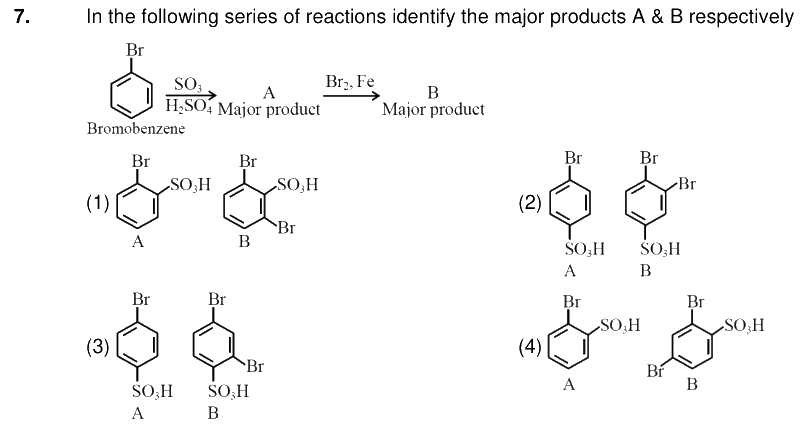
34JEE Main 2025 · 3 Apr · Shift 2MCQOpen question page ↗

In the following series of reactions identify the major products A & B respectively

(see the figure above)

The question and its figure as printed in JEE Main 2025 03 Apr Shift 2. Option 1: A: a benzene ring with 'Br' on the top vertex and 'SO3H' on the upper-right vertex (next to the Br carbon); B: a benzene ring with 'Br' on the top vertex, 'SO3H' on the upper-right vertex and a second 'Br' on a bond going down-right from the lower-right vertex. Option 2: A: a benzene ring with 'Br' on the top vertex and 'SO3H' on the bottom vertex (opposite); B: a benzene ring with 'Br' on the top vertex, a second 'Br' on the upper-right vertex (next to the first) and 'SO3H' on the bottom vertex. Option 3: A: a benzene ring with 'Br' on the top vertex and 'SO3H' on the bottom vertex (opposite); B: a benzene…
The question as printed in the paper.
  • A

    see figure A: a benzene ring with 'Br' on the top vertex and 'SO3H' on the upper-right vertex (next to the Br carbon); B: a benzene ring with 'Br' on the top vertex, 'SO3H' on the upper-right vertex and a second 'Br' on a bond going down-right from the lower-right vertex.

  • B

    see figure A: a benzene ring with 'Br' on the top vertex and 'SO3H' on the bottom vertex (opposite); B: a benzene ring with 'Br' on the top vertex, a second 'Br' on the upper-right vertex (next to the first) and 'SO3H' on the bottom vertex.

  • C

    see figure A: a benzene ring with 'Br' on the top vertex and 'SO3H' on the bottom vertex (opposite); B: a benzene ring with 'Br' on the top vertex, 'SO3H' on the bottom vertex and a second 'Br' on a bond going down-right from the lower-right vertex (next to the SO3H carbon).

  • D

    see figure A: a benzene ring with 'Br' on the top vertex and 'SO3H' on the upper-right vertex (next to the Br carbon); B: a benzene ring with 'Br' on a bond going up from the upper-left vertex, 'SO3H' on a bond going right from the upper-right vertex and a second 'Br' on a bond going down-left from the lower-left vertex.

35JEE Main 2025 · 2 Apr · Shift 1MCQOpen question page ↗

An optically active alkyl halide $C_4H_9Br[A]$ reacts with hot KOH dissolved in ethanol and forms alkene [B] as major product which reacts with bromine to give dibromide [C]. The compound [C] is converted into a gas [D] upon reacting with alcoholic $NaNH_2$. During hydration 18 gram of water is added to 1 mole of gas [D] on warming with mercuric sulphate and dilute acid at 333 K to form compound [E]. The IUPAC name of compound [E] is :

  • A

    Butan-2-one

  • B

    Butan-2-ol

  • C

    But-2-yne

  • D

    Butan-1-al

36JEE Main 2025 · 2 Apr · Shift 2MCQOpen question page ↗

Given below are two statements :

Statement (I) : Neopentane forms only one monosubstituted derivative.

Statement (II) : Melting point of neopentane is higher than n-pentane.

In the light of the above statements, choose the most appropriate answer from the options given below :

  • A

    Statement I is incorrect but Statement II is correct

  • B

    Statement I is correct but Statement II is incorrect

  • C

    Both Statement I and Statement II are incorrect

  • D

    Both Statement I and Statement II are correct

37JEE Main 2025 · 29 Jan · Shift 2MCQOpen question page ↗

Given below are two statements : Statement (I) : On nitration of m-xylene with $\mathrm{HNO_3, H_2SO_4}$ followed by oxidation, 4-nitrobenzene-1,3-dicarboxylic acid is obtained as the major product. Statement (II) : $-\mathrm{CH_3}$ group is o/p-directing while $-\mathrm{NO_2}$ group is m-directing group. In the light of the above statements, choose the correct answer from the options given below :

  • A

    Both Statement I and Statement II are false

  • B

    Statement I is false but Statement II is true

  • C

    Statement I is true but Statement II is false

  • D

    Both Statement I and Statement II are true

38JEE Main 2025 · 28 Jan · Shift 2MCQOpen question page ↗

Identify product [A], [B] and [C] in the following reaction sequence.

$\mathrm{CH_3 - C \equiv CH} \xrightarrow[\mathrm{H_2}]{\mathrm{Pd/C}} [\mathrm{A}] \xrightarrow[\mathrm{(ii)\ Zn,\ H_2O}]{\mathrm{(i)\ O_3}} [\mathrm{B}] + [\mathrm{C}]$

  • A

    [A] : $\mathrm{CH_2 = CH_2}$, [B] : $\mathrm{H_3C - C(=O) - CH_3}$, [C] : HCHO

  • B

    [A] : $\mathrm{CH_3 - CH = CH_2}$, [B] : $\mathrm{CH_3CHO}$, [C] : $\mathrm{CH_3CH_2OH}$

  • C

    [A] : $\mathrm{CH_3 - CH = CH_2}$, [B] : $\mathrm{CH_3CHO}$, [C] : HCHO

  • D

    [A] : $\mathrm{CH_3CH_2CH_3}$, [B] : $\mathrm{CH_3CHO}$, [C] : HCHO

39JEE Main 2025 · 28 Jan · Shift 2MCQOpen question page ↗

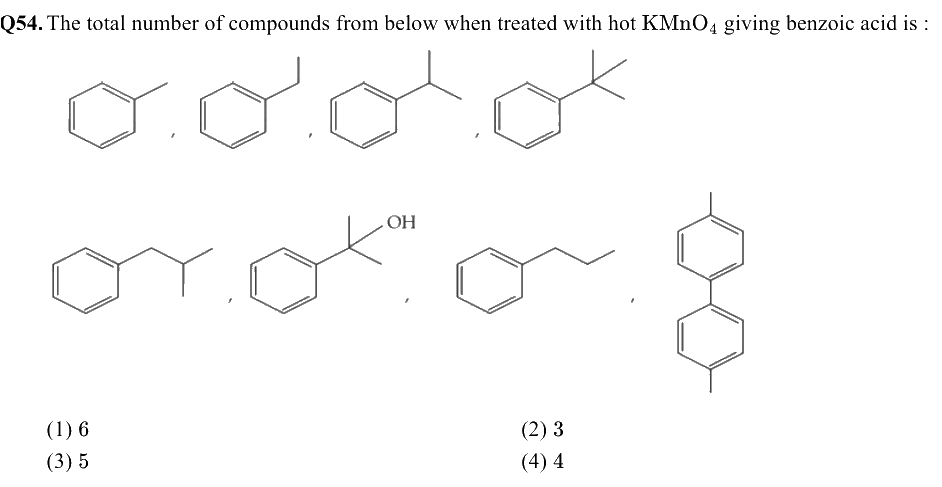
The total number of compounds from below when treated with hot $\mathrm{KMnO_4}$ giving benzoic acid is :

(see the figure above)

The question and its figure as printed in JEE Main 2025 28 Jan Shift 2.
The question as printed in the paper.
  • A

    6

  • B

    3

  • C

    5

  • D

    4

40JEE Main 2025 · 24 Jan · Shift 1MCQOpen question page ↗

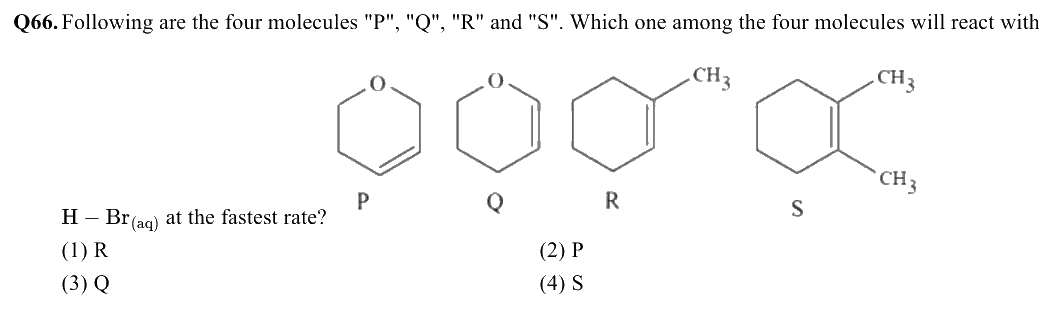
Following are the four molecules "P", "Q", "R" and "S". Which one among the four molecules will react with

(see the figure above)

$\mathrm{H - Br_{(aq)}}$ at the fastest rate?

The question and its figure as printed in JEE Main 2025 24 Jan Shift 1.
The question as printed in the paper.
  • A

    R

  • B

    P

  • C

    Q

  • D

    S

41JEE Main 2025 · 24 Jan · Shift 2MCQOpen question page ↗

Identify correct statement/s : (A) $-\mathrm{OCH_3}$ and $-\mathrm{NHCOCH_3}$ are activating group. (B) -CN and -OH are meta directing group. (C) -CN and $-\mathrm{SO_3H}$ are meta directing group. (D) Activating groups act as ortho - and para directing groups. (E) Halides are activating groups. Choose the correct answer from the options given below :

  • A

    (A) only

  • B

    (A), (B) and (E) only

  • C

    (A) and (C) only

  • D

    (A), (C) and (D) only

42JEE Main 2025 · 23 Jan · Shift 1MCQOpen question page ↗

Propane molecule on chlorination under photochemical condition gives two di-chloro products, " x " and " y ". Amongst " x " and " y ", " x " is an optically active molecule. How many tri-chloro products (consider only structural isomers) will be obtained from " x " when it is further treated with chlorine under the photochemical condition?

  • A

    2

  • B

    5

  • C

    4

  • D

    3

43JEE Main 2025 · 23 Jan · Shift 2MCQOpen question page ↗

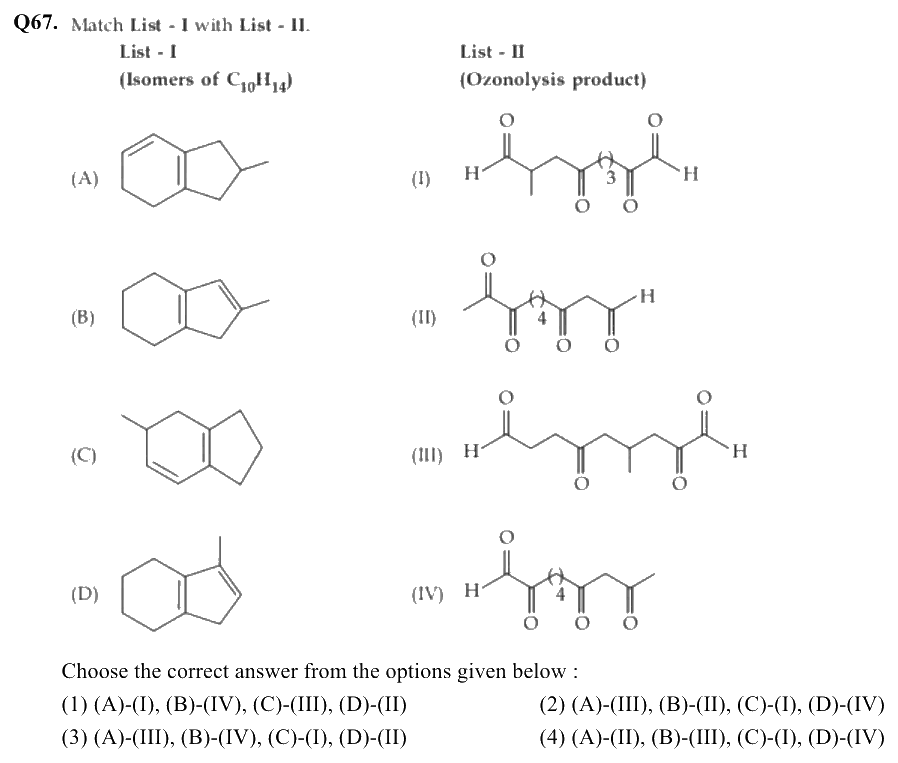
Match List - I with List - II.

(see the figure above)

Choose the correct answer from the options given below :

The question and its figure as printed in JEE Main 2025 23 Jan Shift 2.
The question as printed in the paper.
  • A

    (A)-(I), (B)-(IV), (C)-(III), (D)-(II)

  • B

    (A)-(III), (B)-(II), (C)-(I), (D)-(IV)

  • C

    (A)-(III), (B)-(IV), (C)-(I), (D)-(II)

  • D

    (A)-(II), (B)-(III), (C)-(I), (D)-(IV)

44JEE Main 2025 · 22 Jan · Shift 1MCQOpen question page ↗

Given below are two statements : Statement I : One mole of propyne reacts with excess of sodium to liberate half a mole of $\mathrm{H_2}$ gas. Statement II : Four g of propyne reacts with $\mathrm{NaNH_2}$ to liberate $\mathrm{NH_3}$ gas which occupies 224 mL at STP. In the light of the above statements, choose the most appropriate answer from the options given below:

  • A

    Statement I is incorrect but Statement II is correct

  • B

    Both Statement I and Statement II are correct

  • C

    Statement I is correct but Statement II is incorrect

  • D

    Both Statement I and Statement II are incorrect

45JEE Main 2025 · 22 Jan · Shift 2MCQOpen question page ↗

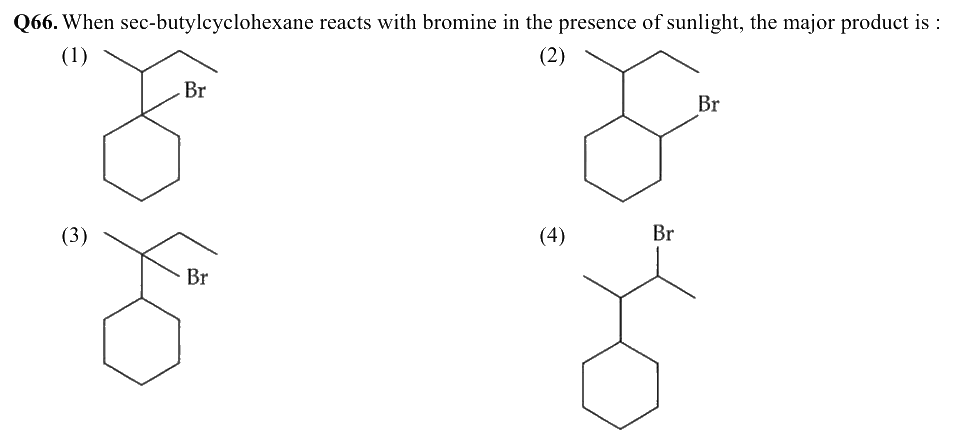
When sec-butylcyclohexane reacts with bromine in the presence of sunlight, the major product is :

The question and its figure as printed in JEE Main 2025 22 Jan Shift 2. Option 1: a cyclohexane ring whose top carbon carries both 'Br' (on a bond to the right) and the sec-butyl group (a zigzag going up from that carbon: a bond up to a branch carbon, then a bond going up-right and another going down-right at the end). Option 2: a cyclohexane ring with the sec-butyl group on its top-left carbon and 'Br' on the adjacent ring carbon to the right (Br on a bond going up-right from the ring carbon next to the substituted one). Option 3: a cyclohexane ring attached through a single bond to a side-chain carbon that carries 'Br' (on a bond to the lower right), an ethyl group going up-right and a…
The question as printed in the paper.
  • A

    see figure a cyclohexane ring whose top carbon carries both 'Br' (on a bond to the right) and the sec-butyl group (a zigzag going up from that carbon: a bond up to a branch carbon, then a bond going up-right and another going down-right at the end).

  • B

    see figure a cyclohexane ring with the sec-butyl group on its top-left carbon and 'Br' on the adjacent ring carbon to the right (Br on a bond going up-right from the ring carbon next to the substituted one).

  • C

    see figure a cyclohexane ring attached through a single bond to a side-chain carbon that carries 'Br' (on a bond to the lower right), an ethyl group going up-right and a one-carbon branch going up-left.

  • D

    see figure a cyclohexane ring attached through a single bond to a side-chain carbon from which a bond goes up to a carbon carrying 'Br' on a bond straight up; that carbon has a one-carbon stub going down-right and the other going left (the chain: ring - CH - CH(Br) - CH3, with a methyl on the first CH).

46JEE Main 2024 · 9 Apr · Shift 1MCQOpen question page ↗

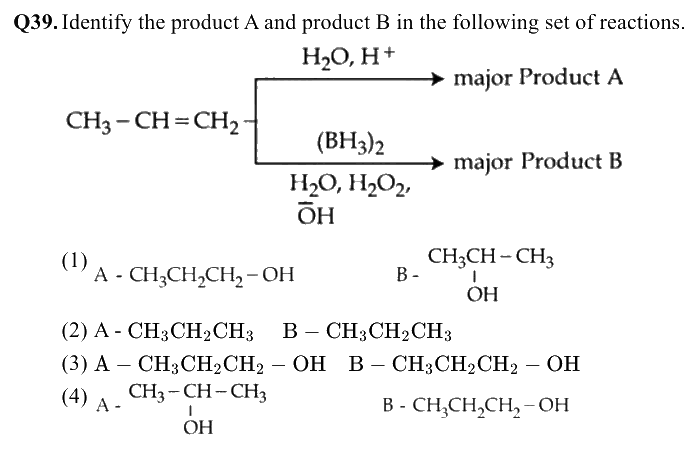
Identify the product A and product B in the following set of reactions.

(see the figure above)

The question and its figure as printed in JEE Main 2024 09 Apr Shift 1.
The question as printed in the paper.
  • A

    A - $\mathrm{CH_3CH_2CH_2-OH}$ B - $\mathrm{CH_3CH-CH_3}$ with OH attached below the middle carbon

  • B

    A - $\mathrm{CH_3CH_2CH_3}$ B $-$ $\mathrm{CH_3CH_2CH_3}$

  • C

    A $-$ $\mathrm{CH_3CH_2CH_2-OH}$ B $-$ $\mathrm{CH_3CH_2CH_2-OH}$

  • D

    A - $\mathrm{CH_3-CH-CH_3}$ with OH attached below the middle carbon B - $\mathrm{CH_3CH_2CH_2-OH}$

47JEE Main 2024 · 9 Apr · Shift 1MCQOpen question page ↗

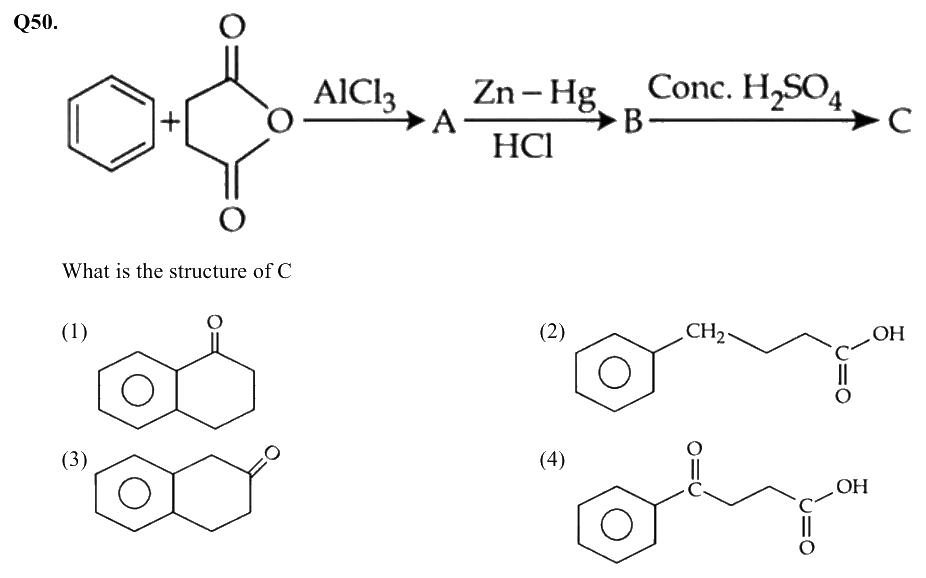
see figure What is the structure of C

The question and its figure as printed in JEE Main 2024 09 Apr Shift 1. Question: What is the structure of C Option 1: a benzene ring (circle drawn inside) fused to a six-membered ring that carries a C=O on the carbon adjacent to the ring fusion, with the O pointing up. Option 2: a benzene ring (circle drawn inside) bearing a chain CH2-CH2-CH2-C(=O)OH, drawn as CH2 then a zigzag to a C with OH at its upper right and a double-bonded O below. Option 3: a benzene ring (circle drawn inside) fused to a six-membered ring that carries a C=O two carbons away from the ring fusion (upper right, O pointing up-right). Option 4: a benzene ring (circle drawn inside) bearing a C(=O) group (O above)…
The question as printed in the paper.
  • A

    see figure a benzene ring (circle drawn inside) fused to a six-membered ring that carries a C=O on the carbon adjacent to the ring fusion, with the O pointing up.

  • B

    see figure a benzene ring (circle drawn inside) bearing a chain CH2-CH2-CH2-C(=O)OH, drawn as CH2 then a zigzag to a C with OH at its upper right and a double-bonded O below.

  • C

    see figure a benzene ring (circle drawn inside) fused to a six-membered ring that carries a C=O two carbons away from the ring fusion (upper right, O pointing up-right).

  • D

    see figure a benzene ring (circle drawn inside) bearing a C(=O) group (O above) followed by a zigzag of two CH2 carbons to a C(=O)OH group (OH at upper right, double-bonded O below).

48JEE Main 2024 · 6 Apr · Shift 2MCQOpen question page ↗

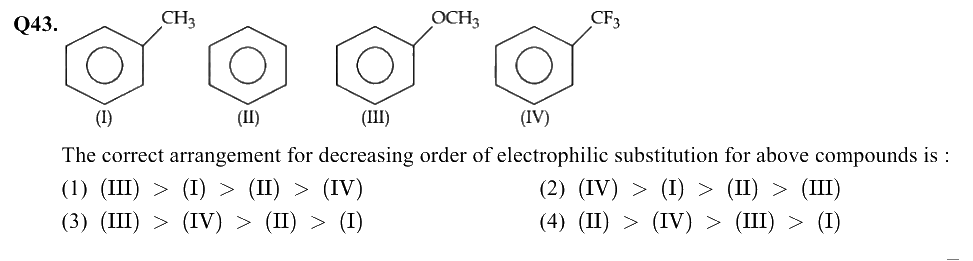
see figure The correct arrangement for decreasing order of electrophilic substitution for above compounds is :

The question and its figure as printed in JEE Main 2024 06 Apr Shift 2. Question: The correct arrangement for decreasing order of electrophilic substitution for above compounds is :
The question as printed in the paper.
  • A

    (III) > (I) > (II) > (IV)

  • B

    (IV) > (I) > (II) > (III)

  • C

    (III) > (IV) > (II) > (I)

  • D

    (II) > (IV) > (III) > (I)

49JEE Main 2024 · 5 Apr · Shift 1MCQOpen question page ↗

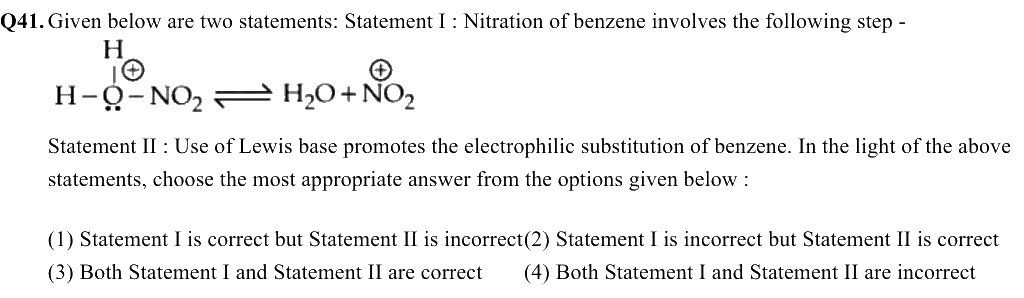
Given below are two statements: Statement I : Nitration of benzene involves the following step -

(see the figure above)
Statement II : Use of Lewis base promotes the electrophilic substitution of benzene. In the light of the above statements, choose the most appropriate answer from the options given below :

The question and its figure as printed in JEE Main 2024 05 Apr Shift 1.
The question as printed in the paper.
  • A

    Statement I is correct but Statement II is incorrect

  • B

    Statement I is incorrect but Statement II is correct

  • C

    Both Statement I and Statement II are correct

  • D

    Both Statement I and Statement II are incorrect

50JEE Main 2024 · 5 Apr · Shift 2MCQOpen question page ↗

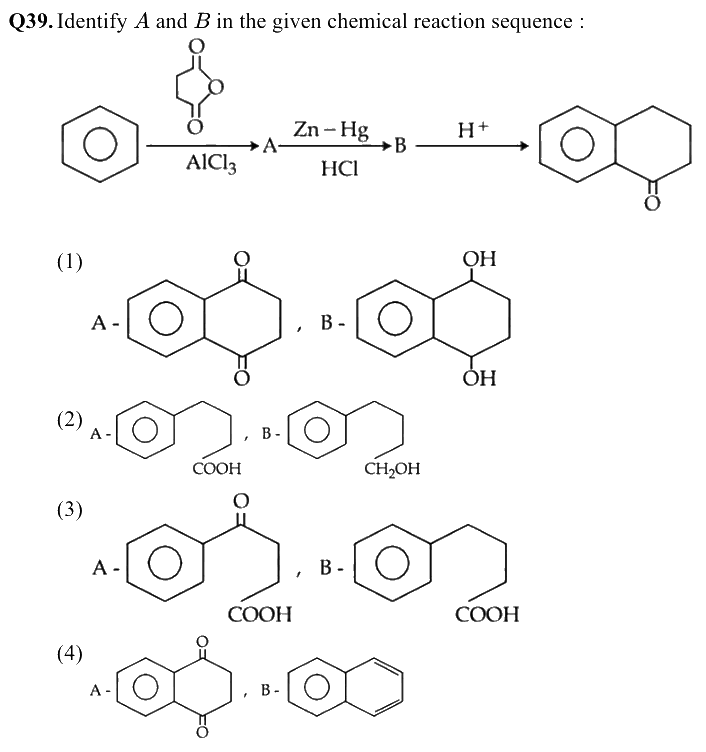
Identify $A$ and $B$ in the given chemical reaction sequence :

(see the figure above)

The question and its figure as printed in JEE Main 2024 05 Apr Shift 2.
The question as printed in the paper.
  • A

    A - (see the figure above) 1,4-dione of tetralin type: a benzene ring fused to a six-membered ring with C=O at the two positions next to the fusion on the right side (one up, one down); B - (see the figure above) the same fused skeleton with an OH at the top and an OH at the bottom position instead of the C=O groups

  • B

    A - (see the figure above) a phenyl ring with a zigzag chain going up-right and ending in COOH; B - (see the figure above) a phenyl ring with a similar chain ending in CH$_2$OH

  • C

    A - (see the figure above) a phenyl ring attached to a carbon bearing C=O (O above), followed by a chain ending in COOH; B - (see the figure above) a phenyl ring with a chain (no C=O) ending in COOH

  • D

    A - (see the figure above) the fused skeleton with C=O at the top and bottom positions (as in option 1); B - (see the figure above) a fused naphthalene skeleton in which the right ring is fully aromatic (with double bonds drawn)

51JEE Main 2024 · 5 Apr · Shift 2MCQOpen question page ↗

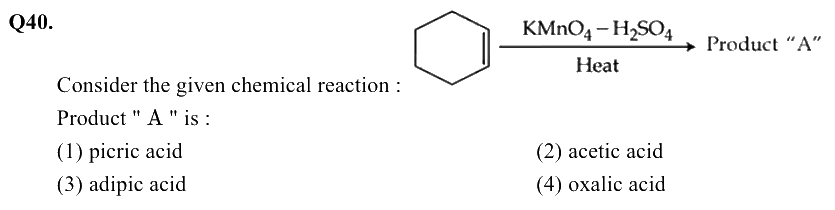
Consider the given chemical reaction :

(see the figure above)
Product " A " is :

The question and its figure as printed in JEE Main 2024 05 Apr Shift 2.
The question as printed in the paper.
  • A

    picric acid

  • B

    acetic acid

  • C

    adipic acid

  • D

    oxalic acid

52JEE Main 2024 · 4 Apr · Shift 1MCQOpen question page ↗

Identify the correct set of reagents or reaction conditions ' $X$ ' and ' $Y$ ' in the following set of transformation

$\mathrm{CH_3 - CH_2 - CH_2 - Br \xrightarrow{'X'} Product \xrightarrow{'Y'} CH_3 - \underset{\underset{Br}{|}}{CH} - CH_3}$

  • A

    X = dil.aq. NaOH, $20^\circ$C, Y = $\mathrm{Br_2/CHCl_3}$

  • B

    X = conc.alc. NaOH, $80^\circ$C, Y = $\mathrm{Br_2/CHCl_3}$

  • C

    X = dil.aq. NaOH, $20^\circ$C, Y = HBr /acetic acid

  • D

    X = conc.alc. NaOH, $80^\circ$C, Y = HBr/ acetic acid

53JEE Main 2024 · 4 Apr · Shift 2MCQOpen question page ↗

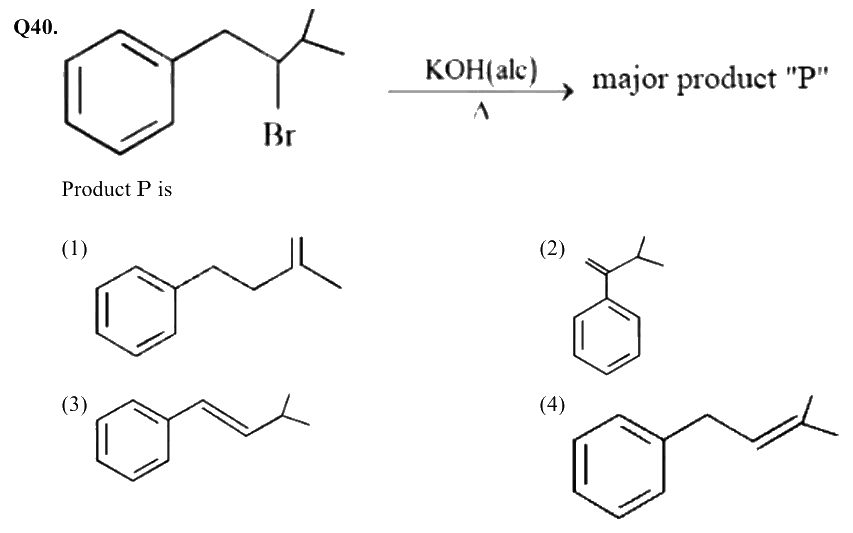
see figure Product P is

The question and its figure as printed in JEE Main 2024 04 Apr Shift 2. Question: Product P is Option 1: Benzene ring joined to a chain: ring, CH2, CH2, then a carbon carrying a double bond drawn upward (a terminal =CH2) and a methyl line to the lower right. Option 2: Benzene ring joined to a carbon bearing a double bond drawn up-left (a terminal =CH2) and a bond up-right to a carbon with two methyl lines (isopropyl group). Option 3: Benzene ring joined to a chain with a double bond between the first and second chain carbons, then a carbon with a methyl branch and a methyl end (a CH(CH3)2 group). Option 4: Benzene ring joined to a CH2, then a double bond between the second and third chain…
The question as printed in the paper.
  • A

    see figure Benzene ring joined to a chain: ring, CH2, CH2, then a carbon carrying a double bond drawn upward (a terminal =CH2) and a methyl line to the lower right.

  • B

    see figure Benzene ring joined to a carbon bearing a double bond drawn up-left (a terminal =CH2) and a bond up-right to a carbon with two methyl lines (isopropyl group).

  • C

    see figure Benzene ring joined to a chain with a double bond between the first and second chain carbons, then a carbon with a methyl branch and a methyl end (a CH(CH3)2 group).

  • D

    see figure Benzene ring joined to a CH2, then a double bond between the second and third chain carbons, the third carbon carrying two methyl lines (up and to the lower right).

54JEE Main 2024 · 4 Apr · Shift 2MCQOpen question page ↗

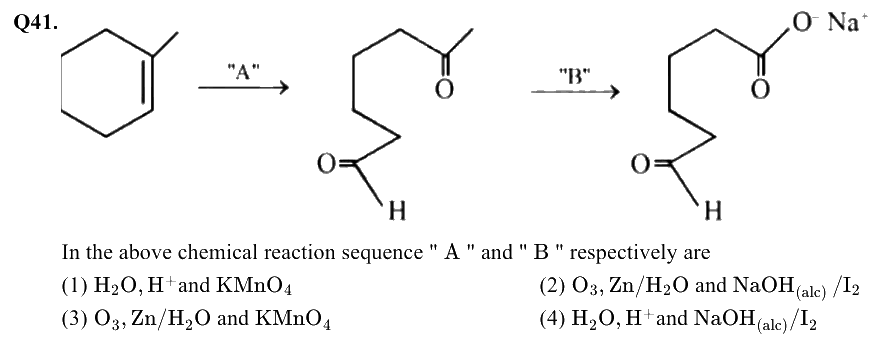
see figure In the above chemical reaction sequence " A " and " B " respectively are

The question and its figure as printed in JEE Main 2024 04 Apr Shift 2. Question: In the above chemical reaction sequence " A " and " B " respectively are
The question as printed in the paper.
  • A

    $\mathrm{H_2O, H^+}$ and $\mathrm{KMnO_4}$

  • B

    $\mathrm{O_3, Zn/H_2O}$ and $\mathrm{NaOH_{(alc)}}$ /$\mathrm{I_2}$

  • C

    $\mathrm{O_3, Zn/H_2O}$ and $\mathrm{KMnO_4}$

  • D

    $\mathrm{H_2O, H^+}$ and $\mathrm{NaOH_{(alc)}}$/$\mathrm{I_2}$

55JEE Main 2024 · 4 Apr · Shift 2MCQOpen question page ↗

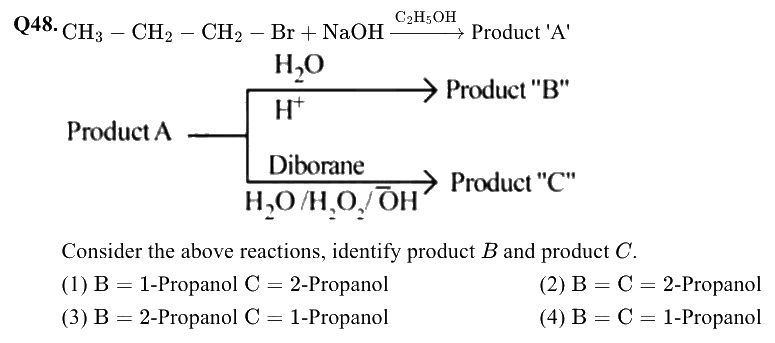
$\mathrm{CH_3 - CH_2 - CH_2 - Br + NaOH \xrightarrow{C_2H_5OH}}$ Product 'A'

(see the figure above)

Consider the above reactions, identify product $B$ and product $C$.

The question and its figure as printed in JEE Main 2024 04 Apr Shift 2.
The question as printed in the paper.
  • A

    B = 1-Propanol C = 2-Propanol

  • B

    B = C = 2-Propanol

  • C

    B = 2-Propanol C = 1-Propanol

  • D

    B = C = 1-Propanol

56JEE Main 2024 · 1 Feb · Shift 1MCQOpen question page ↗

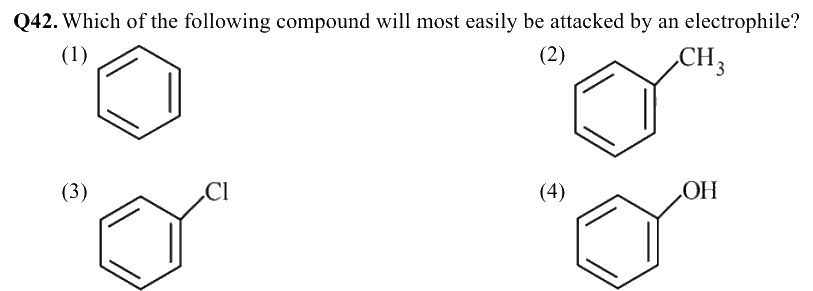
Which of the following compound will most easily be attacked by an electrophile?

The question and its figure as printed in JEE Main 2024 01 Feb Shift 1. Option 1: a benzene ring with no substituent. Option 2: a benzene ring with a CH3 group on its upper-right carbon. Option 3: a benzene ring with a Cl on its upper-right carbon. Option 4: a benzene ring with an OH group on its upper-right carbon.
The question as printed in the paper.
  • A

    see figure a benzene ring with no substituent.

  • B

    see figure a benzene ring with a CH3 group on its upper-right carbon.

  • C

    see figure a benzene ring with a Cl on its upper-right carbon.

  • D

    see figure a benzene ring with an OH group on its upper-right carbon.

57JEE Main 2024 · 1 Feb · Shift 1MCQOpen question page ↗

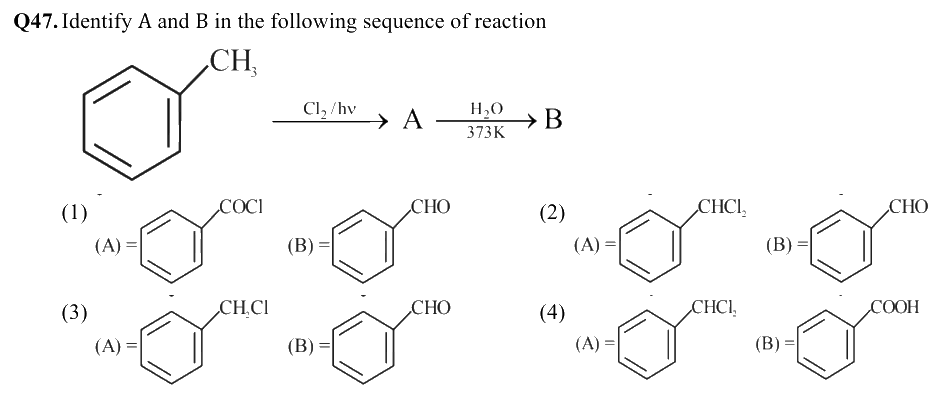
Identify A and B in the following sequence of reaction

(see the figure above)

The question and its figure as printed in JEE Main 2024 01 Feb Shift 1.
The question as printed in the paper.
  • A

    (A) = (see the figure above) benzene ring bearing COCl; (B) = (see the figure above) benzene ring bearing CHO.

  • B

    (A) = (see the figure above) benzene ring bearing CHCl$_2$; (B) = (see the figure above) benzene ring bearing CHO.

  • C

    (A) = (see the figure above) benzene ring bearing CH$_2$Cl; (B) = (see the figure above) benzene ring bearing CHO.

  • D

    (A) = (see the figure above) benzene ring bearing CHCl$_2$; (B) = (see the figure above) benzene ring bearing COOH.

58JEE Main 2024 · 1 Feb · Shift 2MCQOpen question page ↗

The set of meta directing functional groups from the following sets is:

  • A

    -CN, - $\mathrm{NH_2}$, - NHR, - $\mathrm{OCH_3}$

  • B

    -$\mathrm{NO_2}$, - $\mathrm{NH_2}$, - COOH, - COOR

  • C

    -$\mathrm{NO_2}$, - CHO, - $\mathrm{SO_3H}$, - COR

  • D

    -CN, - CHO, - $\mathrm{NHCOCH_3}$, - COOR

59JEE Main 2024 · 1 Feb · Shift 2MCQOpen question page ↗

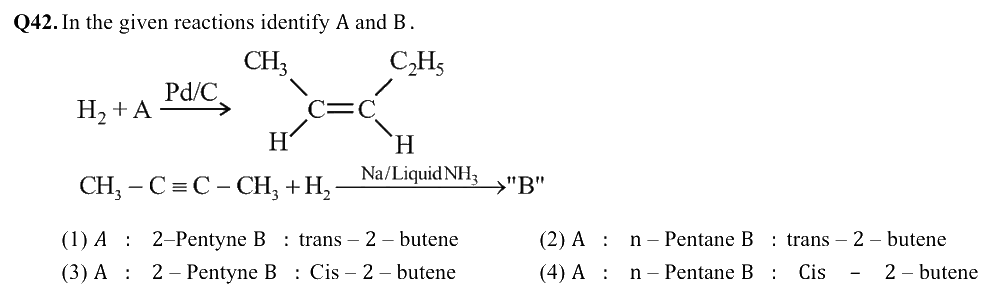
In the given reactions identify A and B .

(see the figure above)

The question and its figure as printed in JEE Main 2024 01 Feb Shift 2.
The question as printed in the paper.
  • A

    $A$ : 2–Pentyne $B$ : trans – 2 – butene

  • B

    $A$ : n – Pentane $B$ : trans – 2 – butene

  • C

    $A$ : 2 – Pentyne $B$ : Cis – 2 – butene

  • D

    $A$ : n – Pentane $B$ : Cis - 2 – butene

60JEE Main 2024 · 31 Jan · Shift 2MCQOpen question page ↗

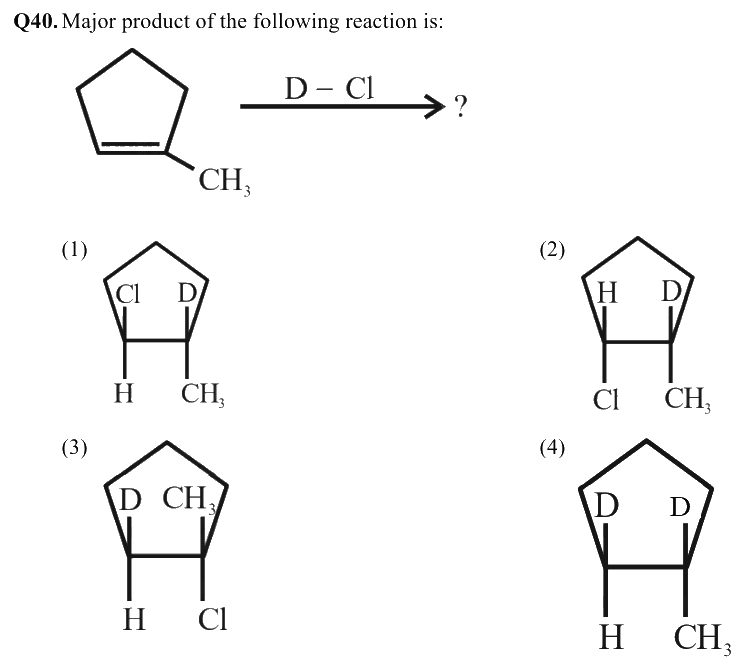
Major product of the following reaction is:

(see the figure above)

The question and its figure as printed in JEE Main 2024 31 Jan Shift 2. Option 1: Cyclopentane ring drawn with its bottom edge as a horizontal bond between two carbons. On the left carbon: Cl pointing up (inside the ring) and H pointing down. On the right carbon: D pointing up (inside the ring) and CH3 pointing down. Option 2: Cyclopentane ring with a horizontal bottom bond. Left carbon: H up and Cl down. Right carbon: D up and CH3 down. Option 3: Cyclopentane ring with a horizontal bottom bond. Left carbon: D up and H down. Right carbon: CH3 up and Cl down. Option 4: Cyclopentane ring with a horizontal bottom bond. Left carbon: D up and H down. Right carbon: D up and CH3 down.
The question as printed in the paper.
  • A

    see figure Cyclopentane ring drawn with its bottom edge as a horizontal bond between two carbons. On the left carbon: Cl pointing up (inside the ring) and H pointing down. On the right carbon: D pointing up (inside the ring) and CH$_3$ pointing down.

  • B

    see figure Cyclopentane ring with a horizontal bottom bond. Left carbon: H up and Cl down. Right carbon: D up and CH$_3$ down.

  • C

    see figure Cyclopentane ring with a horizontal bottom bond. Left carbon: D up and H down. Right carbon: CH$_3$ up and Cl down.

  • D

    see figure Cyclopentane ring with a horizontal bottom bond. Left carbon: D up and H down. Right carbon: D up and CH$_3$ down.

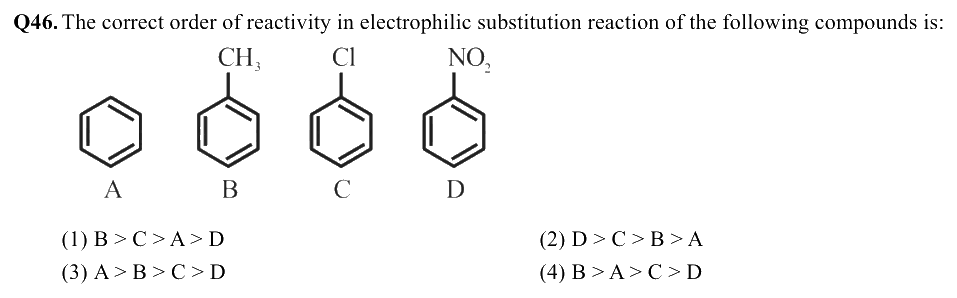
61JEE Main 2024 · 31 Jan · Shift 2MCQOpen question page ↗

The correct order of reactivity in electrophilic substitution reaction of the following compounds is:

(see the figure above)

The question and its figure as printed in JEE Main 2024 31 Jan Shift 2.
The question as printed in the paper.
  • A

    B > C > A > D

  • B

    D > C > B > A

  • C

    A > B > C > D

  • D

    B > A > C > D

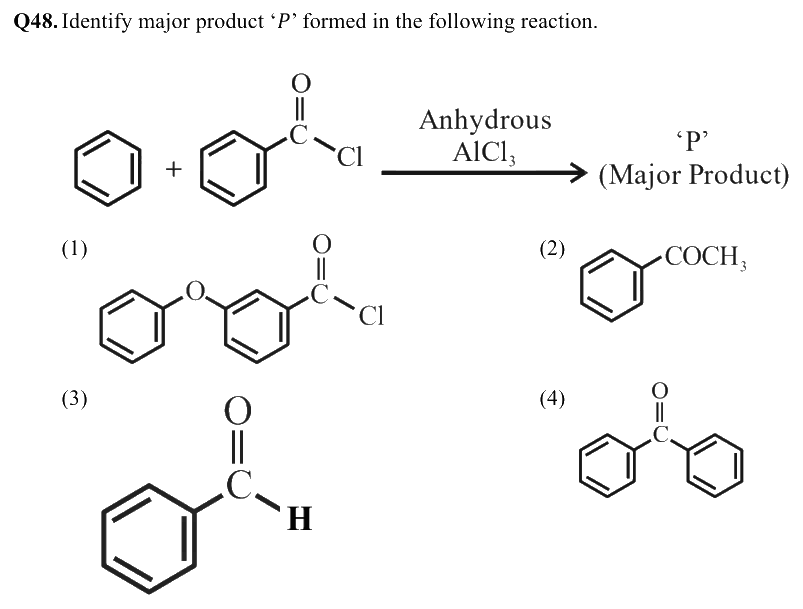
62JEE Main 2024 · 31 Jan · Shift 2MCQOpen question page ↗

Identify major product 'P' formed in the following reaction.

(see the figure above)

The question and its figure as printed in JEE Main 2024 31 Jan Shift 2. Option 1: Two benzene rings joined through an oxygen atom (diphenyl-ether type); the second ring carries a C(=O)Cl group on the carbon meta to the oxygen-bearing carbon Option 2: Benzene ring bearing COCH3 Option 3: Benzene ring bearing a C(=O)H (aldehyde) group Option 4: Two benzene rings joined through a single C=O carbon (diphenyl ketone)
The question as printed in the paper.
  • A

    see figure Two benzene rings joined through an oxygen atom (diphenyl-ether type); the second ring carries a C(=O)Cl group on the carbon meta to the oxygen-bearing carbon

  • B

    see figure Benzene ring bearing COCH$_3$

  • C

    see figure Benzene ring bearing a C(=O)H (aldehyde) group

  • D

    see figure Two benzene rings joined through a single C=O carbon (diphenyl ketone)

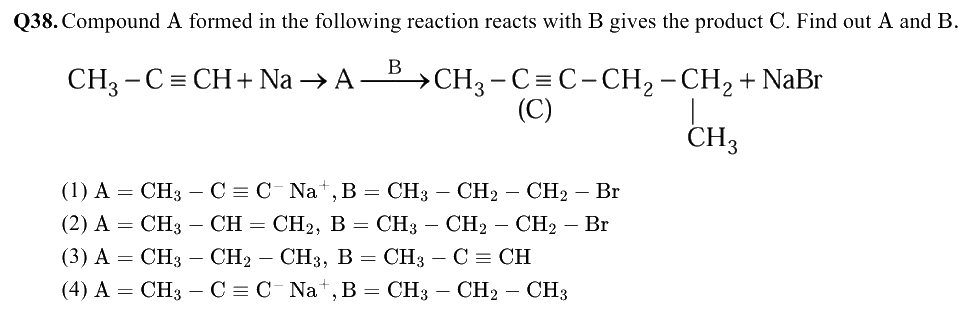
63JEE Main 2024 · 30 Jan · Shift 1MCQOpen question page ↗

Compound A formed in the following reaction reacts with B gives the product C. Find out A and B.

$\mathrm{CH_3 - C \equiv CH + Na \rightarrow A \xrightarrow{B} CH_3 - C \equiv C - CH_2 - CH_2 + NaBr}$ (C)

(see the figure above)

The question and its figure as printed in JEE Main 2024 30 Jan Shift 1.
The question as printed in the paper.
  • A

    $A = \mathrm{CH_3 - C \equiv C^{-}Na^{+}}$, $B = \mathrm{CH_3 - CH_2 - CH_2 - Br}$

  • B

    $A = \mathrm{CH_3 - CH = CH_2}$, $B = \mathrm{CH_3 - CH_2 - CH_2 - Br}$

  • C

    $A = \mathrm{CH_3 - CH_2 - CH_3}$, $B = \mathrm{CH_3 - C \equiv CH}$

  • D

    $A = \mathrm{CH_3 - C \equiv C^{-}Na^{+}}$, $B = \mathrm{CH_3 - CH_2 - CH_3}$

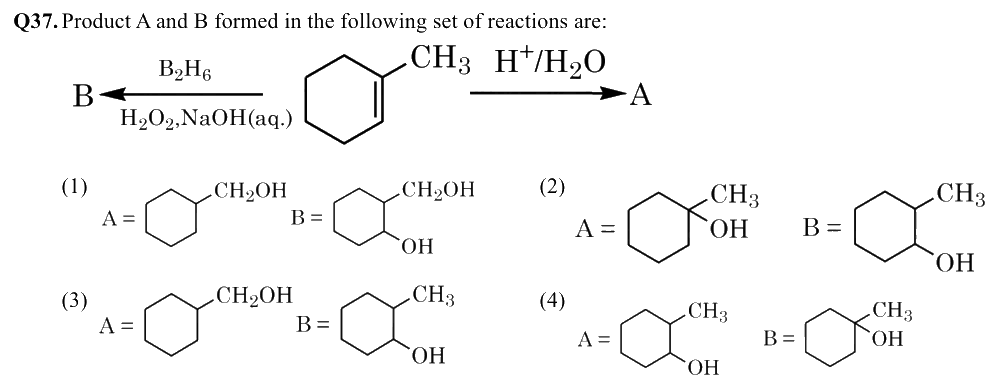
64JEE Main 2024 · 30 Jan · Shift 2MCQOpen question page ↗

Product A and B formed in the following set of reactions are:

(see the figure above)

The question and its figure as printed in JEE Main 2024 30 Jan Shift 2. Option 1: A = cyclohexane ring bearing a CH2OH group; B = cyclohexane ring with CH2OH on one carbon and OH on the adjacent carbon below it. Option 2: A = cyclohexane ring with CH3 and OH both on the same ring carbon; B = cyclohexane ring with CH3 on one carbon and OH on the adjacent carbon below it. Option 3: A = cyclohexane ring bearing a CH2OH group; B = cyclohexane ring with CH3 on one carbon and OH on the adjacent carbon below it. Option 4: A = cyclohexane ring with CH3 on one carbon and OH on the adjacent carbon below it; B = cyclohexane ring with CH3 and OH both on the same ring carbon.
The question as printed in the paper.
  • A

    see figure A = cyclohexane ring bearing a $\mathrm{CH_2OH}$ group; B = cyclohexane ring with $\mathrm{CH_2OH}$ on one carbon and OH on the adjacent carbon below it.

  • B

    see figure A = cyclohexane ring with $\mathrm{CH_3}$ and OH both on the same ring carbon; B = cyclohexane ring with $\mathrm{CH_3}$ on one carbon and OH on the adjacent carbon below it.

  • C

    see figure A = cyclohexane ring bearing a $\mathrm{CH_2OH}$ group; B = cyclohexane ring with $\mathrm{CH_3}$ on one carbon and OH on the adjacent carbon below it.

  • D

    see figure A = cyclohexane ring with $\mathrm{CH_3}$ on one carbon and OH on the adjacent carbon below it; B = cyclohexane ring with $\mathrm{CH_3}$ and OH both on the same ring carbon.

65JEE Main 2024 · 29 Jan · Shift 1MCQOpen question page ↗

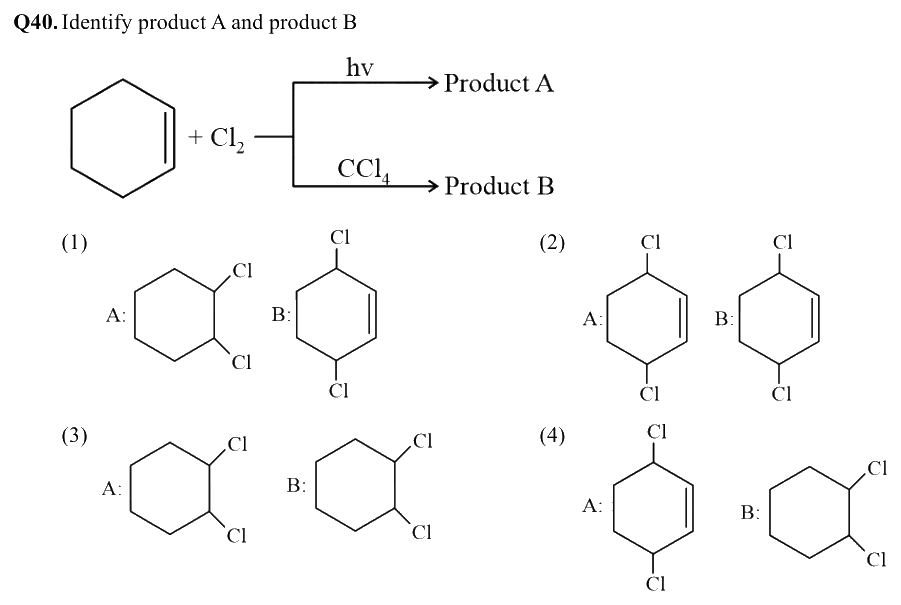
Identify product A and product B

(see the figure above)

The question and its figure as printed in JEE Main 2024 29 Jan Shift 1. Option 1: A: a cyclohexane ring with a Cl on each of the two carbons at the ends of its right-hand vertical edge (adjacent carbons). B: a cyclohexene ring with the C=C on the right-hand vertical edge, a Cl on the top vertex and a Cl on the bottom vertex. Option 2: A: a cyclohexene ring with the C=C on the right-hand vertical edge, a Cl on the top vertex and a Cl on the bottom vertex. B: the same drawing as A (cyclohexene with C=C on the right edge, Cl on the top and bottom vertices). Option 3: A: a cyclohexane ring with a Cl on each of the two carbons at the ends of its right-hand vertical edge (adjacent carbons). B…
The question as printed in the paper.
  • A

    see figure A: a cyclohexane ring with a Cl on each of the two carbons at the ends of its right-hand vertical edge (adjacent carbons). B: a cyclohexene ring with the C=C on the right-hand vertical edge, a Cl on the top vertex and a Cl on the bottom vertex.

  • B

    see figure A: a cyclohexene ring with the C=C on the right-hand vertical edge, a Cl on the top vertex and a Cl on the bottom vertex. B: the same drawing as A (cyclohexene with C=C on the right edge, Cl on the top and bottom vertices).

  • C

    see figure A: a cyclohexane ring with a Cl on each of the two carbons at the ends of its right-hand vertical edge (adjacent carbons). B: the same drawing as A.

  • D

    see figure A: a cyclohexene ring with the C=C on the right-hand vertical edge, a Cl on the top vertex and a Cl on the bottom vertex. B: a cyclohexane ring with a Cl on each of the two carbons at the ends of its right-hand vertical edge (adjacent carbons).

66JEE Main 2024 · 29 Jan · Shift 1MCQOpen question page ↗

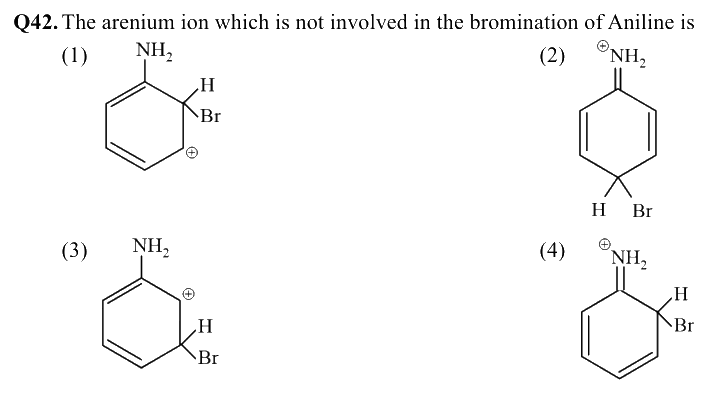
The arenium ion which is not involved in the bromination of Aniline is

The question and its figure as printed in JEE Main 2024 29 Jan Shift 1. Option 1: A six-membered ring: NH2 on the top vertex, which is double-bonded to the upper-left vertex; the upper-right vertex is a carbon bearing H and Br (drawn up-right and down-right); a is drawn at the lower-right vertex; the lower-left edge between the left-lower and bottom vertices is a double bond. Option 2: A six-membered ring: 2 double-bonded to the top vertex; the left and right vertical edges are double bonds; the bottom vertex carries H (down-left) and Br (down-right). Option 3: A six-membered ring: NH2 on the top vertex, which is double-bonded to the upper-left vertex; a is drawn at the upper-right vertex…
The question as printed in the paper.
  • A

    see figure A six-membered ring: NH$_2$ on the top vertex, which is double-bonded to the upper-left vertex; the upper-right vertex is a carbon bearing H and Br (drawn up-right and down-right); a $\oplus$ is drawn at the lower-right vertex; the lower-left edge between the left-lower and bottom vertices is a double bond.

  • B

    see figure A six-membered ring: $\oplus$NH$_2$ double-bonded to the top vertex; the left and right vertical edges are double bonds; the bottom vertex carries H (down-left) and Br (down-right).

  • C

    see figure A six-membered ring: NH$_2$ on the top vertex, which is double-bonded to the upper-left vertex; a $\oplus$ is drawn at the upper-right vertex; the lower-right vertex carries H and Br; a double bond lies on the lower-left edge between the left-lower and bottom vertices.

  • D

    see figure A six-membered ring: $\oplus$NH$_2$ double-bonded to the top vertex; the upper-right vertex carries H and Br; a double bond lies on the left vertical edge and another on the lower-right edge between the bottom and lower-right vertices.

67JEE Main 2024 · 29 Jan · Shift 2MCQOpen question page ↗

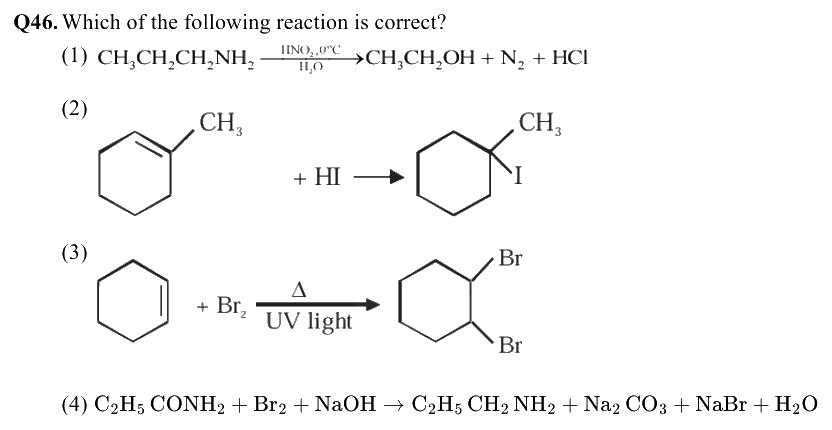
Which of the following reaction is correct?

The question and its figure as printed in JEE Main 2024 29 Jan Shift 2. Option 2: 1-methylcyclohexene (ring with a CH3 group on a ring carbon and a C=C in the ring on the adjacent upper edge) + HI gives a cyclohexane ring with CH3 and I both on the same ring carbon. Option 3: Cyclohexene (C=C drawn on the right edge of the ring) + Br2 with Δ above and 'UV light' below the arrow gives a cyclohexane ring with a Br on each of two adjacent ring carbons on its right side.
The question as printed in the paper.
  • A

    $\mathrm{CH_3CH_2CH_2NH_2 \xrightarrow[H_2O]{HNO_2,\,0^\circ C} CH_3CH_2OH + N_2 + HCl}$

  • B

    see figure 1-methylcyclohexene (ring with a CH3 group on a ring carbon and a C=C in the ring on the adjacent upper edge) + HI gives a cyclohexane ring with CH3 and I both on the same ring carbon.

  • C

    see figure Cyclohexene (C=C drawn on the right edge of the ring) + $\mathrm{Br_2}$ with $\Delta$ above and 'UV light' below the arrow gives a cyclohexane ring with a Br on each of two adjacent ring carbons on its right side.

  • D

    $\mathrm{C_2H_5\,CONH_2 + Br_2 + NaOH \rightarrow C_2H_5\,CH_2\,NH_2 + Na_2\,CO_3 + NaBr + H_2O}$

68JEE Main 2024 · 27 Jan · Shift 2MCQOpen question page ↗

The incorrect statement regarding conformations of ethane is:

  • A

    Ethane has infinite number of conformations

  • B

    The dihedral angle in staggered conformation is 60°

  • C

    Eclipsed conformation is the most stable conformation.

  • D

    The conformations of ethane are interconvertible to one-another

69JEE Main 2024 · 27 Jan · Shift 2MCQOpen question page ↗

The final product A, formed in the following reaction sequence is:

$$\mathrm{Ph{-}CH{=}CH_2} \xrightarrow{\text{(i) } \mathrm{BH_3};\ \text{(ii) } \mathrm{H_2O_2},\ \overset{\ominus}{\mathrm{OH}};\ \text{(iii) HBr};\ \text{(iv) Mg, ether, then } \mathrm{HCHO/H_3O^{+}}} A$$

  • A

    $\mathrm{Ph - CH_2 - CH_2 - CH_3}$

  • B

    $\mathrm{Ph - CH(CH_3) - CH_3}$

  • C

    $\mathrm{Ph - CH(CH_2OH) - CH_3}$

  • D

    $\mathrm{Ph - CH_2 - CH_2 - CH_2 - OH}$

70JEE Main 2023 · 15 Apr · Shift 1MCQOpen question page ↗

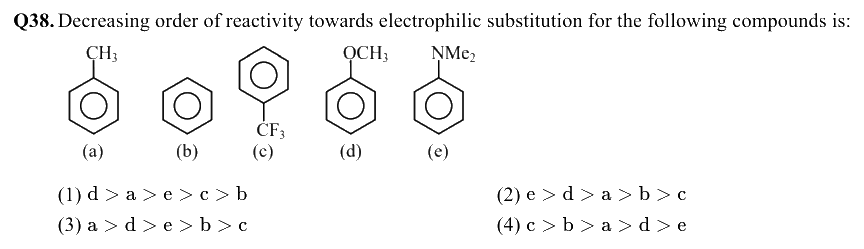
Decreasing order of reactivity towards electrophilic substitution for the following compounds is:

(see the figure above)

The question and its figure as printed in JEE Main 2023 15 Apr Shift 1.
The question as printed in the paper.
  • A

    d $>$ a $>$ e $>$ c $>$ b

  • B

    e $>$ d $>$ a $>$ b $>$ c

  • C

    a $>$ d $>$ e $>$ b $>$ c

  • D

    c $>$ b $>$ a $>$ d $>$ e

71JEE Main 2023 · 15 Apr · Shift 1MCQOpen question page ↗

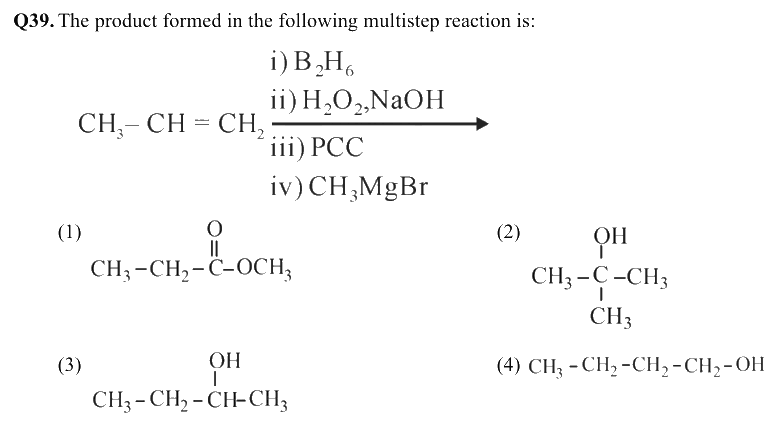
The product formed in the following multistep reaction is:
$\mathrm{CH_3{-}CH{=}CH_2}$ $\xrightarrow[\text{iii) PCC}]{\text{i) B}_2\text{H}_6;\ \text{ii) H}_2\text{O}_2,\text{NaOH};\ \text{iv) CH}_3\text{MgBr}}$

(see the figure above)

The question and its figure as printed in JEE Main 2023 15 Apr Shift 1.
The question as printed in the paper.
  • A

    $\mathrm{CH_3{-}CH_2{-}C(=O){-}OCH_3}$

  • B

    $\mathrm{CH_3{-}C(OH)(CH_3){-}CH_3}$

  • C

    $\mathrm{CH_3{-}CH_2{-}CH(OH){-}CH_3}$

  • D

    $\mathrm{CH_3\,{-}CH_2{-}CH_2{-}CH_2{-}OH}$

72JEE Main 2023 · 15 Apr · Shift 1MCQOpen question page ↗

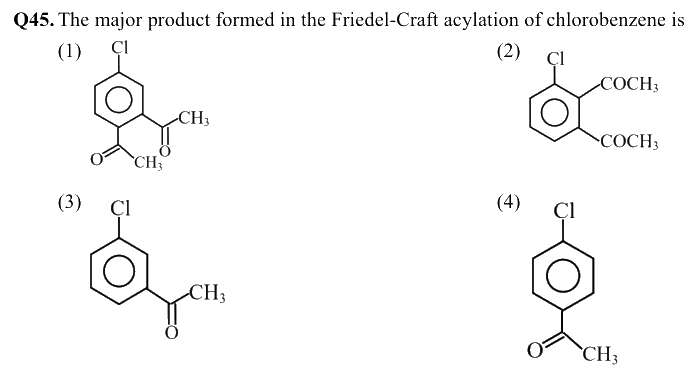
The major product formed in the Friedel-Craft acylation of chlorobenzene is

(see the figure above)

The question and its figure as printed in JEE Main 2023 15 Apr Shift 1.
The question as printed in the paper.
  • A

    (structure drawn, see figure)

  • B

    (structure drawn, see figure)

  • C

    (structure drawn, see figure)

  • D

    (structure drawn, see figure)

73JEE Main 2023 · 13 Apr · Shift 1MCQOpen question page ↗

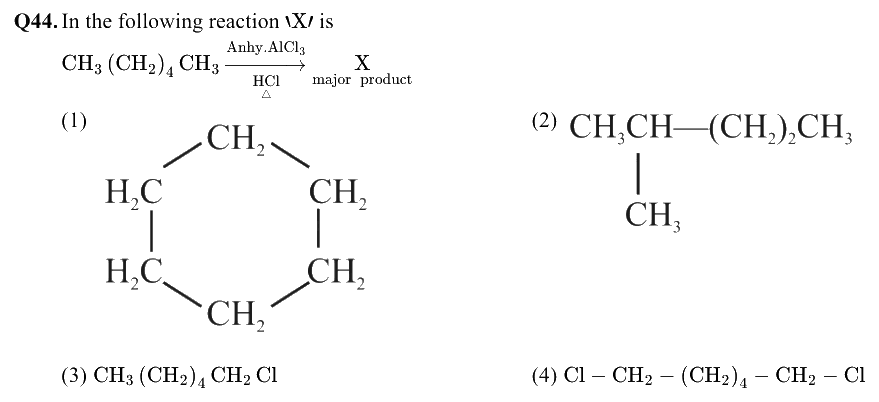
In the following reaction X is
$\mathrm{CH_3\,(CH_2)_4\,CH_3} \xrightarrow[\Delta]{\text{Anhy.AlCl}_3 / \text{HCl}} X$ major product

(see the figure above)

The question and its figure as printed in JEE Main 2023 13 Apr Shift 1.
The question as printed in the paper.
  • A

    (structure drawn, see figure)

  • B

    $\mathrm{CH_3CH{-}(CH_2)_2CH_3}$ with a $\mathrm{CH_3}$ on the CH

  • C

    $\mathrm{CH_3\,(CH_2)_4\,CH_2\,Cl}$

  • D

    $\mathrm{Cl - CH_2 - (CH_2)_4 - CH_2 - Cl}$

74JEE Main 2023 · 12 Apr · Shift 1MCQOpen question page ↗

$\mathrm{2 - hexene}\ \xrightarrow[\text{(ii) } \mathrm{H_2O}]{\text{(i) } \mathrm{O_3}}\ \text{Products}$
The two products formed in above reaction are

  • A

    Butanal and acetaldehyde

  • B

    Butanoic acid and acetaldehyde

  • C

    Butanal and acetic acid

  • D

    Butanoic acid and acetic acid

75JEE Main 2023 · 11 Apr · Shift 1MCQOpen question page ↗

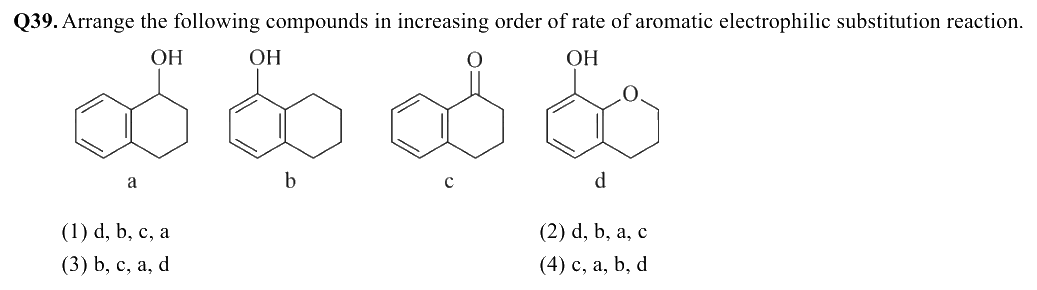
Arrange the following compounds in increasing order of rate of aromatic electrophilic substitution reaction.
(see the figure above)

The question and its figure as printed in JEE Main 2023 11 Apr Shift 1.
The question as printed in the paper.
  • A

    d, b, c, a

  • B

    d, b, a, c

  • C

    b, c, a, d

  • D

    c, a, b, d

76JEE Main 2023 · 10 Apr · Shift 1MCQOpen question page ↗

The major product 'P' formed in the given reaction is
(see the figure above)

The question and its figure as printed in JEE Main 2023 10 Apr Shift 1.
The question as printed in the paper.
  • A

    see figure

  • B

    see figure

  • C

    see figure

  • D

    see figure

77JEE Main 2023 · 10 Apr · Shift 2MCQOpen question page ↗

The major product 'P' formed in the given reaction is
(see the figure above)

The question and its figure as printed in JEE Main 2023 10 Apr Shift 2.
The question as printed in the paper.
  • A

    see figure

  • B

    see figure

  • C

    see figure

  • D

    see figure

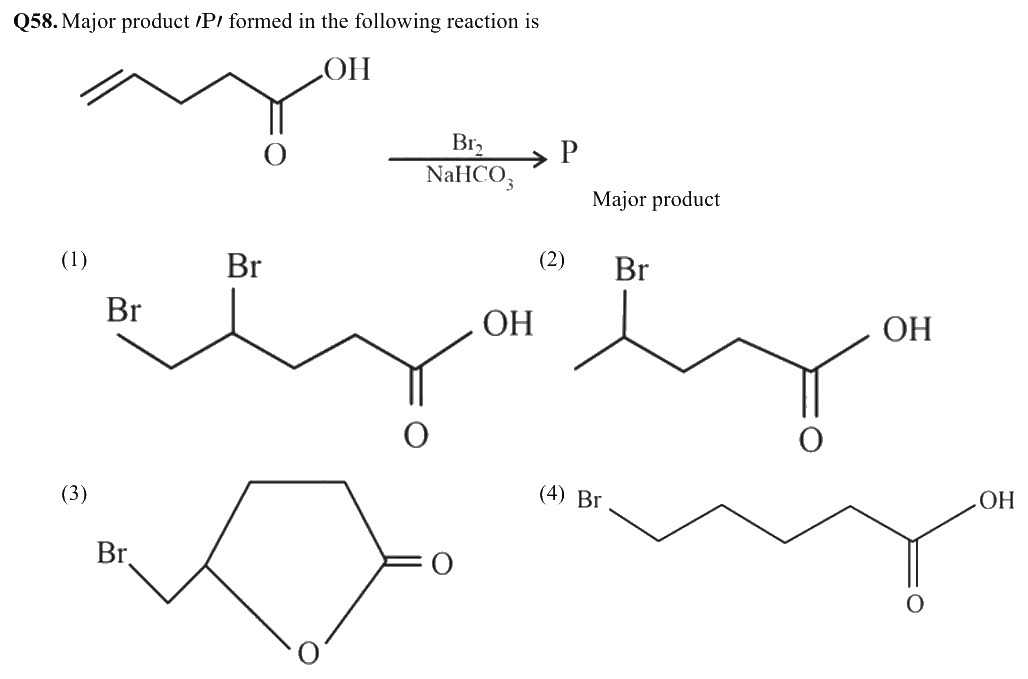
78JEE Main 2023 · 8 Apr · Shift 2MCQOpen question page ↗

Major product 'P' formed in the following reaction is

(see the figure above)

The question and its figure as printed in JEE Main 2023 08 Apr Shift 2. Option 1: Open-chain bromo acid: BrCH2-CHBr-CH2-CH2-COOH (a Br on the terminal carbon and a Br on the next carbon, then a chain to the COOH group with C=O drawn below and OH to the right). Option 2: Open-chain bromo acid: CH3-CHBr-CH2-CH2-COOH (one Br on the second carbon from the left end, chain to COOH). Option 3: A five-membered lactone ring (ring atoms: CH, CH2, CH2, C=O, ring O) with a CH2Br group on the ring carbon next to the ring O. Option 4: Open-chain bromo acid with the Br on the far-left terminal carbon of a four-carbon chain leading to COOH (BrCH2CH2CH2CH2-COOH).
The question as printed in the paper.
  • A

    see figure Open-chain bromo acid: BrCH2-CHBr-CH2-CH2-COOH (a Br on the terminal carbon and a Br on the next carbon, then a chain to the COOH group with C=O drawn below and OH to the right).

  • B

    see figure Open-chain bromo acid: CH3-CHBr-CH2-CH2-COOH (one Br on the second carbon from the left end, chain to COOH).

  • C

    see figure A five-membered lactone ring (ring atoms: CH, CH2, CH2, C=O, ring O) with a CH2Br group on the ring carbon next to the ring O.

  • D

    see figure Open-chain bromo acid with the Br on the far-left terminal carbon of a four-carbon chain leading to COOH (BrCH2CH2CH2CH2-COOH).

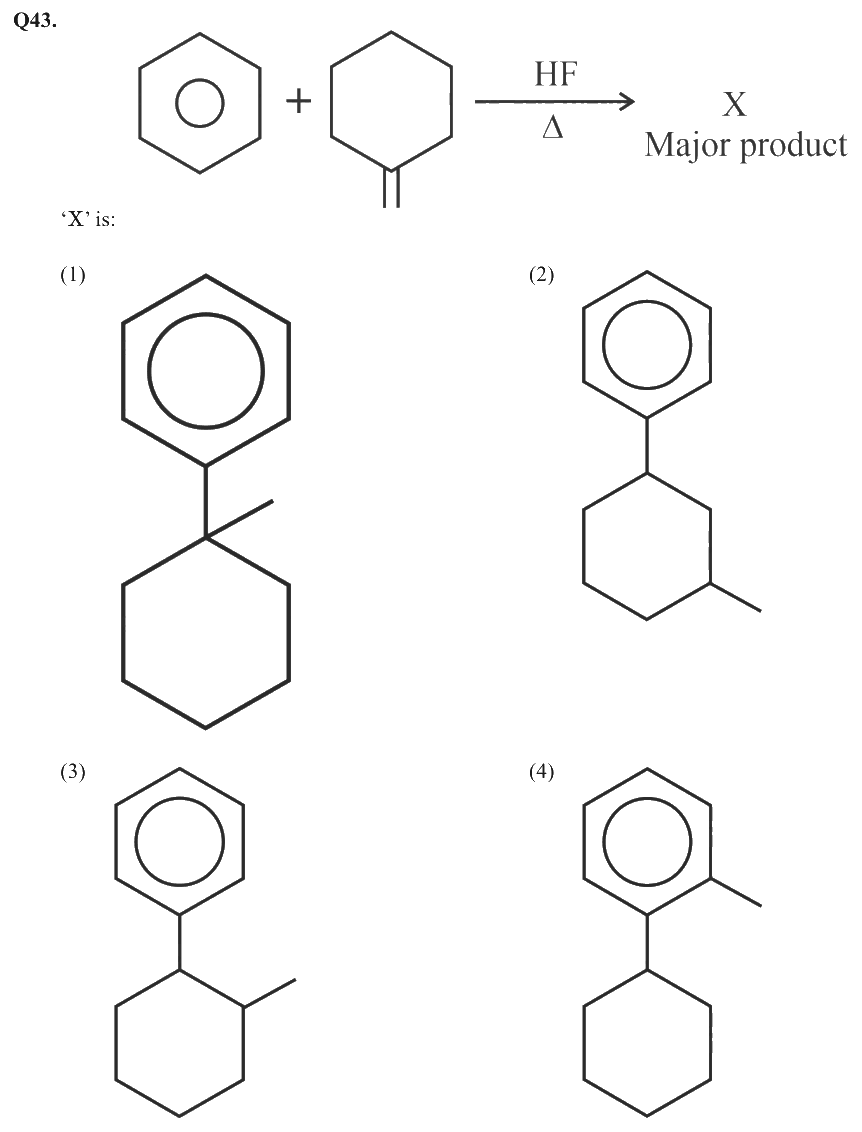
79JEE Main 2023 · 1 Feb · Shift 2MCQOpen question page ↗

see figure 'X' is:

The question and its figure as printed in JEE Main 2023 01 Feb Shift 2. Question: 'X' is: Option 1: a benzene ring (circle inside hexagon) attached to a cyclohexane carbon that also carries a methyl group (the same carbon bears both the phenyl and the methyl). Option 2: a benzene ring attached to a cyclohexane ring, with a methyl group on a ring carbon two positions away from the attached carbon (1,3). Option 3: a benzene ring attached to a cyclohexane ring, with a methyl group on the ring carbon next to the attached carbon (1,2). Option 4: a cyclohexane ring attached to a benzene ring, with a methyl group on the benzene ring carbon next to the attached carbon (ortho).
The question as printed in the paper.
  • A

    see figure a benzene ring (circle inside hexagon) attached to a cyclohexane carbon that also carries a methyl group (the same carbon bears both the phenyl and the methyl).

  • B

    see figure a benzene ring attached to a cyclohexane ring, with a methyl group on a ring carbon two positions away from the attached carbon (1,3).

  • C

    see figure a benzene ring attached to a cyclohexane ring, with a methyl group on the ring carbon next to the attached carbon (1,2).

  • D

    see figure a cyclohexane ring attached to a benzene ring, with a methyl group on the benzene ring carbon next to the attached carbon (ortho).

80JEE Main 2023 · 31 Jan · Shift 1MCQOpen question page ↗

Choose the correct set of reagents for the following conversion
transPh - CH = CH - CH$_3$ $\rightarrow$ cis Ph - CH = CH - CH$_3$

  • A

    $\mathrm{Br_2}$, alc KOH, $\mathrm{NaNH_2}$, $\mathrm{NaLiqNH_3}$

  • B

    $\mathrm{Br_2}$, alc KOH, $\mathrm{NaNH_2}$, $\mathrm{H_2}$ Lindlar Catalyst

  • C

    $\mathrm{Br_2}$, aqKOH, $\mathrm{NaNH_2}$, $\mathrm{H_2}$ Lindlar Catalyst

  • D

    $\mathrm{Br_2}$, aq KOH, $\mathrm{NaNH_2}$, $\mathrm{NaLiqNH_3}$

81JEE Main 2023 · 31 Jan · Shift 2MCQOpen question page ↗

A hydrocarbon 'X' with formula $\mathrm{C_6H_8}$ uses two moles of $\mathrm{H_2}$ on catalytic hydrogenation of its one mole. On ozonolysis, 'X' yields two moles of methane dicarbaldehyde. The hydrocarbon 'X' is :

  • A

    hexa-1, 3, 5-triene

  • B

    1-methylcyclopenta-1, 4$-$diene

  • C

    cyclohexa$-$1, 3$-$diene

  • D

    cyclohexa$-$1, 4$-$diene

82JEE Main 2023 · 30 Jan · Shift 1MCQOpen question page ↗

The major products 'A' and 'B', respectively, are

(see the figure above)

The question and its figure as printed in JEE Main 2023 30 Jan Shift 1.
The question as printed in the paper.
  • A

    see figure

  • B

    see figure

  • C

    see figure

  • D

    see figure

83JEE Main 2023 · 29 Jan · Shift 2MCQOpen question page ↗

The one giving maximum number of isomeric alkenes on dehydrohalogenation reaction is (excluding rearrangement)

  • A

    1-Bromo-2-methylbutane

  • B

    2-Bromopropane

  • C

    2-Bromopentane

  • D

    2-Bromo-3, 3-dimethylpentane

84JEE Main 2023 · 24 Jan · Shift 2MCQOpen question page ↗

Given below are two statements, one is labelled as Assertion A and the other is labelled as Reason R.

Assertion A : Benzene is more stable than hypothetical cyclohexatriene.

Reason R : The delocalized $\pi$ electron cloud is attracted more strongly by nuclei of carbon atoms.

In the light of the above statements, choose the correct answer from the options given below:

  • A

    A is true but R is false.

  • B

    A is false but R is true.

  • C

    Both A and R are correct and R is the correct explanation of A.

  • D

    Both A and R are correct but R is NOT the correct explanation of A.

85JEE Main 2023 · 24 Jan · Shift 2MCQOpen question page ↗

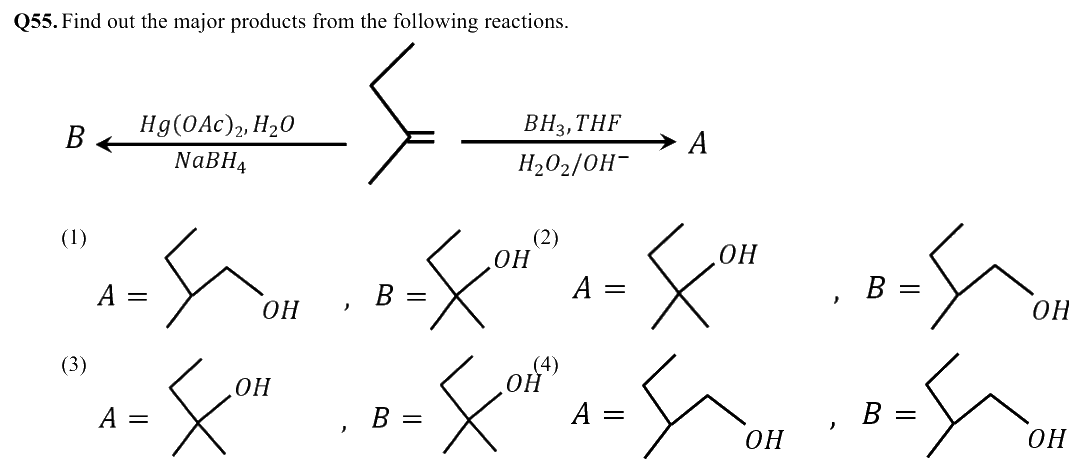
Find out the major products from the following reactions.

(see the figure above)

The question and its figure as printed in JEE Main 2023 24 Jan Shift 2.
The question as printed in the paper.
  • A

    $A=$ (see the figure above) , $B=$ (see the figure above)

  • B

    $A=$ (see the figure above) , $B=$ (see the figure above)

  • C

    $A=$ (see the figure above) , $B=$ (see the figure above)

  • D

    $A=$ (see the figure above) , $B=$ (see the figure above)

86JEE Main 2022 · 29 Jul · Shift 1MCQOpen question page ↗

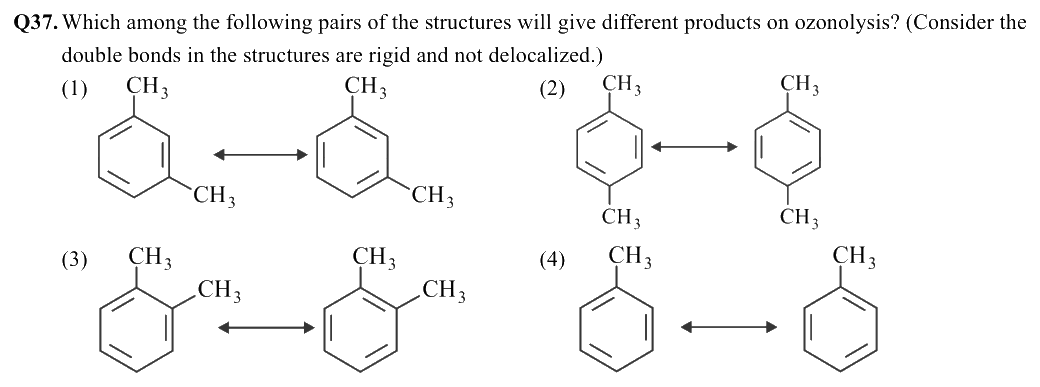
Which among the following pairs of the structures will give different products on ozonolysis? (Consider the double bonds in the structures are rigid and not delocalized.)

The question and its figure as printed in JEE Main 2022 29 Jul Shift 1. Option 1: two Kekule structures of 1,3-dimethylbenzene (m-xylene), joined by a double-headed arrow Option 2: two Kekule structures of 1,4-dimethylbenzene (p-xylene), joined by a double-headed arrow Option 3: two Kekule structures of 1,2-dimethylbenzene (o-xylene), joined by a double-headed arrow Option 4: two Kekule structures of methylbenzene (toluene), joined by a double-headed arrow
The question as printed in the paper.
  • A

    see figure two Kekule structures of 1,3-dimethylbenzene (m-xylene), joined by a double-headed arrow

  • B

    see figure two Kekule structures of 1,4-dimethylbenzene (p-xylene), joined by a double-headed arrow

  • C

    see figure two Kekule structures of 1,2-dimethylbenzene (o-xylene), joined by a double-headed arrow

  • D

    see figure two Kekule structures of methylbenzene (toluene), joined by a double-headed arrow

87JEE Main 2022 · 29 Jul · Shift 2MCQOpen question page ↗

When enthanol is heated with conc. $\mathrm{H_2SO_4}$, a gas is produced. The compound formed, when this gas is treated with cold dilute aqueous solution of Baeyer's reagent, is

  • A

    Formaldehyde

  • B

    Formic acid

  • C

    Glycol

  • D

    Ethanoic acid

88JEE Main 2022 · 28 Jul · Shift 1MCQOpen question page ↗

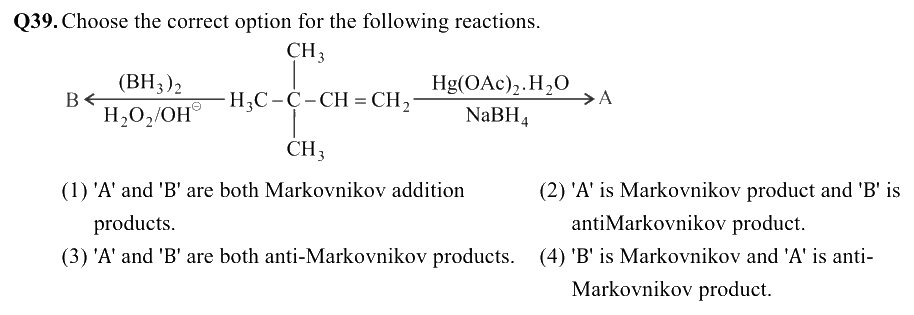
Choose the correct option for the following reactions.

(see the figure above)

The question and its figure as printed in JEE Main 2022 28 Jul Shift 1.
The question as printed in the paper.
  • A

    'A' and 'B' are both Markovnikov addition products.

  • B

    'A' is Markovnikov product and 'B' is antiMarkovnikov product.

  • C

    'A' and 'B' are both anti-Markovnikov products.

  • D

    'B' is Markovnikov product and 'A' is anti-Markovnikov product.

89JEE Main 2022 · 28 Jul · Shift 1MCQOpen question page ↗

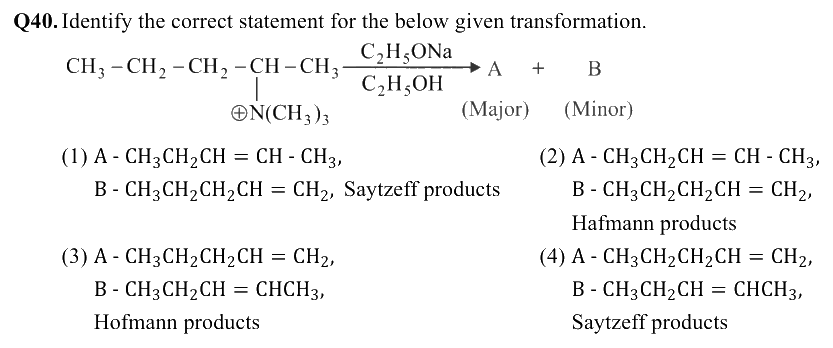
Identify the correct statement for the below given transformation.

(see the figure above)

The question and its figure as printed in JEE Main 2022 28 Jul Shift 1.
The question as printed in the paper.
  • A

    A - $\mathrm{CH_3CH_2CH=CH-CH_3}$, B - $\mathrm{CH_3CH_2CH_2CH=CH_2}$, Saytzeff products

  • B

    A - $\mathrm{CH_3CH_2CH=CH-CH_3}$, B - $\mathrm{CH_3CH_2CH_2CH=CH_2}$, Hafmann products

  • C

    A - $\mathrm{CH_3CH_2CH_2CH=CH_2}$, B - $\mathrm{CH_3CH_2CH=CHCH_3}$, Hofmann products

  • D

    A - $\mathrm{CH_3CH_2CH_2CH=CH_2}$, B - $\mathrm{CH_3CH_2CH=CHCH_3}$, Saytzeff products

90JEE Main 2022 · 28 Jul · Shift 2MCQOpen question page ↗

Arrange the following in increasing order of reactivity towards nitration
A. p-xylene
B. bromobenzene
C. mesitylene
D. nitrobenzene
E. benzene
Choose the correct answer from the options given below

  • A

    $\mathrm{C<D<E<A<B}$

  • B

    $\mathrm{D<B<E<A<C}$

  • C

    $\mathrm{D<C<E<A<B}$

  • D

    $\mathrm{C<D<E<B<A}$

91JEE Main 2022 · 28 Jul · Shift 2MCQOpen question page ↗

see figure Find out the major product for the above reaction.

The question and its figure as printed in JEE Main 2022 28 Jul Shift 2. Question: Find out the major product for the above reaction. Option 1: bicyclic lactone: cyclohexane ring fused to a five-membered lactone ring (ring O and C=O), with the C=C at the ring fusion between the two fusion carbons Option 2: six-membered ring with a CH2CO2H side chain and an iodine on the same ring carbon, and a second iodine on a neighbouring ring carbon; a double bond is drawn in the ring (exact position not fully resolved) Option 3: bicyclic lactone: cyclohexane ring fused to a five-membered lactone ring (ring O and C=O), with the C=C inside the five-membered ring next to the fusion carbon Option 4…
The question as printed in the paper.
  • A

    see figure bicyclic lactone: cyclohexane ring fused to a five-membered lactone ring (ring O and C=O), with the C=C at the ring fusion between the two fusion carbons

  • B

    see figure six-membered ring with a $\mathrm{CH_2CO_2H}$ side chain and an iodine on the same ring carbon, and a second iodine on a neighbouring ring carbon; a double bond is drawn in the ring (exact position not fully resolved)

  • C

    see figure bicyclic lactone: cyclohexane ring fused to a five-membered lactone ring (ring O and C=O), with the C=C inside the five-membered ring next to the fusion carbon

  • D

    see figure bicyclic lactone: cyclohexene ring fused to a five-membered lactone ring (ring O and C=O), with the C=C in the six-membered ring next to the fusion carbon

92JEE Main 2022 · 27 Jul · Shift 2MCQOpen question page ↗

Major product 'B' of the following reaction sequence is
(see the figure above)

The question and its figure as printed in JEE Main 2022 27 Jul Shift 2. Option 1: CH3-C(OH)(CH3)-CH(Br)-CH3 drawn as CH3-C-CH-CH3 with HO above the first carbon, Br above the second carbon, and CH3 below the first carbon. Option 2: CH3-C(I)(CH3)-CH(Br)-CH3: I above the first carbon, Br above the second carbon, CH3 below the first. Option 3: CH3-C(Br)(CH3)-CH(OH)-CH3: Br above the first carbon, OH above the second carbon, CH3 below the first. Option 4: CH3-C(Br)(CH3)-CH(I)-CH3: Br above the first carbon, I above the second carbon, CH3 below the first.
The question as printed in the paper.
  • A

    see figure $\mathrm{CH_3-C(OH)(CH_3)-CH(Br)-CH_3}$ drawn as $\mathrm{CH_3-C-CH-CH_3}$ with HO above the first carbon, Br above the second carbon, and $\mathrm{CH_3}$ below the first carbon.

  • B

    see figure $\mathrm{CH_3-C(I)(CH_3)-CH(Br)-CH_3}$: I above the first carbon, Br above the second carbon, $\mathrm{CH_3}$ below the first.

  • C

    see figure $\mathrm{CH_3-C(Br)(CH_3)-CH(OH)-CH_3}$: Br above the first carbon, OH above the second carbon, $\mathrm{CH_3}$ below the first.

  • D

    see figure $\mathrm{CH_3-C(Br)(CH_3)-CH(I)-CH_3}$: Br above the first carbon, I above the second carbon, $\mathrm{CH_3}$ below the first.

93JEE Main 2022 · 26 Jul · Shift 1MCQOpen question page ↗

The major product formed in the given reaction is:
(see the figure above)

The question and its figure as printed in JEE Main 2022 26 Jul Shift 1. Option 1: A cyclohexadiene ring: OCH3 on the upper-right carbon and O2N on the adjacent upper-left carbon, the C(NO2)=C(OCH3) bond is a double bond; a second double bond on the lower right edge; the other two ring carbons are CH2. Option 2: A cyclohexadiene ring: OCH3 on the top carbon with a double bond to the upper-right carbon; O2N on the lower-left carbon (meta to OCH3), double bonded to the bottom carbon; the other two ring carbons are CH2. Option 3: A cyclohexadiene ring: OCH3 on the top carbon with a double bond to the upper-right carbon; O2N on the adjacent upper-left carbon (no double bond at this carbon); a…
The question as printed in the paper.
  • A

    see figure A cyclohexadiene ring: $\mathrm{OCH_3}$ on the upper-right carbon and $\mathrm{O_2N}$ on the adjacent upper-left carbon, the C(NO2)=C(OCH3) bond is a double bond; a second double bond on the lower right edge; the other two ring carbons are CH2.

  • B

    see figure A cyclohexadiene ring: $\mathrm{OCH_3}$ on the top carbon with a double bond to the upper-right carbon; $\mathrm{O_2N}$ on the lower-left carbon (meta to OCH3), double bonded to the bottom carbon; the other two ring carbons are CH2.

  • C

    see figure A cyclohexadiene ring: $\mathrm{OCH_3}$ on the top carbon with a double bond to the upper-right carbon; $\mathrm{O_2N}$ on the adjacent upper-left carbon (no double bond at this carbon); a second double bond on the lower-left edge; the other two ring carbons are CH2 or CH.

  • D

    see figure A cyclohexadiene ring: $\mathrm{OCH_3}$ on the top carbon with a double bond to the upper-right carbon; $\mathrm{NO_2}$ on the bottom carbon (para to OCH3) with a double bond to the lower-left carbon; the other two ring carbons are CH2.

94JEE Main 2022 · 25 Jul · Shift 1MCQOpen question page ↗

A compound 'A' on reaction with 'X' and 'Y produces the same major product but different by product 'a' and 'b'. Oxidation of 'a' gives a substance produced by ants.

(see the figure above)
'X' and 'Y' respectively are

The question and its figure as printed in JEE Main 2022 25 Jul Shift 1.
The question as printed in the paper.
  • A

    $\mathrm{KMnO_4 / H^+}$ and dil. $\mathrm{KMnO_4}$, 273 K

  • B

    $\mathrm{KMnO_4}$,(dilute), 273 K and $\mathrm{KMnO_4 / H^+}$

  • C

    $\mathrm{KMnO_4 / H^+}$ and $\mathrm{O_3, H_2O / Zn}$

  • D

    $\mathrm{O_3, H_2O / Zn}$ and $\mathrm{KMnO_4 / H^+}$

95JEE Main 2022 · 25 Jul · Shift 2MCQOpen question page ↗

Major product of the following reaction is

(see the figure above)

The question and its figure as printed in JEE Main 2022 25 Jul Shift 2. Option 1: CH3-CHBr-C(=O)-O-CH2CH2CH2-Br drawn as a skeletal structure: ester with a Br on the carbon next to the C=O (the other side of the C=O carbon is a methyl), and a three-carbon chain on the oxygen ending in Br. Option 2: Br-CH2CH2-C(=O)-O-CH2-CHBr-CH3 drawn as a skeletal structure: Br on the terminal carbon of a three-carbon acyl chain, and on the oxygen side a CH2 followed by a carbon bearing Br and a methyl. Option 3: CH3-CHBr-C(=O)-O-CH2-CHBr-CH3 drawn as a skeletal structure: Br on the carbon next to the C=O on the acyl side, and on the oxygen side a CH2 followed by a carbon bearing Br and a methyl. Option…
The question as printed in the paper.
  • A

    see figure $\mathrm{CH_3-CHBr-C(=O)-O-CH_2CH_2CH_2-Br}$ drawn as a skeletal structure: ester with a Br on the carbon next to the C=O (the other side of the C=O carbon is a methyl), and a three-carbon chain on the oxygen ending in Br.

  • B

    see figure $\mathrm{Br-CH_2CH_2-C(=O)-O-CH_2-CHBr-CH_3}$ drawn as a skeletal structure: Br on the terminal carbon of a three-carbon acyl chain, and on the oxygen side a CH2 followed by a carbon bearing Br and a methyl.

  • C

    see figure $\mathrm{CH_3-CHBr-C(=O)-O-CH_2-CHBr-CH_3}$ drawn as a skeletal structure: Br on the carbon next to the C=O on the acyl side, and on the oxygen side a CH2 followed by a carbon bearing Br and a methyl.

  • D

    see figure $\mathrm{Br-CH_2CH_2-C(=O)-O-CH_2CH_2CH_2-Br}$ drawn as a skeletal structure: Br on the terminal carbon of the three-carbon acyl chain and Br on the end of the three-carbon chain on the oxygen.

96JEE Main 2022 · 29 Jun · Shift 1MCQOpen question page ↗

Two isomers 'A' and 'B' with molecular formula $\mathrm{C_4H_8}$ give different products on oxidation with $\mathrm{KMnO_4}$ in acidic medium. Isomer 'A' on reaction with $\mathrm{KMnO_4/H^+}$ results in effervescence of a gas and gives ketone. The compound 'A' is

  • A

    But-1-ene.

  • B

    cis-But-2-ene.

  • C

    trans-But-2-ene.

  • D

    2-methyl propene.

97JEE Main 2022 · 28 Jun · Shift 1MCQOpen question page ↗

The major product (P) in the reaction

(see the figure above) $\xrightarrow{\mathrm{HBr}}$ ? (P) [Ph is - $\mathrm{C_6H_5}$]

The question and its figure as printed in JEE Main 2022 28 Jun Shift 1. Option 1: Ph-CH(Br)-CH(Br)-CH2Br, drawn as a zigzag chain. Option 2: Ph-CH(Br)-CH2-CH2-Br, drawn as a zigzag chain. Option 3: Ph-CH2-CH(Br)-CH2-Br, drawn as a zigzag chain. Option 4: Ph-CH(Br)-CH=CH-Br, drawn as a zigzag chain with the double bond drawn trans between the third and fourth carbon.
The question as printed in the paper.
  • A

    see figure Ph-CH(Br)-CH(Br)-CH$_2$Br, drawn as a zigzag chain.

  • B

    see figure Ph-CH(Br)-CH$_2$-CH$_2$-Br, drawn as a zigzag chain.

  • C

    see figure Ph-CH$_2$-CH(Br)-CH$_2$-Br, drawn as a zigzag chain.

  • D

    see figure Ph-CH(Br)-CH=CH-Br, drawn as a zigzag chain with the double bond drawn trans between the third and fourth carbon.

98JEE Main 2022 · 28 Jun · Shift 2MCQOpen question page ↗

Consider the following reaction,
A $\xrightarrow[\text{2. CN}^{-}]{\text{1. Cl}_2\,/\,hv}$ $\xrightarrow{\text{3. H}_2\text{O/H}^{+}/\Delta}$ 4 $-$ bromophenylacetic acid
What is A in the above reaction?

The question and its figure as printed in JEE Main 2022 28 Jun Shift 2. Option 1: A benzene ring with Br at the top and CH2CH3 (ethyl) at the bottom (para): 4-bromoethylbenzene. Option 2: Bromobenzene: a benzene ring with only a Br substituent. Option 3: A benzene ring with Br at the top and CH3 at the bottom (para): 4-bromotoluene. Option 4: A benzene ring with a CH=CH2 (vinyl) group at the upper right and Br at the lower left (para): 4-bromostyrene.
The question as printed in the paper.
  • A

    see figure A benzene ring with Br at the top and CH2CH3 (ethyl) at the bottom (para): 4-bromoethylbenzene.

  • B

    see figure Bromobenzene: a benzene ring with only a Br substituent.

  • C

    see figure A benzene ring with Br at the top and CH3 at the bottom (para): 4-bromotoluene.

  • D

    see figure A benzene ring with a CH=CH2 (vinyl) group at the upper right and Br at the lower left (para): 4-bromostyrene.

99JEE Main 2022 · 27 Jun · Shift 1MCQOpen question page ↗

'A' and 'B' respectively are
A. $\xrightarrow[\text{(2)Zn-H}_2\text{O}]{\text{(1)O}_3}$ Ethane-1, 2-dicarbaldehyde +Glyoxal/Oxaldehyde
B $\xrightarrow[\text{(2)Zn-H}_2\text{O}]{\text{(1)O}_3}$ 5$-$ -oxohexanal

  • A

    1-methylcyclohex-1, 3-diene & cyclopentene.

  • B

    Cyclohex-1, 3-diene & cyclopentene

  • C

    Cyclohex-1, 3-diene & 1-methylcyclopent-1-ene

  • D

    1-methylcyclohex- 1, 4-diene & 1-methylcyclopent-1-ene

100JEE Main 2022 · 27 Jun · Shift 2MCQOpen question page ↗

What will be the major product of following sequence of reactions?
$\mathrm{n - Bu - \equiv}$ $\xrightarrow{\text{(i) n - BuLi, n - C}_5\text{H}_{11}\text{Cl; (ii) Lindlar cat, H}_2}$

The question and its figure as printed in JEE Main 2022 27 Jun Shift 2. Option 1: A C=C double bond with, on the right carbon, two substituents drawn n - Bu (one up, one down), and on the left carbon one substituent H11C5 (down-left). Option 2: A C=C double bond with, on the right carbon, n - Bu (up) and H11C5 (down), and on the left carbon n - Bu (down-left). Option 3: A cis-drawn C=C double bond (both substituents on the same side, up): H11C5 on the left carbon and n - Bu on the right carbon. Option 4: A trans-drawn C=C double bond: C5H11 on the left carbon pointing up, n - Bu on the right carbon pointing down.
The question as printed in the paper.
  • A

    see figure A C=C double bond with, on the right carbon, two substituents drawn n - Bu (one up, one down), and on the left carbon one substituent H_11C_5 (down-left).

  • B

    see figure A C=C double bond with, on the right carbon, n - Bu (up) and H_11C_5 (down), and on the left carbon n - Bu (down-left).

  • C

    see figure A cis-drawn C=C double bond (both substituents on the same side, up): H_11C_5 on the left carbon and n - Bu on the right carbon.

  • D

    see figure A trans-drawn C=C double bond: C_5H_11 on the left carbon pointing up, n - Bu on the right carbon pointing down.

101JEE Main 2022 · 27 Jun · Shift 2MCQOpen question page ↗

Product 'A' of following sequence of reactions is
Ethylbenzene $\xrightarrow{\text{(a) Br}_2\text{, Fe; (b) Cl}_2\text{, }\Delta\text{; (c) alc. KOH}}$ 'A' (Major product)

The question and its figure as printed in JEE Main 2022 27 Jun Shift 2. Option 1: A benzene ring carrying the substituent C(CH3)=CH2 (alpha-methylstyrene). Option 2: A benzene ring carrying the substituent C(Br)=CH2. Option 3: A benzene ring with Br at the para position and, at the other para position, a Cl atom drawn joined to the ring by a triple-bond mark (Cl with three vertical lines down to the ring), as printed. Option 4: A benzene ring with Br at the para position and, at the other para position, the substituent HC=CH2 as printed.
The question as printed in the paper.
  • A

    see figure A benzene ring carrying the substituent C(CH_3)=CH_2 (alpha-methylstyrene).

  • B

    see figure A benzene ring carrying the substituent C(Br)=CH_2.

  • C

    see figure A benzene ring with Br at the para position and, at the other para position, a Cl atom drawn joined to the ring by a triple-bond mark (Cl with three vertical lines down to the ring), as printed.

  • D

    see figure A benzene ring with Br at the para position and, at the other para position, the substituent HC=CH_2 as printed.

102JEE Main 2022 · 26 Jun · Shift 2MCQOpen question page ↗

see figure

The question and its figure as printed in JEE Main 2022 26 Jun Shift 2. Option 1: 3,3-dimethylbutan-2-ol: skeletal structure with a quaternary carbon bearing three methyl lines and bonded to a CH carbon that carries OH and a methyl Option 2: 2,2-dimethylpropanal (pivaldehyde): quaternary carbon with three methyl lines bonded to CH=O, drawn with O above and H to the right of the carbonyl carbon Option 3: 2,3-dimethylbutan-2-ol: skeletal structure, a carbon bearing OH and a methyl bonded to a CH that carries two methyl lines Option 4: 3,3-dimethylbutan-1-ol: quaternary carbon with three methyl lines, then CH2-CH2-OH
The question as printed in the paper.
  • A

    see figure 3,3-dimethylbutan-2-ol: skeletal structure with a quaternary carbon bearing three methyl lines and bonded to a CH carbon that carries OH and a methyl

  • B

    see figure 2,2-dimethylpropanal (pivaldehyde): quaternary carbon with three methyl lines bonded to CH=O, drawn with O above and H to the right of the carbonyl carbon

  • C

    see figure 2,3-dimethylbutan-2-ol: skeletal structure, a carbon bearing OH and a methyl bonded to a CH that carries two methyl lines

  • D

    see figure 3,3-dimethylbutan-1-ol: quaternary carbon with three methyl lines, then CH2-CH2-OH

103JEE Main 2022 · 26 Jun · Shift 2MCQOpen question page ↗

Halogenation of which one of the following will yield m-substituted product with respect to methyl group as a major product?

The question and its figure as printed in JEE Main 2022 26 Jun Shift 2. Option 1: benzene ring with CH3 at the top and CHO at the meta position (lower right) Option 2: benzene ring with CH3 at the top and NO2 on the adjacent (ortho) carbon on the right Option 3: benzene ring with CH3 at the top left and OH on the adjacent (ortho) carbon Option 4: benzene ring with CH3 at the top and NO2 at the meta position (lower right)
The question as printed in the paper.
  • A

    see figure benzene ring with CH3 at the top and CHO at the meta position (lower right)

  • B

    see figure benzene ring with CH3 at the top and NO2 on the adjacent (ortho) carbon on the right

  • C

    see figure benzene ring with CH3 at the top left and OH on the adjacent (ortho) carbon

  • D

    see figure benzene ring with CH3 at the top and NO2 at the meta position (lower right)

104JEE Main 2022 · 25 Jun · Shift 1MCQOpen question page ↗

The product formed in the following reaction.
(see the figure above)
is:

The question and its figure as printed in JEE Main 2022 25 Jun Shift 1. Option 1: (CH3)2CH-CH2-CH2-CH(CH3)2 (each CH has two CH3 groups) Option 2: (CH3)2CH-CH2-C(CH3)3 (left carbon with two CH3 and an H; right carbon with CH3 above, CH3 to the right and CH3 below) Option 3: CH3-CH-CH-CH(CH3)2 (a CH3 below each of the first two CH carbons; two CH3 on the last CH) Option 4: CH3-C-C-CH (each of the two central C has CH3 above and CH3 below; the chain ends with CH as printed)
The question as printed in the paper.
  • A

    see figure $(\mathrm{CH}_3)_2\mathrm{CH}-\mathrm{CH}_2-\mathrm{CH}_2-\mathrm{CH}(\mathrm{CH}_3)_2$ (each CH has two CH3 groups)

  • B

    see figure $(\mathrm{CH}_3)_2\mathrm{CH}-\mathrm{CH}_2-\mathrm{C}(\mathrm{CH}_3)_3$ (left carbon with two CH3 and an H; right carbon with CH3 above, CH3 to the right and CH3 below)

  • C

    see figure $\mathrm{CH}_3-\mathrm{CH}-\mathrm{CH}-\mathrm{CH}(\mathrm{CH}_3)_2$ (a CH3 below each of the first two CH carbons; two CH3 on the last CH)

  • D

    see figure $\mathrm{CH}_3-\mathrm{C}-\mathrm{C}-\mathrm{CH}$ (each of the two central C has CH3 above and CH3 below; the chain ends with CH as printed)

105JEE Main 2022 · 25 Jun · Shift 2MCQOpen question page ↗

Amongst the following, the major product of the given chemical reaction is
(see the figure above)

The question and its figure as printed in JEE Main 2022 25 Jun Shift 2.
The question as printed in the paper.
  • A

    see figure

  • B

    see figure

  • C

    see figure

  • D

    see figure

106JEE Main 2022 · 24 Jun · Shift 1MCQOpen question page ↗

In the given reaction sequence, the major product 'C' is :
$\mathrm{C_8H_{10}} \xrightarrow[\mathrm{H_2SO_4}]{\mathrm{HNO_3}} \mathrm{A} \xrightarrow[\Delta]{\mathrm{Br_2}} \mathrm{B} \xrightarrow[\mathrm{KOH}]{\mathrm{alcoholic}} \mathrm{C}$

The question and its figure as printed in JEE Main 2022 24 Jun Shift 1.
The question as printed in the paper.
  • A

    see figure

  • B

    see figure

  • C

    see figure

  • D

    see figure

107JEE Main 2022 · 24 Jun · Shift 2MCQOpen question page ↗

Which of the following reagents / reactions will convert 'A' to 'B'?
(see the figure above)

The question and its figure as printed in JEE Main 2022 24 Jun Shift 2.
The question as printed in the paper.
  • A

    PCC oxidation

  • B

    Ozonolysis

  • C

    $\mathrm{BH_3, H_2O_2 /-OH}$ followed by PCC oxidation

  • D

    HBr, hydrolysis followed by oxidation by $\mathrm{K_2Cr_2O_7}$.

108JEE Main 2021 · 1 Sep · Shift 2MCQOpen question page ↗

Experimentally reducing a functional group cannot be done by which one of the following reagents ?

  • A

    $\mathrm{Zn / H_2O}$

  • B

    $\mathrm{Pt - C / H_2}$

  • C

    $\mathrm{Pd - C / H_2}$

  • D

    $\mathrm{Na / H_2}$

109JEE Main 2021 · 31 Aug · Shift 1MCQOpen question page ↗

Given below are two statements : one is labelled as Assertion (A) and the other is labelled as Reason (R).
Assertion (A): Treatment of bromine water with propene yields 1-bromopropan-2-ol.
Reason (R) : Attack of water on bromonium ion follows Markovnikov rule and results in 1-bromopropan-2-ol.
In the light of the above statements, choose the most appropriate answer from the options given below :

  • A

    Both (A) and (R) are true but (R) is NOT the correct explanation of (A).

  • B

    (A) is false but (R) is true.

  • C

    Both (A) and (R) are true and (R) is the correct explanation of (A ).

  • D

    (A) is true but (R) is false.

110JEE Main 2021 · 31 Aug · Shift 2MCQOpen question page ↗

Identify correct A, B and C in the reaction sequence given below :
(see the figure above)

The question and its figure as printed in JEE Main 2021 31 Aug Shift 2. Option 1: A = nitrobenzene; B = a benzene ring with NO2 at the upper right vertex and Cl at the bottom vertex; C = a benzene ring with Cl at the upper right vertex and OH at the bottom vertex. Option 2: A = nitrobenzene; B = a benzene ring with NO2 at the upper right vertex and Cl at the lower left vertex (opposite each other); C = a benzene ring with NH2 at the upper right vertex and Cl at the lower left vertex. Option 3: A = nitrobenzene; B = a benzene ring with NO2 at the upper right vertex and Cl at the bottom vertex; C = a benzene ring with NH2 at the upper right vertex and OH at the bottom vertex. Option 4: A =…
The question as printed in the paper.
  • A

    see figure A = nitrobenzene; B = a benzene ring with NO2 at the upper right vertex and Cl at the bottom vertex; C = a benzene ring with Cl at the upper right vertex and OH at the bottom vertex.

  • B

    see figure A = nitrobenzene; B = a benzene ring with NO2 at the upper right vertex and Cl at the lower left vertex (opposite each other); C = a benzene ring with NH2 at the upper right vertex and Cl at the lower left vertex.

  • C

    see figure A = nitrobenzene; B = a benzene ring with NO2 at the upper right vertex and Cl at the bottom vertex; C = a benzene ring with NH2 at the upper right vertex and OH at the bottom vertex.

  • D

    see figure A = nitrobenzene; B = a benzene ring with NO2 at the upper left vertex and Cl at the upper right vertex; C = a benzene ring with Cl at the upper left vertex and NH2 at the upper right vertex.

111JEE Main 2021 · 31 Aug · Shift 2MCQOpen question page ↗

The structures of A and B formed in the following reaction are : $\mathrm{Ph} = -\mathrm{C_6H_5}$
(see the figure above)

The question and its figure as printed in JEE Main 2021 31 Aug Shift 2. Option 1: A = Ph-C(=O)-CH2-CH2-COOH (Ph on a carbonyl carbon, then two CH2, then C(=O)OH); B = Ph-CH2-CH2-CH2-COOH, the Ph on a plain chain, ending in C(=O)OH. Option 2: A = Ph-C(=O)-CH2-CH3 (Ph ketone with an ethyl group); B = Ph-CH(OH)-CH2-CH3. Option 3: A = Ph-C(=O)-CH2-CH2-COOH; B = Ph on a plain chain ending in OH (Ph-CH2-CH2-CH2-CH2-OH as drawn). Option 4: A = Ph-C(=O)-CH2-CH3; B = Ph-CH2-CH2-CH3 (Ph on a three-carbon chain).
The question as printed in the paper.
  • A

    see figure A = Ph-C(=O)-CH2-CH2-COOH (Ph on a carbonyl carbon, then two CH2, then C(=O)OH); B = Ph-CH2-CH2-CH2-COOH, the Ph on a plain chain, ending in C(=O)OH.

  • B

    see figure A = Ph-C(=O)-CH2-CH3 (Ph ketone with an ethyl group); B = Ph-CH(OH)-CH2-CH3.

  • C

    see figure A = Ph-C(=O)-CH2-CH2-COOH; B = Ph on a plain chain ending in OH (Ph-CH2-CH2-CH2-CH2-OH as drawn).

  • D

    see figure A = Ph-C(=O)-CH2-CH3; B = Ph-CH2-CH2-CH3 (Ph on a three-carbon chain).

112JEE Main 2021 · 27 Aug · Shift 1MCQOpen question page ↗

In the following sequence of reactions, the final product D is:
(see the figure above)

The question and its figure as printed in JEE Main 2021 27 Aug Shift 1.
The question as printed in the paper.
  • A

    $\mathrm{CH_3-CH_2-CH_2-CH_2-CH_2-C-CH_3}$ (the central carbon has a vertical bond going upward, which is overprinted by the label of option 2 in the copy)

  • B

    $\mathrm{H_3C-CH=CH-CH(OH)-CH_2-CH_2-}$ (the formula runs to the right edge of the crop and is not completed in what is shown)

  • C

    $\mathrm{CH_3-CH=CH-CH_2-CH_2-}$ (the formula is overprinted by the label of option 4 and is not completed in what is shown)

  • D

    $\mathrm{H_3C-CH_2-CH_2-CH_2-CH_2-CHO}$ drawn as an aldehyde: the last carbon carries =O above it and H at the right.

113JEE Main 2021 · 26 Aug · Shift 1MCQOpen question page ↗

The major product formed in the following reaction is:
(see the figure above)

The question and its figure as printed in JEE Main 2021 26 Aug Shift 1. Option 1: Open chain BrCH2-CH(CH3)-CH2-CH2-Br (a methyl branch on the second carbon, Br at both ends of the four-carbon chain). Option 2: 3-bromo-3-methylbut-1-ene: a carbon bearing two methyl groups and Br, attached to a vinyl group (CH=CH2). Option 3: An alkene with two methyl groups on one end carbon of the double bond, the other double-bond carbon carrying CH2Br: (CH3)2C=CH-CH2Br. Option 4: 2,3-dibromo-2-methylbutane: a carbon with two methyl groups and Br, joined to a CH(Br)-CH3 carbon.
The question as printed in the paper.
  • A

    see figure Open chain BrCH2-CH(CH3)-CH2-CH2-Br (a methyl branch on the second carbon, Br at both ends of the four-carbon chain).

  • B

    see figure 3-bromo-3-methylbut-1-ene: a carbon bearing two methyl groups and Br, attached to a vinyl group (CH=CH2).

  • C

    see figure An alkene with two methyl groups on one end carbon of the double bond, the other double-bond carbon carrying CH2Br: (CH3)2C=CH-CH2Br.

  • D

    see figure 2,3-dibromo-2-methylbutane: a carbon with two methyl groups and Br, joined to a CH(Br)-CH3 carbon.

114JEE Main 2021 · 26 Aug · Shift 1MCQOpen question page ↗

Excess of isobutane on reaction with $\mathrm{Br_2}$ in presence of light at $125^\circ\mathrm{C}$ gives which one of the following, as the major product?

  • A

    $\mathrm{CH_3-CH-CH_2Br}$ with $\mathrm{CH_2Br}$ attached below the CH (2-methyl chain carrying CH2Br twice)

  • B

    $\mathrm{CH_3-CH-CH_2Br}$ with $\mathrm{CH_3}$ attached below the CH

  • C

    $\mathrm{CH_3-C-CH_2-Br}$ with $\mathrm{Br}$ attached above and $\mathrm{CH_3}$ below the central carbon

  • D

    $\mathrm{CH_3-C-Br}$ with $\mathrm{CH_3}$ attached above and $\mathrm{CH_3}$ below the central carbon

115JEE Main 2021 · 26 Aug · Shift 1MCQOpen question page ↗

The correct sequential addition of reagents in the preparation of $3-$nitrobenzoic acid from benzene is:

  • A

    $\mathrm{Br_2/AlBr_3, HNO_3/H_2SO_4, Mg/ether, CO_2, H_3O^+}$

  • B

    $\mathrm{Br_2/AlBr_3, NaCN, H_3O^+, HNO_3/H_2SO_4}$

  • C

    $\mathrm{Br_2/AlBr_3, HNO_3/H_2SO_4, NaCN, H_3O^+}$

  • D

    $\mathrm{HNO_3/H_2SO_4, Br_2/AlBr_3, Mg/ether, CO_2, H_3O^+}$

116JEE Main 2021 · 26 Aug · Shift 2MCQOpen question page ↗

see figure Consider the given reaction, the Product A is:

The question and its figure as printed in JEE Main 2021 26 Aug Shift 2. Question: Consider the given reaction, the Product A is: Option 1: Bromine on the benzene ring at the meta position (3-bromo), with the C(=O) pentyl-chain side chain unchanged. Option 2: Phenyl ketone with bromine on the chain: C(=O)-CH2-CH2-CH(Br)-CH3 (Br on the second carbon from the chain end). Option 3: Bromine on the benzene ring at the para position (4-bromo), with the C(=O) pentyl-chain side chain unchanged. Option 4: Phenyl ketone with bromine at the end of the chain: C(=O)-CH2-CH2-CH2-CH2-Br.
The question as printed in the paper.
  • A

    see figure Bromine on the benzene ring at the meta position (3-bromo), with the C(=O) pentyl-chain side chain unchanged.

  • B

    see figure Phenyl ketone with bromine on the chain: C(=O)-CH2-CH2-CH(Br)-CH3 (Br on the second carbon from the chain end).

  • C

    see figure Bromine on the benzene ring at the para position (4-bromo), with the C(=O) pentyl-chain side chain unchanged.

  • D

    see figure Phenyl ketone with bromine at the end of the chain: C(=O)-CH2-CH2-CH2-CH2-Br.

117JEE Main 2021 · 27 Jul · Shift 1MCQOpen question page ↗

Presence of which reagent will affect the reversibility of the following reaction, and change it to a irreversible reaction :
$\mathrm{CH_4 + I_2} \xrightleftharpoons[\text{Reversible}]{h\nu} \mathrm{CH_3 - I + HI}$

  • A

    HOCl

  • B

    dilute $\mathrm{HNO_2}$

  • C

    Liquid $\mathrm{NH_3}$

  • D

    Concentrated $\mathrm{HIO_3}$

118JEE Main 2021 · 27 Jul · Shift 1MCQOpen question page ↗

see figure Consider the above reaction and identify the Product P :

The question and its figure as printed in JEE Main 2021 27 Jul Shift 1. Question: Consider the above reaction and identify the Product P : Option 1: cyclohexylmethanol Option 2: 1-methylcyclohexanol Option 3: 2-(hydroxymethyl)cyclohexanol Option 4: 2-methylcyclohexanol
The question as printed in the paper.
  • A

    see figure cyclohexylmethanol

  • B

    see figure 1-methylcyclohexanol

  • C

    see figure 2-(hydroxymethyl)cyclohexanol

  • D

    see figure 2-methylcyclohexanol

119JEE Main 2021 · 25 Jul · Shift 1MCQOpen question page ↗

An organic compound 'A' $\mathrm{C_4H_8}$ on treatment with $\mathrm{KMnO_4 / H^+}$ yields compound 'B' $\mathrm{C_3H_6O}$. Compound 'A' also yields compound 'B' an ozonolysis. Compound 'A' is :

  • A

    2-Methylpropene

  • B

    1-Methylcyclopropane

  • C

    But-2-ene

  • D

    Cyclobutane

120JEE Main 2021 · 20 Jul · Shift 1MCQOpen question page ↗

see figure For above chemical reactions, identify the correct statement from the following:

The question and its figure as printed in JEE Main 2021 20 Jul Shift 1. Question: For above chemical reactions, identify the correct statement from the following:
The question as printed in the paper.
  • A

    Both compound 'A' and compound 'B' are dicarboxylic acids

  • B

    Both compound 'A' and compound 'B' are diols

  • C

    Compound 'A' is diol and compound 'B' is dicarboxylic acid

  • D

    Compound 'A' is dicarboxylic acid and compound 'B' is diol

122JEE Main 2021 · 20 Jul · Shift 2MCQOpen question page ↗

Benzene on nitration gives nitrobenzene in presence of $\mathrm{HNO_3}$ and $\mathrm{H_2\,SO_4}$ mixture, where:

  • A

    both $\mathrm{H_2\,SO_4}$ and $\mathrm{HNO_3}$ act as a bases

  • B

    $\mathrm{HNO_3}$ acts as an acid and $\mathrm{H_2\,SO_4}$ acts as a base

  • C

    both $\mathrm{H_2\,SO_4}$ and $\mathrm{HNO_3}$ act as acids

  • D

    $\mathrm{HNO_3}$ acts as a base and $\mathrm{H_2\,SO_4}$ acts as an acid

123JEE Main 2021 · 20 Jul · Shift 2MCQOpen question page ↗

see figure Major product P of above reaction, is:

The question and its figure as printed in JEE Main 2021 20 Jul Shift 2. Question: Major product P of above reaction, is: Option 1: benzene ring with Br at the para position and a side chain CH(F)-CH=CH2 (F on the carbon next to the ring, then a vinyl group) Option 2: benzene ring with F at the para position and a side chain CH2CH2CH2-F Option 3: benzene ring with Br at the para position and a side chain CH2-CH(F)-CH3 Option 4: benzene ring with Br at the para position and a side chain CH2CH2CH2-F
The question as printed in the paper.
  • A

    see figure benzene ring with Br at the para position and a side chain CH(F)-CH=CH2 (F on the carbon next to the ring, then a vinyl group)

  • B

    see figure benzene ring with F at the para position and a side chain CH2CH2CH2-F

  • C

    see figure benzene ring with Br at the para position and a side chain CH2-CH(F)-CH3

  • D

    see figure benzene ring with Br at the para position and a side chain CH2CH2CH2-F

124JEE Main 2021 · 18 Mar · Shift 1MCQOpen question page ↗

Match List$-$I with List$-$II :
List$-$I (Chemicals)
List$-$ II (Use / Preparation / Constituent)
(a) Alcoholic potassium hydroxide (i) Electrodes in batteries
(b) Pd / $\mathrm{BaSO_4}$ (ii) Obtained by addition reaction
(c) BHC (Benzene hexachloride) (iii) Used for $\beta-$elimination reaction
(d) Polyacetylene (iv) Lindlar's catalyst
Choose the most appropriate match

  • A

    a $-$ ii, b $-$ i, c $-$ iv, d $-$ iii

  • B

    a $-$ iii, b $-$ iv, c $-$ ii, d $-$ i

  • C

    a $-$ iii, b $-$ i, c $-$ iv, d $-$ ii

  • D

    a $-$ ii, b $-$ iv, c $-$ i, d $-$ iii

125JEE Main 2021 · 18 Mar · Shift 1MCQOpen question page ↗

see figure Considering the above chemical reaction, identify the product X :

The question and its figure as printed in JEE Main 2021 18 Mar Shift 1. Question: Considering the above chemical reaction, identify the product X : Option 1: Benzene ring with CHO at one position and OCH3 at the para position (4-methoxybenzaldehyde). Option 2: Benzene ring with CH2OH at one position and OCH3 at the para position. Option 3: Benzene ring with COOH at one position and OCH3 at the para position (4-methoxybenzoic acid). Option 4: Benzene ring with CH3 at one position and OH at the para position.
The question as printed in the paper.
  • A

    see figure Benzene ring with CHO at one position and OCH3 at the para position (4-methoxybenzaldehyde).

  • B

    see figure Benzene ring with CH2OH at one position and OCH3 at the para position.

  • C

    see figure Benzene ring with COOH at one position and OCH3 at the para position (4-methoxybenzoic acid).

  • D

    see figure Benzene ring with CH3 at one position and OH at the para position.

126JEE Main 2021 · 17 Mar · Shift 2MCQOpen question page ↗

Given below are two statements:
Statement-I : 2 -methylbutane on oxidation with $\mathrm{KMnO}_4$ gives 2 -methylbutan-2-ol.
Statement-II : n -alkanes can be easily oxidised to corresponding alcohol with $\mathrm{KMnO}_4$.
Choose the correct option :

  • A

    Both statement I and statement II are correct

  • B

    Both statement I and statement II are incorrect

  • C

    Statement I is correct but Statement II is incorrect

  • D

    Statement I is incorrect but Statement II is correct

127JEE Main 2021 · 16 Mar · Shift 1MCQOpen question page ↗

see figure The product "A" and "B" formed in above reactions are

The question and its figure as printed in JEE Main 2021 16 Mar Shift 1. Question: The product "A" and "B" formed in above reactions are Option 1: A: methylenecyclohexane (cyclohexane ring with exocyclic =CH2); B: methylenecyclohexane (cyclohexane ring with exocyclic =CH2) Option 2: A: 1-methylcyclohexene (ring double bond with CH3 on a double-bond carbon); B: 1-methylcyclohexene (ring double bond with CH3 on a double-bond carbon) Option 3: A: 1-methylcyclohexene (ring double bond with CH3 on a double-bond carbon); B: methylenecyclohexane (exocyclic =CH2) Option 4: A: methylenecyclohexane (exocyclic =CH2); B: 1-methylcyclohexene (ring double bond with CH3 on a double-bond carbon)
The question as printed in the paper.
  • A

    see figure A: methylenecyclohexane (cyclohexane ring with exocyclic =CH2); B: methylenecyclohexane (cyclohexane ring with exocyclic =CH2)

  • B

    see figure A: 1-methylcyclohexene (ring double bond with CH3 on a double-bond carbon); B: 1-methylcyclohexene (ring double bond with CH3 on a double-bond carbon)

  • C

    see figure A: 1-methylcyclohexene (ring double bond with CH3 on a double-bond carbon); B: methylenecyclohexane (exocyclic =CH2)

  • D

    see figure A: methylenecyclohexane (exocyclic =CH2); B: 1-methylcyclohexene (ring double bond with CH3 on a double-bond carbon)

128JEE Main 2021 · 16 Mar · Shift 1MCQOpen question page ↗

Which of the following is Lindlar catalyst?

  • A

    Zinc chloride and HCl

  • B

    Cold dilute solution of $\mathrm{KMnO}_4$

  • C

    Sodium and Liquid $\mathrm{NH}_3$

  • D

    Partially deactivated palladised charcoal

129JEE Main 2021 · 16 Mar · Shift 2MCQOpen question page ↗

An unsaturated hydrocarbon X on ozonolysis gives A. Compound A when warmed with ammoniacal silver nitrate forms a bright silver mirror along the sides of the test tube. The unsaturated hydrocarbon X is :
(see the figure above)

The question and its figure as printed in JEE Main 2021 16 Mar Shift 2. Option 1: CH3 - C = C - CH3 with a CH3 group below each of the two double-bonded carbons. Option 2: A double-bonded carbon carrying two groups, CH3 (above) and CH3 (left), whose double bond goes to a cyclopropane ring (a triangle), i.e. a cyclopropylidene.
The question as printed in the paper.
  • A

    see figure $\mathrm{CH_3 - C = C - CH_3}$ with a $\mathrm{CH_3}$ group below each of the two double-bonded carbons.

  • B

    see figure A double-bonded carbon carrying two groups, CH3 (above) and CH3 (left), whose double bond goes to a cyclopropane ring (a triangle), i.e. a cyclopropylidene.

  • C

    $\mathrm{HC \equiv C - CH_2 - CH_3}$

  • D

    $\mathrm{CH_3 - C \equiv C - CH_3}$

130JEE Main 2021 · 16 Mar · Shift 2MCQOpen question page ↗

see figure Identify the reagent(s) 'A' and condition(s) for the reaction :

The question and its figure as printed in JEE Main 2021 16 Mar Shift 2. Question: Identify the reagent(s) 'A' and condition(s) for the reaction :
The question as printed in the paper.
  • A

    A = HCl; Anhydrous $\mathrm{AlCl_3}$

  • B

    A = HCl, $\mathrm{ZnCl_2}$

  • C

    A = $\mathrm{Cl_2}$; UV light

  • D

    A = $\mathrm{Cl_2}$; dark, Anhydrous $\mathrm{AlCl_3}$

131JEE Main 2021 · 16 Mar · Shift 2MCQOpen question page ↗

see figure In the above reaction, the reagent "$A$" is :

The question and its figure as printed in JEE Main 2021 16 Mar Shift 2. Question: In the above reaction, the reagent "A" is :
The question as printed in the paper.
  • A

    $\mathrm{NaBH_4}$, $\mathrm{H_3O^+}$

  • B

    $\mathrm{LiAlH_4}$

  • C

    Alkaline $\mathrm{KMnO_4}$, $\mathrm{H^+}$

  • D

    HCl, Zn $-$ Hg

132JEE Main 2021 · 26 Feb · Shift 1MCQOpen question page ↗

For the given reaction:
(see the figure above)
What is A?

The question and its figure as printed in JEE Main 2021 26 Feb Shift 1. Option 1: CH3-CH=CH-NH2 (written as CH=CH-NH2 with CH3 below the first CH). Option 2: 1,3,5-Trimethylbenzene: a benzene ring with a CH3 group on each of three alternate carbons. Option 3: Benzene (a plain ring with alternating double bonds, no substituents).
The question as printed in the paper.
  • A

    see figure $\mathrm{CH_3-CH=CH-NH_2}$ (written as CH=CH-NH2 with CH3 below the first CH).

  • B

    see figure 1,3,5-Trimethylbenzene: a benzene ring with a CH3 group on each of three alternate carbons.

  • C

    see figure Benzene (a plain ring with alternating double bonds, no substituents).

  • D

    $\mathrm{CH_3CH_2CH_2NH_2}$

133JEE Main 2021 · 26 Feb · Shift 1MCQOpen question page ↗

For the given reaction:
(see the figure above)
What is A?

The question and its figure as printed in JEE Main 2021 26 Feb Shift 1. Option 1: Benzene ring with a CH2CH3 group, a Br on the adjacent ring carbon and a CN on the next carbon. Option 2: Benzene ring carrying a CH(Br)CH3 group (Br on the benzylic carbon) and a CN on the ring, meta to it. Option 3: Benzene ring with a CH2CH3 group at the top, a Br at the lower left and a CN at the lower right (the three groups meta to each other). Option 4: Benzene ring with a CH2CH3 group at the top, a CN at the lower right and a Br at the bottom.
The question as printed in the paper.
  • A

    see figure Benzene ring with a CH2CH3 group, a Br on the adjacent ring carbon and a CN on the next carbon.

  • B

    see figure Benzene ring carrying a CH(Br)CH3 group (Br on the benzylic carbon) and a CN on the ring, meta to it.

  • C

    see figure Benzene ring with a CH2CH3 group at the top, a Br at the lower left and a CN at the lower right (the three groups meta to each other).

  • D

    see figure Benzene ring with a CH2CH3 group at the top, a CN at the lower right and a Br at the bottom.

134JEE Main 2021 · 26 Feb · Shift 2MCQOpen question page ↗

see figure Considering the above reaction, the major product among the following is:

The question and its figure as printed in JEE Main 2021 26 Feb Shift 2. Question: Considering the above reaction, the major product among the following is: Option 1: Benzene ring bearing a COCH2CH3 group (propiophenone). Option 2: Benzene ring bearing a CH2CH2CH3 group (propylbenzene). Option 3: Benzene ring bearing two adjacent CH3 groups (ortho-dimethylbenzene). Option 4: Benzene ring bearing a CH2CH3 group (ethylbenzene).
The question as printed in the paper.
  • A

    see figure Benzene ring bearing a COCH2CH3 group (propiophenone).

  • B

    see figure Benzene ring bearing a CH2CH2CH3 group (propylbenzene).

  • C

    see figure Benzene ring bearing two adjacent CH3 groups (ortho-dimethylbenzene).

  • D

    see figure Benzene ring bearing a CH2CH3 group (ethylbenzene).

135JEE Main 2021 · 25 Feb · Shift 1MCQOpen question page ↗

Identify $A$ in the given chemical reaction.
(see the figure above)

The question and its figure as printed in JEE Main 2021 25 Feb Shift 1. Option 1: benzene ring (drawn with alternating double bonds) Option 2: cyclohexane ring bearing a CH3 group (methylcyclohexane) Option 3: cyclohexane ring (no substituent) Option 4: benzene ring bearing a CH3 group (toluene)
The question as printed in the paper.
  • A

    see figure benzene ring (drawn with alternating double bonds)

  • B

    see figure cyclohexane ring bearing a $\mathrm{CH_3}$ group (methylcyclohexane)

  • C

    see figure cyclohexane ring (no substituent)

  • D

    see figure benzene ring bearing a $\mathrm{CH_3}$ group (toluene)

136JEE Main 2021 · 25 Feb · Shift 1MCQOpen question page ↗

Identify A and B in the chemical reaction.
(see the figure above)

The question and its figure as printed in JEE Main 2021 25 Feb Shift 1. Option 1: A: cyclohexane ring with OCH3 at the top carbon, Cl on the upper-right carbon and NO2 at the bottom carbon; B: cyclohexane ring with I at the top carbon, Cl on the upper-right carbon and NO2 at the bottom carbon Option 2: A: cyclohexane ring with OMe at the top carbon, Cl on the upper-right carbon and NO2 at the bottom carbon; B: cyclohexane ring with OMe at the top carbon, I on the upper-right carbon and NO2 at the bottom carbon Option 3: A: cyclohexane ring with OCH3 at the top carbon, Cl on the lower-right carbon and NO2 at the bottom carbon; B: cyclohexane ring with I at the top carbon, Cl on the…
The question as printed in the paper.
  • A

    see figure A: cyclohexane ring with $\mathrm{OCH_3}$ at the top carbon, Cl on the upper-right carbon and $\mathrm{NO_2}$ at the bottom carbon; B: cyclohexane ring with I at the top carbon, Cl on the upper-right carbon and $\mathrm{NO_2}$ at the bottom carbon

  • B

    see figure A: cyclohexane ring with OMe at the top carbon, Cl on the upper-right carbon and $\mathrm{NO_2}$ at the bottom carbon; B: cyclohexane ring with OMe at the top carbon, I on the upper-right carbon and $\mathrm{NO_2}$ at the bottom carbon

  • C

    see figure A: cyclohexane ring with $\mathrm{OCH_3}$ at the top carbon, Cl on the lower-right carbon and $\mathrm{NO_2}$ at the bottom carbon; B: cyclohexane ring with I at the top carbon, Cl on the lower-right carbon and $\mathrm{NO_2}$ at the bottom carbon

  • D

    see figure A: cyclohexane ring with $\mathrm{OCH_3}$ at the top carbon, Cl on the upper-right carbon and $\mathrm{NO_2}$ at the bottom carbon; B: cyclohexane ring with $\mathrm{OCH_3}$ at the top carbon, Cl on the lower-right carbon and $\mathrm{NO_2}$ at the bottom carbon

137JEE Main 2021 · 25 Feb · Shift 2MCQOpen question page ↗

The major product of the following reaction is :
(see the figure above)

The question and its figure as printed in JEE Main 2021 25 Feb Shift 2. Option 1: benzene ring bonded to a carbon that carries a CH3 group (upper left), an NO2 group (up) and an ethyl group (CH2-CH3 to the right) Option 2: benzene ring bonded to a CH carbon carrying NO2 (up), which is bonded to a second CH carbon carrying two methyl groups (one up-right, one down) Option 3: benzene ring bonded to a CH carbon carrying a CH3 (up), which is bonded to a second CH carbon carrying NO2 (right) and a CH3 (down) Option 4: benzene ring bonded to a chain CH2-CH2-CH(NO2)-CH3 (the NO2 on the third carbon, with a terminal CH3 to the right)
The question as printed in the paper.
  • A

    see figure benzene ring bonded to a carbon that carries a CH3 group (upper left), an NO2 group (up) and an ethyl group (CH2-CH3 to the right)

  • B

    see figure benzene ring bonded to a CH carbon carrying NO2 (up), which is bonded to a second CH carbon carrying two methyl groups (one up-right, one down)

  • C

    see figure benzene ring bonded to a CH carbon carrying a CH3 (up), which is bonded to a second CH carbon carrying NO2 (right) and a CH3 (down)

  • D

    see figure benzene ring bonded to a chain CH2-CH2-CH(NO2)-CH3 (the NO2 on the third carbon, with a terminal CH3 to the right)

138JEE Main 2021 · 25 Feb · Shift 2MCQOpen question page ↗

The correct sequence of reagents used in the preparation of 4 -bromo-2-nitroethylbenzene from benzene is :

  • A

    $\mathrm{CH_3\ COCl / AlCl_3}$, $\mathrm{Br_2 / AlBr_3}$, $\mathrm{HNO_3 / H_2\,SO_4}$, $\mathrm{Zn / HCl}$

  • B

    $\mathrm{CH_3\ COCl / AlCl_3}$, $\mathrm{Zn - Hg / HCl}$, $\mathrm{Br_2 / AlBr_3}$, $\mathrm{HNO_3 / H_2\,SO_4}$

  • C

    $\mathrm{HNO_3 / H_2\,SO_4}$, $\mathrm{Br_2 / AlCl_3}$, $\mathrm{CH_3\ COCl / AlCl_3}$, $\mathrm{Zn - Hg / HCl}$

  • D

    $\mathrm{Br_2 / AlBr_3}$, $\mathrm{CH_3\ COCl / AlCl_3}$, $\mathrm{HNO_3 / H_2\,SO_4}$, $\mathrm{Zn / HCl}$

139JEE Main 2021 · 24 Feb · Shift 1MCQOpen question page ↗

Identify products A and B.
(see the figure above)

The question and its figure as printed in JEE Main 2021 24 Feb Shift 1. Option 1: A: cyclopentane ring with a CH3 on one carbon and an OH on the neighbouring carbon; B: cyclopentane ring with a CH3 on one carbon and a C=O (ketone, O below) on the neighbouring carbon Option 2: A: cyclopentane ring with CH3 and OH on the same carbon and a second OH on the neighbouring carbon (diol); B: cyclopentene ring with a C=C bond in the ring next to the carbon bearing CH3, and a C=O (O below) on the neighbouring ring carbon Option 3: A: the same diol as in option 2 (CH3 and OH on one carbon, OH on the neighbouring carbon); B: cyclopentane ring with CH3 and OH on the same carbon and a C=O (O below) on…
The question as printed in the paper.
  • A

    see figure A: cyclopentane ring with a CH3 on one carbon and an OH on the neighbouring carbon; B: cyclopentane ring with a CH3 on one carbon and a C=O (ketone, O below) on the neighbouring carbon

  • B

    see figure A: cyclopentane ring with CH3 and OH on the same carbon and a second OH on the neighbouring carbon (diol); B: cyclopentene ring with a C=C bond in the ring next to the carbon bearing CH3, and a C=O (O below) on the neighbouring ring carbon

  • C

    see figure A: the same diol as in option 2 (CH3 and OH on one carbon, OH on the neighbouring carbon); B: cyclopentane ring with CH3 and OH on the same carbon and a C=O (O below) on the neighbouring carbon

  • D

    A: $\mathrm{OHC - CH_2CH_2CH_2 - C(=O) - CH_3}$ B: $\mathrm{HOOC - CH_2CH_2CH_2 - C(=O) - CH_3}$

140JEE Main 2021 · 24 Feb · Shift 1MCQOpen question page ↗

see figure What is the major product formed by HI on reaction with the above compound?

The question and its figure as printed in JEE Main 2021 24 Feb Shift 1. Question: What is the major product formed by HI on reaction with the above compound? Option 1: CH3 - C(CH3)(CH3) - CH(I) - CH3 drawn as C with CH3 on its left, CH3 above and CH3 below, bonded to CH (with I below) which is bonded to CH3 Option 2: CH3 - C(CH3)(I) - CH(CH3) - CH3 drawn as C with CH3 on its left, CH3 above and I below, bonded to CH (with CH3 below) which is bonded to CH3 Option 3: CH3 - C(CH3)(CH3) - CH(H) - CH2I drawn as C with CH3 on its left, CH3 above and CH3 below, bonded to CH (with H below) which is bonded to CH2I Option 4: CH3 - CH(CH3) - CH(I) - CH2 - CH3 drawn as CH with CH3 below, bonded to CH…
The question as printed in the paper.
  • A

    see figure $\mathrm{CH_3 - C(CH_3)(CH_3) - CH(I) - CH_3}$ drawn as C with CH3 on its left, CH3 above and CH3 below, bonded to CH (with I below) which is bonded to CH3

  • B

    see figure $\mathrm{CH_3 - C(CH_3)(I) - CH(CH_3) - CH_3}$ drawn as C with CH3 on its left, CH3 above and I below, bonded to CH (with CH3 below) which is bonded to CH3

  • C

    see figure $\mathrm{CH_3 - C(CH_3)(CH_3) - CH(H) - CH_2I}$ drawn as C with CH3 on its left, CH3 above and CH3 below, bonded to CH (with H below) which is bonded to CH2I

  • D

    see figure $\mathrm{CH_3 - CH(CH_3) - CH(I) - CH_2 - CH_3}$ drawn as CH with CH3 below, bonded to CH with I below, then CH2 and CH3

141JEE Main 2021 · 24 Feb · Shift 1MCQOpen question page ↗

Which of the following reagent is used for the following reaction?
$\mathrm{CH_3CH_2CH_3 \xrightarrow{?} CH_3CH_2CHO}$

  • A

    Copper at high temperature and pressure

  • B

    Manganese acetate

  • C

    Molybdenum oxide

  • D

    Potassium permanganate

142JEE Main 2021 · 24 Feb · Shift 2MCQOpen question page ↗

Which one of the following carbonyl compounds cannot be prepared by addition of water on an alkyne in the presence of $\mathrm{HgSO_4}$ and $\mathrm{H_2\,SO_4}$?

The question and its figure as printed in JEE Main 2021 24 Feb Shift 2. Option 1: CH3 - CH2 - C(=O) - H (propanal: C=O carbon with H, ethyl group) Option 2: CH3 - C(=O) - CH2CH3 (ketone, C=O carbon between a methyl and an ethyl group) Option 3: CH3 - C(=O) - H (acetaldehyde) Option 4: cyclohexane ring bearing C(=O) - CH3 (acetyl group) on one ring carbon
The question as printed in the paper.
  • A

    see figure $\mathrm{CH_3 - CH_2 - C(=O) - H}$ (propanal: C=O carbon with H, ethyl group)

  • B

    see figure $\mathrm{CH_3 - C(=O) - CH_2CH_3}$ (ketone, C=O carbon between a methyl and an ethyl group)

  • C

    see figure $\mathrm{CH_3 - C(=O) - H}$ (acetaldehyde)

  • D

    see figure cyclohexane ring bearing $\mathrm{C(=O) - CH_3}$ (acetyl group) on one ring carbon

143JEE Main 2020 · 6 Sep · Shift 1MCQOpen question page ↗

Consider the following reactions:
$\mathrm{'A'\ (C_7H_{14})} \xrightarrow{\text{ozonolysis}} \mathrm{'B'} + \mathrm{'C'}$
$\mathrm{'B'} \xrightarrow[\Delta]{(\mathrm{I_2}+\mathrm{NaOH})}$ yellow ppt; $\mathrm{'B'} \xrightarrow[\Delta]{\mathrm{Ag_2O}}$ silver mirror
$\mathrm{'C'} \xrightarrow[\Delta]{(\mathrm{I_2}+\mathrm{NaOH})}$ no yellow ppt; $\mathrm{'C'} \xrightarrow{\mathrm{LiAlH_4}} \mathrm{'D'}$, and $\mathrm{'D'} \xrightarrow[\&\ \mathrm{Conc.HCl}]{\mathrm{Anhydrous\ ZnCl_2}}$ gives white turbidity within 5 minutes
'A' is
(see the figure above)

The question and its figure as printed in JEE Main 2020 06 Sep Shift 1. Option 1: skeletal alkene: a carbon bearing two methyl groups (one drawn up, one to the lower left) double-bonded to the next carbon, followed by a three-carbon zigzag chain to the right Option 2: skeletal straight-chain alkene: a zigzag chain of seven carbons with the double bond between the second and third carbons from the left Option 3: skeletal alkene: left arm of one carbon, a double bond to a carbon that carries a methyl group drawn downward and a three-carbon zigzag chain continuing to the right Option 4: skeletal alkene: left arm of one carbon, a double bond to a carbon that carries two ethyl groups, one drawn…
The question as printed in the paper.
  • A

    see figure skeletal alkene: a carbon bearing two methyl groups (one drawn up, one to the lower left) double-bonded to the next carbon, followed by a three-carbon zigzag chain to the right

  • B

    see figure skeletal straight-chain alkene: a zigzag chain of seven carbons with the double bond between the second and third carbons from the left

  • C

    see figure skeletal alkene: left arm of one carbon, a double bond to a carbon that carries a methyl group drawn downward and a three-carbon zigzag chain continuing to the right

  • D

    see figure skeletal alkene: left arm of one carbon, a double bond to a carbon that carries two ethyl groups, one drawn up-right and one drawn downward

144JEE Main 2020 · 6 Sep · Shift 1MCQOpen question page ↗

The major product obtained from the following reaction is :
(see the figure above)

The question and its figure as printed in JEE Main 2020 06 Sep Shift 1. Option 1: 4-nitrophenyl-CH2-C(=O)-4-methoxyphenyl (the carbonyl is next to the methoxyphenyl ring, the CH2 next to the nitrophenyl ring; carbonyl O drawn below) Option 2: 4-nitrophenyl-C(=O)-CH2-4-methoxyphenyl (carbonyl next to the nitrophenyl ring, carbonyl O drawn above) Option 3: 4-nitrophenyl-CH2-C(=O)-4-hydroxyphenyl (carbonyl next to the hydroxyphenyl ring, OH at the para position, carbonyl O drawn below) Option 4: 4-nitrophenyl-C(=O)-CH2-4-methoxyphenyl (carbonyl next to the nitrophenyl ring, carbonyl O drawn above)
The question as printed in the paper.
  • A

    see figure 4-nitrophenyl-CH2-C(=O)-4-methoxyphenyl (the carbonyl is next to the methoxyphenyl ring, the CH2 next to the nitrophenyl ring; carbonyl O drawn below)

  • B

    see figure 4-nitrophenyl-C(=O)-CH2-4-methoxyphenyl (carbonyl next to the nitrophenyl ring, carbonyl O drawn above)

  • C

    see figure 4-nitrophenyl-CH2-C(=O)-4-hydroxyphenyl (carbonyl next to the hydroxyphenyl ring, OH at the para position, carbonyl O drawn below)

  • D

    see figure 4-nitrophenyl-C(=O)-CH2-4-methoxyphenyl (carbonyl next to the nitrophenyl ring, carbonyl O drawn above)

145JEE Main 2020 · 6 Sep · Shift 1MCQOpen question page ↗

The major products of the following reaction are :
(see the figure above)

The question and its figure as printed in JEE Main 2020 06 Sep Shift 1. Option 1: acetone drawn as a carbonyl carbon with CH3 up, CH3 to the lower left and =O to the lower right, + CH3CHO Option 2: the same ketone (acetone) drawn as above, + CH3COOH Option 3: isobutyraldehyde drawn as a carbon with CH3 up, CH3 to the lower left and CHO to the lower right, + HCHO Option 4: the same compound with COOH in place of CHO (2-methylpropanoic acid), + HCOOH
The question as printed in the paper.
  • A

    see figure acetone drawn as a carbonyl carbon with CH3 up, CH3 to the lower left and =O to the lower right, + $\mathrm{CH_3CHO}$

  • B

    see figure the same ketone (acetone) drawn as above, + $\mathrm{CH_3COOH}$

  • C

    see figure isobutyraldehyde drawn as a carbon with CH3 up, CH3 to the lower left and CHO to the lower right, + HCHO

  • D

    see figure the same compound with COOH in place of CHO (2-methylpropanoic acid), + HCOOH

146JEE Main 2020 · 6 Sep · Shift 1MCQOpen question page ↗

The major product of the following reaction is :
(see the figure above)

The question and its figure as printed in JEE Main 2020 06 Sep Shift 1. Option 1: saturated six-membered ring with a carbon bearing CH3 and Br at the top, and a carbon bearing NO2 and Br at the bottom Option 2: saturated six-membered ring with CH3 at the top carbon, Br on the upper-right carbon, and a carbon at the bottom bearing both Br and NO2 Option 3: saturated six-membered ring with CH3 on the top carbon, Br on the upper-right carbon, Br on the lower-left carbon and NO2 on the bottom carbon Option 4: saturated six-membered ring with a top carbon bearing CH3 and Br, Br on the lower-left carbon and NO2 on the bottom carbon
The question as printed in the paper.
  • A

    see figure saturated six-membered ring with a carbon bearing CH3 and Br at the top, and a carbon bearing NO2 and Br at the bottom

  • B

    see figure saturated six-membered ring with CH3 at the top carbon, Br on the upper-right carbon, and a carbon at the bottom bearing both Br and NO2

  • C

    see figure saturated six-membered ring with CH3 on the top carbon, Br on the upper-right carbon, Br on the lower-left carbon and NO2 on the bottom carbon

  • D

    see figure saturated six-membered ring with a top carbon bearing CH3 and Br, Br on the lower-left carbon and NO2 on the bottom carbon

147JEE Main 2020 · 6 Sep · Shift 2MCQOpen question page ↗

The increasing order of the boiling points of the major products A, B and C of the following reactions will be :
(see the figure above)

The question and its figure as printed in JEE Main 2020 06 Sep Shift 2.
The question as printed in the paper.
  • A

    $\mathrm{B < C < A}$

  • B

    $\mathrm{C < A < B}$

  • C

    $\mathrm{A < B < C}$

  • D

    $\mathrm{A < C < B}$

148JEE Main 2020 · 5 Sep · Shift 1MCQOpen question page ↗

In the following reaction sequence the major products A and B are :
(see the figure above)

The question and its figure as printed in JEE Main 2020 05 Sep Shift 1. Option 1: A = 3,4-dimethylphenyl ketone: benzene ring with two adjacent methyls, the ring joined to C(=O)CH2CH2CO2H at the carbon next to the CH adjacent to the methyls; B = 6,7-dimethyl-1-tetralone drawn with the two methyls on the benzo ring remote from the C=O. Option 2: A = the same 3,4-dimethylphenyl keto acid as option 1; B = dimethyl-tetralone drawn almost the same as in option 1 (two adjacent methyls on the benzo ring remote from the C=O); the drawing differs from option 1 only in small details of the benzo ring double bonds. Option 3: A = 2,3-dimethylphenyl keto acid (one methyl on the ring carbon next to the…
The question as printed in the paper.
  • A

    see figure A = 3,4-dimethylphenyl ketone: benzene ring with two adjacent methyls, the ring joined to C(=O)CH2CH2CO2H at the carbon next to the CH adjacent to the methyls; B = 6,7-dimethyl-1-tetralone drawn with the two methyls on the benzo ring remote from the C=O.

  • B

    see figure A = the same 3,4-dimethylphenyl keto acid as option 1; B = dimethyl-tetralone drawn almost the same as in option 1 (two adjacent methyls on the benzo ring remote from the C=O); the drawing differs from option 1 only in small details of the benzo ring double bonds.

  • C

    see figure A = 2,3-dimethylphenyl keto acid (one methyl on the ring carbon next to the chain carbon, a second methyl on the next carbon); B = 5,6-dimethyl-1-tetralone-type structure with the saturated ring, the methyls on the benzo ring near the fusion carbon next to the saturated ring.

  • D

    see figure A = the same 2,3-dimethylphenyl keto acid as option 3; B = a dimethyl naphthalenone with the same methyl positions as in option 3 but with a C=C drawn in the ring that carries the C=O (a partly unsaturated ring) instead of the saturated ring.

149JEE Main 2020 · 5 Sep · Shift 2MCQOpen question page ↗

The major product formed in the following reaction is :
$\mathrm{CH_2CH{=}CHCH(CH_3)_2} \xrightarrow{\mathrm{HBr}}$

  • A

    $\mathrm{CH_3CH_2CH(Br)CH(CH_3)_2}$

  • B

    $\mathrm{CH_3CH(Br)CH_2CH(CH_3)_2}$

  • C

    $\mathrm{Br(CH_2)_3CH(CH_3)_2}$

  • D

    $\mathrm{CH_3CH_2CH_2C(Br)(CH_3)_2}$

150JEE Main 2020 · 4 Sep · Shift 1MCQOpen question page ↗

[P] on treatment with $\mathrm{Br_{2}}$ / $\mathrm{FeBr_{3}}$ in $\mathrm{CCl_{4}}$ produced a single isomer $\mathrm{C_{8}H_{7}O_{2}}$ Br wile heating [P] with sodalime gives toluene. The compound [P] is:
(see the figure above)

The question and its figure as printed in JEE Main 2020 04 Sep Shift 1. Option 1: benzene ring with COOH at the top and CH3 at the bottom (para) Option 2: benzene ring with COOH at the top and CH3 at the lower right (meta) Option 3: benzene ring with a CH2COOH group Option 4: benzene ring with COOH at the top and CH3 at the upper right (ortho)
The question as printed in the paper.
  • A

    see figure benzene ring with COOH at the top and CH3 at the bottom (para)

  • B

    see figure benzene ring with COOH at the top and CH3 at the lower right (meta)

  • C

    see figure benzene ring with a CH2COOH group

  • D

    see figure benzene ring with COOH at the top and CH3 at the upper right (ortho)

151JEE Main 2020 · 4 Sep · Shift 2MCQOpen question page ↗

The major product [C] of the following reaction sequence will be :
(see the figure above)

The question and its figure as printed in JEE Main 2020 04 Sep Shift 2. Option 1: Ph-CH(Br)-CH2-CH2-D Option 2: Ph-CH2-CH(D)-CH2-Br Option 3: Ph-CH2-CH(Br)-CH2-D Option 4: Ph-CH(Br)-CH(D)-CH3
The question as printed in the paper.
  • A

    see figure Ph-CH(Br)-CH2-CH2-D

  • B

    see figure Ph-CH2-CH(D)-CH2-Br

  • C

    see figure Ph-CH2-CH(Br)-CH2-D

  • D

    see figure Ph-CH(Br)-CH(D)-CH3

152JEE Main 2020 · 9 Jan · Shift 1MCQOpen question page ↗

The major product (Y) in the following reactions is:
(see the figure above)

The question and its figure as printed in JEE Main 2020 09 Jan Shift 1. Option 1: CH3-CH(CH3)-C(CH3)=CH-CH3 (the CH3 on the first branch carbon drawn above it, another CH3 drawn below the double-bond carbon) Option 2: H3C-C(=CH2)-CH(C2H5)-CH3 (the =CH2 drawn above the second carbon, the C2H5 drawn below the third carbon) Option 3: CH3-CH(CH3)-C(CH2CH3)=CH2 (CH3 drawn above the CH, CH2CH3 drawn below the C) Option 4: CH3-C(CH3)=C(CH2CH3)-CH3 (CH3 drawn above the first double-bond carbon, CH2CH3 drawn below the second)
The question as printed in the paper.
  • A

    see figure $\mathrm{CH_3-CH(CH_3)-C(CH_3)=CH-CH_3}$ (the CH3 on the first branch carbon drawn above it, another CH3 drawn below the double-bond carbon)

  • B

    see figure $\mathrm{H_3C-C(=CH_2)-CH(C_2H_5)-CH_3}$ (the =CH2 drawn above the second carbon, the $\mathrm{C_2H_5}$ drawn below the third carbon)

  • C

    see figure $\mathrm{CH_3-CH(CH_3)-C(CH_2CH_3)=CH_2}$ (CH3 drawn above the CH, $\mathrm{CH_2CH_3}$ drawn below the C)

  • D

    see figure $\mathrm{CH_3-C(CH_3)=C(CH_2CH_3)-CH_3}$ (CH3 drawn above the first double-bond carbon, $\mathrm{CH_2CH_3}$ drawn below the second)

153JEE Main 2020 · 9 Jan · Shift 1MCQOpen question page ↗

Which of these will produce the highest yield Friedel Crafts reaction?

The question and its figure as printed in JEE Main 2020 09 Jan Shift 1. Option 1: benzene ring with CONH2 Option 2: benzene ring with OH Option 3: benzene ring with Cl Option 4: benzene ring with NH2
The question as printed in the paper.
  • A

    see figure benzene ring with CONH2

  • B

    see figure benzene ring with OH

  • C

    see figure benzene ring with Cl

  • D

    see figure benzene ring with NH2

154JEE Main 2020 · 9 Jan · Shift 1MCQOpen question page ↗

Identify (A) in the following reaction sequence:
(see the figure above)

The question and its figure as printed in JEE Main 2020 09 Jan Shift 1. Option 1: a phenyl ring joined to a double bond; the carbon next to the ring carries a CH3, the other double-bond carbon carries a C(=O)CH3 group (the =O drawn lower left, CH3 lower right) Option 2: a phenyl ring joined to a double bond; the carbon next to the ring is CH (no methyl); the other double-bond carbon carries CH3 above-right and a C(=O)CH3 group (=O lower left, CH3 lower right) Option 3: a phenyl ring joined to a CH=CH double bond, then C(=O)CH3 (=O lower left, CH3 lower right) Option 4: a phenyl ring joined to a double bond; the carbon next to the ring carries a CH3 above; the other double-bond carbon…
The question as printed in the paper.
  • A

    see figure a phenyl ring joined to a double bond; the carbon next to the ring carries a CH3, the other double-bond carbon carries a C(=O)CH3 group (the =O drawn lower left, CH3 lower right)

  • B

    see figure a phenyl ring joined to a double bond; the carbon next to the ring is CH (no methyl); the other double-bond carbon carries CH3 above-right and a C(=O)CH3 group (=O lower left, CH3 lower right)

  • C

    see figure a phenyl ring joined to a CH=CH double bond, then C(=O)CH3 (=O lower left, CH3 lower right)

  • D

    see figure a phenyl ring joined to a double bond; the carbon next to the ring carries a CH3 above; the other double-bond carbon carries a CH3 (upper right) and a C(=O)CH3 group (=O lower left, CH3 lower right)

155JEE Main 2020 · 9 Jan · Shift 2MCQOpen question page ↗

Which of the following reactions will not produce a racemic product ?

The question and its figure as printed in JEE Main 2020 09 Jan Shift 2. Option 1: CH3 - C(=O) - CH2CH3 with HCN above the arrow Option 2: a cyclohexene ring with H3C on a ring carbon next to the double bond and CH3 on the other double-bond carbon, with HCl above the arrow Option 4: CH3 - C(CH3)(H) - CH = CH2 (the central carbon carries a CH3 above and an H below) with HCl above the arrow
The question as printed in the paper.
  • A

    see figure $\mathrm{CH_3 - C(=O) - CH_2CH_3}$ with $\mathrm{HCN}$ above the arrow

  • B

    see figure a cyclohexene ring with $\mathrm{H_3C}$ on a ring carbon next to the double bond and $\mathrm{CH_3}$ on the other double-bond carbon, with $\mathrm{HCl}$ above the arrow

  • C

    $\mathrm{CH_3CH_2CH = CH_2}$ with $\mathrm{HBr}$ above the arrow

  • D

    see figure $\mathrm{CH_3 - C(CH_3)(H) - CH = CH_2}$ (the central carbon carries a CH3 above and an H below) with $\mathrm{HCl}$ above the arrow

156JEE Main 2020 · 9 Jan · Shift 2MCQOpen question page ↗

In the following reaction A is
(see the figure above)

The question and its figure as printed in JEE Main 2020 09 Jan Shift 2. Option 1: cyclohexane (a plain six-membered ring) Option 2: methylcyclopentane (a five-membered ring with one methyl stub drawn at the top) Option 3: a four-membered ring with two single-bond stubs (methyl groups) on adjacent ring carbons at the upper right and the right Option 4: ethylcyclopentane (a five-membered ring with a two-carbon chain at the top)
The question as printed in the paper.
  • A

    see figure cyclohexane (a plain six-membered ring)

  • B

    see figure methylcyclopentane (a five-membered ring with one methyl stub drawn at the top)

  • C

    see figure a four-membered ring with two single-bond stubs (methyl groups) on adjacent ring carbons at the upper right and the right

  • D

    see figure ethylcyclopentane (a five-membered ring with a two-carbon chain at the top)

157JEE Main 2020 · 8 Jan · Shift 2MCQOpen question page ↗

An unsaturated hydrocarbon $X$ absorbs two hydrogen molecules on catalytic hydrogenation, and also gives following reaction:
$X \xrightarrow[\text{(ii) Zn, H}_2\text{O}]{\text{(i)O}_3} A \xrightarrow{[\mathrm{Ag(NH_3)_2}]^+} B$ (3-oxo-hexanedicarboxylic acid) $X$ will be:

The question and its figure as printed in JEE Main 2020 08 Jan Shift 2. Option 1: six-membered ring with an exocyclic =CH2 at the top carbon and a ring C=C at the upper right Option 2: cyclohexenone: six-membered ring with C=O at the top carbon and a ring C=C at the upper right Option 3: six-membered ring with an exocyclic =CH2 at the upper left carbon and a ring C=C at the right Option 4: six-membered ring with exocyclic =CH2 groups at the top carbon and at the lower left carbon (no ring C=C)
The question as printed in the paper.
  • A

    see figure six-membered ring with an exocyclic $=\mathrm{CH_2}$ at the top carbon and a ring C=C at the upper right

  • B

    see figure cyclohexenone: six-membered ring with C=O at the top carbon and a ring C=C at the upper right

  • C

    see figure six-membered ring with an exocyclic $=\mathrm{CH_2}$ at the upper left carbon and a ring C=C at the right

  • D

    see figure six-membered ring with exocyclic $=\mathrm{CH_2}$ groups at the top carbon and at the lower left carbon (no ring C=C)

158JEE Main 2020 · 8 Jan · Shift 2MCQOpen question page ↗

The major product [B] in the following sequence of reactions is:
$\mathrm{CH_3 - \underset{CH(CH_3)_2}{C} = CH - CH_2CH_3} \xrightarrow[\text{(ii) H}_2\text{O}_2,\ \overset{\ominus}{\mathrm{O}}\mathrm{H}]{\text{(i) B}_2\text{H}_6} [A] \xrightarrow[\Delta]{\text{dil. H}_2\text{SO}_4} [B]$

  • A

    $\mathrm{CH_2 = \underset{CH(CH_3)_2}{C} - CH_2CH_2CH_3}$

  • B

    $\mathrm{CH_3 - C(-CH_2CH_2CH_3) = C(CH_3)_2}$

  • C

    $\mathrm{CH_3 - \underset{CH(CH_3)_2}{C} = CH - CH_2CH_3}$

  • D

    $\mathrm{CH_3 - CH - CH = CH - CH_3}$ with $\mathrm{CH(CH_3)_2}$ below the second carbon

159JEE Main 2020 · 7 Jan · Shift 1MCQOpen question page ↗

Consider the following reactions:
(a) $(\mathrm{CH_3})_3\mathrm{CCH(OH)CH_3}$ $\xrightarrow{\text{conc.H}_2\mathrm{SO_4}}$
(b) $(\mathrm{CH_3})_2\mathrm{CHCH(Br)CH_3}$ $\xrightarrow{\text{alc.KOH}}$
(c) $(\mathrm{CH_3})_2\mathrm{CHCH(Br)CH_3}$ $\xrightarrow{(\mathrm{CH_3})_3\mathrm{O}^{\ominus}\mathrm{K}^{\oplus}}$
(d) $(\mathrm{CH_3})_2\underset{\mathrm{OH}}{\mathrm{C}}-\mathrm{CH_2-CHO}$ $\xrightarrow{\Delta}$
Which of the reaction(s) will not produce Saytzeff product?

  • A

    (a), (c) and (d)

  • B

    (d) only

  • C

    (c) only

  • D

    (b) and (d)

160JEE Main 2020 · 7 Jan · Shift 2MCQOpen question page ↗

Consider the following reactions:
(see the figure above)
Which of these reactions are possible?

The question and its figure as printed in JEE Main 2020 07 Jan Shift 2.
The question as printed in the paper.
  • A

    (a) and (b)

  • B

    (a) and (d)

  • C

    (b), (c) and (d)

  • D

    (b) and (d)

161JEE Main 2019 · 12 Apr · Shift 1MCQOpen question page ↗

The major product (s) obtained in the following reaction is/are:

The question and its figure as printed in JEE Main 2019 12 Apr Shift 1. Option 1: OHC-CH2-CH(O^tBr)-CH2-CH2-CHO, drawn as a zigzag chain with OHC at the left end, CHO at the right end and a branch "O^tBr" on the third carbon (as printed; the group is written O with a superscript t before Br) Option 2: OHC at the left end of a zigzag chain with a C=C double bond near the right end, ending in CHO Option 3: OHC at the left joined by a short zigzag to CHO (OHC-CH2-CH2-CHO as drawn, two inner vertices) and OHC-CHO Option 4: OHC-CH2-CHO (OHC and CHO joined through a single vertex)
The question as printed in the paper.
  • A

    see figure OHC-CH2-CH(O$^t$Br)-CH2-CH2-CHO, drawn as a zigzag chain with OHC at the left end, CHO at the right end and a branch "O$^t$Br" on the third carbon (as printed; the group is written O with a superscript t before Br)

  • B

    see figure OHC at the left end of a zigzag chain with a C=C double bond near the right end, ending in CHO

  • C

    see figure OHC at the left joined by a short zigzag to CHO (OHC-CH2-CH2-CHO as drawn, two inner vertices) $\ $ and $\mathrm{OHC-CHO}$

  • D

    see figure OHC-CH2-CHO (OHC and CHO joined through a single vertex)

162JEE Main 2019 · 12 Apr · Shift 1MCQOpen question page ↗

The major product of the following addition reaction is
$\mathrm{H_3C - CH = CH_2}\ \xrightarrow{\mathrm{Cl_2/H_2O}}$

The question and its figure as printed in JEE Main 2019 12 Apr Shift 1. Option 1: acetone: C=O drawn with O above, with H3C and CH3 on the two sides Option 3: propylene oxide: H3C attached to an epoxide (three-membered ring containing O)
The question as printed in the paper.
  • A

    see figure acetone: C=O drawn with O above, with H3C and CH3 on the two sides

  • B

    $\mathrm{H_3C - \underset{OH}{CH} - \underset{Cl}{CH_2}}$

  • C

    see figure propylene oxide: H3C attached to an epoxide (three-membered ring containing O)

  • D

    $\mathrm{CH_3 - \underset{Cl}{CH} - \underset{OH}{CH_2}}$

163JEE Main 2019 · 12 Apr · Shift 1MCQOpen question page ↗

But-2-ene on reaction with alkaline $\mathrm{KMnO_4}$ at elevated temperature followed by acidification will give:

  • A

    2 molecules of $\mathrm{CH_3COOH}$

  • B

    $\mathrm{CH_3 - \underset{OH}{CH} - \underset{OH}{CH} - CH_3}$

  • C

    2 Molecules of $\mathrm{CH_3CHO}$

  • D

    One molecular of $\mathrm{CH_3CHO}$ and one molecular of $\mathrm{CH_3COOH}$

164JEE Main 2019 · 12 Apr · Shift 1MCQOpen question page ↗

The major product of the following reaction

The question and its figure as printed in JEE Main 2019 12 Apr Shift 1. Option 1: indanone (five-membered ring fused to benzene) with the C=O on the right-hand side of the five-membered ring and Cl on the lower left of the benzene ring Option 2: indanone with the C=O on the right-hand side of the five-membered ring and OH (HO) on the lower left of the benzene ring Option 3: indanone with the C=O on the left-hand side (O= at the upper left) of the five-membered ring and Cl on the benzene ring at the lower left next to the ring fusion Option 4: indanone with the C=O on the left-hand side (O= at the upper left) and HO on the benzene ring at the lower left next to the ring fusion
The question as printed in the paper.
  • A

    see figure indanone (five-membered ring fused to benzene) with the C=O on the right-hand side of the five-membered ring and Cl on the lower left of the benzene ring

  • B

    see figure indanone with the C=O on the right-hand side of the five-membered ring and OH (HO) on the lower left of the benzene ring

  • C

    see figure indanone with the C=O on the left-hand side (O= at the upper left) of the five-membered ring and Cl on the benzene ring at the lower left next to the ring fusion

  • D

    see figure indanone with the C=O on the left-hand side (O= at the upper left) and HO on the benzene ring at the lower left next to the ring fusion

165JEE Main 2019 · 12 Apr · Shift 2MCQOpen question page ↗

Heating of 2-chloro-1-phenylbutane with EtOK/EtOH gives X as the major product. Reaction X with $\mathrm{Hg(OAc)_2/H_2O}$ followed by $\mathrm{NaBH_4}$ gives Y as the major product. Y is:

The question and its figure as printed in JEE Main 2019 12 Apr Shift 2. Option 1: Ph-CH(OH)-CH2CH2CH3 (OH on the carbon directly attached to Ph, then a three-carbon zigzag) Option 2: Ph attached to an unsubstituted four-carbon zigzag chain (no OH) Option 3: Ph-CH2CH2-CH(OH)-CH3 (OH on the third carbon from Ph, drawn above the chain, ending in a methyl) Option 4: Ph-CH2-CH(OH)-CH2CH3 (OH on the second carbon from Ph, drawn below the chain)
The question as printed in the paper.
  • A

    see figure Ph-CH(OH)-CH2CH2CH3 (OH on the carbon directly attached to Ph, then a three-carbon zigzag)

  • B

    see figure Ph attached to an unsubstituted four-carbon zigzag chain (no OH)

  • C

    see figure Ph-CH2CH2-CH(OH)-CH3 (OH on the third carbon from Ph, drawn above the chain, ending in a methyl)

  • D

    see figure Ph-CH2-CH(OH)-CH2CH3 (OH on the second carbon from Ph, drawn below the chain)

166JEE Main 2019 · 12 Apr · Shift 2MCQOpen question page ↗

Consider the following reactions:
(see the figure above)
'A' is:

The question and its figure as printed in JEE Main 2019 12 Apr Shift 2.
The question as printed in the paper.
  • A

    $\mathrm{CH_2 = CH_2}$

  • B

    $\mathrm{CH \equiv CH}$

  • C

    $\mathrm{CH_3 - C \equiv C - CH_3}$

  • D

    $\mathrm{CH_3 - C \equiv CH}$

167JEE Main 2019 · 10 Apr · Shift 1MCQOpen question page ↗

The increasing order of the reactivity of the following compounds towards electrophilic aromatic substitution reactions is:

(see the figure above)

The question and its figure as printed in JEE Main 2019 10 Apr Shift 1.
The question as printed in the paper.
  • A

    II < I < III

  • B

    III < II < I

  • C

    III < I < II

  • D

    I < III < II

168JEE Main 2019 · 10 Apr · Shift 2MCQOpen question page ↗

The major product obtained in the given reaction is:

(see the figure above)

The question and its figure as printed in JEE Main 2019 10 Apr Shift 2. Option 1: 3-methylphenyl ether of but-3-enyl: aryl-O-CH2-CH2-CH=CH2 Option 2: 4-methyl-chromane with a further methyl on the benzene ring, drawn with the benzene ring methyl next to the CH3-bearing ring carbon Option 3: aryl-O-CH2-CH=CH-CH3 Option 4: 4-methylchromane with the CH3 on the benzene ring far from the ring fusion
The question as printed in the paper.
  • A

    see figure 3-methylphenyl ether of but-3-enyl: aryl-O-CH2-CH2-CH=CH2

  • B

    see figure 4-methyl-chromane with a further methyl on the benzene ring, drawn with the benzene ring methyl next to the CH3-bearing ring carbon

  • C

    see figure aryl-O-CH2-CH=CH-CH3

  • D

    see figure 4-methylchromane with the CH3 on the benzene ring far from the ring fusion

169JEE Main 2019 · 9 Apr · Shift 1MCQOpen question page ↗

The increasing order of reactivity of the following compounds towards aromatic electrophilic substitution reaction is:
(see the figure above)

The question and its figure as printed in JEE Main 2019 09 Apr Shift 1.
The question as printed in the paper.
  • A

    A < B < C < D

  • B

    B < C < A < D

  • C

    D < B < A < C

  • D

    D < A < C < B

170JEE Main 2019 · 9 Apr · Shift 1MCQOpen question page ↗

The major product of the following reaction is
(see the figure above)

The question and its figure as printed in JEE Main 2019 09 Apr Shift 1. Option 1: Polymer repeat unit in brackets with subscript n: a chain carbon bearing a CH3 group next to a chain carbon bearing a para-chlorophenyl ring (Cl at the bottom of the ring). Option 2: Polymer repeat unit in brackets with subscript n: a two-carbon chain whose second carbon bears a CH2 group linked to a para-hydroxyphenyl ring (OH at the bottom). Option 3: Polymer repeat unit in brackets with subscript n: a chain carbon bearing a CH3 group next to a chain carbon bearing a phenyl ring (no Cl). Option 4: Polymer repeat unit in brackets with subscript n: a two-carbon chain whose second carbon bears a CH2 group…
The question as printed in the paper.
  • A

    see figure Polymer repeat unit in brackets with subscript n: a chain carbon bearing a CH3 group next to a chain carbon bearing a para-chlorophenyl ring (Cl at the bottom of the ring).

  • B

    see figure Polymer repeat unit in brackets with subscript n: a two-carbon chain whose second carbon bears a CH2 group linked to a para-hydroxyphenyl ring (OH at the bottom).

  • C

    see figure Polymer repeat unit in brackets with subscript n: a chain carbon bearing a CH3 group next to a chain carbon bearing a phenyl ring (no Cl).

  • D

    see figure Polymer repeat unit in brackets with subscript n: a two-carbon chain whose second carbon bears a CH2 group linked to a para-chlorophenyl ring (Cl at the bottom right).

171JEE Main 2019 · 9 Apr · Shift 1MCQOpen question page ↗

The major product of the following reaction is
(see the figure above)

The question and its figure as printed in JEE Main 2019 09 Apr Shift 1.
The question as printed in the paper.
  • A

    $\mathrm{CH_3CD(I)CHD(Cl)}$

  • B

    $\mathrm{CH_3CD(Cl)CHD(I)}$

  • C

    $\mathrm{CH_3CD_2CH(Cl)(I)}$

  • D

    $\mathrm{CH_3C(I)(Cl)CHD_2}$

172JEE Main 2019 · 9 Apr · Shift 1MCQOpen question page ↗

The major product of the following reaction is:
(see the figure above)

The question and its figure as printed in JEE Main 2019 09 Apr Shift 1. Option 1: Benzene ring bearing CH2COOH. Option 2: Benzene ring bearing COOH. Option 3: Benzene ring bearing CH2CHO. Option 4: Benzene ring bearing COCH3.
The question as printed in the paper.
  • A

    see figure Benzene ring bearing CH2COOH.

  • B

    see figure Benzene ring bearing COOH.

  • C

    see figure Benzene ring bearing CH2CHO.

  • D

    see figure Benzene ring bearing COCH3.

173JEE Main 2019 · 8 Apr · Shift 1MCQOpen question page ↗

The major product of the following reaction is:
(see the figure above)

The question and its figure as printed in JEE Main 2019 08 Apr Shift 1. Option 1: Anthraquinone (anthracene-9,10-dione) with Cl on a carbon next to a carbonyl (peri position, on the carbon adjacent to the top C=O). Option 2: 2-(4-Chlorobenzoyl)benzoic acid: benzene ring bearing C(=O) linked to a para-chlorophenyl ring and a CO2H group ortho to it. Option 3: Benzene ring bearing CO2H and, ortho to it, a C(=O) group linked to a meta-chlorophenyl ring. Option 4: Anthraquinone with Cl on the outer ring at the position meta/beta to the carbonyl, bottom right (2-chloro).
The question as printed in the paper.
  • A

    see figure Anthraquinone (anthracene-9,10-dione) with Cl on a carbon next to a carbonyl (peri position, on the carbon adjacent to the top C=O).

  • B

    see figure 2-(4-Chlorobenzoyl)benzoic acid: benzene ring bearing C(=O) linked to a para-chlorophenyl ring and a CO2H group ortho to it.

  • C

    see figure Benzene ring bearing CO2H and, ortho to it, a C(=O) group linked to a meta-chlorophenyl ring.

  • D

    see figure Anthraquinone with Cl on the outer ring at the position meta/beta to the carbonyl, bottom right (2-chloro).

174JEE Main 2019 · 8 Apr · Shift 2MCQOpen question page ↗

Polysubstitution is a major drawback in:

  • A

    Reimer Tiemann reaction

  • B

    Friedel Craft's alkylation

  • C

    Acetylation of aniline

  • D

    Friedel Craft's acylation

175JEE Main 2019 · 8 Apr · Shift 2MCQOpen question page ↗

Which one of the following alkenes when treated with HCl yields majorly an anti Markovnikov product?

  • A

    $\mathrm{CH_3O\ \text{-}\ CH = CH_2}$

  • B

    $\mathrm{Cl\ \text{-}\ CH = CH_2}$

  • C

    $\mathrm{H_2N\ \text{-}\ CH = CH_2}$

  • D

    $\mathrm{F_3C\ \text{-}\ CH = CH_2}$

176JEE Main 2019 · 8 Apr · Shift 2MCQOpen question page ↗

The major product of the following reaction is:

(see the figure above)

The question and its figure as printed in JEE Main 2019 08 Apr Shift 2. Option 1: benzene fused to a six-membered ring (two ring-fused rings) with an isopropyl group on the benzene ring (upper left) and a C=O in the saturated ring (at the upper right) Option 2: benzene fused to a six-membered ring with a C=O in the saturated ring (upper right) and an isopropyl group on the benzene ring (below, near the ring junction) Option 3: benzene fused to a five-membered ring with a C=O in the five-membered ring, a CH3 (line) on the carbon next to the C=O, and an isopropyl group on the benzene ring (upper left) Option 4: benzene fused to a five-membered ring with a C=O, a methyl line on the carbon…
The question as printed in the paper.
  • A

    see figure benzene fused to a six-membered ring (two ring-fused rings) with an isopropyl group on the benzene ring (upper left) and a C=O in the saturated ring (at the upper right)

  • B

    see figure benzene fused to a six-membered ring with a C=O in the saturated ring (upper right) and an isopropyl group on the benzene ring (below, near the ring junction)

  • C

    see figure benzene fused to a five-membered ring with a C=O in the five-membered ring, a $\mathrm{CH_3}$ (line) on the carbon next to the C=O, and an isopropyl group on the benzene ring (upper left)

  • D

    see figure benzene fused to a five-membered ring with a C=O, a methyl line on the carbon next to the C=O, and an isopropyl group on the benzene ring (below, near the ring junction)

177JEE Main 2019 · 8 Apr · Shift 2MCQOpen question page ↗

The major product of the following reaction is:

(see the figure above)

The question and its figure as printed in JEE Main 2019 08 Apr Shift 2. Option 1: p-chlorophenyl with CO2H Option 2: p-chlorophenyl with CH2OH Option 3: p-chlorophenyl with CHCl2 Option 4: p-chlorophenyl with CHO
The question as printed in the paper.
  • A

    see figure p-chlorophenyl with $\mathrm{CO_2H}$

  • B

    see figure p-chlorophenyl with $\mathrm{CH_2OH}$

  • C

    see figure p-chlorophenyl with $\mathrm{CHCl_2}$

  • D

    see figure p-chlorophenyl with CHO

178JEE Main 2019 · 12 Jan · Shift 1MCQOpen question page ↗

The correct order for acid strength of compounds $\mathrm{CH \equiv CH}$, $\mathrm{CH_3 - C \equiv CH}$ and $\mathrm{CH_2 = CH_2}$ is as follows:

  • A

    $\mathrm{CH_3 - C \equiv CH > CH \equiv CH > CH_2 = CH_2}$

  • B

    $\mathrm{HC \equiv CH > CH_3 - C \equiv CH > CH_2 = CH_2}$

  • C

    $\mathrm{CH \equiv CH > CH_2 = CH_2 > CH_3 - C \equiv CH}$

  • D

    $\mathrm{CH_2 - C \equiv CH > CH_2 = CH_2 > HC \equiv CH}$

179JEE Main 2019 · 12 Jan · Shift 1MCQOpen question page ↗

The major product of the following reaction is:

(see the figure above)

The question and its figure as printed in JEE Main 2019 12 Jan Shift 1. Option 1: a tetralin-type ring system with Cl on the saturated ring and CH3O on the benzene ring, adjacent to the ring junction Option 2: a tetralin-type ring system with CH3O on the benzene ring and Cl on the saturated ring, far side Option 3: an indane-type ring system with CH2Cl on the five-membered ring and CH3O on the benzene ring, adjacent to the ring junction Option 4: an indane-type ring system with CH3O on the benzene ring and CH2Cl on the five-membered ring
The question as printed in the paper.
  • A

    see figure a tetralin-type ring system with Cl on the saturated ring and $\mathrm{CH_3O}$ on the benzene ring, adjacent to the ring junction

  • B

    see figure a tetralin-type ring system with $\mathrm{CH_3O}$ on the benzene ring and Cl on the saturated ring, far side

  • C

    see figure an indane-type ring system with $\mathrm{CH_2Cl}$ on the five-membered ring and $\mathrm{CH_3O}$ on the benzene ring, adjacent to the ring junction

  • D

    see figure an indane-type ring system with $\mathrm{CH_3O}$ on the benzene ring and $\mathrm{CH_2Cl}$ on the five-membered ring

180JEE Main 2019 · 12 Jan · Shift 2MCQOpen question page ↗

The major product of the following reaction is:

(see the figure above)

The question and its figure as printed in JEE Main 2019 12 Jan Shift 2. Option 1: CH3CH2CH-CH2 with NH2 on each of the two carbons
The question as printed in the paper.
  • A

    see figure $\mathrm{CH_3CH_2CH{-}CH_2}$ with $\mathrm{NH_2}$ on each of the two carbons

  • B

    $\mathrm{CH_3CH{=}CHCH_2NH_2}$

  • C

    $\mathrm{CH_3CH_2C{\equiv}CH}$

  • D

    $\mathrm{CH_3CH{=}C{=}CH_2}$

181JEE Main 2019 · 12 Jan · Shift 2MCQOpen question page ↗

The major product of the following reaction is:

(see the figure above)

The question and its figure as printed in JEE Main 2019 12 Jan Shift 2. Option 1: hydrindane skeleton with CH2-Cl on the side-chain carbon Option 2: decalin skeleton with a carbon bearing CH3, CH3 and an H, Cl on the neighbouring carbon Option 3: decalin skeleton with a carbon bearing CH2-Cl and CH3, H on the neighbouring ring carbon Option 4: hydrindane skeleton with C(CH3)(CH3)Cl side chain
The question as printed in the paper.
  • A

    see figure hydrindane skeleton with $\mathrm{CH_2{-}Cl}$ on the side-chain carbon

  • B

    see figure decalin skeleton with a carbon bearing $\mathrm{CH_3}$, $\mathrm{CH_3}$ and an H, Cl on the neighbouring carbon

  • C

    see figure decalin skeleton with a carbon bearing $\mathrm{CH_2{-}Cl}$ and $\mathrm{CH_3}$, H on the neighbouring ring carbon

  • D

    see figure hydrindane skeleton with $\mathrm{C(CH_3)(CH_3)Cl}$ side chain

182JEE Main 2019 · 12 Jan · Shift 2MCQOpen question page ↗

The major product in the following conversion is

(see the figure above)

The question and its figure as printed in JEE Main 2019 12 Jan Shift 2. Option 1: HO-C6H4-CH(Br)-CH2-CH3 (para) Option 2: CH3O-C6H4-CH2-CH(Br)-CH3 (para) Option 3: HO-C6H4-CH2-CH(Br)-CH3 (para) Option 4: CH3O-C6H4-CH(Br)-CH2-CH3 (para)
The question as printed in the paper.
  • A

    see figure $\mathrm{HO{-}C_6H_4{-}CH(Br){-}CH_2{-}CH_3}$ (para)

  • B

    see figure $\mathrm{CH_3O{-}C_6H_4{-}CH_2{-}CH(Br){-}CH_3}$ (para)

  • C

    see figure $\mathrm{HO{-}C_6H_4{-}CH_2{-}CH(Br){-}CH_3}$ (para)

  • D

    see figure $\mathrm{CH_3O{-}C_6H_4{-}CH(Br){-}CH_2{-}CH_3}$ (para)

183JEE Main 2019 · 11 Jan · Shift 1MCQOpen question page ↗

see figure The major product of the following reaction is :

The question and its figure as printed in JEE Main 2019 11 Jan Shift 1. Question: The major product of the following reaction is : Option 1: benzene ring (para) with COCOOH and COOH Option 2: benzene ring (para) with COOH and CHO Option 3: benzene ring (para) with COOH and COOH Option 4: benzene ring (para) with COCH3 and COOH
The question as printed in the paper.
  • A

    see figure benzene ring (para) with COCOOH and COOH

  • B

    see figure benzene ring (para) with COOH and CHO

  • C

    see figure benzene ring (para) with COOH and COOH

  • D

    see figure benzene ring (para) with COCH3 and COOH

184JEE Main 2019 · 11 Jan · Shift 2MCQOpen question page ↗

The major product of the following reaction is:
(see the figure above)

The question and its figure as printed in JEE Main 2019 11 Jan Shift 2. Option 1: benzene ring fused to a five-membered ring (indane) with Cl on the benzene carbon next to the ring fusion and CH3 on the five-membered ring carbon next to the fusion Option 2: 5-chloro-1-methylindane: Cl on the benzene carbon para to the lower fusion carbon; CH3 on the five-membered-ring carbon bonded to that lower fusion carbon Option 3: benzene ring fused to a five-membered ring (indane) with HO on the benzene carbon next to the ring fusion and CH3 on the five-membered ring carbon next to the fusion Option 4: 1-methylindan-5-ol: the same skeleton with HO in place of Cl
The question as printed in the paper.
  • A

    see figure benzene ring fused to a five-membered ring (indane) with Cl on the benzene carbon next to the ring fusion and CH3 on the five-membered ring carbon next to the fusion

  • B

    see figure 5-chloro-1-methylindane: Cl on the benzene carbon para to the lower fusion carbon; CH3 on the five-membered-ring carbon bonded to that lower fusion carbon

  • C

    see figure benzene ring fused to a five-membered ring (indane) with HO on the benzene carbon next to the ring fusion and CH3 on the five-membered ring carbon next to the fusion

  • D

    see figure 1-methylindan-5-ol: the same skeleton with HO in place of Cl

185JEE Main 2019 · 11 Jan · Shift 2MCQOpen question page ↗

see figure The major product obtained in the following conversion is:

The question and its figure as printed in JEE Main 2019 11 Jan Shift 2. Question: The major product obtained in the following conversion is: Option 1: 2-(acetoxy) aryl ketone: C(=O)-CH(Br)-CH(OMe)-CH3 chain on the ring carbon next to the OCOCH3-bearing carbon (Br on the carbon next to the carbonyl, OMe on the next carbon) Option 2: same aryl ketone with Br on the carbon next to CH3 and OMe on the carbon next to the carbonyl (C(=O)-CH(OMe)-CH(Br)-CH3) Option 3: ring bromo-substituted (Br on the ring, para to the ester oxygen position) with the enone C(=O)-CH=CH-CH3 retained and OCOCH3 retained Option 4: ring bromo-substituted (Br next to the OCOCH3-bearing carbon) with the saturated chain…
The question as printed in the paper.
  • A

    see figure 2-(acetoxy) aryl ketone: C(=O)-CH(Br)-CH(OMe)-CH3 chain on the ring carbon next to the OCOCH3-bearing carbon (Br on the carbon next to the carbonyl, OMe on the next carbon)

  • B

    see figure same aryl ketone with Br on the carbon next to CH3 and OMe on the carbon next to the carbonyl (C(=O)-CH(OMe)-CH(Br)-CH3)

  • C

    see figure ring bromo-substituted (Br on the ring, para to the ester oxygen position) with the enone C(=O)-CH=CH-CH3 retained and OCOCH3 retained

  • D

    see figure ring bromo-substituted (Br next to the OCOCH3-bearing carbon) with the saturated chain C(=O)-CH2-CH2-CH3 and OCOCH3 retained

186JEE Main 2019 · 10 Jan · Shift 1MCQOpen question page ↗

The major product of the following reaction is:
(see the figure above)

The question and its figure as printed in JEE Main 2019 10 Jan Shift 1. Option 1: Ph-C(CH3)=CH-CH2-CH=CH-CH3, second C=C drawn cis Option 2: Ph-CH(CH3)-CH=CH-CH=CH-CH3, first C=C drawn cis (chain curls upward) Option 3: Ph-C(CH3)=CH-CH=CH-CH2-CH3 Option 4: Ph-CH(CH3)-CH=CH-CH=CH-CH3, both C=C drawn trans (zigzag)
The question as printed in the paper.
  • A

    see figure Ph-C(CH3)=CH-CH2-CH=CH-CH3, second C=C drawn cis

  • B

    see figure Ph-CH(CH3)-CH=CH-CH=CH-CH3, first C=C drawn cis (chain curls upward)

  • C

    see figure Ph-C(CH3)=CH-CH=CH-CH2-CH3

  • D

    see figure Ph-CH(CH3)-CH=CH-CH=CH-CH3, both C=C drawn trans (zigzag)

187JEE Main 2019 · 10 Jan · Shift 1MCQOpen question page ↗

Which hydrogen in compound $(E)$ is easily replaceable during bromination reaction in presence of light ?
$CH_3$$-$$CH_2$$-$$CH$$=$$CH_2$ (E)

  • A

    $\beta$ - hydrogen

  • B

    $\delta$ - hydrogen

  • C

    $\alpha$ -hydrogen

  • D

    $\gamma$ - hydrogen

188JEE Main 2019 · 10 Jan · Shift 1MCQOpen question page ↗

The major product of the following reaction is:
(see the figure above)

The question and its figure as printed in JEE Main 2019 10 Jan Shift 1. Option 1: 1,1-dimethylindane with CH3O on the benzene carbon para to the ring-fusion carbon that carries the CMe2 carbon (6-methoxy-1,1-dimethylindane) Option 2: CH3O-substituted benzene fused to a six-membered ring carrying a CH3 on the carbon farthest from the benzene (a tetralin) Option 3: 1,1-dimethylindane with CH3O on the benzene carbon ortho to the ring-fusion carbon that carries the CMe2 carbon (7-methoxy-1,1-dimethylindane) Option 4: OCH3 on the benzene ring adjacent to the ring-fusion position, fused to a six-membered ring carrying a CH3 (a tetralin, methyl on the ring)
The question as printed in the paper.
  • A

    see figure 1,1-dimethylindane with CH3O on the benzene carbon para to the ring-fusion carbon that carries the CMe2 carbon (6-methoxy-1,1-dimethylindane)

  • B

    see figure CH3O-substituted benzene fused to a six-membered ring carrying a CH3 on the carbon farthest from the benzene (a tetralin)

  • C

    see figure 1,1-dimethylindane with CH3O on the benzene carbon ortho to the ring-fusion carbon that carries the CMe2 carbon (7-methoxy-1,1-dimethylindane)

  • D

    see figure OCH3 on the benzene ring adjacent to the ring-fusion position, fused to a six-membered ring carrying a CH3 (a tetralin, methyl on the ring)

189JEE Main 2019 · 10 Jan · Shift 2MCQOpen question page ↗

What will be the major product in the following mononitration reaction?
(see the figure above)

The question and its figure as printed in JEE Main 2019 10 Jan Shift 2. Option 1: The amide with an NO2 group on the para position of the N-phenyl ring (O2N at the far left end of the ring attached to NH). Option 2: The amide with an NO2 group on the para position of the benzoyl (C=O) ring. Option 3: The amide with an NO2 group on the ortho position of the benzoyl (C=O) ring, next to the carbon bearing the C=O. Option 4: The amide with an NO2 group on the meta position of the N-phenyl ring.
The question as printed in the paper.
  • A

    see figure The amide with an NO2 group on the para position of the N-phenyl ring (O2N at the far left end of the ring attached to NH).

  • B

    see figure The amide with an NO2 group on the para position of the benzoyl (C=O) ring.

  • C

    see figure The amide with an NO2 group on the ortho position of the benzoyl (C=O) ring, next to the carbon bearing the C=O.

  • D

    see figure The amide with an NO2 group on the meta position of the N-phenyl ring.

190JEE Main 2019 · 9 Jan · Shift 1MCQOpen question page ↗

In the reaction given below what will be the major product at the end :
(see the figure above)

The question and its figure as printed in JEE Main 2019 09 Jan Shift 1. Option 1: Tetralin (benzene ring fused to a saturated six-membered ring) with OEt on the carbon next to the benzene ring and OEt on the next carbon. Option 2: Benzene ring fused to a six-membered ring that keeps one C=C double bond; OEt on the carbon next to the benzene ring on the far side from the double bond. Option 3: Tetralin with Br on the carbon next to the benzene ring and OEt on the next carbon. Option 4: Tetralin with OEt on the carbon next to the benzene ring and Br on the next carbon.
The question as printed in the paper.
  • A

    see figure Tetralin (benzene ring fused to a saturated six-membered ring) with OEt on the carbon next to the benzene ring and OEt on the next carbon.

  • B

    see figure Benzene ring fused to a six-membered ring that keeps one C=C double bond; OEt on the carbon next to the benzene ring on the far side from the double bond.

  • C

    see figure Tetralin with Br on the carbon next to the benzene ring and OEt on the next carbon.

  • D

    see figure Tetralin with OEt on the carbon next to the benzene ring and Br on the next carbon.

191JEE Main 2019 · 9 Jan · Shift 1MCQOpen question page ↗

Major product of the given reaction is:
(see the figure above)

The question and its figure as printed in JEE Main 2019 09 Jan Shift 1. Option 1: Five-membered ring fused to a benzene ring with C=O on the ring carbon at the top right (indanone type, the C=O next to the benzene ring on the right); Br on the benzene ring at the lower left. Option 2: Five-membered ring fused to a benzene ring with C=O at the upper left (O drawn at the top left); Br on the benzene ring at the lower left. Option 3: As option 1 (C=O at the upper right) with HO on the benzene ring at the lower left. Option 4: As option 2 (O at the upper left) with HO on the benzene ring at the lower left.
The question as printed in the paper.
  • A

    see figure Five-membered ring fused to a benzene ring with C=O on the ring carbon at the top right (indanone type, the C=O next to the benzene ring on the right); Br on the benzene ring at the lower left.

  • B

    see figure Five-membered ring fused to a benzene ring with C=O at the upper left (O drawn at the top left); Br on the benzene ring at the lower left.

  • C

    see figure As option 1 (C=O at the upper right) with HO on the benzene ring at the lower left.

  • D

    see figure As option 2 (O at the upper left) with HO on the benzene ring at the lower left.

192JEE Main 2019 · 9 Jan · Shift 2MCQOpen question page ↗

The major product of the following reaction is:
(see the figure above)

The question and its figure as printed in JEE Main 2019 09 Jan Shift 2. Option 1: Benzene ring fused to a five-membered ring containing NH and two CH2 groups (indoline); NH at the top right. Option 2: Benzene ring fused to a five-membered ring: C=O at the top, then NH, then a carbon bearing CH3 at the bottom (3-methyl isoindolinone type). Option 3: Benzene ring fused to a six-membered ring: C=O at the top, then NH, then two CH2 groups (dihydroisoquinolinone type). Option 4: Benzene ring fused to a four-membered ring containing NH at the top and a carbon bearing CH3 at the bottom.
The question as printed in the paper.
  • A

    see figure Benzene ring fused to a five-membered ring containing NH and two CH2 groups (indoline); NH at the top right.

  • B

    see figure Benzene ring fused to a five-membered ring: C=O at the top, then NH, then a carbon bearing CH3 at the bottom (3-methyl isoindolinone type).

  • C

    see figure Benzene ring fused to a six-membered ring: C=O at the top, then NH, then two CH2 groups (dihydroisoquinolinone type).

  • D

    see figure Benzene ring fused to a four-membered ring containing NH at the top and a carbon bearing CH3 at the bottom.

193JEE Main 2018 · 16 Apr · OnlineMCQOpen question page ↗

The major product of the following reaction is:
(see the figure above)

The question and its figure as printed in JEE Main 2018 16 Apr Online. Option 1: benzene ring with CH2CH2CH2Br Option 2: benzene ring with BrCHCH2CH3 Option 3: benzene ring with CH2CHCH3 and Br on the CH Option 4: benzene ring with CH=CHCH3 and Br at the para position of the ring
The question as printed in the paper.
  • A

    see figure benzene ring with $\mathrm{CH_2CH_2CH_2Br}$

  • B

    see figure benzene ring with $\mathrm{BrCHCH_2CH_3}$

  • C

    see figure benzene ring with $\mathrm{CH_2CHCH_3}$ and Br on the CH

  • D

    see figure benzene ring with $\mathrm{CH=CHCH_3}$ and Br at the para position of the ring

194JEE Main 2018 · 15 Apr · Shift 1MCQOpen question page ↗

The major product of the following reaction is
(see the figure above)

The question and its figure as printed in JEE Main 2018 15 Apr Shift 1 Online. Option 1: structure Option 2: structure Option 3: structure Option 4: structure
The question as printed in the paper.
  • A

    see figure structure

  • B

    see figure structure

  • C

    see figure structure

  • D

    see figure structure

195JEE Main 2018 · 15 Apr · Shift 1MCQOpen question page ↗

The increasing order of nitration of the following compounds is :
(see the figure above)

The question and its figure as printed in JEE Main 2018 15 Apr Shift 1 Online.
The question as printed in the paper.
  • A

    $< (\mathrm{B}) < (\mathrm{D}) < (\mathrm{C})$

  • B

    $< (\mathrm{B}) < (\mathrm{C}) < (\mathrm{D})$

  • C

    $< (\mathrm{A}) < (\mathrm{C}) < (\mathrm{D})$

  • D

    $< (\mathrm{A}) < (\mathrm{D}) < (\mathrm{C})$

196JEE Main 2018 · 15 Apr · Shift 2MCQOpen question page ↗

The total number of optically active compounds formed in the following reaction is:
(see the figure above)

The question and its figure as printed in JEE Main 2018 15 Apr Shift 2 Online.
The question as printed in the paper.
  • A

    Zero

  • B

    Six

  • C

    Four

  • D

    Two

197JEE Main 2018 · 15 Apr · Shift 2MCQOpen question page ↗

When 2-butyne is treated with $\mathrm{H_2}$ /Lindlar's catalyst, compound X is produced as the major product and when treated with Na /liq. $\mathrm{NH_3}$ it produces Y as the major product. Which of the following statements is correct?

  • A

    Y will have higher dipole moment and higher boiling point than X Y

  • B

    Y will have higher dipole moment and lower boiling point than X

  • C

    X will have lower dipole moment and lower boiling point than Y

  • D

    X will have higher dipole moment and higher boiling point than Y

198JEE Main 2018 · 8 Apr · OfflineMCQOpen question page ↗

The trans-alkenes are formed by the reduction of alkynes with

  • A

    $\mathrm{Sn - HCl}$

  • B

    $\mathrm{H_2 - Pd\,/C,\ BaSO_4}$

  • C

    $\mathrm{NaBH_4}$

  • D

    $\mathrm{Na\,/\,liq.\ NH_3}$

199JEE Main 2017 · 9 Apr · OnlineMCQOpen question page ↗

The major product of the following reaction is:
(see the figure above)

The question and its figure as printed in JEE Main 2017 09 Apr Online. Option 1: bromo compound Option 2: bromo compound Option 3: bromo compound Option 4: bromo compound
The question as printed in the paper.
  • A

    see figure bromo compound

  • B

    see figure bromo compound

  • C

    see figure bromo compound

  • D

    see figure bromo compound

200JEE Main 2017 · 8 Apr · OnlineMCQOpen question page ↗

Which of the following compounds will not undergo Friedel Crafts reaction with benzene?

The question and its figure as printed in JEE Main 2017 08 Apr Online. Option 1: vinyl chloride type: a C=C double bond drawn at the left with the chlorine on the carbon at the right end (Cl at lower right) Option 2: a terminal C=C double bond at the left, then two single bonds in a zig-zag ending in Cl at the upper right (allyl chloride type, CH2=CH-CH2-Cl) Option 3: acyl chloride: a terminal C=C double bond at the left joined to a carbon that carries Cl (upper right) and a double-bonded O (below), i.e. CH2=CH-C(=O)Cl Option 4: the group COCl written on a carbon that also bears a double bond to a CH2 (drawn lower left) and a methyl line to the lower right, i.e. CH2=C(CH3)-COCl
The question as printed in the paper.
  • A

    see figure vinyl chloride type: a C=C double bond drawn at the left with the chlorine on the carbon at the right end (Cl at lower right)

  • B

    see figure a terminal C=C double bond at the left, then two single bonds in a zig-zag ending in Cl at the upper right (allyl chloride type, CH2=CH-CH2-Cl)

  • C

    see figure acyl chloride: a terminal C=C double bond at the left joined to a carbon that carries Cl (upper right) and a double-bonded O (below), i.e. CH2=CH-C(=O)Cl

  • D

    see figure the group COCl written on a carbon that also bears a double bond to a CH2 (drawn lower left) and a methyl line to the lower right, i.e. CH2=C(CH3)-COCl

201JEE Main 2017 · 8 Apr · OnlineMCQOpen question page ↗

The major product of the following reaction is:
(see the figure above)

The question and its figure as printed in JEE Main 2017 08 Apr Online. Option 1: C6H5CH2=C(CH3)-CH2CH3 as printed: the benzylic group written C6H5CH2 with a double bond to the central carbon, CH3 drawn below the central carbon, and CH2CH3 to its right Option 2: C6H5CH2-C(CH3)=CHCH3: C6H5CH2 single-bonded to the central carbon, which is double-bonded to CHCH3 on its right and carries CH3 below Option 3: C6H5CH2-C(CH3)(OC2H5)-CH2CH3: central carbon with CH3 above, C6H5CH2 on the left, CH2CH3 on the right and the ethoxy group below (printed "O2CH5") Option 4: C6H5CH2-C(CH2CH3)=CH2CH3 as printed: C6H5CH2 single-bonded to the central carbon, which is double-bonded to CH2CH3 on its right and…
The question as printed in the paper.
  • A

    see figure $\mathrm{C_6H_5CH_2=C(CH_3)-CH_2CH_3}$ as printed: the benzylic group written C6H5CH2 with a double bond to the central carbon, CH3 drawn below the central carbon, and CH2CH3 to its right

  • B

    see figure $\mathrm{C_6H_5CH_2-C(CH_3)=CHCH_3}$: C6H5CH2 single-bonded to the central carbon, which is double-bonded to CHCH3 on its right and carries CH3 below

  • C

    see figure $\mathrm{C_6H_5CH_2-C(CH_3)(OC_2H_5)-CH_2CH_3}$: central carbon with CH3 above, C6H5CH2 on the left, CH2CH3 on the right and the ethoxy group below (printed "O2CH5")

  • D

    see figure $\mathrm{C_6H_5CH_2-C(CH_2CH_3)=CH_2CH_3}$ as printed: C6H5CH2 single-bonded to the central carbon, which is double-bonded to CH2CH3 on its right and carries CH2CH3 below

202JEE Main 2017 · 2 Apr · OfflineMCQOpen question page ↗

Which of the following compounds will form significant amount of meta product during mono-nitration reaction?

The question and its figure as printed in JEE Main 2017 02 Apr. Option 1: benzene ring with OCOCH3 Option 2: benzene ring with NH2 Option 3: benzene ring with NHCOCH3 Option 4: benzene ring with OH
The question as printed in the paper.
  • A

    see figure benzene ring with $\mathrm{OCOCH_3}$

  • B

    see figure benzene ring with $\mathrm{NH_2}$

  • C

    see figure benzene ring with $\mathrm{NHCOCH_3}$

  • D

    see figure benzene ring with $\mathrm{OH}$

203JEE Main 2017 · 2 Apr · OfflineMCQOpen question page ↗

$3$ - Methyl - pent-2 - ene on reaction with $\mathrm{HBr}$ in presence of peroxide forms an addition product. The number of possible stereoisomers for the product is

  • A

    zero

  • B

    two

  • C

    four

  • D

    six

204JEE Main 2016 · 10 Apr · OnlineMCQOpen question page ↗

Consider the reaction sequence below:
(see the figure above)
X is :

The question and its figure as printed in JEE Main 2016 10 Apr Online. Option 1: 1,2,3,4-tetrahydronaphthalene skeleton with OCH3 and two OH groups (wavy bonds) Option 2: 1,2,3,4-tetrahydronaphthalene skeleton with OCH3 and two OH groups (wavy bonds) Option 3: 1,2,3,4-tetrahydronaphthalene skeleton with OCH3 only Option 4: 1,2,3,4-tetrahydronaphthalene skeleton with OCH3 only
The question as printed in the paper.
  • A

    see figure 1,2,3,4-tetrahydronaphthalene skeleton with OCH3 and two OH groups (wavy bonds)

  • B

    see figure 1,2,3,4-tetrahydronaphthalene skeleton with OCH3 and two OH groups (wavy bonds)

  • C

    see figure 1,2,3,4-tetrahydronaphthalene skeleton with OCH3 only

  • D

    see figure 1,2,3,4-tetrahydronaphthalene skeleton with OCH3 only

205JEE Main 2016 · 10 Apr · OnlineMCQOpen question page ↗

Bromination of cyclohexene under conditions given below yields:
(see the figure above)

The question and its figure as printed in JEE Main 2016 10 Apr Online. Option 1: cyclohexane with two Br on adjacent carbons, both on wedge bonds Option 2: cyclohexane with two Br on adjacent carbons, one on a wedge bond and one on a hashed bond Option 3: cyclohexene with Br on the carbon next to one end of the double bond (top) and Br on the carbon at the bottom next to the other end of the double bond Option 4: cyclohexene with one Br on the carbon next to one end of the double bond
The question as printed in the paper.
  • A

    see figure cyclohexane with two Br on adjacent carbons, both on wedge bonds

  • B

    see figure cyclohexane with two Br on adjacent carbons, one on a wedge bond and one on a hashed bond

  • C

    see figure cyclohexene with Br on the carbon next to one end of the double bond (top) and Br on the carbon at the bottom next to the other end of the double bond

  • D

    see figure cyclohexene with one Br on the carbon next to one end of the double bond

206JEE Main 2016 · 9 Apr · OnlineMCQOpen question page ↗

Bouveault-Blanc reduction reaction involves:

  • A

    Reduction of an acyl halide with $\mathrm{H_2}$/Pd.

  • B

    Reduction of an anhydride with $\mathrm{LiAlH_4}$

  • C

    Reduction of an ester with $\mathrm{Na/C_2H_5OH}$ .

  • D

    Reduction of a carbonyl compound with Na / Hg and HCl.

207JEE Main 2016 · 3 Apr · OfflineMCQOpen question page ↗

The reaction of propene with HOCl ($\mathrm{Cl_2 + H_2O}$) proceeds through the intermediate:

  • A

    $\mathrm{CH_3 - CH(OH) - CH_2^+}$

  • B

    $\mathrm{CH_3 - CHCl - CH_2^+}$

  • C

    $\mathrm{CH_3 - CH^+ - CH_2 - OH}$

  • D

    $\mathrm{CH_3 - CH^+ - CH_2 - Cl}$

208JEE Main 2016 · 3 Apr · OfflineMCQOpen question page ↗

The product of the reaction give below is:
(see the figure above)
$\xrightarrow[\text{2. } \mathrm{H_2O/K_2CO_3}]{\text{1. NBS/h}\nu}$ X

The question and its figure as printed in JEE Main 2016 03 Apr. Option 1: ring with C=O on the upper right carbon, double bond at the upper left, tert-butyl at the bottom Option 2: ring with double bond at the top right, tert-butyl at the bottom (as the reactant) Option 3: ring with CO2H on the upper right carbon, double bond at the upper left, tert-butyl at the bottom Option 4: ring with OH on the upper right carbon, double bond at the upper left, tert-butyl at the bottom
The question as printed in the paper.
  • A

    see figure ring with C=O on the upper right carbon, double bond at the upper left, tert-butyl at the bottom

  • B

    see figure ring with double bond at the top right, tert-butyl at the bottom (as the reactant)

  • C

    see figure ring with CO2H on the upper right carbon, double bond at the upper left, tert-butyl at the bottom

  • D

    see figure ring with OH on the upper right carbon, double bond at the upper left, tert-butyl at the bottom

209JEE Main 2015 · 11 Apr · OnlineMCQOpen question page ↗

What is the major product expected from the following reaction?
(see the figure above)
Where D is an isotope of hydrogen.

The question and its figure as printed in JEE Main 2015 11 Apr Online. Option 1: cyclopentane; on two adjacent ring carbons, C1 (upper right) and C2 (lower right), vertical bonds: C1 has CH3 up and Cl down, C2 has D up and H down Option 2: cyclopentane; on two adjacent ring carbons, C1 (upper right) and C2 (lower right), vertical bonds: C1 has D up and CH3 down, C2 has Cl up and H down Option 3: cyclopentane; on two adjacent ring carbons, C1 (upper right) and C2 (lower right), vertical bonds: C1 has CH3 up and Cl down, C2 has H up and D down Option 4: cyclopentane; on two adjacent ring carbons, C1 (upper right) and C2 (lower right), vertical bonds: C1 has D up and CH3 down, C2 has H up and…
The question as printed in the paper.
  • A

    see figure cyclopentane; on two adjacent ring carbons, C1 (upper right) and C2 (lower right), vertical bonds: C1 has CH$_3$ up and Cl down, C2 has D up and H down

  • B

    see figure cyclopentane; on two adjacent ring carbons, C1 (upper right) and C2 (lower right), vertical bonds: C1 has D up and CH$_3$ down, C2 has Cl up and H down

  • C

    see figure cyclopentane; on two adjacent ring carbons, C1 (upper right) and C2 (lower right), vertical bonds: C1 has CH$_3$ up and Cl down, C2 has H up and D down

  • D

    see figure cyclopentane; on two adjacent ring carbons, C1 (upper right) and C2 (lower right), vertical bonds: C1 has D up and CH$_3$ down, C2 has H up and Cl down

210JEE Main 2015 · 10 Apr · OnlineMCQOpen question page ↗

A compound A with molecular formula $\mathrm{C_{10}H_{13}Cl}$, gives a white precipitate on adding silver nitrate solution. A on reacting with alcoholic KOH gives compound B as the main product. B on ozonolysis, gives C and D. C gives Cannizaro reaction, but not aldol condensation. D gives aldol condensation, but not Cannizaro reaction. A is

The question and its figure as printed in JEE Main 2015 10 Apr Online. Option 4: benzene ring carrying, on adjacent carbons, a CH2-CH2-CH2 chain and a CH2-Cl group
The question as printed in the paper.
  • A

    $\mathrm{C_6H_5 - CH_2 - CH_2 - CH(Cl) - CH_3}$

  • B

    $\mathrm{C_6H_5 - CH_2 - C(CH_3)_2Cl}$

  • C

    $\mathrm{C_6H_5 - CH_2 - CH_2 - CH_2 - CH_2 - Cl}$

  • D

    see figure benzene ring carrying, on adjacent carbons, a $\mathrm{CH_2-CH_2-CH_2}$ chain and a $\mathrm{CH_2-Cl}$ group

211JEE Main 2015 · 10 Apr · OnlineMCQOpen question page ↗

see figure A is :

The question and its figure as printed in JEE Main 2015 10 Apr Online. Question: A is : Option 1: naphthalene (two fused benzene rings) Option 2: anthracene (three linearly fused benzene rings) Option 3: naphthalene-type skeleton (benzene ring fused to a second six-membered ring) with an extra bond drawn across the second ring between its two carbons para to each other, and a double bond on one side, giving a bridged bicyclic Option 4: polymer: the 1,4-dihydronaphthalene unit (benzene ring fused to a six-membered ring with one C=C) enclosed in square brackets with open bonds at the two sp3 carbons, subscript n
The question as printed in the paper.
  • A

    see figure naphthalene (two fused benzene rings)

  • B

    see figure anthracene (three linearly fused benzene rings)

  • C

    see figure naphthalene-type skeleton (benzene ring fused to a second six-membered ring) with an extra bond drawn across the second ring between its two carbons para to each other, and a double bond on one side, giving a bridged bicyclic

  • D

    see figure polymer: the 1,4-dihydronaphthalene unit (benzene ring fused to a six-membered ring with one C=C) enclosed in square brackets with open bonds at the two sp3 carbons, subscript n

212JEE Main 2015 · 4 Apr · OfflineMCQOpen question page ↗

Which compound would give 5-keto-2-methyl hexanal upon ozonolysis?

The question and its figure as printed in JEE Main 2015 04 Apr. Option 1: cyclopentene ring with two methyl groups (CH3 on the top alkene carbon; H3C on the neighbouring sp3 ring carbon) Option 2: cyclopentene ring with a methyl group on each alkene carbon Option 3: cyclopentene ring with two methyl groups (CH3 on the top alkene carbon; CH3 on the lower-right sp3 ring carbon) Option 4: cyclopentene ring with two methyl groups (CH3 on the top alkene carbon; CH3 on the bottom-left sp3 ring carbon)
The question as printed in the paper.
  • A

    see figure cyclopentene ring with two methyl groups (CH3 on the top alkene carbon; H3C on the neighbouring sp3 ring carbon)

  • B

    see figure cyclopentene ring with a methyl group on each alkene carbon

  • C

    see figure cyclopentene ring with two methyl groups (CH3 on the top alkene carbon; CH3 on the lower-right sp3 ring carbon)

  • D

    see figure cyclopentene ring with two methyl groups (CH3 on the top alkene carbon; CH3 on the bottom-left sp3 ring carbon)

213JEE Main 2014 · 12 Apr · OnlineMCQOpen question page ↗

see figure on mercuration-demercuration produces the major product:

The question and its figure as printed in JEE Main 2014 12 Apr Online. Question: on mercuration-demercuration produces the major product: Option 1: Benzene ring bonded to CH2-CH-CH3 with an OH below the middle CH. Option 2: Benzene ring bonded to CH2-CH2-CH2-OH. Option 3: Benzene ring bonded to CH2-CH-CH3 with an OH below the middle CH and a second OH below the terminal CH3. Option 4: Benzene ring bonded to CH2-COOH.
The question as printed in the paper.
  • A

    see figure Benzene ring bonded to $\mathrm{CH_2-CH-CH_3}$ with an OH below the middle CH.

  • B

    see figure Benzene ring bonded to $\mathrm{CH_2-CH_2-CH_2-OH}$.

  • C

    see figure Benzene ring bonded to $\mathrm{CH_2-CH-CH_3}$ with an OH below the middle CH and a second OH below the terminal CH3.

  • D

    see figure Benzene ring bonded to $\mathrm{CH_2-COOH}$.

214JEE Main 2014 · 12 Apr · OnlineMCQOpen question page ↗

In the presence of peroxide, HCl and HI do not give anti-Markownikoff's addition of alkenes because:

  • A

    One of the steps is endothermic in HCl and HI

  • B

    Both HCl and HI are strong acids

  • C

    HCl is oxidizing and the HI is reducing

  • D

    All the steps are exothermic is HCl and HI

215JEE Main 2014 · 12 Apr · OnlineMCQOpen question page ↗

The major product obtained in the photo catalysed bromination of 2-methylbutane is:

  • A

    1-bromo-2-methylbutane

  • B

    1-bromo-3-methylbutane

  • C

    2-bromo-3-methylbutane

  • D

    2-bromo-2-methylbutane

216JEE Main 2014 · 11 Apr · OnlineMCQOpen question page ↗

The reagent needed for converting
(see the figure above)

The question and its figure as printed in JEE Main 2014 11 Apr Online.
The question as printed in the paper.
  • A

    Cat. Hydrogenation

  • B

    $\mathrm{H_2}$ /Lindlar Cat.

  • C

    $\mathrm{Li/NH_3}$

  • D

    $\mathrm{LiAlH_4}$

218JEE Main 2014 · 9 Apr · OnlineMCQOpen question page ↗

In the hydroboration - oxidation reaction of propene with diborane, $\mathrm{H_2O_2}$ and NaOH, the organic compound formed is:

  • A

    $\mathrm{CH_3\ CH_2\ CH_2\ OH}$

  • B

    $\mathrm{CH_3\ CH_2\ OH}$

  • C

    $\mathrm{CH_3\ CHOHCH_3}$

  • D

    $\mathrm{(CH_3)_3\ COH}$

Numerical value

32 questions
219JEE Main 2026 · 6 Apr · Shift 2NumericalOpen question page ↗

An alkane (Y) requires 8 moles of oxygen for complete combustion and on chlorination with $\mathrm{Cl_2}$/h$\nu$, (Y) gives only one monochlorinated product (Z). The total number of primary carbon atoms in (Y) is ________.

Numerical answer type: type your answer in EdLoop to check it
220JEE Main 2026 · 4 Apr · Shift 1NumericalOpen question page ↗

Consider the following sequence of reactions to give the major product (X)

(see the figure above)

P g of the major product (X) formed is reacted with $\mathrm{NaHCO_3}$ solution to liberate a gas which occupied 11.2 dm$^3$ at STP.
P = ________ g.
(Given molar mass in g mol$^{-1}$ H:1, C:12, O:16, Cl:35.5)

The question and its figure as printed in B Tech 4th Apr 2026 Shift 1.
The question as printed in the paper.
Numerical answer type: type your answer in EdLoop to check it
221JEE Main 2026 · 2 Apr · Shift 1NumericalOpen question page ↗

Consider the isomers of hydrocarbon with molecular formula $\mathrm{C_5H_{10}}$. These isomers do not decolourise $\mathrm{KMnO_4}$ solution. These isomers are subjected to chlorination with chlorine in presence of light to give monochloro compounds. The total number of monochloro compounds (structural isomers only) formed is ________.

Numerical answer type: type your answer in EdLoop to check it
222JEE Main 2026 · 23 Jan · Shift 2NumericalOpen question page ↗

Consider the following reaction of benzene.

(see the figure above)

In compound (Q), the percentage of oxygen is ________ %. (Nearest integer)

The question and its figure as printed in JEE Main 2026 23 Jan Shift 2.
The question as printed in the paper.
Numerical answer type: type your answer in EdLoop to check it
223JEE Main 2026 · 22 Jan · Shift 1NumericalOpen question page ↗

The cycloalkene (X) on bromination consumes one mole of bromine per mole of (X) and gives the product (Y) in which C:Br ratio is 3:1. The percentage of bromine in the product (Y) is ________ %. (Nearest integer)

(Given : molar mass in g mol$^{-1}$ H : 1, C : 12, O : 16, Br : 80)

Numerical answer type: type your answer in EdLoop to check it
224JEE Main 2025 · 7 Apr · Shift 2NumericalOpen question page ↗

Identify the structure of the final product (D) in the following sequence of the reactions :

$Ph - C(=O) - CH_3 \xrightarrow[\Delta]{PCl_5} A \xrightarrow{3\ eq.\ NaNH_2/NH_3} B \xrightarrow{Acidify} C \xrightarrow[2.\ H_2O_2/OH^-]{1.\ B_2H_6} D$

Total number of $sp^2$ hybridised carbon atoms in product D is ______ .

Numerical answer type: type your answer in EdLoop to check it
225JEE Main 2025 · 2 Apr · Shift 2NumericalOpen question page ↗

see figure Consider the above sequence of reactions. 151 g of 2-bromopentane is made to react. Yield of major product P is 80% whereas Q is 100%. Mass of product Q obtained is ______ g. (Given molar mass in $gmol^{-1}H : 1, C : 12, O : 16, Br : 80$ )

The question and its figure as printed in JEE Main 2025 02 Apr Shift 2. Question: Consider the above sequence of reactions. 151 g of 2-bromopentane is made to react. Yield of major product P is 80% whereas Q is 100%. Mass of product Q obtained is g. (Given molar mass in gmol^-1H : 1, C : 12, O : 16, Br : 80 )
The question as printed in the paper.
Numerical answer type: type your answer in EdLoop to check it
226JEE Main 2025 · 23 Jan · Shift 2NumericalOpen question page ↗

A compound ' $X$' absorbs 2 moles of hydrogen and ' $X$' upon oxidation with $\mathrm{KMnO_4}\ |\ \mathrm{H^+}$ gives $\mathrm{CH_3 - \underset{\underset{O}{\|}}{C} - CH_3}$, $\mathrm{CH_3 - \underset{\underset{O}{\|}}{C} - OH}$ and $\mathrm{CH_3 - \underset{\underset{O}{\|}}{C} - CH_2CH_2 - \underset{\underset{O}{\|}}{C} - OH}$. The total number of $\sigma$ bonds present in the compound ' $X$' is ______ .

Numerical answer type: type your answer in EdLoop to check it
227JEE Main 2025 · 22 Jan · Shift 2NumericalOpen question page ↗

The compound with molecular formula $\mathrm{C_6H_6}$, which gives only one monobromo derivative and takes up four moles of hydrogen per mole for complete hydrogenation has ______ = electrons.

Numerical answer type: type your answer in EdLoop to check it
228JEE Main 2024 · 9 Apr · Shift 2NumericalOpen question page ↗

Number of compounds from the following which cannot undergo Friedel-Crafts reactions is: ______.

toluene, nitrobenzene, xylene, cumene, aniline, chlorobenzene, $m$-nitroaniline, $m$-dinitrobenzene

Numerical answer type: type your answer in EdLoop to check it
229JEE Main 2024 · 8 Apr · Shift 1NumericalOpen question page ↗

Major product $B$ of the following reaction has ______ $\pi$-bond.

(see the figure above)

The question and its figure as printed in JEE Main 2024 08 Apr Shift 1.
The question as printed in the paper.
Numerical answer type: type your answer in EdLoop to check it
230JEE Main 2024 · 6 Apr · Shift 1NumericalOpen question page ↗

The major product of the following reaction is $P$. $CH_3C = C - CH_3$ $\xrightarrow[\text{(ii) dil. KMnO}_4\text{, 273 K}]{\text{(i) Na/ ing NH}_3}$ " Number of oxygen atoms present in product ' P ' is ______ (nearest integer)

Numerical answer type: type your answer in EdLoop to check it
231JEE Main 2024 · 5 Apr · Shift 2NumericalOpen question page ↗

The product (C) in the following sequence of reactions has ______ $\pi$ bonds.

(see the figure above)

The question and its figure as printed in JEE Main 2024 05 Apr Shift 2.
The question as printed in the paper.
Numerical answer type: type your answer in EdLoop to check it
232JEE Main 2024 · 1 Feb · Shift 1NumericalOpen question page ↗

Total number of deactivating groups in aromatic electrophilic substitution reaction among the following is

(see the figure above)

The question and its figure as printed in JEE Main 2024 01 Feb Shift 1.
The question as printed in the paper.
Numerical answer type: type your answer in EdLoop to check it
233JEE Main 2024 · 1 Feb · Shift 2NumericalOpen question page ↗

Total number of isomeric compounds (including stereoisomers) formed by monochlorination of 2-methylbutane is ______.

Numerical answer type: type your answer in EdLoop to check it
234JEE Main 2024 · 31 Jan · Shift 1NumericalOpen question page ↗

Number of alkanes obtained on electrolysis of a mixture of CH$_3$COONa and C$_2$H$_5$COONa is ______.

Numerical answer type: type your answer in EdLoop to check it
235JEE Main 2024 · 31 Jan · Shift 2NumericalOpen question page ↗

Number of isomeric products formed by monochlorination of 2-methylbutane in presence of sunlight is ______.

Numerical answer type: type your answer in EdLoop to check it
236JEE Main 2024 · 29 Jan · Shift 1NumericalOpen question page ↗

Consider the given reaction. The total number of oxygen atoms present per molecule of the product (P) is ______.

(see the figure above)

The question and its figure as printed in JEE Main 2024 29 Jan Shift 1.
The question as printed in the paper.
Numerical answer type: type your answer in EdLoop to check it
237JEE Main 2024 · 27 Jan · Shift 1NumericalOpen question page ↗

Among the following, total number of meta directing functional groups is (Integer based)

$-\mathrm{OCH_3}$, $-\mathrm{NO_2}$, $-\mathrm{CN}$, $-\mathrm{CH_3}$ $-\mathrm{NHCOCH_3}$, $-\mathrm{COR}$, $-\mathrm{OH}$, $-\mathrm{COOH}$, $-\mathrm{Cl}$

Numerical answer type: type your answer in EdLoop to check it
238JEE Main 2024 · 27 Jan · Shift 1NumericalOpen question page ↗

3 $-$ Methylhex-2-ene on reaction with HBr in presence of peroxide forms an addition product (A). The number of possible stereoisomers for ' $A$ ' is ______.

Numerical answer type: type your answer in EdLoop to check it
239JEE Main 2023 · 8 Apr · Shift 1NumericalOpen question page ↗

Molar mass of the hydrocarbon (X) which on ozonolysis consumes one mole of $\mathrm{O_3}$ per mole of (X) and gives one mole each of ethanal and propanone is ______ $\mathrm{g\,mol^{-1}}$ (Molar mass of C : $12\ \mathrm{g\,mol^{-1}}$ , H : $1\ \mathrm{g\,mol^{-1}}$ )

Numerical answer type: type your answer in EdLoop to check it
240JEE Main 2023 · 6 Apr · Shift 1NumericalOpen question page ↗

Number of bromo derivatives obtained on treating ethane with excess of $\mathrm{Br_2}$ in diffused sunlight is ______

Numerical answer type: type your answer in EdLoop to check it
241JEE Main 2023 · 29 Jan · Shift 1NumericalOpen question page ↗

17 mg of a hydrocarbon (M.F. $\mathrm{C_{10}H_{16}}$) takes up $8.40\ \mathrm{mL}$ of the $\mathrm{H_2}$ gas measured at $0^\circ\mathrm{C}$ and $760\ \mathrm{mm}$ of Hg. Ozonolysis of the same hydrocarbon yields

$\mathrm{CH_3 - \underset{O}{\underset{\|}{C}} - CH_3}$, $\mathrm{H - \underset{O}{\underset{\|}{C}} - H}$, $\mathrm{H - \underset{O}{\underset{\|}{C}} - CH_2 - CH_2 - \underset{O}{\underset{\|}{C}} - \underset{O}{\underset{\|}{C}} - H}$

The number of double bond/s present in the hydrocarbon is

Numerical answer type: type your answer in EdLoop to check it
242JEE Main 2023 · 24 Jan · Shift 2NumericalOpen question page ↗

Maximum number of isomeric monochloro derivatives which can be obtained from 2,2,5,5- tetramethylhexane by chlorination is ______.

Numerical answer type: type your answer in EdLoop to check it
243JEE Main 2022 · 26 Jul · Shift 1NumericalOpen question page ↗

In the presence of sunlight, benzene reacts with $\mathrm{Cl_2}$ to give product, X. The number of hydrogens in X is

Numerical answer type: type your answer in EdLoop to check it
244JEE Main 2022 · 26 Jul · Shift 2NumericalOpen question page ↗

Total number of isomers (including stereoisomers) obtain on monochlorination of methylcyclohexane is

Numerical answer type: type your answer in EdLoop to check it
245JEE Main 2022 · 25 Jul · Shift 2NumericalOpen question page ↗

The total number of monobromo derivatives formed by the alkanes with molecular formula $\mathrm{C_5H_{12}}$ is (excluding stereo isomers)

Numerical answer type: type your answer in EdLoop to check it
246JEE Main 2022 · 28 Jun · Shift 2NumericalOpen question page ↗

The major product of the following reaction contains ______ bromine atom(s).
(see the figure above)

The question and its figure as printed in JEE Main 2022 28 Jun Shift 2.
The question as printed in the paper.
Numerical answer type: type your answer in EdLoop to check it
247JEE Main 2021 · 26 Aug · Shift 2NumericalOpen question page ↗

A chloro compound "A".
(i) forms aldehydes on ozonolysis followed by the hydrolysis.
(ii) when vaporized completely $1.53\ \mathrm{g}$ of A, gives $448\ \mathrm{mL}$ of vapour at STP. The number of carbon atoms in a molecule of compound A is

Numerical answer type: type your answer in EdLoop to check it
248JEE Main 2021 · 25 Feb · Shift 1NumericalOpen question page ↗

Consider the following chemical reaction.
$\mathrm{CH \equiv CH \xrightarrow[\ 2)\ CO,HCl,AlCl_3\ ]{1)\ Red\ hot\ Fe\ tube,\ 873\ K}}$ Product
The number of $\mathrm{sp^2}$ hybridized carbon atom(s) present in the product is

Numerical answer type: type your answer in EdLoop to check it
249JEE Main 2020 · 3 Sep · Shift 1NumericalOpen question page ↗

The total number of monohalogenated organic products in the following (including stereoisomers) reaction is
(see the figure above)

The question and its figure as printed in JEE Main 2020 03 Sep Shift 1.
The question as printed in the paper.
Numerical answer type: type your answer in EdLoop to check it
250JEE Main 2020 · 8 Jan · Shift 2NumericalOpen question page ↗

In the following sequence of reactions the maximum number of atoms present in molecule ' $C$ ' in one plane is_______
$\mathrm{A} \xrightarrow[\text{Cu tube}]{\text{Red hot}} \mathrm{B} \xrightarrow[\text{Anhydrous AlCl}_3]{\mathrm{CH_3Cl(1.eq)}} \mathrm{C}$
(A is a lowest molecular weight alkyne)

Numerical answer type: type your answer in EdLoop to check it

Older questions

37 more, each opens its own page

How to prepare Hydrocarbons for JEE Main

How often it comes up

Hydrocarbons forms the core reaction groundwork for organic chemistry under Unit 15: Hydrocarbons in the Class 11 curriculum, holding rank 3 of 31 chapters with a 4.9% share of the chemistry section. Between 2019 and 2026, Hydrocarbons yielded 224 questions across 162 exam papers, making up 4.9% of the chemistry section and holding rank 3 of 31 chapters. In the earlier 2002 to 2018 era, it accounted for 63 questions across 38 papers with a 4.7% share. Across the recent 2024 to 2026 test cycles, it contributed 89 questions across 58 papers, capturing a 5.7% share. Its testing frequency has trended up across recent shifts.

Questions have appeared every year from 2019 to 2026. Across 2019 to 2026, candidates faced an average of 1.4 questions per paper, rising to 1.5 questions per paper during 2024 to 2026. Examiners included 32 numerical answer questions between 2019 and 2026, often requiring calculation of elemental percentages or product degree of unsaturation.

Most-asked topics

The chapter divides across four primary hydrocarbon classes:

  • Alkenes: The highest-volume topic with 120 total questions (93 in 2019 to 2026), examined continuously through 2026. Key areas test Markovnikov addition of hydrogen halides, peroxide-induced free radical additions (Kharasch effect), anti-addition of halogens via cyclic halonium ions, reductive and oxidative ozonolysis to identify double bond positions, and hydroboration-oxidation versus oxymercuration-demercuration.
  • Aromatic Hydrocarbons: Generated 87 total questions (74 in 2019 to 2026), tested through 2026. Focuses on electrophilic aromatic substitution mechanisms on benzene and substituted benzenes, ortho/para versus meta directing effects, activating versus deactivating substituent influences on nitration and halogenation rates, and limitations of Friedel-Crafts reactions on strongly deactivated rings.
  • Alkynes: Produced 40 total questions (29 in 2019 to 2026), active through 2026. Core concepts evaluate terminal alkyne acetylide formation with sodamide, stereoselective hydrogenations (cis-alkenes via Lindlar palladium catalyst versus trans-alkenes via sodium in liquid ammonia), and mercuric ion catalyzed hydration producing ketones.
  • Alkanes: Yielded 40 total questions (28 in 2019 to 2026), evaluated through 2026. Coverage includes free radical chlorination and bromination selectivities, Wurtz reaction coupling limitations, decarboxylation of carboxylic acids, and controlled catalytic oxidations.

What the questions look like

Examiners regularly present multi-step synthesis roadmaps. A typical question starts with an alkyne, treats it with sodium amide and an alkyl halide to extend the chain, reduces it stereoselectively using Lindlar catalyst or Birch reduction, and follows with halogen addition or ozonolysis to identify the final product.

In aromatic chemistry, questions frequently ask students to compare relative rates of electrophilic aromatic substitution across anisole, toluene, chlorobenzene, and nitrobenzene. Ozonolysis problems require working backward from fragments (such as glyoxal, acetone, or formaldehyde) to reconstruct the starting symmetrical or unsymmetrical diene.

Questions to try first

Work through these authentic recent problems to test your readiness:

How to practise it

Because Hydrocarbons ranks third in overall chemistry weight, focus on mechanism distinctions and reagent catalogs:

1. Master alkene stereospecific additions: Know that addition of bromine to trans-alkenes yields meso products, while addition to cis-alkenes produces racemic enantiomeric pairs. 2. Differentiate alkyne reduction reagents: Remember that H₂ with Lindlar catalyst (Pd/CaCO₃ poisoned with quinoline) delivers syn addition yielding cis-alkenes, while sodium in liquid ammonia yields trans-alkenes via radical anions. 3. Master directing effects on benzene: Activating groups and halogens are ortho/para directing; deactivating groups (except halogens) are meta directing. Halogens are unique because they are deactivating yet ortho/para directing due to competing resonance and induction. 4. Practise reverse ozonolysis: Cleave C=O double bonds on paper and fuse the carbons back together with a C=C double bond to determine original alkene structures. 5. Review terminal alkyne acidity: Terminal alkynes react with sodamide or ammoniacal cuprous chloride, whereas internal alkynes do not react.

Frequently asked questions

Which alkene hydration method gives anti-Markovnikov alcohol?

Hydroboration-oxidation adds water in an overall anti-Markovnikov sense without carbocation rearrangement, producing primary alcohols from terminal alkenes.

Why do halobenzenes undergo electrophilic substitution at ortho and para positions despite being deactivated?

Halogens possess strong negative inductive effects that withdraw overall electron density from the ring, making them deactivating. However, unshared lone pairs donate electron density into ortho and para positions through resonance, directing incoming electrophiles to those sites.

Can alkanes with odd numbers of carbons be prepared efficiently by the Wurtz reaction?

No, using two different alkyl halides in a Wurtz reaction produces a statistical mixture of three different alkanes that have very close boiling points and are exceedingly difficult to separate. Step-by-step solutions for each one are in the EdLoop app.

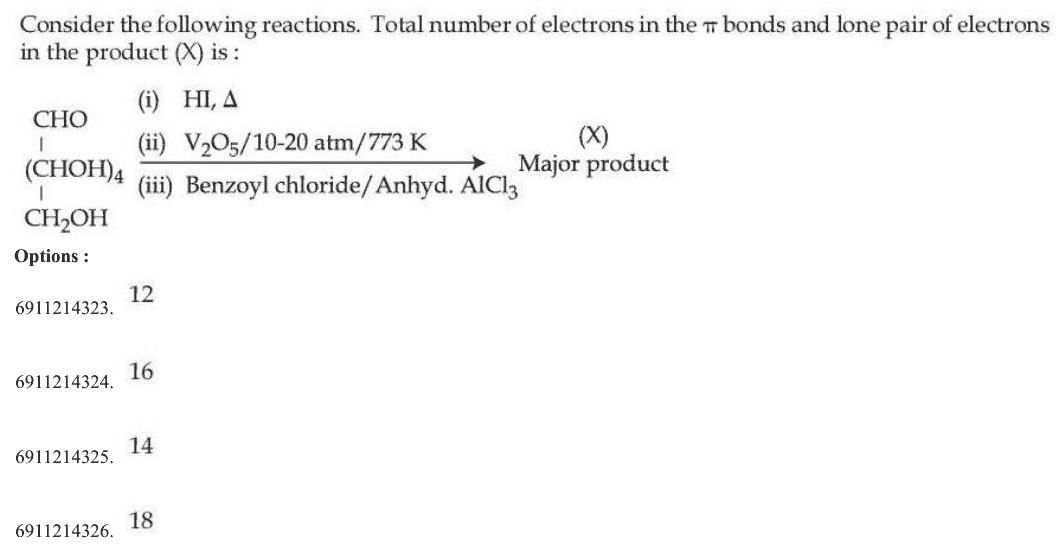
Get EdLoop – freeOpen on the web