
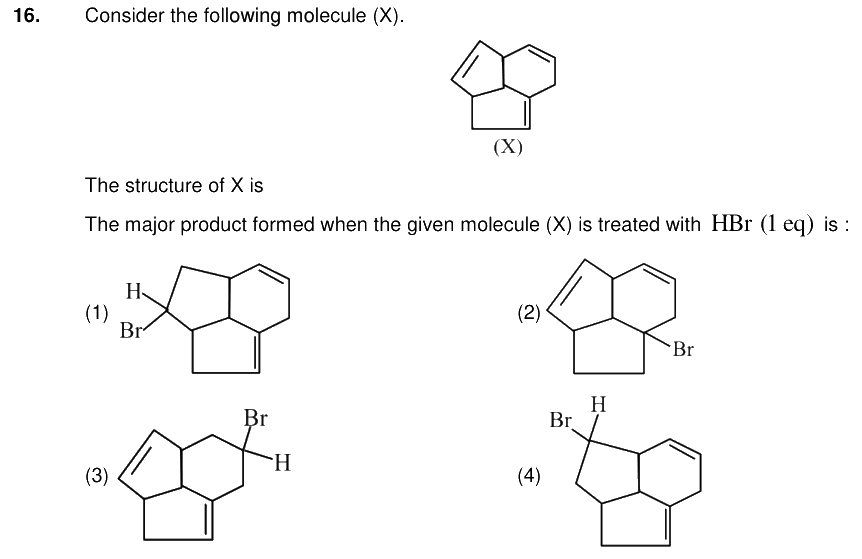
Consider the following molecule (X).
(see the figure above)
The structure of X is
The major product formed when the given molecule (X) is treated with HBr (1 eq) is :
- (1)
see figure the tricyclic skeleton of X with 'H' and 'Br' on the leftmost vertex of the upper-left five-membered ring; that ring has no C=C; the six-membered ring keeps its C=C (top right) and the lower five-membered ring keeps its C=C (right edge).
- (2)
see figure the tricyclic skeleton with the upper-left five-membered ring keeping its C=C (left edge); 'Br' on the lower-right ring-junction carbon (where the lower ring's C=C ended); the six-membered ring keeps its C=C (top right); the lower five-membered ring has no C=C.
- (3)
see figure the tricyclic skeleton with the upper-left five-membered ring keeping its C=C (left edge); 'Br' and 'H' on a carbon at the right side of the six-membered ring (the carbon at the top of the right edge); the six-membered ring has no C=C; the lower five-membered ring keeps its C=C (right edge).
- (4)
see figure the tricyclic skeleton with 'Br' and 'H' on the top-left vertex of the upper-left five-membered ring (this ring has no C=C); the six-membered ring keeps its C=C (top right) and the lower five-membered ring keeps its C=C (right edge).
Show answer
Option (2) is correct.
Key from source paper