EdLoop PYQs · free, no ads · questions and answers here, step-by-step solutions in the EdLoop app
PYQs · free, no adsOpen on the web (app.edloop.in)Get EdLoop – free on Google Play
ChemistrySurface Chemistry

Surface Chemistry: JEE Main PYQs 2002–2023

Every Surface Chemistry question from past JEE Main and AIEEE papers, with options and answers. Newest first.

130questions
123papers covered
2.1%of Chemistry questions, 2019–2026
2002–2023years

Guide at a glance

Surface chemistry studies phenomena at phase boundaries and was formerly in the Class 12 curriculum before being removed in 2024, holding rank 24 of 31 chemistry chapters with a 2.1% share of chemistry questions.

Most asked sub-topics

Colloids72
Adsorption46
Catalysis12

Practise these in EdLoop

Attempt every Surface Chemistry question timed, see the step-by-step solution and track what you get wrong. Free.

Start practice

MCQ, single correct

112 questions
1JEE Main 2023 · 13 Apr · Shift 1MCQOpen question page ↗

What happens when a lyophilic sol is added to a lyophobic sol?

  • A

    Film of lyophilic sol is formed over lyophobic sol

  • B

    Lyophilic sol is dispersed in lyophobic sol

  • C

    Film of lyophobic sol is formed over lyophilic sol

  • D

    Lyophobic sol is coagulated

2JEE Main 2023 · 13 Apr · Shift 2MCQOpen question page ↗

Given below are two statements, one is labelled as Assertion A and the other is labelled as Reason R.
Assertion A : The diameter of colloidal particles in solution should not be much smaller than wavelength of light to show Tyndall effect.
Reason R : The light scatters in all directions when the size of particles is large enough.
In the light of the above statements, choose the correct answer from the options given below :

  • A

    Both A and R are correct but R is NOT the correct explanation of A

  • B

    A is true but R is false

  • C

    A is false but R is true

  • D

    Both A and R are correct and R is the correct explanation of A

3JEE Main 2023 · 12 Apr · Shift 1MCQOpen question page ↗

Four gases, A, B, C and D have critical temperatures 5.3, 33.2, 126.0 and 154.3K respectively
For their adsorption on a fixed amount of charcoal, the correct order is :

  • A

    C > D > B > A

  • B

    C > B > D > A

  • C

    D > C > B > A

  • D

    D > C > A > B

4JEE Main 2023 · 10 Apr · Shift 1MCQOpen question page ↗

The enthalpy change for the adsorption process and micelle formation respectively are

  • A

    $\Delta H_{\mathrm{ads}} > 0$ and $\Delta H_{\mathrm{mic}} < 0$

  • B

    $\Delta H_{\mathrm{ads}} > 0$ and $\Delta H_{\mathrm{mic}} > 0$

  • C

    $\Delta H_{\mathrm{ads}} < 0$ and $\Delta H_{\mathrm{mic}} > 0$

  • D

    $\Delta H_{\mathrm{ads}} < 0$ and $\Delta H_{\mathrm{mic}} < 0$

5JEE Main 2023 · 10 Apr · Shift 2MCQOpen question page ↗

Ferric chloride is applied to stop bleeding because

  • A

    Blood absorbs $\mathrm{FeCl_3}$ and forms a complex.

  • B

    $\mathrm{Cl^-}$ ions cause coagulation of blood.

  • C

    $\mathrm{Fe^{3+}}$ ions coagulate blood which is a negatively charged sol.

  • D

    $\mathrm{FeCl_3}$ reacts with the constituents of blood which is a positively charged sol.

6JEE Main 2023 · 8 Apr · Shift 1MCQOpen question page ↗

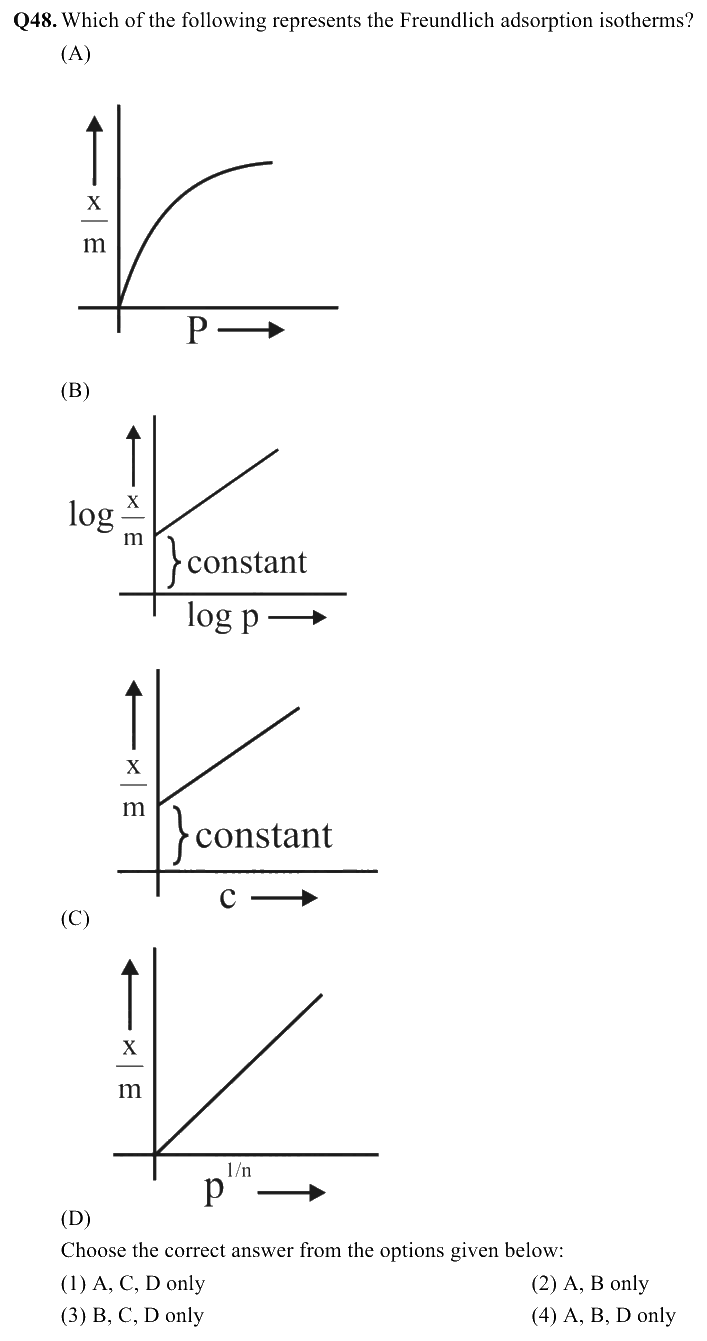
Which of the following represents the Freundlich adsorption isotherms?
(A) (see the figure above)
(B) (see the figure above)
(C) (see the figure above)
(D) (see the figure above)
Choose the correct answer from the options given below:

The question and its figure as printed in JEE Main 2023 08 Apr Shift 1.
The question as printed in the paper.
  • A

    A, C, D only

  • B

    A, B only

  • C

    B, C, D only

  • D

    A, B, D only

7JEE Main 2023 · 1 Feb · Shift 1MCQOpen question page ↗

Given below are two statements: One is labelled as Assertion A and the other is labelled as Reason R.
Assertion A: Amongst He, Ne, Ar and Kr; 1 g of activated charcoal adsorbs more of Kr.
Reason R: The critical volume $\mathrm{V_c}$ ($\mathrm{cm^3\ mol^{-1}}$) and critical pressure $\mathrm{P_c}$ (atm) is highest for Krypton but the compressibility factor at critical point $\mathrm{Z_c}$ is lowest for Krypton.
In the light of the above statements, choose the correct answer from the options given below.

  • A

    A is true but R is false

  • B

    A is false but R is true

  • C

    Both A and R are true but R is NOT the correct explanation of A

  • D

    Both A and R are true and R is the correct explanation A

8JEE Main 2023 · 1 Feb · Shift 2MCQOpen question page ↗

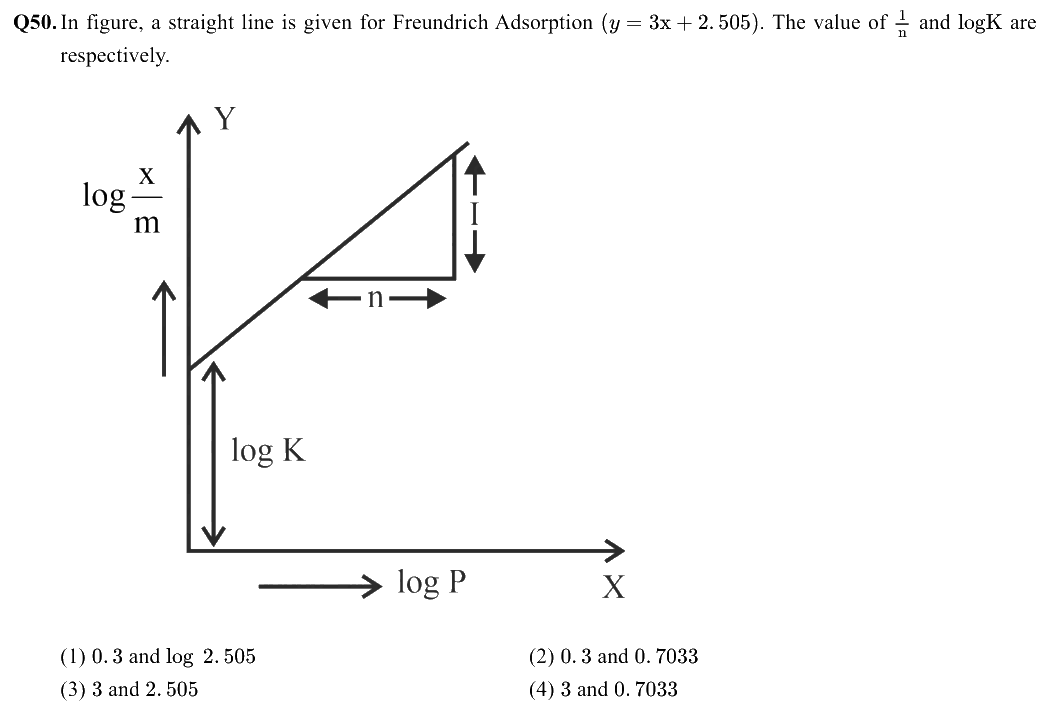
In figure, a straight line is given for Freundrich Adsorption ($y$ = 3x + 2. 505). The value of $\dfrac{1}{\mathrm{n}}$ and logK are respectively.

(see the figure above)

The question and its figure as printed in JEE Main 2023 01 Feb Shift 2.
The question as printed in the paper.
  • A
    1. 3 and log 2. 505
  • B
    1. 3 and 0. 7033
  • C

    3 and 2. 505

  • D

    3 and 0. 7033

9JEE Main 2023 · 31 Jan · Shift 1MCQOpen question page ↗

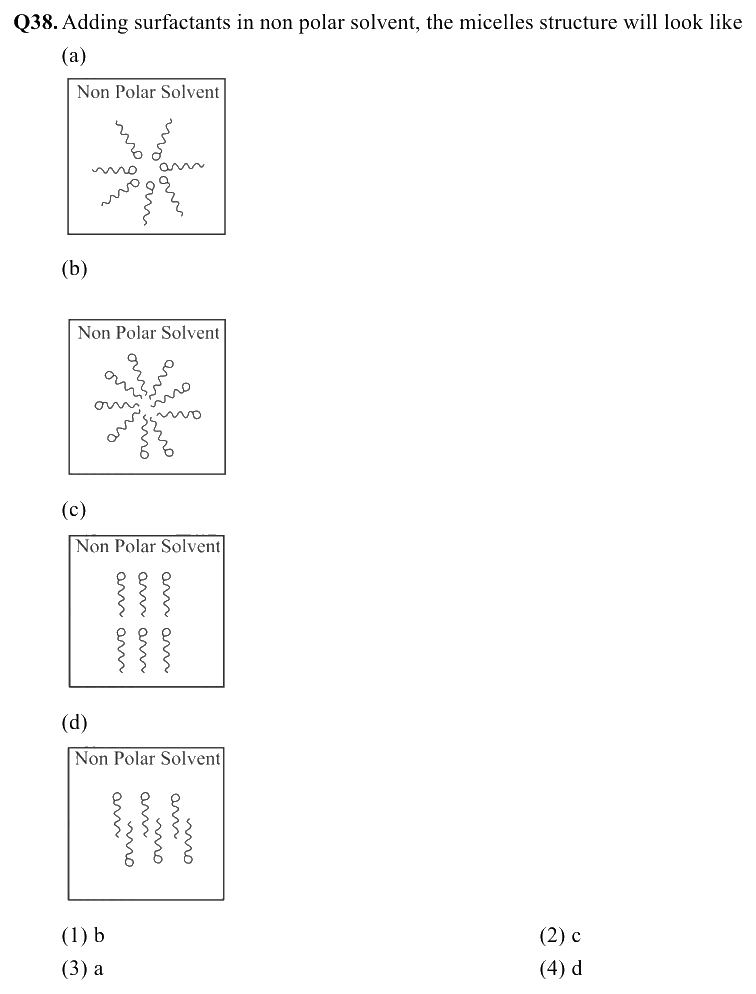
Adding surfactants in non polar solvent, the micelles structure will look like
(a)
(see the figure above)
(b)
(see the figure above)
(c)
(see the figure above)
(d)
(see the figure above)

The question and its figure as printed in JEE Main 2023 31 Jan Shift 1.
The question as printed in the paper.
  • A

    b

  • B

    c

  • C

    a

  • D

    d

10JEE Main 2023 · 31 Jan · Shift 2MCQOpen question page ↗

Match List I with List II

List I
A Physisorption
B Chemisorption
C $\mathrm{N_2(g) + 3H_2(g) \xrightarrow{Fe(s)} 2\,NH_3(g)}$
D Analytical Application or Adsorption

List II
I Single Layer Adsorption
II 20 $-$ 40 kJ mol$^{-1}$
III Chromatography
IV Heterogeneous catalysis

Choose the correct answer from the options given below:

  • A

    A-III, B-IV, C-I, D-II

  • B

    A-II, B-III, C-I, D-IV

  • C

    A-II, B-I, C-IV, D-III

  • D

    A-IV, B-II, C-III, D-I

11JEE Main 2023 · 30 Jan · Shift 1MCQOpen question page ↗

Given below are two statements : one is labelled as Assertion (A) and the other is labelled as Reason (R).

Assertion (A): In expensive scientific instruments, silica gel is kept in watch-glasses or in semipermeable membrane bags.

Reason (R): Silica gel adsorbs moisture from air via adsorption, thus protects the instrument from water corrosion (rusting) and / or prevents malfunctioning.

In the light of the above statements, choose the correct answer from the options given below:

  • A

    (A) is false but (R) is true

  • B

    (A) is true but (R) is false

  • C

    Both (A) and (R) are true and (R) is the correct explanation of (A)

  • D

    Both (A) and (R) are true but (R) is not the correct explanation of (A)

12JEE Main 2023 · 29 Jan · Shift 1MCQOpen question page ↗

Which of the following salt solutions would coagulate the colloid soloution formed when $\mathrm{FeCl_3}$ is added to NaOH solution, at the fastest rate?

  • A

    $10\ \mathrm{mL}$ of $0.2\ \mathrm{mol\ dm^{-3}}$ $\mathrm{AlCl_3}$

  • B

    $10\ \mathrm{mL}$ of $0.1\ \mathrm{mol\ dm^{-3}}$ $\mathrm{Na_2\,SO_4}$

  • C

    $10\ \mathrm{mL}$ of $0.1\ \mathrm{mol\ dm^{-3}}$ $\mathrm{Ca_3\,(PO_4)_2}$

  • D

    $10\ \mathrm{mL}$ of $0.15\ \mathrm{mol\ dm^{-3}}$ $\mathrm{CaCl_2}$

13JEE Main 2023 · 29 Jan · Shift 2MCQOpen question page ↗

Match List-I and List-II
List-I
A. Osmosis
B. Reverse osmosis
C. Electro osmosis
D. Electrophoresis
List-II
I. Solvent molecules pass through semi permeable membrane towards solvent side.
II. Movement of charged colloidal particles under the influence of applied electric potential towards oppositely charged electrodes
III. Solvent molecules pass through semi permeable membrane towards solution side
IV. Dispersion medium moves in an electric field.
Choose the correct answer from the options given below:

  • A

    A-I, B-III, C-IV, D-II

  • B

    A-III, B-I, C-IV, D-II

  • C

    A-III, B-I, C-II, D-IV

  • D

    A-I, B-III, C-II, D-IV

14JEE Main 2023 · 25 Jan · Shift 1MCQOpen question page ↗

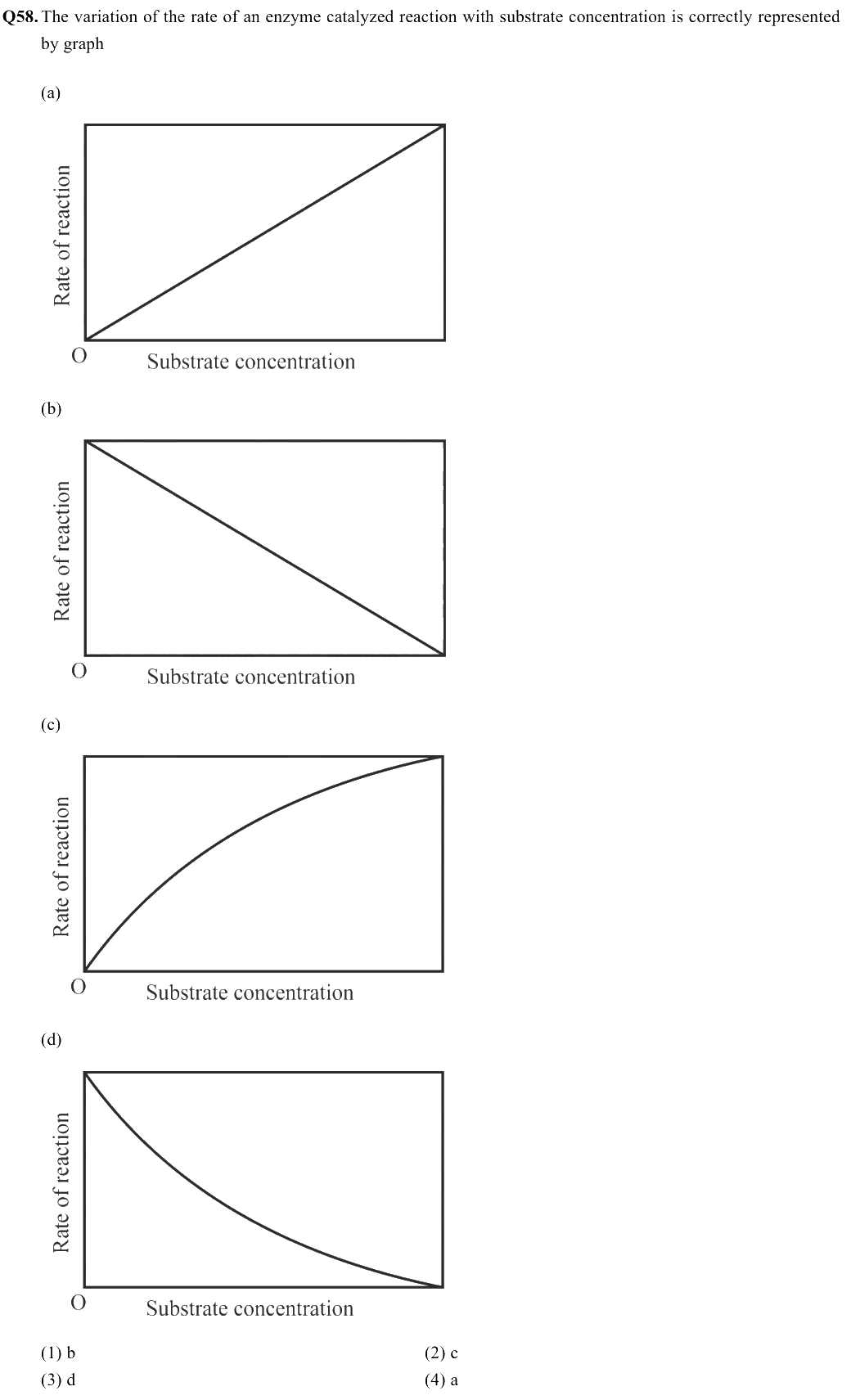
The variation of the rate of an enzyme catalyzed reaction with substrate concentration is correctly represented by graph
(a) (see the figure above)
(b) (see the figure above)
(c) (see the figure above)
(d) (see the figure above)

The question and its figure as printed in JEE Main 2023 25 Jan Shift 1.
The question as printed in the paper.
  • A

    b

  • B

    c

  • C

    d

  • D

    a

15JEE Main 2022 · 29 Jul · Shift 1MCQOpen question page ↗

100 mL of 5%(w/v) solution of NaCl in water was prepared in 250 mL beaker. Albumin from the egg was poured into NaCl solution and stirred well. This resulted in a/ an

  • A

    Lyophilic sol

  • B

    Lyophobic sol

  • C

    Emulsion

  • D

    Precipitate

16JEE Main 2022 · 29 Jul · Shift 2MCQOpen question page ↗

Given below are the critical temperatures of some of the gases:
Gas / Critical temperature K
He: 5.2
$\mathrm{CH_4}$: 190
$\mathrm{CO_2}$: 304.2
$\mathrm{NH_3}$: 405.5
The gas showing least adsorption on a definite amount of charcoal is

  • A

    He

  • B

    $\mathrm{CH_4}$

  • C

    $\mathrm{CO_2}$

  • D

    $\mathrm{NH_3}$

17JEE Main 2022 · 28 Jul · Shift 1MCQOpen question page ↗

Match List-I with List-II.
List-I
A. $\mathrm{4NH_3g+5O_2g\rightarrow4NOg+6H_2Og}$
B. $\mathrm{N_2g+3H_2g\rightarrow2NH_3g}$
C. $\mathrm{C_{12}H_{22}O_{11}aq+H_2Ol\rightarrow C_6H_{12}O_6Glucose+C_6H_{12}O_6Fructose}$
D. $\mathrm{2SO_2g+O_2g\rightarrow2SO_3g}$
List-II
I. $\mathrm{NOg}$
II. $\mathrm{H_2SO_4l}$
III. $\mathrm{Pts}$
IV. $\mathrm{Fes}$
Choose the correct answer from the options given below

  • A

    A - II, B - III, C - I, D - IV

  • B

    A - III, B - II, C - I, D - IV

  • C

    A - III, B - IV, C - II, D - I

  • D

    A - III, B - II, C - IV, D - I

18JEE Main 2022 · 27 Jul · Shift 1MCQOpen question page ↗

Given below are two statements. One is labelled as Assertion A and the other is labelled as Reason R.
Assertion A : Activated charcoal adsorbs $\mathrm{SO_2}$ more efficiently than $\mathrm{CH_4}$.
Reason R : Gases with lower critical temperatures are readily adsorbed by activated charcoal. In the light of the above statements, choose the correct answer from the options given below.

  • A

    Both A and R are correct and R is the correct explanation of A.

  • B

    Both A and R are correct but R is NOT the correct explanation of A.

  • C

    A is correct but R is not correct.

  • D

    A is not correct but R is correct.

19JEE Main 2022 · 27 Jul · Shift 2MCQOpen question page ↗

Given below are two statements: one is labelled as Assertion A and the other is labelled as Reason R
Assertion A : Dissolved substances can be removed from a colloidal solution by diffusion through a parchment paper.
Reason R : Particles in a true solution cannot pass through parchment paper but the collodial particles can pass through the parchment paper.
In the light of the above statements, choose the correct answer from the options given below

  • A

    Both A and R are correct and R is the correct explanation of A

  • B

    Both A and R are correct but R is not the correct explanation of A

  • C

    A is correct but R is not correct

  • D

    A is not correct but R is correct

20JEE Main 2022 · 26 Jul · Shift 1MCQOpen question page ↗

Match List - I with List - II.

List -I (Processes/Reactions)List-II (Catalyst)
A$2\,\mathrm{SO_2(g)} + \mathrm{O_2(g)} \rightarrow 2\,\mathrm{SO_3(g)}$I$\mathrm{Fe(s)}$
B$4\,\mathrm{NH_3(g)} + 5\mathrm{O_2(g)} \rightarrow 4\mathrm{NO(g)} + 6\mathrm{H_2O(g)}$II$\mathrm{Pt(s) - Rh(s)}$
C$\mathrm{N_2(g)} + 3\mathrm{H_2(g)} \rightarrow 2\mathrm{NH_3(g)}$III$\mathrm{V_2O_5}$
DVegetable oil (l) + $\mathrm{H_2}$ $\rightarrow$ Vegetable ghee(s)IV$\mathrm{Ni(s)}$

Choose the correct answer from the options given below

  • A

    (A) – (III), (B) – (I), (C) – (II), (D) – (IV)

  • B

    (A) – (III), (B) – (II), (C) – (I), (D) – (IV)

  • C

    (A) – (IV), (B) – (III), (C) – (I), (D) – (II)

  • D

    (A) – (IV), (B) – (II), (C) – (III), (D) – (I)

21JEE Main 2022 · 26 Jul · Shift 2MCQOpen question page ↗

Given below are two statements: one is labelled as Assertion A and the other is labelled as Reason R.
Assertion A : Finest gold is red in colour, as the size of the particles increases, it appears purple then blue and finally gold.
Assertion R : The colour of the colloidal solution depends on the wavelength of light scattered by the dispersed particles.
In the light of the above statements, choose the most appropriate answer from the options given below

  • A

    Both A and R are true and R is the correct explanation of A

  • B

    Both A and R are true but R is NOT the correct explanation of A

  • C

    A is true but R is false

  • D

    A is false but R is true

22JEE Main 2022 · 25 Jul · Shift 1MCQOpen question page ↗

Match List - I with List - II

List-II
A $\mathrm{N_2g + 3H_2g \rightarrow 2NH_3g}$
B $\mathrm{COg + 3H_2g \rightarrow CH_4g + H_2Og}$
C $\mathrm{COg + H_2g \rightarrow HCHOg}$
D $\mathrm{COg + 2H_2g \rightarrow CH_3OHg}$

List-II
I Cu
II $\mathrm{Cu / ZnO - Cr_2O_3}$
III $\mathrm{Fe_xO_y + K_2O + Al_2O_3}$
IV Ni

Choose the correct answer from the options given below

  • A

    A - II, B - IV, C - I, D - III

  • B

    A - II, B - I, C - IV, D - III

  • C

    A - III, B - IV, C - I, D - II

  • D

    A - III, B - I, C - IV, D - II

23JEE Main 2022 · 25 Jul · Shift 2MCQOpen question page ↗

For micelle formation, which of the following statements are correct?
(A) Micelle formation is an exothermic process.
(B) Micelle formation is an endothermic process.
(C) The entropy change is positive.
(D) The entropy change is negative.

  • A

    A & D only

  • B

    A & C only

  • C

    B & C only

  • D

    B & D only

24JEE Main 2022 · 29 Jun · Shift 1MCQOpen question page ↗

Which of the following is a correct statement?

  • A

    Brownian motion destabilises sols.

  • B

    Any amount of dispersed phase can be added to emulsion without destabilising it.

  • C

    Mixing two oppositely charged sols in equal amount neutralises charges and stabilises colloids.

  • D

    Presence of equal and similar charges on colloidal particles provides stability to the colloidal solution.

25JEE Main 2022 · 28 Jun · Shift 1MCQOpen question page ↗

The Zeta potential is related to which property of colloids?

  • A

    Colour

  • B

    Brownian movement

  • C

    Charge on surface of colloidal particle

  • D

    Tyndall effect

26JEE Main 2022 · 28 Jun · Shift 2MCQOpen question page ↗

Match List-I with List-II
List-I
(A) negatively charged sol
(B) macromolecular colloid
(C) positively charged sol
(D) Cheese
List-II
(I) $\mathrm{Fe_2\,O_3 \cdot xH_2\,O}$
(II) CdS sol
(III) Starch
(IV) a gel
Choose the correct answer from the options given below

  • A

    (A) $-$ (II), (B) $-$ (III), (C) $-$ (IV), (D) $-$ (I)

  • B

    (A) $-$ (II), (B) $-$ (I), (C) $-$ (II), (D) $-$ (IV)

  • C

    (A) $-$ (II), (B) $-$ (III), (C) $-$ (I), (D) $-$ (IV)

  • D

    (A) $-$ (I), (B) $-$ (III), (C) $-$ (II), (D) $-$ (IV)

27JEE Main 2022 · 27 Jun · Shift 1MCQOpen question page ↗

Match List - I with List - II.
List-I
A Lyophilic colloid
B Emulsion
C Positively charged colloid
D Negatively charged colloid
List-II
I Liquid-liquid colloid
II Protective colloid
III $\mathrm{FeCl_3 + NaOH}$
IV $\mathrm{FeCl_3}$+ hot water
Choose the correct answer from the options given below

  • A

    (A) $-$ (II), (B) $-$ (I), (C) $-$ (IV), (D) $-$ (III)

  • B

    (A) $-$ (III), (B) $-$ (I), (C) $-$ (IV), (D) $-$ (II)

  • C

    (A) $-$ (II), (B) $-$ (I), (C) $-$ (III), (D) $-$ (IV)

  • D

    (A) $-$ (III), (B) $-$ (II), (C) $-$ (I), (D) $-$ (IV)

28JEE Main 2022 · 26 Jun · Shift 2MCQOpen question page ↗

Match List I with List II.
List-I Enzyme
A. Invertase
B. Zymase
C. Diastase
D. Maltase
List-II Conversion of
I. Starch into maltose
II. Maltose into glucose
III. Glucose into ethanol
IV. Cane sugar into glucose
Choose the most appropriate answer from the options given below

  • A

    A - III, B - IV, C - II, D - I

  • B

    A - III, B - II, C - I, D - IV

  • C

    A - IV, B - III, C - I, D - II

  • D

    A - IV, B - II, C - III, D - I

29JEE Main 2022 · 25 Jun · Shift 1MCQOpen question page ↗

Incorrect statement for Tyndall effect is

  • A

    The refractive indices of the dispersed phase and the dispersion medium differ greatly in magnitude.

  • B

    The diameter of the dispersed particles is much smaller than the wavelength of the light used.

  • C

    It is used to distinguish a true solution from a colloidal solution.

  • D

    During projection of movies in the cinemas hall, Tyndall effect is noticed.

30JEE Main 2022 · 25 Jun · Shift 1MCQOpen question page ↗

Using very little soap while washing clothes, does not serve the purpose of cleaning of clothes, because

  • A

    soap particles remain floating in water as ions.

  • B

    colloidal structure of soap in water is completely disturbed.

  • C

    the hydrophobic part of soap is not able to take away grease.

  • D

    the micelles are not formed due to concentration of soap, below its CMC value.

31JEE Main 2022 · 24 Jun · Shift 1MCQOpen question page ↗

Given below are two statements:
Statement I : Emulsions of oil in water are unstable and sometimes they separate into two layers on standing.
Statement II : For stabilisation of an emulsion, excess of electrolyte is added.
In the light of the above statements, choose the most appropriate answer from the options given below :

  • A

    Both Statement I and Statement II are correct.

  • B

    Both Statement I and Statement II are incorrect.

  • C

    Statement I is correct but Statement II is incorrect.

  • D

    Statement I is incorrect but Statement II is correct.

32JEE Main 2021 · 1 Sep · Shift 2MCQOpen question page ↗

Match List - I with List - II .
List-I (Colloid Preparation Method)
(a) Hydrolysis
(b) Reduction
(c) Oxidation
(d) Double Decomposition
List-II (Chemical Reaction)
(i) $2\mathrm{AuCl_3} + 3\mathrm{HCHO} + 3\mathrm{H_2O} \rightarrow 2\mathrm{Au(sol)} + 3\mathrm{HCOOH} + 6\mathrm{HCl}$
(ii) $\mathrm{As_2O_3} + 3\mathrm{H_2\ S} \rightarrow \mathrm{As_2\ S_3(sol)} + 3\mathrm{H_2O}$
(iii) $\mathrm{SO_2} + 2\mathrm{H_2\ S} \rightarrow 3\ \mathrm{S(sol)} + 2\mathrm{H_2O}$
(iv) $\mathrm{FeCl_3} + 3\mathrm{H_2O} \rightarrow \mathrm{Fe(OH)_3(sol)} + 3\mathrm{HCl}$
Choose the most appropriate answer from the options given below :

  • A

    (a) - (i), (b) - (iii), (c) - (ii), (d) - (iv)

  • B

    (a) - (iv), (b) - (i), (c) - (iii), (d) - (ii)

  • C

    (a) - (i), (b) - (ii), (c) - (iv), (d) - (iii)

  • D

    (a) - (iv), (b) - (ii), (c) - (iii), (d) - (i)

33JEE Main 2021 · 31 Aug · Shift 1MCQOpen question page ↗

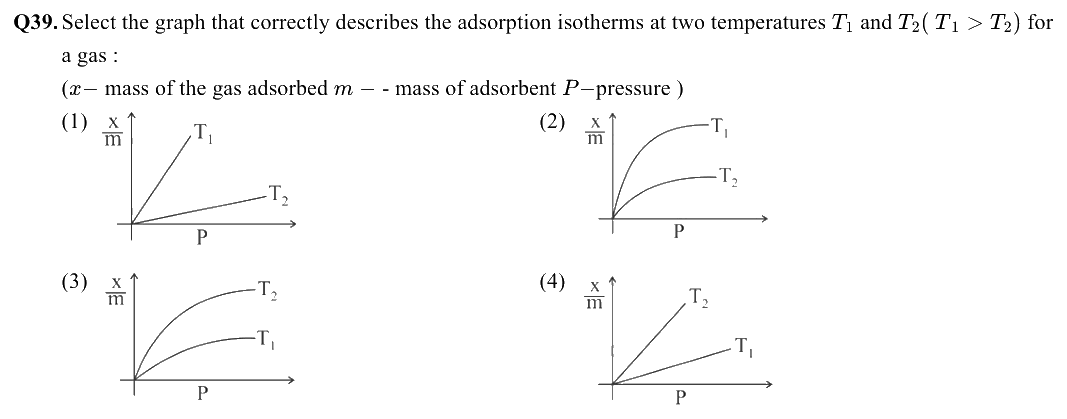
Select the graph that correctly describes the adsorption isotherms at two temperatures $T_1$ and $T_2$( $T_1 > T_2$) for a gas :
($x$ - mass of the gas adsorbed $m$ - - mass of adsorbent $P$ - pressure )

The question and its figure as printed in JEE Main 2021 31 Aug Shift 1. Option 1: x/m against P; two straight lines from the origin, T1 the steeper and T2 the gentler. Option 2: x/m against P; two curves rising and levelling off, T1 higher than T2. Option 3: x/m against P; two curves rising and levelling off, T2 higher than T1. Option 4: x/m against P; two straight lines from the origin, T2 the steeper and T1 the gentler.
The question as printed in the paper.
  • A

    see figure $x/m$ against $P$; two straight lines from the origin, $T_1$ the steeper and $T_2$ the gentler.

  • B

    see figure $x/m$ against $P$; two curves rising and levelling off, $T_1$ higher than $T_2$.

  • C

    see figure $x/m$ against $P$; two curves rising and levelling off, $T_2$ higher than $T_1$.

  • D

    see figure $x/m$ against $P$; two straight lines from the origin, $T_2$ the steeper and $T_1$ the gentler.

34JEE Main 2021 · 27 Aug · Shift 1MCQOpen question page ↗

Tyndall effect is more effectively shown by:

  • A

    lyophilic colloid

  • B

    suspension

  • C

    lyophobic colloid

  • D

    true solution

35JEE Main 2021 · 27 Aug · Shift 2MCQOpen question page ↗

Lyophilic sols are more stable than lyophobic sols because:

  • A

    the colloidal particles have no charge.

  • B

    the colloidal particles have positive charge.

  • C

    the colloidal particles are solvated.

  • D

    there is a strong electrostatic repulsion between the negatively charged colloidal particles.

36JEE Main 2021 · 26 Aug · Shift 1MCQOpen question page ↗

Which one of the following is correct for the adsorption of a gas at a given temperature on a solid surface?

  • A

    $\Delta\mathrm{H}>0,\Delta\mathrm{S}>0$

  • B

    $\Delta\mathrm{H}<0,\Delta\mathrm{S}>0$

  • C

    $\Delta\mathrm{H}>0,\Delta\mathrm{S}<0$

  • D

    $\Delta\mathrm{H}<0,\Delta\mathrm{S}<0$

37JEE Main 2021 · 26 Aug · Shift 2MCQOpen question page ↗

The sol given below with negatively charged colloidal particles is:

  • A

    $\mathrm{AgNO_3}$ added to KI solution

  • B

    KI added to $\mathrm{AgNO_3}$ solution

  • C

    $\mathrm{Al_2O_3\cdot}x\mathrm{H_2O}$ in water

  • D

    $\mathrm{FeCl_3}$ added to hot water

38JEE Main 2021 · 27 Jul · Shift 2MCQOpen question page ↗

Given below are two statement : one is labelled as Assertion A and the other is labelled as Reason R.
Assertion A : $\mathrm{SO_2(g)}$ is adsorbed to a large extent than $\mathrm{H_2(g)}$ on activated charcoal.
Reason R : $\mathrm{SO_2(g)}$ has a higher critical temperature than $\mathrm{H_2(g)}$
In the light of the above statements, choose the most appropriate answer from the options given below.

  • A

    Both A and R are correct but R is not the correct explanation fo A

  • B

    Both A and R are correct and R is the correct explanation of A.

  • C

    A is not correct but R is correct.

  • D

    A is correct but R is not correct.

39JEE Main 2021 · 25 Jul · Shift 1MCQOpen question page ↗

Sodium stearate $\mathrm{CH_3CH_{2_{16}}COO^-Na^+}$ is an anionic surfactant which forms micelles in oil. Choose the correct statement for it from the following :

  • A

    It forms spherical micelles with $\mathrm{CH_3CH_{2_{16}}}$ - group pointing towards the centre of sphere.

  • B

    It forms non-spherical micelles with $\mathrm{-COO^-}$ group pointing outwards on the surface.

  • C

    It forms spherical micelles with $\mathrm{CH_3CH_{2_{16}}}$ - group pointing outwards on the surface of sphere

  • D

    It forms non-spherical micelles with $\mathrm{CH_3CH_{2_{16}}}$ - group pointing towards the centre.

40JEE Main 2021 · 25 Jul · Shift 2MCQOpen question page ↗

Match List I with List II :
List-I Example of colloids | List-II Classification
(a) Cheese | (i) dispersion of liquid in liquid
(b) Pumice stone | (ii) dispersion of liquid in gas
(c) Hair cream | (iii) dispersion of gas in solid
(d) Cloud | (iv) dispersion of liquid in solid
Choose the most appropriate answer from the options given below

  • A

    (a) – (iv), (b) – (iii), (c) – (ii), (d) – (i)

  • B

    (a) – (iv), (b) – (i), (c) – (iii), (d) – (ii)

  • C

    (a) – (iii), (b) – (iv), (c) – (i), (d) – (ii)

  • D

    (a) – (iv), (b) – (iii), (c) – (i), (d) – (ii)

41JEE Main 2021 · 22 Jul · Shift 1MCQOpen question page ↗

When silver nitrate solution is added to potassium iodide solution then the sol produced is:

  • A

    $\mathrm{AgI\,/\,I^-}$

  • B

    $\mathrm{AgI\,/\,Ag^+}$

  • C

    $\mathrm{KI\,/\,NO_3^-}$

  • D

    $\mathrm{AgNO_3\,/\,NO_3^-}$

42JEE Main 2021 · 20 Jul · Shift 1MCQOpen question page ↗

The conditions given below are in the context of observing Tyndall effect in colloidal solutions:
(A) The diameter of the colloidal particles is comparable to the wavelength of light used.
(B) The diameter of the colloidal particles is much smaller than the wavelength of light used.
(C) The diameter of the colloidal particles is much larger than the wavelength of light used.
(D) The refractive indices of the dispersed phase and the dispersion medium are comparable.
(E) The dispersed phase has a very different refractive index from the dispersion medium. Choose the most appropriate conditions from the options given below:

  • A

    (A) and (E) only

  • B

    (C) and (D) only

  • C

    (A) and (D) only

  • D

    (B) and (E) only

43JEE Main 2021 · 18 Mar · Shift 1MCQOpen question page ↗

Match List$-$I with List$-$ II
List$-$I (process)
List$-$ II (catalyst)
(a) Deacon's process (i) ZSM $-$ 5
(b) Contact process (ii) $\mathrm{CuCl_2}$
(c) Cracking of hydrocarbons (iii) Ni
(d) Hydrogenation of vegetable oils (iv) $\mathrm{V_2O_5}$
Choose the most appropriate answer from the options given below-

  • A

    a $-$ ii, b $-$ iv, c $-$ i, d $-$ iii

  • B

    a $-$ i, b $-$ ii, c $-$ ii, d $-$ iv

  • C

    a $-$ iii, b $-$ i, c $-$ iv, d $-$ ii

  • D

    a $-$ iv, b $-$ ii, c $-$ i, d $-$ iii

44JEE Main 2021 · 18 Mar · Shift 2MCQOpen question page ↗

The charges on the colloidal CdS sol and $\mathrm{TiO_2}$ sol are, respectively :

  • A

    positive and positive

  • B

    positive and negative

  • C

    negative and negative

  • D

    negative and positive

46JEE Main 2021 · 17 Mar · Shift 2MCQOpen question page ↗

For the coagulation of a negative sol, the species below, that has the highest flocculating power is:

  • A

    $\mathrm{SO}_4^{2-}$

  • B

    $\mathrm{Ba}^{2+}$

  • C

    $\mathrm{Na}^{+}$

  • D

    $\mathrm{PO}_4^{3-}$

47JEE Main 2021 · 16 Mar · Shift 2MCQOpen question page ↗

The INCORRECT statements below regarding colloidal solutions is :

  • A

    A colloidal solution shows colligative properties.

  • B

    An ordinary filter paper can stop the flow of colloidal particles.

  • C

    The flocculation power of $\mathrm{Al^{3+}}$ is more than that of $\mathrm{Na^+}$

  • D

    A colloidal solution shows Brownian motion of colloidal particles.

48JEE Main 2021 · 26 Feb · Shift 2MCQOpen question page ↗

The nature of charge on resulting colloidal particles when $\mathrm{FeCl_3}$ is added to excess of hot water is:

  • A

    positive

  • B

    sometimes positive and sometimes negative

  • C

    neutral

  • D

    negative

49JEE Main 2021 · 25 Feb · Shift 1MCQOpen question page ↗

In Freundlich adsorption isotherm at moderate pressure, the extent of adsorption $\left(\frac{x}{m}\right)$ is directly proportional to $\mathrm{P^x}$. The value of x is :

  • A

    zero

  • B

    $\frac{1}{n}$

  • C

    $1$

  • D

    $\infty$

50JEE Main 2021 · 25 Feb · Shift 2MCQOpen question page ↗

Which one of the following statements is FALSE for hydrophilic sols?

  • A

    These sols are reversible in nature.

  • B

    Their viscosity is of the order of that of $\mathrm{H_2O}$.

  • C

    The sols cannot be easily coagulated.

  • D

    They do not require electrolytes for stability.

51JEE Main 2021 · 24 Feb · Shift 1MCQOpen question page ↗

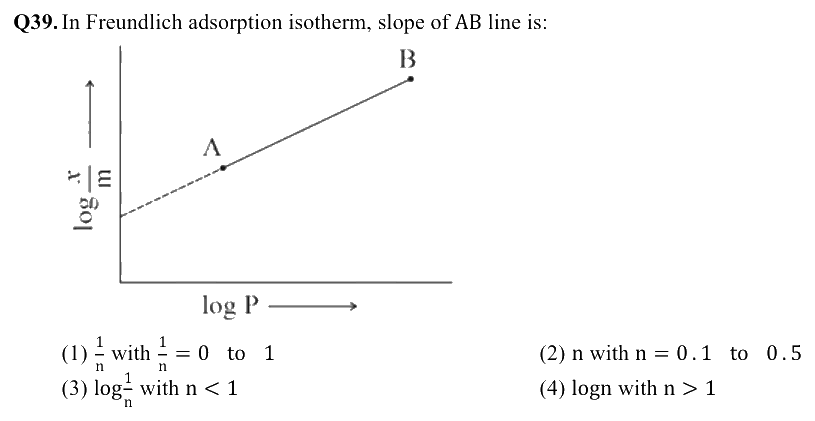
In Freundlich adsorption isotherm, slope of AB line is:
(see the figure above)

The question and its figure as printed in JEE Main 2021 24 Feb Shift 1.
The question as printed in the paper.
  • A

    $\frac{1}{n}$ with $\frac{1}{n} = 0$ to $1$

  • B

    n with n = $0.1$ to $0.5$

  • C

    $\log\frac{1}{n}$ with n < 1

  • D

    logn with n > 1

52JEE Main 2021 · 24 Feb · Shift 2MCQOpen question page ↗

Most suitable salt which can be used for efficient clotting of blood will be?

  • A

    $\mathrm{FeCl_3}$

  • B

    $\mathrm{Mg\,(HCO_3)_2}$

  • C

    $\mathrm{FeSO_4}$

  • D

    $\mathrm{NaHCO_3}$

53JEE Main 2020 · 6 Sep · Shift 1MCQOpen question page ↗

Kraft temperature is the temperature:

  • A

    below which the aqueous solution of detergents starts freezing.

  • B

    below which the formation of micelles takes place.

  • C

    above which the aqueous solution of detergents starts boiling.

  • D

    above which the formation of micelles takes place.

54JEE Main 2020 · 5 Sep · Shift 1MCQOpen question page ↗

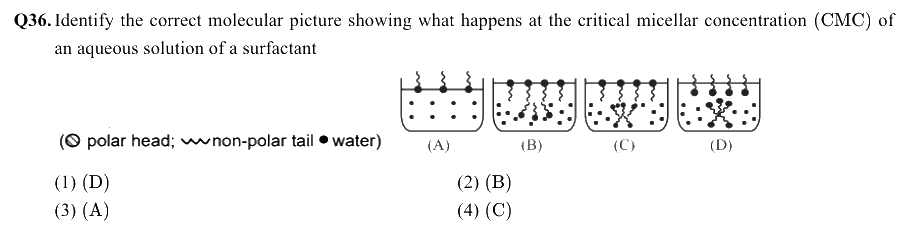
Identify the correct molecular picture showing what happens at the critical micellar concentration (CMC) of an aqueous solution of a surfactant
(see the figure above)

The question and its figure as printed in JEE Main 2020 05 Sep Shift 1.
The question as printed in the paper.
  • A

    (D)

  • B

    (B)

  • C

    (A)

  • D

    (C)

55JEE Main 2020 · 5 Sep · Shift 2MCQOpen question page ↗

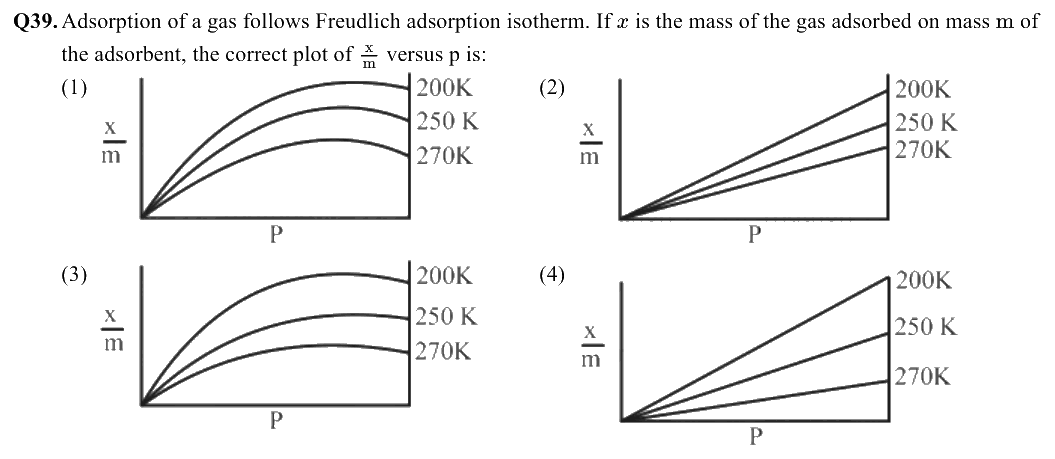
Adsorption of a gas follows Freudlich adsorption isotherm. If $x$ is the mass of the gas adsorbed on mass m of the adsorbent, the correct plot of $\frac{x}{m}$ versus p is:
(see the figure above)

The question and its figure as printed in JEE Main 2020 05 Sep Shift 2. Option 1: x/m versus P: three curves from the origin for 200 K, 250 K, 270 K (200 K highest), each rising to a broad maximum then falling slightly at the right; the three curves are fairly evenly spaced and close together at low P. Option 2: x/m versus P: three nearly straight lines from the origin for 200 K, 250 K, 270 K (200 K highest, steeper), close together. Option 3: x/m versus P: three curves from the origin for 200 K, 250 K, 270 K (200 K highest), each rising to a broad maximum then falling slightly at the right; the 200 K curve rises much more steeply and sits well above the 250 K and 270 K curves. Option 4…
The question as printed in the paper.
  • A

    see figure x/m versus P: three curves from the origin for 200 K, 250 K, 270 K (200 K highest), each rising to a broad maximum then falling slightly at the right; the three curves are fairly evenly spaced and close together at low P.

  • B

    see figure x/m versus P: three nearly straight lines from the origin for 200 K, 250 K, 270 K (200 K highest, steeper), close together.

  • C

    see figure x/m versus P: three curves from the origin for 200 K, 250 K, 270 K (200 K highest), each rising to a broad maximum then falling slightly at the right; the 200 K curve rises much more steeply and sits well above the 250 K and 270 K curves.

  • D

    see figure x/m versus P: three straight lines from the origin for 200 K, 250 K, 270 K, with 200 K steepest and 270 K flattest, clearly fanned out.

56JEE Main 2020 · 4 Sep · Shift 1MCQOpen question page ↗

Match the following:
(i) Foam (a) smoke
(ii) Gel (b) cell fluid
(iii) Aerosol (c) jellies
(iv) Emulsion (d) rubber
(e) froth
(f) milk

  • A

    (i) $-$ (b), (ii) $-$ (c), (iii) $-$ (e), (iv) $-$ (d)

  • B

    (i) $-$ (d), (ii) $-$ (b), (iii) $-$ (a), (iv) $-$ (e)

  • C

    (i) $-$ (e), (ii) $-$ (c), (iii) $-$ (a), (iv) $-$ (f)

  • D

    (i) $-$ (d), (ii) $-$ (b), (iii) $-$ (e), (iv) $-$ (f)

57JEE Main 2020 · 4 Sep · Shift 2MCQOpen question page ↗

A sample of red ink (a colloidal suspension) is prepared by mixing eosine dye, egg white, HCHO and water. The component which ensures stability of the ink sample is :

  • A

    Egg white

  • B

    Water

  • C

    HCHO

  • D

    Eosin dye

58JEE Main 2020 · 3 Sep · Shift 1MCQOpen question page ↗

Tyndall effect is observed when :

  • A

    The diameter of dispersed particles is much larger than the wavelength of light used.

  • B

    The diameter of dispersed particles is much smaller than the wavelength of light used

  • C

    The refractive index od dispersed phase is greater than that of the dispersion medium.

  • D

    The diameter of dispersed particles is similar to the wavelength of light used.

59JEE Main 2020 · 3 Sep · Shift 2MCQOpen question page ↗

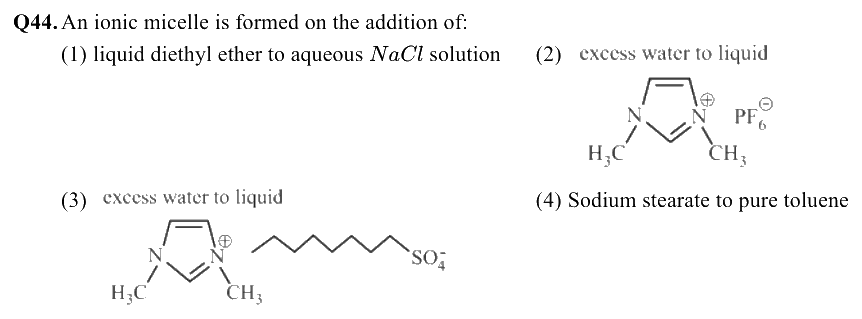
An ionic micelle is formed on the addition of:

The question and its figure as printed in JEE Main 2020 03 Sep Shift 2.
The question as printed in the paper.
  • A

    liquid diethyl ether to aqueous $NaCl$ solution

  • B

    excess water to liquid (see the figure above)

  • C

    excess water to liquid (see the figure above)

  • D

    Sodium stearate to pure toluene

60JEE Main 2020 · 2 Sep · Shift 1MCQOpen question page ↗

Which of the following is used for the preparation of colloids ?

  • A

    Ostwald process

  • B

    Van Arkel Method

  • C

    Bredig's Arc Method

  • D

    Mond Process

61JEE Main 2020 · 2 Sep · Shift 2MCQOpen question page ↗

Amongst the following statements regarding adsorption, those that are valid are:
(a) $\Delta\mathrm{H}$ becomes less negative as adsorption proceeds.
(b) On a given adsorbent, ammonia is adsorbed more than nitrogen gas.
(c) On adsorption, the residual force acting along the surface of the adsorbent increases
(d) With increase in temperature, the equilibrium concentration of adsorbate increases.

  • A

    (d) and (a)

  • B

    (b) and (c)

  • C

    (a) and (b)

  • D

    (c) and (d)

62JEE Main 2020 · 9 Jan · Shift 2MCQOpen question page ↗

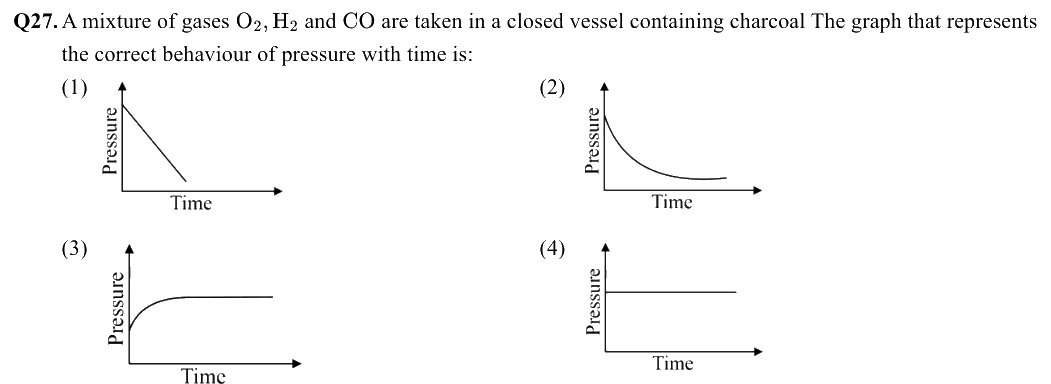
A mixture of gases $\mathrm{O_2}$, $\mathrm{H_2}$ and $\mathrm{CO}$ are taken in a closed vessel containing charcoal The graph that represents the correct behaviour of pressure with time is:

The question and its figure as printed in JEE Main 2020 09 Jan Shift 2. Option 1: Pressure (y-axis) against Time (x-axis): a straight line falling steadily from a high value on the pressure axis down to the time axis. Option 2: Pressure against Time: a curve falling steeply at first and then flattening out to a low, nearly constant, non-zero value. Option 3: Pressure against Time: a curve that starts at a non-zero value on the pressure axis, rises quickly and then flattens to a constant higher value. Option 4: Pressure against Time: a horizontal straight line (constant pressure).
The question as printed in the paper.
  • A

    see figure Pressure (y-axis) against Time (x-axis): a straight line falling steadily from a high value on the pressure axis down to the time axis.

  • B

    see figure Pressure against Time: a curve falling steeply at first and then flattening out to a low, nearly constant, non-zero value.

  • C

    see figure Pressure against Time: a curve that starts at a non-zero value on the pressure axis, rises quickly and then flattens to a constant higher value.

  • D

    see figure Pressure against Time: a horizontal straight line (constant pressure).

63JEE Main 2020 · 8 Jan · Shift 1MCQOpen question page ↗

As per Hardy-Schulze formulation, the flocculation values of the following for ferric hydroxide sol are in the order:

  • A

    $\mathrm{K_3[Fe(CN)_6] < K_2CrO_4 < KBr = KNO_3 = AlCl_3}$

  • B

    $\mathrm{K_3[Fe(CN)_6] < K_2CrO_4 < AlCl_3 < KBr < KNO_3}$

  • C

    $\mathrm{AlCl_3 > K_3[Fe(CN)_6] > K_2CrO_4 > KBr = KNO_3}$

  • D

    $\mathrm{K_3[Fe(CN)_6] > AlCl_3 > K_2CrO_4 > KBr > KNO_3}$

64JEE Main 2020 · 8 Jan · Shift 2MCQOpen question page ↗

For the following Assertion and Reason, the correct option is:
Assertion: For hydrogenation reactions, the catalytic activity increases from Group 5 to Group 11 metals with maximum activity shown by Group $7 - 9$ elements.
Reason: The reactants are most strongly adsorbed on group $7 - 9$ elements.

  • A

    The assertion is true, but the reason is false

  • B

    Both assertion and reason are false

  • C

    Both assertion and reason are true and the reason is the correct explanation for the assertion

  • D

    Both assertion and reason are true but the reason is not the correct explanation for the assertion

65JEE Main 2019 · 12 Apr · Shift 1MCQOpen question page ↗

Peptization is a:

  • A

    Process of converting a colloidal solution into precipitate

  • B

    Process of converting soluble particles to form colloidal solution

  • C

    Process of bringing colloidal molecule into solution

  • D

    Process of converting precipitate into colloidal solution

66JEE Main 2019 · 12 Apr · Shift 2MCQOpen question page ↗

Among the following, the incorrect statement about colloids is:

  • A

    They are larger than small molecules and have high molar mass.

  • B

    They can scatter lighht.

  • C

    The osmotic pressure of a collodial solution is of higher order than the true solution at the same concentration.

  • D

    The range of diameters of colloidal particles is between 1 and 1000 nm.

67JEE Main 2019 · 10 Apr · Shift 1MCQOpen question page ↗

A gas undergoes physical adsorption on a surface and follows the given Freundlich adsorption isotherm equation
$\frac{x}{m} = kp^{0.5}$
Adsorption of the gas increases with:

  • A

    Decrease in p and increase in T

  • B

    Increase in p and decrease in T

  • C

    Increase in p and increase in T

  • D

    Decrease in p and decrease in T

68JEE Main 2019 · 10 Apr · Shift 2MCQOpen question page ↗

The correct option among the following is.

  • A

    Brownian motion in colloidal solution is faster if the viscosity of the solution is very high.

  • B

    Colloidal particles in lyophobic sols can be precipitated by electrophoresis.

  • C

    Colloidal medicines are more effective because they have small surface area.

  • D

    Addition of alum to water makes it unfit for drinking.

69JEE Main 2019 · 9 Apr · Shift 1MCQOpen question page ↗

The aerosol is a kind of colloid in which

  • A

    solid is dispersed in gas.

  • B

    liquid is dispersed in water.

  • C

    gas is dispersed in solid.

  • D

    gas is dispersed in liquid.

70JEE Main 2019 · 9 Apr · Shift 1MCQOpen question page ↗

Match the catalysts (Column I) with products (Column II)
Column I (Catalyst): A. $\mathrm{V_2O_5}$; B. $\mathrm{TiCl_4/Al(Me)_3}$; C. $\mathrm{PdCl_2}$; D. Iron Oxide
Column II (Product): P. Polyethylene; Q. Ethanal; R. $\mathrm{H_2SO_4}$; S. $\mathrm{NH_3}$

  • A

    (A) $-$ (S); (B) $-$ (R); (C) $-$ (Q); (D) $-$ (P)

  • B

    (A) $-$ (R); (B) $-$ (S); (C) $-$ (P); (D) $-$ (Q)

  • C

    (A) $-$ (Q); (B) $-$ (R); (C) $-$ (P); (D) $-$ (S)

  • D

    (A) $-$ (R); (B) $-$ (P); (C) $-$ (Q); (D) $-$ (S)

71JEE Main 2019 · 9 Apr · Shift 2MCQOpen question page ↗

10 mL of 1 mM surfactant solution forms a monolayer covering 0.24 $\mathrm{cm^2}$ on a polar substrate. If the polar head is approximated as a cube, what is its edge length?

  • A

    1.0 pm

  • B

    0.1 nm

  • C

    2.0 pm

  • D

    2.0 nm

72JEE Main 2019 · 8 Apr · Shift 1MCQOpen question page ↗

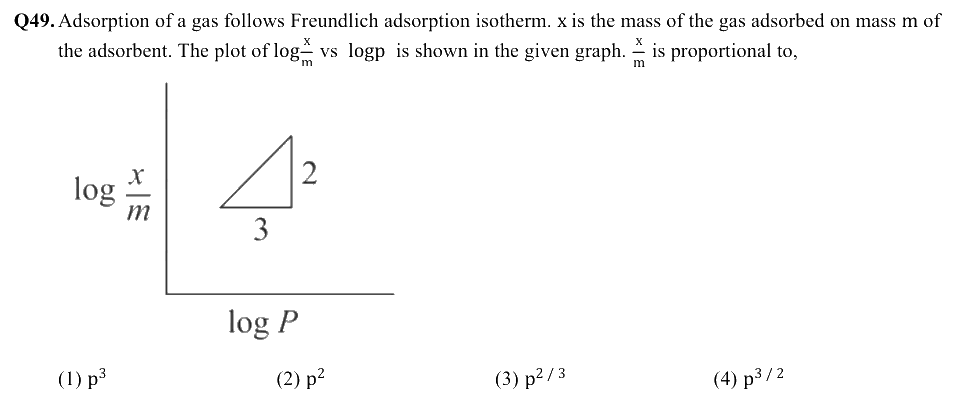
Adsorption of a gas follows Freundlich adsorption isotherm. x is the mass of the gas adsorbed on mass m of the adsorbent. The plot of $\log\dfrac{x}{m}$ vs $\log p$ is shown in the given graph. $\dfrac{x}{m}$ is proportional to,
(see the figure above)

The question and its figure as printed in JEE Main 2019 08 Apr Shift 1.
The question as printed in the paper.
  • A

    $\mathrm{p^3}$

  • B

    $\mathrm{p^2}$

  • C

    $\mathrm{p^{2/3}}$

  • D

    $\mathrm{p^{3/2}}$

73JEE Main 2019 · 12 Jan · Shift 1MCQOpen question page ↗

Given:
Gas: $\mathrm{H_2}$, $\mathrm{CH_4}$, $\mathrm{CO_2}$, $\mathrm{SO_2}$
Critical temperature in K: 33, 190, 304, 630
On the basis of data given above, predict which of the following gases shows the least adsorption on a definite amount of charcoal?

  • A

    $\mathrm{CH_4}$

  • B

    $\mathrm{CO_2}$

  • C

    $\mathrm{SO_2}$

  • D

    $\mathrm{H_2}$

74JEE Main 2019 · 12 Jan · Shift 2MCQOpen question page ↗

Among the following, the false statement is:

  • A

    Latex is a colloidal solution of rubber particles which are positively charged

  • B

    Tyndall effect can be used to distinguish between a colloidal solution and a true solution.

  • C

    It is possible to cause artificial rain by throwing electrified sand carrying charge opposite to the one on clouds from an aeroplane.

  • D

    Lyophilic sols can be coagulated by adding an electrolyte.

76JEE Main 2019 · 11 Jan · Shift 2MCQOpen question page ↗

Among the colloids cheese (C), milk (M) and smoke (S), the correct combination of the dispersed phase and dispersion medium, respectively is :

  • A

    C : liquid in solid; M : liquid in solid; S : solid in gas

  • B

    C : liquid in solid; M : liquid in liquid; S : solid in gas

  • C

    C : solid in liquid; M : liquid in liquid; S : gas in solid

  • D

    C : solid in liquid; M : solid in liquid; S : solid in gas

77JEE Main 2019 · 10 Jan · Shift 1MCQOpen question page ↗

Which of the following is not an example of heterogeneous catalysis reaction?

  • A

    Combustion of Coal

  • B

    Hydrogenation of Vegetable oils

  • C

    Ostwald's process

  • D

    Haber's process

78JEE Main 2019 · 10 Jan · Shift 2MCQOpen question page ↗

The haemoglobin and the gold sol are examples of

  • A

    positively charged sols,

  • B

    negatively and positively charged sols, respectively.

  • C

    negatively charged sols.

  • D

    positively and negatively charged sols, respectively.

79JEE Main 2019 · 9 Jan · Shift 1MCQOpen question page ↗

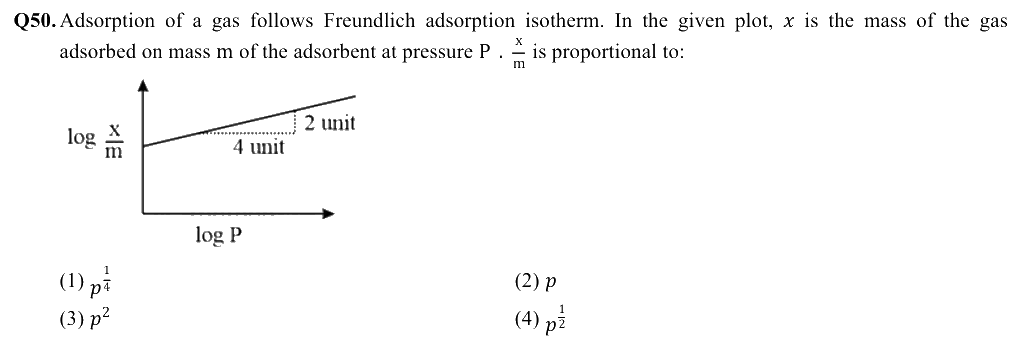
Adsorption of a gas follows Freundlich adsorption isotherm. In the given plot, $x$ is the mass of the gas adsorbed on mass m of the adsorbent at pressure P . $\dfrac{\mathrm{x}}{\mathrm{m}}$ is proportional to:
(see the figure above)

The question and its figure as printed in JEE Main 2019 09 Jan Shift 1.
The question as printed in the paper.
  • A

    $p^{\frac{1}{4}}$

  • B

    $p$

  • C

    $p^2$

  • D

    $p^{\frac{1}{2}}$

80JEE Main 2019 · 9 Jan · Shift 2MCQOpen question page ↗

For coagulation of arsenious sulphide sol, which of the following salt solutions will be most effective?

  • A

    $Na_3PO_4$

  • B

    $NaCl$

  • C

    $AlCl_3$

  • D

    $BaCl_2$

81JEE Main 2018 · 16 Apr · OnlineMCQOpen question page ↗

Which one of the following is not a property of physical adsorption?

  • A

    Higher the pressure, more the adsorption

  • B

    Greater the surface area, more the adsorption

  • C

    Lower the temperature, more the adsorption

  • D

    Unilayer adsorption occurs

82JEE Main 2018 · 15 Apr · Shift 1MCQOpen question page ↗

Which of the following statements about colloids is false?

  • A

    When silver nitrate solution is added to potassium iodide solution, a negatively charged colloidal solution is formed

  • B

    Freezing point of colloidal solution is lower than true solution at same concentration of a solute

  • C

    Colloidal particles can pass through ordinary filter paper

  • D

    When excess of electrolyte is added to colloidal solution, colloidal particle will be precipitated

83JEE Main 2018 · 15 Apr · Shift 2MCQOpen question page ↗

If $x$ gram of gas is adsorbed by $m$ gram of adsorbent at pressure $P$ the plot of $\log\frac{x}{\mathrm{m}}$ versus $\log\mathrm{P}$ is linear. The slope of the plot is: ( m and k are constants and $n > 1$ )

  • A

    $\log\mathrm{k}$

  • B

    $\dfrac{1}{n}$

  • C

    $2\mathrm{k}$

  • D

    $\mathrm{n}$

84JEE Main 2017 · 9 Apr · OnlineMCQOpen question page ↗

Adsorption of gas on a surface follows Freundlich adsorption isotherm. The plot of $\log\frac{x}{m}$ versus $\log(P)$ gives a straight line with slope equal to 0.5, then:
($\frac{x}{m}$ is the mass of the gas adsorbed per gram of adsorbent)

  • A

    adsorption is proportional to the square root of pressure.

  • B

    adsorption is proportional to the square of pressure.

  • C

    adsorption is proportional to the pressure.

  • D

    adsorption is independent of pressure.

85JEE Main 2017 · 8 Apr · OnlineMCQOpen question page ↗

Among the following, the correct statement is:

  • A

    sols of metal sulphides are lyophilic.

  • B

    Brownian movement is more pronounced for smaller particles than for bigger-particles.

  • C

    one would expect charcoal to adsorb chlorine more than hydrogen sulphide.

  • D

    Hardy Schulze law states that bigger the size of the ions, the greater is its coagulating power.

86JEE Main 2017 · 2 Apr · OfflineMCQOpen question page ↗

The Tyndall effect is observed only when the following conditions are satisfied,
i The diameter of the dispersed particles is much smaller than the wavelength of the light used.
ii The diameter of the dispersed particle is not much smaller than the wavelength of the light used.
iii The refractive indices of the dispersed phase and dispersion medium are almost similar in magnitude.
iv The refractive indices of the dispersed phase and dispersion medium differ greatly in magnitude.

  • A

    ii and iv

  • B

    i and iii

  • C

    ii and iii

  • D

    i and iv

87JEE Main 2016 · 10 Apr · OnlineMCQOpen question page ↗

Gold numbers of some colloids are Gelatin: $0.005 - 0.01$, Gum Arabic: $0.15 - 0.25$, Oleate: $0.04 - 1.0$, Starch: $15 - 25$. Which among the following is a better protective colloid?

  • A

    Gelatin

  • B

    Starch

  • C

    Oleate

  • D

    Gum Arabic

88JEE Main 2016 · 9 Apr · OnlineMCQOpen question page ↗

A particular adsorption process has the following characteristics: (i) It arises due to van der Waals forces and (ii) it is reversible. Identify the correct statement that describes the above adsorption process:

  • A

    Adsorption is monolayer

  • B

    Adsorption increases with increase in temperature

  • C

    Enthalpy of adsorption is greater than $100\ \mathrm{kJ\ mol^{-1}}$

  • D

    Energy of activation is low

89JEE Main 2016 · 9 Apr · OnlineMCQOpen question page ↗

The most appropriate method of making egg-albumin sol is:

  • A

    Break an egg carefully and transfer the transparent part of the content to 100 mL of 5% w/V saline solution and stir well

  • B

    Keep the egg in boiling water for 10 minutes. After removing the shell, transfer the yellow part of the content to 100 mL of 5% w/V saline solution and homogenize with a mechanical shaker

  • C

    Keep the egg in boiling water for 10 minutes. After removing the shell, transfer the white part of the content to 100 mL of 5% w/V saline solution and homogenize with a mechanical shaker

  • D

    Break an egg carefully and transfer only the yellow part of the content to 100 mL of 5% w/V saline solution and stir well

90JEE Main 2016 · 3 Apr · OfflineMCQOpen question page ↗

For a linear plot of $\log\left(\frac{x}{m}\right)$ versus $\log$ p in a Freundlich adsorption isotherm, which of the following statements is correct? (k and n are constants)

  • A

    Only $\frac{1}{n}$ appears as the slope.

  • B

    $\log\left(\frac{1}{n}\right)$ appears as the intercept.

  • C

    Both k and $\frac{1}{n}$ appear in the slope term.

  • D

    $\frac{1}{n}$ appears as the intercept.

91JEE Main 2015 · 11 Apr · OnlineMCQOpen question page ↗

Under ambient conditions, which among the following surfactants will form micelles in aqueous solution at lowest molar concentration?

  • A

    $\mathrm{CH_3\,(CH_2)_{11}\overset{\oplus}{N}(CH_3)_3\,Br^-}$

  • B

    $\mathrm{CH_3 - (CH_2)_{13} - OSO_3^-\ Na^+}$

  • C

    $\mathrm{CH_3\,(CH_2)_{15}\overset{\oplus}{N}(CH_3)_3\,Br^-}$

  • D

    $\mathrm{CH_3 - (CH_2)_8 - COO^{\ominus}\ Na^+}$

92JEE Main 2015 · 10 Apr · OnlineMCQOpen question page ↗

The following statements relate to the adsorption of gases on a solid surface. Identify the incorrect statement among them:

  • A

    Entropy of adsorption is negative

  • B

    Enthalpy of adsorption is negative

  • C

    On adsorption decrease in surface energy appears as heat

  • D

    On adsorption, the residual forces on the surface are increased

93JEE Main 2015 · 4 Apr · OfflineMCQOpen question page ↗

$3\ \mathrm{g}$ of activated charcoal was added to $50\ \mathrm{mL}$ of acetic acid solution ($0.06\ \mathrm{N}$) in a flask. After an hour, it was filtered and the strength of the filtrate was found to be $0.042\ \mathrm{N}$. The amount of acetic acid adsorbed (per gram of charcoal) is:

  • A

    $54\ \mathrm{mg}$

  • B

    $18\ \mathrm{mg}$

  • C

    $36\ \mathrm{mg}$

  • D

    $42\ \mathrm{mg}$

94JEE Main 2015 · 4 Apr · OfflineMCQOpen question page ↗

Match the catalysts to the correct process.
Catalyst
A. $\mathrm{TiCl_3}$
B. $\mathrm{PdCl_2}$
C. $\mathrm{CuCl_2}$
D. $\mathrm{V_2O_5}$
Process
i. Wacker process
ii. Ziegler – Natta polymerisation
iii. Contact process`
iv. Deacon's process

  • A

    A $\rightarrow$ iii , B $\rightarrow$ i , C $\rightarrow$ ii , D $\rightarrow$ iv

  • B

    A $\rightarrow$ iii , B $\rightarrow$ ii , C $\rightarrow$ iv , D $\rightarrow$ i

  • C

    A $\rightarrow$ ii , B $\rightarrow$ i , C $\rightarrow$ iv , D $\rightarrow$ iii

  • D

    A $\rightarrow$ ii , B $\rightarrow$ iii , C $\rightarrow$ iv , D $\rightarrow$ i

95JEE Main 2013 · 23 Apr · OnlineMCQOpen question page ↗

Smoke is an example of:

  • A

    Solid dispersed in solid

  • B

    Gas dispersed in liquid

  • C

    Solid dispersed in gas

  • D

    Gas dispersed in solid

96JEE Main 2013 · 22 Apr · OnlineMCQOpen question page ↗

Flocculation value of $\mathrm{BaCl_2}$ is much less than that of KCl for sol A and flocculation value of $\mathrm{Na_2SO_4}$ is much less than that of NaBr for sol B. The correct statement among the following is :

  • A

    Both the sols A and B are negatively charged.

  • B

    Sol A is positively charged and Sol B is negatively charged.

  • C

    Both the sols A and B are positively charged.

  • D

    Sol A is negatively charged and sol B is positively charged.

97JEE Main 2013 · 9 Apr · OnlineMCQOpen question page ↗

The migration of dispersion medium under the influence of an electric potential is called :

  • A

    Cataphoresis

  • B

    Electroosmosis

  • C

    Electrophoresis

  • D

    Sedimentation

98JEE Main 2013 · 7 Apr · OfflineMCQOpen question page ↗

The coagulating power of electrolytes having ions $\mathrm{Na^{+}}$, $\mathrm{Al^{3+}}$ and $\mathrm{Ba^{2+}}$ for arsenic sulphide sol increases in the order,

  • A

    $\mathrm{Ba^{2+}} < \mathrm{Na^{+}} < \mathrm{Al^{3+}}$

  • B

    $\mathrm{Al^{3+}} < \mathrm{Na^{+}} < \mathrm{Ba^{2+}}$

  • C

    $\mathrm{Al^{3+}} < \mathrm{Ba^{2+}} < \mathrm{Na^{+}}$

  • D

    $\mathrm{Na^{+}} < \mathrm{Ba^{2+}} < \mathrm{Al^{3+}}$

100AIEEE 2012 · 19 May · OnlineMCQOpen question page ↗

On addition of $1\ \mathrm{mL}$ of $10\%\mathrm{NaCl}$ solution to $10\ \mathrm{mL}$ gold sol in the presence of $0.025\ \mathrm{g}$ of starch, the coagulation is just prevented. Starch has gold number

  • A

    2.5

  • B

    25

  • C

    0.25

  • D

    0.025

101AIEEE 2012 · 19 May · OnlineMCQOpen question page ↗

Fog is a colloidal solution of

  • A

    solid particles dispersed in gas

  • B

    solid particles dispersed in a liquid

  • C

    liquid particles dispersed in gas

  • D

    gaseous particles dispersed in a liquid

102AIEEE 2012 · 12 May · OnlineMCQOpen question page ↗

The correct statement for both the processes of physisorption and chemisorption is

  • A

    both are endothermic

  • B

    chemisorption is endothermic but physisorption is exothermic

  • C

    both are exothermic

  • D

    physisorption is endothermic but chemisorption is exothermic.

103AIEEE 2012 · 7 May · OnlineMCQOpen question page ↗

If $x$ is the mass of the gas adsorbed on mass $m$ of the adsorbent at pressure $p$, Freundlich adsorption isotherm gives a straight line on plotting

  • A

    $x/m$ vs $p$

  • B

    $x/m$ vs $1/p$

  • C

    $\log x/m$ vs $\log p$

  • D

    $\log x/m$ vs $p$

104AIEEE 2012 · OfflineMCQOpen question page ↗

According to Freundlich adsorption isotherm, which of the following is correct ?

  • A

    $\frac{x}{m} \propto P^0$

  • B

    $\frac{x}{m} \propto p^1$

  • C

    $\frac{x}{m} \propto p^{1/n}$

  • D

    All the above are correct for different ranges of pressure

105AIEEE 2009MCQOpen question page ↗

Which of the following statements is incorrect regarding physissorptions ?

  • A

    It occurs because of vander Waal's forces.

  • B

    More easily liquefiable gases are adsorbed readily.

  • C

    Under high pressure it results into multi molecular layer on adsorbent surface.

  • D

    Enthalpy of adsorption ($\Delta \mathrm{H_{adsorption}}$ ) is low and positive.

106AIEEE 2008MCQOpen question page ↗

Gold numbers of protective colloids $A, B, C$ and $D$ are $0.50, 0.01, 0.10$ and $0.005$, respectively. The correct order of their protective powers is

  • A

    $D < A < C < B$

  • B

    C < B < D < A

  • C

    $A < C < B < D$

  • D

    B < D < A < C

107AIEEE 2006MCQOpen question page ↗

In Langmuir's model of adsorption of a gas on a solid surface

  • A

    the rate of dissociation of adsorbed molecules from the surface does not depend on the surface covered

  • B

    the adsorption at a single site on the surface may involve multiple molecules at the same time

  • C

    the mass of gas striking a given area of surface is proportional to the pressure of the gas

  • D

    the mass of gas striking a given area of surface is independent of the pressure of the gas

108AIEEE 2005MCQOpen question page ↗

The volume of a colloidal particle, $V_C$ as compared to the volume of a solute particle in a true solution $\mathrm{V_s}$, could be

  • A

    $\frac{V_C}{V_S} \simeq 1$

  • B

    $\frac{V_c}{V_s} \simeq 10^{23}$

  • C

    $\frac{V_c}{V_s} \simeq 10^{-3}$

  • D

    $\frac{V_c}{V_s} \simeq 10^{3}$

109AIEEE 2005MCQOpen question page ↗

The disperse phase in colloidal iron (III) hydroxide and colloidal gold is positively and negatively charged, respectively, which of the following statements is NOT correct?

  • A

    magnesium chloride solution coagulates, the gold sol more readily than the iron (III) hydroxide sol.

  • B

    sodium sulphate solution causes coagulation in both sols

  • C

    mixing the sols has no effect

  • D

    coagulation in both sols can be brought about by electrophoresis

110AIEEE 2004MCQOpen question page ↗

Identify the correct statements regarding enzymes

  • A

    Enzymes are specific biological catalysts that can normally function at very high temperature $(T \sim 1000\ \mathrm{K})$

  • B

    Enzymes are specific biological catalysts that the posses well - defined active sites

  • C

    Enzymes are specific biological catalysts that can not be poisoned

  • D

    Enzymes are normally heterogeneous catalysts that are very specific in their action

111AIEEE 2003MCQOpen question page ↗

Which one of the following characteristics is not correct for physical adsorption?

  • A

    Adsorption increases with incresae in temperature

  • B

    Adsorption is spontaneous

  • C

    Both enthalpy and entropy of adsorption are negative

  • D

    Adsorption on solids is reversible

112AIEEE 2002MCQOpen question page ↗

Alum helps in purifying water by

  • A

    forming Si complex with clay particles

  • B

    sulphate part which combines with the dirt and removes it

  • C

    coagulating the mud particles

  • D

    making mud water soluble

Numerical value

18 questions
113JEE Main 2023 · 15 Apr · Shift 1NumericalOpen question page ↗

20 mL of 0.5 M NaCl is required to coagulate 200 mL of $\mathrm{As_2\,S_3}$ solution in 2 hours. The coagulating value of NaCl is ______.

Numerical answer type: type your answer in EdLoop to check it
114JEE Main 2023 · 11 Apr · Shift 2NumericalOpen question page ↗

The number of correct statements about modern adsorption theory of heterogeneous catalysis from the following is ______
A. The catalyst is diffused over the surface of reactants.
B. Reactants are adsorbed on the surface of the catalyst.
C. Occurrence of chemical reaction on the catalyst's surface through formation of an intermediate.
D. It is a combination of intermediate compound formation theory and the old adsorption theory.
E. It explains the action of the catalyst as well as those of catalytic promoters and poisons.

Numerical answer type: type your answer in EdLoop to check it
115JEE Main 2023 · 8 Apr · Shift 2NumericalOpen question page ↗

Coagulating value of the electrolytes $\mathrm{AlCl_3}$ and NaCl for $\mathrm{As_2S_3}$ are 0.09 and 50.04 respectively. The coagulating power of $\mathrm{AlCl_3}$ is x times the coagulating power of NaCl. The value of x is

Numerical answer type: type your answer in EdLoop to check it
116JEE Main 2023 · 6 Apr · Shift 2NumericalOpen question page ↗

The number of colloidal systems from the following, which will have 'liquid' as the dispersion medium, is ______ .

Gem stones, paints, smoke, cheese, milk, hair cream, insecticide sprays, froth, soap lather

Numerical answer type: type your answer in EdLoop to check it
117JEE Main 2023 · 30 Jan · Shift 2NumericalOpen question page ↗

The graph of log $\frac{x}{m}$ vs log p for an adsorption process is a straight line inclined at an angle of 45$^\circ$ with intercept equal to 0.6020. The mass of gas adsorbed per unit mass of adsorbent at the pressure of 0.4 atm is ______ $\times 10^{-1}$ (Nearest integer)
Given : log 2 = 0.3010

Numerical answer type: type your answer in EdLoop to check it
118JEE Main 2023 · 25 Jan · Shift 2NumericalOpen question page ↗

The number of incorrect statement/s from the following is/are

A. Water vapours are adsorbed by anhydrous calcium chloride.

B. There is a decrease in surface energy during adsorption.

C. As the adsorption proceeds, $\Delta H$ becomes more and more negative.

D. Adsorption is accompanied by decrease in entropy of the system.

Numerical answer type: type your answer in EdLoop to check it
119JEE Main 2023 · 24 Jan · Shift 2NumericalOpen question page ↗

The number of statement/s which are the characteristics of physisorption is ______.

A. It is highly specific in nature

B. Enthalpy of adsorption is high

C. It decreases with increase in temperature

D. It results into unimolecular layer

E. No activation energy is needed

Numerical answer type: type your answer in EdLoop to check it
120JEE Main 2022 · 28 Jul · Shift 2NumericalOpen question page ↗

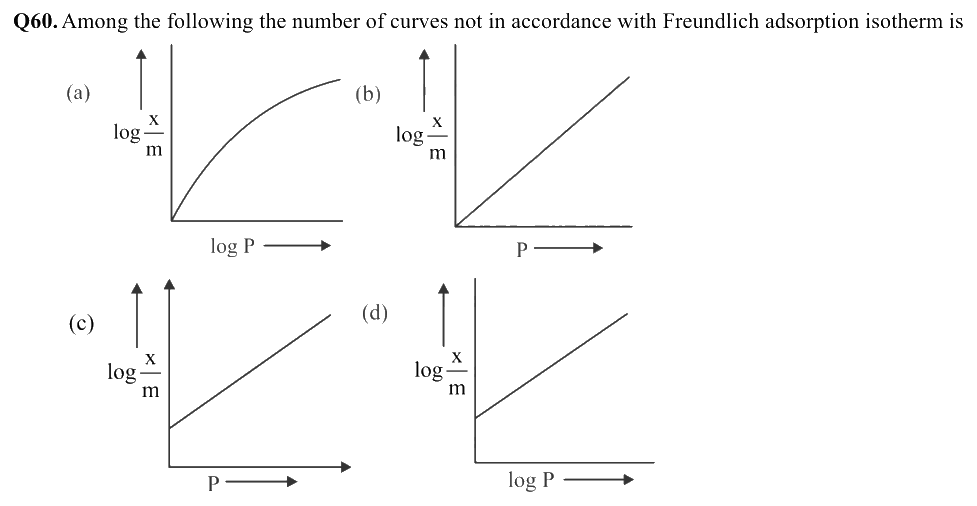
Among the following the number of curves not in accordance with Freundlich adsorption isotherm is

(see the figure above)

The question and its figure as printed in JEE Main 2022 28 Jul Shift 2.
The question as printed in the paper.
Numerical answer type: type your answer in EdLoop to check it
121JEE Main 2022 · 27 Jun · Shift 2NumericalOpen question page ↗

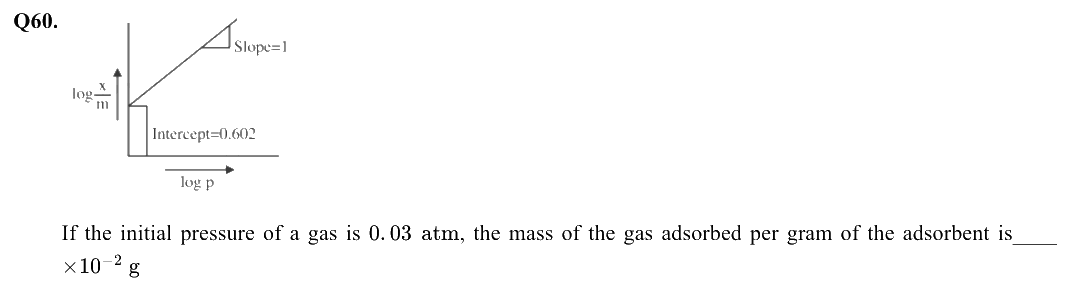
see figure If the initial pressure of a gas is 0.03 atm, the mass of the gas adsorbed per gram of the adsorbent is ______ $\times 10^{-2}$ g

The question and its figure as printed in JEE Main 2022 27 Jun Shift 2. Question: If the initial pressure of a gas is 0.03 atm, the mass of the gas adsorbed per gram of the adsorbent is × 10^-2 g
The question as printed in the paper.
Numerical answer type: type your answer in EdLoop to check it
122JEE Main 2022 · 26 Jun · Shift 1NumericalOpen question page ↗

$2.0 \mathrm{~g}$ of $\mathrm{H}_2$ gas is adsorbed on $2.5 \mathrm{~g}$ of platinum powder at $300 \mathrm{~K}$ and $1 \mathrm{~bar}$ pressure. The volume of the gas adsorbed per gram of the adsorbent is mL
(Given : $\mathrm{R} = 0.083 \mathrm{~L} \mathrm{~bar} \mathrm{~K}^{-1} \mathrm{~mol}^{-1}$)

Numerical answer type: type your answer in EdLoop to check it
123JEE Main 2022 · 24 Jun · Shift 2NumericalOpen question page ↗

When $200 \mathrm{~mL}$ of $0.2 \mathrm{~M}$ acetic acid is shaken with $0.6 \mathrm{~g}$ of wood charcoal, the final concentration of acetic acid after adsorption is $0.1 \mathrm{~M}$. The mass of acetic acid adsorbed per gram of carbon is g.

Numerical answer type: type your answer in EdLoop to check it
124JEE Main 2021 · 31 Aug · Shift 2NumericalOpen question page ↗

$\mathrm{CH_4}$ is adsorbed in $1$ g charcoal at $0^\circ$C following the Freundlich adsorption isotherm. $10.0$ mL of $\mathrm{CH_4}$ is adsorbed at $100$ mm of Hg, whereas $15.0$ mL is adsorbed at $200$ mm of Hg. The volume of $\mathrm{CH_4}$ adsorbed at $300$ mm of Hg is $10^x$ mL. The value of x is ______ $\times 10^{-2}$. (Nearest integer)
[Use $\log_{10}2 = 0.3010$, $\log_{10}3 = 0.4771$]

Numerical answer type: type your answer in EdLoop to check it
125JEE Main 2021 · 27 Jul · Shift 1NumericalOpen question page ↗

$\mathrm{CO_2}$ gas adsorbs on charcoal following Freundlich adsorption isotherm. For a given amount of charcoal, the mass of $\mathrm{CO_2}$ adsorbed becomes 64 times when the pressure of $\mathrm{CO_2}$ is doubled. The value of n in the Freundlich isotherm equation is ______ $\times 10^{-2}$. (Round off to the Nearest Integer)

Numerical answer type: type your answer in EdLoop to check it
126JEE Main 2021 · 20 Jul · Shift 2NumericalOpen question page ↗

For coagulation of $50~\mathrm{mL}$ of a sol, $10~\mathrm{mL}$ of $0.5\mathrm{M}$ $\mathrm{Cl^-}$ ion solution is required. What is the coagulating value of $\mathrm{Cl^-}$ ion solution (Nearest integer)
NOTE: NTA question has been changed because it had errors.}

Numerical answer type: type your answer in EdLoop to check it
127JEE Main 2021 · 26 Feb · Shift 1NumericalOpen question page ↗

$3.12\ \mathrm{g}$ of oxygen is adsorbed on $1.2\ \mathrm{g}$ of platinum metal. The volume of oxygen adsorbed per gram of the adsorbent at $1\ \mathrm{atm}$ and $300\ \mathrm{K}$ in L is ______ [R = $0.0821\ \mathrm{L\ atm\ K^{-1}\ mol^{-1}}$]

Numerical answer type: type your answer in EdLoop to check it
128JEE Main 2020 · 6 Sep · Shift 2NumericalOpen question page ↗

For Freundlich adsorption isotherm, a plot of log (x/m) (y $-$ axis) and log p(x $-$ axis) gives a straight line, the intercept and slope fo rthe line is 0.4771 and 2, respectively. The mass of gas, adsorbed per gram of adsorbent if the initial pressure is 0.04 atm is ______ $\times 10^{-4}$g.

Numerical answer type: type your answer in EdLoop to check it
129JEE Main 2020 · 2 Sep · Shift 1NumericalOpen question page ↗

The mass of gas adsorbed, x, per unit mass of adsorbate, m, was measured at various pressures, p. A graph between $\log\frac{x}{m}$ and $\log p$ gives a straight line with slope equal to 2 and the intercept equal to $0.4771$. The value of $\frac{x}{m}$ at a pressure of 4 atm is :
(Given $\log 3 = 0.4771$)

Numerical answer type: type your answer in EdLoop to check it
130JEE Main 2020 · 7 Jan · Shift 2NumericalOpen question page ↗

The flocculation value of $\mathrm{HCl}$ for arsenic sulphide sol is $30\ \mathrm{mmolL^{-1}}$. If $\mathrm{H_2SO_4}$ is used for the flocculation of arsenic sulphide, the amount, in grams, of $\mathrm{H_2SO_4}$ in $250\mathrm{ml}$ required for the above purpose is ______
(molecular mass of $\mathrm{H_2SO_4} = 98\ \mathrm{g/mol}$

Numerical answer type: type your answer in EdLoop to check it

How to prepare Surface Chemistry for JEE Main

How often it comes up

Surface chemistry studies phenomena at phase boundaries and was formerly in the Class 12 curriculum before being removed in 2024, holding rank 24 of 31 chemistry chapters with a 2.1% share of chemistry questions. Across the 2019 to 2026 timeframe, Surface Chemistry contributed 98 questions across 162 test papers, representing 2.1% of chemistry questions and standing at rank 24 of 31 chapters. Prior to that, from 2002 to 2018, it registered 32 questions across 38 papers with a 2.4% subject share. Following the curriculum reduction in 2024, the chapter saw 0 questions across 58 papers in the 2024 to 2026 period. Consequently, its overall trajectory has trended down.

Because of its removal, the chapter was not asked in 2024, 2025, or 2026. Prior to deletion, the chapter averaged 0.6 questions per paper between 2019 and 2026, including 18 numerical answer questions.

Most-asked topics

Historic papers distributed questions across three specific topics:

  • Colloids: Generated 72 total questions (55 during 2019 to 2026), last evaluated in 2023. Areas covered included classification of sols, lyophilic versus lyophobic behaviors, Hardy-Schulze rule for coagulation, electrophoresis, and micelle formation.
  • Adsorption: Accounted for 46 total questions (33 during 2019 to 2026), last tested in 2023. Core concepts focused on distinguishing physisorption from chemisorption, thermodynamic parameters (enthalpy and entropy changes), and the Freundlich adsorption isotherm.
  • Catalysis: Yielded 12 total questions (10 during 2019 to 2026), last asked in 2023. Questions examined homogeneous and heterogeneous catalysis, enzyme kinetics curves, and intermediate compound theories.

What the questions look like

Past problems were predominantly conceptual and descriptive, demanding accurate recall of terminology. Typical items asked students to contrast physisorption against chemisorption based on reversibility, temperature influence, or enthalpy values. In colloidal systems, questions regularly tested the coagulating power of various electrolytes on positively or negatively charged sols.

Mathematical questions were restricted almost entirely to the Freundlich isotherm equation, evaluating logarithmic plots of x/m versus pressure to deduce constants.

Questions to try first

If exploring historical papers or preparing for allied engineering tests, consider these past questions:

How to practise it

Given the syllabus status, adjust your study schedule thoughtfully:

1. Prioritize active chapters: Since this unit is excluded from the current JEE Main curriculum, dedicate your primary revision hours to high-weight active units. 2. Review basic colloid terms: If preparing for board exams or other competitive assessments, understand Brownian motion, Tyndall effect, and zeta potential. 3. Understand adsorption thermodynamics: Know that adsorption is always exothermic with negative entropy change under spontaneous conditions. 4. Recall the Hardy-Schulze rule: Remember that higher ionic charge corresponds to exponentially greater coagulating power for an oppositely charged sol.

Frequently asked questions

Is Surface Chemistry tested in the current JEE Main exam?

No, the National Testing Agency officially excised Surface Chemistry from the JEE Main curriculum in 2024, and no questions appeared in 2024, 2025, or 2026 papers.

Should I study this chapter for other engineering entrance tests?

Certain state level or private entrance exams may still retain colloidal chemistry and adsorption in their syllabi. Check the latest information bulletin for each specific examination.

Where can I access past Surface Chemistry questions with explanations?

Full past year questions from previous cycles remain valuable for general conceptual clarity. Step-by-step solutions for each one are in the EdLoop app.

Get EdLoop – freeOpen on the web