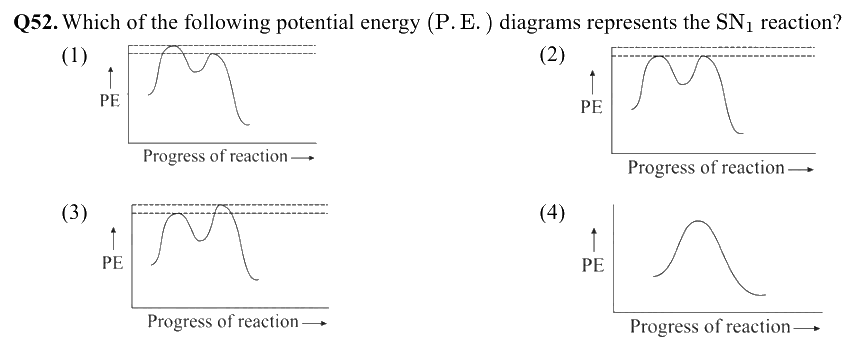
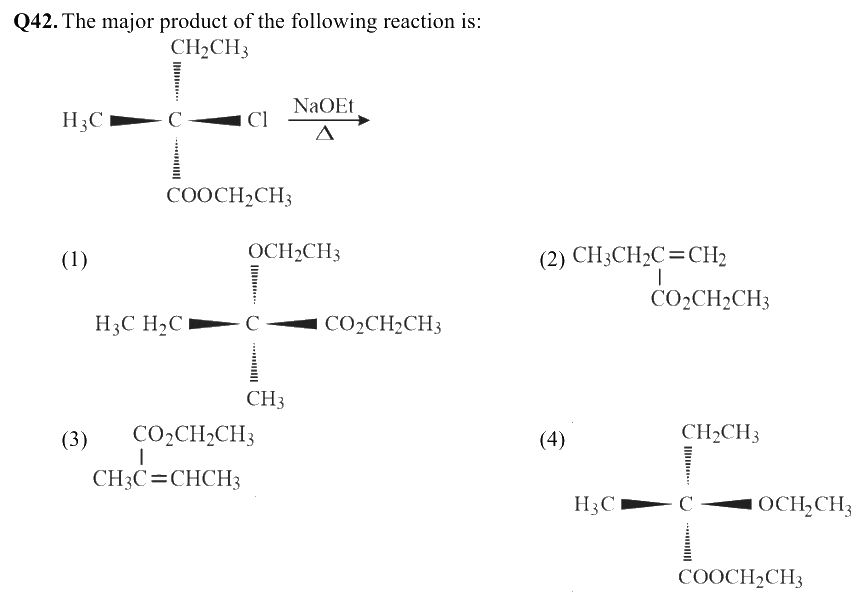
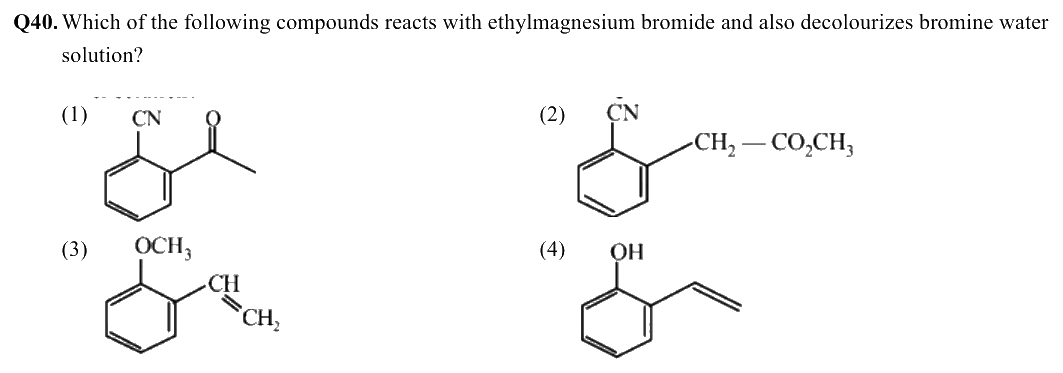
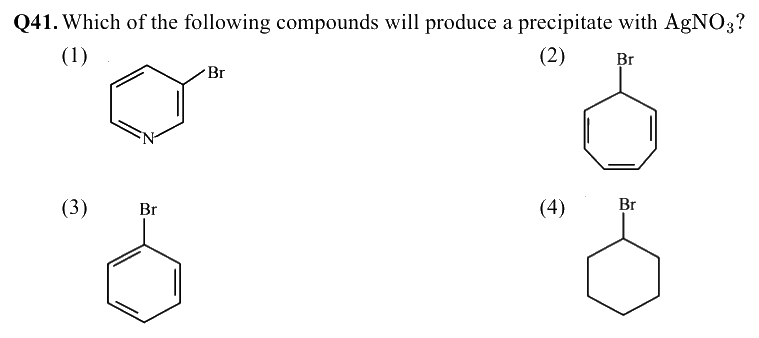
EdLoop PYQs · free, no ads · questions and answers here, step-by-step solutions in the EdLoop app
PYQs · free, no adsOpen on the web (app.edloop.in)Get EdLoop – free on Google Play
ChemistryHaloalkanes & Haloarenes

Haloalkanes & Haloarenes: JEE Main PYQs 2002–2026

Every Haloalkanes & Haloarenes question from past JEE Main and AIEEE papers, with options and answers. Newest first.

149questions
116papers covered
2.5%of Chemistry questions, 2019–2026
2002–2026years

Guide at a glance

Haloalkanes and haloarenes covers substitution and elimination reactions under Unit 16: Organic Compounds Containing Halogens in the Class 12 curriculum, holding rank 19 of 31 chapters with a 2.5% share of the chemistry section.

Most asked sub-topics

Nucleophilic Substitution77
Elimination & Other Reactions56
Preparation & Properties16

Practise these in EdLoop

Attempt every Haloalkanes & Haloarenes question timed, see the step-by-step solution and track what you get wrong. Free.

Start practice

MCQ, single correct

142 questions
1JEE Main 2026 · 8 Apr · Shift 2MCQOpen question page ↗

Given below are two statements :

Statement I : Due to increase in van der Waals forces, the order of boiling points is $\mathrm{CH_3CH_2CH_2I} > \mathrm{CH_3CH_2I} > \mathrm{CH_3I}$.

Statement II : As (see the figure above) is more symmetric, its melting point is higher than (see the figure above), however its boiling point is lower than (see the figure above)

In the light of the above statements, choose the correct answer from the options given below :

The question and its figure as printed in B Tech 8th Apr 2026 Shift 2.
The question as printed in the paper.
  • A

    Both Statement I and Statement II are true

  • B

    Both Statement I and Statement II are false

  • C

    Statement I is true but Statement II is false

  • D

    Statement I is false but Statement II is true

2JEE Main 2026 · 4 Apr · Shift 1MCQOpen question page ↗

Match the LIST-I with LIST-II

List-I Name of reactionList-II Reagent or catalyst used
A. Finkelstein reactionI. $\mathrm{SbF_3}$
B. Swarts reactionII. Na, dry ether
C. Sandmeyer's reactionIII. NaI
D. Fittig reactionIV. $\mathrm{Cu_2Cl_2}$

Choose the *correct* answer from the options given below:

  • A

    A-I, B-IV, C-III, D-II

  • B

    A-III, B-I, C-IV, D-II

  • C

    A-IV, B-II, C-I, D-III

  • D

    A-I, B-III, C-II, D-IV

3JEE Main 2026 · 2 Apr · Shift 1MCQOpen question page ↗

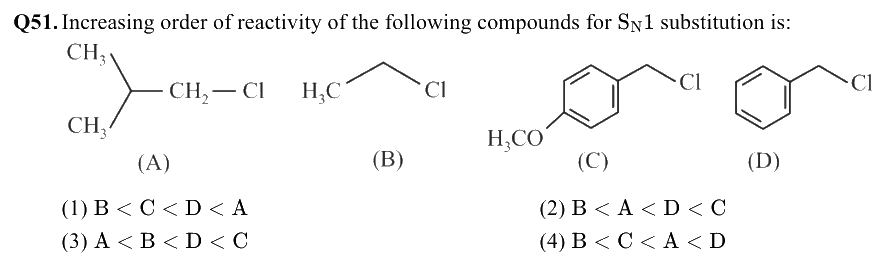
Given below are two statements :

Statement (I) : Benzyl chloride reacts faster in $\mathrm{S_N1}$ mechanism than ethyl chloride.

Statement (II) : Ethyl carbocation intermediate is less stabilized by hyperconjugation than benzyl carbocation by resonance.

In the light of the above statements, choose the correct answer from the options given below :

  • A

    Both Statement I and Statement II are true

  • B

    Both Statement I and Statement II are false

  • C

    Statement I is true but Statement II is false

  • D

    Statement I is false but Statement II is true

4JEE Main 2026 · 2 Apr · Shift 2MCQOpen question page ↗

Correct statements regarding alkyl halides (R$-$X) among the following are :

A. Alcohol being less polar solvent as compared to water, alcoholic KOH favours elimination reaction with R$-$X.

B. Order of reactivity towards $\mathrm{S_N}1$ mechanism is $\mathrm{C_6H_5-CH_2-Cl} > \mathrm{C_6H_5-CHCl-C_6H_5}$.

C. Non substituted aryl halides exhibit properties similar to alkyl halides.

D. Vinyl chloride is an example of haloalkene and allyl chloride is an example of haloalkyne.

E. R$-$Cl can be prepared by reacting R$-$OH with $\mathrm{SOCl_2}$ but Ar$-$Cl cannot be prepared by reacting Ar$-$OH with $\mathrm{SOCl_2}$.

Choose the correct answer from the options given below :

  • A

    A, B and C Only

  • B

    B and D Only

  • C

    A and E Only

  • D

    D and E Only

5JEE Main 2026 · 24 Jan · Shift 1MCQOpen question page ↗

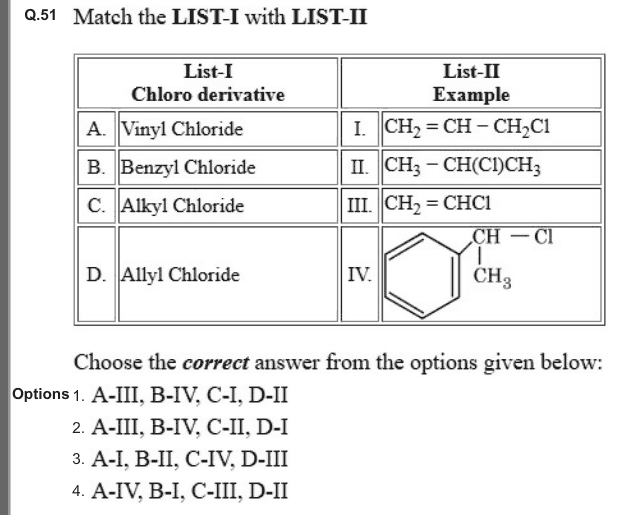
Match the LIST-I with LIST-II

List-I Chloro derivativeList-II Example
A.Vinyl ChlorideI.$\mathrm{CH_2=CH-CH_2Cl}$
B.Benzyl ChlorideII.$\mathrm{CH_3-CH(Cl)CH_3}$
C.Alkyl ChlorideIII.$\mathrm{CH_2=CHCl}$
D.Allyl ChlorideIV.(see the figure above)

Choose the *correct* answer from the options given below:

The question and its figure as printed in JEE Main 2026 24 Jan Shift 1.
The question as printed in the paper.
  • A

    A-III, B-IV, C-I, D-II

  • B

    A-III, B-IV, C-II, D-I

  • C

    A-I, B-II, C-IV, D-III

  • D

    A-IV, B-I, C-III, D-II

6JEE Main 2026 · 24 Jan · Shift 1MCQOpen question page ↗

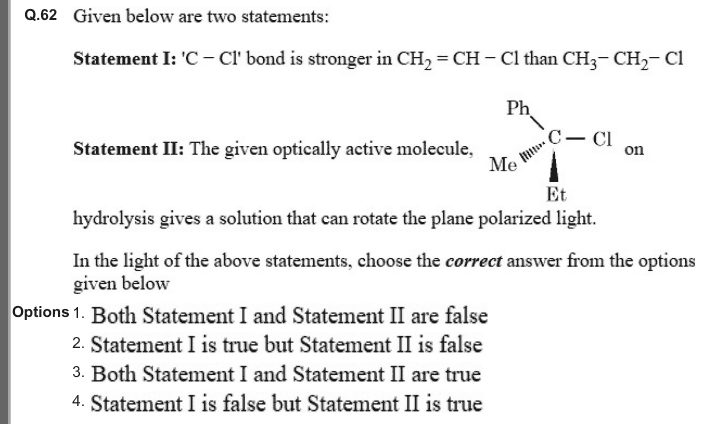
Given below are two statements:

Statement I: 'C $-$ Cl' bond is stronger in $\mathrm{CH_2=CH-Cl}$ than $\mathrm{CH_3-CH_2-Cl}$

Statement II: The given optically active molecule,

(see the figure above)

on hydrolysis gives a solution that can rotate the plane polarized light.

In the light of the above statements, choose the *correct* answer from the options given below

The question and its figure as printed in JEE Main 2026 24 Jan Shift 1.
The question as printed in the paper.
  • A

    Both Statement I and Statement II are false

  • B

    Statement I is true but Statement II is false

  • C

    Both Statement I and Statement II are true

  • D

    Statement I is false but Statement II is true

7JEE Main 2026 · 22 Jan · Shift 1MCQOpen question page ↗

The correct order of reactivity of $\mathrm{CH_3Br}$ in methanol with the following nucleophiles is

$\mathrm{F^-}$, $\mathrm{I^-}$, $\mathrm{C_2H_5O^-}$ and $\mathrm{C_6H_5O^-}$

  • A

    $\mathrm{I^-} > \mathrm{C_2H_5O^-} > \mathrm{F^-} > \mathrm{C_6H_5O^-}$

  • B

    $\mathrm{I^-} > \mathrm{C_6H_5O^-} > \mathrm{F^-} > \mathrm{C_2H_5O^-}$

  • C

    $\mathrm{I^-} > \mathrm{F^-} > \mathrm{C_6H_5O^-} > \mathrm{C_2H_5O^-}$

  • D

    $\mathrm{I^-} > \mathrm{C_2H_5O^-} > \mathrm{C_6H_5O^-} > \mathrm{F^-}$

8JEE Main 2026 · 22 Jan · Shift 1MCQOpen question page ↗

As compared with chlorocyclohexane, which of the following statements correctly apply to chlorobenzene?

A. The magnitude of negative charge is more on chlorine atom.

B. The C $-$ Cl bond has partial double bond character.

C. C $-$ Cl bond is less polar.

D. C $-$ Cl bond is longer due to repulsion between delocalised electrons of the aromatic ring and lone pairs of electrons of chlorine.

E. The C $-$ Cl bond is formed using $\mathrm{sp^2}$ hybridised orbital of carbon.

Choose the correct answer from the options given below:

  • A

    B, C and D Only

  • B

    A, C and E Only

  • C

    A, D and E Only

  • D

    B, C and E Only

9JEE Main 2026 · 22 Jan · Shift 1MCQOpen question page ↗

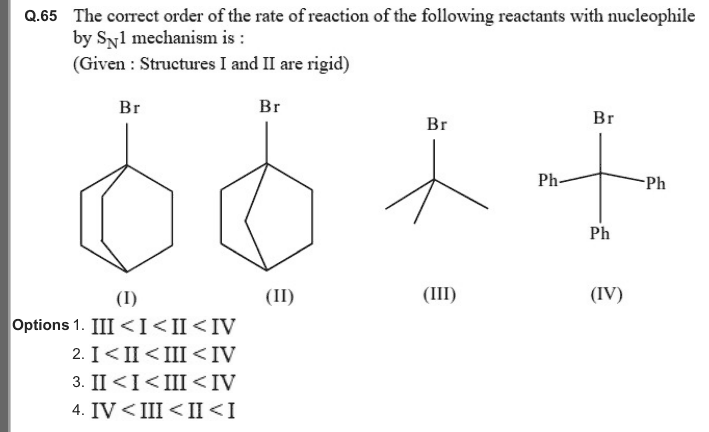
The correct order of the rate of reaction of the following reactants with nucleophile by $\mathrm{S_N1}$ mechanism is :

(Given : Structures I and II are rigid)

(see the figure above)

The question and its figure as printed in JEE Main 2026 22 Jan Shift 1.
The question as printed in the paper.
  • A

    III $<$ I $<$ II $<$ IV

  • B

    I $<$ II $<$ III $<$ IV

  • C

    II $<$ I $<$ III $<$ IV

  • D

    IV $<$ III $<$ II $<$ I

10JEE Main 2026 · 21 Jan · Shift 2MCQOpen question page ↗

The correct order of the rate of the reaction for the following reaction with respect to nucleophiles is :

$\mathrm{CH_3Br} + \mathrm{Nu}^{\ominus} \longrightarrow \mathrm{CH_3Nu} + \mathrm{Br}^{\ominus}$

  • A

    $\mathrm{CH_3COO^-} > \mathrm{PhO^-} > {}^{-}\mathrm{OH} > \mathrm{ClO_4^-}$

  • B

    $\mathrm{ClO_4^-} > \mathrm{CH_3COO^-} > {}^{-}\mathrm{OH} > \mathrm{PhO^-}$

  • C

    ${}^{-}\mathrm{OH} > \mathrm{PhO^-} > \mathrm{CH_3COO^-} > \mathrm{ClO_4^-}$

  • D

    $\mathrm{PhO^-} > {}^{-}\mathrm{OH} > \mathrm{CH_3COO^-} > \mathrm{ClO_4^-}$

11JEE Main 2026 · 21 Jan · Shift 2MCQOpen question page ↗

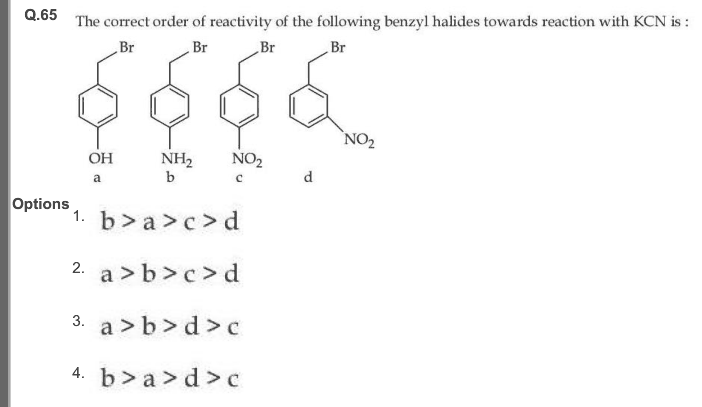
The correct order of reactivity of the following benzyl halides towards reaction with KCN is :

(see the figure above)

The question and its figure as printed in JEE Main 2026 21 Jan Shift 2.
The question as printed in the paper.
  • A

    $b > a > c > d$

  • B

    $a > b > c > d$

  • C

    $a > b > d > c$

  • D

    $b > a > d > c$

12JEE Main 2025 · 7 Apr · Shift 2MCQOpen question page ↗

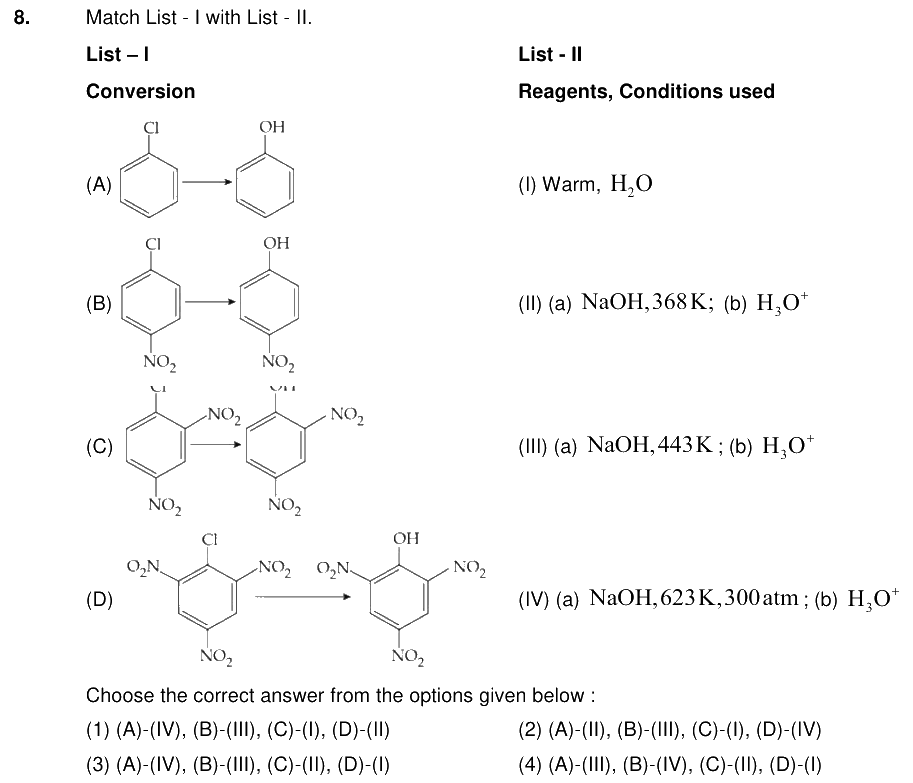
Match List - I with List - II.

(see the figure above)

Choose the correct answer from the options given below :

The question and its figure as printed in JEE Main 2025 07 Apr Shift 2.
The question as printed in the paper.
  • A

    (A)-(IV), (B)-(III), (C)-(I), (D)-(II)

  • B

    (A)-(II), (B)-(III), (C)-(I), (D)-(IV)

  • C

    (A)-(IV), (B)-(III), (C)-(II), (D)-(I)

  • D

    (A)-(III), (B)-(IV), (C)-(II), (D)-(I)

13JEE Main 2025 · 4 Apr · Shift 2MCQOpen question page ↗

Given below are two statements :

Statement (I) : Alcohols are formed when alkyl chlorides are treated with aqueous potassium hydroxide by elimination reaction.

Statement (II) : In alcoholic potassium hydroxide, alkyl chlorides form alkenes by abstracting the hydrogen from the $\beta$ -carbon.

In the light of the above statements, choose the most appropriate answer from the options given below :

  • A

    Both Statement I and Statement II are incorrect

  • B

    Statement I is incorrect but Statement II is correct

  • C

    Both Statement I and Statement II are correct

  • D

    Statement I is correct but Statement II is incorrect

14JEE Main 2025 · 2 Apr · Shift 2MCQOpen question page ↗

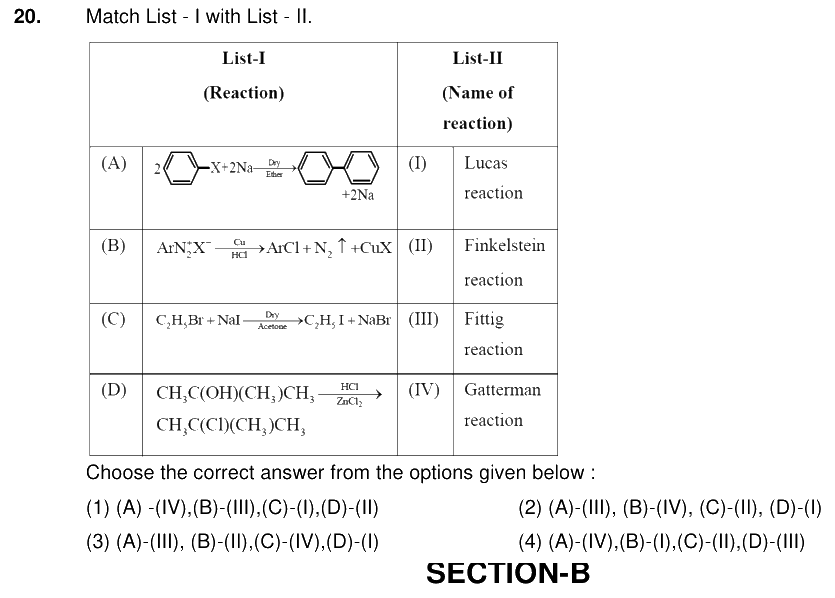
Match List - I with List - II.

(see the figure above)

Choose the correct answer from the options given below :

The question and its figure as printed in JEE Main 2025 02 Apr Shift 2.
The question as printed in the paper.
  • A

    (A) -(IV),(B)-(III),(C)-(I),(D)-(II)

  • B

    (A)-(III), (B)-(IV), (C)-(II), (D)-(I)

  • C

    (A)-(III), (B)-(II),(C)-(IV),(D)-(I)

  • D

    (A)-(IV),(B)-(I),(C)-(II),(D)-(III)

15JEE Main 2025 · 29 Jan · Shift 1MCQOpen question page ↗

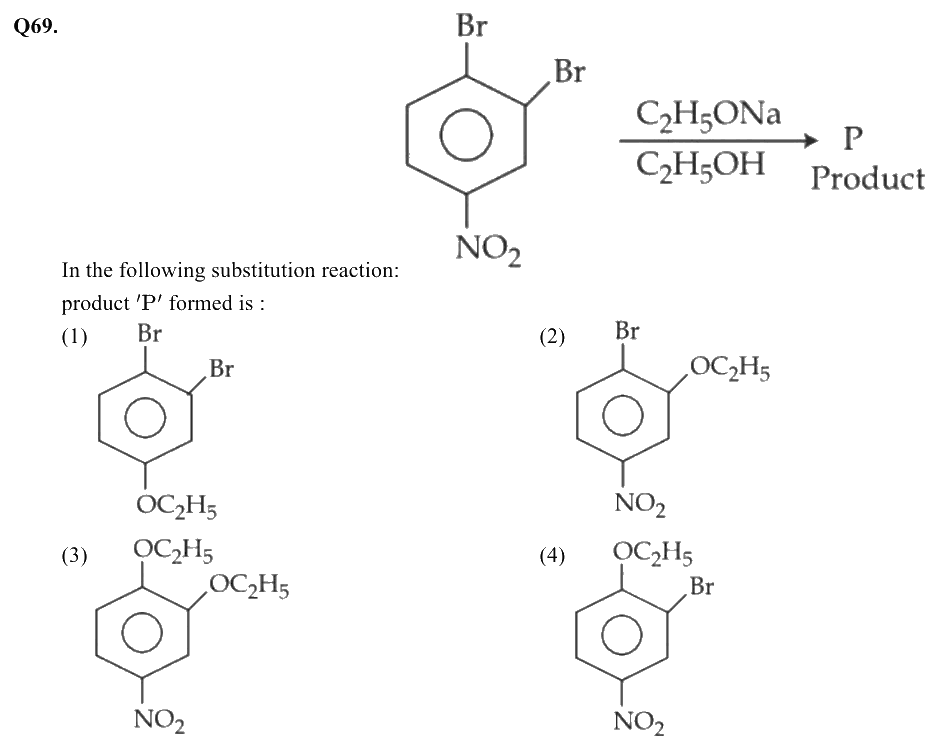
In the following substitution reaction: product 'P' formed is :

(see the figure above)

The question and its figure as printed in JEE Main 2025 29 Jan Shift 1. Option 1: a benzene ring (circle inside) with 'Br' at the top, 'Br' at the upper right and 'OC2H5' at the bottom. Option 2: a benzene ring (circle inside) with 'Br' at the top, 'OC2H5' at the upper right and 'NO2' at the bottom. Option 3: a benzene ring (circle inside) with 'OC2H5' at the top, 'OC2H5' at the upper right and 'NO2' at the bottom. Option 4: a benzene ring (circle inside) with 'OC2H5' at the top, 'Br' at the upper right and 'NO2' at the bottom.
The question as printed in the paper.
  • A

    see figure a benzene ring (circle inside) with 'Br' at the top, 'Br' at the upper right and 'OC2H5' at the bottom.

  • B

    see figure a benzene ring (circle inside) with 'Br' at the top, 'OC2H5' at the upper right and 'NO2' at the bottom.

  • C

    see figure a benzene ring (circle inside) with 'OC2H5' at the top, 'OC2H5' at the upper right and 'NO2' at the bottom.

  • D

    see figure a benzene ring (circle inside) with 'OC2H5' at the top, 'Br' at the upper right and 'NO2' at the bottom.

16JEE Main 2025 · 28 Jan · Shift 1MCQOpen question page ↗

The products $A$ and $B$ in the following reactions, respectively are

$\mathrm{A} \xleftarrow{\mathrm{Ag{-}NO_2}} \mathrm{CH_3 - CH_2 - CH_2 - Br} \xrightarrow{\mathrm{AgCN}} \mathrm{B}$

  • A

    $\mathrm{CH_3 - CH_2 - CH_2 - NO_2, CH_3 - CH_2 - CH_2 - CN}$

  • B

    $\mathrm{CH_3 - CH_2 - CH_2 - ONO, CH_3 - CH_2 - CH_2 - NC}$

  • C

    $\mathrm{CH_3 - CH_2 - CH_2 - ONO, CH_3 - CH_2 - CH_2 - CN}$

  • D

    $\mathrm{CH_3 - CH_2 - CH_2 - NO_2, CH_3 - CH_2 - CH_2 - NC}$

17JEE Main 2025 · 28 Jan · Shift 1MCQOpen question page ↗

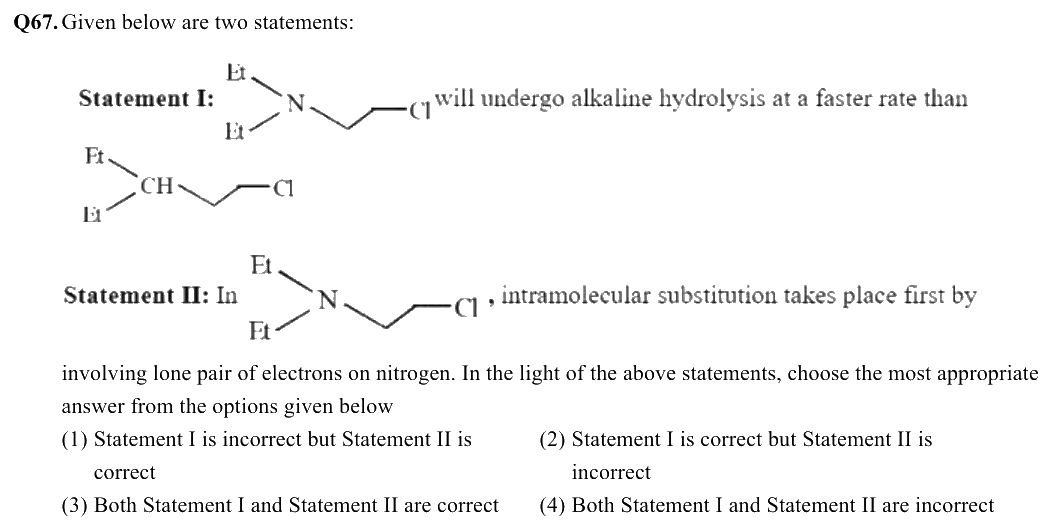
Given below are two statements:

(see the figure above)

In the light of the above statements, choose the most appropriate answer from the options given below

The question and its figure as printed in JEE Main 2025 28 Jan Shift 1.
The question as printed in the paper.
  • A

    Statement I is incorrect but Statement II is correct

  • B

    Statement I is correct but Statement II is incorrect

  • C

    Both Statement I and Statement II are correct

  • D

    Both Statement I and Statement II are incorrect

18JEE Main 2025 · 28 Jan · Shift 2MCQOpen question page ↗

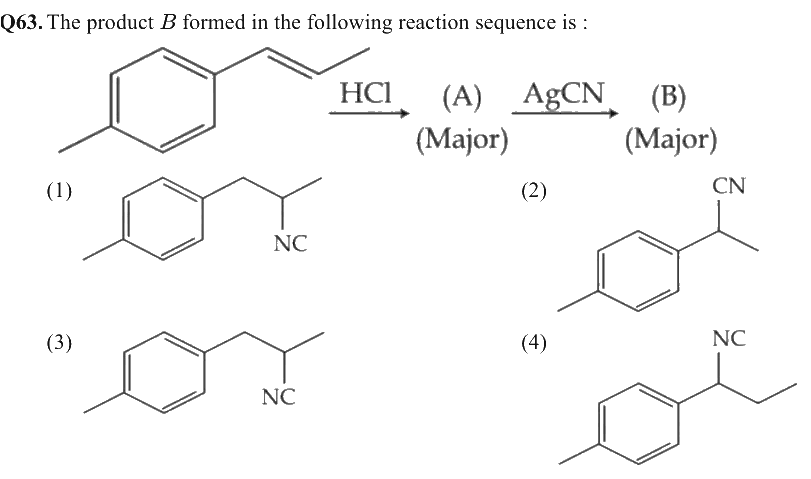
The product $B$ formed in the following reaction sequence is :

(see the figure above)

The question and its figure as printed in JEE Main 2025 28 Jan Shift 2. Option 1: a benzene ring with a methyl at one end (left) and, at the opposite end, a CH2 that is joined to a CH carrying 'NC' (below) and a CH3 (up-right): ring–CH2–CH(NC)–CH3. Option 2: a benzene ring with a methyl at the left end and, at the opposite end, a CH carrying 'CN' (above) and a CH3 to the right: ring–CH(CN)–CH3. Option 3: a benzene ring with a methyl at the left end and, at the opposite end, a CH2 that is joined to a CH carrying 'NC' (below) and a CH3 (up-right): ring–CH2–CH(NC)–CH3. Option 4: a benzene ring with a methyl at the left end and, at the opposite end, a CH carrying 'NC' (above) and a CH2–CH3…
The question as printed in the paper.
  • A

    see figure a benzene ring with a methyl at one end (left) and, at the opposite end, a CH2 that is joined to a CH carrying 'NC' (below) and a CH3 (up-right): ring–CH2–CH(NC)–CH3.

  • B

    see figure a benzene ring with a methyl at the left end and, at the opposite end, a CH carrying 'CN' (above) and a CH3 to the right: ring–CH(CN)–CH3.

  • C

    see figure a benzene ring with a methyl at the left end and, at the opposite end, a CH2 that is joined to a CH carrying 'NC' (below) and a CH3 (up-right): ring–CH2–CH(NC)–CH3.

  • D

    see figure a benzene ring with a methyl at the left end and, at the opposite end, a CH carrying 'NC' (above) and a CH2–CH3 chain to the right: ring–CH(NC)–CH2–CH3.

19JEE Main 2025 · 28 Jan · Shift 2MCQOpen question page ↗

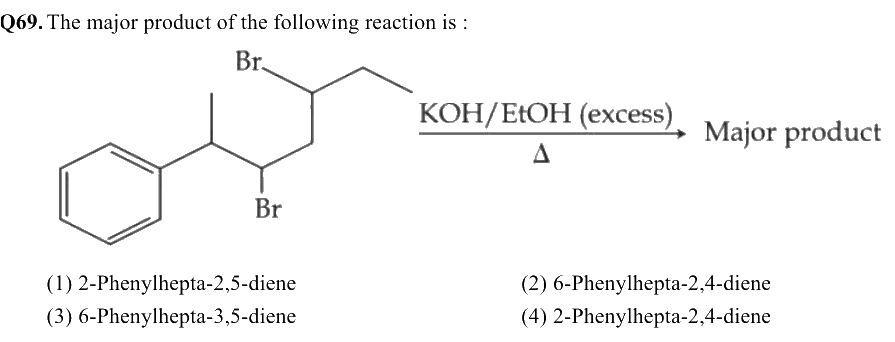
The major product of the following reaction is :

(see the figure above)

The question and its figure as printed in JEE Main 2025 28 Jan Shift 2.
The question as printed in the paper.
  • A

    2-Phenylhepta-2,5-diene

  • B

    6-Phenylhepta-2,4-diene

  • C

    6-Phenylhepta-3,5-diene

  • D

    2-Phenylhepta-2,4-diene

20JEE Main 2025 · 24 Jan · Shift 1MCQOpen question page ↗

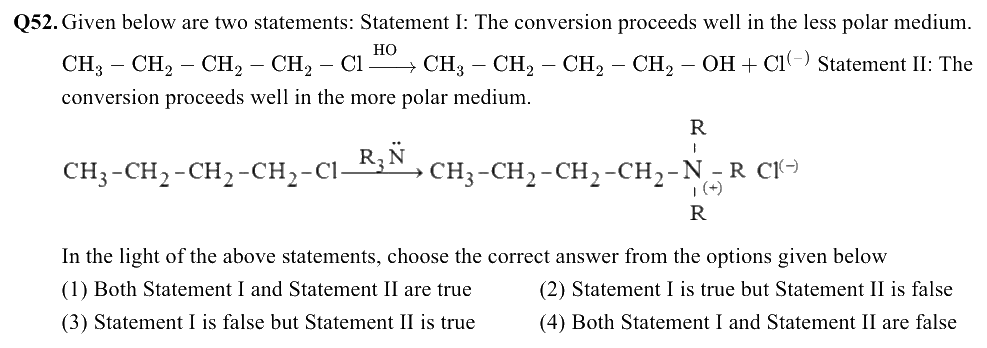
Given below are two statements: Statement I: The conversion proceeds well in the less polar medium. $\mathrm{CH_3 - CH_2 - CH_2 - CH_2 - Cl} \xrightarrow{\mathrm{HO^-}} \mathrm{CH_3 - CH_2 - CH_2 - CH_2 - OH + Cl^{(-)}}$ Statement II: The conversion proceeds well in the more polar medium.

(see the figure above)

In the light of the above statements, choose the correct answer from the options given below

The question and its figure as printed in JEE Main 2025 24 Jan Shift 1.
The question as printed in the paper.
  • A

    Both Statement I and Statement II are true

  • B

    Statement I is true but Statement II is false

  • C

    Statement I is false but Statement II is true

  • D

    Both Statement I and Statement II are false

21JEE Main 2025 · 24 Jan · Shift 2MCQOpen question page ↗

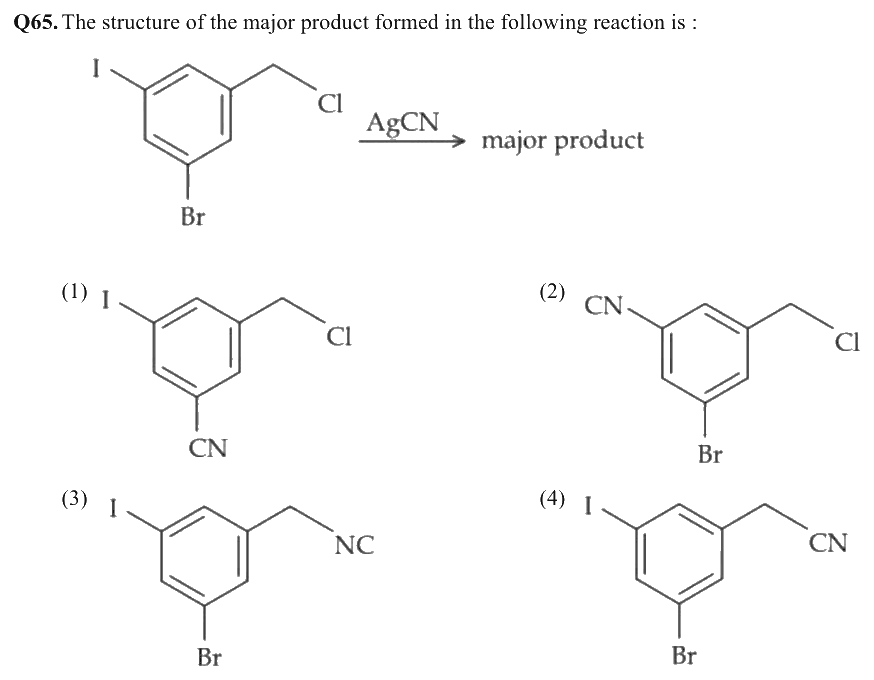
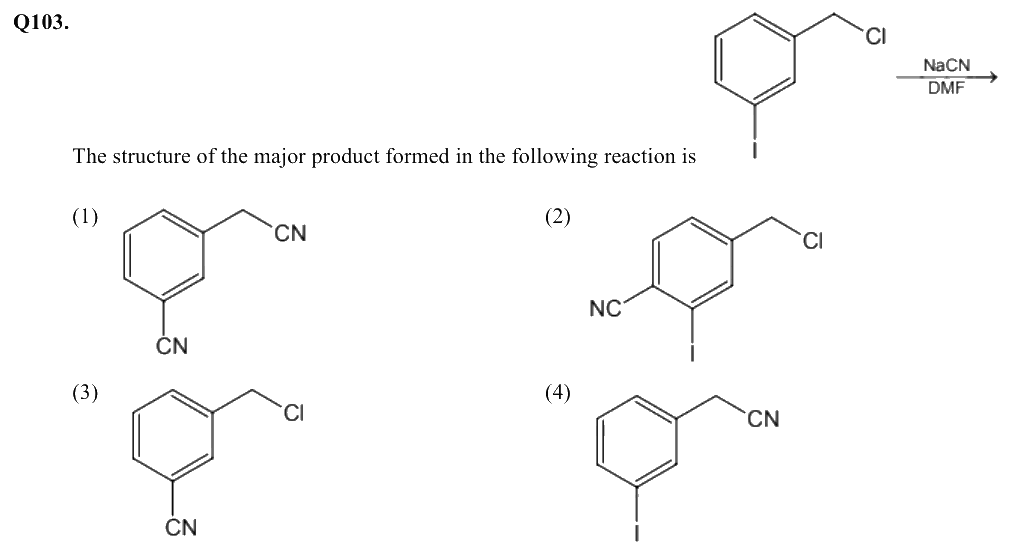
The structure of the major product formed in the following reaction is :

(see the figure above)

The question and its figure as printed in JEE Main 2025 24 Jan Shift 2. Option 1: a benzene ring with 'I' at the upper left, '–CH2–Cl' going to the upper right (CH2 then 'Cl' below it) and 'CN' at the bottom (the CN group attached directly to the ring at the lower carbon, replacing the Br). Option 2: a benzene ring with 'CN' at the upper left (attached directly to the ring), '–CH2–Cl' at the upper right and 'Br' at the bottom. Option 3: a benzene ring with 'I' at the upper left, 'Br' at the bottom and a CH2 group at the upper right ending in 'NC' (written N then C, the ring-side CH2 joined to the N end). Option 4: a benzene ring with 'I' at the upper left, 'Br' at the bottom and a CH2…
The question as printed in the paper.
  • A

    see figure a benzene ring with 'I' at the upper left, '–CH2–Cl' going to the upper right (CH2 then 'Cl' below it) and 'CN' at the bottom (the CN group attached directly to the ring at the lower carbon, replacing the Br).

  • B

    see figure a benzene ring with 'CN' at the upper left (attached directly to the ring), '–CH2–Cl' at the upper right and 'Br' at the bottom.

  • C

    see figure a benzene ring with 'I' at the upper left, 'Br' at the bottom and a CH2 group at the upper right ending in 'NC' (written N then C, the ring-side CH2 joined to the N end).

  • D

    see figure a benzene ring with 'I' at the upper left, 'Br' at the bottom and a CH2 group at the upper right ending in 'CN' (the CH2 joined to the C end).

22JEE Main 2025 · 23 Jan · Shift 1MCQOpen question page ↗

Match the LIST-I with LIST-II

LIST-I Name reactionLIST-II Product obtainable
A.Swarts reactionI.Ethyl benzene
B.Sandmeyer's reactionII.Ethyl iodide
C.Wurtz Fittig reactionIII.Cyanobenzene
D.Finkelstein reactionIV.Ethyl fluoride

Choose the correct answer from the options given below:

  • A

    A-II, B-I, C-III, D-IV

  • B

    A-II, B-III, C-I, D-IV

  • C

    A-IV, B-I, C-III, D-II

  • D

    A-IV, B-III, C-I, D-II

23JEE Main 2025 · 23 Jan · Shift 2MCQOpen question page ↗

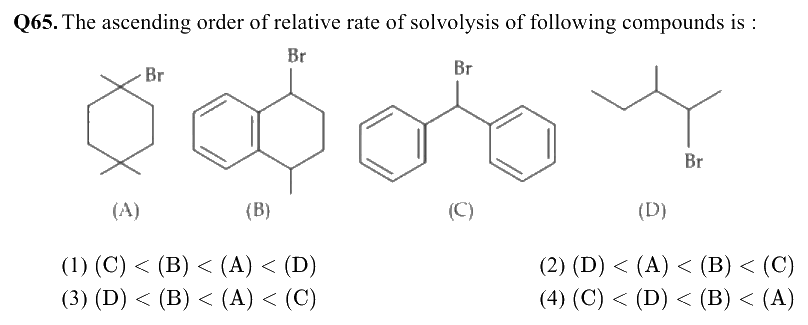
The ascending order of relative rate of solvolysis of following compounds is :

(see the figure above)

The question and its figure as printed in JEE Main 2025 23 Jan Shift 2.
The question as printed in the paper.
  • A

    (C) < (B) < (A) < (D)

  • B

    (D) < (A) < (B) < (C)

  • C

    (D) < (B) < (A) < (C)

  • D

    (C) < (D) < (B) < (A)

24JEE Main 2025 · 22 Jan · Shift 1MCQOpen question page ↗

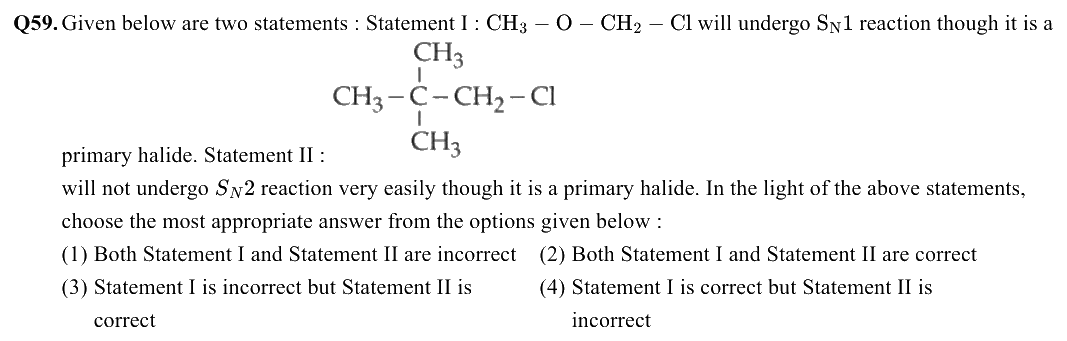
Given below are two statements : Statement I : $\mathrm{CH_3 - O - CH_2 - Cl}$ will undergo $\mathrm{S_N}$1 reaction though it is a primary halide. Statement II : (see the figure above) will not undergo $S_N$2 reaction very easily though it is a primary halide. In the light of the above statements, choose the most appropriate answer from the options given below :

The question and its figure as printed in JEE Main 2025 22 Jan Shift 1.
The question as printed in the paper.
  • A

    Both Statement I and Statement II are incorrect

  • B

    Both Statement I and Statement II are correct

  • C

    Statement I is incorrect but Statement II is correct

  • D

    Statement I is correct but Statement II is incorrect

25JEE Main 2025 · 22 Jan · Shift 2MCQOpen question page ↗

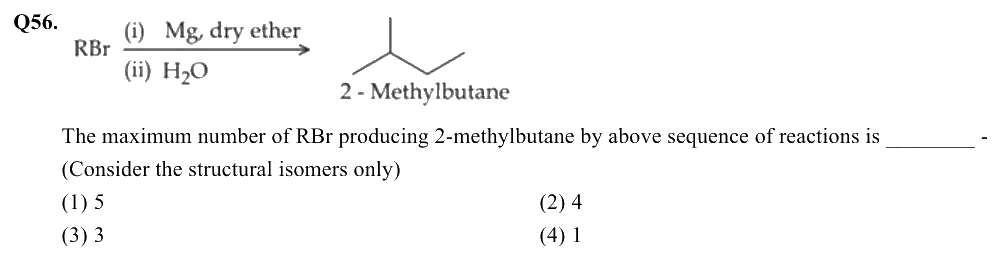
see figure The maximum number of RBr producing 2-methylbutane by above sequence of reactions is ______ - (Consider the structural isomers only)

The question and its figure as printed in JEE Main 2025 22 Jan Shift 2. Question: The maximum number of RBr producing 2-methylbutane by above sequence of reactions is - (Consider the structural isomers only)
The question as printed in the paper.
  • A

    5

  • B

    4

  • C

    3

  • D

    1

26JEE Main 2024 · 9 Apr · Shift 1MCQOpen question page ↗

Given below are two statements : one is labelled as Assertion (A) and the other is labelled as Reason (R). Assertion (A): $\mathrm{S_N2}$ reaction of $\mathrm{C_6H_5CH_2Br}$ occurs more readily than the $\mathrm{S_N2}$ reaction of $\mathrm{CH_3CH_2Br}$. Reason (R) : The partially bonded unhybridized p-orbital that develops in the trigonal bipyramidal transition state is stabilized by conjugation with the phenyl ring. In the light of the above statements, choose the most appropriate answer from the options given below :

  • A

    (A) is correct but (R) is not correct

  • B

    (A) is not correct but (R) is correct

  • C

    Both (A) and (R) are correct but (R) is not the correct explanation of (A)

  • D

    Both (A) and (R) are correct and (R) is the correct explanation of (A)

27JEE Main 2024 · 9 Apr · Shift 1MCQOpen question page ↗

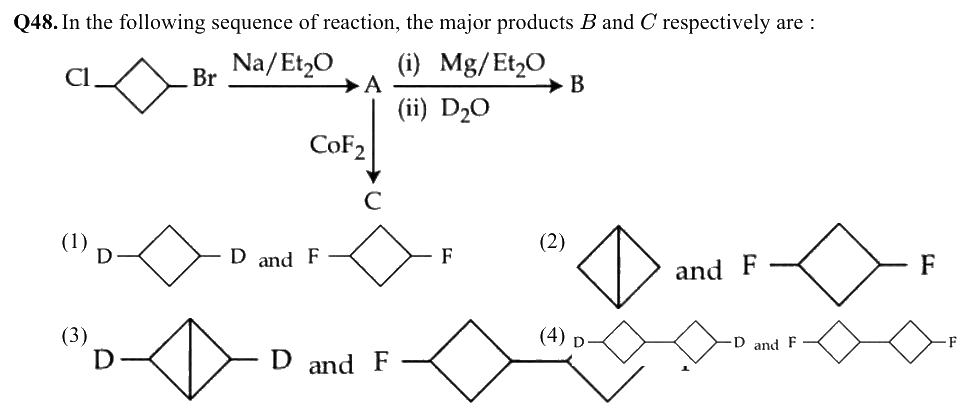
In the following sequence of reaction, the major products $B$ and $C$ respectively are :

(see the figure above)

The question and its figure as printed in JEE Main 2024 09 Apr Shift 1. Option 1: D attached to the left vertex and D to the right vertex of a four-membered ring (cyclobutane drawn as a diamond), then 'and', then F attached to the left vertex and F to the right vertex of a four-membered ring. Option 2: a diamond-shaped ring with a vertical line joining its top and bottom vertices (two fused three-membered rings), with no substituent labels drawn, then 'and', then F attached to the left vertex and F to the right vertex of a four-membered ring. Option 3: D attached to the left vertex and D to the right vertex of a diamond-shaped ring with a vertical line joining its top and bottom vertices…
The question as printed in the paper.
  • A

    see figure D attached to the left vertex and D to the right vertex of a four-membered ring (cyclobutane drawn as a diamond), then 'and', then F attached to the left vertex and F to the right vertex of a four-membered ring.

  • B

    see figure a diamond-shaped ring with a vertical line joining its top and bottom vertices (two fused three-membered rings), with no substituent labels drawn, then 'and', then F attached to the left vertex and F to the right vertex of a four-membered ring.

  • C

    see figure D attached to the left vertex and D to the right vertex of a diamond-shaped ring with a vertical line joining its top and bottom vertices, then 'and', then F attached to the left vertex of a four-membered ring whose right vertex is joined by a horizontal line to a further bond that goes down-right and then up-right and is cut off by the option-4 line printed over it.

  • D

    see figure D attached to the left of a chain of two four-membered rings joined by a short horizontal bond, with D at the right end, then 'and', then F attached to the left of a chain of two four-membered rings joined by a short horizontal bond, with F at the right end.

28JEE Main 2024 · 9 Apr · Shift 2MCQOpen question page ↗

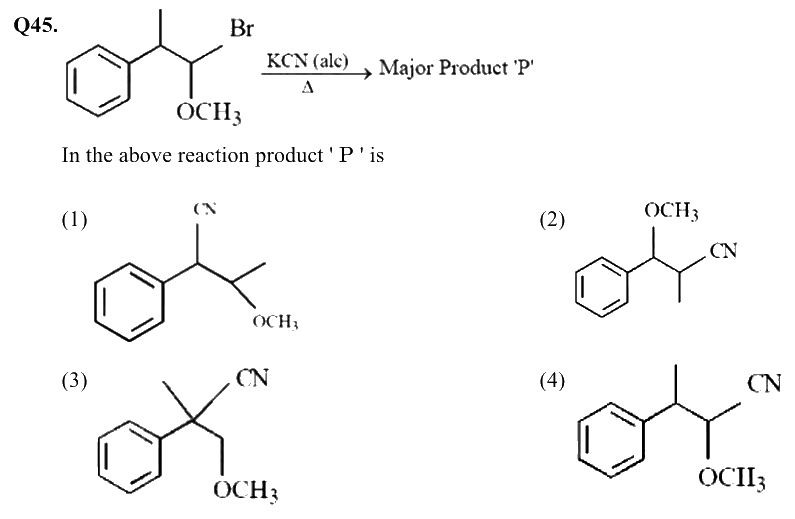
see figure In the above reaction product ' P ' is

The question and its figure as printed in JEE Main 2024 09 Apr Shift 2. Question: In the above reaction product ' P ' is Option 1: a benzene ring joined to a carbon that carries a CN group (up) and is bonded to a second carbon carrying a methyl (up-right) and an OCH3 group (down-right). Option 2: a benzene ring joined to a carbon that carries an OCH3 group (up) and is bonded to a second carbon carrying a methyl (down) and a CN group (up-right). Option 3: a benzene ring joined to a carbon that also carries a methyl (up-left) and a CN group (up-right) and is bonded to a CH2 whose chain goes down to OCH3. Option 4: a benzene ring joined to a carbon that carries a methyl (up), bonded to a…
The question as printed in the paper.
  • A

    see figure a benzene ring joined to a carbon that carries a CN group (up) and is bonded to a second carbon carrying a methyl (up-right) and an OCH3 group (down-right).

  • B

    see figure a benzene ring joined to a carbon that carries an OCH3 group (up) and is bonded to a second carbon carrying a methyl (down) and a CN group (up-right).

  • C

    see figure a benzene ring joined to a carbon that also carries a methyl (up-left) and a CN group (up-right) and is bonded to a CH2 whose chain goes down to OCH3.

  • D

    see figure a benzene ring joined to a carbon that carries a methyl (up), bonded to a second carbon carrying a CN group (up-right) and an OCH3 group (down).

29JEE Main 2024 · 8 Apr · Shift 1MCQOpen question page ↗

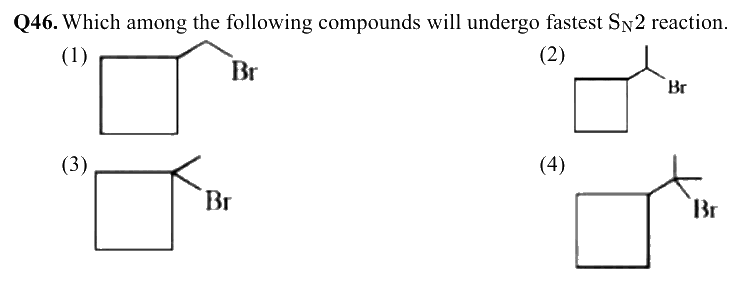
Which among the following compounds will undergo fastest $\mathrm{S_N}2$ reaction.

The question and its figure as printed in JEE Main 2024 08 Apr Shift 1. Option 1: a cyclobutane ring with a CH2-Br group on its upper-right vertex (the CH2 rises from the vertex and the Br is at its end, lower right). Option 2: a cyclobutane ring whose upper-right vertex carries a CH(CH3)Br carbon: a bond to a carbon with a short vertical bond upward (methyl) and a bond down-right to Br. Option 3: a cyclobutane ring whose upper-right vertex carries both a methyl (a short bond going up-right) and a Br (bond going down-right). Option 4: a cyclobutane ring whose upper-right vertex is bonded to a carbon carrying two short bonds (one up, one right, the two methyls) and a Br going down-right…
The question as printed in the paper.
  • A

    see figure a cyclobutane ring with a CH2-Br group on its upper-right vertex (the CH2 rises from the vertex and the Br is at its end, lower right).

  • B

    see figure a cyclobutane ring whose upper-right vertex carries a CH(CH3)Br carbon: a bond to a carbon with a short vertical bond upward (methyl) and a bond down-right to Br.

  • C

    see figure a cyclobutane ring whose upper-right vertex carries both a methyl (a short bond going up-right) and a Br (bond going down-right).

  • D

    see figure a cyclobutane ring whose upper-right vertex is bonded to a carbon carrying two short bonds (one up, one right, the two methyls) and a Br going down-right, i.e. a C(CH3)2Br group.

30JEE Main 2024 · 8 Apr · Shift 2MCQOpen question page ↗

Given below are two statements : Statement (I) : $\mathrm{S_N}2$ reactions are 'stereospecific', indicating that they result in the formation of only one stereo-isomer as the product. Statement (II) : $\mathrm{S_N}1$ reactions generally result in formation of product as racemic mixtures. In the light of the above statements, choose the correct answer from the options given below :

  • A

    Both Statement I and Statement II are false

  • B

    Statement I is false but Statement II is true

  • C

    Statement I is true but Statement II is false

  • D

    Both Statement I and Statement II are true

31JEE Main 2024 · 6 Apr · Shift 1MCQOpen question page ↗

Match List I with List II Choose the correct answer from the options given below:

List - I (Compound)List - II (Uses)
A.IodoformI.Fire extinguisher
B.Carbon tetrachlorideII.Insecticide
C.CFCIII.Antiseptic
D.DDTIV.Refrigerants
  • A

    A-I, B-II, C-III, D-IV

  • B

    A-III, B-I, C-IV, D-II

  • C

    A-II, B-IV, C-I, D-III

  • D

    A-III, B-II, C-IV, D-I

32JEE Main 2024 · 6 Apr · Shift 2MCQOpen question page ↗

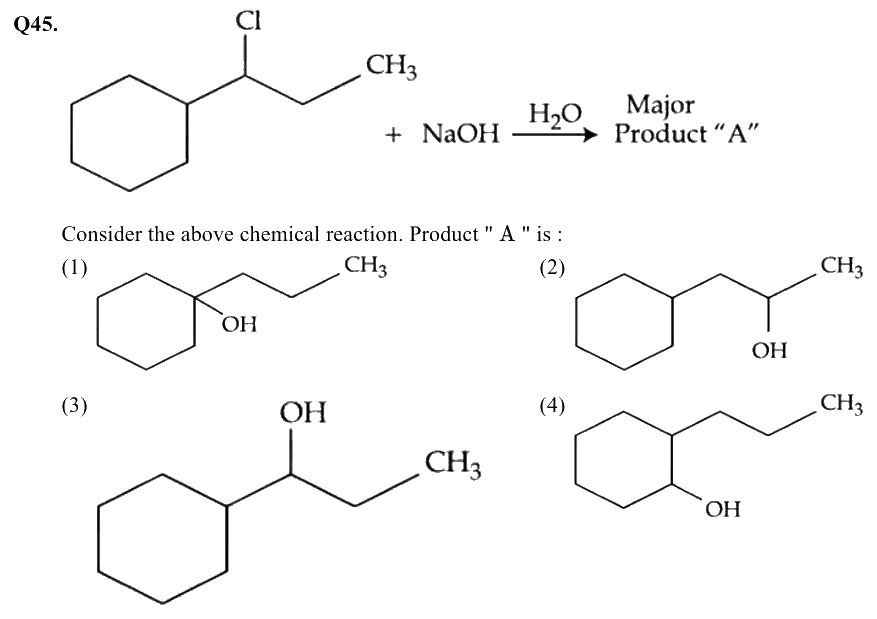
see figure Consider the above chemical reaction. Product " A " is :

The question and its figure as printed in JEE Main 2024 06 Apr Shift 2. Question: Consider the above chemical reaction. Product " A " is : Option 1: a cyclohexane ring whose lower-right carbon carries an OH group (pointing down-right) and a chain going up and to the right: up, down, up, ending in CH3 (propyl chain on the same ring carbon as the OH). Option 2: a cyclohexane ring joined by a bond to a chain: up, then down to a carbon that has OH on a vertical bond below and a CH3 up to the right. Option 3: a cyclohexane ring joined to a carbon that has OH on a vertical bond above, followed by a down bond and an up bond ending in CH3. Option 4: a cyclohexane ring whose upper-right carbon…
The question as printed in the paper.
  • A

    see figure a cyclohexane ring whose lower-right carbon carries an OH group (pointing down-right) and a chain going up and to the right: up, down, up, ending in CH3 (propyl chain on the same ring carbon as the OH).

  • B

    see figure a cyclohexane ring joined by a bond to a chain: up, then down to a carbon that has OH on a vertical bond below and a CH3 up to the right.

  • C

    see figure a cyclohexane ring joined to a carbon that has OH on a vertical bond above, followed by a down bond and an up bond ending in CH3.

  • D

    see figure a cyclohexane ring whose upper-right carbon carries a chain going up, down, up, ending in CH3, and whose lower-right carbon (next to it) carries OH pointing down-right.

33JEE Main 2024 · 5 Apr · Shift 2MCQOpen question page ↗

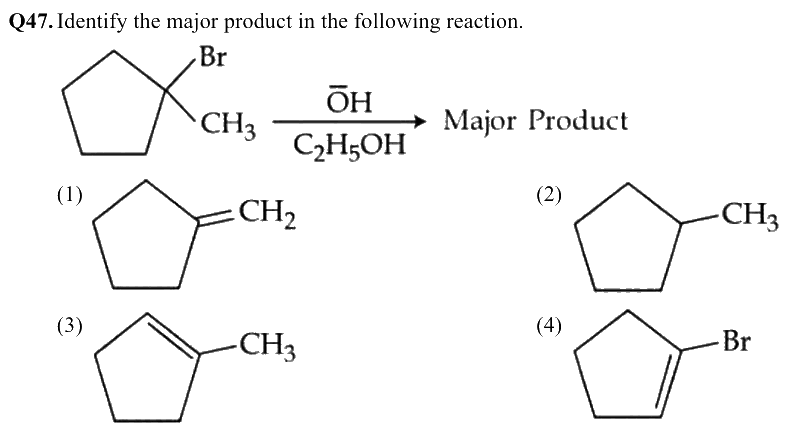
Identify the major product in the following reaction.

(see the figure above)

The question and its figure as printed in JEE Main 2024 05 Apr Shift 2. Option 1: methylenecyclopentane: a cyclopentane ring with an exocyclic double bond to CH2 Option 2: methylcyclopentane: a cyclopentane ring with a CH3 substituent Option 3: a cyclopentene ring with the double bond to the carbon that carries the CH3 substituent Option 4: a cyclopentene ring with the double bond to the carbon that carries a Br substituent
The question as printed in the paper.
  • A

    see figure methylenecyclopentane: a cyclopentane ring with an exocyclic double bond to CH$_2$

  • B

    see figure methylcyclopentane: a cyclopentane ring with a CH$_3$ substituent

  • C

    see figure a cyclopentene ring with the double bond to the carbon that carries the CH$_3$ substituent

  • D

    see figure a cyclopentene ring with the double bond to the carbon that carries a Br substituent

34JEE Main 2024 · 4 Apr · Shift 1MCQOpen question page ↗

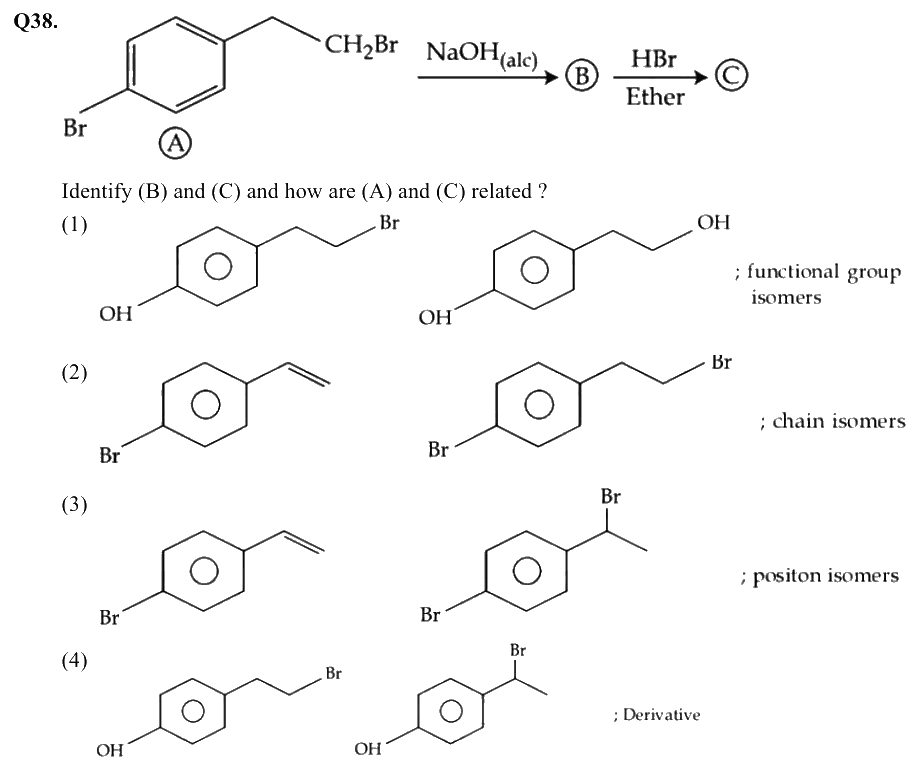
see figure Identify (B) and (C) and how are (A) and (C) related ?

The question and its figure as printed in JEE Main 2024 04 Apr Shift 1. Question: Identify (B) and (C) and how are (A) and (C) related ? Option 1: Two drawings side by side, then the text '; functional group isomers'. Left drawing: a benzene ring (circle inside) with OH on the lower-left carbon and, from the upper-right carbon, a chain of two CH2 units ending in Br. Right drawing: the same ring with OH at the lower left and a two-carbon chain at the upper right ending in OH. Option 2: Two drawings side by side, then the text '; chain isomers'. Left drawing: a benzene ring with Br on the lower-left carbon and a vinyl group (CH=CH2, double bond drawn) on the upper-right carbon. Right…
The question as printed in the paper.
  • A

    see figure Two drawings side by side, then the text '; functional group isomers'. Left drawing: a benzene ring (circle inside) with OH on the lower-left carbon and, from the upper-right carbon, a chain of two CH2 units ending in Br. Right drawing: the same ring with OH at the lower left and a two-carbon chain at the upper right ending in OH.

  • B

    see figure Two drawings side by side, then the text '; chain isomers'. Left drawing: a benzene ring with Br on the lower-left carbon and a vinyl group (CH=CH2, double bond drawn) on the upper-right carbon. Right drawing: the same ring with Br at the lower left and a two-carbon chain at the upper right ending in Br.

  • C

    see figure Two drawings side by side, then the text '; positon isomers'. Left drawing: a benzene ring with Br on the lower-left carbon and a vinyl group on the upper-right carbon. Right drawing: the same ring with Br at the lower left and, at the upper right, a carbon bearing Br (pointing up) and a methyl group (pointing to the lower right).

  • D

    see figure Two drawings side by side, then the text '; Derivative'. Left drawing: a benzene ring with OH on the lower-left carbon and a two-carbon chain at the upper right ending in Br. Right drawing: the same ring with OH at the lower left and, at the upper right, a carbon bearing Br (pointing up) and a methyl group (pointing to the lower right).

35JEE Main 2024 · 4 Apr · Shift 2MCQOpen question page ↗

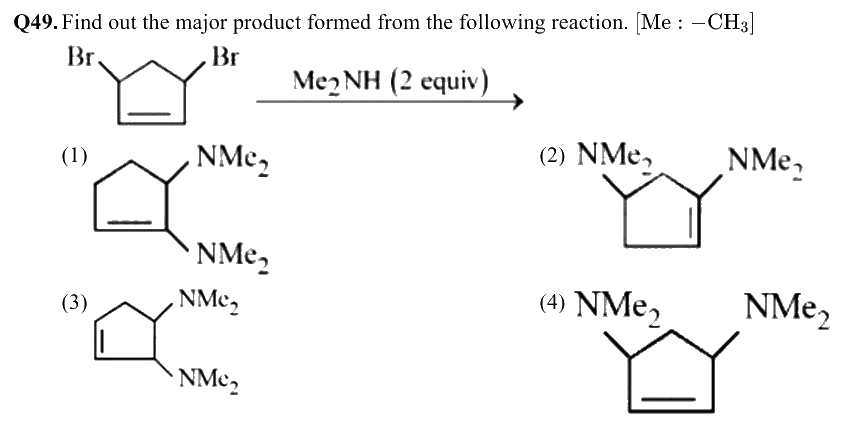
Find out the major product formed from the following reaction. [Me : $-\mathrm{CH_3}$]

(see the figure above)

The question and its figure as printed in JEE Main 2024 04 Apr Shift 2. Option 1: Five-membered ring with the double bond along its bottom edge; NMe2 on the upper-right ring carbon and NMe2 on the lower-right ring carbon (the right-hand carbon of the double bond), the two NMe2 groups on adjacent ring carbons. Option 2: Five-membered ring with the double bond along its right-hand vertical edge; NMe2 on the upper-right ring carbon (a double-bond carbon) and NMe2 on the upper-left ring carbon, with the top ring carbon between them. Option 3: Five-membered ring with the double bond along its left-hand vertical edge; NMe2 on the upper-right ring carbon and NMe2 on the lower-right ring carbon…
The question as printed in the paper.
  • A

    see figure Five-membered ring with the double bond along its bottom edge; NMe2 on the upper-right ring carbon and NMe2 on the lower-right ring carbon (the right-hand carbon of the double bond), the two NMe2 groups on adjacent ring carbons.

  • B

    see figure Five-membered ring with the double bond along its right-hand vertical edge; NMe2 on the upper-right ring carbon (a double-bond carbon) and NMe2 on the upper-left ring carbon, with the top ring carbon between them.

  • C

    see figure Five-membered ring with the double bond along its left-hand vertical edge; NMe2 on the upper-right ring carbon and NMe2 on the lower-right ring carbon, on adjacent ring carbons at the right of the ring.

  • D

    see figure Five-membered ring with the double bond along its bottom edge; NMe2 on the upper-left ring carbon and NMe2 on the upper-right ring carbon, with the top ring carbon between them.

36JEE Main 2024 · 1 Feb · Shift 2MCQOpen question page ↗

Match List - I with List - II.

List - I CompoundList-II Use
(A)Carbon tetrachloride(I)Paint remover
(B)Methylene chloride(II)Refrigerators and air conditioners
(C)DDT(III)Fire extinguisher
(D)Freons(IV)Non Biodegradable insecticide

Choose the correct answer from the options given below:

  • A

    (A)-(I), (B), (II), (C)-(III), (D)-(IV)

  • B

    (A)-(III), (B)-(I), (C)-(IV), (D)-( II)

  • C

    (A)-(IV), (B)-(III), (C)-(II), (D)-(I)

  • D

    (A)-( II), (B)-(III), (C)-(I), (D)-(IV)

37JEE Main 2024 · 31 Jan · Shift 1MCQOpen question page ↗

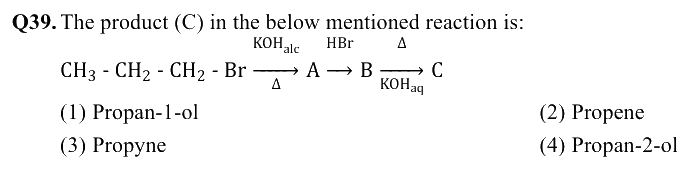
The product (C) in the below mentioned reaction is:

(see the figure above)

The question and its figure as printed in JEE Main 2024 31 Jan Shift 1.
The question as printed in the paper.
  • A

    Propan-1-ol

  • B

    Propene

  • C

    Propyne

  • D

    Propan-2-ol

38JEE Main 2024 · 31 Jan · Shift 2MCQOpen question page ↗

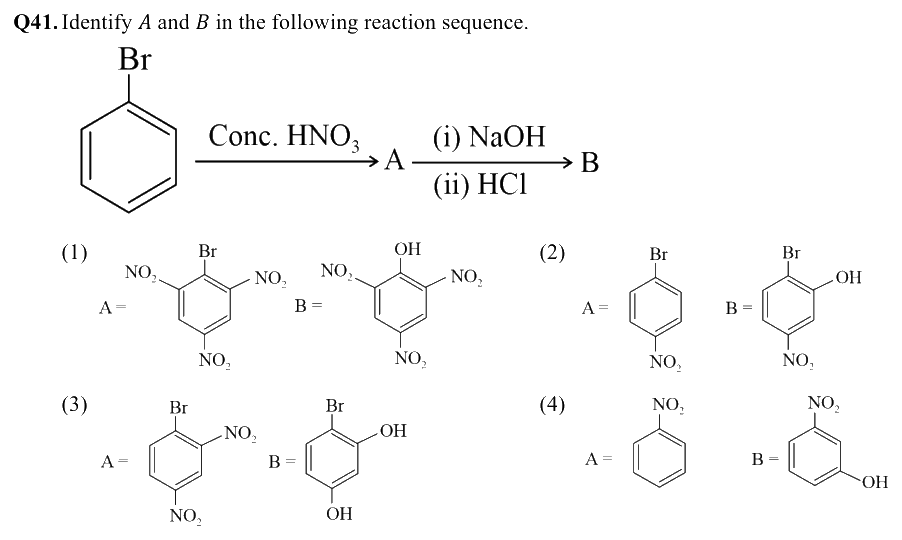
Identify $A$ and $B$ in the following reaction sequence.

(see the figure above)

The question and its figure as printed in JEE Main 2024 31 Jan Shift 2. Option 1: A = benzene ring with Br at the top vertex and NO2 at the upper-left, upper-right and bottom vertices; B = the same ring with OH at the top vertex (in place of Br) and NO2 at the upper-left, upper-right and bottom vertices Option 2: A = benzene ring with Br at the top vertex and NO2 at the bottom vertex; B = ring with Br at the top vertex, OH at the upper-right vertex and NO2 at the bottom vertex Option 3: A = benzene ring with Br at the top vertex, NO2 at the upper-right vertex and NO2 at the bottom vertex; B = ring with Br at the top vertex, OH at the upper-right vertex and OH at the bottom vertex Option 4…
The question as printed in the paper.
  • A

    see figure A = benzene ring with Br at the top vertex and NO$_2$ at the upper-left, upper-right and bottom vertices; B = the same ring with OH at the top vertex (in place of Br) and NO$_2$ at the upper-left, upper-right and bottom vertices

  • B

    see figure A = benzene ring with Br at the top vertex and NO$_2$ at the bottom vertex; B = ring with Br at the top vertex, OH at the upper-right vertex and NO$_2$ at the bottom vertex

  • C

    see figure A = benzene ring with Br at the top vertex, NO$_2$ at the upper-right vertex and NO$_2$ at the bottom vertex; B = ring with Br at the top vertex, OH at the upper-right vertex and OH at the bottom vertex

  • D

    see figure A = benzene ring with NO$_2$ at the top vertex only; B = ring with NO$_2$ at the top vertex and OH at the lower-right vertex

39JEE Main 2024 · 30 Jan · Shift 1MCQOpen question page ↗

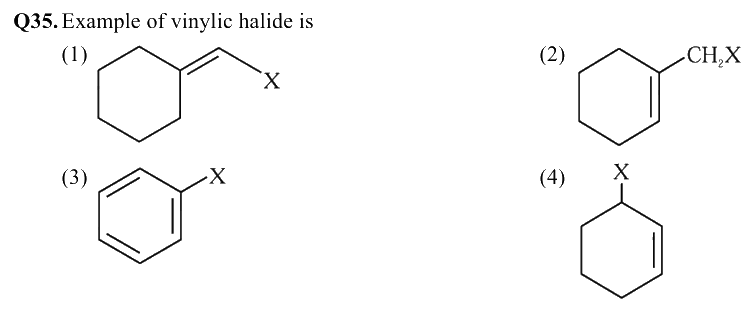
Example of vinylic halide is

(see the figure above)

The question and its figure as printed in JEE Main 2024 30 Jan Shift 1. Option 1: A cyclohexane ring whose upper-right carbon is double-bonded (exocyclic double bond) to a CH carbon that carries X, drawn as a line going to the right and down to 'X'. Option 2: A cyclohexene ring (double bond on the right-hand side of the ring) whose upper-right carbon carries a CH2X group. Option 3: A benzene ring (alternating double bonds) with X on the upper-right carbon. Option 4: A cyclohexene ring (double bond on the right-hand side) with X attached to the top ring carbon, which is adjacent to the double bond.
The question as printed in the paper.
  • A

    see figure A cyclohexane ring whose upper-right carbon is double-bonded (exocyclic double bond) to a CH carbon that carries X, drawn as a line going to the right and down to 'X'.

  • B

    see figure A cyclohexene ring (double bond on the right-hand side of the ring) whose upper-right carbon carries a $\mathrm{CH_2X}$ group.

  • C

    see figure A benzene ring (alternating double bonds) with X on the upper-right carbon.

  • D

    see figure A cyclohexene ring (double bond on the right-hand side) with X attached to the top ring carbon, which is adjacent to the double bond.

40JEE Main 2024 · 30 Jan · Shift 1MCQOpen question page ↗

Given below are two statement one is labeled as Assertion (A) and the other is labeled as Reason (R).

Assertion (A): $\mathrm{CH_2 = CH - CH_2 - Cl}$ is an example of allyl halide

Reason (R): Allyl halides are the compounds in which the halogen atom is attached to $\mathrm{sp^2}$ hybridised carbon atom.

In the light of the two above statements, choose the most appropriate answer from the options given below:

  • A

    (A) is true but (R) is false

  • B

    Both (A) and (R) are true but (R) is not the correct explanation of $A$

  • C

    (A) is false but (R) is true

  • D

    Both (A) and (R) are true and (R) is the correct explanation of (A)

41JEE Main 2024 · 30 Jan · Shift 2MCQOpen question page ↗

Given below are two statements:

Statement - I: High concentration of strong nucleophilic reagent with secondary alkyl halides which do not have bulky substituents will follow $\mathrm{S_N2}$ mechanism.

Statement - II: A secondary alkyl halide when treated with a large excess of ethanol follows $\mathrm{S_N1}$ mechanism.

In the the light of the above statements, choose the most appropriate from the questions given below:

  • A

    Statement I is true but Statement II is false.

  • B

    Statement I is false but Statement II is true.

  • C

    Both statement I and Statement II are false.

  • D

    Both Statement I and Statement II are true.

42JEE Main 2024 · 29 Jan · Shift 1MCQOpen question page ↗

Given below are two statements : one is labelled as Assertion A and the other is labelled as Reason R :

Assertion A : Aryl halides cannot be prepared by replacement of hydroxyl group of phenol by halogen atom.

Reason R : Phenols react with halogen acids violently.

In the light of the above statements, choose the most appropriate from the options given below:

  • A

    Both A and R are true but R is NOT the correct explanation of A

  • B

    A is false but R is true

  • C

    A is true but R is false

  • D

    Both A and R are true and R is the correct explanation of A

43JEE Main 2024 · 27 Jan · Shift 1MCQOpen question page ↗

The correct statement regarding nucleophilic substitution reaction in a chiral alkyl halide is ;

  • A

    Retention occurs in $\mathrm{S_N}$1 reaction and inversion occurs in $\mathrm{S_N}$2 reaction.

  • B

    Racemisation occurs in $\mathrm{S_N}$1 reaction and retention occurs in $\mathrm{S_N}$2 reaction.

  • C

    Racemisation occurs in both $\mathrm{S_N}$1 and $\mathrm{S_N}$2 reactions.

  • D

    Racemisation occurs in $\mathrm{S_N}$1 reaction and inversion occurs in $\mathrm{S_N}$2 reaction.

44JEE Main 2024 · 27 Jan · Shift 2MCQOpen question page ↗

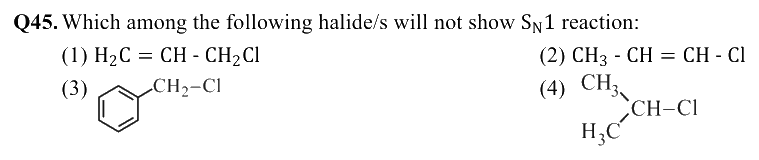
Which among the following halide/s will not show $\mathrm{S_N1}$ reaction:

The question and its figure as printed in JEE Main 2024 27 Jan Shift 2. Option 3: Benzene ring with a CH2-Cl group attached Option 4: A CH-Cl carbon bonded to CH3 (upper left) and H3C (lower left), i.e. isopropyl chloride drawn with CH3 and H3C on the left of CH-Cl
The question as printed in the paper.
  • A

    $\mathrm{H_2C = CH - CH_2Cl}$

  • B

    $\mathrm{CH_3 - CH = CH - Cl}$

  • C

    see figure Benzene ring with a CH2-Cl group attached

  • D

    see figure A CH-Cl carbon bonded to CH3 (upper left) and H3C (lower left), i.e. isopropyl chloride drawn with CH3 and H3C on the left of CH-Cl

45JEE Main 2023 · 13 Apr · Shift 1MCQOpen question page ↗

2-Methyl propyl bromide reacts with $\mathrm{C_2H_5O^{-}}$ and gives A whereas on reaction with $\mathrm{C_2H_5\,OH}$ it gives B.
The mechanism followed in these reactions and the products A and B respectively are:

  • A

    $\mathrm{S_N}2$, A =iso-butyl ethyl ether; $\mathrm{S_N}1$, B =tert-butyl ethyl ether

  • B

    $\mathrm{S_N}1$, A =tert-butyl ethyl ether; $\mathrm{S_N}1$, B = 2-butyl ethyl ether

  • C

    $\mathrm{S_N}2$, A = 2-butyl ethyl ether; $\mathrm{S_N}2$, B =iso-butyl ethyl ether

  • D

    $\mathrm{S_N}1$, A =tert-butyl ethyl ether; $\mathrm{S_N}2$, B =iso-butyl ethyl ether

46JEE Main 2023 · 13 Apr · Shift 2MCQOpen question page ↗

Match List-I with List-II.
1-Bromopropane is reacted with reagents in List-I to give product in List-II
List-I Reagent | List-II Product
A. KOH (alc) | I. Nitrile
B. KCN (alc) | II. Ester
C. $\mathrm{AgNO_2}$ | III. Alkene
D. $\mathrm{H_3CCOOAg}$ | IV. Nitroalkane
Choose the correct answer from the options given below

  • A

    A-III, B-I, C-IV, D-II

  • B

    A-I, B-II, C-III, D-IV

  • C

    A-I, B-III, C-IV, D-II

  • D

    A-IV, B-III, C-II, D-I

47JEE Main 2023 · 11 Apr · Shift 1MCQOpen question page ↗

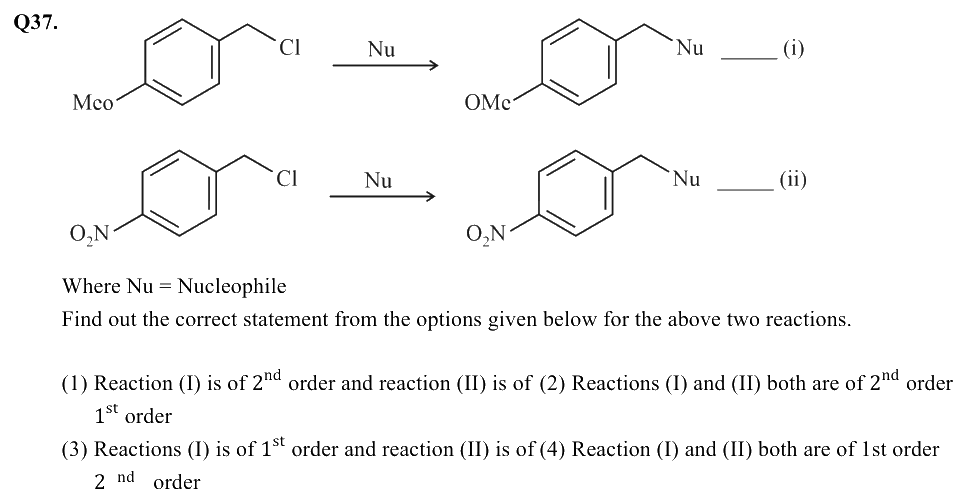
see figure Where Nu = Nucleophile
Find out the correct statement from the options given below for the above two reactions.

The question and its figure as printed in JEE Main 2023 11 Apr Shift 1. Question: Where Nu = Nucleophile Find out the correct statement from the options given below for the above two reactions.
The question as printed in the paper.
  • A

    Reaction (I) is of $2^{nd}$ order and reaction (II) is of $1^{st}$ order

  • B

    Reactions (I) and (II) both are of $2^{nd}$ order

  • C

    Reactions (I) is of $1^{st}$ order and reaction (II) is of $2^{nd}$ order

  • D

    Reaction (I) and (II) both are of 1st order

48JEE Main 2023 · 11 Apr · Shift 2MCQOpen question page ↗

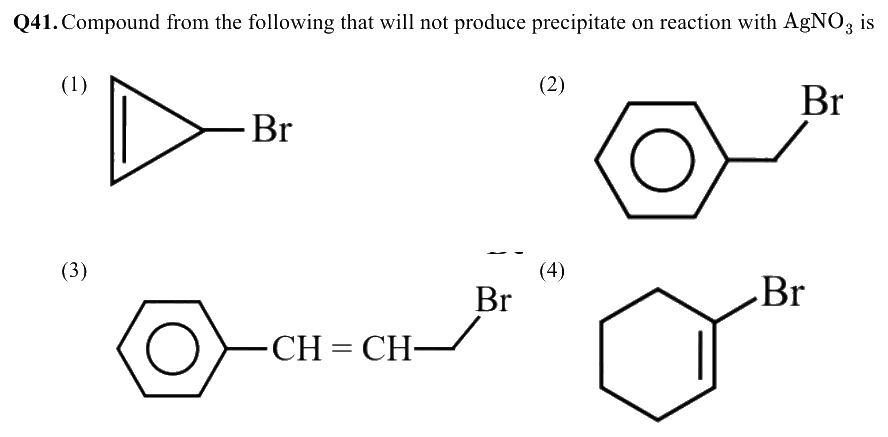
Compound from the following that will not produce precipitate on reaction with $\mathrm{AgNO_3}$ is

The question and its figure as printed in JEE Main 2023 11 Apr Shift 2.
The question as printed in the paper.
  • A

    see figure

  • B

    see figure

  • C

    see figure

  • D

    see figure

49JEE Main 2023 · 11 Apr · Shift 2MCQOpen question page ↗

Which of the following compounds is an example of Freon?

  • A

    $\mathrm{C_2H_2\ F_2}$

  • B

    $\mathrm{C_2\ F_4}$

  • C

    $\mathrm{C_2\ HF_3}$

  • D

    $\mathrm{C_2\ Cl_2\ F_2}$

50JEE Main 2023 · 11 Apr · Shift 2MCQOpen question page ↗

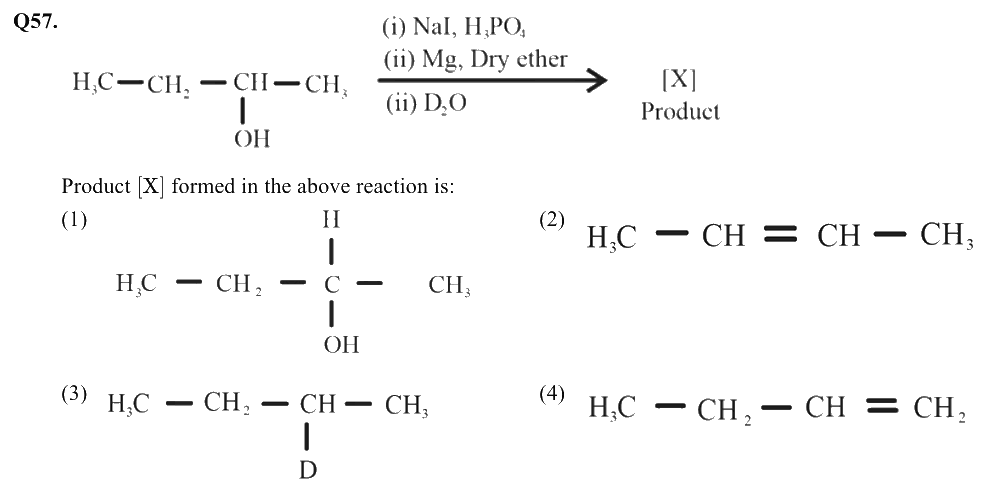
see figure Product [X] formed in the above reaction is:

The question and its figure as printed in JEE Main 2023 11 Apr Shift 2. Question: Product [X] formed in the above reaction is:
The question as printed in the paper.
  • A

    see figure

  • B

    see figure

  • C

    see figure

  • D

    see figure

51JEE Main 2023 · 10 Apr · Shift 1MCQOpen question page ↗

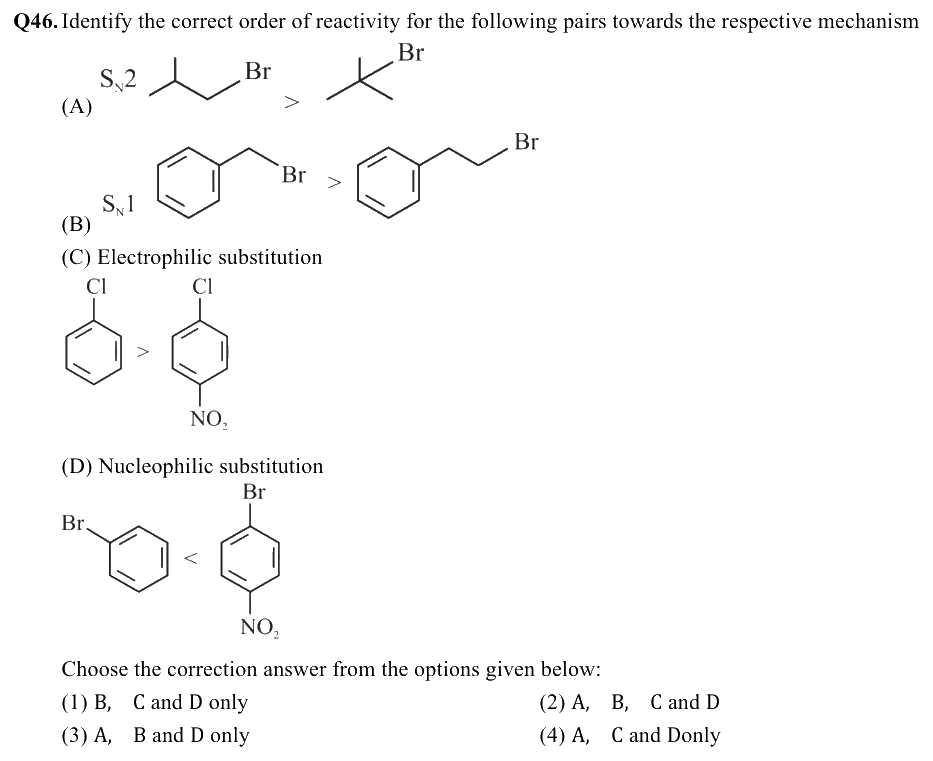
Identify the correct order of reactivity for the following pairs towards the respective mechanism
(A) $\mathrm{S_N2}$ (see the figure above) $>$ (see the figure above)
(B) $\mathrm{S_N1}$ (see the figure above) $>$ (see the figure above)
(C) Electrophilic substitution (see the figure above) $>$ (see the figure above)
(D) Nucleophilic substitution (see the figure above) $<$ (see the figure above)
Choose the correction answer from the options given below:

The question and its figure as printed in JEE Main 2023 10 Apr Shift 1.
The question as printed in the paper.
  • A

    B, C and D only

  • B

    A, B, C and D

  • C

    A, B and D only

  • D

    A, C and Donly

52JEE Main 2023 · 8 Apr · Shift 1MCQOpen question page ↗

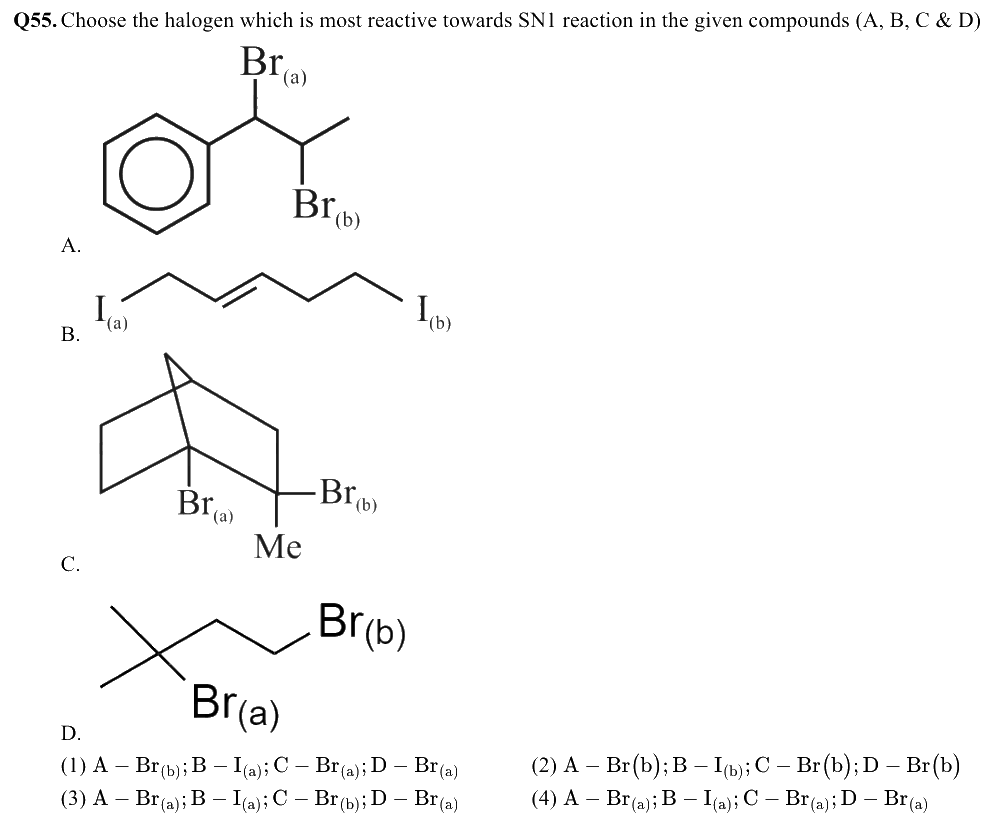
Choose the halogen which is most reactive towards SN1 reaction in the given compounds (A, B, C & D)
A. (see the figure above)
B. (see the figure above)
C. (see the figure above)
D. (see the figure above)

The question and its figure as printed in JEE Main 2023 08 Apr Shift 1.
The question as printed in the paper.
  • A

    $\mathrm{A - Br_{(b)}; B - I_{(a)}; C - Br_{(a)}; D - Br_{(a)}}$

  • B

    $\mathrm{A - Br(b); B - I_{(b)}; C - Br(b); D - Br(b)}$

  • C

    $\mathrm{A - Br_{(a)}; B - I_{(a)}; C - Br_{(b)}; D - Br_{(a)}}$

  • D

    $\mathrm{A - Br_{(a)}; B - I_{(a)}; C - Br_{(a)}; D - Br_{(a)}}$

53JEE Main 2023 · 8 Apr · Shift 2MCQOpen question page ↗

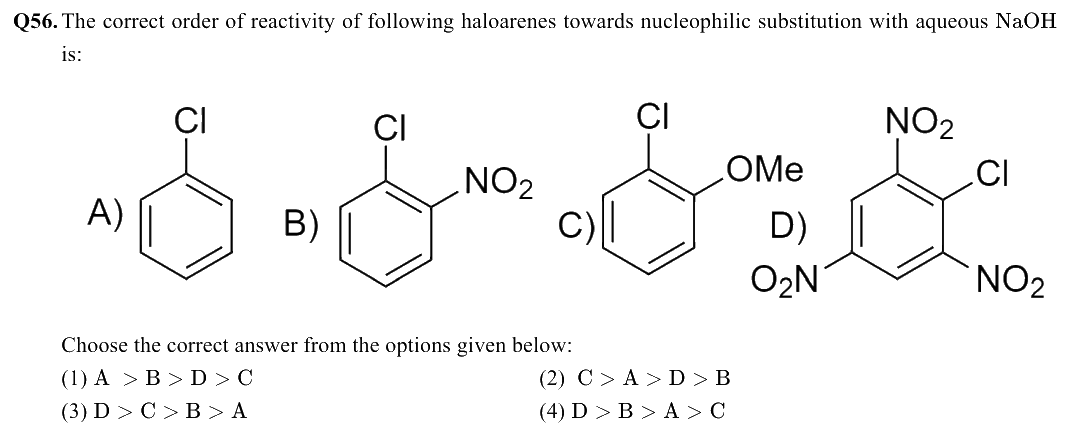
The correct order of reactivity of following haloarenes towards nucleophilic substitution with aqueous NaOH is:

(see the figure above)

The question and its figure as printed in JEE Main 2023 08 Apr Shift 2.
The question as printed in the paper.
  • A

    A > B > D > C

  • B

    C > A > D > B

  • C

    D > C > B > A

  • D

    D > B > A > C

54JEE Main 2023 · 6 Apr · Shift 1MCQOpen question page ↗

For the reaction

$\mathrm{RCH_2Br + I^-} \xrightarrow{\text{Acetone}} \underset{\text{major}}{\mathrm{RCH_2I}} + \mathrm{Br^-}$

The correct statement is

  • A

    $\mathrm{Br^-}$ can act as competing nucleophile.

  • B

    The reaction can occur in acetic acid also.

  • C

    The transition state formed in the above reaction is less polar than the localised anion.

  • D

    The solvent used in the reaction solvates the ions formed in rate determining step

55JEE Main 2023 · 1 Feb · Shift 1MCQOpen question page ↗

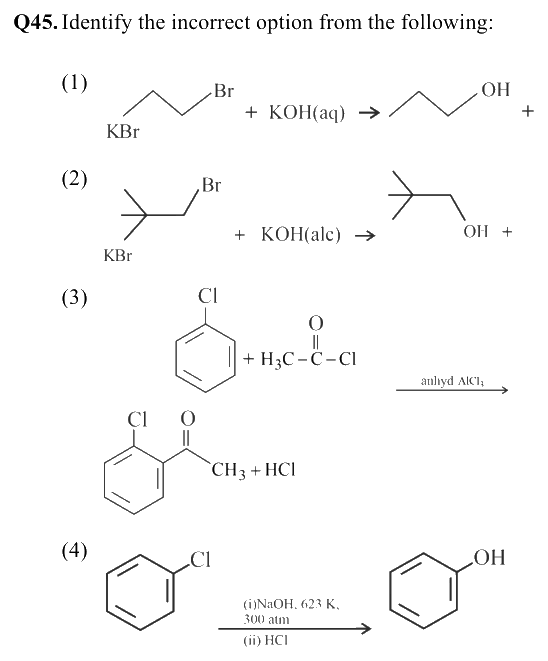
Identify the incorrect option from the following:

(see the figure above)

The question and its figure as printed in JEE Main 2023 01 Feb Shift 1. Option 1: a short zigzag chain ending in Br, plus KOH(aq), gives a short chain ending in OH, plus KBr. Option 2: a skeletal structure with a carbon carrying three branches and a further bond to Br (drawn as a branched skeleton with Br at the end), plus KOH(alc), gives a branched skeleton with OH, plus KBr. Option 3: chlorobenzene plus acetyl chloride (H3C-C(=O)-Cl), with anhyd AlCl3 above the arrow, gives a benzene ring with Cl and C(=O)CH3 on adjacent carbons, plus HCl. Option 4: chlorobenzene, with reagents (i) NaOH, 623 K, 300 atm and (ii) HCl on the arrow, gives phenol (benzene ring with OH).
The question as printed in the paper.
  • A

    see figure a short zigzag chain ending in Br, plus KOH(aq), gives a short chain ending in OH, plus KBr.

  • B

    see figure a skeletal structure with a carbon carrying three branches and a further bond to Br (drawn as a branched skeleton with Br at the end), plus KOH(alc), gives a branched skeleton with OH, plus KBr.

  • C

    see figure chlorobenzene plus acetyl chloride ($\mathrm{H_3C-C(=O)-Cl}$), with anhyd $\mathrm{AlCl_3}$ above the arrow, gives a benzene ring with Cl and C(=O)$\mathrm{CH_3}$ on adjacent carbons, plus HCl.

  • D

    see figure chlorobenzene, with reagents (i) NaOH, 623 K, 300 atm and (ii) HCl on the arrow, gives phenol (benzene ring with OH).

56JEE Main 2023 · 1 Feb · Shift 2MCQOpen question page ↗

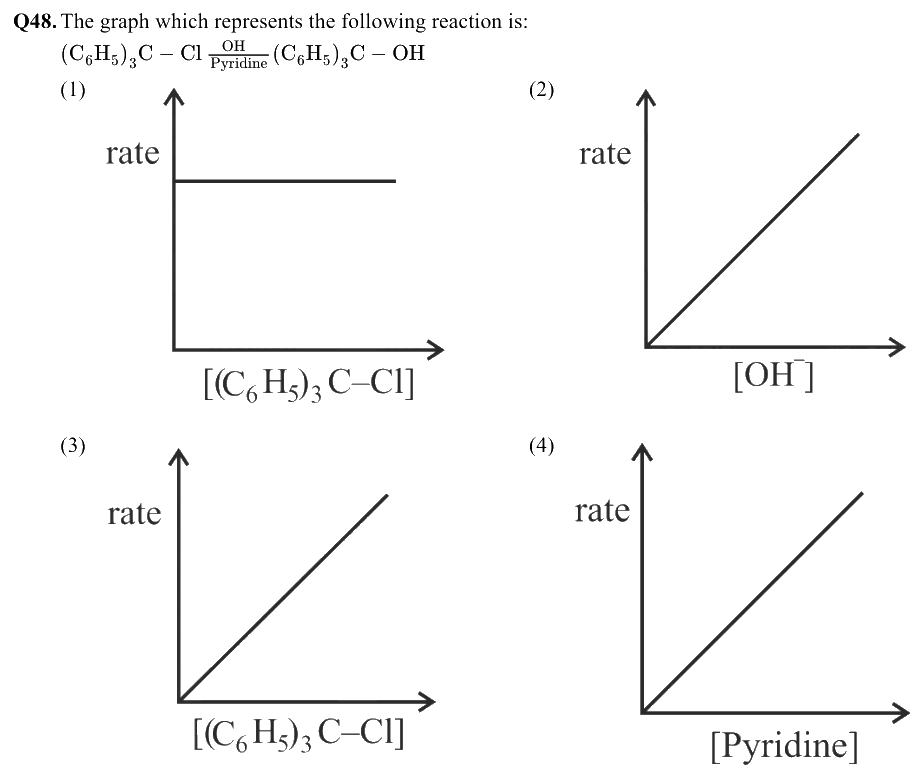
The graph which represents the following reaction is:
$(\mathrm{C_6H_5})_3\mathrm{C} - \mathrm{Cl} \xrightarrow[\text{Pyridine}]{\mathrm{OH^-}} (\mathrm{C_6H_5})_3\mathrm{C} - \mathrm{OH}$

(see the figure above)

The question and its figure as printed in JEE Main 2023 01 Feb Shift 2.
The question as printed in the paper.
  • A

    (graph 1, see figure)

  • B

    (graph 2, see figure)

  • C

    (graph 3, see figure)

  • D

    (graph 4, see figure)

57JEE Main 2023 · 31 Jan · Shift 1MCQOpen question page ↗

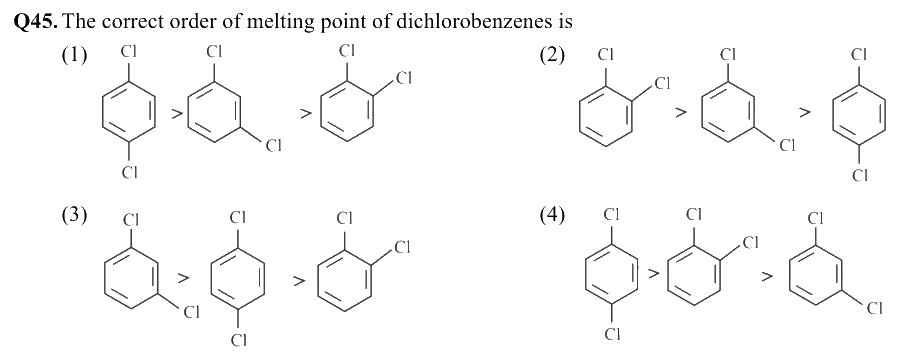
The correct order of melting point of dichlorobenzenes is

The question and its figure as printed in JEE Main 2023 31 Jan Shift 1. Option 1: para-dichlorobenzene (Cl at top and bottom) > meta-dichlorobenzene (Cl at top and lower right) > ortho-dichlorobenzene (Cl at top and upper right). Option 2: ortho-dichlorobenzene (Cl at top and upper right) > meta-dichlorobenzene (Cl at top and lower right) > para-dichlorobenzene (Cl at top and bottom). Option 3: meta-dichlorobenzene (Cl at top and lower right) > para-dichlorobenzene (Cl at top and bottom) > ortho-dichlorobenzene (Cl at top and upper right). Option 4: para-dichlorobenzene (Cl at top and bottom) > ortho-dichlorobenzene (Cl at top and upper right) > meta-dichlorobenzene (Cl at top and lower…
The question as printed in the paper.
  • A

    see figure para-dichlorobenzene (Cl at top and bottom) > meta-dichlorobenzene (Cl at top and lower right) > ortho-dichlorobenzene (Cl at top and upper right).

  • B

    see figure ortho-dichlorobenzene (Cl at top and upper right) > meta-dichlorobenzene (Cl at top and lower right) > para-dichlorobenzene (Cl at top and bottom).

  • C

    see figure meta-dichlorobenzene (Cl at top and lower right) > para-dichlorobenzene (Cl at top and bottom) > ortho-dichlorobenzene (Cl at top and upper right).

  • D

    see figure para-dichlorobenzene (Cl at top and bottom) > ortho-dichlorobenzene (Cl at top and upper right) > meta-dichlorobenzene (Cl at top and lower right).

58JEE Main 2023 · 31 Jan · Shift 2MCQOpen question page ↗

In the following halogenated organic compounds the one with maximum number of chlorine atoms in its structure is:

  • A

    Chloral

  • B

    Gammaxene

  • C

    Chloropicrin

  • D

    Freon-12

59JEE Main 2023 · 30 Jan · Shift 1MCQOpen question page ↗

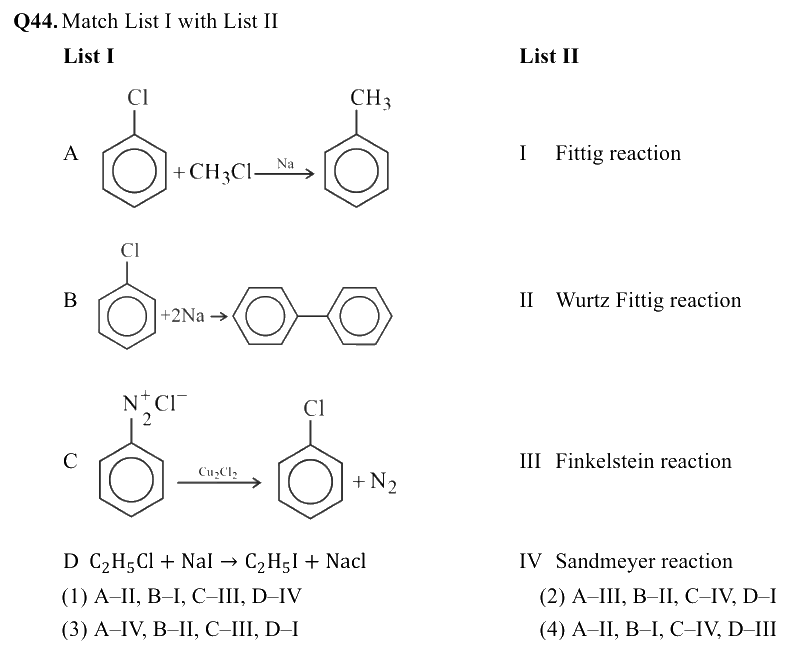
Match List I with List II

List I
A (see the figure above)
B (see the figure above)
C (see the figure above)
D $\mathrm{C_2H_5Cl + NaI \rightarrow C_2H_5I + NaCl}$

List II
I Fittig reaction
II Wurtz Fittig reaction
III Finkelstein reaction
IV Sandmeyer reaction

The question and its figure as printed in JEE Main 2023 30 Jan Shift 1.
The question as printed in the paper.
  • A

    A-II, B-I, C-III, D-IV

  • B

    A-III, B-II, C-IV, D-I

  • C

    A-IV, B-II, C-III, D-I

  • D

    A-II, B-I, C-IV, D-III

60JEE Main 2023 · 30 Jan · Shift 2MCQOpen question page ↗

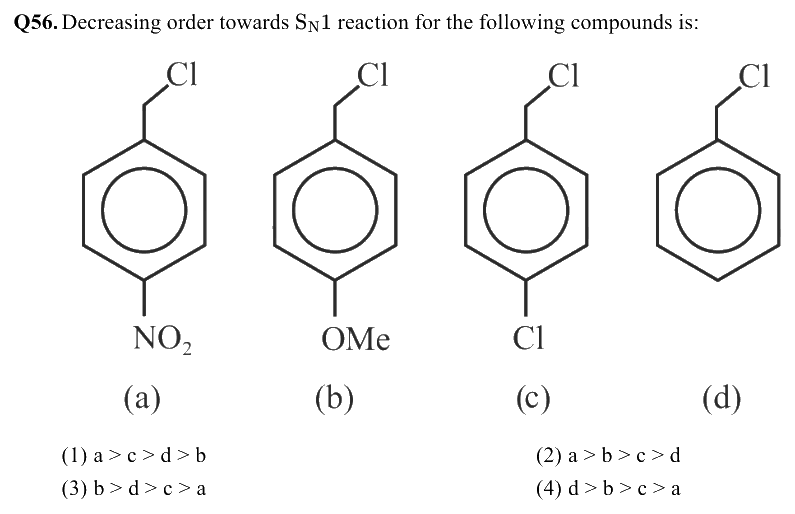
Decreasing order towards $\mathrm{S_N}$1 reaction for the following compounds is:

(see the figure above)

The question and its figure as printed in JEE Main 2023 30 Jan Shift 2.
The question as printed in the paper.
  • A

    a > c > d > b

  • B

    a > b > c > d

  • C

    b > d > c > a

  • D

    d > b > c > a

61JEE Main 2023 · 29 Jan · Shift 1MCQOpen question page ↗

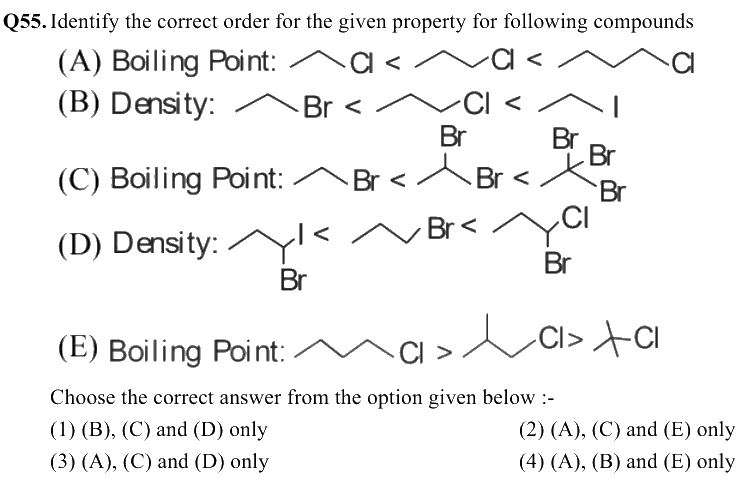
Identify the correct order for the given property for following compounds

(A) Boiling Point: (see the figure above) < (see the figure above) < (see the figure above)
(B) Density: (see the figure above) < (see the figure above) < (see the figure above)
(C) Boiling Point: (see the figure above) < (see the figure above) < (see the figure above)
(D) Density: (see the figure above) < (see the figure above) < (see the figure above)
(E) Boiling Point: (see the figure above) > (see the figure above) > (see the figure above)

Choose the correct answer from the option given below :-

The question and its figure as printed in JEE Main 2023 29 Jan Shift 1.
The question as printed in the paper.
  • A

    (B), (C) and (D) only

  • B

    (A), (C) and (E) only

  • C

    (A), (C) and (D) only

  • D

    (A), (B) and (E) only

62JEE Main 2023 · 25 Jan · Shift 1MCQOpen question page ↗

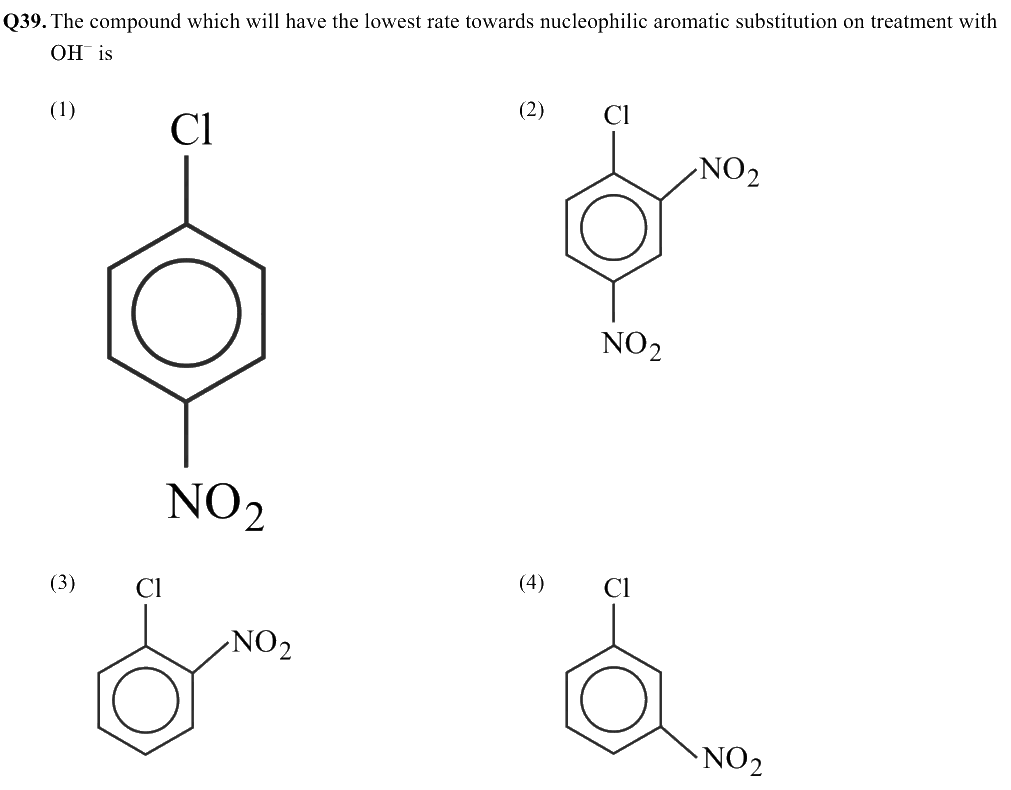
The compound which will have the lowest rate towards nucleophilic aromatic substitution on treatment with $\mathrm{OH^-}$ is

The question and its figure as printed in JEE Main 2023 25 Jan Shift 1.
The question as printed in the paper.
  • A

    see figure

  • B

    see figure

  • C

    see figure

  • D

    see figure

63JEE Main 2023 · 24 Jan · Shift 1MCQOpen question page ↗

Which of the following is true about freons?

  • A

    These are chlorofluorocarbon compounds

  • B

    These are chemicals causing skin cancer

  • C

    These are radicals of chlorine and chlorine monoxide

  • D

    All radicals are called freons

64JEE Main 2023 · 24 Jan · Shift 1MCQOpen question page ↗

Assertion A: Hydrolysis of an alkyl chloride is a slow reaction but in the presence of NaI, the rate of hydrolysis increases.

Reason R: $\mathrm{I^{-}}$ is a good nucleophile as well as a good leaving group.

In the light of the above statements, choose the correct answer from the options given below.

  • A

    A is false but R is true

  • B

    A is true but R is false

  • C

    Both A and R are true and R is the correct explanation of A

  • D

    Both A and R are true and R is not the correct explanation of A

65JEE Main 2022 · 29 Jul · Shift 2MCQOpen question page ↗

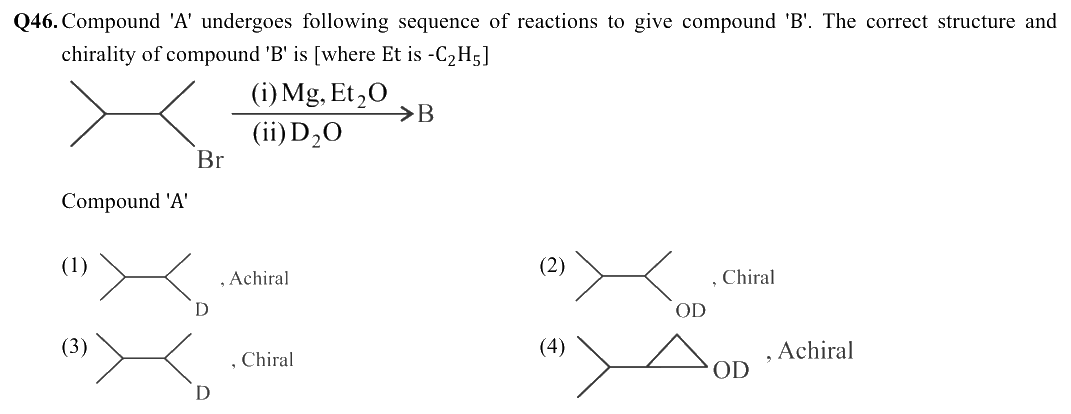
Compound 'A' undergoes following sequence of reactions to give compound 'B'. The correct structure and chirality of compound 'B' is [where Et is $\mathrm{-C_2H_5}$]
(see the figure above)
Compound 'A'

The question and its figure as printed in JEE Main 2022 29 Jul Shift 2. Option 1: , Achiral Option 2: , Chiral Option 3: , Chiral Option 4: , Achiral
The question as printed in the paper.
  • A

    see figure , Achiral

  • B

    see figure , Chiral

  • C

    see figure , Chiral

  • D

    see figure , Achiral

66JEE Main 2022 · 27 Jul · Shift 1MCQOpen question page ↗

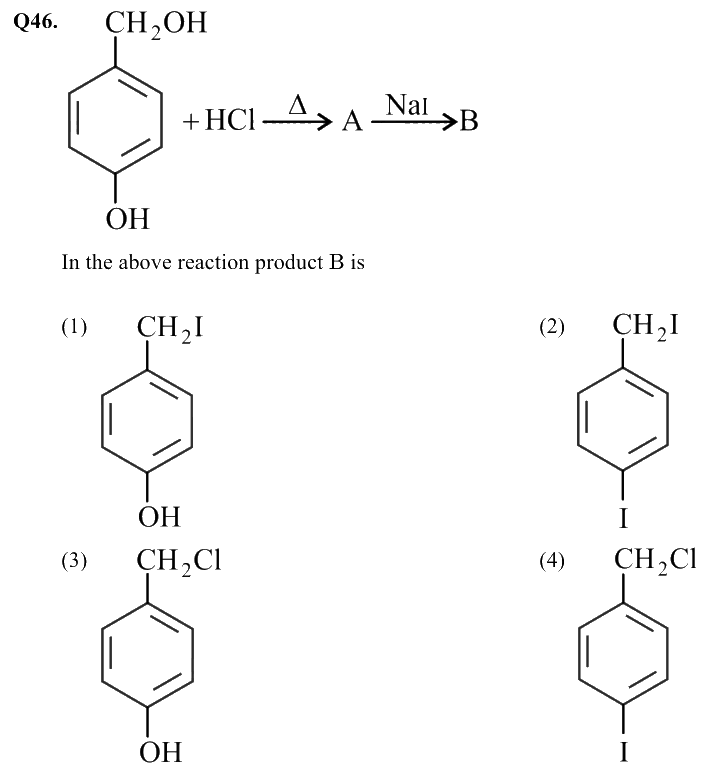
see figure In the above reaction product B is

The question and its figure as printed in JEE Main 2022 27 Jul Shift 1. Question: In the above reaction product B is Option 1: A benzene ring with CH2I at the top and OH at the bottom (para). Option 2: A benzene ring with CH2I at the top and I at the bottom (para). Option 3: A benzene ring with CH2Cl at the top and OH at the bottom (para). Option 4: A benzene ring with CH2Cl at the top and I at the bottom (para).
The question as printed in the paper.
  • A

    see figure A benzene ring with $\mathrm{CH_2I}$ at the top and OH at the bottom (para).

  • B

    see figure A benzene ring with $\mathrm{CH_2I}$ at the top and I at the bottom (para).

  • C

    see figure A benzene ring with $\mathrm{CH_2Cl}$ at the top and OH at the bottom (para).

  • D

    see figure A benzene ring with $\mathrm{CH_2Cl}$ at the top and I at the bottom (para).

67JEE Main 2022 · 25 Jul · Shift 1MCQOpen question page ↗

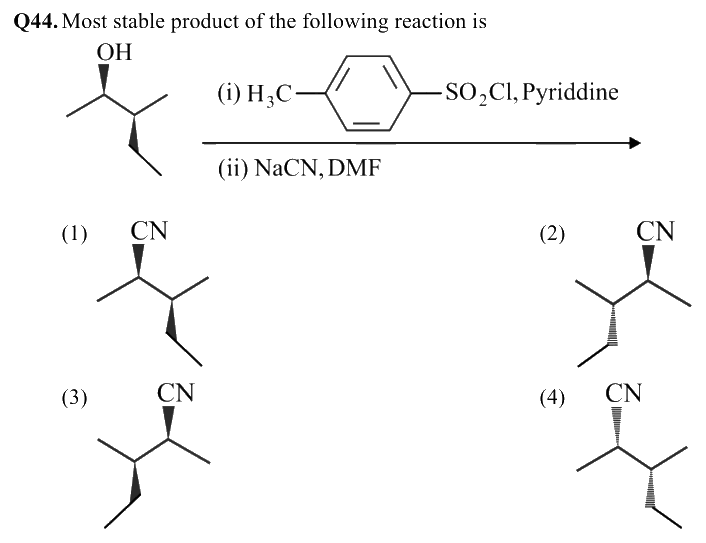
Most stable product of the following reaction is

(see the figure above)

The question and its figure as printed in JEE Main 2022 25 Jul Shift 1. Option 1: skeletal structure with CN on a solid wedge bond at the carbon at the top left, a methyl to the left of that carbon, then a carbon with a methyl at the upper right and a solid wedge bond down to an ethyl group. Option 2: skeletal structure with CN on a solid wedge bond at the carbon at the top right, a methyl to its right, then a carbon with a methyl at the upper left and a hashed bond down to an ethyl group. Option 3: skeletal structure with CN on a solid wedge bond at the carbon at the top right, a methyl to its right, then a carbon with a methyl at the upper left and a solid wedge bond down to an ethyl…
The question as printed in the paper.
  • A

    see figure skeletal structure with CN on a solid wedge bond at the carbon at the top left, a methyl to the left of that carbon, then a carbon with a methyl at the upper right and a solid wedge bond down to an ethyl group.

  • B

    see figure skeletal structure with CN on a solid wedge bond at the carbon at the top right, a methyl to its right, then a carbon with a methyl at the upper left and a hashed bond down to an ethyl group.

  • C

    see figure skeletal structure with CN on a solid wedge bond at the carbon at the top right, a methyl to its right, then a carbon with a methyl at the upper left and a solid wedge bond down to an ethyl group.

  • D

    see figure skeletal structure with CN on a hashed bond at the carbon at the top left, a methyl to the left of that carbon, then a carbon with a methyl at the upper right and a hashed bond down to an ethyl group.

68JEE Main 2022 · 29 Jun · Shift 1MCQOpen question page ↗

see figure $\xrightarrow{(\mathrm{CH_2})_3\mathrm{CLi}}$ (A) $\xrightarrow[\text{(ii) }\mathrm{H_2O^+}]{\text{(i) }\mathrm{CO_2}}$ (see the figure above)
In the given conversion the compound A is

The question and its figure as printed in JEE Main 2022 29 Jun Shift 1. Question: (CH2)3CLi (A) [(ii) H2O^+](i) CO2 (figure) In the given conversion the compound A is Option 1: Benzene ring with Li on one carbon and OH on the adjacent carbon (2-lithiophenol). Option 2: Benzene ring with Li on one carbon and OLi on the adjacent carbon. Option 3: Benzene ring with Br on one carbon and OC(CH3)3 on the adjacent carbon. Option 4: Benzene ring with C(CH3)3 on one carbon and OH on the adjacent carbon.
The question as printed in the paper.
  • A

    see figure Benzene ring with Li on one carbon and OH on the adjacent carbon (2-lithiophenol).

  • B

    see figure Benzene ring with Li on one carbon and OLi on the adjacent carbon.

  • C

    see figure Benzene ring with Br on one carbon and $\mathrm{OC(CH_3)_3}$ on the adjacent carbon.

  • D

    see figure Benzene ring with $\mathrm{C(CH_3)_3}$ on one carbon and OH on the adjacent carbon.

69JEE Main 2022 · 29 Jun · Shift 2MCQOpen question page ↗

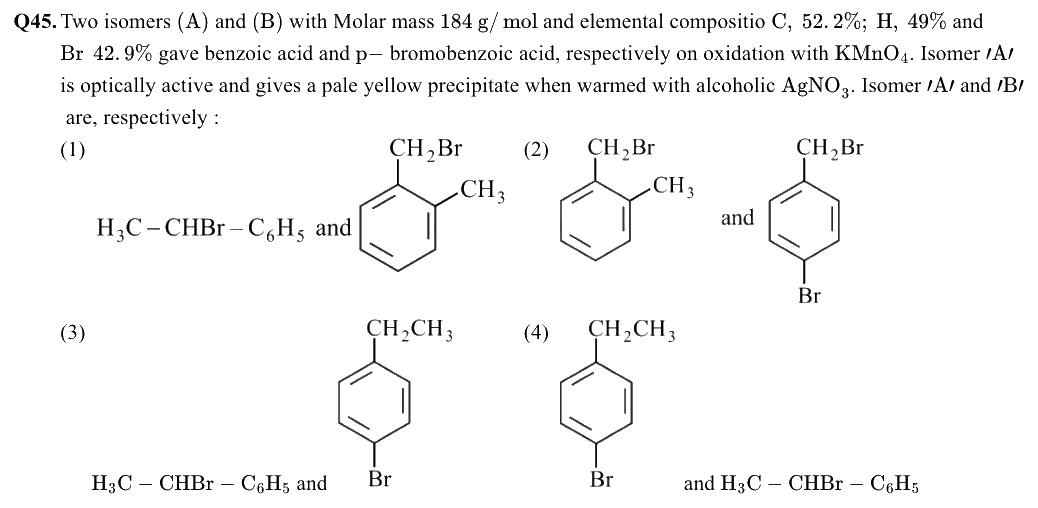
Two isomers (A) and (B) with Molar mass $184\ \mathrm{g/\ mol}$ and elemental compositio C, $52.2\%$; H, $49\%$ and Br $42.9\%$ gave benzoic acid and p$-$ bromobenzoic acid, respectively on oxidation with $\mathrm{KMnO_4}$. Isomer 'A' is optically active and gives a pale yellow precipitate when warmed with alcoholic $\mathrm{AgNO_3}$. Isomer 'A' and 'B' are, respectively :

The question and its figure as printed in JEE Main 2022 29 Jun Shift 2. Option 1: A: H3C-CHBr-C6H5; B: a benzene ring with CH2Br and CH3 on adjacent (ortho) carbons. Option 2: A: a benzene ring with CH2Br and CH3 on adjacent (ortho) carbons; B: a benzene ring with CH2Br at one position and Br para to it. Option 3: A: H3C-CHBr-C6H5; B: a benzene ring with CH2CH3 at one position and Br para to it. Option 4: A: a benzene ring with CH2CH3 at one position and Br para to it; B: H3C-CHBr-C6H5.
The question as printed in the paper.
  • A

    see figure A: $\mathrm{H_3C-CHBr-C_6H_5}$; B: a benzene ring with $\mathrm{CH_2Br}$ and $\mathrm{CH_3}$ on adjacent (ortho) carbons.

  • B

    see figure A: a benzene ring with $\mathrm{CH_2Br}$ and $\mathrm{CH_3}$ on adjacent (ortho) carbons; B: a benzene ring with $\mathrm{CH_2Br}$ at one position and Br para to it.

  • C

    see figure A: $\mathrm{H_3C-CHBr-C_6H_5}$; B: a benzene ring with $\mathrm{CH_2CH_3}$ at one position and Br para to it.

  • D

    see figure A: a benzene ring with $\mathrm{CH_2CH_3}$ at one position and Br para to it; B: $\mathrm{H_3C-CHBr-C_6H_5}$.

70JEE Main 2022 · 28 Jun · Shift 1MCQOpen question page ↗

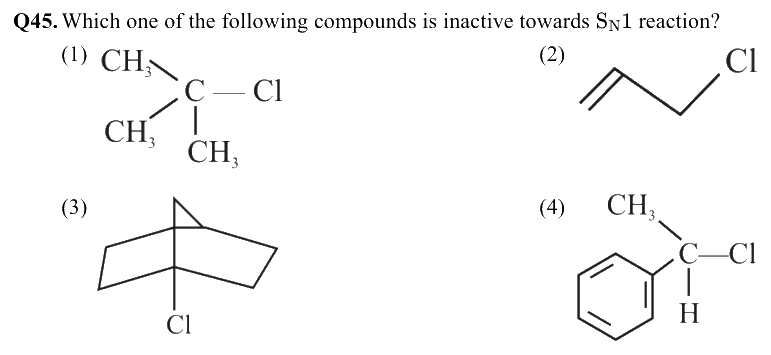
Which one of the following compounds is inactive towards $\mathrm{S_N1}$ reaction?

The question and its figure as printed in JEE Main 2022 28 Jun Shift 1. Option 1: A carbon bonded to Cl and three CH3 groups (tert-butyl chloride). Option 2: Allyl chloride: CH2=CH-CH2-Cl drawn as a zigzag with a double bond at the left end and Cl at the right. Option 3: A bicyclic (norbornane-type, bridged) skeleton with Cl on a bridgehead carbon, at the bottom. Option 4: A benzene ring attached to a carbon bearing CH3, H and Cl (1-phenylethyl chloride).
The question as printed in the paper.
  • A

    see figure A carbon bonded to Cl and three CH$_3$ groups (tert-butyl chloride).

  • B

    see figure Allyl chloride: CH$_2$=CH-CH$_2$-Cl drawn as a zigzag with a double bond at the left end and Cl at the right.

  • C

    see figure A bicyclic (norbornane-type, bridged) skeleton with Cl on a bridgehead carbon, at the bottom.

  • D

    see figure A benzene ring attached to a carbon bearing CH$_3$, H and Cl (1-phenylethyl chloride).

71JEE Main 2022 · 27 Jun · Shift 1MCQOpen question page ↗

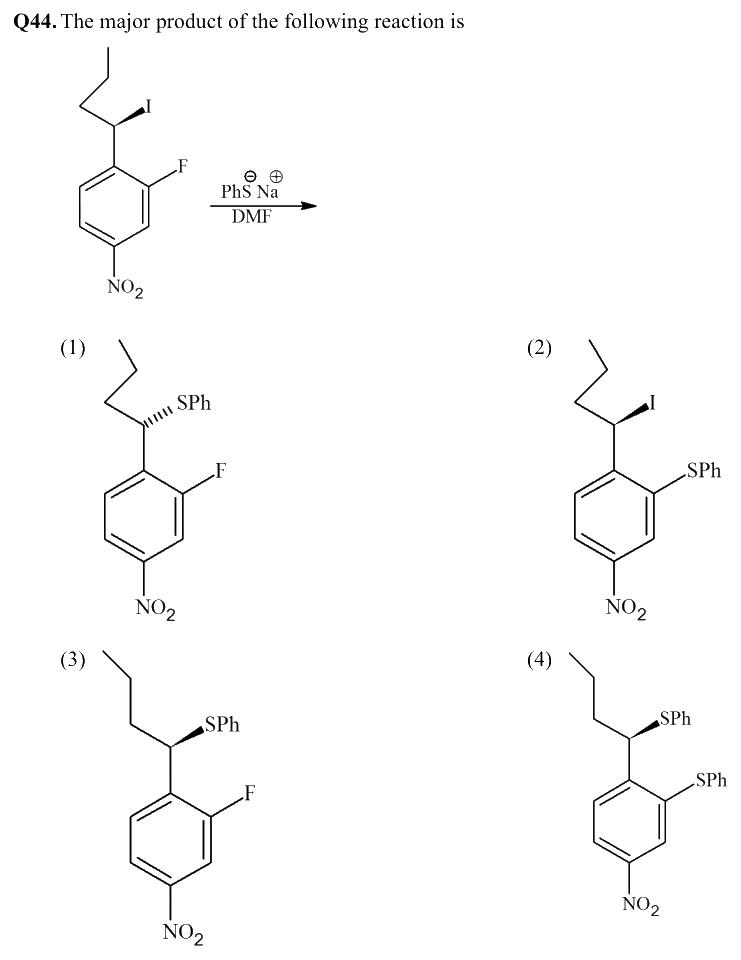
The major product of the following reaction is
(see the figure above)

The question and its figure as printed in JEE Main 2022 27 Jun Shift 1. Option 1: The chain compound drawn with SPh on a hashed bond at the benzylic carbon (SPh in place of I), the ring still carrying F (ortho) and NO2 (para). Option 2: The chain compound with I still on a wedge bond at the benzylic carbon, and SPh on the ring in place of F, NO2 still para. Option 3: The chain compound drawn with SPh on a wedge bond at the benzylic carbon (SPh in place of I), the ring still carrying F (ortho) and NO2 (para). Option 4: The chain compound with SPh on a wedge bond at the benzylic carbon and a second SPh on the ring in place of F, NO2 still para.
The question as printed in the paper.
  • A

    see figure The chain compound drawn with SPh on a hashed bond at the benzylic carbon (SPh in place of I), the ring still carrying F (ortho) and NO_2 (para).

  • B

    see figure The chain compound with I still on a wedge bond at the benzylic carbon, and SPh on the ring in place of F, NO_2 still para.

  • C

    see figure The chain compound drawn with SPh on a wedge bond at the benzylic carbon (SPh in place of I), the ring still carrying F (ortho) and NO_2 (para).

  • D

    see figure The chain compound with SPh on a wedge bond at the benzylic carbon and a second SPh on the ring in place of F, NO_2 still para.

72JEE Main 2022 · 25 Jun · Shift 1MCQOpen question page ↗

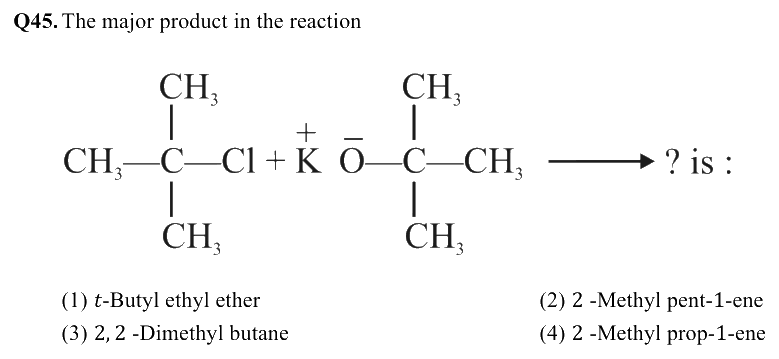
The major product in the reaction
(see the figure above)
? is :

The question and its figure as printed in JEE Main 2022 25 Jun Shift 1.
The question as printed in the paper.
  • A

    $t$-Butyl ethyl ether

  • B

    2 -Methyl pent-1-ene

  • C

    2, 2 -Dimethyl butane

  • D

    2 -Methyl prop-1-ene

73JEE Main 2021 · 31 Aug · Shift 1MCQOpen question page ↗

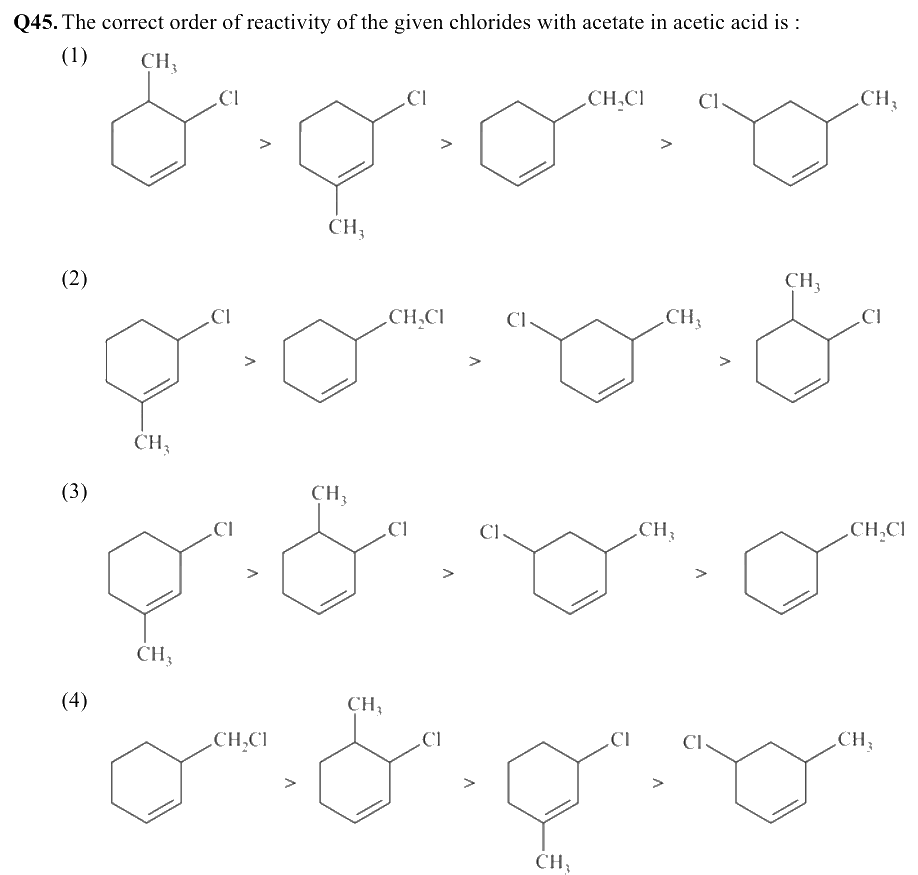
The correct order of reactivity of the given chlorides with acetate in acetic acid is :
(see the figure above)

The question and its figure as printed in JEE Main 2021 31 Aug Shift 1. Option 1: P > Q > R > S Option 2: Q > R > S > P Option 3: Q > P > S > R Option 4: R > P > Q > S
The question as printed in the paper.
  • A

    see figure P > Q > R > S

  • B

    see figure Q > R > S > P

  • C

    see figure Q > P > S > R

  • D

    see figure R > P > Q > S

74JEE Main 2021 · 31 Aug · Shift 2MCQOpen question page ↗

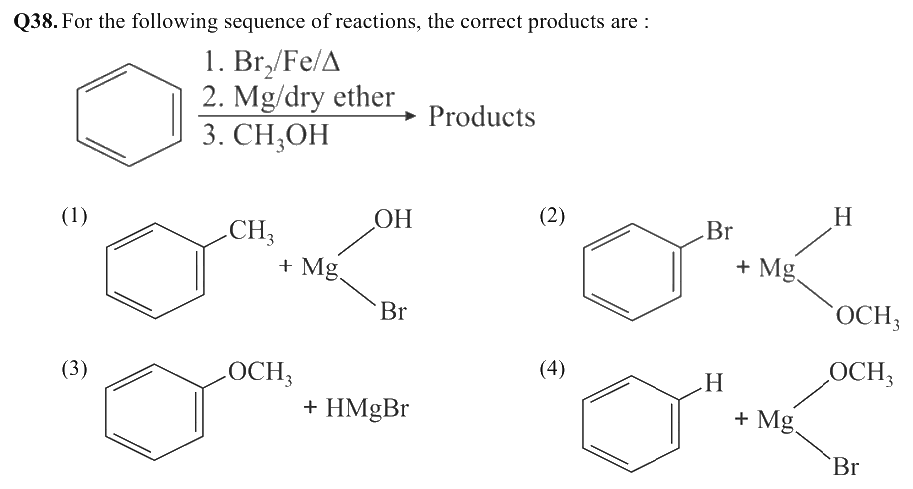
For the following sequence of reactions, the correct products are :
(see the figure above)

The question and its figure as printed in JEE Main 2021 31 Aug Shift 2. Option 1: benzene ring carrying CH3 + Mg(OH)Br (Mg bonded to OH and Br). Option 2: benzene ring carrying Br + Mg(H)(OCH3) (Mg bonded to H and OCH3). Option 3: benzene ring carrying OCH3 + HMgBr. Option 4: benzene ring carrying H (i.e. benzene) + Mg(OCH3)Br (Mg bonded to OCH3 and Br).
The question as printed in the paper.
  • A

    see figure benzene ring carrying CH3 + Mg(OH)Br (Mg bonded to OH and Br).

  • B

    see figure benzene ring carrying Br + Mg(H)(OCH3) (Mg bonded to H and OCH3).

  • C

    see figure benzene ring carrying OCH3 + HMgBr.

  • D

    see figure benzene ring carrying H (i.e. benzene) + Mg(OCH3)Br (Mg bonded to OCH3 and Br).

75JEE Main 2021 · 31 Aug · Shift 2MCQOpen question page ↗

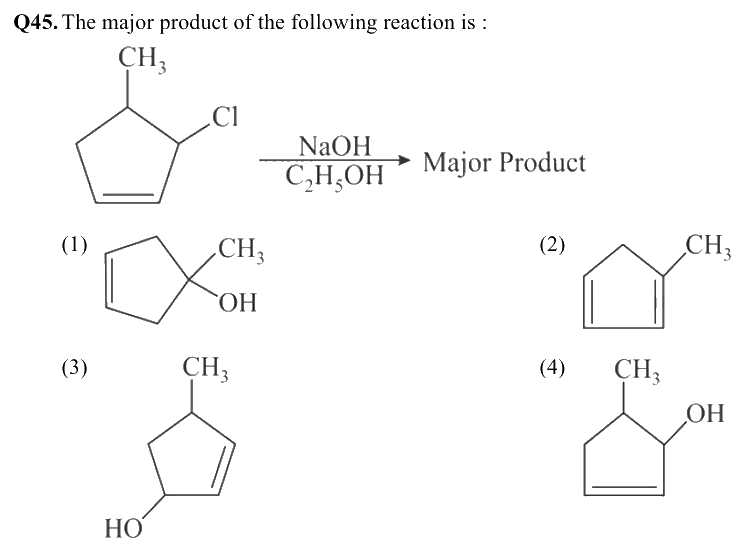
The major product of the following reaction is :
(see the figure above)

The question and its figure as printed in JEE Main 2021 31 Aug Shift 2. Option 1: five-membered ring with one C=C double bond on the left side, and a carbon at the upper right carrying both CH3 and OH. Option 2: five-membered ring (apex at the top, two vertical sides) with two C=C double bonds, on the left vertical edge and on the right vertical edge, and a CH3 on the upper right carbon (the top of the right vertical edge). Option 3: five-membered ring with one C=C double bond on the right side, CH3 on the top carbon and HO on the lower left carbon. Option 4: five-membered ring with one C=C double bond on the bottom edge, CH3 on the top carbon and OH on the upper right carbon next to it.
The question as printed in the paper.
  • A

    see figure five-membered ring with one C=C double bond on the left side, and a carbon at the upper right carrying both CH3 and OH.

  • B

    see figure five-membered ring (apex at the top, two vertical sides) with two C=C double bonds, on the left vertical edge and on the right vertical edge, and a CH3 on the upper right carbon (the top of the right vertical edge).

  • C

    see figure five-membered ring with one C=C double bond on the right side, CH3 on the top carbon and HO on the lower left carbon.

  • D

    see figure five-membered ring with one C=C double bond on the bottom edge, CH3 on the top carbon and OH on the upper right carbon next to it.

76JEE Main 2021 · 27 Aug · Shift 1MCQOpen question page ↗

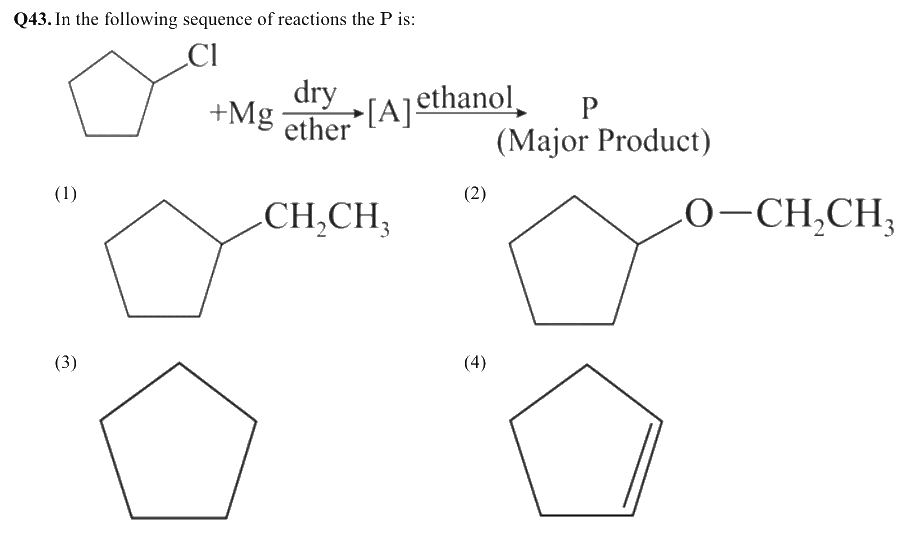
In the following sequence of reactions the P is:
(see the figure above)

The question and its figure as printed in JEE Main 2021 27 Aug Shift 1. Option 1: cyclopentane ring carrying an ethyl group (CH2CH3). Option 2: cyclopentane ring carrying an ethoxy group (O-CH2CH3). Option 3: plain cyclopentane ring (five-membered ring, no substituent). Option 4: cyclopentene ring (five-membered ring with one C=C double bond on the right-hand side).
The question as printed in the paper.
  • A

    see figure cyclopentane ring carrying an ethyl group ($\mathrm{CH_2CH_3}$).

  • B

    see figure cyclopentane ring carrying an ethoxy group ($\mathrm{O-CH_2CH_3}$).

  • C

    see figure plain cyclopentane ring (five-membered ring, no substituent).

  • D

    see figure cyclopentene ring (five-membered ring with one C=C double bond on the right-hand side).

77JEE Main 2021 · 27 Aug · Shift 2MCQOpen question page ↗

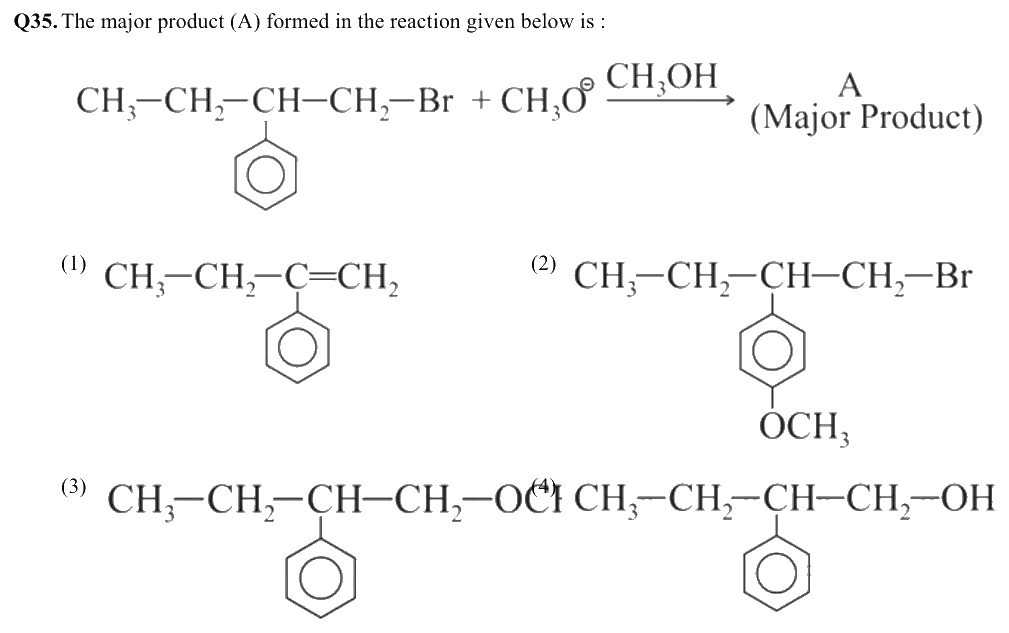
The major product (A) formed in the reaction given below is :
(see the figure above)

The question and its figure as printed in JEE Main 2021 27 Aug Shift 2. Option 1: CH3-CH2-C(=CH2)- with a phenyl ring on the double-bonded carbon (2-phenylbut-1-ene) Option 2: CH3-CH2-CH-CH2-Br with a phenyl ring bearing OCH3 at its para position on the CH carbon Option 3: CH3-CH2-CH(Ph)-CH2-OCH3 with the phenyl ring on the CH carbon Option 4: CH3-CH2-CH(Ph)-CH2-OH with the phenyl ring on the CH carbon
The question as printed in the paper.
  • A

    see figure $\mathrm{CH_3-CH_2-C(=CH_2)-}$ with a phenyl ring on the double-bonded carbon (2-phenylbut-1-ene)

  • B

    see figure $\mathrm{CH_3-CH_2-CH-CH_2-Br}$ with a phenyl ring bearing OCH3 at its para position on the CH carbon

  • C

    see figure $\mathrm{CH_3-CH_2-CH(Ph)-CH_2-OCH_3}$ with the phenyl ring on the CH carbon

  • D

    see figure $\mathrm{CH_3-CH_2-CH(Ph)-CH_2-OH}$ with the phenyl ring on the CH carbon

78JEE Main 2021 · 26 Aug · Shift 1MCQOpen question page ↗

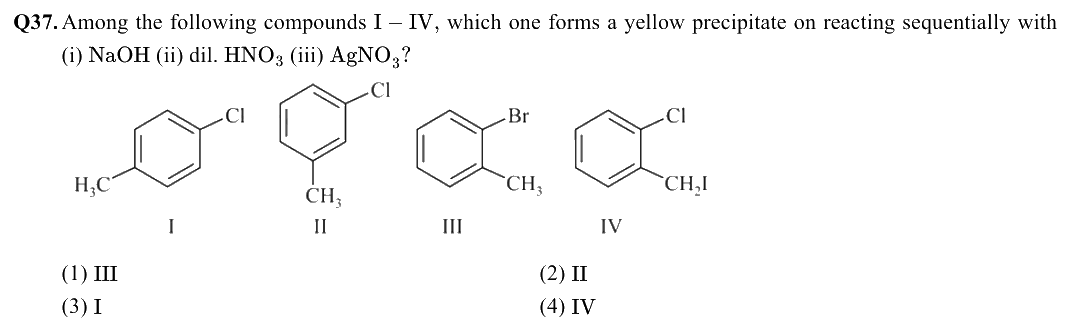
Among the following compounds I $-$ IV, which one forms a yellow precipitate on reacting sequentially with (i) $\mathrm{NaOH}$ (ii) dil. $\mathrm{HNO_3}$ (iii) $\mathrm{AgNO_3}$?
(see the figure above)

The question and its figure as printed in JEE Main 2021 26 Aug Shift 1.
The question as printed in the paper.
  • A

    III

  • B

    II

  • C

    I

  • D

    IV

79JEE Main 2021 · 27 Jul · Shift 2MCQOpen question page ↗

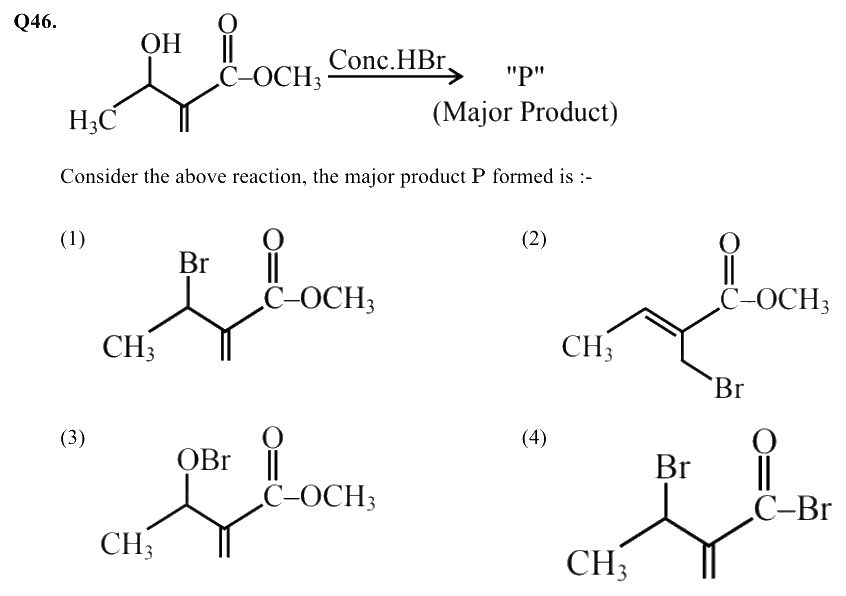
see figure Consider the above reaction, the major product P formed is :-

The question and its figure as printed in JEE Main 2021 27 Jul Shift 2. Question: Consider the above reaction, the major product P formed is :- Option 1: bromo ester with C=CH2 Option 2: allylic bromide ester Option 3: hypobromite ester Option 4: acid bromide
The question as printed in the paper.
  • A

    see figure bromo ester with C=CH2

  • B

    see figure allylic bromide ester

  • C

    see figure hypobromite ester

  • D

    see figure acid bromide

80JEE Main 2021 · 25 Jul · Shift 2MCQOpen question page ↗

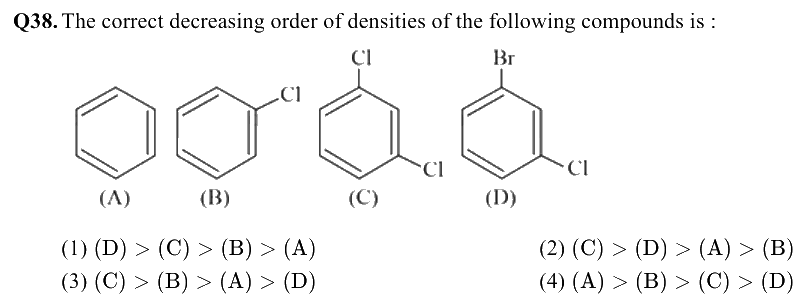
The correct decreasing order of densities of the following compounds is :
(see the figure above)

The question and its figure as printed in JEE Main 2021 25 Jul Shift 2.
The question as printed in the paper.
  • A

    (D) $>$ (C) $>$ (B) $>$ (A)

  • B

    (C) $>$ (D) $>$ (A) $>$ (B)

  • C

    (C) $>$ (B) $>$ (A) $>$ (D)

  • D

    (A) $>$ (B) $>$ (C) $>$ (D)

81JEE Main 2021 · 20 Jul · Shift 1MCQOpen question page ↗

In the given reaction 3-Bromo-2, 2-dimethyl butane $\xrightarrow{\mathrm{C_2H_5OH}}$ 'A' (Major Product) Product A is:

  • A

    2-Ethoxy-3, 3-dimethyl butane

  • B

    1-Ethoxy-3, 3 -dimethyl butane

  • C

    2-Ethoxy-2, 3-dimethyl butane

  • D

    2-Hydroxy-3, 3-dimethyl butane

82JEE Main 2021 · 26 Feb · Shift 2MCQOpen question page ↗

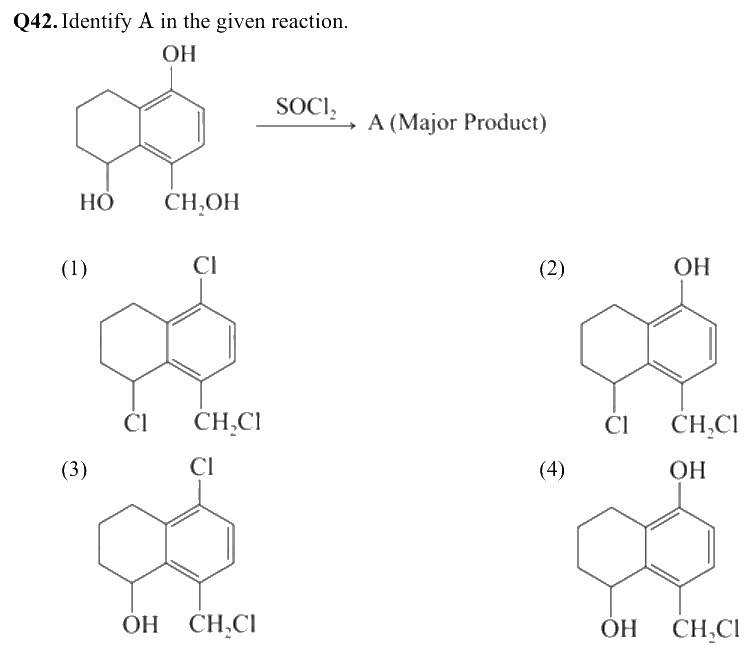
Identify A in the given reaction.
(see the figure above)

The question and its figure as printed in JEE Main 2021 26 Feb Shift 2. Option 1: Tetralin-type bicyclic (benzene ring fused to a saturated six-membered ring) with Cl on the aromatic ring carbon at the top, CH2Cl on the aromatic ring carbon at the bottom, and Cl on the saturated-ring carbon at the lower left. Option 2: The same bicyclic skeleton with OH on the aromatic ring carbon at the top, CH2Cl on the aromatic carbon at the bottom, and Cl on the saturated-ring carbon at the lower left. Option 3: The same bicyclic skeleton with Cl on the aromatic ring carbon at the top, CH2Cl at the bottom aromatic carbon, and OH on the saturated-ring carbon at the lower left. Option 4: The same…
The question as printed in the paper.
  • A

    see figure Tetralin-type bicyclic (benzene ring fused to a saturated six-membered ring) with Cl on the aromatic ring carbon at the top, CH2Cl on the aromatic ring carbon at the bottom, and Cl on the saturated-ring carbon at the lower left.

  • B

    see figure The same bicyclic skeleton with OH on the aromatic ring carbon at the top, CH2Cl on the aromatic carbon at the bottom, and Cl on the saturated-ring carbon at the lower left.

  • C

    see figure The same bicyclic skeleton with Cl on the aromatic ring carbon at the top, CH2Cl at the bottom aromatic carbon, and OH on the saturated-ring carbon at the lower left.

  • D

    see figure The same bicyclic skeleton with OH on the aromatic ring carbon at the top, CH2Cl at the bottom aromatic carbon, and OH on the saturated-ring carbon at the lower left.

83JEE Main 2021 · 24 Feb · Shift 1MCQOpen question page ↗

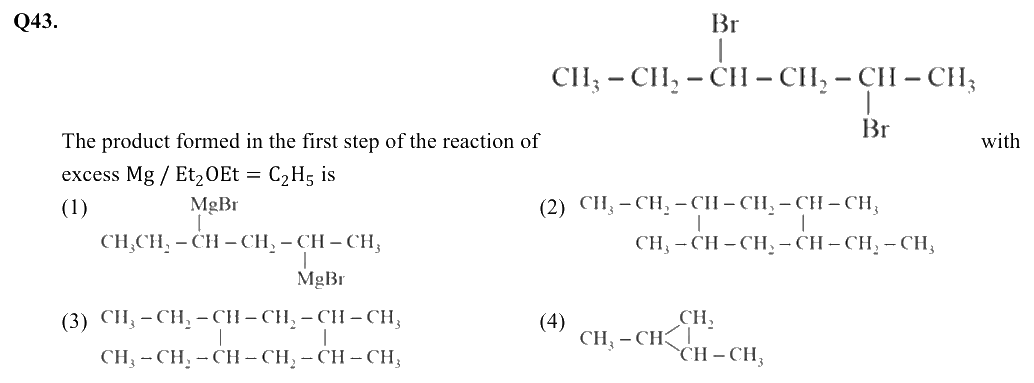
see figure The product formed in the first step of the reaction of the above compound with excess $\mathrm{Mg / Et_2OEt = C_2H_5}$ is

The question and its figure as printed in JEE Main 2021 24 Feb Shift 1. Question: The product formed in the first step of the reaction of the above compound with excess Mg / Et2OEt = C2H5 is Option 1: CH3CH2 - CH(MgBr) - CH2 - CH(MgBr) - CH3 (a Grignard compound with MgBr on the two CH carbons) Option 2: two six-carbon chains CH3 - CH2 - CH - CH2 - CH - CH3 (upper) and CH3 - CH - CH2 - CH - CH2 - CH3 (lower), joined by two vertical bonds between their CH carbons (the upper chain's third and fifth carbons to the lower chain's second and fourth carbons) Option 3: two identical six-carbon chains CH3 - CH2 - CH - CH2 - CH - CH3 (upper) and CH3 - CH2 - CH - CH2 - CH - CH3 (lower), joined by two…
The question as printed in the paper.
  • A

    see figure $\mathrm{CH_3CH_2 - CH(MgBr) - CH_2 - CH(MgBr) - CH_3}$ (a Grignard compound with MgBr on the two CH carbons)

  • B

    see figure two six-carbon chains $\mathrm{CH_3 - CH_2 - CH - CH_2 - CH - CH_3}$ (upper) and $\mathrm{CH_3 - CH - CH_2 - CH - CH_2 - CH_3}$ (lower), joined by two vertical bonds between their CH carbons (the upper chain's third and fifth carbons to the lower chain's second and fourth carbons)

  • C

    see figure two identical six-carbon chains $\mathrm{CH_3 - CH_2 - CH - CH_2 - CH - CH_3}$ (upper) and $\mathrm{CH_3 - CH_2 - CH - CH_2 - CH - CH_3}$ (lower), joined by two vertical bonds between their CH carbons

  • D

    see figure a three-membered ring of $\mathrm{CH(CH_3)}$, $\mathrm{CH_2}$ and $\mathrm{CH(CH_3)}$: $\mathrm{CH_3 - CH}$ bonded to a $\mathrm{CH_2}$ above and a $\mathrm{CH - CH_3}$ below, the CH2 and the lower CH joined by a bond (a dimethylcyclopropane)

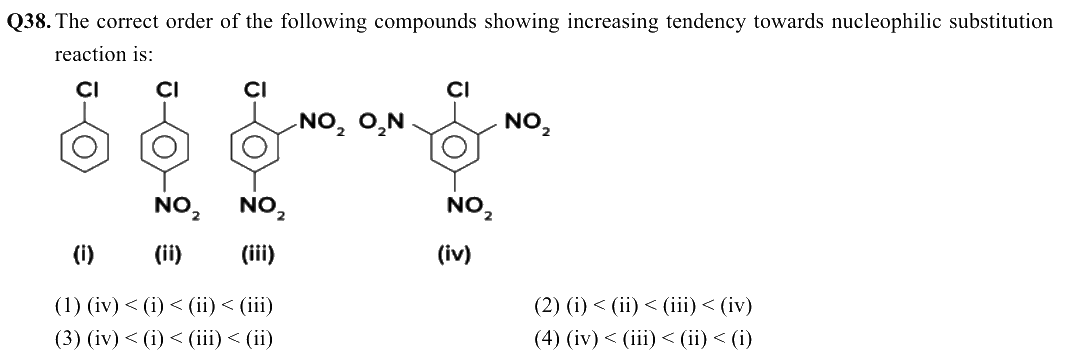
84JEE Main 2021 · 24 Feb · Shift 2MCQOpen question page ↗

The correct order of the following compounds showing increasing tendency towards nucleophilic substitution reaction is:
(see the figure above)

The question and its figure as printed in JEE Main 2021 24 Feb Shift 2.
The question as printed in the paper.
  • A

    (iv) < (i) < (ii) < (iii)

  • B

    (i) < (ii) < (iii) < (iv)

  • C

    (iv) < (i) < (iii) < (ii)

  • D

    (iv) < (iii) < (ii) < (i)

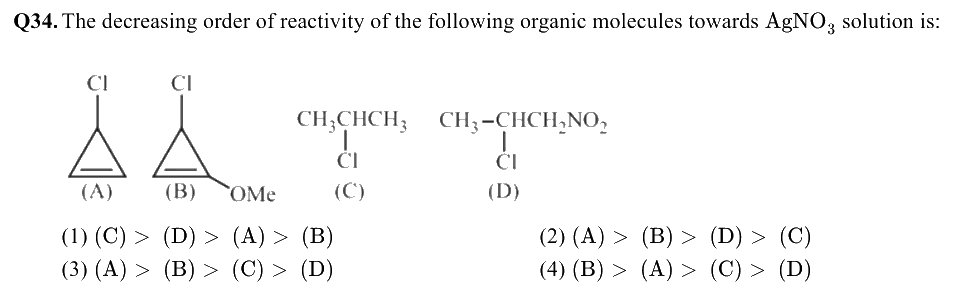
85JEE Main 2020 · 4 Sep · Shift 1MCQOpen question page ↗

The decreasing order of reactivity of the following organic molecules towards $\mathrm{AgNO_{3}}$ solution is:
(see the figure above)

The question and its figure as printed in JEE Main 2020 04 Sep Shift 1.
The question as printed in the paper.
  • A

    (C) > (D) > (A) > (B)

  • B

    (A) > (B) > (D) > (C)

  • C

    (A) > (B) > (C) > (D)

  • D

    (B) > (A) > (C) > (D)

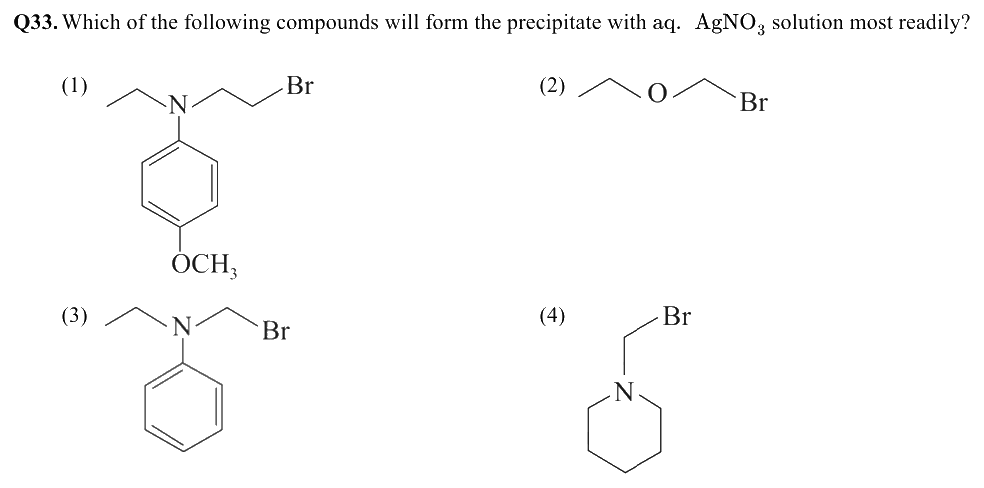
86JEE Main 2020 · 4 Sep · Shift 2MCQOpen question page ↗

Which of the following compounds will form the precipitate with aq. $\mathrm{AgNO_{3}}$ solution most readily?
(see the figure above)

The question and its figure as printed in JEE Main 2020 04 Sep Shift 2. Option 1: N(ethyl)(CH2CH2Br) on a benzene ring bearing para OCH3 Option 2: CH3CH2-O-CH2-Br Option 3: N(ethyl)(CH2Br) on a benzene ring Option 4: piperidine ring with N-CH2Br
The question as printed in the paper.
  • A

    see figure N(ethyl)(CH2CH2Br) on a benzene ring bearing para OCH3

  • B

    see figure CH3CH2-O-CH2-Br

  • C

    see figure N(ethyl)(CH2Br) on a benzene ring

  • D

    see figure piperidine ring with N-CH2Br

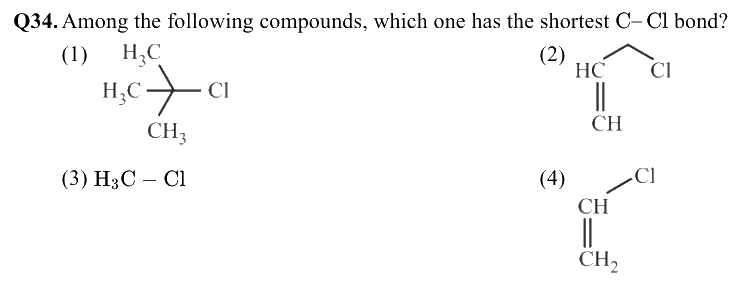
87JEE Main 2020 · 4 Sep · Shift 2MCQOpen question page ↗

Among the following compounds, which one has the shortest C$-$Cl bond?
(see the figure above)

The question and its figure as printed in JEE Main 2020 04 Sep Shift 2. Option 1: C(CH3)3-Cl drawn with H3C, H3C, CH3 around the central carbon Option 2: HC=CH group with a CH2-Cl as drawn (labels HC and CH as printed) Option 4: CH2=CH-Cl as drawn
The question as printed in the paper.
  • A

    see figure C(CH3)3-Cl drawn with H3C, H3C, CH3 around the central carbon

  • B

    see figure HC=CH group with a CH2-Cl as drawn (labels HC and CH as printed)

  • C

    $\mathrm{H_{3}C - Cl}$

  • D

    see figure CH2=CH-Cl as drawn

88JEE Main 2020 · 3 Sep · Shift 1MCQOpen question page ↗

The mechanism of Sn1 reaction is given as:
$\mathrm{R-X} \longrightarrow \mathrm{R^{\oplus}X^{\ominus}} \longrightarrow \mathrm{R^{\oplus}\ \|\ X^{\ominus}} \overset{\mathrm{Y^{\ominus}}}{\rightarrow} \mathrm{R-Y} + \mathrm{X^{\ominus}}$
Ion pair Solvent Speparated ion pair
A student writes general characteristics based on the given mechanism as :
(a) The reaction is favoured by weak nucleophiles.
(b) $\mathrm{R^{\oplus}}$ would be easily formed if the substituents are bulky $y$
(c) The reaction is accompanied by recemization
(d) The reaction is favoured by non-polar solvents.
Which observations are correct?

  • A

    (a) and (b)

  • B

    (a) and (c)

  • C

    (a), (b) and (c)

  • D

    (b) and (d)

89JEE Main 2020 · 3 Sep · Shift 2MCQOpen question page ↗

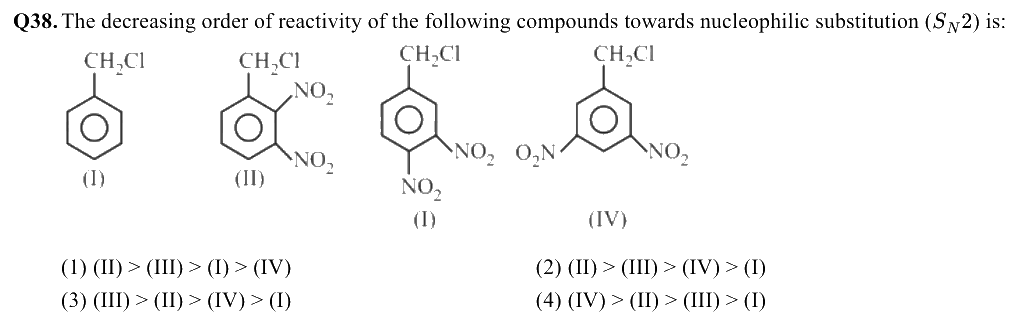
The decreasing order of reactivity of the following compounds towards nucleophilic substitution ($S_N2$) is:
(see the figure above)

The question and its figure as printed in JEE Main 2020 03 Sep Shift 2.
The question as printed in the paper.
  • A

    (II) > (III) > (I) > (IV)

  • B

    (II) > (III) > (IV) > (I)

  • C

    (III) > (II) > (IV) > (I)

  • D

    (IV) > (II) > (III) > (I)

90JEE Main 2020 · 3 Sep · Shift 2MCQOpen question page ↗

The major product in the following reaction is:
(see the figure above)

The question and its figure as printed in JEE Main 2020 03 Sep Shift 2.
The question as printed in the paper.
  • A

    see figure

  • B

    see figure

  • C

    see figure

  • D

    see figure

91JEE Main 2020 · 2 Sep · Shift 1MCQOpen question page ↗

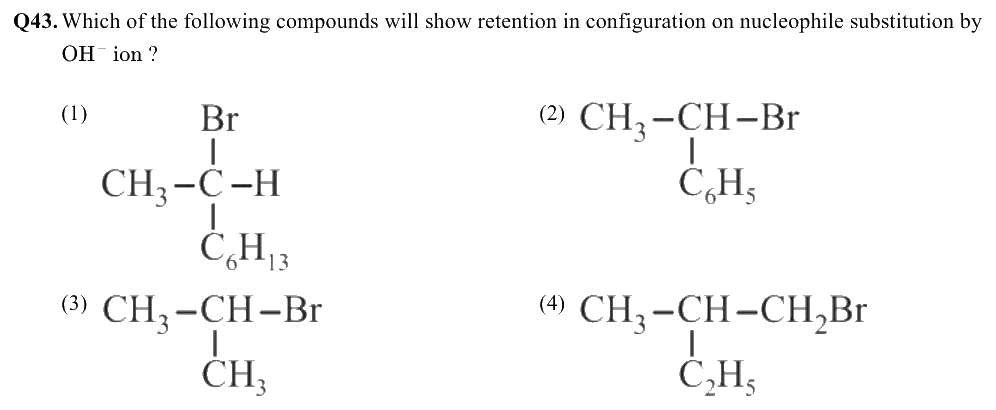
Which of the following compounds will show retention in configuration on nucleophile substitution by $\mathrm{OH}^{-}$ ion ?

The question and its figure as printed in JEE Main 2020 02 Sep Shift 1. Option 1: CH3-C-H with Br above the C and C6H13 below the C. Option 2: CH3-CH-Br with C6H5 below the CH. Option 3: CH3-CH-Br with CH3 below the CH. Option 4: CH3-CH-CH2Br with C2H5 below the CH.
The question as printed in the paper.
  • A

    see figure $\mathrm{CH}_{3}-\mathrm{C}-\mathrm{H}$ with Br above the C and $\mathrm{C}_{6}\mathrm{H}_{13}$ below the C.

  • B

    see figure $\mathrm{CH}_{3}-\mathrm{CH}-\mathrm{Br}$ with $\mathrm{C}_{6}\mathrm{H}_{5}$ below the CH.

  • C

    see figure $\mathrm{CH}_{3}-\mathrm{CH}-\mathrm{Br}$ with $\mathrm{CH}_{3}$ below the CH.

  • D

    see figure $\mathrm{CH}_{3}-\mathrm{CH}-\mathrm{CH}_{2}\mathrm{Br}$ with $\mathrm{C}_{2}\mathrm{H}_{5}$ below the CH.

92JEE Main 2020 · 2 Sep · Shift 2MCQOpen question page ↗

The major product obtained from $\mathrm{E}_{2}$-elimination of $3 - \mathrm{bromo} - 2 - \mathrm{fluoropentane}$ is

The question and its figure as printed in JEE Main 2020 02 Sep Shift 2. Option 1: CH3CH2-CH-CH=CH2 with Br attached by a vertical bond above the CH of the CH=CH2 group. Option 2: CH3CH2CH=C-F with CH3 attached by a vertical bond below the C. Option 3: CH3-CH=CH-CH-CH3 with F attached by a vertical bond above the fourth carbon (the CH before the last CH3). Option 4: CH3-CH2-CH=CH-CH2 with Br attached by a vertical bond above the fourth carbon (the CH before the last CH2).
The question as printed in the paper.
  • A

    see figure $\mathrm{CH}_{3}\mathrm{CH}_{2}-\mathrm{CH}-\mathrm{CH}=\mathrm{CH}_{2}$ with Br attached by a vertical bond above the CH of the CH=CH2 group.

  • B

    see figure $\mathrm{CH}_{3}\mathrm{CH}_{2}\mathrm{CH}=\mathrm{C}-\mathrm{F}$ with $\mathrm{CH}_{3}$ attached by a vertical bond below the C.

  • C

    see figure $\mathrm{CH}_{3}-\mathrm{CH}=\mathrm{CH}-\mathrm{CH}-\mathrm{CH}_{3}$ with F attached by a vertical bond above the fourth carbon (the CH before the last CH3).

  • D

    see figure $\mathrm{CH}_{3}-\mathrm{CH}_{2}-\mathrm{CH}=\mathrm{CH}-\mathrm{CH}_{2}$ with Br attached by a vertical bond above the fourth carbon (the CH before the last CH2).

93JEE Main 2020 · 2 Sep · Shift 2MCQOpen question page ↗

Consider the reaction sequence given below :
(see the figure above)
Which of the following statements is true:

The question and its figure as printed in JEE Main 2020 02 Sep Shift 2.
The question as printed in the paper.
  • A

    Changing the base from $\mathrm{OH}^{\ominus}$ to $^{\ominus}\mathrm{OR}$ will have no effect on reaction (2)

  • B

    Changing the concentration of base will have no effect on reaction (1)

  • C

    Doubling the concentration of base will double the rate of both the reactions

  • D

    Changing the concentration of base will have no effect on reaction (2)

94JEE Main 2020 · 8 Jan · Shift 1MCQOpen question page ↗

The decreasing order of reactivity towards dehydrohalogenation ($\mathrm{E_1}$) reaction of the following compounds is:
(see the figure above)

The question and its figure as printed in JEE Main 2020 08 Jan Shift 1.
The question as printed in the paper.
  • A

    $\mathrm{D > B > C > A}$

  • B

    $\mathrm{B > D > A > C}$

  • C

    $\mathrm{B > D > C > A}$

  • D

    $\mathrm{B > A > D > C}$

95JEE Main 2020 · 7 Jan · Shift 2MCQOpen question page ↗

For the following reactions
(see the figure above)
where,
$\mathrm{k_s}$ and $\mathrm{k_e}$ , are respectively, the rate constants for substitution and elimination, and $\mu = \frac{\mathrm{k_s}}{\mathrm{k_e}}$ , the correct option is ______

The question and its figure as printed in JEE Main 2020 07 Jan Shift 2.
The question as printed in the paper.
  • A

    $\mu_B > \mu_A$ and $\mathrm{k_e(A) > k_e(B)}$

  • B

    $\mu_A > \mu_B$ and $\mathrm{k_e(B) > k_e(A)}$

  • C

    $\mu_B > \mu_A$ and $\mathrm{k_e(B) > k_e(A)}$

  • D

    $\mu_A > \mu_B$ and $\mathrm{k_e(A) > k_e(B)}$

96JEE Main 2019 · 12 Apr · Shift 2MCQOpen question page ↗

Which one of the following is likely to give a precipitate with $\mathrm{AgNO_3}$ solution?

  • A

    $\mathrm{CH_2 = CH - Cl}$

  • B

    $\mathrm{(CH_3)_3CCl}$

  • C

    $\mathrm{CCl_4}$

  • D

    $\mathrm{CHCl_3}$

97JEE Main 2019 · 12 Apr · Shift 2MCQOpen question page ↗

An 'Assertion' and a 'Reason' is given below. Choose the correct answer from the following options:
Assertion (A): Vinyl halides do not undergo nucleophilic substitution easily.
Reason (R): Even though the intermediate carbocation is stabilized by loosely held $\pi-$ electrons, the cleavage is difficult because of the strong bonding.

  • A

    Both (A) and (R) are correct statements but (R) is not the correct explanation of (A).

  • B

    Both (A) and (R) are wrong statements.

  • C

    Both (A) and (R) are wrong statements and (R) is the correct explanation of (A).

  • D

    (A) is a correct statement but (R) is a wrong statement.

98JEE Main 2019 · 10 Apr · Shift 1MCQOpen question page ↗

Increasing rate of $\mathrm{S_N}1$ reaction in the following compounds is:

(see the figure above)

The question and its figure as printed in JEE Main 2019 10 Apr Shift 1.
The question as printed in the paper.
  • A

    (I) < (II) < (III) < (IV)

  • B

    (II) < (I) < (III) < (IV)

  • C

    (II) < (I) < (IV) < (III)

  • D

    (I) < (II) < (IV) < (III)

99JEE Main 2019 · 10 Apr · Shift 1MCQOpen question page ↗

The major product of the following reaction is:

(see the figure above)

The question and its figure as printed in JEE Main 2019 10 Apr Shift 1. Option 1: CH3-C(CH3)(OCH3)-CH2CH3, a tertiary methyl ether Option 2: CH3-C(CH3)(H)-CH=CH2 Option 3: CH3-C(CH3)=CH-CH3 Option 4: CH3-C(CH3)(H)-CH(OCH3)-CH3
The question as printed in the paper.
  • A

    see figure $\mathrm{CH_3-C(CH_3)(OCH_3)-CH_2CH_3}$, a tertiary methyl ether

  • B

    see figure $\mathrm{CH_3-C(CH_3)(H)-CH=CH_2}$

  • C

    see figure $\mathrm{CH_3-C(CH_3)=CH-CH_3}$

  • D

    see figure $\mathrm{CH_3-C(CH_3)(H)-CH(OCH_3)-CH_3}$

100JEE Main 2019 · 10 Apr · Shift 2MCQOpen question page ↗

The major product 'Y' in the following reaction is:

(see the figure above)

The question and its figure as printed in JEE Main 2019 10 Apr Shift 2. Option 1: skeletal structure: HO on a carbon that carries a methyl (vertical line down) and joins a carbon bearing two methyls Option 2: skeletal structure: Br at the end of an unbranched chain with a branch at the far end (Br-CH2-CH2-CH(CH3)-CH3 as drawn) Option 3: skeletal structure: Br on a carbon that carries a methyl, joined to a carbon bearing two methyls Option 4: skeletal structure: Br on a quaternary carbon bearing two methyl groups and an ethyl group
The question as printed in the paper.
  • A

    see figure skeletal structure: HO on a carbon that carries a methyl (vertical line down) and joins a carbon bearing two methyls

  • B

    see figure skeletal structure: Br at the end of an unbranched chain with a branch at the far end (Br-CH2-CH2-CH(CH3)-CH3 as drawn)

  • C

    see figure skeletal structure: Br on a carbon that carries a methyl, joined to a carbon bearing two methyls

  • D

    see figure skeletal structure: Br on a quaternary carbon bearing two methyl groups and an ethyl group

101JEE Main 2019 · 9 Apr · Shift 1MCQOpen question page ↗

The major product of the following reaction is
(see the figure above)

The question and its figure as printed in JEE Main 2019 09 Apr Shift 1. Option 1: Cyclohexenone-type ring with a C=C double bond at the upper left next to the carbonyl-bearing carbon (C=O at the bottom left) and an OH group still present at the right. Option 2: Cyclohexenone ring with C=O at the bottom left and a C=C double bond on the right side of the ring. Option 3: Phenol: a benzene ring with an OH at the bottom left. Option 4: Cyclohexenone ring with C=O at the bottom left and a C=C double bond at the upper right.
The question as printed in the paper.
  • A

    see figure Cyclohexenone-type ring with a C=C double bond at the upper left next to the carbonyl-bearing carbon (C=O at the bottom left) and an OH group still present at the right.

  • B

    see figure Cyclohexenone ring with C=O at the bottom left and a C=C double bond on the right side of the ring.

  • C

    see figure Phenol: a benzene ring with an OH at the bottom left.

  • D

    see figure Cyclohexenone ring with C=O at the bottom left and a C=C double bond at the upper right.

102JEE Main 2019 · 9 Apr · Shift 2MCQOpen question page ↗

Increasing order of reactivity of the following compounds for $\mathrm{S_N}$1 substitution is:
(see the figure above)

The question and its figure as printed in JEE Main 2019 09 Apr Shift 2.
The question as printed in the paper.
  • A

    B < C < D < A

  • B

    B < A < D < C

  • C

    A < B < D < C

  • D

    B < C < A < D

103JEE Main 2019 · 9 Apr · Shift 2MCQOpen question page ↗

Which of the following potential energy (P. E. ) diagrams represents the SN$_1$ reaction?
(see the figure above)

The question and its figure as printed in JEE Main 2019 09 Apr Shift 2. Option 1: PE against progress of reaction: a two-hump curve (two peaks with a shallow valley between them) ending low; the first peak is higher than the second; two dashed horizontal lines at the top. Option 2: PE against progress of reaction: a two-hump curve ending low; the two peaks are of equal height (both reach the lower dashed line); two dashed horizontal lines at the top. Option 3: PE against progress of reaction: a two-hump curve ending low; the second peak is higher than the first; two dashed horizontal lines at the top. Option 4: PE against progress of reaction: a single-hump curve ending lower than it starts.
The question as printed in the paper.
  • A

    see figure PE against progress of reaction: a two-hump curve (two peaks with a shallow valley between them) ending low; the first peak is higher than the second; two dashed horizontal lines at the top.

  • B

    see figure PE against progress of reaction: a two-hump curve ending low; the two peaks are of equal height (both reach the lower dashed line); two dashed horizontal lines at the top.

  • C

    see figure PE against progress of reaction: a two-hump curve ending low; the second peak is higher than the first; two dashed horizontal lines at the top.

  • D

    see figure PE against progress of reaction: a single-hump curve ending lower than it starts.

104JEE Main 2019 · 12 Jan · Shift 2MCQOpen question page ↗

The major product of the following reaction is:

(see the figure above)

The question and its figure as printed in JEE Main 2019 12 Jan Shift 2. Option 1: stereo-drawing with OCH2CH3 (hashed, top), H3C H2C (wedge, left), CO2CH2CH3 (wedge, right), CH3 (hashed, bottom) on the central C Option 4: central C with CH2CH3 (hashed, top), H3C (wedge, left), OCH2CH3 (wedge, right), COOCH2CH3 (hashed, bottom)
The question as printed in the paper.
  • A

    see figure stereo-drawing with $\mathrm{OCH_2CH_3}$ (hashed, top), $\mathrm{H_3C\ H_2C}$ (wedge, left), $\mathrm{CO_2CH_2CH_3}$ (wedge, right), $\mathrm{CH_3}$ (hashed, bottom) on the central C

  • B

    $\mathrm{CH_3CH_2C{=}CH_2}$ with $\mathrm{CO_2CH_2CH_3}$ on the doubly bonded carbon bearing the $\mathrm{CH_3CH_2}$

  • C

    $\mathrm{CH_3C{=}CHCH_3}$ with $\mathrm{CO_2CH_2CH_3}$ on the carbon bearing the first $\mathrm{CH_3}$

  • D

    see figure central C with $\mathrm{CH_2CH_3}$ (hashed, top), $\mathrm{H_3C}$ (wedge, left), $\mathrm{OCH_2CH_3}$ (wedge, right), $\mathrm{COOCH_2CH_3}$ (hashed, bottom)

105JEE Main 2019 · 11 Jan · Shift 2MCQOpen question page ↗

Which of the following compounds reacts with ethylmagnesium bromide and also decolourizes bromine water solution?
(see the figure above)

The question and its figure as printed in JEE Main 2019 11 Jan Shift 2. Option 1: benzene ring with CN and an acetyl group (C(=O)CH3) on adjacent carbons Option 2: benzene ring with CN and CH2-CO2CH3 on adjacent carbons Option 3: benzene ring with OCH3 and a vinyl group (CH=CH2) on adjacent carbons Option 4: benzene ring with OH and a vinyl group (CH=CH2) on adjacent carbons
The question as printed in the paper.
  • A

    see figure benzene ring with CN and an acetyl group (C(=O)CH3) on adjacent carbons

  • B

    see figure benzene ring with CN and CH2-CO2CH3 on adjacent carbons

  • C

    see figure benzene ring with OCH3 and a vinyl group (CH=CH2) on adjacent carbons

  • D

    see figure benzene ring with OH and a vinyl group (CH=CH2) on adjacent carbons

106JEE Main 2019 · 11 Jan · Shift 2MCQOpen question page ↗

Which of the following compounds will produce a precipitate with AgNO$_3$?
(see the figure above)

The question and its figure as printed in JEE Main 2019 11 Jan Shift 2. Option 1: pyridine ring (N at the lower left) with Br on the carbon at the right (3-bromopyridine) Option 2: seven-membered ring with three double bonds (cycloheptatriene) with Br on the sp3 carbon at the top Option 3: bromobenzene Option 4: bromocyclohexane
The question as printed in the paper.
  • A

    see figure pyridine ring (N at the lower left) with Br on the carbon at the right (3-bromopyridine)

  • B

    see figure seven-membered ring with three double bonds (cycloheptatriene) with Br on the sp3 carbon at the top

  • C

    see figure bromobenzene

  • D

    see figure bromocyclohexane

107JEE Main 2018 · 16 Apr · OnlineMCQOpen question page ↗

The major product of the following reaction is:
(see the figure above)

The question and its figure as printed in JEE Main 2018 16 Apr Online. Option 1: zigzag chain with OH on a hashed bond at the left end, a trans C=C, and NH2 on a wedged bond at the right end Option 2: zigzag chain with OH on a wedged bond at the left end, a C=C, and NH2 on a hashed bond at the right end Option 3: zigzag chain with H2N on a wedged bond at the left end, a C=C, and OH on a wedged bond at the right end Option 4: zigzag chain with H2N on a wedged bond at the left end, a C=C, and OH on a hashed bond at the right end
The question as printed in the paper.
  • A

    see figure zigzag chain with OH on a hashed bond at the left end, a trans C=C, and NH2 on a wedged bond at the right end

  • B

    see figure zigzag chain with OH on a wedged bond at the left end, a C=C, and NH2 on a hashed bond at the right end

  • C

    see figure zigzag chain with H2N on a wedged bond at the left end, a C=C, and OH on a wedged bond at the right end

  • D

    see figure zigzag chain with H2N on a wedged bond at the left end, a C=C, and OH on a hashed bond at the right end

108JEE Main 2018 · 15 Apr · Shift 1MCQOpen question page ↗

Which of the following will most readily give the dehydrohalogenation product?

The question and its figure as printed in JEE Main 2018 15 Apr Shift 1 Online. Option 1: structure Option 2: structure Option 3: structure Option 4: structure
The question as printed in the paper.
  • A

    see figure structure

  • B

    see figure structure

  • C

    see figure structure

  • D

    see figure structure

109JEE Main 2018 · 15 Apr · Shift 2MCQOpen question page ↗

The major product formed in the following reaction is:
(see the figure above)

The question and its figure as printed in JEE Main 2018 15 Apr Shift 2 Online. Option 1: Cyclopentene with a C=C between the NO2-bearing carbon and the next ring carbon; CH3 and Cl remain. Option 2: Cyclopentene with a C=C between the carbon next to the NO2 carbon and the CH3-bearing carbon; Cl remains. Option 3: Cyclopentene with a C=C on the left side of the ring; NO2, Cl and CH3 remain. Option 4: Cyclopentene with a C=C on the left side of the ring, ending at the CH3-bearing carbon; NO2 and Cl remain.
The question as printed in the paper.
  • A

    see figure Cyclopentene with a C=C between the NO2-bearing carbon and the next ring carbon; CH3 and Cl remain.

  • B

    see figure Cyclopentene with a C=C between the carbon next to the NO2 carbon and the CH3-bearing carbon; Cl remains.

  • C

    see figure Cyclopentene with a C=C on the left side of the ring; NO2, Cl and CH3 remain.

  • D

    see figure Cyclopentene with a C=C on the left side of the ring, ending at the CH3-bearing carbon; NO2 and Cl remain.

110JEE Main 2018 · 8 Apr · OfflineMCQOpen question page ↗

The major product of the following reaction is:
(see the figure above)

The question and its figure as printed in JEE Main 2018 08 Apr. Option 1: 2,2-dimethylcyclohexyl skeleton with OMe on a hashed bond Option 2: 2,2-dimethylcyclohexyl skeleton with OMe on a bold wedge bond Option 3: 3,3-dimethylcyclohexene (ring C=C on the right side of the ring, two methyls on the quaternary carbon at the top) Option 4: 1,2-dimethylcyclohexene (ring C=C at the top right, one methyl on each alkene carbon)
The question as printed in the paper.
  • A

    see figure 2,2-dimethylcyclohexyl skeleton with OMe on a hashed bond

  • B

    see figure 2,2-dimethylcyclohexyl skeleton with OMe on a bold wedge bond

  • C

    see figure 3,3-dimethylcyclohexene (ring C=C on the right side of the ring, two methyls on the quaternary carbon at the top)

  • D

    see figure 1,2-dimethylcyclohexene (ring C=C at the top right, one methyl on each alkene carbon)

111JEE Main 2017 · 8 Apr · OnlineMCQOpen question page ↗

The major product of the following reaction is:
(see the figure above)

The question and its figure as printed in JEE Main 2017 08 Apr Online.
The question as printed in the paper.
  • A

    $\mathrm{CH_3\,CH=CH-CH=CHCH_3}$

  • B

    $\mathrm{CH_2=CHCH=CHCH_2\,CH_3}$

  • C

    $\mathrm{CH_3\,CH=C=CHCH_2\,CH_3}$

  • D

    $\mathrm{CH_2=CHCH_2\,CH=CHCH_3}$

112JEE Main 2017 · 2 Apr · OfflineMCQOpen question page ↗

The major product obtained in the following reaction is,
(see the figure above)

The question and its figure as printed in JEE Main 2017 02 Apr.
The question as printed in the paper.
  • A

    $\mathrm{C_6H_5CH = CHC_6H_5}$

  • B

    $+\ \mathrm{C_6H_5CHOtBuCH_2C_6H_5}$

  • C

    $-\ \mathrm{C_6H_5CHOtBuCH_2C_6H_5}$

  • D

    $\pm\ \mathrm{C_6H_5CHOtBuCH_2C_6H_5}$

113JEE Main 2017 · 2 Apr · OfflineMCQOpen question page ↗

The increasing order of the reactivity of the following halides for the $\mathrm{S_N}1$ reaction is
(see the figure above)

The question and its figure as printed in JEE Main 2017 02 Apr.
The question as printed in the paper.
  • A

    (II) < (I) < (III)

  • B

    (I) < (III) < (II)

  • C

    (II) < (III) < (I)

  • D

    (III) < (II) < (I)

114JEE Main 2017 · 2 Apr · OfflineMCQOpen question page ↗

Which of the following, upon treatment with tert-BuONa followed by addition of bromine water, fails to decolourize the colour of bromine?

The question and its figure as printed in JEE Main 2017 02 Apr. Option 1: cyclohexyl-CO-CH(Br)-CH3 Option 2: C6H5-CH2-CH(Br)-C6H5 Option 3: C6H5-O-CH(Br)-CH3 Option 4: cyclohexyl-O-CH2Br
The question as printed in the paper.
  • A

    see figure cyclohexyl-CO-CH(Br)-CH3

  • B

    see figure C6H5-CH2-CH(Br)-C6H5

  • C

    see figure C6H5-O-CH(Br)-CH3

  • D

    see figure cyclohexyl-O-CH2Br

115JEE Main 2016 · 10 Apr · OnlineMCQOpen question page ↗

Which one of the following reagents is not suitable for the elimination reaction?
(see the figure above)

The question and its figure as printed in JEE Main 2016 10 Apr Online.
The question as printed in the paper.
  • A

    $\mathrm{NaI}$

  • B

    $\mathrm{NaOEt/EtOH}$

  • C

    $\mathrm{NaOH/H_2O},\ \Delta$

  • D

    $\mathrm{NaOH/H_2O} - \mathrm{EtOH}$

117JEE Main 2016 · 3 Apr · OfflineMCQOpen question page ↗

2- chloro - 2 - methylpentane on reaction with sodium methoxide in methanol yields:
(i) (see the figure above)
(ii) (see the figure above)
(iii) (see the figure above)

The question and its figure as printed in JEE Main 2016 03 Apr.
The question as printed in the paper.
  • A

    iii only

  • B

    i and ii

  • C

    i and iii

  • D

    All of these

118JEE Main 2015 · 4 Apr · OfflineMCQOpen question page ↗

The synthesis of alkyl fluorides is best accomplished by:

  • A

    Swarts reaction

  • B

    Free radical fluorination

  • C

    Sandmeyer's reaction

  • D

    Finkelstein reaction

119JEE Main 2014 · 11 Apr · OnlineMCQOpen question page ↗

Chlorobenzne (sic) reacts with trichloro acetaldehyde in the presence of $\mathrm{H_2SO_4}$.
(see the figure above)
The major product formed is:

The question and its figure as printed in JEE Main 2014 11 Apr Online. Option 1: Two 4-chlorophenyl rings joined to a central carbon that carries two Cl atoms (one drawn above, one below): (ClC6H4)2CCl2. Option 2: Two 4-chlorophenyl rings joined to a central carbon that carries one Cl (drawn above) and one CH2Cl (drawn below). Option 3: Two 4-chlorophenyl rings joined to a central CH carbon that carries CCl3 (drawn below). Option 4: Two 4-chlorophenyl rings joined to a central CH carbon that carries Cl (drawn below).
The question as printed in the paper.
  • A

    see figure Two 4-chlorophenyl rings joined to a central carbon that carries two Cl atoms (one drawn above, one below): $(\mathrm{ClC_6H_4})_2\mathrm{CCl_2}$.

  • B

    see figure Two 4-chlorophenyl rings joined to a central carbon that carries one Cl (drawn above) and one $\mathrm{CH_2Cl}$ (drawn below).

  • C

    see figure Two 4-chlorophenyl rings joined to a central CH carbon that carries $\mathrm{CCl_3}$ (drawn below).

  • D

    see figure Two 4-chlorophenyl rings joined to a central CH carbon that carries Cl (drawn below).

120JEE Main 2014 · 9 Apr · OnlineMCQOpen question page ↗

In a nucleophilic substitution reaction : $\mathrm{R - Br + Cl^-} \xrightarrow{\mathrm{DMF}} \mathrm{R - Cl + Br^-}$ , which one of the following undergoes complete inversion of configuration ?

  • A

    $\mathrm{C_6H_5CHC_6H_5Br}$

  • B

    $\mathrm{C_6H_5CCH_3C_6H_5Br}$

  • C

    $\mathrm{C_6H_5CH_2Br}$

  • D

    $\mathrm{C_6H_5CH_2CH_2Br}$

121JEE Main 2014 · 6 Apr · OfflineMCQOpen question page ↗

The major organic compound formed by the reaction of 1, 1, 1 - trichloroethane with silver powder is :

  • A

    Acetylene

  • B

    Ethene

  • C

    2 - Butyne

  • D

    2 - Butene

122JEE Main 2014 · 6 Apr · OfflineMCQOpen question page ↗

In $\mathrm{S_N}2$ reactions, the correct order of reactivity for the following compounds :
$\mathrm{CH_3Cl}$, $\mathrm{CH_3CH_2Cl}$, $(\mathrm{CH_3})_2\mathrm{CHCl}$ and $(\mathrm{CH_3})_3\mathrm{CCl}$ is :

  • A

    $\mathrm{CH_3Cl} > (\mathrm{CH_3})_2\mathrm{CHCl} > \mathrm{CH_3CH_2Cl} > (\mathrm{CH_3})_3\mathrm{CCl}$

  • B

    $\mathrm{CH_3Cl} > \mathrm{CH_3CH_2Cl} > (\mathrm{CH_3})_2\mathrm{CHCl} > (\mathrm{CH_3})_3\mathrm{CCl}$

  • C

    $\mathrm{CH_3CH_2Cl} > \mathrm{CH_3Cl} > (\mathrm{CH_3})_2\mathrm{CHCl} > (\mathrm{CH_3})_3\mathrm{CCl}$

  • D

    $(\mathrm{CH_3})_2\mathrm{CHCl} > \mathrm{CH_3CH_2Cl} > \mathrm{CH_3Cl} > (\mathrm{CH_3})_3\mathrm{CCl}$

123JEE Main 2014 · 6 Apr · OfflineMCQOpen question page ↗

In the reaction,
$\mathrm{CH_3COOH} \xrightarrow{\mathrm{LiAlH_4}} \mathrm{A} \xrightarrow{\mathrm{PCl_5}} \mathrm{B} \xrightarrow{\text{Alc. KOH}} \mathrm{C}$,
the product C is :

  • A

    Acetaldehyde

  • B

    Acetylene

  • C

    Ethylene

  • D

    Acetyl chloride

124JEE Main 2013 · 25 Apr · OnlineMCQOpen question page ↗

In nucleophilic substitution reaction, order of halogens as incoming (attacking) nucleophile is: $\mathrm{I^-}$ > $\mathrm{Br^-}$ > $\mathrm{Cl^-}$ The order of halogens as departing nucleophile should be :

  • A

    $\mathrm{Br^-}$ > $\mathrm{I^-}$ > $\mathrm{Cl^-}$

  • B

    $\mathrm{I^-}$ > $\mathrm{Br^-}$ > $\mathrm{Cl^-}$

  • C

    $\mathrm{Cl^-}$ > $\mathrm{Br^-}$ > $\mathrm{I^-}$

  • D

    $\mathrm{Cl^-}$ > $\mathrm{I^-}$ > $\mathrm{Br^-}$

125JEE Main 2013 · 25 Apr · OnlineMCQOpen question page ↗

The major product in the following reaction (see the figure above) is :

The question and its figure as printed in JEE Main 2013 25 Apr Online. Option 1: Benzene ring with CH2OH at the top and OH at the bottom (para), and Cl on the ring carbon next to the OH-bearing carbon (lower right, ortho to OH). Option 2: Benzene ring with CH2OH at the top and Cl at the bottom (para). Option 3: Benzene ring with CH2Cl at the top and Cl at the bottom (para). Option 4: Benzene ring with CH2Cl at the top and OH at the bottom (para).
The question as printed in the paper.
  • A

    see figure Benzene ring with CH$_2$OH at the top and OH at the bottom (para), and Cl on the ring carbon next to the OH-bearing carbon (lower right, ortho to OH).

  • B

    see figure Benzene ring with CH$_2$OH at the top and Cl at the bottom (para).

  • C

    see figure Benzene ring with CH$_2$Cl at the top and Cl at the bottom (para).

  • D

    see figure Benzene ring with CH$_2$Cl at the top and OH at the bottom (para).

126JEE Main 2013 · 23 Apr · OnlineMCQOpen question page ↗

The order of reactivity of the given haloalkanes towards nucleophile is :

  • A

    RI > RBr > RCl

  • B

    RCl > RBr > RI

  • C

    RBr > RCl > RI

  • D

    RBr > RI > RCl

127JEE Main 2013 · 22 Apr · OnlineMCQOpen question page ↗

The Wurtz-Fittig reaction involves condensation of:

  • A

    two molecules of aryl halides

  • B

    one molecule of each of aryl-halide and alkyl-halide.

  • C

    one molecule of each of aryl-halide and phenol.

  • D

    two molecules of aralkyl-halides.

128JEE Main 2013 · 7 Apr · OfflineMCQOpen question page ↗

A solution of ($-$)1 $-$ chloro $-$ 1 $-$ phenylethane in toluene racemises slowly in the presence of a small amount of $\mathrm{SbCl_5}$, due to the formation of :

  • A

    Carbocation

  • B

    Free radical

  • C

    Carbanion

  • D

    Carbene

129JEE Main 2013 · 7 Apr · OfflineMCQOpen question page ↗

Compound (A), $\mathrm{C_8H_9}$ Cl, gives a white precipitate when warmed with alcoholic $\mathrm{AgNO_3}$. Oxidation of (A) gives an acid (B), $\mathrm{C_8H_6O_4}$. (B) easily forms anhydride on heating. Identify the compound (A).

The question and its figure as printed in JEE Main 2013 07 Apr. Option 1: structure (1) Option 2: structure (2) Option 3: structure (3) Option 4: structure (4)
The question as printed in the paper.
  • A

    see figure structure (1)

  • B

    see figure structure (2)

  • C

    see figure structure (3)

  • D

    see figure structure (4)

130AIEEE 2010MCQOpen question page ↗

see figure Consider the following bromides :
The correct order of $\mathrm{S_N}1$ reactivity is

The question and its figure as printed in AIEEE 2010. Question: Consider the following bromides : The correct order of SN1 reactivity is
The question as printed in the paper.
  • A

    $B > C > A$

  • B

    $B > A > C$

  • C

    $C > B > A$

  • D

    $A > B > C$

131AIEEE 2008MCQOpen question page ↗

The organic chloro compound, which shows complete stereochemical inversion during a $\mathrm{S_N2}$ reaction, is

  • A

    $\mathrm{(C_2H_5)_2CHCl}$

  • B

    $\mathrm{(CH_3)_3CCl}$

  • C

    $\mathrm{(CH_3)_2CHCl}$

  • D

    $\mathrm{CH_3Cl}$

132AIEEE 2007MCQOpen question page ↗

Which of the following is the correct order of decreasing $\mathrm{S_N^2}$ reactivity?

  • A

    $\mathrm{RCH_2X > R_3CX > R_2CHX}$

  • B

    $\mathrm{RCH_2X > R_2CHX > R_3CX}$

  • C

    $\mathrm{R_3CX > R_2CHX > RCH_2}X$

  • D

    $\mathrm{R_2CHX > R_3CX > RCH_2X}$ (X = a halogen )

133AIEEE 2006MCQOpen question page ↗

$\mathrm{CH_3Br + Nu^- \longrightarrow CH_3 - Nu + Br^-}$
The decreasing order of the rate of the above reaction with nucleophiles $(\mathrm{Nu^-})$ A to D is $[\mathrm{Nu^-}$ = (A)$\mathrm{PhO^-}$, (B) $\mathrm{AcO^-}$, (C) $\mathrm{HO^-}$, (D) $\mathrm{CH_3O^-}$]

  • A

    $D > C > A > B$

  • B

    $D > C > B > A$

  • C

    $A > B > C > D$

  • D

    $B > D > C > A$

134AIEEE 2006MCQOpen question page ↗

see figure The structure of the major product formed in the following reaction is

The question and its figure as printed in AIEEE 2006. Question: The structure of the major product formed in the following reaction is Option 1: benzene ring with a CH2CN group and a CN group meta to each other (no iodine) Option 2: benzene ring with CN, I and CH2Cl Option 3: benzene ring with CH2Cl and CN meta to each other (no iodine) Option 4: benzene ring with CH2CN and I meta to each other
The question as printed in the paper.
  • A

    see figure benzene ring with a CH2CN group and a CN group meta to each other (no iodine)

  • B

    see figure benzene ring with CN, I and CH2Cl

  • C

    see figure benzene ring with CH2Cl and CN meta to each other (no iodine)

  • D

    see figure benzene ring with CH2CN and I meta to each other

135AIEEE 2006MCQOpen question page ↗

Reaction of trans-2-phenyl-1-bromocyclopentane on reaction with alcoholic KOH produces

  • A

    4-phenylcyclopentene

  • B

    2-phenylcyclopentene

  • C

    1-phenylcyclopentene

  • D

    3-phenylcyclopentene

136AIEEE 2006MCQOpen question page ↗

Phenyl magnesium bromide reacts with methanol to give

  • A

    a mixture of anisole and Mg(OH)Br

  • B

    a mixture of benzene and Mg(OMe)Br

  • C

    a mixture of toluene and Mg(OH)Br

  • D

    a mixture of phenol and Mg(Me)Br

137AIEEE 2005MCQOpen question page ↗

Tertiary alkyl halides are practically inert to substitution by $\mathrm{S_N2}$ mechanism because of

  • A

    insolubility

  • B

    instability

  • C

    inductive effect

  • D

    steric hindrance

139AIEEE 2004MCQOpen question page ↗

The compound formed on heating chlorobenzene with chloral in the presence concentrated sulphuric acid is

  • A

    gammexene

  • B

    hexachloroethane

  • C

    Freon

  • D

    DDT

140AIEEE 2003MCQOpen question page ↗

Bottles containing $\mathrm{C_6H_5I}$ and $\mathrm{C_6H_5CH_2I}$ lost their original labels. They were labelled A and B for testing A and B were separately taken in test tubes and boiled with NaOH solution. The end solution in each tube was made acidic with dilute $\mathrm{HNO_3}$ and then some $\mathrm{AgNO_3}$ solution was added. Substance B gave a yellow precipitate. Which one of the following statements is true for this experiment?

  • A

    A and $\mathrm{C_6H_5CH_2I}$

  • B

    $B$ and $\mathrm{C_6H_5I}$

  • C

    Addition of $\mathrm{HNO_3}$ was unnecessary

  • D

    A was $\mathrm{C_6H_5I}$

141AIEEE 2002MCQOpen question page ↗

$\mathrm{CH_3 - Mg - Br}$ is an organo metallic compound due to

  • A

    $\mathrm{Mg - Br}$ bond

  • B

    $C$ - $Mg$ bond

  • C

    $C$ - $Br$ bond

  • D

    $\mathrm{C - H}$ bond

142AIEEE 2002MCQOpen question page ↗

The reaction: $\mathrm{(CH_3)_3C - Br \xrightarrow{H_2O} (CH_3)_3 - C - OH}$

  • A

    elimination reaction

  • B

    substitution reaction

  • C

    free radical reaction

  • D

    displacement reaction

Numerical value

7 questions
143JEE Main 2026 · 5 Apr · Shift 2NumericalOpen question page ↗

RMgI when treated with ice cold water liberated a gas which occupied 1.4 dm$^3$/g at STP. The gas produced is further reacted with iodine in presence of $\mathrm{HIO_3}$ to give compound (X). Compound (X) in presence of Na and dry ether produced compound (Y). Molar mass of compound (Y) is ________ g mol$^{-1}$. (Nearest integer)

Numerical answer type: type your answer in EdLoop to check it
144JEE Main 2026 · 24 Jan · Shift 2NumericalOpen question page ↗

Grignard reagent RMgBr (P) reacts with water and forms a gas (Q). One gram of Q occupies 1.4 dm$^3$ at STP. (P) on reaction with dry ice in dry ether followed by $\mathrm{H_3O^+}$ forms a compound (Z). 0.1 mole of (Z) will weigh ________ g. (Nearest integer)

Numerical answer type: type your answer in EdLoop to check it
145JEE Main 2024 · 6 Apr · Shift 1NumericalOpen question page ↗

The major products from the following reaction sequence are product $A$ and product B.

(see the figure above)

The total sum of $\pi$ electrons in product $A$ and product $B$ are ______ (nearest integer)

The question and its figure as printed in JEE Main 2024 06 Apr Shift 1.
The question as printed in the paper.
Numerical answer type: type your answer in EdLoop to check it
146JEE Main 2024 · 31 Jan · Shift 1NumericalOpen question page ↗

see figure The total number of hydrogen atoms in product $A$ and product $B$ is ______.

The question and its figure as printed in JEE Main 2024 31 Jan Shift 1. Question: The total number of hydrogen atoms in product A and product B is .
The question as printed in the paper.
Numerical answer type: type your answer in EdLoop to check it
147JEE Main 2023 · 24 Jan · Shift 1NumericalOpen question page ↗

Number of moles of AgCl formed in the following reaction is ______ .

(see the figure above)

The question and its figure as printed in JEE Main 2023 24 Jan Shift 1.
The question as printed in the paper.
Numerical answer type: type your answer in EdLoop to check it
148JEE Main 2022 · 26 Jul · Shift 2NumericalOpen question page ↗

A 100 mL solution of $\mathrm{CH_3CH_2MgBr}$ on treatment with methanol produces $2.24$ mL of a gas at STP. The weight of gas produced is______mg (nearest integer)

Numerical answer type: type your answer in EdLoop to check it
149JEE Main 2022 · 24 Jun · Shift 2NumericalOpen question page ↗

see figure Consider the above reaction. The number of $\pi$ electrons present in the product 'P' is

The question and its figure as printed in JEE Main 2022 24 Jun Shift 2. Question: Consider the above reaction. The number of π electrons present in the product 'P' is
The question as printed in the paper.
Numerical answer type: type your answer in EdLoop to check it

How to prepare Haloalkanes & Haloarenes for JEE Main

How often it comes up

Haloalkanes and haloarenes covers substitution and elimination reactions under Unit 16: Organic Compounds Containing Halogens in the Class 12 curriculum, holding rank 19 of 31 chapters with a 2.5% share of the chemistry section. In the 2019 to 2026 testing window, Haloalkanes & Haloarenes accounted for 113 questions across 162 exam papers, making up 2.5% of the chemistry section and holding rank 19 of 31 chapters. During the 2002 to 2018 timeframe, it contributed 36 questions across 38 papers with a 2.7% share. Across the 2024 to 2026 seasons, the chapter yielded 48 questions across 58 papers, accounting for a 3.1% share. Comparing 2002 to 2018 against 2024 to 2026, its share is about the same, while comparing 2019 to 2026 against 2024 to 2026, the trend is up.

The topic has appeared every year from 2019 to 2026. Across the 2019 to 2026 period, it averaged 0.7 questions per paper, rising to 0.8 questions per paper between 2024 and 2026. Numerical value questions are relatively rare here, with 7 numerical answer questions set between 2019 and 2026.

Most-asked topics

The syllabus divides across three primary topics:

  • Nucleophilic Substitution: The dominant focus with 77 total questions (61 in 2019 to 2026), examined continuously through 2026. Focuses on SN1 versus SN2 competition, steric hindrance versus carbocation stability, solvent polarity effects (protic versus aprotic), inversion of configuration at chiral centers, and unreactivity of vinyl and aryl halides due to partial double bond resonance character.
  • Elimination & Other Reactions: Produced 56 total questions (38 in 2019 to 2026), evaluated through 2026. Evaluates E2 dehydrohalogenation stereochemistry (anti-periplanar requirement), Saytzeff major alkene orientation with unhindered bases versus Hofmann orientation with bulky bases like potassium tert-butoxide, Grignard reagent formations, and Wurtz-Fittig couplings.
  • Preparation & Properties: Accounted for 16 total questions (14 in 2019 to 2026), active through 2026. Covers halogen exchange reactions (Finkelstein reaction using sodium iodide in dry acetone, Swarts reaction using metal fluorides like AgF), Sandmeyer reaction, and physical trends in boiling point and dipole moments.

What the questions look like

Examiners test reaction mechanisms through comparative sequences. Many problems ask students to order four organic halides by their rate of SN1 solvolysis (dependent on allylic, benzylic, or tertiary carbocation stability) or SN2 displacement (inversely proportional to steric crowding around the reacting carbon).

Another frequent pattern examines haloarenes: students must recognize why chlorobenzene resists nucleophilic attack under ambient conditions, and how introducing electron-withdrawing nitro groups at ortho and para positions dramatically accelerates nucleophilic aromatic substitution via Meisenheimer complexes.

Questions to try first

Work through these authentic recent exam questions:

How to practise it

Prepare for mechanism questions by focusing on structural constraints and reagent clues:

1. Master SN1 versus SN2 decision trees: Primary halides undergo SN2; tertiary halides undergo SN1; secondary halides depend strongly on nucleophile strength and solvent (polar aprotic like DMSO favors SN2; polar protic favors SN1). 2. Recognize unreactive halides: Vinyl halides, aryl halides, and bridgehead halides resist both SN1 and SN2 substitutions due to resonance stabilization of the C–X bond and Bredt's rule preventing planar carbocation formation. 3. Track stereochemical consequences: SN2 reactions produce pure inversion of configuration (Walden inversion), whereas SN1 reactions proceed with partial or complete racemization. 4. Distinguish substitution from elimination: High temperature and strong, bulky bases favor E2 elimination over SN2 substitution. 5. Memorize named preparation reactions: Be fluent with Finkelstein synthesis of alkyl iodides and Swarts synthesis of alkyl fluorides.

Frequently asked questions

Why do aryl halides resist nucleophilic substitution?

The halogen lone pair conjugates with the aromatic ring, giving the carbon-halogen bond partial double-bond character, making it shorter, stronger, and far harder to break than an alkyl halide bond.

How do nitro groups make chlorobenzene more reactive?

Nitro groups placed at ortho and para positions stabilize the negative charge of the intermediate Meisenheimer carbanion by resonance, lowering the activation energy for nucleophilic aromatic substitution.

What is the Finkelstein reaction?

It is a halogen exchange reaction where an alkyl chloride or bromide reacts with sodium iodide in dry acetone, driving the equilibrium forward because sodium chloride and sodium bromide precipitate out of acetone. Step-by-step solutions for each one are in the EdLoop app.

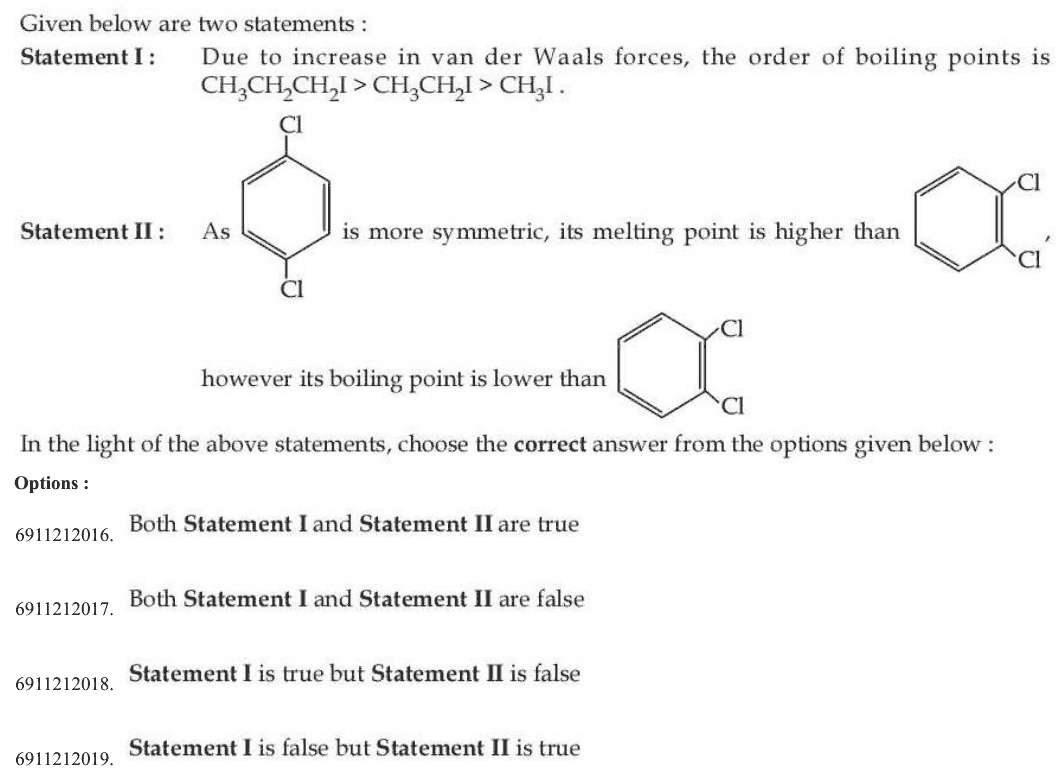
Get EdLoop – freeOpen on the web