Every Ionic Equilibrium question from past JEE Main and AIEEE papers, with options and answers. Newest first.
153questions
120papers covered
2.3%of Chemistry questions, 2019–2026
2002–2026years
Guide at a glance
Ionic equilibrium examines the dissociation and ionization of weak acids, bases, and salts under Unit 6: Equilibrium in the Class 11 curriculum, holding rank 21 among the 31 chemistry chapters with a 2.3 percent share of total chemistry questions.
Given is a concentrated solution of a weak electrolyte $\mathrm{A_xB_y}$ of concentration 'c' and dissociation constant 'K'. The degree of dissociation is given by :
$\mathrm{M_3A_2}$ is a sparingly soluble salt of molar mass $y$ g mol$^{-1}$ and solubility $x$ g L$^{-1}$. The ratio of the molar concentration of the anion ($\mathrm{A^{3-}}$) to the solubility product of the salt is
20 mL of a solution of acetic acid required 28.4 mL of 0.1 M NaOH for its neutralization. A solution (X) was prepared by mixing 20 mL of the above acetic acid and 14.2 mL of 0.1 M NaOH solution. What is the pH of the solution (X)? ($\mathrm{pK_a}$ value of acetic acid is 4.75).
The solubility product constants of $\mathrm{Ag_2CrO_4}$ and AgBr are $32x$ and $4y$ respectively at 298 K. The value of $\left(\frac{\text{molarity of } \mathrm{Ag_2CrO_4}}{\text{molarity of AgBr}}\right)$ can be expressed as :
The first and second ionization constants of a weak dibasic acid $\mathrm{H_2A}$ are $8.1\times10^{-8}$ and $1.0\times10^{-13}$ respectively. 0.1 mol of $\mathrm{H_2A}$ was dissolved in 1L of 0.1 M HCl solution. The concentration of $\mathrm{HA^-}$ in the resultant solution is :
At 25°C, 20.0 mL of 0.2 M weak monoprotic acid HX is titrated against 0.2 M NaOH. The pH of the solution (a) at the start of the titration (when NaOH has not been added) and (b) when 10 mL of NaOH is added respectively, are : Given : $\mathrm{K_a} = 5\times10^{-4}$ $\mathrm{pK_a} = 3.3$ $\alpha \ll 1$
Consider a weak base 'B' of $\mathrm{pK_b} = 5.699$. 'x' mL of 0.02 M HCl and 'y' mL of 0.02 M weak base 'B' are mixed to make 100 mL of a buffer of pH 9 at 25 °C. The values of 'x' and 'y' respectively are:
An aqueous solution of HCl with pH 1.0 is diluted by adding equal volume of water (ignoring dissociation of water). The pH of HCl solution would (Given $\log 2 = 0.30$ )
If equal volumes of $AB_2$ and XY (both are salts) aqueous solutions are mixed, which of the following combination will give a precipitate of $AY_2$ at 300 K ?
Which of the following happens when $\mathrm{NH_4OH}$ is added gradually to the solution containing 1 M $\mathrm{A^{2+}}$ and $1\mathrm{MB^{3+}}$ ions? Given : $\mathrm{K_{sp}}\ [\mathrm{A(OH)_2}] = 9 \times 10^{-10}$ and $\mathrm{K_{sp}}\ [\mathrm{B(OH)_3}] = 27 \times 10^{-18}$ at 298 K .
A
Both $\mathrm{A(OH)_2}$ and $\mathrm{B(OH)_3}$ do not show precipitation with $\mathrm{NH_4OH}$
B
$\mathrm{A(OH)_2}$ will precipitate before $\mathrm{B(OH)_3}$
C
$\mathrm{B(OH)_3}$ will precipitate before $\mathrm{A(OH)_2}$
D
$\mathrm{A(OH)_2}$ and $\mathrm{B(OH)_3}$ will precipitate together
The molar solubility(s) of zirconium phosphate with molecular formula $\left(\mathrm{Zr^{4+}}\right)_3\left(\mathrm{PO_4^{3-}}\right)_4$ is given by relation :
For a sparingly soluble salt $\mathrm{AB_2}$, the equilibrium concentrations of $\mathrm{A^{2+}}$ ions and $B^{-}$ ions are $1.2 \times 10^{-4}$M and $0.24 \times 10^{-3}$M, respectively. The solubility product of $\mathrm{AB_2}$ is :
Given below are two statements : Statement (I) : A Buffer solution is the mixture of a salt and an acid or a base mixed in any particular quantities. Statement (II) : Blood is naturally occurring buffer solution whose pH is maintained by $\mathrm{H_2CO_3/HCO_3^{-}}$ $\ominus$ concentrations. In the light of the above statements, choose the correct answer from the options given below :
Given below are two statements : Statement I : On passing $\mathrm{HCl_{(g)}}$ through a saturated solution of $\mathrm{BaCl_2}$, at room temperature white turbidity appears. Statement II : When HCl gas is passed through a saturated solution of NaCl, sodium chloride is precipitated due to common ion effect. In the light of the above statements, choose the most appropriate answer from the options given below :
A
Both Statement I and Statement II are correct
B
Statement I is correct but Statement II is incorrect
C
Both Statement I and Statement II are incorrect
D
Statement I is incorrect but Statement II is correct
Statement (I) : Aqueous solution of ammonium carbonate is basic.
Statement (II) : Acidic/basic nature of salt solution of a salt of weak acid and weak base depends on $K_a$ and $K_b$ value of acid and the base forming it.
In the light of the above statements, choose the most appropriate answer from the options given below :
A
Both Statement I and Statement II are correct
B
Statement I is correct but Statement II is incorrect
C
Both Statement I and Statement II are incorrect
D
Statement I is incorrect but Statement II is correct
Which of the following statement(s) is/are correct? (A) The pH of $1 \times 10^{-8}$ M HCl solution is 8. (B) The conjugate base of $\mathrm{H_2\,PO_4^{-}}$ is $\mathrm{HPO_4^{2-}}$. (C) $\mathrm{K_w}$ increases with increase in temperature. (D) When a solution of a weak monoprotic acid is titrated against a strong base at half neutralisation point, $\mathrm{pH} = \frac{1}{2}\mathrm{pK_a}$. Choose the correct answer from the options given below:
25 mL of silver nitrate solution $(1\mathrm{M})$ is added dropwise to 25 mL of potassium iodide solution $(1.05\ \mathrm{M})$ solution. The ion(s) present in very small quantity in the solution is/are
For a concentrated solution of a weak electrolyte ($\mathrm{K_{eq}}$ = equilibrium constant) $\mathrm{A_2B_3}$ of concentration 'C', the degree of dissociation '$\alpha$' is
A compound 'X' is a weak acid and it exhibits colour change at pH close to the equivalence point during neutralization of NaOH with $\mathrm{CH_3COOH}$. Compound 'X' exists in ionized form in basic medium. The compound 'X' is
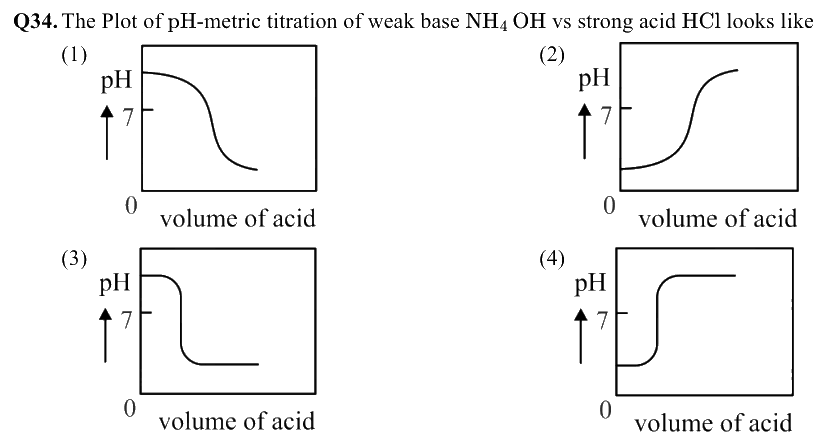
The Plot of pH-metric titration of weak base $\mathrm{NH_4\ OH}$ vs strong acid HCl looks like (see the figure above)
The question as printed in the paper.
A
see figure Plot of pH (vertical axis, with the mark 7 and an upward arrow) against volume of acid: starts at a high pH (above 7) and falls smoothly in an S-shaped curve to a low pH (below 7).
B
see figure Plot of pH against volume of acid: starts at a low pH (below 7) and rises in an S-shaped curve to a high pH (above 7).
C
see figure Plot of pH against volume of acid: starts at a high pH (above 7) as a flat line, then drops almost vertically to a low pH (below 7) and continues flat.
D
see figure Plot of pH against volume of acid: starts at a low pH (below 7) as a flat line, then rises almost vertically to a high pH (above 7) and continues flat.
Class XII students were asked to prepare one litre of buffer solution of pH $8.26$ by their chemistry teacher. The amount of ammonium chloride to be dissolved by the student in $0.2$M ammonia solution to make one litre of the buffer is (Given $\mathrm{pK_b NH_3} = 4.74$; Molar mass of $\mathrm{NH_3} = 17\ \mathrm{g\ mol^{-1}}$. Molar mass of $\mathrm{NH_4Cl} = 53.5\ \mathrm{g\ mol^{-1}}$)
Given below are two statements: one is labelled as Assertion A and the other is labelled as Reason R. Assertion A :Phenolphthalein is a pH dependent indicator, remains colourless in acidic solution and gives pink colour in basic medium Reason R : Phenolphthalein is a weak acid. It doesn't dissociate in basic medium. In the light of the above statements, choose the most appropriate answer from the options given below
A
Both A and R are true and R is the correct explanation of A
B
Both A and R are true but R is NOT the correct explanation of A.
20 mL of $0.1$M $\mathrm{NH_4OH}$ is mixed with 40 mL of $0.05$ M HCl. The pH of the mixture is nearest to: (Given: $\mathrm{K_b NH_4OH} = 1\times10^{-5}$, $\log2 = 0.30$, $\log3 = 0.48$, $\log5 = 0.69$, $\log7 = 0.84$, $\log11 = 1.04$)
$\mathrm{K_{a_1}}$, $\mathrm{K_{a_2}}$ and $\mathrm{K_{a_3}}$ are the respective ionization constants for the following reactions (a), (b) and (c). (a) $\mathrm{H_2C_2O_4 \rightleftharpoons H^+ + HC_2O_4^-}$ (b) $\mathrm{HC_2O_4^- \rightleftharpoons H^+ + C_2O_4^{2-}}$ (c) $\mathrm{H_2C_2O_4 \rightleftharpoons 2H^+ + C_2O_4^{2-}}$ The relationship between $\mathrm{K_{a_1}}$, $\mathrm{K_{a_2}}$ and $\mathrm{K_{a_3}}$ is given as
A student needs to prepare a buffer solution of propanoic acid and its sodium salt with pH 4. The ratio of $\frac{[\mathrm{CH_3\,CH_2\,COO^{-}}]}{[\mathrm{CH_3\,CH_2\,COOH}]}$ required to make buffer is Given : $\mathrm{K_a(CH_3\,CH_2\,COOH)} = 1.3 \times 10^{-5}$
The $\mathrm{K_{sp}}$ for bismuth sulphide $\mathrm{Bi_2S_3}$ is $1.08 \times 10^{-73}$. The solubility of $\mathrm{Bi_2S_3}$ in $\mathrm{molL^{-1}}$ at $298 \mathrm{~K}$ is
Assertion: The amphoteric behaviour of water is explained by Lewis acid base theory Reason: water acts as acid with $\mathrm{NH_3}$ and base with $\mathrm{H_2S}$
A
Both Assertion and Reason are true and Reason is the correct explanation of Assertion.
B
Both Assertion and Reason are true but Reason is NOT the correct explanation of Assertion.
Given below are two statements: Statement I : In the titration between strong acid and weak base methyl orange is suitable as an indicator. Statement II : For titration of acetic acid with $\mathrm{NaOH}$ phenolphthalein is not a suitable indicator. In the light of the above statements, choose the most appropriate answer from the options given below:
A solution is $0.1\mathrm{M}$ in $\mathrm{Cl^-}$ and $0.001\mathrm{M}$ in $\mathrm{CrO_4^{2-}}$. Solid $\mathrm{AgNO_3}$ is gradually added to it Assuming that the addition does not change in volume and $\mathrm{K_{sp}(AgCl)} = 1.7 \times 10^{-10}\mathrm{M^2}$ and $\mathrm{K_{sp}(Ag_2\,CrO_4)} = 1.9 \times 10^{-12}\mathrm{M^3}$. Select correct statement from the following:
A
$\mathrm{AgCl}$ precipitates first because its $\mathrm{K_{sp}}$ is high.
B
$\mathrm{Ag_2\,CrO_4}$ precipitates first as its $\mathrm{K_{sp}}$ is low.
C
$\mathrm{Ag_2\,CrO_4}$ precipitates first because the amount of $\mathrm{Ag^+}$ needed is low.
D
$\mathrm{AgCl}$ will precipitate first as the amount of $\mathrm{Ag^+}$ needed to precipitate is low.
The solubility of AgCN in a buffer solution of pH = 3 is x. The value of x is: [Assume : No cyano complex is formed ; $\mathrm{K_{sp}(AgCN)} = 2.2 \times 10^{-16}$ and $\mathrm{K_a(HCN)} = 6.2 \times 10^{-10}$]
Arrange the following solutions in the decreasing order of pOH : (A) $0.01\ \mathrm{M\,HCl}$ (B) $0.01\ \mathrm{M\,NaOH}$ (C) $0.01\ \mathrm{M\,CH_3\,COONa}$ (D) $0.01\ \mathrm{M\,NaCl}$
For the following Assertion and Reason, the correct option is Assertion (A) : When Cu (II) and sulphide ions are mixed, they react together extremely quickly to give a solid. Reason (R) : The equilibrium constant of $\mathrm{Cu}^{2+}(\mathrm{aq}) + \mathrm{S}^{2-}(\mathrm{aq}) \rightleftharpoons \mathrm{Cus}(\mathrm{s})$ is high because the solubility product is low.
A
(A) is false and (R) is true.
B
Both (A) and (R) are false.
C
Both (A) and (R) are true but (R) is not the explanation for (A).
D
Both (A) and (R) are true and (R) is the explanation for (A).
The $\mathrm{K_{sp}}$ for the following dissociation is $1.6 \times 10^{-5}$ $\mathrm{PbCl_{2(s)} \rightleftharpoons Pb^{2+}_{(aq)} + 2Cl^-_{(aq)}}$ Which of the following choices is correct for a mixture of 300 mL 0.134 M $\mathrm{Pb(NO_3)_2}$ and 100 mL 0.4 M NaCl?
The solubility product of $\mathrm{Cr(OH)_3}$ at 298K is $6.0 \times 10^{-31}$. The concentration of hydroxide ions in a saturated solution of $\mathrm{Cr(OH)_3}$ will be
For the following Assertion and Reason, the correct option is: Assertion: The pH of water increases with increase in temperature. Reason: The dissociation of water into $\mathrm{H^+}$ and $\mathrm{OH^-}$ is an exothermic reaction.
A
Both assertion and reason are true, and the reason is the correct explanation for the assertion.
B
Both assertion and reason are false.
C
Both assertion and reason are true, but the reason is not the correct explanation for the assertion.
The molar solubility of $\mathrm{Cd(OH)_2}$ is $1.84 \times 10^{-5}\mathrm{M}$ in water. The expectes solunility of $\mathrm{Cd(OH)_2}$ in a buffer solution of $\mathrm{pH} = 12$ is:
Consider the following statements (a) The pH of a mixture containing 400 mL of 0.1 M $\mathrm{H_2SO_4}$ and 400 mL of 0.1 M NaOH will be approximately 1.3. (b) Ionic product of water is temperature dependent. (c) A monobasic acid with $K_a = 10^{-5}$ has a pH = 5 . The degree of dissociation of this acid is 50% . (d) The Le Chatelier's principle is not applicable to common-ion effect. The correct statements are:
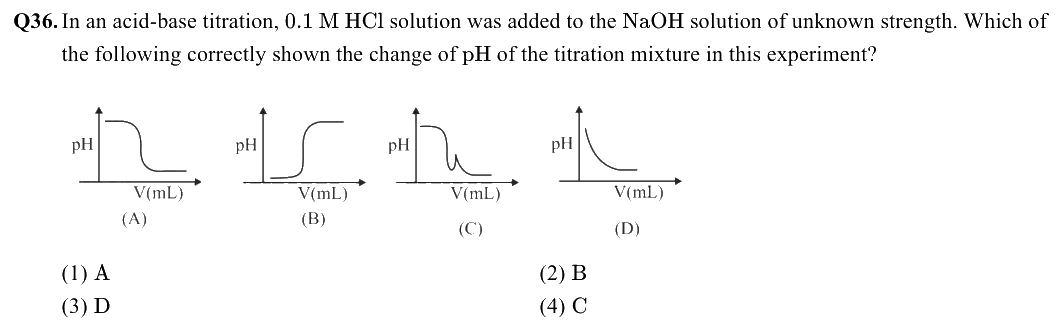
In an acid-base titration, 0.1 M HCl solution was added to the NaOH solution of unknown strength. Which of the following correctly shown the change of pH of the titration mixture in this experiment? (see the figure above)
If solubility product of $\mathrm{Zr_3(PO_4)_4}$ is denoted by $\mathrm{K_{sp}}$ and its molar solubility is denoted by S , then which of the following relation between S and $\mathrm{K_{sp}}$ is correct?
$20\ \mathrm{ml}$ of $0.1\ \mathrm{M\ H_2SO_4}$ solution is added to $30\ \mathrm{mL}$ of $0.2\ \mathrm{M\ NH_4OH}$ solution. The pH of the resultant mixture is: $\mathrm{pk_b}$ of $\mathrm{NH_4OH} = 4.7$
The minimum volume of water required to dissolve $0.1\ \mathrm{g}$ lead (II) chloride to get a saturated solution ($K_{\mathrm{SP}}$ of $\mathrm{PbCl_2} = 3.2 \times 10^{-8}$; atomic mass of Pb $= 207\ \mathrm{u}$) is :
Following four solutions are prepared by mixing different volumes of NaOH and HCl of different concentrations, pH of which one of them will be equal to 1 ?
An aqueous solution contains $0.10\ \mathrm{M\ H_2S}$ and $0.20\ \mathrm{M\ HCl}$. If the equilibrium constant for the formation of $\mathrm{HS^{-}}$ from $\mathrm{H_2S}$ is $1.0 \times 10^{-7}$ and that of $\mathrm{S^{2-}}$ from $\mathrm{HS^{-}}$ ions is $1.2 \times 10^{-13}$, then, the concentration of $\mathrm{S^{2-}}$ ions in the aqueous solution is:
An aqueous solution contains an unknown concentration of $\mathrm{Ba^{2+}}$. When $50\ \mathrm{mL}$ of a $1\ \mathrm{M}$ solution of $\mathrm{Na_2\,SO_4}$ is added, $\mathrm{BaSO_4}$ just begins to precipitate. The final volume is $500\ \mathrm{mL}$. The solubility product of $\mathrm{BaSO_4}$ is $1 \times 10^{-10}$. What is the original concentration of $\mathrm{Ba^{2+}}$?
Addition of sodium hydroxide solution to a weak acid (HA) results in a buffer of pH 6. If ionization constant of HA is $10^{-5}$, the ratio of salt to acid concentration in the buffer solution will be:
$\mathrm{pK_a}$ of a weak acid HA and $\mathrm{pK_b}$ of a weak base BOH are $3.2$ and $3.4$ respectively. The pH of their salt AB solution at $25^\circ\mathrm{C}$ is
Zirconium phosphate $[\mathrm{Zr_3(PO_4)_4}]$ dissociates into three zirconium cations of charge $+4$ and four phosphate anions of charge $-3$. If molar solubility of zirconium phosphate is denoted by s and its solubility product by $\mathrm{K_{sp}}$ then which of the following relationship between s and $\mathrm{K_{sp}}$ is correct ?
In some solutions, the concentration of $\mathrm{H_3O^+}$ remains constant even when small amounts of strong acid or strong base are added to them. These solutions are known as:
What would be the pH of a solution obtained by mixing 5 g of acetic acid and 7.5 g of sodium acetate and making the volume equal to 500 mL ? ( $\mathrm{K_a}$ = 1.75 $\times$ $10^{-5}$, $\mathrm{pK_a}$ = 4.76)
Values of dissociation constant, $K_a$ are given as follows : Acid : $K_a$ HCN : $6.2 \times 10^{-10}$ HF : $7.2 \times 10^{-4}$ $\mathrm{HNO_2}$ : $4.0 \times 10^{-4}$ Correct order of increasing base strength of the base $\mathrm{CN^{-}}$, $\mathrm{F^{-}}$ and $\mathrm{NO_2^{-}}$ will be :
Solid $\mathrm{Ba(NO_3)_2}$ is gradually dissolved in a $1.0 \times 10^{-4}$ M $\mathrm{Na_2CO_3}$ solution. At which concentration of $\mathrm{Ba^{2+}}$, precipitate of $\mathrm{BaCO_3}$ begins to form ? ($K_{sp}$ for $\mathrm{BaCO_3} = 5.1 \times 10^{-9}$)
The solubility of $\mathrm{PbI_2}$ at $25^{\circ}\mathrm{C}$ is 0.7 g $\mathrm{L^{-1}}$. The solubility product of $\mathrm{PbI_2}$ at this temperature is (molar mass of $\mathrm{PbI_2}$ = 461.2 g $\mathrm{mol^{-1}}$ )
If $K_{sp}$ of $\mathrm{CaF_2}$ at $25^\circ\mathrm{C}$ is $1.7 \times 10^{-10}$, the combination amongst the following which gives a precipitate of $\mathrm{CaF_2}$ is
A
$1 \times 10^{-2}\mathrm{MCa^{2+}}$ and $1 \times 10^{-3}\mathrm{MF^-}$
B
$1 \times 10^{-4}\mathrm{MCa^{2+}}$ and $1 \times 10^{-4}\mathrm{MF^-}$
C
$1 \times 10^{-2}\mathrm{MCa^{2+}}$ and $1 \times 10^{-5}\mathrm{MF^-}$
D
$1 \times 10^{-3}\mathrm{MCa^{2+}}$ and $1 \times 10^{-5}\mathrm{MF^-}$
Given (i) $\mathrm{HCN}(aq) + \mathrm{H_2O}(l) \rightleftharpoons \mathrm{H_3O^+}(aq) + \mathrm{CN^-}(aq)\ K_\mathrm{a} = 6.2 \times 10^{-10}$ (ii) $\mathrm{CN^-}(aq) + \mathrm{H_2O}(\mathrm{l}) \rightleftharpoons \mathrm{HCN}(aq) + \mathrm{OH^-}(aq)\ K_\mathrm{b} = 1.6 \times 10^{-5}$. These equilibria show the following order of the relative base strength,
In aqueous solution the ionization constants for carbonic acid are $\mathrm{K_1} = 4.2 \times 10^{-7}$ and $\mathrm{K_2} = 4.8 \times 10^{-11}$. Select the correct statement for a saturated 0.034M solution of the carbonic acid.
A
The concentration of $\mathrm{CO_3^{2-}}$ is 0.034M.
B
The concentration of $\mathrm{CO_3^{2-}}$ is greater than that of $\mathrm{HCO_3^{-}}$.
C
The concentration of $\mathrm{H^{+}}$ and $\mathrm{HCO_3^{-}}$ are approximately equal.
D
The concentration of $\mathrm{H^{+}}$ is double that of $\mathrm{CO_3^{2-}}$.
Solubility product of silver bromide is $5.0 \times 10^{-13}$. The quantity of potassium bromide (molar mass taken as 120 g mol$^{-1}$) to be added to 1 litre of 0.05 M solution of silver nitrate to start the precipitation of AgBr is
At $25°\mathrm{C}$, the solubility product of $\mathrm{Mg(OH)_2}$ is $1.0 \times 10^{-11}$. At which pH, will $\mathrm{Mg^{2+}}$ ions start precipitating in the form of $\mathrm{Mg(OH)_2}$ from a solution of $0.001\mathrm{M}\ \mathrm{Mg^{2+}}$ ions ?
Three reactions involving $\mathrm{H_2PO_4^{-}}$ are given below : (i) $\mathrm{H_3PO_4 + H_2O \rightarrow H_3O^{+} + H_2PO_4^{-}}$ (ii) $\mathrm{H_2PO_4^{-} + H_2O \rightarrow HPO_4^{2-} + H_3O^{+}}$ (iii) $\mathrm{H_2PO_4^{-} + OH^{-} \rightarrow H_3PO_4 + O^{2-}}$ In which of the above does $\mathrm{H_2PO_4^{-}}$ act as an acid ?
Solid Ba $\mathrm{(NO_3)_2}$ is gradually dissolved in a $1.0 \times 10^{-4}\ \mathrm{M\,Na_2CO_3}$ solution. At what concentration of $\mathrm{Ba^{2+}}$ will a precipitate begin to form ? ($\mathrm{K_{sp}}$ for $\mathrm{BaCO_3} = 5.1 \times 10^{-9}$).
Four species are listed below i. $\mathrm{HCO_3^{-}}$ ii. $\mathrm{H_3O^{+}}$ iii. $\mathrm{HSO_4^{-}}$ iv. $\mathrm{HSO_3\,F}$ Which one of the following is the correct sequence of their acid strength?
The $\mathrm{pK_a}$ of a weak acid, HA, is 4.80. The $\mathrm{pK_b}$ of a weak base, BOH, is 4.78. The pH of an aqueous solution of the corresponding salt, BA, will be
In a sautrated solution of the sparingly soluble strong electrolyte $\mathrm{AgIO_3}$ (Molecular mass = 283) the equilibrium which sets in is $\mathrm{AgIO_{3(s)} \rightleftharpoons Ag^+_{(aq)} + IO^-_{3(aq)}}$ If the solubility product constant $\mathrm{K_{sp}}$ of $\mathrm{AgIO_3}$ at a given temperature is $1.0 \times 10^{-8}$, what is the mass of $\mathrm{AgIO_3}$ contained in 100 ml of its saturated solution?
The first and second dissociation constants of an acid $\mathrm{H_2A}$ are $1.0 \times 10^{-5}$ and $5.0 \times 10^{-10}$ respectively. The overall dissociation constant of the acid will be
The solubility product of a salt having general formula $MX_2$, in water is: $4 \times 10^{-12}$. The concentration of $\mathrm{M^{2+}}$ ions in the aqueous solution of the salt is
The molar solubility (in mol L$^{-1}$) of a sparingly soluble salt $\mathrm{MX_4}$ is ' s '. The corresponding solubility product is $\mathrm{K_{sp}}$. ' s ' is given in terms of $\mathrm{K_{sp}}$ by the relation
The pH of a solution obtained by mixing 5 mL of 0.1 M $\mathrm{NH_4OH}$ solution with 250 mL of 0.1 M $\mathrm{NH_4Cl}$ solution is ________ $\times10^{-2}$. (Nearest integer) Given: $\mathrm{pK_b}$ ($\mathrm{NH_4OH}$) = 4.74
$\log 2 = 0.30$
$\log 3 = 0.48$
$\log 5 = 0.70$
Numerical answer type: type your answer in EdLoop to check it
Consider two Group IV metal ions $\mathrm{X^{2+}}$ and $\mathrm{Y^{2+}}$.
A solution containing 0.01 M $\mathrm{X^{2+}}$ and 0.01 M $\mathrm{Y^{2+}}$ is saturated with $\mathrm{H_2S}$. The pH at which the metal sulphide YS will form as a precipitate is ________. (Nearest integer)
The first and second ionization constants of $\mathrm{H_2X}$ are $2.5\times10^{-8}$ and $1.0\times10^{-13}$ respectively. The concentration of $\mathrm{X^{2-}}$ in 0.1 M $\mathrm{H_2X}$ solution is ________ $\times10^{-15}$ M. (Nearest Integer)
Numerical answer type: type your answer in EdLoop to check it
One litre buffer solution was prepared by adding 0.10 mol each of $NH_3$ and $NH_4Cl$ in deionised water. The change in pH on addition of 0.05 mol of HCl to the above solution is ______ $\times 10^{-2}$. (Nearest integer)
Given : $pK_b$ of $NH_3 = 4.745$ and $\log_{10}3 = 0.477$
Numerical answer type: type your answer in EdLoop to check it
The pH of a 0.01 M weak acid $HX\left(K_a = 4 \times 10^{-10}\right)$ is found to be 5. Now the acid solution is diluted with excess of water so that the pH of the solution changes to 6. The new concentration of the diluted weak acid is given as $x \times 10^{-4}M$. The value of $x$ is ______ (nearest integer)
Numerical answer type: type your answer in EdLoop to check it
$x$ mg of $Mg(OH)_2$ ( molar mass $= 58$) is required to be dissolved in 1.0 L of water to produce a pH of 10.0 at 298 K . The value of $x$ is ______ mg. (Nearest integer)
(Given : $Mg(OH)_2$ is assumed to dissociate completely in $H_2O$ ]
Numerical answer type: type your answer in EdLoop to check it
If 1 mM solution of ethylamine produces pH = 9, then the ionization constant ($\mathrm{K_b}$) of ethylamine is $10^{-x}$. The value of $x$ is ______ (nearest integer). [The degree of ionization of ethylamine can be neglected with respect to unity.]
Numerical answer type: type your answer in EdLoop to check it
$\mathrm{K_a}$ for $\mathrm{CH_3COOH}$ is $1.8 \times 10^{-5}$ and $\mathrm{K_b}$ for $\mathrm{NH_4OH}$ is $1.8 \times 10^{-5}$. The pH of ammonium acetate solution will be
Numerical answer type: type your answer in EdLoop to check it
The pH at which $\mathrm{Mg(OH)_2}\left[\mathrm{K_{sp}} = 1 \times 10^{-11}\right]$ begins to precipitate from a solution containing 0. 10M $\mathrm{Mg^{2+}}$ ions is ______.
Numerical answer type: type your answer in EdLoop to check it
The pH of an aqueous solution containing 1M benzoic acid $\mathrm{p}K_a$ = 4.20 and 1M sodium benzoate is 4.5. The volume of benzoic acid solution in 300 mL of this buffer solution is ______ mL.
Numerical answer type: type your answer in EdLoop to check it
25.0 mL of 0.050 M $\mathrm{Ba(NO_3)_2}$ is mixed with 25.0 mL of 0.020 M NaF. $K_{sp}$ of $\mathrm{BaF_2}$ is $0.5 \times 10^{-6}$ at 298K. The ratio of $\left[\mathrm{Ba^{2+}}\right]\left[\mathrm{F^{-}}\right]^{2}$ and $K_{sp}$ is ______.
Numerical answer type: type your answer in EdLoop to check it
20 mL of 0.1MNaOH is added to 50 mL of 0.1M acetic acid solution. The pH of the resulting solution is $\times 10^{-2}$. (Nearest integer) Given : $\mathrm{pKa\,CH_3COOH}$ = 4.76 $\log 2$ = 0.30 $\log 3$ = 0.48
Numerical answer type: type your answer in EdLoop to check it
An analyst wants to convert 1 L HCl of pH = 1 to a solution of HCl of pH = 2. The volume of water needed to do this dilution is ______ mL. (Nearest integer)
Numerical answer type: type your answer in EdLoop to check it
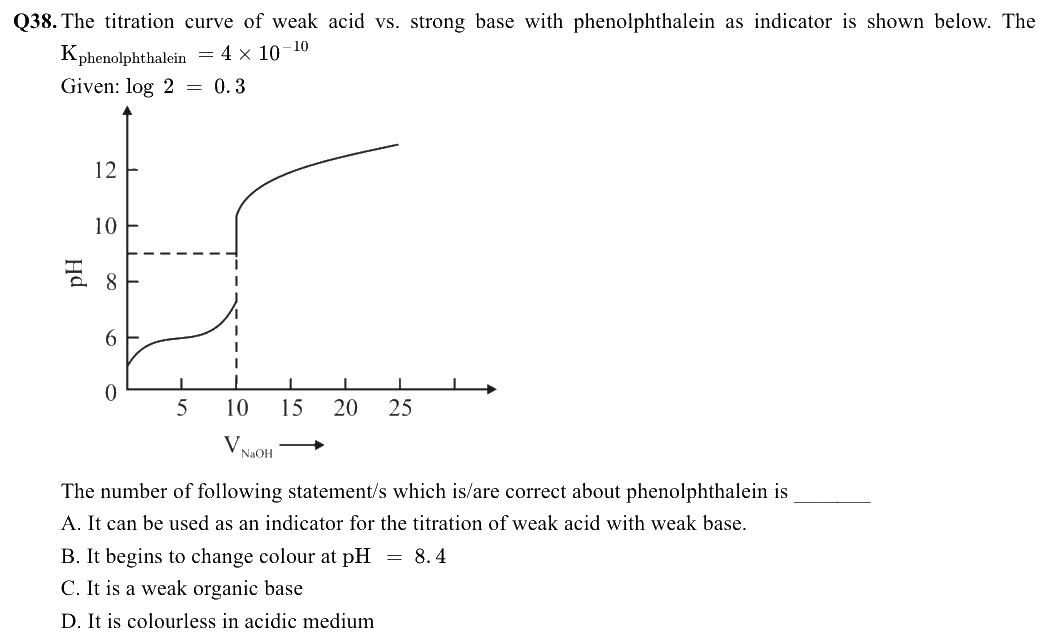
The titration curve of weak acid vs. strong base with phenolphthalein as indicator is shown below. $\mathrm{K_{phenolphthalein}} = 4 \times 10^{-10}$ Given: $\log 2 = 0.3$ (see the figure above) The number of following statement/s which is/are correct about phenolphthalein is ______ A. It can be used as an indicator for the titration of weak acid with weak base. B. It begins to change colour at $\mathrm{pH} = 8.4$ C. It is a weak organic base D. It is colourless in acidic medium
The question as printed in the paper.
Numerical answer type: type your answer in EdLoop to check it
The solubility product of $\mathrm{BaSO_4}$ is $1 \times 10^{-10}$ at 298 K. The solubility of $\mathrm{BaSO_4}$ in 0.1M $\mathrm{K_2SO_4(aq)}$ solution is ______ $\times 10^{-9}\ \mathrm{g\ L^{-1}}$ (nearest integer).
Given: Molar mass of $\mathrm{BaSO_4}$ is $233\ \mathrm{g\ mol^{-1}}$
Numerical answer type: type your answer in EdLoop to check it
At 298 K, the solubility of silver chloride in water is $1.434 \times 10^{-3}$ g L$^{-1}$. The value of $-\log \mathrm{K_{sp}}$ for silver chloride is (Given mass of Ag is 107.9 g mol$^{-1}$, and mass of Cl is 35.5 g mol$^{-1}$)
Numerical answer type: type your answer in EdLoop to check it
600 mL of 0.01 M HCl is mixed with 400 mL of 0.01 M $\mathrm{H_2SO_4}$. The pH of the mixture is ______ $\times 10^{-2}$. (Nearest integer) [Given log2 = 0.30, log3 = 0.48, log5 = 0.69, log7 = 0.84, log11 = 1.04]
Numerical answer type: type your answer in EdLoop to check it
Millimoles of calcium hydroxyide required to produce $100\ \mathrm{mL}$ of the aqueous solution of pH $12$ is $x \times 10^{-1}$. The value of $x$ is ______ (Nearest integer). Assume complete dissociation.
Numerical answer type: type your answer in EdLoop to check it
A litre of buffer solution contains 0.1 mole of each of $\mathrm{NH_3}$ and $\mathrm{NH_4Cl}$. On the addition of 0.02 mole of HCl by dissolving gaseous HCl, the pH of the solution is found to be ______ $\times 10^{-3}$ (Nearest integer) Given: $\mathrm{pK_b(NH_3)} = 4.745$ $\log 2 = 0.301$ $\log 3 = 0.477$ $T = 298$ K]
Numerical answer type: type your answer in EdLoop to check it
The dissociation constant of acetic is x $\times$ $10^{-5}$. When 25 mL of 0.2 M $\mathrm{CH_3COONa}$ solution is mixed with 25 mL of 0.02 M $\mathrm{CH_3COOH}$ solution, the pH of the resultant solution is found to be equal to 5. The value of x is ______.
Numerical answer type: type your answer in EdLoop to check it
If the solubility product of PbS is $8 \times 10^{-28}$, then the solubility of PbS in pure water at 298 K is $\mathrm{x} \times 10^{-16}\ \mathrm{mol\ L^{-1}}$. The value of x is ______ (Nearest integer) [Given $\sqrt{2} = 1.41$]
Numerical answer type: type your answer in EdLoop to check it
$\mathrm{K_a}$ for butyric acid $\mathrm{C_3H_7COOH}$ is $2\times10^{-5}$. ThepH of $0.2\mathrm{M}$ solution of butyric acid is ______ $\times10^{-1}$. (Nearest integer) [Given log2 $=0.30$]
Numerical answer type: type your answer in EdLoop to check it
At 310 K, the solubility of $\mathrm{CaF_2}$ in water is $2.34 \times 10^{-3}$ g/100 mL. The solubility product of $\mathrm{CaF_2}$ is ______ $\times 10^{-8}$ $(\mathrm{mol\ /L})^3$ (nearest integer). (Given molar mass : $\mathrm{CaF_2}$ = 78 g $\mathrm{mol^{-1}}$)
Numerical answer type: type your answer in EdLoop to check it
$50 \mathrm{~mL}$ of $0.1 \mathrm{~M}$ $\mathrm{CH}_3\mathrm{COOH}$ is being titrated against $0.1 \mathrm{~M}$ NaOH. When $25 \mathrm{~mL}$ of NaOH has been added, the pH of the solution will be ______ $\times 10^{-2}$. (Nearest integer) (Given : $\mathrm{pK}_\mathrm{a}(\mathrm{CH_3COOH}) = 4.76$) $\log 2 = 0.30$ $\log 3 = 0.48$ $\log 5 = 0.69$ $\log 7 = 0.84$ $\log 11 = 1.04$
Numerical answer type: type your answer in EdLoop to check it
The molar solubility of $\mathrm{Zn(OH)_2}$ in $0.1$M NaOH solution is $x \times 10^{-18}$M. The value of x is ______. (Nearest integer) Given : The solubility product of $\mathrm{Zn(OH)_2}$ is $2 \times 10^{-20}$
Numerical answer type: type your answer in EdLoop to check it
$\mathrm{A_3B_2}$ is a sparingly soluble salt of molar mass M(g mol$^{-1}$) and solubility x g L$^{-1}$. The solubility product satisfies $\mathrm{K_{sp}} = \mathrm{a}\left(\frac{x}{M}\right)^5$. The value of a is ______. (Integer answer)
Numerical answer type: type your answer in EdLoop to check it
The pH of a solution obtained by mixing $50$ mL of $1$ M HCl and $30$ mL of $1$ M NaOH is x $\times 10^{-4}$. The value of x is (Nearest integer) $\log 2.5 = 0.3979$
Numerical answer type: type your answer in EdLoop to check it
The $\mathrm{OH^{-}}$ concentration in a mixture of $5.0\ \mathrm{mL}$ of $0.0504\ \mathrm{M}\ \mathrm{NH_4Cl}$ and $2\ \mathrm{mL}$ of $0.0210\ \mathrm{M}\ \mathrm{NH_3}$ solution is $x\times10^{-6}\ \mathrm{M}$. The value of $x$ is (Nearest integer) [Given $K_w=1\times10^{-14}$ and $K_b=1.8\times10^{-5}$]
Numerical answer type: type your answer in EdLoop to check it
Assuming that $\mathrm{Ba(OH)_2}$ is completely ionised in aqueous solution under the given conditions the concentration of $\mathrm{H_3O^+}$ ions in $0.005\mathrm{M}$ aqueous solution of $\mathrm{Ba(OH)_2}$ at $298\ \mathrm{K}$ is ______ $\times 10^{-12}\ \mathrm{mol\ L^{-1}}$. (Nearest integer)
Numerical answer type: type your answer in EdLoop to check it
In order to prepare a buffer solution of pH 5.74, sodium acetate is added to acetic acid. If the concentration of acetic acid in the buffer is $1.0~\mathrm{M}$, the concentration of sodium acetate in the buffer is ______ M. (Round off to the Nearest Integer). [Given : $\mathrm{pKa}$(acetic acid) $= 4.74$]
Numerical answer type: type your answer in EdLoop to check it
The solubility of $\mathrm{CdSO_4}$ in water is $8.0 \times 10^{-4}~\mathrm{mol~L^{-1}}$. Its solubility in $0.01\mathrm{M}$ $\mathrm{H_2\,SO_4}$ solution is ______ $\times 10^{-6}~\mathrm{mol~L^{-1}}$ (Round off to the Nearest integer) (Assume that solubility is much less than $0.01~\mathrm{M}$ )
Numerical answer type: type your answer in EdLoop to check it
0.01 moles of a weak acid HA $\left(\mathrm{K}_{\mathrm{a}}=2.0 \times 10^{-6}\right)$ is dissolved in 1.0 L of 0.1M HCl solution. The degree of dissociation of HA is ______ $\times 10^{-5}$ (Round off to the Nearest Integer). [Neglect volume change on adding HA and assume degree of dissociation $<<1$]
Numerical answer type: type your answer in EdLoop to check it
Two salts $\mathrm{A}_2 \mathrm{X}$ and $\mathrm{MX}$ have the same value of solubility product of $4.0 \times 10^{-12}$. The ratio of their molar solubilizes i.e. $\frac{\mathrm{S}\left(\mathrm{A}_2 \mathrm{X}\right)}{\mathrm{S}(\mathrm{MX})}=$ ______. (Round off to the Nearest Integer).
Numerical answer type: type your answer in EdLoop to check it
Sulphurous acid $(\mathrm{H_2SO_3})$ has $\mathrm{Ka_1} = 1.7 \times 10^{-2}$ and $\mathrm{Ka_2} = 6.4 \times 10^{-8}$. The pH of $0.588\ \mathrm{M}$ $\mathrm{H_2SO_3}$ is ______ (Round off to the Nearest Integer).
Numerical answer type: type your answer in EdLoop to check it
The pH of ammonium phosphate solution, if $\mathrm{pk_a}$ of phosphoric acid and $\mathrm{pk_b}$ of ammonium hydroxide are $5.23$ and $4.75$ respectively, is
Numerical answer type: type your answer in EdLoop to check it
The solubility product of $\mathrm{PbI_2}$ is $8.0 \times 10^{-9}$. The solubility of lead iodide in $0.1$ molar solution of lead nitrate is $x \times 10^{-6}\ \mathrm{mol/L}$. The value of x is ______ (Rounded off to the nearest integer) [Given $\sqrt{2} = 1.41$]
Numerical answer type: type your answer in EdLoop to check it
If the solubility product of $\mathrm{AB_2}$ is $3.20 \times 10^{-11}\ \mathrm{M^3}$, then the solubility of $\mathrm{AB_2}$ in pure water is ______ $\times 10^{-4}\ \mathrm{mol\ L^{-1}}$ [Assuming that neither kind of ion reacts with water]
Numerical answer type: type your answer in EdLoop to check it
A soft drink was bottled with a partial pressure of $\mathrm{CO_2}$ of 3 bar over the liquid at room temperature. The partial pressure of $\mathrm{CO_2}$ over the solution approaches a value of 30 bar when 44 g of $\mathrm{CO_2}$ is dissolved in 1 kg of water at room temperature. The approximate pH of the soft drink is ____________$\times 10^{-1}$. (First dissociation constant of $\mathrm{H_2CO_3}$ = 4. 0 $\times 10^{-7}$; log 2 = 0. 3; density of the soft drink = 1 g mL$^{-1}$)
Numerical answer type: type your answer in EdLoop to check it
Two solutions, A and B, each of $100\mathrm{L}$ was made by dissolving $4\mathrm{g}$ of $\mathrm{NaOH}$ and $9.8\mathrm{g}$ of $\mathrm{H_2SO_4}$ in water, respectively. The pH of the resultant solution obtained from mixing $40\mathrm{L}$ of solution A and $10\mathrm{L}$ of solution B is ______ . $(\log 2 = 0.3)$
Numerical answer type: type your answer in EdLoop to check it
$3\ \mathrm{g}$ of acetic acid is added to $250\ \mathrm{mL}$ of $0.1\ \mathrm{M\ HCl}$ and the solution made up to $500\ \mathrm{mL}$. To $20\ \mathrm{mL}$ of this solution $\frac{1}{2}\mathrm{mL}$ of $5\mathrm{M\ NaOH}$ is added. The pH of the solution is ______ [Given: $\mathrm{pKa}$ of acetic acid $= 4.75$, molar mass of acetic acid $60\ \mathrm{g/mol}$, $\log 3 = 0.4771$ , Neglect any changes in volume]
Numerical answer type: type your answer in EdLoop to check it
Accepted answers: 5.22 or 5.23. · Key from source paper
How to prepare Ionic Equilibrium for JEE Main
How often it comes up
Ionic equilibrium examines the dissociation and ionization of weak acids, bases, and salts under Unit 6: Equilibrium in the Class 11 curriculum, holding rank 21 among the 31 chemistry chapters with a 2.3 percent share of total chemistry questions. In the computer-based testing era spanning 2019 to 2026, candidates answered 103 questions across 162 papers, representing an average rate of 0.6 questions per shift. The chapter featured in 92 of those 162 papers, and questions were asked every single year throughout the cycle. During the recent 2024 to 2026 testing seasons, examiners set 33 questions across 58 papers, maintaining an average of 0.6 questions per shift and a 2.1 percent subject share. The chapter's share is down compared to the 2002 to 2018 window, which recorded 50 questions across 38 papers for a 3.7 percent share. Relative to the complete 2019 to 2026 baseline, the recent share has stayed about the same. Looking specifically at the 2026 exam cycle, 13 questions appeared across 10 different shifts out of 19 papers. A total of 43 questions between 2019 and 2026 were formatted as numerical answer questions, requiring students to calculate pH values, molar solubilities, and precipitation thresholds to exact figures.
Most-asked topics
The question pool spans four core areas of aqueous ionic behavior:
Solubility Equilibria: 53 questions historically, with 37 appearing between 2019 and 2026, tested up to 2026. This dominant area tests solubility product K sp expressions for binary and ternary salts, common ion effects suppressing solubility, selective fractional precipitation of metal sulfides, and comparative molar solubilities.
Acids, Bases & pH: 53 total questions, including 30 from 2019 to 2026, continuing into 2026. Concepts explore Ostwald's dilution law for weak electrolytes, ionization constants K a and K b, polyprotic acid step-wise dissociation, autoionization of water, and pH calculations for strong and weak acid mixtures.
Buffers & Titrations: 36 lifetime problems, with 29 between 2019 and 2026, tested in 2026. Topics evaluate acidic and basic buffer solutions, the Henderson-Hasselbalch equation, buffer capacity, titration neutralization curves, and pH at half-equivalence points.
Salt Hydrolysis: 11 questions overall, including 7 from 2019 to 2026, last asked in 2024. Questions analyze hydrolysis constants K h, degree of hydrolysis, and pH formulas for salts formed from strong acid-weak base, weak acid-strong base, and weak acid-weak base combinations.
What the questions look like
JEE Main problems in ionic equilibrium combine logarithmic acid-base arithmetic with simultaneous equilibria:
Selective precipitation of metal ions: Saturating an aqueous solution containing two divalent cations with hydrogen sulfide gas at controlled pH, calculating the exact hydronium concentration at which precipitation initiates.
Polyprotic acid second ionization concentration: Deducing the equilibrium concentration of the divalent conjugate base X2- from a weak diprotic acid solution using successive ionization constants K1 and K2.
Buffer preparation volumetric proportions: Finding the exact mixing volumes of hydrochloric acid and weak base required to synthesize a buffer possessing a specified alkaline pH.
Salt hydrolysis acidity checks: Determining whether an aqueous solution of an ammonium salt is acidic, neutral, or basic by comparing acid dissociation and base dissociation constants.
Master the Henderson-Hasselbalch equations for both acidic and basic buffers. For an acidic buffer, pH equals pKa plus log of salt over acid. For a basic buffer, pOH equals pKb plus log of salt over base, followed by subtracting from fourteen to obtain pH at twenty-five degrees Celsius.
For solubility equilibria, write the dissociation equation clearly and identify stoichiometric powers. For a general salt A x B y, solubility product K sp equals x to the power x multiplied by y to the power y multiplied by molar solubility s raised to the power x plus y. In the presence of a common ion, treat the common ion concentration as fixed by the fully dissociated strong electrolyte.
In weak diprotic acid solutions, understand that the concentration of the second dissociated anion X2- is approximately equal to K2, independent of the initial acid concentration, because primary ionization completely suppresses secondary dissociation.
Frequently asked questions
Which topic in ionic equilibrium carries the highest weight in JEE Main?
Solubility equilibria and acid-base pH calculations together account for over sixty percent of all modern questions. Mastering K sp calculations, common ion suppression, and weak acid pH formulas provides the strongest foundation.
What is the most common student pitfall in pH calculations?
Neglecting the contribution of water autoionization when calculating the pH of extremely dilute strong acid solutions, or misapplying Henderson-Hasselbalch equations by substituting pKb directly into a pH expression instead of calculating pOH first.
How does common ion effect influence solubility?
Adding a soluble salt containing a common ion shifts the dissolution equilibrium backward according to Le Chatelier's principle, drastically lowering the molar solubility of the sparingly soluble precipitate without altering its K sp value. Step-by-step solutions for each one are in the EdLoop app.