Every Chemical Equilibrium question from past JEE Main and AIEEE papers, with options and answers. Newest first.
124questions
105papers covered
1.8%of Chemistry questions, 2019–2026
2002–2026years
Guide at a glance
Chemical equilibrium investigates reversible reactions and equilibrium constants under Unit 6: Equilibrium in the Class 11 curriculum, holding rank 27 among 31 chemistry chapters with a 1.8 percent share of total chemistry questions.
One mole each of He and A(g) are taken in a 10 L closed flask and heated to 400 K to establish the following equilibrium.
A(g) $\rightleftharpoons$ B (g)
$\mathrm{K_c}$ for this reaction at 400 K is 4.0. The partial pressures (in atm) of He and B(g) are respectively (at equilibrium) (Assume He, A(g) and B(g) behave as ideal gases) (Given : R = 0.082 L atm K$^{-1}$ mol$^{-1}$)
The reaction $\mathrm{A(g) \rightleftharpoons B(g) + C(g)}$ was initiated with the amount 'a' of A(g). At equilibrium it is found that the amount of A(g) remaining is $(a - x)$ at a total pressure of p.
The equilibrium constant Kp of the reaction can be calculated from the expression :
At T(K), the equilibrium constant of $\mathrm{A_2(g) + B_2(g) \rightleftharpoons C(g)}$ is $2.7\times10^{-5}$. What is the equilibrium constant for $\frac{1}{3}\mathrm{A_2(g)} + \frac{1}{3}\mathrm{B_2(g)} \rightleftharpoons \frac{1}{3}\mathrm{C(g)}$ at the same temperature?
The plot of $\log_{10}\mathrm{K}$ vs $\dfrac{1}{\mathrm{T}}$ gives a straight line. The intercept and slope respectively are (where K is equilibrium constant).
At T(K), the equilibrium concentrations of A and B are 0.5 M and 0.375 M respectively. 0.1 moles of A is added into the flask and heated to T(K) to establish the equilibrium again. The new equilibrium concentrations (in M) of A and B are respectively
2 moles each of $\mathrm{P_2(g)}$, $\mathrm{Q_2(g)}$ and PQ(g) are present at equilibrium. Now one mole each of 'P$_2$' and 'Q$_2$' are added to the equilibrium keeping the temperature at T(K). The number of moles of $\mathrm{P_2}$, $\mathrm{Q_2}$ and PQ at the new equilibrium, respectively, are
In the following system, $PCl_5(g) \rightleftharpoons PCl_3(g) + Cl_2(g)$ at equilibrium, upon addition of xenon gas at constant T & p, the concentration of
Consider the following chemical equilibrium of the gas phase reaction at a constant temperature :
$A(g) \rightarrow B(g) + C(g)$
If $p$ being the total pressure, $K_p$ is the pressure equilibrium constant and $\alpha$ is the degree of dissociation, then which of the following is true at equilibrium?
A
When p increases $\alpha$ increases
B
If p value is extremely high compared to $K_p, \alpha \approx 1$
C
When p increases $\alpha$ decreases
D
If $K_p$ value is extremely high compared to $p, \alpha$ becomes much less than unity
At temperature T, compound $\mathrm{AB_{2(\,g)}}$ dissociates as $\mathrm{AB_{2(\,g)} \rightleftharpoons AB_{(g)} + \frac{1}{2}\,B_{2(\,g)}}$ having degree of dissociation $x$ (small compared to unity). The correct expression for $x$ in terms of $\mathrm{K_p}$ and p is
Consider the equilibrium $\mathrm{CO(\,g) + 3H_2(\,g) \rightleftharpoons CH_4(\,g) + H_2O(\,g)}$ If the pressure applied over the system increases by two fold at constant temperature then (A) Concentration of reactants and products increases. (B) Equilibrium will shift in forward direction. (C) Equilibrium constant increases since concentration of products increases. (D) Equilibrium constant remains unchanged as concentration of reactants and products remain same. Choose the correct answer from the options given below :
Ice and water are placed in a closed container at a pressure of 1 atm and temperature 273.15 K . If pressure of the system is increased 2 times, keeping temperature constant, then identify correct observation from following
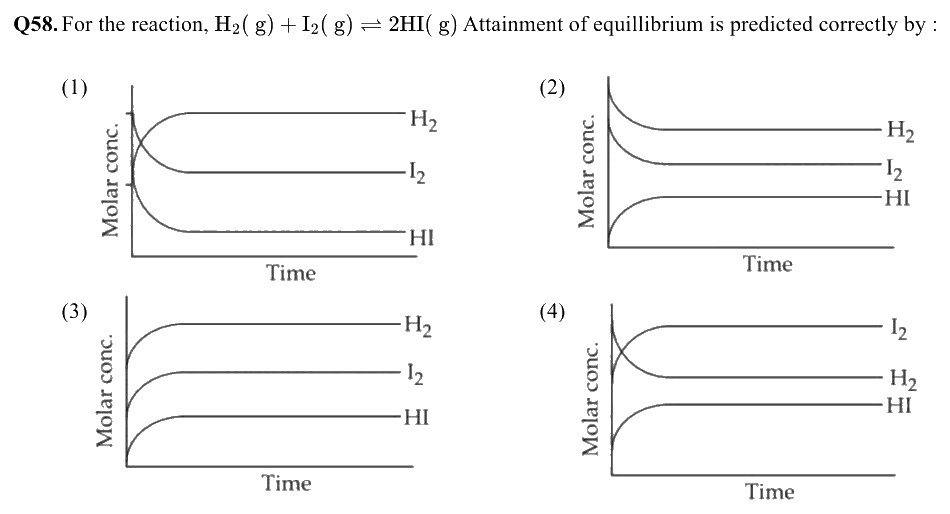
For the reaction, $\mathrm{H_2(\,g) + I_2(\,g) \rightleftharpoons 2HI(\,g)}$ Attainment of equillibrium is predicted correctly by :
The question as printed in the paper.
A
see figure axes 'Molar conc.' (vertical) and 'Time' (horizontal); curves start high on the vertical axis at time zero: 'H2' rises to the highest plateau, 'I2' falls to a middle plateau and 'HI' falls to the lowest plateau.
B
see figure same axes; 'H2' and 'I2' start high on the vertical axis and fall to two close plateaus ('H2' slightly above 'I2'), while 'HI' rises from the bottom of the vertical axis to a lower plateau.
C
see figure same axes; all three curves rise from the bottom of the vertical axis to plateaus: 'H2' highest, 'I2' in the middle and 'HI' lowest.
D
see figure same axes; one curve starts high and falls to the middle plateau labelled 'H2', another curve rises to the top plateau labelled 'I2', and 'HI' rises from the bottom to the lowest plateau.
Consider the reaction $\mathrm{X_2Y(\ g)} = \mathrm{X_2(\ g)} + \frac{1}{2}\mathrm{Y_2(\ g)}$ The equation representing correct relationship between the degree of dissociation (x) of $\mathrm{X_2Y(g)}$ with its equilibrium constant Kp is ______ . Assume $x$ to be very very small.
A vessel at 1000 K contains $\mathrm{CO_2}$ with a pressure of 0.5 atm . Some of $\mathrm{CO_2}$ is converted into CO on addition of graphite. If total pressure at equilibrium is 0.8 atm , then Kp is :
At $-20^\circ$C and 1 atm pressure, a cylinder is filled with equal number of $H_2$, $I_2$ and HI molecules for the reaction $H_{2(g)} + I_{2(g)} \rightleftharpoons 2HI_{(g)}$, the $K_p$ for the process is $x \times 10^{-1}$. x = ______ [Given : R = 0.082 L atm K$^{-1}$ mol$^{-1}$]
The following reaction occurs in the Blast furnace where iron ore is reduced to iron metal $\mathrm{Fe_2O_{3(\,s)} + 3CO_{(g)} \rightleftharpoons Fe_{(l)} + 3CO_{2(\,g)}}$ Using the Le-chatelier's principle, predict which one of the following will not disturb the equilibrium.
The equilibrium constant for the reaction $\mathrm{SO_3(g) \rightleftharpoons SO_2(g) + \frac{1}{2}O_2(g)}$ is $K_c = 4.9 \times 10^{-2}$. The value of $K_c$ for the reaction given below is $\mathrm{2SO_2(g) + O_2(g) \rightleftharpoons 2SO_3(g)}$ is :
The effect of addition of helium gas to the following reaction in equilibrium state at constant volume, is : $\mathrm{PCl_5(\ g)} \rightleftharpoons \mathrm{PCl_3(\ g)} + \mathrm{Cl_2(\ g)}$
A
the equilibrium will shift in the forward direction and more of $\mathrm{Cl_2}$ and $\mathrm{PCl_3}$ gases will be produced.
B
the equilibrium will go backward due to suppression of dissociation of $\mathrm{PCl_5}$.
C
helium will deactivate $\mathrm{PCl_5}$ and reaction will stop.
D
addition of helium will not affect the equilibrium.
$4.0$ moles of argon and $5.0$ moles of $\mathrm{PCl_5}$ are introduced into an evacuated flask of 100 litre capacity at $610\ \mathrm{K}$. The system is allowed to equilibrate. At equilibrium, the total pressure of mixture was found to be $6.0\ \mathrm{atm}$. The $\mathrm{K_p}$ for the reaction is [Given : $\mathrm{R} = 0.082\ \mathrm{L\,atm\,K^{-1}\,mol^{-1}}$ ]
For a reaction at equilibrium $\mathrm{A(g)} \rightleftharpoons \mathrm{B(g)} + \frac{1}{2}\mathrm{C(g)}$ the relation between dissociation constant (K), degree of dissociation ($\alpha$) and equilibrium pressure (p) is given by :
The variation of equilibrium constant with temperature is given below : Temperature Equilibrium Constant $\mathrm{T_1} = 25^\circ\mathrm{C}$ $\mathrm{K_1} = 10$ $\mathrm{T_2} = 100^\circ\mathrm{C}$ $\mathrm{K_2} = 100$ The values of $\Delta\mathrm{H}^\circ$, $\Delta\mathrm{G}^\circ$ at $\mathrm{T_1}$ and $\Delta\mathrm{G}^\circ$ at $\mathrm{T_2}$ (in $\mathrm{kJ\ mol^{-1}}$ ) respectively, are close to [use $\mathrm{R} = 8.314\ \mathrm{JK^{-1}\ mol^{-1}}$]
The value of $\mathrm{K_c}$ us 64 at 800 K for the reaction $\mathrm{N_2(g) + 3H_2(g) \rightarrow 2\ NH_3\ (g)}$ The value of $\mathrm{K_c}$ for the following reaction is : $\mathrm{NH_3\ (g) \rightarrow \frac{1}{2}\ N_2\ (g) + \frac{3}{2}\ H_2\ (g)}$
Consider the following reaction: $\mathrm{N_2O_4}(g) = 2\,\mathrm{NO_2}(g) : \Delta\mathrm{H}^0 = +58\mathrm{k}$ For each of the following cases (a, b), the direction in which the equilibrium shifts is: (a) Temperature is decreased. (b) Pressure is increased by adding $\mathrm{N_2}$ at constant T.
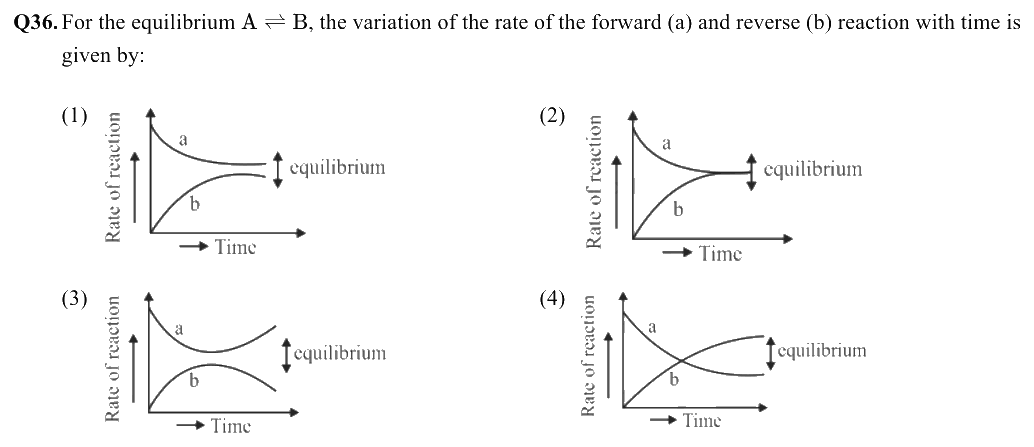
For the equilibrium $\mathrm{A \rightleftharpoons B}$, the variation of the rate of the forward (a) and reverse (b) reaction with time is given by: (see the figure above)
The question as printed in the paper.
A
see figure rate-time graph, curves a and b level off at different rates
B
see figure rate-time graph, curves a and b meet at one rate
C
see figure rate-time graph, a dips then rises, b rises then falls
If the equilibrium constant for $\mathrm{A \rightleftharpoons B + C}$ is $\mathrm{K_{eq}^{(1)}}$ and that of $\mathrm{B + C \rightleftharpoons P}$ is $\mathrm{K_{eq}^{(2)}}$, the equilibrium constant for $\mathrm{A \rightleftharpoons P}$ is :
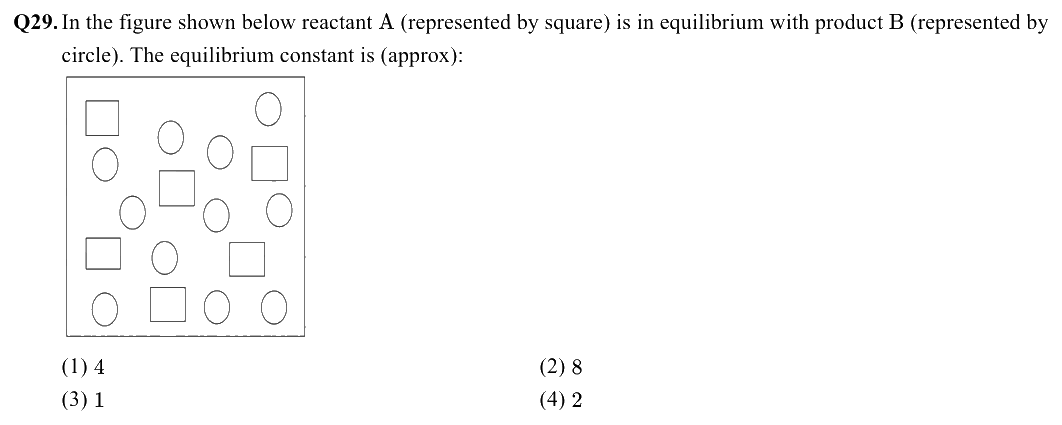
In the figure shown below reactant A (represented by square) is in equilibrium with product B (represented by circle). The equilibrium constant is (approx): (see the figure above)
For the reaction, $\mathrm{2SO_2g + O_2g \rightleftharpoons 2SO_3g}$, $\Delta H = -57.2\ \mathrm{kJ\ mol^{-1}}$ and $K_c = 1.7\times10^{16}$. Which of the following statements is incorrect?
A
The equilibrium constant is large suggestive of reaction going to completion and so, no catalyst is required.
B
The equilibrium will shift in forward direction as the pressure increases.
C
The equilibrium constant decreases as the temperature increases.
D
The addition of inert gas at constant volume will not affect the equilibrium constant.
For the following reaction, equilibrium constant are given: Ss + $\mathrm{O_2}$g $\rightleftharpoons$ $\mathrm{SO_2}$g; $\mathrm{K_1}$ = $10^{52}$ 2Ss + 3$\mathrm{O_2}$g $\rightleftharpoons$ 2$\mathrm{SO_3}$g; $\mathrm{K_2}$ = $10^{129}$ The equilibrium constant for the reaction, 2$\mathrm{SO_2}$g + $\mathrm{O_2}$g $\rightleftharpoons$ 2$\mathrm{SO_3}$g is:
In a chemical reaction, $\mathrm{A + 2B} \overset{K}{\rightleftharpoons} \mathrm{2C + D}$ , the initial concentration of B was 1.5 times of the concentration of A , but the equilibrium concentrations of A and B were found to be equal. The equilibrium constant (K) for the chemical reaction is:
Two solids dissociate as follows: $\mathrm{A\ (s) \rightleftharpoons B\ (g) + C\ (g);\ K_{P_1} = x\ atm^2}$ $\mathrm{D\ (s) \rightleftharpoons C\ (g) + E\ (g);\ K_{P_2} = y\ atm^2}$ The total pressure when both the solids dissociate simultaneously is:
Consider the reaction N$_2$( g) + 3H$_2$( g) $\rightleftharpoons$ 2NH$_3$( g) The equilibrium constant of the above reaction is K$_P$. If pure ammonia is left to dissociate, the partial pressure of ammonia at equilibrium is given by (Assume that P$_{NH_3}$ << P$_{total}$ at equilibrium)
What are the values of $\frac{K_p}{K_c}$ for the following reactions at 300 K respectively? (At 300 K, RT = 24.62 dm$^2$ atm mol$^{-1}$ ) $N_2$ (g) + $O_2$ (g) $\rightleftharpoons$ 2 NO (g) $N_2O_4$ (g) $\rightleftharpoons$ 2 NO (g) $N_2$ (g) + 3$H_2$ (g) $\rightleftharpoons$ 2 $NH_3$ (g)
$5.1\ \mathrm{g}$ $\mathrm{NH_4SH}$ is introduced in $3.0\ \mathrm{L}$ evacuated flask at $327^oC$ . $30\%$ of the solid $\mathrm{NH_4SH}$ is decomposed to $\mathrm{NH_3}$ and $\mathrm{H_2S}$ as gases. The $\mathrm{K_P}$ of the reaction at $327^oC$ is $(\mathrm{R} = 0.082\ \mathrm{L\ atm\ mol^{-1}K^{-1}}$, Molar mass of S $= 32\ \mathrm{g\ mol^{-1}}$, Molar mass of N $= 14\ \mathrm{g\ mol^{-1}})$
Consider the following reversible chemical reactions: $A_2(g) + B_2(g) \overset{k_1}{\rightleftharpoons} 2AB(g)$ .....(1) $6AB(g) \overset{k_2}{\rightleftharpoons} 3A_2(g) + 3B_2(g)$ .....(2) The relation between $K_1$ and $K_2$ is:
At 320 K, a gas $A_2$ is $20\ \%$ dissociated to $A(g)$. The standard Gibbs free energy change at $320\ K$ and 1 atm in $J\ mol^{-1}$ is approximately: ($\mathrm{R} = 8.314\ \mathrm{JK^{-1}\ mol^{-1}}$ ; $\ln 2 = 0.693$ ; $\ln 3 = 1.098$)
The gas phase reaction $2\,\mathrm{NO_2(g)} \rightarrow \mathrm{N_2O_4\ (g)}$ is an exothermic reaction. The decomposition of $\mathrm{N_2O_4}$ , in equilibrium mixture of $\mathrm{NO_2}$ (g) and $\mathrm{N_2O_4}$ (g) can be increased by:
At a certain temperature in a 5L vessel, 2 moles of carbon monoxide and 3 moles of chlorine were allowed to reach equilibrium according to the reaction, $\mathrm{CO + Cl_2 \rightleftharpoons COCl_2}$. At equilibrium, if one mole of CO is present then equilibrium constant ($K_c$) for the reaction is:
The following reaction occurs in the Blast Furnace where iron ore is reduced to iron metal: $\mathrm{Fe_2O_3(s) + 3CO(g) \rightleftharpoons 2Fe\,(l) + 3CO_2(g)}$ Using the Le Chatelier's principle, predict which one of the following will not disturb the equilibrium?
A solid XY kept in an evacuated sealed container undergoes decomposition to form a mixture of gases X and Y at temperature T. The equilibrium pressure is $10$ bar in this vessel. $\mathrm{K_p}$ for this reaction is?
The equilibrium constant at 298 K for a reaction $\mathrm{A + B \rightleftharpoons C + D}$ is 100. If the initial concentration of all the four species were1 M each, then the equilibrium concentration of D (in mol $\mathrm{L^{-1}}$) will be:
Gaseous $\mathrm{N_2O_4}$ dissociates into gaseous $\mathrm{NO_2}$ according to the reaction $\mathrm{N_2O_4(g) \rightleftharpoons 2NO_2(g)}$ At 300 K and 1 atm pressure, the degree of dissociation of $\mathrm{N_2O_4}$ is 0.2. If one mole of $\mathrm{N_2O_4}$ gas is contained in a vessel, then the density of the equilibrium mixture is:
For the decomposition of the compound, represented as $\mathrm{NH_2COONH_4(s) \rightleftharpoons 2NH_3(g) + CO_2(g)}$ the $\mathrm{K_p} = 2.9 \times 10^{-5}\ \mathrm{atm^3}$. If the reaction is started with 1 mole of the compound, the total pressure at equilibrium would be :
Consider the following equilibrium $$\mathrm{AgCl}\downarrow + 2\mathrm{NH_3} \rightleftharpoons [\mathrm{Ag(NH_3)_2}]^+ + \mathrm{Cl}^-$$ White precipitate of AgCl appears on adding which of the following?
For the reaction $\mathrm{SO_2}(g) + \frac{1}{2}\mathrm{O_2}(g) \rightleftharpoons \mathrm{SO_3}(g)$ , if $\mathrm{K_P} = \mathrm{K_C}(RT)^x$ where the symbols have usual meaning then the value of $x$ is: (assuming ideality)
In reaction $\mathrm{A} + 2\,\mathrm{B} \rightleftharpoons 2\mathrm{C} + \mathrm{D}$, initial concentration of B was 1.5 times of [A], but at equilibrium the concentrations of A and B became equal. The equilibrium constant for the reaction is :
One mole of $\mathrm{O_{2(\,g)}}$ and two moles of $\mathrm{SO_{2(\,g)}}$ were heated in a closed vessel of one-litre capacity at 1098 K. At equilibrium 1.6 moles of $\mathrm{SO_{3(\,g)}}$ were found. The equilibrium constant $K_c$ of the reaction would be
The value of $K_p$ for the equilibrium reaction $\mathrm{N_2O_4}(g) \rightleftharpoons 2\mathrm{NO_2}(g)$ is 2 . The percentage dissociation of $\mathrm{N_2O_4}(g)$ at a pressure of 0.5 atm is
$8$ mol of $AB_3(\ g)$ are introduced into a $1.0\mathrm{dm^3}$ vessel. If it dissociates as $2AB_3(g) \rightleftharpoons A_2(g) + 3B_2(g)$. At equilibrium, $2$ mol of $A_2$ are found to be present. The equilibrium constant of this reaction is
$K_1$, $K_2$ and $K_3$ are the equilibrium constants of the following reactions (I), (II) and (III) respectively: (I) $\mathrm{N_2} + 2\mathrm{O_2} \rightleftharpoons 2\mathrm{NO_2}$ (II) $2\mathrm{NO_2} \rightleftharpoons \mathrm{N_2} + 2\mathrm{O_2}$ (III) $\mathrm{NO_2} \rightleftharpoons \frac{1}{2}\mathrm{N_2} + \mathrm{O_2}$ The correct relation from the following is
The equilibrium constant ($\mathrm{K_c}$) for the reaction $\mathrm{N_2(g)} + \mathrm{O_2( g)} \rightarrow 2\mathrm{NO(g)}$ at temperature T is $4 \times 10^{-4}$. The value of $\mathrm{K_c}$ for the reaction, $\mathrm{NO(g)} \rightarrow 1/2\ \mathrm{N_2(g)} + 1/2\ \mathrm{O_2(g)}$ at the same temperature is :
A vessel at 1000 K contains $\mathrm{CO_2}$ with a pressure of 0.5 atm. Some of the $\mathrm{CO_2}$ is converted into CO on the addition of graphite. If the total pressure at equilibrium is 0.8 atm, the value of K is
The equilibrium constants $K_{P_1}$ and $K_{P_2}$ for the reactions $X \rightleftharpoons 2Y$ and $Z \rightleftharpoons P + Q$, respectively are in the ratio of $1 : 9$. If the degree of dissociation of $X$ and $Z$ be equal then the ratio of total pressure at these equilibria is
For the following three reactions $a, b$ and $c$, equilibrium constants are given: a. $\mathrm{CO(g) + H_2O(g) \rightleftharpoons CO_2(g) + H_2(g)}$; $\mathrm{K_1}$ b. $\mathrm{CH_4(g) + H_2O(g) \rightleftharpoons CO(g) + 3H_2(g)}$; $\mathrm{K_2}$ c. $\mathrm{CH_4(g) + 2H_2O(g) \rightleftharpoons CO_2(g) + 4H_2(g)}$; $\mathrm{K_3}$ Which of the following relations is correct?
Phosphorus pentachloride dissociates as follows, in a closed reaction vessel, $\mathrm{PCl_5(g) \rightleftharpoons PCl_3(g) + Cl_2(g)}$ If total pressure at equilibrium of the reaction mixture is P and degree of dissociation of $\mathrm{PCl_5}$ is x, the partial pressure of $\mathrm{PCl_3}$ will be
The equilibrium constant for the reaction $\mathrm{SO_3(g) \rightleftharpoons SO_2(g) + \frac{1}{2}O_2(g)}$ is $K_c = 4.9 \times 10^{-2}$. The value of $K_c$ for the reaction $\mathrm{2SO_2(g) + O_2(g) \rightleftharpoons 2SO_3(g)}$ will be
The exothermic formation of $\mathrm{ClF_3}$ is represented by the equation: $\mathrm{Cl_{2(g)} + 3\,F_{2(g)} \rightleftharpoons 2ClF_{3(g)}}$; $\Delta_r H = -329$ kJ Which of the following will increase the quantity of $\mathrm{ClF_3}$ in an equilibrium mixture of $\mathrm{Cl_2}$, $\mathrm{F_2}$ and $\mathrm{ClF_3}$ ?
For the reaction $\mathrm{2NO_{2(g)} \rightleftharpoons 2NO_{(g)} + O_{2(g)}}$, $(\mathrm{K_c} = 1.8 \times 10^{-6}$ at 184C$)$ $(\mathrm{R} = 0.0831\ \mathrm{kJ/(mol.K)})$ When $\mathrm{K_p}$ and $\mathrm{K_c}$ are compared at $184^\circ\mathrm{C}$, it is found that
A
$\mathrm{K_p}$ is greater than $\mathrm{K_c}$
B
$\mathrm{K_p}$ is less than $\mathrm{K_c}$
C
$\mathrm{K_p = K_c}$
D
Whether $\mathrm{K_p}$ is greater than, less than or equal to $\mathrm{K_c}$ depends upon the total gas pressure
An amount of solid $\mathrm{NH_4HS}$ is placed in a flask already containing ammonia gas at a certain temperature and 0.50 atm. Pressure. Ammonium hydrogen sulphide decomposes to yield $\mathrm{NH_3}$ and $\mathrm{H_2\,S}$ gases in the flask. When the decomposition reaction reaches equilibrium, the total pressure in the flask rises to 0.84 atm. The equilibrium constant for $\mathrm{NH_4HS}$ decomposition at this temperature is
The equilibrium constant for the reaction $\mathrm{N_2(\,g)} + \mathrm{O_2(\,g)} \rightleftharpoons 2\mathrm{NO(g)}$ at temperature T is $4 \times 10^{-4}$. The value of Kc for the reaction $\mathrm{NO(g)} \rightleftharpoons \frac{1}{2}\,\mathrm{N_2(\,g)} + \frac{1}{2}\mathrm{O_2(\,g)}$ at the same temperature is
For the reaction equilibrium $\mathrm{N_2O_4(g) \rightleftharpoons 2NO_2(g)}$ the concentrations of $\mathrm{N_2O_4}$ and $\mathrm{NO_2}$ at equilibrium are $4.8 \times 10^{-2}$ and $1.2 \times 10^{-2}$ $\mathrm{mol\ L^{-1}}$ respectively. The value of $\mathrm{K_c}$ for the reaction is
Consider the reaction equilibrium $\mathrm{2SO_2(g) + O_2(g) \rightleftharpoons 2SO_3(g)}$; $\Delta H^0 = -198$ kJ. On the basis of Le Chatelier's principle, the condition favourable for the forward reaction is
A
increasing temperature as well as pressure
B
lowering the temperature and increasing the pressure
At equilibrium, 75% $\mathrm{X_2Y_4(g)}$ was dissociated and the total pressure is 1 atm. The magnitude of $\Delta_r G^\ominus$ (in kJ mol$^{-1}$) at this temperature is ________. (Nearest Integer) (Given : R = 8.3 J mol$^{-1}$ K$^{-1}$; ln 10 = 2.3, log 2 = 0.3, log 3 = 0.48, log 5 = 0.69, log 7 = 0.84)
Numerical answer type: type your answer in EdLoop to check it
if the total pressure is $\sqrt{3}$ atm and the pressure equilibrium constant ($\mathrm{K_p}$) is 9 atm, then the degree of dissociation is given as $(x \times 10^{-2})^{-1/2}$. The value of $x$ is ________. (nearest integer)
Numerical answer type: type your answer in EdLoop to check it
$\mathrm{X_2(g)}$ and $\mathrm{Y_2(g)}$ are added to a 1 L flask and it is found that the system attains the above equilibrium at T(K) with the number of moles of $\mathrm{X_2(g)}$, $\mathrm{Y_2(g)}$ and $\mathrm{Z(g)}$ being 3, 3 and 9 mol respectively (equilibrium moles). Under this condition of equilibrium, 10 mol of Z(g) is added to the flask and the temperature is maintained at T(K). Then the number of moles of Z(g) in the flask when the new equilibrium is established is ________. (Nearest integer)
Numerical answer type: type your answer in EdLoop to check it
is $8.0 \times 10^{-3}$ at 2300 K and total pressure at equilibrium is 1 bar. Under this condition, the degree of dissociation ($\alpha$) of water is ______ $\times 10^{-2}$ (nearest integer value).
[Assume $\alpha$ is negligible with respect to 1 ]
Numerical answer type: type your answer in EdLoop to check it
0.1 mol of CO along with a catalyst is present in a $2dm^3$ flask maintained at 500 K . Hydrogen is introduced into the flask until the pressure is 5 bar and 0.04 mol of $CH_3OH$ is formed. The $K_p^\theta$ is ______ $\times 10^{-3}$ (nearest integer).
Given : $R = 0.08dm^3$ bar $K^{-1}mol^{-1}$
Assume only methanol is formed as the product and the system follows ideal gas behaviour.
Numerical answer type: type your answer in EdLoop to check it
37.8 g $\mathrm{N_2O_5}$ was taken in a 1 L reaction vessel and allowed to undergo the following reaction at 500 K $\mathrm{2\,N_2O_{5(\,g)} \rightleftharpoons 2\,N_2O_{4(\,g)} + O_{2(g)}}$ The total pressure at equilibrium was found to be 18.65 bar. Then, Kp = ______ $\times 10^{-2}$ [nearest integer] Assume $\mathrm{N_2O_5}$ to behave ideally under these conditions. Given: R = 0.082 bar $\mathrm{Lmol^{-1}\,K^{-1}}$
Numerical answer type: type your answer in EdLoop to check it
For the reaction $\mathrm{N_2O_4(g)} \rightleftharpoons 2\mathrm{NO_2(g)}$, $\mathrm{K_p} = 0.492$ atm at 300 K. $\mathrm{K_c}$ for the reaction at same temperature is ______ $\times 10^{-2}$. (Given :R = 0.082 L atm mol$^{-1}$ K$^{-1}$)
Numerical answer type: type your answer in EdLoop to check it
The following concentrations were observed at 500 K for the formation of $\mathrm{NH_3}$ from $\mathrm{N_2}$ and $\mathrm{H_2}$. At equilibrium : $[\mathrm{N_2}] = 2 \times 10^{-2}$M, $[\mathrm{H_2}] = 3 \times 10^{-2}$M and $[\mathrm{NH_3}] = 1.5 \times 10^{-2}$M. Equilibrium constant for the reaction is ______.
Numerical answer type: type your answer in EdLoop to check it
A mixture of one mole of $\mathrm{H_2O}$ and 1 mole of CO is taken in a 10 litre container and heated to 725 K. At equilibrium 40% of water by mass reacts with carbon monoxide according to the equation: $\mathrm{CO(g) + H_2O(g) \rightleftharpoons CO_2(g) + H_2(g)}$. The equilibrium constant $K_C \times 10^{2}$ for the reaction is ______ (Nearest integer)
Numerical answer type: type your answer in EdLoop to check it
4.5 moles each of hydrogen and iodine is heated in a sealed ten litre vessel. At equilibrium, 3 moles of HI were found. The equilibrium constant for $\mathrm{H_2(g) + I_2(g) \rightleftharpoons 2HI_{(g)}}$ is ______
Numerical answer type: type your answer in EdLoop to check it
The number of correct statement/s involving equilibria in physical processes from the following is ______ (A) Equilibrium is possible only in a closed system at a given temperature. (B) Both the opposing processes occur at the same rate. (C) When equilibrium is attained at a given temperature, the value of all its parameters became equal (D) For dissolution of solids in liquids, the solubility is constant at a given temperature.
Numerical answer type: type your answer in EdLoop to check it
If 0.2 mol of $\mathrm{Cl_2}$ is added at the same temperature, the equilibrium concentrations of $\mathrm{PCl_5}$ is ______ $\times 10^{-2}\ \mathrm{mol\ L^{-1}}$
Given: $\mathrm{K_c}$ for the reaction at 298 K is 20
Numerical answer type: type your answer in EdLoop to check it
(i) $\mathrm{X(g)} \rightleftharpoons \mathrm{Y(g)} + \mathrm{Z(g)}$ $\mathrm{K_{p1}}$ = 3 (ii) $\mathrm{A(g)} \rightleftharpoons 2\ \mathrm{B(g)}$ $\mathrm{K_{p2}}$ = 1 If the degree of dissociation and initial concentration of both the reactants $\mathrm{X(g)}$ and $\mathrm{A(g)}$ are equal, then the ratio of the total pressure at equilibrium $\dfrac{p_1}{p_2}$ is equal to x: 1. The value of x is (Nearest integer)
Numerical answer type: type your answer in EdLoop to check it
For reaction: $\mathrm{SO_2}$(g) + $\dfrac{1}{2}\mathrm{O_2}$(g) $\rightleftharpoons$ $\mathrm{SO_3}$(g) $\mathrm{K_p}$ = $2 \times 10^{12}$ at $27^\circ\mathrm{C}$ and 1 atm pressure. The $\mathrm{K_c}$ for the same reaction is $\times 10^{13}$. (Nearest integer) (Given R = 0.082 $\mathrm{L\ atm\ K^{-1}\ mol^{-1}}$)
Numerical answer type: type your answer in EdLoop to check it
Consider the following equation: $\mathrm{2\,SO_2(g) + O_2(g) \rightleftharpoons 2\,SO_3(g)}$, $\Delta$H = $-190$ kJ. The number of factors which will increase the yield of $\mathrm{SO_3}$ at equilibrium from the following is ______ . A. Increasing temperature B. Increasing pressure C. Adding more $\mathrm{SO_2}$ D. Adding more $\mathrm{O_2}$ E. Addition of catalyst
Numerical answer type: type your answer in EdLoop to check it
The percent of water decomposing at $2300\ \mathrm{K}$ and $1$ bar is ______ (Nearest integer). Equilibrium constant for the reaction is $2 \times 10^{-3}$ at $2300\ \mathrm{K}$
Numerical answer type: type your answer in EdLoop to check it
At $600\ \mathrm{K}$, $2\ \mathrm{mol}$ of NO are mixed with $1\ \mathrm{mol}$ of $\mathrm{O_2}$. $2\,\mathrm{NO_{(g)}}+\mathrm{O_2(g)}\rightleftarrows2\,\mathrm{NO_2(g)}$ The reaction occurring as above comes to equilibrium under a total pressure of $1\ \mathrm{atm}$. Analysis of the system shows that $0.6\ \mathrm{mol}$ of oxygen are present at equilibrium. The equilibrium constant for the reaction is ______.
Numerical answer type: type your answer in EdLoop to check it
At 298 K, the equilibrium constant is $2 \times 10^{15}$ for the reaction: $\mathrm{Cu(s)} + 2\,\mathrm{Ag^+(aq)} \rightleftharpoons \mathrm{Cu^{2+}(aq)} + 2\,\mathrm{Ag(s)}$ The equilibrium constant for the reaction $\frac{1}{2}\mathrm{Cu^{2+}(aq)} + \mathrm{Ag(s)} \rightleftharpoons \frac{1}{2}\mathrm{Cu(s)} + \mathrm{Ag^+(aq)}$ is x $\times$ $10^{-8}$. The value of x is ______ . (Round off the answer to the nearest integer)
Numerical answer type: type your answer in EdLoop to check it
$2\,\mathrm{NOCl(g)} \rightleftharpoons 2\,\mathrm{NO(g)} + \mathrm{Cl_2(g)}$ In an experiment, 2.0 moles of NOCl was placed in a one-litre flask and the concentration of NO after equilibrium established, was found to be $0.4\ \mathrm{mol/L}$. The equilibrium constant at $30\ ^{\circ}\mathrm{C}$ is ______ $\times 10^{-4}$.
Numerical answer type: type your answer in EdLoop to check it
$40\%$ of HI undergoes decomposition to $\mathrm{H}_2$ and $\mathrm{I}_2$ at $300 \mathrm{~K}$. $\Delta G^\ominus$ for this decompostion reaction at one atmopsphere pressure is ______ $\mathrm{J} \mathrm{mol}^{-1}$-[nearest integer] (Use $\mathrm{R} = 8.31 \mathrm{~J} \mathrm{~K}^{-1} \mathrm{~mol}^{-1}$; $\log 2 = 0.3010$, $\ln 10 = 2.3$, $\log 3 = 0.477$)
Numerical answer type: type your answer in EdLoop to check it
The standard free energy change $\Delta G^\circ$ for $50\%$ dissociation of $\mathrm{N}_2\mathrm{O}_4$ into $\mathrm{NO}_2$ at $27 {}^\circ\mathrm{C}$ and $1 \mathrm{~atm}$ pressure is $-x \mathrm{~J} \mathrm{~mol}^{-1}$. The value of x is $-$______ J. (Nearest Integer) [Given : $R = 8.31 \mathrm{~J} \mathrm{~K}^{-1} \mathrm{~mol}^{-1}$, $\log 1.33 = 0.1239$ $\ln 10 = 2.3$]
Numerical answer type: type your answer in EdLoop to check it
$2\mathrm{O_3(g)} \rightleftharpoons 3\mathrm{O_2(g)}$ At $300 \mathrm{~K}$, ozone is fifty percent dissociated. The standard free energy change at this temperature and $1 \mathrm{~atm}$ pressure is $(-)$ ______ $\mathrm{J~mol^{-1}}$. (Nearest integer) [Given: $\ln 1.35 = 0.3$ and $\mathrm{R} = 8.3 \mathrm{~J~K^{-1}~mol^{-1}}$]
Numerical answer type: type your answer in EdLoop to check it
$\mathrm{PCl_5}$ dissociates as $\mathrm{PCl_5(g)} \rightleftharpoons \mathrm{PCl_3(g)} + \mathrm{Cl_2(g)}$ $5$ moles of $\mathrm{PCl_5}$ are placed in a $200$ litre vessel which contains $2$ moles of $\mathrm{N_2}$ and is maintained at $600 \mathrm{~K}$. The equilibrium pressure is $2.46 \mathrm{~atm}$. The equilibrium constant $\mathrm{K_p}$ for the dissociation of $\mathrm{PCl_5}$ is ______ $\times 10^{-3}$. (nearest integer) (Given: $\mathrm{R} = 0.082 \mathrm{~L~atm~K^{-1}~mol^{-1}}$; Assume ideal gas behaviour)
Numerical answer type: type your answer in EdLoop to check it
When $5.1\ \mathrm{g}$ of solid $\mathrm{NH_4\,HS}$ is introduced into a two litre evacuated flask at $27^\circ\mathrm{C}$, $20\%$ of the solid decomposes into gaseous ammonia and hydrogen sulphide. The $\mathrm{K_p}$ for the reaction at $27^\circ\mathrm{C}$ is $\mathrm{x}\times10^{-2}$. The value of x is (Integer answer) [Given 1R $=0.082\ \mathrm{L\ atm\ K^{-1}\ mol^{-1}}$]
Numerical answer type: type your answer in EdLoop to check it
The equilibrium constant $K_c$ at $298\ \mathrm{K}$ for the reaction $\mathrm{A+B\rightleftharpoons C+D}$ is $100$. Starting with an equimolar solution with concentrations of $A, B, C$ and $D$ all equal to $1\mathrm{M}$, the equilibrium concentration of D is ______$\times10^{-2}\mathrm{M}$. (Nearest integer)
Numerical answer type: type your answer in EdLoop to check it
The reaction rate for the reaction $\mathrm{[PtCl_4]^{2-}+H_2O\rightleftharpoons[Pt(H_2O)Cl_3]^-+Cl^-}$ was measured as a function of concentrations of different species. It was observed that $\frac{-\mathrm{d}\left[\mathrm{PtCl_4^{2-}}\right]}{\mathrm{d}t}=4.8\times10^{-5}\left[\mathrm{PtCl_4^{2-}}\right]-2.4\times10^{-3}\left[\mathrm{[Pt(H_2O)Cl_3]^-}\right]\left[\mathrm{Cl^-}\right]$ where square brackets are used to denote molar concentrations. The equilibrium constant $\mathrm{K_c}=X$(Nearest integer) Value of $\frac{1}{X}$ is (question is modified.)
Numerical answer type: type your answer in EdLoop to check it
$\mathrm{PCl_5 \rightleftharpoons PCl_3 + Cl_2}$ $\mathrm{K_c} = 1.844$ 3.0 moles of $\mathrm{PCl_5}$ is introduced in a 1L closed reaction vessel at 380 K. The number of moles of $\mathrm{PCl_5}$ at equilibrium is — $\times 10^{-3}$ (Round off to the Nearest Integer)
Numerical answer type: type your answer in EdLoop to check it
The equilibrium constant for the reaction $\mathrm{A(s) \rightleftharpoons M(s) + \frac{1}{2}O_2(g)}$ is $\mathrm{K_p} = 4$. At equilibrium, the partial pressure of $\mathrm{O_2}$ is ______ atm. (Round off to the nearest integer)
Numerical answer type: type your answer in EdLoop to check it
For the reaction $\mathrm{A + B \rightleftharpoons 2C}$ the value of equilibrium constant is 100 at $298\ \mathrm{K}$. If the initial concentration of all the three species is $1\ \mathrm{M}$ each, then the equilibrium concentration of C is $\mathrm{x} \times 10^{-1}\ \mathrm{M}$. The value of x is ______. (Nearest integer)
Numerical answer type: type your answer in EdLoop to check it
Value of $\mathrm{K_P}$ for the equilibrium reaction $\mathrm{N_2O_4(g)} \rightleftharpoons 2\mathrm{NO_{2(g)}}$ at $288\ \mathrm{K}$ is $47.9$. The $\mathrm{K_C}$ for this reaction at same temperature is (Nearest integer) ($\mathrm{R} = 0.083\ \mathrm{L\ bar\ K^{-1}\ mol^{-1}}$)
Numerical answer type: type your answer in EdLoop to check it
The gas phase reaction $2\,\mathrm{A(g)} \rightleftharpoons \mathrm{A_2(g)}$ at 400 K has $\Delta G^\circ = +25.2~\mathrm{kJ~mol^{-1}}$. The equilibrium constant $\mathrm{K_C}$ for this reaction is ______ $\times 10^{-2}$. (Round off to the Nearest integer) Use : $R = 8.3~\mathrm{J~mol^{-1}~K^{-1}}$, $\ln 10 = 2.3$ $\log_{10} 2 = 0.30$, $1~\mathrm{atm} = 1~\mathrm{bar}$ antilog $(-0.3) = 0.501$
Numerical answer type: type your answer in EdLoop to check it
Consider the reaction $\mathrm{N}_2 \mathrm{O}_4(\mathrm{~g}) \rightleftharpoons 2 \mathrm{NO}_2(\mathrm{~g})$ The temperature at which $\mathrm{K}_{\mathrm{C}}=20.4$ and $\mathrm{K}_{\mathrm{P}}=600.1$, is ______ K. (Round off to the Nearest Integer). [Assume all gases are ideal and $\mathrm{R}=0.0831 \mathrm{~L}$ bar $\mathrm{K}^{-1} \mathrm{~mol}^{-1}$]
Numerical answer type: type your answer in EdLoop to check it
A homogeneous ideal gaseous reaction $\mathrm{AB_{2(g)}} \rightleftharpoons \mathrm{A_{(g)}} + 2\,\mathrm{B_{(g)}}$ is carried out in a 25 litre flask at $27^\circ\mathrm{C}$. The initial amount of $\mathrm{AB_2}$ was 1 mole and the equilibrium pressure was $1.9\ \mathrm{atm}$. The value of $\mathrm{K_p}$ is $\mathrm{x \times 10^{-2}}$. The value of x is ______ (Integer answer) [R = $0.08206\ \mathrm{dm^3\ atm\ K^{-1}\ mol^{-1}}$]
Numerical answer type: type your answer in EdLoop to check it
At 1990 K and 1 atm pressure, there are equal number of $\mathrm{Cl_2}$ molecules and Cl atoms in the reaction mixture. The value of $\mathrm{K_p}$ for the reaction $\mathrm{Cl_{2g} \rightleftharpoons 2Cl_g}$ under the above conditions is $x \times 10^{-1}$. The value of x is ______ (Rounded off to the nearest integer)
Numerical answer type: type your answer in EdLoop to check it
For a reaction $X + Y = 2Z$, 1.0 mol of X, 1.5 mol of Y and 0. 5 mol of Z were taken in a 1L vessel and allowed to react. At equilibrium, the concentration of Z was 1.0 $\mathrm{molL^{-1}}$. the equilibrium constant of the reaction is ______ $\frac{x}{15}$. The value of x is ______
Numerical answer type: type your answer in EdLoop to check it
Chemical equilibrium investigates reversible reactions and equilibrium constants under Unit 6: Equilibrium in the Class 11 curriculum, holding rank 27 among 31 chemistry chapters with a 1.8 percent share of total chemistry questions. In the computer-based testing era from 2019 to 2026, candidates answered 84 questions across 162 papers, representing an average rate of 0.5 questions per shift. The chapter featured in 76 of those 162 papers, and questions appeared every single year throughout the cycle. During the recent 2024 to 2026 examination sessions, testing registered 36 questions across 58 papers, maintaining an average of 0.6 questions per shift and achieving a 2.3 percent subject share. The chapter's share is down compared to the 2002 to 2018 window, which logged 40 questions across 38 papers for a 3.0 percent share. When compared against the broader 2019 to 2026 baseline, the recent share has stayed about the same. In 2026 alone, examiners presented 15 questions across 19 papers, showing up in 12 separate shifts. A total of 41 questions between 2019 and 2026 appeared as numerical answer questions, meaning nearly half of all chemical equilibrium items require final numerical entry.
Most-asked topics
Questions in this chapter concentrate across three defined areas:
Equilibrium Constant: 52 questions historically, with 36 asked between 2019 and 2026, tested up to 2026. This dominant area tests relations connecting K p and K c via delta n g, multiplying or reversing chemical equations and finding the new equilibrium constant, units of equilibrium constants, and reaction quotient Q comparisons against K to determine reaction direction.
Equilibrium Calculations: 45 total problems, including 33 from 2019 to 2026, tested through 2026. Core concepts evaluate degree of dissociation alpha in gaseous decomposition reactions like ammonia and dinitrogen tetroxide, equilibrium partial pressures, total vessel pressure, and standard Gibbs free energy conversions.
Le Chatelier's Principle: 27 lifetime problems, with 15 between 2019 and 2026, continuing in 2026. Concepts explore equilibrium shifts induced by changes in concentration, pressure, volume, temperature, and addition of inert gases at constant volume or constant pressure, alongside van't Hoff isochore temperature plots.
What the questions look like
JEE Main tests chemical equilibrium through stoichiometric ICE tables and algebraic pressure relationships:
Degree of dissociation from partial pressures: Evaluating the fractional dissociation of ammonia or dimer gas into elemental components at a stated total pressure given the equilibrium constant K p.
Le Chatelier re-equilibration after concentration perturbation: An initial equilibrium mixture of reactants and products receives an additional injection of moles of product. Students recalculate the final mole counts after the system shifts backward to establish new equilibrium.
K p versus K c stoichiometric power exponents: Identifying integer stoichiometric coefficients x and y for a general reaction from measured pairs of K p and K c at a specified absolute temperature.
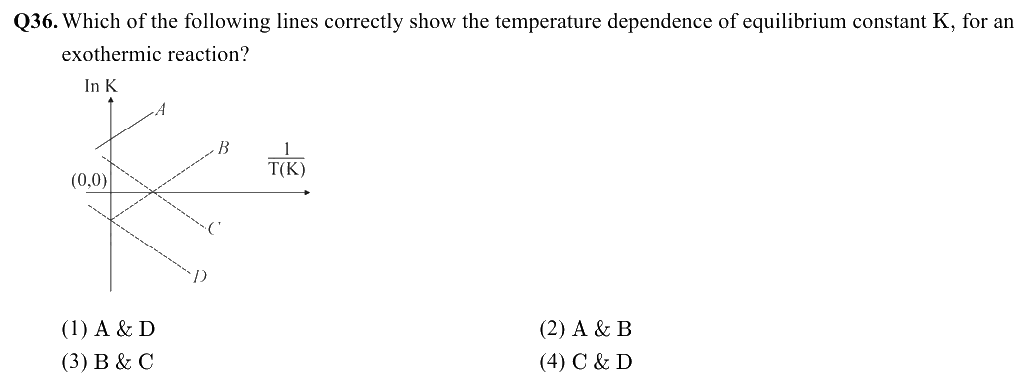
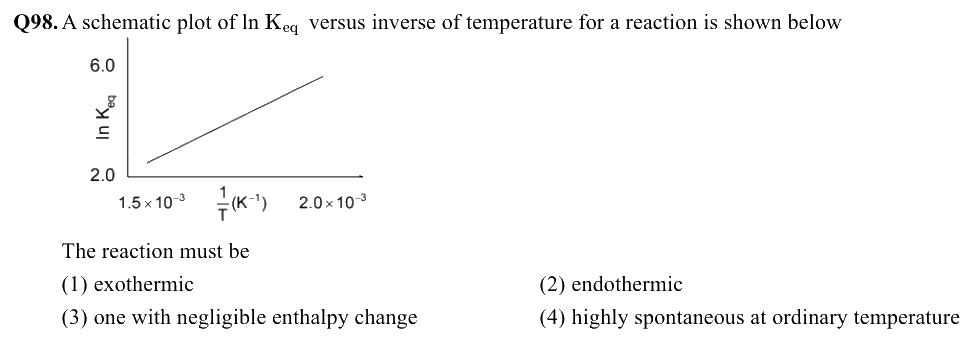
Temperature dependence of equilibrium constants: Extracting the standard reaction enthalpy and entropy from the slope and intercept of a plot of log K against inverse temperature.
Master the connection between K p and K c. The formula K p equals K c multiplied by R T raised to the power delta n g is central. Remember that delta n g counts only gaseous species in products minus reactants, omitting pure solids and pure liquids entirely.
Set up rigorous Initial, Change, Equilibrium (ICE) tables in terms of initial moles and degree of dissociation alpha. For gaseous systems, express partial pressures as mole fractions multiplied by total pressure P, and simplify algebraic expressions before substituting numerical values.
For Le Chatelier's principle, remember that adding an inert gas at constant volume produces no change in partial pressures and causes zero shift in equilibrium. In contrast, adding inert gas at constant pressure expands the system volume, shifting the reaction toward the side with more gaseous moles.
Frequently asked questions
What is the most common mathematical mistake in equilibrium calculations?
Forgetting to divide equilibrium moles by the container volume when substituting into K c expressions, or confusing mole fractions with partial pressures in K p expressions.
How does temperature alter the equilibrium constant?
Temperature is the only variable that alters the numerical value of K. For endothermic reactions with positive delta H, increasing temperature raises K and favors products. For exothermic reactions with negative delta H, increasing temperature lowers K and favors reactants.
Are catalyst effects tested under Le Chatelier's principle?
Yes, conceptual questions frequently test that adding a catalyst accelerates forward and backward rates equally, reaching equilibrium faster without changing the equilibrium composition or the equilibrium constant value. Step-by-step solutions for each one are in the EdLoop app.