EdLoop PYQs · free, no ads · questions and answers here, step-by-step solutions in the EdLoop app
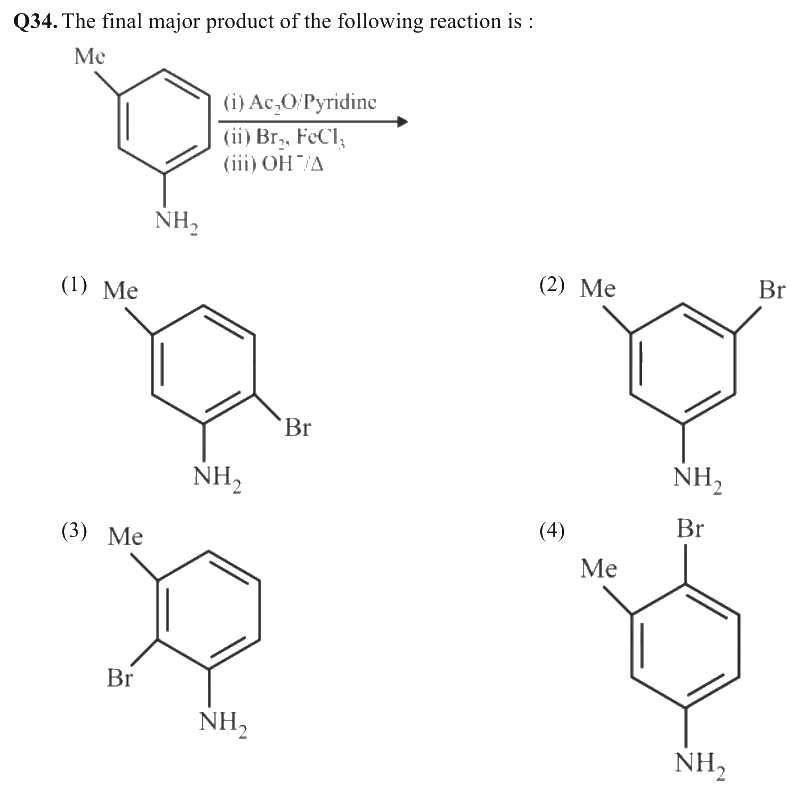
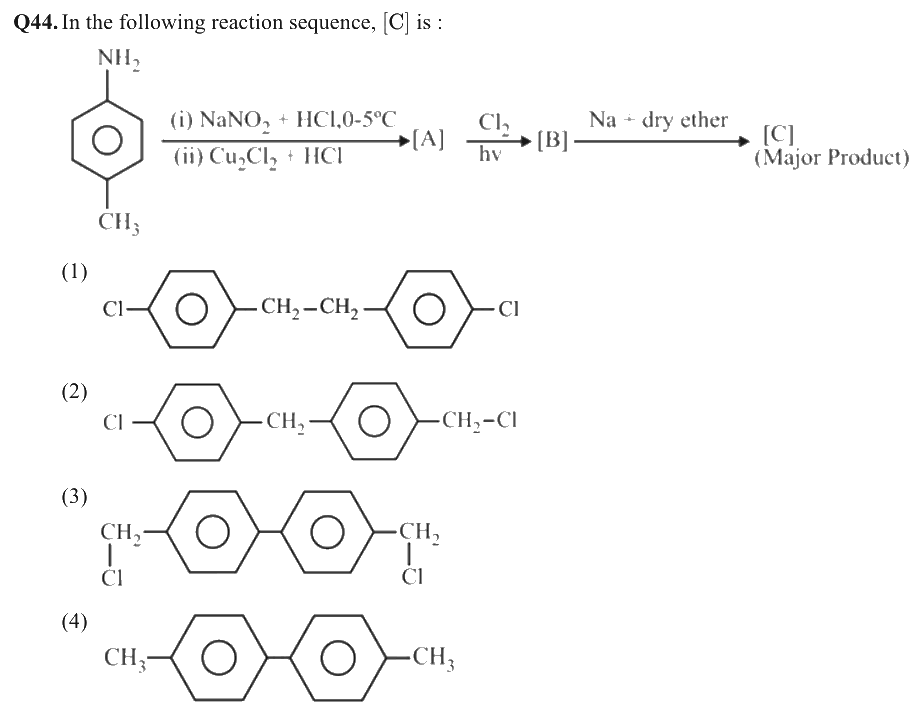
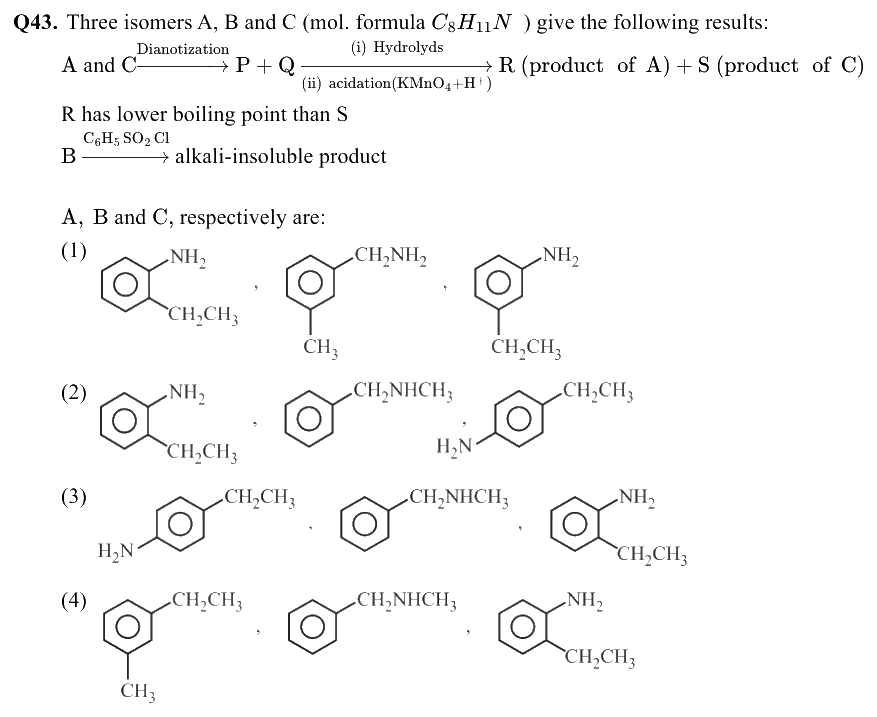
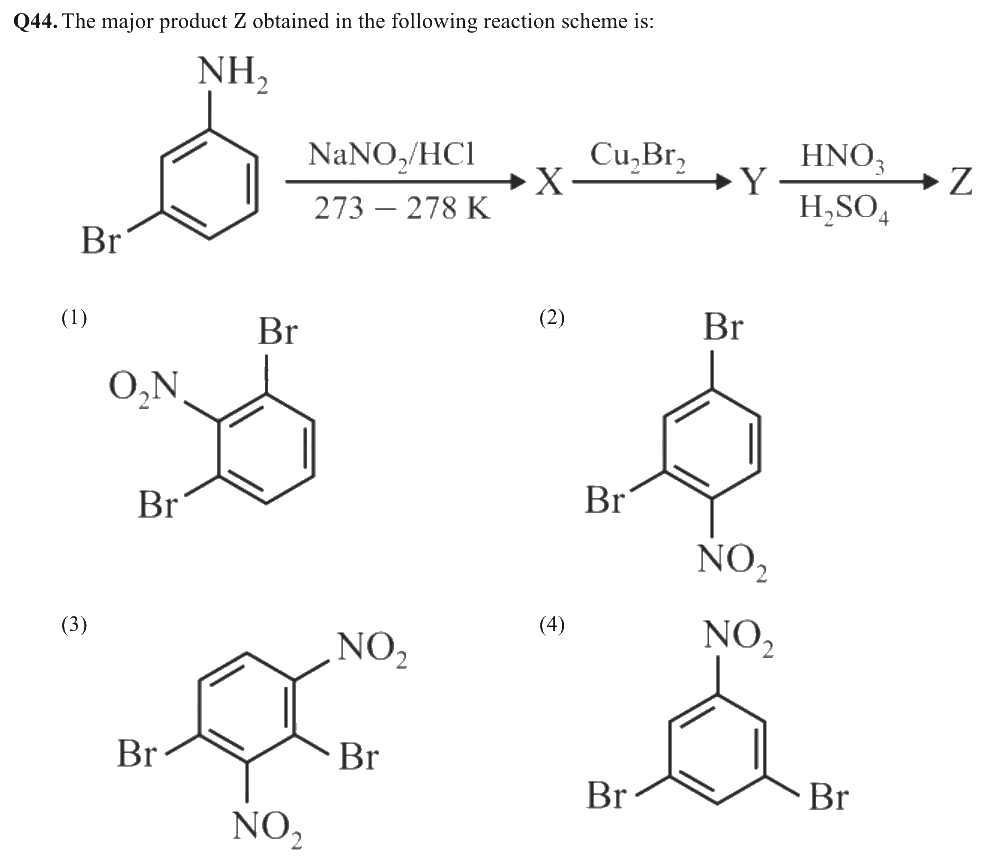
PYQs · free, no adsOpen on the web (app.edloop.in)Get EdLoop – free on Google Play
ChemistryAmines & Nitrogen Compounds

Amines & Nitrogen Compounds: JEE Main PYQs 2002–2026

Every Amines & Nitrogen Compounds question from past JEE Main and AIEEE papers, with options and answers. Newest first.

220questions
160papers covered
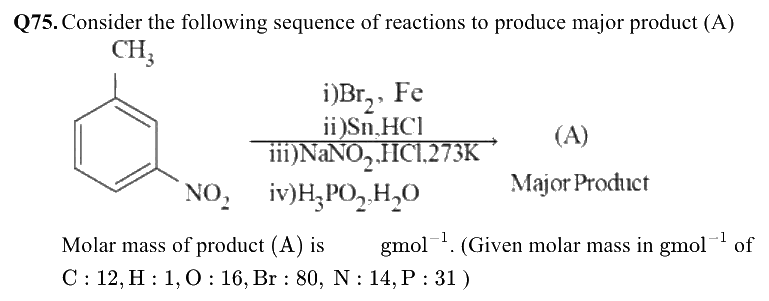
4%of Chemistry questions, 2019–2026
2002–2026years

Guide at a glance

Amines and nitrogen compounds covers basicity and diazonium transformations under Unit 18: Organic Compounds Containing Nitrogen in the Class 12 curriculum, holding rank 9 of 31 chapters with a 4.0% share of the chemistry section.

Most asked sub-topics

Amines134
Diazonium Salts68
Nitro & Cyano Compounds18

Practise these in EdLoop

Attempt every Amines & Nitrogen Compounds question timed, see the step-by-step solution and track what you get wrong. Free.

Start practice

MCQ, single correct

196 questions
1JEE Main 2026 · 8 Apr · Shift 2MCQOpen question page ↗

Which statements are True ?

A. In Hoffmann bromamide degradation, 4 moles of NaOH and 2 moles of $\mathrm{Br_2}$ are consumed per mole of an amide

B. Hoffmann bromamide reaction is not given by alkyl amides.

C. Primary amines can be synthesized by Hoffmann bromamide degradation.

D. Secondary amide on reaction with $\mathrm{Br_2}$ and NaOH will give secondary amine.

E. The by-products of Hoffmann degradation are $\mathrm{Na_2CO_3}$, NaBr and $\mathrm{H_2O}$.

Choose the correct answer from the options given below :

  • A

    A, C and E only

  • B

    B, C and D only

  • C

    C and E only

  • D

    C, D and E only

2JEE Main 2026 · 6 Apr · Shift 2MCQOpen question page ↗

Consider the following organic reaction sequence. Choose the final product (X) from the following (consider the major product in all intermediate reactions)

(see the figure above)

The question and its figure as printed in B Tech 6th Apr 2026 Shift 2.
The question as printed in the paper.
  • A

    Benzene

  • B

    Phenol

  • C

    Propanol

  • D

    Chlorobenzene

3JEE Main 2026 · 6 Apr · Shift 2MCQOpen question page ↗

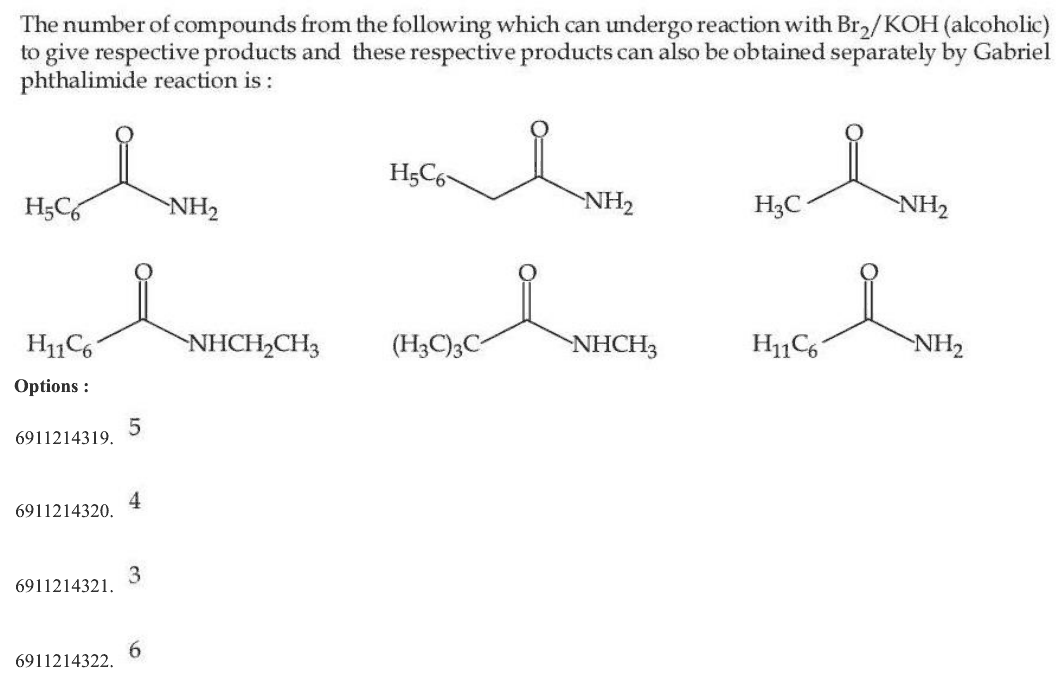
The number of compounds from the following which can undergo reaction with $\mathrm{Br_2}$/KOH (alcoholic) to give respective products and these respective products can also be obtained separately by Gabriel phthalimide reaction is :

(see the figure above)

The question and its figure as printed in B Tech 6th Apr 2026 Shift 2.
The question as printed in the paper.
  • A

    5

  • B

    4

  • C

    3

  • D

    6

4JEE Main 2026 · 5 Apr · Shift 1MCQOpen question page ↗

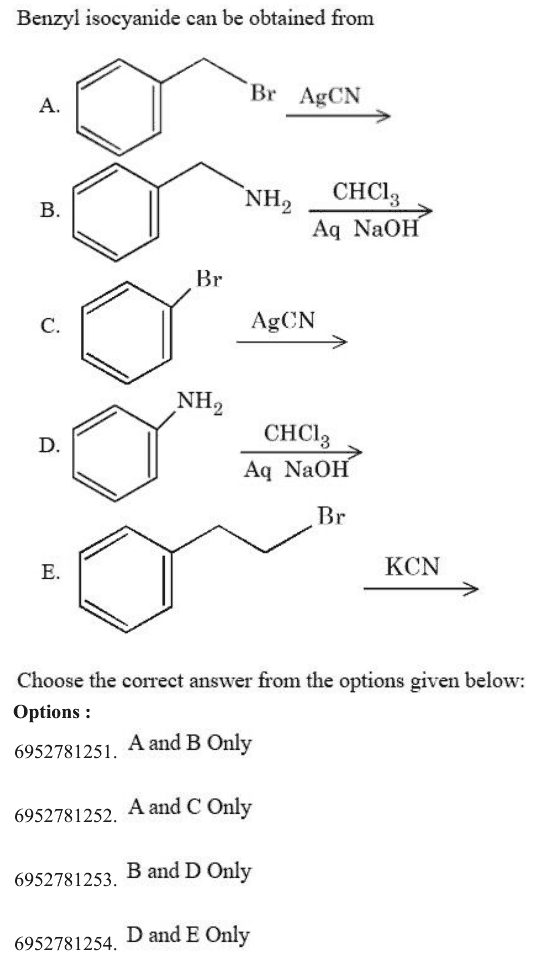
Benzyl isocyanide can be obtained from

A. (see the figure above)

B. (see the figure above)

C. (see the figure above)

D. (see the figure above)

E. (see the figure above)

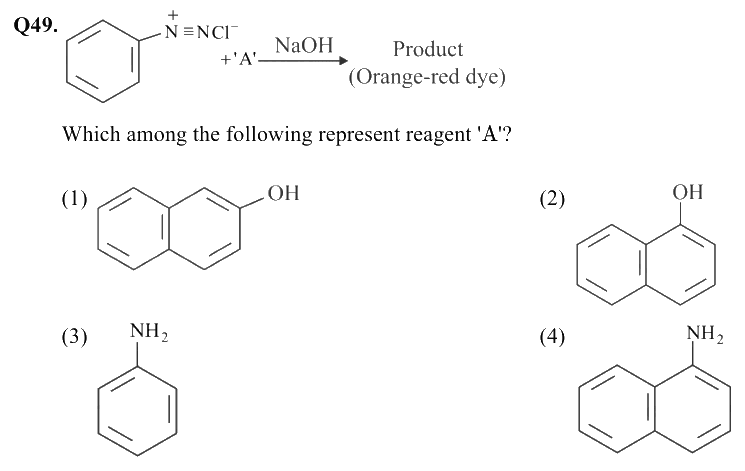
Choose the correct answer from the options given below:

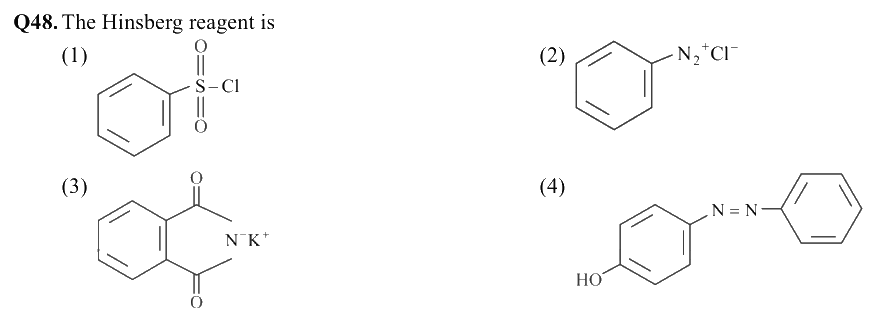
The question and its figure as printed in B Tech 5th Apr 2026 Shift 1.
The question as printed in the paper.
  • A

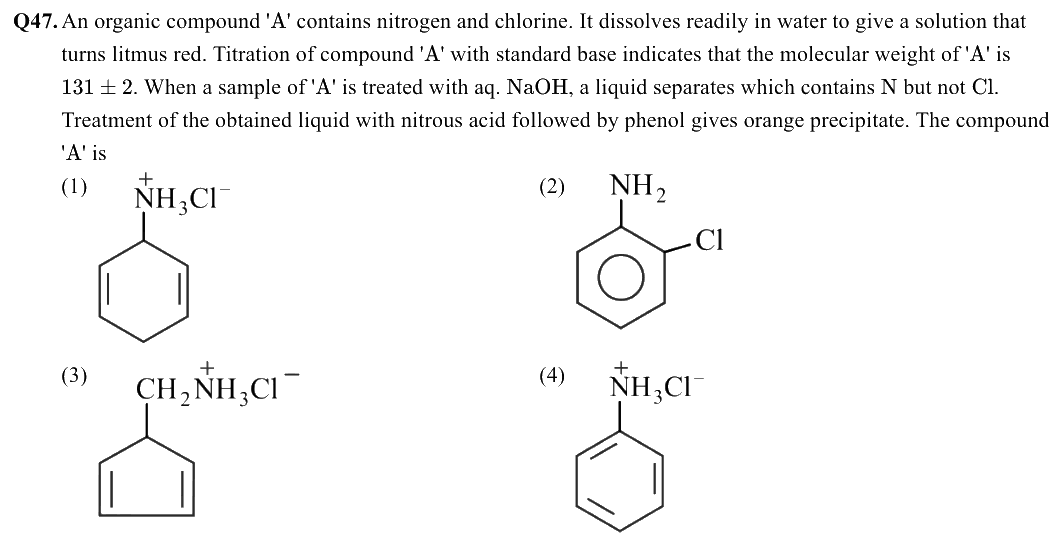
    A and B Only

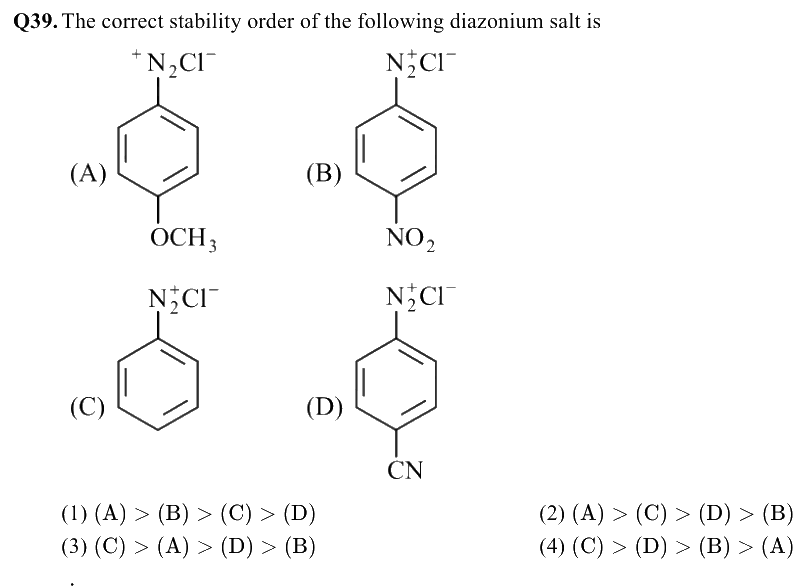
  • B

    A and C Only

  • C

    B and D Only

  • D

    D and E Only

5JEE Main 2026 · 5 Apr · Shift 1MCQOpen question page ↗

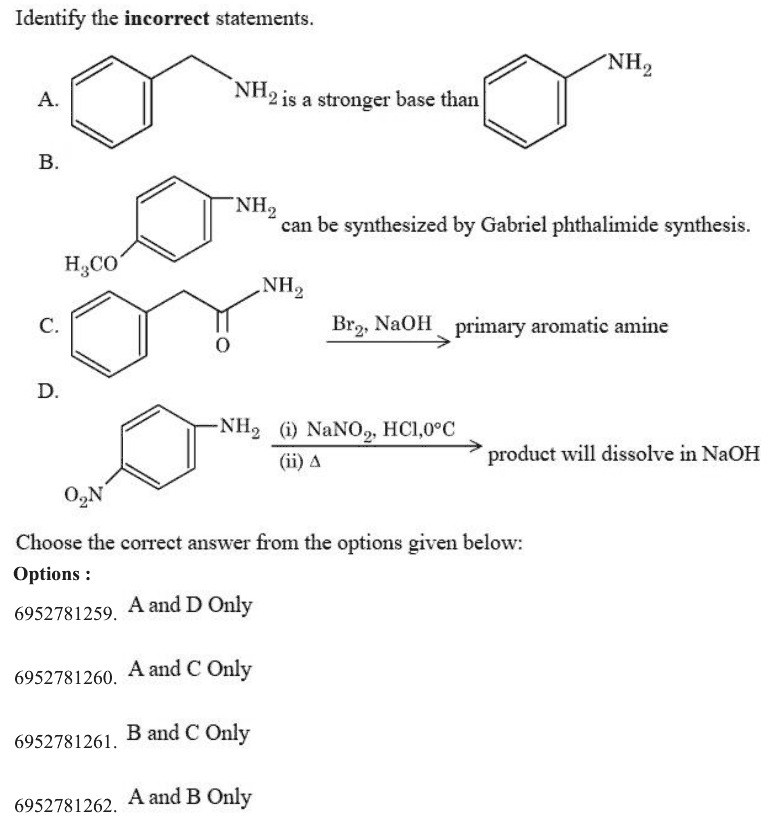
Identify the incorrect statements.

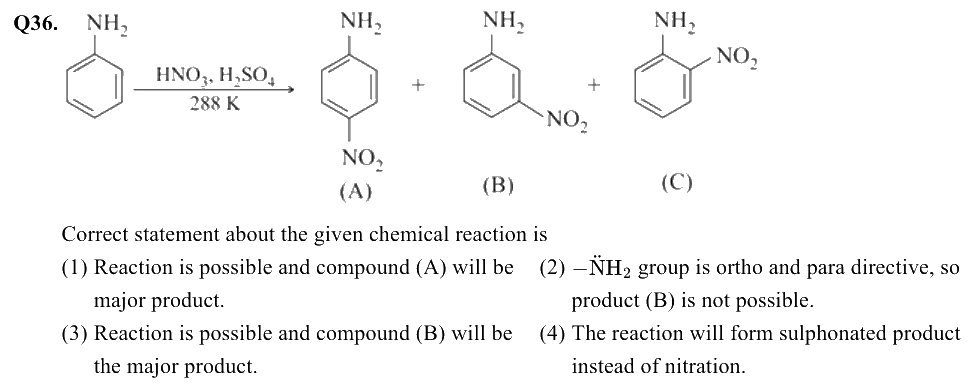
A. (see the figure above) is a stronger base than (see the figure above)

B. (see the figure above) can be synthesized by Gabriel phthalimide synthesis.

C. (see the figure above) $\xrightarrow{\mathrm{Br_2,\ NaOH}}$ primary aromatic amine

D. (see the figure above) $\xrightarrow[\text{(ii) }\Delta]{\text{(i) }\mathrm{NaNO_2,\ HCl,0^\circ C}}$ product will dissolve in NaOH

Choose the correct answer from the options given below:

The question and its figure as printed in B Tech 5th Apr 2026 Shift 1.
The question as printed in the paper.
  • A

    A and D Only

  • B

    A and C Only

  • C

    B and C Only

  • D

    A and B Only

6JEE Main 2026 · 5 Apr · Shift 2MCQOpen question page ↗

Given below are two statements :

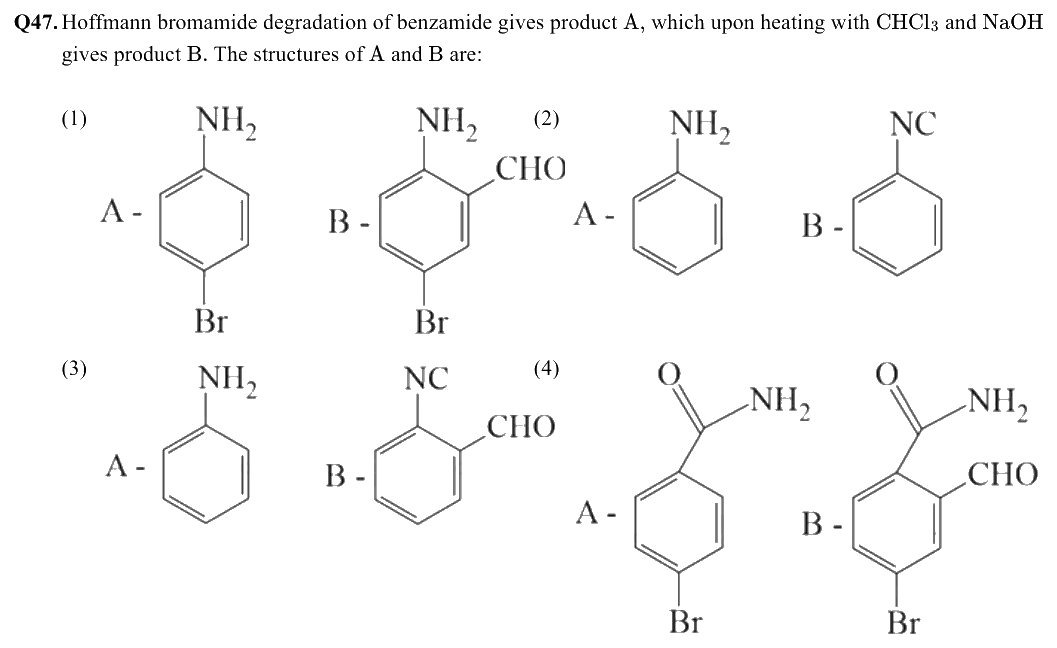
Statement I : Heating benzamide with bromine in an ethanolic solution of sodium hydroxide will give benzylamine.

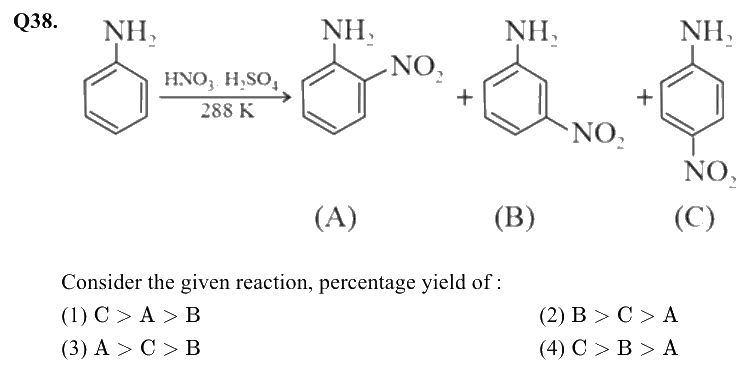
Statement II : Nitration of aniline with $\mathrm{HNO_3/H_2SO_4}$ at 288 K produces *m*-nitroaniline in higher amount than *o*-nitroaniline (pH adjusted).

In the light of the above statements, choose the correct answer from the options given below :

  • A

    Both Statement I and Statement II are true

  • B

    Both Statement I and Statement II are false

  • C

    Statement I is true but Statement II is false

  • D

    Statement I is false but Statement II is true

7JEE Main 2026 · 4 Apr · Shift 1MCQOpen question page ↗

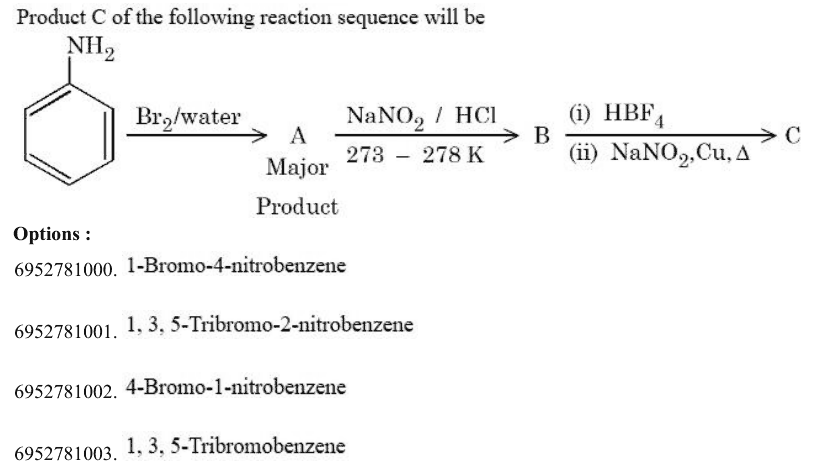
Product C of the following reaction sequence will be

(see the figure above)

The question and its figure as printed in B Tech 4th Apr 2026 Shift 1.
The question as printed in the paper.
  • A

    1-Bromo-4-nitrobenzene

  • B

    1, 3, 5-Tribromo-2-nitrobenzene

  • C

    4-Bromo-1-nitrobenzene

  • D

    1, 3, 5-Tribromobenzene

8JEE Main 2026 · 4 Apr · Shift 2MCQOpen question page ↗

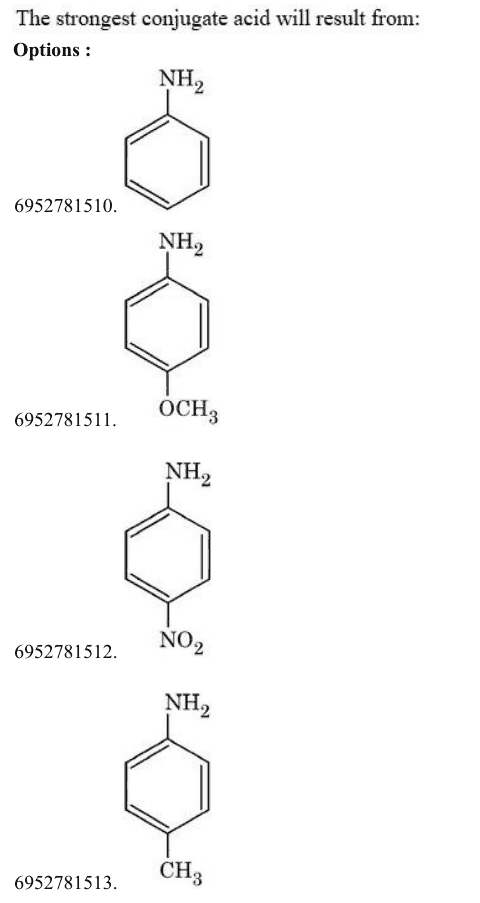
The strongest conjugate acid will result from:

The question and its figure as printed in B Tech 4th Apr 2026 Shift 2. Option 1: a six-membered ring drawn with alternating double bonds, with NH2 on a bond straight up from its top vertex and nothing on its bottom vertex Option 2: a six-membered ring drawn with alternating double bonds, with NH2 on a bond straight up from its top vertex and OCH3 on a bond straight down from its bottom vertex Option 3: a six-membered ring drawn with alternating double bonds, with NH2 on a bond straight up from its top vertex and NO2 on a bond straight down from its bottom vertex Option 4: a six-membered ring drawn with alternating double bonds, with NH2 on a bond straight up from its top vertex and CH3 on…
The question as printed in the paper.
  • A

    see figure a six-membered ring drawn with alternating double bonds, with NH2 on a bond straight up from its top vertex and nothing on its bottom vertex

  • B

    see figure a six-membered ring drawn with alternating double bonds, with NH2 on a bond straight up from its top vertex and OCH3 on a bond straight down from its bottom vertex

  • C

    see figure a six-membered ring drawn with alternating double bonds, with NH2 on a bond straight up from its top vertex and NO2 on a bond straight down from its bottom vertex

  • D

    see figure a six-membered ring drawn with alternating double bonds, with NH2 on a bond straight up from its top vertex and CH3 on a bond straight down from its bottom vertex

9JEE Main 2026 · 2 Apr · Shift 2MCQOpen question page ↗

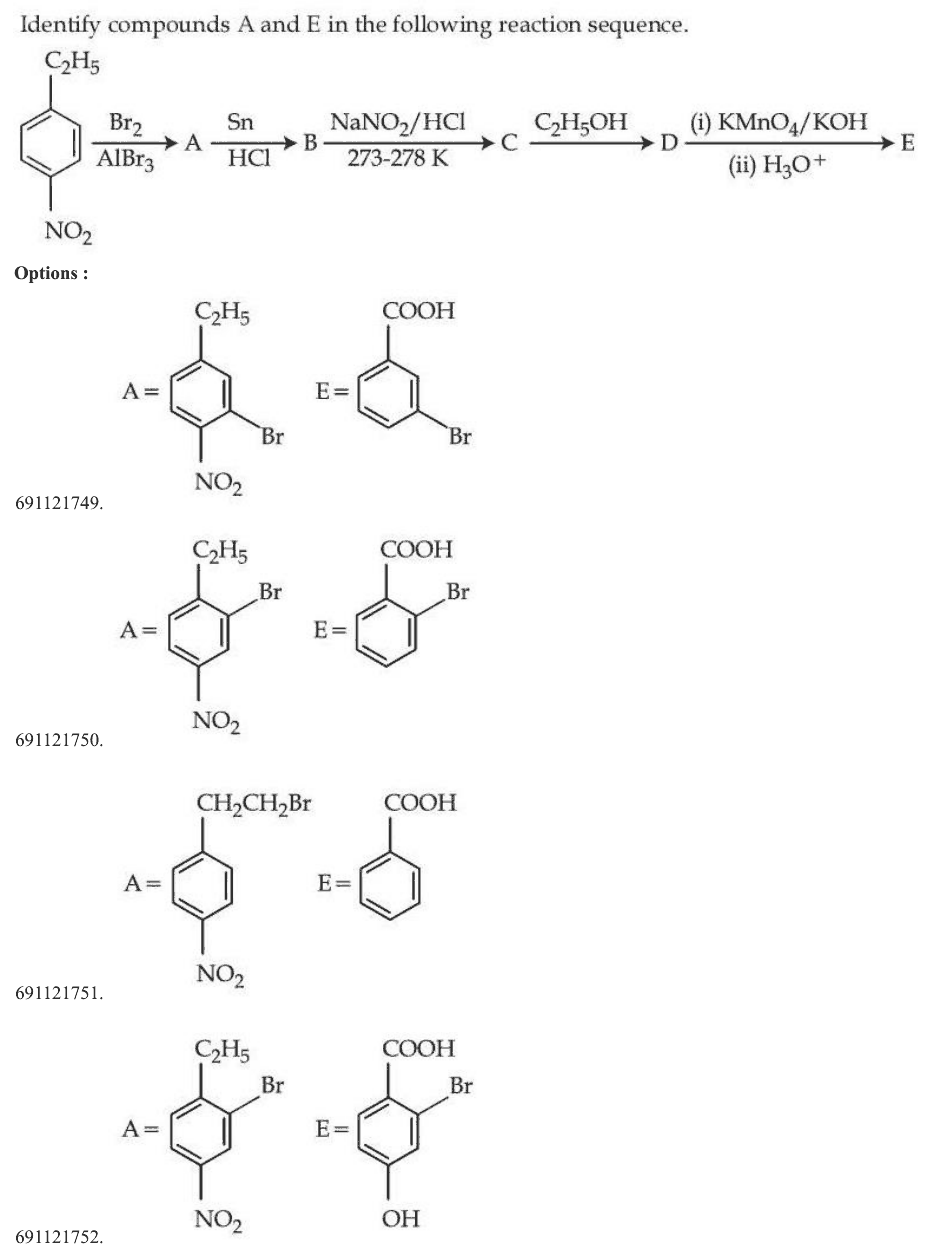
Identify compounds A and E in the following reaction sequence.

(see the figure above)

The question and its figure as printed in B Tech 2nd Apr 2026 Shift 2. Option 1: A = ring with C2H5 at top, Br at lower right, NO2 at bottom; E = ring with COOH at top, Br at lower right Option 2: A = ring with C2H5 at top, Br at upper right, NO2 at bottom; E = ring with COOH at top and Br at upper right Option 3: A = ring with CH2CH2Br at top and NO2 at bottom; E = ring with COOH at top only Option 4: A = ring with C2H5 at top, Br at upper right, NO2 at bottom; E = ring with COOH at top, Br at upper right and OH at bottom
The question as printed in the paper.
  • A

    see figure A = ring with C2H5 at top, Br at lower right, NO2 at bottom; E = ring with COOH at top, Br at lower right

  • B

    see figure A = ring with C2H5 at top, Br at upper right, NO2 at bottom; E = ring with COOH at top and Br at upper right

  • C

    see figure A = ring with CH2CH2Br at top and NO2 at bottom; E = ring with COOH at top only

  • D

    see figure A = ring with C2H5 at top, Br at upper right, NO2 at bottom; E = ring with COOH at top, Br at upper right and OH at bottom

10JEE Main 2026 · 28 Jan · Shift 1MCQOpen question page ↗

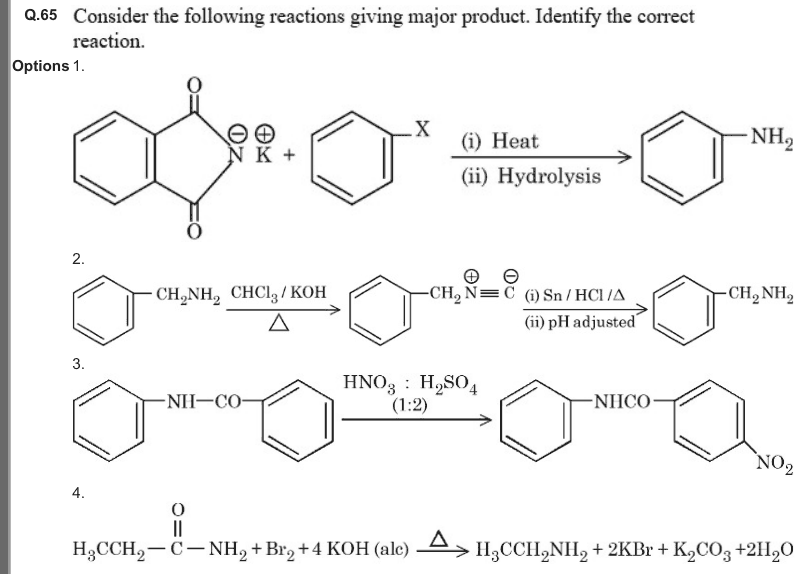
Consider the following reactions giving major product. Identify the correct reaction.

The question and its figure as printed in JEE Main 2026 28 Jan Shift 1. Option 1: the potassium salt of phthalimide (a benzene ring fused to a five-membered ring with two C=O groups and N⁻ with K⁺) plus a benzene ring bearing 'X' on its right (written '+ [ring]–X'); an arrow labelled '(i) Heat' and '(ii) Hydrolysis' leads to a benzene ring bearing 'NH2'. Option 2: a benzene ring bearing 'CH2NH2'; an arrow labelled 'CHCl3 / KOH' above and 'Δ' below leads to a benzene ring bearing 'CH2N≡C' with a plus charge above the N and a minus charge above the C; a second arrow labelled '(i) Sn / HCl / Δ' above and '(ii) pH adjusted' below leads to a benzene ring bearing 'CH2NH2'. Option 3: a benzene…
The question as printed in the paper.
  • A

    see figure the potassium salt of phthalimide (a benzene ring fused to a five-membered ring with two C=O groups and N⁻ with K⁺) plus a benzene ring bearing 'X' on its right (written '+ [ring]–X'); an arrow labelled '(i) Heat' and '(ii) Hydrolysis' leads to a benzene ring bearing 'NH2'.

  • B

    see figure a benzene ring bearing 'CH2NH2'; an arrow labelled 'CHCl3 / KOH' above and 'Δ' below leads to a benzene ring bearing 'CH2N≡C' with a plus charge above the N and a minus charge above the C; a second arrow labelled '(i) Sn / HCl / Δ' above and '(ii) pH adjusted' below leads to a benzene ring bearing 'CH2NH2'.

  • C

    see figure a benzene ring joined by 'NH–CO' to a second benzene ring; an arrow labelled 'HNO3 : H2SO4' above and '(1:2)' below leads to a benzene ring joined by 'NHCO' to a second benzene ring that carries 'NO2' at its lower right.

  • D

    $\mathrm{H_3CCH_2-\underset{O}{\overset{\|}{C}}-NH_2} + \mathrm{Br_2} + 4\,\mathrm{KOH\ (alc)} \xrightarrow{\Delta} \mathrm{H_3CCH_2NH_2} + 2\mathrm{KBr} + \mathrm{K_2CO_3} + 2\mathrm{H_2O}$

11JEE Main 2026 · 28 Jan · Shift 2MCQOpen question page ↗

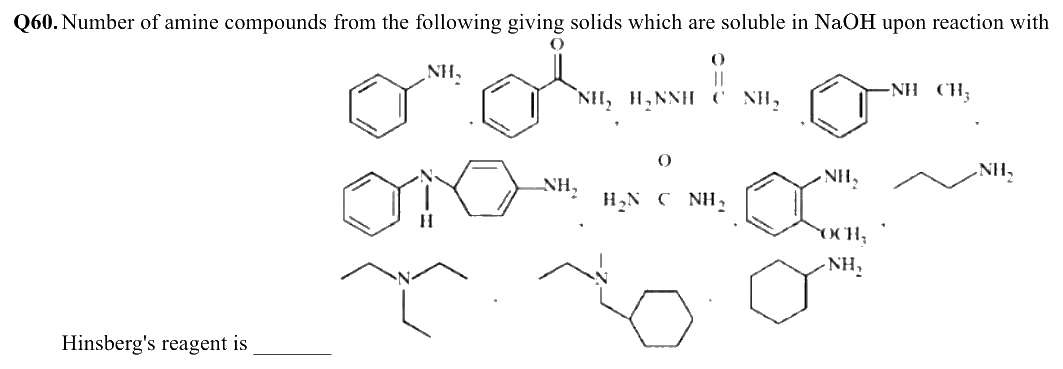
Total number of alkali insoluble solid sulphonamides obtained by reaction of given amines with Hinsberg's reagent is ________.

Aniline, N-Methylaniline, Methanamine, N, N $-$ Dimethylmethanamine, N-Methyl methanamine, Phenylmethanamine, N-propylaniline, N-phenylaniline, N, N-Dimethylaniline, Allyl amine, Isopropyl amine

  • A

    2

  • B

    4

  • C

    5

  • D

    8

12JEE Main 2026 · 28 Jan · Shift 2MCQOpen question page ↗

A student performed analysis of aliphatic organic compound 'X' which on analysis gave C=61.01%, H=15.25%, N=23.74%.

This compound, on treatment with $\mathrm{HNO_2/H_2O}$ produced another compound 'Y' which did not contain any nitrogen atom. However, the compound 'Y' upon controlled oxidation produced another compound 'Z' that responded to iodoform test.

The structure of 'X' is :

  • A

    Ph$-$CH$-$NH$_2$ with CH$_3$ attached below the CH

  • B

    (CH$_3$)$_2$CH$-$NH$_2$, drawn with two CH$_3$ groups bracketed to the CH

  • C

    CH$_3-$CH$_2$CH$-$CH$_3$ with NH$_2$ attached below the CH

  • D

    CH$_3$CH$_2$CH$_2$NH$_2$

13JEE Main 2026 · 24 Jan · Shift 1MCQOpen question page ↗

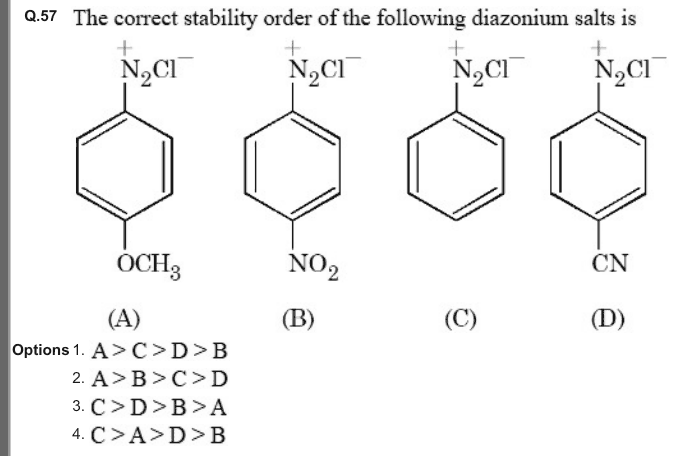
The correct stability order of the following diazonium salts is

(see the figure above)

(A) (B) (C) (D)

The question and its figure as printed in JEE Main 2026 24 Jan Shift 1.
The question as printed in the paper.
  • A

    A $>$ C $>$ D $>$ B

  • B

    A $>$ B $>$ C $>$ D

  • C

    C $>$ D $>$ B $>$ A

  • D

    C $>$ A $>$ D $>$ B

14JEE Main 2026 · 24 Jan · Shift 2MCQOpen question page ↗

Given below are two statements:

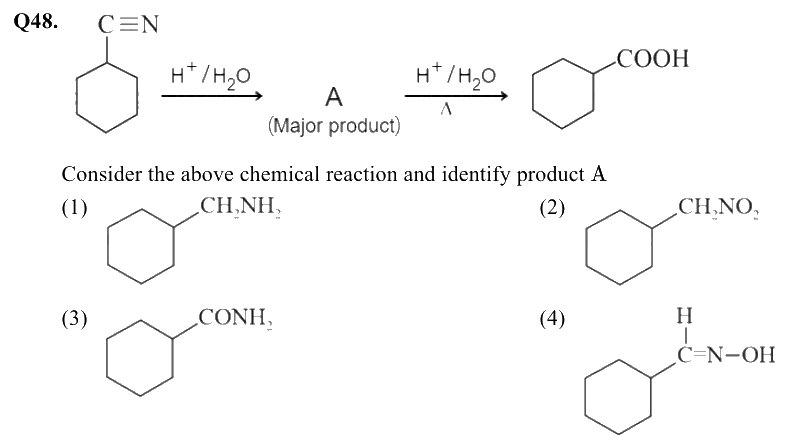
Statement I: The dipole moment of R-CN is greater than R-NC and R-NC can undergo hydrolysis under acidic medium to produce R$-$C(=O)$-$OH.

Statement II: R-CN hydrolyses under acidic medium to produce a compound which on treatment with $\mathrm{SOCl_2}$, followed by the addition of $\mathrm{NH_3}$ gives another compound(x). This compound (x) on treatment with NaOCl/NaOH gives a product, that on treatment with $\mathrm{CHCl_3}$/KOH/$\Delta$ produces R-NC

In the light of the above statements, choose the *correct* answer from the options given below

  • A

    Both Statement I and Statement II are true

  • B

    Both Statement I and Statement II are false

  • C

    Statement I is true but Statement II is false

  • D

    Statement I is false but Statement II is true

15JEE Main 2026 · 23 Jan · Shift 1MCQOpen question page ↗

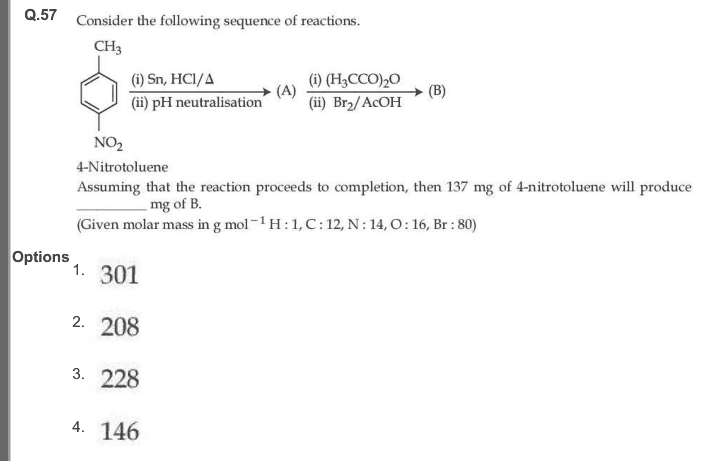
Consider the following sequence of reactions.

(see the figure above)

4-Nitrotoluene

Assuming that the reaction proceeds to completion, then 137 mg of 4-nitrotoluene will produce ________ mg of B.

(Given molar mass in g mol$^{-1}$ H : 1, C : 12, N : 14, O : 16, Br : 80)

The question and its figure as printed in JEE Main 2026 23 Jan Shift 1.
The question as printed in the paper.
  • A

    301

  • B

    208

  • C

    228

  • D

    146

16JEE Main 2026 · 23 Jan · Shift 2MCQOpen question page ↗

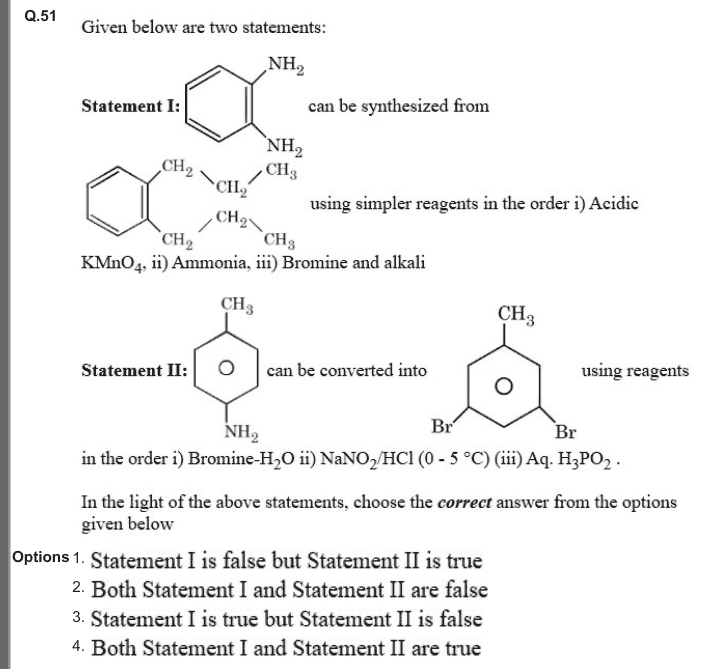
Given below are two statements:

Statement I: (see the figure above) can be synthesized from (see the figure above) using simpler reagents in the order i) Acidic $\mathrm{KMnO_4}$, ii) Ammonia, iii) Bromine and alkali

Statement II: (see the figure above) can be converted into (see the figure above) using reagents in the order i) Bromine-$\mathrm{H_2O}$ ii) $\mathrm{NaNO_2}$/HCl (0 - 5 °C) (iii) Aq. $\mathrm{H_3PO_2}$.

In the light of the above statements, choose the correct answer from the options given below

The question and its figure as printed in JEE Main 2026 23 Jan Shift 2.
The question as printed in the paper.
  • A

    Statement I is false but Statement II is true

  • B

    Both Statement I and Statement II are false

  • C

    Statement I is true but Statement II is false

  • D

    Both Statement I and Statement II are true

17JEE Main 2026 · 23 Jan · Shift 2MCQOpen question page ↗

A student has been given a compound "x" of molecular formula- $\mathrm{C_6H_7N}$. 'x' is sparingly soluble in water. However, on addition of dilute mineral acid, 'x' becomes soluble in water. 'x' when treated with $\mathrm{CHCl_3}$ and KOH(alc), 'y' is produced. 'y' has a specific unpleasant smell. On treatment with benzenesulphonyl chloride, 'x' gives a compound 'z' which is soluble in alkali. The number of different "H" atoms present in 'z' is:-

  • A

    5

  • B

    4

  • C

    8

  • D

    7

18JEE Main 2026 · 22 Jan · Shift 2MCQOpen question page ↗

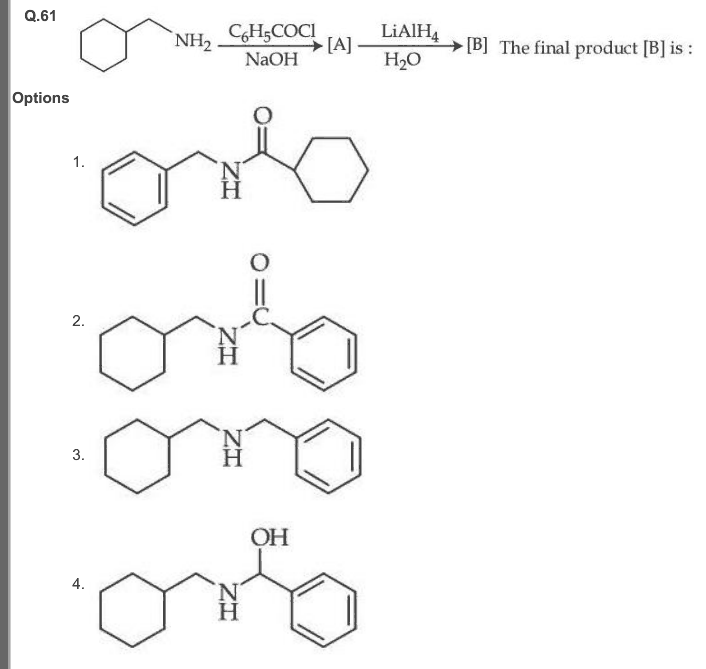
see figure The final product [B] is :

The question and its figure as printed in JEE Main 2026 22 Jan Shift 2. Question: The final product [B] is : Option 1: a six-membered ring drawn with alternating double bonds, joined by a bond going up-right then down-right to 'N' with 'H' written below it; from N a bond goes up-right to a carbon with a double bond to 'O' above; that carbon is also bonded to a plain six-membered ring (no double bonds) on the right. Option 2: a plain six-membered ring (no double bonds), joined by a bond going up-right then down-right to 'N' with 'H' below it; from N a bond goes up-right to an atom printed 'C' that has a double bond to 'O' above and a bond down-right to a six-membered ring drawn with…
The question as printed in the paper.
  • A

    see figure a six-membered ring drawn with alternating double bonds, joined by a bond going up-right then down-right to 'N' with 'H' written below it; from N a bond goes up-right to a carbon with a double bond to 'O' above; that carbon is also bonded to a plain six-membered ring (no double bonds) on the right.

  • B

    see figure a plain six-membered ring (no double bonds), joined by a bond going up-right then down-right to 'N' with 'H' below it; from N a bond goes up-right to an atom printed 'C' that has a double bond to 'O' above and a bond down-right to a six-membered ring drawn with alternating double bonds.

  • C

    see figure a plain six-membered ring, a bond up-right then down-right to 'N' with 'H' below it, then a bond up-right then down-right to a six-membered ring drawn with alternating double bonds.

  • D

    see figure a plain six-membered ring, a bond up-right then down-right to 'N' with 'H' below it; from N a bond goes up-right to a carbon that has 'OH' on a bond straight up and a bond down-right to a six-membered ring drawn with alternating double bonds.

19JEE Main 2026 · 21 Jan · Shift 2MCQOpen question page ↗

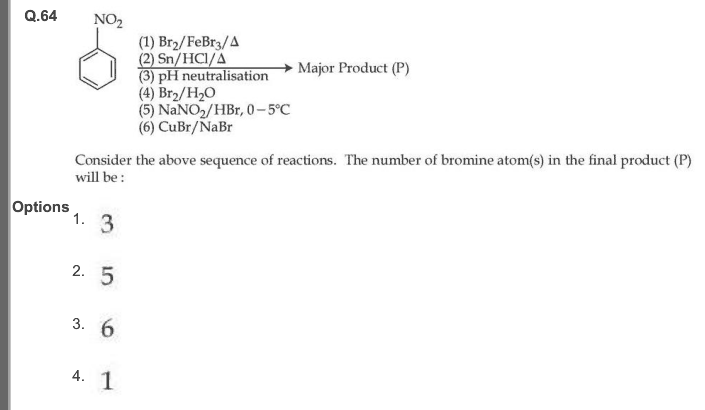
Consider the above sequence of reactions. The number of bromine atom(s) in the final product (P) will be :

(see the figure above)

The question and its figure as printed in JEE Main 2026 21 Jan Shift 2.
The question as printed in the paper.
  • A

    3

  • B

    5

  • C

    6

  • D

    1

20JEE Main 2025 · 7 Apr · Shift 1MCQOpen question page ↗

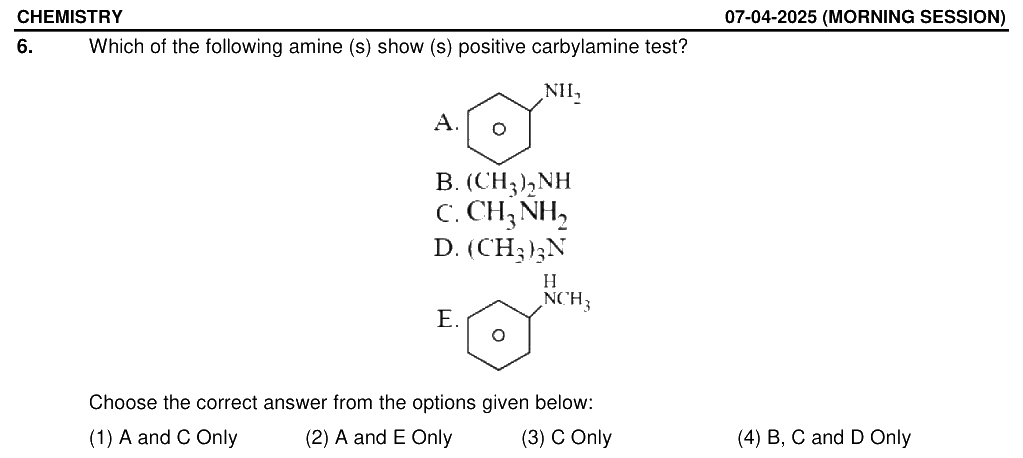
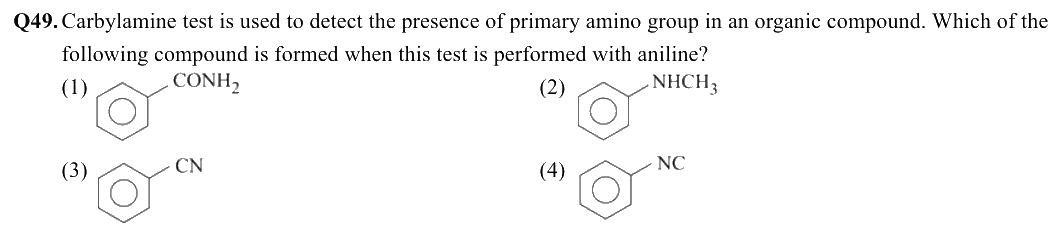
Which of the following amine (s) show (s) positive carbylamine test?

(see the figure above)

Choose the correct answer from the options given below:

The question and its figure as printed in JEE Main 2025 07 Apr Shift 1.
The question as printed in the paper.
  • A

    A and C Only

  • B

    A and E Only

  • C

    C Only

  • D

    B, C and D Only

21JEE Main 2025 · 7 Apr · Shift 2MCQOpen question page ↗

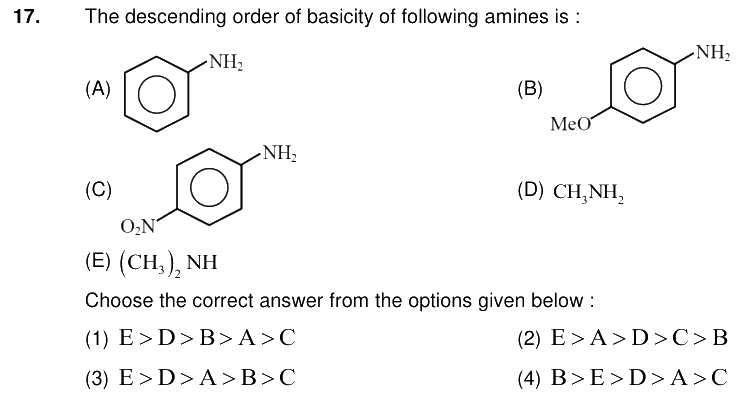
The descending order of basicity of following amines is :

(see the figure above)

(D) $CH_3NH_2$

(E) $(CH_3)_2NH$

Choose the correct answer from the options given below :

The question and its figure as printed in JEE Main 2025 07 Apr Shift 2.
The question as printed in the paper.
  • A

    E > D > B > A > C

  • B

    E > A > D > C > B

  • C

    E > D > A > B > C

  • D

    B > E > D > A > C

22JEE Main 2025 · 4 Apr · Shift 1MCQOpen question page ↗

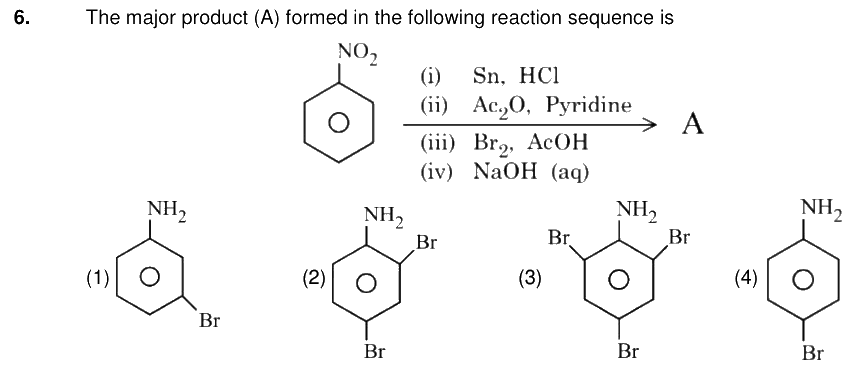
The major product (A) formed in the following reaction sequence is

(see the figure above)

The question and its figure as printed in JEE Main 2025 04 Apr Shift 1. Option 1: a benzene ring (circle inside) with 'NH2' on the top vertex and 'Br' on the lower-right vertex (meta to the NH2). Option 2: a benzene ring (circle inside) with 'NH2' on the top vertex, 'Br' on the upper-right vertex (next to the NH2 carbon) and a second 'Br' on the bottom vertex (opposite the NH2). Option 3: a benzene ring (circle inside) with 'NH2' on the top vertex, 'Br' on the upper-left vertex, 'Br' on the upper-right vertex and a third 'Br' on the bottom vertex. Option 4: a benzene ring (circle inside) with 'NH2' on the top vertex and 'Br' on the bottom vertex (opposite the NH2).
The question as printed in the paper.
  • A

    see figure a benzene ring (circle inside) with 'NH2' on the top vertex and 'Br' on the lower-right vertex (meta to the NH2).

  • B

    see figure a benzene ring (circle inside) with 'NH2' on the top vertex, 'Br' on the upper-right vertex (next to the NH2 carbon) and a second 'Br' on the bottom vertex (opposite the NH2).

  • C

    see figure a benzene ring (circle inside) with 'NH2' on the top vertex, 'Br' on the upper-left vertex, 'Br' on the upper-right vertex and a third 'Br' on the bottom vertex.

  • D

    see figure a benzene ring (circle inside) with 'NH2' on the top vertex and 'Br' on the bottom vertex (opposite the NH2).

23JEE Main 2025 · 3 Apr · Shift 1MCQOpen question page ↗

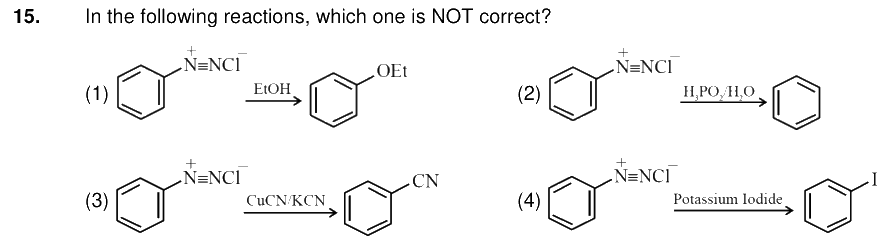
In the following reactions, which one is NOT correct?

The question and its figure as printed in JEE Main 2025 03 Apr Shift 1. Option 1: benzenediazonium chloride (a benzene ring with '–N≡N Cl' and a '+' above the N) with 'EtOH' on the arrow, giving a benzene ring with 'OEt'. Option 2: benzenediazonium chloride with 'H3PO2/H2O' on the arrow, giving a plain benzene ring. Option 3: benzenediazonium chloride with 'CuCN/KCN' on the arrow, giving a benzene ring with 'CN'. Option 4: benzenediazonium chloride with 'Potassium Iodide' on the arrow, giving a benzene ring with 'I'.
The question as printed in the paper.
  • A

    see figure benzenediazonium chloride (a benzene ring with '–N≡N Cl' and a '+' above the N) with 'EtOH' on the arrow, giving a benzene ring with 'OEt'.

  • B

    see figure benzenediazonium chloride with 'H3PO2/H2O' on the arrow, giving a plain benzene ring.

  • C

    see figure benzenediazonium chloride with 'CuCN/KCN' on the arrow, giving a benzene ring with 'CN'.

  • D

    see figure benzenediazonium chloride with 'Potassium Iodide' on the arrow, giving a benzene ring with 'I'.

24JEE Main 2025 · 3 Apr · Shift 1MCQOpen question page ↗

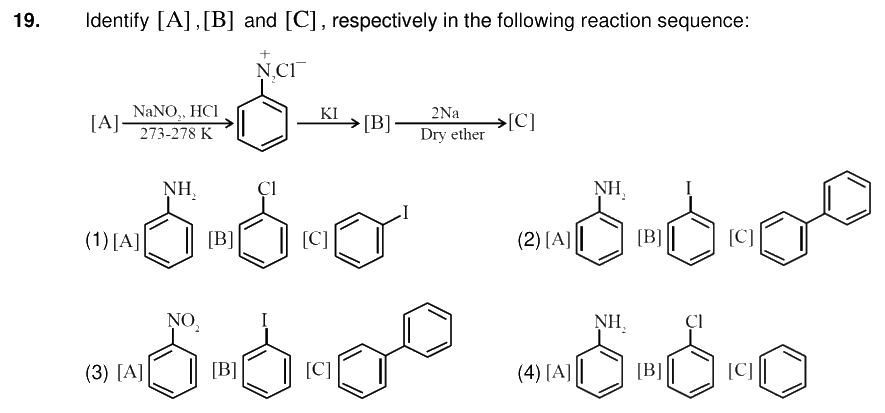
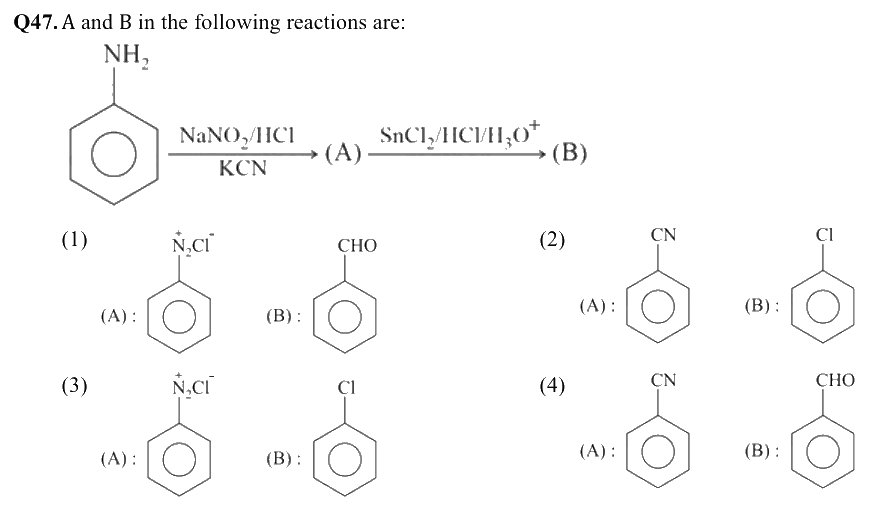
Identify $[A], [B]$ and $[C]$, respectively in the following reaction sequence:

(see the figure above)

The question and its figure as printed in JEE Main 2025 03 Apr Shift 1. Option 1: [A]: a benzene ring with 'NH2' on a bond going up; [B]: a benzene ring with 'Cl' on a bond going up; [C]: a benzene ring with 'I' on a bond going up-right. Option 2: [A]: a benzene ring with 'NH2' on a bond going up; [B]: a benzene ring with 'I' on a bond going up; [C]: two benzene rings joined by a single bond (biphenyl). Option 3: [A]: a benzene ring with 'NO2' on a bond going up; [B]: a benzene ring with 'I' on a bond going up; [C]: two benzene rings joined by a single bond (biphenyl). Option 4: [A]: a benzene ring with 'NH2' on a bond going up; [B]: a benzene ring with 'Cl' on a bond going up; [C]: a…
The question as printed in the paper.
  • A

    see figure [A]: a benzene ring with 'NH2' on a bond going up; [B]: a benzene ring with 'Cl' on a bond going up; [C]: a benzene ring with 'I' on a bond going up-right.

  • B

    see figure [A]: a benzene ring with 'NH2' on a bond going up; [B]: a benzene ring with 'I' on a bond going up; [C]: two benzene rings joined by a single bond (biphenyl).

  • C

    see figure [A]: a benzene ring with 'NO2' on a bond going up; [B]: a benzene ring with 'I' on a bond going up; [C]: two benzene rings joined by a single bond (biphenyl).

  • D

    see figure [A]: a benzene ring with 'NH2' on a bond going up; [B]: a benzene ring with 'Cl' on a bond going up; [C]: a plain benzene ring.

25JEE Main 2025 · 3 Apr · Shift 2MCQOpen question page ↗

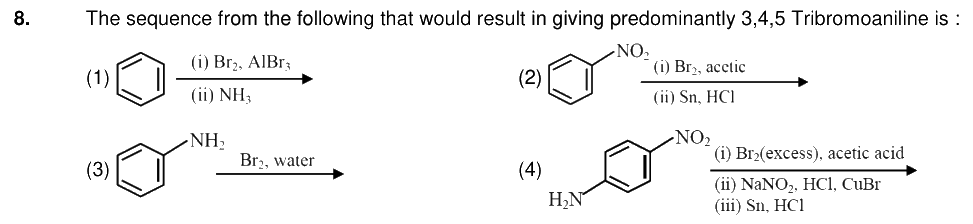
The sequence from the following that would result in giving predominantly 3,4,5 Tribromoaniline is :

The question and its figure as printed in JEE Main 2025 03 Apr Shift 2. Option 1: a benzene ring; arrow with '(i) Br2, AlBr3' over and '(ii) NH3' under. Option 2: a benzene ring with 'NO2' on a bond going up-right; arrow with '(i) Br2, acetic' over and '(ii) Sn, HCl' under. Option 3: a benzene ring with 'NH2' on a bond going up-right; arrow with 'Br2, water'. Option 4: a benzene ring with 'NO2' at the upper right and 'H2N' at the lower left (opposite carbons); arrow with '(i) Br2(excess), acetic acid', '(ii) NaNO2, HCl, CuBr' and '(iii) Sn, HCl' under it.
The question as printed in the paper.
  • A

    see figure a benzene ring; arrow with '(i) Br2, AlBr3' over and '(ii) NH3' under.

  • B

    see figure a benzene ring with 'NO2' on a bond going up-right; arrow with '(i) Br2, acetic' over and '(ii) Sn, HCl' under.

  • C

    see figure a benzene ring with 'NH2' on a bond going up-right; arrow with 'Br2, water'.

  • D

    see figure a benzene ring with 'NO2' at the upper right and 'H2N' at the lower left (opposite carbons); arrow with '(i) Br2(excess), acetic acid', '(ii) NaNO2, HCl, CuBr' and '(iii) Sn, HCl' under it.

26JEE Main 2025 · 2 Apr · Shift 1MCQOpen question page ↗

The correct order of basic nature in aqueous solution for the bases $NH_3, H_2N - NH_2, CH_3CH_2NH_2, (CH_3CH_2)_2NH$ and $(CH_3CH_2)_3N$ is :

  • A

    $NH_3 < H_2N - NH_2 < (CH_3CH_2)_3N < CH_3CH_2NH_2 < (CH_3CH_2)_2NH$

  • B

    $NH_3 < H_2N - NH_2 < CH_3CH_2NH_2 < (CH_3CH_2)_2NH < (CH_3CH_2)_3N$

  • C

    $H_2N - NH_2 < NH_3 < (CH_3CH_2)_3N < CH_3CH_2NH_2 < (CH_3CH_2)_2NH$

  • D

    $NH_2 - NH_2 < NH_3 < CH_3CH_2NH_2 < (CH_3CH_2)_3N < (CH_3CH_2)_2NH$

27JEE Main 2025 · 2 Apr · Shift 2MCQOpen question page ↗

When a concentrated solution of sulphanilic acid and 1-naphthylamine is treated with nitrous acid (273 K) and acidified with acetic acid, the mass (g) of 0.1 mole of product formed is :

(Given molar mass in $gmol^{-1}H : 1, C : 12, N : 14, O : 16, S : 32$ )

  • A

    343

  • B

    330

  • C

    33

  • D

    66

28JEE Main 2025 · 29 Jan · Shift 2MCQOpen question page ↗

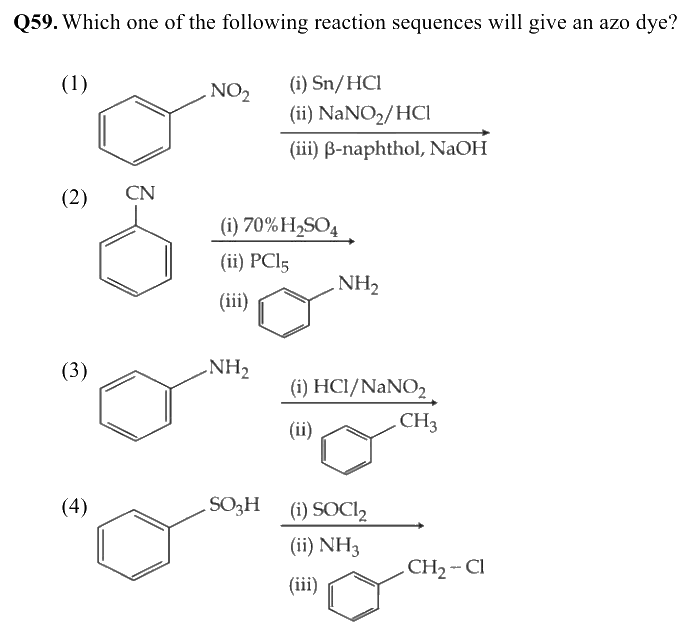
Which one of the following reaction sequences will give an azo dye?

The question and its figure as printed in JEE Main 2025 29 Jan Shift 2. Option 1: a benzene ring with 'NO2' on a bond going up-right; an arrow to the right with the steps '(i) Sn/HCl', '(ii) NaNO2/HCl' and '(iii) β-naphthol, NaOH' over and under it. Option 2: a benzene ring with 'CN' on a bond going up from its top; an arrow with the steps '(i) 70%H2SO4', '(ii) PCl5' and '(iii)' followed by a second benzene ring with 'NH2' on a bond going up-right. Option 3: a benzene ring with 'NH2' on a bond going up-right; an arrow with the steps '(i) HCl/NaNO2' and '(ii)' followed by a benzene ring with 'CH3' on a bond going up-right. Option 4: a benzene ring with 'SO3H' on a bond going up-right; an…
The question as printed in the paper.
  • A

    see figure a benzene ring with 'NO2' on a bond going up-right; an arrow to the right with the steps '(i) Sn/HCl', '(ii) NaNO2/HCl' and '(iii) β-naphthol, NaOH' over and under it.

  • B

    see figure a benzene ring with 'CN' on a bond going up from its top; an arrow with the steps '(i) 70%H2SO4', '(ii) PCl5' and '(iii)' followed by a second benzene ring with 'NH2' on a bond going up-right.

  • C

    see figure a benzene ring with 'NH2' on a bond going up-right; an arrow with the steps '(i) HCl/NaNO2' and '(ii)' followed by a benzene ring with 'CH3' on a bond going up-right.

  • D

    see figure a benzene ring with 'SO3H' on a bond going up-right; an arrow with the steps '(i) SOCl2', '(ii) NH3' and '(iii)' followed by a benzene ring with 'CH2–Cl' on a bond going up-right.

29JEE Main 2025 · 28 Jan · Shift 2MCQOpen question page ↗

Identify correct statements : (A) Primary amines do not give diazonium salts when treated with $\mathrm{NaNO_2}$ in acidic condition. (B) Aliphatic and aromatic primary amines on heating with $\mathrm{CHCl_3}$ and ethanolic KOH form carbylamines. (C) Secondary and tertiary amines also give carbylamine test. (D) Benzenesulfonyl chloride is known as Hinsberg's reagent. (E) Tertiary amines reacts with benzenesulfonyl chloride very easily. Choose the correct answer from the options given below :

  • A

    (A) and (B) only

  • B

    (D) and (E) only

  • C

    (B) and (D) only

  • D

    (B) and (C) only

30JEE Main 2025 · 24 Jan · Shift 2MCQOpen question page ↗

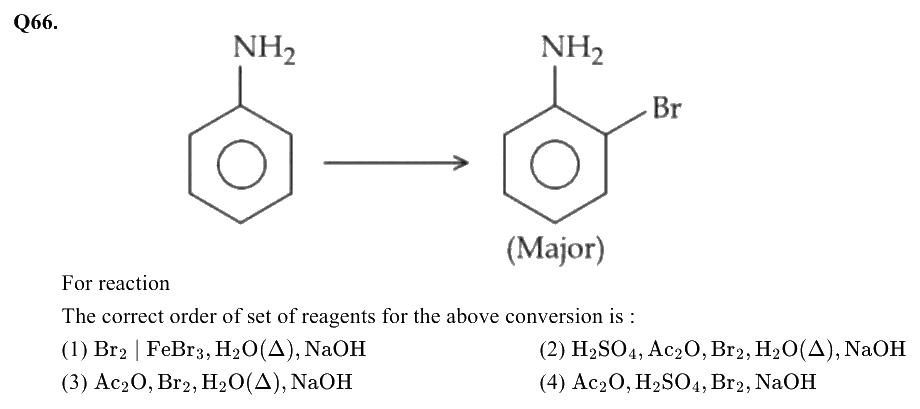
see figure For reaction
The correct order of set of reagents for the above conversion is :

The question and its figure as printed in JEE Main 2025 24 Jan Shift 2. Question: For reaction The correct order of set of reagents for the above conversion is :
The question as printed in the paper.
  • A

    $\mathrm{Br_2 \mid FeBr_3, H_2O(\Delta), NaOH}$

  • B

    $\mathrm{H_2SO_4, Ac_2O, Br_2, H_2O(\Delta), NaOH}$

  • C

    $\mathrm{Ac_2O, Br_2, H_2O(\Delta), NaOH}$

  • D

    $\mathrm{Ac_2O, H_2SO_4, Br_2, NaOH}$

31JEE Main 2025 · 23 Jan · Shift 1MCQOpen question page ↗

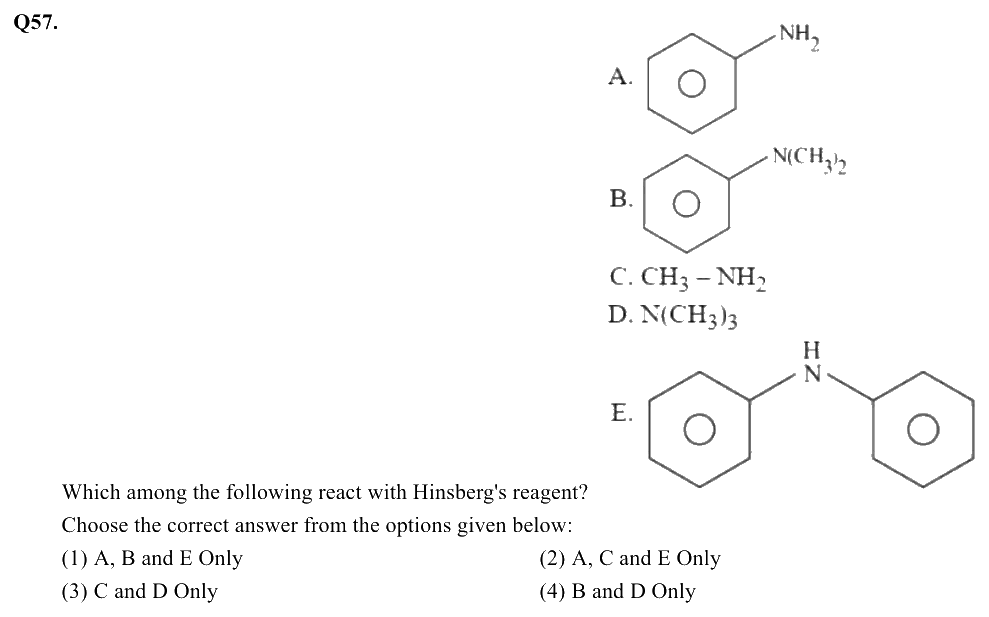
see figure Which among the following react with Hinsberg's reagent? Choose the correct answer from the options given below:

The question and its figure as printed in JEE Main 2025 23 Jan Shift 1. Question: Which among the following react with Hinsberg's reagent? Choose the correct answer from the options given below:
The question as printed in the paper.
  • A

    A, B and E Only

  • B

    A, C and E Only

  • C

    C and D Only

  • D

    B and D Only

32JEE Main 2025 · 22 Jan · Shift 1MCQOpen question page ↗

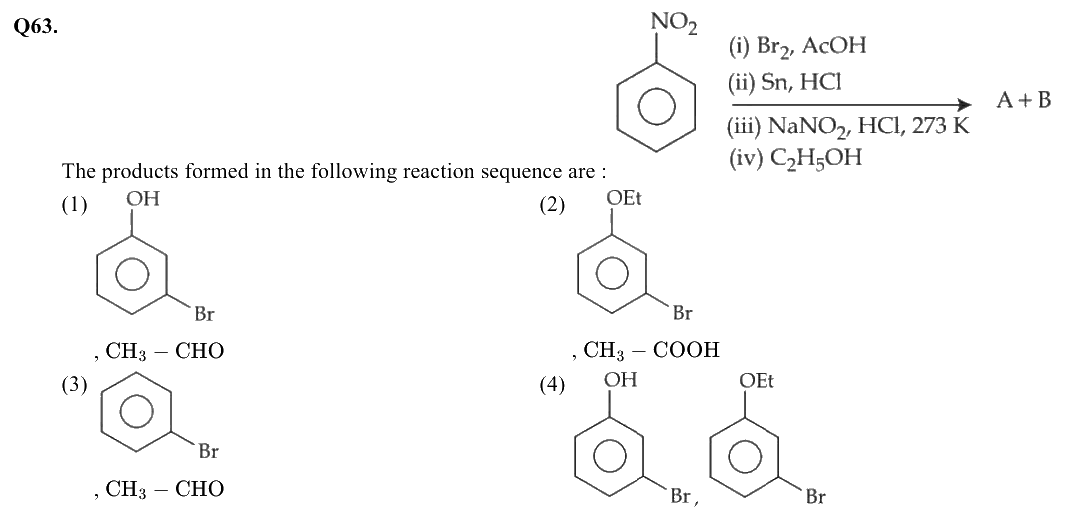
see figure The products formed in the following reaction sequence are :

The question and its figure as printed in JEE Main 2025 22 Jan Shift 1. Question: The products formed in the following reaction sequence are : Option 1: a benzene ring (circle inside) with 'OH' on a bond going up and 'Br' on a bond going down-right (the two groups on ring carbons separated by one carbon); then ', CH3 – CHO'. Option 2: a benzene ring (circle inside) with 'OEt' on a bond going up and 'Br' on a bond going down-right; then ', CH3 – COOH'. Option 3: a benzene ring (circle inside) with 'Br' on a bond going down-right; then ', CH3 – CHO'. Option 4: two benzene rings (circle inside each): the first with 'OH' on a bond going up and 'Br' on a bond going down-right, then a comma; the…
The question as printed in the paper.
  • A

    see figure a benzene ring (circle inside) with 'OH' on a bond going up and 'Br' on a bond going down-right (the two groups on ring carbons separated by one carbon); then ', CH3 – CHO'.

  • B

    see figure a benzene ring (circle inside) with 'OEt' on a bond going up and 'Br' on a bond going down-right; then ', CH3 – COOH'.

  • C

    see figure a benzene ring (circle inside) with 'Br' on a bond going down-right; then ', CH3 – CHO'.

  • D

    see figure two benzene rings (circle inside each): the first with 'OH' on a bond going up and 'Br' on a bond going down-right, then a comma; the second with 'OEt' on a bond going up and 'Br' on a bond going down-right.

33JEE Main 2025 · 22 Jan · Shift 2MCQOpen question page ↗

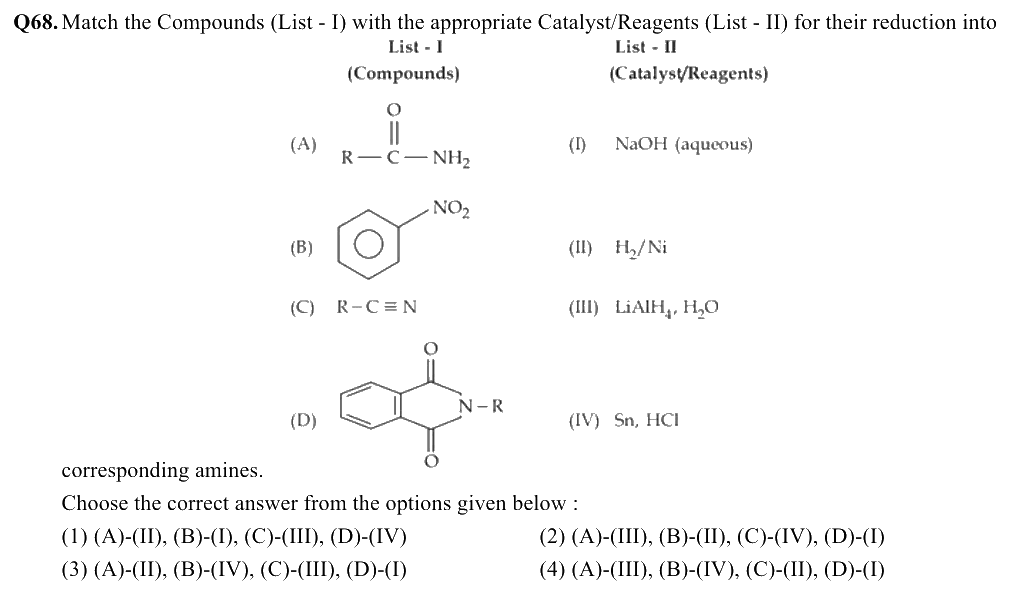
Match the Compounds (List - I) with the appropriate Catalyst/Reagents (List - II) for their reduction into corresponding amines.

(see the figure above)

Choose the correct answer from the options given below :

The question and its figure as printed in JEE Main 2025 22 Jan Shift 2.
The question as printed in the paper.
  • A

    (A)-(II), (B)-(I), (C)-(III), (D)-(IV)

  • B

    (A)-(III), (B)-(II), (C)-(IV), (D)-(I)

  • C

    (A)-(II), (B)-(IV), (C)-(III), (D)-(I)

  • D

    (A)-(III), (B)-(IV), (C)-(II), (D)-(I)

34JEE Main 2024 · 8 Apr · Shift 2MCQOpen question page ↗

Given below are two statements : Statement (I) : All the following compounds react with p-toluenesulfonyl chloride. $\mathrm{C_6H_5NH_2}$ $\mathrm{(C_6H_5)_2NH}$ $\mathrm{(C_6H_5)_3\,N}$ Statement (II) : Their products in the above reaction are soluble is aqueous NaOH. In the light of the above statements, choose the correct answer from the options given below

  • A

    Statement I is false but Statement II is true

  • B

    Statement I is true but Statement II is false

  • C

    Both Statement I and Statement II are true

  • D

    Both Statement I and Statement II are false

35JEE Main 2024 · 6 Apr · Shift 2MCQOpen question page ↗

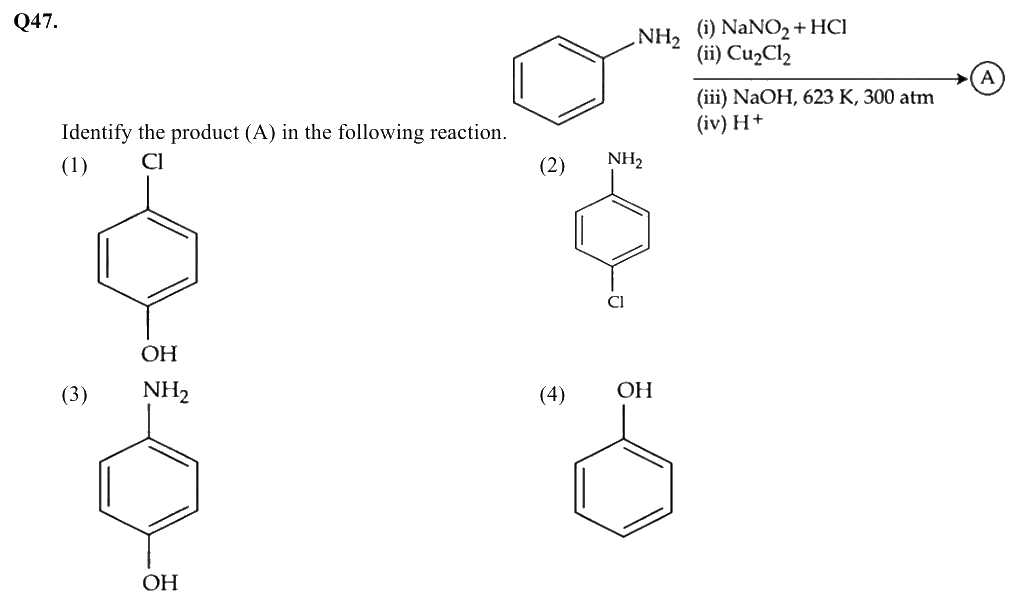
see figure Identify the product (A) in the following reaction.

The question and its figure as printed in JEE Main 2024 06 Apr Shift 2. Question: Identify the product (A) in the following reaction. Option 1: a benzene ring (Kekule drawing) with Cl at the top and OH at the bottom. Option 2: a benzene ring (Kekule drawing) with NH2 at the top and Cl at the bottom. Option 3: a benzene ring (Kekule drawing) with NH2 at the top and OH at the bottom. Option 4: a benzene ring (Kekule drawing) with OH at the top and no other substituent.
The question as printed in the paper.
  • A

    see figure a benzene ring (Kekule drawing) with Cl at the top and OH at the bottom.

  • B

    see figure a benzene ring (Kekule drawing) with NH2 at the top and Cl at the bottom.

  • C

    see figure a benzene ring (Kekule drawing) with NH2 at the top and OH at the bottom.

  • D

    see figure a benzene ring (Kekule drawing) with OH at the top and no other substituent.

36JEE Main 2024 · 1 Feb · Shift 1MCQOpen question page ↗

Given below are two statements:

Statement (I) : Aminobenzene and aniline are same organic compounds.

Statement (II) : Aminobenzene and aniline are different organic compounds.

In the light of the above statements, choose the most appropriate answer from the options given below:

  • A

    Both Statement I and Statement II are correct

  • B

    Statement I is correct but Statement II is incorrect

  • C

    Statement I is incorrect but Statement II is correct

  • D

    Both Statement I and Statement II are incorrect

37JEE Main 2024 · 1 Feb · Shift 1MCQOpen question page ↗

Given below are two statements : one is labelled as Assertion A and the other is labelled as Reason R.

Assertion A: Haloalkanes react with KCN to form alkyl cyanides as a main product while with AgCN form isocyanide as the main product.

Reason R: KCN and AgCN both are highly ionic compounds.

In the light of the above statement, choose the most appropriate answer from the options given below.

  • A

    A is correct but R is not correct

  • B

    Both A and R are correct but R is not the correct explanation of A

  • C

    A is not correct but R is correct

  • D

    Both A and R are correct and R is the correct explanation of A

38JEE Main 2024 · 1 Feb · Shift 1MCQOpen question page ↗

Given below are two statements:

Statement (I) : The $\mathrm{NH_2}$ group in Aniline is ortho and para directing and a powerful activating group.

Statement (II) : Aniline does not undergo FriedelCraft's reaction (alkylation and acylation).

In the light of the above statements, choose the most appropriate answer from the options given below:

  • A

    Both Statement I and Statement II are correct

  • B

    Both Statement I and Statement II are incorrect

  • C

    Statement I is incorrect but Statement II is correct

  • D

    Statement I is correct but Statement II is incorrect

39JEE Main 2024 · 31 Jan · Shift 2MCQOpen question page ↗

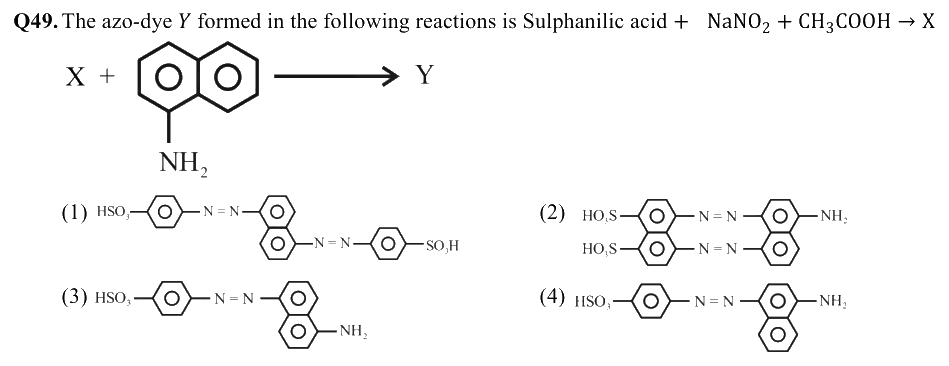
The azo-dye $Y$ formed in the following reactions is Sulphanilic acid + NaNO$_2$ + CH$_3$COOH $\rightarrow$ X

(see the figure above)

The question and its figure as printed in JEE Main 2024 31 Jan Shift 2. Option 1: HSO3 on a benzene ring joined by an N=N link to the upper ring of a naphthalene; a second N=N link from the lower ring of the naphthalene leads to a second benzene ring bearing SO3H Option 2: A naphthalene with HO3S on each of its two rings, joined by two N=N links (one from each ring) to a second naphthalene, which carries NH2 on its upper ring Option 3: HSO3 on a benzene ring joined by an N=N link to the upper ring of a naphthalene, with NH2 on the lower ring of the naphthalene Option 4: HSO3 on a benzene ring joined by an N=N link to the upper ring of a naphthalene, with NH2 on the same upper ring on the…
The question as printed in the paper.
  • A

    see figure HSO$_3$ on a benzene ring joined by an N=N link to the upper ring of a naphthalene; a second N=N link from the lower ring of the naphthalene leads to a second benzene ring bearing SO$_3$H

  • B

    see figure A naphthalene with HO$_3$S on each of its two rings, joined by two N=N links (one from each ring) to a second naphthalene, which carries NH$_2$ on its upper ring

  • C

    see figure HSO$_3$ on a benzene ring joined by an N=N link to the upper ring of a naphthalene, with NH$_2$ on the lower ring of the naphthalene

  • D

    see figure HSO$_3$ on a benzene ring joined by an N=N link to the upper ring of a naphthalene, with NH$_2$ on the same upper ring on the side opposite the N=N link; the lower ring has no substituent

40JEE Main 2024 · 31 Jan · Shift 2MCQOpen question page ↗

Given below are two statements :

Statement I: Aniline reacts with con. H$_2$SO$_4$ followed by heating at 453 - 473 K gives p-aminobenzene sulphonic acid, which gives blood red colour in the 'Lassaigne's test'.

Statement II: In Friedel - Craft's alkylation and acylation reactions, aniline forms salt with the AlCl$_3$ catalyst. Due to this, nitrogen of aniline acquires a positive charge and acts as deactivating group.

In the light of the above statements, choose the correct answer from the options given below :

  • A

    Statement I is false but statement II is true

  • B

    Both statement I and statement II are false

  • C

    Statement I is true but statement II is false

  • D

    Both statement I and statement II are true

41JEE Main 2024 · 30 Jan · Shift 1MCQOpen question page ↗

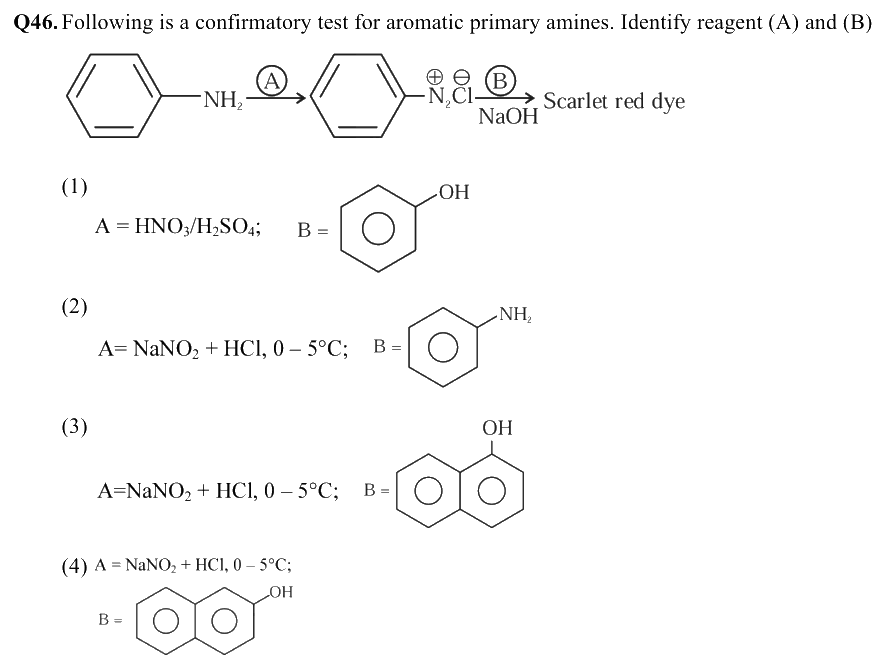
Following is a confirmatory test for aromatic primary amines. Identify reagent (A) and (B)

(see the figure above)

The question and its figure as printed in JEE Main 2024 30 Jan Shift 1.
The question as printed in the paper.
  • A

    $A = \mathrm{HNO_3/H_2SO_4}$; $B =$ (see the figure above) benzene ring with OH on its top right carbon (phenol).

  • B

    $A = \mathrm{NaNO_2 + HCl}$, $0 - 5^\circ\mathrm{C}$; $B =$ (see the figure above) benzene ring with $\mathrm{NH_2}$ on its top right carbon (aniline).

  • C

    $A = \mathrm{NaNO_2 + HCl}$, $0 - 5^\circ\mathrm{C}$; $B =$ (see the figure above) naphthalene (two fused rings) with OH on the top carbon of the right-hand ring next to the shared bond.

  • D

    $A = \mathrm{NaNO_2 + HCl}$, $0 - 5^\circ\mathrm{C}$; $B =$ (see the figure above) naphthalene (two fused rings) with OH on the upper-right carbon of the right-hand ring, one carbon further from the shared bond.

42JEE Main 2024 · 30 Jan · Shift 2MCQOpen question page ↗

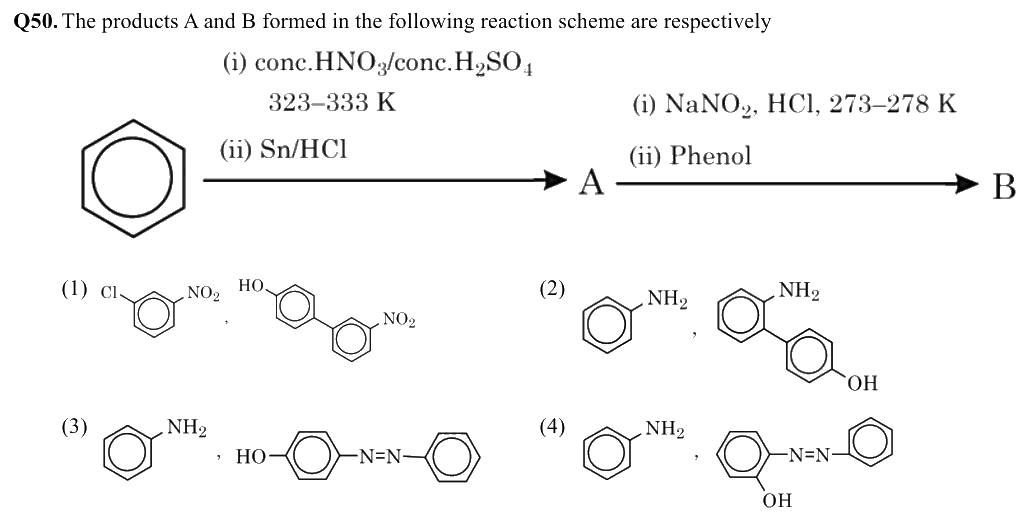
The products A and B formed in the following reaction scheme are respectively

(see the figure above)

The question and its figure as printed in JEE Main 2024 30 Jan Shift 2. Option 1: Two structures separated by a comma: a benzene ring with Cl at the upper left and NO2 at the upper right; and a biphenyl with HO on the top-left ring carbon of the left ring and, on the right ring, NO2 on the carbon at the right. Option 2: Two structures separated by a comma: aniline (benzene ring with NH2 at the upper right); and a biphenyl whose left ring carries NH2 at the top next to the ring-ring bond and whose right ring carries OH at the lower right. Option 3: Two structures separated by a comma: aniline (benzene ring with NH2 at the upper right); and a azo compound HO–C6H4–N=N–C6H5 drawn in a line: a…
The question as printed in the paper.
  • A

    see figure Two structures separated by a comma: a benzene ring with Cl at the upper left and $\mathrm{NO_2}$ at the upper right; and a biphenyl with HO on the top-left ring carbon of the left ring and, on the right ring, $\mathrm{NO_2}$ on the carbon at the right.

  • B

    see figure Two structures separated by a comma: aniline (benzene ring with $\mathrm{NH_2}$ at the upper right); and a biphenyl whose left ring carries $\mathrm{NH_2}$ at the top next to the ring-ring bond and whose right ring carries OH at the lower right.

  • C

    see figure Two structures separated by a comma: aniline (benzene ring with $\mathrm{NH_2}$ at the upper right); and a azo compound HO–C6H4–N=N–C6H5 drawn in a line: a ring with HO at its left end, then N=N, then a second benzene ring at the right.

  • D

    see figure Two structures separated by a comma: aniline (benzene ring with $\mathrm{NH_2}$ at the upper right); and an azo compound: a ring with N=N attached on its right (followed by a second benzene ring) and OH at the bottom of the same ring.

44JEE Main 2024 · 29 Jan · Shift 2MCQOpen question page ↗

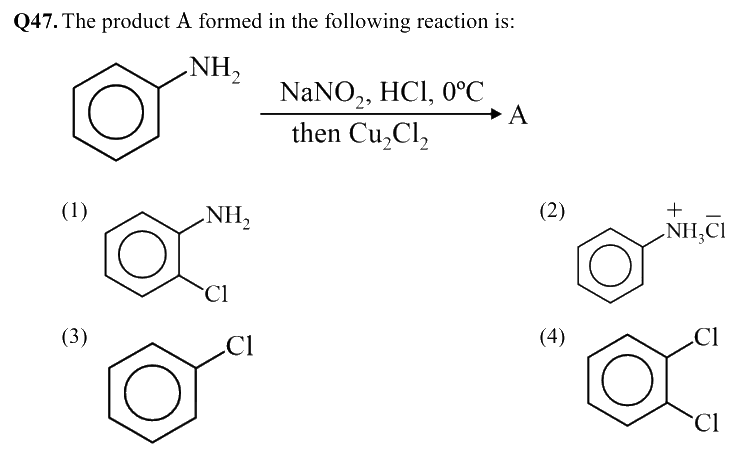
The product A formed in the following reaction is:

(see the figure above)

The question and its figure as printed in JEE Main 2024 29 Jan Shift 2. Option 1: Benzene ring with NH2 on one carbon and Cl on the adjacent carbon (ortho). Option 2: Benzene ring with an NH3 group carrying a plus charge, followed by a Cl with a minus charge (printed as NH3Cl with + over NH3 and a bar over Cl). Option 3: Chlorobenzene: benzene ring with a single Cl. Option 4: Benzene ring with two Cl on adjacent carbons (ortho).
The question as printed in the paper.
  • A

    see figure Benzene ring with NH2 on one carbon and Cl on the adjacent carbon (ortho).

  • B

    see figure Benzene ring with an NH3 group carrying a plus charge, followed by a Cl with a minus charge (printed as $\mathrm{NH_3Cl}$ with + over NH3 and a bar over Cl).

  • C

    see figure Chlorobenzene: benzene ring with a single Cl.

  • D

    see figure Benzene ring with two Cl on adjacent carbons (ortho).

45JEE Main 2024 · 27 Jan · Shift 2MCQOpen question page ↗

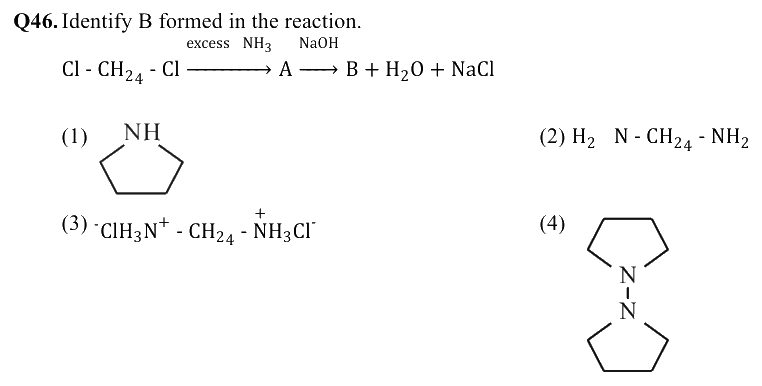
Identify B formed in the reaction.

$$\mathrm{Cl - CH_{24} - Cl} \xrightarrow{\text{excess } \mathrm{NH_3}} A \xrightarrow{\text{NaOH}} B + \mathrm{H_2O} + \mathrm{NaCl}$$

The question and its figure as printed in JEE Main 2024 27 Jan Shift 2. Option 1: Five-membered saturated ring containing one NH (pyrrolidine) Option 4: Two five-membered saturated rings each containing one N, the two N atoms joined to each other by a single bond (N-N), one ring above and one below
The question as printed in the paper.
  • A

    see figure Five-membered saturated ring containing one NH (pyrrolidine)

  • B

    $\mathrm{H_2N - CH_{24} - NH_2}$

  • C

    ${}^{-}\mathrm{ClH_3N^{+} - CH_{24} - \overset{+}{N}H_3Cl^{-}}$

  • D

    see figure Two five-membered saturated rings each containing one N, the two N atoms joined to each other by a single bond (N-N), one ring above and one below

46JEE Main 2023 · 15 Apr · Shift 1MCQOpen question page ↗

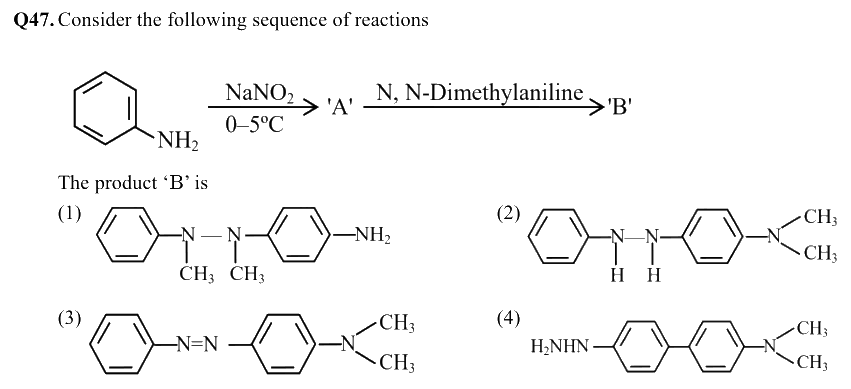
Consider the following sequence of reactions

(see the figure above)
The product 'B' is

The question and its figure as printed in JEE Main 2023 15 Apr Shift 1.
The question as printed in the paper.
  • A

    (structure drawn, see figure)

  • B

    (structure drawn, see figure)

  • C

    (structure drawn, see figure)

  • D

    (structure drawn, see figure)

47JEE Main 2023 · 15 Apr · Shift 1MCQOpen question page ↗

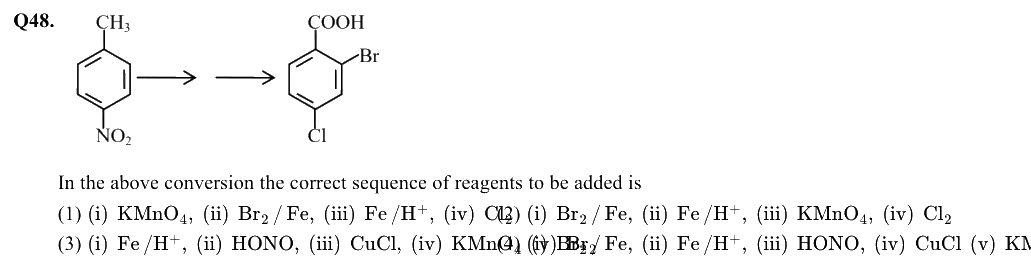
see figure In the above conversion the correct sequence of reagents to be added is

The question and its figure as printed in JEE Main 2023 15 Apr Shift 1. Question: In the above conversion the correct sequence of reagents to be added is
The question as printed in the paper.
  • A

    (i) $\mathrm{KMnO_4}$, (ii) $\mathrm{Br_2}$ / Fe, (iii) Fe /$\mathrm{H^{+}}$, (iv) $\mathrm{Cl_2}$

  • B

    (i) $\mathrm{Br_2}$ / Fe, (ii) Fe /$\mathrm{H^{+}}$, (iii) $\mathrm{KMnO_4}$, (iv) $\mathrm{Cl_2}$

  • C

    (i) Fe /$\mathrm{H^{+}}$, (ii) HONO, (iii) CuCl, (iv) $\mathrm{KMnO_4}$

  • D

    (i) $\mathrm{Br_2}$ / Fe, (ii) Fe /$\mathrm{H^{+}}$, (iii) HONO, (iv) CuCl (v) KM

48JEE Main 2023 · 13 Apr · Shift 2MCQOpen question page ↗

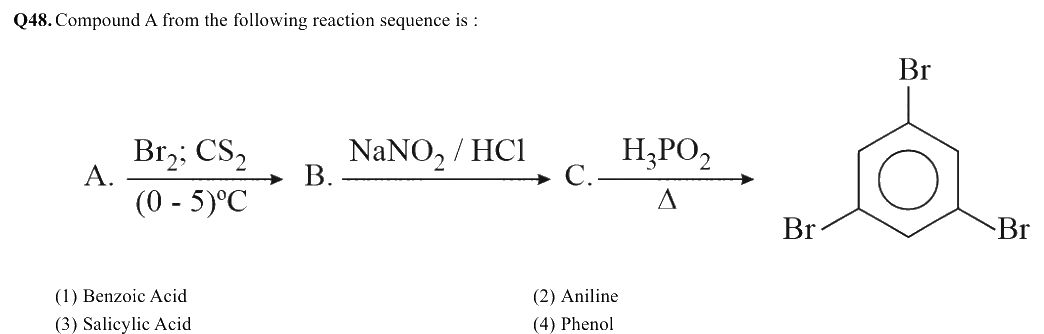
Compound A from the following reaction sequence is :

(see the figure above)

The question and its figure as printed in JEE Main 2023 13 Apr Shift 2.
The question as printed in the paper.
  • A

    Benzoic Acid

  • B

    Aniline

  • C

    Salicylic Acid

  • D

    Phenol

49JEE Main 2023 · 12 Apr · Shift 1MCQOpen question page ↗

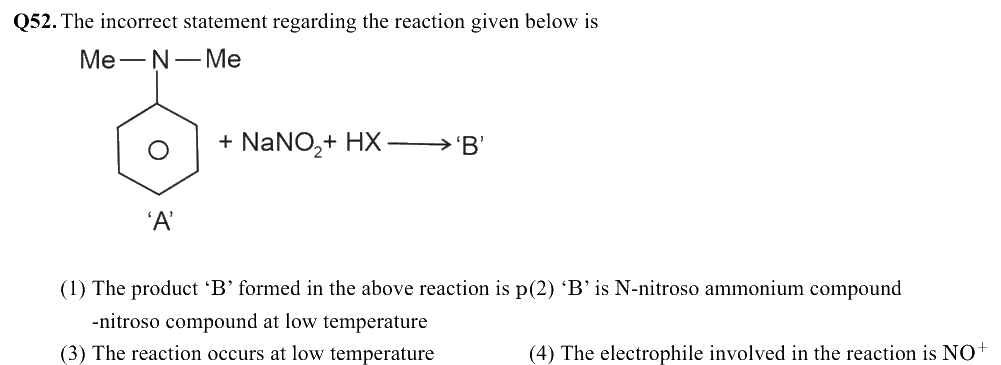
The incorrect statement regarding the reaction given below is
(see the figure above)

The question and its figure as printed in JEE Main 2023 12 Apr Shift 1.
The question as printed in the paper.
  • A

    The product 'B' formed in the above reaction is p-nitroso compound at low temperature

  • B

    'B' is N-nitroso ammonium compound

  • C

    The reaction occurs at low temperature

  • D

    The electrophile involved in the reaction is $\mathrm{NO^+}$

50JEE Main 2023 · 11 Apr · Shift 1MCQOpen question page ↗

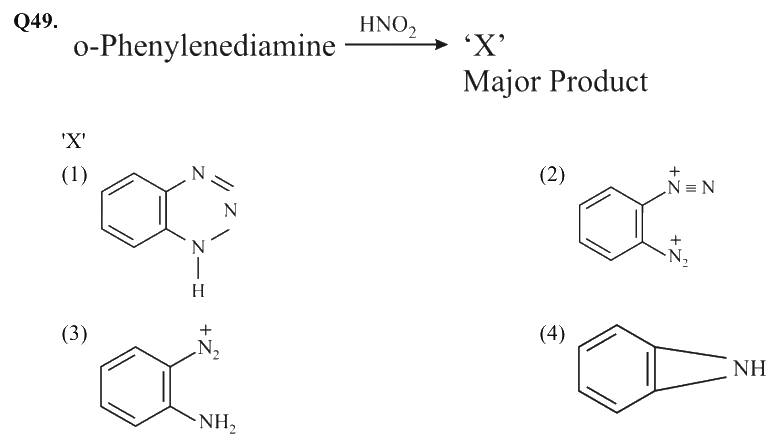
o-Phenylenediamine $\xrightarrow{\mathrm{HNO_2}}$ 'X' Major Product
'X'

The question and its figure as printed in JEE Main 2023 11 Apr Shift 1.
The question as printed in the paper.
  • A

    see figure

  • B

    see figure

  • C

    see figure

  • D

    see figure

51JEE Main 2023 · 10 Apr · Shift 1MCQOpen question page ↗

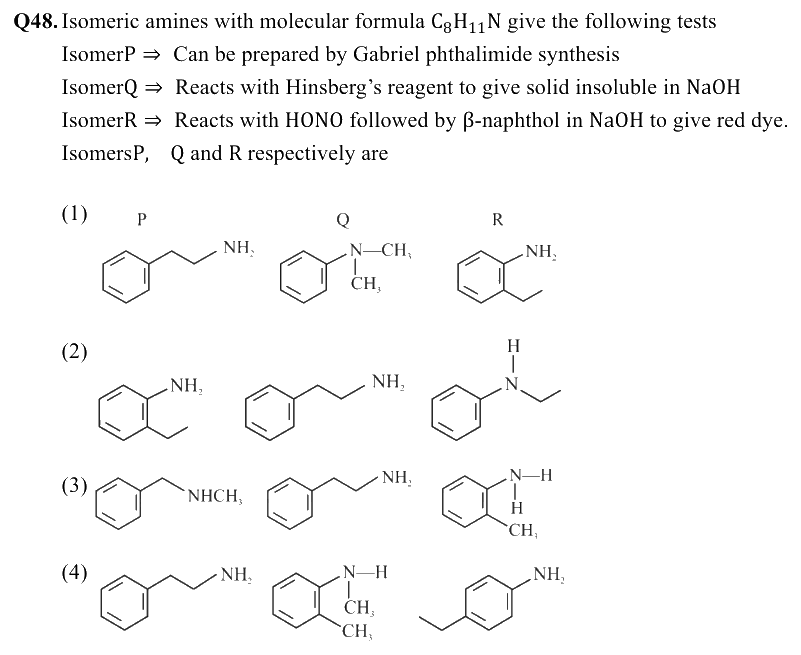
Isomeric amines with molecular formula $\mathrm{C_8H_{11}N}$ give the following tests
IsomerP $\Rightarrow$ Can be prepared by Gabriel phthalimide synthesis
IsomerQ $\Rightarrow$ Reacts with Hinsberg's reagent to give solid insoluble in NaOH
IsomerR $\Rightarrow$ Reacts with HONO followed by $\beta$-naphthol in NaOH to give red dye.
IsomersP, Q and R respectively are
(see the figure above)

The question and its figure as printed in JEE Main 2023 10 Apr Shift 1.
The question as printed in the paper.
  • A

    see figure

  • B

    see figure

  • C

    see figure

  • D

    see figure

52JEE Main 2023 · 8 Apr · Shift 1MCQOpen question page ↗

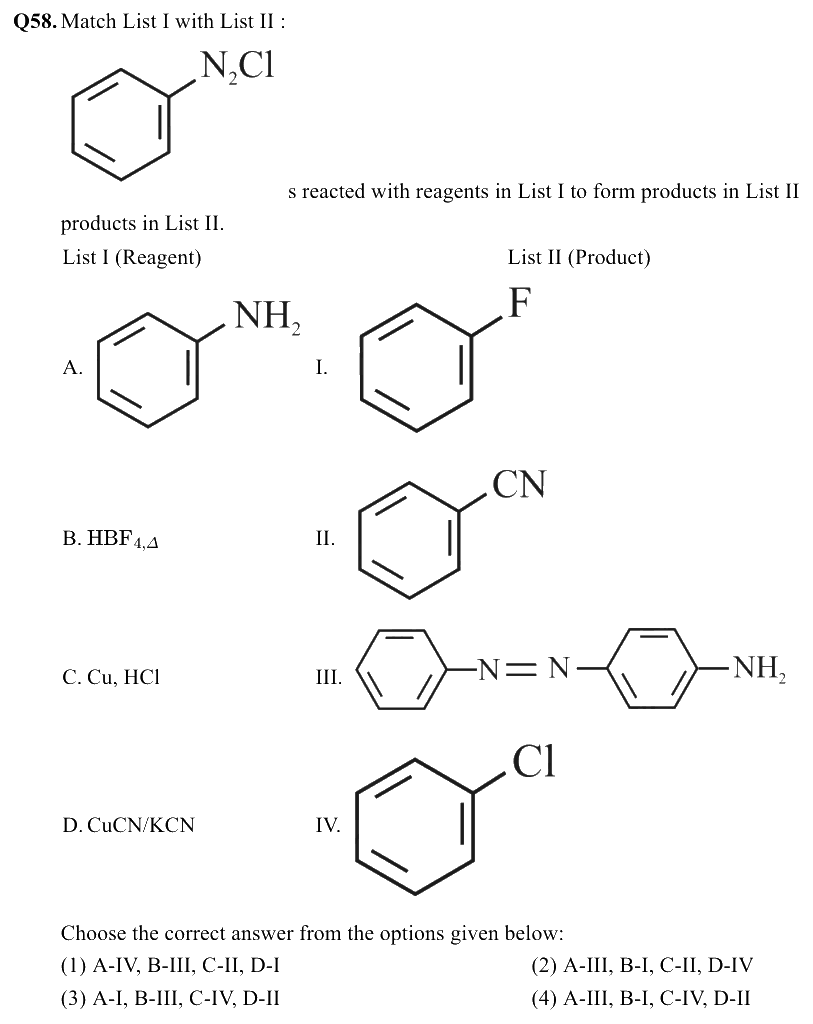
see figure s reacted with reagents in List I to form products in List II
products in List II.
List I (Reagent) List II (Product)
A. (see the figure above) I. (see the figure above)
B. $\mathrm{HBF_{4}, \Delta}$ II. (see the figure above)
C. Cu, HCl III. (see the figure above)
D. CuCN/KCN IV. (see the figure above)
Choose the correct answer from the options given below:

The question and its figure as printed in JEE Main 2023 08 Apr Shift 1. Question: s reacted with reagents in List I to form products in List II products in List II. List I (Reagent) List II (Product) A. (figure) I. (figure) B. HBF4, Δ II. (figure) C. Cu, HCl III. (figure) D. CuCN/KCN IV. (figure) Choose the correct answer from the options given below:
The question as printed in the paper.
  • A

    A-IV, B-III, C-II, D-I

  • B

    A-III, B-I, C-II, D-IV

  • C

    A-I, B-III, C-IV, D-II

  • D

    A-III, B-I, C-IV, D-II

53JEE Main 2023 · 8 Apr · Shift 2MCQOpen question page ↗

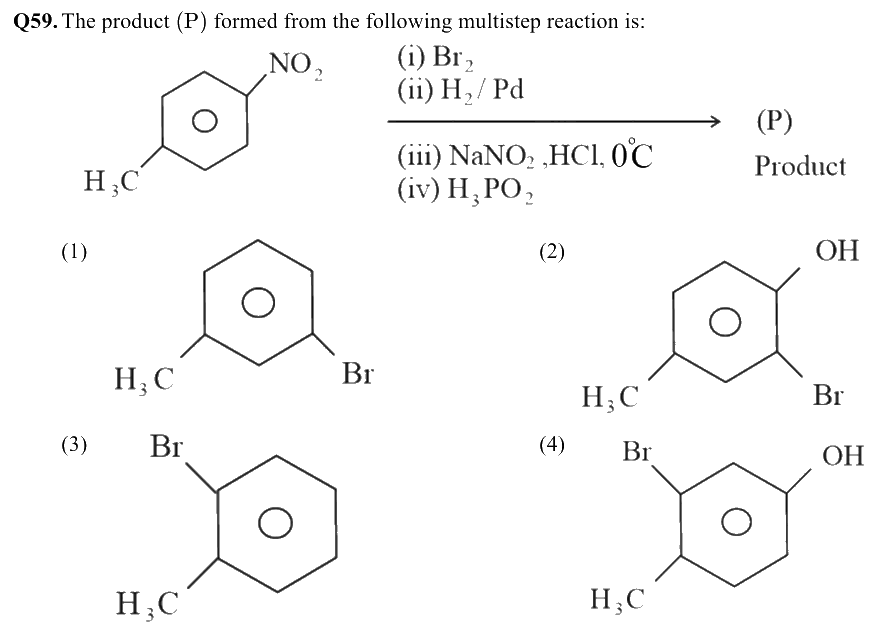
The product (P) formed from the following multistep reaction is:

(see the figure above)

The question and its figure as printed in JEE Main 2023 08 Apr Shift 2. Option 1: Benzene ring with CH3 on the lower-left carbon and Br on the lower-right carbon (meta to each other). Option 2: Benzene ring with OH on the upper-right carbon, Br on the lower-right carbon (next to the OH carbon) and CH3 on the lower-left carbon. Option 3: Benzene ring with Br on the upper-left carbon and CH3 on the lower-left carbon (adjacent carbons). Option 4: Benzene ring with Br on the upper-left carbon, OH on the upper-right carbon (one carbon between them) and CH3 on the lower-left carbon, next to the Br carbon.
The question as printed in the paper.
  • A

    see figure Benzene ring with CH3 on the lower-left carbon and Br on the lower-right carbon (meta to each other).

  • B

    see figure Benzene ring with OH on the upper-right carbon, Br on the lower-right carbon (next to the OH carbon) and CH3 on the lower-left carbon.

  • C

    see figure Benzene ring with Br on the upper-left carbon and CH3 on the lower-left carbon (adjacent carbons).

  • D

    see figure Benzene ring with Br on the upper-left carbon, OH on the upper-right carbon (one carbon between them) and CH3 on the lower-left carbon, next to the Br carbon.

54JEE Main 2023 · 6 Apr · Shift 1MCQOpen question page ↗

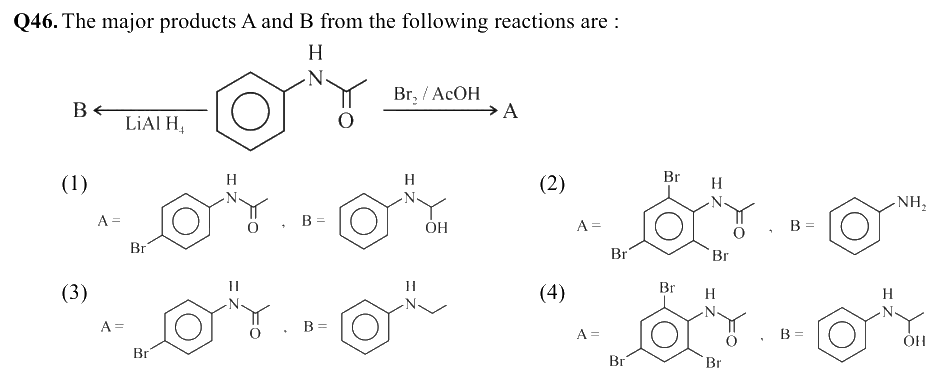
The major products A and B from the following reactions are :

(see the figure above)

The question and its figure as printed in JEE Main 2023 06 Apr Shift 1. Option 1: A = para-bromoacetanilide (benzene ring with NHCOCH3 and Br on the carbon opposite it); B = benzene ring with NH-CH(OH)-CH3. Option 2: A = 2,4,6-tribromoacetanilide (NHCOCH3 on the ring with Br on both ortho carbons and the para carbon); B = aniline (benzene ring with NH2). Option 3: A = para-bromoacetanilide (benzene ring with NHCOCH3 and Br opposite it); B = benzene ring with NH-CH2-CH3 (N-ethylaniline). Option 4: A = 2,4,6-tribromoacetanilide (Br on both ortho carbons and the para carbon); B = benzene ring with NH-CH(OH)-CH3.
The question as printed in the paper.
  • A

    see figure A = para-bromoacetanilide (benzene ring with NHCOCH3 and Br on the carbon opposite it); B = benzene ring with NH-CH(OH)-CH3.

  • B

    see figure A = 2,4,6-tribromoacetanilide (NHCOCH3 on the ring with Br on both ortho carbons and the para carbon); B = aniline (benzene ring with NH2).

  • C

    see figure A = para-bromoacetanilide (benzene ring with NHCOCH3 and Br opposite it); B = benzene ring with NH-CH2-CH3 (N-ethylaniline).

  • D

    see figure A = 2,4,6-tribromoacetanilide (Br on both ortho carbons and the para carbon); B = benzene ring with NH-CH(OH)-CH3.

55JEE Main 2023 · 6 Apr · Shift 1MCQOpen question page ↗

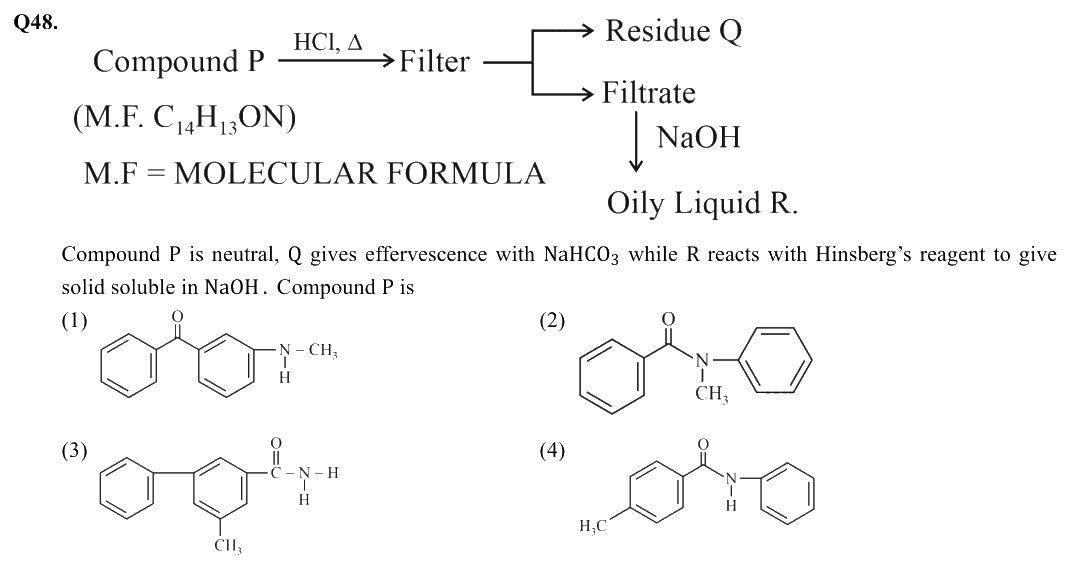
see figure Compound P is neutral, Q gives effervescence with $\mathrm{NaHCO_3}$ while R reacts with Hinsberg's reagent to give solid soluble in NaOH. Compound P is

The question and its figure as printed in JEE Main 2023 06 Apr Shift 1. Question: Compound P is neutral, Q gives effervescence with NaHCO3 while R reacts with Hinsberg's reagent to give solid soluble in NaOH. Compound P is Option 1: A benzophenone-type ketone: a phenyl ring bonded to C=O, which is bonded to a second benzene ring that carries an NH-CH3 group on the meta carbon. Option 2: N-methyl-N-phenylbenzamide: benzoyl group (phenyl-C=O) bonded to a nitrogen that carries a CH3 and a phenyl ring. Option 3: A biphenyl: a phenyl ring attached to a second benzene ring that carries a C(=O)-NH2 group and a CH3 group, both meta to the phenyl link. Option 4: N-phenyl-4-methylbenzamide: a…
The question as printed in the paper.
  • A

    see figure A benzophenone-type ketone: a phenyl ring bonded to C=O, which is bonded to a second benzene ring that carries an NH-CH3 group on the meta carbon.

  • B

    see figure N-methyl-N-phenylbenzamide: benzoyl group (phenyl-C=O) bonded to a nitrogen that carries a CH3 and a phenyl ring.

  • C

    see figure A biphenyl: a phenyl ring attached to a second benzene ring that carries a C(=O)-NH2 group and a CH3 group, both meta to the phenyl link.

  • D

    see figure N-phenyl-4-methylbenzamide: a benzene ring with CH3 at the para carbon and a C(=O)-NH group, the N bonded to a phenyl ring.

56JEE Main 2023 · 1 Feb · Shift 1MCQOpen question page ↗

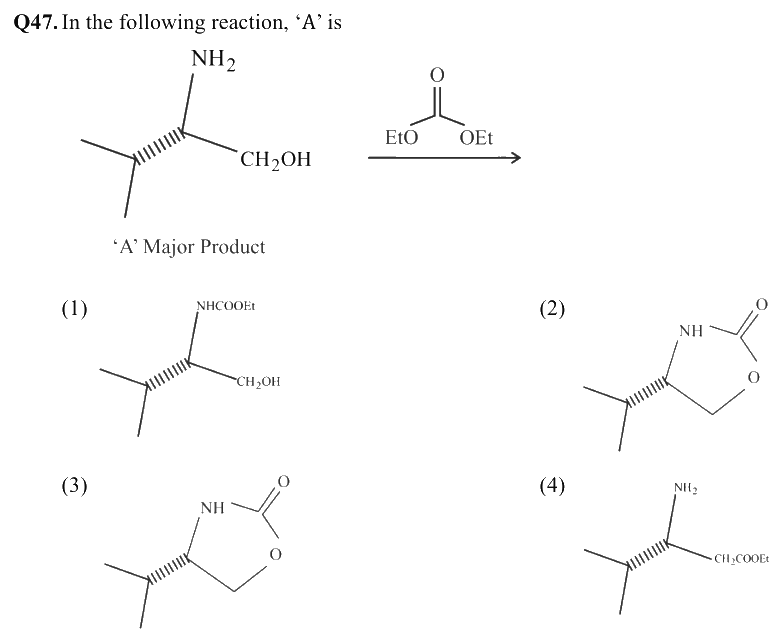
In the following reaction, 'A' is

(see the figure above)

The question and its figure as printed in JEE Main 2023 01 Feb Shift 1. Option 1: the chain with NHCOOEt in place of NH2 and CH2OH unchanged. Option 2: a five-membered ring in which the carbon bearing the isopropyl group (hashed bond) is bonded to NH, which is bonded to a C(=O) (O at upper right), which is bonded to a ring O, which is bonded to CH2 back to the first carbon. Option 3: a five-membered ring with the same atoms as in option 2 (NH, C=O, ring O, CH2, and the carbon bearing the isopropyl group), drawn with the C=O pointing up and the ring O at the lower right. Option 4: the chain with NH2 unchanged and CH2COOEt in place of CH2OH.
The question as printed in the paper.
  • A

    see figure the chain with NHCOOEt in place of $\mathrm{NH_2}$ and $\mathrm{CH_2OH}$ unchanged.

  • B

    see figure a five-membered ring in which the carbon bearing the isopropyl group (hashed bond) is bonded to NH, which is bonded to a C(=O) (O at upper right), which is bonded to a ring O, which is bonded to $\mathrm{CH_2}$ back to the first carbon.

  • C

    see figure a five-membered ring with the same atoms as in option 2 (NH, C=O, ring O, $\mathrm{CH_2}$, and the carbon bearing the isopropyl group), drawn with the C=O pointing up and the ring O at the lower right.

  • D

    see figure the chain with $\mathrm{NH_2}$ unchanged and $\mathrm{CH_2COOEt}$ in place of $\mathrm{CH_2OH}$.

57JEE Main 2023 · 1 Feb · Shift 2MCQOpen question page ↗

Given below are two statements: one is labelled as Assertion (A) and the other is labelled as Reason (R).
Assertion (A): $\alpha$-halocarboxylic acid on reaction with dil. $\mathrm{NH_3}$ gives good yield of $\alpha$-amino carboxylic acid whereas the yield of amines is very low when prepared from alkyl halides.
Reason (R): Amino acids exist in zwitter ion form in aqueous medium.
In the light of the above statements, choose the correct answer from the options given below :

  • A

    Both (A) and (R) are correct and (R) is the correct explanation of (A).

  • B

    Both (A) and (R) are correct but (R) is not the correct explanation of (A).

  • C

    (A) is correct but (R) is not correct.

  • D

    (A) is not correct but (R) is correct.

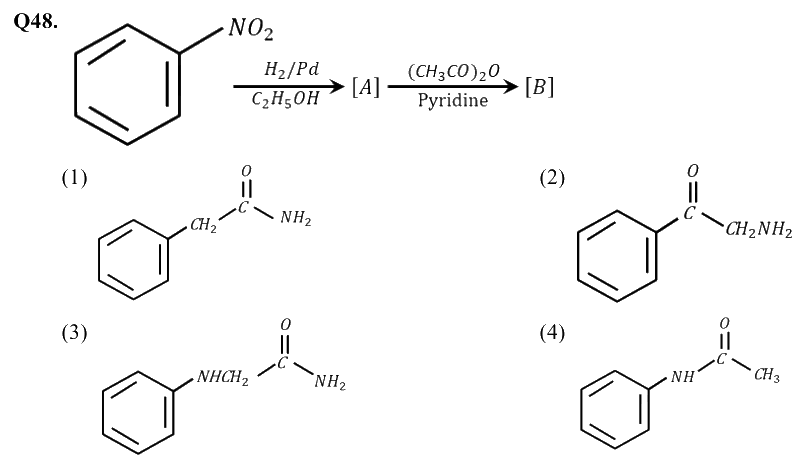
58JEE Main 2023 · 31 Jan · Shift 1MCQOpen question page ↗

see figure

The question and its figure as printed in JEE Main 2023 31 Jan Shift 1. Option 1: benzene ring with CH2 attached to a C(=O) that carries NH2 (phenylacetamide). Option 2: benzene ring attached to a C(=O) that is attached to CH2NH2. Option 3: benzene ring attached to NH, then CH2, then C(=O)NH2 (NHCH2 then C with =O above and NH2). Option 4: benzene ring attached to NH, then C(=O) carrying CH3 (N-phenylacetamide).
The question as printed in the paper.
  • A

    see figure benzene ring with $\mathrm{CH_2}$ attached to a C(=O) that carries $\mathrm{NH_2}$ (phenylacetamide).

  • B

    see figure benzene ring attached to a C(=O) that is attached to $\mathrm{CH_2NH_2}$.

  • C

    see figure benzene ring attached to NH, then $\mathrm{CH_2}$, then C(=O)$\mathrm{NH_2}$ ($\mathrm{NHCH_2}$ then C with =O above and $\mathrm{NH_2}$).

  • D

    see figure benzene ring attached to NH, then C(=O) carrying $\mathrm{CH_3}$ (N-phenylacetamide).

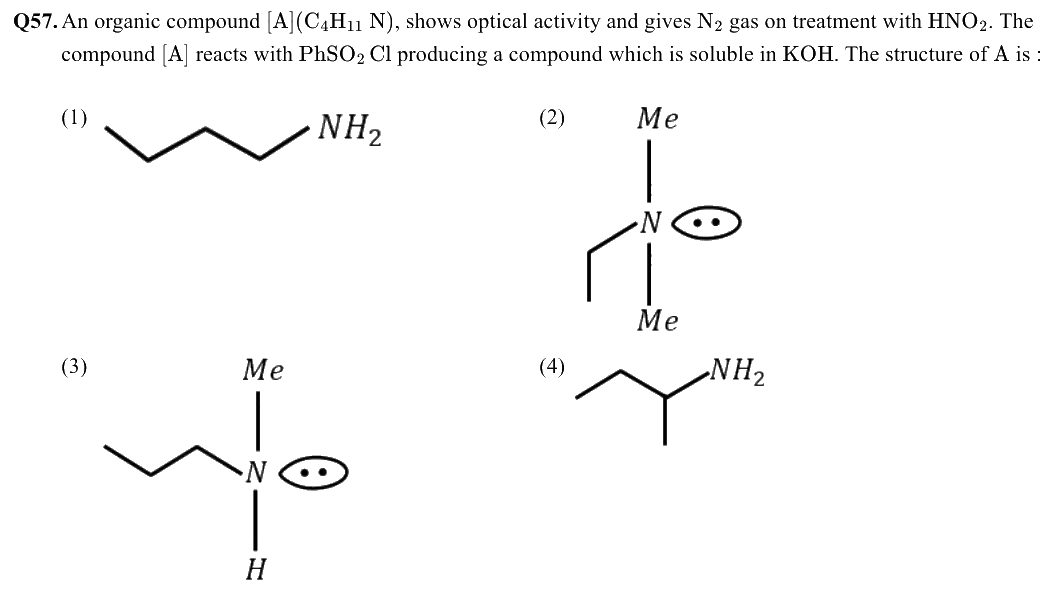
59JEE Main 2023 · 31 Jan · Shift 2MCQOpen question page ↗

An organic compound [A]($\mathrm{C_4H_{11}\,N}$), shows optical activity and gives $\mathrm{N_2}$ gas on treatment with $\mathrm{HNO_2}$. The compound [A] reacts with $\mathrm{PhSO_2\,Cl}$ producing a compound which is soluble in KOH. The structure of A is :

(see the figure above)

The question and its figure as printed in JEE Main 2023 31 Jan Shift 2.
The question as printed in the paper.
  • A

    see figure

  • B

    see figure

  • C

    see figure

  • D

    see figure

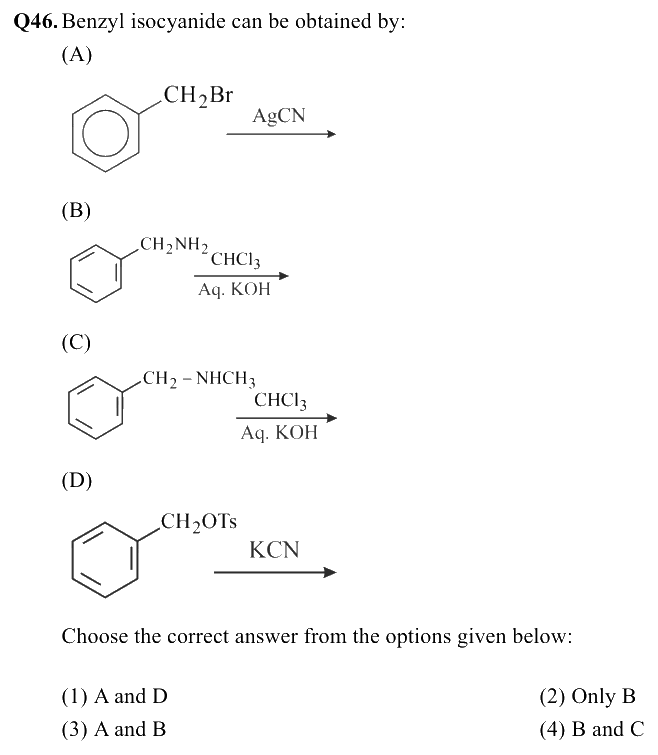
60JEE Main 2023 · 30 Jan · Shift 1MCQOpen question page ↗

Benzyl isocyanide can be obtained by:
(A) (see the figure above)
(B) (see the figure above)
(C) (see the figure above)
(D) (see the figure above)
Choose the correct answer from the options given below:

The question and its figure as printed in JEE Main 2023 30 Jan Shift 1.
The question as printed in the paper.
  • A

    A and D

  • B

    Only B

  • C

    A and B

  • D

    B and C

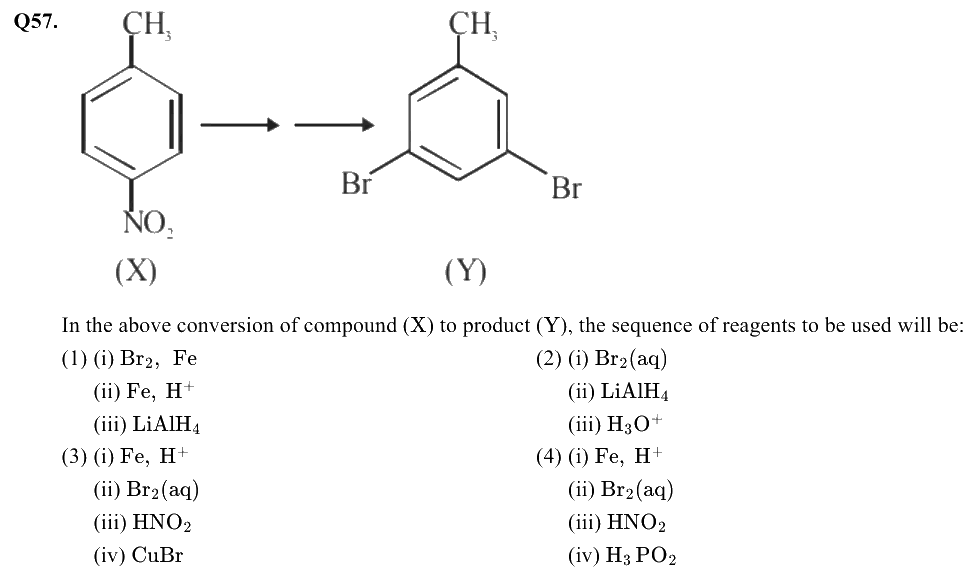
61JEE Main 2023 · 30 Jan · Shift 2MCQOpen question page ↗

see figure In the above conversion of compound (X) to product (Y), the sequence of reagents to be used will be:

The question and its figure as printed in JEE Main 2023 30 Jan Shift 2. Question: In the above conversion of compound (X) to product (Y), the sequence of reagents to be used will be:
The question as printed in the paper.
  • A

    (i) $\mathrm{Br_2}$, Fe
    (ii) Fe, $\mathrm{H^+}$
    (iii) $\mathrm{LiAlH_4}$

  • B

    (i) $\mathrm{Br_2}$(aq)
    (ii) $\mathrm{LiAlH_4}$
    (iii) $\mathrm{H_3O^+}$

  • C

    (i) Fe, $\mathrm{H^+}$
    (ii) $\mathrm{Br_2}$(aq)
    (iii) $\mathrm{HNO_2}$
    (iv) CuBr

  • D

    (i) Fe, $\mathrm{H^+}$
    (ii) $\mathrm{Br_2}$(aq)
    (iii) $\mathrm{HNO_2}$
    (iv) $\mathrm{H_3\,PO_2}$

62JEE Main 2023 · 25 Jan · Shift 1MCQOpen question page ↗

The correct order in aqueous medium of basic strength in case of methyl substituted amines is:

  • A

    $\mathrm{Me_2NH > MeNH_2 > Me_3N > NH_3}$

  • B

    $\mathrm{Me_2NH > Me_3N > MeNH_2 > NH_3}$

  • C

    $\mathrm{NH_3 > Me_3N > MeNH_2 > Me_2NH}$

  • D

    $\mathrm{Me_3N > Me_2NH > MeNH_2 > NH_3}$

63JEE Main 2023 · 25 Jan · Shift 1MCQOpen question page ↗

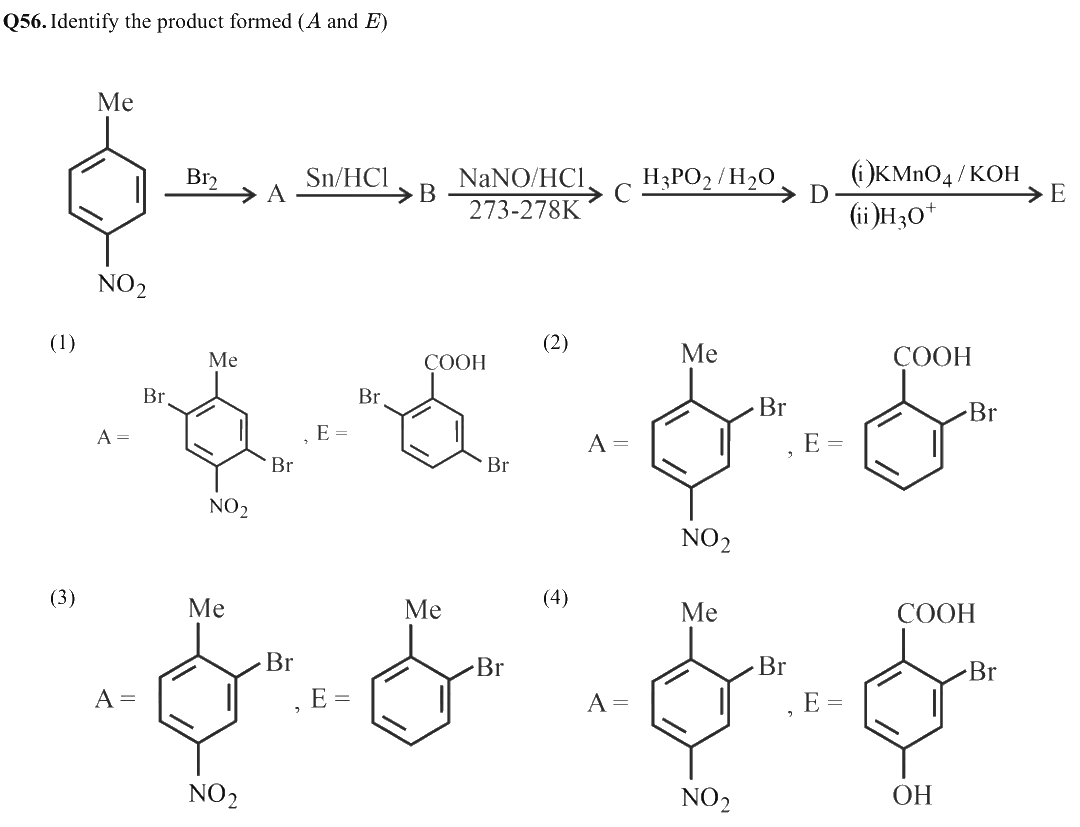
Identify the product formed (A and E)
(see the figure above)

The question and its figure as printed in JEE Main 2023 25 Jan Shift 1.
The question as printed in the paper.
  • A

    A = (see the figure above), E = (see the figure above)

  • B

    A = (see the figure above), E = (see the figure above)

  • C

    A = (see the figure above), E = (see the figure above)

  • D

    A = (see the figure above), E = (see the figure above)

64JEE Main 2023 · 25 Jan · Shift 2MCQOpen question page ↗

Match List I with List II

List I (Amines)List II (pKb)
A. AnilineI. 3.25
B. EthanamineII. 3.00
C. N-EthylethanamineIII. 9.38
D. N, N-DiethylethanamineIV. 3.29

Choose the correct answer from the options given below:-

  • A

    A-I, B-IV, C-II, D-III

  • B

    A-III, B-II, C-I, D-IV

  • C

    A-III, B-II, C-IV, D-I

  • D

    A-III, B-IV, C-II, D-I

65JEE Main 2023 · 24 Jan · Shift 2MCQOpen question page ↗

Given below are two statements :

Statement I : Pure Aniline and other arylamines are usually colourless.

Statement II : Arylamines get coloured on storage due to atmospheric reduction.

In the light of the above statements, choose the most appropriate answer from the options given below :

  • A

    Both Statement I and Statement II are incorrect

  • B

    Both Statement I and Statement II are correct

  • C

    Statement I is correct but Statement II is incorrect

  • D

    Statement I is incorrect but Statement II is correct

66JEE Main 2023 · 24 Jan · Shift 2MCQOpen question page ↗

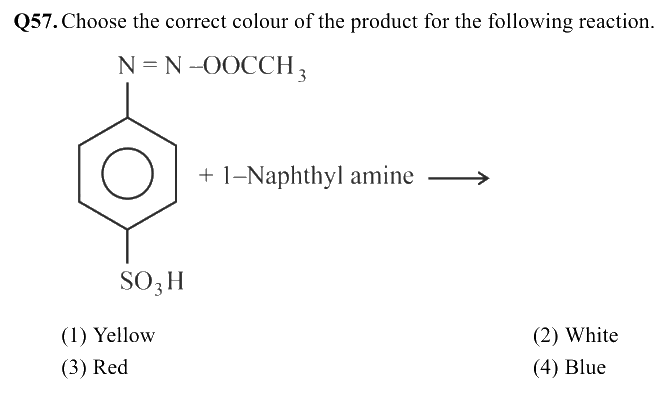
Choose the correct colour of the product for the following reaction.

(see the figure above) $+$ 1-Naphthyl amine $\longrightarrow$

The question and its figure as printed in JEE Main 2023 24 Jan Shift 2.
The question as printed in the paper.
  • A

    Yellow

  • B

    White

  • C

    Red

  • D

    Blue

67JEE Main 2022 · 29 Jul · Shift 1MCQOpen question page ↗

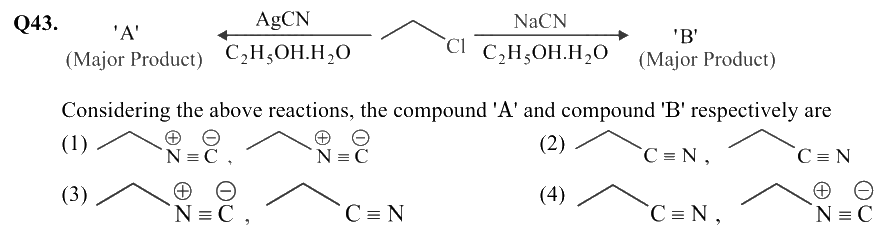
see figure Considering the above reactions, the compound 'A' and compound 'B' respectively are

The question and its figure as printed in JEE Main 2022 29 Jul Shift 1. Question: Considering the above reactions, the compound 'A' and compound 'B' respectively are Option 1: , (figure) Option 2: , (figure) Option 3: , (figure) Option 4: , (figure)
The question as printed in the paper.
  • A

    see figure , (see the figure above)

  • B

    see figure , (see the figure above)

  • C

    see figure , (see the figure above)

  • D

    see figure , (see the figure above)

68JEE Main 2022 · 29 Jul · Shift 1MCQOpen question page ↗

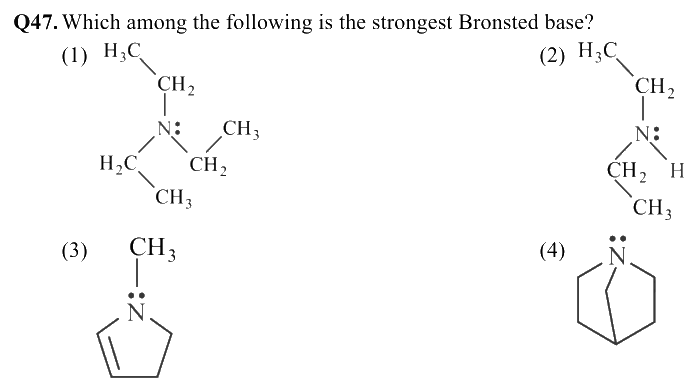
Which among the following is the strongest Bronsted base?

The question and its figure as printed in JEE Main 2022 29 Jul Shift 1. Option 1: triethylamine: N with a lone pair and three ethyl groups (H3C-CH2 drawn three times) Option 2: diethylamine: N with a lone pair, one H and two ethyl groups Option 3: N-methyl-2,3-dihydropyrrole (N-methyl five-membered ring with one C=C double bond next to N), N with a lone pair Option 4: quinuclidine (1-azabicyclo[2.2.2]octane): a bicyclic amine with N at the bridgehead, with a lone pair
The question as printed in the paper.
  • A

    see figure triethylamine: N with a lone pair and three ethyl groups ($\mathrm{H_3C-CH_2}$ drawn three times)

  • B

    see figure diethylamine: N with a lone pair, one H and two ethyl groups

  • C

    see figure N-methyl-2,3-dihydropyrrole (N-methyl five-membered ring with one C=C double bond next to N), N with a lone pair

  • D

    see figure quinuclidine (1-azabicyclo[2.2.2]octane): a bicyclic amine with N at the bridgehead, with a lone pair

69JEE Main 2022 · 29 Jul · Shift 1MCQOpen question page ↗

see figure Which among the following represent reagent 'A'?

The question and its figure as printed in JEE Main 2022 29 Jul Shift 1. Question: Which among the following represent reagent 'A'? Option 1: naphthalene with OH on the carbon of a ring that is not next to the ring fusion (2-naphthol) Option 2: naphthalene with OH on a carbon next to the ring fusion (1-naphthol) Option 3: benzene ring with NH2 (aniline) Option 4: naphthalene with NH2 on a carbon next to the ring fusion (1-naphthylamine)
The question as printed in the paper.
  • A

    see figure naphthalene with OH on the carbon of a ring that is not next to the ring fusion (2-naphthol)

  • B

    see figure naphthalene with OH on a carbon next to the ring fusion (1-naphthol)

  • C

    see figure benzene ring with $\mathrm{NH_2}$ (aniline)

  • D

    see figure naphthalene with $\mathrm{NH_2}$ on a carbon next to the ring fusion (1-naphthylamine)

70JEE Main 2022 · 29 Jul · Shift 2MCQOpen question page ↗

The Hinsberg reagent is

The question and its figure as printed in JEE Main 2022 29 Jul Shift 2. Option 1: benzenesulfonyl chloride: benzene ring bearing S(=O)2-Cl Option 2: benzenediazonium chloride: benzene ring bearing N2^+Cl^- Option 3: potassium phthalimide: benzene ring fused to a five-membered ring with two C=O groups and N^-K^+ Option 4: 4-hydroxyazobenzene: two benzene rings joined by N=N, one ring bearing OH
The question as printed in the paper.
  • A

    see figure benzenesulfonyl chloride: benzene ring bearing $\mathrm{S(=O)_2-Cl}$

  • B

    see figure benzenediazonium chloride: benzene ring bearing $\mathrm{N_2^+Cl^-}$

  • C

    see figure potassium phthalimide: benzene ring fused to a five-membered ring with two C=O groups and $\mathrm{N^-K^+}$

  • D

    see figure 4-hydroxyazobenzene: two benzene rings joined by N=N, one ring bearing OH

71JEE Main 2022 · 28 Jul · Shift 2MCQOpen question page ↗

Given below are two statements : one is labelled as Assertion A and the other is labelled as Reason R
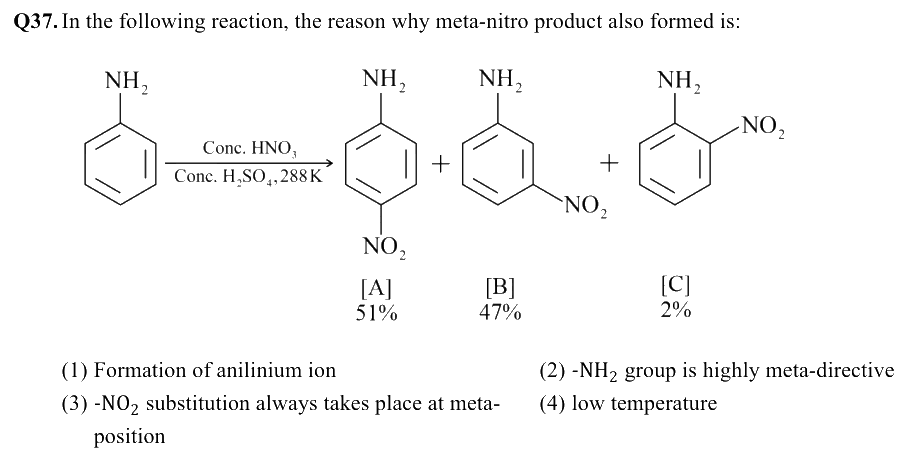
Assertion A : Aniline on nitration yields ortho, meta & para nitro derivatives of aniline.
Reason R : Nitrating mixture is a strong acidic mixture.
In the light of the above statements, choose the correct answer from the options given below

  • A

    Both A and R are true and R is the correct explanation of A

  • B

    Both A and R are true but R is NOT the correct explanation of A

  • C

    A is true but R is false

  • D

    A is false but R is true

72JEE Main 2022 · 27 Jul · Shift 1MCQOpen question page ↗

Match List-I with List-II

List-IList-II
ABenzenesulphonyl chlorideITest for primary amines
BHoffmann bromamide reactionIIAnti Saytzeff
CCarbylamine reactionIIIHinsberg reagent
DHoffmann orientationIVKnown reaction of Isocyanates.

Choose the correct answer from the options given below

  • A

    A – IV, B – III, C – II, D – I

  • B

    A – IV, B – II, C – I, D – III

  • C

    A – III, B – IV, C – I, D – II

  • D

    A – IV, B – III, C – I, D – II

73JEE Main 2022 · 27 Jul · Shift 2MCQOpen question page ↗

An organic compound 'A' contains nitrogen and chlorine. It dissolves readily in water to give a solution that turns litmus red. Titration of compound 'A' with standard base indicates that the molecular weight of 'A' is $131 \pm 2$. When a sample of 'A' is treated with aq. NaOH, a liquid separates which contains N but not Cl. Treatment of the obtained liquid with nitrous acid followed by phenol gives orange precipitate. The compound 'A' is
(see the figure above)

The question and its figure as printed in JEE Main 2022 27 Jul Shift 2. Option 1: A six-membered carbon ring with two C=C double bonds (drawn as vertical double bonds on the left and right sides) and a +NH3Cl^- group at the top. Option 2: A benzene ring (drawn with a circle) with NH2 at the top and Cl on the adjacent upper-right carbon (2-chloroaniline). Option 3: A five-membered carbon ring with two C=C double bonds (drawn as vertical double bonds) and a CH2+NH3Cl^- group at the top. Option 4: A benzene ring (alternating double bonds) with +NH3Cl^- at the top (anilinium chloride).
The question as printed in the paper.
  • A

    see figure A six-membered carbon ring with two C=C double bonds (drawn as vertical double bonds on the left and right sides) and a $\mathrm{\overset{+}{N}H_3Cl^-}$ group at the top.

  • B

    see figure A benzene ring (drawn with a circle) with $\mathrm{NH_2}$ at the top and Cl on the adjacent upper-right carbon (2-chloroaniline).

  • C

    see figure A five-membered carbon ring with two C=C double bonds (drawn as vertical double bonds) and a $\mathrm{CH_2\overset{+}{N}H_3Cl^-}$ group at the top.

  • D

    see figure A benzene ring (alternating double bonds) with $\mathrm{\overset{+}{N}H_3Cl^-}$ at the top (anilinium chloride).

74JEE Main 2022 · 26 Jul · Shift 1MCQOpen question page ↗

The correct stability order of the following diazonium salt is
(see the figure above)

The question and its figure as printed in JEE Main 2022 26 Jul Shift 1.
The question as printed in the paper.
  • A

    (A) > (B) > (C) > (D)

  • B

    (A) > (C) > (D) > (B)

  • C

    (C) > (A) > (D) > (B)

  • D

    (C) > (D) > (B) > (A)

75JEE Main 2022 · 26 Jul · Shift 1MCQOpen question page ↗

Given below are two statements: one is labelled as Assertion (A) and the other is labelled as Reason (R).
Assertion (A) : Experimental reaction of $\mathrm{CH_3\,Cl}$ with aniline and anhydrous $\mathrm{AlCl_3}$ does not give o and p-methylaniline.
Reason (R) : The $-\mathrm{NH_2}$ group of aniline becomes deactivating because of salt formation with anhydrous $\mathrm{AlCl_3}$ and hence yields m-methyl aniline as the product.
In the light of the above statements, choose the most appropriate answer from the options given below

  • A

    Both (A) and (R) are true and (R) is the correct explanation of (A).

  • B

    Both (A) and (R) are true but (R) is not the correct explanation of (A).

  • C

    (A) is true, but (R) is false.

  • D

    (A) is false, but (R) is true.

76JEE Main 2022 · 26 Jul · Shift 2MCQOpen question page ↗

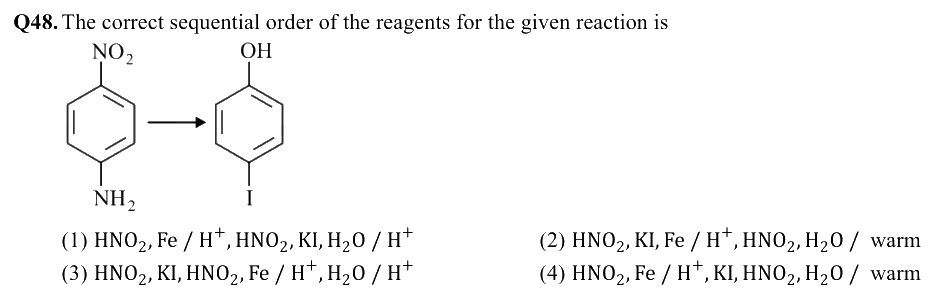
The correct sequential order of the reagents for the given reaction is

(see the figure above)

The question and its figure as printed in JEE Main 2022 26 Jul Shift 2.
The question as printed in the paper.
  • A

    $\mathrm{HNO_2, Fe / H^+, HNO_2, KI, H_2O / H^+}$

  • B

    $\mathrm{HNO_2, KI, Fe / H^+, HNO_2, H_2O /}$ warm

  • C

    $\mathrm{HNO_2, KI, HNO_2, Fe / H^+, H_2O / H^+}$

  • D

    $\mathrm{HNO_2, Fe / H^+, KI, HNO_2, H_2O /}$ warm

77JEE Main 2022 · 25 Jul · Shift 1MCQOpen question page ↗

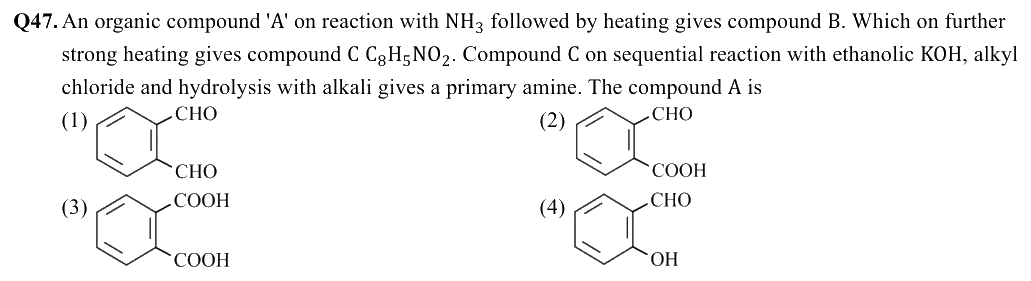
An organic compound 'A' on reaction with $\mathrm{NH_3}$ followed by heating gives compound B. Which on further strong heating gives compound C $\mathrm{C_8H_5NO_2}$. Compound C on sequential reaction with ethanolic KOH, alkyl chloride and hydrolysis with alkali gives a primary amine. The compound A is

The question and its figure as printed in JEE Main 2022 25 Jul Shift 1. Option 1: benzene ring with two CHO groups on adjacent carbons. Option 2: benzene ring with CHO and COOH on adjacent carbons. Option 3: benzene ring with two COOH groups on adjacent carbons. Option 4: benzene ring with CHO and OH on adjacent carbons.
The question as printed in the paper.
  • A

    see figure benzene ring with two CHO groups on adjacent carbons.

  • B

    see figure benzene ring with CHO and COOH on adjacent carbons.

  • C

    see figure benzene ring with two COOH groups on adjacent carbons.

  • D

    see figure benzene ring with CHO and OH on adjacent carbons.

78JEE Main 2022 · 29 Jun · Shift 1MCQOpen question page ↗

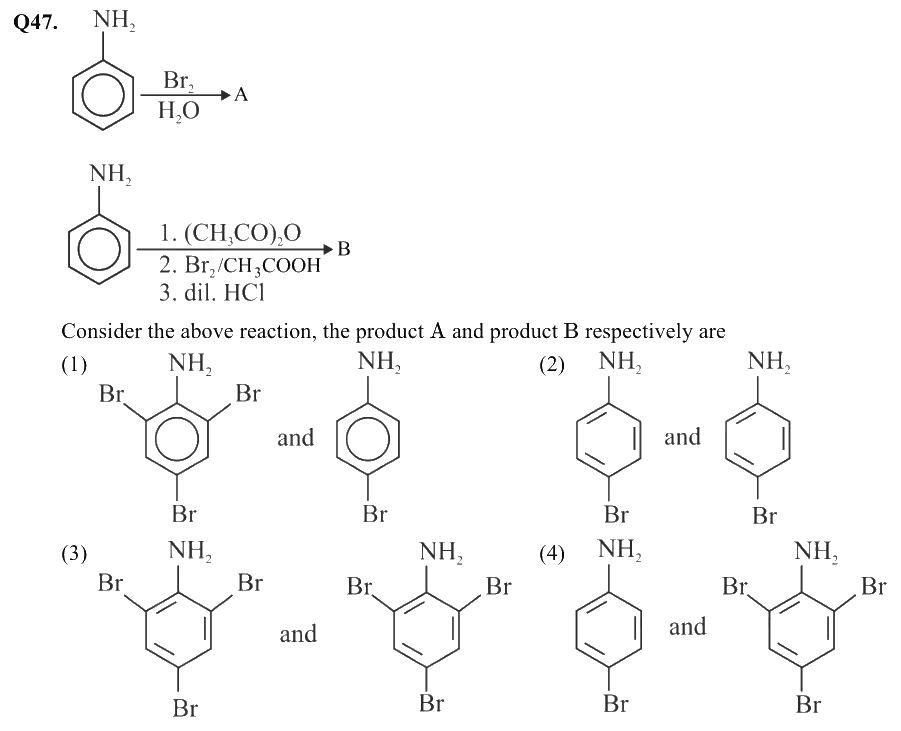
see figure $\xrightarrow[\mathrm{H_2O}]{\mathrm{Br_2}}$ A
(see the figure above) $\xrightarrow[\text{3. dil. HCl}]{\text{1. }(\mathrm{CH_3CO})_2\mathrm{O}\ \ \text{2. }\mathrm{Br_2/CH_3COOH}}$ B
Consider the above reaction, the product A and product B respectively are

The question and its figure as printed in JEE Main 2022 29 Jun Shift 1. Question: [H2O]Br2 A (figure) [3. dil. HCl]1. (CH3CO)2O 2. Br2/CH3COOH B Consider the above reaction, the product A and product B respectively are Option 1: A: 2,4,6-tribromoaniline; B: 4-bromoaniline. Option 2: A: 4-bromoaniline; B: 4-bromoaniline. Option 3: A: 2,4,6-tribromoaniline; B: 2,4,6-tribromoaniline. Option 4: A: 4-bromoaniline; B: 2,4,6-tribromoaniline.
The question as printed in the paper.
  • A

    see figure A: 2,4,6-tribromoaniline; B: 4-bromoaniline.

  • B

    see figure A: 4-bromoaniline; B: 4-bromoaniline.

  • C

    see figure A: 2,4,6-tribromoaniline; B: 2,4,6-tribromoaniline.

  • D

    see figure A: 4-bromoaniline; B: 2,4,6-tribromoaniline.

79JEE Main 2022 · 29 Jun · Shift 2MCQOpen question page ↗

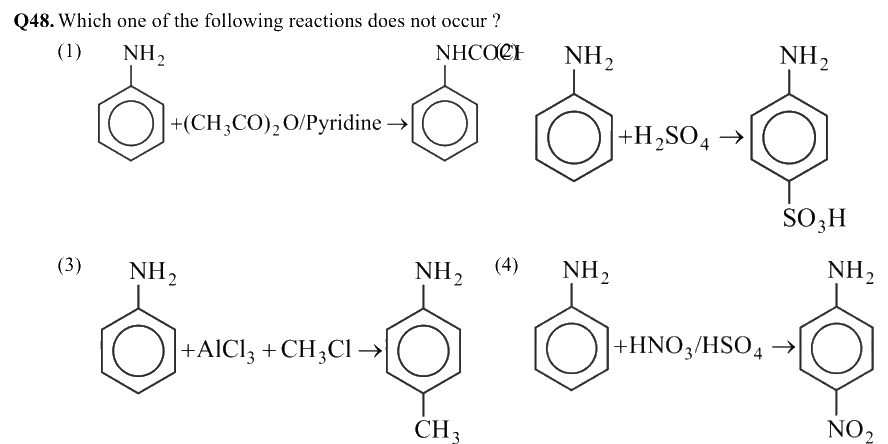
In Friedel-Crafts alkylation of aniline, one gets:

  • A

    alkylated product with ortho and para substitution.

  • B

    secondary amine after acidic treatment.

  • C

    an amide product.

  • D

    positively charged nitrogen at benzene ring.

80JEE Main 2022 · 28 Jun · Shift 1MCQOpen question page ↗

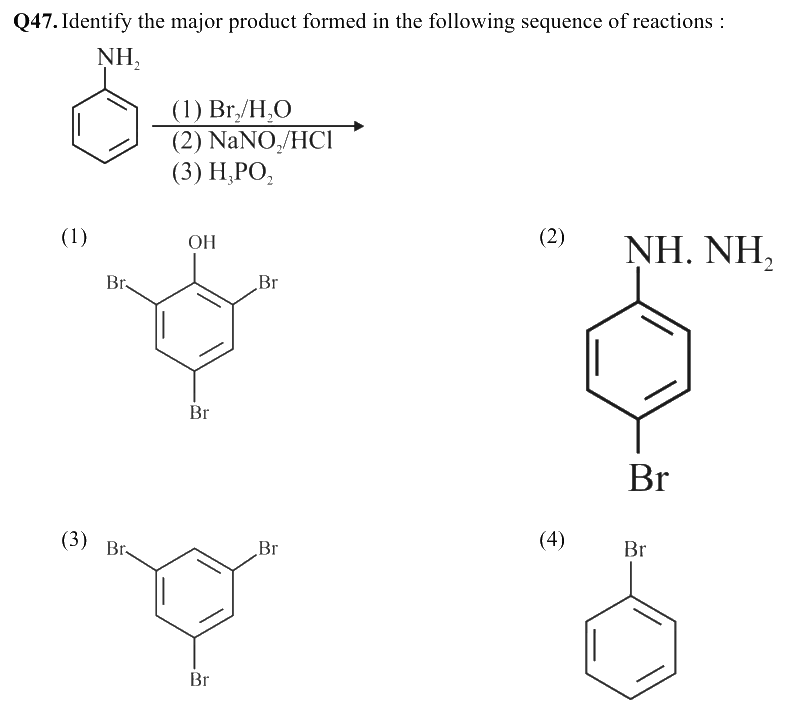
Identify the major product formed in the following sequence of reactions :

(see the figure above)

The question and its figure as printed in JEE Main 2022 28 Jun Shift 1. Option 1: Benzene ring with OH at the top and Br at both positions next to it (2,6) and at the bottom (4): 2,4,6-tribromophenol. Option 2: Benzene ring with NH.NH2 at the top and Br at the bottom (para). Option 3: Benzene ring with Br at three alternate positions (top-left, top-right and bottom): 1,3,5-tribromobenzene. Option 4: Benzene ring with a single Br at the top (bromobenzene).
The question as printed in the paper.
  • A

    see figure Benzene ring with OH at the top and Br at both positions next to it (2,6) and at the bottom (4): 2,4,6-tribromophenol.

  • B

    see figure Benzene ring with NH.NH$_2$ at the top and Br at the bottom (para).

  • C

    see figure Benzene ring with Br at three alternate positions (top-left, top-right and bottom): 1,3,5-tribromobenzene.

  • D

    see figure Benzene ring with a single Br at the top (bromobenzene).

81JEE Main 2022 · 28 Jun · Shift 1MCQOpen question page ↗

A primary aliphatic amine on reaction with nitrous acid in cold (273 K) and there after raising temperature of reaction mixture to room temperature (298 K), gives a/an

  • A

    Alcohol

  • B

    nitrile

  • C

    diazonium salt

  • D

    secondary amine

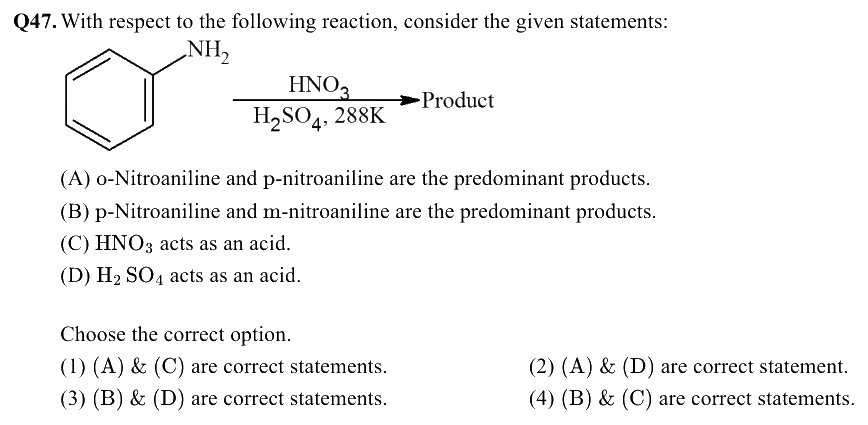
82JEE Main 2022 · 28 Jun · Shift 2MCQOpen question page ↗

With respect to the following reaction, consider the given statements:
(see the figure above)
(A) o-Nitroaniline and p-nitroaniline are the predominant products.
(B) p-Nitroaniline and m-nitroaniline are the predominant products.
(C) $\mathrm{HNO_3}$ acts as an acid.
(D) $\mathrm{H_2\,SO_4}$ acts as an acid.
Choose the correct option.

The question and its figure as printed in JEE Main 2022 28 Jun Shift 2.
The question as printed in the paper.
  • A

    (A) & (C) are correct statements.

  • B

    (A) & (D) are correct statement.

  • C

    (B) & (D) are correct statements.

  • D

    (B) & (C) are correct statements.

83JEE Main 2022 · 27 Jun · Shift 1MCQOpen question page ↗

Given below are two statements :
Statement - I : In Hofmann degradation reaction, the migration of only an alkyl group takes place from carbonyl carbon of the amide to the nitrogen atom.
Statement - II : The group is migrated in Hofmann degradation reaction to electron deficient atom.
In the light of the above statements, choose the most appropriate answer from the options given below

  • A

    Both Statement I and Statement II are correct.

  • B

    Both Statement I and Statement II are incorrect.

  • C

    Statement I is correct but Statement II is incorrect.

  • D

    Statement I is incorrect but Statement II is correct.

84JEE Main 2022 · 26 Jun · Shift 2MCQOpen question page ↗

Which statement is NOT correct for p-toluenesulphonyl chloride?

  • A

    It is hinsberg's reagent

  • B

    It is used to distinguish primary and secondary amines.

  • C

    On treatment with secondary amine, it leads to a product, that is soluble in alkali.

  • D

    It does not react with tertiary amine.

85JEE Main 2022 · 26 Jun · Shift 2MCQOpen question page ↗

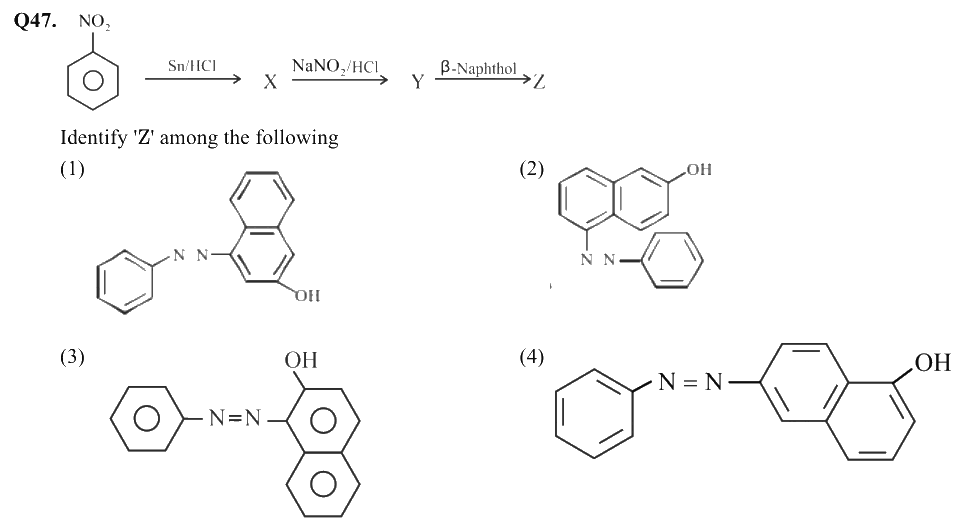
see figure Identify 'Z' among the following

The question and its figure as printed in JEE Main 2022 26 Jun Shift 2. Question: Identify 'Z' among the following Option 1: phenyl-N=N- attached to a naphthalene ring carbon, with OH on the other carbon of that same ring one carbon away from the azo carbon (the two groups are not on adjacent carbons) Option 2: naphthalene with OH on the far end of one ring and the phenyl-azo group (N=N-Ph) on a carbon of the other ring next to the ring fusion Option 3: 1-phenylazo-2-naphthol: phenyl-N=N- on a naphthalene carbon next to the ring fusion with OH on the adjacent carbon Option 4: naphthalene with Ph-N=N- on one ring and OH on the other ring (far end)
The question as printed in the paper.
  • A

    see figure phenyl-N=N- attached to a naphthalene ring carbon, with OH on the other carbon of that same ring one carbon away from the azo carbon (the two groups are not on adjacent carbons)

  • B

    see figure naphthalene with OH on the far end of one ring and the phenyl-azo group (N=N-Ph) on a carbon of the other ring next to the ring fusion

  • C

    see figure 1-phenylazo-2-naphthol: phenyl-N=N- on a naphthalene carbon next to the ring fusion with OH on the adjacent carbon

  • D

    see figure naphthalene with Ph-N=N- on one ring and OH on the other ring (far end)

86JEE Main 2022 · 24 Jun · Shift 1MCQOpen question page ↗

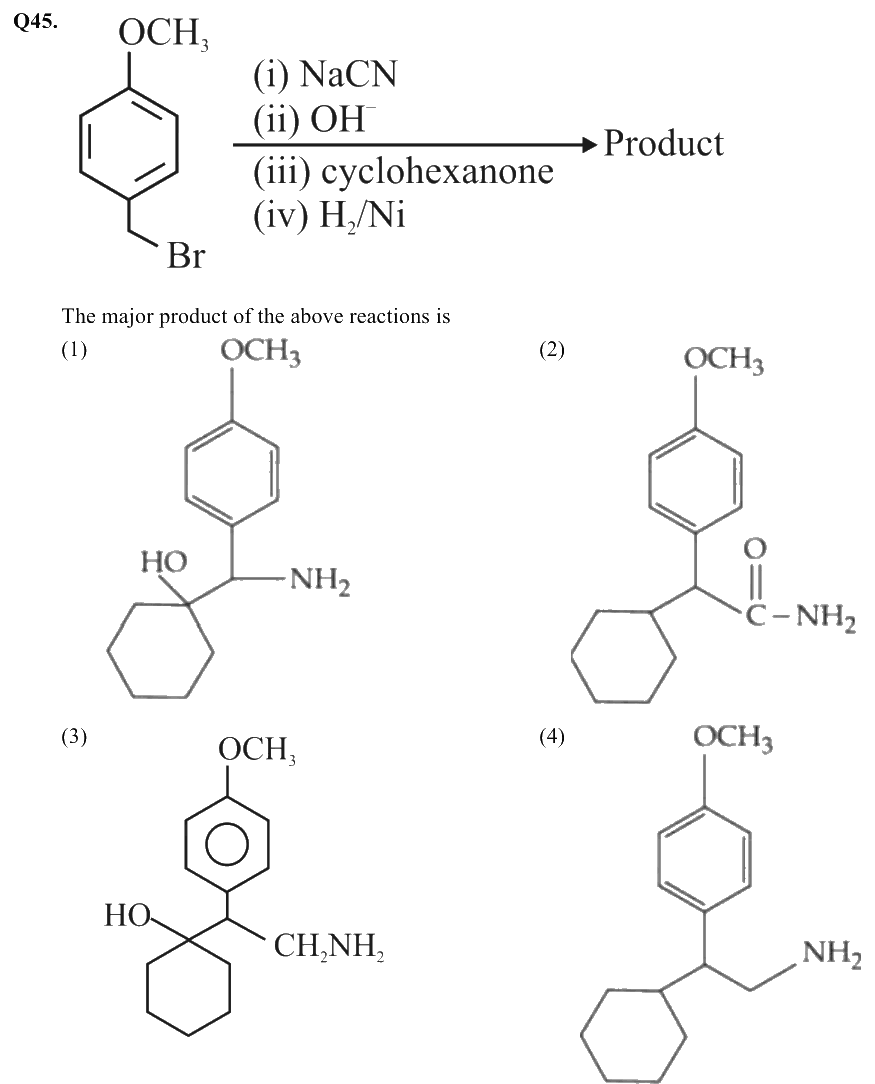
see figure The major product of the above reactions is

The question and its figure as printed in JEE Main 2022 24 Jun Shift 1. Question: The major product of the above reactions is
The question as printed in the paper.
  • A

    see figure

  • B

    see figure

  • C

    see figure

  • D

    see figure

87JEE Main 2022 · 24 Jun · Shift 2MCQOpen question page ↗

The conversion of propan-1-ol to n-butylamine involves the sequential addition of reagents. The correct sequential order of reagents is

  • A

    (i) $\mathrm{SOCl_2}$
    (ii) KCN
    (iii) $\mathrm{H_2}$/ Ni, Na(Hg)/$\mathrm{C_2H_5}$ OH

  • B

    (i) HCl
    (ii) $\mathrm{H_2}$/ Ni, Na(Hg)/$\mathrm{C_2H_5}$ OH

  • C

    (i) $\mathrm{SOCl_2}$
    (ii) KCN
    (iii) $\mathrm{CH_3NH_2}$

  • D

    (i) HCl
    (ii) $\mathrm{CH_3NH_2}$

88JEE Main 2021 · 1 Sep · Shift 2MCQOpen question page ↗

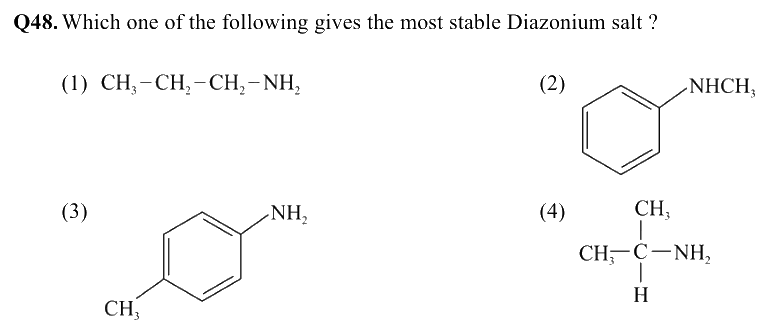
Which one of the following gives the most stable Diazonium salt ?

The question and its figure as printed in JEE Main 2021 01 Sep Shift 2. Option 2: a benzene ring carrying NHCH3. Option 3: a benzene ring carrying NH2 and, para to it, CH3. Option 4: a carbon carrying CH3 (up), CH3 (left), H (down) and NH2 (right), i.e. (CH3)2CH-NH2 drawn with its bonds shown.
The question as printed in the paper.
  • A

    $\mathrm{CH_3-CH_2-CH_2-NH_2}$

  • B

    see figure a benzene ring carrying NHCH3.

  • C

    see figure a benzene ring carrying NH2 and, para to it, CH3.

  • D

    see figure a carbon carrying CH3 (up), CH3 (left), H (down) and NH2 (right), i.e. $\mathrm{(CH_3)_2CH-NH_2}$ drawn with its bonds shown.

89JEE Main 2021 · 1 Sep · Shift 2MCQOpen question page ↗

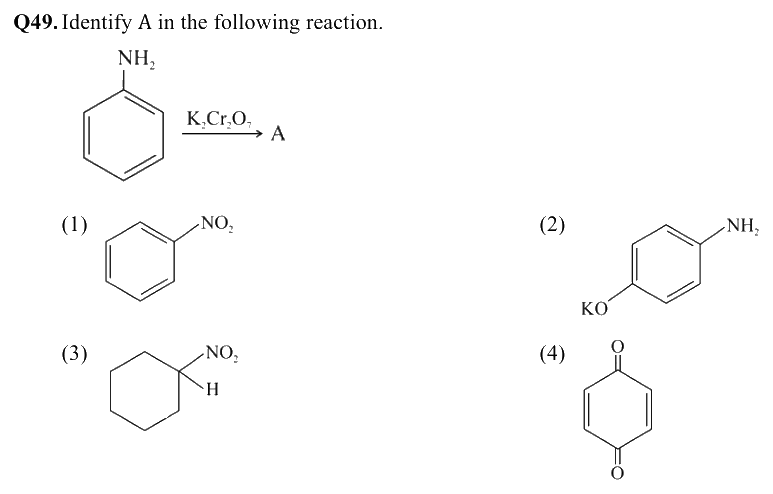
Identify A in the following reaction.
(see the figure above)

The question and its figure as printed in JEE Main 2021 01 Sep Shift 2. Option 1: benzene ring with NO2. Option 2: benzene ring carrying NH2 and, para to it, KO. Option 3: cyclohexane ring carrying NO2 and H on the same carbon. Option 4: para-benzoquinone: a six-membered ring with two C=O groups opposite each other and two C=C double bonds.
The question as printed in the paper.
  • A

    see figure benzene ring with NO2.

  • B

    see figure benzene ring carrying NH2 and, para to it, KO.

  • C

    see figure cyclohexane ring carrying NO2 and H on the same carbon.

  • D

    see figure para-benzoquinone: a six-membered ring with two C=O groups opposite each other and two C=C double bonds.

90JEE Main 2021 · 31 Aug · Shift 1MCQOpen question page ↗

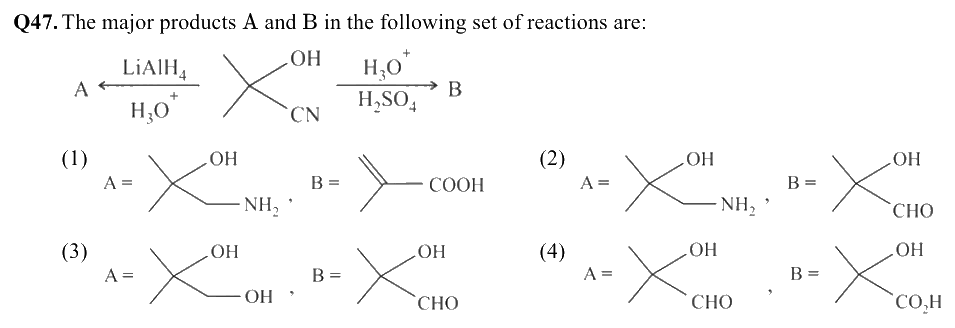
The major products A and B in the following set of reactions are:
(see the figure above)

The question and its figure as printed in JEE Main 2021 31 Aug Shift 1. Option 1: A = a skeletal amino alcohol: central carbon with two methyl lines, OH and a CH2-NH2 group; B = a skeletal unsaturated acid: a terminal C=C next to a central carbon that carries a methyl line and COOH. Option 2: A = the same amino alcohol (OH and CH2-NH2 on the central carbon with two methyl lines); B = a skeletal hydroxy aldehyde: central carbon with two methyl lines, OH and CHO. Option 3: A = a skeletal diol: central carbon with two methyl lines, OH and CH2-OH; B = a skeletal hydroxy aldehyde: central carbon with two methyl lines, OH and CHO. Option 4: A = a skeletal hydroxy aldehyde: central carbon with…
The question as printed in the paper.
  • A

    see figure A = a skeletal amino alcohol: central carbon with two methyl lines, OH and a CH2-NH2 group; B = a skeletal unsaturated acid: a terminal C=C next to a central carbon that carries a methyl line and COOH.

  • B

    see figure A = the same amino alcohol (OH and CH2-NH2 on the central carbon with two methyl lines); B = a skeletal hydroxy aldehyde: central carbon with two methyl lines, OH and CHO.

  • C

    see figure A = a skeletal diol: central carbon with two methyl lines, OH and CH2-OH; B = a skeletal hydroxy aldehyde: central carbon with two methyl lines, OH and CHO.

  • D

    see figure A = a skeletal hydroxy aldehyde: central carbon with two methyl lines, OH and CHO; B = a skeletal hydroxy acid: central carbon with two methyl lines, OH and CO2H.

91JEE Main 2021 · 31 Aug · Shift 2MCQOpen question page ↗

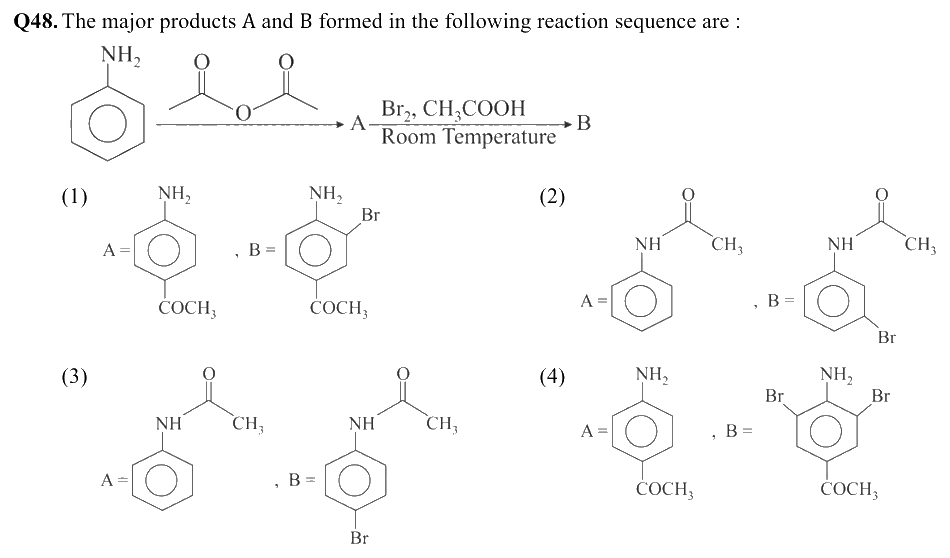
The major products A and B formed in the following reaction sequence are :
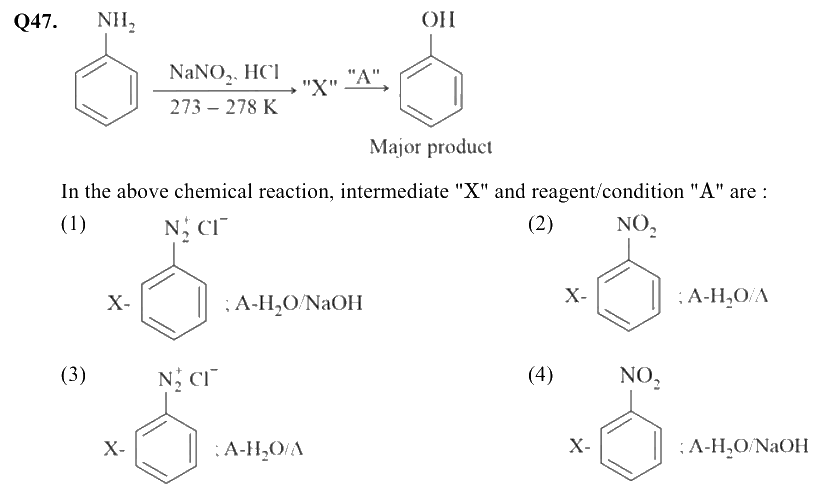
(see the figure above)

The question and its figure as printed in JEE Main 2021 31 Aug Shift 2. Option 1: A = benzene ring with NH2 at the top and COCH3 at the bottom; B = the same ring with an additional Br at the upper right vertex next to NH2. Option 2: A = acetanilide (benzene ring with NH-C(=O)-CH3); B = acetanilide with Br at the lower right vertex of the ring. Option 3: A = acetanilide (benzene ring with NH-C(=O)-CH3); B = acetanilide with Br at the bottom vertex of the ring (opposite NH). Option 4: A = benzene ring with NH2 at the top and COCH3 at the bottom; B = the same ring with Br at the upper left and upper right vertices (both next to NH2).
The question as printed in the paper.
  • A

    see figure A = benzene ring with NH2 at the top and COCH3 at the bottom; B = the same ring with an additional Br at the upper right vertex next to NH2.

  • B

    see figure A = acetanilide (benzene ring with NH-C(=O)-CH3); B = acetanilide with Br at the lower right vertex of the ring.

  • C

    see figure A = acetanilide (benzene ring with NH-C(=O)-CH3); B = acetanilide with Br at the bottom vertex of the ring (opposite NH).

  • D

    see figure A = benzene ring with NH2 at the top and COCH3 at the bottom; B = the same ring with Br at the upper left and upper right vertices (both next to NH2).

92JEE Main 2021 · 27 Aug · Shift 1MCQOpen question page ↗

Which of the following is not a correct statement for primary aliphatic amines?

  • A

    Primary amines can be prepared by the Gabriel phthalimide synthesis.

  • B

    Primary amines are less basic than the secondary amines.

  • C

    The intermolecular association in primary amines is less than the intermolecular association in secondary amines.

  • D

    Primary amines on treating with nitrous acid solution form corresponding alcohols except methyl amine.

93JEE Main 2021 · 27 Aug · Shift 2MCQOpen question page ↗

The correct structures of A and B formed in the following reactions are :
(see the figure above)

The question and its figure as printed in JEE Main 2021 27 Aug Shift 2.
The question as printed in the paper.
  • A

    A: (see the figure above) 4-aminophenol (benzene ring with OH and NH2 para); B: (see the figure above) benzene ring with OH, an adjacent C(=O)CH3 group (acetyl) and NO2 at the position para to OH

  • B

    A: (see the figure above) 4-aminophenol (benzene ring with OH and NH2 para); B: (see the figure above) 4-aminophenyl acetate (benzene ring with O-C(=O)-CH3 and NH2 para)

  • C

    A: (see the figure above) 4-aminophenyl acetate (benzene ring with O-C(=O)-CH3 and NH2 para); B: (see the figure above) benzene ring with O-C(=O)-CH3 and, para to it, NH-C(=O)-CH3

  • D

    A: (see the figure above) 4-aminophenol (benzene ring with OH and NH2 para); B: (see the figure above) N-(4-hydroxyphenyl)acetamide (benzene ring with OH and NH-C(=O)-CH3 para)

94JEE Main 2021 · 26 Aug · Shift 2MCQOpen question page ↗

see figure The Major Product in the above reaction is :

The question and its figure as printed in JEE Main 2021 26 Aug Shift 2. Question: The Major Product in the above reaction is : Option 1: meta-disubstituted benzene with CH2NH2 and C(=O)NHCOCH3. Option 2: meta-disubstituted benzene with CH2NHCOCH3 and C(=O)NH2. Option 3: meta-disubstituted benzene with CH2NHCOCH3 and C(=O)NHCOCH3. Option 4: meta-disubstituted benzene with CH2-NH3(+) CH3COO(-) written as a salt group (printed as NH3CH3COO with a plus on N and a minus on the carboxylate) and C(=O)NHCOCH3.
The question as printed in the paper.
  • A

    see figure meta-disubstituted benzene with CH2NH2 and C(=O)NHCOCH3.

  • B

    see figure meta-disubstituted benzene with CH2NHCOCH3 and C(=O)NH2.

  • C

    see figure meta-disubstituted benzene with CH2NHCOCH3 and C(=O)NHCOCH3.

  • D

    see figure meta-disubstituted benzene with CH2-NH3(+) CH3COO(-) written as a salt group (printed as NH3CH3COO with a plus on N and a minus on the carboxylate) and C(=O)NHCOCH3.

95JEE Main 2021 · 27 Jul · Shift 1MCQOpen question page ↗

Given below are two statements :
Statement I : Aniline is less basic than acetamide.
Statement II : In aniline, the lone pair of electrons on nitrogen atom is delocalised over benzene ring due to resonance and hence less available to a proton.
Choose the most appropriate option ;

  • A

    Statement I is true but statement II is false.

  • B

    Statement I is false but statement II is true.

  • C

    Both statement I and statement II are true.

  • D

    Both statement I and statement II are false.

96JEE Main 2021 · 27 Jul · Shift 2MCQOpen question page ↗

The correct sequence of correct reagents for the following transformation is :-
(see the figure above)

The question and its figure as printed in JEE Main 2021 27 Jul Shift 2.
The question as printed in the paper.
  • A

    (i) Fe, HCl
    (ii) $\mathrm{Cl_2}$, HCl,
    (iii) $\mathrm{NaNO_2}$, HCl, $0^\circ\mathrm{C}$
    (iv) $\mathrm{H_2O/H^+}$

  • B

    (i) Fe, HCl
    (ii) $\mathrm{NaNO_2}$, HCl, $0^\circ\mathrm{C}$
    (iii) $\mathrm{H_2O/H^+}$
    (iv) $\mathrm{Cl_2}$, $\mathrm{FeCl_3}$

  • C

    (i) $\mathrm{Cl_2}$, $\mathrm{FeCl_3}$
    (ii) Fe, HCl
    (iii) $\mathrm{NaNO_2}$, HCl, $0^\circ\mathrm{C}$
    (iv) $\mathrm{H_2O/H^+}$

  • D

    (i) $\mathrm{Cl_2}$, $\mathrm{FeCl_3}$
    (ii) $\mathrm{NaNO_2}$, HCl, $0^\circ\mathrm{C}$
    (iii) Fe, HCl
    (iv) $\mathrm{H_2O/H^+}$

97JEE Main 2021 · 27 Jul · Shift 2MCQOpen question page ↗

What is A in the following reaction?
(see the figure above)

The question and its figure as printed in JEE Main 2021 27 Jul Shift 2. Option 1: benzoyl compound with NH2 - CH2 - phenyl Option 2: benzyl alcohol Option 3: phthalimide Option 4: benzylamine
The question as printed in the paper.
  • A

    see figure benzoyl compound with NH2 - CH2 - phenyl

  • B

    see figure benzyl alcohol

  • C

    see figure phthalimide

  • D

    see figure benzylamine

98JEE Main 2021 · 27 Jul · Shift 2MCQOpen question page ↗

$\mathrm{R - CN}$ $\xrightarrow[\mathrm{(ii) H_2O}]{\mathrm{(i)\ DIBAL-H}}$ $\mathrm{R - Y}$ Consider the above reaction and identify "Y"

  • A

    $\mathrm{-\ CH_2\ NH_2}$

  • B

    $\mathrm{-\ CONH_2}$

  • C

    $\mathrm{-\ CHO}$

  • D

    $\mathrm{-\ COOH}$

99JEE Main 2021 · 25 Jul · Shift 1MCQOpen question page ↗

Given below are two statements, one is labelled as Assertion (A) and other is labelled as Reason (R).
Assertion (R) : Gabriel phthalimide synthesis cannot be used to prepare aromatic primary amines.
Reason : Aryl halides do not undergo nucleophilic substitution reaction.
In the light of the above statements, choose the correct answer from the options given below:

  • A

    Both (A) and (R) true but (R) is not the correct explanation of (A).

  • B

    (A) is false but ( R) is true.

  • C

    Both (A) and (R) true and (R) is correct explanation of (A).

  • D

    (A) is true but (R) is false.

100JEE Main 2021 · 25 Jul · Shift 1MCQOpen question page ↗

Which one of the products of the following reactions does not react with Hinsberg reagent to form sulphonamide?

The question and its figure as printed in JEE Main 2021 25 Jul Shift 1. Option 1: 4-nitrobenzonitrile + Na/Hg, C2H5OH Option 2: benzonitrile + SnCl2 + HCl Option 3: 4-cyanobenzaldehyde + LiAlH4, then H3O+ Option 4: 3-methylbenzonitrile + H2/Ni
The question as printed in the paper.
  • A

    see figure 4-nitrobenzonitrile + Na/Hg, C2H5OH

  • B

    see figure benzonitrile + SnCl2 + HCl

  • C

    see figure 4-cyanobenzaldehyde + LiAlH4, then H3O+

  • D

    see figure 3-methylbenzonitrile + H2/Ni

101JEE Main 2021 · 25 Jul · Shift 1MCQOpen question page ↗

Which one of the following compounds will liberate $\mathrm{CO_2}$, when treated with $\mathrm{NaHCO_3}$ ?

The question and its figure as printed in JEE Main 2021 25 Jul Shift 1. Option 3: CH3-C(=O)-NH2
The question as printed in the paper.
  • A

    $\mathrm{CH_3}_{3}\overset{\oplus}{\mathrm{N}}\mathrm{H}\overset{\ominus}{\mathrm{Cl}}$

  • B

    $\mathrm{CH_3}_{4}\overset{\oplus}{\mathrm{N}}\overset{\ominus}{\mathrm{O}}\mathrm{H}$

  • C

    see figure $\mathrm{CH_3-C(=O)-NH_2}$

  • D

    $\mathrm{CH_3NH_2}$

102JEE Main 2021 · 25 Jul · Shift 2MCQOpen question page ↗

What is the major product "P" of the following reaction ?
(see the figure above)

The question and its figure as printed in JEE Main 2021 25 Jul Shift 2.
The question as printed in the paper.
  • A

    see figure

  • B

    see figure

  • C

    see figure

  • D

    see figure

103JEE Main 2021 · 25 Jul · Shift 2MCQOpen question page ↗

see figure Consider the above reaction, the Product "P" is :

The question and its figure as printed in JEE Main 2021 25 Jul Shift 2. Question: Consider the above reaction, the Product "P" is : Option 1: two rings joined by N=N, NH2 ortho Option 2: two rings joined by N=N, NH2 para Option 3: two rings joined by N-H Option 4: two rings joined by N=N-N(H)
The question as printed in the paper.
  • A

    see figure two rings joined by N=N, NH2 ortho

  • B

    see figure two rings joined by N=N, NH2 para

  • C

    see figure two rings joined by N-H

  • D

    see figure two rings joined by N=N-N(H)

104JEE Main 2021 · 22 Jul · Shift 1MCQOpen question page ↗

see figure In the chemical reactions given above $A$ and $B$ respectively are :

The question and its figure as printed in JEE Main 2021 22 Jul Shift 1. Question: In the chemical reactions given above A and B respectively are :
The question as printed in the paper.
  • A

    $\mathrm{H_3\ PO_2}$ and $\mathrm{CH_3\ CH_2\ Cl}$

  • B

    $\mathrm{CH_3\ CH_2\ OH}$ and $\mathrm{H_3\ PO_2}$

  • C

    $\mathrm{H_3\ PO_2}$ and $\mathrm{CH_3\ CH_2\ OH}$

  • D

    $\mathrm{CH_3\ CH_2\ Cl}$ and $\mathrm{H_3\ PO_2}$

105JEE Main 2021 · 22 Jul · Shift 1MCQOpen question page ↗

Which one of the following reactions does not occur ?

The question and its figure as printed in JEE Main 2021 22 Jul Shift 1. Option 1: ring-NH2 + (CH3CO)2O/Pyridine gives ring-NHCOCH3 Option 2: ring-NH2 + H2SO4 gives ring with NH2 and SO3H Option 3: ring-NH2 + AlCl3 + CH3Cl gives ring with NH2 and CH3 Option 4: ring-NH2 + HNO3/HSO4 gives ring with NH2 and NO2
The question as printed in the paper.
  • A

    see figure ring-NH2 + (CH3CO)2O/Pyridine gives ring-NHCOCH3

  • B

    see figure ring-NH2 + H2SO4 gives ring with NH2 and SO3H

  • C

    see figure ring-NH2 + AlCl3 + CH3Cl gives ring with NH2 and CH3

  • D

    see figure ring-NH2 + HNO3/HSO4 gives ring with NH2 and NO2

106JEE Main 2021 · 20 Jul · Shift 1MCQOpen question page ↗

Compound A is converted to B on reaction with $\mathrm{CHCl_3}$ and KOH. The compound B is toxic and can be decomposed by C. A, B and C respectively are:

  • A

    primary amine, nitrile compound, conc. HCl

  • B

    secondary amine, isonitrile compound, conc. NaOH

  • C

    primary amine, isonitrile compound, conc. HCl

  • D

    secondary amine, nitrile compound, conc. NaOH

107JEE Main 2021 · 20 Jul · Shift 2MCQOpen question page ↗

see figure In the above reactions, product A and product B respectively are:

The question and its figure as printed in JEE Main 2021 20 Jul Shift 2. Question: In the above reactions, product A and product B respectively are: Option 1: A: aniline (benzene ring with NH2, no bromine); B: 3-bromobenzylamine (benzene ring with CH2NH2 and Br at the meta position) Option 2: A: 3-bromoaniline (benzene ring with NH2 and Br at the meta position); B: benzylamine (benzene ring with CH2NH2, no bromine) Option 3: A: aniline (benzene ring with NH2, no bromine); B: benzylamine (benzene ring with CH2NH2, no bromine) Option 4: A: 3-bromoaniline (benzene ring with NH2 and Br at the meta position); B: 3-bromobenzylamine (benzene ring with CH2NH2 and Br at the meta position)
The question as printed in the paper.
  • A

    see figure A: aniline (benzene ring with NH2, no bromine); B: 3-bromobenzylamine (benzene ring with CH2NH2 and Br at the meta position)

  • B

    see figure A: 3-bromoaniline (benzene ring with NH2 and Br at the meta position); B: benzylamine (benzene ring with CH2NH2, no bromine)

  • C

    see figure A: aniline (benzene ring with NH2, no bromine); B: benzylamine (benzene ring with CH2NH2, no bromine)

  • D

    see figure A: 3-bromoaniline (benzene ring with NH2 and Br at the meta position); B: 3-bromobenzylamine (benzene ring with CH2NH2 and Br at the meta position)

108JEE Main 2021 · 20 Jul · Shift 2MCQOpen question page ↗

see figure Consider the above reaction, compound B is:

The question and its figure as printed in JEE Main 2021 20 Jul Shift 2. Question: Consider the above reaction, compound B is: Option 1: 4-sulfo-phenyl (HO3S on the benzene ring) joined through N=N to a second benzene ring that carries N(CH3)2 at the meta position Option 2: phenyl joined through N=N to a benzene ring that carries N(CH3)2 at the para position Option 3: HO3S-substituted benzene ring joined through N=N to a benzene ring that carries N(CH3)2 at the para position Option 4: HO3S-substituted benzene ring joined directly (no N=N) to a second benzene ring that carries N(CH3)2 at the para position (a biphenyl)
The question as printed in the paper.
  • A

    see figure 4-sulfo-phenyl (HO3S on the benzene ring) joined through N=N to a second benzene ring that carries N(CH3)2 at the meta position

  • B

    see figure phenyl joined through N=N to a benzene ring that carries N(CH3)2 at the para position

  • C

    see figure HO3S-substituted benzene ring joined through N=N to a benzene ring that carries N(CH3)2 at the para position

  • D

    see figure HO3S-substituted benzene ring joined directly (no N=N) to a second benzene ring that carries N(CH3)2 at the para position (a biphenyl)

109JEE Main 2021 · 18 Mar · Shift 1MCQOpen question page ↗

see figure Considering the above reaction, X and Y respectively are:

The question and its figure as printed in JEE Main 2021 18 Mar Shift 1. Question: Considering the above reaction, X and Y respectively are: Option 1: X: benzenediazonium chloride (benzene ring with N2+ Cl-). Y: an azo compound, phenyl-N=N- attached to a benzene ring that carries N(CH3)2 on the carbon adjacent to the azo carbon (ortho). Option 2: X: benzenediazonium chloride (benzene ring with N2+ Cl-). Y: an azo compound, phenyl-N=N- attached to a benzene ring that carries N(CH3)2 at the position opposite the azo carbon (para). Option 3: X: chlorobenzene (benzene ring with Cl). Y: an azo compound, phenyl-N=N- attached to a benzene ring that carries N(CH3)2 at the position opposite the azo…
The question as printed in the paper.
  • A

    see figure X: benzenediazonium chloride (benzene ring with N2+ Cl-). Y: an azo compound, phenyl-N=N- attached to a benzene ring that carries N(CH3)2 on the carbon adjacent to the azo carbon (ortho).

  • B

    see figure X: benzenediazonium chloride (benzene ring with N2+ Cl-). Y: an azo compound, phenyl-N=N- attached to a benzene ring that carries N(CH3)2 at the position opposite the azo carbon (para).

  • C

    see figure X: chlorobenzene (benzene ring with Cl). Y: an azo compound, phenyl-N=N- attached to a benzene ring that carries N(CH3)2 at the position opposite the azo carbon (para).

  • D

    see figure X: chlorobenzene (benzene ring with Cl). Y: an azo compound, phenyl-N=N- attached to a benzene ring that carries N(CH3)2 on the carbon adjacent to the azo carbon (ortho).

110JEE Main 2021 · 18 Mar · Shift 1MCQOpen question page ↗

see figure Consider the above chemical reaction and identify product A

The question and its figure as printed in JEE Main 2021 18 Mar Shift 1. Question: Consider the above chemical reaction and identify product A Option 1: Cyclohexane ring bearing CH2NH2. Option 2: Cyclohexane ring bearing CH2NO2. Option 3: Cyclohexane ring bearing CONH2. Option 4: Cyclohexane ring bearing a CH group (H shown above the carbon) double-bonded to N and then OH (CH=N-OH, an oxime).
The question as printed in the paper.
  • A

    see figure Cyclohexane ring bearing CH2NH2.

  • B

    see figure Cyclohexane ring bearing CH2NO2.

  • C

    see figure Cyclohexane ring bearing CONH2.

  • D

    see figure Cyclohexane ring bearing a CH group (H shown above the carbon) double-bonded to N and then OH (CH=N-OH, an oxime).

111JEE Main 2021 · 18 Mar · Shift 2MCQOpen question page ↗

see figure Consider the given reaction, percentage yield of :

The question and its figure as printed in JEE Main 2021 18 Mar Shift 2. Question: Consider the given reaction, percentage yield of :
The question as printed in the paper.
  • A

    $\mathrm{C} > \mathrm{A} > \mathrm{B}$

  • B

    $\mathrm{B} > \mathrm{C} > \mathrm{A}$

  • C

    $\mathrm{A} > \mathrm{C} > \mathrm{B}$

  • D

    $\mathrm{C} > \mathrm{B} > \mathrm{A}$

112JEE Main 2021 · 18 Mar · Shift 2MCQOpen question page ↗

An organic compound A on treatment with benzene sulfonyl chloride gives compound B. B is soluble in dil. NaOH solution. Compound A is :

  • A

    $\mathrm{C_6H_5 - N(CH_3)_2}$

  • B

    $\mathrm{C_6H_5 - NHCH_2\,CH_3}$

  • C

    $\mathrm{C_6H_5 - CH_2\,NHCH_3}$

  • D

    $\mathrm{C_6H_5 - CH - NH_2}$ with a $\mathrm{CH_3}$ group on the CH

113JEE Main 2021 · 17 Mar · Shift 1MCQOpen question page ↗

Hoffmann bromamide degradation of benzamide gives product A, which upon heating with $\mathrm{CHCl}_3$ and NaOH gives product B. The structures of A and B are:

The question and its figure as printed in JEE Main 2021 17 Mar Shift 1. Option 1: A: 4-bromoaniline (benzene ring with NH2 and Br para to each other); B: 2-amino-5-bromobenzaldehyde (benzene ring with NH2, an adjacent CHO and Br para to the NH2) Option 2: A: aniline; B: phenyl isocyanide (benzene ring with NC) Option 3: A: aniline; B: 2-isocyanobenzaldehyde (benzene ring with NC and an adjacent CHO) Option 4: A: 4-bromobenzamide (benzene ring with C(=O)NH2 and Br para to each other); B: benzamide with an adjacent CHO and Br on the ring (C(=O)NH2, CHO ortho to it, Br para to the amide)
The question as printed in the paper.
  • A

    see figure A: 4-bromoaniline (benzene ring with $\mathrm{NH_2}$ and Br para to each other); B: 2-amino-5-bromobenzaldehyde (benzene ring with $\mathrm{NH_2}$, an adjacent CHO and Br para to the $\mathrm{NH_2}$)

  • B

    see figure A: aniline; B: phenyl isocyanide (benzene ring with NC)

  • C

    see figure A: aniline; B: 2-isocyanobenzaldehyde (benzene ring with NC and an adjacent CHO)

  • D

    see figure A: 4-bromobenzamide (benzene ring with $\mathrm{C(=O)NH_2}$ and Br para to each other); B: benzamide with an adjacent CHO and Br on the ring ($\mathrm{C(=O)NH_2}$, CHO ortho to it, Br para to the amide)

114JEE Main 2021 · 17 Mar · Shift 1MCQOpen question page ↗

Which of the following reaction is an example of ammonolysis?

  • A

    $\mathrm{C}_6 \mathrm{H}_5 \mathrm{COCl}+\mathrm{C}_6 \mathrm{H}_5 \mathrm{NH}_2 \rightarrow \mathrm{C}_6 \mathrm{H}_5 \mathrm{CONHC}_6 \mathrm{H}_5$

  • B

    $\mathrm{C}_6 \mathrm{H}_5 \mathrm{CH}_2 \mathrm{CN} \stackrel{[\mathrm{H}]}{\rightarrow} \mathrm{C}_6 \mathrm{H}_5 \mathrm{CH}_2 \mathrm{CH}_2 \mathrm{NH}_2$

  • C

    $\mathrm{C}_6 \mathrm{H}_5 \mathrm{NH}_2 \xrightarrow{\mathrm{HCl}} \mathrm{C}_6 \mathrm{H}_5 \mathrm{NH}_3 \mathrm{Cl}^{-}$

  • D

    $\mathrm{C}_6 \mathrm{H}_5 \mathrm{CH}_2 \mathrm{Cl}+\mathrm{NH}_3 \rightarrow \mathrm{C}_6 \mathrm{H}_5 \mathrm{CH}_2 \mathrm{NH}_2$

115JEE Main 2021 · 17 Mar · Shift 2MCQOpen question page ↗

see figure In the above reaction, the structural formula of (A), "X" and "Y" respectively are :

The question and its figure as printed in JEE Main 2021 17 Mar Shift 2. Question: In the above reaction, the structural formula of (A), "X" and "Y" respectively are : Option 1: A: 4-methoxybenzenediazonium chloride (N2^+Cl^- on one carbon of the benzene ring, OCH3 on the para carbon); X: acetaldehyde (CH3-C(=O)-H); Y: HCl Option 2: A: 4-chlorobenzenediazonium with the counter-ion drawn as N2^+ OCH3 (para Cl on the ring); X: oxirane (a three-membered ring of two carbons and an O, each carbon with two H); Y: OCH3 Option 3: A: 4-chlorobenzenediazonium with the counter-ion drawn as N2^+ OCH3 (para Cl on the ring); X: acetaldehyde (CH3-C(=O)-H); Y: H2O Option 4: A: 4-methoxybenzenediazonium…
The question as printed in the paper.
  • A

    see figure A: 4-methoxybenzenediazonium chloride ($\mathrm{N_2^{+}Cl^{-}}$ on one carbon of the benzene ring, $\mathrm{OCH_3}$ on the para carbon); X: acetaldehyde ($\mathrm{CH_3-C(=O)-H}$); Y: HCl

  • B

    see figure A: 4-chlorobenzenediazonium with the counter-ion drawn as $\mathrm{N_2^{+}\ \overline{O}CH_3}$ (para Cl on the ring); X: oxirane (a three-membered ring of two carbons and an O, each carbon with two H); Y: $\mathrm{OCH_3}$

  • C

    see figure A: 4-chlorobenzenediazonium with the counter-ion drawn as $\mathrm{N_2^{+}\ \overline{O}CH_3}$ (para Cl on the ring); X: acetaldehyde ($\mathrm{CH_3-C(=O)-H}$); Y: $\mathrm{H_2O}$

  • D

    see figure A: 4-methoxybenzenediazonium chloride ($\mathrm{N_2^{+}Cl^{-}}$ on one carbon of the benzene ring, $\mathrm{OCH_3}$ on the para carbon); X: oxirane (a three-membered ring of two carbons and an O, each carbon with two H); Y: $\mathrm{H_2O}$

116JEE Main 2021 · 17 Mar · Shift 2MCQOpen question page ↗

Primary, secondary and tertiary amines can be separated using:

  • A

    Para-Toluene sulphonyl chloride

  • B

    Chloroform and KOH

  • C

    Benzene sulphonic acid

  • D

    Acetyl amide

117JEE Main 2021 · 16 Mar · Shift 1MCQOpen question page ↗

see figure In the above chemical reaction, intermediate "X" and reagent/condition "A" are :

The question and its figure as printed in JEE Main 2021 16 Mar Shift 1. Question: In the above chemical reaction, intermediate "X" and reagent/condition "A" are :
The question as printed in the paper.
  • A

    X- (see the figure above) benzene ring with $\mathrm{N_2^{+}Cl^{-}}$ (benzenediazonium chloride); A-$\mathrm{H}_2\mathrm{O}/\mathrm{NaOH}$

  • B

    X- (see the figure above) benzene ring with $\mathrm{NO}_2$ (nitrobenzene); A-$\mathrm{H}_2\mathrm{O}/\Delta$

  • C

    X- (see the figure above) benzene ring with $\mathrm{N_2^{+}Cl^{-}}$ (benzenediazonium chloride); A-$\mathrm{H}_2\mathrm{O}/\Delta$

  • D

    X- (see the figure above) benzene ring with $\mathrm{NO}_2$ (nitrobenzene); A-$\mathrm{H}_2\mathrm{O}/\mathrm{NaOH}$

118JEE Main 2021 · 16 Mar · Shift 2MCQOpen question page ↗

Ammonolysis of Alkyl halides followed by the treatment with NaOH solution can be used to prepare primary, secondary and tertiary amines. The purpose of NaOH in the reaction is.

  • A

    to remove basic impurities

  • B

    to activate $\mathrm{NH_3}$ used in the reaction

  • C

    to remove acidic impurities

  • D

    to increase the reactivity of alkyl halide.

119JEE Main 2021 · 16 Mar · Shift 2MCQOpen question page ↗

Which of the following is least basic?

  • A

    $(\mathrm{CH_3\ CO})\ddot{\mathrm{N}}\mathrm{HC_2H_5}$

  • B

    $(\mathrm{C_2H_5})_3\ddot{\mathrm{N}}$

  • C

    $(\mathrm{CH_3\ CO})_2\ddot{\mathrm{N}}\mathrm{H}$

  • D

    $(\mathrm{C_2H_5})_2\ddot{\mathrm{N}}\mathrm{H}$

120JEE Main 2021 · 26 Feb · Shift 1MCQOpen question page ↗

An amine on reaction with benzenesulphonyl chloride produces a compound insoluble in alkaline solution. This amine can be prepared by ammonolysis of ethyl chloride. The correct structure of amine is:

The question and its figure as printed in JEE Main 2021 26 Feb Shift 1. Option 4: N-propylaniline: a benzene ring with an NH-CH2CH2CH3 group.
The question as printed in the paper.
  • A

    $\mathrm{CH_3CH_2NH_2}$

  • B

    $\mathrm{CH_3CH_2CH_2NHCH_3}$

  • C

    $\mathrm{CH_3CH_2CH_2-N(H)-CH_2CH_3}$ (drawn with H above the N)

  • D

    see figure N-propylaniline: a benzene ring with an NH-CH2CH2CH3 group.

121JEE Main 2021 · 26 Feb · Shift 2MCQOpen question page ↗

Match List-I with List-II.

List-IList-II
(a) (see the figure above)(i) Wurtz reaction
(b) (see the figure above)(ii) Sandmeyer reaction
(c) $2\,\mathrm{CH_3CH_2Cl} + 2\mathrm{Na} \xrightarrow{\text{Ether}} \mathrm{C_2H_5} - \mathrm{C_2H_5} + 2\,\mathrm{NaCl}$(iii) Fittig reaction
(d) $2\mathrm{C_6H_5Cl} + 2\mathrm{Na} \xrightarrow{\text{Ether}} \mathrm{C_6H_5} - \mathrm{C_6H_5} + 2\,\mathrm{NaCl}$(iv) Gatterman reaction

Choose the correct answer from the options given below:

The question and its figure as printed in JEE Main 2021 26 Feb Shift 2.
The question as printed in the paper.
  • A

    (a) $\rightarrow$ (iii), (b) $\rightarrow$ (iv), (c) $\rightarrow$ (i), (d) $\rightarrow$ (ii)

  • B

    (a) $\rightarrow$ (ii), (b) $\rightarrow$ (i), (c) $\rightarrow$ (iv), (d) $\rightarrow$ (iii)

  • C

    (a) $\rightarrow$ (iii), (b) $\rightarrow$ (i), (c) $\rightarrow$ (iv), (d) $\rightarrow$ (ii)

  • D

    (a) $\rightarrow$ (ii), (b) $\rightarrow$ (iv), (c) $\rightarrow$ (i), (d) $\rightarrow$ (iii)

122JEE Main 2021 · 26 Feb · Shift 2MCQOpen question page ↗

A. Phenyl methanamine
B. N, N-Dimethylaniline
C. N-Methyl aniline
D. Benzenamine
Choose the correct order of basic nature of the above amines.

  • A

    $\mathrm{A} > \mathrm{B} > \mathrm{C} > \mathrm{D}$

  • B

    $\mathrm{A} > \mathrm{C} > \mathrm{B} > \mathrm{D}$

  • C

    $\mathrm{D} > \mathrm{B} > \mathrm{C} > \mathrm{A}$

  • D

    $\mathrm{D} > \mathrm{C} > \mathrm{B} > \mathrm{A}$

123JEE Main 2021 · 25 Feb · Shift 1MCQOpen question page ↗

Which of the following reaction/s will not give $p$ -aminoazobenzene?
(see the figure above)

The question and its figure as printed in JEE Main 2021 25 Feb Shift 1.
The question as printed in the paper.
  • A

    B only

  • B

    A only

  • C

    C only

  • D

    A and B

124JEE Main 2021 · 25 Feb · Shift 2MCQOpen question page ↗

see figure Correct statement about the given chemical reaction is

The question and its figure as printed in JEE Main 2021 25 Feb Shift 2. Question: Correct statement about the given chemical reaction is
The question as printed in the paper.
  • A

    Reaction is possible and compound (A) will be major product.

  • B

    $-\ddot{\mathrm{N}}\mathrm{H_2}$ group is ortho and para directive, so product (B) is not possible.

  • C

    Reaction is possible and compound (B) will be the major product.

  • D

    The reaction will form sulphonated product instead of nitration.

125JEE Main 2021 · 25 Feb · Shift 2MCQOpen question page ↗

Carbylamine test is used to detect the presence of primary amino group in an organic compound. Which of the following compound is formed when this test is performed with aniline?

The question and its figure as printed in JEE Main 2021 25 Feb Shift 2. Option 1: benzene ring bearing CONH2 Option 2: benzene ring bearing NHCH3 Option 3: benzene ring bearing CN Option 4: benzene ring bearing NC
The question as printed in the paper.
  • A

    see figure benzene ring bearing $\mathrm{CONH_2}$

  • B

    see figure benzene ring bearing $\mathrm{NHCH_3}$

  • C

    see figure benzene ring bearing $\mathrm{CN}$

  • D

    see figure benzene ring bearing $\mathrm{NC}$

126JEE Main 2021 · 24 Feb · Shift 1MCQOpen question page ↗

In the following reaction, the reason why meta-nitro product also formed is:
(see the figure above)

The question and its figure as printed in JEE Main 2021 24 Feb Shift 1.
The question as printed in the paper.
  • A

    Formation of anilinium ion

  • B

    $\mathrm{-NH_2}$ group is highly meta-directive

  • C

    $\mathrm{-NO_2}$ substitution always takes place at meta-position

  • D

    low temperature

127JEE Main 2021 · 24 Feb · Shift 1MCQOpen question page ↗

A and B in the following reactions are:
(see the figure above)

The question and its figure as printed in JEE Main 2021 24 Feb Shift 1. Option 1: (A): benzenediazonium chloride (benzene ring bearing N2^+Cl^-); (B): benzaldehyde (ring bearing CHO) Option 2: (A): benzonitrile (ring bearing CN); (B): chlorobenzene (ring bearing Cl) Option 3: (A): benzenediazonium chloride (ring bearing N2^+Cl^-); (B): chlorobenzene (ring bearing Cl) Option 4: (A): benzonitrile (ring bearing CN); (B): benzaldehyde (ring bearing CHO)
The question as printed in the paper.
  • A

    see figure (A): benzenediazonium chloride (benzene ring bearing $\mathrm{N_2^+Cl^-}$); (B): benzaldehyde (ring bearing CHO)

  • B

    see figure (A): benzonitrile (ring bearing CN); (B): chlorobenzene (ring bearing Cl)

  • C

    see figure (A): benzenediazonium chloride (ring bearing $\mathrm{N_2^+Cl^-}$); (B): chlorobenzene (ring bearing Cl)

  • D

    see figure (A): benzonitrile (ring bearing CN); (B): benzaldehyde (ring bearing CHO)

128JEE Main 2021 · 24 Feb · Shift 2MCQOpen question page ↗

What is the correct sequence of reagents used for converting nitrobenzene into m-dibromobenzene?
(see the figure above)

The question and its figure as printed in JEE Main 2021 24 Feb Shift 2.
The question as printed in the paper.
  • A

    $\xrightarrow{\mathrm{Sn/HCl}} / \xrightarrow{\mathrm{KBr}} / \xrightarrow{\mathrm{Br_2}} / \xrightarrow{\mathrm{H^+}}$

  • B

    $\xrightarrow{\mathrm{Br_2/Fe}} / \xrightarrow{\mathrm{Sn/HCl}} / \xrightarrow{\mathrm{NaNO_2/HCl}} / \xrightarrow{\mathrm{CuBr/HBr}}$

  • C

    $\xrightarrow{\mathrm{NaNO_2}} / \xrightarrow{\mathrm{HCl}} / \xrightarrow{\mathrm{KBr}} / \xrightarrow{\mathrm{H^+}}$

  • D

    $\xrightarrow{\mathrm{Sn/HCl}} / \xrightarrow{\mathrm{Br_2}} / \xrightarrow{\mathrm{NaNO_2}} / \xrightarrow{\mathrm{NaBr}}$

129JEE Main 2021 · 24 Feb · Shift 2MCQOpen question page ↗

The diazonium salt of which of the following compounds will form a coloured dye on reaction with $\beta$-Naphthol in NaOH?

The question and its figure as printed in JEE Main 2021 24 Feb Shift 2. Option 1: benzene ring bearing N(CH3)-CH3, i.e. a nitrogen carrying two methyl groups, attached to the ring Option 2: benzene ring bearing NH2 Option 3: benzene ring bearing CH2NH2 Option 4: benzene ring bearing NH - CH3
The question as printed in the paper.
  • A

    see figure benzene ring bearing $\mathrm{N(CH_3)-CH_3}$, i.e. a nitrogen carrying two methyl groups, attached to the ring

  • B

    see figure benzene ring bearing $\mathrm{NH_2}$

  • C

    see figure benzene ring bearing $\mathrm{CH_2NH_2}$

  • D

    see figure benzene ring bearing $\mathrm{NH - CH_3}$

130JEE Main 2020 · 6 Sep · Shift 1MCQOpen question page ↗

The increasing order of $\mathrm{pK_b}$ values of the following compounds is :
(see the figure above)

The question and its figure as printed in JEE Main 2020 06 Sep Shift 1.
The question as printed in the paper.
  • A

    II < IV < III < I

  • B

    I < II < IV < III

  • C

    II < I < III < IV

  • D

    I < II < III < IV

131JEE Main 2020 · 6 Sep · Shift 2MCQOpen question page ↗

Which of the following compounds can be prepared in good yield by Gabriel phthalimide synthesis ?

The question and its figure as printed in JEE Main 2020 06 Sep Shift 2. Option 1: benzene ring with a CH2NH2 group (benzylamine) Option 3: benzene ring with a CH2-C(=O)-NH2 group (carbonyl O above the C) Option 4: benzene ring with NH2 at the top and CH2NH2 at the bottom (para positions)
The question as printed in the paper.
  • A

    see figure benzene ring with a $\mathrm{CH_2NH_2}$ group (benzylamine)

  • B

    $\mathrm{CH_3 - CH_2 - NHCH_3}$

  • C

    see figure benzene ring with a $\mathrm{CH_2-C(=O)-NH_2}$ group (carbonyl O above the C)

  • D

    see figure benzene ring with $\mathrm{NH_2}$ at the top and $\mathrm{CH_2NH_2}$ at the bottom (para positions)

132JEE Main 2020 · 5 Sep · Shift 1MCQOpen question page ↗

The most appropriate reagent for conversion of $\mathrm{C_2H_5\ CN}$ into $\mathrm{CH_3\ CH_2\ CH_2\ NH_2}$ is :

  • A

    $\mathrm{NaBH_4}$

  • B

    $\mathrm{CaH_2}$

  • C

    $\mathrm{LiAlH_4}$

  • D

    $\mathrm{Na(CN)\ BH_3}$

133JEE Main 2020 · 5 Sep · Shift 2MCQOpen question page ↗

The final major product of the following reaction is :
(see the figure above)

The question and its figure as printed in JEE Main 2020 05 Sep Shift 2. Option 1: benzene ring with Me, NH2 and Br: NH2 and Me are meta to each other and Br is ortho to NH2 on the side away from Me (Br para to Me). Option 2: benzene ring with Me, Br and NH2 all in meta (1,3,5) positions. Option 3: benzene ring with Me and Br on adjacent carbons and NH2 on the carbon next to Br (Br between Me and NH2). Option 4: benzene ring with Me and Br on adjacent carbons and NH2 on the carbon opposite (para) to Br.
The question as printed in the paper.
  • A

    see figure benzene ring with Me, NH2 and Br: NH2 and Me are meta to each other and Br is ortho to NH2 on the side away from Me (Br para to Me).

  • B

    see figure benzene ring with Me, Br and NH2 all in meta (1,3,5) positions.

  • C

    see figure benzene ring with Me and Br on adjacent carbons and NH2 on the carbon next to Br (Br between Me and NH2).

  • D

    see figure benzene ring with Me and Br on adjacent carbons and NH2 on the carbon opposite (para) to Br.

134JEE Main 2020 · 4 Sep · Shift 1MCQOpen question page ↗

Which of the following will react with $\mathrm{CHCl_{3}}$ + alc. KOH?

  • A

    Adenine and proline

  • B

    Thymine and proline

  • C

    Adenine and lysine

  • D

    Adenine and thymine

135JEE Main 2020 · 4 Sep · Shift 2MCQOpen question page ↗

In the following reaction sequence, [C] is :
(see the figure above)

The question and its figure as printed in JEE Main 2020 04 Sep Shift 2. Option 1: Cl-C6H4-CH2-CH2-C6H4-Cl Option 2: Cl-C6H4-CH2-C6H4-CH2-Cl Option 3: ClCH2-C6H4-C6H4-CH2Cl Option 4: CH3-C6H4-C6H4-CH3
The question as printed in the paper.
  • A

    see figure Cl-C6H4-CH2-CH2-C6H4-Cl

  • B

    see figure Cl-C6H4-CH2-C6H4-CH2-Cl

  • C

    see figure ClCH2-C6H4-C6H4-CH2Cl

  • D

    see figure CH3-C6H4-C6H4-CH3

136JEE Main 2020 · 3 Sep · Shift 2MCQOpen question page ↗

Three isomers A, B and C (mol. formula $C_8H_{11}N$ ) give the following results:
$\mathrm{A\ and\ C} \xrightarrow{\mathrm{Dianotization}} \mathrm{P} + \mathrm{Q} \xrightarrow[\mathrm{(ii)\ acidation(KMnO_4+H^+)}]{\mathrm{(i)\ Hydrolyds}} \mathrm{R\ (product\ of\ A)} + \mathrm{S\ (product\ of\ C)}$
R has lower boiling point than S
$\mathrm{B} \xrightarrow{\mathrm{C_6H_5\ SO_2\ Cl}}$ alkali-insoluble product
A, B and C, respectively are:

The question and its figure as printed in JEE Main 2020 03 Sep Shift 2. Option 1: A: ring with NH2 and CH2CH3 on adjacent carbons; B: ring with CH2NH2 and CH3 (meta); C: ring with NH2 and CH2CH3 (para) Option 2: A: ring with NH2 and CH2CH3 on adjacent carbons; B: ring with CH2NHCH3; C: ring with CH2CH3 and H2N (para) Option 3: A: ring with CH2CH3 and H2N (para); B: ring with CH2NHCH3; C: ring with NH2 and CH2CH3 on adjacent carbons Option 4: A: ring with CH2CH3 and CH3 (meta), no NH2 drawn; B: ring with CH2NHCH3; C: ring with NH2 and CH2CH3 on adjacent carbons
The question as printed in the paper.
  • A

    see figure A: ring with NH2 and CH2CH3 on adjacent carbons; B: ring with CH2NH2 and CH3 (meta); C: ring with NH2 and CH2CH3 (para)

  • B

    see figure A: ring with NH2 and CH2CH3 on adjacent carbons; B: ring with CH2NHCH3; C: ring with CH2CH3 and H2N (para)

  • C

    see figure A: ring with CH2CH3 and H2N (para); B: ring with CH2NHCH3; C: ring with NH2 and CH2CH3 on adjacent carbons

  • D

    see figure A: ring with CH2CH3 and CH3 (meta), no NH2 drawn; B: ring with CH2NHCH3; C: ring with NH2 and CH2CH3 on adjacent carbons

137JEE Main 2020 · 9 Jan · Shift 1MCQOpen question page ↗

The major product Z obtained in the following reaction scheme is:
(see the figure above)

The question and its figure as printed in JEE Main 2020 09 Jan Shift 1. Option 1: benzene ring with three adjacent substituents: Br at the top, NO2 at the upper left and Br at the lower left (NO2 between the two Br) Option 2: benzene ring with Br at the top, Br at the lower left and NO2 at the bottom (NO2 para to the top Br and ortho to the lower-left Br) Option 3: benzene ring with NO2 at the upper right, Br at the lower right, Br at the lower left and NO2 at the bottom Option 4: benzene ring with NO2 at the top and Br at the lower left and lower right (1,3,5 pattern)
The question as printed in the paper.
  • A

    see figure benzene ring with three adjacent substituents: Br at the top, NO2 at the upper left and Br at the lower left (NO2 between the two Br)

  • B

    see figure benzene ring with Br at the top, Br at the lower left and NO2 at the bottom (NO2 para to the top Br and ortho to the lower-left Br)

  • C

    see figure benzene ring with NO2 at the upper right, Br at the lower right, Br at the lower left and NO2 at the bottom

  • D

    see figure benzene ring with NO2 at the top and Br at the lower left and lower right (1,3,5 pattern)

138JEE Main 2020 · 9 Jan · Shift 2MCQOpen question page ↗

Consider the following reactions,
(see the figure above)
The compound [P] is:

The question and its figure as printed in JEE Main 2020 09 Jan Shift 2. Option 1: benzene ring with NH2 at the top and CH3 at the bottom (para) Option 2: benzene ring with NHCH3 at the top and CH3 at the lower right (meta) Option 3: benzene ring with NH2 at the top and CH3 at the lower right (meta) Option 4: benzene ring with NH2 at the top and CH3 at the upper right (ortho)
The question as printed in the paper.
  • A

    see figure benzene ring with NH2 at the top and CH3 at the bottom (para)

  • B

    see figure benzene ring with NHCH3 at the top and CH3 at the lower right (meta)

  • C

    see figure benzene ring with NH2 at the top and CH3 at the lower right (meta)

  • D

    see figure benzene ring with NH2 at the top and CH3 at the upper right (ortho)

139JEE Main 2020 · 9 Jan · Shift 2MCQOpen question page ↗

The decreasing order of basicity of the following amines is:
(see the figure above)

The question and its figure as printed in JEE Main 2020 09 Jan Shift 2.
The question as printed in the paper.
  • A

    (I) > (III) > (IV) > (II)

  • B

    (III) > (I) > (II) > (IV)

  • C

    (II) > (III) > (IV) > (I)

  • D

    (III) > (II) > (I) > (IV)

140JEE Main 2020 · 7 Jan · Shift 1MCQOpen question page ↗

Consider the following reaction:
(see the figure above)
The product 'X' is used:

The question and its figure as printed in JEE Main 2020 07 Jan Shift 1.
The question as printed in the paper.
  • A

    in protein estimation as an alternative to ninhydrin

  • B

    in acid base titration as an indicator

  • C

    as food grade colourant

  • D

    in laboratory test for phenols

141JEE Main 2020 · 7 Jan · Shift 2MCQOpen question page ↗

In the following reaction sequence,
(see the figure above)
the major product B is

The question and its figure as printed in JEE Main 2020 07 Jan Shift 2. Option 1: NHCOCH3 at top, Br ortho to it, CH3 at bottom Option 2: NHCOCH3 at top, Br ortho to it (left), CH2Br at bottom Option 3: NHCOCH3 at top, COCH3 ortho to it, CH3 at bottom Option 4: NHCOCH3 at top, Br meta to it (ortho to CH3), CH3 at bottom
The question as printed in the paper.
  • A

    see figure NHCOCH3 at top, Br ortho to it, CH3 at bottom

  • B

    see figure NHCOCH3 at top, Br ortho to it (left), CH2Br at bottom

  • C

    see figure NHCOCH3 at top, COCH3 ortho to it, CH3 at bottom

  • D

    see figure NHCOCH3 at top, Br meta to it (ortho to CH3), CH3 at bottom

142JEE Main 2019 · 12 Apr · Shift 2MCQOpen question page ↗

Benzene diazonium chloride on reaction with aniline in the presence of dilute hydrochloric acid gives:

The question and its figure as printed in JEE Main 2019 12 Apr Shift 2. Option 1: Ph-N=N-C6H4-NH2 (azo compound, NH2 para on the second ring) Option 2: Ph-N=N-C6H4-NH2 (azo compound, NH2 ortho on the second ring, drawn with H2N below the carbon next to the azo carbon) Option 3: Ph-N=N-NH-Ph (diazoamino compound, two phenyl rings joined through N=N-NH) Option 4: Ph-C6H4-NH2 (biphenyl with NH2 on the far ring, para, no azo group)
The question as printed in the paper.
  • A

    see figure Ph$-$N=N$-$C6H4$-$NH2 (azo compound, NH2 para on the second ring)

  • B

    see figure Ph$-$N=N$-$C6H4$-$NH2 (azo compound, NH2 ortho on the second ring, drawn with H2N below the carbon next to the azo carbon)

  • C

    see figure Ph$-$N=N$-$NH$-$Ph (diazoamino compound, two phenyl rings joined through N=N-NH)

  • D

    see figure Ph$-$C6H4$-$NH2 (biphenyl with NH2 on the far ring, para, no azo group)

143JEE Main 2019 · 10 Apr · Shift 1MCQOpen question page ↗

The major product of the following reaction is:

(see the figure above)

The question and its figure as printed in JEE Main 2019 10 Apr Shift 1. Option 1: CH3OHCHCH2CH2NHCHO (the N-formyl amide) Option 2: CH3-CH(OH)-CH=CH2 Option 4: formate ester: HC(=O)-O-CH(CH3)CH2CH2NH2
The question as printed in the paper.
  • A

    see figure $\mathrm{CH_3\overset{OH}{C}HCH_2CH_2NHCHO}$ (the N-formyl amide)

  • B

    see figure $\mathrm{CH_3-CH(OH)-CH=CH_2}$

  • C

    $\mathrm{CH_3CH = CH - CH_2NH_2}$

  • D

    see figure formate ester: $\mathrm{HC(=O)-O-CH(CH_3)CH_2CH_2NH_2}$

144JEE Main 2019 · 10 Apr · Shift 1MCQOpen question page ↗

Ethylamine $\left(\mathrm{C_2H_5NH_2}\right)$ can be obtained from N-ethylphthalimide on treatment with:

  • A

    $\mathrm{CaH_2}$

  • B

    $\mathrm{NH_2NH_2}$

  • C

    $\mathrm{H_2O}$

  • D

    $\mathrm{NaBH_4}$

145JEE Main 2019 · 10 Apr · Shift 2MCQOpen question page ↗

Which of the following is not a correct method of the preparation of benzyl amine from cyano benzene?

  • A

    $\mathrm{H_2}$ / Ni

  • B

    (i) HCl / $\mathrm{H_2O}$ (ii) $\mathrm{NaBH_4}$

  • C

    (i) $\mathrm{SnCl_2}$ + HClgas (ii) $\mathrm{NaBH_4}$

  • D

    (i) $\mathrm{LiAlH_4}$ (ii) $\mathrm{H_3O^{+}}$

146JEE Main 2019 · 9 Apr · Shift 1MCQOpen question page ↗

Aniline dissolved in dilute HCl is reacted with sodium nitrite at $0^\circ$C. This solution was added dropwise to a solution containing an equimolar mixture of aniline and phenol in dilute HCl. The structure of the major product is
(see the figure above)

The question and its figure as printed in JEE Main 2019 09 Apr Shift 1. Option 1: Two benzene rings joined by N=N; the right-hand ring carries a substituent printed as "N" (apparently NH2; the rest is hidden under the option 2 label). Option 2: Two benzene rings joined by N=N-O (a ring-N=N-O-ring structure). Option 3: Two benzene rings joined by N=N; the right-hand ring carries a substituent printed as "O" (apparently OH; the rest is hidden under the option 4 label). Option 4: Two benzene rings joined by N=N-NH2 in between (ring-N=N-NH2-ring).
The question as printed in the paper.
  • A

    see figure Two benzene rings joined by N=N; the right-hand ring carries a substituent printed as "N" (apparently NH2; the rest is hidden under the option 2 label).

  • B

    see figure Two benzene rings joined by N=N-O (a ring-N=N-O-ring structure).

  • C

    see figure Two benzene rings joined by N=N; the right-hand ring carries a substituent printed as "O" (apparently OH; the rest is hidden under the option 4 label).

  • D

    see figure Two benzene rings joined by N=N-NH2 in between (ring-N=N-NH2-ring).

147JEE Main 2019 · 9 Apr · Shift 2MCQOpen question page ↗

The major products A and B for the following reactions are, respectively:
(see the figure above)

The question and its figure as printed in JEE Main 2019 09 Apr Shift 2. Option 1: A: cyclohexane carrying OH and CN on the same carbon and the CH2CH2I chain on the next carbon; B: the same ring with OH and CH2-NH2 on the same carbon and the chain ending in H (the I replaced by H). Option 2: A: 2-(2-cyanoethyl)cyclohexanone (ketone retained, chain ending in CN); B: the ketone with a chain ending in CH2NH2. Option 3: A: cyclohexanone with a chain ending in CN; B: cyclohexanol (OH on the ring) with a chain ending in CH2NH2. Option 4: A: cyclohexane carrying OH and CN on the same carbon and the CH2CH2I chain on the next carbon; B: the same ring with OH and CH2-NH2 on the same carbon and the…
The question as printed in the paper.
  • A

    see figure A: cyclohexane carrying OH and CN on the same carbon and the CH2CH2I chain on the next carbon; B: the same ring with OH and CH2-NH2 on the same carbon and the chain ending in H (the I replaced by H).

  • B

    see figure A: 2-(2-cyanoethyl)cyclohexanone (ketone retained, chain ending in CN); B: the ketone with a chain ending in CH2NH2.

  • C

    see figure A: cyclohexanone with a chain ending in CN; B: cyclohexanol (OH on the ring) with a chain ending in CH2NH2.

  • D

    see figure A: cyclohexane carrying OH and CN on the same carbon and the CH2CH2I chain on the next carbon; B: the same ring with OH and CH2-NH2 on the same carbon and the CH2CH2I chain still ending in I.

148JEE Main 2019 · 9 Apr · Shift 2MCQOpen question page ↗

Hinsberg's reagent is:

  • A

    $\mathrm{C_6H_5SO_2Cl}$

  • B

    $\mathrm{SOCl_2}$

  • C

    $\mathrm{(COCl)_2}$

  • D

    $\mathrm{C_6H_5COCl}$

149JEE Main 2019 · 8 Apr · Shift 1MCQOpen question page ↗

Which of the following amines can be prepared by Gabriel phthalimide reaction?

  • A

    t - butylamine

  • B

    n - butylamine

  • C

    triethylamine

  • D

    neo - pentylamine

150JEE Main 2019 · 8 Apr · Shift 1MCQOpen question page ↗

Coupling of benzene diazonium chloride with 1 - naphthol in alkaline medium will give:

The question and its figure as printed in JEE Main 2019 08 Apr Shift 1. Option 1: Naphthalene with OH on C1 and, on the adjacent carbon of the same ring, an N=N-phenyl group (azo next to OH). Option 2: Naphthalene with OH at the upper right of one ring and an N=N-phenyl group on the other ring (at the carbon of the lower-left ring, across the molecule). Option 3: Naphthalene with an N=N-phenyl group on one ring carbon and OH on the carbon directly opposite (para) in the same ring. Option 4: Naphthalene with OH on the upper ring carbon and an N=N-phenyl group on the carbon meta to it in the same ring.
The question as printed in the paper.
  • A

    see figure Naphthalene with OH on C1 and, on the adjacent carbon of the same ring, an N=N-phenyl group (azo next to OH).

  • B

    see figure Naphthalene with OH at the upper right of one ring and an N=N-phenyl group on the other ring (at the carbon of the lower-left ring, across the molecule).

  • C

    see figure Naphthalene with an N=N-phenyl group on one ring carbon and OH on the carbon directly opposite (para) in the same ring.

  • D

    see figure Naphthalene with OH on the upper ring carbon and an N=N-phenyl group on the carbon meta to it in the same ring.

151JEE Main 2019 · 8 Apr · Shift 1MCQOpen question page ↗

In the following compounds, the decreasing order of basic strength will be:

  • A

    $\mathrm{C_2H_5NH_2 > NH_3 > (C_2H_5)_2NH}$

  • B

    $\mathrm{(C_2H_5)_2NH > NH_3 > C_2H_5NH_2}$

  • C

    $\mathrm{NH_3 > C_2H_5NH_2 > (C_2H_5)_2NH}$

  • D

    $\mathrm{(C_2H_5)_2NH > C_2H_5NH_2 > NH_3}$

152JEE Main 2019 · 8 Apr · Shift 2MCQOpen question page ↗

The major product obtained in the following reaction is:

(see the figure above)

The question and its figure as printed in JEE Main 2019 08 Apr Shift 2. Option 1: benzene with NHCH3 (with H above N), C(=O)CH3 and CN Option 2: benzene with NHCH3, CH(OH)CH3 and CH2NH2 (H2N on a one-carbon chain) Option 3: benzene with NHCH3, CH(OH)CH3 and CN Option 4: benzene with NHCHCl2, CH(OH)CH3 and CN
The question as printed in the paper.
  • A

    see figure benzene with $\mathrm{NHCH_3}$ (with H above N), $\mathrm{C(=O)CH_3}$ and CN

  • B

    see figure benzene with $\mathrm{NHCH_3}$, $\mathrm{CH(OH)CH_3}$ and $\mathrm{CH_2NH_2}$ ($\mathrm{H_2N}$ on a one-carbon chain)

  • C

    see figure benzene with $\mathrm{NHCH_3}$, $\mathrm{CH(OH)CH_3}$ and CN

  • D

    see figure benzene with $\mathrm{NHCHCl_2}$, $\mathrm{CH(OH)CH_3}$ and CN

153JEE Main 2019 · 12 Jan · Shift 1MCQOpen question page ↗

The increasing order of reactivity of the following compounds towards reaction with alkyl halides directly is:

(i) (see the figure above)

(ii) (see the figure above)

(iii) (see the figure above)

(iv) (see the figure above)

The question and its figure as printed in JEE Main 2019 12 Jan Shift 1.
The question as printed in the paper.
  • A

    $(i) < (ii) < (iii) < (iv)$

  • B

    $(ii) < (i) < (iii) < (iv)$

  • C

    $(ii) < (i) < (iv) < (iii)$

  • D

    $(i) < (iii) < (iv) < (ii)$

154JEE Main 2019 · 12 Jan · Shift 2MCQOpen question page ↗

The major product of the following reaction is:

(see the figure above)

The question and its figure as printed in JEE Main 2019 12 Jan Shift 2. Option 1: benzene fused to a five-membered ring with C=O at the lower right; HO on the benzene ring at the upper left Option 2: benzene fused to a five-membered ring with C=O at the lower right; H3C-C(=O)-O on the benzene ring at the upper left Option 3: benzene fused to a five-membered ring with C=O at the top; H3C-C(=O)-O on the benzene carbon next to the fusion carbon that carries the C=O side Option 4: benzene fused to a five-membered ring with C=O at the top; HO on the benzene carbon next to the fusion carbon that carries the C=O side
The question as printed in the paper.
  • A

    see figure benzene fused to a five-membered ring with C=O at the lower right; HO on the benzene ring at the upper left

  • B

    see figure benzene fused to a five-membered ring with C=O at the lower right; $\mathrm{H_3C{-}C(=O){-}O}$ on the benzene ring at the upper left

  • C

    see figure benzene fused to a five-membered ring with C=O at the top; $\mathrm{H_3C{-}C(=O){-}O}$ on the benzene carbon next to the fusion carbon that carries the C=O side

  • D

    see figure benzene fused to a five-membered ring with C=O at the top; HO on the benzene carbon next to the fusion carbon that carries the C=O side

155JEE Main 2019 · 11 Jan · Shift 2MCQOpen question page ↗

see figure The major product obtained in the following reaction is:

The question and its figure as printed in JEE Main 2019 11 Jan Shift 2. Question: The major product obtained in the following reaction is: Option 1: ring with COOH retained, vinyl retained, NO2 retained, and the acetyl group reduced to CH(OH)CH3 Option 2: ring with CH2OH, the vinyl reduced to ethyl, NH2 on the ring (instead of NO2), and CH(OH)CH3 Option 3: ring with CH2OH, vinyl retained, NH2 on the ring, and CH(OH)CH3 Option 4: ring with CH2OH, vinyl retained, NO2 retained, and CH(OH)CH3
The question as printed in the paper.
  • A

    see figure ring with COOH retained, vinyl retained, NO2 retained, and the acetyl group reduced to CH(OH)CH3

  • B

    see figure ring with CH2OH, the vinyl reduced to ethyl, NH2 on the ring (instead of NO2), and CH(OH)CH3

  • C

    see figure ring with CH2OH, vinyl retained, NH2 on the ring, and CH(OH)CH3

  • D

    see figure ring with CH2OH, vinyl retained, NO2 retained, and CH(OH)CH3

156JEE Main 2019 · 10 Jan · Shift 1MCQOpen question page ↗

The major product formed in the reaction given below will be :
(see the figure above)

The question and its figure as printed in JEE Main 2019 10 Jan Shift 1. Option 1: Bicyclic (six-membered ring fused to a five-membered ring) bearing a CH2-NO2 substituent on the five-membered ring Option 2: Two fused six-membered rings (decalin) bearing NO2 on the ring Option 3: Two fused six-membered rings (decalin) bearing OH on the ring Option 4: Six-membered ring fused to a five-membered ring bearing OH directly on the five-membered ring
The question as printed in the paper.
  • A

    see figure Bicyclic (six-membered ring fused to a five-membered ring) bearing a CH2-NO2 substituent on the five-membered ring

  • B

    see figure Two fused six-membered rings (decalin) bearing NO2 on the ring

  • C

    see figure Two fused six-membered rings (decalin) bearing OH on the ring

  • D

    see figure Six-membered ring fused to a five-membered ring bearing OH directly on the five-membered ring

157JEE Main 2019 · 9 Jan · Shift 1MCQOpen question page ↗

Arrange the following amines in the decreasing order of basicity.
(see the figure above)

The question and its figure as printed in JEE Main 2019 09 Jan Shift 1.
The question as printed in the paper.
  • A

    III > I > II

  • B

    I > III > II

  • C

    III > II > I

  • D

    I > II > III

158JEE Main 2019 · 9 Jan · Shift 1MCQOpen question page ↗

The compounds A and B in the following reaction are, respectively:
(see the figure above)

The question and its figure as printed in JEE Main 2019 09 Jan Shift 1.
The question as printed in the paper.
  • A

    $A =$ Benzyl alcohol, $B =$ Benzyl isocyanide

  • B

    $A =$ Benzyl chloride, $B =$ Benzyl isocyanide

  • C

    $A =$ Benzyl alcohol, $B =$ Benzyl cyanide

  • D

    $A =$ Benzyl chloride, $B =$ Benzyl cyanide

159JEE Main 2019 · 9 Jan · Shift 2MCQOpen question page ↗

The major product obtained in the following reaction is:
(see the figure above)

The question and its figure as printed in JEE Main 2019 09 Jan Shift 2. Option 1: Phenyl (no OH) attached to a C=C bond; the far alkene carbon carries NHCOCH3 and a methyl line. Option 2: Phenyl attached to a carbon bearing OH, then a carbon bearing NHCOCH3 and a methyl line. Option 3: Benzene ring carrying COCH3 on the top ring carbon; the side chain on the neighbouring ring carbon is a carbon bearing OH, then a carbon bearing NH2 and a methyl line. Option 4: Phenyl (no ring substituent) attached to a carbon bearing OCOCH3, then a carbon bearing NH2 and a methyl line.
The question as printed in the paper.
  • A

    see figure Phenyl (no OH) attached to a C=C bond; the far alkene carbon carries NHCOCH3 and a methyl line.

  • B

    see figure Phenyl attached to a carbon bearing OH, then a carbon bearing NHCOCH3 and a methyl line.

  • C

    see figure Benzene ring carrying COCH3 on the top ring carbon; the side chain on the neighbouring ring carbon is a carbon bearing OH, then a carbon bearing NH2 and a methyl line.

  • D

    see figure Phenyl (no ring substituent) attached to a carbon bearing OCOCH3, then a carbon bearing NH2 and a methyl line.

160JEE Main 2019 · 9 Jan · Shift 2MCQOpen question page ↗

The increasing basicity order of the following compounds is:
$(A)$ $CH_3CH_2NH_2$
$(B)$ $CH_3 - CH_2 - NH - CH_2 - CH_3$
$(C)$ $H_3C - N - CH_3$ with a $CH_3$ group on the N (drawn above the N, so $(CH_3)_3N$)
$(D)$ $Ph - N - H$ with a $CH_3$ group on the N (drawn above the N, so $PhNHCH_3$)

  • A

    $(D) < (C) < (B) < (A)$

  • B

    $(D) < (C) < (A) < (B)$

  • C

    $(A) < (B) < (C) < (D)$

  • D

    $(A) < (B) < (D) < (C)$

161JEE Main 2018 · 16 Apr · OnlineMCQOpen question page ↗

Products A and B formed in the following reactions are respectively:
(see the figure above)

The question and its figure as printed in JEE Main 2018 16 Apr Online. Option 1: p-HO3S-C6H4-N=N-O-C(=O)CH3 and p-HO3S-C6H4-N=N-C6H4-NH2 Option 2: p-HO3S-C6H4-N=N-O-C(=O)CH3 and p-HO3S-C6H4-N=N-NH-C6H5 Option 3: p-HO3S-C6H4-N=NCOCH3 and p-HO3S-C6H4-N=N-C6H5 Option 4: p-HO3S-C6H4-N=NCOCH3 and HO3S-C6H4-NH-C6H4-NH2 (para)
The question as printed in the paper.
  • A

    see figure $p$-$\mathrm{HO_3S{-}C_6H_4{-}N{=}N{-}O{-}C(=O)CH_3}$ and $p$-$\mathrm{HO_3S{-}C_6H_4{-}N{=}N{-}C_6H_4{-}NH_2}$

  • B

    see figure $p$-$\mathrm{HO_3S{-}C_6H_4{-}N{=}N{-}O{-}C(=O)CH_3}$ and $p$-$\mathrm{HO_3S{-}C_6H_4{-}N{=}N{-}NH{-}C_6H_5}$

  • C

    see figure $p$-$\mathrm{HO_3S{-}C_6H_4{-}N{=}NCOCH_3}$ and $p$-$\mathrm{HO_3S{-}C_6H_4{-}N{=}N{-}C_6H_5}$

  • D

    see figure $p$-$\mathrm{HO_3S{-}C_6H_4{-}N{=}NCOCH_3}$ and $\mathrm{HO_3S{-}C_6H_4{-}NH{-}C_6H_4{-}NH_2}$ (para)

162JEE Main 2018 · 8 Apr · OfflineMCQOpen question page ↗

The increasing order of basicity of the following compounds is :
(see the figure above)

The question and its figure as printed in JEE Main 2018 08 Apr.
The question as printed in the paper.
  • A

    (iv) < (ii) < (i) <(iii)

  • B

    (i) < (ii) < (iii) < (iv)

  • C

    (ii) < (i) < (iii) < (iv)

  • D

    (ii) < (i) < (iv) < (iii)

163JEE Main 2017 · 9 Apr · OnlineMCQOpen question page ↗

Among the following compounds, the increasing order of their basic strength is:
(see the figure above)

The question and its figure as printed in JEE Main 2017 09 Apr Online.
The question as printed in the paper.
  • A

    (II) < (I) < (III) < (IV)

  • B

    (II) < (I) < (IV) < (III)

  • C

    (I) < (II) < (IV) < (III)

  • D

    (I) < (II) < (III) < (IV)

164JEE Main 2017 · 8 Apr · OnlineMCQOpen question page ↗

A mixture containing the following four compounds is extracted with 1 M HCl. The compound that goes to aqueous layer is:
(see the figure above)

The question and its figure as printed in JEE Main 2017 08 Apr Online.
The question as printed in the paper.
  • A

    IV

  • B

    II

  • C

    I

  • D

    III

165JEE Main 2016 · 10 Apr · OnlineMCQOpen question page ↗

Fluorination of an aromatic ring is easily accomplished by treating a diazonium salt with $\mathrm{HBF_4}$. Which of the following conditions is correct about this reaction?

  • A

    $\mathrm{NaF/Cu}$

  • B

    $\mathrm{Cu_2O/H_2O}$

  • C

    Only Heat

  • D

    $\mathrm{NaNO_2/Cu}$

166JEE Main 2016 · 9 Apr · OnlineMCQOpen question page ↗

The test to distinguish primary, secondary and tertiary amines is:

  • A

    Sandmeyer's reaction

  • B

    Carbylamine reaction

  • C

    Idoform test (sic)

  • D

    $\mathrm{C_6H_5SO_2Cl}$

167JEE Main 2016 · 3 Apr · OfflineMCQOpen question page ↗

In the Hoffmann bromamide degradation reaction, the number of moles of NaOH and $\mathrm{Br_2}$ used per mole of amine produced are:

  • A

    Two moles of NaOH and two moles of $\mathrm{Br_2}$

  • B

    Four moles of NaOH and one mole of $\mathrm{Br_2}$

  • C

    One mole of NaOH and one mole of $\mathrm{Br_2}$

  • D

    Four moles of NaOH and two moles of $\mathrm{Br_2}$

168JEE Main 2015 · 10 Apr · OnlineMCQOpen question page ↗

The correct order of basicity is

The question and its figure as printed in JEE Main 2015 10 Apr Online. Option 1: aniline < 4-methoxyaniline < 4-nitroaniline < CH3NH2 Option 2: 4-methoxyaniline < 4-nitroaniline < aniline < CH3NH2 Option 3: 4-nitroaniline < aniline < 4-methoxyaniline < CH3NH2 Option 4: CH3NH2 < aniline < 4-methoxyaniline < 4-nitroaniline
The question as printed in the paper.
  • A

    see figure aniline < 4-methoxyaniline < 4-nitroaniline < $\mathrm{CH_3NH_2}$

  • B

    see figure 4-methoxyaniline < 4-nitroaniline < aniline < $\mathrm{CH_3NH_2}$

  • C

    see figure 4-nitroaniline < aniline < 4-methoxyaniline < $\mathrm{CH_3NH_2}$

  • D

    see figure $\mathrm{CH_3NH_2}$ < aniline < 4-methoxyaniline < 4-nitroaniline

169JEE Main 2015 · 4 Apr · OfflineMCQOpen question page ↗

In the reaction,
(see the figure above)
The product E is

The question and its figure as printed in JEE Main 2015 04 Apr. Option 1: benzene ring with one CH3 substituent (toluene) Option 2: benzene ring with COOH on top and CH3 at the bottom (para) Option 3: two benzene rings joined directly (biphenyl), H3C on the left ring and CH3 on the right ring at the para ends Option 4: benzene ring with CN on top and CH3 at the bottom (para)
The question as printed in the paper.
  • A

    see figure benzene ring with one CH3 substituent (toluene)

  • B

    see figure benzene ring with COOH on top and CH3 at the bottom (para)

  • C

    see figure two benzene rings joined directly (biphenyl), H3C on the left ring and CH3 on the right ring at the para ends

  • D

    see figure benzene ring with CN on top and CH3 at the bottom (para)

170JEE Main 2014 · 19 Apr · OnlineMCQOpen question page ↗

The final product formed when methylamine is treated with $\mathrm{NaNO_2}$ and HCl followed by hydrolysis is:

  • A

    Nitromethane

  • B

    Methylcyanide

  • C

    Methyl alcohol

  • D

    Diazomethane

171JEE Main 2014 · 19 Apr · OnlineMCQOpen question page ↗

In a set of reactions p - nitrotoluene yielded a product E
(see the figure above)
The product E would be :

The question and its figure as printed in JEE Main 2014 19 Apr Online. Option 1: Benzene ring with CH2Br at the top vertex and Br at the bottom vertex (para). Option 2: Benzene ring with CH3 at the top vertex, Br on the upper-right vertex and Br on the lower-right vertex. Option 3: Benzene ring with CH3 at the top vertex, Br on the upper-right vertex and Br at the bottom vertex. Option 4: Benzene ring with CH3 at the top vertex, Br on the upper-left vertex, Br on the upper-right vertex and Br at the bottom vertex.
The question as printed in the paper.
  • A

    see figure Benzene ring with $\mathrm{CH_2Br}$ at the top vertex and Br at the bottom vertex (para).

  • B

    see figure Benzene ring with $\mathrm{CH_3}$ at the top vertex, Br on the upper-right vertex and Br on the lower-right vertex.

  • C

    see figure Benzene ring with $\mathrm{CH_3}$ at the top vertex, Br on the upper-right vertex and Br at the bottom vertex.

  • D

    see figure Benzene ring with $\mathrm{CH_3}$ at the top vertex, Br on the upper-left vertex, Br on the upper-right vertex and Br at the bottom vertex.

172JEE Main 2014 · 12 Apr · OnlineMCQOpen question page ↗

Conversion of benzene diazonium chloride to chlorobenzene is an example of which of the following reactions?

  • A

    Claisen

  • B

    Friedel-craft

  • C

    Sandmeyer

  • D

    Wurtz

173JEE Main 2014 · 11 Apr · OnlineMCQOpen question page ↗

Complete reduction of benzene-diazonium chloride with $\mathrm{Zn/HCl}$ gives:

  • A

    Aniline

  • B

    Phenylhydrazine

  • C

    Azobenzene

  • D

    Hydrazobenzene

174JEE Main 2014 · 9 Apr · OnlineMCQOpen question page ↗

The major product of the reaction is
(see the figure above)

The question and its figure as printed in JEE Main 2014 09 Apr Online. Option 1: Skeletal structure: a C=C double bond whose two carbons each carry two further line stubs (methyl groups), one pointing up and one down on each side (a tetramethyl-substituted C=C). Option 2: Skeletal structure: two single-bonded carbons, each carrying two line stubs (methyl groups, up and down); the left carbon also carries H (drawn straight down) and the right carbon carries OH (drawn straight down). Option 3: Skeletal structure: two single-bonded carbons, each carrying two line stubs (methyl groups); both are also joined to an N below them, labelled NH, forming a three-membered ring (C-C-N). Option 4…
The question as printed in the paper.
  • A

    see figure Skeletal structure: a C=C double bond whose two carbons each carry two further line stubs (methyl groups), one pointing up and one down on each side (a tetramethyl-substituted C=C).

  • B

    see figure Skeletal structure: two single-bonded carbons, each carrying two line stubs (methyl groups, up and down); the left carbon also carries H (drawn straight down) and the right carbon carries OH (drawn straight down).

  • C

    see figure Skeletal structure: two single-bonded carbons, each carrying two line stubs (methyl groups); both are also joined to an N below them, labelled NH, forming a three-membered ring (C-C-N).

  • D

    see figure Skeletal structure: a left carbon carrying three line stubs (up-left, down-left and straight down) single-bonded to a right carbon that is double-bonded to O (down-right) and carries one line stub (up-right).

175JEE Main 2014 · 6 Apr · OfflineMCQOpen question page ↗

Considering the basic strength of amines in an aqueous solution, which one has the smallest $\mathrm{pK_b}$ value?

  • A

    $(\mathrm{CH_3})$ NH

  • B

    $\mathrm{CH_3\ NH_2}$

  • C

    $(\mathrm{CH_3})_3$N

  • D

    $\mathrm{C_6H_5\ NH_2}$

176JEE Main 2014 · 6 Apr · OfflineMCQOpen question page ↗

On heating an aliphatic primary amine with chloroform and ethanolic potassium hydroxide, the organic compound formed is :

  • A

    An alkanol

  • B

    An alkanediol

  • C

    An alkyl cyanide

  • D

    An alkyl isocyanide

177JEE Main 2013 · 25 Apr · OnlineMCQOpen question page ↗

Carbylamine forms from aliphatic or aromatic primary amine via which of the following intermediates?

  • A

    Carbanion

  • B

    Carbene

  • C

    Carbocation

  • D

    Carbon radical

178JEE Main 2013 · 23 Apr · OnlineMCQOpen question page ↗

The order of basicity of amines in gaseous state is :

  • A

    $1^\circ > 2^\circ > 3^\circ > \mathrm{NH_3}$

  • B

    $3^\circ > 2^\circ > \mathrm{NH_3} > 1^\circ$

  • C

    $3^\circ > 2^\circ > 1^\circ > \mathrm{NH_3}$

  • D

    $\mathrm{NH_3} > 1^\circ > 2^\circ > 3^\circ$

179JEE Main 2013 · 9 Apr · OnlineMCQOpen question page ↗

Aryl fluoride may be prepared from arene diazonium chloride using :

  • A

    $\mathrm{HBF_4}/\Delta$

  • B

    $\mathrm{HBF_4/NaNO_2}$, Cu, $\Delta$

  • C

    CuF/HF

  • D

    Cu/HF 0

180JEE Main 2013 · 7 Apr · OfflineMCQOpen question page ↗

A compound with molecular mass 180 is acylated with $\mathrm{CH_3}$ COCl to get a compound with molecular mass 390. The number of amino groups presents per molecule of the former compound is

  • A

    4

  • B

    6

  • C

    2

  • D

    5

181AIEEE 2012 · 26 May · OnlineMCQOpen question page ↗

see figure In the following compounds: the order of basicity is as follows

The question and its figure as printed in AIEEE 2012 26 May Online. Question: In the following compounds: the order of basicity is as follows
The question as printed in the paper.
  • A

    IV > III > II > I

  • B

    III > I > II > IV

  • C

    II > III > I > IV

  • D

    I > III > II > IV

182AIEEE 2012 · 19 May · OnlineMCQOpen question page ↗

see figure The order of basicity of the compounds is

The question and its figure as printed in AIEEE 2012 19 May Online. Question: The order of basicity of the compounds is
The question as printed in the paper.
  • A

    IV > I > III > II

  • B

    I > III > II > IV

  • C

    III > I > IV > II

  • D

    II > I > III > IV

183AIEEE 2012 · 12 May · OnlineMCQOpen question page ↗

The conversion of benzene diazonium chloride to bromobenzene can be accomplished by

  • A

    Reimer-Tiemann reaction

  • B

    Friedel-Crafts reaction

  • C

    Gattermann reaction

  • D

    Azo-coupling reaction

185AIEEE 2012 · 7 May · OnlineMCQOpen question page ↗

$\mathrm{C_2H_5Br} \xrightarrow{\mathrm{AgCN}} \mathrm{X} \xrightarrow[\mathrm{Zn-Hg/HCl}]{\mathrm{Reduction}} \mathrm{Y}$, Here Y is

  • A

    Ethyl methyl amine

  • B

    n-propylamine

  • C

    Isopropylamine

  • D

    Ethylamine

186AIEEE 2010MCQOpen question page ↗

see figure In the chemical reactions, the compounds ' A ' and ' B ' respectively are

The question and its figure as printed in AIEEE 2010. Question: In the chemical reactions, the compounds ' A ' and ' B ' respectively are
The question as printed in the paper.
  • A

    nitrobenzene and fluorobenzene

  • B

    phenol and benzene

  • C

    benzene diazonium chloride and fluorobenzene

  • D

    nitrobenzene and chlorobenzene

187AIEEE 2008MCQOpen question page ↗

Toluene is nitrated and the resulting product is reduced with tin and hydrochloric acid. The product so obtained is diazotised and then heated with cuprous bromide. The reaction mixture so formed contains

  • A

    mixture of $o-$ and p-bromotoluenes

  • B

    mixture of $o-$ and p-dibromobenzenes

  • C

    mixture of o - and p-bromoanilines

  • D

    mixture of 0 - and m-bromotoluenes

188AIEEE 2007MCQOpen question page ↗

In the chemical reaction, $\mathrm{CH_3CH_2NH_2 + CHCl_3 + 3KOH \longrightarrow}$ (A) + (B) + $\mathrm{3H_2O}$, the compound (A) and (B) are respectively

  • A

    $\mathrm{C_2H_5CN}$ and $\mathrm{3KCl}$

  • B

    $\mathrm{CH_3CH_2CONH_2}$ and $\mathrm{3KCl}$

  • C

    $\mathrm{C_2H_5NC}$ and $\mathrm{K_2CO_3}$

  • D

    $\mathrm{C_2H_5NC}$ and $\mathrm{3KCl}$

190AIEEE 2006MCQOpen question page ↗

Fluorobenzene ($\mathrm{C_6H_5\,F}$) can be synthesized in the laboratory

  • A

    by heating phenol with HF and KF

  • B

    from aniline by diazotisation followed by heating the diazonium salt with $\mathrm{HBF_4}$

  • C

    by direct fluorination of benzene with $\mathrm{F_2}$ gas

  • D

    by reacting bromobenzene with NaF solution

191AIEEE 2005MCQOpen question page ↗

Which one of the following methods is neither meant for the synthesis nor for separation of amines?

  • A

    Hinsberg method

  • B

    Hofmann method

  • C

    Wurtz reaction

  • D

    Curtius reaction

193AIEEE 2004MCQOpen question page ↗

Which of the following is the strongest base?

  • A

    aniline (benzenamine, C6H5-NH2)

  • B

    benzylamine (phenylmethanamine, C6H5-CH2-NH2)

  • C

    2-methylaniline (o-toluidine: a benzene ring with CH3 and NH2 on adjacent ring carbons)

  • D

    N-methylaniline (C6H5-NH-CH3)

194AIEEE 2003MCQOpen question page ↗

Ethyl isocyanide on hydrolysis in acidic medium generates

  • A

    propanoic acid and ammonium salt

  • B

    ethanoic acid and ammonium salt

  • C

    methylamine salt and ethanoic acid

  • D

    ethylamine salt and methanoic acid

195AIEEE 2003MCQOpen question page ↗

The correct order of increasing basic nature for the bases $\mathrm{NH_3}$, $\mathrm{CH_3NH_2}$ and $\mathrm{(CH_3)_2NH}$ is

  • A

    $\mathrm{(CH_3)_2NH < NH_3 < CH_3NH_2}$

  • B

    $\mathrm{NH_3 < CH_3NH_2 < (CH_3)_2NH}$

  • C

    $\mathrm{CH_3NH_2 < (CH_3)_2NH < NH_3}$

  • D

    $\mathrm{CH_3NH_2 < NH_3 < (CH_3)_2NH}$

Numerical value

24 questions
197JEE Main 2026 · 6 Apr · Shift 1NumericalOpen question page ↗

Consider the following sequence of reactions.

(see the figure above)

The percentage of nitrogen in the yellow product (X) formed is ________ %. (Nearest Integer)
(Given Molar mass in g mol$^{-1}$ H:1, C:12, N:14)

The question and its figure as printed in B Tech 6th Apr 2026 Shift 1.
The question as printed in the paper.
Numerical answer type: type your answer in EdLoop to check it
198JEE Main 2026 · 2 Apr · Shift 2NumericalOpen question page ↗

Consider the following reactions sequence

(see the figure above)

When the product (P) is subjected to Carius analysis using $\mathrm{AgNO_3}$, 1.0 g of the product (P) will produce ________ g of the precipitate of AgBr. (Nearest Integer)
(Given : molar mass in g mol$^{-1}$ C : 12, H : 1, O : 16, N : 14, Br : 80, Ag : 108)

The question and its figure as printed in B Tech 2nd Apr 2026 Shift 2.
The question as printed in the paper.
Numerical answer type: type your answer in EdLoop to check it
199JEE Main 2026 · 22 Jan · Shift 2NumericalOpen question page ↗

The mass of benzanilide obtained from the benzoylation reaction of 5.8 g of aniline, if yield of product is 82%, is ________ g (nearest integer).

(Given molar mass in g mol$^{-1}$ H : 1, C : 12, N : 14, O : 16)

Numerical answer type: type your answer in EdLoop to check it
200JEE Main 2026 · 21 Jan · Shift 1NumericalOpen question page ↗

Consider the following reaction sequence

(see the figure above)

The percentage of nitrogen in product 'T' formed is ________ %. (Nearest integer) (Given molar mass in g mol$^{-1}$ H : 1, C : 12, N : 14, O : 16)

The question and its figure as printed in JEE Main 2026 21 Jan Shift 1.
The question as printed in the paper.
Numerical answer type: type your answer in EdLoop to check it
201JEE Main 2025 · 29 Jan · Shift 1NumericalOpen question page ↗

Given below are some nitrogen containing compounds

(see the figure above)

Each of them is treated with HCl separately. 1.0 g of the most basic compound will consume ______ mg of HCl. (Given molar mass in $\mathrm{gmol^{-1}}$ C : 12, H : 1, O : 16, Cl : 35.5)

The question and its figure as printed in JEE Main 2025 29 Jan Shift 1.
The question as printed in the paper.
Numerical answer type: type your answer in EdLoop to check it
202JEE Main 2025 · 23 Jan · Shift 1NumericalOpen question page ↗

Consider the following sequence of reactions to produce major product (A)

(see the figure above)

Molar mass of product (A) is ______ $\mathrm{gmol^{-1}}$. (Given molar mass in $\mathrm{gmol^{-1}}$ of C : 12, H : 1, O : 16, Br : 80, N : 14, P : 31 )

The question and its figure as printed in JEE Main 2025 23 Jan Shift 1.
The question as printed in the paper.
Numerical answer type: type your answer in EdLoop to check it
203JEE Main 2025 · 23 Jan · Shift 2NumericalOpen question page ↗

Consider the following sequence of reactions.

(see the figure above)

Total number of $\mathrm{sp^3}$ hybridised carbon atoms in the major product C formed is ______

The question and its figure as printed in JEE Main 2025 23 Jan Shift 2.
The question as printed in the paper.
Numerical answer type: type your answer in EdLoop to check it
204JEE Main 2025 · 22 Jan · Shift 1NumericalOpen question page ↗

see figure Consider the following sequence of reactions : Molar mass of the product formed $(A)$ is ______ $\mathrm{gmol^{-1}}$.

The question and its figure as printed in JEE Main 2025 22 Jan Shift 1. Question: Consider the following sequence of reactions : Molar mass of the product formed (A) is gmol^-1.
The question as printed in the paper.
Numerical answer type: type your answer in EdLoop to check it
205JEE Main 2024 · 8 Apr · Shift 1NumericalOpen question page ↗

If 279 g of aniline is reacted with one equivalent of benzenediazonium chloride, the maximum amount of aniline yellow formed will be ______ g. (nearest integer) (consider complete conversion).

Numerical answer type: type your answer in EdLoop to check it
206JEE Main 2024 · 8 Apr · Shift 1NumericalOpen question page ↗

Number of amine compounds from the following giving solids which are soluble in NaOH upon reaction with Hinsberg's reagent is ______

(see the figure above)

The question and its figure as printed in JEE Main 2024 08 Apr Shift 1.
The question as printed in the paper.
Numerical answer type: type your answer in EdLoop to check it
207JEE Main 2024 · 6 Apr · Shift 1NumericalOpen question page ↗

9.3 g of pure aniline upon diazotisation followed by coupling with phenol gives an orange dye. The mass of orange dye produced (assume 100\% yield/conversion) is ______ g. (nearest integer)

Numerical answer type: type your answer in EdLoop to check it
208JEE Main 2024 · 6 Apr · Shift 2NumericalOpen question page ↗

An amine (X) is prepared by ammonolysis of benzyl chloride. On adding p-toluenesulphonyl chloride to it the solution remains clear. Molar mass of the amine (X) formed is ______ gmol$^{-1}$. (Given molar mass in gmol$^{-1}$C : 12, H : 1, O : 16, N : 14)

Numerical answer type: type your answer in EdLoop to check it
209JEE Main 2024 · 5 Apr · Shift 1NumericalOpen question page ↗

The number of halobenzenes from the following that can be prepared by Sandmeyer's reaction is ______

(see the figure above)

The question and its figure as printed in JEE Main 2024 05 Apr Shift 1.
The question as printed in the paper.
Numerical answer type: type your answer in EdLoop to check it
210JEE Main 2024 · 5 Apr · Shift 2NumericalOpen question page ↗

X g of ethanamine was subjected to reaction with $\mathrm{NaNO_2}$/HCl followed by hydrolysis to liberate $\mathrm{N_2}$ and HCl. The HCl generated was completely neutralised by 0.2 moles of NaOH. $X$ is ______ g.

Numerical answer type: type your answer in EdLoop to check it
211JEE Main 2024 · 4 Apr · Shift 1NumericalOpen question page ↗

Xg of ethylamine is subjected to reaction with $\mathrm{NaNO_2/HCl}$ followed by water; evolved dinitrogen gas which occupied 2.24 L volume at STP. X is ______ $\times 10^{-1}$ g.

Numerical answer type: type your answer in EdLoop to check it
212JEE Main 2024 · 4 Apr · Shift 2NumericalOpen question page ↗

Phthalimide is made to undergo following sequence of reactions.

(i) KOH
(ii) Benzylchloride

Phthalimide $\longrightarrow$ 'P'

Total number of $\pi$ bonds present in product 'P' is/are ______

Numerical answer type: type your answer in EdLoop to check it
213JEE Main 2024 · 1 Feb · Shift 2NumericalOpen question page ↗

Number of compounds which give reaction with Hinsberg's reagent is ______.

(see the figure above)

The question and its figure as printed in JEE Main 2024 01 Feb Shift 2.
The question as printed in the paper.
Numerical answer type: type your answer in EdLoop to check it
214JEE Main 2024 · 31 Jan · Shift 2NumericalOpen question page ↗

A compound $x$ with molar mass $108g$ mol$^{-1}$ undergoes acetylation to give product with molar mass $192g$ mol$^{-1}$. The number of amino groups in the compound $x$ is ______.

Numerical answer type: type your answer in EdLoop to check it
215JEE Main 2023 · 12 Apr · Shift 1NumericalOpen question page ↗

see figure The value of x in compound 'D' is ______

The question and its figure as printed in JEE Main 2023 12 Apr Shift 1. Question: The value of x in compound 'D' is
The question as printed in the paper.
Numerical answer type: type your answer in EdLoop to check it
216JEE Main 2023 · 6 Apr · Shift 2NumericalOpen question page ↗

Number of isomeric aromatic amines with molecular formula $\mathrm{C_8H_{11}N}$, which can be synthesized by Gabriel Phthalimide synthesis is ______ .

Numerical answer type: type your answer in EdLoop to check it
217JEE Main 2023 · 31 Jan · Shift 1NumericalOpen question page ↗

How many of the transformation given below would result in aromatic amines?

(see the figure above)

The question and its figure as printed in JEE Main 2023 31 Jan Shift 1.
The question as printed in the paper.
Numerical answer type: type your answer in EdLoop to check it
218JEE Main 2021 · 31 Aug · Shift 1NumericalOpen question page ↗

The total number of reagents from those given below, that can convert nitrobenzene into aniline is ______. (Integer answer)
I. $\mathrm{Sn - HCl}$
II. $\mathrm{Sn - NH_4OH}$
III. $\mathrm{Fe - HCl}$
IV. $\mathrm{Zn - HCl}$
V. $\mathrm{H_2 - Pd}$
VI. $\mathrm{H_2-}$ Raney Nickel

Numerical answer type: type your answer in EdLoop to check it
219JEE Main 2021 · 18 Mar · Shift 1NumericalOpen question page ↗

A reaction of $0.1$ mole of Benzylamine with bromomethane gave $23~\mathrm{g}$ of Benzyl trimethyl ammonium bromide. The number of moles of bromomethane consumed in this reaction are $\mathrm{n} \times 10^{-1}$, when n = ______ (Round off to the Nearest Integer).
(Given : Atomic masses : C : 12.0 u, H : 1.0 u, N : 14.0 u, Br : 80.0 u)

Numerical answer type: type your answer in EdLoop to check it
220JEE Main 2021 · 24 Feb · Shift 2NumericalOpen question page ↗

The total number of amines among the following which can be synthesized by Gabriel synthesis is ______.
(A) $\mathrm{(CH_3)_2CH - CH_2 - NH_2}$
(B) $\mathrm{CH_3CH_2NH_2}$
(C) (see the figure above)
(D) (see the figure above)

The question and its figure as printed in JEE Main 2021 24 Feb Shift 2.
The question as printed in the paper.
Numerical answer type: type your answer in EdLoop to check it

How to prepare Amines & Nitrogen Compounds for JEE Main

How often it comes up

Amines and nitrogen compounds covers basicity and diazonium transformations under Unit 18: Organic Compounds Containing Nitrogen in the Class 12 curriculum, holding rank 9 of 31 chapters with a 4.0% share of the chemistry section. In the 2019 to 2026 exam cycle, Amines & Nitrogen Compounds produced 184 questions across 162 exam papers, delivering 4.0% of the chemistry section and holding rank 9 of 31 chapters. During the 2002 to 2018 period, it accounted for 36 questions across 38 papers with a 2.7% share. Across recent 2024 to 2026 sessions, it yielded 63 questions across 58 papers, accounting for a 4.1% share. Comparing 2002 to 2018 against 2024 to 2026, the trend is up, whereas comparing 2019 to 2026 against 2024 to 2026, the testing share has remained about the same.

The topic has appeared every year from 2019 to 2026. Across 2019 to 2026, it averaged 1.1 questions per paper, identical to the 1.1 questions per paper observed across 2024 to 2026. Examiners included 24 numerical answer questions between 2019 and 2026, frequently involving reaction yields, molar mass ratios, or nitrogen percentages.

Most-asked topics

The syllabus organizes across three fundamental topics:

  • Amines: The largest topic with 134 total questions (111 in 2019 to 2026), evaluated continuously through 2026. Major areas evaluate aqueous basicity sequences (interplay of inductive, hydration, and steric effects), Hinsberg reagent (benzenesulfonyl chloride) distinguishing primary, secondary, and tertiary amines, carbylamine test for primary amines, acylation (protecting amino groups during bromination or nitration of aniline), and Gabriel phthalimide synthesis.
  • Diazonium Salts: Produced 68 total questions (57 in 2019 to 2026), tested through 2026. Focuses on diazotization of aniline under ice-cold conditions, Sandmeyer and Gattermann reactions for halobenzenes, replacement of the diazonium group by fluoride (Balz-Schiemann), iodide, cyanide, or hydrogen (hypophosphorous acid or ethanol), and azo dye coupling with phenol or beta-naphthol in alkaline conditions.
  • Nitro & Cyano Compounds: Generated 18 total questions (16 in 2019 to 2026), active through 2026. Centers on selective reduction of nitro groups (ammonium sulfide Zinin reduction), catalytic hydrogenation of nitriles to primary amines, and acidic versus alkaline hydrolysis of alkyl cyanides and isocyanides.

What the questions look like

Examiners regularly evaluate reaction sequences revolving around aniline. A typical problem begins with nitrobenzene, reduces it with tin or iron in hydrochloric acid to aniline, protects the amino group with acetic anhydride to prevent polybromination, carries out monobromination at the para position, and hydrolyzes the anilide back to para-bromoaniline.

Diazonium problems frequently test synthetic routes to meta-substituted aromatics that cannot be prepared by direct electrophilic aromatic substitution, such as converting toluene via nitration, reduction, diazotization, and Sandmeyer reaction into 3,5-dibromotoluene.

Questions to try first

Work through these authentic recent exam questions:

How to practise it

Mastering nitrogen chemistry requires memorizing diagnostic tests and protecting strategies:

1. Memorize aqueous basicity orders: In aqueous solution, ethyl-substituted amines follow secondary > tertiary > primary > ammonia; methyl-substituted amines follow secondary > primary > tertiary > ammonia due to steric hindrance and hydration energies. 2. Master the Hinsberg test: Primary amines react with benzenesulfonyl chloride to give sulfonamides with an acidic N–H hydrogen, which dissolve in aqueous potassium hydroxide; secondary amines give sulfonamides without an acidic hydrogen, remaining insoluble in alkali; tertiary amines do not react. 3. Understand Gabriel phthalimide constraints: It prepares pure primary aliphatic amines exclusively; aryl halides cannot undergo the necessary SN2 displacement on the phthalimide anion, so aniline cannot be prepared this way. 4. Note Hofmann bromamide degradation: Treats an amide with bromine and alkali, releasing a primary amine containing exactly one fewer carbon atom via an isocyanate intermediate. 5. Review diazonium replacements: H₃PO₂ or CH₃CH₂OH reduces the diazonium group to a hydrogen atom, providing a classic method for removing an amino directing group from an aromatic ring.

Frequently asked questions

Why is direct nitration of aniline problematic?

Aniline is readily oxidized by strong nitric acid into complex tarry mixtures. Furthermore, in strong acid, aniline gets protonated into the meta-directing anilinium ion, giving an unusually large amount of meta-nitroaniline alongside ortho and para isomers unless protected by acetylation.

Why does Gabriel phthalimide synthesis fail for aromatic amines?

The reaction requires nucleophilic displacement (SN2) of a halide by the potassium phthalimide anion. Aryl halides cannot undergo SN2 displacement due to resonance partial double-bond character and steric shielding of the aromatic ring.

How does the carbylamine test work?

Heating any aliphatic or aromatic primary amine with chloroform and alcoholic potassium hydroxide produces an extremely foul-smelling carbylamine (isocyanide), providing a conclusive test for primary amines. Step-by-step solutions for each one are in the EdLoop app.

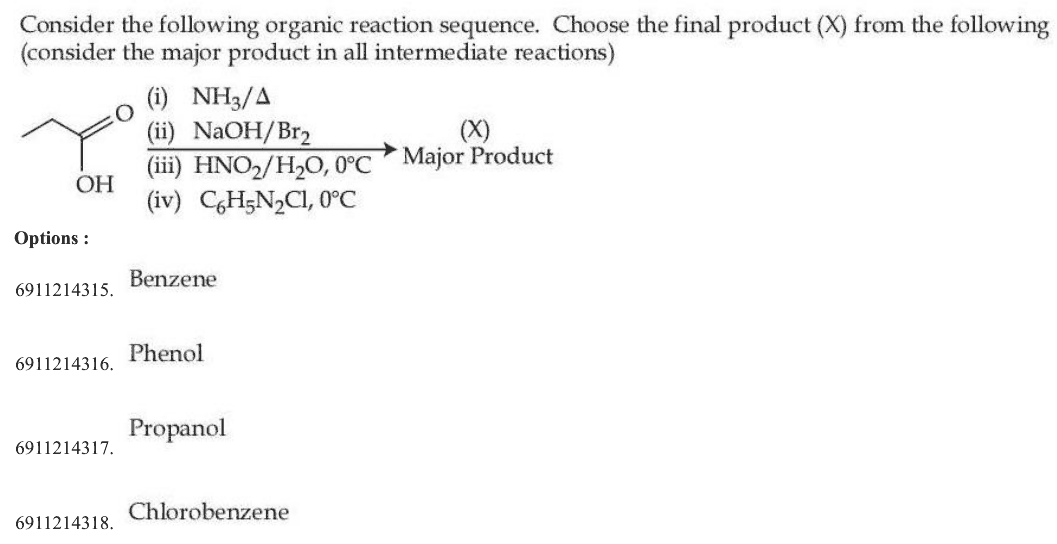
Get EdLoop – freeOpen on the web