Every Chemical Thermodynamics question from past JEE Main and AIEEE papers, with options and answers. Newest first.
229questions
182papers covered
3.8%of Chemistry questions, 2019–2026
2002–2026years
Guide at a glance
Chemical thermodynamics establishes criteria for reaction spontaneity and energy changes under Unit 4: Chemical Thermodynamics in the Class 11 curriculum, holding rank 12 among all 31 chemistry chapters with a 3.8 percent share of total chemistry questions.
Statement I: For an ideal gas, heat capacity at constant volume is always greater than the heat capacity at constant pressure.
Statement II: In a constant volume process, no work is produced and all the heat withdrawn goes into the chaotic motion and is reflected by a temperature increase of the ideal gas.
In the light of the above statements, choose the *correct* answer from the options given below
Gas 'A' undergoes change from state 'X' to state 'Y'. In this process, the heat absorbed and work done by the gas is 10 J and 18 J respectively. Now gas is brought back to state 'X' by another process during which 6 J of heat is evolved. In the reverse process of 'Y' to 'X',
A
18 J of the work is done by the gas 'A'.
B
2 J of the work is done by the gas 'A'.
C
12 J of the work is done on the gas 'A' by the surrounding.
D
14 J of the work is done on the gas 'A' by the surrounding.
20.0 dm$^3$ of an ideal gas 'X' at 600 K and 0.5 MPa undergoes isothermal reversible expansion until pressure of the gas is 0.2 MPa. Which of the following option is correct?
The heat of atomisation of methane and ethane are 'x' kJ mol$^{-1}$ and 'y' kJ mol$^{-1}$ respectively. The longest wavelength ($\lambda$) of light capable of breaking the C$-$C bond can be expressed in SI unit as:
A cup of water at 5°C (system) is placed in a microwave oven and the oven is turned on for one minute during which the water begins to boil. Which of the following option is true ?
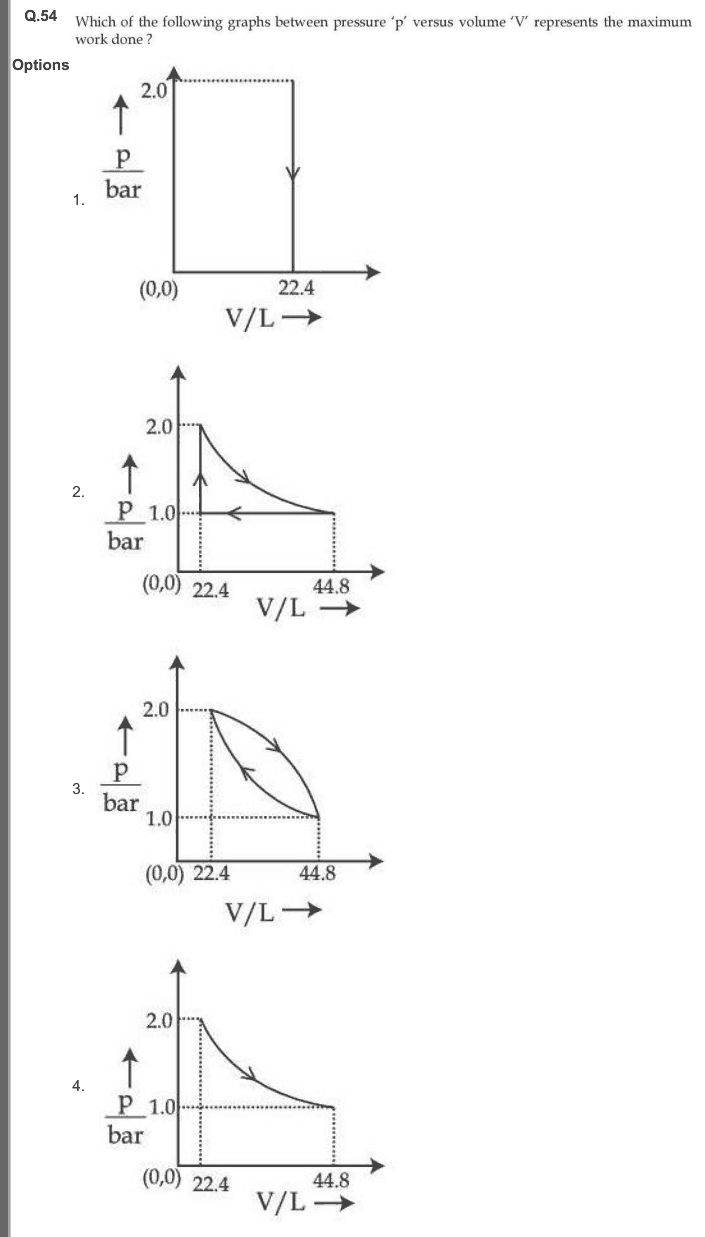
Which of the following graphs between pressure 'p' versus volume 'V' represents the maximum work done ?
The question as printed in the paper.
A
see figure axes labelled 'p/bar' (vertical) and 'V/L' (horizontal), with '2.0' at the top of the vertical axis, '22.4' on the horizontal axis and '(0,0)' at the origin; a dotted horizontal line at 2.0 from the vertical axis to V = 22.4, then a vertical line at V = 22.4 down to the horizontal axis with an arrowhead pointing down. There is no curve; together with the two axes the drawing is a rectangle.
B
see figure axes 'p/bar' and 'V/L' with 2.0 and 1.0 on the vertical axis and 22.4 and 44.8 on the horizontal axis; a closed three-sided loop: a curve falling from (22.4, 2.0) to (44.8, 1.0) with an arrowhead pointing down-right, then a straight horizontal line at 1.0 running back left to V = 22.4 (arrowhead pointing left), then a straight vertical line at V = 22.4 up from 1.0 to 2.0 (arrowhead pointing up); dotted guide lines at 2.0, 1.0, 22.4 and 44.8.
C
see figure axes 'p/bar' and 'V/L' with 2.0 and 1.0 on the vertical axis and 22.4 and 44.8 on the horizontal axis; two curved lines between the points (22.4, 2.0) and (44.8, 1.0) enclosing a lens-shaped region: the upper curve bulges up and to the right and has an arrowhead pointing towards the lower right (toward 44.8, 1.0), and the lower curve bulges down and to the left and has an arrowhead pointing up-left (back toward 22.4, 2.0); dotted guide lines at 2.0, 1.0, 22.4 and 44.8.
D
see figure axes 'p/bar' and 'V/L' with 2.0 and 1.0 on the vertical axis and 22.4 and 44.8 on the horizontal axis; a single curve falling from (22.4, 2.0) to (44.8, 1.0) with an arrowhead pointing down-right and no return path; dotted guide lines at 1.0, 22.4 and 44.8.
Let us consider a reversible reaction at temperature, T.
In this reaction, both $\Delta H$ and $\Delta S$ were observed to have positive values. If the equilibrium temperature is Te, then the reaction becomes spontaneous at:
One mole of an ideal gas expands isothermally and reversibly from $10dm^3$ to $20dm^3$ at 300 K. $\Delta U, q$ and work done in the process respectively are
Statement I : When a system containing ice in equilibrium with water (liquid) is heated, heat is absorbed by the system and there is no change in the temperature of the system until whole ice gets melted.
Statement II : At melting point of ice, there is absorption of heat in order to overcome intermolecular forces of attraction within the molecules of water in ice and kinetic energy of molecules is not increased at melting point.
In the light of the above statements, choose the correct answer from the options given below
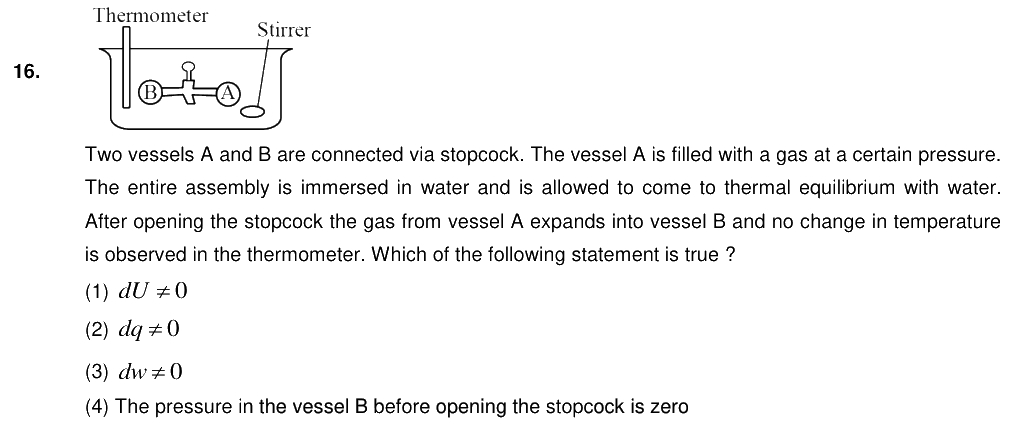
see figure Two vessels A and B are connected via stopcock. The vessel A is filled with a gas at a certain pressure. The entire assembly is immersed in water and is allowed to come to thermal equilibrium with water. After opening the stopcock the gas from vessel A expands into vessel B and no change in temperature is observed in the thermometer. Which of the following statement is true ?
The question as printed in the paper.
A
$dU \neq 0$
B
$dq \neq 0$
C
$dw \neq 0$
D
The pressure in the vessel B before opening the stopcock is zero
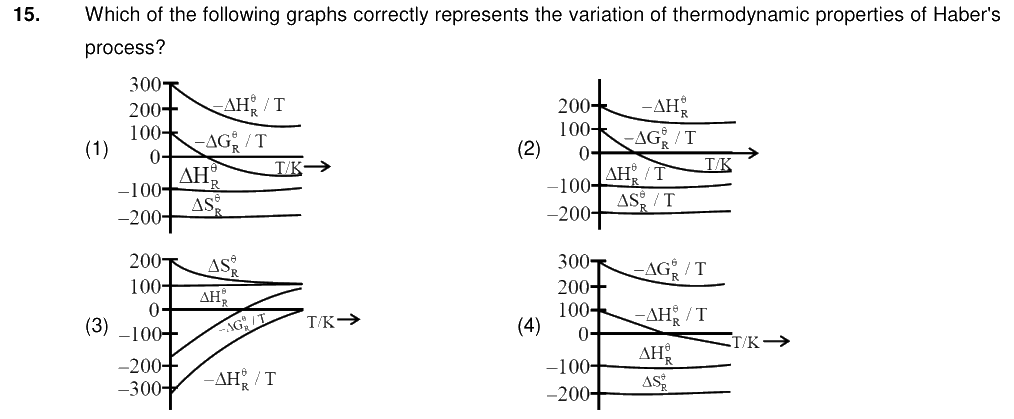
Which of the following graphs correctly represents the variation of thermodynamic properties of Haber's process?
The question as printed in the paper.
A
see figure vertical axis marked 300, 200, 100, 0, −100, −200 and a horizontal axis 'T/K →' through 0; four curves: '−ΔH°R / T' starts at 300 and falls to about 120; '−ΔG°R / T' starts at 100, falls and crosses the T/K axis to below zero; 'ΔH°R' a nearly flat line just below −100; 'ΔS°R' a nearly flat line near −200.
B
see figure vertical axis marked 200, 100, 0, −100, −200 and 'T/K →' through 0; four curves: '−ΔH°R' starts at 200 and falls to about 120; '−ΔG°R / T' starts at about 100, falls and crosses the T/K axis; 'ΔH°R / T' a nearly flat line near −100; 'ΔS°R / T' a nearly flat line near −200.
C
see figure vertical axis marked 200, 100, 0, −100, −200, −300 and 'T/K →' through 0; 'ΔS°R' starts at 200 and falls to 100; 'ΔH°R' a flat line at 100; '−ΔG°R / T' starts near −170 and rises, crossing the T/K axis and ending near 100; '−ΔH°R / T' starts near −300 and rises to about 0 at the right.
D
see figure vertical axis marked 300, 200, 100, 0, −100, −200 and 'T/K →' through 0; '−ΔG°R / T' starts at 300 and falls to about 200; '−ΔH°R / T' starts at 100, falls and crosses the T/K axis to below zero; 'ΔH°R' a nearly flat line near −100; 'ΔS°R' a nearly flat line near −200.
J of energy is transferred as heat to 0.5 mol of Argon gas at 298 K and 1.00 atm. The final temperature and the change in internal energy respectively are: Given : R = 8.3 J $\mathrm{K^{-1}\,mol^{-1}}$
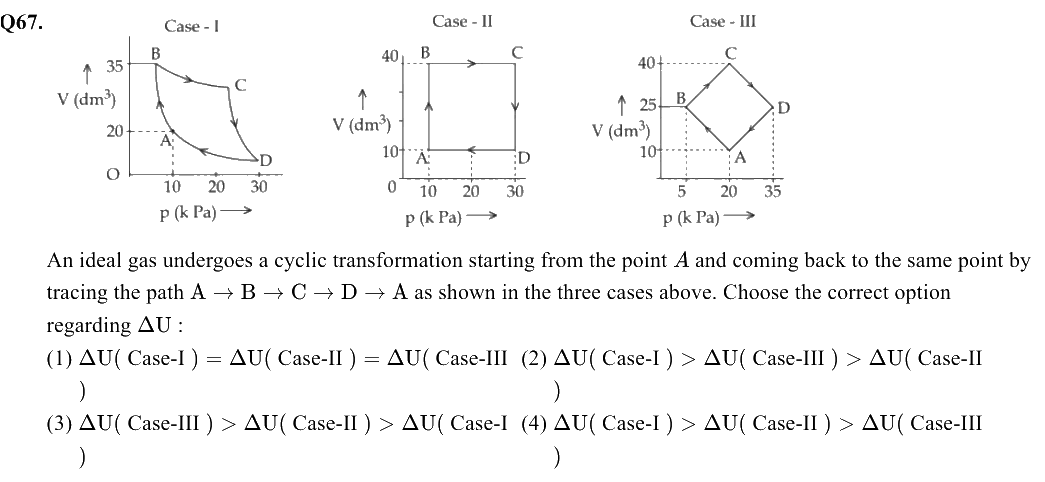
see figure An ideal gas undergoes a cyclic transformation starting from the point $A$ and coming back to the same point by tracing the path $\mathrm{A \rightarrow B \rightarrow C \rightarrow D \rightarrow A}$ as shown in the three cases above. Choose the correct option regarding $\Delta$U :
Let us consider an endothermic reaction which is non-spontaneous at the freezing point of water. However, the reaction is spontaneous at boiling point of water. Choose the correct option.
$\mathrm{S(\,g) + \frac{3}{2}O_2(\,g) \rightarrow SO_3(\,g) + 2\mathit{x}\,kcal}$ $\mathrm{SO_2(\,g) + \frac{1}{2}O_2(\,g) \rightarrow SO_3(\,g) + \mathit{y}\,kcal}$ The heat of formation of $\mathrm{SO_2(\,g)}$ is given by :
Ice at $-5^\circ$C is heated to become vapor with temperature of $110^\circ$C at atmospheric pressure. The entropy change associated with this process can be obtained from
A liquid when kept inside a thermally insulated closed vessel at $25^\circ$C was mechanically stirred from outside. What will be the correct option for the following thermodynamic parameters ?
Given below are two statements : One is labelled as Assertion (A) and the other is labelled as Reason (R) Assertion (A) : Enthalpy of neutralisation of strong monobasic acid with strong monoacidic base is always $-57$ kJ $\mathrm{mol^{-1}}$. Reason (R) : Enthalpy of neutralisation is the amount of heat liberated when one mole of $\mathrm{H^+}$ ions furnished by acid combine with one mole of $\mathrm{OH^-}$ ions furnished by base to form one mole of water. In the light of the above statements, choose the correct answer from the options given below.
A
(A) is true but (R) is false
B
Both (A) and (R) are true but (R) is not the correct explanation of (A)
C
Both (A) and (R) are true and (R) is the correct explanation of (A)
Which of the following relations are correct? (A) $\Delta\mathrm{U} = \mathrm{q} + \mathrm{p}\Delta\mathrm{V}$ (B) $\Delta\mathrm{G} = \Delta\mathrm{H} - \mathrm{T}\Delta\mathrm{S}$ (C) $\Delta\mathrm{S} = \frac{\mathrm{q_{rev}}}{\mathrm{T}}$ (D) $\Delta\mathrm{H} = \Delta\mathrm{U} - \Delta\mathrm{n}\mathrm{RT}$ Choose the most appropriate answer from the options given below :
$\mathrm{C(s)} + \mathrm{O_2(g)} \to \mathrm{CO_2(g)} + 400$ kJ $\mathrm{C(s)} + \frac{1}{2}\mathrm{O_2(g)} \to \mathrm{CO(g)} + 100$ kJ When coal of purity 60% is allowed to burn in presence of insufficient oxygen, 60% of carbon is converted into 'CO' and the remaining is converted into '$\mathrm{CO_2}$'. The heat generated when 0.6 kg of coal is burnt is
Match List - I with List - II. List-I (A) Spontaneous process (B) Process with $\Delta P = 0, \Delta T = 0$ (C) $\Delta \mathrm{H}_{\mathrm{reaction}}$ (D) Exothermic Process List-II (I) $\Delta \mathrm{H} < 0$ (II) $\Delta \mathrm{G}_{\mathrm{T,P}} < 0$ (III) Isothermal and isobaric process (IV) [Bond energies of molecules in reactants] - [Bond energies of product molecules] Choose the correct answer from the options given below
At $25^\circ\mathrm{C}$ and $1 \mathrm{~atm}$ pressure, the enthalpy of combustion of benzene 1 and acetylene g are $-3268 \mathrm{~kJ~mol^{-1}}$ and $-1300 \mathrm{~kJ~mol^{-1}}$, respectively. The change in enthalpy for the reaction $3\mathrm{C_2H_2}\mathrm{g} \rightarrow \mathrm{C_6H_6}\mathrm{l}$, is
During which of the following processes, does entropy decrease ? (A) Freezing of water to ice at $0^{\circ} \mathrm{C}$ (B) Freezing of water to ice at $-10^{\circ} \mathrm{C}$ (C) $\mathrm{N}_2(\mathrm{~g})+3 \mathrm{H}_2(\mathrm{~g}) \rightarrow 2 \mathrm{NH}_3(\mathrm{~g})$ (D) Adsorption of $\mathrm{CO}(\mathrm{g})$ and lead surface (E) Dissolution of $\mathrm{NaCl}$ in water
For one mole of an ideal gas, which of these statements must be true? (a) Internal energy (U) and enthalpy (H) each depends on temperature. (b) Compressibility factor Z is not equal to 1 (c) $\mathrm{C_{P,\ m}} - \mathrm{C_{V,\ m}} = \mathrm{R}$ (d) $\mathrm{dU = C_{v}\ dT}$ for any process
Enthalpy of sublimation of iodine is $24\ \mathrm{cal\ g^{-1}}$ at $200^\circ\mathrm{C}$ . If specific heat of $\mathrm{I_2}$ (s) and $\mathrm{I_2}$ (vap) are 0.055 and $0.031\ \mathrm{cal\ g^{-1}K^{-1}}$ respectively, then enthalpy of sublimation of iodine at $250^\circ\mathrm{C}$ in $\mathrm{cal\ g^{-1}}$ is:
The difference between $\Delta H$ and $\Delta U$ is $\Delta H - \Delta U$, when the combustion of one mole of heptane l is carried out at a temperature T , is equal to:
During compression of a spring the work done is 10 kJ and 2 kJ escaped to the surroundings as heat. The change in internal energy, $\Delta$U(in kJ) is:
Which one of the following equations does not correctly represent the first law of thermodynamics for the given processes involving an ideal gas? (Assume non- expansion work is zero)
For silver, $\mathrm{C_p\ (JK^{-1}mol^{-1})} = 23 + 0.01T$. If the temperature T of 3 moles of silver is raised from 300 K to 1000 K at 1 atm pressure, the value of $\Delta H$ will be close to:
5 moles of an ideal gas at 100 K are allowed to undergo reversible compression till its temperature becomes 200 K. If $\mathrm{C_V}$ = 28 J $\mathrm{K^{-1}}$, calculate $\Delta$U and $\Delta$pV for the process. ( R = 8.0 J $\mathrm{K^{-1}}$ $\mathrm{mol^{-1}}$)
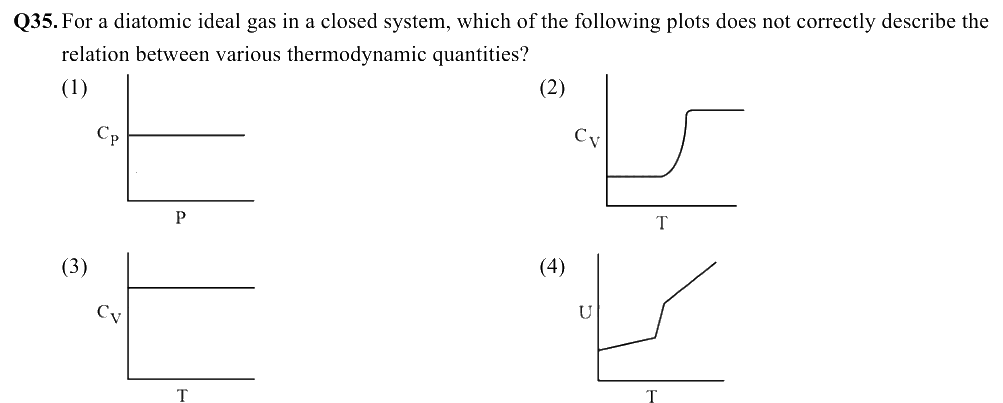
For a diatomic ideal gas in a closed system, which of the following plots does not correctly describe the relation between various thermodynamic quantities?
Given: (i) C(graphite) + $\mathrm{O_2}$(g) $\rightarrow$ $\mathrm{CO_2}$(g); $\Delta_r H^{\ominus}$ = x kJ mol$^{-1}$ (ii) C(graphite) + $\frac{1}{2}\mathrm{O_2}$(g) $\rightarrow$ CO(g) ; $\Delta_r H^{\ominus}$ = y kJ mol$^{-1}$ (iii) CO(g) + $\frac{1}{2}\mathrm{O_2}$(g) $\rightarrow$ $\mathrm{CO_2}$(g); $\Delta_r H^{\ominus}$ = z kJ mol$^{-1}$ Based on the above thermochemical equations, find out which one of the following algebraic relationships is correct?
Two blocks of the same metal having same mass and at temperature T$_1$, and T$_2$, respectively, are brought in contact with each other and allowed to attain thermal equilibrium at constant pressure. The change in entropy, $\Delta$S, for this process is :
For the chemical reaction X $\rightleftharpoons$ Y, the standard reaction Gibbs energy depends on temperature $T$ (in $K$ ) as $\Delta_r G^{\circ}$ ( in kJmol$^{-1}$) = 120 $-$ $\frac{3}{8}$ T The major component of the reaction mixture at T is :
The reaction MgO(s) + C(s) $\rightarrow$ Mg(s) + CO(g), for which $\Delta$H$^{\circ}$ = +491.1 kJ mol$^{-1}$ and $\Delta$S$^{\circ}$ = 198.0JK$^{-1}$ mol$^{-1}$ is not feasible at 298 K. Temperature above which reaction will be feasible is
The standard reaction Gibbs energy for a chemical reaction at an absolute temperature T is given by $\Delta$G$^{\circ}$ = A $-$ BT where A and $B$ are non-zero constants. Which of the following is true about this reaction?
A process has $\Delta H = 200\ J\ mol^{-1}$ and $\Delta S = 40\ JK^{-1}mol^{-1}$. Out of the values given below choose the minimum temperature above which the process will be spontaneous:
An ideal gas undergoes isothermal compression from $5\ \mathrm{m^3}$ to $1\ \mathrm{m^3}$ against a constant external pressure of $4\ \mathrm{N\ m^{-2}}$. The heat released in this process is $24\ \mathrm{J\ mol^{-1}K^{-1}}$ and is used to increase the pressure of $1$ mole of Al. The temperature of Al increases by:
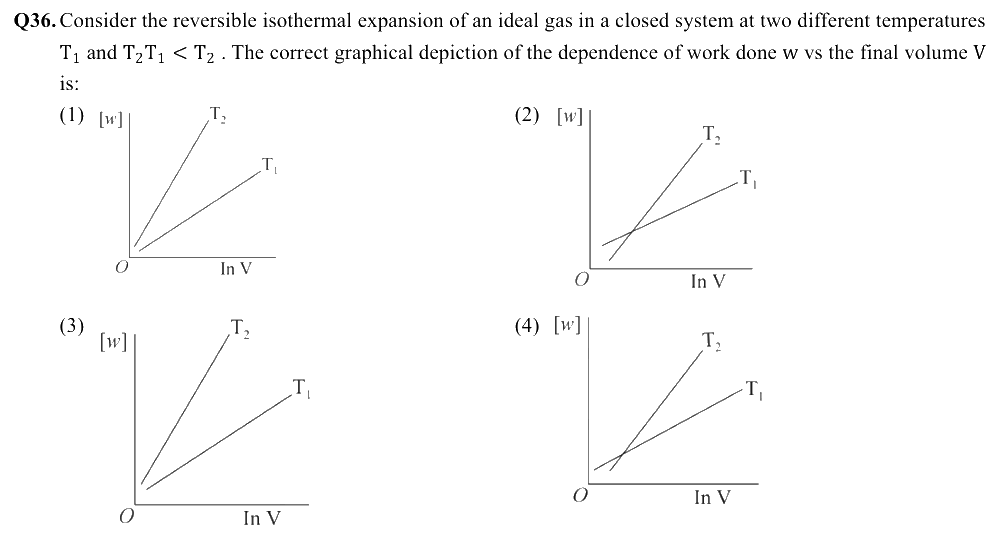
Consider the reversible isothermal expansion of an ideal gas in a closed system at two different temperatures $\mathrm{T_1}$ and $\mathrm{T_2T_1} < \mathrm{T_2}$ . The correct graphical depiction of the dependence of work done w vs the final volume V is: (see the figure above)
The question as printed in the paper.
A
see figure Graph of [w] against ln V: two straight lines rising from near the origin O, the T2 line steeper than the T1 line, not crossing.
B
see figure Graph of [w] against ln V: two straight lines that cross; the T1 line starts higher on the vertical axis side and is less steep, the T2 line starts lower and is steeper.
C
see figure Graph of [w] against ln V: two straight lines rising from near the origin O, the T2 line steeper than the T1 line, not crossing.
D
see figure Graph of [w] against ln V: two straight lines that cross; the T1 line starts higher on the vertical axis side and is less steep, the T2 line starts lower and is steeper.
The entropy change associated with the conversion of $1\ kg$ of ice at $273\ K$ to water vapours at $383\ K$ is: (Specific heat of water liquid and water vapour are $4.2\ kJ\ K^{-}$ (sic) and $2.0\ kJ\ K^{-1}kg^{-1}$ ; heat of liquid fusion and vaporization of water are $334\ kJ\ kg^{-1}$ and $2491\ kJ\ kg^{-1}$ , respectively). ( $\log 273 = 2.436, \log 373 = 2.572, \log 383 = 2.583$ )
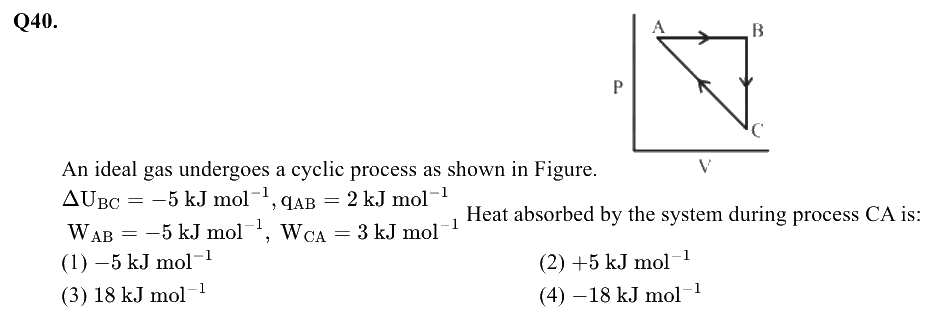
see figure An ideal gas undergoes a cyclic process as shown in Figure. $\Delta U_{BC} = -5\ \mathrm{kJ\ mol^{-1}}$, $q_{AB} = 2\ \mathrm{kJ\ mol^{-1}}$ $W_{AB} = -5\ \mathrm{kJ\ mol^{-1}}$, $W_{CA} = 3\ \mathrm{kJ\ mol^{-1}}$ Heat absorbed by the system during process CA is:
$\Delta_f\mathrm{G}^\circ$ at $500\ \mathrm{K}$ for substance ' S ' in liquid state and gaseous state are $+100.7\mathrm{kcal\,mol^{-1}}$ and $+103\ \mathrm{kcal\,mol^{-1}}$, respectively. Vapour pressure of liquid ' S ' at $500\ \mathrm{K}$ is approximately equal to: $\left(\mathrm{R} = 2\mathrm{cal\,K^{-1}\ mol^{-1}}\right)$.
The combustion of benzene (l) gives $\mathrm{CO_2(g)}$ and $\mathrm{H_2O(l)}$. Given that heat of combustion of benzene at constant volume is $-3263 .9\ \mathrm{kJ\ mol^{-1}}$ at $25^\circ\mathrm{C}$; the heat of combustion $(\text{in } \mathrm{kJ\ mol^{-1}})$ of benzene at constant pressure will be $(\mathrm{R} = 8 .314\ \mathrm{JK^{-1}\ mol^{-1}})$
A gas undergoes change from state A to state B. In this process, the heat absorbed and work done by the gas is 5 J and 8 J, respectively. Now gas is brought back to A by another process during which 3 J of heat is evolved. In this reverse process of B to A.
A
6 J of the work will be done by the gas
B
6 J of the work will be done by the surroundings on gas
C
10 J of the work will be done by the surroundings on gas
The enthalpy change on freezing of 1 mol of water at $5^\circ\mathrm{C}$ to ice at $-5^\circ\mathrm{C}$ is: (Given $\Delta_{\mathrm{fus}}\mathrm{H}$ = 6 kJ $\mathrm{mol^{-1}}$ at $0^\circ\mathrm{C}$, $\mathrm{C_p(H_2O, l)}$ = 75.3 J $\mathrm{mol^{-1}\,K^{-1}}$ $\mathrm{C_p(H_2O, s)}$ = 36.8 J $\mathrm{mol^{-1}\,K^{-1}}$ )
If $100$ mole of $\mathrm{H_2O_2}$ decompose at $1$ bar and $300\ \mathrm{K}$, the work is done (kJ) by one mole of $\mathrm{O_2(g)}$ as it expands against $1$ bar pressure is: $2\mathrm{H_2O_2(l)} \rightleftharpoons 2\mathrm{H_2O(l)} + \mathrm{O_2(g)}$ $(\mathrm{R} = 8.3\ \mathrm{J\,K^{-1}\,mol^{-1}})$
For the reaction, $\mathrm{A(g) + B(g) \rightarrow C(g) + D(g)}$, $\Delta\mathrm{H^o}$ and $\Delta\mathrm{S^o}$ are, respectively, $-29.8\ \mathrm{kJ\ mol^{-1}}$ and $-0.100\ \mathrm{kJ\ K^{-1}\ mol^{-1}}$ at 298 K. The equilibrium constant for the reaction at 298 k is:
A reaction at 1 bar is non-spontaneous at low temperature but becomes spontaneous at high temperature. Identify the correct statement about the reaction among the following:
The heats of combustion of carbon and carbon monoxide are $-393.5$ and $-283.5$ kJ $\mathrm{mol^{-1}}$, respectively. The heat of formation (in kJ) of carbon monoxide per mole is:
The heat of atomization of methane and ethane are $360\ \mathrm{kJ\ mol^{-1}}$ and $620\ \mathrm{kJ\ mol^{-1}}$, respectively. The longest wavelength of light capable of breaking the $\mathrm{C - C}$ bond is (Avogadro's number = $6.023 \times 10^{23}$, h = $6.62 \times 10^{-34}$ J s)
The following reaction is performed at $298\ \mathrm{K}$. $2\mathrm{NO(g)} + \mathrm{O_2(g)} \rightleftharpoons 2\mathrm{NO_2(g)}$ The standard free energy of the formation of $\mathrm{NO(g)}$ is $86.6\ \mathrm{kJ\ mol^{-1}}$ at $298\ \mathrm{K}$. What is the standard free energy of the formation of $\mathrm{NO_2(g)}$ at $298\ \mathrm{K}$? ($\mathrm{K_P} = 1.6 \times 10^{12}$)
The standard Gibbs energy change at $300\ \mathrm{K}$ for the reaction $2\mathrm{A} \rightleftharpoons \mathrm{B} + \mathrm{C}$ is $2494.2\ \mathrm{J}$. At a given time, the composition of the reaction mixture is $[\mathrm{A}] = \dfrac{1}{2}$, $[\mathrm{B}] = 2$ and $[\mathrm{C}] = \dfrac{1}{2}$. The reaction proceeds in the: $[\mathrm{R} = 8.314\ \mathrm{J/K - mol}$ , $\mathrm{e} = 2.718\ ]$ {Given antilog $(-0.44) = 0.36$}
A
Reverse direction because $\mathrm{Q} < \mathrm{K_C}$
B
Forward direction because $\mathrm{Q} > \mathrm{K_C}$
C
Reverse direction because $\mathrm{Q} > \mathrm{K_C}$
D
Forward direction because $\mathrm{Q} < \mathrm{K_C}$
The standard enthalpy of formation $(\Delta_f \mathrm{H}^{\circ}_{298})$ for methane, $\mathrm{CH_4}$ is $-74.9\ \mathrm{kJ\ mol^{-1}}$. In order to calculate the average energy given out in the formation of a $\mathrm{C} - \mathrm{H}$ bond from this it is necessary to know which one of the following?
A
The dissociation energy of the hydrogen molecule, $\mathrm{H_2}$.
B
The first four ionisation energies of carbon.
C
The dissociation energy of $\mathrm{H_2}$ and enthalpy and sublimation of carbon (graphite).
D
The first four ionisation energies of carbon and electron affinity of hydrogen.
The molar heat capacity $(\mathrm{C_p})$ of $\mathrm{CD_2O}$ is 10 cals at $1000\ \mathrm{K}$. The change in entropy associated with cooling of $32\ \mathrm{g}$ of $\mathrm{CD_2O}$ vapour from $1000\ \mathrm{K}$ to $100\ \mathrm{K}$ at constant pressure will be: (D = deuterium, atomic mass = 2u)
The standard enthalpy of formation of $\mathrm{NH_3}$ is $-46.0\ \mathrm{kJ/mol}$. If bond enthalpy of $\mathrm{H_2}$ is $-436\ \mathrm{kJ/mol}$ and that of $\mathrm{N_2}$ is $-712\ \mathrm{kJ/mol}$, the average bond enthalpy of $\mathrm{N-H}$ bond in $\mathrm{NH_3}$ is :
For complete combustion of ethanol, $\mathrm{C_2H_5OH}(l) + 3\mathrm{O_2}(g) \rightarrow 2\mathrm{CO_2}(g) + 3\mathrm{H_2O}(l)$, the amount of heat produced as measured in bomb calorimeter, is 1364.47 kJ mol$^{-1}$ at $25^\circ$C. Assuming ideality the Enthalpy of combustion, $\Delta_c\mathrm{H}$, for the reaction will be: (R = 8.314 kJ mol$^{-1}$)
Given that: (i) $\Delta_f H^\circ$ of $\mathrm{N_2O}$ is 82 kJ $\mathrm{mol^{-1}}$ (ii) Bond energies of N $\equiv$ N, N = N, O = O and N = O are 946, 418, 498 and 607 kJ $\mathrm{mol^{-1}}$ respectively, The resonance energy of $\mathrm{N_2O}$ is :
Given: (I) $\mathrm{H_2(g)} + \frac{1}{2}\mathrm{O_2(g)} \rightarrow \mathrm{H_2O}(l)$; $\Delta\mathrm{H^\circ_{298\,K}} = -285.9\ \mathrm{kJ\ mol^{-1}}$ (II) $\mathrm{H_2(g)} + \frac{1}{2}\mathrm{O_2(g)} \rightarrow \mathrm{H_2O(g)}$; $\Delta\mathrm{H^\circ_{298\,K}} = -241.8\ \mathrm{kJ\ mol^{-1}}$ The molar enthalpy of vapourisation of water will be :
A piston filled with 0.04 mol of an ideal gas expands reversibly from 50.0 mL to 375 mL at a constant temperature of 37.0$^{\circ}$C. As it does so, it absorbs 208 J of heat. The values of q and w for the process will be (R = 8.314 J/mol K) (ln7.5 = 2.01)
One mole of an ideal gas is expanded isothermally and reversibly to half of its initial pressure. $\Delta S$ for the process in $\mathrm{JK^{-1}\,mol^{-1}}$ is [$\ln 2 = 0.693$ and $R = 8.314$, J/(molK)]
The enthalpy of neutralisation of $\mathrm{NH_4OH}$ with $\mathrm{HCl}$ is $-51.46\ \mathrm{kJ\ mol^{-1}}$ and the enthalpy of neutralisation of $\mathrm{NaOH}$ with $\mathrm{HCl}$ is $-55.90\ \mathrm{kJ\ mol^{-1}}$. The enthalpy of ionisation of $\mathrm{NH_4OH}$ is
The difference between the reaction enthalpy change $(\Delta_r\mathrm{H})$ and reaction internal energy change $(\Delta_r\mathrm{U})$ for the reaction: $2\mathrm{C_6H_6(l)} + 15\mathrm{O_2(g)} \longrightarrow$ at 300 K is $(\mathrm{R} = 8.314\ \mathrm{J\,mol^{-1}\,K^{-1}})$
The entropy of a sample of a certain substance increases by $0.836\ \mathrm{J\ K}^{-1}$ on adding reversibly 0.3344 J of heat at constant temperature. The temperature of the sample is:
The entropy change involved in the isothermal reversible expansion of 2 moles of an ideal gas from a volume of $10\ \mathrm{dm^3}$ to a volume of $100\ \mathrm{dm^3}$ at $27^\circ\mathrm{C}$ is :
The standard enthalpy of formation of $\mathrm{NH_3}$ is $-46.0\ \mathrm{kJ\ mol^{-1}}$. If the enthalpy of formation of $\mathrm{H_2}$ from its atoms is $-436\ \mathrm{kJ\ mol^{-1}}$ and that of $\mathrm{N_2}$ is $-712\ \mathrm{kJ\ mol^{-1}}$, the average bond enthalpy of $\mathrm{N - H}$ bond in $\mathrm{NH_3}$ is
For a particular reversible reaction at temperature $T$, $\Delta H$ and $\Delta S$ were found to be both $+ve$. If $T_e$ is the temperature at equilibrium, the reaction would be spontaneous when
On the basis of the following thermochemical data: $\left(\Delta_f G^\circ \mathrm{H^+_{(aq)}} = 0\right)$ $\mathrm{H_2O(\ell) \to H^+(aq) + OH^-(aq)}$; $\Delta H = 57.32$ kJ $\mathrm{H_2(g) + \frac{1}{2}O_2(g) \to H_2O(\ell)}$; $\Delta H = -286.20$ kJ The value of enthalpy of formation of $\mathrm{OH^-}$ ion at $25^\circ$C is:
Oxidising power of chlorine in aqueous solution can be determined by the parameters indicated below: $\frac{1}{2}\mathrm{Cl_2(g)} \xrightarrow{\frac{1}{2}\Delta_{\mathrm{ass}}H^{\ominus}} \mathrm{Cl(g)} \xrightarrow{\Delta_{\mathrm{eg}}H^{\ominus}} \mathrm{Cl^{-}(g)} \xrightarrow{\Delta_{\mathrm{mon}}H^{\ominus}} \mathrm{Cl^{-}(aq)}$. The energy involved in the conversion of $\frac{1}{2}\mathrm{Cl_2(g)}$ to $\mathrm{Cl^{-}(g)}$ (using the data, $\Delta_{\mathrm{diss}}H^{\ominus}_{\mathrm{Cl_2}} = 240\,\mathrm{kJ\,mol^{-1}}$, $\Delta_{\mathrm{eg}}H^{\ominus}_{\mathrm{cl}} = -349\,\mathrm{kJ\,mol^{-1}}$, $\Delta_{\mathrm{hyd}}H^{\ominus}_{\mathrm{Cl}} = -381\,\mathrm{kJ\,mol^{-1}}$) will be
Standard entropy of $X_2, Y_2$ and $XY_3$ are 60,40 and $50\,\mathrm{JK^{-1}\ mol^{-1}}$, respectively. For the reaction, $\frac{1}{2}X_2 + \frac{3}{2}Y_2 \rightarrow XY_3$, $\Delta\mathrm{H} = -30$ kJ, to be at equilibrium, the temperature will be
Assuming that water vapour is an ideal gas, the internal energy ($\Delta$U) when 1 mol of water is vapourised at 1 bar pressure and $100^\circ$C, (Given: Molar enthalpy of vapourization of water at 1 bar and 373 K = 41 $\mathrm{kJ\ mol^{-1}}$ and R = 8.3 $\mathrm{J\ mol^{-1}\ K^{-1}}$ ) will be
In conversion of lime-stone to lime, $\mathrm{CaCO_3(\ s) \longrightarrow CaO(s) + CO_2(\ g)}$ the vales of $\Delta\mathrm{H^\circ}$ and $\Delta\mathrm{S^\circ}$ are +179.1 $\mathrm{kJ\ mol^{-1}}$ and 160.2 J/K respectively at 298 K and 1 bar. Assuming that $\Delta\mathrm{H^\circ}$ do not change with temperature, temperature above which conversion of limestone to lime will be spontaneous is
The standard enthalpy of formation ($\Delta_{\mathrm{f}}H^\circ$) at 298 K for methane, $\mathrm{CH_4(g)}$, is $-74.8\ \mathrm{kJ\ mol^{-1}}$. The additional information required to determine the average energy for C - H bond formation would be
A
the dissociation energy of $\mathrm{H_2}$ and enthalpy of sublimation of carbon
B
latent heat of vapourization of methane
C
the first four ionization energies of carbon and electron gain enthalpy of hydrogen
D
the dissociation energy of hydrogen molecule, $\mathrm{H_2}$
The enthalpy changes for the following processes are listed below: $\mathrm{Cl_2(g) = 2Cl(g)}$, $242.3\ \mathrm{kJ\ mol^{-1}}$ $\mathrm{I_2(g) = 2I(g)}$, $151.0\ \mathrm{kJ\ mol^{-1}}$ $\mathrm{ICl(g) = I(g) + Cl(g)}$, $211.3\ \mathrm{kJ\ mol^{-1}}$ $\mathrm{I_2(s) = I_2(g)}$, $62.76\ \mathrm{kJ\ mol^{-1}}$ Given that the standard states for iodine and chlorine are $\mathrm{I_2(s)}$ and $\mathrm{Cl_2(g)}$, the standard enthalpy of formation for ICl(g) is
Consider the reaction: $\mathrm{N_2 + 3H_2 \longrightarrow 2NH_3}$ carried out at constant temperature and pressure. If $\Delta H$ and $\Delta U$ are the enthalpy and internal energy changes for the reaction, which of the following expressions is true?
If the bond dissociation energies of $XY$, $X_2$ and $Y_2$ (all diatomic molecules) are in the ratio of 1:1:0.5 and $\Delta_f H$ for the formation of $XY$ is $-200$ kJ mole$^{-1}$. The bond dissociation energy of $\mathrm{X_2}$ will be
An ideal gas expands in volume from $1 \times 10^{-3}\ \mathrm{m^3}$ to $1 \times 10^{-2}\ \mathrm{m^3}$ at 300 K against a constant pressure of $1 \times 10^{5}\mathrm{Nm^{-2}}$. The work done is
The enthalpies of combustion of carbon and carbon monoxide are $-393.5$ and $-283\ \mathrm{kJ\ mol^{-1}}$ respectively. The enthalpy of formation of carbon monoxide per mole is
The internal energy change when a system goes from state A to B is 40 kJ/mole. If the system goes from A to B by a reversible path and returns to state A by an irreversible path what would be the net change in internal energy?
If at 298 K the bond energies of $\mathrm{C-H}$, $\mathrm{C-C}$, $\mathrm{C=C}$ and $\mathrm{H-H}$ bonds are respectively 414, 347, 615 and 435 kJ $\mathrm{mol^{-1}}$, the value of enthalpy change for the reaction $\mathrm{H_2C=CH_2(g) + H_2(g) \rightarrow H_3C-CH_3(g)}$ at 298 K will be
In an irreversible process taking place at constant T and P and in which only pressure-volume work is being done, the change in Gibbs free energy (dG) and change in entropy (dS), satisfy the criteria
Consider the reaction X $\rightleftharpoons$ Y at 300 K. If $\Delta H^\ominus$ and K are 28.40 kJ mol$^{-1}$ and $1.8\times10^{-7}$ at the same temperature, then the magnitude of $\Delta S^\ominus$ for the reaction in J K$^{-1}$ mol$^{-1}$ is ________. (Nearest integer) (Given : R = 8.3 J K$^{-1}$ mol$^{-1}$, ln 10 = 2.3, log 3 = 0.48, log 2 = 0.30)
Numerical answer type: type your answer in EdLoop to check it
If 3.365g of ethanol ($l$) is burnt completely in a bomb calorimeter at 298.15 K, the heat produced is 99.472 kJ. The $|\Delta H_f^\circ|$ of ethanol at 298.15 K is ________ $\times10^2$ kJ mol$^{-1}$. (Nearest integer)
Given: Standard enthalpy for combustion of graphite $= -393.5$ kJ mol$^{-1}$ Standard enthalpy of formation of water (l) $= -285.8$ kJ mol$^{-1}$ Molar mass in g mol$^{-1}$ of C, H, O are 12, 1 and 16 respectively
Numerical answer type: type your answer in EdLoop to check it
At the transition temperature T, $\mathrm{A} \rightleftharpoons \mathrm{B}$ and $\Delta\mathrm{G}^0 = 105 - 35\log \mathrm{T}$ where A and B are two states of substance X. The transition temperature in °C when pressure is 1 atm is ________. (Nearest integer)
Numerical answer type: type your answer in EdLoop to check it
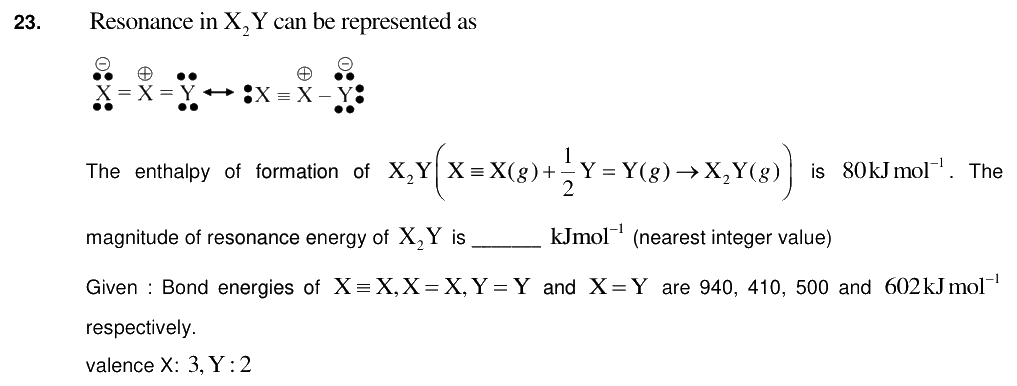
The enthalpy of formation of $X_2Y\left(X \equiv X(g) + \frac{1}{2}Y = Y(g) \rightarrow X_2Y(g)\right)$ is $80\,kJ\,mol^{-1}$. The magnitude of resonance energy of $X_2Y$ is ______ $kJmol^{-1}$ (nearest integer value)
Given : Bond energies of $X \equiv X, X = X, Y = Y$ and $X = Y$ are 940, 410, 500 and $602\,kJ\,mol^{-1}$ respectively.
valence X: 3, Y: 2
The question as printed in the paper.
Numerical answer type: type your answer in EdLoop to check it
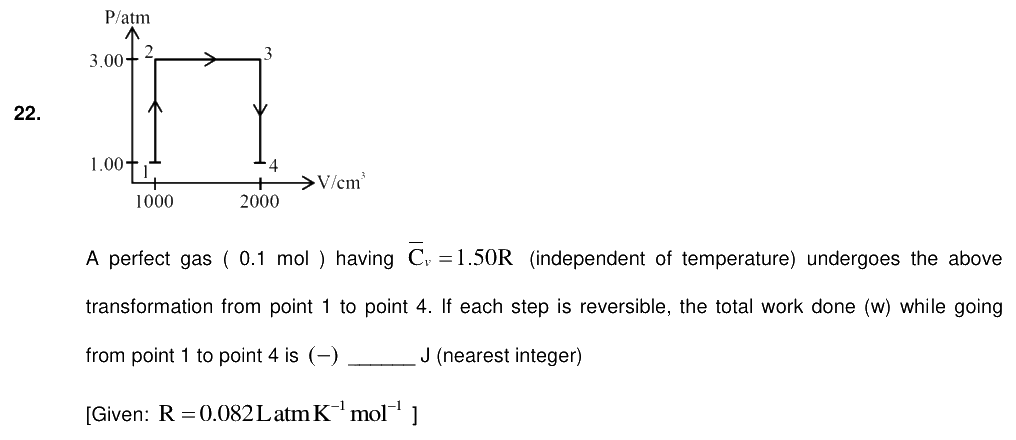
see figure A perfect gas ( 0.1 mol ) having $\overline{C}_v = 1.50R$ (independent of temperature) undergoes the above transformation from point 1 to point 4. If each step is reversible, the total work done (w) while going from point 1 to point 4 is $(-)$ ______ J (nearest integer)
[Given: $R = 0.082L\,atm\,K^{-1}mol^{-1}$ ]
The question as printed in the paper.
Numerical answer type: type your answer in EdLoop to check it
A sample of $n$ -octane $(1.14g)$ was completely burnt in excess of oxygen in a bomb calorimeter, whose heat capacity is $5kJ\,K^{-1}$. As a result of combustion reaction, the temperature of the calorimeter is increased by 5 K . The magnitude of the heat of combustion of octane at constant volume is ______ $kJmol^{-1}$ (nearest integer).
Numerical answer type: type your answer in EdLoop to check it
The formation enthalpies, $\Delta\mathrm{H_f}^\ominus$ for $\mathrm{H_{(g)}}$ and $\mathrm{O_{(g)}}$ are 220.0 and 250.0 kJ $\mathrm{mol^{-1}}$, respectively, at 298.15 K , and $\Delta\mathrm{H_f}^\ominus$ for $\mathrm{H_2O_{(g)}}$ is $-242.0$ kJ $\mathrm{mol^{-1}}$ at the same temperature. The average bond enthalpy of the O $-$ H bond in water at 298.15 K is ______ kJmol$^{-1}$ (nearest integer).
Numerical answer type: type your answer in EdLoop to check it
Consider the following data : Heat of formation of $\mathrm{CO_2(\,g)}$ = $-393.5$ kJ $\mathrm{mol^{-1}}$ Heat of formation of $\mathrm{H_2O(l)}$ = $-286.0$ kJ $\mathrm{mol^{-1}}$ Heat of combustion of benzene = $-3267.0$ kJ $\mathrm{mol^{-1}}$ The heat of formation of benzene is ______ $\mathrm{kJmol^{-1}}$. (Nearest integer)
Numerical answer type: type your answer in EdLoop to check it
Standard entropies of $\mathrm{X_2}$, $\mathrm{Y_2}$ and $\mathrm{XY_5}$ are 70,50 and 110 J $\mathrm{K^{-1}\,mol^{-1}}$ respectively. The temperature in Kelvin at which the reaction $\frac{1}{2}\mathrm{X_2} + \frac{5}{2}\mathrm{Y_2} \rightleftharpoons \mathrm{XY_5}\Delta\mathrm{H^\Theta}$ = $-35$ kJ $\mathrm{mol^{-1}}$ will be at equilibrium is ______ . (Nearest integer)
Numerical answer type: type your answer in EdLoop to check it
The standard enthalpy and standard entropy of decomposition of $\mathrm{N_2O_4}$ to $\mathrm{NO_2}$ are 55.0 kJ $\mathrm{mol^{-1}}$ and 175.0 J/K/mol respectively. The standard free energy change for this reaction at $25^\circ$C in J $\mathrm{mol^{-1}}$ is ______ (Nearest integer)
Numerical answer type: type your answer in EdLoop to check it
When equal volume of 1M$\mathrm{HCl}$ and 1M$\mathrm{H_2SO_4}$ are separately neutralised by excess volume of 1M NaOH solution. $x$ and $y$ kJ of heat is liberated respectively. The value of $y/x$ is ______
Numerical answer type: type your answer in EdLoop to check it
The heat of solution of anhydrous $\mathrm{CuSO_4}$ and $\mathrm{CuSO_4 \cdot 5H_2O}$ are $-70$ kJ mol$^{-1}$ and $+12$ kJ mol$^{-1}$ respectively. The heat of hydration of $\mathrm{CuSO_4}$ to $\mathrm{CuSO_4 \cdot 5H_2O}$ is $-x$ kJ. The value of $x$ is ______ (nearest integer).
Numerical answer type: type your answer in EdLoop to check it
When $\Delta\mathrm{H_{vap}}$ = 30 kJ/mol and $\Delta\mathrm{S_{vap}}$ = 75 J mol$^{-1}$ K$^{-1}$, then the temperature of vapour, at one atmosphere is ______ K.
Numerical answer type: type your answer in EdLoop to check it
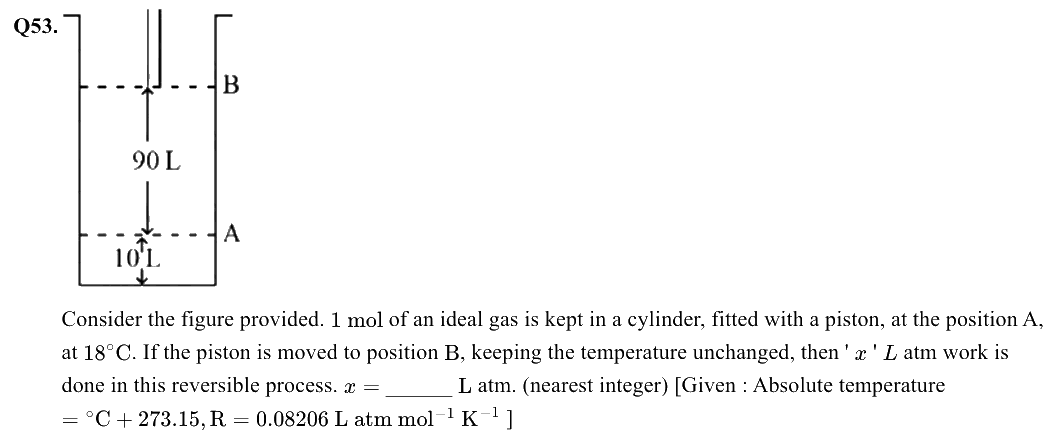
see figure Consider the figure provided. 1 mol of an ideal gas is kept in a cylinder, fitted with a piston, at the position A, at $18^{\circ}$C. If the piston is moved to position B, keeping the temperature unchanged, then ' $x$ $L$ atm work is done in this reversible process. $x$ = ______ L atm. (nearest integer) [Given : Absolute temperature = $^{\circ}$C + 273.15, $R = 0.08206\ \mathrm{L\ atm\ mol^{-1}\ K^{-1}}$ ]
The question as printed in the paper.
Numerical answer type: type your answer in EdLoop to check it
$\Delta_{vap}H^{\ominus}$ for water is +40.79 kJ $\mathrm{mol^{-1}}$ at 1 bar and $100^{\circ}$C. Change in internal energy for this vapourisation under same condition is ______ $\mathrm{kJmol^{-1}}$. (Integer answer) (Given $R = 8.3\,\mathrm{JK^{-1}\,mol^{-1}}$)
Numerical answer type: type your answer in EdLoop to check it
An ideal gas, $\overline{C}_v = \frac{5}{2}R$, is expanded adiabatically against a constant pressure of 1 atm untill it doubles in volume. If the initial temperature and pressure is 298 K and 5 atm, respectively then the final temperature is ______ K (nearest integer). [$\overline{C}_v$ is the molar heat capacity at constant volume]
Numerical answer type: type your answer in EdLoop to check it
For the reaction at 298 K, $2\,A + B \rightarrow C$. $\Delta H = 400$ kJ mol$^{-1}$ and $\Delta S = 0.2$ kJ mol$^{-1}$ K$^{-1}$. The reaction will become spontaneous above ______ K.
Numerical answer type: type your answer in EdLoop to check it
The heat of combustion of solid benzoic acid at constant volume is $-321.30$ kJ at $27^\circ$C. The heat of combustion at constant pressure is $(-321.30 - x\mathrm{R})$kJ, the value of $x$ is ______ .
Numerical answer type: type your answer in EdLoop to check it
Combustion of 1 mole of benzene is expressed at $\mathrm{C_6H_6(l) + \frac{15}{2}O_2(g) \rightarrow 6CO_2(g) + 3H_2O(l)}$. The standard enthalpy of combustion of 2 mol of benzene is $-'x'$kJ. $x$ = ______ Given: 1. standard Enthalpy of formation of 1 mol of $\mathrm{C_6H_6(l)}$, for the reaction 6C (graphite) $+ 3\mathrm{H_2}$( g) $\rightarrow$ $\mathrm{C_6H_6(l)}$ is 48.5 kJ $\mathrm{mol^{-1}}$. 2. Standard Enthalpy of formation of 1 mol of $\mathrm{CO_2}$( g), for the reaction C (graphite) $+ \mathrm{O_2}$( g) $\rightarrow$ $\mathrm{CO_2}$( g) is $-393.5$ kJ $\mathrm{mol^{-1}}$. 3. Standard and Enthalpy of formation of 1 mol of $\mathrm{H_2O(l)}$, for the reaction $\mathrm{H_2}$( g) $+ \frac{1}{2}\mathrm{O_2}$( g) $\rightarrow$ $\mathrm{H_2O(l)}$ is $-286$ kJ $\mathrm{mol^{-1}}$.
Numerical answer type: type your answer in EdLoop to check it
The enthalpy of formation of ethane ($\mathrm{C_2H_6}$) from ethylene by addition of hydrogen where the bond-energies of C $-$ H, C $-$ C, C = C, H $-$ H are 414 kJ, 347 kJ, 615 kJ and 435 kJ respectively is ______ kJ
Numerical answer type: type your answer in EdLoop to check it
Three moles of an ideal gas are compressed isothermally from 60 L to 20 L using constant pressure of 5 atm. Heat exchange Q for the compression is - ______ Lit. atm.
Numerical answer type: type your answer in EdLoop to check it
If 5 moles of an ideal gas expands from 10L to a volume of 100L at 300K under isothermal and reversible condition then work, w, is $-x$ J. The value of x is - ______. (Given R = 8.314 J K$^{-1}$ mol$^{-1}$)
Numerical answer type: type your answer in EdLoop to check it
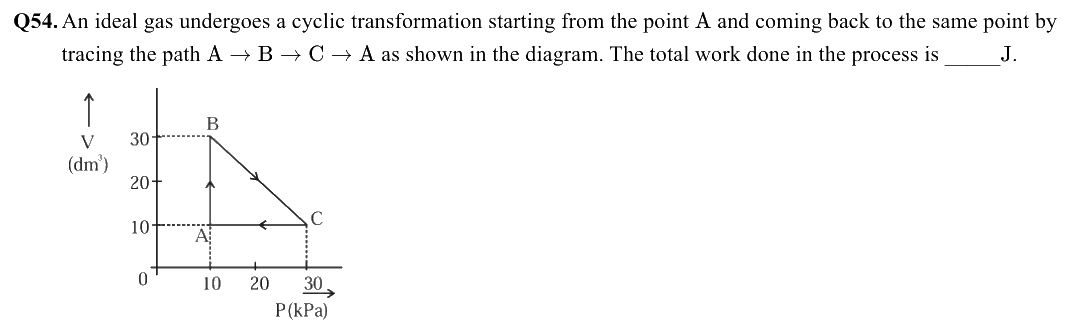
An ideal gas undergoes a cyclic transformation starting from the point A and coming back to the same point by tracing the path A → B → C → A as shown in the diagram. The total work done in the process is ______ J.
(see the figure above)
The question as printed in the paper.
Numerical answer type: type your answer in EdLoop to check it
Standard enthalpy of vapourisation for $\mathrm{CCl_4}$ is 30.5 kJ mol$^{-1}$. Heat required for vapourisation of 284 g of $\mathrm{CCl_4}$ at constant temperature is ______ kJ. (Given molar mass in gmol$^{-1}$; C = 12, Cl = 35.5)
Round off your answer to the nearest integer.
Numerical answer type: type your answer in EdLoop to check it
If three moles of an ideal gas at 300 K expand isothermally from $30\ \mathrm{dm^3}$ to $45\ \mathrm{dm^3}$ against a constant opposing pressure of 80 kPa, then the amount of heat transferred is ______ J.
Numerical answer type: type your answer in EdLoop to check it
For a certain thermochemical reaction M $\rightarrow$ N at T = 400 K, $\Delta H^\circ = 77.2$ kJ mol$^{-1}$, $\Delta S^\circ = 122$ J K$^{-1}$, log equilibrium constant ($\log K$) is - ______ $\times 10^{-1}$.
Numerical answer type: type your answer in EdLoop to check it
30.4 kJ of heat is required to melt one mole of sodium chloride and the entropy change at the melting point is 28.4 J K$^{-1}$ mol$^{-1}$ at 1 atm. The melting point of sodium chloride is ______ K (Nearest Integer)
Numerical answer type: type your answer in EdLoop to check it
$\mathrm{A_2 + B_2 \rightarrow 2\,AB}$. $\Delta\mathrm{H_f}$ = $-200$ kJ mol$^{-1}$ AB, $\mathrm{A_2}$ and $\mathrm{B_2}$ are diatomic molecules. If the bond enthalpies of $\mathrm{A_2}$, $\mathrm{B_2}$ and AB are in the ratio 1 : 0.5 : 1, then the bond enthalpy of $\mathrm{A_2}$ is ______ kJ mol$^{-1}$ (Nearest integer)
Numerical answer type: type your answer in EdLoop to check it
Solid fuel used in rocket is a mixture of $\mathrm{Fe_2O_3}$ and Al (in ratio 1 : 2). The heat evolved $(\mathrm{kJ})$ per gram of the mixture is ______ (Nearest integer) Given $\Delta H_f^0\ \mathrm{Al_2O_3} = -1700\ \mathrm{kJ\ mol^{-1}}$ $\Delta H_f^0\ \mathrm{Fe_2O_3} = -840\ \mathrm{kJ\ mol^{-1}}$ Molar mass of Fe, Al and O are 56, 27 and 16 $\mathrm{g\ mol^{-1}}$ respectively
Numerical answer type: type your answer in EdLoop to check it
The total number of intensive properties from the following is ______ Volume, Molar heat capacity, molarity, $\mathrm{E^o_{cell}}$, Gibbs free energy change, Molar mass, Mole
Numerical answer type: type your answer in EdLoop to check it
The number of endothermic process/es from the following is ______. A. $\mathrm{I_2(g)} \rightarrow 2\mathrm{I(g)}$ B. $\mathrm{HCl(g)} \rightarrow \mathrm{H(g)} + \mathrm{Cl(g)}$ C. $\mathrm{H_2O(l)} \rightarrow \mathrm{H_2O(g)}$ D. $\mathrm{C(s)} + \mathrm{O_2(g)} \rightarrow \mathrm{CO_2(g)}$ E. Dissolution of ammonium chloride in water
Numerical answer type: type your answer in EdLoop to check it
When a 60 W electric heater is immersed in a gas for 100 s in a constant volume container with adiabatic walls, the temperature of the gas rises by $5^\circ\mathrm{C}$. The heat capacity of the given gas is ______ $\mathrm{J\,K^{-1}}$ (Nearest integer)
Numerical answer type: type your answer in EdLoop to check it
the amount of heat produced as measured in bomb calorimeter is $1406\ \mathrm{kJ\ mol^{-1}}$ at $300\ \mathrm{K}$. The minimum value of $\mathrm{T\Delta S}$ needed to reach equilibrium is $(-)$ ______ kJ. (Nearest integer)
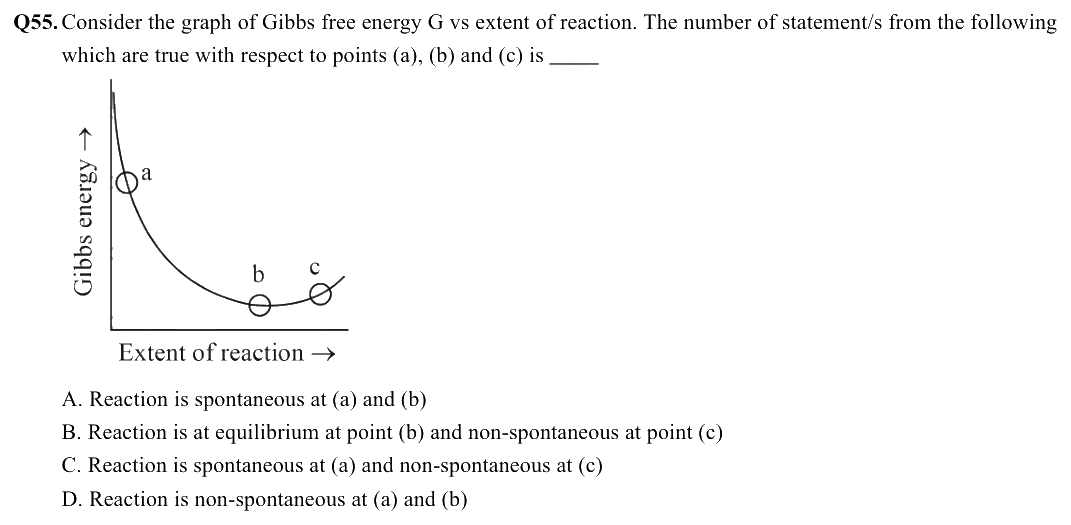
Consider the graph of Gibbs free energy G vs extent of reaction. The number of statement/s from the following which are true with respect to points (a), (b) and (c) is ______
(see the figure above)
A. Reaction is spontaneous at (a) and (b)
B. Reaction is at equilibrium at point (b) and non-spontaneous at point (c)
C. Reaction is spontaneous at (a) and non-spontaneous at (c)
D. Reaction is non-spontaneous at (a) and (b)
The question as printed in the paper.
Numerical answer type: type your answer in EdLoop to check it
At $25^\circ$C, the enthalpy of the following processes are given: $\mathrm{H_2(\ g)} + \mathrm{O_2(\ g)} \rightarrow 2\mathrm{OH(g)}$ $\Delta H^o$ = 78 $\mathrm{kJ\ mol^{-1}}$ $\mathrm{H_2(\ g)} + 1/2\mathrm{O_2(\ g)} \rightarrow \mathrm{H_2O(g)}$ $\Delta H^0$ = - 242 $\mathrm{kJ\ mol^{-1}}$ $\mathrm{H_2(\ g)} \rightarrow 2\mathrm{H(g)}$ $\Delta H^o$ = 436 $\mathrm{kJ\ mol^{-1}}$ $1/2\mathrm{O_2(\ g)} \rightarrow \mathrm{O(g)}$ $\Delta H^0$ = 249 $\mathrm{kJ\ mol^{-1}}$ What would be the value of X for the following reaction? (Nearest integer) $\mathrm{H_2O(g)} \rightarrow \mathrm{H(g)} + \mathrm{OH(g)}$ $\Delta H^o$ = X $\mathrm{kJmol^{-1}}$
Numerical answer type: type your answer in EdLoop to check it
3 g of ethane undergoes combustion at $27^\circ$C in a bomb calorimeter. The temperature of calorimeter system (including the water) is found to rise by 0. 5$^\circ$C. The heat evolved during combustion of ethane at constant pressure is ______ $\mathrm{kJmol^{-1}}$. (Nearest integer)
[Given : The heat capacity of the calorimeter system is 20 $\mathrm{kJ\ K^{-1}}$, R = 8. 3 $\mathrm{JK^{-1}\ mol^{-1}}$. Assume ideal gas behaviour. Assume ideal gas behaviour. Atomic mass of C and H are 12 and 1 $\mathrm{g\ mol^{-1}}$ respectively]
Numerical answer type: type your answer in EdLoop to check it
The enthalpy change for the conversion of $\dfrac{1}{2}\mathrm{Cl_2}$ (g) to $\mathrm{Cl^-}$ (aq) is $(-)$ ______ $\mathrm{kJ\ mol^{-1}}$ (Nearest integer)
Enthalpies of formation of $\mathrm{CCl_4(g)}$, $\mathrm{H_2O(g)}$, $\mathrm{CO_2(g)}$ and HCl are $-105$, $-242$, $-394$ and $-92$ kJ mol$^{-1}$ respectively. The magnitude of enthalpy of the reaction given below is kJmol$^{-1}$. (nearest integer) $\mathrm{CCl_4(g) + 2H_2O(g) \rightarrow CO_2(g) + 4\,HCl(g)}$
Numerical answer type: type your answer in EdLoop to check it
1 mole of ideal gas is allowed to expand reversibly and adiabatically from a temperature of 27$^\circ$C. The work done is 3 kJ mol$^{-1}$. The final temperature of the gas is ______ K (Nearest integer). Given $C_v$ = 20 J mol$^{-1}$ K$^{-1}$
Numerical answer type: type your answer in EdLoop to check it
The standard Gibbs's energy change ($\Delta_r G^\circ$) at $27^\circ\mathrm{C}$ is $(-)$ ______ $\mathrm{kJ\,mol^{-1}}$ (Nearest integer). (Given : R = $8.3\ \mathrm{J\,K^{-1}\,mol^{-1}}$ and $\ln 10 = 2.3$)
Numerical answer type: type your answer in EdLoop to check it
An athlete is given 100 g of glucose ($\mathrm{C_6H_{12}O_6}$) for energy. This is equivalent to 1800 kJ of energy. The 50% of this energy gained is utilized by the athlete for sports activities at the event. In order to avoid storage of energy, the weight of extra water he would need to perspire is ______ g (Nearest integer) Assume that there is no other way of consuming stored energy. Given : The enthalpy of evaporation of water is 45 kJ $\mathrm{mol^{-1}}$ Molar mass of C, H&O are 12.1 and 16 g $\mathrm{mol^{-1}}$.
Numerical answer type: type your answer in EdLoop to check it
28.0 L of $\mathrm{CO_2}$ is produced on complete combustion of 16.8 L gaseous mixture of ethene and methane at $25^\circ$C and 1 atm. Heat evolved during the combustion process is kJ
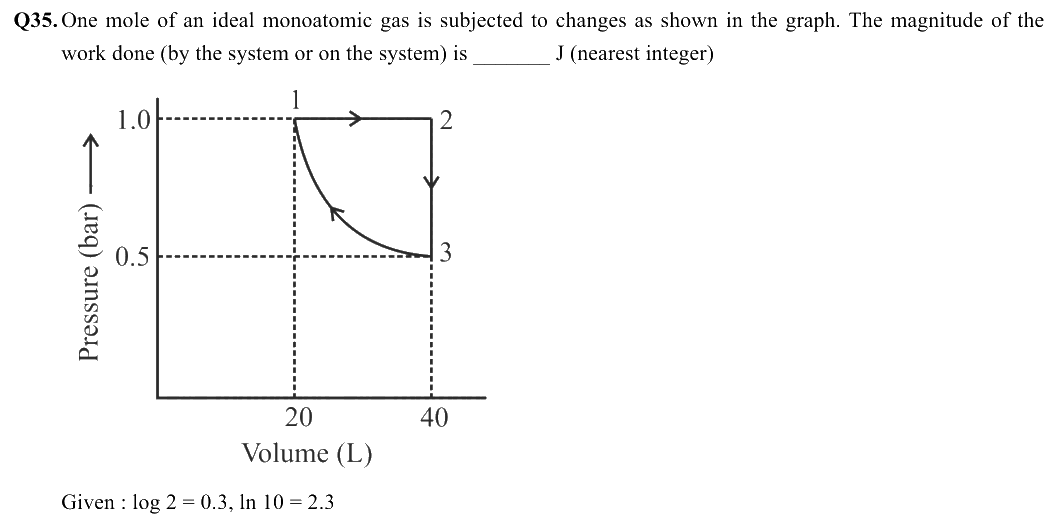
One mole of an ideal monoatomic gas is subjected to changes as shown in the graph. The magnitude of the work done (by the system or on the system) is ______ J (nearest integer)
(see the figure above)
Given : $\log 2=0.3$, $\ln 10=2.3$
The question as printed in the paper.
Numerical answer type: type your answer in EdLoop to check it
When 600 mL of 0.2 M $\mathrm{HNO_3}$ is mixed with 400 mL of 0.1 M NaOH solution in a flask, the rise in temperature of the flask is ______ $\times 10^{-2}\ ^\circ\mathrm{C}$ (Enthalpy of neutralisation = 57 $\mathrm{kJ\ mol^{-1}}$ and Specific heat of water = 4.2 $\mathrm{JK^{-1}\ g^{-1}}$) (Neglect heat capacity of flask)
Numerical answer type: type your answer in EdLoop to check it
The molar heat capacity for an ideal gas at constant pressure is 20.785 $\mathrm{J~K^{-1}}$ $\mathrm{mol^{-1}}$. The change in internal energy is 5000 J upon heating it from 300 K to 500 K. The number of moles of the gas at constant volume is ______ (Given: R = 8.314 $\mathrm{J~K^{-1}}$ $\mathrm{mol^{-1}}$)
Numerical answer type: type your answer in EdLoop to check it
A gas ( Molar mass = 280 g $\mathrm{mol^{-1}}$) was burnt in excess $\mathrm{O_2}$ in a constant volume calorimeter and during combustion the temperature of calorimeter increased from 298.0 K to 298.45 K. If the heat capacity of calorimeter is 2.5 kJ $\mathrm{K^{-1}}$ and enthalpy of combustion of gas is 9 kJ $\mathrm{mol^{-1}}$ then amount of gas burnt is ______ g.
Numerical answer type: type your answer in EdLoop to check it
2.4 g coal is burnt in a bomb calorimeter in excess of oxygen at 298 K and 1 atm pressure. The temperature of the calorimeter rises from 298 K to 300 K. The enthalpy change during the combustion of coal is $-$x kJ $\mathrm{mol^{-1}}$. The value of x is ______ (Given : Heat capacity of bomb calorimeter 20.0 $\mathrm{kJK^{-1}}$. Assume coal to be pure carbon)
Numerical answer type: type your answer in EdLoop to check it
For the reaction $\mathrm{H_2F_2g \rightarrow H_2g + F_2g}$ $\Delta U = -59.6\ \mathrm{kJ\ mol^{-1}}$ at $27\ ^\circ$C The enthalpy change for the above reaction is - ______ $\mathrm{kJmol^{-1}}$ (nearest integer) (Given : R = $8.314\mathrm{JK^{-1}\ mol^{-1}}$).
Numerical answer type: type your answer in EdLoop to check it
The enthalpy of combustion of propane, graphite and dihydrogen at 298 K are: -2220.0 $\mathrm{kJ\ mol^{-1}}$, -393.5 $\mathrm{kJ\ mol^{-1}}$ and -285.8 $\mathrm{kJ\ mol^{-1}}$ respectively. The magnitude enthalpy of formation of propane $\mathrm{C_3H_8}$ is ______ $\mathrm{kJmol^{-1}}$. (Nearest integer)
Numerical answer type: type your answer in EdLoop to check it
While performing a thermodynamics experiment, a student made the following observations, $\mathrm{HCl + NaOH \rightarrow NaCl + H_2O}$ $\Delta H = -57.3\ \mathrm{kJ\,mol^{-1}}$ $\mathrm{CH_3COOH + NaOH \rightarrow CH_3COONa + H_2O}$ $\Delta H = -55.3\ \mathrm{kJ\,mol^{-1}}$. The enthalpy of ionization of $\mathrm{CH_3COOH}$ as calculated by the student is $\mathrm{kJ\ mol^{-1}}$.
Numerical answer type: type your answer in EdLoop to check it
$17.0\ \mathrm{g}$ of $\mathrm{NH_3}$ completely vapourises at $-33.42\ ^\circ\mathrm{C}$ and 1 bar pressure and the enthalpy change in the process is $23.4\ \mathrm{kJ\ mol^{-1}}$. The enthalpy change for the vapourisation of $85\ \mathrm{g}$ of $\mathrm{NH_3}$ under the same conditions is kJ.
Numerical answer type: type your answer in EdLoop to check it
$2.2\ \mathrm{g}$ of nitrous oxide ($\mathrm{N_2O}$) gas is cooled at a constant pressure of $1\ \mathrm{atm}$ from $310\ \mathrm{K}$ to $270\ \mathrm{K}$ causing the compression of the gas from $217.1\ \mathrm{mL}$ to $167.75\ \mathrm{mL}$. The change in internal energy of the process, $\Delta\mathrm{U}$ is '$-x$' J. The value of 'x' is ______. [nearest integer] (Given: atomic mass of N $= 14\ \mathrm{g\ mol^{-1}}$ and of O $= 16\ \mathrm{g\ mol^{-1}}$. Molar heat capacity of $\mathrm{N_2O}$ is $100\ \mathrm{JK^{-1}\ mol^{-1}}$)
Numerical answer type: type your answer in EdLoop to check it
4.0 L of an ideal gas is allowed to expand isothermally into vacuum until the total volume is 20 L. The amount of heat absorbed in this expansion is ______ L atm.
Numerical answer type: type your answer in EdLoop to check it
For combustion of one mole of magnesium in an open container at 300 K and 1 bar pressure, $\Delta_C H^{\ominus} = -601.70\ \mathrm{kJ\ mol^{-1}}$, the magnitude of change in internal energy for the reaction is kJ. (Nearest integer) (Given : R = $8.3\ \mathrm{J\ K^{-1}\ mol^{-1}}$)
Numerical answer type: type your answer in EdLoop to check it
When 5 moles of He gas expand isothermally and reversibly at $300\ \mathrm{K}$ from 10 litre to 20 litre, the magnitude of the maximum work obtained is J. [nearest integer ] (Given : $\mathrm{R} = 8.3\ \mathrm{J\ K^{-1}\ mol^{-1}}$ and $\log 2 = 0.3010$)
Numerical answer type: type your answer in EdLoop to check it
For complete combustion of methanol $\mathrm{CH}_3\mathrm{OH(l)} + \frac{3}{2}\mathrm{O}_2\mathrm{(g)} \rightarrow \mathrm{CO}_2\mathrm{(g)} + 2\mathrm{H}_2\mathrm{O(l)}$ the amount of heat produced as measured by bomb calorimeter is $726 \mathrm{~kJ} \mathrm{~mol}^{-1}$ at $27^\circ\mathrm{C}$. The enthalpy of combustion for the reaction is $-x \mathrm{~kJ} \mathrm{~mol}^{-1}$, where x is integer) (Given : $\mathrm{R} = 8.3 \mathrm{~JK}^{-1} \mathrm{~mol}^{-1}$)
Numerical answer type: type your answer in EdLoop to check it
A fish swimming in water body when taken out from the water body is covered with a film of water of weight $36 \mathrm{~g}$. When it is subjected to cooking at $100^\circ\mathrm{C}$, then the internal energy for vaporization in $\mathrm{kJ} \mathrm{mol}^{-1}$ is integer] [Assume steam to be an ideal gas. Given $\Delta_{\mathrm{vap}}H^\ominus$ for water at $373 \mathrm{~K}$ and $1 \mathrm{~bar}$ is $41.1 \mathrm{~kJ} \mathrm{~mol}^{-1}$ : $\mathrm{R} = 8.31 \mathrm{~J} \mathrm{~K}^{-1} \mathrm{~mol}^{-1}$]
Numerical answer type: type your answer in EdLoop to check it
The standard entropy change for the reaction $4\mathrm{Fes} + 3\mathrm{O}_2\mathrm{g} \rightarrow 2\mathrm{Fe}_2\mathrm{O}_3\mathrm{s}$ is $-550 \mathrm{~J} \mathrm{~K}^{-1}$ at $298 \mathrm{~K}$ [Given : The standard enthalpy change for the reaction is $-165 \mathrm{~kJ} \mathrm{~mol}^{-1}$]. The temperature in K at which the reaction attains equilibrium is (Nearest Integer)
Numerical answer type: type your answer in EdLoop to check it
For the reaction $2\mathrm{NO_2}(g) \rightleftharpoons \mathrm{N_2O_4}(g)$, when $\Delta\mathrm{S} = -176.0$ J K$^{-1}$ and $\Delta\mathrm{H} = -57.8$ kJ mol$^{-1}$ the magnitude of $\Delta\mathrm{G}$ at $298$ K for the reaction is ______ kJmol$^{-1}$. (Nearest integer)
Numerical answer type: type your answer in EdLoop to check it
$200$ mL of $0.2$ M HCl is mixed with $300$ mL of $0.1$ M NaOH. The molar heat of neutralization of this reaction is $-57.1$ kJ. The increase in temperature in $^\circ$C of the system on mixing is x $\times\ 10^{-2}$. The value of x is (Nearest integer) [Given: Specific heat of water $= 4.18$ J g$^{-1}$ K$^{-1}$ Density of water$= 1.00$ g cm$^{-3}$] (Assume no volume change on mixing)
Numerical answer type: type your answer in EdLoop to check it
Data given for the following reaction is as follows : $\mathrm{FeO_{(s)}+C_{(graphite)}\longrightarrow Fe_{(s)}+CO_{(g)}}$ Table with columns Substance, $\Delta_f\mathrm{H}^{\circ}\ (\mathrm{kJmol^{-1}})$ and $\Delta S^{\circ}\ (\mathrm{Jmol^{-1}\,K^{-1}})$: $\mathrm{FeO_{(s)}}$: $-266.3$, $57.49$ $\mathrm{C_{(graphite)}}$: $0$, $5.74$ $\mathrm{Fe_{(s)}}$: $0$, $27.28$ $\mathrm{CO_{(g)}}$: $-110.5$, $197.6$ The minimum temperature in K at which the reaction becomes spontaneous is_____.(Integer answer)
Numerical answer type: type your answer in EdLoop to check it
For water $\Delta_{\mathrm{vap}}\mathrm{H}=41\ \mathrm{kJ\ mol^{-1}}$ at $373\ \mathrm{K}$ and 1 bar pressure. Assuming that water vapour is an ideal gas that occupies a much larger volume than liquid water, the internal energy change during evaporation of water is $(\mathrm{kJmol^{-1}})$: [Use : $\mathrm{R}=8.3\ \mathrm{J\ mol^{-1}\ K^{-1}}$]
Numerical answer type: type your answer in EdLoop to check it
For water at $100^\circ\mathrm{C}$ and 1 bar, $\Delta_{vap}\mathrm{H} - \Delta_{vap}\mathrm{U}$ = ______ $\times 10^2\ \mathrm{J\ mol^{-1}}$ (Round off to the Nearest Integer) [Use : R = $8.31\ \mathrm{J\ mol^{-1}\ K^{-1}}$] [Assume volume of $\mathrm{H_2O(l)}$ is much smaller than volume of $\mathrm{H_2O(g)}$. Assume $\mathrm{H_2O(g)}$ treated as an ideal gas]
Numerical answer type: type your answer in EdLoop to check it
When $400\ \mathrm{mL}$ of $0.2\ \mathrm{M\ H_2SO_4}$ solution is mixed with $600\ \mathrm{mL}$ of $0.1\ \mathrm{M NaOH}$ solution, the increase in temperature of the final solution is — $\times 10^{-2}$ K. (Round off to the nearest integer). [Use :$\mathrm{H^+(aq) + OH^-(aq) \rightarrow H_2O : \Delta_rH = -57.1\ kJ\ mol^{-1}}$] Specific heat of $\mathrm{H_2O} = 4.18\ \mathrm{J\ K^{-1}\ g^{-1}}$, density of $\mathrm{H_2O} = 1.0\ \mathrm{g\ cm^{-3}}$ Assume no change in volume of solution on mixing.
Numerical answer type: type your answer in EdLoop to check it
At $298\ \mathrm{K}$, the enthalpy of fusion of a solid X is $2.8\ \mathrm{kJ\ mol^{-1}}$ and the enthalpy of vaporisation of the liquid X is $98.2\ \mathrm{kJ\ mol^{-1}}$. The enthalpy of sublimation of the substance X in $\mathrm{kJ\ mol^{-1}}$ is ______. (in nearest integer)
Numerical answer type: type your answer in EdLoop to check it
A system does $200\ \mathrm{J}$ of work and at the same time absorbs $150\ \mathrm{J}$ of heat. The magnitude of the change in internal energy is ______ J. (Nearest integer)
Numerical answer type: type your answer in EdLoop to check it
If the standard molar enthalpy change for combustion of graphite powder is $-2.48 \times 10^2\ \mathrm{kJ\ mol^{-1}}$, the amount of heat generated on combustion of $1\ \mathrm{g}$ of graphite powder in kJ (Nearest integer):
Numerical answer type: type your answer in EdLoop to check it
An average person needs about $10000\ \mathrm{kJ}$ energy per day. The amount of glucose (molar mass $= 180.0\ \mathrm{g\ mol^{-1}}$) needed to meet this energy requirement is ______g. (Use : $\Delta_c H$ (glucose)$= -2700\ \mathrm{kJ\ mol^{-1}}$)
Numerical answer type: type your answer in EdLoop to check it
For a given chemical reaction A $\rightarrow$ B at 300 K the free energy change is $-49.4~\mathrm{kJ~mol^{-1}}$ and the enthalpy of reaction is $51.4~\mathrm{kJ~mol^{-1}}$. The entropy change of the reaction is ______ $\mathrm{JK^{-1}~mol^{-1}}$.
Numerical answer type: type your answer in EdLoop to check it
For the reaction $\mathrm{C_2H_6} \rightarrow \mathrm{C_2H_4} + \mathrm{H_2}$ the reaction enthalpy $\Delta_rH$ in $\mathrm{kJmol^{-1}}$ is (Round off to the Nearest Integer). [Given : Bond enthalpies in $\mathrm{kJmol^{-1}}$ : C $-$ C : 347, C = C : 611; C $-$ H : 414, H $-$ H : 436]
Numerical answer type: type your answer in EdLoop to check it
The standard enthalpies of formation of $\mathrm{Al}_2 \mathrm{O}_3$ and $\mathrm{CaO}$ are $-1675 \mathrm{~kJ} \mathrm{~mol}^{-1}$ and $-635 \mathrm{~kJ} \mathrm{~mol}^{-1}$ respectively. For the reaction $3 \mathrm{CaO}+2 \mathrm{Al} \rightarrow 3 \mathrm{Ca}+\mathrm{Al}_2 \mathrm{O}_3$ the standard reaction enthalpy $\Delta_{\mathrm{r}} \mathrm{H}^0=$ ______ kJ. (Round off to the Nearest Integer).
Numerical answer type: type your answer in EdLoop to check it
For the reaction $\mathrm{A}(\mathrm{g}) \rightleftharpoons \mathrm{B}(\mathrm{g})$ at $495 \mathrm{~K}, \Delta_r G^{\circ}=-9.478 \mathrm{~kJ} \mathrm{~mol}^{-1}$ If we start the reaction in a closed container at 495 K with 22 millimoles of A, the amount of B is the equilibrium mixture is ______ millimoles. (Round off to the Nearest Integer). [$\mathrm{R}=8.314 \mathrm{~J} \mathrm{~mol}^{-1} \mathrm{~K}^{-1} ; \ell \mathrm{n} 10=2.303$]
Numerical answer type: type your answer in EdLoop to check it
At $25^\circ\mathrm{C}$, $50\ \mathrm{g}$ of iron reacts with HCl to form $\mathrm{FeCl_2}$. The evolved hydrogen gas expands against a constant pressure of $1\ \mathrm{bar}$. The work done by the gas during this expansion is $-$______ J. (Round off to the Nearest Integer) [Given : R = $8.314\ \mathrm{J\ mol^{-1}\ K^{-1}}$. Assume, hydrogen is an ideal gas] [Atomic mass off Fe is $55.85\ \mathrm{u}$]
Numerical answer type: type your answer in EdLoop to check it
For a chemical reaction $\mathrm{A + B = C + D}$ $(\Delta_r H^{\ominus} = 80\ \mathrm{kJ\ mol^{-1}})$ the entropy change $\Delta_r S^{\ominus}$ depends on the temperature T (in K) as $\Delta_r S^{\ominus} = 2T\ (\mathrm{JK^{-1}\,mol^{-1}})$. Minimum temperature at which it will become spontaneous is ______ K. (Integer)
Numerical answer type: type your answer in EdLoop to check it
The average S $-$ F bond energy in $\mathrm{kJ\ mol^{-1}}$ of $\mathrm{SF_6}$ is ______. (Rounded off to the nearest integer) [Given : The values of standard enthalpy of formation of $\mathrm{SF_6(g)}$, $\mathrm{S(g)}$ and $\mathrm{F(g)}$ are $-1100$, $275$ and $80\ \mathrm{kJ\ mol^{-1}}$ respectively.]
Numerical answer type: type your answer in EdLoop to check it
The reaction of cyanamide, $\mathrm{NH_2\,CN_{(s)}}$ with oxygen was run in a bomb calorimeter and $\Delta U$ was found to be $-742.24\ \mathrm{kJ\ mol^{-1}}$. The magnitude of $\Delta H_{298}$ for the reaction $\mathrm{NH_2\,CN_{(s)} + \frac{3}{2}O_{2(g)} \rightarrow N_{2(g)} + O_{2(g)} + H_2O_{(l)}}$ is kJ. (Rounded off to the nearest integer) [Assume ideal gases and $\mathrm{R} = 8.314\ \mathrm{J\ mol^{-1}\ K^{-1}}$]
Numerical answer type: type your answer in EdLoop to check it
Five moles of an ideal gas at $293\ \mathrm{K}$ is expanded isothermally from an initial pressure of $2.1\ \mathrm{MPa}$ to $1.3\ \mathrm{MPa}$ against at constant external pressure $4.3\ \mathrm{MPa}$. The heat transferred in this process is ______ $\mathrm{kJ\,mol^{-1}}$. (Rounded-off to the nearest integer) [ Use $R = 8.314\ \mathrm{J\ mol^{-1}\ K^{-1}}$]
Numerical answer type: type your answer in EdLoop to check it
For the reaction $\mathrm{A_g \rightarrow B_g}$, the value of the equilibrium constant at $300\ \mathrm{K}$ and $1$ atm is equal to $100.0$. The value of $\Delta G^\circ$ for the reaction at $300\ \mathrm{K}$ and $1$ atm in $\mathrm{J\,mol^{-1}}$ is $-x\mathrm{R}$, where x is (Rounded off to the nearest integer) $\mathrm{R} = 8.31\ \mathrm{J\ mol^{-1}\ K^{-1}}$ and $\ln 10 = 2.3$
Numerical answer type: type your answer in EdLoop to check it
Assuming ideal behaviour, the magnitude of $\log \mathrm{K}$ for the following reaction at $25^\circ\mathrm{C}$ is $\mathrm{x} \times 10^{-1}$. The value of x is ______. (Integer answer) $3\mathrm{HC \equiv CH_{(g)}} \rightleftharpoons \mathrm{C_6H_{6(l)}}$ [Given: $\Delta_f G^\circ(\mathrm{HC \equiv CH}) = -2.04 \times 10^{5}\ \mathrm{J\ mol^{-1}}$; $\Delta_f G^\circ(\mathrm{C_6H_6}) = -1.24 \times 10^{5}\ \mathrm{J\ mol^{-1}}$; $\mathrm{R} = 8.314\ \mathrm{J\ K^{-1}\ mol^{-1}}$ ]
Numerical answer type: type your answer in EdLoop to check it
For a dimerization reaction, 2A(g) $\rightarrow$ A$_2$(g) at 298K, $\Delta U^{\ominus}$ = $-20\ \mathrm{kJmol^{-1}}$, $\Delta S^{\ominus}$ = $-30\ \mathrm{JK^{-1}mol^{-1}}$,then the $\Delta G^{\ominus}$ will be ______J.
Numerical answer type: type your answer in EdLoop to check it
The internal energy change (in J) when 90 g of water undergoes complete evaporation at $100^{\circ}\mathrm{C}$ is .............. (Given : $\Delta\mathrm{H}_{\mathrm{vap}}$ for water at 373 K $= 41\ \mathrm{kJ}\ /\ \mathrm{mol}$, $\mathrm{R} = 8.314\ \mathrm{JK}^{-1}\ \mathrm{mol}^{-1}$)
Numerical answer type: type your answer in EdLoop to check it
The heat of combustion of ethanol into carbon dioxides and water is $-327\ \mathrm{Kcal}$ at constant pressure. The heat evolved (in cal) at constant volume at $27^{\circ}\ \mathrm{C}$ (if all gases behave ideally) is ($\mathrm{R} = 2\ \mathrm{calmol}^{-1}\mathrm{K}^{-1}$) ______
Numerical answer type: type your answer in EdLoop to check it
At constant volume, $4\ \mathrm{mol}$ of an ideal gas when heated from $300\mathrm{K}$ to $500\mathrm{K}$ changes its internal energy by $5000\mathrm{J}$. The molar heat capacity at constant volume is _______
Numerical answer type: type your answer in EdLoop to check it
For the reaction; $\mathrm{A(l)} \rightarrow 2\mathrm{B(g)}$ $\Delta U = 2.1\mathrm{kcal}$, $\Delta S = 20\mathrm{calK^{-1}}$ at $300\mathrm{K}$. Hence $\Delta G$ in kcal is ______ .
Numerical answer type: type your answer in EdLoop to check it
The standard heat of formation $(\Delta_f H^0_{298})$ of ethane (in $\mathrm{kJ/mol}$ ), if the heat of combustion of ethane, hydrogen and graphite are $-1560$, $-393.5$ and $-286\ \mathrm{kJ/mol}$ , respectively is ______
Numerical answer type: type your answer in EdLoop to check it
How to prepare Chemical Thermodynamics for JEE Main
How often it comes up
Chemical thermodynamics establishes criteria for reaction spontaneity and energy changes under Unit 4: Chemical Thermodynamics in the Class 11 curriculum, holding rank 12 among all 31 chemistry chapters with a 3.8 percent share of total chemistry questions. In the computerized exam period spanning 2019 to 2026, candidates answered 172 questions from this chapter across 162 papers, representing an average of 1.1 questions per test shift. The topic featured in 147 of those 162 papers, appearing consistently in every single exam year. During the recent 2024 to 2026 seasons, testing recorded 71 questions across 58 papers, raising the average to 1.2 questions per shift and lifting its subject share to 4.6 percent. This marks a trend that is up compared to the 3.8 percent share across the entire 2019 to 2026 baseline. When measured against the 2002 to 2018 window, which logged 57 questions across 38 papers for a 4.2 percent share, the recent share has stayed about the same. In 2026 alone, examiners presented 20 questions across 19 papers, showing up in 15 separate shifts. Crucially, 97 questions from 2019 to 2026 appeared as numerical answer questions, meaning more than half of all thermodynamics questions in modern tests require precise numerical calculation.
Most-asked topics
Questions in this chapter divide across three prominent conceptual pillars:
First Law & Enthalpy: 87 questions historically, with 68 appearing between 2019 and 2026, tested up to 2026. This area examines the first law of thermodynamics delta U equals q plus w, sign conventions for heat and work, reversible and irreversible isothermal expansions, adiabatic processes, work done from pressure-volume indicator diagrams, and enthalpy relationships delta H equals delta U plus delta n g R T.
Thermochemistry: 74 problems overall, including 55 between 2019 and 2026, continuing into 2026. Focus areas assess Hess's law of constant heat summation, standard enthalpy of formation, enthalpy of combustion, bond dissociation enthalpies, resonance energy, and lattice energy cycles.
Entropy & Gibbs Energy: 68 lifetime problems, with 49 asked from 2019 to 2026, tested in 2026. Concepts explore the second and third laws of thermodynamics, entropy of universe, Gibbs free energy criterion delta G equals delta H minus T delta S, reaction spontaneity conditions, and standard Gibbs energy linked to equilibrium constants via delta G standard equals minus R T ln K.
What the questions look like
JEE Main problems in chemical thermodynamics combine thermodynamic sign conventions with multi-step arithmetic:
Hess's law algebraic summation: Given combustion or formation enthalpies for intermediate reactions, students manipulate and sum algebraic equations to evaluate the unknown standard enthalpy of formation for a target compound.
Isothermal work and heat calculations: Evaluating expansion work, change in internal energy, and absorbed heat for an ideal gas expanding reversibly or irreversibly against external pressure.
Standard Gibbs energy and equilibrium constants: Connecting measured equilibrium constants or reaction quotients at specified temperatures with standard enthalpy and entropy changes.
Bond energy bookkeeping: Calculating individual average bond enthalpies, such as carbon-hydrogen bond strength, from the enthalpy of formation of methane combined with graphite atomization and hydrogen gas dissociation enthalpies.
Pay rigorous attention to IUPAC sign conventions used in chemistry. Work done on the system by surroundings during compression is positive, while work done by the system on surroundings during expansion is negative: w equals minus P external multiplied by delta V. Heat absorbed by the system is positive, and heat released is negative.
For thermochemical cycles using bond energies, remember that reaction enthalpy equals the sum of bond enthalpies of broken bonds in reactants minus the sum of bond enthalpies of formed bonds in products. Contrast this with standard enthalpies of formation, where reaction enthalpy equals products minus reactants.
When calculating spontaneity using Gibbs energy, convert enthalpy and entropy values to matching units before evaluating delta H minus T delta S. Enthalpies are typically given in kilojoules while entropies are given in joules per Kelvin, which is a frequent source of calculation errors.
Frequently asked questions
Why are there so many numerical answer questions in thermodynamics?
Thermodynamics questions evaluate definite quantities like enthalpies, entropies, and equilibrium constants, making them ideal for Section B numerical questions where 97 problems appeared between 2019 and 2026.
How do chemical thermodynamics sign conventions differ from physics?
In chemistry, the first law is written as delta U equals q plus w, where work done on the system is positive. In physics, it is commonly written as delta Q equals delta U plus delta W, where work done by the system is positive.
How do I determine whether a reaction is spontaneous at all temperatures?
Examine the signs of delta H and delta S. When delta H is negative and delta S is positive, delta G is negative at all temperatures, ensuring spontaneity regardless of thermal energy. Step-by-step solutions for each one are in the EdLoop app.