Periodic Table & Periodicity: JEE Main PYQs 2003–2026
Every Periodic Table & Periodicity question from past JEE Main and AIEEE papers, with options and answers. Newest first.
182questions
154papers covered
3.2%of Chemistry questions, 2019–2026
2003–2026years
Guide at a glance
Periodic table and periodicity establishes periodic trends under Unit 9: Classification of Elements and Periodicity in Properties in the Class 11 curriculum, holding rank 16 of 31 chapters with a 3.2% share of the chemistry section.
In a period, the first ionisation enthalpy of the element at extreme left and the negative electron gain enthalpy of the extreme right element, except noble gases, are respectively.
Statement I : The number of pairs among $[\mathrm{Al_2O_3, Cr_2O_3}]$, $[\mathrm{Cl_2O_7, Mn_2O_7}]$, $[\mathrm{Na_2O, V_2O_3}]$ and $[\mathrm{CO, N_2O}]$ that contain oxides of same nature (acidic, basic, neutral or amphoteric) is 4.
Statement II : Among $\mathrm{Na_2O}$, $\mathrm{Al_2O_3}$, CO and $\mathrm{Cl_2O_7}$, the most basic and acidic oxides are $\mathrm{Na_2O}$ and $\mathrm{Cl_2O_7}$, respectively.
In the light of the above statements, choose the correct answer from the options given below :
The 1$^{\text{st}}$ ionization enthalpy for Mg is +737 kJ/mol. The most probable estimated value of the 2$^{\text{nd}}$ ionization enthalpy of Mg is ________.
Consider the elements N, P, O, S, Cl and F. The number of valence electrons present in the elements with most and least metallic character from the above list is respectively.
Statement I : $\mathrm{C} < \mathrm{O} < \mathrm{N} < \mathrm{F}$ is the correct order in terms of first ionization enthalpy values.
Statement II : $\mathrm{S} > \mathrm{Se} > \mathrm{Te} > \mathrm{Po} > \mathrm{O}$ is the correct order in terms of the magnitude of electron gain enthalpy values.
In the light of the above statements, choose the correct answer from the options given below :
An element ' $E'$ has the ionisation enthalpy value of 374 kJ $\mathrm{mol^{-1}}$. ' E ' reacts with elements A, B, C and D with electron gain enthalpy values of $-328, -349, -325$ and $-295$ kJ $\mathrm{mol^{-1}}$, respectively. The correct order of the products EA, EB, EC and ED in terms of ionic character is :
Given below are two statements : Statement (I): The radii of isoelectronic species increases in the order. $\mathrm{Mg^{2+} < Na^+ < F^- < O^{2-}}$ Statement (II): The magnitude of electron gain enthalpy of halogen decreases in the order. Cl > F > Br > I In the light of the above statements, choose the most appropriate answer from the options given below :
A
Statement I is incorrect but Statement II is correct
B
Statement I is correct but Statement II is incorrect
Consider the following elements In, Tl, Al, Pb, Sn and Ge . The most stable oxidation states of elements with highest and lowest first ionisation enthalpies, respectively, are
Given below are two statements : Statement (I): According to the Law of Octaves, the elements were arranged in the increasing order of their atomic number. Statement (II): Meyer observed a periodically repeated pattern upon plotting physical properties of certain elements against their respective atomic numbers. In the light of the above statements, choose the correct answer from the options given below :
A
Both Statement (I) and Statement (II) are false.
B
Both Statement (I) and Statement (II) are true.
C
Statement (I) is false but Statement (II) is true.
D
Statement (I) is true but Statement (II) is false.
Which of the following statements are NOT true about the periodic table? A. The properties of elements are function of atomic weights. B. The properties of elements are function of atomic numbers. C. Elements having similar outer electronic configurations are arranged in same period. D. An element's location reflects the quantum numbers of the last filled orbital. E. The number of elements in a period is same as the number of atomic orbitals available in energy level that is being filled. Choose the correct answer from the options given below:
The successive 5 ionisation energies of an element are 800, 2427, 3658, 25024 and 32824 kJ/mol, respectively. By using the above values predict the group in which the above element is present :
Given below are two statements about X-ray spectra of elements : Statement (I) : A plot of $\sqrt{v}$ ( $v$ = frequency of $X$-rays emitted) vs atomic mass is a straight line. Statement (II) : A plot of $v$($v$ = frequency of $X$-rays emitted) vs atomic number is a straight line. In the light of the above statements, choose the correct answer from the options given below :
Given below are two statements : Statement (I) : An element in the extreme left of the periodic table forms acidic oxides. Statement (II) : Acid is formed during the reaction between water and oxide of a reactive element present in the extreme right of the periodic table. In the light of the above statements, choose the correct answer from the options given below :
Given below are two statements : Statement (I) : The oxidation state of an element in a particular compound is the charge acquired by its atom on the basis of electron gain enthalpy consideration from other atoms in the molecule. Statement (II) : p$\pi - $p$\pi$ bond formation is more prevalent in second period elements over other periods. In the light of the above statements, choose the most appropriate answer from the options given below :
A
Both Statement I and Statement II are correct
B
Both Statement I and Statement II are incorrect
C
Statement I is incorrect but Statement II is correct
D
Statement I is correct but Statement II is incorrect
Identify the correct statements about p-block elements and their compounds. (A) Non metals have higher electronegativity than metals. (B) Non metals have lower ionisation enthalpy than metals. (C) Compounds formed between highly reactive nonmetals and highly reactive metals are generally ionic. (D) The non-metal oxides are generally basic in nature. (E) The metal oxides are generally acidic or neutral in nature. Choose the correct answer from the options given below :
The electron affinity value are negative for A. Be $\rightarrow$ $Be^{-}$ B. N $\rightarrow$ $N^{-}$ C. O $\rightarrow$ $O^{2-}$ D. Na $\rightarrow$ $Na^{-}$ E. Al $\rightarrow$ $Al^{-}$ Choose the most appropriate answer from the options given below :
The statement(s) that are correct about the species $\mathrm{O^{2-}}$, $\mathrm{F^-}$, $\mathrm{Na^+}$ and $\mathrm{Mg^{2+}}$. (A) All are isoelectronic (B) All have the same nuclear charge (C) $\mathrm{O^{2-}}$ has the largest ionic radii (D) $\mathrm{Mg^{2+}}$ has the smallest ionic radii Choose the most appropriate answer from the options given below :
Given below are two statements : Statement I : The metallic radius of Na is 1.86 $\mathrm{A^\circ}$ and the ionic radius of $\mathrm{Na^+}$ is lesser than 1.86 $\mathrm{A^\circ}$. Statement II : Ions are always smaller in size than the corresponding elements. In the light of the above statements, choose the correct answer from the options given below :
Number of elements from the following that CANNOT form compounds with valencies which match with their respective group valencies is ______. B, C, N, S, O, F, P, Al, Si
The correct order of first ionization enthalpy values of the following elements is : (A) O (B) N (C) Be (D) F (E) B Choose the correct answer from the options given below :
Given below are two statements : Statement I : The correct order of first ionization enthalpy values of Li, Na, F and Cl is Na < Li < Cl < F. Statement II : The correct order of negative electron gain enthalpy values of Li, Na, F and Cl is Na < Li < F < Cl In the light of the above statements, choose the correct answer from the options given below :
Which of the following statements are not correct? A. The electron gain enthalpy of F is more negative than that of Cl. B. Ionization enthalpy decreases in a group of periodic table. C. The electronegativity of an atom depends upon the atoms bonded to it. D. $\mathrm{Al_2\,O_3}$ and NO are examples of amphoteric oxides. Choose the most appropriate answer from the options given below:
Given below are two statements: one is labelled as Assertion A and the other is labelled as Reason R. Assertion A : The energy required to form $\mathrm{Mg^{2+}}$ from Mg is much higher than that required to produce $\mathrm{Mg^{+}}$ Reason R: $\mathrm{Mg^{2+}}$ is small ion and carry more charge than $\mathrm{Mg^{+}}$ In the light of the above statements, choose the correct answer from the options given below.
A
Both A and R are true but R is NOT the correct explanation of A
B
A is true but R is false
C
A is false but R is true
D
Both A and R are true and R is the correct explanation of A
Given below are two statements: Statement I: Chlorine can easily combine with oxygen to from oxides: and the product has a tendency to explode. Statement II: Chemical reactivity of an element can be determined by its reaction with oxygen and halogens. In the light of the above statements, choose the correct answer from the options given below
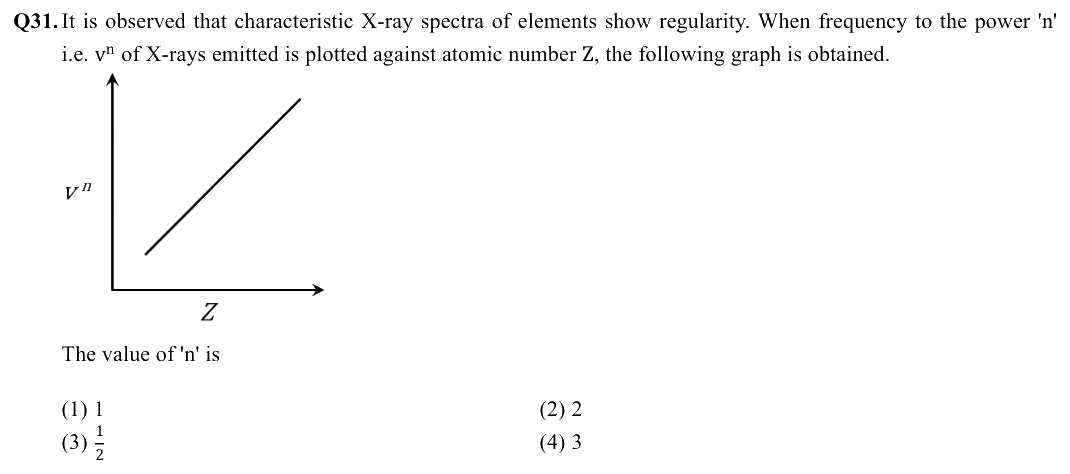
It is observed that characteristic X-ray spectra of elements show regularity. When frequency to the power 'n' i.e. $\nu^{n}$ of X-rays emitted is plotted against atomic number Z, the following graph is obtained.
The first ionization enthalpy of Na, Mg and Si, respectively, are: 496, 737 and 786 $\mathrm{kJ\ mol^{-1}}$. The first ionization enthalpy ($\mathrm{kJ mol^{-1}}$) of Al is
In which of the following pairs, electron gain enthalpies of constituent elements are nearly the same or identical? (A) Rb and Cs (B) Na and K (C) Ar and Kr (D) I and At Choose the correct answer from the options given below
Outermost electronic configurations of four elements A, B, C, D are given below: (A) $3\ \mathrm{s^2}$ (B) $\mathrm{3s^2 3p^1}$ (C) $3\ \mathrm{s^2 3p^3}$ (D) $3\ \mathrm{s^2 3p^4}$ The correct order of first ionization enthalpy for them is
Given two statements below : Statement I : In $\mathrm{Cl_2}$ molecule the covalent radius is double of the atomic radius of chlorine. Statement II : Radius of anionic species is always greater than their parent atomic radius. Choose the most appropriate answer from options given below
A
Both Statement I and Statement II are correct.
B
Both Statement I and Statement II are incorrect.
C
Statement I is correct but Statement II is incorrect.
D
Statement I is incorrect but Statement II is correct.
Given below are two statements. One is labelled as Assertion A and the other is labelled as Reason R. Assertion A : The first ionization enthalpy for oxygen is lower than that of nitrogen. Reason R : The four electrons in 2p orbitals of oxygen experience more electron-electron repulsion. In the light of the above statements, choose the correct answer from the options given below.
A
Both A and R are correct and R is the correct explanation of A.
B
Both A and R are correct but R is NOT the correct explanation of A.
Element "E" belongs to the period 4 and group 16 of the periodic table. The valence shell electron configuration of the element, which is just above "E" in the group is
Match List-I with List-II List-I (A) $\mathrm{Cl_2\,O_7}$ (B) $\mathrm{Na_2\,O}$ (C) $\mathrm{Al_2\,O_3}$ (D) $\mathrm{N_2O}$ List-II (I) Amphoteric (II) Basic (III) Neutral (IV) Acidic Choose the correct answer from the options given below
Given below are two statements : one is labelled as Assertion and the other is labelled as Reason. Assertion: The ionic radii of $\mathrm{O^{2-}}$ and $\mathrm{Mg^{2+}}$ are same. Reason: Both $\mathrm{O^{2-}}$ and $\mathrm{Mg^{2+}}$ are isoelectronic species. In the light of the above statements, choose the correct answer from the options given below.
A
Both Assertion and Reason are true and Reason is the correct explanation of Assertion.
B
Both Assertion and Reason are true but Reason is not the correct explanation of Assertion.
Given below are two statements : one is labelled as Assertion (A) and the other is labelled as Reason (R). Assertion (A) : Metallic character decreases and non-metallic character increases on moving from left to right in a period. Reason (R): It is due to increase in ionisation enthalpy and decrease in electron gain enthalpy, when one moves from left to right in a period. In the light of the above statements, choose the most appropriate answer from the options given below :
A
(A) is false but (R) is true.
B
Both (A) and (R) are correct and (R) is the correct explanation of (A)
C
Both (A) and (R) are correct but (R) is not the correct explanation of (A).
Match List $-$ I with List $-$ II : List $-$I: (a) NaOH; (b) $\mathrm{Be(OH)_2}$; (c) $\mathrm{Ca(OH)_2}$; (d) $\mathrm{B(OH)_3}$; (e) $\mathrm{Al(OH)_3}$ List$-$ II: (i) Acidic; (ii) Basic; (iii) Amphoteric Choose the most appropriate answer from the options given below
The ionic radii of $\mathrm{F^-}$ and $\mathrm{O^{2-}}$ respectively are $1.33\ \mathrm{A}$ and $1.4\mathrm{A}$, while the covalent radius of N is $0.74\mathrm{A}$ The correct statement for the ionic radius of $\mathrm{N^{3-}}$ from the following is :
A
It is smaller than $\mathrm{F^-}$ and N
B
It is bigger than $\mathrm{O^{2-}}$ and $\mathrm{F^-}$
C
It is bigger than $\mathrm{F^-}$ and N, but smaller than of $\mathrm{O^{2-}}$
D
It is smaller than $\mathrm{O^{2-}}$ and $\mathrm{F^-}$, but bigger than of N
Outermost electronic configuration of a group 13 element, E, is $4~\mathrm{s^2}, 4\mathrm{p^1}$. The electronic configuration of an element of p-block period-five placed diagonally to element, E is:
The ionic radius of $\mathrm{Na^+}$ ions is $1.02\,\mathrm{\AA}$. The ionic radii (in $\mathrm{\AA}$) of $\mathrm{Mg^{2+}}$ and $\mathrm{Al^{3+}}$, respectively, are
The first ionization energy of magnesium is smaller, as compared to that of elements X and Y, but higher than that of Z. The elements X, Y and Z, respectively, are :
The correct order of the ionic radii of $\mathrm{O^{2-}}$, $\mathrm{N^{3-}}$, $\mathrm{F^{-}}$, $\mathrm{Mg^{2+}}$, $\mathrm{Na^{+}}$ and $\mathrm{Al^{3+}}$ is :
The five successive ionization enthalpies of an element are 800, 2427, 3658, 35024 32824 $\mathrm{kJ\ mol^{-1}}$. The number of valence electrons in the element is:
Among the statement (I – IV), the correct ones are: (I) Be has smaller atomic radius compared to Mg. (II) Be has higher ionization enthalpy than AI. (III) Charge/radius ratio of Be is greater than that of Al. (IV) Both Be and Al form mainly covalent compounds
Three elements X, Y and Z are in the $3^{\mathrm{rd}}$ period of the periodic table. The oxides ofX, Y and Z, respectively, are basic, amphoteric and acidic. The correct order of the atomic numbers of X, Y and Z is:
B has a smaller first ionization enthalpy than Be. Consider the following statement: (I) it is easier to remove 2p electron than2s electron (II) 2p electron of B is more shielded from the nucleus by the inner core of electrons than the 2s electrons of Be (III) 2s electron has more penetration power than 2p electron (IV) atomic radius of B is more than Be (atomic number B : 5, Be = 4 ) The correct statements are.
The first and second ionisation enthalpies of a metal are 496 and $4560\ \mathrm{kJ\ mol^{-1}}$, respectively. How many moles of $\mathrm{HCl}$ and $\mathrm{H_2SO_4}$, respectively, will be needed to react completely with 1 mole of the metal hydroxide?
Within each pair of elements $\mathrm{F}$ and $\mathrm{Cl}$, $\mathrm{S}$ and $\mathrm{Se}$, and $\mathrm{Li}$ and $\mathrm{Na}$, respectively, the elements that release more energy upon an electron gain are
Consider the following ionization enthalpies of two elements 'A' and 'B'. Element | Ionization enthalpy (kJ / mol): 1st | 2nd | 3rd A | 899 | 1757 | 14847 B | 737 | 1450 | 7731 Which of the following statements is correct?
A
Both 'A' and 'B' belong to group-1 where 'A' comes below 'B'.
B
Both 'A' and 'B' belong to group-2 where 'A' comes below 'B'.
C
Both 'A' and 'B' belong to group-1 where 'B' comes below 'A'.
D
Both 'A' and 'B' belong to group-2 where 'B' comes below 'A'.
In the following reactions, $\mathrm{ZnO}$ is respectively acting as a/an, (i) $\mathrm{ZnO + Na_2O \rightarrow Na_2ZnO_2}$ (ii) $\mathrm{ZnO + CO_2 \rightarrow ZnCO_3}$
Answer: (B) Elements of group 16 have lower ionization enthalpy values compared to those of group 15 in the corresponding periods.· Key from source paper
Which of the following arrangements represents the increasing order (smallest to largest) of ionic radii of the given species $\mathrm{O^{2-}}, \mathrm{S^{2-}}, \mathrm{N^{3-}}, \mathrm{P^{3-}}$ ?
In the following sets of reactants which two sets best exhibit the amphoteric character of $\mathrm{Al_2O_3 \cdot xH_2O}$ ? Set I $\mathrm{Al_2O_3 \cdot xH_2O_{(s)} + OH^-_{(aq)}}$ Set II $\mathrm{Al_2O_3x \cdot H_2O_{(s)} + H_2O_{(l)}}$ Set III $\mathrm{Al_2O_3x \cdot H_2O_{(s)} + H^+_{(aq)}}$ Set IV $\mathrm{Al_2O_3 \cdot xH_2O_{(s)} + NH_{3(aq)}}$
The electron affinity of chlorine is 3.7eV.1 gram of chlorine is completely converted to $\mathrm{Cl}^{-}$ ion in a gaseous state. $(1\mathrm{eV} = 23.06\mathrm{kcalmol}^{-1})$. Energy released in the process is
Following statements regarding the periodic trends of chemical reactivity of the alkali metals and the halogens are given. Which of these statements gives the correct picture?
A
The reactivity decreases in the alkali metals but increases in the halogens with increase in atomic number down the group
B
In both the alkali metals and the halogens the chemical reactivity decreases with increase in atomic number down the group
C
Chemical reactivity increases with increase in atomic number down the group in both the alkali metals and halogens
D
In alkali metals the reactivity increases but in the halogens it decreases with increase in atomic number down the group
Answer: (D) In alkali metals the reactivity increases but in the halogens it decreases with increase in atomic number down the group· Key from source paper
The formation of the oxide ion $\mathrm{O^{2-}}(\mathrm{g})$ requires first an exothermic and then an endothermic step as shown below $\mathrm{O(g)} + \mathrm{e^-}\ \mathrm{O^-(g)}\,\Delta\mathrm{H^\circ} = -142\,\mathrm{kJmol^{-1}}$ $\mathrm{O^-(g)} + \mathrm{e^-}\ \mathrm{O^{2-}(g)}\,\Delta\mathrm{H^\circ} = 844\,\mathrm{kJmol^{-1}}$
A
Oxygen is more electronegative
B
$\mathrm{O^-}$ ion has comparatively larger size than oxygen atom
C
$\mathrm{O^-}$ ion will tend to resist the addition of another electron
The atomic numbers of vanadium (V), Chromium (Cr), manganese (Mn) and iron (Fe) are respectively 23 , 24,25 and 26 . Which one of these may be expected to have the highest second ionization enthalpy?
First and second ionization enthalpies of lithium are 520 kJ mol$^{-1}$ and 7297 kJ mol$^{-1}$ respectively. Energy required to convert 3.5 mg lithium (g) into $\mathrm{Li^{2+}}$(g) [Li(g) $\rightarrow$ $\mathrm{Li^{2+}}$(g)] is ________ kJ mol$^{-1}$. (nearest integer) [Molar mass of Li = 7 g mol$^{-1}$]
Numerical answer type: type your answer in EdLoop to check it
Among the following oxides of p-block elements, number of oxides having amphoteric nature is ______ : $\mathrm{Cl_2O_7}$, CO, $\mathrm{PbO_2}$, $\mathrm{N_2O}$, NO, $\mathrm{Al_2O_3}$, $\mathrm{SiO_2}$, $\mathrm{N_2O_5}$, $\mathrm{SnO_2}$
Numerical answer type: type your answer in EdLoop to check it
In the following reaction, the total number of oxygen atoms in $X$ and $Y$ is ______ $\mathrm{Na_2O} + \mathrm{H_2O} \rightarrow 2\mathrm{X}$ $\mathrm{Cl_2O_7} + \mathrm{H_2O} \rightarrow 2\mathrm{Y}$
Numerical answer type: type your answer in EdLoop to check it
Total number of acidic oxides among $\mathrm{N_2O_3}$, $\mathrm{NO_2}$, $\mathrm{N_2O}$, $\mathrm{Cl_2\,O_7}$, $\mathrm{SO_2}$, CO, CaO, $\mathrm{Na_2\,O}$ and NO is ______ .
Numerical answer type: type your answer in EdLoop to check it
How to prepare Periodic Table & Periodicity for JEE Main
How often it comes up
Periodic table and periodicity establishes periodic trends under Unit 9: Classification of Elements and Periodicity in Properties in the Class 11 curriculum, holding rank 16 of 31 chapters with a 3.2% share of the chemistry section. Between 2019 and 2026, Periodic Table & Periodicity yielded 145 questions across 162 exam papers, corresponding to a 3.2% share of the chemistry section and holding rank 16 of 31 chapters. In the earlier testing phase from 2002 to 2018, the chapter accounted for 37 questions across 38 papers, delivering a 2.8% share. Recent sessions from 2024 to 2026 saw 59 questions across 58 papers, representing a 3.8% share. The chapter's testing trend has moved up across recent exam sessions.
Questions have appeared every year from 2019 to 2026. Across the 2019 to 2026 span, it averaged 0.9 questions per paper, rising to 1.0 question per paper in the 2024 to 2026 interval. Because the subject matter is primarily qualitative, numerical answer questions are uncommon here, with only 8 recorded from 2019 to 2026.
Most-asked topics
The syllabus divides into two main topics:
Periodic Trends: Represents the overwhelming majority with 157 total questions (123 during 2019 to 2026), evaluated consistently through 2026. Subtopics feature first and successive ionisation enthalpy irregularities, isoelectronic species sizing, electron gain enthalpy anomalies, and acidic versus basic oxide characteristics.
Periodic Table: Accounted for 25 total questions (22 during 2019 to 2026), last tested in 2025. Coverage involves atomic number assignments, IUPAC nomenclature for super-heavy elements, electronic subshell assignments, and classifying elements into s, p, d, and f blocks.
What the questions look like
Test items frequently present four elements or ions and ask candidates to arrange them in order of an atomic property or identify the single incorrect sequence. Isoelectronic series (such as oxide, fluoride, sodium, and magnesium ions) appear regularly, where students determine size orders by comparing nuclear charge.
Another staple pattern involves successive ionisation energies, where a dramatic jump between consecutive removal steps signals valence shell emptying. Questions also evaluate anomalous electron affinity values in the second period compared to the third period, caused by interelectronic repulsions in compact valence shells.
Questions to try first
Begin your practice with these authentic recent exam questions:
Combined periodic trends comparison: Assessing relative arrangements of elements by ionisation energy, electron affinity, and basic oxide behavior.
Mastering periodicity requires memorizing both the regular baseline trends and their notable exceptions:
1. Learn electronic configurations thoroughly: Exceptional trends in ionisation enthalpy (such as nitrogen exceeding oxygen, or beryllium exceeding boron) stem directly from stable half-filled or completely filled subshells. 2. Master isoelectronic radii: For ions with identical electron counts, radius decreases strictly with increasing atomic number because the higher positive nuclear charge pulls the electron cloud closer. 3. Understand second-period electron affinity anomalies: Fluorine and oxygen possess lower electron gain enthalpies than chlorine and sulfur due to intense repulsions inside their compact valence shells. 4. Categorize oxides systematically: Memorize standard amphoteric oxides (such as those of zinc, aluminum, beryllium, and tin) and neutral oxides (carbon monoxide, nitric oxide, nitrous oxide). 5. Practise multi-statement matching problems: Modern papers often combine four separate periodic properties into one question.
Frequently asked questions
Why does nitrogen have a higher first ionisation enthalpy than oxygen?
Nitrogen possesses a stable half-filled 2p subshell, requiring significantly higher energy to remove an electron compared to oxygen, where removing one electron leaves a stable half-filled configuration.
How do I identify the group and period of an element from its atomic number?
Determine the nearest preceding noble gas core. Subtract its atomic number to find the remaining valence electrons, then distribute them into orbitals using the Aufbau principle to identify the highest principal quantum number for period and valence electrons for group.
Are questions from this chapter mostly memory-based or conceptual?
While foundational values need to be memorized, JEE Main tests the underlying concepts such as effective nuclear charge, shielding, and electronic configuration stability. Step-by-step solutions for each one are in the EdLoop app.