General Principles of Metallurgy: JEE Main PYQs 2002–2023
Every General Principles of Metallurgy question from past JEE Main and AIEEE papers, with options and answers. Newest first.
124questions
116papers covered
2.1%of Chemistry questions, 2019–2026
2002–2023years
Guide at a glance
General principles of metallurgy covers the chemical extraction of metals and was formerly in the Class 12 curriculum before being removed in 2024, standing at rank 25 of 31 chapters with a 2.1% share of the chemistry section.
Given below are two statements related to Ellingham diagram : Statement I : Ellingham diagrams can be constructed for formation of oxides, sulphides and halides of metals. Statement II : It consists of plots of $\Delta H°$ vs T for formation of oxides of elements. In the light of the above statements, choose the most appropriate answer from the options given below :
A
Both Statement I and Statement II are correct
B
Both Statement I and Statement II are incorrect
C
Statement I is correct but Statement II is incorrect
D
Statement I is incorrect but Statement II is correct
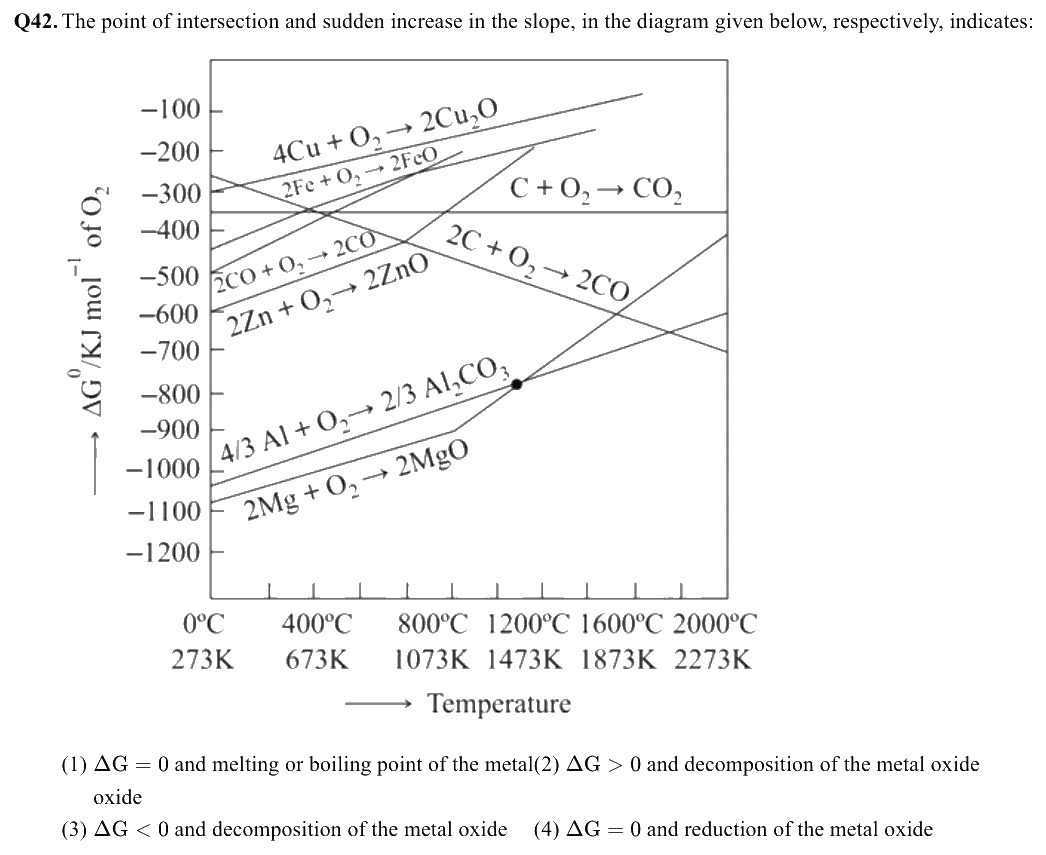
Given below are two statements: one is labelled as Assertion A and the other is labelled as Reason R Assertion A: In the Ellingham diagram, a sharp change in slope of the line is observed from Mg $\rightarrow$ MgO at ~1120$^\circ$C Reason R: There is a large change of entropy associated with the change of state In the light of the above statements, choose the correct answer from the options given below
A
Both A and R are true but R is NOT the correct explanation of A
B
A is false but R is true
C
Both A and R are true and R is the correct explanation of A
In the extraction process of copper, the product obtained after carrying out the reactions (i) $2\mathrm{Cu_2S} + 3\mathrm{O_2} \rightarrow 2\mathrm{Cu_2O} + 2\mathrm{SO_2}$ (ii) $2\mathrm{Cu_2O} + \mathrm{Cu_2S} \rightarrow 6\mathrm{Cu} + \mathrm{SO_2}$ is called
Given below are two statements: Statement I: In the metallurgy process, sulphide ore is converted to oxide before reduction. Statement II: Oxide ores in general are easier to reduce. In the light of the above statements, choose the most appropriate answer from the options given below:
A
Statement I is correct but Statement II is incorrect
B
Both Statement I and Statement II are incorrect
C
Statement I is incorrect but Statement II is correct
Given below are two statements: one is labelled as Assertion A and the other is labelled as Reason $R$ Assertion A: In an Ellingham diagram, the oxidation of carbon to carbon monoxide shows a negative slope with respect to temperature. Reason R: CO tends to get decomposed at higher temperature. In the light of the above statements, choose the correct answer from the options given below
A
Both A and R are correct and R is the correct explanation of A
B
A is not correct but R is correct
C
Both A and R are correct but R is NOT the correct explanation of A
The methods NOT involved in concentration of ore are (A) Liquation (B) Leaching (C) Electrolysis (D) Hydraulic washing (E) Froth floatation Choose the correct answer from the options given below:
Given below are two statements: Statement I: During Electrolytic refining, the pure metal is made to act as anode and its impure metallic form is used as cathode. Statement II: During the Hall-Heroult electrolysis process, purified $\mathrm{Al_2\,O_3}$ is mixed with $\mathrm{Na_3\,AlF_6}$ to lower the melting point of the mixture. In the light of the above statements, choose the most appropriate answer from the options given below:
A
Statement I is incorrect but Statement II is correct
B
Both Statement I and Statement II are incorrect
C
Statement I is correct but Statement II is incorrect
Given below are two statements: One is labelled as Assertion A and the other is labelled as Reason R Assertion A : The reduction of a metal oxide is easier if the metal formed is in liquid state than solid state. Reason R : The value of $\Delta G^{\Theta}$ becomes more on negative side as entropy is higher in liquid state than solid state. In the light of the above statements. Choose the most appropriate answer from the options given below
A
Both A and R are correct and R is the correct explanation of A
B
Both A and R are correct but R is NOT correct explanation of A
Which of the following methods are not used to refine any metal? (A) Liquation (B) Calcination (C) Electrolysis (D) Leaching (E) Distillation Choose the correct answer from the options given below
The compound(s) that is(are) removed as slag during the extraction of copper is : (1) CaO (2) FeO (3) $\mathrm{Al_2O_3}$ (4) ZnO (5) NiO Choose the correct answer from the options given below
Given below are two statements. Statement I : Pig iron is obtained by heating cast iron with scrap iron. Statement II : Pig iron has a relatively lower carbon content than that of cast iron. In the light of the above statements, choose the correct answer from the options given below.
A
Both Statement I and Statement II are correct.
B
Both Statement I and Statement II are not correct.
C
Statement I is correct but Statement II is not correct
D
Statement I is not correct but Statement II is correct.
Match List I with List II. List I With Ore A.Siderite B.Malachite C.Sphalerite D.Calamine List II Composition I.$\mathrm{FeCO_3}$ II.$\mathrm{CuCO_3 \cdot Cu(OH)_2}$ III.$\mathrm{ZnS}$ IV.$\mathrm{ZnCO_3}$ Choose the correct answer from the options given below:
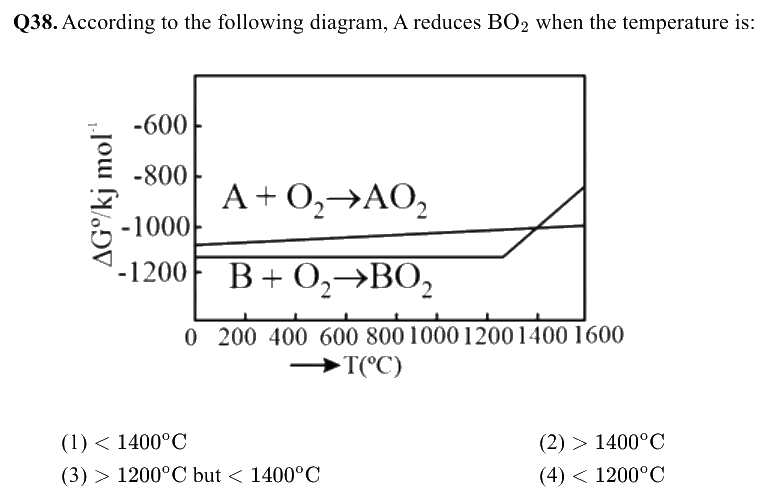
Given are two statements one is labelled as Assertion and other is labelled as Reason. Assertion: Magnesium can reduce $\mathrm{Al_2O_3}$ at a temperature below $1350\ ^\circ\mathrm{C}$, while above $1350\ ^\circ\mathrm{C}$ aluminium can reduce $\mathrm{MgO}$. Reason: The melting and boiling points of magnesium are lower than those of aluminium. In light of the above statements, choose most appropriate answer from the options given below
A
Both Assertion and Reason are correct, and Reason is correct explanation of Assertion.
B
Both Assertion and Reason are correct, but Reason is NOT the correct explanation of Assertion.
In the metallurgical extraction of copper, following reaction is used : $\mathrm{FeO + SiO_2 \rightarrow FeSiO_3}$ $\mathrm{FeO}$ and $\mathrm{FeSiO_3}$ respectively are.
Match List - I with List - II. List-I A Concentration of gold ore B Leaching of alumina C Froth stabiliser D Blister copper List-II I Aniline II NaOH III $\mathrm{SO_2}$ IV NaCN Choose the correct answer from the options given below.
Statement I: Leaching of gold with cyanide ion in absence of air / $\mathrm{O_2}$ leads to cyano complex of Au(III). Statement II: Zinc is oxidized during the displacement reaction carried out for gold extraction. In the light of the above statements, choose the correct answer from the options given below.
A
Both Statement 1 and statement 2 are correct
B
Both Statement 1 and statement 2 are incorrect
C
Statement 1 is correct but statement 2 is incorrect
D
Statement 1 is incorrect but statement 2 is correct
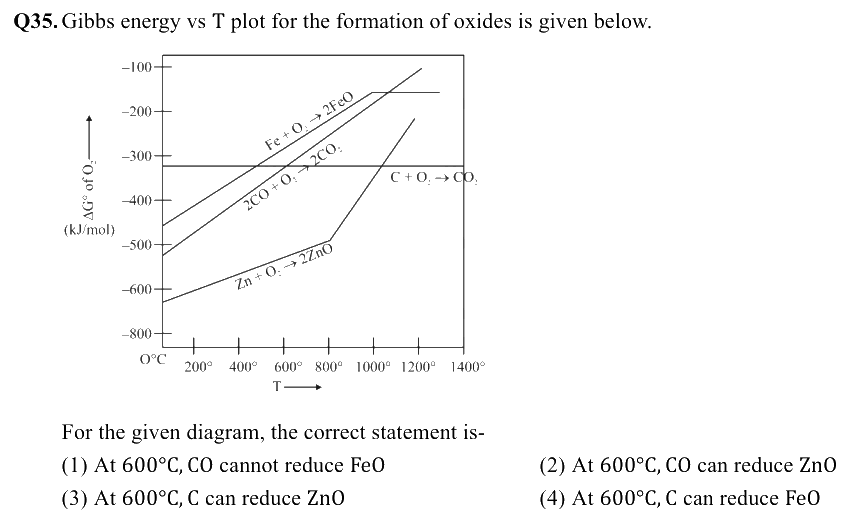
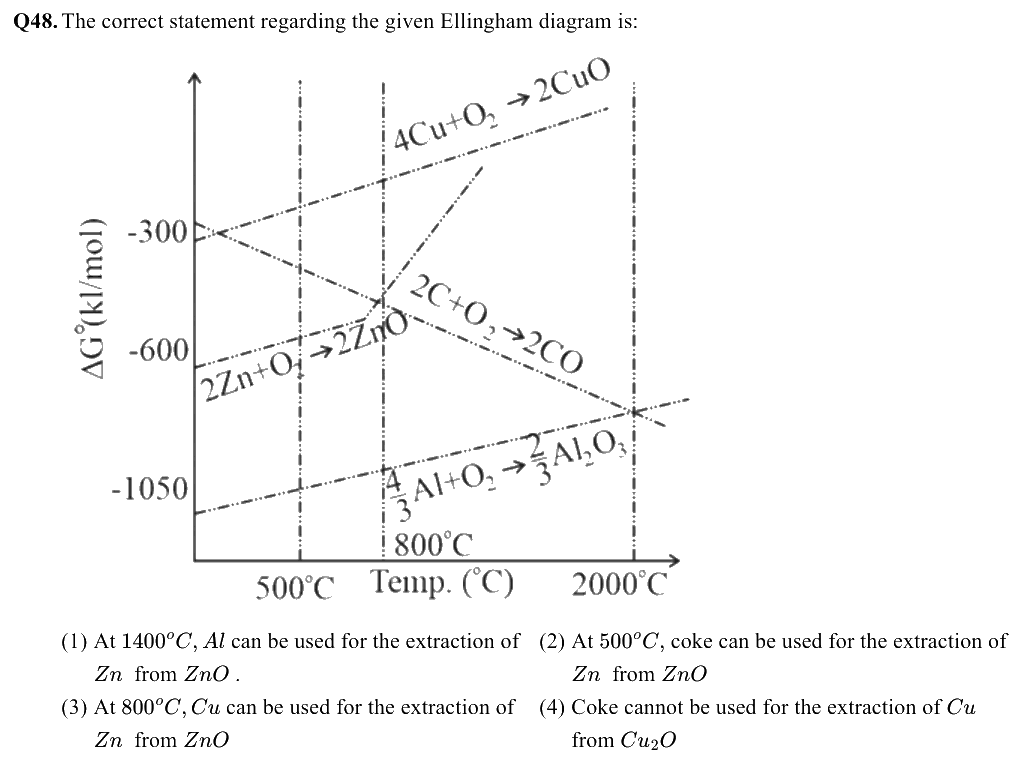
Given below are two statements : Statement I : According to the Ellingham diagram, any metal oxide with higher $\Delta G^\circ$ is more stable than the one with lower $\Delta G^\circ$. Statement II : The metal involved in the formation of oxide placed lower in the Ellingham diagram can reduce the oxide of a metal placed higher in the diagram. In the light of the above statements, choose the most appropriate answer from the options given below
A
Both Statement I and Statement II are correct.
B
Both Statement I and Statement II are incorrect.
C
Statement I is correct but Statement II is incorrect.
D
Statement I is incorrect but Statement II is correct.
Leaching of gold with dilute aqueous solution of NaCN in presence of oxygen gives complex A, which on reaction with zinc forms the elemental gold and another complex B. A and B, respectively are
A
$\mathrm{AuCN}_2^-$ and $\mathrm{ZnCN}_4^{2-}$
B
$\mathrm{AuCN}_4^-$ and $\mathrm{ZnCN}_2\mathrm{OH}_2^{2-}$
Given below are two statements. Statement I: During electrolytic refining. blister copper deposits precious metals. Statement II: In the process of obtaining pure copper by electrolysis method, copper blister is used to make the anode. In the light of the above statements, choose the correct answer from the options given below.
Given below are two statements : one is labelled as Assertion (A) and the other is labelled as Reason (R). Assertion (A) : Aluminium is extracted from bauxite by the electrolysis of molten mixture of $\mathrm{Al_2O_3}$ with cryolite. Reason (R) : The oxidation state of Al in cryolite is $+3$. In the light of the above statements, choose the most appropriate answer from the options given below :
A
Both (A) and (R) are correct and (R) is the correct explanation of (A).
B
(A) is true but (R) is false.
C
Both (A) and (R) are correct but (R) is not the correct explanation of (A).
Match List-I with List-II : List-I (Name of ore/mineral) a Calamine b Malachite c Siderite d Sphalerite List-I (Chemical formula) i $\mathrm{ZnS}$ ii $\mathrm{FeCO_3}$ iii $\mathrm{ZnCO_3}$ iv $\mathrm{CuCO_3\cdot Cu(OH)_2}$ Choose the most appropriate answer from the options given below :
Given below are two statements. Statement I: The choice of reducing agents for metals extraction can be made by using the Ellingham diagram, a plot of $\Delta$G vs temperature. Statement II: The value of $\Delta$S increases from left to right in the Ellingham diagram. In the light of the above statements, choose the most appropriate answer from the options given below:
Given below are two statements: Statement I : Sphalerite is a sulphide ore of zinc and copper glance is a sulphide ore of copper. Statement II : It is possible to separate two sulphide ores by adjusting proportion of oil to water or by using 'depressants' in a froth flotation method. Choose the most appropriate answer from the options given below :
Match List I with List II : (Both having metallurgical terms) List-I | List-II (a) Concentration of Ag ore | (i) Reverberatory furnace (b) Blast furnace | (ii) Pig iron (c) Blister copper | (iii) Leaching with dilute NaCN solution (d) Froth floatation method | (iv) Sulfide ores Choose the correct answer from the options given below.
Consider two chemical reactions (A) and (B) that take place during metallurgical process: (A) $\mathrm{ZnCO_{3(s)}} \xrightarrow{\Delta} \mathrm{ZnO_{(s)}} + \mathrm{CO_{2(g)}}$ (B) $2\,\mathrm{ZnS_{(s)}} + 3\mathrm{O_{2(g)}} \xrightarrow{\Delta} 2\,\mathrm{ZnO_{(s)}} + 2\,\mathrm{SO_{2(g)}}$ The correct option of names given to them respectively is:
A
(A) is calcination and (B) is roasting
B
Both (A) and (B) are producing same product so both are roasting
C
Both (A) and (B) are producing same product so both are calcination
Match list-I with list-II : List-I List-II (a) Mercury (i) Vapour phase refining (b) Copper (ii) Distillation refining (c) Silicon (iii) Electrolytic refining (d) Nickel (iv) Zone refining Choose the most appropriate answer from the option given below :
Match List-I and List-II : List-I : a Haematite, b Bauxite, c Magnetite, d Malachite List-II : i $\mathrm{Al}_2 \mathrm{O}_3 \cdot x \mathrm{H}_2 \mathrm{O}$, ii $\mathrm{Fe}_2 \mathrm{O}_3$, iii $\mathrm{CuCO}_3 \cdot \mathrm{Cu}(\mathrm{OH})_2$, iv $\mathrm{Fe}_3 \mathrm{O}_4$ Choose the correct answer from the options given below :
Match List - I with List - II. List-I (Metal) (a) Aluminium (b) Iron (c) Copper (d) Zinc List-II (Ores) (i) Siderite (ii) Calamine (iii) Kaolinite (iv) Malachite Choose the correct answer from the options given below:
For a reaction $4\ \mathrm{M(s)} + n\mathrm{O_2(g)} \rightarrow 2\mathrm{M_2O_n(s)}$ The free energy change is plotted as a function of temperature. The temperature below which the oxide is stable could be inferred from the plot as the point at which :
A
the slope change from negative to positive
B
the free energy change show a change from negative to positive value
Among statements (a) $-$ (d), the correct ones are : (a) Lime stone is decomposed to CaO during the extraction of iron from its oxides. (b) In the extraction of silver, silver is extracted as an anionic complex. (c) Nickel is purified by Mond's process. (d) Zr and Ti are purified by Van Arkel method.
Among the reactions (a) $-$ (d), the reaction(s) that does/do not occur in the blast furnace during the extraction of iron is/are: $(a)\ CaO + SiO_2 \to CaSiO_3$ $(b)\ 3Fe_2O_3 + CO \to 2Fe_3O_4 + CO_2$ $(c)\ FeO + SiO_2 \to FeSiO_3$ $(d)\ FeO \to Fe + \frac{1}{2}O_2$
Match the refining methods (Column I) with metals (Column II). Column I (Refining methods) (I) Liquation (II) Zone Refining (III) Mond Process (IV) Van Arkel Method Column II (Metals) (a) Zr (b) Ni (c) Sn (d) Ga
Match the ores (column A) with the metals (column B) : (Column A) Ores (I) Siderite (II) Kaolinite (III) Malachite (IV) Calamine (Column B) Metals (a) Zinc (b) Copper (c) Iron (d) Aluminium
In the leaching method, bauxite ore is digested with a concentrated solution of NaOH that produces ' X '. When $\mathrm{CO_2}$ gas is passed through the aqueous solution of ' $X'$, a hydrated compound ' Y' ' is precipitated. ' X ' and ' Y ' respectively are.
A
$\mathrm{Na\,[Al(OH)_4]}$ and $\mathrm{Al_2(CO_3)_3\cdot xH_2O}$
B
$\mathrm{Al(OH)_3}$ and $\mathrm{Al_2O_3\cdot xH_2O}$
C
$\mathrm{NaAlO_2}$ and $\mathrm{Al_2(CO_3)_3\cdot xH_2O}$
D
$\mathrm{Na\,[Al(OH)_4]}$ and $\mathrm{Al_2O_3\cdot xH_2O}$
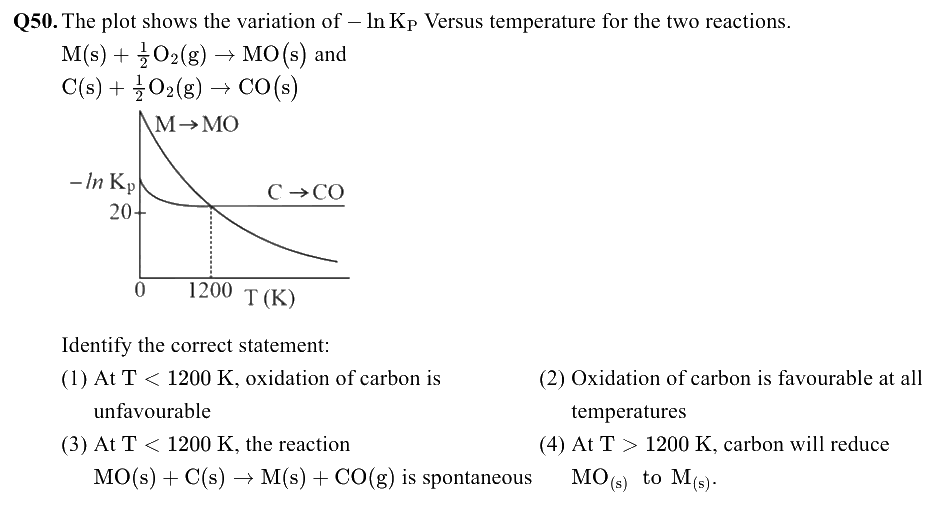
The plot shows the variation of $-\ln \mathrm{K_P}$ Versus temperature for the two reactions. $\mathrm{M(s) + \frac{1}{2}O_2(g) \rightarrow MO(s)}$ and $\mathrm{C(s) + \frac{1}{2}O_2(g) \rightarrow CO(s)}$ (see the figure above) Identify the correct statement:
The question as printed in the paper.
A
At T < 1200 K, oxidation of carbon is unfavourable
B
Oxidation of carbon is favourable at all temperatures
C
At T < 1200 K, the reaction $\mathrm{MO(s) + C(s) \rightarrow M(s) + CO(g)}$ is spontaneous
D
At T > 1200 K, carbon will reduce $\mathrm{MO_{(s)}}$ to $\mathrm{M_{(s)}}$.
Which method of purification is represented by the following equation: $\mathrm{Ti(s)} + 2\mathrm{I_2(g)} \xrightarrow{523\ \mathrm{K}} \mathrm{TiI_4(g)} \xrightarrow{1700\ \mathrm{K}} \mathrm{Ti(s)} + 2\mathrm{I_2(g)}$
Which of the following factors is of no significance for roasting sulphide ores to the oxides and not subjecting the sulphide ores to carbon reduction directly?
A
Metal sulphides are thermodynamically more stable than $\mathrm{CS_2}$
B
$\mathrm{CO_2}$ is thermodynamically more stable than $\mathrm{CS_2}$
C
Metal sulphides are less stable than the corresponding oxides
D
$\mathrm{CO_2}$ is more volatile than $\mathrm{CS_2}$
Among the following ores Bauxite, Siderite, Cuprite, Calamine, Haematite, Kaolinite, Malachite, Magnetite, Sphalerite, Limonite, Cryolite, the number of principal ores of iron is
Numerical answer type: type your answer in EdLoop to check it
In the electrolytic refining of blister copper, the total number of main impurities, from the following, removed as anode mud is ______. Pb, Sb, Se, Te, Ru, Ag, Au and Pt
Numerical answer type: type your answer in EdLoop to check it
How to prepare General Principles of Metallurgy for JEE Main
How often it comes up
General principles of metallurgy covers the chemical extraction of metals and was formerly in the Class 12 curriculum before being removed in 2024, standing at rank 25 of 31 chapters with a 2.1% share of the chemistry section. In the 2019 to 2026 test series, General Principles of Metallurgy yielded 98 questions across 162 exam papers, accounting for 2.1% of the chemistry section and standing at rank 25 of 31 chapters. During the 2002 to 2018 period, it produced 26 questions across 38 papers with a 1.9% share. Across the 2024 to 2026 seasons, it recorded 0 questions across 58 papers, resulting in a 0.0% share. The chapter's appearance frequency has trended down following curriculum deletion.
Due to its removal, the chapter was not asked in 2024, 2025, or 2026. Across the 2019 to 2026 span, it averaged 0.6 questions per paper, with only 4 numerical answer questions recorded.
Most-asked topics
Historic test items fall under one comprehensive topic:
Extraction of Metals: Composed 124 total questions (98 during 2019 to 2026), last tested in 2023. Core themes focused on mineral matching (such as sphalerite, calamine, malachite, and bauxite), concentration by froth flotation and leaching, Ellingham diagram Gibbs free energy curves, metallurgy of copper (matte formation and blister copper), blast furnace reduction of hematite, Hall-Héroult process for aluminum, and refining via Mond process and van Arkel method.
What the questions look like
Previous exam questions were largely descriptive and factual. Common problems asked candidates to match mineral names with their chemical formulas, identify the role of depressants like sodium cyanide in separating galena from zinc blende, or explain why Ellingham curves exhibit a positive slope as temperature rises.
Refining methods appeared very frequently, testing which pure metals correspond to specific techniques such as zone refining for semiconductors (silicon and germanium), Mond process for nickel, or van Arkel method for zirconium and titanium.
Questions to try first
Students reviewing past papers for broader inorganic chemistry intuition can explore these historical questions:
Because metallurgy has been dropped from the active syllabus, optimize your study plan accordingly:
1. Dedicate time to current inorganic units: Concentrate your preparation hours on active syllabus topics such as Coordination Compounds and d- and f-Block Elements. 2. Maintain basic mineral formula recall: Knowing common ore names like bauxite, hematite, and copper pyrites occasionally supports practical chemistry questions. 3. Understand Ellingham fundamentals: Grasping that lower lines on free energy plots reduce metal oxides located higher up reinforces core thermodynamic principles.
Frequently asked questions
Is Metallurgy included in the current JEE Main curriculum?
No, the National Testing Agency removed Isolation of Metals in 2024, with zero questions appearing in 2024, 2025, and 2026.
Are refining processes like the Mond process still relevant?
The Mond process involves nickel tetracarbonyl, which remains an important coordination complex under the active Coordination Compounds chapter.
Where can I review full solutions to past metallurgy questions?
Past questions remain accessible for historical reference and foundational chemistry. Step-by-step solutions for each one are in the EdLoop app.