The reaction used for preparation of soap from fat is :
- A
An addition reaction
- B
Reduction reaction
- C
Alkaline hydrolysis reaction
- D
An oxidation reaction
Answer: (C) Alkaline hydrolysis reaction · Key from source paper
 PYQs · free, no adsOpen on the web (app.edloop.in)Get EdLoop – free on Google Play
Every Chemistry in Everyday Life question from past JEE Main and AIEEE papers, with options and answers. Newest first.
Chemistry in everyday life covers pharmaceutical drugs and detergents and was formerly in the Class 12 curriculum before being removed in 2024, standing at rank 31 of 31 chapters with a 1.3% share of the chemistry section.
Attempt every Chemistry in Everyday Life question timed, see the step-by-step solution and track what you get wrong. Free.
The reaction used for preparation of soap from fat is :
An addition reaction
Reduction reaction
Alkaline hydrolysis reaction
An oxidation reaction
Match List I with List II :
List I List II
A. Saccharin I. High potency sweetener
B. Aspartame II. First artificial sweetening agent
C. Alitame III. Stable at cooking temperature
D. Sucralose IV. Unstable at cooking temperature
Choose the correct answer from the options given below :
A-IV, B-III, C-I, D-II
A-II, B-III, C-IV, D-I
A-II, B-IV, C-III, D-I
A-II, B-IV, C-I, D-III
The statement/s which are true about antagonists from the following is/are:
A. They bind to the receptor site.
B. Get transferred inside the cell for their action.
C. Inhibit the natural communication of the body.
D. Mimic the natural messenger.
Choose the correct answer from the options given below:
B only
A, C and D
A and C
A and B
Given below are two statements:
Statement I: Morphine is a narcotic analgesic. It helps in relieving pain without producing sleep.
Statement II: Morphine and its derivatives are obtained from opium poppy.
In the light of the above statements, choose the correct answer from the options given below
Both Statement I and Statement II are true
Statement I is true but Statement II is false
Both Statement I and Statement II are false
Statement I is false but Statement II is true
Match List I with List II
| List I | List II | ||
|---|---|---|---|
| (A) | Tranquilizers | (I) | Anti blood clotting |
| (B) | Aspirin | (II) | Salvarsan |
| (C) | Antibiotic | (III) | Antidepressant drugs |
| (D) | Antiseptic | (IV) | Soframicine |
Choose the correct answer from the options given below:
(A)-IV, (B)-II, (C)-I, (D)-III
(A)-II, (B)-I, (C)-III, (D)-IV
(A)-III, (B)-I, (C)-II, (D)-IV
(A)-II, (B)-IV, (C)-I, (D)-III
Which of the following artificial sweeteners has the highest sweetness value in comparison to cane sugar?
Aspartame
Sucralose
Alitame
Saccharin
Which of the following compounds are not used as disinfectants?
A. Chloroxylenol
B. Bithional
C. Veronal
D. Prontosil
E. Terpineol
Choose the correct answer from the options given below:
A, B, E
C, D
A, B
B, D, E
Amongst the following compounds, which one is an antacid.
Ranitidine
Meprobamate
Terfenadine
Brompheniramine
Given below are two statements: One is labelled as Assertion A and the other labelled as Reason R.
Assertion A: Antihistamines do not affect the secretion of acid in stomach.
Reason R : Antiallergic and antacid drugs work on different receptors.
In the light of the above statements, choose the correct answer from the options given below:
A is false but R is true
Both A and R are true and R is the correct explanation of A
A is true but R is false
Both A and R are true but R is not the correct explanation of A.
Match List I with List II
List I | Antimicrobials
(A) Narrow Spectrum Antibiotic
(B) Antiseptic
(C) Disinfectants
(D) Broad spectrum antibiotic
List II | Names
(I) Furacin
(II) Sulphur dioxide
(III) Penicillin-G
(IV) Chloramphenicol
(A) - III, (B) - I, (C) - II, (D) - IV
(A) - I, (B) - II, (C) - IV, (D) - III
(A) - II, (B) - I, (C) - IV, (D) - III
(A) - III, (B) - I, (C) - IV, (D) - II
A doctor prescribed the drug Equanil to a patient. The patient was likely to have symptoms of which disease?
Stomach ulcers
Hyperacidity
Anxiety and stress
Depression and hypertension
Which of the following statements is incorrect for antibiotics?
An antibiotic must be a product of metabolism.
An antibiotic is a synthetic substance produced as a structural analogue of naturally occurring antibiotic.
An antibiotic should promote the growth or survival of microorganisms.
An antibiotic should be effective in low concentrations.
Given below are two statements, one is labelled as Assertion A and the other is labelled as Reason R
Assertion A:- Butylated hydroxyl anisole when added to butter increases its shelf life.
Reason R:- Butylated hydroxyl anisole is more reactive towards oxygen than food.
In the light of the above statements, choose the most appropriate answer from the options given below:-
Both A and R are correct and R is the correct explanation of A.
A is correct but R is not correct.
A is not correct but R is correct.
Both A and R are correct but R is NOT the correct explanation of A.
Given below are two statements :
Statement I : Noradrenaline is a neurotransmitter.
Statement II : Low level of noradrenaline is not the cause of depression in human.
In the light of the above statements, choose the correct answer from the options given below
Both statement 1 and 2 are correct..
Statement 1 is correct but statement 2 is incorrect
Statement 1 is incorrect but statement 2 is correct
Both statement 1 and 2 are correct
Match List I with List II
| LIST I Type | LIST II Name |
|---|---|
| A. Antifertility drug | I. Norethindrone |
| B. Tranquilizer | II. Meprobamate |
| C. Antihistamine | III. Seldane |
| D. Antibiotic | IV. Ampicillin |
Choose the correct answer from the options given below :
A-II, B-I, C-III, D-IV
A-IV, B-III, C-II, D-I
A-I, B-III, C-II, D-IV
A-I, B-II, C-III, D-IV
Which of the following compounds is an example of hypnotic drug?
Seldane
Amytal
Aspartame
Prontosil
Statements about Enzyme Inhibitor Drugs are given below :
(A) There are Competitive and Non-competitive inhibitor drugs.
(B) These can bind at the active sites and allosteric sites.
(C) Competitive Drugs are allosteric site blocking drugs.
(D) Non-competitive Drugs are active site blocking drugs.
Choose the correct answer from the options given below
A, D only
A, C only
A, B only
A, B, C only
Two statements in respect of drug-enzyme interaction are given below
Statement I : Action of an enzyme can be blocked only when an inhibitor blocks the active site of the enzyme.
Statement II : An inhibitor can form a strong covalent bond with the enzyme.
In the light of the above statements. Choose the correct answer from the options given below
Both Statement I and Statement II are true
Both Statement I and Statement II are false
Statement I is true but Statement II is false
Statement I is false but Statement II is true
Match List-I with List-II
(see the figure above)
List-I
List-II
I Anti-depressant
II 550 times sweeter than cane sugar
III Narcotic analgesic
IV Antiseptic
Choose the correct answer from the options given below
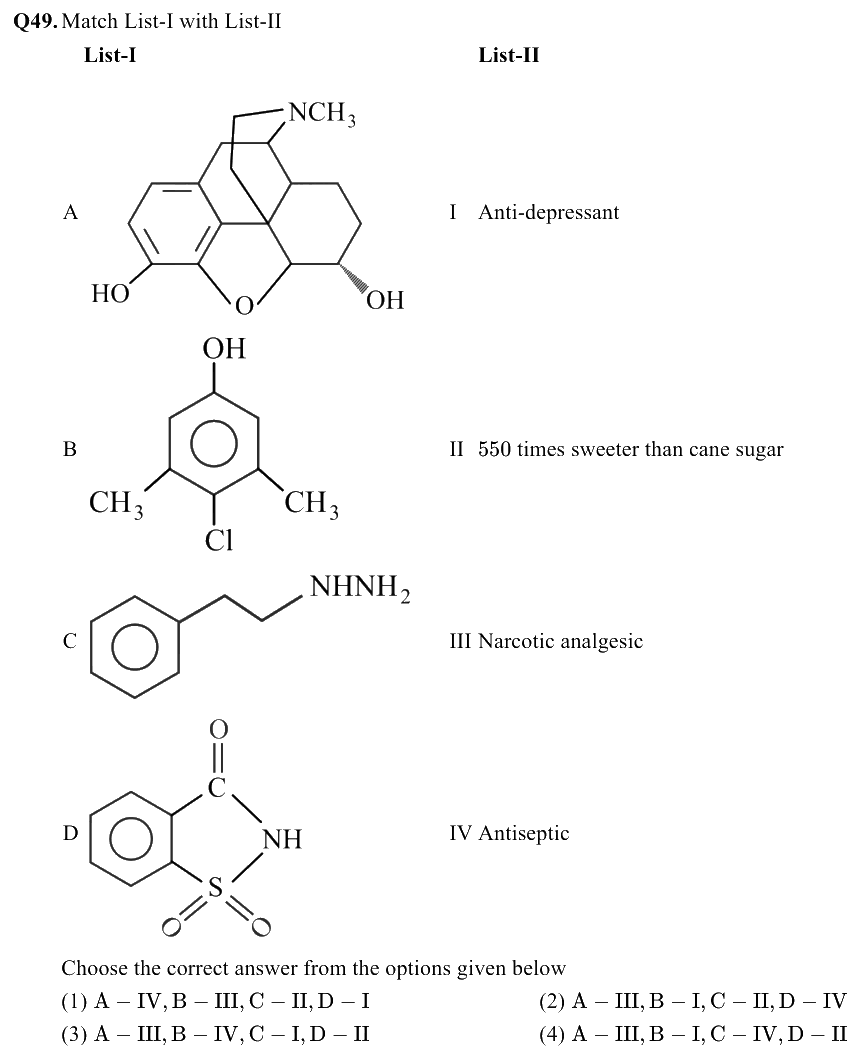
A – IV, B – III, C – II, D – I
A – III, B – I, C – II, D – IV
A – III, B – IV, C – I, D – II
A – III, B – I, C – IV, D – II
Which of the following enhances the lathering property of soap?
Sodium stearate
Sodium carbonate
Sodium rosinate
Trisodium phosphate
Stearic acid and polyethylene glycol react to form which one of the following soap/s detergents?
Cationic detergent
Soap
Anionic detergent
Non-ionic detergent
Drugs used to bind to receptors, inhibiting its natural function and blocking a message are called
antagonists.
agonists.
allosteric.
lead compounds.
Some drugs bind to a site other than, the active site of an enzyme. This site is known as
non-active site
allosteric site
competitive site
therapeutic site
Which of the following compound does not contain sulphur atom?
Histamine
Cimetidine
Saccharin
Ranitidine
The mixture of chloroxylenol and terpineol is an example of :
Antiseptic
Pesticide
Disinfectant
narcotic analgesic
The structure of Tagamet (Cimetidine) is:
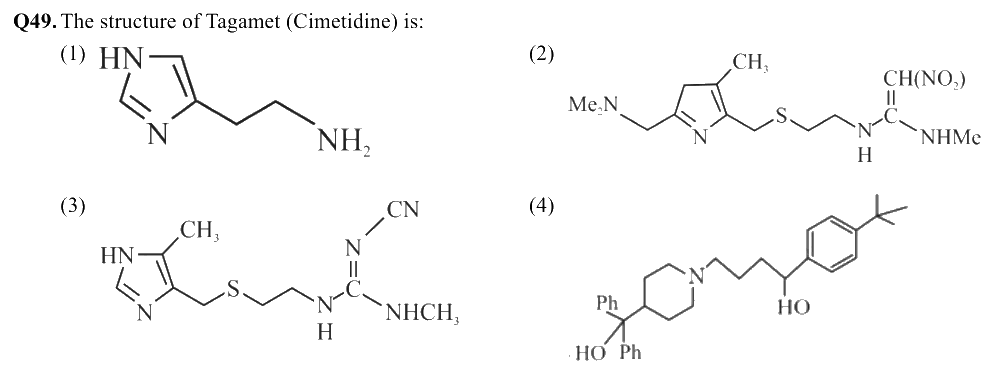
see figure An imidazole ring (with HN and N) carrying a CH2CH2NH2 chain.
see figure A five-membered ring containing N with a Me2N-CH2 group, a CH3 group and a CH2-S-CH2CH2-NH chain ending in a C(=CH(NO2))-NHMe unit (printed as CH(NO2) over a double bond to C, with NHMe).
see figure An imidazole ring (with HN and N) carrying a CH3 and a CH2-S-CH2CH2-NH-C(=N-CN)-NHCH3 chain.
see figure A piperidine ring bearing a C(OH)(Ph)2 group, with N joined through a chain to a CH(OH) that is attached to a para-substituted benzene ring with a tert-butyl group.
Match List - I with List - II.
List-I
A $\mathrm{CH_3(CH_2)_{15}}-\overset{+}{\mathrm{N}}(\mathrm{CH_3})_3\ \mathrm{Br^{-}}$
B $\mathrm{CH_3(CH_2)_{11}}-\mathrm{C_6H_4}-\mathrm{SO_3^{-}Na^{+}}$
C $\mathrm{C_{17}H_{35}\,COO^{-}\,Na^{+} + Na_2\,CO_3 +}$ Rosinate
D $\mathrm{CH_3\,(CH_2)_{16}\,COO\,(CH_2\,CH_2\,O)_n\,CH_2\,CH_2\,OH}$
List-II
I Dishwashing powder
II Toothpaste
III Laundry soap
IV Hair conditioner
Choose the correct answer from the options given below
(A) $-$ (IV), (B) $-$ (II), (C) $-$ (III), (D) $-$ (I)
(A) $-$ (III), (B) $-$ (II), (C) $-$ (IV), (D) $-$ (I)
(A) $-$ (IV), (B) $-$ (III), (C) $-$ (II), (D) $-$ (I)
(A) $-$ (II), (B) $-$ (IV), (C) $-$ (I), (D) $-$ (III)
Match List-I with List-II
List-I
(A) Antipyretic
(B) Analgesic
(C) Tranquilizer
(D) Antacid
List-II
(I) Reduces pain
(II) Reduces stress
(III) Reduces fever
(IV) Reduces acidity(stomach)
Choose the correct answer from the options given below
A $-$ III, B $-$ I, C $-$ II, D $-$ IV
A $-$ III, B $-$ I, C $-$ IV, D $-$ II
A $-$ I, B $-$ IV, C $-$ II, D $-$ III
A $-$ I, B $-$ III, C $-$ II, D $-$ IV
A chemical which stimulates the secretion of pepsin is
Histamine
Cimetidine
Zantac
Anti histamine
Which of the following is NOT an example of synthetic detergent?
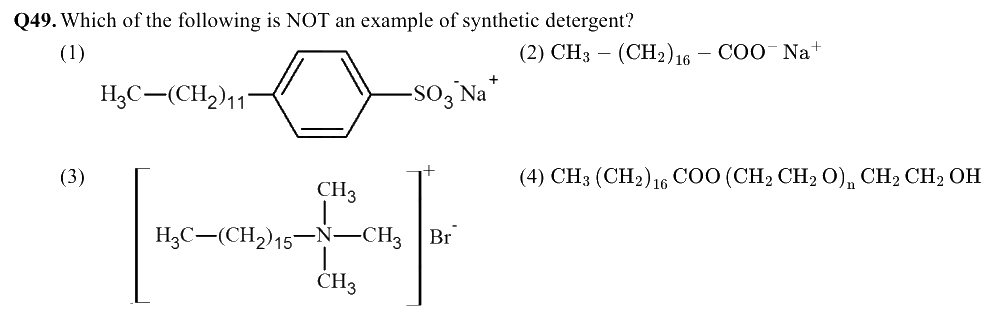
see figure $\mathrm{H_3C-(CH_2)_{11}}$ attached to a benzene ring with $\mathrm{SO_3^-Na^+}$ on the opposite (para) carbon
$\mathrm{CH_3 - (CH_2)_{16} - COO^- Na^+}$
see figure square-bracketed cation: central N bonded to CH3 (above), CH3 (right), CH3 (below) and H3C-(CH2)15 (left), with + charge outside the bracket, and Br- as counter-ion
$\mathrm{CH_3 (CH_2)_{16} COO (CH_2 CH_2 O)_n CH_2 CH_2 OH}$
Which one of the following is an example of artificial sweetner?
Bithional
Alitame
Lactose
Salvarsan
An antiseptic dettol is a mixture of two compounds 'A' and 'B' where A has $6\pi$ electrons and B has $2\pi$ electrons. What is B?
Bithional
Terpineol
Chlorophenol
Chloroxyenol
Which of the following is not a broad spectrum antibiotic?
Vancomycin
Penicillin G
Ofloxacin
Ampicillin
The structure shown below is of which well-known drug molecule?
(see the figure above)
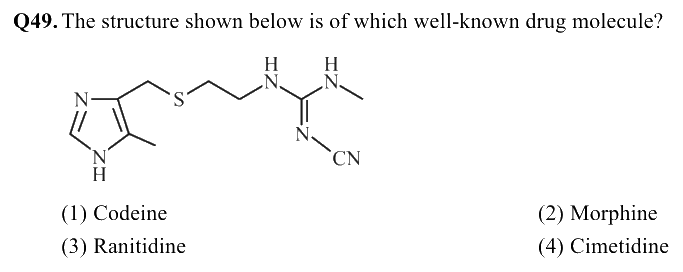
Codeine
Morphine
Ranitidine
Cimetidine
see figure The correct statement about (A), (B), (C) and (D) is:
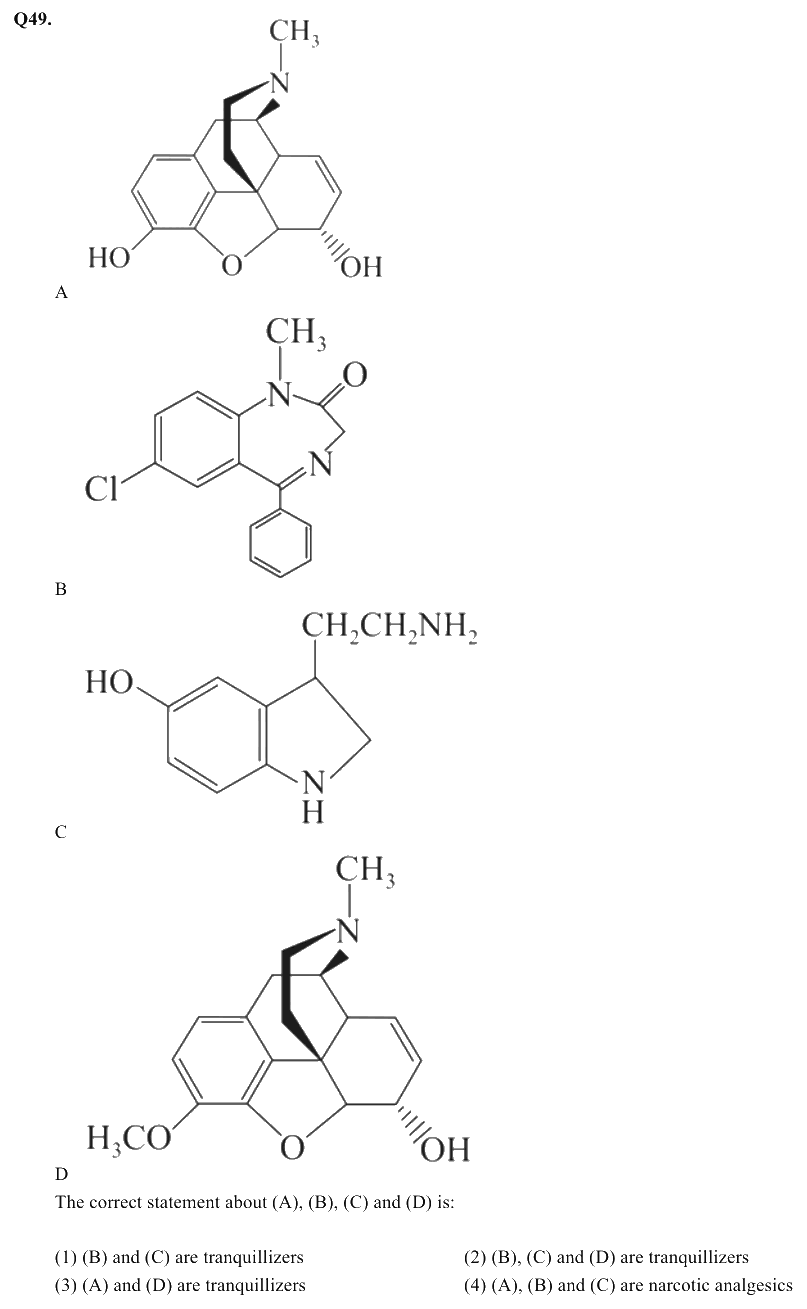
(B) and (C) are tranquillizers
(B), (C), (D) are tranquillizers
(A) and (D) are tranquillizers
(A), (B) and (C) are narcotic analgesics
Which one of the following chemicals is responsible for the production of HCl in the stomach leading to irritation and pain?
(see the figure above)
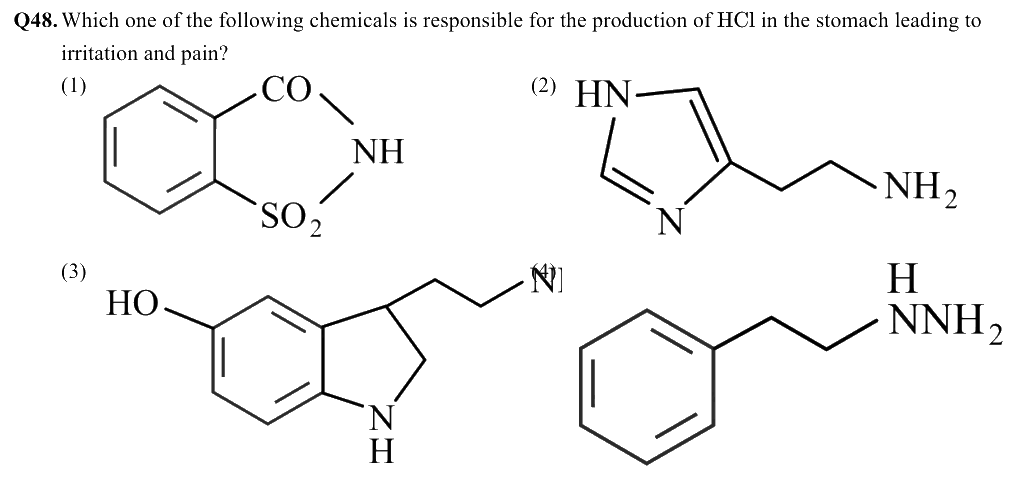
see figure Saccharin: a benzene ring fused to a five-membered ring with CO-NH-SO2.
see figure Histamine: an imidazole ring (HN and N in the ring) with a CH2-CH2-NH2 side chain.
see figure A hydroxy-substituted indoline-type ring system: a benzene ring with HO, fused to a five-membered ring with N-H, carrying a CH2-CH2-N side chain whose end group is hidden under the label (4).
see figure Phenelzine: a benzene ring with a CH2-CH2-NH-NH2 side chain (H and NNH2 at the end).
see figure The class of drug to which chlordiazepoxide with above structure belongs is :
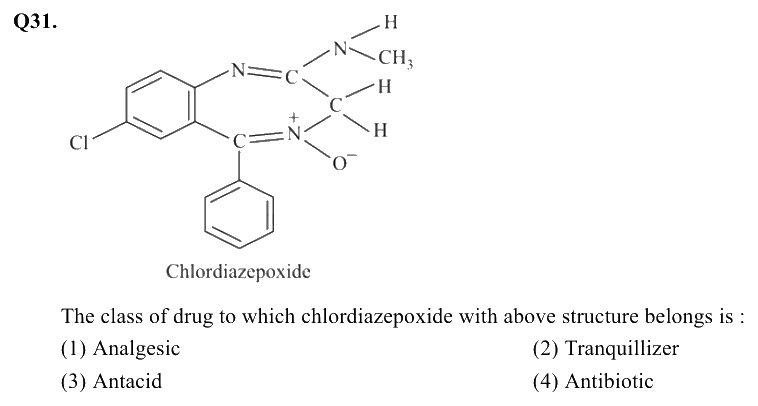
Analgesic
Tranquillizer
Antacid
Antibiotic
List $-$I (Drug): (a) Furacin; (b) Arsphenamine; (c) Dimetone; (d) Valium
List$-$ II (Class of Drug): (i) Antibiotic; (ii) Tranquilizers; (iii) Antiseptic; (iv) Synthetic antihistamines
Choose the most appropriate match :
(a) $-$ (i), (b) $-$ (iii), (c) $-$ (iv), (d) $-$ (ii)
(a) $-$ (iii), (b) $-$ (iv), (c) $-$ (ii), (d) $-$ (i)
(a) $-$ (ii), (b) $-$ (i), (c) $-$ (iii), (d) $-$ (iv)
(a) $-$ (iii), (b) $-$ (i), (c) $-$ (iv), (d) $-$ (ii)
Given below are two statements :
Statement I : Penicillin is a bacteriostatic type antibiotic.
Statement II : The general structure of Penicillin is:
(see the figure above)
Choose the correct option :
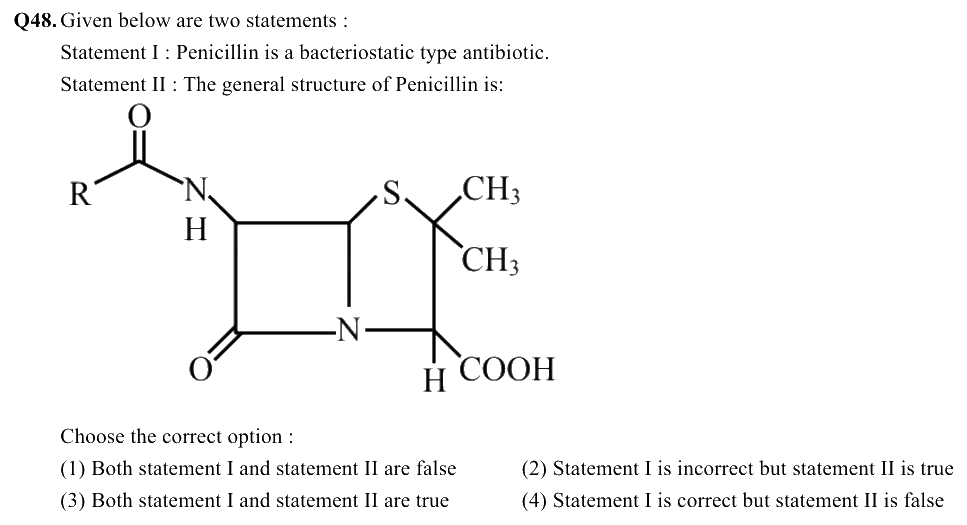
Both statement I and statement II are false
Statement I is incorrect but statement II is true
Both statement I and statement II are true
Statement I is correct but statement II is false
Match the list$-$I with list$-$ II
List$-$I (Class of Drug)
List$-$ II (Example)
(a) Antacid (i) Novestrol
(b) Artificial sweetener (ii) Cimetidine
(c) Antifertility (iii) Valium
(d) Tranquilizers (iv) Alitame
a $-$ ii, b $-$ iv, c $-$ i, d $-$ iii
a $-$ iv, b $-$ i, c $-$ ii, d $-$ iii
a $-$ iv, b $-$ iii, c $-$ i, d $-$ ii
a $-$ ii, b $-$ iv, c $-$ iii, d $-$ i
Match List - I with List - II :
List-I (Class of Chemicals)
List-II (Example)
(a) Antifertility drug (i) Meprobamate
(b) Antibiotic (ii) Alitame
(c) Tranquilizer (iii) Norethindrone
(d) Artificial Sweetener (iv) Salvarsan
(a) $-$ (ii), (b) $-$ (iii), (c) $-$ (iv), (d) $-$ (i)
(a) $-$ (iv), (b) $-$ (iii), (c) $-$ (ii), (d) $-$ (i)
(a) $-$ (iii), (b) $-$ (iv), (c) $-$ (i), (d) $-$ (ii)
(a) $-$ (ii), (b) $-$ (iv), (c) $-$ (i), (d) $-$ (iii)
With respect to drug-enzyme interaction, identify the wrong statement:
Non-Competitive inhibitor binds to the allosteric site
Allosteric inhibitor changes the enzyme's active site
Allosteric inhibitor competes with the enzyme's active site
Competitive inhibitor binds to the enzyme's active site
Match List-I with List-II :
List-I Chemical Compound : a Sucralose, b Glyceryl ester of stearic acid, c Sodium benzoate, d Bithional
List-II Used as : i Synthetic detergent, ii Artificial sweetener, iii Antiseptic, iv Food preservative
Choose the correct match :
(a) $-$ (iv), (b) $-$ (iii), (c) $-$ (ii), (d) $-$ (i)
(a) $-$ (ii), (b) $-$ (i), (c) $-$ (iv), (d) $-$ (iii)
(a) $-$ (iii), (b) $-$ (ii), (c) $-$ (iv), (d) $-$ (i)
(a) $-$ (i), (b) $-$ (ii), (c) $-$ (iv), (d) $-$ (iii)
The functions of antihistamine are :
Antiallergic and Analgesic
Antacid and Antiallergic
Analgesic and antacid
Antiallergic and antidepressant
Match List - I with List - II.
List-I
(a) Valium
(b) Morphine
(c) Norethindrone
(d) Vitamin $\mathrm{B_{12}}$
List-II
(i) Antifertility drug
(ii) Pernicious anaemia
(iii) Analgesic
(iv) Tranquilizer
Choose the correct answer from the options given below:
(a)-(iv), (b)-(iii), (c)-(ii), (d)-(i)
(a)-(ii), (b)-(iv), (c)-(iii), (d)-(i)
(a)-(i), (b)-(iii), (c)-(iv), (d)-(ii)
(a)-(iv), (b)-(iii), (c)-(i), (d)-(ii)
If a person is suffering from the deficiency of nor-adrenaline, what kind of drug can be suggested?
Anti-inflammatory
Antidepressant
Antihistamine
Analgesic
The following molecule acts as an :
(see the figure above)
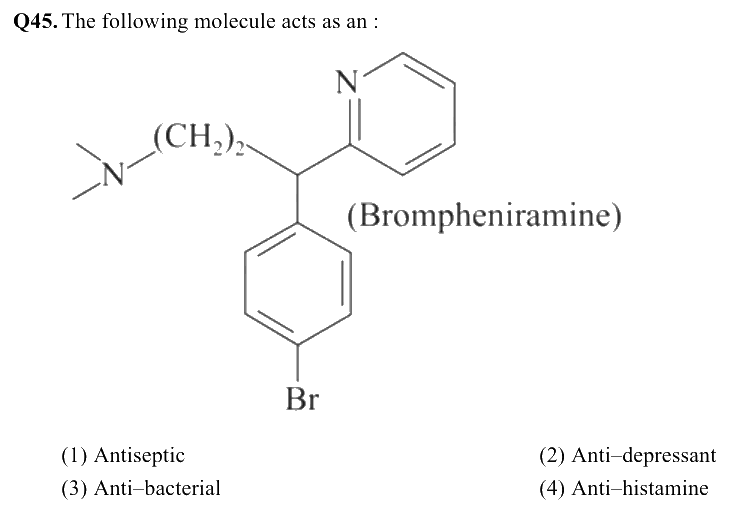
Antiseptic
Anti–depressant
Anti–bacterial
Anti–histamine
The mechanism of action of "Terfenadine" (Seldane) is :
Activates the histamine receptor
Inhibits the secretion of histamine
Helps in the secretion of histamine
Inhibits the action of histamine receptor
The antifertility drug "Novestrol" can react with :
$\mathrm{ZnCl_2\ /\ HCl;\ FeCl_3;\ Alcoholic\ HCN}$
$\mathrm{Br_2\ /\ water,\ ZnCl_2\ /\ HCl;\ FeCl_3}$
$\mathrm{Alcoholic\ HCN;\ NaOCl;\ ZnCl_2\ /\ HCl}$
$\mathrm{Br_2\ /\ water,\ ZnCl_2\ /\ HCl;\ NaOCl}$
Match the following drugs with their therapeutic actions:
(i) Ranitidine
(ii) Nardil (Phenelzine)
(iii) Chloramphenicol
(iv) Dimetane (Brompheniramine)
(a) Antidepressant
(b) Antibiotic
(c) Antihistamine
(d) Antacid
(e) Analgesic
(i)-(a); (ii)-(c); (iii)-(b); (iv)-(e);
(i)-(d); (ii)-(a); (iii)-(b); (iv)-(c);
(i)-(e); (ii)-(a); (iii)-(c); (iv)-(d);
(i)-(d); (ii)-(c); (iii)-(a); (iv)-(e);
A chemist has 4 samples of artificial sweetener A, B, C and D . To identify these samples, he performed certain experiments and noted the following observations:
(i) A and D both form blue-violet colour with ninhydrin.
(ii) Lassaigne extract of C gives positive $\mathrm{AgNO_3}$ test and negative $\mathrm{Fe_4[Fe(CN)_6]_3}$ test.
(iii) Lassaigne extract of B and D gives positive sodium nitroprusside test.
Based on these observations which option is correct?
A : Aspartame; B : Saccharin; C : Sucralose; D : Alitame
A : Alitame; B : Saccharin; C : Aspartame; D : Sucralose
A : Saccharin; B : Alitame; C : Sucralose; D : Aspartame
A : Aspartame; B : Alitame; C : Saccharin; D : Sucralose
Noradrenaline is a/an
Antihistamine
Neurotransmitter
Antacid
Antidepressant
The correct match between item (I) and item (II) is :
Item - I
(A) Norethindrone
(B) Ofloxacin
(C) Equanil
Item - II
(P) Antibiotic
(Q) Antifertility
(R) Hypertension
(S) Analgesics
(A) $\rightarrow$ (Q); (B) $\rightarrow$ (R); (C) $\rightarrow$ (S)
(A) $\rightarrow$ (Q); (B) $\rightarrow$ (P); (C) $\rightarrow$ (R)
(A) $\rightarrow$ (R); (B) $\rightarrow$ (P); (C) $\rightarrow$ (S)
(A) $\rightarrow$ (R); (B) $\rightarrow$ (P); (C) $\rightarrow$ (R)
see figure The correct match between Item I and Item II is:
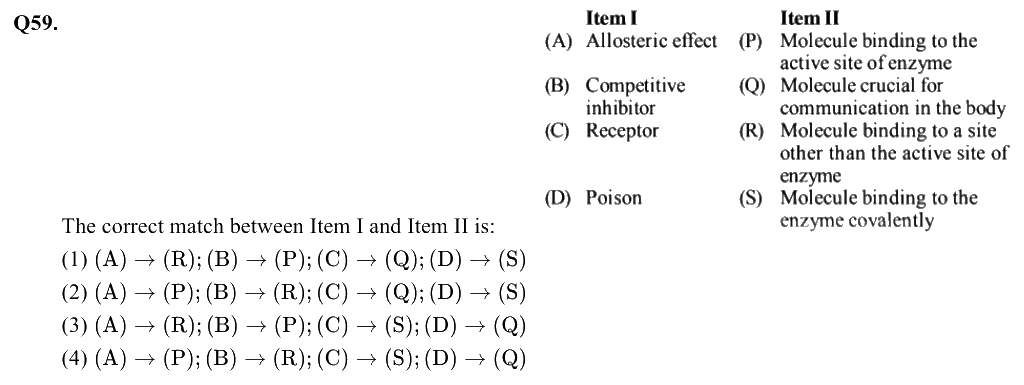
(A) $\rightarrow$ (R); (B) $\rightarrow$ (P); (C) $\rightarrow$ (Q); (D) $\rightarrow$ (S)
(A) $\rightarrow$ (P); (B) $\rightarrow$ (R); (C) $\rightarrow$ (Q); (D) $\rightarrow$ (S)
(A) $\rightarrow$ (R); (B) $\rightarrow$ (P); (C) $\rightarrow$ (S); (D) $\rightarrow$ (Q)
(A) $\rightarrow$ (P); (B) $\rightarrow$ (R); (C) $\rightarrow$ (S); (D) $\rightarrow$ (Q)
The correct match between column-I and column-II is
Column-I (drug)
$(A)$ Chloroxylenol
$(B)$ Norethindrone
$(C)$ Sulphapyridine
$(D)$ Penicillin
Column-II (test)
$(P)$ Carbylamine test
$(Q)$ Sodium hydrogen carbonate test
$(R)$ Ferric chloride test
$(S)$ Baeyer's test
$A \rightarrow R, B \rightarrow P, C \rightarrow S, D \rightarrow Q$
$A \rightarrow Q, B \rightarrow S, C \rightarrow P, D \rightarrow R$
$A \rightarrow Q, B \rightarrow P, C \rightarrow S, D \rightarrow R$
$A \rightarrow R, B \rightarrow S, C \rightarrow P, D \rightarrow Q$
The correct match between items of List-I and List-II is:
List -I
(A) Phenelzine
(B) Chloroxylenol
(C) Uracil
(D) Ranitidine
List - II
(P) Pyrimidine
(Q) Furan
(R) Hydrazine
(S) Phenol
(A) $-$ (S), (B) $-$ (R), (C) $-$ (Q), (D) $-$ (P)
(A) $-$ (R), (B) $-$ (S), (C) $-$ (P), (D) $-$ (Q)
(A) $-$ (R), (B) $-$ (S), (C) $-$ (Q), (D) $-$ (P)
(A) $-$ (S), (B) $-$ (R), (C) $-$ (P), (D) $-$ (Q)
Which of the following is a bactericidal antibiotic?
Ofloxacin
Tetracycline
Chloramphenicol
Erythromycin
The artificial sweetener that has the highest sweetness value in comparison to cane sugar is:
Sucralose
Aspartame
Saccharin
Alitame
Which of the following is an anionic detergent?
Cetyltrimethyl ammonium bromide
Glyceryl oleate
hexadecyltrimethyl ammonium bromide
Sodium lauryl sulphate
Which artificial sweetener contains chlorine?
Sucralose
Alitame
Saccharin
Aspartame
see figure is used as:
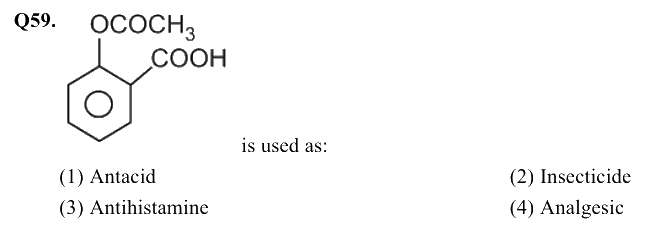
Antacid
Insecticide
Antihistamine
Analgesic
Which of the following compounds is not an antacid?
Ranitidine
Aluminium hydroxide
Cimetidine
Phenelzine
Aminoglycosides are usually used as:
antibiotic
analgesic
hypnotic
antifertility
Which one of the following is used as Antihistamine?
Omeprazole
Chloranphenicol
Diphenhydramine
Norethindrone
$\mathrm{H_1}$ $-$ Receptor antagonists is a term associated with :
Antiseptics
Antihistamins
Antacids
Analgesics
Which of the following statements about aspirin is not true?
It is effective in relieving pain.
It is a neurologically active drug.
It has antiblood clotting action.
It belongs to narcotic analgesics.
Sulphonamides act as
Antiseptic
Analgesic
Antimicrobials
Antipyretic
Aspirin can be prepared by the reaction of
Salicyldehyde with acetic anhydride in presence of $\mathrm{H_2SO_4}$
Salicylic acid with methanol in presence of $\mathrm{H_2SO_4}$
Salicylic acid with acetic anhydride in presence of $\mathrm{H_2SO_4}$
Cinnamic acid with acetic anhydride in presence of $\mathrm{H_2SO_4}$
Chemically heroin is
morphine monoacetate
morphine dibenzoate
morphine diacetate
morphine monobenzoate
Which one of the following compounds is an antifertility drug?
Aspirin
Chloromycetin
Saheli
Penicillin
Aspirin is known as:
Acetyl salicylic acid
Phenyl salicylate
Acetyl salicylate
Methyl salicylic acid
Which one of the following types of drugs reduces fever?
Analgesic
Antipyretic
Antibiotic
Tranquiliser
see figure The compound is used as
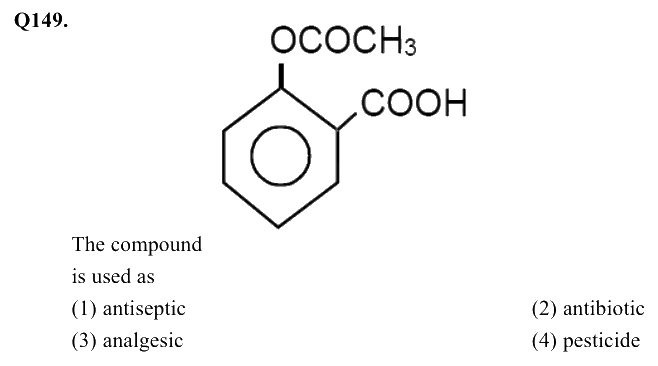
antiseptic
antibiotic
analgesic
pesticide
Among the following, the number of tranquilizer/s is/are
A. Chloroliazepoxide
B. Veronal
C. Valium
D. Salvarsan
The number of chlorine atoms in bithionol is
How many of the following drugs is/are example(s) of broad spectrum antibiotic? Ofloxacin, Penicillin G, Terpineol, Salvarsan
The number of $\mathrm{sp^2}$ hybridised carbons present in "Aspartame" is
Chemistry in everyday life covers pharmaceutical drugs and detergents and was formerly in the Class 12 curriculum before being removed in 2024, standing at rank 31 of 31 chapters with a 1.3% share of the chemistry section. Across 2019 to 2026, Chemistry in Everyday Life accounted for 59 questions across 162 test papers, delivering 1.3% of the chemistry section and standing at rank 31 of 31 chapters. During the earlier 2002 to 2018 timeframe, it contributed 18 questions across 38 papers with a 1.3% share. Over the 2024 to 2026 cycle, it recorded 0 questions across 58 papers, capturing a 0.0% share. The overall trajectory has trended down following curriculum reduction.
Because it was deleted from the syllabus, the chapter was not asked in 2024, 2025, or 2026. Across 2019 to 2026, it averaged 0.4 questions per paper, with 4 numerical answer questions recorded.
Historical test questions group under one broad topic:
Previous exam questions were purely memory-based matching and classification tasks. A common problem provided a list of medication brand names or active molecules (such as ranitidine, meprobamate, terfenadine, and cimetidine) and asked students to categorize each by pharmacological therapeutic effect (such as antacids versus antihistamines).
Other items evaluated artificial sweeteners (identifying alitame as possessing the highest sweetness relative to cane sugar, or noting that aspartame is unstable at cooking temperatures) and synthetic detergents (such as cetyltrimethylammonium bromide as a cationic detergent).
Candidates consulting past year questions or reviewing pharmaceutical chemistry basics can examine these historical questions:
Because this unit has been excised from active JEE Main papers, adjust study priorities appropriately:
1. Prioritize active chapters: Concentrate your study hours on active organic units such as Aldehydes, Ketones & Carboxylic Acids, and Biomolecules. 2. Note basic antiseptic terminology: Remembering that Dettol consists of chloroxylenol and terpineol remains helpful general chemistry knowledge. 3. Understand detergent classes: Knowing that cationic detergents are quaternary ammonium salts with germicidal properties provides helpful surface chemistry intuition.
No, the National Testing Agency officially excised this chapter from the syllabus in 2024, resulting in 0 questions across 2024, 2025, and 2026.
Antiseptics prevent microbial growth and are applied safely to living human tissues (such as Dettol or tincture of iodine), whereas disinfectants kill microorganisms on inanimate objects like floors and instruments (such as 1% phenol).
Historical question explanations remain cataloged for reference. Step-by-step solutions for each one are in the EdLoop app.