
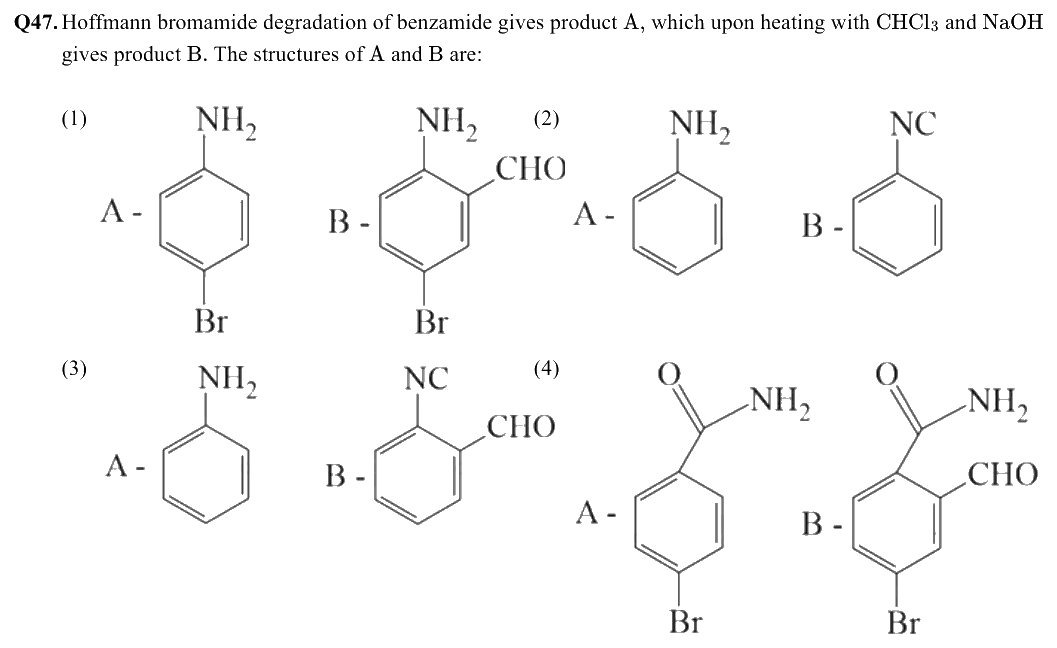
Hoffmann bromamide degradation of benzamide gives product A, which upon heating with $\mathrm{CHCl}_3$ and NaOH gives product B. The structures of A and B are:
- (1)
see figure A: 4-bromoaniline (benzene ring with $\mathrm{NH_2}$ and Br para to each other); B: 2-amino-5-bromobenzaldehyde (benzene ring with $\mathrm{NH_2}$, an adjacent CHO and Br para to the $\mathrm{NH_2}$)
- (2)
see figure A: aniline; B: phenyl isocyanide (benzene ring with NC)
- (3)
see figure A: aniline; B: 2-isocyanobenzaldehyde (benzene ring with NC and an adjacent CHO)
- (4)
see figure A: 4-bromobenzamide (benzene ring with $\mathrm{C(=O)NH_2}$ and Br para to each other); B: benzamide with an adjacent CHO and Br on the ring ($\mathrm{C(=O)NH_2}$, CHO ortho to it, Br para to the amide)
Show answer
Option (2) is correct.
Key from source paper