
For the reaction, $\mathrm{H_2(\,g) + I_2(\,g) \rightleftharpoons 2HI(\,g)}$ Attainment of equillibrium is predicted correctly by :
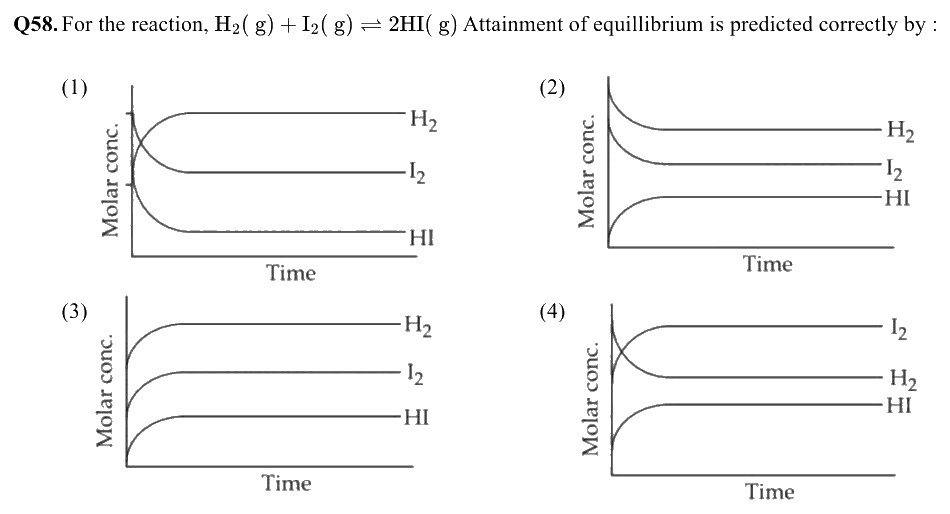
- (1)
see figure axes 'Molar conc.' (vertical) and 'Time' (horizontal); curves start high on the vertical axis at time zero: 'H2' rises to the highest plateau, 'I2' falls to a middle plateau and 'HI' falls to the lowest plateau.
- (2)
see figure same axes; 'H2' and 'I2' start high on the vertical axis and fall to two close plateaus ('H2' slightly above 'I2'), while 'HI' rises from the bottom of the vertical axis to a lower plateau.
- (3)
see figure same axes; all three curves rise from the bottom of the vertical axis to plateaus: 'H2' highest, 'I2' in the middle and 'HI' lowest.
- (4)
see figure same axes; one curve starts high and falls to the middle plateau labelled 'H2', another curve rises to the top plateau labelled 'I2', and 'HI' rises from the bottom to the lowest plateau.
Show answer
Option (2) is correct.
Key from source paper