
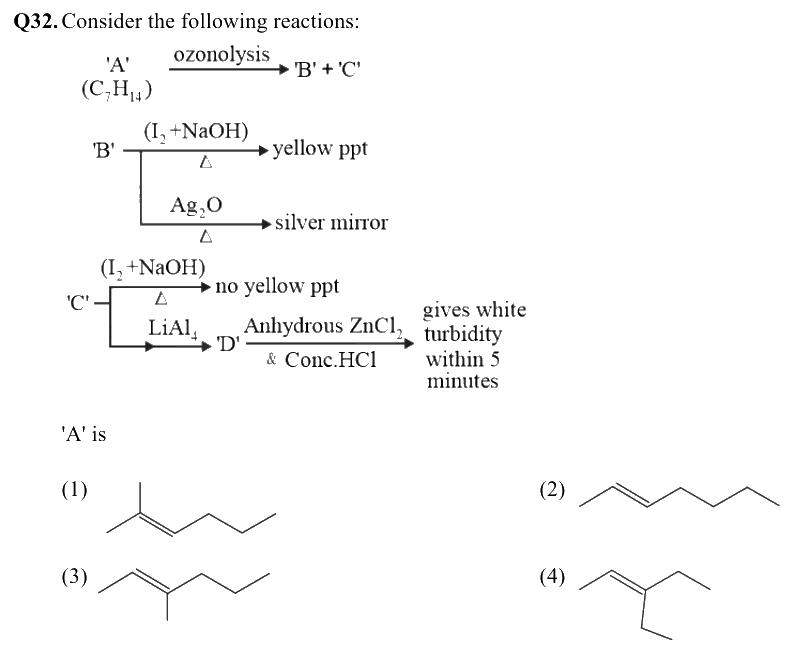
Consider the following reactions:
$\mathrm{'A'\ (C_7H_{14})} \xrightarrow{\text{ozonolysis}} \mathrm{'B'} + \mathrm{'C'}$
$\mathrm{'B'} \xrightarrow[\Delta]{(\mathrm{I_2}+\mathrm{NaOH})}$ yellow ppt; $\mathrm{'B'} \xrightarrow[\Delta]{\mathrm{Ag_2O}}$ silver mirror
$\mathrm{'C'} \xrightarrow[\Delta]{(\mathrm{I_2}+\mathrm{NaOH})}$ no yellow ppt; $\mathrm{'C'} \xrightarrow{\mathrm{LiAlH_4}} \mathrm{'D'}$, and $\mathrm{'D'} \xrightarrow[\&\ \mathrm{Conc.HCl}]{\mathrm{Anhydrous\ ZnCl_2}}$ gives white turbidity within 5 minutes
'A' is
(see the figure above)
- (1)
see figure skeletal alkene: a carbon bearing two methyl groups (one drawn up, one to the lower left) double-bonded to the next carbon, followed by a three-carbon zigzag chain to the right
- (2)
see figure skeletal straight-chain alkene: a zigzag chain of seven carbons with the double bond between the second and third carbons from the left
- (3)
see figure skeletal alkene: left arm of one carbon, a double bond to a carbon that carries a methyl group drawn downward and a three-carbon zigzag chain continuing to the right
- (4)
see figure skeletal alkene: left arm of one carbon, a double bond to a carbon that carries two ethyl groups, one drawn up-right and one drawn downward
Show answer
Option (4) is correct.
Key from source paper