
An unsaturated hydrocarbon $X$ absorbs two hydrogen molecules on catalytic hydrogenation, and also gives following reaction:
$X \xrightarrow[\text{(ii) Zn, H}_2\text{O}]{\text{(i)O}_3} A \xrightarrow{[\mathrm{Ag(NH_3)_2}]^+} B$ (3-oxo-hexanedicarboxylic acid) $X$ will be:
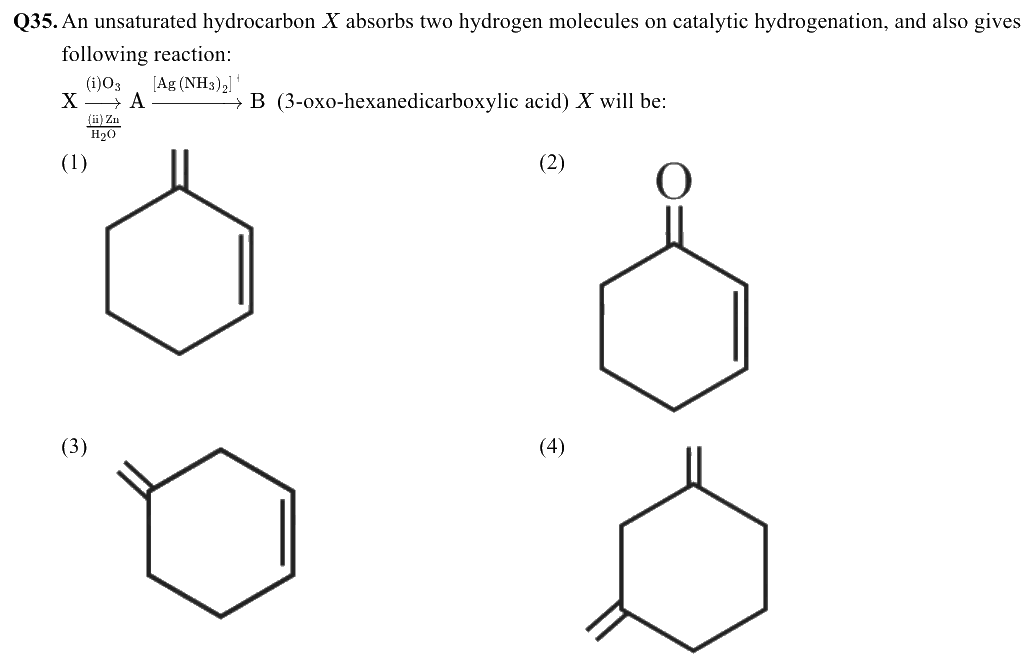
- (1)
see figure six-membered ring with an exocyclic $=\mathrm{CH_2}$ at the top carbon and a ring C=C at the upper right
- (2)
see figure cyclohexenone: six-membered ring with C=O at the top carbon and a ring C=C at the upper right
- (3)
see figure six-membered ring with an exocyclic $=\mathrm{CH_2}$ at the upper left carbon and a ring C=C at the right
- (4)
see figure six-membered ring with exocyclic $=\mathrm{CH_2}$ groups at the top carbon and at the lower left carbon (no ring C=C)
Show answer
Option (3) is correct.
Key from source paper