
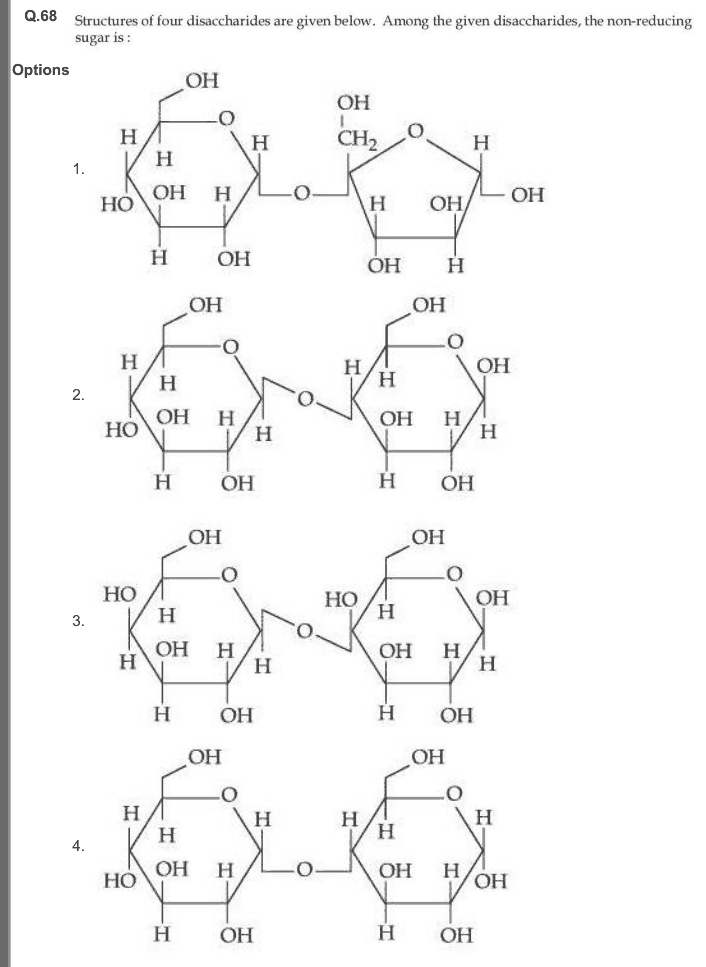
Structures of four disaccharides are given below. Among the given disaccharides, the non-reducing sugar is :
- (1)
see figure a six-membered ring (left) joined through a bridging 'O' to a five-membered ring (right). Left ring, going round from its top-left carbon: that carbon has an arm going up then right ending in 'OH' (CH2OH) and an 'H' below it; the ring O is at the upper right; the carbon at the left has 'H' above and 'HO' below; the bottom-left carbon has 'OH' above and 'H' below; the bottom-right carbon has 'H' above and 'OH' below; the carbon at the right (next to the ring O) has 'H' above, and its bond to the bridging O goes DOWN and then right. Right ring: its top-left carbon carries 'CH2' with 'OH' above it, and the bridging O is bonded to the carbon that carries it (bond goes left); the ring O is at the top; the right-hand carbon next to the ring O has 'H' above and a bond going down then right to 'OH'; the lower-left carbon has 'H' above and 'OH' below; the lower-right carbon has 'OH' above and 'H' below.
- (2)
see figure two six-membered rings joined through a bridging 'O'. Left ring: top-left carbon with CH2OH arm (up then right ending in 'OH') and 'H' below; the carbon at the left has 'H' above and 'HO' below; the bottom-left carbon has 'OH' above and 'H' below; the bottom-right carbon has 'H' above and 'OH' below; the carbon at the right (next to the ring O) has 'H' BELOW it, and its bond to the bridging O goes UP and then down-right. Right ring: top-left carbon with CH2OH arm (up then right ending in 'OH') and 'H' below; the carbon at the left, which is bonded to the bridging O through a bond going down, has 'H' above; the bottom-left carbon has 'OH' above and 'H' below; the bottom-right carbon has 'H' above and 'OH' below; the carbon at the right (next to the ring O) has 'OH' above and 'H' below.
- (3)
see figure two six-membered rings joined through a bridging 'O'. Left ring: top-left carbon with CH2OH arm (up then right ending in 'OH') and 'H' below; the carbon at the left has 'HO' above and 'H' below; the bottom-left carbon has 'OH' above and 'H' below; the bottom-right carbon has 'H' above and 'OH' below; the carbon at the right (next to the ring O) has 'H' BELOW it, and its bond to the bridging O goes UP and then down-right. Right ring: top-left carbon with CH2OH arm (up then right ending in 'OH') and 'H' below; the carbon at the left, which is bonded to the bridging O through a bond going down, has 'HO' above; the bottom-left carbon has 'OH' above and 'H' below; the bottom-right carbon has 'H' above and 'OH' below; the carbon at the right (next to the ring O) has 'OH' above and 'H' below.
- (4)
see figure two six-membered rings joined through a bridging 'O'. Left ring: top-left carbon with CH2OH arm (up then right ending in 'OH') and 'H' below; the carbon at the left has 'H' above and 'HO' below; the bottom-left carbon has 'OH' above and 'H' below; the bottom-right carbon has 'H' above and 'OH' below; the carbon at the right (next to the ring O) has 'H' ABOVE it, and its bond to the bridging O goes DOWN and then right. Right ring: top-left carbon with CH2OH arm (up then right ending in 'OH') and 'H' below; the carbon at the left, bonded to the bridging O through a bond going down, has 'H' above; the bottom-left carbon has 'OH' above and 'H' below; the bottom-right carbon has 'H' above and 'OH' below; the carbon at the right (next to the ring O) has 'H' above and 'OH' below.
Show answer
Option (1) is correct.
Official NTA final key