Given that $K$ = energy, $V$ = velocity, $T$ = time. If they are chosen as the fundamental units, then what is dimensional formula for surface tension?
- A
$[KV^{-2}T^{-2}]$
- B
$[K^{2}V^{2}T^{-2}]$
- C
$[K^{2}V^{-2}T^{-2}]$
- D
$[KV^{2}T^{2}]$
Given that $K$ = energy, $V$ = velocity, $T$ = time. If they are chosen as the fundamental units, then what is dimensional formula for surface tension?
$[KV^{-2}T^{-2}]$
$[K^{2}V^{2}T^{-2}]$
$[K^{2}V^{-2}T^{-2}]$
$[KV^{2}T^{2}]$
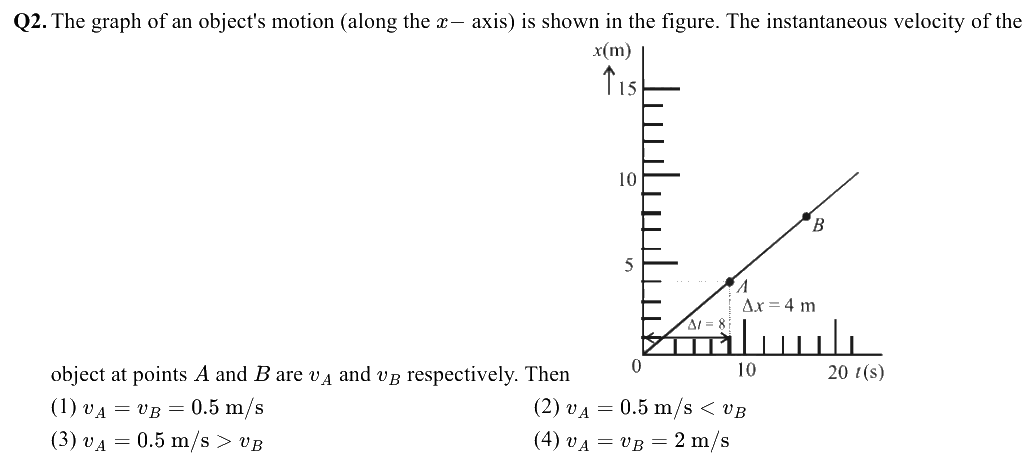
The graph of an object's motion (along the $x-$ axis) is shown in the figure. The instantaneous velocity of the object at points $A$ and $B$ are $v_A$ and $v_B$ respectively. Then
(see the figure above)

$v_A = v_B = 0.5\ \mathrm{m/s}$
$v_A = 0.5\ \mathrm{m/s} < v_B$
$v_A = 0.5\ \mathrm{m/s} > v_B$
$v_A = v_B = 2\ \mathrm{m/s}$
A car of mass 1000 kg is moving at a speed of 30 m/s. Brakes are applied to bring the car to rest. If the net retarding force is 5000 N, the car comes to stop after travelling $d$ m in $t$ s. Then
$d = 150, t = 5$
$d = 120, t = 8$
$d = 180, t = 6$
$d = 90, t = 6$
An engine pumps water continuously through a hose. Water leaves the hose with velocity $v$ and $m$ is mass per unit length of the water jet. If this jet hits a surface and came to rest instantaneously, the force on the surface is
$mv^{3}$
$mv^{2}$
$\frac{1}{2}mv^{2}$
$\frac{1}{2}mv^{3}$
A particle gets displaced by $\Delta\vec{r} = (2\hat{i} + 3\hat{j} + 4\hat{k})\mathrm{m}$ under the action of a force $\vec{F} = (7\hat{i} + 4\hat{j} + 3\hat{k})$. The change in its kinetic energy is
38 J
70 J
52.5 J
126 J
You have seen the first 5 questions with answers. Questions 6–87 are listed below; their answers and step-by-step solutions are in the EdLoop app, free.