
A ball is dropped vertically downwards from a height $h$ above the ground. It hits the ground inelastically and bounces up vertically. Neglecting subsequent motion and air resistance, which of the following graph represents variation between speed ($v$) and height ($h$) correctly?
- (1)
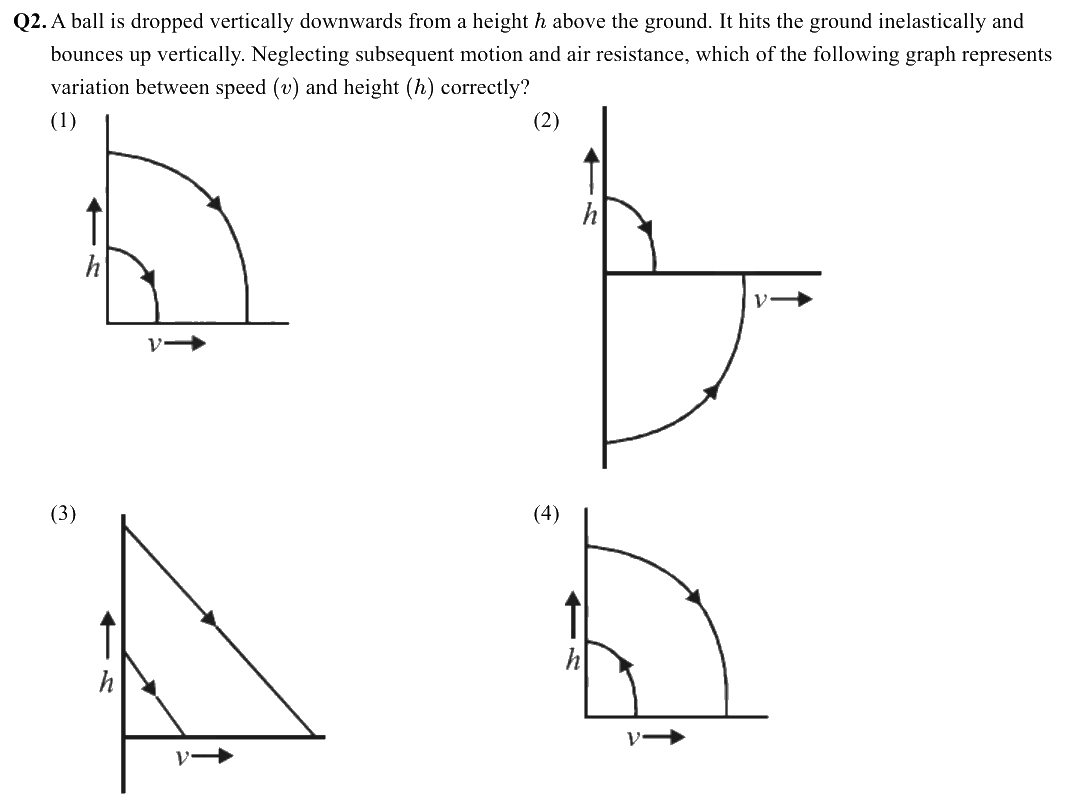
see figure Graph with $h$ on the vertical axis and $v$ on the horizontal axis, first quadrant only. Two curved arcs (quarter-ellipse like, convex away from the origin) run from a point on the $h$-axis down to a point on the $v$-axis; the outer arc starts higher and ends at larger $v$, the inner arc starts lower and ends at smaller $v$. Both arcs carry an arrowhead pointing downwards (towards the $v$-axis).
- (2)
see figure Graph with $h$ on the vertical axis (pointing up) and $v$ on the horizontal axis; the horizontal axis sits at the middle of the vertical axis, so the vertical axis extends below it. Above the horizontal axis: a small arc from a point on the $h$-axis curving down to a small positive $v$ on the horizontal axis, arrowhead pointing downwards. Below the horizontal axis: a larger arc from a large positive $v$ on the horizontal axis curving down and to the left to a point far down on the $h$-axis, arrowhead pointing up and to the right (towards the horizontal axis).
- (3)
see figure Graph with $h$ on the vertical axis and $v$ on the horizontal axis, first quadrant only. Two straight lines sloping down to the right, from points on the $h$-axis to points on the $v$-axis; the outer line starts higher and ends at larger $v$, the inner line starts lower and ends at smaller $v$. Both lines carry an arrowhead pointing down-right (towards the $v$-axis).
- (4)
see figure Graph with $h$ on the vertical axis and $v$ on the horizontal axis, first quadrant only. Two curved arcs (quarter-ellipse like, convex away from the origin): the outer arc runs from a high point on the $h$-axis down to a large $v$ on the $v$-axis with an arrowhead pointing downwards; the inner arc is smaller, joining a lower point on the $h$-axis and a smaller $v$ on the $v$-axis, with its arrowhead pointing upwards (up and to the left, away from the $v$-axis).
Show answer
Option (4) is correct.
Key from source paper