EdLoop PYQs · free, no ads · questions and answers here, step-by-step solutions in the EdLoop app
PYQs · free, no adsOpen on the web (app.edloop.in)Get EdLoop – free on Google Play

JEE Main 2020 Question Paper with Answers (4 Sep, Shift 1)

JEE Main4 Sep 2020Shift 1Memory based
75questions
25 / 25 / 25Physics / Chemistry / Maths
180 minduration
5 of 75answers shown here

Physics

25 questions · Questions 1–25

A tennis ball is released from a height h and after freely falling on a wooden floor it rebounds and reaches height h/2. The velocity versus height of the ball during its motion may be represented graphically by: (graphs are drawn schematically and on not to scale)
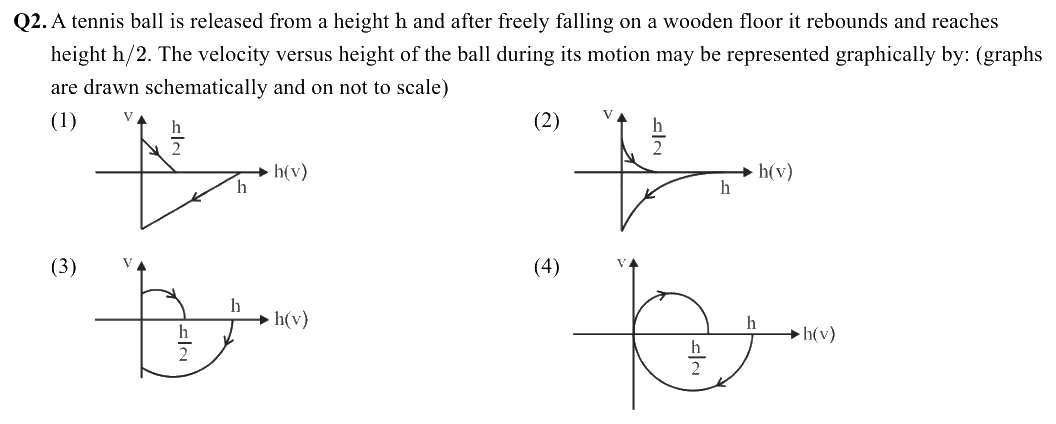
The question and its figure as printed in JEE Main 2020 04 Sep Shift 1. Option 1: v versus h(v) graph, two straight pieces Option 2: v versus h(v) graph, two curved pieces Option 3: v versus h(v) graph, two circular arcs Option 4: v versus h(v) graph, one large looped curve
The question as printed in the paper.
  • A

    see figure v versus h(v) graph, two straight pieces

  • B

    see figure v versus h(v) graph, two curved pieces

  • C

    see figure v versus h(v) graph, two circular arcs

  • D

    see figure v versus h(v) graph, one large looped curve

Starting from the origin at time $\mathrm{t} = 0$, with initial velocity $5\ \hat{j}\ \mathrm{ms^{-1}}$, a particle moves in the $x$ -$y$ plane with a constant acceleration of $\left(10\hat{i} + 4\hat{j}\right)\mathrm{ms^{-2}}$. At time t, its coordinates are $(20\ \mathrm{m}, \mathrm{y_{0}}\ \mathrm{m})$. The values of t and $\mathrm{y_{0}}$ are, respectively:

  • A

    2 s and 18 m

  • B

    4 s and 52 m

  • C

    2 s and 24 m

  • D

    5 s and 25 m

Blocks of masses m, 2m, 4m and 8m are arranged in a line of a frictionless floor. Another block of mass m , moving with speed $v$ along the same line (see figure) collides with mass m in perfectly inelastic manner. All subsequent collisions are also perfectly inelastic. By the time the last block of mass 8m starts moving the total energy loss is p% of the original energy. Value of 'p ' is close to:
(see the figure above)
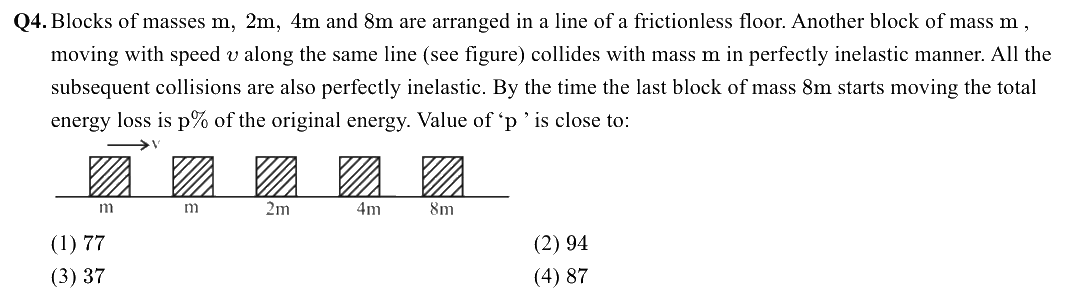
The question and its figure as printed in JEE Main 2020 04 Sep Shift 1.
The question as printed in the paper.
  • A

    77

  • B

    94

  • C

    37

  • D

    87

On the $x$-axis and at a distance $x$ from the origin, the gravitational field due to a mass distribution is given by $\frac{Ax}{(x^{2}+a^{2})^{3/2}}$ in the $x$-direction. The magnitude of the gravitational potential on the $x$-axis at a distance $x$, taking its value to be zero at infinity is:

  • A

    $\frac{A}{(x^{2}+a^{2})^{1/2}}$

  • B

    $\frac{A}{(x^{2}+a^{2})^{3/2}}$

  • C

    $A\left(x^{2}+a^{2}\right)^{1/2}$

  • D

    $A\left(x^{2}+a^{2}\right)^{3/2}$

Sit the whole paper timed in EdLoop

You have seen the first 5 questions with answers. Questions 6–75 are listed below; their answers and step-by-step solutions are in the EdLoop app, free.

  1. 6Fluid MechanicsMass of an air bubble rising with a given acceleration in water
  2. 7Thermal Properties of MatterMass of ice melted as warm water cools to 0 °C
  3. 8Kinetic Theory of GasesMatch molecule types with their Cp/Cv ratios
  4. 9WavesPossible wavelengths from crest-to-crest and crest-to-trough distances
  5. 10ElectrostaticsField lines of two perpendicular charged sheets of unequal density
  6. 11ElectrostaticsChange in energy of a charge moved along a semicircle near two fixed charges
  7. 12Current ElectricityPower lost in the internal resistance from emf, terminal voltage and load power
  8. 13Magnetism & MatterWork to turn a bar magnet from stable to unstable equilibrium
  9. 14Magnetic Effects of CurrentRatio of fields at the centre from two concentric arcs with radial leads
  10. 15Electromagnetic InductionGalvanometer readings as a small magnet passes through a coil
  11. 16Electromagnetic WavesOrder of radio waves, microwaves, visible light and X-rays by wavelength
  12. 17Wave OpticsEnergy through a rotating polariser per revolution for polarised light
  13. 18Dual Nature of Matter &…Change in de Broglie wavelength of a particle after a 1D elastic collision
  14. 19Dual Nature of Matter &…Work function from a stopping potential versus frequency graph
  15. 20Semiconductor ElectronicsOutput waveform of two back-to-back Zener diodes with a ±10 V sine input
  16. 21Rotational MotionMOI of an equilateral triangular lamina after its top corner triangle is cut off
  17. 22Rotational MotionPercentage energy lost when a smaller disc is dropped onto a rotating disc
  18. 23Kinetic Theory of GasesFinal temperature after adding a hot sample of the same gas to a closed vessel
  19. 24Ray OpticsEyepiece focal length of a compound microscope from its magnification
  20. 25AtomsSpread of Paschen wavelengths from the spread of Lyman wavelengths

Chemistry

25 questions · Questions 26–50
  1. 26Atomic StructureRegion of the electromagnetic spectrum in which the Balmer lines lie
  2. 27Periodic Table & PeriodicityBlock and group of the elements with atomic numbers 101 and 104
  3. 28Periodic Table & PeriodicityOrder of ionic radii of O²⁻, F⁻, Na⁺ and Mg²⁺
  4. 29Chemical Bonding &…Reading bond length, bond enthalpy and stiffness from potential energy curves
  5. 30Chemical ThermodynamicsStatements that must hold for one mole of an ideal gas: U, H, Z, Cp − Cv and dU
  6. 31s-Block ElementsMain oxides formed when Li, Na and K burn in excess air
  7. 32p-Block ElementsLead nitrate to brown gas, its dimer, then a blue solid with NO: oxidation…
  8. 33General Organic ChemistryIUPAC name of a cyclopentane ring carrying COOH, CH₃ and Br
  9. 34Haloalkanes & HaloarenesOrder of reactivity towards AgNO₃ of chlorocyclopropenes and two secondary…
  10. 35ElectrochemistryDaniell cell opposed by an external voltage: the incorrect statement
  11. 36Chemical EquilibriumGraph of forward and reverse rates against time for A ⇌ B
  12. 37Surface ChemistryMatch foam, gel, aerosol and emulsion with their examples
  13. 38General Principles of…Statements on limestone in the blast furnace, silver leaching, Mond and van…
  14. 39Coordination CompoundsNumber of isomers of the square planar complex [Pt(en)(NO₂)₂]
  15. 40Coordination CompoundsPair of complexes with the same spin-only magnetic moment
  16. 41Alcohols, Phenols & EthersEster C₆H₁₂O₂ whose hydrolysis alcohol gives immediate Lucas turbidity
  17. 42Alcohols, Phenols & EthersAlkenes from acid dehydration of neopentyl alcohol in an 85 : 15 ratio
  18. 43HydrocarbonsAcid C₈H₈O₂ that decarboxylates to toluene and gives a single ring-bromination…
  19. 44Amines & Nitrogen CompoundsWhich bases and amino acids give the carbylamine test with CHCl₃ and alcoholic…
  20. 45BiomoleculesAcetal, hemiacetal, ketal or hemiketal groups present in maltose
  21. 46Mole Concept & StoichiometryMass of ammonia from given masses of dinitrogen and dihydrogen
  22. 47Redox ReactionsPercentage purity of H₂O₂ from the mass of KMnO₄ it reduces in acid
  23. 48SolutionsPure vapour pressure of n-heptane from two hexane–heptane mixtures
  24. 49Chemical KineticsTime for a given fraction of a first-order reaction from the time for another
  25. 50General Organic ChemistryChiral centres in the alcohol made from a nitrile by vinyl then methyl Grignard

Maths

25 questions · Questions 51–75
  1. 51Sets, Relations & FunctionsNumber of solutions of a quadratic equation in the greatest integer of x
  2. 52Quadratic EquationsRoots of two quadratics forming a GP: ratio (2q + p) : (2q − p)
  3. 53Complex NumbersLocus Re(u) + Im(u) = 1 for a Möbius-type u: y-intercept length gives k
  4. 54Sequences & SeriesSeries 1 + Σ(1 − (2k)²(2k − 1)) written as α − 220β
  5. 55Binomial TheoremSum of ⁽⁵⁰⁻ʳ⁾C₆ for r = 0 to 20 in closed form
  6. 56Straight LinesRight angle at A and given area: abscissa of the third vertex C
  7. 57EllipseEllipse with given latus rectum and e equal to the maximum of a quadratic: a²…
  8. 58HyperbolaNormal to a hyperbola at a given point meets the x-axis at a given point: (a²…
  9. 59Mathematical ReasoningIs (q ∨ p) → (p ↔ ~q) a tautology and ~q ∧ (~p ↔ q) a fallacy?
  10. 60StatisticsTwo missing observations from mean and variance: their absolute difference
  11. 61TrigonometryTwo vertical poles: height of the crossing point of the lines joining tops to…
  12. 62Sets, Relations & FunctionsSurvey percentages for two newspapers: a possible percentage reading both
  13. 63MatricesFifth power of [[cos θ, i sin θ], [i sin θ, cos θ]]: which relation is false
  14. 64Differentiationdx/dy at (π/4, π/4) for an implicit product relation in cos x and cos y
  15. 65DifferentiationBounds on f(5) and f′(5) from lower bounds on f′ and f″
  16. 66Indefinite IntegrationIntegral of (x/(x sin x + cos x))² by a clever split for parts
  17. 67Definite Integrationf(3) − f(1) for f(x) = ∫√x/(1 + x)² dx
  18. 68Definite IntegrationIntegral of f(f(x)) − f(x) over [0, 3] for f(x) = |x − 2|
  19. 69Differential EquationsLinear DE xy′ − y = x²(x cos x + sin x) with a given point: y″ + y at π/2
  20. 70Vector AlgebraLocal maximum of a scalar triple product in x, then a·b + b·c + c·a there
  21. 71Binomial TheoremRatio of two coefficients of a power of a quadratic trinomial
  22. 72Matrices3×3 linear system with unknowns a and b having infinitely many solutions: a − b
  23. 73Limits, Continuity &…f(x + y) = f(x) + f(y) + xy² + x²y with f(x)/x → 1: value of f′(3)
  24. 74Three Dimensional GeometryPlane through the line of two planes matched to ax + by + 6z = 15: distance of…
  25. 75ProbabilityLeast number of shots for hitting a target at least once with probability…

Chapters in this paper

Get EdLoop – freeOpen on the web
