Amount of solar energy received on the earth's surface per unit area per unit time is defined a solar constant. Dimension of solar constant is:
- A
$\mathrm{ML^{2}T^{-2}}$
- B
$\mathrm{ML^{0}T^{-3}}$
- C
$\mathrm{M^{2}L^{0}T^{-1}}$
- D
$\mathrm{MLT^{-2}}$
Amount of solar energy received on the earth's surface per unit area per unit time is defined a solar constant. Dimension of solar constant is:
$\mathrm{ML^{2}T^{-2}}$
$\mathrm{ML^{0}T^{-3}}$
$\mathrm{M^{2}L^{0}T^{-1}}$
$\mathrm{MLT^{-2}}$
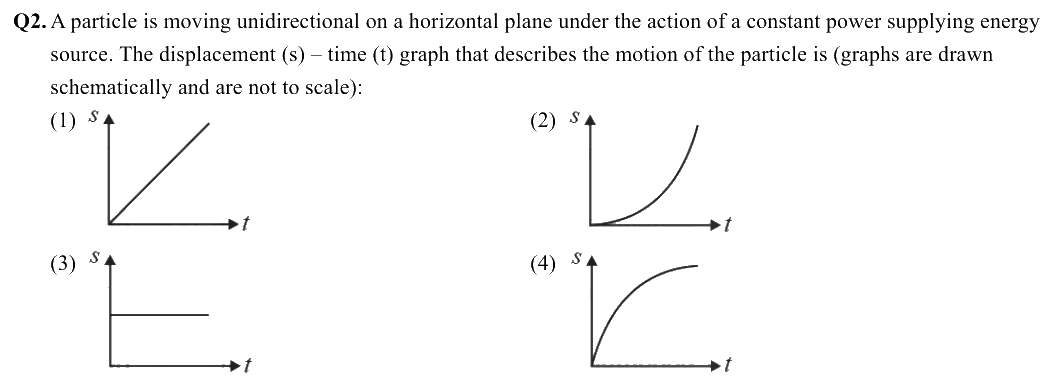
A particle is moving unidirectional on a horizontal plane under the action of a constant power supplying energy source. The displacement $(s)$ – time $(t)$ graph that describes the motion of the particle is (graphs are drawn schematically and are not to scale):

see figure $s$–$t$ graph
Hydrogen ion and singly ionized helium atom are accelerated, from rest, through the same potential difference. The ratio of final speeds of hydrogen and helium ions is close to:
$1:2$
$10:7$
$2:1$
$5:7$
A block of mass $1.9\ \mathrm{kg}$ is at rest at the edge of a table, of height $1\ \mathrm{m}$. A bullet of mass $0.1\ \mathrm{kg}$ collides with the block and sticks to it. If the velocity of the bullet is $20\ \mathrm{m\,s^{-1}}$ in the horizontal direction just before the collision then the kinetic energy just before the combined system strikes the floor, is [Take $g = 10\ \mathrm{m\,s^{-2}}$. Assume there is no rotational motion and loss of energy after the collision is negligible.]
$21\ \mathrm{J}$
$20\ \mathrm{J}$
$19\ \mathrm{J}$
$23\ \mathrm{J}$
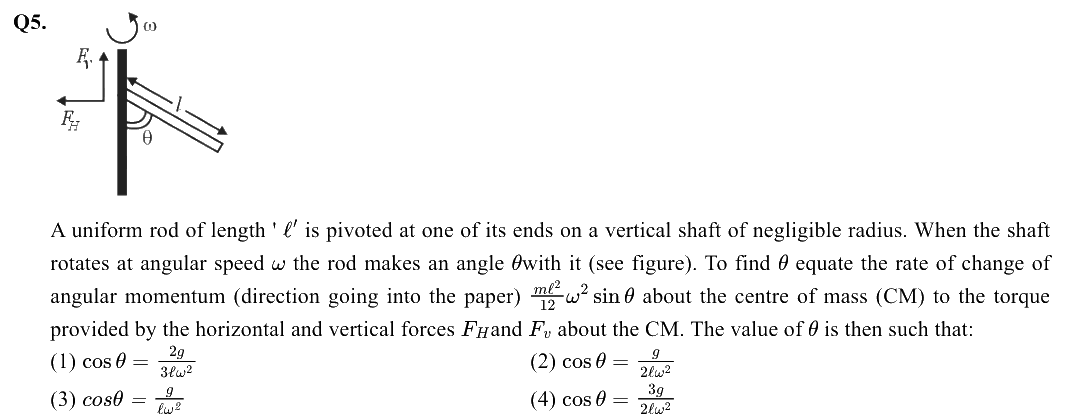
see figure A uniform rod of length $'\ell'$ is pivoted at one of its ends on a vertical shaft of negligible radius. When the shaft rotates at angular speed $\omega$ the rod makes an angle $\theta$ with it (see figure). To find $\theta$ equate the rate of change of angular momentum (direction going into the paper) $\frac{m\ell^{2}}{12}\omega^{2}\sin\theta$ about the centre of mass (CM) to the torque provided by the horizontal and vertical forces $F_H$ and $F_v$ about the CM. The value of $\theta$ is then such that:

$\cos\theta = \frac{2g}{3\ell\omega^{2}}$
$\cos\theta = \frac{g}{2\ell\omega^{2}}$
$\cos\theta = \frac{g}{\ell\omega^{2}}$
$\cos\theta = \frac{3g}{2\ell\omega^{2}}$
You have seen the first 5 questions with answers. Questions 6–74 are listed below; their answers and step-by-step solutions are in the EdLoop app, free.