A clock has a continuously moving second's hand of $0.1\mathrm{m}$ length. The average acceleration of the tip of the hand (in units of $\mathrm{ms^{-2}}$ ]) is of the order of :
- A
$10^{-3}$
- B
$10^{-4}$
- C
$10^{-2}$
- D
$10^{-1}$
A clock has a continuously moving second's hand of $0.1\mathrm{m}$ length. The average acceleration of the tip of the hand (in units of $\mathrm{ms^{-2}}$ ]) is of the order of :
$10^{-3}$
$10^{-4}$
$10^{-2}$
$10^{-1}$
An insect is at the bottom of a hemispherical ditch of radius $1\mathrm{m}$. It crawls up the ditch but starts slipping after it is at height h from the bottom. If the coefficient of friction between the ground and the insect is $0.75$, then $h$ is : ($g = 10\ \mathrm{m\ s^{-2}}$)
$0.20\ \mathrm{m}$
$0.45\ \mathrm{m}$
$0.60\ \mathrm{m}$
$0.80\ \mathrm{m}$
If the potential energy between two molecules is given by $U = \frac{A}{r^6} + \frac{B}{r^{12}}$, then at equilibrium, separation between molecules, and the potential energy are:
$\left(\frac{B}{2A}\right)^{1/6},\ -\frac{A^2}{2B}$
$\left(\frac{B}{A}\right)^{1/6},\ 0$
$\left(\frac{2B}{A}\right)^{1/6},\ \frac{A^2}{4B}$
$\left(\frac{B}{2A}\right)^{\frac{1}{6}},\ \frac{A^2}{2B}$
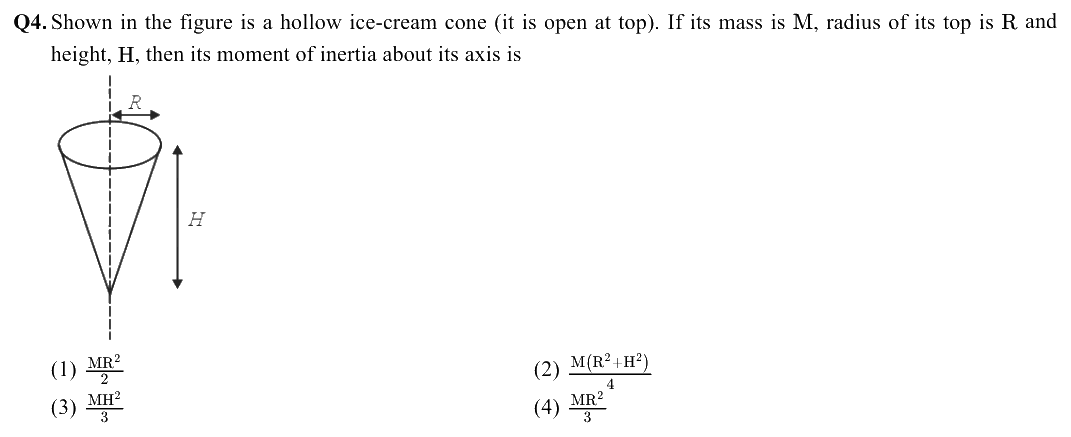
Shown in the figure is a hollow ice-cream cone (it is open at top). If its mass is M, radius of its top is R and height, H, then its moment of inertia about its axis is
(see the figure above)

$\frac{MR^2}{2}$
$\frac{M(R^2+H^2)}{4}$
$\frac{MH^2}{3}$
$\frac{MR^2}{3}$
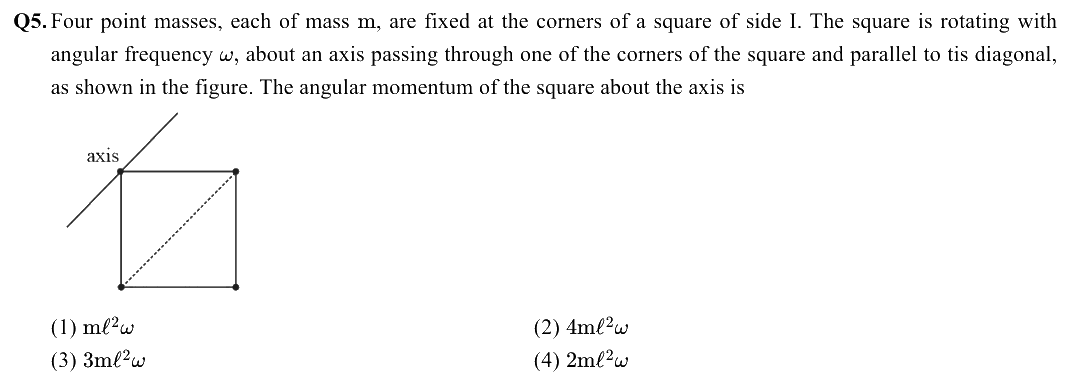
Four point masses, each of mass m, are fixed at the corners of a square of side I. The square is rotating with angular frequency $\omega$, about an axis passing through one of the corners of the square and parallel to tis diagonal, as shown in the figure. The angular momentum of the square about the axis is
(see the figure above)

$m\ell^2\omega$
$4m\ell^2\omega$
$3m\ell^2\omega$
$2m\ell^2\omega$
You have seen the first 5 questions with answers. Questions 6–74 are listed below; their answers and step-by-step solutions are in the EdLoop app, free.