
An organic compound (A) (molecular formula $\mathrm{C_{6}H_{12}O_{2}}$) was hydrolysed with dil. $\mathrm{H_{2}\ SO_{4}}$ to give a carboxylic acid (B) and an alcohol (C). 'C ' gives white turbidity immediately when treated with anhydrous $\mathrm{ZnCl_{2}}$ and conc. HCl. The organic compound (A) is:
(see the figure above)
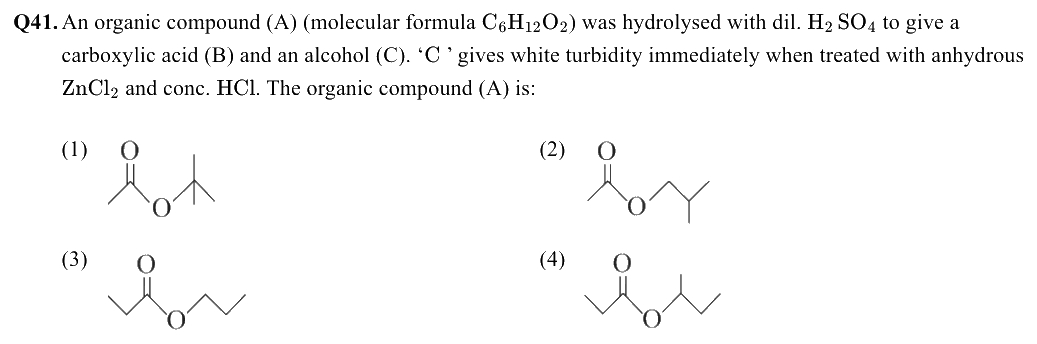
- (1)
see figure ester drawn with a C=O carbon bearing one single bond (to CH3) and O bonded to a carbon carrying three single bonds (tert-butyl)
- (2)
see figure ester drawn with a C=O carbon bearing one single bond (CH3) and O-CH2-CH(CH3)-CH3 (isobutyl-type chain)
- (3)
see figure ester drawn with a C=O carbon bearing a two-bond chain (ethyl) and O-CH2-CH2-CH3 (three-bond chain from O)
- (4)
see figure ester drawn with a C=O carbon bearing a two-bond chain (ethyl) and O-CH(CH3)-CH2-CH3 (a branched four-carbon group on O)
Show answer
Option (1) is correct.
Key from source paper