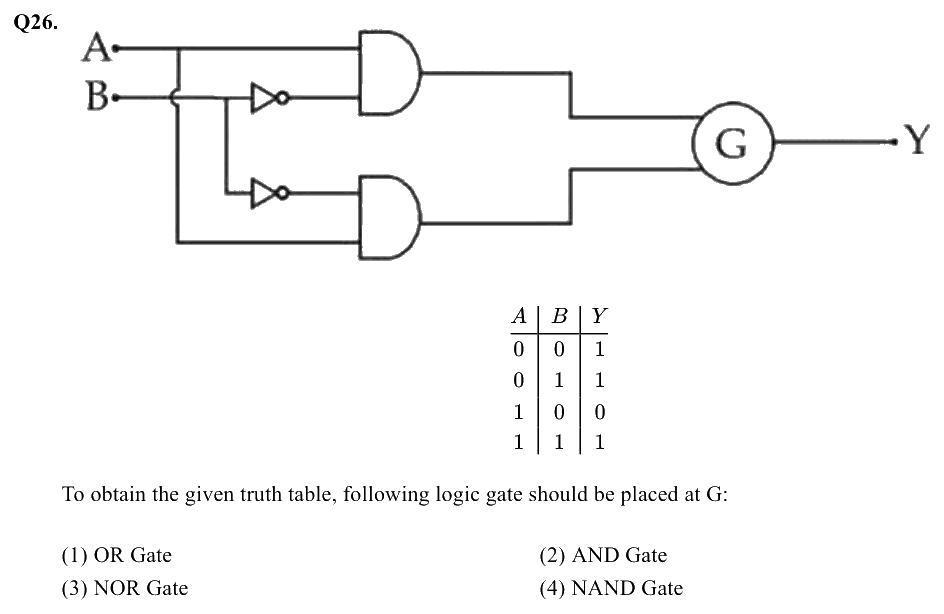
see figure
To obtain the given truth table, following logic gate should be placed at G:$A$ $B$ $Y$ 0 0 1 0 1 1 1 0 0 1 1 1
- A
OR Gate
- B
AND Gate
- C
NOR Gate
- D
NAND Gate
Answer: (C) NOR Gate · Key from source paper
 PYQs · free, no adsOpen on the web (app.edloop.in)Get EdLoop – free on Google Play
see figure
To obtain the given truth table, following logic gate should be placed at G:$A$ $B$ $Y$ 0 0 1 0 1 1 1 0 0 1 1 1
OR Gate
AND Gate
NOR Gate
NAND Gate
A small rigid spherical ball of mass M is dropped in a long vertical tube containing glycerine. The velocity of the ball becomes constant after some time. If the density of glycerine is half of the density of the ball, then the viscous force acting on the ball will be (consider g as acceleration due to gravity)
2 Mg
Mg
$\frac{3}{2}$Mg
$\frac{Mg}{2}$
The torque due to the force $(2\hat{i} + \hat{j} + 2\hat{k})$ about the origin, acting on a particle whose position vector is $(\hat{i} + \hat{j} + \hat{k})$, would be
$\hat{i} - \hat{k}$
$\hat{i} + \hat{k}$
$\hat{j} + \hat{k}$
$\hat{i} - \hat{j} + \hat{k}$
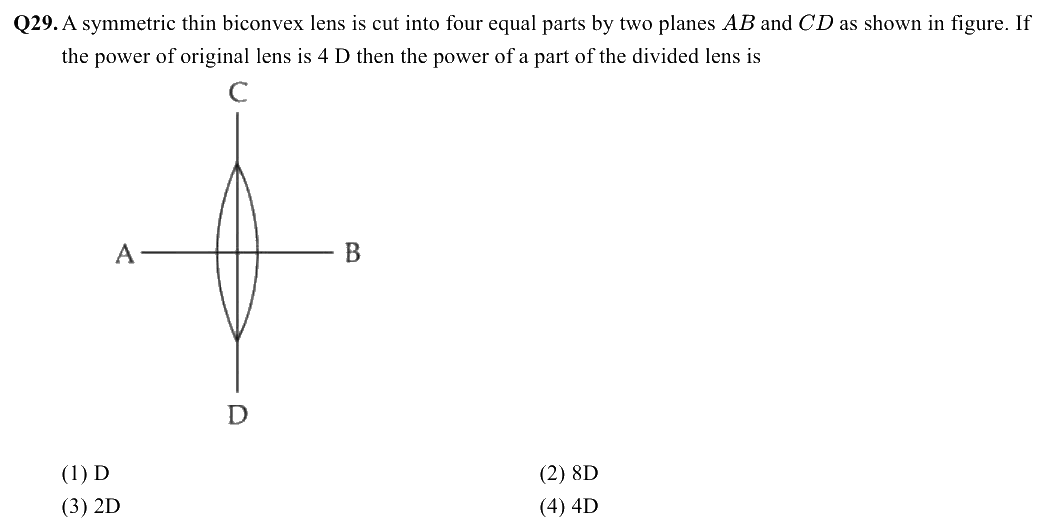
A symmetric thin biconvex lens is cut into four equal parts by two planes $AB$ and $CD$ as shown in figure. If the power of original lens is 4 D then the power of a part of the divided lens is
(see the figure above)
D
8D
2D
4D
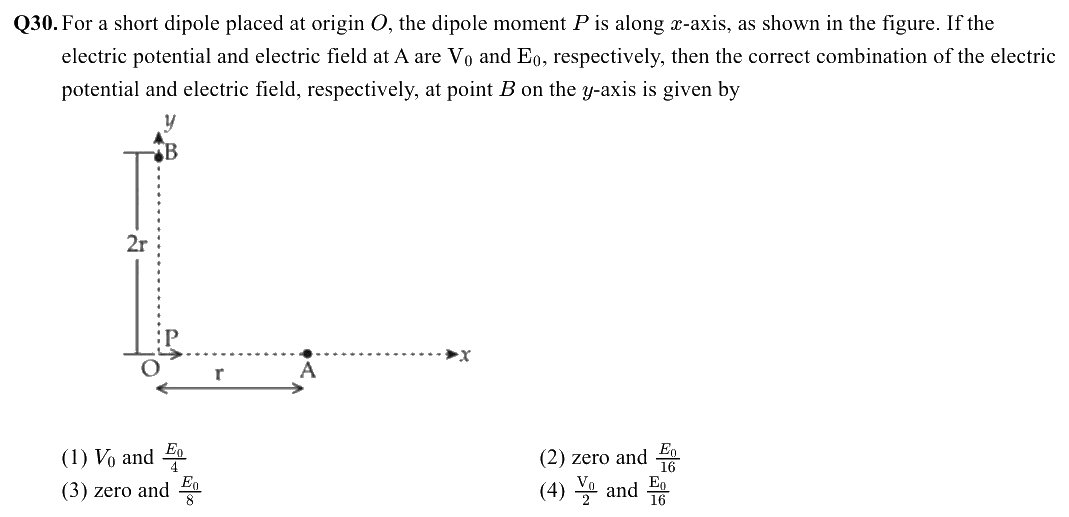
For a short dipole placed at origin $O$, the dipole moment $P$ is along $x$-axis, as shown in the figure. If the electric potential and electric field at A are $\mathrm{V_0}$ and $\mathrm{E_0}$, respectively, then the correct combination of the electric potential and electric field, respectively, at point $B$ on the $y$-axis is given by
(see the figure above)
$V_0$ and $\frac{E_0}{4}$
zero and $\frac{E_0}{16}$
zero and $\frac{E_0}{8}$
$\frac{V_0}{2}$ and $\frac{E_0}{16}$
You have seen the first 5 questions with answers. Questions 6–75 are listed below; their answers and step-by-step solutions are in the EdLoop app, free.