
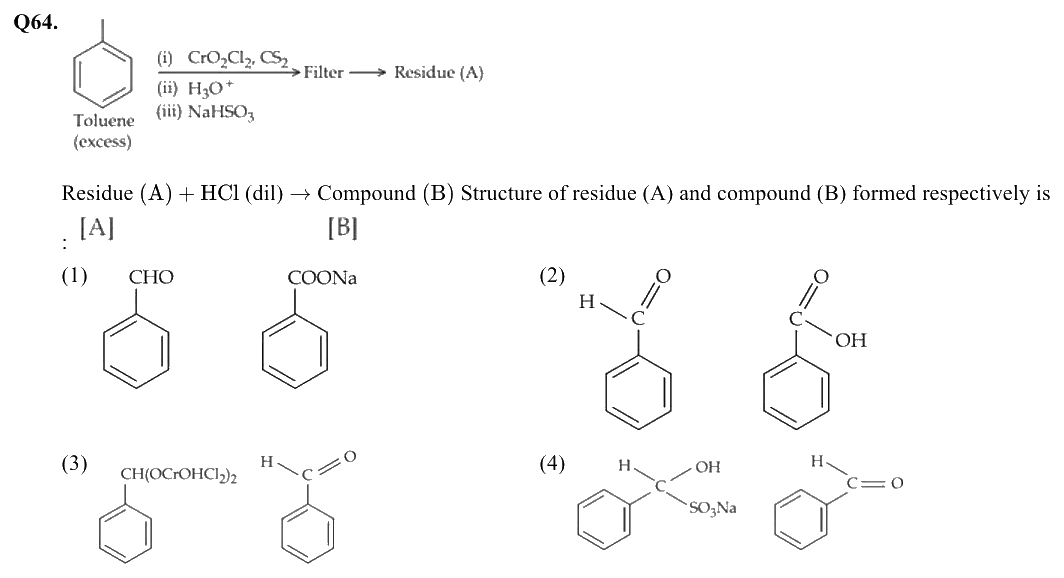
see figure Residue (A) + HCl (dil) $\rightarrow$ Compound (B) Structure of residue (A) and compound (B) formed respectively is : [A] [B]
- (1)
see figure [A]: a benzene ring with CHO on a bond going up; [B]: a benzene ring with COONa on a bond going up.
- (2)
see figure [A]: a benzene ring bonded to a carbon that has 'H' on its left and a double bond to 'O' above it (benzaldehyde drawn with the H shown); [B]: a benzene ring bonded to a carbon with a double bond to 'O' above and 'OH' to its lower right.
- (3)
see figure [A]: a benzene ring with 'CH(OCrOHCl2)2' on a bond going up; [B]: a benzene ring bonded to a carbon with 'H' on its left and a double bond to 'O' at its upper right.
- (4)
see figure [A]: a benzene ring bonded to a carbon that carries 'H' above-left, 'OH' to its upper right and 'SO3Na' below; [B]: a benzene ring bonded to a carbon with 'H' above-left and a double bond to 'O' on its right.
Show answer
Option (4) is correct.
Key from source paper