Skip to content
EdLoop PYQs · free, no ads · questions and answers here, step-by-step solutions in the EdLoop app
JEE Main 2025 Question Paper with Answers (23 Jan, Shift 1) JEE Main 23 Jan 2025 Shift 1 Memory based
74 questions
24 / 25 / 25 Physics / Chemistry / Maths
180 min duration
5 of 74 answers shown here
Physics1–24 Chemistry25–49 Maths50–74
Physics 24 questions · Questions 1–24
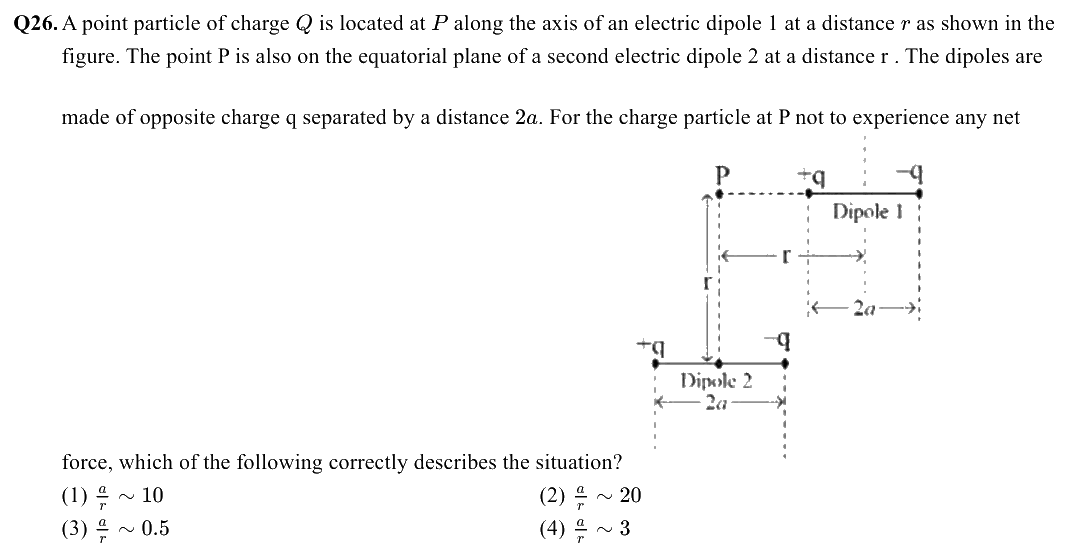
A point particle of charge $Q$ is located at $P$ along the axis of an electric dipole 1 at a distance $r$ as shown in the figure. The point P is also on the equatorial plane of a second electric dipole 2 at a distance r . The dipoles are made of opposite charge q separated by a distance $2a$. For the charge particle at P not to experience any net force, which of the following correctly describes the situation ?
(see the figure above)
The question as printed in the paper. A $\frac{a}{r} \sim 10$
B $\frac{a}{r} \sim 20$
C $\frac{a}{r} \sim 0.5$
D $\frac{a}{r} \sim 3$
Answer: (D) $\frac{a}{r} \sim 3$ · Key from source paper
A spherical surface of radius of curvature $R$, separates air from glass (refractive index = 1.5 ). The centre of curvature is in the glass medium. A point object ' $O$ ' placed in air on the optic axis of the surface, so that its real image is formed at ' $I$ ' inside glass. The line OI intersects the spherical surface at P and PO = PI. The distance PO equals to
Answer: (A) 5 R · Key from source paper
The position of a particle moving on $x$-axis is given by $x(t) = A\sin t + B\cos^2 t + Ct^2 + D$, where $t$ is time. The dimension of $\frac{ABC}{D}$ is
A $L^2T^{-2}$
B $L^2$
C $L$
D $L^3\ \mathrm{T}^{-2}$
Answer: (A) $L^2T^{-2}$ · Key from source paper
Given a thin convex lens (refractive index $\mu_2$ ), kept in a liquid (refractive index $\mu_1, \mu_1 < \mu_2$ ) having radii of curvatures $|R_1|$ and $|R_2|$. Its second surface is silver polished. Where should an object be placed on the optic axis so that a real and inverted image is formed at the same place?
A $\frac{\mu_1|R_1|\cdot|R_2|}{\mu_2\left(|R_1|+|R_2|\right)-\mu_1|R_2|}$
B $\frac{\mu_1|R_1|\cdot|R_2|}{\mu_2\left(|R_1|+|R_2|\right)-\mu_1|R_1|}$
C $\frac{\left(\mu_2+\mu_1\right)|R_1|}{\left(\mu_2-\mu_1\right)}$
D $\frac{\mu_1|R_1|\cdot|R_2|}{\mu_2\left(2|R_1|+|R_2|\right)-\mu_1\sqrt{|R_1|\cdot|R_2|}}$
Answer: (A) $\frac{\mu_1|R_1|\cdot|R_2|}{\mu_2\left(|R_1|+|R_2|\right)-\mu_1|R_2|}$ · Key from source paper
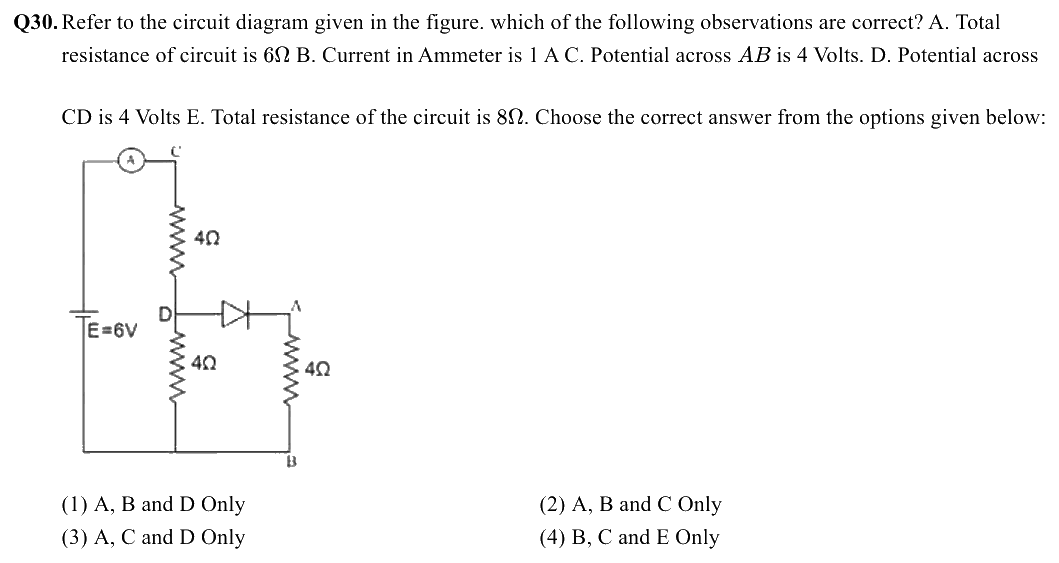
Refer to the circuit diagram given in the figure. which of the following observations are correct? A. Total resistance of circuit is $6\Omega$ B. Current in Ammeter is 1 A C. Potential across $AB$ is 4 Volts. D. Potential across CD is 4 Volts E. Total resistance of the circuit is $8\Omega$. Choose the correct answer from the options given below:
(see the figure above)
The question as printed in the paper. A A, B and D Only
B A, B and C Only
C A, C and D Only
D B, C and E Only
Answer: (A) A, B and D Only · Key from source paper
Sit the whole paper timed in EdLoop You have seen the first 5 questions with answers. Questions 6–74 are listed below; their answers and step-by-step solutions are in the EdLoop app, free.
6 Fluid Mechanics Hot water flows faster; soap water has higher surface tension: true or false 7 Rotational Motion Disc of radius 20 cm with a 5 cm hole at its edge: shift of centre of mass 8 Units, Dimensions & Errors Flux written as ασ + βλ: what α/β represents 9 Dual Nature of Matter &… Particle of 10⁻³⁰ kg at 2.21×10⁶ m/s: which radiation its wavelength resembles 10 Magnetic Effects of Current Statements on a moving coil galvanometer: torsion constant, sensitivities, shunt 11 Thermodynamics Match descriptions of gas processes with isothermal, isobaric, adiabatic… 12 Electromagnetic Waves EM wave travelling along 3x + 4y with E along 4î − 3ĵ: magnetic field vector 13 Thermal Properties of Matter Lead bullet at 300 K heated to 600 K and melted by 625 J: its mass 14 Ray Optics Lateral shift through a glass slab of thickness h 15 Nuclei Nuclei with decay constants λ and 3λ: ratio N₂/N₁ after one half-life of n₁ 16 Oscillations (SHM) Light hollow cube floating in water pushed down: period of oscillation 17 Electromagnetic Induction Statements about self-inductance 18 Kinematics Airplane v–t graph rising 200 → 400 m/s then steady: distance in 30.5 s 19 Capacitors RC circuit at the instant the key closes: current, voltage and charge 20 Rotational Motion Solid sphere rolling down an incline of fixed length at 30° and 45°: v₁² : v₂² 21 Electrostatics Ratio of electrostatic to gravitational force between two given ions 22 Electromagnetic Induction LR circuit with a rheostat increased so current falls at 8 A/s: current at R =… 23 Kinematics Equal-length perpendicular vectors 2î + 3nĵ + 2k̂ and 2î − 2ĵ + 4pk̂: find 1/n 24 Thermodynamics Gas at 0 °C compressed suddenly to a quarter volume, γ = 3/2: temperature rise
Chemistry 25 questions · Questions 25–49 25 Biomolecules Fructose reducing Tollens' reagent and its rearrangement in base 26 Coordination Compounds Cobalt complex that shows fac–mer isomerism 27 Electrochemistry Latimer diagram of iron: E° for FeO₄²⁻/Fe²⁺ 28 Periodic Table & Periodicity Which of Ir, Pt, Os and Pd lies in a different period 29 Chemical Bonding &… Match octet-rule categories with example molecules 30 Alcohols, Phenols & Ethers Mass of bromine to turn 2 g of phenol into 2,4,6-tribromophenol 31 Amines & Nitrogen Compounds Which amines react with Hinsberg's reagent 32 d- and f-Block Elements Set of aqueous 3d ions that share the same colour 33 Purification &… Lassaigne's test: ionic products, and the colour when both N and S are present 34 Hydrocarbons Trichloropropanes from the optically active dichloropropane 35 Solutions CrCl₃·xNH₃ with ΔTf = 0.558 °C at 0.1 molal: formula of the complex 36 Ionic Equilibrium NH₄OH added to 1 M A²⁺ and 1 M B³⁺: which hydroxide precipitates first 37 Aldehydes, Ketones &… Propanal with excess HCHO in alkali under reflux: major product 38 Chemical Thermodynamics Entropy change for ice at −5 °C to steam at 110 °C: the right expression 39 p-Block Elements Incorrect statement on PH₃, SO₂, PF₃/NF₅ and NO₂ 40 Mole Concept & Stoichiometry 10²¹ molecules removed from CO₂, 2.8×10⁻³ mol left: initial mass 41 Haloalkanes & Haloarenes Match Swarts, Sandmeyer, Wurtz–Fittig and Finkelstein with their products 42 Atomic Structure Hydrogen line near 900 nm for heat treatment: which series and transition 43 Coordination Compounds Octahedral Co(II) complex with μ = 3.95 BM: its d-electron configuration 44 General Organic Chemistry Stability of cyclopropenyl anion, cyclopentadienyl anion and cyclooctatetraene 45 Chemical Thermodynamics ΔG° for N₂O₄ → NO₂ at 25 °C from ΔH° and ΔS° 46 Chemical Kinetics N₂O₅ decomposition at constant volume: total pressure after 100 s 47 Purification &… 160 mg compound gives 466 mg BaSO₄: percentage of sulphur 48 Ionic Equilibrium 1 mM ethylamine has pH 9: its Kb 49 Amines & Nitrogen Compounds m-Nitrotoluene: bromination, reduction, diazotisation, H₃PO₂: molar mass of A
Maths 25 questions · Questions 50–74 50 Sequences & Series AP with first term 3 and S₄ one-fifth of the next four terms: S₂₀ 51 Probability Two unusual dice: probability that the sum is 4 or 5 52 Vector Algebra Tetrahedron with given AD and volume: where the altitude from D meets the median 53 Matrices Inverse of A(adj(A⁻¹) + adj(B⁻¹))⁻¹B 54 Statistics Grouped median 14 in class 12–18 with frequency 12: total number of students 55 Differential Equations Separable DE 2(3 + y)e^(2x)dx = (7 + e^(2x))dy through (0, 5): y at x = ln 2 56 Limits, Continuity &… Piecewise function with sine and log pieces continuous at 0: k₁² + k₂² 57 Straight Lines Chord of 4y = 3x² cut by 3x − 2y + 12 = 0: angle at the vertex 58 Three Dimensional Geometry Foot P of perpendicular from Q on a line; area of right triangle PQR with R(3… 59 Vector Algebra Quarter-circle arc divided 1 : 5 at B: write OC in terms of OA and OB 60 Sets, Relations & Functions Domain of ln(g(x)) for a quartic over a quadratic 61 Matrices System in λ with infinitely many solutions: λ² + λ 62 Permutations & Combinations Arrangements of DAUGHTER with the vowels never all together 63 Sets, Relations & Functions Fewest pairs to add to (1,2), (2,3), (3,3) on 1, 2, 3, 4 for an equivalence 64 Straight Lines Triangle with P(5, 4), Q(−2, 4), area 35 and orthocentre (2, 14/5): centroid 65 Definite Integration Integral from e² to e⁴ that becomes a symmetric King's-property integral 66 Complex Numbers Circle |(z̄ − i)/(2z̄ + i)| = 1/3: triangle with its centre has area 11, find α² 67 Trigonometry Value of sin 70°(cot 10° cot 70° − 1) 68 Indefinite Integration I(x) = ∫dx/((x − 11)^(11/13)(x + 15)^(15/13)): I(37) − I(24) 69 Inverse Trigonometric… cos⁻¹((12/13)cos x + (5/13)sin x) for π/2 ≤ x ≤ 3π/4 70 Hyperbola Circle tangent to a line with a given chord, then a hyperbola built from it… 71 Quadratic Equations a(b − c)x² + b(c − a)x + c(a − b) = 0 with equal roots: a² + c² 72 Quadratic Equations Values of a for which 5x³ − 15x − a = 0 has three distinct real roots 73 Binomial Theorem Sum of rational terms of (1 + 2^(1/3) + 3^(1/2))⁶ 74 Area Under Curves Larger region of x² + y² = 25 cut by y = |x − 1|: area as (bπ + c)/4
About the answers Answers come from the key printed with the source paper. The first 5 answers are shown on this page; the others, with step-by-step solutions, are in the EdLoop app.