If two vectors $\vec{P}=\hat{i}+2m\hat{j}+m\hat{k}$ and $\vec{Q}=4\hat{i}-2\hat{j}+m\hat{k}$ are perpendicular to each other. Then, the value of $m$ will be
- A
$-1$
- B
$2$
- C
$3$
- D
$1$
Answer: (B) $2$ · Key from source paper
 PYQs · free, no adsOpen on the web (app.edloop.in)Get EdLoop – free on Google Play
If two vectors $\vec{P}=\hat{i}+2m\hat{j}+m\hat{k}$ and $\vec{Q}=4\hat{i}-2\hat{j}+m\hat{k}$ are perpendicular to each other. Then, the value of $m$ will be
$-1$
$2$
$3$
$1$
The frequency ($\nu$) of an oscillating liquid drop may depend upon radius ($r$) of the drop, density ($\rho$) of liquid and the surface tension ($s$) of the liquid as: $\nu=r^{a}\rho^{b}s^{c}$. The values of $a$, $b$ and $c$ respectively are
$\left(-\frac{3}{2},-\frac{1}{2},\frac{1}{2}\right)$
$\left(-\frac{3}{2},\frac{1}{2},\frac{1}{2}\right)$
$\left(\frac{3}{2},\frac{1}{2},-\frac{1}{2}\right)$
$\left(\frac{3}{2},-\frac{1}{2},\frac{1}{2}\right)$
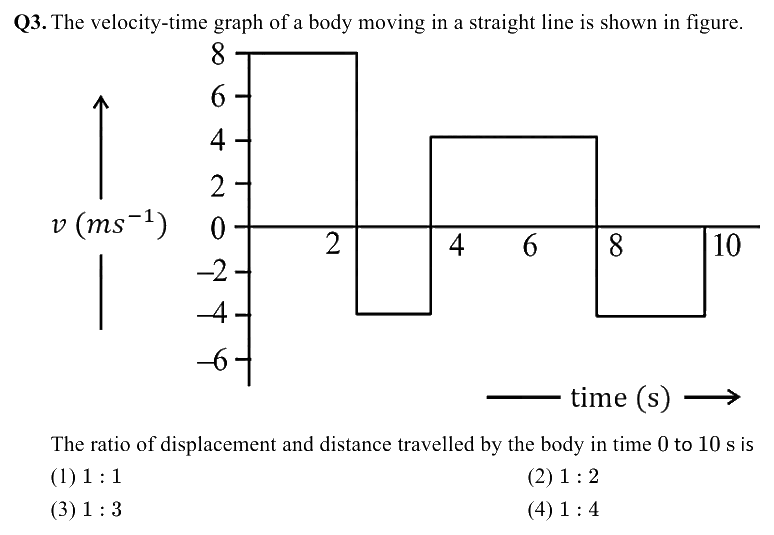
The velocity-time graph of a body moving in a straight line is shown in figure.
(see the figure above)
The ratio of displacement and distance travelled by the body in time 0 to 10 s is
$1:1$
$1:2$
$1:3$
$1:4$
A body of mass 200 g is tied to a spring of spring constant $12.5\ \mathrm{N\,m^{-1}}$, while the other end of spring is fixed at point $O$. If the body moves about $O$ in a circular path on a smooth horizontal surface with constant angular speed $5\ \mathrm{rad\,s^{-1}}$, then the ratio of extension in the spring to its natural length will be :
$1:2$
$1:1$
$2:3$
$2:5$
A body of mass 1 kg begins to move under the action of a time dependent force $\vec{F}=\left(t\hat{i}+3t^{2}\hat{j}\right)$ N, where $\hat{i}$ and $\hat{j}$ are the unit vectors along $x$ and $y$ axis. The power developed by above force, at the time $t=2$ s, will be ______ W.
You have seen the first 5 questions with answers. Questions 6–90 are listed below; their answers and step-by-step solutions are in the EdLoop app, free.