Velocity ($v$) and acceleration ($a$) in two systems of units 1 and 2 are related as $v_2 = \frac{n}{m^{2}}v_1$ and $a_2 = \frac{a_1}{mn}$ respectively. Here $m$ and $n$ are constants. The relations for distance and time in two systems respectively are
A
$\frac{n^{3}}{m^{3}}L_1 = L_2$ and $\frac{n^{2}}{m}T_1 = T_2$
B
$L_1 = \frac{n^{4}}{m^{2}}L_2$ and $T_1 = \frac{n^{2}}{m}T_2$
C
$L_1 = \frac{n^{2}}{m}L_2$ and $T_1 = \frac{n^{4}}{m^{2}}T_2$
D
$\frac{n^{2}}{m}L_1 = L_2$ and $\frac{n^{4}}{m^{2}}T_1 = T_2$
A ball is spun with angular acceleration $\alpha = 6t^{2} - 2t$ where $t$ is in second and $\alpha$ is in $\mathrm{rad\ s^{-2}}$. At $t = 0$, the ball has angular velocity of $10\ \mathrm{rad\ s^{-1}}$ and angular position of $4\ \mathrm{rad}$. The most appropriate expression for the angular position of the ball is
A block of mass $2\ \mathrm{kg}$ moving on a horizontal surface with speed of $4\ \mathrm{m\ s^{-1}}$ enters a rough surface ranging from $x = 0.5\ \mathrm{m}$ to $x = 1.5\ \mathrm{m}$. The retarding force in this range of rough surface is related to distance by $F = -kx$ where $k = 12\ \mathrm{N\ m^{-1}}$. The speed of the block as it just crosses the rough surface will be
Water falls from a $40\ \mathrm{m}$ high dam at the rate of $9 \times 10^{4}\ \mathrm{kg}$ per hour. Fifty percentage of gravitational potential energy can be converted into electrical energy. Using this hydro electric energy number of $100\ \mathrm{W}$ lamps, that can be lit, is (Take $g = 10\ \mathrm{ms^{-2}}$)
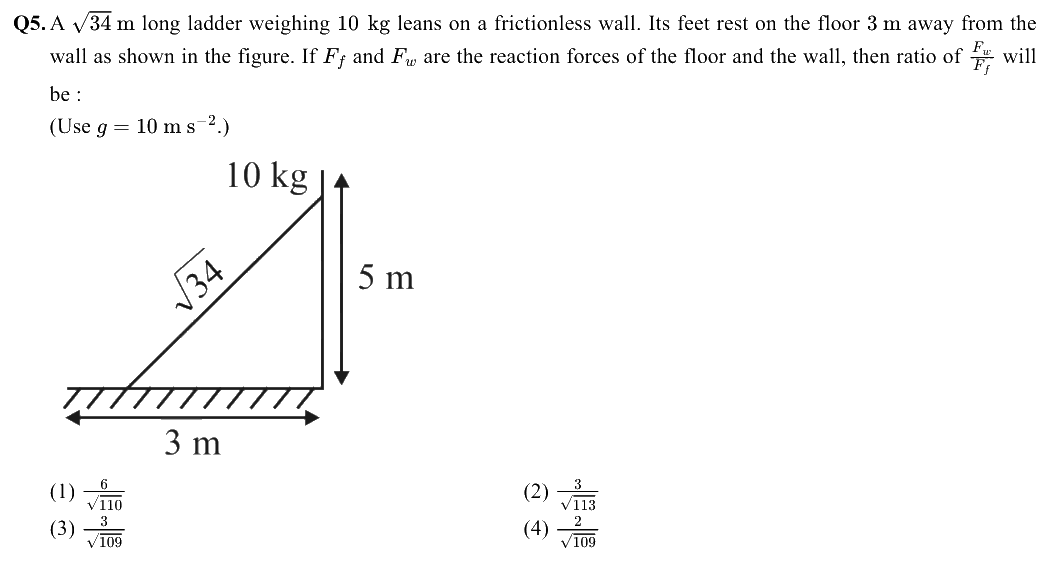
A $\sqrt{34}\ \mathrm{m}$ long ladder weighing $10\ \mathrm{kg}$ leans on a frictionless wall. Its feet rest on the floor $3\ \mathrm{m}$ away from the wall as shown in the figure. If $F_f$ and $F_w$ are the reaction forces of the floor and the wall, then ratio of $\frac{F_w}{F_f}$ will be : (Use $g = 10\ \mathrm{m\ s^{-2}}$.) (see the figure above)
Answer: (C) $\frac{3}{\sqrt{109}}$· Key from source paper
Sit the whole paper timed in EdLoop
You have seen the first 5 questions with answers. Questions 6–90 are listed below; their answers and step-by-step solutions are in the EdLoop app, free.