
Isobutyraldehyde on reaction with formaldehyde and $\mathrm{K_2\,CO_3}$ gives compound 'A'. Compound 'A' reacts with KCN and yields compound 'B', which on hydrolysis gives a stable compound 'C'. The compound 'C' is
- (1)
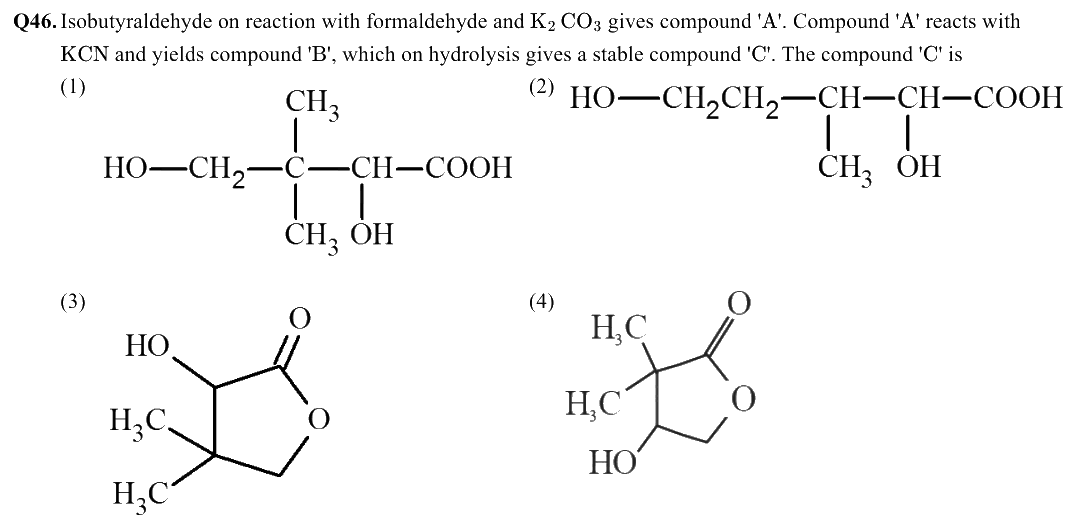
see figure $\mathrm{HO-CH_2-C(CH_3)(CH_3)-CH(OH)-COOH}$ drawn in full: HO, CH2, then a carbon with CH3 above and CH3 below, then CH with OH below, then COOH.
- (2)
see figure $\mathrm{HO-CH_2CH_2-CH(CH_3)-CH(OH)-COOH}$ drawn in full: CH(CH3) with CH3 below and the next CH with OH below, ending in COOH.
- (3)
see figure A five-membered lactone ring (C=O at the upper right, ring O at the right), with HO on the carbon next to the carbonyl carbon at the upper left and two H3C groups on the carbon below it.
- (4)
see figure A five-membered lactone ring (C=O at the top, ring O at the right), with two H3C groups on the carbon next to the carbonyl carbon and HO on the next carbon.
Show answer
Option (3) is correct.
Key from source paper