In order to determine the Young's Modulus of a wire of radius $0.2\ \mathrm{cm}$ (measured using a scale of least count $= 0.001\ \mathrm{cm}$) and length $1\ \mathrm{m}$ (measured using a scale of least count $= 1\ \mathrm{mm}$), a weight of mass $1\ \mathrm{kg}$ (measured using a scale of least count $= 1\ \mathrm{g}$) was hanged to get the elongation of $0.5\ \mathrm{cm}$ (measured using a scale of least count $0.001\ \mathrm{cm}$). What will be the fractional error in the value of Young's Modulus determined by this experiment?
A mosquito is moving with a velocity $\vec{v} = 0.5t^2\hat{i} + 3t\hat{j} + 9\hat{k}\ \mathrm{m\,s^{-1}}$ and accelerating in uniform conditions. What will be the direction of mosquitoes after $2\ \mathrm{s}$ ?
A
$\tan^{-1}\left(\frac{2}{3}\right)$ from $x$-axis
B
$\tan^{-1}\left(\frac{\sqrt{85}}{6}\right)$ from $y$-axis
Statement I: A cyclist is moving on an unbanked road with a speed of $7\ \mathrm{km\ h^{-1}}$ and takes a sharp circular turn along a path of the radius of $2\ \mathrm{m}$ without reducing the speed. The static friction coefficient is $0.2$. The cyclist will not slip and pass the curve $(g = 9.8\ \mathrm{m\,s^{-2}})$ Statement II : If the road is banked at an angle of $45^\circ$, cyclist can cross the curve of $2\ \mathrm{m}$ radius with the speed of $18.5\ \mathrm{km\ h^{-1}}$ without slipping. In the light of the above statements, choose the correct answer from the options given below.
A
Statement I is incorrect and statement II is correct
B
Statement I is correct and statement II is incorrect
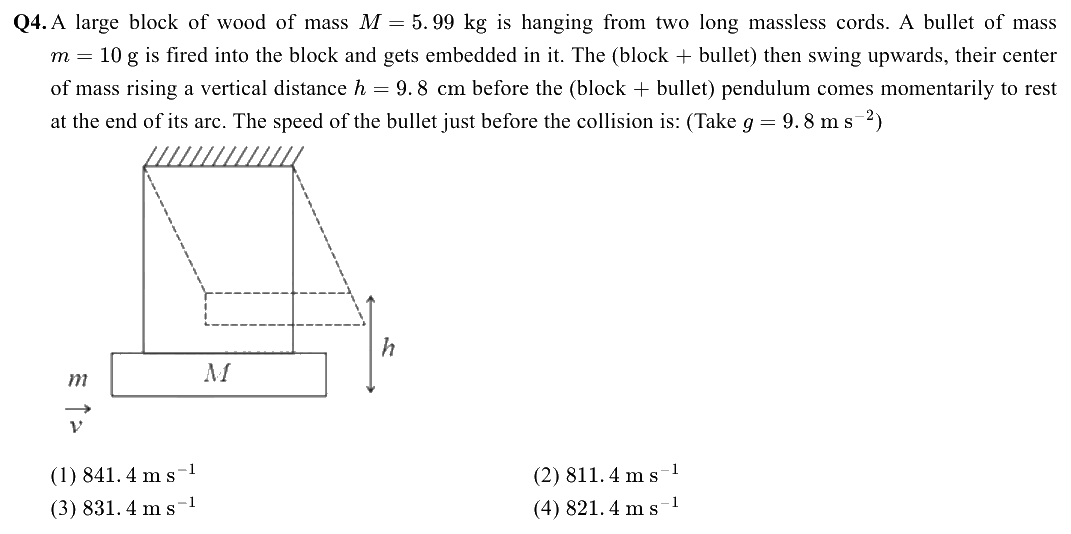
A large block of wood of mass $M = 5.99\ \mathrm{kg}$ is hanging from two long massless cords. A bullet of mass $m = 10\ \mathrm{g}$ is fired into the block and gets embedded in it. The (block + bullet) then swing upwards, their center of mass rising a vertical distance $h = 9.8\ \mathrm{cm}$ before the (block + bullet) pendulum comes momentarily to rest at the end of its arc. The speed of the bullet just before the collision is: (Take $g = 9.8\ \mathrm{m\,s^{-2}}$) (see the figure above)
What will be the nature of flow of water from a circular tap, when its flow rate increased from $0.18\ \mathrm{L\ (min)^{-1}}$ to $0.48\ \mathrm{L\ (min)^{-1}}$? The radius of the tap and viscosity of water are $0.5\ \mathrm{cm}$ and $10^{-3}\ \mathrm{Pa\ s}$, respectively. (Density of water : $10^3\ \mathrm{kg\ m^{-3}}$)
Answer: (D) Steady flow to unsteady flow· Key from source paper
Sit the whole paper timed in EdLoop
You have seen the first 5 questions with answers. Questions 6–90 are listed below; their answers and step-by-step solutions are in the EdLoop app, free.