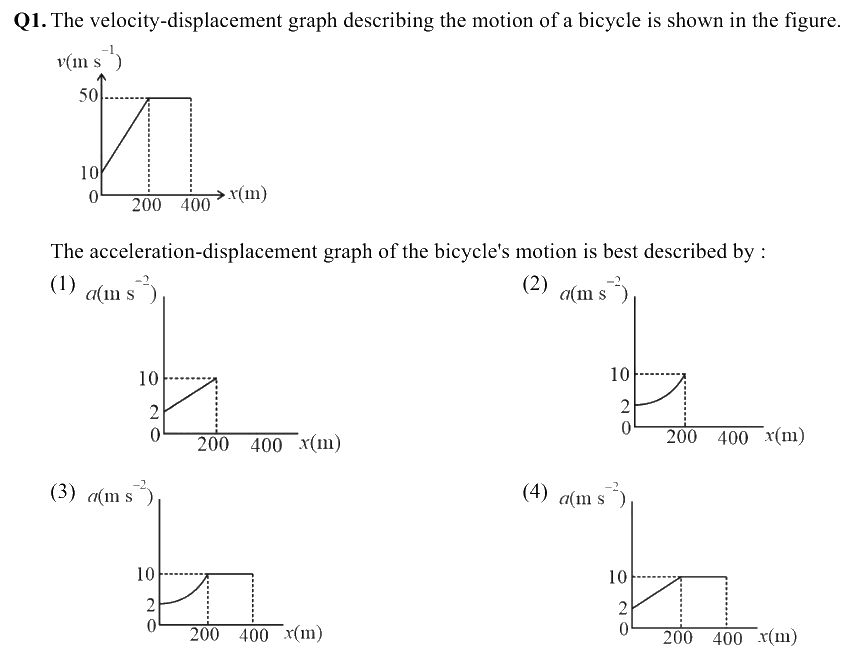
The velocity-displacement graph describing the motion of a bicycle is shown in the figure. (see the figure above) The acceleration-displacement graph of the bicycle's motion is best described by :
The question as printed in the paper.
A
see figure a-x graph: straight line rising from a = 2 at x = 0 to a = 10 at x = 200 (dotted guides to 10 and 200); beyond x = 200 the graph lies on the x-axis (a = 0); x-axis marked 200 and 400
B
see figure a-x graph: curve rising from a = 2 at x = 0 to a = 10 at x = 200, bending upward (concave up, steeper at the end); beyond x = 200 the graph lies on the x-axis (a = 0); x-axis marked 200 and 400
C
see figure a-x graph: curve rising from a = 2 at x = 0 to a = 10 at x = 200, bending upward (concave up), then a horizontal line at a = 10 from x = 200 to x = 400 (dotted guides at 200 and 400)
D
see figure a-x graph: straight line rising from a = 2 at x = 0 to a = 10 at x = 200, then a horizontal line at a = 10 from x = 200 to x = 400 (dotted guides at 200 and 400)
A block of 200 g mass moves with a uniform speed in a horizontal circular groove, with vertical side walls of radius $20 \mathrm{~cm}$. If the block takes $40 \mathrm{~s}$ to complete one round, the normal force by the side walls of the groove is:
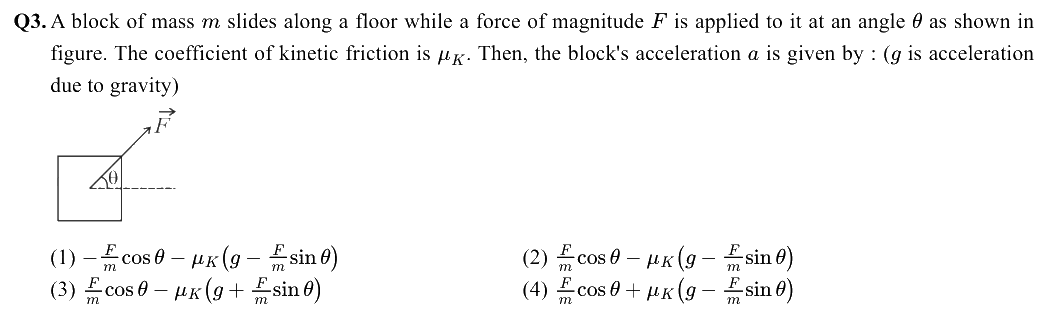
A block of mass $m$ slides along a floor while a force of magnitude $F$ is applied to it at an angle $\theta$ as shown in figure. The coefficient of kinetic friction is $\mu_K$. Then, the block's acceleration $a$ is given by : ($g$ is acceleration due to gravity) (see the figure above)
The maximum and minimum distances of a comet from the Sun are $1.6 \times 10^{12} \mathrm{~m}$ and $8.0 \times 10^{10} \mathrm{~m}$ respectively. If the speed of the comet at the nearest point is $6 \times 10^4 \mathrm{~m} \mathrm{~s}^{-1}$, the speed at the farthest point is
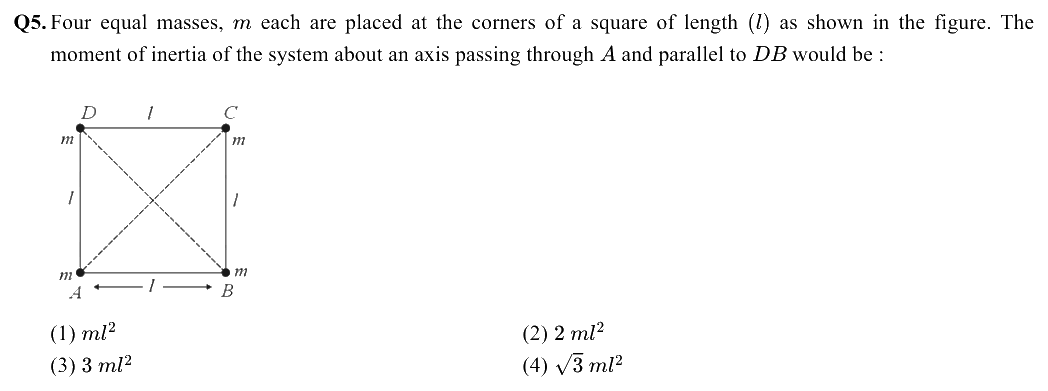
Four equal masses, $m$ each are placed at the corners of a square of length $(l)$ as shown in the figure. The moment of inertia of the system about an axis passing through $A$ and parallel to $D B$ would be : (see the figure above)
You have seen the first 5 questions with answers. Questions 6–90 are listed below; their answers and step-by-step solutions are in the EdLoop app, free.