A student determined Young's Modulus of elasticity using the formula $Y = \frac{MgL^3}{4\mathrm{bd}^3\delta}$. The value of $g$ is taken to be $9.8$ m s$^{-2}$ without any significant error, his observations are as following. Physical Quantity | Least count of the Equipment used for measurement | Observed Value Mass ( M ) | $1$ g | $2$ kg Length of bar ( L ) | $1$ mm | $1$ m Breadth of bar ( b ) | $0.1$ mm | $4$ cm Thickness of bar ( d ) | $0.01$ mm | $0.4$ cm Depression ( $\delta$ ) | $0.01$ mm | $5$ mm Then the fractional error in the measurement of $Y$ is :
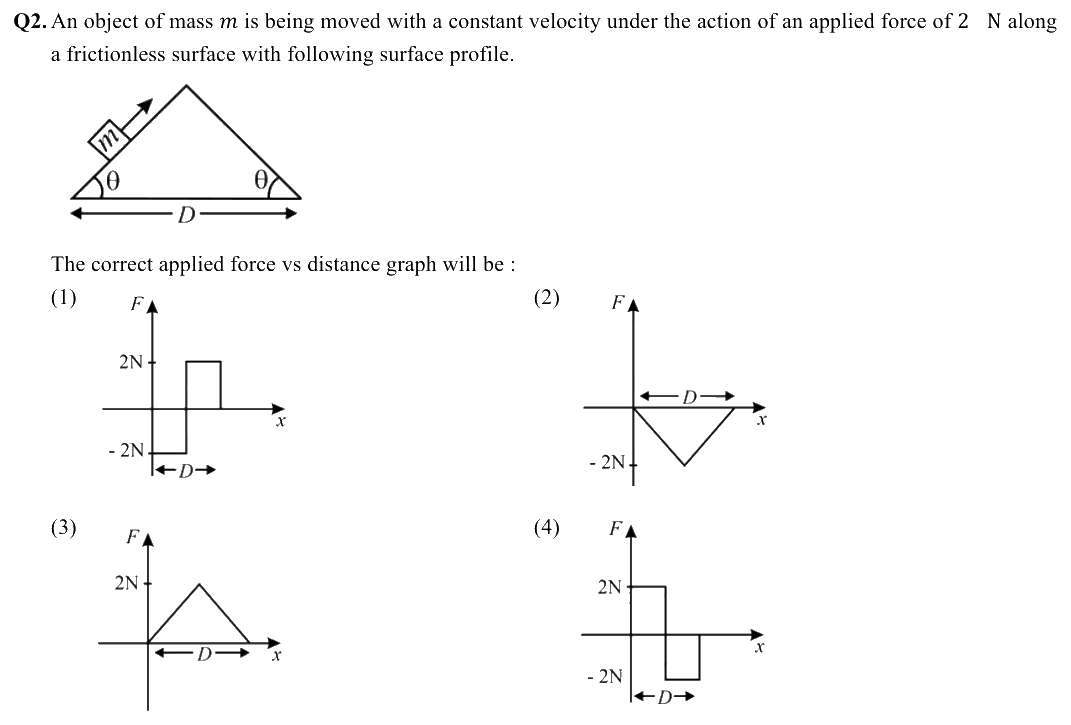
An object of mass $m$ is being moved with a constant velocity under the action of an applied force of $2$ N along a frictionless surface with following surface profile. (see the figure above) The correct applied force vs distance graph will be :
The question as printed in the paper.
A
see figure F against x; a rectangular step: F = -2N from the F axis over a stretch marked D, then F = +2N over the next stretch, zero elsewhere.
B
see figure F against x; a V-shaped dip below the x axis, going down from the axis to -2N at the middle and back to the axis, the span marked D.
C
see figure F against x; an inverted-V above the x axis, rising from the origin to a peak (below the 2N mark) at the middle and back to the axis, the span marked D.
D
see figure F against x; F = +2N over the first stretch, then F = -2N over the next stretch (a rectangle below the axis), the second stretch marked D.
The ranges and heights for two projectiles projected with the same initial velocity at angles $42^\circ$ and $48^\circ$ with the horizontal are $R_1$, $R_2$ and $H_1$, $H_2$ respectively. Choose the correct option:
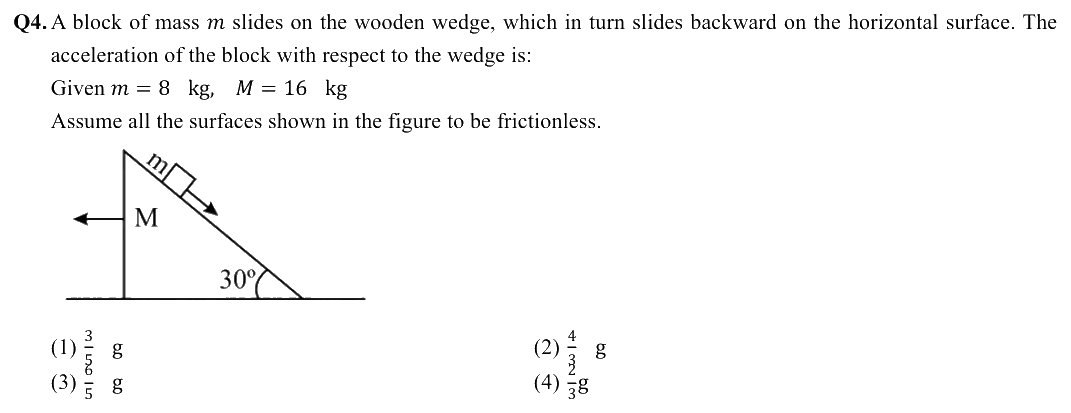
A block of mass $m$ slides on the wooden wedge, which in turn slides backward on the horizontal surface. The acceleration of the block with respect to the wedge is: Given $m = 8$ kg, $M = 16$ kg Assume all the surfaces shown in the figure to be frictionless. (see the figure above)
You have seen the first 5 questions with answers. Questions 6–90 are listed below; their answers and step-by-step solutions are in the EdLoop app, free.