A simple pendulum is being used to determine the value of gravitational acceleration $g$ at a certain place. The length of the pendulum is $25.0\ \mathrm{cm}$ and a stopwatch with $1\ \mathrm{s}$ resolution measures the time taken for 40 oscillations to be $50\ \mathrm{s}$. The accuracy in g is:
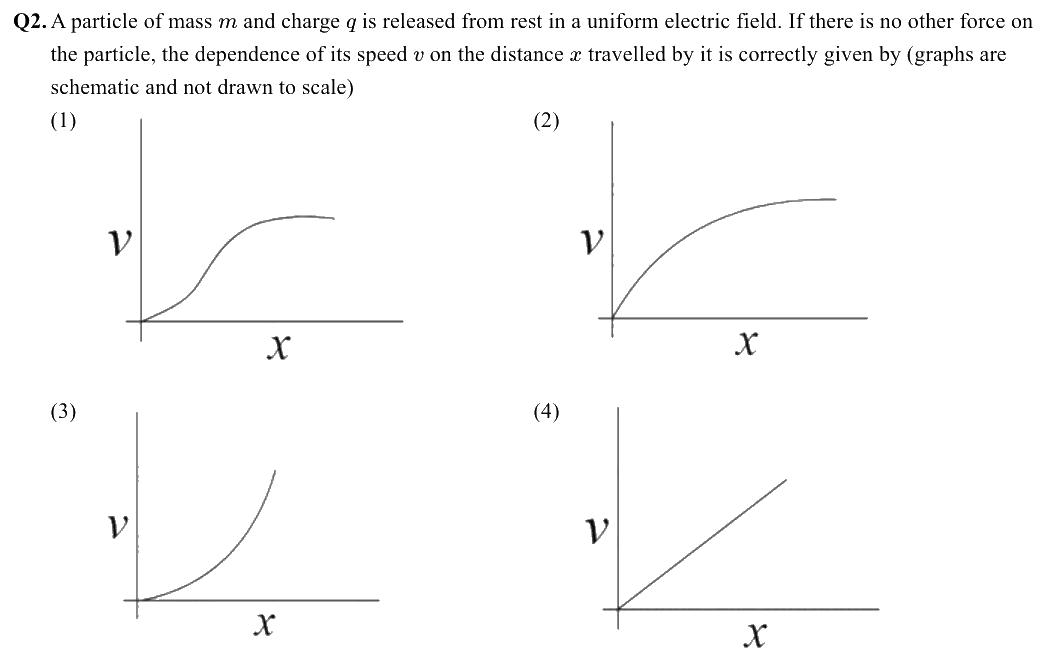
A particle of mass $m$ and charge $q$ is released from rest in a uniform electric field. If there is no other force on the particle, the dependence of its speed $v$ on the distance $x$ travelled by it is correctly given by (graphs are schematic and not drawn to scale)
A particle moves such that its position vector $\vec{r}(t) = \cos \omega t\,\hat{i} + \sin \omega t\,\hat{j}$ where $\omega$ is a constant and $t$ is time. Then which of the following statements is true for the velocity $\vec{v}(t)$ and acceleration $\vec{a}(t)$ of the particle:
A
$\vec{v}$ is perpendicular to $\vec{r}$ and $\vec{a}$ is directed away from the origin
B
$\vec{v}$ and $\vec{a}$ both are perpendicular to $\vec{r}$
C
$\vec{v}$ and $\vec{a}$ both are parallel to $\vec{r}$
D
$\vec{v}$ is perpendicular to $\vec{r}$ and $\vec{a}$ is directed towards the origin
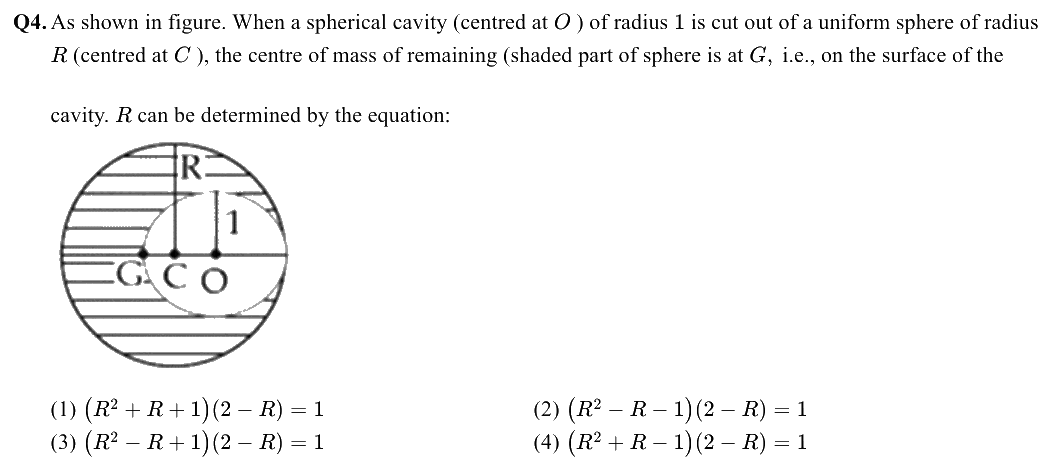
As shown in figure. When a spherical cavity (centred at $O$) of radius 1 is cut out of a uniform sphere of radius $R$ (centred at $C$), the centre of mass of remaining (shaded part of sphere is at $G$, i.e., on the surface of the cavity. $R$ can be determined by the equation: (see the figure above)
A particle of mass $m$ is dropped from a height $h$ above the ground. At the same time another particle of the same mass is thrown vertically upwards from the ground with a speed of $\sqrt{2gh}$. If they collide head-on completely inelastically, the time taken for the combined mass to reach the ground, in units of $\sqrt{\frac{h}{g}}$ is:
Answer: (D) $\sqrt{\frac{3}{2}}$· Key from source paper
Sit the whole paper timed in EdLoop
You have seen the first 5 questions with answers. Questions 6–74 are listed below; their answers and step-by-step solutions are in the EdLoop app, free.